EP0548715B1 - Mischungen von Dispersionsfarbstoffen - Google Patents
Mischungen von Dispersionsfarbstoffen Download PDFInfo
- Publication number
- EP0548715B1 EP0548715B1 EP92121194A EP92121194A EP0548715B1 EP 0548715 B1 EP0548715 B1 EP 0548715B1 EP 92121194 A EP92121194 A EP 92121194A EP 92121194 A EP92121194 A EP 92121194A EP 0548715 B1 EP0548715 B1 EP 0548715B1
- Authority
- EP
- European Patent Office
- Prior art keywords
- formula
- dye
- disperse dye
- hydrogen
- alkyl
- Prior art date
- Legal status (The legal status is an assumption and is not a legal conclusion. Google has not performed a legal analysis and makes no representation as to the accuracy of the status listed.)
- Expired - Lifetime
Links
- 239000000986 disperse dye Substances 0.000 title claims description 121
- 239000000203 mixture Substances 0.000 title claims description 87
- 239000000975 dye Substances 0.000 claims description 137
- 125000000217 alkyl group Chemical group 0.000 claims description 43
- 229910052739 hydrogen Inorganic materials 0.000 claims description 35
- 239000001257 hydrogen Substances 0.000 claims description 35
- -1 nitro, cyano, sulfomethyl Chemical group 0.000 claims description 35
- 229920000728 polyester Polymers 0.000 claims description 35
- NYGZLYXAPMMJTE-UHFFFAOYSA-M metanil yellow Chemical group [Na+].[O-]S(=O)(=O)C1=CC=CC(N=NC=2C=CC(NC=3C=CC=CC=3)=CC=2)=C1 NYGZLYXAPMMJTE-UHFFFAOYSA-M 0.000 claims description 32
- 229910052736 halogen Inorganic materials 0.000 claims description 27
- 150000002367 halogens Chemical class 0.000 claims description 27
- 125000004093 cyano group Chemical group *C#N 0.000 claims description 19
- 150000002431 hydrogen Chemical class 0.000 claims description 19
- 125000002887 hydroxy group Chemical group [H]O* 0.000 claims description 19
- 239000000835 fiber Substances 0.000 claims description 18
- 125000003545 alkoxy group Chemical group 0.000 claims description 17
- UFHFLCQGNIYNRP-UHFFFAOYSA-N Hydrogen Chemical compound [H][H] UFHFLCQGNIYNRP-UHFFFAOYSA-N 0.000 claims description 13
- 125000002496 methyl group Chemical group [H]C([H])([H])* 0.000 claims description 13
- 125000000449 nitro group Chemical group [O-][N+](*)=O 0.000 claims description 10
- 125000002947 alkylene group Chemical group 0.000 claims description 8
- 125000001997 phenyl group Chemical group [H]C1=C([H])C([H])=C(*)C([H])=C1[H] 0.000 claims description 6
- 125000004178 (C1-C4) alkyl group Chemical group 0.000 claims description 5
- 125000000229 (C1-C4)alkoxy group Chemical group 0.000 claims description 5
- 125000005083 alkoxyalkoxy group Chemical group 0.000 claims description 5
- 125000005113 hydroxyalkoxy group Chemical group 0.000 claims description 5
- 125000002023 trifluoromethyl group Chemical group FC(F)(F)* 0.000 claims description 4
- NAWXUBYGYWOOIX-SFHVURJKSA-N (2s)-2-[[4-[2-(2,4-diaminoquinazolin-6-yl)ethyl]benzoyl]amino]-4-methylidenepentanedioic acid Chemical compound C1=CC2=NC(N)=NC(N)=C2C=C1CCC1=CC=C(C(=O)N[C@@H](CC(=C)C(O)=O)C(O)=O)C=C1 NAWXUBYGYWOOIX-SFHVURJKSA-N 0.000 claims description 3
- 125000006273 (C1-C3) alkyl group Chemical group 0.000 claims description 3
- QVGXLLKOCUKJST-UHFFFAOYSA-N atomic oxygen Chemical compound [O] QVGXLLKOCUKJST-UHFFFAOYSA-N 0.000 claims description 3
- 125000004435 hydrogen atom Chemical group [H]* 0.000 claims description 3
- 239000001301 oxygen Substances 0.000 claims description 3
- 229910052760 oxygen Inorganic materials 0.000 claims description 3
- 239000004744 fabric Substances 0.000 description 57
- 238000004043 dyeing Methods 0.000 description 44
- 238000000859 sublimation Methods 0.000 description 27
- 230000008022 sublimation Effects 0.000 description 27
- XLYOFNOQVPJJNP-UHFFFAOYSA-N water Substances O XLYOFNOQVPJJNP-UHFFFAOYSA-N 0.000 description 25
- 238000002156 mixing Methods 0.000 description 21
- 238000000034 method Methods 0.000 description 12
- 230000000052 comparative effect Effects 0.000 description 11
- 150000001875 compounds Chemical class 0.000 description 11
- 238000011156 evaluation Methods 0.000 description 11
- 0 CCC*c1ccc(C)cc1CICC Chemical compound CCC*c1ccc(C)cc1CICC 0.000 description 9
- 238000001035 drying Methods 0.000 description 9
- 238000005406 washing Methods 0.000 description 9
- 238000012360 testing method Methods 0.000 description 7
- 239000007859 condensation product Substances 0.000 description 6
- 239000003795 chemical substances by application Substances 0.000 description 5
- 238000007796 conventional method Methods 0.000 description 5
- 238000005562 fading Methods 0.000 description 5
- WKBOTKDWSSQWDR-UHFFFAOYSA-N Bromine atom Chemical compound [Br] WKBOTKDWSSQWDR-UHFFFAOYSA-N 0.000 description 4
- ZAMOUSCENKQFHK-UHFFFAOYSA-N Chlorine atom Chemical compound [Cl] ZAMOUSCENKQFHK-UHFFFAOYSA-N 0.000 description 4
- NBIIXXVUZAFLBC-UHFFFAOYSA-N Phosphoric acid Chemical compound OP(O)(O)=O NBIIXXVUZAFLBC-UHFFFAOYSA-N 0.000 description 4
- 229920005830 Polyurethane Foam Polymers 0.000 description 4
- GDTBXPJZTBHREO-UHFFFAOYSA-N bromine Substances BrBr GDTBXPJZTBHREO-UHFFFAOYSA-N 0.000 description 4
- 229910052794 bromium Inorganic materials 0.000 description 4
- 229910052801 chlorine Inorganic materials 0.000 description 4
- 239000000460 chlorine Substances 0.000 description 4
- 238000004140 cleaning Methods 0.000 description 4
- 125000001495 ethyl group Chemical group [H]C([H])([H])C([H])([H])* 0.000 description 4
- 229920005610 lignin Polymers 0.000 description 4
- 239000011496 polyurethane foam Substances 0.000 description 4
- 239000000047 product Substances 0.000 description 4
- 239000001044 red dye Substances 0.000 description 4
- 239000004576 sand Substances 0.000 description 4
- 238000001694 spray drying Methods 0.000 description 4
- 239000006097 ultraviolet radiation absorber Substances 0.000 description 4
- QTBSBXVTEAMEQO-UHFFFAOYSA-N Acetic acid Chemical compound CC(O)=O QTBSBXVTEAMEQO-UHFFFAOYSA-N 0.000 description 3
- ZMXDDKWLCZADIW-UHFFFAOYSA-N N,N-Dimethylformamide Chemical compound CN(C)C=O ZMXDDKWLCZADIW-UHFFFAOYSA-N 0.000 description 3
- 239000001045 blue dye Substances 0.000 description 3
- 238000010998 test method Methods 0.000 description 3
- GAWIXWVDTYZWAW-UHFFFAOYSA-N C[CH]O Chemical group C[CH]O GAWIXWVDTYZWAW-UHFFFAOYSA-N 0.000 description 2
- KKEYFWRCBNTPAC-UHFFFAOYSA-N Terephthalic acid Chemical compound OC(=O)C1=CC=C(C(O)=O)C=C1 KKEYFWRCBNTPAC-UHFFFAOYSA-N 0.000 description 2
- 229910000147 aluminium phosphate Inorganic materials 0.000 description 2
- 125000000484 butyl group Chemical group [H]C([*])([H])C([H])([H])C([H])([H])C([H])([H])[H] 0.000 description 2
- 239000003086 colorant Substances 0.000 description 2
- 238000005859 coupling reaction Methods 0.000 description 2
- 125000001449 isopropyl group Chemical group [H]C([H])([H])C([H])(*)C([H])([H])[H] 0.000 description 2
- BDAGIHXWWSANSR-UHFFFAOYSA-N methanoic acid Natural products OC=O BDAGIHXWWSANSR-UHFFFAOYSA-N 0.000 description 2
- AJDUTMFFZHIJEM-UHFFFAOYSA-N n-(9,10-dioxoanthracen-1-yl)-4-[4-[[4-[4-[(9,10-dioxoanthracen-1-yl)carbamoyl]phenyl]phenyl]diazenyl]phenyl]benzamide Chemical compound O=C1C2=CC=CC=C2C(=O)C2=C1C=CC=C2NC(=O)C(C=C1)=CC=C1C(C=C1)=CC=C1N=NC(C=C1)=CC=C1C(C=C1)=CC=C1C(=O)NC1=CC=CC2=C1C(=O)C1=CC=CC=C1C2=O AJDUTMFFZHIJEM-UHFFFAOYSA-N 0.000 description 2
- 125000004123 n-propyl group Chemical group [H]C([H])([H])C([H])([H])C([H])([H])* 0.000 description 2
- 238000010186 staining Methods 0.000 description 2
- QAOWNCQODCNURD-UHFFFAOYSA-N sulfuric acid Substances OS(O)(=O)=O QAOWNCQODCNURD-UHFFFAOYSA-N 0.000 description 2
- 239000001043 yellow dye Substances 0.000 description 2
- 125000001731 2-cyanoethyl group Chemical group [H]C([H])(*)C([H])([H])C#N 0.000 description 1
- OSWFIVFLDKOXQC-UHFFFAOYSA-N 4-(3-methoxyphenyl)aniline Chemical compound COC1=CC=CC(C=2C=CC(N)=CC=2)=C1 OSWFIVFLDKOXQC-UHFFFAOYSA-N 0.000 description 1
- CYJRNFFLTBEQSQ-UHFFFAOYSA-N 8-(3-methyl-1-benzothiophen-5-yl)-N-(4-methylsulfonylpyridin-3-yl)quinoxalin-6-amine Chemical compound CS(=O)(=O)C1=C(C=NC=C1)NC=1C=C2N=CC=NC2=C(C=1)C=1C=CC2=C(C(=CS2)C)C=1 CYJRNFFLTBEQSQ-UHFFFAOYSA-N 0.000 description 1
- KWOLFJPFCHCOCG-UHFFFAOYSA-N CC(c1ccccc1)=O Chemical compound CC(c1ccccc1)=O KWOLFJPFCHCOCG-UHFFFAOYSA-N 0.000 description 1
- YXFVVABEGXRONW-UHFFFAOYSA-N Cc1ccccc1 Chemical compound Cc1ccccc1 YXFVVABEGXRONW-UHFFFAOYSA-N 0.000 description 1
- 229920000742 Cotton Polymers 0.000 description 1
- PXGOKWXKJXAPGV-UHFFFAOYSA-N Fluorine Chemical compound FF PXGOKWXKJXAPGV-UHFFFAOYSA-N 0.000 description 1
- 239000004952 Polyamide Substances 0.000 description 1
- 229920000297 Rayon Polymers 0.000 description 1
- YIMQCDZDWXUDCA-UHFFFAOYSA-N [4-(hydroxymethyl)cyclohexyl]methanol Chemical compound OCC1CCC(CO)CC1 YIMQCDZDWXUDCA-UHFFFAOYSA-N 0.000 description 1
- 239000006096 absorbing agent Substances 0.000 description 1
- 235000011054 acetic acid Nutrition 0.000 description 1
- 230000002378 acidificating effect Effects 0.000 description 1
- 125000003277 amino group Chemical group 0.000 description 1
- BFNBIHQBYMNNAN-UHFFFAOYSA-N ammonium sulfate Chemical compound N.N.OS(O)(=O)=O BFNBIHQBYMNNAN-UHFFFAOYSA-N 0.000 description 1
- 229910052921 ammonium sulfate Inorganic materials 0.000 description 1
- 235000011130 ammonium sulphate Nutrition 0.000 description 1
- 125000002490 anilino group Chemical group [H]N(*)C1=C([H])C([H])=C([H])C([H])=C1[H] 0.000 description 1
- 239000012736 aqueous medium Substances 0.000 description 1
- 230000015572 biosynthetic process Effects 0.000 description 1
- 125000005998 bromoethyl group Chemical group 0.000 description 1
- 125000006226 butoxyethyl group Chemical group 0.000 description 1
- 125000002603 chloroethyl group Chemical group [H]C([*])([H])C([H])([H])Cl 0.000 description 1
- 238000004737 colorimetric analysis Methods 0.000 description 1
- 230000008878 coupling Effects 0.000 description 1
- 238000010168 coupling process Methods 0.000 description 1
- 230000006866 deterioration Effects 0.000 description 1
- 239000002270 dispersing agent Substances 0.000 description 1
- 230000000694 effects Effects 0.000 description 1
- 125000006232 ethoxy propyl group Chemical group [H]C([H])([H])C([H])([H])OC([H])([H])C([H])([H])C([H])([H])* 0.000 description 1
- 238000002474 experimental method Methods 0.000 description 1
- 229910052731 fluorine Inorganic materials 0.000 description 1
- 239000011737 fluorine Substances 0.000 description 1
- NVVZQXQBYZPMLJ-UHFFFAOYSA-N formaldehyde;naphthalene-1-sulfonic acid Chemical compound O=C.C1=CC=C2C(S(=O)(=O)O)=CC=CC2=C1 NVVZQXQBYZPMLJ-UHFFFAOYSA-N 0.000 description 1
- 235000019253 formic acid Nutrition 0.000 description 1
- 230000001771 impaired effect Effects 0.000 description 1
- 239000000463 material Substances 0.000 description 1
- WSFSSNUMVMOOMR-NJFSPNSNSA-N methanone Chemical compound O=[14CH2] WSFSSNUMVMOOMR-NJFSPNSNSA-N 0.000 description 1
- PSZYNBSKGUBXEH-UHFFFAOYSA-N naphthalene-1-sulfonic acid Chemical compound C1=CC=C2C(S(=O)(=O)O)=CC=CC2=C1 PSZYNBSKGUBXEH-UHFFFAOYSA-N 0.000 description 1
- 235000011007 phosphoric acid Nutrition 0.000 description 1
- 229920002647 polyamide Polymers 0.000 description 1
- 238000006068 polycondensation reaction Methods 0.000 description 1
- 229920000139 polyethylene terephthalate Polymers 0.000 description 1
- 239000005020 polyethylene terephthalate Substances 0.000 description 1
- 229920002635 polyurethane Polymers 0.000 description 1
- 239000004814 polyurethane Substances 0.000 description 1
- 125000006233 propoxy propyl group Chemical group [H]C([H])([H])C([H])([H])C([H])([H])OC([H])([H])C([H])([H])C([H])([H])* 0.000 description 1
- 125000001436 propyl group Chemical group [H]C([*])([H])C([H])([H])C([H])([H])[H] 0.000 description 1
- 239000002964 rayon Substances 0.000 description 1
- 239000000126 substance Substances 0.000 description 1
- 238000003786 synthesis reaction Methods 0.000 description 1
- 239000004753 textile Substances 0.000 description 1
- 210000002268 wool Anatomy 0.000 description 1
Classifications
-
- C—CHEMISTRY; METALLURGY
- C09—DYES; PAINTS; POLISHES; NATURAL RESINS; ADHESIVES; COMPOSITIONS NOT OTHERWISE PROVIDED FOR; APPLICATIONS OF MATERIALS NOT OTHERWISE PROVIDED FOR
- C09B—ORGANIC DYES OR CLOSELY-RELATED COMPOUNDS FOR PRODUCING DYES, e.g. PIGMENTS; MORDANTS; LAKES
- C09B67/00—Influencing the physical, e.g. the dyeing or printing properties of dyestuffs without chemical reactions, e.g. by treating with solvents grinding or grinding assistants, coating of pigments or dyes; Process features in the making of dyestuff preparations; Dyestuff preparations of a special physical nature, e.g. tablets, films
- C09B67/0033—Blends of pigments; Mixtured crystals; Solid solutions
-
- C—CHEMISTRY; METALLURGY
- C09—DYES; PAINTS; POLISHES; NATURAL RESINS; ADHESIVES; COMPOSITIONS NOT OTHERWISE PROVIDED FOR; APPLICATIONS OF MATERIALS NOT OTHERWISE PROVIDED FOR
- C09B—ORGANIC DYES OR CLOSELY-RELATED COMPOUNDS FOR PRODUCING DYES, e.g. PIGMENTS; MORDANTS; LAKES
- C09B67/00—Influencing the physical, e.g. the dyeing or printing properties of dyestuffs without chemical reactions, e.g. by treating with solvents grinding or grinding assistants, coating of pigments or dyes; Process features in the making of dyestuff preparations; Dyestuff preparations of a special physical nature, e.g. tablets, films
- C09B67/0033—Blends of pigments; Mixtured crystals; Solid solutions
- C09B67/0046—Mixtures of two or more azo dyes
- C09B67/0051—Mixtures of two or more azo dyes mixture of two or more monoazo dyes
-
- C—CHEMISTRY; METALLURGY
- C09—DYES; PAINTS; POLISHES; NATURAL RESINS; ADHESIVES; COMPOSITIONS NOT OTHERWISE PROVIDED FOR; APPLICATIONS OF MATERIALS NOT OTHERWISE PROVIDED FOR
- C09B—ORGANIC DYES OR CLOSELY-RELATED COMPOUNDS FOR PRODUCING DYES, e.g. PIGMENTS; MORDANTS; LAKES
- C09B67/00—Influencing the physical, e.g. the dyeing or printing properties of dyestuffs without chemical reactions, e.g. by treating with solvents grinding or grinding assistants, coating of pigments or dyes; Process features in the making of dyestuff preparations; Dyestuff preparations of a special physical nature, e.g. tablets, films
- C09B67/0071—Process features in the making of dyestuff preparations; Dehydrating agents; Dispersing agents; Dustfree compositions
- C09B67/008—Preparations of disperse dyes or solvent dyes
-
- D—TEXTILES; PAPER
- D06—TREATMENT OF TEXTILES OR THE LIKE; LAUNDERING; FLEXIBLE MATERIALS NOT OTHERWISE PROVIDED FOR
- D06P—DYEING OR PRINTING TEXTILES; DYEING LEATHER, FURS OR SOLID MACROMOLECULAR SUBSTANCES IN ANY FORM
- D06P1/00—General processes of dyeing or printing textiles, or general processes of dyeing leather, furs, or solid macromolecular substances in any form, classified according to the dyes, pigments, or auxiliary substances employed
- D06P1/16—General processes of dyeing or printing textiles, or general processes of dyeing leather, furs, or solid macromolecular substances in any form, classified according to the dyes, pigments, or auxiliary substances employed using dispersed, e.g. acetate, dyestuffs
- D06P1/18—Azo dyes
-
- Y—GENERAL TAGGING OF NEW TECHNOLOGICAL DEVELOPMENTS; GENERAL TAGGING OF CROSS-SECTIONAL TECHNOLOGIES SPANNING OVER SEVERAL SECTIONS OF THE IPC; TECHNICAL SUBJECTS COVERED BY FORMER USPC CROSS-REFERENCE ART COLLECTIONS [XRACs] AND DIGESTS
- Y10—TECHNICAL SUBJECTS COVERED BY FORMER USPC
- Y10S—TECHNICAL SUBJECTS COVERED BY FORMER USPC CROSS-REFERENCE ART COLLECTIONS [XRACs] AND DIGESTS
- Y10S8/00—Bleaching and dyeing; fluid treatment and chemical modification of textiles and fibers
- Y10S8/92—Synthetic fiber dyeing
- Y10S8/922—Polyester fiber
Definitions
- the present invention relates to a disperse dye mixture which is excellent particularly in both the light-fastness and temperature dependency and which is capable of dyeing polyester fibers in an excellent orange to reddish blue color and a dye mixture having blended to such a disperse dye mixture yellow and blue disperse dyes or a red disperse dye.
- Dyes having the following formulas (E) to (G) are, for example, known as disperse dyes which are excellent in the light-fastness and sublimation fastness when used alone.
- a disperse dye mixture for a practical color such as brown or gray prepared by mixing a yellow disperse dye of the following formula (E), a red disperse dye of the following formula (F) and a blue disperse dye of the following formula (G)
- a disperse dye mixture for a practical color such as brown or gray prepared by mixing a yellow disperse dye of the following formula (E), a red disperse dye of the following formula (F) and a blue disperse dye of the following formula (G)
- dyes may be mixed to obtain a mixture which does not undergo a deterioration of the light-fastness.
- a red color covers a wide range of hues from yellowish red to bluish red. To obtain a particular hue, it is often required to blend a red disperse dye with another red disperse dye. In such a case, if an optional red disperse dye is blended, the light-fastness or sublimation fastness will be impaired. Therefore, it is desired to have a mixture whereby the color hue can be adjusted within a wide range while maintaining the light-fastness and sublimation fastness.
- the present inventors have conducted various studies to present a disperse dye which is excellent in both the light-fastness and temperature dependency and which is suitable for dyeing polyester fibers for automobile seats, and as a result, they have found that the above object can be accomplished by a specific dye mixture of the present invention.
- the present inventors have conducted various studies on a method for improving the temperature dependency and dyeing affinity of a certain orange to reddish blue disperse dye while maintaining its light-fastness, and as a result, they have found that when this dye is used in combination with another specific orange to reddish blue dye in the form of a mixture, the dyeing properties can be improved remarkably over the single use.
- the present invention has been accomplished on the basis of this discovery.
- the present invention provides a disperse dye mixture comprising a monoazo dye of the following formula (1) and a monoazo dye of the following formula (2) blended thereto in an amount of from 0.1 to 10 times by weight of the dye of the formula (1): wherein each of X 1 and X 2 which are independent of each other, is nitro, cyano, sulfomethyl or halogen, each of Y 1 , Y 2 , Z 1 and Z 2 which are independent of one another, is hydrogen, cyano, nitro, trifluoromethyl, halogen or sulfomethyl, each of W 1 and W 2 which are independent of each other, is hydrogen, halogen, C 1 -C 2 alkyl or alkoxy, and each of R 1 and R 2 which are independent of each other, is C 1 -C 4 alkyl, or C 2 -C 4 alkyl which is substituted by cyano, halogen, hydroxy, hydroxyalkoxy, C 1 -C 4 alkoxy
- a disperse dye mixture obtained by blending a certain yellow disperse dye and a certain blue disperse dye to the orange to reddish blue disperse dye mixture of the monoazo dyes of the above formulas (1) and (2), has been found to have particularly excellent light fastness.
- a second aspect of the present invention has been accomplished on the basis of this discovery.
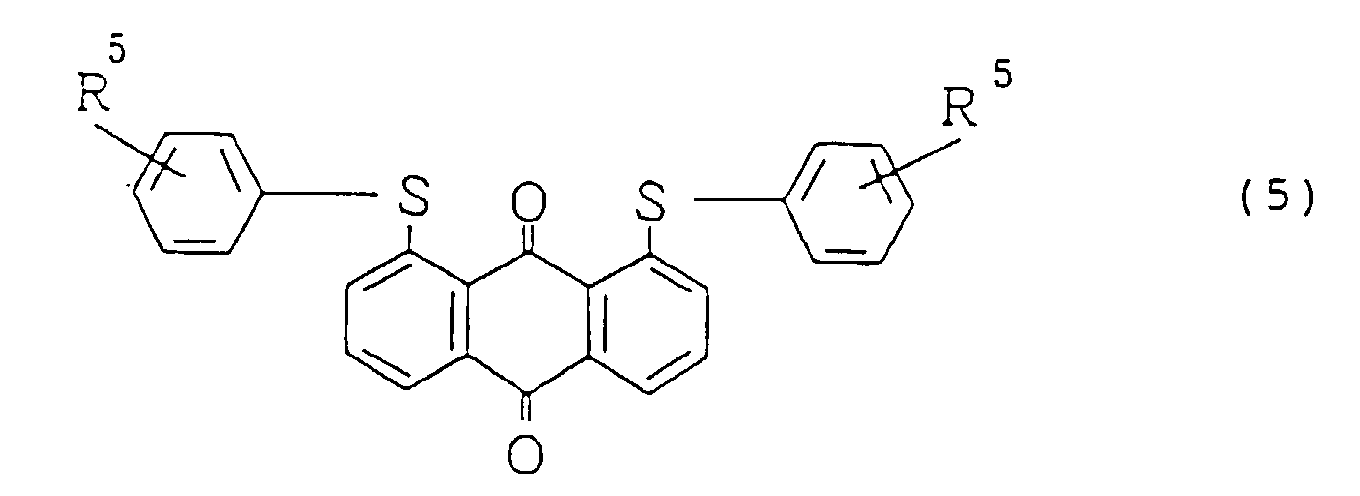
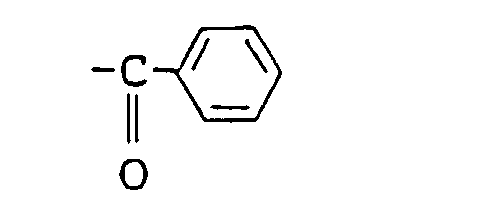
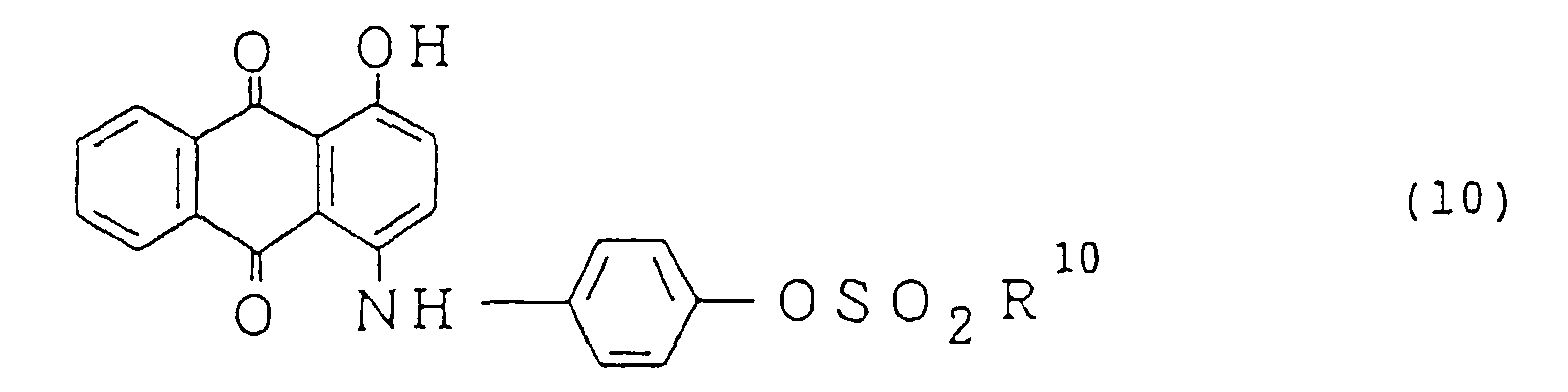
- the present invention provides a disperse dye mixture comprising 100 parts by weight of the mixture of a monoazo dye of the formula (1) and a monoazo dye of the formula (2) as defined above, from 2 to 2,000 parts by weight of at least one yellow disperse dye selected from the group consisting of dyes of the following formulas (3) to (7) and from 2 to 2,000 parts by weight of at least one blue disperse dye selected from the group consisting of dyes of the following formulas (8) to (10): wherein R 3 in the formula (3) is C 2 -C 3 alkyl which is substituted by hydroxy or cyano, R 4 in the formula (4) is hydrogen, methyl or halogen, R 5 in the formula (5) is hydrogen or methyl, R 6 in the formula (6) is C 1 -C 3 alkyl which is unsubstituted or substituted by hydroxy or cyano, and R 7 in the formula (7) is hydrogen or C 1 -C 2 alkyl; wherein R 8 in the formula (8) is hydrogen, hal
- a red disperse dye mixture obtained by blending a certain specific red disperse dye to the orange to reddish blue disperse dye mixture of the monoazo dyes of the above formulas (1) and (2), has been found to retain the excellent light-fastness and sublimation fastness.
- a third aspect of the present invention has been accomplished on the basis of this discovery.
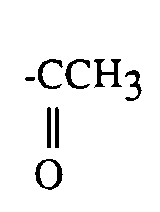
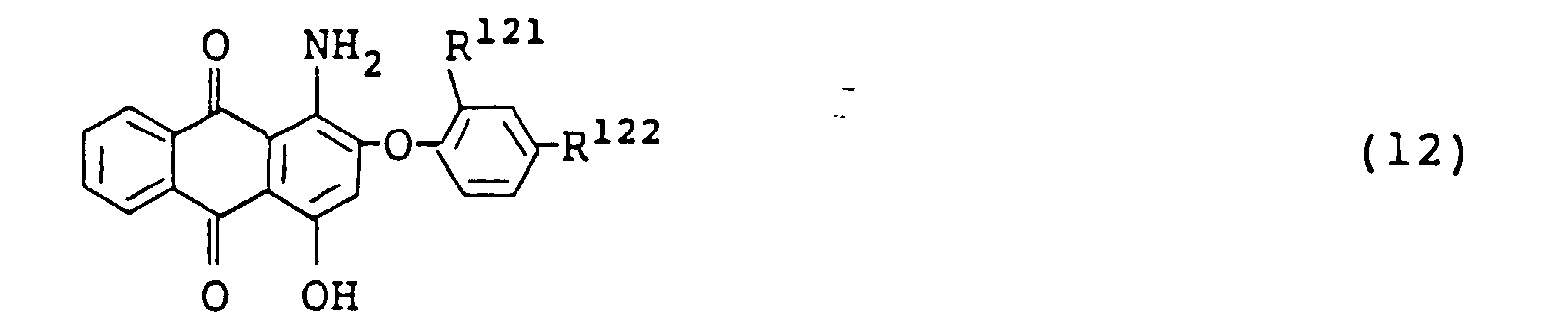
- the present invention provides a disperse dye mixture comprising 100 parts by weight of the mixture of a monoazo dye of the formula (1) and a monoazo dye of the formula (2) as defined above and from 1 to 100 parts by weight of at least one red disperse dye selected from the group consisting of dyes of the following formulas (11) to (14): wherein Q 11 is C 2 -C 6 alkylene, and R 11 is hydrogen, phenyl, wherein R 121 is hydrogen or methyl, and R 122 is -SO 2 NHC 3 H 6 OC 2 H 5 , -C 2 H 4 COOCH 3 or wherein R 13 is hydrogen or lower alkyl; wherein each of X 141 and X 142 which are independent of each other, is -Q 14 -OH or -Q 14 -O-Q 14 -O-R 14 , wherein Q 14 is C 2 -C 3 alkylene and R 14 is hydrogen, lower alkyl or phenyl.
- the disperse dyes of the formulas (1) and (2) are used in combination as a mixture.
- the blending ratio is such that the dye of the formula (2) is in an amount of from 0.1 to 10 times by weight, preferably from 0.3 to 4 times by weight, of the dye of the formula (1). If the amount of the dye of the formula (2) is too small or too large, the effects for improving the dyeing affinity and temperature dependency are low.
- the dye of the formula (2) to be blended to the dye of the formula (1) may be a single dye or a mixture of dyes of the formula (2).
- X 1 and X 2 independently represent nitro, cyano, sulfomethyl or halogen.
- the halogen is preferably chlorine or bromine.
- X 1 and X 2 are preferably the same. It is particularly preferred that X 1 and X 2 are nitro.
- Each of Y 1 , Y 2 , Z 1 and Z 2 which are independent of one another, is hydrogen, cyano, nitro, trifluoromethyl, halogen or sulfomethyl.
- Y 1 , Y 2 , Z 1 and Z 2 may be the same or different. It is particularly preferred that Y 1 and Y 2 are the same and Z 1 and Z 2 are the same.
- the halogen for Y 1 , Y 2 , Z 1 and Z 2 is preferably chlorine or bromine.
- a combination of X 1 and X 2 being nitro, Y 1 and Y 2 being cyano and Z 1 and Z 2 being hydrogen is preferred.
- Each of W 1 and W 2 which are independent of each other, is halogen, C 1 -C 2 alkyl or alkoxy. Particularly preferred is hydrogen.
- Each of R 1 and R 2 which are independent of each other, is C 1 -C 4 alkyl, or C 2 -C 4 alkyl which is substituted by cyano, halogen, hydroxy, hydroxyalkoxy, C 1 -C 4 alkoxy, hydroxyalkoxyalkoxy, acyloxyalkoxy, acyloxyalkoxyalkoxy or alkoxyalkoxy.
- C 1 -C 4 alkyl may, for example, be methyl, ethyl or straight chain or branched propyl or butyl.
- C 2 -C 4 alkyl substituted by cyano, halogen or hydroxy may, for example, be cyanoethyl, chloroethyl, bromoethyl, hydroxyethyl, cyanopropyl, chloropropyl, bromopropyl, hydroxypropyl or hydroxybutyl.
- C 2 -C 4 alkyl substituted by hydroxyalkoxy, hydroxyalkoxyalkoxy, acyloxyalkoxy or acyloxyalkoxyalkoxy may, for example, be hydroxyethoxyethyl, hydroxyethoxybutyl, hydroxypropoxyethyl, hydroxypropoxypropyl, hydroxybutoxyethyl, hydroxyethoxyethyl, hydroxypropoxypropoxypropyl, formyloxyethoxyethyl, acetyloxyethoxyethyl, propionyloxyethyl, acetyloxypropoxypropyl or acetyloxypropoxypropyl.
- C 2 -C 4 alkyl substituted by C 1 -C 4 alkoxy may, for example, be methoxyethyl, butoxyethyl, ethoxypropyl, propoxypropyl or methoxybutyl.
- C 2 -C 4 alkyl substituted by alkoxyalkoxy may, for example, be methoxyethoxypropyl or ethoxyethoxyethyl.
- a preferred blending ratio is such that the dye of the formula (2) is in an amount of from 0.25 to 4 times by weight of the dye of the formula (1).
- R 1 and R 2 are both hydroxyethyl
- a particularly preferred blending ratio is such that the dye of the formula (2) is in an amount of from 1.5 to 4 times by weight of the dye of the formula (1).
- the present invention provides a dye mixture prepared by blending at least one yellow disperse dye selected from the group consisting of dyes of the formulas (3) to (7) and at least one blue disperse dye selected from the group consisting of dyes of the formulas (8) to (10) to the orange to reddish blue disperse dye mixture of the monoazo dyes of the formulas (1) and (2), as mentioned above.
- R 3 may specifically be -C 2 H 4 OH, -CH 2 CH(CH 3 )OH, -C 3 H 6 OH, -C 2 H 4 CN or -C 3 H 6 CN. Particularly preferred is -C 2 H 4 OH or -C 2 H 4 CN.
- the halogen for R 4 or R 8 may, for example, be fluorine, chlorine or bromine. Particularly preferred is chlorine or bromine.
- R 6 may specifically be methyl, ethyl, n-propyl, i-propyl, -C 2 H 4 OH, -C 2 CH(CH 3 )OH, -C 3 H 6 OH, -C 2 H 4 CN or -C 3 H 6 CN.
- Particularly preferred is -C 2 H 4 OH or -C 2 H 4 CN.
- C 1 -C 2 alkyl for R 7 or R 10 is methyl or ethyl.
- hydroxy C 2 -C 3 lower alkyl for R 8 is hydroxy lower alkyl such as -C 2 H 4 OH or -C 3 H 6 OH. Particularly preferred is -C 2 H 4 OH.
- R 9 may be lower alkoxy lower alkyl such as -C 3 H 6 OCH 3 or -C 3 H 6 OC 3 H 7 , or lower alkoxy lower alkoxy lower alkyl such as -C 2 H 4 OC 2 H 4 OC 2 H 5 or - C 2 H 4 OC 2 H 4 OCH 3 . Preferred is lower alkoxy lower alkyl.
- the blending ratio for the disperse dye mixture in the second aspect of the present invention is such that at least one yellow disperse dye selected from the group consisting of dyes of the formulas (3) to (7) is in a total amount of from 2 to 2,000 parts by weight, preferably from 10 to 1,000 parts by weight, and at least one blue disperse dye selected from the group consisting of dyes of the formulas (8) to (10) is in a total amount of from 2 to 2,000 parts by weight, preferably from 10 to 1,000 parts by weight, per 100 parts by weight of the orange to reddish blue disperse dye mixture of the monoazo dyes of the formulas (1) and (2).
- the most preferred blending ratio is such that the yellow disperse dye is from 30 to 500 parts by weight and the blue disperse dye is from 30 to 500 parts by weight, per 100 parts by weight of the above orange to reddish blue disperse dye mixture.
- the present invention provides a dye mixture prepared by blending at least one red disperse dye selected from the group consisting of dyes of the the above formulas (11) to (14) to the orange to reddish blue disperse dye mixture of the monoazo dyes of the formulas (1) and (2).
- C 2 -C 6 alkylene for Q 11 may, for example, be -CH 2 CH 2 -, -CH 2 CH 2 CH 2 -, -(CH 2 ) 4 - or -(CH 2 ) 6 -.
- lower alkyl for R 13 or R 14 may, for example, be methyl, ethyl, n-propyl, i-propyl, or linear or branched butyl.
- C 2 -C 3 alkylene for Q 14 may be -CH 2 CH 2 - or -CH 2 CH 2 CH 2 -.
- the blending ratio for the disperse dye mixture in the third aspect of the present invention is such that at least one red disperse dye selected from the group consisting of dyes of the formulas (11) to (14) is in an amount of from 1 to 100 parts by weight, preferably from 20 to 60 parts by weight, per 100 parts by weight of the orange to reddish blue disperse dye mixture of the monoazo dyes of the formulas (1) and (2).
- the disperse dyes of the formulas (1) and (2) can be prepared in accordance with the method disclosed in Japanese Examined Patent Publication No. 39347/1986. With respect to the blending method, the respective dyes of independent structures may be mixed to obtain the dye mixture. Otherwise, such a mixture may be obtained by mixing at least two coupling components during the synthesis of the dyes, followed by a coupling reaction.
- the disperse dyes of the formulas (3) to (10) are per se known, and can be prepared in accordance with known methods.
- the disperse dyes of the formulas (11) to (14) are also per se known, for example, in Japanese Examined Patent Publications No. 3299/1963, No. 14316/1965, No. 18179/1968 and No. 1039/1963 and can be prepared in accordance with known methods.
- Fibers which can be dyed by the disperse dye mixture of the present invention may, for example, be polyester fibers made of e.g. polyethylene terephthalate or a polycondensation product of terephthalic acid and 1,4-bis(hydroxymethyl)cyclohexane, or blended yarn products or combined filament yarn products of such polyester fibers with other fibers such as cotton, silk, wool, rayon, polyamide or polyurethane.
- polyester fibers In a case where the fibers are polyester fibers for automobile seats, polyester fibers of from 2 to 5 deniers are preferred, and in a case of fine denier polyester cloths for clothings, polyester fibers of from 0.1 to 1 denier are preferred.
- the disperse dye mixture of the present invention is insoluble or hardly soluble in water. Accordingly, to dye the polyester fibers with the disperse dye mixture of the present invention, a dye bath or a printing paste is prepared by dispersing the mixture in an aqueous medium by using a dispersing agent such as a condensation product of naphthalene sulfonic acid with formaldehyde, a higher alcohol sulfuric acid ester or a higher alkylbenzene sulfonate in accordance with a conventional method, followed by dip dyeing or textile printing.
- a dispersing agent such as a condensation product of naphthalene sulfonic acid with formaldehyde, a higher alcohol sulfuric acid ester or a higher alkylbenzene sulfonate
- a conventional dyeing treatment such as a high temperature dyeing method, a carrier dyeing method or a thermosol dyeing method, whereby polyester fibers or blended yarn products thereof can be dyed with excellent fastness.
- a known acidic substance such as formic acid, acetic acid, phosphoric acid or ammonium sulfate
- the pH of the dye bath is usually preferably adjusted within a range of from 5.0 to 9.5.
- the dyeing temperature may, for example, be at a level of from 120 to 140°C.
- the disperse dye mixture of the present invention exhibits excellent dyeing affinity and temperature dependency.
- the dyeing conditions for exhaustion dyeing are not particular restriction as to the dyeing conditions for exhaustion dyeing.
- the dyeing temperature is at a level of from 120 to 140°C
- the dyeing time is from 30 to 60 minutes
- the pH of the dye bath is at a level of from 4.0 to 9.5.
- various leveling agents and/or ultraviolet absorbers may be used in combination.
- a dye of the formula (2) having a structure similar thereto, it is possible to remarkably improve the temperature dependency and dyeing affinity while maintaining the excellent light-fastness, as compared with a case where the respective dyes are used independently.
- the disperse dye mixture having the specific yellow and blue disperse dyes or the specific red disperse dye mixed to the mixture of the dyes of the formulas (1) and (2) is excellent in the light-fastness and sublimation fastness and is very useful.
- red disperse dye No. (1-1) in Table 1 and red disperse dye No. (2-1) in Table 2 in Table 2, experiments were conducted in the same manner as in Examples 1 to 17, except that the blending ratio was changed as identified in Table 4. The results are shown in Table 4.
- 140 g of a lignin sulfonic acid-formaline condensation product and 650 g of water were mixed to 60 g of a disperse dye mixture comprising 25 parts by weight of monoazo dye No. (1-1) in Table 1 and 75 parts by weight of monoazo dye No. (2-1) in Table 2, and the mixture was pulverized in a wet system by a sand grinder, followed by spray drying.
- this powdery disperse dye mixture 0.08 g of a nonionic leveling agent (Diaserver® LR-PSL, manufactured by Mitsubishi Kasei Corporation), 0.10 g of an ultraviolet absorber (Sunlife LP-100, tradename, manufactured by Nikka Kagaku K.K.) and 150 ml of water were added, and the resulding dye bath was adjusted to pH5.5. To the dye bath, 5 g of a polyester cloth was introduced and subjected to exhaustion dyeing at 130°C for one hour, followed by soaping, washing with water and drying to obtain a red-dyed cloth.
- a nonionic leveling agent (Diaserver® LR-PSL, manufactured by Mitsubishi Kasei Corporation)
- an ultraviolet absorber Sunlife LP-100, tradename, manufactured by Nikka Kagaku K.K.
- the light-fastness of this dyed cloth was measured by a JIS test method (JIS L-0843) modified for testing automobile seats (the temperature was 89°C ⁇ 5°C, a soft polyurethane foam (10 mm) was lined on the rear side of the test cloth, and the fastness was evaluated by the color fading scale stipulated in JIS) and found to be grade 4-5.
- Dyeing and evaluation were conducted in the same manner as in Examples 1 to 17 except that one of the orange to reddish blue disperse dyes as identified in Table 5 or a dye mixture with the composition as identified in Table 5 was used.
- the light-fastness, sublimation fastness and water fastness of the obtained cloth as well as the temperature stability and the pH dependency during dyeing were excellent in each case.
- the tinted dye densities and the temperature dependency obtained in the same manner as in Examples 1 to 17 are shown in Table 5.
- m-Br presented, for example, in the column for W for Example No. 28 means that Br is substituted at the m-position relative to the amino group on the phenylamino group.
- 140 g of a lignin sulfonic acid-formaline condensation product and 650 g of water were mixed to 60 g of a disperse dye mixture comprising 25% by weight of a monoazo dye of the following formula (1-60) and 75% by weight of a monoazo dye of the following formula (2-60), and the mixture was pulverized in a wet system by a sand grinder, followed by spray drying.
- this powdery disperse dye mixture 0.08 g of a nonionic leveling agent (Diaserver® LR-PSL, manufactured by Mitsubishi Kasei Corporation), 0.10 g of an ultraviolet absorber (Sunlife LP-100, tradename, manufactured by Nikka Kagaku K.K.) and 150 ml of water were added, and the resulting dye bath was adjusted to pH5.5. To this dye bath, 5 g of a polyester cloth was introduced and subjected to exhaustion dyeing at 130°C for one hour, followed by soaping, washing with water and drying to obtain a bluish red dyed cloth.
- a nonionic leveling agent (Diaserver® LR-PSL, manufactured by Mitsubishi Kasei Corporation)
- an ultraviolet absorber Sunlife LP-100, tradename, manufactured by Nikka Kagaku K.K.
- the light-fastness of this dyed cloth was measured by a JIS testing method (JIS L-0843) modified for testing automobile seats (the temperature was 89°C ⁇ 5°C, a soft polyurethane foam (10 mm) was lined on the rear side of the sample cloth, and the light-fastness was evaluated by the color fading scale stipulated in JIS) and found to be grade 4-5.
- 140 g of a lignin sulfonic acid-formaline condensation product and 650 g of water were mixed to a mixture comprising 30 g of a yellow disperse dye of the formula (4) wherein R 4 is H, 20 g of a red disperse dye mixture comprising 40 parts by weight of a dye of the formula (1-1) in Example 1 and 60 parts by weight of a dye of the formula (2-1) in Example 1 and 18 g of a blue disperse dye of the following formula (8-1), and the mixture was pulverized in a wet system by a sand grinder, followed by spray-drying.
- this powdery disperse dye composition To 0.085 g of this powdery disperse dye composition, 0.08 g of a nonionic leveling agent (Diaserver® LR-PSL, manufactured by Mitsubishi Kasei Corporation), 0.10 g of an ultraviolet absorber (Sunlife LP-100, tradename, manufactured by Nikka Kagaku K.K.) and 150 ml of water were added. The resulting dye bath was adjusted to pH5.5. To this dye bath, 5 g of a polyester cloth was introduced and subjected to exhaustion dyeing at 130°C for one hour, followed by soaping, washing with water and drying to obtain a brown dyed cloth.
- a nonionic leveling agent Diaserver® LR-PSL, manufactured by Mitsubishi Kasei Corporation
- an ultraviolet absorber Sunlife LP-100, tradename, manufactured by Nikka Kagaku K.K.
- the light-fastness of this dyed cloth was measured by a JIS test method (JIS L-0843) modified for testing automobile seats (the temperature was 89°C ⁇ 5°C, a soft polyurethane foam (10 mm) was lined on the rear side of the sample cloth, and the light-fastness was evaluated by the color fading scale stipulated in JIS) and found to be grade 4-5.
- a polyester white cloth was sandwiched between the dyed cloths and contacted at 180°C for 30 minutes, whereupon the staining of the white cloth was evaluated by a gray scale and found to be grade 4.
- Dyeing was conducted in the same manner as in Example 62 except that the red component was changed from the red disperse dye mixture of the dyes of the formulas (1-1) and (2-1) in Example 1 to 95 g of a disperse dye of the above formula (F) to obtain a brown dyed cloth. Evaluation was conducted in the same manner as in Example 62, whereby the light-fastness was grade 2, and the sublimation fastness was grade 3.
- Example 62 A polyester cloth was dyed in the same manner as in Example 62 except that in Example 62, the yellow disperse dye was changed to the dye identified in the following Table 6, followed by evaluation. The hue, light-fastness and sublimation fastness of the dyed cloth are shown in Table 6.
- a polyester cloth was dyed in the same manner as in Example 62 except that in Example 62, the blue disperse dye was changed to the dye identified in the following Table 7, and the hue, light-fastness and sublimation fastness of the dyed cloth are shown in Table 7.
- Example 62 Dyeing was conducted in the same manner as in Example 62 except that in Example 62, the red disperse dye mixture comprising the dye of the formula (1-1) and the dye of the formula (2-1), was changed to 20 g of a red disperse dye mixture comprising 40% by weight of a monoazo dye of the formula (1) wherein X 1 is -NO 2 , Y 1 is -CN, Z 1 is H, R 1 is -C 3 H 6 OC 2 H 4 OCH 3 , and W 1 is H and 60% by weight of a monoazo dye of the formula (2) wherein X 2 is -NO 2 , Y 2 is -CN, Z 2 is H, R 2 is -C 3 H 6 OC 2 H 4 OCH 3 and W 2 is H, to obtain a brown dyed cloth.
- the light-fastness and sublimation fastness were evaluated in the same manner as in Example 62. The results are shown in Table 10.
- Example 89 Dyeing was conducted in the same manner as in Example 89 except that the red component was changed to 47.5 g of a disperse dye of the above formula (F), to obtain a brown dyed cloth.
- the light-fastness and sublimation fastness were evaluated in the same manner as in Example 62. The results are shown in Table 10.
- Table 10 Light-fastness Sublimation fastness Example 89 Grade 4-5 Grade 4 Comparative Example 89 Grade 2 Grade 3
- Example 89 A polyester cloth was dyed in the same manner as in Example 89 except that in Example 89, the yellow disperse dye was changed to a yellow disperse dye identified in Table 11, followed by evaluation.
- the hue, light-fastness and sublimation fastness of the dyed cloth are shown in Table 11.
- Table 11 Example No. Yellow disperse dye Light-fastness (grade) Sublimation fastness (grade) Hue 90 Same as in Example 63 4 4-5 Brown 91 Same as in Example 64 4-5 4-5 Brown 92 Same as in Example 65 4-5 4-5 Brown 93 Same as in Example 66 4 4 Brown 94 Same as in Example 67 4 4 Brown 95 Same as in Example 68 4-5 4 Brown 96 Same as in Example 69 4-5 4-5 Brown
- Example 89 A polyester cloth was dyed in the same manner as in Example 89 except that in Example 89, the blue disperse dye was changed to a blue disperse dye identified in Table 12, followed by evaluation. The hue, light-fastness and sublimation fastness of the dyed cloth are shown in Table 12.
- Table 12 Example No. Blue disperse dye Light-fastness (grade) Sublimation fastness (grade) Hue 97 Same as in Example 74 4-5 4 Brown 98 Same as in Example 75 4-5 4 Brown 99 Same as in Example 76 4-5 4 Brown 100 Same as in Example 77 4-5 4 Brown
- the hue, light-fastness and sublimation fastness of the dyed cloth are shown in Table 13.
- a lignin sulfonic acid-formaline condensation product 140 g of a lignin sulfonic acid-formaline condensation product and 650 g of water were added to a mixture comprising 30 g of a red disperse dye mixture comprising 50% by weight of a dye of the formula (1-1) in Example 1 and 50% by weight of a dye of the formula (2-1) in Example 1 and 15 g of a red disperse dye of the following formula (12-1), and the mixture was pulverized in a wet system by a sand grinder, followed by spray drying.
- this powdery disperse dye composition To 0.085 g of this powdery disperse dye composition, 0.08 g of a nonionic leveling agent (Diaserver® LR-PSL, manufactured by Mitsubishi Kasei Corporation), 0.10 g of an ultraviolet absorber (Sunlife LP-100, tradename, manufactured by Nikka Kagaku K.K.) and 150 ml of water were added, and the resulting dye bath was adjusted to pH5.5. To this dye bath, 5 g of a polyester cloth was introduced and subjected to exhaustion dyeing at 130°C for one hour, followed by soaping, washing with water and drying to obtain a red dyed cloth.
- a nonionic leveling agent Diaserver® LR-PSL, manufactured by Mitsubishi Kasei Corporation
- an ultraviolet absorber Sunlife LP-100, tradename, manufactured by Nikka Kagaku K.K.
- the light-fastness of this dyed cloth was measured by a JIS test method (JIS L-0843) modified for testing automobile seats (the temperature was 89°C ⁇ 5°C, a soft polyurethane foam (10 mm) was lined on the rear side of the sample cloth, and the light-fastness was evaluated by a color fading scale stipulated in JIS).
- JIS L-0843 JIS L-0843 modified for testing automobile seats
- the temperature was 89°C ⁇ 5°C
- a soft polyurethane foam (10 mm) was lined on the rear side of the sample cloth, and the light-fastness was evaluated by a color fading scale stipulated in JIS.
- a polyester white cloth was sandwiched between the dyed cloths and contacted at 180°C for 30 seconds, whereupon the staining of the white cloth was evaluated by a gray scale. The results are shown in Table 14.
- Dyeing was conducted in the same manner as in Example 109 except that the red disperse dye of the formula (12-1) was changed to one of the following dyes (H) to (J), whereby a red dyed cloth was obtained.
- Example 109 The light-fastness and sublimation fastness were measured in the same manner as in Example 109. The results are shown in Table 14. Table 14 Light-fastness (grade) Sublimation fastness (grade) Example 109 4-5 5 - Comparative Example 109 4 2-3 Comparative Example 110 3 2-3 Comparative Example 111 2-3 5 -
- a polyester cloth was dyed in the same manner as in Example 109 except that in Example 109, the red disperse dye of the formula (12-1) was changed to a red disperse dye identified in Table 15.
- the hue, light-fastness and sublimation fastness of the dyed cloth are shown in Table 15.
- Dyeing was conducted in the same manner as in Example 109 except that the amount of the red disperse dye of the formula (12-1) in Example 109 was changed to 1.5 g or 30 g, followed by evaluation. The results are shown in Table 17.
- Table 17 Example No. Amount of the disperse dye of the formula (12-1) (g) Light-fastness (grade) Sublimation fastness (grade) Hue 121 1.5 4-5 4-5 Red 122 30 4-5 - 4-5 Red
- Dyeing was conducted in the same manner as in Example 109 except that in Example 109, the red dye mixture comprising a dye of the (1-1) and a dye of the formula (2-1) was changed to a red dye mixture comprising a dye of the formula (1') and a dye of the formula (2'), followed by evaluation.
- the results are shown in Table 18.
- X 1 and X 2 , Y 1 and Y 2 , Z 1 and Z 2 , and W 1 and W 2 in the formulas (1) and (2) are the same, respectively. Accordingly, in the formulas (1') and (2') in Table 18, they were simply represented by X, Y, Z and W. Further, the blending ratio of the dye of the formula (1') and the dye of the formula (2') was 1:1 (weight ratio).
Landscapes
- Chemical & Material Sciences (AREA)
- Chemical Kinetics & Catalysis (AREA)
- Organic Chemistry (AREA)
- Dispersion Chemistry (AREA)
- Engineering & Computer Science (AREA)
- Textile Engineering (AREA)
- Coloring (AREA)
- Paper (AREA)
Claims (14)
- Dispersionsfarbstoffgemisch, umfassend einen Monoazofarbstoff der nachstehenden Formel (1) und in einer Menge des 0,1 bis 10-fachen, bezogen auf das Gewicht des Farbstoffs der Formel (1), einen Monoazofarbstoff der nachstehenden Formel (2) zugemischt:


- Dispersionsfarbstoffgemisch nach Anspruch 1, wobei in den Formeln (1) und (2) X1 und X2 Nitro sind.
- Dispersionsfarbstoffgemisch nach Anspruch 1, wobei in den Formeln (1) und (2) X1 und X2 Nitro sind, Y1 und Y2 Cyano oder Halogen sind und Z1 und Z2 Wasserstoff sind.
- Dispersionsfarbstoffgemisch nach Anspruch 1, wobei in den Formeln (1) und (2) W1 und W2 Wasserstoff sind.
- Dispersionsfarbstoffgemisch nach Anspruch 1, wobei in den Formeln (1) und (2) R1 und R2 Hydroxyethoxyethyl sind.
- Dispersionsfarbstoffgemisch nach Anspruch 1, wobei der Monoazofarbstoff der Formel (2) in einer Menge des 0,25 bis 4-fachen auf das Gewicht des Monoazofarbstoffs der Formel (1) zugemischt wird.
- Dispersionsfarbstoffgemisch, umfassend 100 Gewichtsteile des Gemisches eines Monoazofarbstoffs der Formel (1) und eines Monoazofarbstoffs der Formel (2) nach Anspruch 1, 2 bis 2000 Gewichtsteile mindestens eines gelben Dispersionsfarbstoffs, ausgewählt aus der Gruppe, bestehend aus Farbstoffen der nachstehenden Formeln (3) bis (7) und 2 bis 2000 Gewichtsteile mindestens eines blauen Dispersionsfarbstoffs, ausgewählt aus der Gruppe, bestehend aus Farbstoffen der nachstehenden Formeln (8) bis (10):




- Dispersionsfarbstoffgemisch nach Anspruch 7, wobei die Menge des gelben Dispersionsfarbstoffs 10 bis 1000 Gewichtsteile und die Menge des blauen Dispersionsfarbstoffs 10 bis 1000 Gewichtsteile beträgt.
- Dispersionsfarbstoffgemisch nach Anspruch 7, wobei die Menge des gelben Dispersionsfarbstoffs 30 bis 500 Gewichtsteile und die Menge des blauen Dispersionsfarbstoffs 30 bis 500 Gewichtsteile beträgt.
- Dispersionsfarbstoffgemisch, umfassend 100 Gewichtsteile des Gemisches eines Monoazofarbstoffs der Formel (1) und eines Monoazofarbstoffs der Formel (2) nach Anspruch 1 und 1 bis 100 Gewichtsteile mindestens eines roten Dispersionsfarbstoffs, ausgewählt aus der Gruppe, bestehend aus Farbstoffen der nachstehenden Formeln (11) bis (14):




- Dispersionsfarbstoffgemisch nach Anspruch 10, wobei die Menge des roten Dispersionsfarbstoffs, ausgewählt aus der Gruppe, bestehend aus Farbstoffen der Formeln (11) bis (14), 20 bis 60 Gewichtsteile beträgt.
- Polyesterfasern, gefärbt mit einem Dispersionsfarbstoffgemisch, umfassend einen Monoazofarbstoff der nachstehenden Formel (1) und in einer Menge des 0,1 bis 10-fachen, bezogen auf das Gewicht des Farbstoffs der Formel (1), einen Monoazofarbstoff der nachstehenden Formel (2) zugemischt:


- Polyesterfasern, gefärbt mit einem Dispersionsfarbstoffgemisch, umfassend 100 Gewichtsteile des Gemisches eines Monoazofarbstoffs der Formel (1) und eines Monoazoarbstoffs der Formel (2) nach Anspruch 1, 2 bis 2000 Gewichtsteile mindestens eines gelben Dispersionsfarbstoffs, ausgewählt aus der Gruppe, bestehend aus Farbstoffen der nachstehenden Formeln (3) bis (7) und 2 bis 2000 Gewichtsteile mindestens eines blauen Dispersionsfarbstoffs, ausgewählt aus der Gruppe, bestehend aus Farbstoffen der nachstehenden Formeln (8) bis (10):


- Polyesterfasern, gefärbt mit einem Dispersionsfarbstoffgemisch, umfassend 100 Gewichtsteile des Gemisches eines Monoazofarbstoffs der Formel (1) und eines Monoazoarbstoffs der Formel (2) nach Anspruch 1 und 1 bis 100 Gewichtsteile mindestens eines roten Dispersionsfarbstoffs, ausgewählt aus der Gruppe, bestehend aus Farbstoffen der nachstehenden Formeln (11) bis (14):




Applications Claiming Priority (8)
| Application Number | Priority Date | Filing Date | Title |
|---|---|---|---|
| JP330726/91 | 1991-12-13 | ||
| JP33072691 | 1991-12-13 | ||
| JP15978492 | 1992-06-18 | ||
| JP159784/92 | 1992-06-18 | ||
| JP183822/92 | 1992-07-10 | ||
| JP18382292 | 1992-07-10 | ||
| JP26519192A JP3234004B2 (ja) | 1991-12-13 | 1992-10-02 | 分散染料混合物 |
| JP265191/92 | 1992-10-02 |
Publications (2)
| Publication Number | Publication Date |
|---|---|
| EP0548715A1 EP0548715A1 (de) | 1993-06-30 |
| EP0548715B1 true EP0548715B1 (de) | 1997-07-23 |
Family
ID=27473636
Family Applications (1)
| Application Number | Title | Priority Date | Filing Date |
|---|---|---|---|
| EP92121194A Expired - Lifetime EP0548715B1 (de) | 1991-12-13 | 1992-12-11 | Mischungen von Dispersionsfarbstoffen |
Country Status (7)
| Country | Link |
|---|---|
| US (1) | US5332404A (de) |
| EP (1) | EP0548715B1 (de) |
| JP (1) | JP3234004B2 (de) |
| KR (1) | KR100220654B1 (de) |
| DE (1) | DE69221099T2 (de) |
| ES (1) | ES2106123T3 (de) |
| TW (1) | TW211032B (de) |
Families Citing this family (18)
| Publication number | Priority date | Publication date | Assignee | Title |
|---|---|---|---|---|
| JP3165745B2 (ja) * | 1992-07-13 | 2001-05-14 | ダイスタージャパン株式会社 | モノアゾ分散染料およびその混合物 |
| US5403363A (en) * | 1992-12-07 | 1995-04-04 | Basf Aktiengesellschaft | Dye mixtures containing azo dyes having a coupling component from the diaminopyridine series |
| DE4329915A1 (de) * | 1993-09-04 | 1995-03-09 | Basf Ag | Farbmischungen, enthaltend gleichfarbige Azofarbstoffe mit einer Kupplungskomponente aus der Diaminopyridinreihe |
| US5494493A (en) * | 1993-12-20 | 1996-02-27 | Dystar Japan Ltd. | Disperse dye mixture |
| ES2142372T3 (es) * | 1994-01-03 | 2000-04-16 | Dystar Textilfarben Gmbh & Co | Colorantes monoazocarbazolicos. |
| JP3750704B2 (ja) * | 1997-05-19 | 2006-03-01 | 株式会社日立製作所 | エンジンの弁作動装置 |
| ATE499414T1 (de) * | 2001-01-26 | 2011-03-15 | Huntsman Adv Mat Switzerland | Azofarbstoffe, verfahren zu ihrer herstellung sowie ihre verwendung zum faerben oder bedrucken von hydrophobem fasermaterial |
| RU2005109165A (ru) * | 2002-08-30 | 2006-02-10 | Циба Спешиалти Кемикэлз Холдинг Инк. (Ch) | Способ получения окрашенных пластмасс или полимерных цветных частиц |
| US7101408B2 (en) * | 2003-05-14 | 2006-09-05 | Dystar Textilfarben Gmbh & Co. Deutschland Kg | Disperse dye mixtures |
| JP4449012B2 (ja) * | 2003-07-04 | 2010-04-14 | ダイスタージャパン株式会社 | 高耐光堅牢度を有する分散染料混合物 |
| US20050155163A1 (en) * | 2004-01-21 | 2005-07-21 | Griffin Bruce O. | Dye mixtures |
| US20080010756A1 (en) * | 2004-09-03 | 2008-01-17 | Huntsman International Llc | Cyanopyridine-Based Azo Dyes |
| EP2039728B1 (de) * | 2007-09-18 | 2012-05-02 | LANXESS Deutschland GmbH | Rote Farbstoffmischung |
| DE102007044743A1 (de) * | 2007-09-18 | 2009-04-02 | Lanxess Deutschland Gmbh | Rote Farbstoffmischung |
| BR112013012541B8 (pt) * | 2010-12-20 | 2023-05-16 | Huntsman Adv Mat Switzerland | Corantes azo dispersos, seu uso e seu processo de preparação, mistura corante, e processo para coloração ou impressão de um material de fibra hidrofóbica semi-sintética ou sintética |
| CN102952414B (zh) * | 2012-09-19 | 2014-02-19 | 浙江吉华集团股份有限公司 | 一种红色环保型分散染料混合物及其应用 |
| CN102936428B (zh) * | 2012-11-20 | 2014-04-16 | 江苏德旺化工工业有限公司 | 一种分散深蓝色染料及其应用 |
| CN114773876B (zh) * | 2022-05-20 | 2023-11-24 | 上海鸿源鑫创材料科技有限公司 | 一种分散红染料组合物及其制品 |
Family Cites Families (13)
| Publication number | Priority date | Publication date | Assignee | Title |
|---|---|---|---|---|
| DE2251719A1 (de) * | 1972-10-21 | 1974-04-25 | Basf Ag 6700 Ludwigshafen | Dispersionsfarbstoffe der 2,6diaminopyridinreihe |
| FR2118075B1 (de) * | 1970-12-19 | 1976-04-30 | Basf Ag | |
| DE2263458A1 (de) * | 1972-12-27 | 1974-07-04 | Basf Ag | 2,6-diaminopyridin-farbstoffe |
| DE2211663C3 (de) * | 1972-03-10 | 1975-01-16 | Basf Ag, 6700 Ludwigshafen | Azofarbstoffe mit 2,6-Diaminopyrfdinen als Kupplungskomponenten, Verfahren zu deren Herstellung und Farbstoffzubereitungen |
| DE2062717C3 (de) * | 1970-12-19 | 1975-02-13 | Basf Ag | Azofarbstoffe aus 2,6-Diaminopyridin-derivaten, Verfahren zu deren Herstellung und Verwendung |
| DE2512365A1 (de) * | 1975-03-21 | 1976-09-30 | Cassella Farbwerke Mainkur Ag | Wasserunloesliche monoazofarbstoffe und verfahren zu ihrer herstellung |
| CH645232GA3 (de) * | 1977-03-15 | 1984-09-28 | ||
| DE2929848A1 (de) * | 1979-07-23 | 1981-02-19 | Basf Ag | Farbstoffmischungen |
| CH666780GA3 (de) * | 1981-11-21 | 1988-08-31 | ||
| JPS6139347A (ja) * | 1984-07-30 | 1986-02-25 | Matsushita Electronics Corp | 電磁偏向型陰極線管装置 |
| EP0425435A1 (de) * | 1989-10-23 | 1991-05-02 | Ciba-Geigy Ag | Verfahren zum Trichromie-Färben oder -Bedrucken |
| EP0433693B1 (de) * | 1989-11-22 | 1994-02-02 | Hoechst Mitsubishi Kasei Co., Ltd. | Wasserunlösliche Monoazofarbstoffe und deren Mischungen |
| EP2705972A1 (de) | 2012-09-10 | 2014-03-12 | Sandvik Mining and Construction Oy | Bergbaufahrzeug |
-
1992
- 1992-10-02 JP JP26519192A patent/JP3234004B2/ja not_active Expired - Lifetime
- 1992-12-09 TW TW081109877A patent/TW211032B/zh active
- 1992-12-10 US US07/988,813 patent/US5332404A/en not_active Expired - Lifetime
- 1992-12-11 DE DE69221099T patent/DE69221099T2/de not_active Expired - Fee Related
- 1992-12-11 KR KR1019920023974A patent/KR100220654B1/ko not_active Expired - Fee Related
- 1992-12-11 EP EP92121194A patent/EP0548715B1/de not_active Expired - Lifetime
- 1992-12-11 ES ES92121194T patent/ES2106123T3/es not_active Expired - Lifetime
Also Published As
| Publication number | Publication date |
|---|---|
| JP3234004B2 (ja) | 2001-12-04 |
| DE69221099D1 (de) | 1997-08-28 |
| KR100220654B1 (ko) | 1999-09-15 |
| ES2106123T3 (es) | 1997-11-01 |
| KR930013008A (ko) | 1993-07-21 |
| EP0548715A1 (de) | 1993-06-30 |
| TW211032B (de) | 1993-08-11 |
| JPH0673301A (ja) | 1994-03-15 |
| US5332404A (en) | 1994-07-26 |
| DE69221099T2 (de) | 1997-12-04 |
Similar Documents
| Publication | Publication Date | Title |
|---|---|---|
| EP0548715B1 (de) | Mischungen von Dispersionsfarbstoffen | |
| US20090263655A1 (en) | Dye mixtures | |
| EP0519459B1 (de) | Mischung von Dispersionfarbstoffen | |
| WO2005005552A1 (en) | Disperse dye mixtures which have a high degree of light fastness | |
| US4872882A (en) | Dyeing formulations of mixtures of red disperse dyes for the washfast dyeing of polyester fibers or mixtures thereof with cellulose fibers: benzo-di-furanone and azo dyes | |
| EP0491386B1 (de) | Mischung von Dispersionsfarbstoffen und Färbemethode | |
| US5744588A (en) | Blue type disperse dye mixture and process for its preparation | |
| US4690686A (en) | Light-fast yellow disperse dye composition for polyester | |
| EP1394218B1 (de) | Mischungen von Nicht-Azo-Dispersfarbstoffen | |
| EP1513980B1 (de) | Färben von polyester-textilmaterialien | |
| EP0579192B1 (de) | Monoazodispersionsfarbstoffe und Mischungen davon | |
| EP0684290A2 (de) | Dispersionsfarbstoffzubereitungen | |
| EP0771856B1 (de) | Blaue Dispersionsfarbstoffmischung | |
| EP0714956B1 (de) | Blaue Dispersionsfarbstoffmischungen | |
| JP3115135B2 (ja) | 分散染料混合物 | |
| US7097670B2 (en) | Yellow disperse dye mixture which has a high level of light fastness | |
| EP0491387A2 (de) | Mischung von Dispersionsfarbstoffen und Methode zum Färben von Polyesterfasern | |
| US5494493A (en) | Disperse dye mixture | |
| JP2820787B2 (ja) | 分散染料組成物及び疎水性繊維の染色法 | |
| JP3592774B2 (ja) | 分散染料混合物 | |
| EP0442477B1 (de) | Mischung von Dispersionsfarbstoffen | |
| JP3243098B2 (ja) | 分散染料混合物 | |
| KR100454606B1 (ko) | 청색계분산염료혼합물및그의제법 |
Legal Events
| Date | Code | Title | Description |
|---|---|---|---|
| PUAI | Public reference made under article 153(3) epc to a published international application that has entered the european phase |
Free format text: ORIGINAL CODE: 0009012 |
|
| AK | Designated contracting states |
Kind code of ref document: A1 Designated state(s): BE CH DE ES FR GB IT LI |
|
| 17P | Request for examination filed |
Effective date: 19931105 |
|
| RAP1 | Party data changed (applicant data changed or rights of an application transferred) |
Owner name: DYSTAR JAPAN LTD. |
|
| 17Q | First examination report despatched |
Effective date: 19960206 |
|
| GRAG | Despatch of communication of intention to grant |
Free format text: ORIGINAL CODE: EPIDOS AGRA |
|
| GRAH | Despatch of communication of intention to grant a patent |
Free format text: ORIGINAL CODE: EPIDOS IGRA |
|
| GRAH | Despatch of communication of intention to grant a patent |
Free format text: ORIGINAL CODE: EPIDOS IGRA |
|
| GRAA | (expected) grant |
Free format text: ORIGINAL CODE: 0009210 |
|
| AK | Designated contracting states |
Kind code of ref document: B1 Designated state(s): BE CH DE ES FR GB IT LI |
|
| PG25 | Lapsed in a contracting state [announced via postgrant information from national office to epo] |
Ref country code: BE Effective date: 19970723 |
|
| REG | Reference to a national code |
Ref country code: CH Ref legal event code: EP |
|
| REG | Reference to a national code |
Ref country code: CH Ref legal event code: NV Representative=s name: A. BRAUN, BRAUN, HERITIER, ESCHMANN AG PATENTANWAE |
|
| REF | Corresponds to: |
Ref document number: 69221099 Country of ref document: DE Date of ref document: 19970828 |
|
| ITF | It: translation for a ep patent filed | ||
| ET | Fr: translation filed | ||
| REG | Reference to a national code |
Ref country code: ES Ref legal event code: FG2A Ref document number: 2106123 Country of ref document: ES Kind code of ref document: T3 |
|
| PGFP | Annual fee paid to national office [announced via postgrant information from national office to epo] |
Ref country code: DE Payment date: 19971222 Year of fee payment: 6 |
|
| PLBE | No opposition filed within time limit |
Free format text: ORIGINAL CODE: 0009261 |
|
| STAA | Information on the status of an ep patent application or granted ep patent |
Free format text: STATUS: NO OPPOSITION FILED WITHIN TIME LIMIT |
|
| 26N | No opposition filed | ||
| PG25 | Lapsed in a contracting state [announced via postgrant information from national office to epo] |
Ref country code: DE Free format text: LAPSE BECAUSE OF NON-PAYMENT OF DUE FEES Effective date: 19991001 |
|
| REG | Reference to a national code |
Ref country code: GB Ref legal event code: IF02 |
|
| REG | Reference to a national code |
Ref country code: CH Ref legal event code: PFA Owner name: DYSTAR JAPAN LTD. Free format text: DYSTAR JAPAN LTD.#7-20, AZUCHIMACHI 1-CHOME CHUO-KU, OSAKA-SHI#OSAKA (JP) -TRANSFER TO- DYSTAR JAPAN LTD.#7-20, AZUCHIMACHI 1-CHOME CHUO-KU, OSAKA-SHI#OSAKA (JP) |
|
| PGFP | Annual fee paid to national office [announced via postgrant information from national office to epo] |
Ref country code: FR Payment date: 20101224 Year of fee payment: 19 |
|
| PGFP | Annual fee paid to national office [announced via postgrant information from national office to epo] |
Ref country code: CH Payment date: 20101215 Year of fee payment: 19 |
|
| PGFP | Annual fee paid to national office [announced via postgrant information from national office to epo] |
Ref country code: GB Payment date: 20101208 Year of fee payment: 19 Ref country code: IT Payment date: 20101218 Year of fee payment: 19 |
|
| PGFP | Annual fee paid to national office [announced via postgrant information from national office to epo] |
Ref country code: ES Payment date: 20110120 Year of fee payment: 19 |
|
| REG | Reference to a national code |
Ref country code: CH Ref legal event code: PL |
|
| GBPC | Gb: european patent ceased through non-payment of renewal fee |
Effective date: 20111211 |
|
| REG | Reference to a national code |
Ref country code: FR Ref legal event code: ST Effective date: 20120831 |
|
| PG25 | Lapsed in a contracting state [announced via postgrant information from national office to epo] |
Ref country code: LI Free format text: LAPSE BECAUSE OF NON-PAYMENT OF DUE FEES Effective date: 20111231 Ref country code: CH Free format text: LAPSE BECAUSE OF NON-PAYMENT OF DUE FEES Effective date: 20111231 Ref country code: GB Free format text: LAPSE BECAUSE OF NON-PAYMENT OF DUE FEES Effective date: 20111211 |
|
| PG25 | Lapsed in a contracting state [announced via postgrant information from national office to epo] |
Ref country code: IT Free format text: LAPSE BECAUSE OF NON-PAYMENT OF DUE FEES Effective date: 20111211 |
|
| PG25 | Lapsed in a contracting state [announced via postgrant information from national office to epo] |
Ref country code: FR Free format text: LAPSE BECAUSE OF NON-PAYMENT OF DUE FEES Effective date: 20120102 |
|
| REG | Reference to a national code |
Ref country code: ES Ref legal event code: FD2A Effective date: 20130703 |
|
| PG25 | Lapsed in a contracting state [announced via postgrant information from national office to epo] |
Ref country code: ES Free format text: LAPSE BECAUSE OF NON-PAYMENT OF DUE FEES Effective date: 20111212 |