EP0548764B1 - Oxadimethacryl-Verbindungen und Verfahren zu ihrer Herstellung - Google Patents
Oxadimethacryl-Verbindungen und Verfahren zu ihrer Herstellung Download PDFInfo
- Publication number
- EP0548764B1 EP0548764B1 EP92121357A EP92121357A EP0548764B1 EP 0548764 B1 EP0548764 B1 EP 0548764B1 EP 92121357 A EP92121357 A EP 92121357A EP 92121357 A EP92121357 A EP 92121357A EP 0548764 B1 EP0548764 B1 EP 0548764B1
- Authority
- EP
- European Patent Office
- Prior art keywords
- alkyl
- amino
- aryl
- cycloalkyl
- aminocarbonyl
- Prior art date
- Legal status (The legal status is an assumption and is not a legal conclusion. Google has not performed a legal analysis and makes no representation as to the accuracy of the status listed.)
- Expired - Lifetime
Links
- 150000001875 compounds Chemical class 0.000 title claims description 54
- 238000000034 method Methods 0.000 title claims description 34
- 238000002360 preparation method Methods 0.000 title description 11
- -1 C1-C4-alkoxycarbonyl Chemical group 0.000 claims description 197
- WSFSSNUMVMOOMR-UHFFFAOYSA-N Formaldehyde Chemical compound O=C WSFSSNUMVMOOMR-UHFFFAOYSA-N 0.000 claims description 38
- 150000001298 alcohols Chemical class 0.000 claims description 28
- 238000006243 chemical reaction Methods 0.000 claims description 27
- NIXOWILDQLNWCW-UHFFFAOYSA-N acrylic acid group Chemical group C(C=C)(=O)O NIXOWILDQLNWCW-UHFFFAOYSA-N 0.000 claims description 26
- 239000011541 reaction mixture Substances 0.000 claims description 24
- 125000003917 carbamoyl group Chemical group [H]N([H])C(*)=O 0.000 claims description 20
- QVGXLLKOCUKJST-UHFFFAOYSA-N atomic oxygen Chemical compound [O] QVGXLLKOCUKJST-UHFFFAOYSA-N 0.000 claims description 19
- 229910052760 oxygen Inorganic materials 0.000 claims description 19
- 239000001301 oxygen Substances 0.000 claims description 19
- LFQSCWFLJHTTHZ-UHFFFAOYSA-N Ethanol Chemical compound CCO LFQSCWFLJHTTHZ-UHFFFAOYSA-N 0.000 claims description 16
- 239000000203 mixture Substances 0.000 claims description 16
- 150000003512 tertiary amines Chemical class 0.000 claims description 15
- 229910052736 halogen Inorganic materials 0.000 claims description 13
- 150000002367 halogens Chemical class 0.000 claims description 13
- 125000006552 (C3-C8) cycloalkyl group Chemical group 0.000 claims description 12
- 229920000642 polymer Polymers 0.000 claims description 11
- 125000003118 aryl group Chemical group 0.000 claims description 10
- 125000002648 azanetriyl group Chemical group *N(*)* 0.000 claims description 10
- 125000002924 primary amino group Chemical group [H]N([H])* 0.000 claims description 10
- 125000003178 carboxy group Chemical group [H]OC(*)=O 0.000 claims description 9
- 229910052739 hydrogen Inorganic materials 0.000 claims description 9
- 125000006702 (C1-C18) alkyl group Chemical group 0.000 claims description 8
- 238000010438 heat treatment Methods 0.000 claims description 8
- 125000000229 (C1-C4)alkoxy group Chemical group 0.000 claims description 7
- 150000001412 amines Chemical class 0.000 claims description 7
- 125000000753 cycloalkyl group Chemical group 0.000 claims description 6
- 239000001257 hydrogen Substances 0.000 claims description 5
- NWVVVBRKAWDGAB-UHFFFAOYSA-N p-methoxyphenol Chemical compound COC1=CC=C(O)C=C1 NWVVVBRKAWDGAB-UHFFFAOYSA-N 0.000 claims description 5
- 238000004519 manufacturing process Methods 0.000 claims description 3
- 150000002431 hydrogen Chemical class 0.000 claims 4
- SNVLJLYUUXKWOJ-UHFFFAOYSA-N methylidenecarbene Chemical compound C=[C] SNVLJLYUUXKWOJ-UHFFFAOYSA-N 0.000 claims 4
- CBOIHMRHGLHBPB-UHFFFAOYSA-N hydroxymethyl Chemical compound O[CH2] CBOIHMRHGLHBPB-UHFFFAOYSA-N 0.000 claims 2
- 229920006397 acrylic thermoplastic Polymers 0.000 claims 1
- 229920003229 poly(methyl methacrylate) Polymers 0.000 claims 1
- ISXSCDLOGDJUNJ-UHFFFAOYSA-N tert-butyl prop-2-enoate Chemical compound CC(C)(C)OC(=O)C=C ISXSCDLOGDJUNJ-UHFFFAOYSA-N 0.000 claims 1
- 125000002496 methyl group Chemical group [H]C([H])([H])* 0.000 description 15
- 125000001495 ethyl group Chemical group [H]C([H])([H])C([H])([H])* 0.000 description 14
- 125000004108 n-butyl group Chemical group [H]C([H])([H])C([H])([H])C([H])([H])C([H])([H])* 0.000 description 14
- 125000000959 isobutyl group Chemical group [H]C([H])([H])C([H])(C([H])([H])[H])C([H])([H])* 0.000 description 13
- 125000001449 isopropyl group Chemical group [H]C([H])([H])C([H])(*)C([H])([H])[H] 0.000 description 12
- VLKZOEOYAKHREP-UHFFFAOYSA-N n-Hexane Chemical compound CCCCCC VLKZOEOYAKHREP-UHFFFAOYSA-N 0.000 description 12
- 125000004123 n-propyl group Chemical group [H]C([H])([H])C([H])([H])C([H])([H])* 0.000 description 12
- 239000007789 gas Substances 0.000 description 10
- XEKOWRVHYACXOJ-UHFFFAOYSA-N Ethyl acetate Chemical compound CCOC(C)=O XEKOWRVHYACXOJ-UHFFFAOYSA-N 0.000 description 9
- YXFVVABEGXRONW-UHFFFAOYSA-N Toluene Chemical compound CC1=CC=CC=C1 YXFVVABEGXRONW-UHFFFAOYSA-N 0.000 description 9
- 125000000217 alkyl group Chemical group 0.000 description 9
- IMNIMPAHZVJRPE-UHFFFAOYSA-N triethylenediamine Chemical compound C1CN2CCN1CC2 IMNIMPAHZVJRPE-UHFFFAOYSA-N 0.000 description 9
- 125000001997 phenyl group Chemical group [H]C1=C([H])C([H])=C(*)C([H])=C1[H] 0.000 description 8
- 125000000094 2-phenylethyl group Chemical group [H]C1=C([H])C([H])=C(C([H])=C1[H])C([H])([H])C([H])([H])* 0.000 description 7
- 125000001797 benzyl group Chemical group [H]C1=C([H])C([H])=C(C([H])=C1[H])C([H])([H])* 0.000 description 7
- 125000001971 neopentyl group Chemical group [H]C([*])([H])C(C([H])([H])[H])(C([H])([H])[H])C([H])([H])[H] 0.000 description 7
- 239000003381 stabilizer Substances 0.000 description 7
- 125000006201 3-phenylpropyl group Chemical group [H]C1=C([H])C([H])=C(C([H])=C1[H])C([H])([H])C([H])([H])C([H])([H])* 0.000 description 6
- UHOVQNZJYSORNB-UHFFFAOYSA-N Benzene Chemical compound C1=CC=CC=C1 UHOVQNZJYSORNB-UHFFFAOYSA-N 0.000 description 6
- IMNFDUFMRHMDMM-UHFFFAOYSA-N N-Heptane Chemical compound CCCCCCC IMNFDUFMRHMDMM-UHFFFAOYSA-N 0.000 description 6
- 239000012973 diazabicyclooctane Substances 0.000 description 6
- 238000004821 distillation Methods 0.000 description 6
- 125000003136 n-heptyl group Chemical group [H]C([H])([H])C([H])([H])C([H])([H])C([H])([H])C([H])([H])C([H])([H])C([H])([H])* 0.000 description 6
- 125000001280 n-hexyl group Chemical group C(CCCCC)* 0.000 description 5
- 229910052757 nitrogen Inorganic materials 0.000 description 5
- 125000000963 oxybis(methylene) group Chemical group [H]C([H])(*)OC([H])([H])* 0.000 description 5
- 125000002914 sec-butyl group Chemical group [H]C([H])([H])C([H])([H])C([H])(*)C([H])([H])[H] 0.000 description 5
- 125000000999 tert-butyl group Chemical group [H]C([H])([H])C(*)(C([H])([H])[H])C([H])([H])[H] 0.000 description 5
- NHTMVDHEPJAVLT-UHFFFAOYSA-N Isooctane Chemical compound CC(C)CC(C)(C)C NHTMVDHEPJAVLT-UHFFFAOYSA-N 0.000 description 4
- BAPJBEWLBFYGME-UHFFFAOYSA-N Methyl acrylate Chemical compound COC(=O)C=C BAPJBEWLBFYGME-UHFFFAOYSA-N 0.000 description 4
- 230000015572 biosynthetic process Effects 0.000 description 4
- 229940125890 compound Ia Drugs 0.000 description 4
- 125000000582 cycloheptyl group Chemical group [H]C1([H])C([H])([H])C([H])([H])C([H])([H])C([H])(*)C([H])([H])C1([H])[H] 0.000 description 4
- 125000000113 cyclohexyl group Chemical group [H]C1([H])C([H])([H])C([H])([H])C([H])(*)C([H])([H])C1([H])[H] 0.000 description 4
- 125000000640 cyclooctyl group Chemical group [H]C1([H])C([H])([H])C([H])([H])C([H])([H])C([H])(*)C([H])([H])C([H])([H])C1([H])[H] 0.000 description 4
- 125000001511 cyclopentyl group Chemical group [H]C1([H])C([H])([H])C([H])([H])C([H])(*)C1([H])[H] 0.000 description 4
- 125000001559 cyclopropyl group Chemical group [H]C1([H])C([H])([H])C1([H])* 0.000 description 4
- 239000000178 monomer Substances 0.000 description 4
- 125000000740 n-pentyl group Chemical group [H]C([H])([H])C([H])([H])C([H])([H])C([H])([H])C([H])([H])* 0.000 description 4
- 238000006116 polymerization reaction Methods 0.000 description 4
- 230000035484 reaction time Effects 0.000 description 4
- 125000004079 stearyl group Chemical group [H]C([*])([H])C([H])([H])C([H])([H])C([H])([H])C([H])([H])C([H])([H])C([H])([H])C([H])([H])C([H])([H])C([H])([H])C([H])([H])C([H])([H])C([H])([H])C([H])([H])C([H])([H])C([H])([H])C([H])([H])C([H])([H])[H] 0.000 description 4
- 125000004178 (C1-C4) alkyl group Chemical group 0.000 description 3
- DRSHXJFUUPIBHX-UHFFFAOYSA-N COc1ccc(cc1)N1N=CC2C=NC(Nc3cc(OC)c(OC)c(OCCCN4CCN(C)CC4)c3)=NC12 Chemical compound COc1ccc(cc1)N1N=CC2C=NC(Nc3cc(OC)c(OC)c(OCCCN4CCN(C)CC4)c3)=NC12 DRSHXJFUUPIBHX-UHFFFAOYSA-N 0.000 description 3
- 229930040373 Paraformaldehyde Natural products 0.000 description 3
- ZMANZCXQSJIPKH-UHFFFAOYSA-N Triethylamine Chemical compound CCN(CC)CC ZMANZCXQSJIPKH-UHFFFAOYSA-N 0.000 description 3
- 125000002843 carboxylic acid group Chemical group 0.000 description 3
- 238000004587 chromatography analysis Methods 0.000 description 3
- 239000000047 product Substances 0.000 description 3
- 150000003254 radicals Chemical class 0.000 description 3
- 239000002904 solvent Substances 0.000 description 3
- 239000007858 starting material Substances 0.000 description 3
- 238000010626 work up procedure Methods 0.000 description 3
- 125000004400 (C1-C12) alkyl group Chemical group 0.000 description 2
- AZQWKYJCGOJGHM-UHFFFAOYSA-N 1,4-benzoquinone Chemical compound O=C1C=CC(=O)C=C1 AZQWKYJCGOJGHM-UHFFFAOYSA-N 0.000 description 2
- NXXYKOUNUYWIHA-UHFFFAOYSA-N 2,6-Dimethylphenol Chemical compound CC1=CC=CC(C)=C1O NXXYKOUNUYWIHA-UHFFFAOYSA-N 0.000 description 2
- 125000000022 2-aminoethyl group Chemical group [H]C([*])([H])C([H])([H])N([H])[H] 0.000 description 2
- 125000000954 2-hydroxyethyl group Chemical group [H]C([*])([H])C([H])([H])O[H] 0.000 description 2
- QOXOZONBQWIKDA-UHFFFAOYSA-N 3-hydroxypropyl Chemical group [CH2]CCO QOXOZONBQWIKDA-UHFFFAOYSA-N 0.000 description 2
- 125000004042 4-aminobutyl group Chemical group [H]C([*])([H])C([H])([H])C([H])([H])C([H])([H])N([H])[H] 0.000 description 2
- SXIFAEWFOJETOA-UHFFFAOYSA-N 4-hydroxy-butyl Chemical group [CH2]CCCO SXIFAEWFOJETOA-UHFFFAOYSA-N 0.000 description 2
- WFDIJRYMOXRFFG-UHFFFAOYSA-N Acetic anhydride Chemical compound CC(=O)OC(C)=O WFDIJRYMOXRFFG-UHFFFAOYSA-N 0.000 description 2
- WKBOTKDWSSQWDR-UHFFFAOYSA-N Bromine atom Chemical compound [Br] WKBOTKDWSSQWDR-UHFFFAOYSA-N 0.000 description 2
- ZAMOUSCENKQFHK-UHFFFAOYSA-N Chlorine atom Chemical compound [Cl] ZAMOUSCENKQFHK-UHFFFAOYSA-N 0.000 description 2
- 239000004971 Cross linker Substances 0.000 description 2
- RTZKZFJDLAIYFH-UHFFFAOYSA-N Diethyl ether Chemical compound CCOCC RTZKZFJDLAIYFH-UHFFFAOYSA-N 0.000 description 2
- JIGUQPWFLRLWPJ-UHFFFAOYSA-N Ethyl acrylate Chemical compound CCOC(=O)C=C JIGUQPWFLRLWPJ-UHFFFAOYSA-N 0.000 description 2
- PXGOKWXKJXAPGV-UHFFFAOYSA-N Fluorine Chemical compound FF PXGOKWXKJXAPGV-UHFFFAOYSA-N 0.000 description 2
- UFHFLCQGNIYNRP-UHFFFAOYSA-N Hydrogen Chemical compound [H][H] UFHFLCQGNIYNRP-UHFFFAOYSA-N 0.000 description 2
- QIGBRXMKCJKVMJ-UHFFFAOYSA-N Hydroquinone Chemical compound OC1=CC=C(O)C=C1 QIGBRXMKCJKVMJ-UHFFFAOYSA-N 0.000 description 2
- OFBQJSOFQDEBGM-UHFFFAOYSA-N Pentane Chemical compound CCCCC OFBQJSOFQDEBGM-UHFFFAOYSA-N 0.000 description 2
- ISWSIDIOOBJBQZ-UHFFFAOYSA-N Phenol Chemical compound OC1=CC=CC=C1 ISWSIDIOOBJBQZ-UHFFFAOYSA-N 0.000 description 2
- VYPSYNLAJGMNEJ-UHFFFAOYSA-N Silicium dioxide Chemical compound O=[Si]=O VYPSYNLAJGMNEJ-UHFFFAOYSA-N 0.000 description 2
- 125000001931 aliphatic group Chemical group 0.000 description 2
- 125000004202 aminomethyl group Chemical group [H]N([H])C([H])([H])* 0.000 description 2
- 125000002178 anthracenyl group Chemical group C1(=CC=CC2=CC3=CC=CC=C3C=C12)* 0.000 description 2
- 125000003828 azulenyl group Chemical group 0.000 description 2
- 125000002529 biphenylenyl group Chemical group C1(=CC=CC=2C3=CC=CC=C3C12)* 0.000 description 2
- GDTBXPJZTBHREO-UHFFFAOYSA-N bromine Substances BrBr GDTBXPJZTBHREO-UHFFFAOYSA-N 0.000 description 2
- 229910052794 bromium Inorganic materials 0.000 description 2
- 229910052799 carbon Inorganic materials 0.000 description 2
- 150000001733 carboxylic acid esters Chemical class 0.000 description 2
- YCIMNLLNPGFGHC-UHFFFAOYSA-N catechol Chemical compound OC1=CC=CC=C1O YCIMNLLNPGFGHC-UHFFFAOYSA-N 0.000 description 2
- 229910052801 chlorine Inorganic materials 0.000 description 2
- 239000000460 chlorine Substances 0.000 description 2
- 238000002425 crystallisation Methods 0.000 description 2
- 230000008025 crystallization Effects 0.000 description 2
- KBLWLMPSVYBVDK-UHFFFAOYSA-N cyclohexyl prop-2-enoate Chemical compound C=CC(=O)OC1CCCCC1 KBLWLMPSVYBVDK-UHFFFAOYSA-N 0.000 description 2
- 125000004210 cyclohexylmethyl group Chemical group [H]C([H])(*)C1([H])C([H])([H])C([H])([H])C([H])([H])C([H])([H])C1([H])[H] 0.000 description 2
- 125000004851 cyclopentylmethyl group Chemical group C1(CCCC1)C* 0.000 description 2
- 125000004186 cyclopropylmethyl group Chemical group [H]C([H])(*)C1([H])C([H])([H])C1([H])[H] 0.000 description 2
- DMBHHRLKUKUOEG-UHFFFAOYSA-N diphenylamine Chemical compound C=1C=CC=CC=1NC1=CC=CC=C1 DMBHHRLKUKUOEG-UHFFFAOYSA-N 0.000 description 2
- 239000003480 eluent Substances 0.000 description 2
- 238000005516 engineering process Methods 0.000 description 2
- 125000004185 ester group Chemical group 0.000 description 2
- 125000003754 ethoxycarbonyl group Chemical group C(=O)(OCC)* 0.000 description 2
- 125000006260 ethylaminocarbonyl group Chemical group [H]N(C(*)=O)C([H])([H])C([H])([H])[H] 0.000 description 2
- 125000004029 hydroxymethyl group Chemical group [H]OC([H])([H])* 0.000 description 2
- 239000003112 inhibitor Substances 0.000 description 2
- PNDPGZBMCMUPRI-UHFFFAOYSA-N iodine Chemical compound II PNDPGZBMCMUPRI-UHFFFAOYSA-N 0.000 description 2
- 229910052740 iodine Inorganic materials 0.000 description 2
- 239000000463 material Substances 0.000 description 2
- 125000001160 methoxycarbonyl group Chemical group [H]C([H])([H])OC(*)=O 0.000 description 2
- 125000004458 methylaminocarbonyl group Chemical group [H]N(C(*)=O)C([H])([H])[H] 0.000 description 2
- 125000002004 n-butylamino group Chemical group [H]N(*)C([H])([H])C([H])([H])C([H])([H])C([H])([H])[H] 0.000 description 2
- 125000001624 naphthyl group Chemical group 0.000 description 2
- TVMXDCGIABBOFY-UHFFFAOYSA-N octane Chemical compound CCCCCCCC TVMXDCGIABBOFY-UHFFFAOYSA-N 0.000 description 2
- PNJWIWWMYCMZRO-UHFFFAOYSA-N pent‐4‐en‐2‐one Natural products CC(=O)CC=C PNJWIWWMYCMZRO-UHFFFAOYSA-N 0.000 description 2
- 239000004033 plastic Substances 0.000 description 2
- 229920003023 plastic Polymers 0.000 description 2
- 238000000039 preparative column chromatography Methods 0.000 description 2
- LYBIZMNPXTXVMV-UHFFFAOYSA-N propan-2-yl prop-2-enoate Chemical compound CC(C)OC(=O)C=C LYBIZMNPXTXVMV-UHFFFAOYSA-N 0.000 description 2
- WGYKZJWCGVVSQN-UHFFFAOYSA-N propylamine Chemical group CCCN WGYKZJWCGVVSQN-UHFFFAOYSA-N 0.000 description 2
- SBYHFKPVCBCYGV-UHFFFAOYSA-N quinuclidine Chemical compound C1CC2CCN1CC2 SBYHFKPVCBCYGV-UHFFFAOYSA-N 0.000 description 2
- 125000003548 sec-pentyl group Chemical group [H]C([H])([H])C([H])([H])C([H])([H])C([H])(*)C([H])([H])[H] 0.000 description 2
- 239000000741 silica gel Substances 0.000 description 2
- 229910002027 silica gel Inorganic materials 0.000 description 2
- SNOOUWRIMMFWNE-UHFFFAOYSA-M sodium;6-[(3,4,5-trimethoxybenzoyl)amino]hexanoate Chemical compound [Na+].COC1=CC(C(=O)NCCCCCC([O-])=O)=CC(OC)=C1OC SNOOUWRIMMFWNE-UHFFFAOYSA-M 0.000 description 2
- 239000000126 substance Substances 0.000 description 2
- 125000001973 tert-pentyl group Chemical group [H]C([H])([H])C([H])([H])C(*)(C([H])([H])[H])C([H])([H])[H] 0.000 description 2
- GETQZCLCWQTVFV-UHFFFAOYSA-N trimethylamine Chemical compound CN(C)C GETQZCLCWQTVFV-UHFFFAOYSA-N 0.000 description 2
- 125000003960 triphenylenyl group Chemical group C1(=CC=CC=2C3=CC=CC=C3C3=CC=CC=C3C12)* 0.000 description 2
- XLYOFNOQVPJJNP-UHFFFAOYSA-N water Substances O XLYOFNOQVPJJNP-UHFFFAOYSA-N 0.000 description 2
- 239000008096 xylene Substances 0.000 description 2
- POILWHVDKZOXJZ-ARJAWSKDSA-M (z)-4-oxopent-2-en-2-olate Chemical compound C\C([O-])=C\C(C)=O POILWHVDKZOXJZ-ARJAWSKDSA-M 0.000 description 1
- BGJSXRVXTHVRSN-UHFFFAOYSA-N 1,3,5-trioxane Chemical compound C1OCOCO1 BGJSXRVXTHVRSN-UHFFFAOYSA-N 0.000 description 1
- DKCPKDPYUFEZCP-UHFFFAOYSA-N 2,6-di-tert-butylphenol Chemical compound CC(C)(C)C1=CC=CC(C(C)(C)C)=C1O DKCPKDPYUFEZCP-UHFFFAOYSA-N 0.000 description 1
- BFSBNRYIKMQEIT-UHFFFAOYSA-N 2-(2-cyclohexyloxycarbonylprop-2-enoxymethyl)prop-2-enoic acid Chemical compound OC(=O)C(=C)COCC(=C)C(=O)OC1CCCCC1 BFSBNRYIKMQEIT-UHFFFAOYSA-N 0.000 description 1
- SMZOUWXMTYCWNB-UHFFFAOYSA-N 2-(2-methoxy-5-methylphenyl)ethanamine Chemical compound COC1=CC=C(C)C=C1CCN SMZOUWXMTYCWNB-UHFFFAOYSA-N 0.000 description 1
- PZRTVXQTABNTNV-UHFFFAOYSA-N 2-(2-propan-2-yloxycarbonylprop-2-enoxymethyl)prop-2-enoic acid Chemical compound CC(C)OC(=O)C(=C)COCC(=C)C(O)=O PZRTVXQTABNTNV-UHFFFAOYSA-N 0.000 description 1
- IIFFFBSAXDNJHX-UHFFFAOYSA-N 2-methyl-n,n-bis(2-methylpropyl)propan-1-amine Chemical compound CC(C)CN(CC(C)C)CC(C)C IIFFFBSAXDNJHX-UHFFFAOYSA-N 0.000 description 1
- RBTBFTRPCNLSDE-UHFFFAOYSA-N 3,7-bis(dimethylamino)phenothiazin-5-ium Chemical compound C1=CC(N(C)C)=CC2=[S+]C3=CC(N(C)C)=CC=C3N=C21 RBTBFTRPCNLSDE-UHFFFAOYSA-N 0.000 description 1
- LKVFCSWBKOVHAH-UHFFFAOYSA-N 4-Ethoxyphenol Chemical compound CCOC1=CC=C(O)C=C1 LKVFCSWBKOVHAH-UHFFFAOYSA-N 0.000 description 1
- XDTMQSROBMDMFD-UHFFFAOYSA-N Cyclohexane Chemical compound C1CCCCC1 XDTMQSROBMDMFD-UHFFFAOYSA-N 0.000 description 1
- VTLYFUHAOXGGBS-UHFFFAOYSA-N Fe3+ Chemical compound [Fe+3] VTLYFUHAOXGGBS-UHFFFAOYSA-N 0.000 description 1
- DJEQZVQFEPKLOY-UHFFFAOYSA-N N,N-dimethylbutylamine Chemical compound CCCCN(C)C DJEQZVQFEPKLOY-UHFFFAOYSA-N 0.000 description 1
- CTQNGGLPUBDAKN-UHFFFAOYSA-N O-Xylene Chemical compound CC1=CC=CC=C1C CTQNGGLPUBDAKN-UHFFFAOYSA-N 0.000 description 1
- 239000004952 Polyamide Substances 0.000 description 1
- 239000002253 acid Substances 0.000 description 1
- 230000001476 alcoholic effect Effects 0.000 description 1
- 230000009435 amidation Effects 0.000 description 1
- 238000007112 amidation reaction Methods 0.000 description 1
- 150000001408 amides Chemical group 0.000 description 1
- 238000007098 aminolysis reaction Methods 0.000 description 1
- 239000007864 aqueous solution Substances 0.000 description 1
- 150000004945 aromatic hydrocarbons Chemical class 0.000 description 1
- 239000003849 aromatic solvent Substances 0.000 description 1
- 150000005840 aryl radicals Chemical class 0.000 description 1
- 238000009835 boiling Methods 0.000 description 1
- CODNYICXDISAEA-UHFFFAOYSA-N bromine monochloride Chemical compound BrCl CODNYICXDISAEA-UHFFFAOYSA-N 0.000 description 1
- 239000006227 byproduct Substances 0.000 description 1
- 125000005392 carboxamide group Chemical group NC(=O)* 0.000 description 1
- 150000001732 carboxylic acid derivatives Chemical class 0.000 description 1
- 239000011248 coating agent Substances 0.000 description 1
- 238000000576 coating method Methods 0.000 description 1
- 229920001577 copolymer Polymers 0.000 description 1
- 150000004292 cyclic ethers Chemical class 0.000 description 1
- 125000004177 diethyl group Chemical group [H]C([H])([H])C([H])([H])* 0.000 description 1
- JVSWJIKNEAIKJW-UHFFFAOYSA-N dimethyl-hexane Natural products CCCCCC(C)C JVSWJIKNEAIKJW-UHFFFAOYSA-N 0.000 description 1
- 238000000921 elemental analysis Methods 0.000 description 1
- 230000032050 esterification Effects 0.000 description 1
- 238000005886 esterification reaction Methods 0.000 description 1
- NLFBCYMMUAKCPC-KQQUZDAGSA-N ethyl (e)-3-[3-amino-2-cyano-1-[(e)-3-ethoxy-3-oxoprop-1-enyl]sulfanyl-3-oxoprop-1-enyl]sulfanylprop-2-enoate Chemical compound CCOC(=O)\C=C\SC(=C(C#N)C(N)=O)S\C=C\C(=O)OCC NLFBCYMMUAKCPC-KQQUZDAGSA-N 0.000 description 1
- 238000002474 experimental method Methods 0.000 description 1
- 238000000605 extraction Methods 0.000 description 1
- 229910052731 fluorine Inorganic materials 0.000 description 1
- 239000011737 fluorine Substances 0.000 description 1
- 150000002373 hemiacetals Chemical class 0.000 description 1
- 229920001519 homopolymer Polymers 0.000 description 1
- 230000003301 hydrolyzing effect Effects 0.000 description 1
- 239000007788 liquid Substances 0.000 description 1
- 229920002521 macromolecule Polymers 0.000 description 1
- WSFSSNUMVMOOMR-NJFSPNSNSA-N methanone Chemical compound O=[14CH2] WSFSSNUMVMOOMR-NJFSPNSNSA-N 0.000 description 1
- VOTNBIJNPNEGJA-UHFFFAOYSA-N methyl 2-(2-methoxycarbonylprop-2-enoxymethyl)prop-2-enoate Chemical compound COC(=O)C(=C)COCC(=C)C(=O)OC VOTNBIJNPNEGJA-UHFFFAOYSA-N 0.000 description 1
- 150000004702 methyl esters Chemical class 0.000 description 1
- 229960000907 methylthioninium chloride Drugs 0.000 description 1
- 238000002156 mixing Methods 0.000 description 1
- GDHRQDYGUDOEIZ-UHFFFAOYSA-N n,n,2-trimethylpropan-1-amine Chemical compound CC(C)CN(C)C GDHRQDYGUDOEIZ-UHFFFAOYSA-N 0.000 description 1
- ULWOJODHECIZAU-UHFFFAOYSA-N n,n-diethylpropan-2-amine Chemical compound CCN(CC)C(C)C ULWOJODHECIZAU-UHFFFAOYSA-N 0.000 description 1
- DAZXVJBJRMWXJP-UHFFFAOYSA-N n,n-dimethylethylamine Chemical compound CCN(C)C DAZXVJBJRMWXJP-UHFFFAOYSA-N 0.000 description 1
- ZUHZZVMEUAUWHY-UHFFFAOYSA-N n,n-dimethylpropan-1-amine Chemical compound CCCN(C)C ZUHZZVMEUAUWHY-UHFFFAOYSA-N 0.000 description 1
- VMOWKUTXPNPTEN-UHFFFAOYSA-N n,n-dimethylpropan-2-amine Chemical compound CC(C)N(C)C VMOWKUTXPNPTEN-UHFFFAOYSA-N 0.000 description 1
- OOHAUGDGCWURIT-UHFFFAOYSA-N n,n-dipentylpentan-1-amine Chemical compound CCCCCN(CCCCC)CCCCC OOHAUGDGCWURIT-UHFFFAOYSA-N 0.000 description 1
- GNVRJGIVDSQCOP-UHFFFAOYSA-N n-ethyl-n-methylethanamine Chemical compound CCN(C)CC GNVRJGIVDSQCOP-UHFFFAOYSA-N 0.000 description 1
- ISRXMEYARGEVIU-UHFFFAOYSA-N n-methyl-n-propan-2-ylpropan-2-amine Chemical compound CC(C)N(C)C(C)C ISRXMEYARGEVIU-UHFFFAOYSA-N 0.000 description 1
- 229940049964 oleate Drugs 0.000 description 1
- ZQPPMHVWECSIRJ-KTKRTIGZSA-N oleic acid Chemical compound CCCCCCCC\C=C/CCCCCCCC(O)=O ZQPPMHVWECSIRJ-KTKRTIGZSA-N 0.000 description 1
- 238000005457 optimization Methods 0.000 description 1
- 229920002647 polyamide Polymers 0.000 description 1
- 229920000193 polymethacrylate Polymers 0.000 description 1
- 239000002243 precursor Substances 0.000 description 1
- 239000007787 solid Substances 0.000 description 1
- 239000000243 solution Substances 0.000 description 1
- 125000001424 substituent group Chemical group 0.000 description 1
- 239000000758 substrate Substances 0.000 description 1
- 238000005809 transesterification reaction Methods 0.000 description 1
- IMFACGCPASFAPR-UHFFFAOYSA-N tributylamine Chemical compound CCCCN(CCCC)CCCC IMFACGCPASFAPR-UHFFFAOYSA-N 0.000 description 1
- RKBCYCFRFCNLTO-UHFFFAOYSA-N triisopropylamine Chemical compound CC(C)N(C(C)C)C(C)C RKBCYCFRFCNLTO-UHFFFAOYSA-N 0.000 description 1
- YFTHZRPMJXBUME-UHFFFAOYSA-N tripropylamine Chemical compound CCCN(CCC)CCC YFTHZRPMJXBUME-UHFFFAOYSA-N 0.000 description 1
- 229920003169 water-soluble polymer Polymers 0.000 description 1
- 150000003738 xylenes Chemical class 0.000 description 1
Classifications
-
- C—CHEMISTRY; METALLURGY
- C07—ORGANIC CHEMISTRY
- C07C—ACYCLIC OR CARBOCYCLIC COMPOUNDS
- C07C69/00—Esters of carboxylic acids; Esters of carbonic or haloformic acids
- C07C69/66—Esters of carboxylic acids having esterified carboxylic groups bound to acyclic carbon atoms and having any of the groups OH, O—metal, —CHO, keto, ether, acyloxy, groups, groups, or in the acid moiety
- C07C69/73—Esters of carboxylic acids having esterified carboxylic groups bound to acyclic carbon atoms and having any of the groups OH, O—metal, —CHO, keto, ether, acyloxy, groups, groups, or in the acid moiety of unsaturated acids
- C07C69/734—Ethers
Definitions
- the invention further relates to processes for the preparation of oxadimethacrylic compounds I and the use of these compounds for the production of polymers.
- the reaction of the alcohols of the type alcohol III to the oxadimethacrylic compounds I ''' is carried out with heating, and in addition to considerable polymerization of the monomers, only moderate yields of the oxadimethacrylic compounds I''' are obtained in the course of one to two days of reaction times.
- the main product according to US Pat. No. 4,889,948 is alcohols of the type Alcohol III.
- the oxadimethacrylic compound I ''' is formed only in small amounts.
- higher ones arise (Ether) homologues and polymeric by-products.
- the long reaction times (10 to 20 days) and considerable polymer formation at temperatures above room temperature are further disadvantageous.
- the object of the present invention was to provide new oxadimethacrylic compounds in high purity.
- Preferred oxadimethacrylic compounds I can be found in Table I.
- Oxamethylene compounds Ia which comprise the compounds I according to the invention and the exempted compounds, are accessible in various ways.
- reaction mixture can now be reacted further without isolating the alcohols, or the alcohols can be isolated by known methods and then reacted further. It is practically more advantageous to carry out the reaction without isolating the alcohols.
- the reaction mixture containing the alcohols IIIa and IIIb, or the isolated alcohols IIIa and IIIb is then heated in the presence of at least one tertiary amine and at least one stabilizer, oxygen or an oxygen-containing gas mixture (containing further not) reactive gases), over or through the reaction mixture.
- the acrylic compounds II required for the process according to the invention are either commercially available or can be obtained, for example, by esterification, transesterification, amidation or aminolysis using methods known per se (see H. Rauch-Puntigam et al., Chemistry, Physics and Technology of Plastics, Vol 9, Springer Verlag, Berlin, 1967) from the corresponding easily accessible acrylic precursors such as acrylic acid and its known derivatives.
- the formaldehyde can be used in gaseous, liquid form, for example as an aqueous solution such as formalin or in the form of an alcoholic solution, or in solid form, for example as para-formaldehyde, trioxane, tetroxocane or as a hemiacetal.
- a tertiary amine or a mixture of different tertiary amines is used, preference being given to using only one tertiary amine.
- Suitable tertiary amines are open-chain aliphatic or cyclic tertiary amines such as trimethylamine, triethylamine, tri-n-propylamine, triisopropylamine, tri-n-butylamine, triisobutylamine, tri-n-pentylamine, methyldiisopropylamine, N, N-diethylisopropylamine, N, N -Dimethylethylamine, N, N-dimethylisopropylamine, tri-2-ethylhexylamine, N-methyldiethylamine, N, N-dimethyl-n-propylamine, N, N-dimethyl-n-butylamine, N, N-dimethylisobutylamine, N, N-
- the usual polymerization inhibitors such as hydroquinone, hydroquinone monomethyl ether, p-benzoquinone, phenol, 2,6-dimethylphenol, 2,6-di-tert-butylphenol, methylene blue, diphenylamine, Cu (II) oleate, are generally used as stabilizers.
- the oxygen can be passed over or through the reaction mixture in pure form or in the form of a mixture with non-reactive gases, preferably air.
- the acrylic compounds IIa and IIb and the formaldehyde are generally used in a molar ratio of the sum of the acrylic compounds to formaldehyde of 1: 1 to 8: 1, preferably of 1.0 : 1 to 2.5: 1, a.
- the tertiary amine is preferably used in a molar ratio of formaldehyde to amine of 1: 1 to 200: 1, preferably 2: 1 to 100: 1, particularly preferably 4: 1 to 50: 1.
- the stabilizer is generally used in amounts of 10 to 1000 mg per kg of the acrylic compounds.
- the amount of oxygen is generally in the range from 0.01 to 100, preferably from 0.1 to 20 l / h per kg of the acrylic compounds. If air is used as the oxygen supplier, the amount of gas is generally selected in the range from 0.01 to 1000, preferably from 1 to 250, l / h per kg of the acrylic compounds.
- temperatures from 10 to 100 ° C, preferably from 40 to 80 ° C, particularly preferably from 60 to 75 ° C.
- the reaction is usually carried out under atmospheric pressure. However, it can also be carried out under reduced or elevated pressure, preferably in the range from 80 to 250 kPa. Working under pressure is particularly indicated when the reaction is carried out at temperatures above 80 ° C.
- reaction is usually carried out without a solvent.
- the reaction can also be carried out in the presence of a suitable solvent such as a C 5 -C 8 -alkane, preferably n-pentane, n-hexane, n-heptane, n-octane, i-octane, a carboxylic acid ester such as acetylacetate and an aromatic Solvents such as benzene, toluene and xylenes, particularly preferably n-hexane, i-octane and toluene, or mixtures thereof.
- a suitable solvent such as a C 5 -C 8 -alkane, preferably n-pentane, n-hexane, n-heptane, n-octane, i-octane, a carboxylic acid ester such as acetylacetate and an aromatic Solvents such as benzene,
- the reaction time mainly depends on the reaction temperature. It is generally in the range from 1 to 6 hours.
- the alcohols IIIa and IIIb formed in this reaction can be isolated by the customary work-up methods such as distillation or chromatography.
- the mixture of the isolated alcohols IIIa and IIIb obtained after the first stage, or the reaction mixture containing these alcohols is reacted in the presence of at least one tertiary amine and preferably at least one stabilizer with heating to give the oxadimethacrylic compound Ia, with simultaneous reaction Passes oxygen or an oxygen-containing gas mixture containing further, non-reactive gases over or through the reaction mixture.
- the type and amount of the amine, the stabilizer and the solvent correspond to those already mentioned in the reaction of the acrylic compounds II to the reaction mixture containing the alcohols IIIa and IIIb.
- the amount of oxygen is generally in the range from 0.01 to 1000, preferably from 0.1 to 50 l / h per kg of the alcohol compounds IIIa and IIIb. If air is used as the oxygen supplier, the amount of gas is generally selected in the range from 0.1 to 1000, preferably from 1 to 500 l / h per kg of the alcohol compound IIIa and IIIb.
- the reaction in the second stage is generally carried out at a temperature in the range from 100 to 200 ° C., preferably from 100 to 150 ° C., and at a pressure which is generally in the range from 70 to 300 kPa. however, preference is given to working under atmospheric pressure.
- the water of reaction obtained during the reaction can generally be removed from the reaction mixture by distillation, preferably by rectification.
- An entrainer can expediently be added to the reaction mixture.
- aliphatic, cycloaliphatic and aromatic hydrocarbons and carboxylic acid esters such as n-hexane, n-heptane, i-octane, benzene, toluene, xylene, cyclohexane, ethyl acetate or, if appropriate, the acrylic compounds IIa and IIb not separated off before the reaction are suitable.
- the boiling point of the entrainer is generally chosen in the range between 80 and 200 ° C.
- the reaction time depends on the usual parameters such as temperature, pressure and the amounts of the starting materials and is usually in the range from 4 to 12 hours.
- reaction mixture which is obtained in the preparation of the alcohols IIIa and IIIb starting from the acrylic compounds IIa and IIb by the process described above can be used without further workup for further conversion to the corresponding oxadimethacrylic compounds Ia.
- the reaction is expediently carried out by first preparing the alcohols IIIa and IIIb (first stage) and then the reaction mixture without isolating the alcohols IIIa and IIIb, starting from the acrylic compounds IIa and IIb (first stage), further heated under the conditions described in the preparation of the oxadimethacrylic compounds Ia (second stage) starting from the alcohols IIa and IIb.
- the acrylic compounds IIa and IIb which are usually still present in excess in the two-stage process in the reaction mixture after the formation of alcohols IIIa and IIIb can, however, be used can also be separated off before the further reaction to give the oxadimethacrylic compound Ia, for example by distillation. However, this can also take place after the reaction to give the oxadimethacrylic compound Ia.
- the asymmetrical oxadimethacrylic compounds Ia can also be prepared starting from only one acrylic compound IIa (variant B), by following the same procedure as in the preparation of alcohols IIIa and IIIb, starting from a mixture of acrylic compounds IIa and IIb (variant A, first stage).
- the alcohol IIIa formed can be isolated or left in the reaction mixture.
- another alcohol IIIb which has been obtained, for example, by the same process or in a different way, is added to the isolated alcohol IIIa or to the reaction mixture containing the alcohol IIIa.
- the procedure for the second stage of the first process (A) is followed by heating the reaction mixture containing the alcohols IIIa and IIIb in the presence of at least one tertiary amine and preferably at least one stabilizer, and at the same time oxygen or an oxygen-containing gas mixture containing others , non-reactive gases, passes over or through the reaction mixture.
- the type and amount of the starting materials and the test parameters are selected analogously to the first or second stage of the first process (variant A) already described.
- oxadimethacrylic compounds Ia can also be prepared directly from alcohols IIIa and IIIb (variant C). The procedure corresponds to the second stage of the first method (A), so that it need not be repeated here.
- the type and amount of the input materials and the test parameters are selected analogously to the second stage of the first process (variant A) already described.
- the oxadimethacrylic compounds I prepared in these processes can be isolated by the customary work-up methods such as distillation, crystallization or chromatography.
- the oxadimethacrylic compounds I can be used as monomers, comonomers or as crosslinkers, and the polymerization can be carried out, for example, by the method described in US Pat. No. 4,889,948. Furthermore, they can also be implemented by a 1,6-intra-intermolecular cyclopolymerization to cyclic ethers according to methods as described, for example, in Polymer Preprints, 31 (1), 1990, 503. In this way, a higher heat resistance can be achieved compared to poly (meth) acrylates.
- copolymers can also be produced for further optimization.
- oxadimethacrylic compounds Ia for use as a coating material or for blending with other polymers such as polyamides, it is preferred to use oxadimethacrylic compounds Ia in which A is an ester group and B is an amide or carboxylic acid group.
- Oxadimethacrylic compounds Ia having a carboxylic acid group (A) and a carboxamide group (B) can be used to prepare water-soluble polymers.
- oxadimethacrylic compounds I in which at least one group (A and / or B) denotes a quaternized aminoalkyl ester radical.
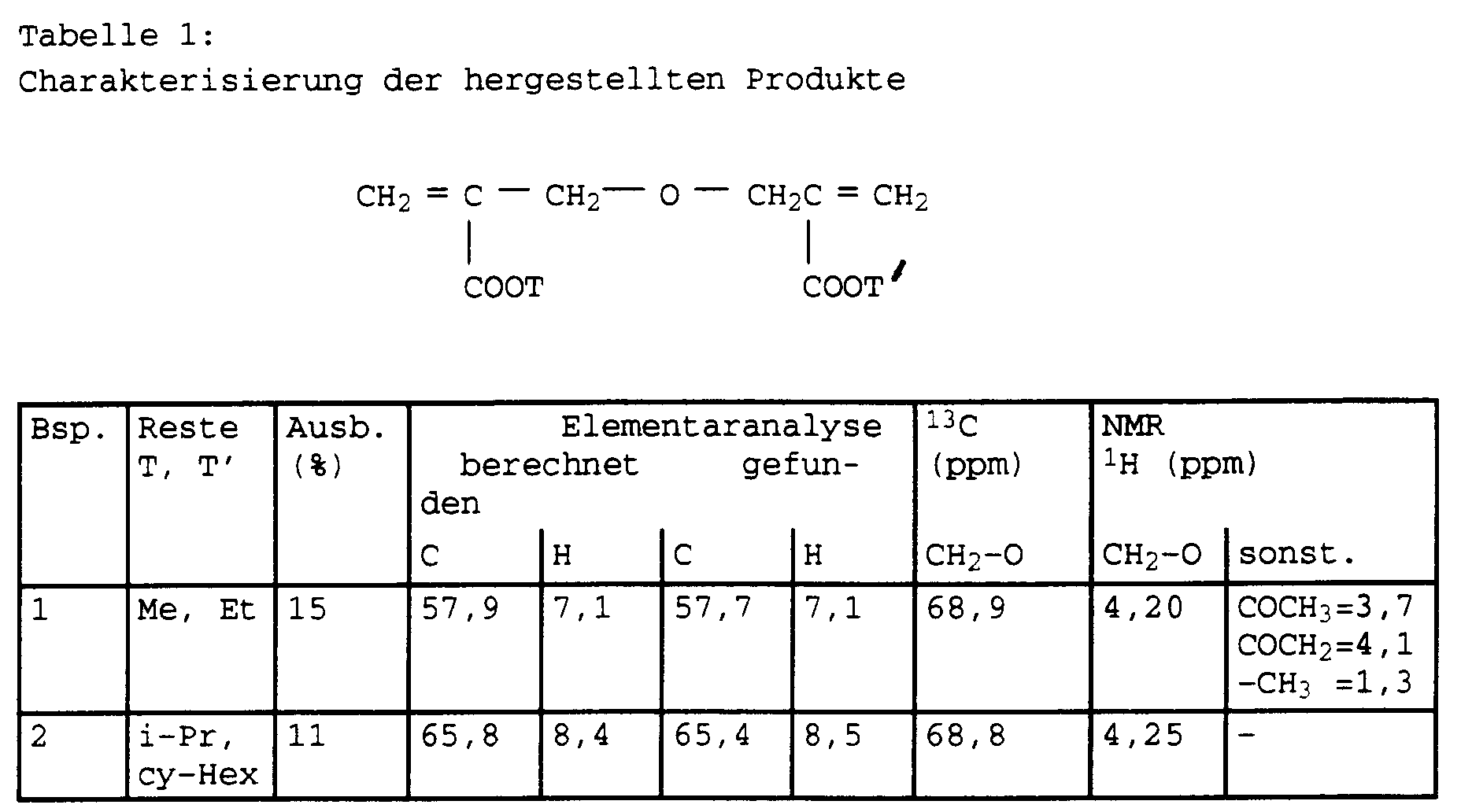
- the product was characterized by elemental analysis and 13 C and 1 H NMR spectroscopic experiments (see Table 1).
Landscapes
- Chemical & Material Sciences (AREA)
- Organic Chemistry (AREA)
- Organic Low-Molecular-Weight Compounds And Preparation Thereof (AREA)
Description
- Die vorliegende Erfindung betrifft Oxadimethacrylverbindungen der allgemeinen Formel I
CH2=C(A)CH2-O-CH2C(B)=CH2 I
in der A und B ausgewählt sind aus der Gruppe aus -COOR1, -COR1, - CONR2R3 und -CN, mit der Maßgabe, daß A ≠ B ist, und R1, R2 und R3 folgende Bedeutung haben: - R1 =
- H, C1-C18-Alkyl, C3-C8-Cycloalkyl, C3-C8-Cycloalkyl-C1-C5-alkyl, wobei die Cycloalkyl-Ringe bis zu dreifach mit C1-C4-Alkyl- oder C1-C4-Alkoxy-Gruppen substituiert sein können, Hydroxy-C1-C5-alkyl, Amino-C1-C5-alkyl, N-C1-C4-Alkyl-amino-C1-C5-alkyl, N,N-Di-(C1-C4-Alkyl)-amino-C1-C5-alkyl, C6-C18-Aryl, C6-C18-Aryl-C1-C4-alkyl, wobei die Arylgruppen bis zu drei der folgenden Gruppen tragen können: Halogen, C1-C22-Alkyl, C1-C4-Alkoxy, Carboxy, C1-C4-Alkoxycarbonyl, Aminocarbonyl, C1-C4-Alkylaminocarbonyl, Di-(C1-C4-Alkyl)aminocarbonyl, Nitrilo, Nitro, Amino, C1-C4-Alkylamino, Di-(C1-C4-Alkyl)amino;
- R2,R3 =
- H, C1-C18-Alkyl, C3-C8-Cycloalkyl, C3-C8-Cycloalkyl-C1-C5-alkyl, wobei die Cycloalkyl-Ringe bis zu dreifach mit C1-C4-Alkyl- oder C1-C4-Alkoxy-Gruppen substituiert sein können, C6-C18-Aryl, C6-C18-Aryl-C1-C4-alkyl, wobei die Arylgruppen bis zu drei der folgenden Gruppen tragen können: Halogen, C1-C22-Alkyl, C1-C4-Alkoxy, Carboxy, C1-C4-Alkoxycarbonyl, Aminocarbonyl, C1-C4-Alkylaminocarbonyl, Di-(C1-C4-Alkyl)aminocarbonyl, Nitrilo, Nitro, Amino, C1-C4-Alkylamino, Di-(C1-C4-Alkyl)amino, ausgenommen Verbindungen I, in denen A -COO-n-Butyl bedeutet, wenn B für -COO-C1- bis C2-Alkyl steht und Verbindungen I, in denen A für -COO-Methyl steht, wenn B -COO-Ethyl bedeutet.
- Weiterhin betrifft die Erfindung Verfahren zur Herstellung der Oxadimethacrylverbindungen I sowie die Verwendung dieser Verbindungen zur Herstellung von Polymeren.
- Symmetrische Oxadimethacrylverbindungen, d.h. solche, in denen A = B ist, sind bekannt. So sind aus der US-A 4,889,948 und aus Polymer Preprints, American Chemical Society, Division of Polymer Chemistry 31(1) (1990) 503 Oxadimethacrylverbindungen der allgemeinen Formel I'''
CH2=C(COOZ)CH2-O-CH2C(COOZ)=CH2 I'''
in der Z = H, Me, Et, n-Butyl, i-Butyl, tert.-Butyl, Neopentyl, Benzyl, Phenethyl, Trimethylcyclohexyl und Tetrahydrofurfuryl bedeutet, beschrieben. - Verbindungen dieses Typs sind wegen ihrer Bifunktionalität als Monomerbausteine geschätzte Verbindungen, die vielfach Verwendung finden, beispielsweise als Monomere zur Herstellung von Homopolymeren, oder als Comonomere oder Vernetzer. Bislang stehen aber nur einige wenige, und zwar ausschließlich symmetrische Oxadimethacrylverbindungen in nicht ausreichender Menge zur Verfügung. Ein weiterer Nachteil besteht in der meist nicht voll zufriedenstellenden Reinheit dieser Verbindungen.
- Die Oxadimethacrylverbindungen I''' kann man nach der US-A 4,889,948 ausgehend von Alkoholen des Typs Alkohol III, H2C=C(A)CH2OH, als auch ausgehend von der Acrylverbindungen des Typs Acrylverbindung II, H2C=C(A)H, erhalten. Die Reaktion der Alkohole des Typs Alkohol III zu den Oxadimethacrylverbindungen I''' wird dabei unter Erhitzen durchgeführt, wobei bei ein- bis zweitägigen Reaktionszeiten neben beträchtlicher Polymerisation der Monomeren nur mäßige Ausbeuten an den Oxadimethacrylverbindungen I''' erhalten werden.
- Ausgehend von den Acrylverbindungen des Typs Acrylverbindung II, die man in Gegenwart des tertiären Amins 1,4-Diazabicyclo-[2.2.2]-octan (DABCO®) mit Formaldehyd umsetzt, erhält man als Hauptprodukt nach der US-A 4,889,948 Alkohole des Typs Alkohol III. Die Oxadimethacrylverbindung I''' entsteht dabei nur in geringen Mengen. Daneben entstehen höhere (Ether-)Homologe und polymere Nebenprodukte. Neben dieser unspezifischen Reaktion sind weiter nachteilig die langen Reaktionszeiten (10 bis 20 Tage) sowie eine beträchtliche Polymerbildung bei Temperaturen oberhalb der Raumtemperatur.
- Aus Macromolecules, 1987, 20, 2039 war die Oxadimethylacrylverbindung I''', in der Z eine Methylgrupe bedeutet, sowie deren Ethyl- und n-Butylanaloga bekannt. Diese Verbindungen werden durch Umsetzen von CH2=C(A)H mit Formaldehyd in Gegenwart von DABCO® hergestellt.
- Zwei unsymmetrisch substituierte Oxadimethacrylverbindungen (A = -COO-n-Butyl oder -COO Methyl und B = -COO Ethyl) sind in Chemical Abstract unter den Nummern 118363-09-0 und 118363-07-8 registriert.
- Aufgabe der vorliegenden Erfindung war es, neue Oxadimethacrylverbindungen in hoher Reinheit zur Verfügung zu stellen.
- Demgemäß wurden die eingangs definierten Oxadimethacrylverbindungen I gefunden.
- Außerdem wurden Verfahren zur Herstellung dieser Verbindungen sowie deren Verwendung zur Herstellung von Polymeren gefunden.
- Als Substituenten R1, R2, R3 in den erfindungsgemäßen Oxadimethacrylverbindungen I kommen bevorzugt folgende Reste in Betracht:
- R1
- Wasserstoff;
C1-C18-Alkyl, darunter vorzugsweise C1-C12-Alkyl wie Methyl, Ethyl, n-Propyl, i-Propyl, n-Butyl, sek.-Butyl, i-Butyl, tert.-Butyl, n-Pentyl, i-Pentyl, sek.-Pentyl, tert.-Pentyl, neo-Pentyl, n-Hexyl, n-Heptyl, n-Octyl, n-Nonyl, n-Decyl, n-Undecyl, n-Dodecyl und Stearyl, besonders bevorzugt C1-C4-Alkyl wie Methyl, Ethyl, n-Propyl, i-Propyl, n-Butyl, i-Butyl, sek.-Butyl, tert.-Butyl;
C3-C8-Cycloalkyl wie Cyclopropyl, Cyclopentyl, Cyclohexyl, Cycloheptyl, Cyclooctyl, 4-Methylcyclohexyl, 4-Methoxy-cyclohexyl, 2,4,6-Trimethylcyclohexyl;
C3-C8-Cycloalkyl-C1-C5-alkyl wie Cyclopropylmethyl, Cyclopentylmethyl, Cyclohexylmethyl, Cyclopropylethyl, Cyclopentylethyl, Cyclohexylethyl, Cyclopropylpropyl, Cyclopentylpropyl, Cyclohexylpropyl, Cyclopentylbutyl, Cyclohexylbutyl, Cyclopentylpentyl, Cyclohexylpentyl, Cyclooctylpentyl;
Hydroxy-C1-C5-alkyl wie Hydroxymethyl, 2-Hydroxyethyl, 2-Hydroxypropyl, 3-Hydroxypropyl, 4-Hydroxybutyl, 5-Hydroxypentyl, 2,2-Dimethyl-3-hydroxypropyl;
Amino-C1-C5-alkyl wie Aminomethyl, 2-Aminoethyl, 3-Aminopropyl, 4-Aminobutyl, 5-Aminopentyl;
N-C1-C4-Alkyl-amino-C1-C5-alkyl wie N-Methylaminomethyl, 2-(N-Methylamino)ethyl, 3-(N-Methylamino)propyl, 4-(N-Methylamino)butyl, 5-(N-Methylamino)pentyl, N-Ethylaminomethyl,N-n-Propylaminomethyl, N-n-Butylaminomethyl;
N,N-Di-(C1-C4-Alkyl)amino-C1-C5-alkyl wie N,N-Dimethylaminomethyl, 2-(N,N-Dimethylamino)ethyl, 3-(N,N-Dimethylamino)propyl, 4-(N,N-Dimethylamino)butyl, 5-(N,N-Dimethylamino)pentyl, N,N-Diethylaminomethyl, N,N-Di(n-Propyl)aminomethyl, N,N-Di(i-Propyl)aminomethyl, N,N-Di-(n-Butyl)aminomethyl, N-Ethyl-N-methyl-aminomethyl, N-Methyl-N-propyl-aminomethyl;
C6-C18-Aryl wie Phenyl, Naphthyl, Anthracenyl, Phenantrenyl, Azulenyl, Biphenylenyl, Triphenylenyl, bevorzugt Phenyl, wobei die Arylreste bis zu drei der unter R11 genannten Gruppen tragen können;
C6-C18-Aryl-C1-C4-alkyl, bevorzugt Phenyl-C1-C4-alkyl wie Benzyl, 2-Phenylethyl, 3-Phenylpropyl, 4-Phenylbutyl, besonders bevorzugt Benzyl, 2-Phenylethyl, 3-Phenylpropyl, wobei die Arylgruppen bis zu drei der unter R11 genannten Gruppen tragen können; - R2,R3
- C1-C18-Alkyl wie bei R1 genannt, darunter besonders bevorzugt C1-C4-Alkyl wie Methyl, Ethyl, n-Propyl, i-Propyl, n-Butyl, sek.-Butyl, i-Butyl, tert.-Butyl;
C3-C8-Cycloalkyl wie Cyclopropyl, Cyclopentyl, Cyclohexyl, Cycloheptyl, Cyclooctyl, 4-Methylcyclohexyl, 2,4,6-Trimethylcyclohexyl;
C6-C18-Aryl wie bei R1 genannt, vorzugsweise Phenyl, welches bis zu drei der unter R11 genannten Gruppen tragen kann;
C6-C18-Aryl-C1-C4-alkyl wie bei R1 genannt, vorzugsweise phenyl-C1-C4-alkyl, besonders bevorzugt Benzyl, 2-Phenylethyl, 3-Phenylpropyl, wobei die Phenylgruppe bis zu drei der unter R11 genannten Gruppen tragen kann; - R11
- Halogen wie Fluor, Chlor, Brom und Iod, C1-C22-Alkyl wie Methyl, Ethyl, n-Propyl, i-Propyl, n-Butyl, sek.-Butyl, i-Butyl, tert.-Butyl, n-Pentyl, i-Pentyl, sek.-Pentyl, tert.-Pentyl, neo-Pentyl, n-Hexyl, n-Heptyl, n-Octyl, n-Nonyl, n-Decyl, n-Undecyl, n-Dodecyl, n-Tridecyl, n-Tetradecyl, n-Pentadecyl, n-Hexadecyl, n-Heptadecyl, n-Octadecyl, n-Nonadecyl, n-Eicosyl, n-Heneicosyl und n-Docosyl, vorzugsweise C1-C12-Alkyl wie Methyl, Ethyl, n-Propyl, i-Propyl, n-Butyl, sek.-Butyl, i-Butyl, tert.-Butyl, n-Pentyl, i-Pentyl, sek.-Pentyl, tert.-Pentyl, neo-Pentyl, n-Hexyl, n-Heptyl, n-Octyl, n-Nonyl, n-Decyl, n-Undecyl, n-Dodecyl und Stearyl, besonders bevorzugt C1-C4-Alkyl wie Methyl, Ethyl, n-Propyl, i-Propyl, n-Butyl, i-Butyl, sek.-Butyl, tert.-Butyl; C1-C4-Alkoxy wie Methoxy, Ethoxy, n-Propoxy und n-Butoxy, Carboxy, C1-C4-Alkoxycarbonyl wie Methoxycarbonyl, Ethoxycarbonyl, n-Propoxycarbonyl und n-Butoxycarbonyl, Aminocarbonyl, C1-C4-Alkylaminocarbonyl wie Methylaminocarbonyl, Ethylaminocarbonyl, n-Propylaminocarbonyl und n-Butylaminocarbonyl, Di-(C1-C4-Alkyl)aminocarbonyl wie Dimethylaminocarbonyl, Diethylaminocarbonyl, Di-(n-Propyl)aminocarbonyl und Di-(n-Butyl)aminocarbonyl, Nitrilo, Nitro, Amino, C1-C4-Alkylamino wie Methylamino, Ethylamino, n-Propylamino und n-Butylamino, Di-(C1-C4-alkyl)amino wie Dimethylamino, Diethylamino, Di-(n-Propyl)amino und Di-(n-Butyl)amino.
- Dabei sind Verbindungen I ausgenommen, in denen A -COO-n-Butyl bedeutet, wenn B für -COO-C1- bis C2 -Alkyl steht und Verbindungen I, in denen A für -COO-Methyl steht, wenn B -COO-Ethyl bedeutet.
- Bevorzugte Oxadimethacrylverbindungen I finden sich in der Tabelle I.
- Oxamethylenverbindungen Ia, die die erfindungsgemäßen Verbindungen I sowie die ausgenommenen Verbindungen umfassen sind auf verschiedenen Wegen zugänglich.
- Bei der ersten Variante des Verfahrens zur Herstellung der Oxadimethacrylverbindungen Ia ausgehend von einer Mischung der Acrylverbindungen IIa und IIb, H2C=C(A)H und H2C=C(B)H, geht man so vor, daß man zunächst die Acrylverbindungen II mit Formaldehyd oder Formaldehyd-liefernden Verbindungen in Gegenwart mindestens eines tertiären Amins und vorzugsweise mindestens eines Stabilisators, insbesondere eines polymerisationsinhibitors, zur Reaktion bringt. Gleichzeitig leitet man Sauerstoff oder ein Gemisch von Sauerstoff und einem oder mehreren nicht reaktiven Gasen über oder durch das Reaktionsgemisch. Das erhaltene Reaktionsgemisch enthält dann im wesentlichen die beiden Alkohole IIIa und IIIb, H2C=C(A)CH2OH und H2C=C(B)CH2OH.
- Man kann nun das Reaktionsgemisch ohne Isolierung der Alkohole weiter umsetzen oder die Alkohole nach bekannten Methoden isolieren und dann weiter umsetzen. Praktisch vorteilhafter ist die Durchführung der Reaktion ohne Isolierung der Alkohole.
- Im zweiten Teil der Reaktion erhitzt man sodann das die Alkohole IIIa und IIIb enthaltende Reaktionsgemisch, oder die isolierten Alkohole IIIa und IIIb, in Gegenwart mindestens eines tertiären Amins und mindestens eines Stabilisators, wobei man Sauerstoff, oder ein Sauerstoff enthaltendes Gasgemisch (enthaltend weitere, nicht reaktive Gase), über oder durch die Reaktionsmischung leitet. Hierbei erhält man ein Reaktionsgemisch enthaltend die entsprechenden Oxadimethacrylverbindung Ia, die man nach üblichen Methoden wie Chromatographie, Kristallisation oder Extraktion isolieren kann.
- Die für das erfindungsgemäße Verfahren benötigten Acrylverbindungen II sind entweder käuflich oder man erhält sie beispielsweise durch Veresterung, Umesterung, Amidierung oder Aminolyse nach an sich bekannten Methoden (s. H.Rauch-Puntigam et al., Chemie, Physik und Technologie der Kunststoffe, Bd. 9, Springer Verlag, Berlin, 1967) aus den entsprechenden leicht zugänglichen Acrylvorstufen wie Acrylsäure und deren bekannte Derivate.
- Den Formaldehyd kann man gasförmig, flüssig, beispielsweise als wäßrige Lösung wie Formalin oder in Form einer alkoholischen Lösung, oder in fester Form, zum Beispiel als para-Formaldehyd, Trioxan, Tetroxocan oder als Halbacetal einsetzen.
- Des weiteren setzt man ein tertiäres Amin oder eine Mischung unterschiedlicher tertiärer Amine ein, wobei der Einsatz nur eines tertiären Amins bevorzugt ist. Als tertiäre Amine kommen offenkettige aliphatische oder cyclische tertiäre Amine in Betracht wie Trimethylamin, Triethylamin, Tri-n-propylamin, Triisopropylamin, Tri-n-butylamin, Triisobutylamin, Tri-n-pentylamin, Methyldiisopropylamin, N,N-Diethylisopropylamin, N,N-Dimethylethylamin, N,N-Dimethylisopropylamin, Tri-2-ethylhexylamin, N-Methyldiethylamin, N,N-Dimethyl-n-propylamin, N,N-Dimethyl-n-butylamin, N,N-Dimethylisobutylamin, N,N-Dimethyl-(2-ethylhexyl)amin, N,N-Diisopropyl-(2-ethylhexyl)amin, N,N-Di-n-butyl-(2-ethylhexyl)amin, N-Methyl-di-(2-ethylhexyl)amin, N-n-butyl-(2-ethylhexyl)amin, N-Isobutyl-di-(2-ethylhexyl)amin, Chinuclidin und 1,4-Diazabicyclo[2.2.2]octan (DAECO®), bevorzugt Chinuclidin und DABCO® besonders bevorzugt DABCO®.
- Als Stabilisatoren verwendet man in der Regel die üblichen Polymerisationsinhibitoren wie Hydrochinon, Hydrochinonmonomethylether, p-Benzochinon, Phenol, 2,6-Dimethylphenol, 2,6-Di-tert.-Butylphenol, Methylenblau, Diphenylamin, Cu-(II)-oleat, Fe-(III)-acetylacetonat, Brenzkatechin, bevorzugt Hydrochinonmonomethylether und Hydrochinonmonoethylether.
- Den Sauerstoff kann man in reiner Form oder in Form eines Gemisches mit nicht reaktiven Gasen, bevorzugt Luft, über oder durch das Reaktionsgemisch leiten.
- In der ersten Stufe der Umsetzung, die zur Bildung der Alkoholverbindungen IIIa und IIIb führt, setzt man die Acrylverbindungen IIa und IIb und den Formaldehyd im allgemeinen im Molverhältnis Summe der Acrylverbindungen zu Formaldehyd von 1:1 bis 8:1, vorzugsweise von 1,0:1 bis 2,5:1, ein.
- Das tertiäre Amin verwendet man hierbei vorzugsweise im Molverhältnis Formaldehyd zu Amin von 1:1 bis 200:1, bevorzugt 2:1 bis 100:1, besonders bevorzugt 4:1 bis 50:1.
- Den Stabilisator setzt man in der Regel in Mengen von 10 bis 1000 mg pro kg der Acrylverbindungen ein.
- Die Menge des Sauerstoffs liegt in der Regel im Bereich von 0,01 bis 100, bevorzugt von 0,1 bis 20 l/h pro kg der Acrylverbindungen. Verwendet man Luft als Sauerstofflieferanten, so wählt man die Gasmenge im allgemeinen im Bereich von 0,01 bis 1000, bevorzugt von 1 bis 250 l/h pro kg der Acrylverbindungen.
- Im allgemeinen arbeitet man bei Temperaturen von 10 bis 100°C, bevorzugt von 40 bis 80°C, besonders bevorzugt von 60 bis 75°C. Des weiteren führt man die Reaktion in der Regel unter Atmosphärendruck durch. Sie kann jedoch auch bei vermindertem oder erhöhtem Druck, vorzugsweise im Bereich von 80 bis 250 kPa, vorgenommen werden. Ein Arbeiten unter Druck ist vor allem dann angezeigt, wenn man die Umsetzung bei Temperaturen oberhalb von 80°C vornimmt.
- Des weiteren führt man die Reaktion in der Regel ohne Lösungsmittel durch. Jedoch kann man die Umsetzung auch in Gegenwart eines geeigneten Lösungsmittels wie eines C5-C8-Alkans, bevorzugt n-Pentan, n-Hexan, n-Heptan, n-Octan, i-Octan, eines Carbonsäureesters wie Acetylacetat, sowie eines aromatischen Lösungsmittels wie Benzol, Toluol und Xylole, besonders bevorzugt n-Hexan, i-Octan und Toluol, oder deren Mischungen, durchführen.
- Die Reaktionszeit hängt hauptsächlich von der Reaktionstemperatur ab. Sie liegt im allgemeinen im Bereich von 1 bis 6 h.
- Die bei dieser Reaktion gebildeten Alkohole IIIa und IIIb kann man nach den üblichen Aufarbeitungsmethoden wie Destillation oder Chromatographie isolieren.
- In der zweiten Stufe des erfindungsgemäßen Verfahrens setzt man die nach der ersten Stufe erhaltene Mischung der isolierten Alkohole IIIa und IIIb, oder das diese Alkohole enthaltende Reaktionsgemisch in Gegenwart mindestens eines tertiären Amins und vorzugsweise mindestens eines Stabilisators unter Erhitzen zur Oxadimethacrylverbindung Ia um, wobei man gleichzeitig Sauerstoff oder ein Sauerstoff enthaltendes Gasgemisch, enthaltend weitere, nicht reaktive Gase, über oder durch die Reaktionsmischung leitet.
- Art und Menge des Amins, des Stabilisators sowie des Lösungsmittels entsprechen denen, die bei der Reaktion der Acrylverbindungen II zu dem die Alkohole IIIa und IIIb enthaltenden Reaktionsgemisch bereits genannt wurden. Die Menge des Sauerstoffs liegt in der Regel im Bereich von 0,01 bis 1000, bevorzugt von 0,1 bis 50 l/h pro kg der Alkoholverbindungen IIIa und IIIb. Verwendet man Luft als Sauerstofflieferanten, so wählt man die Gasmenge im allgemeinen im Bereich von 0,1 bis 1000, bevorzugt von 1 bis 500 l/h pro kg der Alkoholverbindung IIIa und IIIb.
- Die Umsetzung in der zweiten Stufe nimmt man im allgemeinen bei einer Temperatur im Bereich von 100 bis 200°C, bevorzugt von 100 bis 150°C, und bei einem Druck, der in der Regel im Bereich von 70 bis 300 kPa liegt, vor, bevorzugt arbeitet man jedoch unter Atmosphärendruck.
- Das während der Reaktion anfallende Reaktionswasser kann man in der Regel durch Destillation, bevorzugt durch Rektifikation, aus dem Reaktionsgemisch entfernen.
- Zweckmäßig kann man dabei dem Reaktionsgemisch ein Schleppmittel zusetzen. Hierfür eignen sich beispielsweise aliphatische, cycloaliphatische und aromatische Kohlenwasserstoffe sowie Carbonsäureester wie n-Hexan, n-Heptan, i-Octan, Benzol, Toluol, Xylol, Cyclohexan, Essigsäureethylester, oder gegebenenfalls die vor der Reaktion nicht abgetrennten Acrylverbindungen IIa und IIb. Den Siedepunkt der Schleppmittel wählt man im allgemeinen im Bereich zwischen 80 und 200°C.
- Die Reaktionszeit ist von den üblichen Parametern wie Temperatur, Druck und den Mengen der Ausgangsstoffe abhängig und liegt in der Regel im Bereich von 4 bis 12 h.
- Besonders vorteilhaft ist es, daß man das Reaktionsgemisch, das man bei der Herstellung der Alkohole IIIa und IIIb ausgehend von den Acrylverbindungen IIa und IIb nach dem weiter oben beschriebenen Verfahren erhält, ohne weitere Aufarbeitung zur Weiterumsetzung zu den entsprechenden Oxadimethacrylverbindungen Ia einsetzen kann.
- Hierzu führt man die Reaktion zweckmäßig so durch, daß man nach dem oben beschriebenen erfindungsgemäßen Verfahren ausgehend von den Acrylverbindungen IIa und IIb zunächst die Alkohole IIIa und IIIb herstellt (erste Stufe), und dann das Reaktionsgemisch, ohne die Alkohole IIIa und IIIb zu isolieren, unter den Bedingungen weitererhitzt, wie sie bei der Herstellung der Oxadimethacrylverbindungen Ia (zweite Stufe) ausgehend von den Alkoholen IIa und IIb beschrieben wurden.
- Die beim zweistufigen Verfahren im Reaktionsgemisch nach der Bildung der Alkohole IIIa und IIIb in der Regel im Überschuß noch vorhandenen Acrylverbindungen IIa und IIb, können jedoch auch vor der Weiterreaktion zur Oxadimethacrylverbindung Ia abgetrennt werden, beispielsweise durch Destillation. Dies kann jedoch auch nach der Reaktion zur Oxadimethacrylverbindung Ia erfolgen.
- Man kann die unsymmetrischen Oxadimethacrylverbindungen Ia auch ausgehend von nur einer Acrylverbindung IIa herstellen (Variante B), indem man im Prinzip genauso vorgeht wie es bei der Herstellung der Alkohole IIIa und IIIb, ausgehend von einer Mischung der Acrylverbindungen IIa und IIb, beschrieben wurde (Variante A, erste Stufe). Auch hier kann man nach der Umsetzung der Acrylverbindung IIa mit Formaldehyd den entstandenen Alkohol IIIa isolieren oder im Reaktionsgemisch belassen. Im Unterschied zum ersten Verfahren, gibt man aber nach der Bildung des Alkohols IIIa einen weiteren Alkohol IIIb, der beispielsweise nach dem gleichen Verfahren oder auf einem anderem Wege gewonnen wurde, zum isolierten Alkohol IIIa oder zum den Alkohol IIIa enthaltenden Reaktionsgemisch hinzu. Anschließend verfährt man analog zur zweiten Stufe des ersten Verfahrens (A), indem man die Reaktionsmischung, enthaltend die Alkohole IIIa und IIIb, in Gegenwart mindestens eines tertiären Amins und vorzugsweise mindestens eines Stabilisators erhitzt, und gleichzeitig Sauerstoff oder ein Sauerstoff enthaltendes Gasgemisch, enthaltend weitere, nicht reaktive Gase, über oder durch die Reaktionsmischung leitet.
- Art und Menge der Einsatzstoffe sowie die Versuchsparameter wählt man analog zu der bereits beschriebenen ersten bzw. zweiten Stufe des ersten Verfahrens (Variante A).
- Es versteht sich von selbst, daß man Oxadimethacrylverbindungen Ia auch direkt von den Alkoholen IIIa und IIIb ausgehend herstellen kann (Variante C). Die Vorgehensweise entspricht der zweiten Stufe des ersten Verfahrens (A), so daß sie hier nicht wiederholt zu werden braucht.
- Art und Menge der Einsatzstoffe sowie die Versuchsparameter wählt man analog zu der bereits beschriebenen zweiten Stufe des ersten Verfahrens (Variante A).
- Selbstverständlich ist es auch möglich mehr als zwei Acrylverbindungen des Typs II bzw. Alkoholverbindungen des Typs III einzusetzen. Jedoch ist es im allgemeinen zweckmäßiger nur von jeweils zwei dieser Verbindungen auszugehen, um Reaktionsgemische, enthaltend mehrere Oxadimethacrylverbindungen des Typs I, zu vermeiden.
- Ausgehend von Oxadimethacrylverbindungen der allgemeinen Formel I''
CH2=C(E)CH2-O-CH2C(COQ)=CH2 I''
in der E -COOR4 oder -CONR5R6, und Q -OR10 oder Halogen wie Chlor oder Brom bedeutet, wobei R10 die gleiche Bedeutung wie R1 hat, mit der Maßgabe, daß R10 ≠ R7 ist, kann man Oxadimethacrylverbindungen der allgemeinen Formel I'
CH2=C(E)CH2-O-CH2C(F)=CH2 I'
in der F -COOR7 oder -CONR8R9 bedeutet, wobei R4 und R7 die gleiche Bedeutung wie R1, R5 und R8 die gleiche Bedeutung wie R2, und R6 und R9 die gleiche Bedeutung wie R3 haben, mit der Maßgabe, daß R4 ≠ R7, R5 ≠ R8 und R6 ≠ R9 sind, herstellen, indem man die Oxidimethacrylverbindungen I'' mit einem Alkohol, R7OH, oder einem Amin, HNR8R9, nach an sich bekannten Methoden umsetzt (s. Houben-Weyl, Methoden der organischen Chemie, Bd. VIII/III, S. 503 ff und S. 647 ff, 1952). - Oxadimethacrylverbindungen I'', in denen Q = -OR10 bedeutet, kann man nach den Verfahren wie sie weiter oben beschrieben wurden erhalten. Bei Symmetrischen Verbindungen, d.h. in den Fällen, in denen E = -COOR4 und Q = -OR4 ist, setzt man dabei entsprechend nur eine Acrylverbindung II bzw. eine Alkoholverbindung III anstelle von zwei dieser Verbindungen als Ausgangsverbindung für die Oxadimethacrylverbindungen I'' ein.
- Oxadimethacrylverbindungen I'', in denen Q = Halogen bedeutet, kann man aus den entsprechenden Esterverbindungen (Q = -COOR1) erhalten, indem man die Estergruppe zunächst zur Carbonsäuregruppe hydrolysiert und anschließend zum Carbonsäurehalogenid, bevorzugt dem Carbonsäurechlorid, nach an sich bekannten Methoden (S. Rauch-Puntigam et al., Chemie, Physik und Technologie der Kunststoffe, Bd 9., S. 79, Springer Verlag, Berlin, 1967) umsetzt.
- Die bei diesen Verfahren hergestellten Oxadimethacrylverbindungen I kann man nach den üblichen Aufarbeitungsmethoden wie Destillation, Kristallisation oder Chromatographie isolieren.
- Die Oxadimethacrylverbindungen I kann man als Monomere, Comonomere oder als Vernetzer verwenden, wobei man die Polymerisation beispielsweise nach der in der US-A 4,889,948 beschriebenen Methode durchführen kann. Des weiteren kann man sie auch durch eine 1,6-intra-intermolekulare Cyclopolymerisation zu cyclischen Ethern nach Methoden wie sie beispielsweise in Polymer Preprints, 31(1), 1990, 503 beschrieben sind, umsetzen. Hierdurch kann man im Vergleich zu Poly (meth)acrylaten eine höhere Wärmeformbeständigkeit erreichen.
- Ein Vorteil gegenüber symmetrischen Oxadimethacrylverbindungen (A = B) liegt darin, daß man durch Wahl unterschiedlicher Reste A und B bestimmte Polymereigenschaften ohne Einbuße der Wärmeformbeständigkeit gezielt einstellen kann. So kann man beispielsweise den Brechungsindex in einem Oxadimethacryl-Polymer unter Beibehaltung einer guten Bewitterungsbeständigkeit dadurch erhöhen, daß man für den Rest A = - COOR1 eine kurzkettige Alkylgruppe wie Methyl für R1 wählt, während man für den Rest B = -COOR1 einen aromatischen Rest wie Phenyl für R1 wählt. Natürlich kann man auch zur weiteren Optimierung Copolymerisate herstellen.
- Für die Verwendung als Beschichtungsmaterial oder zum Abmischen mit anderen Polymeren wie Polyamiden kann man bevorzugt solche Oxadimethacrylverbindungen Ia einsetzen, in denen A eine Estergruppe und B eine Amid- oder die Carbonsäuregruppe bedeuten.
- Für die Herstellung wasserlöslicher Polymere kann man Oxadimethacrylverbindungen Ia mit einer Carbonsäuregruppe (A) und einer Carboxamidgruppe (B) verwenden.
- Eine Verbesserung der Substrathaftung und der Verklebungsfähigkeit kann man min solchen Oxadimethacrylverbindungen I erreichen, in denen mindestens eine Gruppe (A und/oder B) einen quaternisierten Aminoalkylesterrest bedeutet.
- Eine Mischung aus 430 g (5 mol) Methylacrylat, 500 g (5 mol) Ethylacrylat, 135 g (4,5 mol) para-Formaldehyd, 56 g (0,5 mol) DABCO® (1,4-Diazobicyclo-[2.2.2]-octan) und 200 mg Hydrochinonmonomethylether wurde während 3 h auf 75°C erhitzt, wobei gleichzeitig 10 l/h Luft durch die Mischung geleitet wurden. Dann wurde unter weiterem Erhitzen überschüssiges Methylacrylat und Ethylacrylat soweit abdestilliert, bis die Temperatur des Reaktionsgemisches im Sumpf 140°C betrug. Anschließend wurde das bei der Reaktion entstandene Reaktionswasser während 8 h bei 140°C abdestilliert, wobei als azeotropes Schleppmittel Isooctan diente. Danach erhielt man durch präparative Säulenchromatographie des Destillationsrückstandes an Silikagel mit Ethylacetat/Hexan (20/80) als Elutionsmittel
39 g 2,2'[Oxybis(methylen)]bis-2-propensäure-dimethylester
77 g (15,0 %) 2,2'[Oxybis(methylen)]-2-propensäure-ethylester-2'-propen-säure-methylester
53 g 2,2'[Oxybis(methylen)]bis-2-propensäure-diethylester. - Eine Mischung aus 308 g (2 mol) Cylohexylacrylat, 228 g (2 mol) Isopropylacrylat, 60 g (2 mol) para-Formaldehyd, 22,4 g (0,2 mol) DABCO® und 100 mg Hydrochinonmonomethylether wurde während 6 h auf 75°C erhitzt, wobei gleichzeitig 10 l/h Luft durch die Mischung geleitet wurden. Dann wurde unter weiterem Erhitzen überschüssiges Cyclohexylacrylat und Isopropylacrylat soweit abdestilliert, bis die Temperatur des Reaktionsgemisches während 14 h im Sumpf auf 125°C stieg. Danach erhielt man durch präparative Säulenchromatographie des Destillationsrückstandes an Silikagel mit Ethylacetat/Hexan (20/80) als Elutionsmittel
51 g 2,2'[Oxybis(methylen)]bis-2-propensäure-isopropylester,
68 g (11,0 %) 2,2'[Oxybis(methylen)]-2-propensäure-cyclohexylester-2'-propensaure-isopropylester und
86 g 2,2'[Oxybis(methylen)]bis-2-propensäure-cyclohexylester. - Die Produktcharakterisierung erfolgte durch Elementaranalyse und 13C- und 1H-NMR-spektroskopische Versuche (s. Tabelle 1).
Claims (8)
- Oxadimethacrylverbindungen der allgemeinen Formel I
CH2=C(A)CH2-O-CH2C(B)=CH2 I
in der A und B ausgewählt sind aus der Gruppe aus -COOR1, -COR1, -CONR2R3 und -CN, mit der Maßgabe, daß A ≠ B ist, und R1, R2 und R3 folgende Bedeutung haben:R1 = H, C1-C18-Alkyl, C3-C8-Cycloalkyl, C3-C8-Cycloalkyl-C1-C5-alkyl, wobei die Cycloalkyl-Ringe bis zu dreifach mit C1-C4-Alkyl oder C1-C4-Alkoxy-Gruppen substituiert sein können, Hydroxy-C1-C5-alkyl, Amino-C1-C5-alkyl, N-C1-C4-Alkyl-amino-C1-C5-alkyl, N,N-Di-(C1-C4-Alkyl)-amino-C1-C5-alkyl, C6-C18-Aryl, C6-C18-Aryl-C1-C4-alkyl, wobei die Arylgruppen bis zu drei der folgenden Gruppen tragen können: Halogen, C1-C22-Alkyl, C1-C4-Alkoxy, Carboxy, C1-C4-Alkoxycarbonyl, Aminocarbonyl, C1-C4-Alkylaminocarbonyl, Di-(C1-C4-Alkyl)aminocarbonyl, Nitrilo, Nitro, Amino, C1-C4-Alkylamino, Di-(C1-C4-Alkyl)amino;R2,R3 = H, C1-C18-Alkyl, C3-C8-Cycloalkyl, C3-C6-Cycloalkyl-C1-C5-alkyl, wobei die Cycloalkyl-Ringe bis zu dreifach mit C1-C4-Alkyl- oder C1-C4-Alkoxy-Gruppen substituiert sein können, C6-C18-Aryl, C6-C18-Aryl-C1-C4-alkyl, wobei die Arylgruppen bis zu drei der folgenden Gruppen tragen können: Halogen, C1-C22-Alkyl, C1-C4-Alkoxy, Carboxy, C1-C4-Alkoxycarbonyl, Aminocarbonyl, C1-C4-Alkylaminocarbonyl, Di-(C1-C4-Alkyl)aminocarbonyl, Nitrilo, Nitro, Amino, C1-C4-Alkylamino, Di-(C1-C4-Alkyl)amino, ausgenommen Verbindungen I, in denen A -COO-n-Butyl bedeutet, wenn B für -COO-C1- bis C2-Alkyl steht und Verbindungen I, in denen A für -COO-Methyl steht, wenn B -COO-Ethyl bedeutet. - Verfahren zur Herstellung von Oxadimethacrylverbindungen der allgemeinen Formel Ia
CH2=C(A)CH2-O-CH2C(B)=CH2 Ia
in der A und B ausgewählt sind aus der Gruppe aus -COOR1, -COR1-, -CONR2R3 und -CN, mit der Maßgabe, daß A ≠ B und nicht -COOH bedeuten,und R1, R2 und R3 folgende Bedeutung haben:R1 = H, C1-C18-Alkyl, C3-C8-Cycloalkyl, C3-C8-Cycloalkyl-C1-C5-alkyl, wobei die Cycloalkyl-Ringe bis zu dreifach mit C1-C4-Alkyl- oder C1-C4-Alkoxy-Gruppen substituiert sein können, Hydroxy-C1-C5-alkyl, Amino-C1-C5-alkyl, N-C1-C4-Alkyl-amino-C1-C5-alkyl, N,N-Di-(C1-C4-Alkyl)-amino-C1-C5-alkyl, C6-C18-Aryl, C6-C18-Aryl-C1-C4-alkyl, wobei die Arylgruppen bis zu drei der folgenden Gruppen tragen können: Halogen, C1-C22-Alkyl, C1-C4-Alkoxy, Carboxy, C1-C4-Alkoxycarbonyl, Aminocarbonyl, C1-C4-Alkylaminocarbonyl, Di-(C1-C4-Alkyl)aminocarbonyl, Nitrilo, Nitro, Amino, C1-C4-Alkylamino, Di-(C1-C4-Alkyl)amino;R2,R3 = H, C1-C18-Alkyl, C3-C8-Cycloalkyl, C3-C8-Cycloalkyl-C1-C5-alkyl, wobei die Cycloalkyl-Ringe bis zu dreifach mit C1-C4-Alkyl- oder C1-C4-Alkoxy-Gruppen substituiert sein können, C6-C18-Aryl, C6-C18-Aryl-C1-C4-alkyl, wobei die Arylgruppen bis zu drei der folgenden Gruppen tragen können: Halogen, C1-C22-Alkyl, C1-C4-Alkoxy, Carboxy, C1-C4-Alkoxycarbonyl, Aminocarbonyl, C1-C4-Alkylaminocarbonyl, Di-(C1-C4-Alkyl)aminocarbonyl, Nitrilo, Nitro, Amino, C1-C4-Alkylamino, Di-(C1-C4-Alkyl)aminodadurch gekennzeichnet, daß manA) eine Mischung aus zwei verschiedenen Acrylverbindungen der allgemeinen Formeln IIa und IIb
H2C=C(A)H IIa
H2C=C(B)H IIb
in Gegenwart von Sauerstoff und mindestens einem tertiären Amin mit Formaldehyd oder einer Formaldehyd-liefernden Verbindung zu den Alkoholen der allgemeinen Formeln
H2C=C(A)CH2OH IIIa
H2C=C(B)CH2OH IIIb
überführt, und dann entweder das diese Alkohole enthaltende Reaktionsgemisch, oder die aus dem Reaktionsgemisch isolierten Alkohole IIIa und IIIb unter Erhitzen in Gegenwart von Sauerstoff und mindestens einem tertiären Amin zur entsprechenden Oxadimethacrylverbindung I umsetzt, oderB) eine Acrylverbindung IIa in Gegenwart von Sauerstoff und mindestens einem tertiären Amin mit Formaldehyd oder einer Formaldehyd-liefernden Verbindung zum Alkohol IIIa umsetzt, und dann den isolierten Alkohol IIIa oder das den nicht isolierten Alkohol IIIa enthaltende Reaktionsgemisch, mit einem weiteren, davon verschiedenen Alkohol IIIb unter Erhitzen in Gegenwart von Sauerstoff und mindestens einem tertiären Amin zur Oxadimethacrylverbindung I umsetzt, oderC) eine Mischung aus zwei verschiedenen Alkoholen IIa und IIb in Gegenwart von Sauerstoff und mindestens einem tertiären Amin unter Erhitzen zur Oxadimethacrylverbindung I umsetzt. - Verfahren nach Anspruch 2, dadurch gekennzeichnet, daß die Menge Sauerstoff im Bereich von 0,01 bis 100 l/h pro kg Acrylverbindung oder 0,01 bis 1000 l/h pro kg Alkoholverbindung liegt.
- Verfahren nach Anspruch 2 oder 3, dadurch gekennzeichnet, daß man die Umsetzung in Gegenwart von Hydrochinonmonomethylether durchführt.
- Verfahren nach einem der Ansprüche 2 bis 4, dadurch gekennzeichnet, daß man die erste Reaktionsstufe bei Temperaturen von 40 bis 80°C und die zweite Reaktionsstufe bei Temperaturen von 100 bis 150°C durchführt.
- Verfahren zur Herstellung von Oxadimethacrylverbindungen der allgemeinen Formel I'
CH2=C(E)CH2-O-CH2C(F)=CH2 I'
in der E -COOR4 oder -CONR5R6 und F -COOR7 oder -CONR8R9 bedeuten, wobei R4 und R7 die gleiche Bedeutung wie R1, R5 und R8 die gleiche Bedeutung wie R2, und R6 und R9 die gleiche Bedeutung wie R3 haben, mit der Maßgabe, daß R4 ≠ R7, R5 ≠ R8 und R6 ≠ R9 ist, dadurch gekennzeichnet, daß man Oxadimethacrylverbindungen der allgemeinen Formel I''
CH2=C(E)CH2-O-CH2C(COQ)=CH2 I''
in der Q -OR10 oder Halogen bedeutet, wobei R10 die gleiche Bedeutung wie R1 hat, mit der Maßgabe, daß R10 ≠R7,
mit einem Alkohol, R7OH, oder einem Amin, HNR8R9, umsetzt. - Verwendung der Oxadimethacrylverbindungen Ia gemäß Anspruch 2 zur Herstellung von Polymeren.
- Polymerisate, erhältlich aus Oxadimethacrylverbindungen Ia gemäß Anspruch 2 hergestellt.
Applications Claiming Priority (2)
| Application Number | Priority Date | Filing Date | Title |
|---|---|---|---|
| DE4142909 | 1991-12-24 | ||
| DE4142909A DE4142909A1 (de) | 1991-12-24 | 1991-12-24 | Oxadimethacryl-verbindungen und verfahren zu ihrer herstellung |
Publications (2)
| Publication Number | Publication Date |
|---|---|
| EP0548764A1 EP0548764A1 (de) | 1993-06-30 |
| EP0548764B1 true EP0548764B1 (de) | 1996-08-28 |
Family
ID=6448086
Family Applications (1)
| Application Number | Title | Priority Date | Filing Date |
|---|---|---|---|
| EP92121357A Expired - Lifetime EP0548764B1 (de) | 1991-12-24 | 1992-12-16 | Oxadimethacryl-Verbindungen und Verfahren zu ihrer Herstellung |
Country Status (3)
| Country | Link |
|---|---|
| US (1) | US5354895A (de) |
| EP (1) | EP0548764B1 (de) |
| DE (2) | DE4142909A1 (de) |
Families Citing this family (4)
| Publication number | Priority date | Publication date | Assignee | Title |
|---|---|---|---|---|
| KR100281903B1 (ko) * | 1998-12-24 | 2001-03-02 | 윤종용 | 백본이 환상 구조를가지는 감광성 폴리머 및 이를 포함하는 레지스트 조성물 |
| WO2010114077A1 (ja) | 2009-03-31 | 2010-10-07 | 株式会社日本触媒 | α-(不飽和アルコキシアルキル)アクリレート組成物及びその製造方法 |
| JP5496534B2 (ja) * | 2009-03-31 | 2014-05-21 | 株式会社日本触媒 | α−(不飽和アルコキシアルキル)アクリレートの製造方法 |
| JP5520116B2 (ja) * | 2009-03-31 | 2014-06-11 | 株式会社日本触媒 | α−(不飽和アルコキシアルキル)アクリレート組成物及びその製造方法 |
Family Cites Families (1)
| Publication number | Priority date | Publication date | Assignee | Title |
|---|---|---|---|---|
| US4889948A (en) * | 1987-08-18 | 1989-12-26 | University Of Southern Mississippi | Acrylate ester ether derivatives |
-
1991
- 1991-12-24 DE DE4142909A patent/DE4142909A1/de not_active Withdrawn
-
1992
- 1992-12-16 EP EP92121357A patent/EP0548764B1/de not_active Expired - Lifetime
- 1992-12-16 DE DE59206999T patent/DE59206999D1/de not_active Expired - Lifetime
- 1992-12-23 US US07/996,394 patent/US5354895A/en not_active Expired - Fee Related
Also Published As
| Publication number | Publication date |
|---|---|
| EP0548764A1 (de) | 1993-06-30 |
| US5354895A (en) | 1994-10-11 |
| DE4142909A1 (de) | 1993-07-01 |
| DE59206999D1 (de) | 1996-10-02 |
Similar Documents
| Publication | Publication Date | Title |
|---|---|---|
| DE2416658C3 (de) | Verfahren zur Herstellung von wasserlöslichen und wasserdispergierbaren Alkydharzen und ihre Verwendung | |
| DE4225921A1 (de) | Aminoacrylate, ein Verfahren zu ihrer Herstellung und ihre Verwendung | |
| DE2344070B2 (de) | Verfahren zur Herstellung eines N,N-Dialkylacrylamids | |
| EP1664177B1 (de) | Verwendung von isononylbenzoaten als filmbildehilfsmittel | |
| EP0548764B1 (de) | Oxadimethacryl-Verbindungen und Verfahren zu ihrer Herstellung | |
| WO2009146995A1 (de) | Monomermischungen, polymere sowie beschichtungszusammensetzungen | |
| DE102008002923A1 (de) | Verfahren zur Hestellung von tertiären Alkylestern der(Meth)Acrylsäure mit mindestens 4 Kohlenstoffatomen im Alkylrest | |
| EP0416360B1 (de) | Sekundäre Aminogruppen aufweisende Copolymerisate, ein Verfahren zu ihrer Herstellung und ihre Verwendung als Bindemittel oder Bindemittelkomponente | |
| DE840157C (de) | Verfahren zur Herstellung von Polyamidharzen | |
| EP0561230B1 (de) | Polymethacrylimide mit hoher Wärmeformbeständigkeit | |
| EP0552603B1 (de) | Lösliche Polymerisate | |
| EP0548736A1 (de) | Verfahren zur Herstellung von Oxadimethacryl-Verbindungen | |
| EP0105529A1 (de) | Neue Copolymerisate, Verfahren zu ihrer Herstellung und ihre Verwendung | |
| DE872341C (de) | Verfahren zur Herstellung von Estern der Acrylsaeure und ihrer Substitutionserzeugnisse | |
| EP1352914B1 (de) | Verfahren zur Herstellung von Polyvinylester-Festharz | |
| DE4142912A1 (de) | Verfahren zur isolierung und reinigung von oxadimethacrylverbindungen | |
| DE1811266A1 (de) | Fluorcyanoacrylate | |
| EP1284954A1 (de) | Verfahren zur herstellung von estern ungesättigter carbonsäuren | |
| DE1520403B2 (de) | Verfahren zur herstellung von homo oder mischpolymerisaten von olefinoxyden | |
| EP0548737A2 (de) | Verfahren zur Herstellung von Oxadimethacrylsäure | |
| DE3321501A1 (de) | Polymerisierbare ester der acrylsaeure und methacrylsaeure mit aromatischen thioetheralkoholen und verfahren zu ihrer herstellung | |
| EP1894949B1 (de) | Verfahren zur Herstellung von kaltgehärteten Biopolymeren | |
| DE2023433A1 (de) | Verfahren zur Herstellung von Estern | |
| AT390800B (de) | Verfahren zur herstellung von niedrigviskosen, lufttrocknenden bindemitteln und deren verwendung fuer festkoerperreiche, schnelltrocknende maler- und bautenlacke | |
| EP0018629B1 (de) | Verfahren zur Herstellung von N-substituierten Acrylamiden |
Legal Events
| Date | Code | Title | Description |
|---|---|---|---|
| PUAI | Public reference made under article 153(3) epc to a published international application that has entered the european phase |
Free format text: ORIGINAL CODE: 0009012 |
|
| AK | Designated contracting states |
Kind code of ref document: A1 Designated state(s): BE DE FR GB NL |
|
| 17P | Request for examination filed |
Effective date: 19930517 |
|
| 17Q | First examination report despatched |
Effective date: 19950220 |
|
| GRAG | Despatch of communication of intention to grant |
Free format text: ORIGINAL CODE: EPIDOS AGRA |
|
| GRAH | Despatch of communication of intention to grant a patent |
Free format text: ORIGINAL CODE: EPIDOS IGRA |
|
| GRAH | Despatch of communication of intention to grant a patent |
Free format text: ORIGINAL CODE: EPIDOS IGRA |
|
| GRAA | (expected) grant |
Free format text: ORIGINAL CODE: 0009210 |
|
| AK | Designated contracting states |
Kind code of ref document: B1 Designated state(s): BE DE FR GB NL |
|
| REF | Corresponds to: |
Ref document number: 59206999 Country of ref document: DE Date of ref document: 19961002 |
|
| GBT | Gb: translation of ep patent filed (gb section 77(6)(a)/1977) |
Effective date: 19960917 |
|
| PGFP | Annual fee paid to national office [announced via postgrant information from national office to epo] |
Ref country code: FR Payment date: 19961125 Year of fee payment: 5 |
|
| PGFP | Annual fee paid to national office [announced via postgrant information from national office to epo] |
Ref country code: NL Payment date: 19961130 Year of fee payment: 5 |
|
| PGFP | Annual fee paid to national office [announced via postgrant information from national office to epo] |
Ref country code: BE Payment date: 19961212 Year of fee payment: 5 |
|
| PGFP | Annual fee paid to national office [announced via postgrant information from national office to epo] |
Ref country code: GB Payment date: 19961216 Year of fee payment: 5 |
|
| PGFP | Annual fee paid to national office [announced via postgrant information from national office to epo] |
Ref country code: DE Payment date: 19961223 Year of fee payment: 5 |
|
| ET | Fr: translation filed | ||
| PLBE | No opposition filed within time limit |
Free format text: ORIGINAL CODE: 0009261 |
|
| STAA | Information on the status of an ep patent application or granted ep patent |
Free format text: STATUS: NO OPPOSITION FILED WITHIN TIME LIMIT |
|
| 26N | No opposition filed | ||
| PG25 | Lapsed in a contracting state [announced via postgrant information from national office to epo] |
Ref country code: GB Free format text: LAPSE BECAUSE OF NON-PAYMENT OF DUE FEES Effective date: 19971216 |
|
| PG25 | Lapsed in a contracting state [announced via postgrant information from national office to epo] |
Ref country code: DE Effective date: 19971217 |
|
| PG25 | Lapsed in a contracting state [announced via postgrant information from national office to epo] |
Ref country code: FR Free format text: THE PATENT HAS BEEN ANNULLED BY A DECISION OF A NATIONAL AUTHORITY Effective date: 19971231 Ref country code: BE Free format text: LAPSE BECAUSE OF NON-PAYMENT OF DUE FEES Effective date: 19971231 |
|
| BERE | Be: lapsed |
Owner name: BASF A.G. Effective date: 19971231 |
|
| PG25 | Lapsed in a contracting state [announced via postgrant information from national office to epo] |
Ref country code: NL Free format text: LAPSE BECAUSE OF NON-PAYMENT OF DUE FEES Effective date: 19980701 |
|
| GBPC | Gb: european patent ceased through non-payment of renewal fee |
Effective date: 19971216 |
|
| NLV4 | Nl: lapsed or anulled due to non-payment of the annual fee |
Effective date: 19980701 |
|
| REG | Reference to a national code |
Ref country code: FR Ref legal event code: ST |