EP0549127A2 - Méthode d'interception de messages dans un système de signalisation à canal commun - Google Patents
Méthode d'interception de messages dans un système de signalisation à canal commun Download PDFInfo
- Publication number
- EP0549127A2 EP0549127A2 EP92310666A EP92310666A EP0549127A2 EP 0549127 A2 EP0549127 A2 EP 0549127A2 EP 92310666 A EP92310666 A EP 92310666A EP 92310666 A EP92310666 A EP 92310666A EP 0549127 A2 EP0549127 A2 EP 0549127A2
- Authority
- EP
- European Patent Office
- Prior art keywords
- message
- service logic
- identity
- identifying
- network
- Prior art date
- Legal status (The legal status is an assumption and is not a legal conclusion. Google has not performed a legal analysis and makes no representation as to the accuracy of the status listed.)
- Granted
Links
Images



Classifications
-
- H—ELECTRICITY
- H04—ELECTRIC COMMUNICATION TECHNIQUE
- H04Q—SELECTING
- H04Q3/00—Selecting arrangements
- H04Q3/0016—Arrangements providing connection between exchanges
- H04Q3/0025—Provisions for signalling
-
- H—ELECTRICITY
- H04—ELECTRIC COMMUNICATION TECHNIQUE
- H04Q—SELECTING
- H04Q3/00—Selecting arrangements
- H04Q3/0016—Arrangements providing connection between exchanges
- H04Q3/0029—Provisions for intelligent networking
-
- H—ELECTRICITY
- H04—ELECTRIC COMMUNICATION TECHNIQUE
- H04Q—SELECTING
- H04Q2213/00—Indexing scheme relating to selecting arrangements in general and for multiplex systems
- H04Q2213/13517—SLEE - service logic execution
-
- H—ELECTRICITY
- H04—ELECTRIC COMMUNICATION TECHNIQUE
- H04Q—SELECTING
- H04Q2213/00—Indexing scheme relating to selecting arrangements in general and for multiplex systems
- H04Q2213/13545—Indexing scheme relating to selecting arrangements in general and for multiplex systems monitoring of signaling messages, intelligent network
Definitions
- the invention relates to telephone networks, and more particularly relates to identifying and executing call processing logic that is associated with a particular service request.
- Another prior approach attempts to optimize trunk usage by associating a trunk group, and thus the service logic, with a combination (set) of network services. Although such optimization is somewhat economical, it is not flexible. That is, in order to obtain a desired service a telephone user has to subscribe to a combination of such services, some of which the telephone user might find to be undesirable.
- SS7 Signaling System 7
- CITT International Committee
- IAM Initial Address Message
- An advancement in the art of call processing is achieved by providing in a telecommunications network a facility which, in accord with the invention, appends to an IAM message associated with an incoming call the identity of the service logic that will process the call and then presents the revised message to an associated toll switch.
- the inventive facility operates to intercept such an IAM message before it is presented to the associated toll switch.
- the facility then translates the ANI information contained in the message into the identity of the service logic that will process the call.
- the facility then appends the identity to the message and passes the result to the associated toll switch.
- communications network 200 shown in FIG. 1 may be an interexchange network, such as, for example, the well-known AT&T public switched network that provides a plurality of services for its subscribers, such as the subscribers associated with station sets 105-1 through 105-N and 125-1 through 125-P. More specifically, Network 200 includes, inter alia, a plurality of interconnected Toll Switches (TS), three of which are shown in the FIG., namely, TS 205, 210 and 215.
- TS Toll Switches
- Such toll switches e.g., 205, 210 and 215) may be any one of the well-known type of switching equipment, such as, for example, the No. 4ESS (Electronic Switching System) that is available from AT&T.
- a toll switch serves a number of local central (switching) offices (CO), such as COs 105,120 and 125.
- CO local central
- a CO e.g., CO 105 or CO 125
- a CO is also arranged to connect a telephone call received from an associated toll switch to an intended telephone station set.
- Network 200 also includes so-called Common Channel Signaling (CCS) links 302-1 through 302-3 which implement the aforementioned SS7 signaling network (hereinafter CCS7 links).
- CCS7 links 302-1 through 302-3 respectively connect to toll switches 105, 110 and 120 via respective CNI ring packet switches 300-1 through 300-3.
- each of the CNI rings 300-1 through 300-3 may be of the type disclosed in U. S. Patent No. 4,554,659 issued November 19, 1985 to M. L. Blood et al, and U. S. Patent No. 4,683,563 issued July 28, 1987, to D. M. Rouse et al, which are hereby incorporated by reference.
- a CNI ring is the means by which a toll switch, e.g., TS 205, connects via respective ring nodes to a network 200 Signal Transfer Points (STP), one of which is shown in the FIG., namely STP 220.
- STP Signal Transfer Points
- an STP operates to route messages between toll switches, between a toll switch and a CO, and between a toll switch and a network 200 data base, such as Network Control Point (NCP) 225.
- NCP Network Control Point
- a toll switch e.g., TS 205
- TS 205 comprises, inter alia, a central control processor 205-1 and a Time Division Multiplexed (TDM) network 205-2.
- TDM network 205-2 operates under the control of processor 205-1, and connects to a CO, e.g., CO 105, via respective communications paths, e.g., path 106.
- TDM network 205-2 may also connect to an associated adjunct 240 via communications path 241.
- Adjunct 240 which may be, for example, the Conversant® (registered trademark of AT&T) voice information system available from AT&T, communicates with central control processor 205-1 via path 304, CNI ring 300-1 and path 301-1. In a conventional manner, adjunct 240 may also communicate with other toll switches, e.g., TS 210 and TS 215, via path 304, CNI ring 300-1, CCS7 link 302-1 and STP 220 for the purpose of completing a telephone call.
- toll switches e.g., TS 210 and TS 215, via path 304, CNI ring 300-1, CCS7 link 302-1 and STP 220 for the purpose of completing a telephone call.
- CNI ring 300 comprising so-called oppositely directed transmission paths 306 forming what is commonly referred to as a token ring.
- Token ring 306 operates under the control of a so-called executive node (not shown).
- CNI ring 300 also comprises a plurality of CCS7 link nodes 307-1 through 307-N, D-channel node 308 and direct link node 309 interconnected to one another via token ring 306.
- Nodes 307-1 through 307-N respectively connect to CCS7 links 302 thereby providing a multiple link interface between CNI ring 300 and a particular network 200 STP, such as STP 220.
- central control processor 205-1 may exchange CCS7 messages, for example, an IAM message, with CO 105 or other toll switches via path 301-1, direct link node 309, token ring 306 and one of the CCS7 links 302 forming multiple CCS7 link 302-1.
- processor 205-1 may send a CCS7 message to a particular STP, e.g., STP 220, for delivery to another network 200 toll switch or data base (i.e., NCP 225) by supplying the message to direct link node 309 via path 301-1.
- Direct link node 309 transmits the message over the up-stream leg of token ring 306 for delivery to a particular one of the nodes 307-1 through 307-N which is identified in the message.
- the link node transmits the message over its respective one of the multiple links 302 forming multiple CCS7 link 302-1.
- a link node e.g., node 307-1
- receives a CCS7 message via its respective CCS7 link 302 outputs the message to the down-stream leg of token ring 306 for transmission to direct link node 309.
- Direct link node 309 removes the message from token ring 306 and supplies it to central control processor 205-1 via communications path 301-1.
- Node 309 which is of the type disclosed in the aforementioned U. S. Patent No. 4,752924, includes ring interface circuit 309-11 which presents a interface to token ring 306, and host interface 309-13 which presents an interface to an associated toll switch central processor, e.g., processor 205-1, by way of a dual channel communications path 301.
- Node 309 also includes memory 309-12, which is partitioned into, inter alia, two I/O buffers 309-16 and 309-17.
- Memory 309-12 is also partitioned to provide, in accord with an aspect of the invention, ANI Table 309-18, as will be discussed below.
- I/O buffers 309-16 and 309-17 operate as conventional First In, First Out (FIFO) memory arrangements.
- the overall operation of node 309 is under the control of node processor 309-14.
- ring interface 309-11 upon receiving a CCS7 message via the up-stream leg of token ring 306, ring interface 309-11 checks the message to determine if it contains an identifier identifying its associated central control processor, e.g, processor 205-1. If that is not the case, then interface 309-11 outputs the message to the succeeding up-stream leg of token ring 306. If that is case, then interface 309-11 stores the message in buffer 309-16. Node processor 309-14 periodically unloads a CCS7 message from buffer 309-16, converts the format of the message to a format expected by the associated central control processor and then stores the revised message in buffer 309-17.
- Host interface 309-13 then unloads the message from buffer 309-17 and supplies it to its associated host, e.g., central control processor 205-1, via communications path 301.
- host interface 309-13 stores messages that it receives from its associated host via path 301 in buffer 309-17.
- Node processor 309-14 in turn, unloads those messages from buffer 309-17, reformats them to conform with the SS7 protocol and then stores them in buffer 309-16.
- Interface 309-11 then unloads the latter messages, one at a time, and transmits them over the down-stream leg of token 306 for delivery to one of the link nodes 307-1 through 307-N.
- D-channel node 308 of FIG. 2 operates in a similar manner. That is, node 308 is the means by which adjunct 240 (FIG. 1) exchanges messages with its associated central control processor 205-1, in which the messages are formatted in accord with the Q.931 protocol. Accordingly, D-link node 309 is further arranged so that it converts a Q.931 message that it receives via ring 306 into a format expected by processor 205-1. Similarly, node 309 converts processor 205-1 messages addressed to adjunct 240 into the Q.931 format before such messages are outputted to ring 306 for delivery to node 308.)
- node 309 is arranged, in accord with an aspect of the invention, to intercept each IAM message before it is delivered to the associated central control processor and determine whether the call identified by the intercepted message is associated with a particular network 200 service or feature. If node 309 determines that is case, then node 309 identifies, in accord with an aspect of the invention, the associated service and/or feature module that will process the call and appends that identity to the IAM message before delivering the message to the associated central control processor, e.g., processor 205-1.
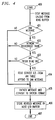
- the program when the program controlling the operation of node processor 309-14 unloads a message from ring buffer 309-11 the program then enters the program module shown in FIG. 4. Entry of the program at block 400 causes the program to proceed to block 401 where it determines whether or not the unloaded CCS7 message is an IAM message. If the CCS7 message is not an IAM message, then the program proceeds to block 405. Otherwise, the program proceeds to block 402 where it determines if the IAM message identifies an incoming call from an associated CO, e.g., CO 105 (FIG.1). If that is not the case, i.e., the call is from another network 200 toll switch, then the program proceeds to block 405. Otherwise, the program proceeds to block block 403.
- CO e.g., CO 105
- the program determines whether the ANI (e.g., telephone number of calling telephone party or, in particular instances, the dialed telephone number) specified in the IAM message is contained in ANI table 309-18. If it is not, then the program concludes that the call (i.e., calling party) is not associated with a particular network 200 service or feature and proceeds to block 405. If the ANI information is contained in table 309-18, then the program proceeds to block 404 where it translates the ANI information into a service identity code identifying the particular service and/or feature logic that will process the call. The program then appends the identity code to the IAM message and proceeds to block 405.
- the ANI e.g., telephone number of calling telephone party or, in particular instances, the dialed telephone number
- the program revises the format of the CCS7 message so that the message may be processed by the associated central control processor, as mentioned above.
- the program then proceeds to block 406 where it stores the reformatted message in host buffer 309-17 and then exits via block 407.
- FIG. 5 through 7 illustrate the manner in which the program at blocks 403 and 404 determines if the ANI information is contained in ANI table 309-19. It also illustrates how such information may be translated into a service identity code.
- ANI table 309-18 (FIG. 3) is composed of a number of tables, the first of which is indexed using the first three digits of the ANI information contained in the IAM message that the program is processing.
- ANI information may be, for example, what is commonly referred to as a long distance telephone number of the form NPA-NXX-XXXX.
- NPA conforms with the North American dialing plan and comprises three digits, for example, 201.
- NXX identifies a local exchange (e.g., CO 105) and also comprise three digits, e.g., 555.
- XXXX identifies a line circuit connected to a subscriber telephone line associated with the local exchange and comprises four digits (e.g., 5432).
- Block 403 of FIG. 4 first accesses table 500 comprising -- illustratively a thousand locations -- using as an index the three digit NPA code contained in the intercepted IAM message. If the accessed location contains a null word (e.g., all zeroes), then the program proceeds to block 405. If, on the other hand, the accessed location contains an address indicative of a valid NPA that is served by the associated toll switch, then the program proceeds to block 404, as mentioned above. Block 404 then proceeds to access one of the tables of FIG. 6. It is noted that, in a typical case, the majority of entries in table 500 would be null words, since a toll switch serves a relatively few NPAs.
- Block 403 accesses table 500 using 201 as a index, meaning that the program unloads the contents of location 201 of table 500. If that location contains a null word, then, as mentioned, the program proceeds to block 405. However, assume that location 201 contains an address, which points the program to one of the tables of FIG. 6, namely table 201 associated with area code (NPA) 201. Each of the tables of FIG.
- NXX local exchange number
- the number of valid entries (entries which do not contain a null word) in each of the tables of FIG. 6 is commensurate with the number of local exchanges that are served by the associated toll switch for that NPA.
- the program accesses table 201 using as an index the NXX (i.e.,555) contained in the ANI of the intercepted IAM message.
- location 555 of table 601 contains an address of a next table, i.e., table 601-555, rather than a null word.
- an address contained in one of the tables of FIG 6, e.g., table 201 in turn, "points" to one of a number of subscriber tables.
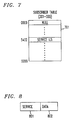
- FIG. 7 illustrates one such table, whose address is stored in location 555 of table 201.
- Each such subscriber table comprises a number of locations, e.g, 10,000 locations, each of which is associated with a particular subscriber served by the associated toll switch. If the particular subscriber has subscribed to one or more services and/or features provided by network 200 (FIG. 1), then an associated location in one of the subscriber tables identifies that subscription.
- the program accesses that table.
- the program uses as an index the last four digits forming the ANI information (value) contained in the intercepted IAM message.
- those four digits are assumed to be 5432.
- location 5432 of table 701 contains a service identity (I.D. in the FIG.) record that is associated with the ANI value contained in the intercepted IAM message.
- a service identity record identifies the toll switch logic module that will process the associated call. Accordingly, the program unloads a copy of the service identity record from location 5432 and appends it to the IAM message. The program then proceeds to block 405.
- a service identity record may contain a value identifying what is commonly referred to as "plain old telephone service”.
- FIG. 8 shows an illustrative example of a service identity record 801 that is stored in an associated subscriber table, such as table 701.
- subscriber record 801 comprises a number of fields, including a service field 801 identifying the associated subscriber's subscription of a network 200 service and/or feature, if any.
- field 801 identifies the service module that needs to be invoked to process telephone calls originated by the associated subscriber.
- Field 802 contains associated data that is used to implement the service. For example, such data may identify a particular service adjunct, e.g., adjunct 240, as will be explained below.
- Processor 205-1 responsive to receipt of a revised IAM message removes the appended subscriber record and invokes the service module identified therein.
- the identified service is a service which queries the calling subscriber for entry of an authorization code, and then compares the entered code with a code contained in the data field of the associated subscriber record. If the comparison is found to be true, then the service module directs the associated toll switch to complete the call to the called station. If the comparison is not true, then the service module directs the switch (TS 205) to terminate the call.
- a service module resides in one or more of a number of adjuncts identified in the data field of the associated subscriber record, for example, adjunct 240 (FIG. 2).
- TS 205 reformats a copy of the IAM message into the Q.931 message format and supplies the result to adjunct 240 via ring 300-1.
- TS 205 establishes a connection between the incoming call and adjunct 240 via associated TDM network 205-2 and path 241.
- Adjunct 240 responsive to receipt of the message, transmits a recorded announcement over path 241 for delivery to station set 105-1. The recorded announcement requests that the subscriber enter via the station keypad a predetermined authorization code.
- Adjunct 240 collects the digits forming the code as they are entered by the station set 105 subscriber (or caller).
- adjunct 240 Upon receipt of the last of such digits, adjunct 240 compares the string of digits entered by the subscriber with the code contained in the data field of associated subscriber record. As mentioned above, if adjunct 240 finds that the string compares with the authorization code, then adjunct 240 transmits a request to complete the call to central control processor 205-1 via CNI ring 300-1. Otherwise, the request directs processor 205-1 to terminate the call. Processor 205-1, in turn and in a conventional manner, either completes or terminates the call based on the contents of the adjunct 240 request.
- a particular network service is identified, in the manner discussed above, using the telephone number of the calling telephone station (subscriber). It can be appreciated that in certain instances the called telephone number (dialed digits) may be used to identify the requested service. In that instance, then, direct link node 809 would translate the dialed telephone number, rather than the calling telephone number, into a code identifying the associated network service ad, thus, the associated service logic.
Landscapes
- Engineering & Computer Science (AREA)
- Computer Networks & Wireless Communication (AREA)
- Exchange Systems With Centralized Control (AREA)
- Telephonic Communication Services (AREA)
- Sub-Exchange Stations And Push- Button Telephones (AREA)
- Data Exchanges In Wide-Area Networks (AREA)
Applications Claiming Priority (2)
| Application Number | Priority Date | Filing Date | Title |
|---|---|---|---|
| US07/813,708 US5367566A (en) | 1991-12-27 | 1991-12-27 | Common channel signaling message intercept system |
| US813708 | 1991-12-27 |
Publications (3)
| Publication Number | Publication Date |
|---|---|
| EP0549127A2 true EP0549127A2 (fr) | 1993-06-30 |
| EP0549127A3 EP0549127A3 (en) | 1994-07-20 |
| EP0549127B1 EP0549127B1 (fr) | 1999-03-17 |
Family
ID=25213139
Family Applications (1)
| Application Number | Title | Priority Date | Filing Date |
|---|---|---|---|
| EP92310666A Expired - Lifetime EP0549127B1 (fr) | 1991-12-27 | 1992-11-23 | Système d'interception de messages avec signalisation à canal commun |
Country Status (5)
| Country | Link |
|---|---|
| US (1) | US5367566A (fr) |
| EP (1) | EP0549127B1 (fr) |
| JP (1) | JP2801490B2 (fr) |
| CA (1) | CA2081037C (fr) |
| DE (1) | DE69228666T2 (fr) |
Cited By (10)
| Publication number | Priority date | Publication date | Assignee | Title |
|---|---|---|---|---|
| EP0669771A1 (fr) * | 1994-02-25 | 1995-08-30 | Hewlett-Packard Company | Intercepteur de messages pour un réseau de signalisation |
| WO1996016517A1 (fr) * | 1994-11-22 | 1996-05-30 | Unisys Corporation | Extraction et traitement de donnees provenant d'un reseau de signalisation par canal semaphore |
| US5550914A (en) * | 1994-02-25 | 1996-08-27 | Clarke; David A. | Communications signalling network apparatus |
| EP0714214A3 (fr) * | 1994-11-24 | 1997-04-23 | Tecnomen Oy | Procédé et dispositif d'introduction de fonctions intelligentes dans un réseau téléphonique |
| EP0658063A3 (fr) * | 1993-12-09 | 1997-07-02 | At & T Corp | Système de signalisation pour des réseaux de communication à large bande. |
| EP0699007A3 (fr) * | 1994-08-24 | 1997-07-02 | Siemens Ag | Procédé d'acheminement dans un réseau de télécommunication |
| WO1997044964A1 (fr) * | 1996-05-21 | 1997-11-27 | Telecom Finland Oy | Procede et dispositif aux fins de l'etablissement d'une connexion de telecommunications entre deux terminaux d'un systeme de telecommunications |
| EP0792074A3 (fr) * | 1996-02-20 | 1998-11-11 | Hewlett-Packard Company | Procédé assurant le service dans un système de télécommunications commuté et intercepteur de messages convenant à un tel procédé |
| US8938062B2 (en) | 1995-12-11 | 2015-01-20 | Comcast Ip Holdings I, Llc | Method for accessing service resource items that are for use in a telecommunications system |
| US9191505B2 (en) | 2009-05-28 | 2015-11-17 | Comcast Cable Communications, Llc | Stateful home phone service |
Families Citing this family (62)
| Publication number | Priority date | Publication date | Assignee | Title |
|---|---|---|---|---|
| US6172977B1 (en) * | 1994-05-05 | 2001-01-09 | Sprint Communications Company, L. P. | ATM direct access line system |
| DE69533831T2 (de) | 1994-05-05 | 2005-04-21 | Sprint Communications Co | Verfahren, system und gerät zur übertragungssteuerung |
| US6633561B2 (en) | 1994-05-05 | 2003-10-14 | Sprint Communications Company, L.P. | Method, system and apparatus for telecommunications control |
| US6031840A (en) * | 1995-12-07 | 2000-02-29 | Sprint Communications Co. L.P. | Telecommunications system |
| US6430195B1 (en) | 1994-05-05 | 2002-08-06 | Sprint Communications Company L.P. | Broadband telecommunications system interface |
| US6314103B1 (en) | 1994-05-05 | 2001-11-06 | Sprint Communications Company, L.P. | System and method for allocating bandwidth for a call |
| US5926482A (en) | 1994-05-05 | 1999-07-20 | Sprint Communications Co. L.P. | Telecommunications apparatus, system, and method with an enhanced signal transfer point |
| US6023474A (en) * | 1996-11-22 | 2000-02-08 | Sprint Communications C.O.L.P. | Broadband telecommunications system interface |
| US6181703B1 (en) * | 1995-09-08 | 2001-01-30 | Sprint Communications Company L. P. | System for managing telecommunications |
| US5920562A (en) | 1996-11-22 | 1999-07-06 | Sprint Communications Co. L.P. | Systems and methods for providing enhanced services for telecommunication call |
| US5991301A (en) * | 1994-05-05 | 1999-11-23 | Sprint Communications Co. L.P. | Broadband telecommunications system |
| US5615253A (en) * | 1994-10-28 | 1997-03-25 | At&T | Method for processing forwarded telephone calls |
| US5812639A (en) * | 1994-12-05 | 1998-09-22 | Bell Atlantic Network Services, Inc. | Message communication via common signaling channel |
| US6285745B1 (en) | 1994-12-05 | 2001-09-04 | Bell Atlantic Network Services, Inc. | Analog terminal internet access |
| US5661782A (en) * | 1994-12-05 | 1997-08-26 | Bell Atlantic Network Services, Inc. | Voice mail communication with call blocking |
| US6215858B1 (en) | 1994-12-05 | 2001-04-10 | Bell Atlantic Network Services, Inc. | Analog terminal internet access |
| US5592541A (en) * | 1995-05-31 | 1997-01-07 | Southwestern Bell Technology Resources, Inc. | Apparatus and method for forwarding incoming calls |
| US5768361A (en) * | 1995-12-29 | 1998-06-16 | Mci Corporation | Flexible enhanced signaling subsystem for a telecommunications switch |
| WO1997025849A1 (fr) * | 1996-01-11 | 1997-07-17 | Bell Communications Research, Inc. | Systeme et procede de traitement de numeros de telephone internationaux |
| WO1997028622A1 (fr) * | 1996-02-02 | 1997-08-07 | Sprint Communications Company, L.P. | Systeme de passerelle mta |
| US5870550A (en) * | 1996-02-26 | 1999-02-09 | Network Engineering Software | Web server employing multi-homed, moldular framework |
| US8117298B1 (en) | 1996-02-26 | 2012-02-14 | Graphon Corporation | Multi-homed web server |
| US6154445A (en) | 1996-04-18 | 2000-11-28 | Bell Atlantic Network Services, Inc. | Telephony communication via varied redundant networks |
| US6069890A (en) | 1996-06-26 | 2000-05-30 | Bell Atlantic Network Services, Inc. | Internet telephone service |
| US6125113A (en) * | 1996-04-18 | 2000-09-26 | Bell Atlantic Network Services, Inc. | Internet telephone service |
| US6438218B1 (en) | 1996-04-18 | 2002-08-20 | Robert D. Farris | Internet telephone service |
| US5940393A (en) * | 1996-05-28 | 1999-08-17 | Sprint Communications Co. L.P. | Telecommunications system with a connection processing system |
| US5903571A (en) * | 1996-10-07 | 1999-05-11 | Timeplex, Inc. | Distributed transit private branch exchange |
| US6002689A (en) * | 1996-11-22 | 1999-12-14 | Sprint Communications Co. L.P. | System and method for interfacing a local communication device |
| UA54474C2 (uk) | 1996-11-22 | 2003-03-17 | Спрінт Ком'Юнікейшнз Компані, Л.П. | Система та спосіб передачі виклику в мережі далекого зв'язку |
| US6115380A (en) | 1996-11-22 | 2000-09-05 | Sprint Communications Co., L.P. | Broadband telecommunications system |
| US6014378A (en) * | 1996-11-22 | 2000-01-11 | Sprint Communications Company, L.P. | Telecommunications tandem system for circuit-based traffic |
| US6078582A (en) | 1996-12-18 | 2000-06-20 | Bell Atlantic Network Services, Inc. | Internet long distance telephone service |
| US6282279B1 (en) | 1997-02-10 | 2001-08-28 | At&T Corp. | Method and system for processing outbound service calls via a network adjunct platform |
| US5889846A (en) * | 1997-02-10 | 1999-03-30 | At&T Corp | Method and system for initiating a software defined network call via a network adjunct platform |
| US6137869A (en) | 1997-09-16 | 2000-10-24 | Bell Atlantic Network Services, Inc. | Network session management |
| US6574216B1 (en) | 1997-03-11 | 2003-06-03 | Verizon Services Corp. | Packet data network voice call quality monitoring |
| US6870827B1 (en) | 1997-03-19 | 2005-03-22 | Verizon Services Corp. | Voice call alternative routing through PSTN and internet networks |
| US6067299A (en) * | 1997-04-16 | 2000-05-23 | Sprint Communications Company, L.P. | Communications system for providing ATM connections and echo cancellation |
| US6704327B1 (en) | 1997-05-09 | 2004-03-09 | Sprint Communications Company, L.P. | System and method for connecting a call |
| US6137800A (en) * | 1997-05-09 | 2000-10-24 | Sprint Communications Company, L. P. | System and method for connecting a call |
| US6178170B1 (en) | 1997-05-13 | 2001-01-23 | Sprint Communications Company, L. P. | System and method for transporting a call |
| US6483837B1 (en) | 1998-02-20 | 2002-11-19 | Sprint Communications Company L.P. | System and method for connecting a call with an interworking system |
| US6563918B1 (en) | 1998-02-20 | 2003-05-13 | Sprint Communications Company, LP | Telecommunications system architecture for connecting a call |
| US6160871A (en) | 1998-04-10 | 2000-12-12 | Sprint Communications Company, L.P. | Communications test system |
| US6088433A (en) | 1998-07-09 | 2000-07-11 | Sbc Technology Resources, Inc. | System and method for forwarding call from disconnected telephone number to new telephone number |
| FI106596B (fi) * | 1998-10-30 | 2001-02-28 | Nokia Networks Oy | Palveluiden välinen vuorovaikutus tietoliikenneverkossa |
| US6724765B1 (en) | 1998-12-22 | 2004-04-20 | Sprint Communications Company, L.P. | Telecommunication call processing and connection system architecture |
| US6888833B1 (en) | 1998-12-22 | 2005-05-03 | Sprint Communications Company L.P. | System and method for processing call signaling |
| US6597701B1 (en) | 1998-12-22 | 2003-07-22 | Sprint Communications Company L.P. | System and method for configuring a local service control point with a call processor in an architecture |
| US7079530B1 (en) | 1999-02-25 | 2006-07-18 | Sprint Communications Company L.P. | System and method for caching toll free number information |
| US6560226B1 (en) | 1999-02-25 | 2003-05-06 | Sprint Communications Company, L.P. | System and method for caching ported number information |
| US6631186B1 (en) | 1999-04-09 | 2003-10-07 | Sbc Technology Resources, Inc. | System and method for implementing and accessing call forwarding services |
| US6532285B1 (en) * | 1999-04-14 | 2003-03-11 | Bellsouth Intellectual Property Corporation | Method and system for providing multiple services per trigger |
| US6535599B1 (en) * | 1999-11-08 | 2003-03-18 | Sprint Communications Company, L.P. | System and method for processing ported calls |
| US6662010B1 (en) | 2000-10-31 | 2003-12-09 | Motorola, Inc. | Method and system for providing integrated services in a mobile radio communication system |
| US6873690B2 (en) * | 2002-03-15 | 2005-03-29 | Locus Telecommunications, Inc. | System and method for providing prepaid telecommunication services |
| US6954524B2 (en) * | 2002-06-07 | 2005-10-11 | Sbc Properties, L.P. | System and method for implementing and accessing call forwarding services |
| US8374319B1 (en) | 2002-07-26 | 2013-02-12 | At&T Intellectual Property I, L.P. | Realtime call screening |
| ATE287617T1 (de) * | 2003-01-24 | 2005-02-15 | Siemens Ag | Abhören von gruppen von teilnehmern |
| CN100486145C (zh) * | 2003-08-15 | 2009-05-06 | 华为技术有限公司 | 实现空中监听的方法和监听设备 |
| CN101141176B (zh) * | 2007-09-27 | 2010-08-11 | 北京航空航天大学 | 分布式获取多址接入方法 |
Family Cites Families (10)
| Publication number | Priority date | Publication date | Assignee | Title |
|---|---|---|---|---|
| US4555594A (en) * | 1983-08-03 | 1985-11-26 | At&T Bell Laboratories | Telephone interexchange signaling protocol |
| US4683563A (en) * | 1984-10-11 | 1987-07-28 | American Telephone And Telegraph Company, At&T Bell Laboratories | Data communication network |
| US4752924A (en) * | 1985-09-05 | 1988-06-21 | American Telephone And Telegraph Company, At&T Bell Laboratories | Ring packet switch |
| US4782519A (en) * | 1986-05-22 | 1988-11-01 | Network Access Corporation | Method and apparatus for enhancing the operating capabilities of a telephone switching system |
| US4769834A (en) * | 1987-01-30 | 1988-09-06 | American Telephone And Telegraph Company And At&T Information Systems Inc. | Inter-exchange carrier access |
| US4757267A (en) * | 1987-06-17 | 1988-07-12 | Applied Telematics, Inc. | Telephone system for connecting a customer to a supplier of goods |
| AU618897B2 (en) * | 1989-05-17 | 1992-01-09 | Telstra Corporation Limited | A telecommunications system and routing method |
| US4953203A (en) * | 1989-07-26 | 1990-08-28 | At&T Bell Laboratories | High capacity information forwarding system |
| US5136636A (en) * | 1991-02-07 | 1992-08-04 | At&T Bell Laboratories | Telephone connection to a nearby dealer |
| US5255315A (en) * | 1991-04-24 | 1993-10-19 | At&T Bell Laboratories | Method of rerouting telecommunications traffic |
-
1991
- 1991-12-27 US US07/813,708 patent/US5367566A/en not_active Expired - Lifetime
-
1992
- 1992-10-21 CA CA002081037A patent/CA2081037C/fr not_active Expired - Fee Related
- 1992-11-23 EP EP92310666A patent/EP0549127B1/fr not_active Expired - Lifetime
- 1992-11-23 DE DE69228666T patent/DE69228666T2/de not_active Expired - Fee Related
- 1992-12-24 JP JP4357268A patent/JP2801490B2/ja not_active Expired - Lifetime
Cited By (11)
| Publication number | Priority date | Publication date | Assignee | Title |
|---|---|---|---|---|
| EP0658063A3 (fr) * | 1993-12-09 | 1997-07-02 | At & T Corp | Système de signalisation pour des réseaux de communication à large bande. |
| EP0669771A1 (fr) * | 1994-02-25 | 1995-08-30 | Hewlett-Packard Company | Intercepteur de messages pour un réseau de signalisation |
| US5550914A (en) * | 1994-02-25 | 1996-08-27 | Clarke; David A. | Communications signalling network apparatus |
| EP0699007A3 (fr) * | 1994-08-24 | 1997-07-02 | Siemens Ag | Procédé d'acheminement dans un réseau de télécommunication |
| WO1996016517A1 (fr) * | 1994-11-22 | 1996-05-30 | Unisys Corporation | Extraction et traitement de donnees provenant d'un reseau de signalisation par canal semaphore |
| EP0714214A3 (fr) * | 1994-11-24 | 1997-04-23 | Tecnomen Oy | Procédé et dispositif d'introduction de fonctions intelligentes dans un réseau téléphonique |
| US8938062B2 (en) | 1995-12-11 | 2015-01-20 | Comcast Ip Holdings I, Llc | Method for accessing service resource items that are for use in a telecommunications system |
| EP0792074A3 (fr) * | 1996-02-20 | 1998-11-11 | Hewlett-Packard Company | Procédé assurant le service dans un système de télécommunications commuté et intercepteur de messages convenant à un tel procédé |
| US5949871A (en) * | 1996-02-20 | 1999-09-07 | Hewlett-Packard Company | Method and apparatus for providing a service in a switched telecommunications system wherein a control message is altered by a receiving party |
| WO1997044964A1 (fr) * | 1996-05-21 | 1997-11-27 | Telecom Finland Oy | Procede et dispositif aux fins de l'etablissement d'une connexion de telecommunications entre deux terminaux d'un systeme de telecommunications |
| US9191505B2 (en) | 2009-05-28 | 2015-11-17 | Comcast Cable Communications, Llc | Stateful home phone service |
Also Published As
| Publication number | Publication date |
|---|---|
| CA2081037C (fr) | 1997-04-22 |
| DE69228666D1 (de) | 1999-04-22 |
| US5367566A (en) | 1994-11-22 |
| JP2801490B2 (ja) | 1998-09-21 |
| CA2081037A1 (fr) | 1993-06-28 |
| DE69228666T2 (de) | 1999-09-09 |
| JPH0678050A (ja) | 1994-03-18 |
| EP0549127A3 (en) | 1994-07-20 |
| EP0549127B1 (fr) | 1999-03-17 |
Similar Documents
| Publication | Publication Date | Title |
|---|---|---|
| EP0549127B1 (fr) | Système d'interception de messages avec signalisation à canal commun | |
| EP0520688B1 (fr) | Méthode de détournement de trafic de télécommunication | |
| US6047055A (en) | Number portability with database query | |
| US6002757A (en) | Number portability using enhanced routing table | |
| US5394463A (en) | Telephone call processing arrangement based on calling and called party telephone services | |
| US5454034A (en) | Arrangement for sharing a telephone office code | |
| US5440626A (en) | Arrangement for sharing a telephone office code | |
| US5610977A (en) | Number portability using ISUP message option | |
| US5018191A (en) | Special service call routing | |
| US5661792A (en) | Completing telecommunications calls in a competitive local and toll enviroment | |
| US6175574B1 (en) | Technique for providing an improved signaling network for telephone systems | |
| US5864614A (en) | Intelligent peripheral and network control | |
| EP0581526B1 (fr) | Système de télécommunication à structure de réseau intelligent | |
| US5898917A (en) | System for providing enhanced services in cellular radio telecommunication systems using #CCSC based triggers | |
| CA1275482C (fr) | Transferabilite de numeros de station | |
| US4982421A (en) | Virtual private line service | |
| MXPA01008594A (es) | Metodos y sistmas para permitir responder una llamada a un mensaje de correo de voz. | |
| CZ303894A3 (en) | Signal system for broadband communication networks | |
| WO1999025131A1 (fr) | Affichage du nom d'un appelant pour l'abonne d'un telephone numerique | |
| US5907548A (en) | Telephone network local access using data messaging | |
| US6717940B1 (en) | Message transfer part level three alias point codes | |
| AU613825B2 (en) | Special service call routing | |
| US7035391B2 (en) | Communication of intelligent network signaling between a SSP and an external intelligent peripheral | |
| US6738472B1 (en) | System and method for managing telephony network resources | |
| KR100398723B1 (ko) | 이동 지능망에서 망 요소간 정보 검색 방법 |
Legal Events
| Date | Code | Title | Description |
|---|---|---|---|
| PUAI | Public reference made under article 153(3) epc to a published international application that has entered the european phase |
Free format text: ORIGINAL CODE: 0009012 |
|
| AK | Designated contracting states |
Kind code of ref document: A2 Designated state(s): DE FR GB IT SE |
|
| PUAL | Search report despatched |
Free format text: ORIGINAL CODE: 0009013 |
|
| RAP3 | Party data changed (applicant data changed or rights of an application transferred) |
Owner name: AT&T CORP. |
|
| AK | Designated contracting states |
Kind code of ref document: A3 Designated state(s): DE FR GB IT SE |
|
| 17P | Request for examination filed |
Effective date: 19950112 |
|
| GRAG | Despatch of communication of intention to grant |
Free format text: ORIGINAL CODE: EPIDOS AGRA |
|
| GRAG | Despatch of communication of intention to grant |
Free format text: ORIGINAL CODE: EPIDOS AGRA |
|
| GRAH | Despatch of communication of intention to grant a patent |
Free format text: ORIGINAL CODE: EPIDOS IGRA |
|
| 17Q | First examination report despatched |
Effective date: 19980804 |
|
| GRAH | Despatch of communication of intention to grant a patent |
Free format text: ORIGINAL CODE: EPIDOS IGRA |
|
| GRAA | (expected) grant |
Free format text: ORIGINAL CODE: 0009210 |
|
| AK | Designated contracting states |
Kind code of ref document: B1 Designated state(s): DE FR GB IT SE |
|
| ITF | It: translation for a ep patent filed | ||
| REF | Corresponds to: |
Ref document number: 69228666 Country of ref document: DE Date of ref document: 19990422 |
|
| ET | Fr: translation filed | ||
| PLBE | No opposition filed within time limit |
Free format text: ORIGINAL CODE: 0009261 |
|
| 26N | No opposition filed | ||
| PGFP | Annual fee paid to national office [announced via postgrant information from national office to epo] |
Ref country code: SE Payment date: 20011002 Year of fee payment: 10 |
|
| PGFP | Annual fee paid to national office [announced via postgrant information from national office to epo] |
Ref country code: FR Payment date: 20011022 Year of fee payment: 10 |
|
| PGFP | Annual fee paid to national office [announced via postgrant information from national office to epo] |
Ref country code: GB Payment date: 20011116 Year of fee payment: 10 |
|
| PGFP | Annual fee paid to national office [announced via postgrant information from national office to epo] |
Ref country code: DE Payment date: 20011230 Year of fee payment: 10 |
|
| REG | Reference to a national code |
Ref country code: GB Ref legal event code: IF02 |
|
| PG25 | Lapsed in a contracting state [announced via postgrant information from national office to epo] |
Ref country code: GB Free format text: LAPSE BECAUSE OF NON-PAYMENT OF DUE FEES Effective date: 20021123 |
|
| PG25 | Lapsed in a contracting state [announced via postgrant information from national office to epo] |
Ref country code: SE Free format text: LAPSE BECAUSE OF NON-PAYMENT OF DUE FEES Effective date: 20021124 |
|
| PG25 | Lapsed in a contracting state [announced via postgrant information from national office to epo] |
Ref country code: DE Free format text: LAPSE BECAUSE OF NON-PAYMENT OF DUE FEES Effective date: 20030603 |
|
| EUG | Se: european patent has lapsed | ||
| GBPC | Gb: european patent ceased through non-payment of renewal fee | ||
| PG25 | Lapsed in a contracting state [announced via postgrant information from national office to epo] |
Ref country code: FR Free format text: LAPSE BECAUSE OF NON-PAYMENT OF DUE FEES Effective date: 20030731 |
|
| REG | Reference to a national code |
Ref country code: FR Ref legal event code: ST |
|
| PG25 | Lapsed in a contracting state [announced via postgrant information from national office to epo] |
Ref country code: IT Free format text: LAPSE BECAUSE OF NON-PAYMENT OF DUE FEES;WARNING: LAPSES OF ITALIAN PATENTS WITH EFFECTIVE DATE BEFORE 2007 MAY HAVE OCCURRED AT ANY TIME BEFORE 2007. THE CORRECT EFFECTIVE DATE MAY BE DIFFERENT FROM THE ONE RECORDED. Effective date: 20051123 |