EP0549476A2 - Brenner mit Oberflächenverbrennung - Google Patents
Brenner mit Oberflächenverbrennung Download PDFInfo
- Publication number
- EP0549476A2 EP0549476A2 EP92403548A EP92403548A EP0549476A2 EP 0549476 A2 EP0549476 A2 EP 0549476A2 EP 92403548 A EP92403548 A EP 92403548A EP 92403548 A EP92403548 A EP 92403548A EP 0549476 A2 EP0549476 A2 EP 0549476A2
- Authority
- EP
- European Patent Office
- Prior art keywords
- porous member
- mixing chamber
- combustion
- fuel gas
- region
- Prior art date
- Legal status (The legal status is an assumption and is not a legal conclusion. Google has not performed a legal analysis and makes no representation as to the accuracy of the status listed.)
- Granted
Links
Images


Classifications
-
- F—MECHANICAL ENGINEERING; LIGHTING; HEATING; WEAPONS; BLASTING
- F23—COMBUSTION APPARATUS; COMBUSTION PROCESSES
- F23D—BURNERS
- F23D14/00—Burners for combustion of a gas, e.g. of a gas stored under pressure as a liquid
- F23D14/12—Radiant burners
-
- F—MECHANICAL ENGINEERING; LIGHTING; HEATING; WEAPONS; BLASTING
- F23—COMBUSTION APPARATUS; COMBUSTION PROCESSES
- F23D—BURNERS
- F23D14/00—Burners for combustion of a gas, e.g. of a gas stored under pressure as a liquid
- F23D14/26—Burners for combustion of a gas, e.g. of a gas stored under pressure as a liquid with provision for a retention flame
-
- F—MECHANICAL ENGINEERING; LIGHTING; HEATING; WEAPONS; BLASTING
- F23—COMBUSTION APPARATUS; COMBUSTION PROCESSES
- F23D—BURNERS
- F23D2203/00—Gaseous fuel burners
- F23D2203/10—Flame diffusing means
- F23D2203/102—Flame diffusing means using perforated plates
-
- F—MECHANICAL ENGINEERING; LIGHTING; HEATING; WEAPONS; BLASTING
- F23—COMBUSTION APPARATUS; COMBUSTION PROCESSES
- F23D—BURNERS
- F23D2203/00—Gaseous fuel burners
- F23D2203/10—Flame diffusing means
- F23D2203/105—Porous plates
Definitions
- the present invention relates to surface combustion burners and more particularly to a surface combustion burner which can ensure high intensity combustion at the burner surface by preventing the occurrence of a so-called lift phenomenon of flames caused by whirling of air from the burner peripheral portion.
- a surface combustion burner wherein a planar porous member made of, for example, ceramics and having small porosities, which pass from rear side to front side and are sufficient to permit a fuel gas mixture to diffuse, is provided and the fuel gas mixture supplied to the rear surface of the planar porous member diffuses to reach the front surface thereof and is burnt near the front surface of the porous member.
- the planar porous member is heated to incandesce so as to discharge part of energy as radiation heat and temperature at the rear surface is not raised considerably even when combustion temperature at the front surface is raised considerably to prevent counter flames from occurring because the porous member made of ceramics or the like has usually a small thermal conductivity.
- the conventional surface combustion burner has been used as a safe burner of high thermal efficiency not only in domestic combustors but also in a variety of fields ( " Combustibility of Metal Fiber Burner “by Kuwabara, Combustion Study, Vol.81, August, 1989, Nippon Nenryo Kenkyu-kai and “Development and Combustion Characteristics of Metal Fiber Burner " by Kuwabara et al, Industrial Heating, January, 1991, Nippon Kohgyoro Kyokai, Vol.28, No.1).
- a square or circular planar porous member 11 is mounted to the front side of a rectangular or cylindrical casing 13 through a heat resistant packing 12.
- the front end of the casing 13 is bent inwardly at right angles to form a flange 14 and the flange 14 covers a region near the peripheral edge (hereinafter referred to as a peripheral edge nearby region) of the porous member 11 by a constant width to engage the porous member 11, thus positioning the porous member 11 in the frontward direction.
- the porous member 11 is a sintered body of long fibers made of an alloy of iron, chromium, silicon, aluminum and yttrium, thus being heatresistant for temperatures of 1200 °C or more and similarly a ceramic fiber sheet being highly heat resistant is used as the heal resistant packing.
- the fuel gas mixture distributing means 20 Disposed in the casing 13 is fuel gas mixture distributing means 20 adapted to diffuse a fuel gas mixture so as to distribute the mixture uniformly over the rear surface of the planar porous member 11.
- the fuel gas mixture distributing means 20 is formed of the same material as that of the casing 13 and consists of a hindrance plate 21 positioned in parallel to the porous member 11 and an annular member 22 fixed to the periphery of the hindrance plate 21 by suitable means.
- the annular member 22 has a ⁇ -shaped sectional form as shown in Fig.9, forming a circulating path 26 and has its inner peripheral wall 23 formed with a plurality of openings 24 and a plurality of openings 25 which are frontally and rearwardly of the hindrance plate 21, respectively.
- the annular member 22 has its outer periphery of the same contour as that of the inner peripheral wall of the casing 13 and is press-fitted in the casing 13 from the back thereof to support the rear surface of the planar porous member 11 by pressing the front surface thereof against the flange 14 of the casing.
- the fuel gas mixture distributing means 20 is supported by a back plate 30 having the same contour as that of the inner peripheral wall of the casing 13.
- the back plate 30 is bent at its peripheral edge to form a bent portion 31 and the tip of the bent portion 31 and the rear end of the casing 13 are welded at 35 throughout the circumference.
- a pipe 32 is fixedly secured to a central portion of the back plate 30 by suitable means and the pipe 32 is connected to a fuel gas supply source through suitable piping means not shown.
- a mixing chamber 40 forming an airtightly closed space is defined by the casing 13, planar porous member 11 and back plate 30, and the mixing chamber 40 is divided into the aforementioned circulating path 26 constituting the fuel gas mixture distributing means 20 and defined by the annular member 22 and casing 13, into a front mixing chamber 41 defined by the planar porous member 11 and hindrance plate 21, and into a rear mixing chamber 42 defined by the hindrance plate 21 and back plate 30.
- a fuel gas mixture from the suitable fuel source is supplied under pressure into the rear mixing chamber 42 through the cylindrical member 32.
- the fuel gas mixture supplied under pressure impinges upon the hindrance plate 21 to change its flow direction so that it may enter the circulating path 26 through the openings 25 formed in the inner peripheral wall 23 of the annular member 22, again change its direction and then enter the front mixing chamber 41 through the openings 24.
- fuel and air are mixed sufficiently and uniformly.
- the uniformly mixed fuel gas mixture enters into the rear surface of the planar porous member 11, passes through porosities contiguous to the rear surface to reach the front surface and is burnt into combustion at the front surface of the porous member 11 excepting the portion covered with the aforementioned flange 14 of the casing 13. Through the combustion, the front surface of the planar porous member 11 incandesces to discharge radiation heat.
- the surface combustion burner as described above is very effective from the standpoint of effective utilization of heat and safety.
- a lift phenomenon of flames lakes place leading to unstable combustion and therefore high intensity combustion exceeding a predetermined limit is not allowed to proceed to thereby impose a limitation on the combustion load range.
- NOx is usually liable to occur relatively easily within this range and therefore the burner is required to be improved in combustion load as well as prevention of environmental pollution.
- the occurrence of lift is suppressed by suppressing averaged flow velocity over the entire area of the combustion surface of the porous member and inevitably a limitation is imposed on high intensity combustion.
- the present inventors have studied the lift phenomenon thoroughly to have a knowledge of the fact that a lift phenomenon in the surface combustion burner does not occur uniformly over the entire combustion surface but does frequently at the outer peripheral edge of the combustion surface during an early phase of combustion and that the lift phenomenon occurring at the peripheral edge affects combustion flames at an inward portion. Giving rise to a cause of generation of lift. Conceivably, a phenomenon of whirling ambient air caused by flames takes place at the outer peripheral edge of the combustion surface to accelerate the lift phenomenon.
- the present invention discloses a first embodiment according to which in a surface combustion burner comprising a porous member having its front surface constituting a combustion surface, a casing extending rearwards from an outer periphery nearby rear surface of the porous member, a mixing chamber defined by the porous member and the casing, and opening means for supplying a fuel gas mixture to the mixing chamber, the mixing chamber is divided by a partition wall into a first mixing chamber positioned at a central portion and a second mixing chamber positioned to surround the first mixing chamber, and openings are provided for supplying fuel gas mixtures to the first and second mixing chambers, respectively.
- fuel gas mixtures at different air ratios are supplied to the first mixing chamber and second mixing chamber.
- a fuel lean mixture having an air ratio of, for example, about 1.3 to 2.0
- a fuel mixture having an air ratio of, for example, about 1.0 to 1.2
- which incandesces the porous member or makes flames pale blue is supplied to the second mixing chamber positioned to surround the outer periphery of the first mixing chamber.
- the present invention further discloses a second embodiment according to which in a surface combustion burner comprising a porous member having its front surface constituting a combustion surface, a casing extending rearwards from an outer periphery nearby rear surface of the porous member, a mixing chamber defined by the porous member and the casing, and opening means for supplying a fuel gas mixture to the mixing chamber, the porous member has a resistance against the flow velocity of fuel gas mixture which is made to be higher at a peripheral edge nearby region of the porous member than at the remaining region.
- a porous member for use in the surface combustion burner having a resistance against the flow velocity of fuel gas mixture which is made to be higher at a peripheral edge nearby region of the porous member than at the remaining region.
- a sintered body of long fibers made of an alloy of iron, chromium, silicon, aluminum and yttrium is preferable but the material is not limited thereto and conventionally known materials may be used as necessary.
- the present invention discloses a third embodiment according to which in a surface combustion burner comprising a porous member having its front surface constituting a combustion surface and a great number of small porosities which pass from rear side to front side, and a mixing chamber disposed rearwardly of the porous member so that a fuel gas mixture supplied to the mixing chamber may pass through the porous member to the front surface thereof so as to be burnt at the front surface serving as the combustion surface, a great number of through holes having diameters each larger than that of a small porosities of the porous member are formed in the porous member substantially vertically to the surface thereof and the great number of through holes are sorted into several kinds of groups of through holes having different diameters.
- the great mumber of through holes are formed in the porous member in a pattern in which the diameters of through holes are changed stepwise from the center of the porous member to the outer periphery thereof or in a pattern in which through holes of small diameter surround through holes of large diameter.
- porous member in accordance with the second embodiment i.e., a porous member having a resistance against the flow velocity of fuel gas mixture which is made to be higher at a peripheral edge nearby region of the porous member than at the remaining region
- porous member in accordance with the third embodiment i.e., a porous member which has a great number of through holes having diameters each larger than that of a small porosities of the porous member and formed substantially vertically to the surface thereof, the great number of through holes being sorted into several kinds of groups of through holes having different diameters.
- the materials of the casing constituting the burner according to the invention and of the porous member can be used without alternation.
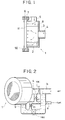
- Fig.1 is a sectional view showing a preferred embodiment of a surface combustion burner 1 according to the present invention.
- a casing 2 has a bottomed cylindrical form which is opened frontwards, a first tube 4 is fixedly secured at a suitable site to a bottom 3 of the casing 1 by suitable means, a second tube 5 is fixedly secured at a suitable site to the peripheral wall of the cylindrical casing also by suitable means, and the tubes 4 and 5 are connected to a fuel gas supply source through conduit means to be described later.
- the opened front end of the casing 2 terminates in a portion 6 of enlarged diameter having a predetermined depth and a plurality of openings 7 are formed in the enlarged diameter portion 6.
- a cylindrical partition wall 8 having a smaller diameter than that of the casing 2 is fixedly secured, inside the casing, to the bottom 3 thereof by suitable means.
- the partition wall 8 is flush with a front surface of the bottom of the enlarged diameter portion 6.
- a porous member 11 is received in the enlarged diameter portion 6 of the casing 2 and a tap member 50 having its peripheral edge portion formed with openings is applied so that the porous member may be mounted to the casing 2 securedly by means of bolts and nuts.
- a heat insulating packing may be interposed between the porous member 11 and the tap plate 50.
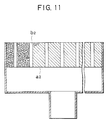
- the surface combustion burner constructed as above differs from the conventional burners shown in Figs.9, 10 and 11 in that the mixing chamber is divided into a first mixing chamber defined by the bottom 3 of casing 2, the inner surface of partition wall 8 and the porous member 11, and a second mixing chamber surrounding the outer periphery of the first mixing chamber and defined by the bottom 3 of casing 2, the outer surface of partition wall 8, the inner surface of the cylindrical peripheral wall of casing 2 and the porous member 2, the first and second mixing chambers being independent of each other.
- a fuel gas mixture coming from the cylindrical tube 4 passes through the first mixing chamber and a central portion of the porous member so as to be burnt at the surface thereof, whereas a fuel gas mixture coming from the tube 5 passes through the second mixing chamber and a peripheral portion of the porous member so as to be burnt at the surface thereof, thus substantially preventing the fuel gas mixtures from mixing together.
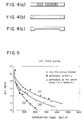
- Fig.2 shows an embodiment of a piping system for use with the surface combustion burner according to the invention.
- a gas pipe arrangement a is connected to a suitable fuel supply source not shown and merges into two branches of which one is connected to the first tube 4, directly in communication with the first mixing chamber, through a flow control valve v1 and the other is similarly connected to the second cylindrical tube 5, in communication with the second mixing chamber, through a flow control valve v2.
- An air pipe arrangement b is connected to an air supply source not shown and also merges into two branches of which one is connected to the first tube 4, in communicatlion with the first mixing chamber, through a flow control valve val and the other is similarly connected to the second tube 5, in communication with the second mixing chamber, through a flow control valve va2.
- fuel gas and air respectively supplied from the suitable sources to the gas pipe arrangement a and air pipe arrangement b in accordance with the burner use ambience are suitably regulated by means of the flow control valves v1, v2, va1 and va2, so that fuel gas mixtures at different air ratios are supplied to the first and second mixing chambers simultaneously.
- Fig.3 demonstrates that at the same air ratio, the surface combustion burner of the present invention can maintain a stable combustion state in higher combustion load conditions.
- voids are distribuled substantially uniformly, having a percentage of voids of 96 % and a surface area of 132 cm2.
- a second embodiment of the invention will now be described wherein in a surface combustion burner comprising a porous member having its front surface constituting a combustion surface, the porous member has a resistance against the flow velocity of fuel gas mixture which is made to be higher at a peripheral edge nearby region of the porous member than at the remaining region.
- the conventionally known burner for example, described with reference to Figs.9.10 and 11 can be used without alternation or the surface combustion burner 1 according to the first embodiment described previously can also be used, provided that the porous member is shaped differently. Accordingly, the following description will be given of only the porous member and any description of the burner per se will be omitted.
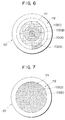
- the resistance against the flow velocity of fuel gas mixture can be made to be different for the peripheral edge nearby region of the porous member and the remaining region as exemplified at (a) in Fig.4 wherein a great number of through holes are formed in a region of the porous member excepting its peripheral edge nearby region, as exemplified at (b) in Fig.4 wherein a material forming the porous member has a percentage of voids which is large at the peripheral edge nearby region and small at the remaining region or as exemplified at (c) in Fig.4 wherein the thickness of the porous member is made to be larger at the peripheral edge nearby region than at the remaining region.
- the peripheral edge nearby region " of the porous member has no critical meaning and its optimum area can be determined numerically through experiments by taking into account the size of the burner, the size of the porous member, the kind of a fuel gas mixture used and the use ambience of the burner. Further, the porous member and "the peripheral edge nearby region” can be shaped desirably. The size and number of the through holes to be provided. the difference in percentage of voids and the difference in thickness can also be determined experimentally.
- the porous member used was made of iron, chromium, silicon, aluminum or yttrium, having in its original form an effective surface area of 169 cm2 and a percentage of voids, distributed substantially uniformly, of 81 % and it was used as it was for the aforementioned case (a), was altered or modified for the case (b) such that a great number of through holes having each a diameter of 1.0mm are formed to provide a percentage of voids of 96 % over the entire region and was modified for the case (c) such that a peripheral edge nearby region and a central region are defined concentrically to have an area ratio of the former region to the latter region which is 1.15 : 1 and a plurality of through holes having each a diameter of 1.1mm are formed in the central region to provide a percentage of voids of 96 %.
- the air ratio was measured at the central portion of the porous member of the burner used.
- the surface combustion burner using the porous member according to the invention can maintain a stable combustion state even in higher combustion load conditions as compared to the conventional surface combustion burner.
- the resistance against the flow velocity at the peripheral edge nearby region of the porous member forming the combustion surface is different from that at the remaining region (an inward main combustion portion). Accordingly, in the burner using the porous member of this embodiment, a fuel gas mixture is resisted more largely at the peripheral edge region on the combustion surface than at the central portion even when the fuel gas mixture is supplied to the mixing chamber uniformly under the same condition, and quantity of fuel gas mixture supply peripheral edge and central portions. Consequently, when the burner is used at a low combustion load, main combustion is carried out giving off stable flames at the central region where the resistance is low.
- a third embodiment of the invention will now be described wherein in a surface combustion burner comprising a porous member having its front surface constituting a combustion surface, a great number of through holes having diameters each larger than that of a small porosity of the porous member are formed in the porous member substantially vertically to the surface thereof and the great number of through holes are sorted into several kinds of groups of through holes having different diameters.
- the surface combustion burner 1 according to the previously-described first embodiment of the invention or for example, the conventionally known burners described with reference to Figs.9, 10 and 11 can be used without alternation as the burner proper, provided that the porous member is shaped differently as will be described with reference to Figs.6 and 7. Accordingly, in the following, only the porous member will be described principally and the burner per se will not be described.
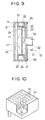
- FIGs.6 and 7 are plan views showing examples of porous member.
- a porous member 101 illustrated therein is formed of thin metal fibers which are conglomerated in the form of an unwoven sheet having a great number of small porosities of about 100 ⁇ m diameter.
- This planar porous member 101 covers both of a central high load lean premixed combustion region 111 corresponding to the first mixing chamber of the surface combustion burner shown in Fig.1 and a peripheral stable combustion region 112 corresponding to the peripheral second mixing chamber.
- a great number of through holes 113 having diameters larger than that of the small porosities of the porous member are formed substantially vertically to the surface thereof, and the great number of through holes 113 are sorted into several kinds of groups of through holes having different diameters.
- the several kinds of groups of through holes having different diameters may be arranged randomly but preferably the arrangement may be patterned according to a predetermined rule.
- a first example shown in Fig.6 groups of three kinds of different-diameter through holes 113A (D1.0-P2.5), 113B (D3.0-P5.0) and 113C (D5.0 -P7.5) are arranged, in the circular central portion 111 standing for the high load lean premixed combustion region of the porous member 101, from the center of the porous member to the outer periphery in the order of A-B-C-A, so that the through holes 113 are formed in a pattern in which the diameter is changed stepwise (where D represents the diameter of a through hole(mm) and P represents the mean distance between adhacent through holes(mm)).
- the stable combustion limit of surface combustion burners respectively having porous members 101 formed with patterns of through holes as described previoulsy was compared with that of a surface combustion burner having a planar porous member which, as in the foregoing embodiments, has a peripheral stable combustion region and a high load lean premixed combustion region positioned inwardly of the stable combustion region and has through holes (D1.0-P2.5) of uniform size formed in the high load lean premixed combustion region.
- Results are shown in Fig.8 (where the pattern shown in Fig.6 is denoted by hole pattern 1 and the pattern shown in Fig.7 is denoted by hole pattern 2). It should be understood that the surface combustion burners according to the invention are clearly improved in the stable combustion limit as compared to the conventional surface combustion burner.
- the present invention has been described by way of preferred embodiments thereof but it is not limited thereto and may be modified in various ways.
- the whole shape of the casing is not limited to the cylindrical shape of circular cross section but may have a cylindrical shape of square or elliptic cross section, and besides the partition wall defining the first and second mixing chambers may have a desired shape.
- the volume ratio between the first and second mixing chambers or the ratio between surface areas of the porous member which contact the first and second mixing chambers are not limited to those described previously but may be set experimentally to optimum values in accordance with the use ambiance of the burner.
- the construction of the surface combustion burner, excepting the structure of the porous member 101, used in the third embodiment is not limited to that shown in Figs.1 and 2 but the third embodiment may be applied to a different type of construction, for example, having no partition wall 8 for partitioning the mixing chamber, and besides the pattern of through holes is not limited to those shown in Figs.6 and 7 but may be realized with various forms, provided that two or more kinds of groups of through holes having different diameters which are larger than the diameter of a small porosities of the porous member are distributed substantially uniformly over the combustion surface.
- the surface combustion burner of the present invention has the construction set forth hereinbefore and especially, in the first embodiment, fuel gas mixtures can be supplied at different air ratios to the central and peripheral portions of the porous member serving as the combustion surface and by selecting the air ratios suitably, high load lean premixed combustion can be performed for a long time under the condition that NOx is less generated than in the co conventional burner.
- the flow velocity of fuel gas mixture can be changed partly at the high load lean premixed combustion region on the combustion surface by employing the simple construction in which several kinds of groups of through holes of different diameters are formed in the porous member in accordance with a predetermined pattern, whereby even when the combustion load changes, some portions of the combustion surface can behave as a stable combustion region which stabilizes surrounding unstable combustion portions.
- This permits the high load lean premixed combustion to be performed stably over a wide combustion load range and consequently ensures suppression of generation of NOx.
Landscapes
- Engineering & Computer Science (AREA)
- Chemical & Material Sciences (AREA)
- Combustion & Propulsion (AREA)
- Mechanical Engineering (AREA)
- General Engineering & Computer Science (AREA)
- Gas Burners (AREA)
Applications Claiming Priority (6)
| Application Number | Priority Date | Filing Date | Title |
|---|---|---|---|
| JP341334/91 | 1991-12-24 | ||
| JP34133691A JP2674722B2 (ja) | 1991-12-24 | 1991-12-24 | 表面燃焼バーナ及びその多孔質部材 |
| JP341336/91 | 1991-12-24 | ||
| JP3341334A JP2702027B2 (ja) | 1991-12-24 | 1991-12-24 | 表面燃焼バーナ |
| JP1992033673U JP2573197Y2 (ja) | 1992-05-21 | 1992-05-21 | 表面燃焼バーナ |
| JP33673/92U | 1992-05-21 |
Publications (3)
| Publication Number | Publication Date |
|---|---|
| EP0549476A2 true EP0549476A2 (de) | 1993-06-30 |
| EP0549476A3 EP0549476A3 (en) | 1993-08-18 |
| EP0549476B1 EP0549476B1 (de) | 1998-09-23 |
Family
ID=27288168
Family Applications (1)
| Application Number | Title | Priority Date | Filing Date |
|---|---|---|---|
| EP92403548A Expired - Lifetime EP0549476B1 (de) | 1991-12-24 | 1992-12-23 | Brenner mit Oberflächenverbrennung |
Country Status (3)
| Country | Link |
|---|---|
| US (1) | US5496171A (de) |
| EP (1) | EP0549476B1 (de) |
| DE (1) | DE69227094T2 (de) |
Cited By (8)
| Publication number | Priority date | Publication date | Assignee | Title |
|---|---|---|---|---|
| DE19548439A1 (de) * | 1994-12-28 | 1996-07-11 | Yazaki Corp | Verfahren zum Crimpen eines Kontaktelementes und Vorrichtung für das Verfahren |
| EP0718551A3 (de) * | 1994-12-20 | 1996-12-18 | Schott Glaswerke | Strahlungsbrenner mit einer gasdurchlässigen Brennerplatte |
| WO2005064233A1 (en) * | 2003-12-29 | 2005-07-14 | Lg Electronics Inc. | Burner assembly for gas burners of radiant heating type |
| DE19847042B4 (de) * | 1998-10-13 | 2008-05-29 | Ceramat, S. Coop., Asteasu | Hochporöse Brennermatte für Gas- und/oder Ölbrenner |
| WO2011147654A1 (en) * | 2010-05-25 | 2011-12-01 | Solaronics S.A. | Burner element having local differences in physical properties |
| US9212818B2 (en) | 2010-11-16 | 2015-12-15 | Ulrich Dreizler | Displacement method for the production of a burner fabric membrane for a cool flame base |
| US9360210B2 (en) | 2010-11-16 | 2016-06-07 | Ulrich Dreizler | Combustion method with cool flame base |
| CN110461437A (zh) * | 2017-01-06 | 2019-11-15 | 阿尔泽塔公司 | 用于改善废气消减的系统和方法 |
Families Citing this family (13)
| Publication number | Priority date | Publication date | Assignee | Title |
|---|---|---|---|---|
| CA2231425A1 (en) * | 1995-09-20 | 1997-03-27 | Texas Heart Institute | Detecting thermal discrepancies in vessel walls |
| US6435861B1 (en) * | 1997-06-10 | 2002-08-20 | Usf Filtration And Separations Group, Inc. | Gas burner assembly and method of making |
| US6176977B1 (en) * | 1998-11-05 | 2001-01-23 | Sharper Image Corporation | Electro-kinetic air transporter-conditioner |
| US6183241B1 (en) | 1999-02-10 | 2001-02-06 | Midwest Research Institute | Uniform-burning matrix burner |
| US20050095182A1 (en) * | 2003-09-19 | 2005-05-05 | Sharper Image Corporation | Electro-kinetic air transporter-conditioner devices with electrically conductive foam emitter electrode |
| ITLU20050015A1 (it) * | 2005-06-07 | 2006-12-08 | Pietro Biagioni | "caldaia a gasolio con spirali piatte" |
| FR2899956B1 (fr) * | 2006-04-14 | 2008-07-25 | Thirode Grandes Cuisines Poligny | Bruleur a gaz pour four de cuisine |
| EP2079961B1 (de) * | 2006-11-08 | 2015-12-23 | Flare Industries, LLC | Modulares Fackelrohr und dessen Verwendung zur Abfackelung von Abgasen |
| US10690340B2 (en) * | 2010-01-06 | 2020-06-23 | Precision Combustion, Inc. | Flameless cooking appliance |
| EP2956717B1 (de) * | 2013-02-14 | 2020-07-08 | ClearSign Technologies Corporation | Kraftstoffverbrennungssystem mit perforiertem reaktionshalter |
| CA2922014A1 (en) * | 2013-09-23 | 2015-03-26 | Clearsign Combustion Corporation | Porous flame holder for low nox combustion |
| DE102013220653B4 (de) * | 2013-10-14 | 2019-12-05 | Eberspächer Climate Control Systems GmbH & Co. KG | Brennkammerbaugruppe, insbesondere für einen Verdampferbrenner |
| KR20180121600A (ko) * | 2016-03-10 | 2018-11-07 | 셀라스 히트 테크놀로지 캄파니 엘엘씨 | 고강도 가스 연소 적외선 방출기 |
Family Cites Families (16)
| Publication number | Priority date | Publication date | Assignee | Title |
|---|---|---|---|---|
| US3077922A (en) * | 1958-03-10 | 1963-02-19 | Whirlpool Co | Gas burner |
| US3150711A (en) * | 1960-12-23 | 1964-09-29 | Acme Steel Co | Gas burner |
| FR1552220A (de) * | 1967-11-23 | 1969-01-03 | ||
| US3606612A (en) * | 1969-10-20 | 1971-09-20 | Columbia Gas Syst | Gas burner and control |
| US3772427A (en) * | 1971-06-14 | 1973-11-13 | Gen Electric | Combustion process for producing high surface area silica |
| US3843313A (en) * | 1973-07-23 | 1974-10-22 | Raytheon Co | Multi-cavity radiant burner |
| JPS61106727A (ja) * | 1984-10-30 | 1986-05-24 | Ito Seitetsushiyo:Kk | 熱間圧延条鋼等の表面強化のための冷却装置 |
| JPS61106728A (ja) * | 1984-10-31 | 1986-05-24 | Nippon Kokan Kk <Nkk> | 塊成鉱及びその製造方法 |
| US5008432A (en) * | 1985-07-11 | 1991-04-16 | Phillips Petroleum Company | Production of mercapto compounds |
| JPH0743100B2 (ja) * | 1985-09-13 | 1995-05-15 | 三浦工業株式会社 | 高負荷燃焼バーナ |
| JPS6280417A (ja) * | 1985-10-04 | 1987-04-13 | Ngk Insulators Ltd | バ−ナエレメント |
| JPS62258917A (ja) * | 1986-04-18 | 1987-11-11 | Miura Co Ltd | セラミック粒子からなる助燃体を用いた表面燃焼バーナ |
| EP0331037B1 (de) * | 1988-02-27 | 1995-01-04 | Osaka Gas Co., Ltd. | Gasbrenner |
| DE8908324U1 (de) * | 1989-07-07 | 1990-11-08 | Graef, Peter, 8671 Schönwald | Brenner zum Beheizen von Brennöfen mit gasförmigen Brennstoffen |
| ES2018441A6 (es) * | 1989-12-11 | 1991-04-01 | Catalana Gas Sa | Perfeccionamientos en quemadores para encimeras vitroceramicas a gas. |
| JP2904130B2 (ja) * | 1996-06-13 | 1999-06-14 | 日本電気株式会社 | プログラム誤動作検出開発支援装置およびプログラム誤動作検出方法 |
-
1992
- 1992-12-23 EP EP92403548A patent/EP0549476B1/de not_active Expired - Lifetime
- 1992-12-23 DE DE69227094T patent/DE69227094T2/de not_active Expired - Fee Related
-
1994
- 1994-08-25 US US08/295,491 patent/US5496171A/en not_active Expired - Fee Related
Cited By (9)
| Publication number | Priority date | Publication date | Assignee | Title |
|---|---|---|---|---|
| EP0718551A3 (de) * | 1994-12-20 | 1996-12-18 | Schott Glaswerke | Strahlungsbrenner mit einer gasdurchlässigen Brennerplatte |
| US5800156A (en) * | 1994-12-20 | 1998-09-01 | Schott-Glaswerke | Radiant burner with a gas-permeable burner plate |
| DE19548439A1 (de) * | 1994-12-28 | 1996-07-11 | Yazaki Corp | Verfahren zum Crimpen eines Kontaktelementes und Vorrichtung für das Verfahren |
| DE19847042B4 (de) * | 1998-10-13 | 2008-05-29 | Ceramat, S. Coop., Asteasu | Hochporöse Brennermatte für Gas- und/oder Ölbrenner |
| WO2005064233A1 (en) * | 2003-12-29 | 2005-07-14 | Lg Electronics Inc. | Burner assembly for gas burners of radiant heating type |
| WO2011147654A1 (en) * | 2010-05-25 | 2011-12-01 | Solaronics S.A. | Burner element having local differences in physical properties |
| US9212818B2 (en) | 2010-11-16 | 2015-12-15 | Ulrich Dreizler | Displacement method for the production of a burner fabric membrane for a cool flame base |
| US9360210B2 (en) | 2010-11-16 | 2016-06-07 | Ulrich Dreizler | Combustion method with cool flame base |
| CN110461437A (zh) * | 2017-01-06 | 2019-11-15 | 阿尔泽塔公司 | 用于改善废气消减的系统和方法 |
Also Published As
| Publication number | Publication date |
|---|---|
| EP0549476B1 (de) | 1998-09-23 |
| US5496171A (en) | 1996-03-05 |
| EP0549476A3 (en) | 1993-08-18 |
| DE69227094T2 (de) | 1999-03-11 |
| DE69227094D1 (de) | 1998-10-29 |
Similar Documents
| Publication | Publication Date | Title |
|---|---|---|
| US5496171A (en) | Surface combustion burner | |
| US4480988A (en) | Surface combustion type burner with air supply entirely as primary air | |
| US6129545A (en) | Gas burner with pollution-reducing features | |
| US5879154A (en) | Flame spreader-type fuel burner with lowered NOx emissions | |
| US5490778A (en) | Burner | |
| US6093018A (en) | Gas burner | |
| US4569652A (en) | Combustion cylinder construction for oil space heater | |
| JP3488634B2 (ja) | 水素表面燃焼バーナ | |
| EP0084451B1 (de) | Ölbrenner | |
| JP2674722B2 (ja) | 表面燃焼バーナ及びその多孔質部材 | |
| JP2702027B2 (ja) | 表面燃焼バーナ | |
| JP2573197Y2 (ja) | 表面燃焼バーナ | |
| KR0148089B1 (ko) | 예혼합방식의 고부하.저공해 가정용 가스버너 | |
| JPH0344977Y2 (de) | ||
| JPH0278813A (ja) | 燃焼装置 | |
| JPH05172313A (ja) | 表面燃焼バーナ | |
| JP3447252B2 (ja) | 触媒燃焼装置 | |
| JPS59112111A (ja) | 予混合式燃焼器 | |
| JPS6115391Y2 (de) | ||
| JP2502622B2 (ja) | 燃焼装置 | |
| JPS60191104A (ja) | 燃焼器 | |
| JPH081281B2 (ja) | バ−ナ | |
| GB2317221A (en) | Oil fired apparatus | |
| JPS61134513A (ja) | 石油燃焼器 | |
| JPS613912A (ja) | ブラストバ−ナ |
Legal Events
| Date | Code | Title | Description |
|---|---|---|---|
| PUAI | Public reference made under article 153(3) epc to a published international application that has entered the european phase |
Free format text: ORIGINAL CODE: 0009012 |
|
| AK | Designated contracting states |
Kind code of ref document: A2 Designated state(s): DE FR GB NL |
|
| PUAL | Search report despatched |
Free format text: ORIGINAL CODE: 0009013 |
|
| AK | Designated contracting states |
Kind code of ref document: A3 Designated state(s): DE FR GB NL |
|
| 17P | Request for examination filed |
Effective date: 19940129 |
|
| 17Q | First examination report despatched |
Effective date: 19950512 |
|
| GRAG | Despatch of communication of intention to grant |
Free format text: ORIGINAL CODE: EPIDOS AGRA |
|
| GRAG | Despatch of communication of intention to grant |
Free format text: ORIGINAL CODE: EPIDOS AGRA |
|
| GRAH | Despatch of communication of intention to grant a patent |
Free format text: ORIGINAL CODE: EPIDOS IGRA |
|
| GRAH | Despatch of communication of intention to grant a patent |
Free format text: ORIGINAL CODE: EPIDOS IGRA |
|
| GRAA | (expected) grant |
Free format text: ORIGINAL CODE: 0009210 |
|
| AK | Designated contracting states |
Kind code of ref document: B1 Designated state(s): DE FR GB NL |
|
| REF | Corresponds to: |
Ref document number: 69227094 Country of ref document: DE Date of ref document: 19981029 |
|
| PGFP | Annual fee paid to national office [announced via postgrant information from national office to epo] |
Ref country code: DE Payment date: 19981031 Year of fee payment: 7 |
|
| PGFP | Annual fee paid to national office [announced via postgrant information from national office to epo] |
Ref country code: GB Payment date: 19981211 Year of fee payment: 7 |
|
| PGFP | Annual fee paid to national office [announced via postgrant information from national office to epo] |
Ref country code: NL Payment date: 19981231 Year of fee payment: 7 Ref country code: FR Payment date: 19981231 Year of fee payment: 7 |
|
| ET | Fr: translation filed | ||
| PLBE | No opposition filed within time limit |
Free format text: ORIGINAL CODE: 0009261 |
|
| 26N | No opposition filed | ||
| PG25 | Lapsed in a contracting state [announced via postgrant information from national office to epo] |
Ref country code: GB Free format text: LAPSE BECAUSE OF NON-PAYMENT OF DUE FEES Effective date: 19991223 |
|
| PG25 | Lapsed in a contracting state [announced via postgrant information from national office to epo] |
Ref country code: NL Free format text: LAPSE BECAUSE OF NON-PAYMENT OF DUE FEES Effective date: 20000701 |
|
| GBPC | Gb: european patent ceased through non-payment of renewal fee |
Effective date: 19991223 |
|
| PG25 | Lapsed in a contracting state [announced via postgrant information from national office to epo] |
Ref country code: FR Free format text: LAPSE BECAUSE OF NON-PAYMENT OF DUE FEES Effective date: 20000831 |
|
| NLV4 | Nl: lapsed or anulled due to non-payment of the annual fee |
Effective date: 20000701 |
|
| PG25 | Lapsed in a contracting state [announced via postgrant information from national office to epo] |
Ref country code: DE Free format text: LAPSE BECAUSE OF NON-PAYMENT OF DUE FEES Effective date: 20001003 |
|
| REG | Reference to a national code |
Ref country code: FR Ref legal event code: ST |