EP0549932B1 - Als Baustoff verwendbares ökologisch unbedenkliches Entsorgungsprodukt aus Abfällen - Google Patents
Als Baustoff verwendbares ökologisch unbedenkliches Entsorgungsprodukt aus Abfällen Download PDFInfo
- Publication number
- EP0549932B1 EP0549932B1 EP19920121031 EP92121031A EP0549932B1 EP 0549932 B1 EP0549932 B1 EP 0549932B1 EP 19920121031 EP19920121031 EP 19920121031 EP 92121031 A EP92121031 A EP 92121031A EP 0549932 B1 EP0549932 B1 EP 0549932B1
- Authority
- EP
- European Patent Office
- Prior art keywords
- product
- refuse
- waste disposal
- temperatures
- building material
- Prior art date
- Legal status (The legal status is an assumption and is not a legal conclusion. Google has not performed a legal analysis and makes no representation as to the accuracy of the status listed.)
- Expired - Lifetime
Links
Images

Classifications
-
- A—HUMAN NECESSITIES
- A62—LIFE-SAVING; FIRE-FIGHTING
- A62D—CHEMICAL MEANS FOR EXTINGUISHING FIRES OR FOR COMBATING OR PROTECTING AGAINST HARMFUL CHEMICAL AGENTS; CHEMICAL MATERIALS FOR USE IN BREATHING APPARATUS
- A62D3/00—Processes for making harmful chemical substances harmless or less harmful, by effecting a chemical change in the substances
- A62D3/30—Processes for making harmful chemical substances harmless or less harmful, by effecting a chemical change in the substances by reacting with chemical agents
- A62D3/33—Processes for making harmful chemical substances harmless or less harmful, by effecting a chemical change in the substances by reacting with chemical agents by chemical fixing the harmful substance, e.g. by chelation or complexation
-
- A—HUMAN NECESSITIES
- A62—LIFE-SAVING; FIRE-FIGHTING
- A62D—CHEMICAL MEANS FOR EXTINGUISHING FIRES OR FOR COMBATING OR PROTECTING AGAINST HARMFUL CHEMICAL AGENTS; CHEMICAL MATERIALS FOR USE IN BREATHING APPARATUS
- A62D3/00—Processes for making harmful chemical substances harmless or less harmful, by effecting a chemical change in the substances
- A62D3/10—Processes for making harmful chemical substances harmless or less harmful, by effecting a chemical change in the substances by subjecting to electric or wave energy or particle or ionizing radiation
- A62D3/17—Processes for making harmful chemical substances harmless or less harmful, by effecting a chemical change in the substances by subjecting to electric or wave energy or particle or ionizing radiation to electromagnetic radiation, e.g. emitted by a laser
- A62D3/172—Gamma rays, i.e. radiation having a wavelength of about 0.003nm to 0.03 nm
-
- C—CHEMISTRY; METALLURGY
- C04—CEMENTS; CONCRETE; ARTIFICIAL STONE; CERAMICS; REFRACTORIES
- C04B—LIME, MAGNESIA; SLAG; CEMENTS; COMPOSITIONS THEREOF, e.g. MORTARS, CONCRETE OR LIKE BUILDING MATERIALS; ARTIFICIAL STONE; CERAMICS; REFRACTORIES; TREATMENT OF NATURAL STONE
- C04B18/00—Use of agglomerated or waste materials or refuse as fillers for mortars, concrete or artificial stone; Treatment of agglomerated or waste materials or refuse, specially adapted to enhance their filling properties in mortars, concrete or artificial stone
- C04B18/04—Waste materials; Refuse
- C04B18/18—Waste materials; Refuse organic
-
- C—CHEMISTRY; METALLURGY
- C04—CEMENTS; CONCRETE; ARTIFICIAL STONE; CERAMICS; REFRACTORIES
- C04B—LIME, MAGNESIA; SLAG; CEMENTS; COMPOSITIONS THEREOF, e.g. MORTARS, CONCRETE OR LIKE BUILDING MATERIALS; ARTIFICIAL STONE; CERAMICS; REFRACTORIES; TREATMENT OF NATURAL STONE
- C04B20/00—Use of materials as fillers for mortars, concrete or artificial stone according to more than one of groups C04B14/00 - C04B18/00 and characterised by shape or grain distribution; Treatment of materials according to more than one of the groups C04B14/00 - C04B18/00 specially adapted to enhance their filling properties in mortars, concrete or artificial stone; Expanding or defibrillating materials
- C04B20/02—Treatment
-
- C—CHEMISTRY; METALLURGY
- C04—CEMENTS; CONCRETE; ARTIFICIAL STONE; CERAMICS; REFRACTORIES
- C04B—LIME, MAGNESIA; SLAG; CEMENTS; COMPOSITIONS THEREOF, e.g. MORTARS, CONCRETE OR LIKE BUILDING MATERIALS; ARTIFICIAL STONE; CERAMICS; REFRACTORIES; TREATMENT OF NATURAL STONE
- C04B26/00—Compositions of mortars, concrete or artificial stone, containing only organic binders, e.g. polymer or resin concrete
- C04B26/02—Macromolecular compounds
- C04B26/10—Macromolecular compounds obtained otherwise than by reactions only involving carbon-to-carbon unsaturated bonds
- C04B26/16—Polyurethanes
-
- A—HUMAN NECESSITIES
- A62—LIFE-SAVING; FIRE-FIGHTING
- A62D—CHEMICAL MEANS FOR EXTINGUISHING FIRES OR FOR COMBATING OR PROTECTING AGAINST HARMFUL CHEMICAL AGENTS; CHEMICAL MATERIALS FOR USE IN BREATHING APPARATUS
- A62D2101/00—Harmful chemical substances made harmless, or less harmful, by effecting chemical change
- A62D2101/08—Toxic combustion residues, e.g. toxic substances contained in fly ash from waste incineration
-
- A—HUMAN NECESSITIES
- A62—LIFE-SAVING; FIRE-FIGHTING
- A62D—CHEMICAL MEANS FOR EXTINGUISHING FIRES OR FOR COMBATING OR PROTECTING AGAINST HARMFUL CHEMICAL AGENTS; CHEMICAL MATERIALS FOR USE IN BREATHING APPARATUS
- A62D2101/00—Harmful chemical substances made harmless, or less harmful, by effecting chemical change
- A62D2101/20—Organic substances
-
- A—HUMAN NECESSITIES
- A62—LIFE-SAVING; FIRE-FIGHTING
- A62D—CHEMICAL MEANS FOR EXTINGUISHING FIRES OR FOR COMBATING OR PROTECTING AGAINST HARMFUL CHEMICAL AGENTS; CHEMICAL MATERIALS FOR USE IN BREATHING APPARATUS
- A62D2101/00—Harmful chemical substances made harmless, or less harmful, by effecting chemical change
- A62D2101/20—Organic substances
- A62D2101/22—Organic substances containing halogen
-
- A—HUMAN NECESSITIES
- A62—LIFE-SAVING; FIRE-FIGHTING
- A62D—CHEMICAL MEANS FOR EXTINGUISHING FIRES OR FOR COMBATING OR PROTECTING AGAINST HARMFUL CHEMICAL AGENTS; CHEMICAL MATERIALS FOR USE IN BREATHING APPARATUS
- A62D2101/00—Harmful chemical substances made harmless, or less harmful, by effecting chemical change
- A62D2101/20—Organic substances
- A62D2101/24—Organic substances containing heavy metals
-
- A—HUMAN NECESSITIES
- A62—LIFE-SAVING; FIRE-FIGHTING
- A62D—CHEMICAL MEANS FOR EXTINGUISHING FIRES OR FOR COMBATING OR PROTECTING AGAINST HARMFUL CHEMICAL AGENTS; CHEMICAL MATERIALS FOR USE IN BREATHING APPARATUS
- A62D2101/00—Harmful chemical substances made harmless, or less harmful, by effecting chemical change
- A62D2101/20—Organic substances
- A62D2101/28—Organic substances containing oxygen, sulfur, selenium or tellurium, i.e. chalcogen
-
- A—HUMAN NECESSITIES
- A62—LIFE-SAVING; FIRE-FIGHTING
- A62D—CHEMICAL MEANS FOR EXTINGUISHING FIRES OR FOR COMBATING OR PROTECTING AGAINST HARMFUL CHEMICAL AGENTS; CHEMICAL MATERIALS FOR USE IN BREATHING APPARATUS
- A62D2101/00—Harmful chemical substances made harmless, or less harmful, by effecting chemical change
- A62D2101/40—Inorganic substances
- A62D2101/43—Inorganic substances containing heavy metals, in the bonded or free state
-
- A—HUMAN NECESSITIES
- A62—LIFE-SAVING; FIRE-FIGHTING
- A62D—CHEMICAL MEANS FOR EXTINGUISHING FIRES OR FOR COMBATING OR PROTECTING AGAINST HARMFUL CHEMICAL AGENTS; CHEMICAL MATERIALS FOR USE IN BREATHING APPARATUS
- A62D2203/00—Aspects of processes for making harmful chemical substances harmless, or less harmful, by effecting chemical change in the substances
- A62D2203/04—Combined processes involving two or more non-distinct steps covered by groups A62D3/10 - A62D3/40
-
- C—CHEMISTRY; METALLURGY
- C04—CEMENTS; CONCRETE; ARTIFICIAL STONE; CERAMICS; REFRACTORIES
- C04B—LIME, MAGNESIA; SLAG; CEMENTS; COMPOSITIONS THEREOF, e.g. MORTARS, CONCRETE OR LIKE BUILDING MATERIALS; ARTIFICIAL STONE; CERAMICS; REFRACTORIES; TREATMENT OF NATURAL STONE
- C04B2103/00—Function or property of ingredients for mortars, concrete or artificial stone
- C04B2103/0004—Compounds chosen for the nature of their cations
-
- C—CHEMISTRY; METALLURGY
- C04—CEMENTS; CONCRETE; ARTIFICIAL STONE; CERAMICS; REFRACTORIES
- C04B—LIME, MAGNESIA; SLAG; CEMENTS; COMPOSITIONS THEREOF, e.g. MORTARS, CONCRETE OR LIKE BUILDING MATERIALS; ARTIFICIAL STONE; CERAMICS; REFRACTORIES; TREATMENT OF NATURAL STONE
- C04B2111/00—Mortars, concrete or artificial stone or mixtures to prepare them, characterised by specific function, property or use
- C04B2111/00474—Uses not provided for elsewhere in C04B2111/00
- C04B2111/00767—Uses not provided for elsewhere in C04B2111/00 for waste stabilisation purposes
-
- Y—GENERAL TAGGING OF NEW TECHNOLOGICAL DEVELOPMENTS; GENERAL TAGGING OF CROSS-SECTIONAL TECHNOLOGIES SPANNING OVER SEVERAL SECTIONS OF THE IPC; TECHNICAL SUBJECTS COVERED BY FORMER USPC CROSS-REFERENCE ART COLLECTIONS [XRACs] AND DIGESTS
- Y02—TECHNOLOGIES OR APPLICATIONS FOR MITIGATION OR ADAPTATION AGAINST CLIMATE CHANGE
- Y02W—CLIMATE CHANGE MITIGATION TECHNOLOGIES RELATED TO WASTEWATER TREATMENT OR WASTE MANAGEMENT
- Y02W30/00—Technologies for solid waste management
- Y02W30/50—Reuse, recycling or recovery technologies
- Y02W30/91—Use of waste materials as fillers for mortars or concrete
Definitions
- the invention relates to an ecologically harmless waste disposal product that can be used as a building material, and to a method for its production.
- EP 0 402 306 discloses a method for immobilizing dangerous substances contained in a liquid or semi-liquid organic mixture as an impurity by adding a cement-like material and substances which influence its hydration, setting behavior and permeability.
- German laid-open specification DE 34 27 502 discloses a method for producing a fire-resistant component by pressing chip material with substances which impart powder-like fire resistance and which are not hydraulic binders, and correspondingly manufactured components.
- WO 90/14130 discloses a plastic filled with a filler in which toxic substances are bound in synthetic resin in such a way that the product obtained is no longer toxic.
- the synthetic resin is the reaction product of a multi-component synthetic resin composition with a component with a nitrogen-containing reaction group, in particular NCO and a multi-component synthetic resin composition with a component with an oxygen-hydrogen component (OH group).
- the present invention provides a solution for the reuse of waste by putting it in a
- an ecologically sound disposal product that can be used as a building material is transferred from waste, which contains 30-80% by weight of organic material and has a fire resistance of over 65 minutes (DIN 4102).
- the disposal product according to the invention has a very wide range of uses, either alone or as a laminate with other materials, for example in building and civil engineering, in water and drainage construction, in gardening and landscaping and in sports facility construction.
- the disposal products can e.g. as filter and substrate material in road and sports facility construction, as heat and sound insulation and waterproof sewer insulation, fully composite bricks, drainage plates, building material for interior and exterior walls, fill insulation, cast screed, fire protection panels, exterior and interior plastering and much more.
- the disposal products according to the invention are completely harmless from an ecological point of view, since organic pollutants are either bound or converted into a harmless form and heavy metals are almost completely immobilized, so that the products according to the invention can be used in conventional processes (ELUAT-TEST -INERTSTOFFE according to TVA of December 10, 1990) less heavy metals are extracted than with conventional building materials made from "clean" raw materials.
- the advantages of the disposal products according to the invention are therefore not only their properties due to their composition and structure, which make them valuable building materials for many applications, but also their ecologically harmless disposal.
- the disposal products according to the invention also make it possible for waste to be stored in special waste landfills to be stored in normal waste landfill sites after their reuse in disposal products according to the invention, or by means of the likewise subject process forming this invention can again be converted into new building materials.
- Another object of the invention is a method for producing the waste disposal products according to the invention from waste.
- waste that can be used as starting materials are very diverse. Sewage sludge, flotation residues, household waste, packaging waste, contaminated soil, industrial filter residues, building rubble, residual chemicals, liquid manure and other agricultural waste are usually used, the process not being restricted to these starting materials.
- the waste to be disposed of is referred to below as secondary raw materials.
- Additives are added to these starting materials during the processing process. These additives are divided into two groups, the carriers or basic chemicals and the control chemicals or primary substances.
- Special waste can also be used as additives, so that the amount of pure chemicals resp. Materials can be greatly reduced, usually to about 7 wt .-%, based on the amount of secondary raw materials. By reducing the pure materials to be purchased, the disposal product becomes cheaper again.
- waste is also suitable as a source of additives: e.g. from antifreeze (glycols), from alcohol production, from oils, from oil derivatives, from refineries (especially polyols and ureas), from polyol-water mixtures, e.g. from paint manufacture, of certain ester compositions, Polyurethanes, isocyanates and iron salts.
- antifreeze glycols
- alcohol production from oils, from oil derivatives, from refineries (especially polyols and ureas)
- polyol-water mixtures e.g. from paint manufacture, of certain ester compositions, Polyurethanes, isocyanates and iron salts.
- Halogenated hydrocarbons respectively. whose by-products are used, for example fluorine-chlorohydrocarbons, as are known under the trade names "Freon".
- halogen-containing substances fluoride-containing substances
- radiation treatment can be carried out directly before reaction stage I, for example with 137 Cs or preferably with 60 Co.
- the ⁇ -radiation emitted by these radioisotopes at least partially eliminates the halogens from the organic substances.
- This upstream reaction can have a favorable effect on the reaction in stage I.
- waste is analyzed as soon as it is delivered and, according to the analysis, stored in different boxes and containers.
- presorted materials I can then be transported to the plant area on the basis of the recipe for the desired end product and the previous analysis and, if necessary, comminuted and mixed with one another. After the secondary raw materials to be processed have been mixed, they go into a post-mixing container in which the first basic chemicals II and the isocyanate are mixed.
- the isocyanate is a very important component because it reacts with existing, undesirable substances such as uric acid, ammonia, hormones (from sewage sludge and liquid manure) and residues of organic and pharmaceutical substances, so that they are then bound or converted into harmless compounds.
- these reaction products, as well as the reaction product formed between unreacted isocyanate and polyols, are an important part of the desired plastic structure, which makes up the excellent properties of the end product.
- isocyanates it is therefore necessary for isocyanates to be present in the starting mixture in a total amount of up to 0.3% by volume.
- Other substances that can be added to the secondary raw material mixture prior to the first reaction stage depending on the analysis, respectively. must include: lime, cement, gypsum, bentonite, slate, slag from incinerators, topsoil, sand and sludge of various types, straw, reeds and bark, with the addition of lime, preferably a mixture of baked and unbaked lime, is necessary.
- reaction stage I a mixture which contains at least some of the above-mentioned substances is at a pH of about 12 and at temperatures between 80 and 100 ° C and a pressure of 50 to 150 bar for at least 1- Reacted for 15 minutes.
- reaction mixture is corrected by a two-stage addition of control chemicals.
- isocyanates can be replenished at this stage.
- polyols (N) are added separately, which react with fatty acids, vegetable and / or animal oils and / or mineral oils, hydrocarbons and isocyanates.
- the main reaction II is generally carried out at this temperature and a pressure between 100 and 250 bar and a neutral pH, the highly viscous suspension being converted into a preformed molding compound.
- the quality of the molding compound is checked as part of an inspection. Dimensions. Here, a sample is structurally opened, ie crushed and chopped. If this sample does not meet the requirements, the overall reaction II product is structurally opened and either the reaction refinement or reaction stage I is fed. If the result of the test is positive, the product is brought to full structuring.
- the desired solidified structure is achieved at elevated temperature (150 to 250 ° C) and elevated pressure (150 to 350 bar).
- Hygiene already begins at reaction stage I, which is usually complete after reaction stage II.
- a post-reaction stage III is added after the full structuring, in which the products are temporarily stored using the remaining reaction temperature and under slight excess pressure.
- the subsequent final inspection decides whether the products are sent for further processing or run through the process again as secondary raw materials.
- the quantity ranges (in total) in which work is usually carried out are as follows: Secondary substances Cardboard, polystyrene, plastic 0 - 20 vol .-% Sewage sludge (TS 25%) 1 0 - 40 vol .-% Slag, filter dust, fly ash 0 - 30 vol .-% Household waste 0 - 50 vol .-% Total at least 20 vol .-% other waste materials Max. 60 vol .-% Content of critical 1 - 50 g / kg Metals organic portion approx.
- Both the multi-stage and the one-stage process have the advantage that despite high temperatures there is no odor nuisance, e.g. can be determined by escaping ammonia.
- the properties of the building materials according to the invention can also be adjusted to the requirements of their respective intended use. optimize, e.g. the reduction in pressure leads to a greater swelling of the structure and thus to an elastic product.
- Heavy metals and organic pollutants such as dioxins and formaldehyde can only be detected in the finished product using conventional test methods in amounts below the limit values, if at all.
Landscapes
- Chemical & Material Sciences (AREA)
- Engineering & Computer Science (AREA)
- Ceramic Engineering (AREA)
- Chemical Kinetics & Catalysis (AREA)
- Organic Chemistry (AREA)
- Structural Engineering (AREA)
- Materials Engineering (AREA)
- Toxicology (AREA)
- General Health & Medical Sciences (AREA)
- Business, Economics & Management (AREA)
- Emergency Management (AREA)
- General Chemical & Material Sciences (AREA)
- Health & Medical Sciences (AREA)
- Physics & Mathematics (AREA)
- Civil Engineering (AREA)
- Environmental & Geological Engineering (AREA)
- Optics & Photonics (AREA)
- Electromagnetism (AREA)
- Processing Of Solid Wastes (AREA)
- Building Environments (AREA)
- Manufacture Of Macromolecular Shaped Articles (AREA)
- Fire-Extinguishing Compositions (AREA)
Description
- Die Erfindung betrifft ein als Baustoff verwendbares ökologisch unbedenkliches Entsorgungsprodukt aus Abfällen sowie ein Verfahren zu dessen Herstellung.
- Aus der Fachliteratur sind viele Verfahren zur Entsorgung von Klärschlamm, Müll, Sondermüll und industriellen Abfällen bekannt. Die bisher verwendeten Verfahren sind aber grösstenteils mit mehr oder weniger grossen Nachteilen für die Umwelt behaftet.
- So führt z.B. der Einsatz von Klärschlamm infolge seiner Hormonbelastung sowie seiner Belastung mit medikamentösen Restsubstanzen, Pestiziden, Kohlenwasserstoffen etc. bei der Verwendung als Weiden- resp. Wiesendünger z.B. zur teilweisen Sterilität von Kühen.
- Bei der gängigen Verbrennung von Hausmüll entstehen neben Asche auch schädliche Abgase, die entweder in die Umgebung entweichen oder mittels einer Rauchgasreinigungsanlage aufgefangen werden. Bei einer allfälligen Rauchgasreinigung fallen jedoch abermals schwer zu entsorgende Abfälle an.
- Die meisten bekannten Verfahren sind nur Teillösungen und zielen darauf ab, die Abfallmenge zu verkleinern, wobei allerdings die Schadstoffbelastung in den verbleibenden Restmengen gewöhnlich um ein Vielfaches ansteigt.
- EP 0 402 306 offenbart ein Verfahren zur Immobilisierung von in einem flüssigen oder halbflüssigen organischen Gemisch als Verunreinigung enthaltenen gefährlichen Stoffen durch Zugabe eines zementartigen Materials sowie Substanzen, die dessen Hydratation, Abbindeverhalten und Permeabilität beeinflussen.
- Es wurden auch bereits Versuche unternommen, spezielle Abfälle in wiederverwendbares Material überzuführen. Solche werden z.B. in DE 34 67 502 und WO 90/14130 beschrieben.
- Die deutsche Offenlegungsschrift DE 34 27 502 offenbart ein Verfahren zur Herstellung eines feuerwiderstandsfähigen Bauteils durch Verpressen von Spanmaterial mit pulverförmigen Feuerwiderstandsfähigkeit verleihenden Substanzen, die nicht hydraulische Bindemittel sind, sowie entsprechend hergestellte Bauteile.
- WO 90/14130 offenbart einen mit einem Füllmittel gefüllten Kunststoff, in dem toxische Stoffe in Kunstharz derart gebunden sind, dass das erhaltene Produkt nicht mehr toxisch ist. Das Kunstharz ist das Reaktionsprodukt einer Mehrkomponenten-Kunstharzmasse mit einer Komponente mit stickstoffhaltiger Reaktionsgruppe, insbesondere NCO und einer Mehrkomponenten-Kunstharzmasse mit einer Komponente mit einer Sauerstoff-Wasserstoff-Komponente (OH-Gruppe).
- Wie der obengenannte Stand der Technik zeigt, kann sinnvoll wiederverwendbares Material gewöhnlich nur bei materialspezifischer Sammlung sowie unter hohem Energieaufwand gewonnen werden (z.B. Glas- und Aluminiumrecycling). Die Ueberführung von unsortiertem Abfall in eine wiederverwendbare, ökologisch unbedenkliche Form ohne Kreation von neuerlich schwerentsorgbaren Rückständen ist deshalb sehr wünschenswert.
- Die vorliegende Erfindung gibt eine Lösung für die Wiederverwendung von Abfall, indem dieser in ein z.B. als Baustoff verwendbares ökologisch unbedenkliches Entsorgungsprodukt aus Abfällen übergeführt wird, welches 30-80 Gew.-% organisches Material enthält und eine Brandbeständigkeit von über 65 Minuten aufweist (DIN 4102).
- Das erfindungsgemässe Entsorgungsprodukt findet sehr vielfältige Verwendungsmöglichkeiten, entweder allein oder als Laminat mit anderen Werkstoffen, beispielsweise im Hoch- und Tiefbau, im Wasser- und Drainagebau, im Garten- und Landschaftsbau und im Sportanlagebau. Die Entsorgungsprodukte können z.B. als Filter- und Substratmaterial im Strassen- und Sportanlagebau, als Wärme- und Schallisolationen und wasserfeste Kanalisolation, Vollverbundziegel, Drainageplatten, Baumaterial für Innen- und Aussenwände, Füllisolierung, Gussestrich, Brandschutzplatten, Aussen- und Innenverputz und vieles mehr eingesetzt werden.
- Trotz einer hohen Schadstoffbelastung der Ausgangsmaterialien (Abfälle) sind die erfindungsgemässen Entsorgungsprodukte ökologisch völlig unbedenklich, da organische Schadstoffe darin entweder gebunden oder in eine unschädliche Form übergeführt vorliegen und Schwermetalle nahezu vollständig immobilisiert sind, so dass aus den erfindungsgemässen Produkten bei gängigen Verfahren (ELUAT-TEST-INERTSTOFFE gemäss TVA vom 10. Dezember 1990) weniger Schwermetalle extrahiert werden als bei herkömmlichen, aus "sauberen" Ausgangsmaterialien hergestellten Baustoffen.
- Die Vorteile der erfindungsgemässen Entsorgungsprodukte sind deshalb nicht nur ihre durch die Zusammensetzung und Struktur bedingten Eigenschaften, die sie zu wertvollen Baustoffen für viele Anwendungen machen, sondern auch die ökologisch unbedenkliche Entsorgung. Die erfindungsgemässen Entsorgungsprodukte gestatten es auch, dass in Sondermülldeponien zu lagernde Abfälle nach ihrer Wiederverwendung in erfindungsgemässen Entsorgungsprodukten in normalen Mülldeponien gelagert werden können, respektive mittels des ebenfalls Gegenstand dieser Erfindung bildenden Verfahrens abermals in neuwertige Baustoffe umgewandelt werden können.
- Wie bereits erwähnt ist ein weiterer Gegenstand der Erfindung, ein Verfahren für die Herstellung der erfindungsgemässen Entsorgungsprodukte aus Abfällen.
- Die als Ausgangsstoffe einsetzbaren Arten von Abfällen sind sehr vielfältig. Ueblicherweise werden Klärschlamm, Flotationsrückstände, Hausmüll, Verpackungsabfälle, kontaminierte Böden, industrielle Filterrückstände, Bauschutt, Restchemikalien, Jauche und andere landwirtschaftliche Abfälle verwendet, wobei das Verfahren nicht auf diese Ausgangsstoffe beschränkt ist. Die zu entsorgenden Abfälle werden in der Folge als Sekundärrohstoffe bezeichnet.
- Diesen Ausgangsstoffen werden während des Verarbeitungsprozesses Zusatzstoffe beigegeben. Diese Zusatzstoffe werden in zwei Gruppen unterteilt, die Trägerstoffe oder Basischemikalien und die Steuerchemikalien oder Primärstoffe.
- Als Zusatzstoffe können ebenfalls spezielle Abfälle verwendet werden, so dass die Menge an reinen Chemikalien resp. Materialien stark reduziert werden kann, üblicherweise auf ca. 7 Gew.-%, bezogen auf die Sekundärrohstoffmenge. Durch die Verminderung der reinen, zuzukaufenden Materialien verbilligt sich das Entsorgungsprodukt abermals.
- Es ist selbstverständlich, dass sogar ausschliesslich mit Abfallstoffen gearbeitet werden kann, sofern durch diese ausreichende Mengen an Zusatzstoffen bereitgestellt werden können.
- Als Quellen für Zusatzstoffe eignen sich neben reinen Chemikalien auch Abfälle: beispielsweise von Frostschutzmitteln (Glykolen), aus der Alkoholherstellung, von Oelen, von Oelderivaten, aus Raffinerien (speziell Polyole und Harnstoffe), von Polyol-Wasser-Mischungen, z.B. aus der Farbenherstellung, von gewissen Ester-Zusammensetzungen, Polyurethanen, Isocyanaten und Eisensalzen.
- Es können auch Halogenkohlenwasserstoffe resp. deren Nebenprodukte eingesetzt werden, beispielsweise Fluor-Chlor-Kohlenwasserstoffe, wie sie unter den Handelsnamen "Freon" bekannt sind.
- Beim Einsatz halogenhaltiger Stoffe (Freone, Dioxine, PCB etc.) kann direkt vor der Reaktionsstufe I eine Strahlenbehandlung, beispielsweise mit 137Cs oder bevorzugt mit 60Co vorgenommen werden. Durch die von diesen Radioisotopen emittierte γ-Strahlung werden die Halogene mindestens teilweise aus den organischen Stoffen eliminiert. Diese vorgeschaltete Reaktion kann sich günstig auf die Reaktion in Stufe I auswirken.
- Es ist vorteilhaft, wenn die Abfälle bereits bei ihrer Anlieferung analysiert und der Analyse entsprechend in verschiedenen Boxen und Behältern gelagert werden.
- Bei dieser Analyse werden neben Metallen (gemäss TVA vom 10. Dezember 1991) auch der organische Anteil enthaltend Kohlenwasserstoffe, und eventuell Dioxine, Formaldehyd und ähnliches erfasst. Bei hohen Metallgehalten kann eine vorgeschaltete Metallrückgewinnung vorteilhaft sein, z.B. über Hydrometallurgie.
- Die Verarbeitung der Abfälle erfolgt bevorzugt nach dem in der Figur dargestellten Verfahren, in welchem
- I.
- Zu entsorgende Stoffe (Abfälle, Sekundärrohstoffe)
- II.
- Trägerstoffe (Basischemikalien)
- III.
- Steuerchemikalien (Primärstoffe)
- IV.
- Polyole
- A - E
- Analytische Prüfungen
- 1 - 7
- Aggregatverbindungsleitungen in Prozessablaufrichtung
- 8 - 10
- Rückführungsleitungen
- 11 - 14
- Aggregatverbindungsleitungen
- 15
- Reaktionsweiche
- 16 - 18
- Transportweg in Prozessablaufrichtung
- 19
- Rückführungsleitung
- 20
- Transportweg zur Weiterbearbeitung (mechanisch)
- Diese vorsortierten Materialien I können dann aufgrund der Rezeptur für das gewünschte Endprodukt und der vorgängigen Analyse in den Anlagenbereich transportiert und falls erforderlich, zerkleinert und miteinander vermischt werden. Nach erfolgter Vermengung der zu verarbeitenden Sekundärrohstoffe gelangen selbige in einen Nachmischbehälter, in dem die ersten Basischemikalien II sowie das Isocyanat zugemischt werden.
- Das Isocyanat ist ein sehr wichtiger Bestandteil, da es mit vorhandenen, unerwünschten Stoffen wie Harnsäure, Ammoniak, Hormonen (aus Klärschlamm und Jauche) sowie Resten von organischen und pharmazeutischen Substanzen reagiert, so dass diese anschliessend gebunden oder in unschädliche Verbindungen übergeführt vorliegen. Ausserdem sind diese Reaktionsprodukte, sowie das später gebildete Reaktionsprodukt zwischen noch nicht reagiertem Isocyanat und Polyolen, ein wichtiger Bestandteil der gewünschten Kunststoffstruktur, welche die hervorragenden Eigenschaften des Endprodukts ausmacht.
- Es ist deshalb notwendig, dass Isocyanate in der Ausgangsmischung in einer Gesamtmenge von bis zu 0,3 Volumen % vorhanden sind. Weitere Stoffe, die der Sekundärrohstoffmischung vorgängig zur ersten Reaktionsstufe je nach Analyse zugegeben werden können, resp. müssen, sind: Kalk, Zement, Gips, Bentonit, Tonschiefer, Schlacke aus Verbrennungsanlagen, Mutterboden, Sand und Schlämme verschiedener Art, Stroh, Schilf und Rinde, wobei der Zusatz von Kalk, bevorzugt eine Mischung aus gebranntem und ungebranntem Kalk, notwendig ist.
- In einer ersten Reaktionsstufe (Reaktionsstufe I) wird ein Gemenge, welches mindestens einige der obengenannten Stoffe enthält, bei einem pH-Wert von ca. 12 und bei Temperaturen zwischen 80 und 100°C und einem Druck von 50 bis 150 bar während mindestens 1-15 Minuten zur Reaktion gebracht. In diesem Reaktionsschritt wird eine verfestigte Struktur gebildet, welche kristalline Bereiche aufweist (= Vorhygienisierungs- und Neutralisationsstufe).
- In den nachfolgenden Verfahrensstufen kommt es zu einer Korrektur der Reaktionsmischung durch einen zweistufigen Zusatz von Steuerchemikalien.
- In einer ersten Stufe werden als Steuerchemikalien III Eisen(II)- und Eisen(III)-Salze und, falls notwendig, Aluminiumhydroxid, Borsäure, Natriumtetraborat, Salzsäure, Essigsäure, Alkohol, Natronlauge, Cellulose, Enzyme, Schwefel (bevorzugt Raffinerieschwefel = verunreinigter Elementarschwefel) Humussäure sowie luftporenbildende Zusätze zugegeben. In dieser Stufe kann allenfalls eine Nachdosierung von Isocyanaten stattfinden. Nachdem diese Zusätze mit dem Produkt aus der ersten Reaktionsstufe vermischt worden sind, werden separat Polyole (N) zugegeben, welche mit Fettsäuren, pflanzlichen und/oder tierischen Oelen und/oder Mineralölen, Kohlenwasserstoffen sowie Isocyanaten reagieren. Durch die exotherme Reaktion des bisher unreagierten Isocyanats mit den Polyolen steigt die Temperatur auf ca. 100-150°C. Hierbei wird eine faserbindende Vorstrukturierung erzielt. Die Hauptreaktion II wird im allgemeinen bei dieser Temperatur und einem Druck zwischen 100 und 250 bar und neutralem pH-Wert durchgeführt, wobei die hochviskose Suspension in eine vorgeformte Pressmasse umgewandelt wird.
- Nach dieser Umwandlung erfolgt im Rahmen einer Prüfung die Kontrolle der Beschaffenheit der Pressmasse. masse. Dabei wird eine Probe strukturell geöffnet, d.h. zerkleinert und zerhackt. Erfüllt diese Probe die Anforderungen nicht, so wird das Produkt der Hauptreaktion II gesamthaft strukturell geöffnet und entweder der Reaktionsverfeinerung oder der Reaktionsstufe I zugeführt. Ist das Ergebnis der Prüfung positiv, so wird das Produkt der Vollstrukturierung zugeführt.
- Im Vollstrukturierungsprozess wird bei erhöhter Temperatur (150 bis 250 °C) und erhöhtem Druck (150 bis 350 bar) die gewünschte verfestigte Struktur erzielt.
- Es hat sich gezeigt, dass das Produkt gelegentlich schon nach der Hauptreaktion II die gewünschten Eigenschaften aufweist. Die Vollstrukturierung kann in diesen Fällen ausgelassen werden.
- Bereits bei der Reaktionsstufe I setzt eine Hygienisierung ein, die meist nach der Reaktionsstufe II vollständig ist. Zur Sicherheit wird allerdings nach der Vollstrukturierung noch eine Nachreaktionsstufe III nachgeschaltet, in der die Produkte unter Ausnutzung der restlichen Reaktionstemperatur und unter geringem Ueberdruck zwischengelagert werden.
- Die anschliessende Endkontrolle entscheidet, ob die Produkte der Weiterverarbeitung zugeführt werden oder als Sekundärrohstoffe den Prozess abermals durchlaufen.
- Die Mengenbereiche (gesamthaft), in denen üblicherweise gearbeitet wird, sind folgende:
Sekundärstoffe Karton, Styropor, Plaste 0 - 20 Vol.-% Klärschlamm (TS 25 %) 1 0 - 40 Vol.-% Schlacke, Filterstaub, Flugasche 0 - 30 Vol.-% Hausmüll 0 - 50 Vol.-% Total mind. 20 Vol.-% weitere Abfallstoffe max. 60 Vol.-% Gehalt an kritischen 1 - 50 g/kg Metallen organischer Anteil ca. 30 - 95 Vol.-% Zusatzstoffe: Isocyanat 0.2 - 0.7 Vol.-% Basischemikalien 2 -10 Vol.-% Steuerchemikalien 0.2 - 1.1 Vol.-% Polyole 2 - 7 Vol.-% 1 TS = Trockensubstanz - Technologisch ist das Verfahren so ausgelegt, dass jede Prozessstufe nach Bedarf angesteuert werden kann (vgl. Figur). Es hat sich auch gezeigt, dass ein Einstufenverfahren mit entsprechend verlängerten Reaktionszeiten sowie angepassten Druck- und Temperaturbedingungen zu durchaus brauchbaren Produkten führt. Im Einstufenverfahren werden oft Temperaturen bis 350°C erreicht.
- Sowohl das mehrstufige als auch das einstufige Verfahren haben den Vorteil, dass trotz hoher Temperaturen keine Geruchsbelästigung, z.B. durch entweichenden Ammoniak festzustellen ist.
- Durch Variation der Zusatzstoffe, der Temperatur und des Drucks lassen sich ausserdem die Eigenschaften der erfindungsgemässen Baustoffe auf die Erfordernisse ihres jeweiligen Verwendungszwecks einstellen resp. optimieren, z.B. führt die Verringerung des Drucks zu einem stärkeren Aufquellen der Struktur und somit zu einem elastischen Produkt.
- Im fertigen Produkt sind Schwermetalle und organische Schadstoffe wie Dioxine und Formaldehyd mit gängigen Testverfahren nur noch in Mengen unterhalb der Grenzwerte, falls überhaupt, nachweisbar.
- Das nachfolgende Beispiel soll das Verfahren näher erläutern:
-

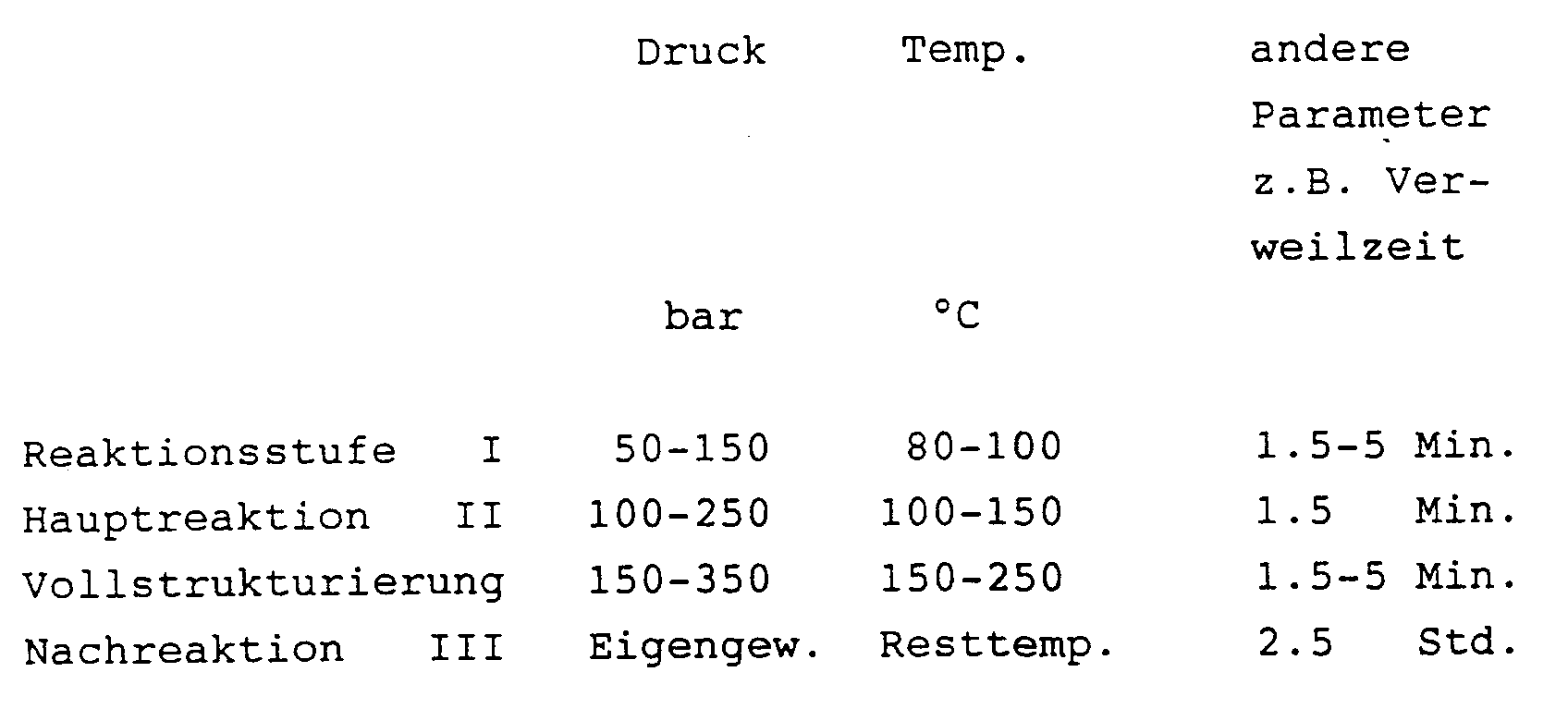
- Die 2.5 Std. der Nachreaktion geben die Sicherheit, dass das Produkt Seuchenhygienisch unbedenklich gemäss Merkblatt M7 des BRD Bundesgesetzes ist. Es hat sich gezeigt, dass die Parameter im angegebenen Rahmen variieren können, ohne dass das Endprodukt nachteilig verändert wird.
Claims (12)
- Als Baustoff verwendbares ökologisch unbedenkliches Entsorgungsprodukt aus Abfällen, dadurch gekennzeichnet, dass es herstellbar ist durch Vermischen von Abfällen mit Isocyanaten, Kalk, Eisen(II)- und Eisen (III)-Salzen sowie Polyolen oder diese enthaltenden Materialien, die gegebenenfalls ebenfalls Abfälle sein können, und zur Reaktion bringen dieser Mischung bei Temperaturen bis 350°C und Drücken bis 350 bar und dass es von 30 bis 80 Gew.-% organisches Material enthält und eine Brandbeständigkeit, bestimmt nach DIN 4102 vom Mai 1981, bis über 65 Minuten aufweist.
- Entsorgungsprodukt nach Anspruch 1, dadurch gekennzeichnet, dass es Schwermetalle in einer solchen Form enthält, dass sie bei ELUAT TESTS gemäss TVA vom 10. Dezember 1990 in Mengen unter und in den Grenzen von Inertstoffen sind.
- Entsorgungsprodukt nach Anspruch 1 oder 2, dadurch gekennzeichnet, dass es ein Laminat aus oder mit einem anderen Entsorgungsprodukt oder mit neuem Material ist.
- Verfahren zur Herstellung des Entsorgungsproduktes nach Anspruch 1 oder 2 durch Druck- und Temperaturbehandlung, dadurch gekennzeichnet, dass Abfälle mit Isocyanaten, Kalk, Eisen(II)- und Eisen (III)-Salzen sowie Polyolen oder diese enthaltende Materialien, die gegebenenfalls ebenfalls Abfälle sein können, vermischt und bei Temperaturen bis 350 °C und Drücken bis 350 bar zur Reaktion gebracht werden.
- Verfahren nach Anspruch 4, dadurch gekennzeichnet, dass ausserdem Trägerstoffe und Steuerchemikalien zugegeben werden.
- Verfahren nach Anspruch 4 oder 5, dadurch gekennzeichnet, dass die Reaktion in folgende Reaktionsstufen unterteilt durchgeführt wird:a) die Abfälle werden mit Isocyanaten, Kalk und gegebenenfalls weiteren Trägerstoffen vermischt und bei Temperaturen zwischen 80 und 100 °C und Drücken zwischen 50 und 150 bar zur Reaktion gebracht, woraufb) das Produkt aus Stufe a) mit Fe(II)- und Fe(III)-Salzen sowie gegebenenfalls mit einer oder mehreren weiteren Steuerchemikalien vermischt wird, wonach Polyole zugegeben werden und die Mischung bei Temperaturen von 100 bis 150 °C und Drücken von 100 bis 250 bar vorstrukturiert undc) das vorstrukturierte Produkt aus Stufe b) bei Temperaturen zwischen 150 und 250 °C und Drücken zwischen 150 und 350 bar zur Endfestigkeit gebracht wird.
- Verfahren nach Anspruch 5 oder 6, dadurch gekennzeichnet, dass die Trägerstoffe ausgewählt sind aus der Gruppe umfassend Zement, Gips, Bentonite, Tonschiefer, Schlacke aus Verbrennungsanlagen, Mutterboden, Sand, Schlämmen verschiedener Art, Stroh, Schilf und Rinde.
- Verfahren nach einem der Ansprüche 5 bis 7, dadurch gekennzeichnet, dass die Steuerchemikalien ausgewählt sind aus der Gruppe umfassend Aluminiumhydroxid, Borsäure, Natriumtetraborat, Salzsäure, Alkohol, Essigsäure, Natronlauge, Enzymen, Cellulose, Schwefel, Humussäure, luftporenbildenden Zusätzen und Isocyanaten.
- Verfahren nach einem der Ansprüche 4 bis 8, dadurch gekennzeichnet, dass halogen-, insbesondere chlorhaltige Abfälle vor der Reaktionsstufe I einer Bestrahlung mit Gamma-Strahlen ausgesetzt werden, bevorzugt einer Bestrahlung mit 60Co.
- Verfahren nach einem der Ansprüche 4-9, dadurch gekennzeichnet, dass es so ausgelegt ist, dass das Produkt an mindestens einer Stelle des Verfahrens analysiert wird und dass das Produkt in eine beliebige, bereits durchlaufene Stufe zurück- oder in eine beliebige noch nicht durchlaufene Stufe weitergeführt werden kann.
- Verwendung des Entsorgungsproduktes nach einem der Ansprüche 1 bis 3 als Bau- und Werkstoff.
- Verwendung nach Anspruch 11 als Filter- und Substratmaterial im Strassen- und Sportanlagenbau, als Wärme- und/ oder Schall-Isolation und wasserfeste Kanalisolation, Vollverbundziegel, Drainageplatten, Baumaterial für Innen- und Aussenwände, Füllisolierung, Gussestrich und Brandschutzplatten, Aussen- oder Innenverputz.
Applications Claiming Priority (2)
| Application Number | Priority Date | Filing Date | Title |
|---|---|---|---|
| CH3818/91 | 1991-12-20 | ||
| CH381891 | 1991-12-20 |
Publications (2)
| Publication Number | Publication Date |
|---|---|
| EP0549932A1 EP0549932A1 (de) | 1993-07-07 |
| EP0549932B1 true EP0549932B1 (de) | 1997-04-09 |
Family
ID=4264128
Family Applications (1)
| Application Number | Title | Priority Date | Filing Date |
|---|---|---|---|
| EP19920121031 Expired - Lifetime EP0549932B1 (de) | 1991-12-20 | 1992-12-10 | Als Baustoff verwendbares ökologisch unbedenkliches Entsorgungsprodukt aus Abfällen |
Country Status (9)
| Country | Link |
|---|---|
| EP (1) | EP0549932B1 (de) |
| JP (1) | JPH05262890A (de) |
| AT (1) | ATE151394T1 (de) |
| AU (1) | AU657380B2 (de) |
| CA (1) | CA2085769A1 (de) |
| DE (1) | DE59208329D1 (de) |
| IL (1) | IL104083A (de) |
| MX (1) | MX9207280A (de) |
| RU (1) | RU2125915C1 (de) |
Families Citing this family (8)
| Publication number | Priority date | Publication date | Assignee | Title |
|---|---|---|---|---|
| GB2291419B (en) * | 1994-07-18 | 1998-05-13 | Europ Environmental Recycling | A method for recycling waste materials |
| RU2187390C2 (ru) * | 2000-08-03 | 2002-08-20 | Научно-исследовательский центр по проблемам управления ресурсосбережением и отходами | Способ обезвреживания высокотоксичных ртутьсодержащих отходов (варианты) |
| RU2276165C2 (ru) * | 2003-06-18 | 2006-05-10 | Российский государственный университет нефти и газа им. И.М. Губкина | Способ переработки промышленных и бытовых отходов |
| WO2007051479A1 (de) * | 2005-11-02 | 2007-05-10 | Ciwatec Gmbh | Verfahren und anlage zur behandlung und verarbeitung von abfall mit gesundheitsgefährdenden anteilen |
| JP2007152266A (ja) * | 2005-12-07 | 2007-06-21 | Uchida Kogyo Kk | 廃棄物の処理方法 |
| RU2349397C1 (ru) * | 2008-02-22 | 2009-03-20 | Закрытое акционерное общество Научно-производственное предприятие "Кубаньцветмет" (ЗАО НПП "Кубаньцветмет") | Способ обезвреживания высокотоксичных ртутьсодержащих пестицидов |
| CA2886896C (en) | 2012-10-12 | 2020-03-10 | Blue Sky Mines Ltd. | Methods of and systems for treating incinerated waste |
| CN108188149B (zh) * | 2017-12-29 | 2021-04-06 | 上海浦东路桥建设股份有限公司 | 一种建筑垃圾处理工艺 |
Family Cites Families (9)
| Publication number | Priority date | Publication date | Assignee | Title |
|---|---|---|---|---|
| GB506409A (en) * | 1936-08-22 | 1939-05-26 | Louis Amedee Marchal | Improved process for manufacturing a material and articles having a porous or cellular texture, namely building materials and like agglomerates |
| GB1499405A (en) * | 1975-04-07 | 1978-02-01 | Imp Metal Ind Kynoch Ltd | Burning refuse and coal |
| AU579994B2 (en) * | 1983-03-07 | 1988-12-22 | Earl W. Hall | Process and apparatus for destructive distillation with by-product and energy recovery from municipal solid waste material |
| DE3427502A1 (de) * | 1984-07-26 | 1986-01-30 | Bayer Ag, 5090 Leverkusen | Feuerwiderstandsfaehiges bauteil |
| DE3811392A1 (de) * | 1988-04-05 | 1989-10-19 | Juergen Mennes | Mit fuellmittel gefuellter kunststoff |
| DE3831734A1 (de) * | 1988-09-17 | 1990-03-22 | Willibald Juergens | Verfahren zum verwerten von abfallstoffen |
| DE3918292C2 (de) * | 1988-10-04 | 1993-11-25 | Steinmueller Gmbh L & C | Verfahren zur Behandlung von schwermetallhaltiger Flugasche aus dem Rauchgas von Verbrennungsanlagen, insbesondere Müll- bzw. Abfallverbrennungsanlagen |
| EP0402306A1 (de) * | 1989-06-05 | 1990-12-12 | Raymond F. Funderburk | Verfahren und Aktivsubstanz zur Verfestigung und Immobilisierung von Sonderabfällen aus der flüssigen oder halbflüssigen Phase |
| IT1238836B (it) * | 1990-03-05 | 1993-09-03 | Roberto Cappellari | Procedimento per la compattazione di materiali di rifiuto urbano, industriale o simili e impianto per l'attuazione del procedimento |
-
1992
- 1992-12-10 EP EP19920121031 patent/EP0549932B1/de not_active Expired - Lifetime
- 1992-12-10 DE DE59208329T patent/DE59208329D1/de not_active Expired - Fee Related
- 1992-12-10 AT AT92121031T patent/ATE151394T1/de active
- 1992-12-14 AU AU30098/92A patent/AU657380B2/en not_active Ceased
- 1992-12-14 IL IL10408392A patent/IL104083A/en not_active IP Right Cessation
- 1992-12-15 MX MX9207280A patent/MX9207280A/es unknown
- 1992-12-16 JP JP33626292A patent/JPH05262890A/ja active Pending
- 1992-12-18 RU RU92016222A patent/RU2125915C1/ru active
- 1992-12-18 CA CA002085769A patent/CA2085769A1/en not_active Abandoned
Also Published As
| Publication number | Publication date |
|---|---|
| CA2085769A1 (en) | 1993-06-21 |
| IL104083A (en) | 1995-01-24 |
| MX9207280A (es) | 1993-06-01 |
| AU3009892A (en) | 1993-06-24 |
| DE59208329D1 (de) | 1997-05-15 |
| RU2125915C1 (ru) | 1999-02-10 |
| EP0549932A1 (de) | 1993-07-07 |
| IL104083A0 (en) | 1993-05-13 |
| JPH05262890A (ja) | 1993-10-12 |
| AU657380B2 (en) | 1995-03-09 |
| ATE151394T1 (de) | 1997-04-15 |
Similar Documents
| Publication | Publication Date | Title |
|---|---|---|
| DE2634839C2 (de) | ||
| DE2100627A1 (de) | Verfahren zur Abfallbeseitigung | |
| EP0549932B1 (de) | Als Baustoff verwendbares ökologisch unbedenkliches Entsorgungsprodukt aus Abfällen | |
| DE69020886T2 (de) | Behandlung von gefährlichen abfallstoffen. | |
| DE3630107A1 (de) | Verfahren zur deponierung von filterstaeuben aus muellverbrennungsanlagen | |
| DE4119390C2 (de) | Verfahren zum Aufbereiten und auslaugbeständigen Verfestigen von Filterstäuben und Reaktionsprodukten aus der Rauchgasreinigung von Abfall- und Klärschlammverbrennungsanlagen | |
| DE4417012C2 (de) | Verfahren zum Aufbereiten von Klärschlamm und Verwendung des Endprodukts | |
| DE2624484A1 (de) | Verfahren zur aufbereitung und vernichtung von bei der nassreinigung der heizflaechen von dampferzeugern und bei der rauchgasreinigung anfallenden schlammfuehrenden reinigungsabwaessern und von daraus abgezogenem schlamm | |
| DE19936324A1 (de) | Gemisch zur Behandlung von Abfallmaterial | |
| EP0423567A2 (de) | Verfahren zur Entsorgung von Stäuben aus Abfallverbrennungsanlagen | |
| DE3909060A1 (de) | Verfahren zur inertisierung von verbrennungsrueckstaenden sowie von natuerlichen und industriellen sedimenten | |
| AT391429B (de) | Verfahren zur behandlung von abfallstoffen | |
| DE3502585C2 (de) | Verfahren zur Unschädlichmachung von Dioxinen und Dibenzofuranen | |
| DE3841219A1 (de) | Verfahren zur behandlung von mit schwermetallen belastetem muell | |
| DE2614848A1 (de) | Verfahren und vorrichtung zur ueberfuehrung von schlammfoermigen oder zaehfluessigen abfallstoffen in einen festen deponierbaren zustand | |
| EP0135147A1 (de) | Verfahren und Vorrichtung zur Herstellung eines trockenen, pulverförmigen Flugaschederivats und seine Verwendungen | |
| DE3938885C2 (de) | Verfahren zum Verfestigen korn- oder pulverförmiger Abfälle | |
| DE3824078C1 (en) | Process for solidifying water-soluble special wastes | |
| LU102329B1 (de) | Der Technologische Prozess der Verwertung von Kommunalschlamm | |
| DE4001230A1 (de) | Verfahren zur auslaugfesten bindung anorganischer abfallstoffe | |
| DE4006826A1 (de) | Verfahren zum binden von mit schadstoffen belasteten rueckstaenden | |
| EP0303157B1 (de) | Verfahren zur Verfestigung wasserlöslicher Sonderabfälle | |
| DE4243768C2 (de) | Verfahren zur Herstellung eines kompostanalogen Produktes aus Fäkalien | |
| DE69808427T2 (de) | Verfahren zum lagern von schwermetalle enthaltenden, festen rückständen auf einer deponie | |
| DE3012706A1 (de) | Dichtungsmaterial aus einem gemisch von braunkohlenkraftwerksasche, rheinischem trass, wasserglas und wasser |
Legal Events
| Date | Code | Title | Description |
|---|---|---|---|
| PUAI | Public reference made under article 153(3) epc to a published international application that has entered the european phase |
Free format text: ORIGINAL CODE: 0009012 |
|
| AK | Designated contracting states |
Kind code of ref document: A1 Designated state(s): AT BE CH DE DK ES FR GB GR IT LI LU NL PT SE |
|
| 17P | Request for examination filed |
Effective date: 19931127 |
|
| 17Q | First examination report despatched |
Effective date: 19940725 |
|
| RAP1 | Party data changed (applicant data changed or rights of an application transferred) |
Owner name: JENEY, PETER Owner name: BALATON HOLDING SA |
|
| GRAH | Despatch of communication of intention to grant a patent |
Free format text: ORIGINAL CODE: EPIDOS IGRA |
|
| GRAH | Despatch of communication of intention to grant a patent |
Free format text: ORIGINAL CODE: EPIDOS IGRA |
|
| GRAA | (expected) grant |
Free format text: ORIGINAL CODE: 0009210 |
|
| AK | Designated contracting states |
Kind code of ref document: B1 Designated state(s): AT BE CH DE DK ES FR GB GR IT LI LU NL PT SE |
|
| PG25 | Lapsed in a contracting state [announced via postgrant information from national office to epo] |
Ref country code: IT Free format text: LAPSE BECAUSE OF FAILURE TO SUBMIT A TRANSLATION OF THE DESCRIPTION OR TO PAY THE FEE WITHIN THE PRE;WARNING: LAPSES OF ITALIAN PATENTS WITH EFFECTIVE DATE BEFORE 2007 MAY HAVE OCCURRED AT ANY TIME BEFORE 2007. THE CORRECT EFFECTIVE DATE MAY BE DIFFERENT FROM THE ONE RECORDED.SCRIBED TIME-LIMIT Effective date: 19970409 Ref country code: DK Effective date: 19970409 Ref country code: NL Effective date: 19970409 Ref country code: ES Free format text: THE PATENT HAS BEEN ANNULLED BY A DECISION OF A NATIONAL AUTHORITY Effective date: 19970409 Ref country code: GR Free format text: LAPSE BECAUSE OF FAILURE TO SUBMIT A TRANSLATION OF THE DESCRIPTION OR TO PAY THE FEE WITHIN THE PRESCRIBED TIME-LIMIT Effective date: 19970409 Ref country code: FR Effective date: 19970409 Ref country code: GB Effective date: 19970409 |
|
| REF | Corresponds to: |
Ref document number: 151394 Country of ref document: AT Date of ref document: 19970415 Kind code of ref document: T |
|
| REG | Reference to a national code |
Ref country code: CH Ref legal event code: EP |
|
| REF | Corresponds to: |
Ref document number: 59208329 Country of ref document: DE Date of ref document: 19970515 |
|
| REG | Reference to a national code |
Ref country code: CH Ref legal event code: NV Representative=s name: E. BLUM & CO. PATENTANWAELTE |
|
| PG25 | Lapsed in a contracting state [announced via postgrant information from national office to epo] |
Ref country code: SE Effective date: 19970709 Ref country code: PT Effective date: 19970709 |
|
| NLV1 | Nl: lapsed or annulled due to failure to fulfill the requirements of art. 29p and 29m of the patents act | ||
| EN | Fr: translation not filed | ||
| GBV | Gb: ep patent (uk) treated as always having been void in accordance with gb section 77(7)/1977 [no translation filed] |
Effective date: 19970409 |
|
| PG25 | Lapsed in a contracting state [announced via postgrant information from national office to epo] |
Ref country code: LU Free format text: LAPSE BECAUSE OF NON-PAYMENT OF DUE FEES Effective date: 19971210 |
|
| PG25 | Lapsed in a contracting state [announced via postgrant information from national office to epo] |
Ref country code: BE Free format text: LAPSE BECAUSE OF NON-PAYMENT OF DUE FEES Effective date: 19971231 |
|
| PLBE | No opposition filed within time limit |
Free format text: ORIGINAL CODE: 0009261 |
|
| STAA | Information on the status of an ep patent application or granted ep patent |
Free format text: STATUS: NO OPPOSITION FILED WITHIN TIME LIMIT |
|
| 26N | No opposition filed | ||
| BERE | Be: lapsed |
Owner name: JENEY PETER Effective date: 19971231 Owner name: S.A. BALATON HOLDING Effective date: 19971231 |
|
| PG25 | Lapsed in a contracting state [announced via postgrant information from national office to epo] |
Ref country code: DE Free format text: LAPSE BECAUSE OF NON-PAYMENT OF DUE FEES Effective date: 19980901 |
|
| PGFP | Annual fee paid to national office [announced via postgrant information from national office to epo] |
Ref country code: CH Payment date: 19981203 Year of fee payment: 7 |
|
| PGFP | Annual fee paid to national office [announced via postgrant information from national office to epo] |
Ref country code: AT Payment date: 19981210 Year of fee payment: 7 |
|
| PG25 | Lapsed in a contracting state [announced via postgrant information from national office to epo] |
Ref country code: AT Free format text: LAPSE BECAUSE OF NON-PAYMENT OF DUE FEES Effective date: 19991210 |
|
| PG25 | Lapsed in a contracting state [announced via postgrant information from national office to epo] |
Ref country code: CH Free format text: LAPSE BECAUSE OF NON-PAYMENT OF DUE FEES Effective date: 19991231 Ref country code: LI Free format text: LAPSE BECAUSE OF NON-PAYMENT OF DUE FEES Effective date: 19991231 |