EP0550166A2 - Procédé et filtre pour éliminer le bruit dans une séquence d'images - Google Patents
Procédé et filtre pour éliminer le bruit dans une séquence d'images Download PDFInfo
- Publication number
- EP0550166A2 EP0550166A2 EP92311183A EP92311183A EP0550166A2 EP 0550166 A2 EP0550166 A2 EP 0550166A2 EP 92311183 A EP92311183 A EP 92311183A EP 92311183 A EP92311183 A EP 92311183A EP 0550166 A2 EP0550166 A2 EP 0550166A2
- Authority
- EP
- European Patent Office
- Prior art keywords
- filter
- information
- controller
- recursion
- recursive
- Prior art date
- Legal status (The legal status is an assumption and is not a legal conclusion. Google has not performed a legal analysis and makes no representation as to the accuracy of the status listed.)
- Granted
Links
Images

Classifications
-
- H—ELECTRICITY
- H04—ELECTRIC COMMUNICATION TECHNIQUE
- H04N—PICTORIAL COMMUNICATION, e.g. TELEVISION
- H04N5/00—Details of television systems
- H04N5/14—Picture signal circuitry for video frequency region
- H04N5/21—Circuitry for suppressing or minimising disturbance, e.g. moiré or halo
-
- G—PHYSICS
- G06—COMPUTING OR CALCULATING; COUNTING
- G06T—IMAGE DATA PROCESSING OR GENERATION, IN GENERAL
- G06T5/00—Image enhancement or restoration
- G06T5/20—Image enhancement or restoration using local operators
Definitions
- the present invention relates to a method and a filter to eliminate the noise in a picture sequence, in which the input information is filtered by a recursive filter having a recursion non-linearly adapted with a controller, and in which the filtered information is stored in a memory and in which the filtered previous information is obtained from the memory.
- the picture sequences are three-dimensional (3-D) signals. Two of the dimensions comprise the picture surface and the third represents time.
- the picture sequences further comprise three different color components, which can be e.g. the luminance and color difference components (Y,I,Q) or (Y,U,V), or the color components (R,G,B).
- Figure 1 shows the picture sequence structure comprising several (two-dimensional) pictures on the time axis t. An interleaved picture can be divided on the basis of even and odd lines into two fields, the samples of which can be processed as components or as vector values.
- the picture sequences are by nature very random and may contain stationary areas and areas with motion.
- sample values can vary within certain limits in three dimensions x, y, t, and further in relation to three picture components, as mentioned above.
- Motion in the picture is an example of a phenomenon causing abrupt changes in the contents of the picture sequences. Therefore it would be of advantage if picture reproducing equipment, such as television receivers, projecting devices and multimedia devices belonging to future plans, could comprise filters retaining these changes.
- Noise is a natural phenomenon in telecommunication systems and it occurs in many different ways in radio and television networks. Already when a picture is recorded, noise is generated in the television camera. Noise is further caused by the electronic circuits processing and transmitting the signal, and yet more noise is caused by recorders when the signal circulates in a noisy loop during post production.
- the transmitter, the transmitting channel and the receiver also distort the signal.
- the noise superimposed on the signal in the transmitting channel depends on the information transmitting means, i.e. whether satellite or landline transmission is used.
- Other noise containing sources are e.g. programs produced from narrowfilms containing noise and scratches, and programs which are viewed from video cassettes containing noise and drop-outs.
- picture sequences of the above mentioned projecting and multimedia devices can contain noise, as well as the picture sequences of a television receiver.
- the quality of the picture sequence can be improved with digital filtering methods.
- the filtering improves the picture quality and at the same time it facilitates the utilization of the picture's information content in further processing.
- a television receiver, a projecting device and a multimedia device should reproduce a picture sequence with high quality for all signals received by them, their noise elimination filters should be robust.
- the filters should efficiently eliminate varying noise types and still retain a high picture quality.
- Robust filters tolerate very well deviations from the default noise values without an essentially decreasing filtering level. Linear and non-linear filtering can be used to eliminate the noise, both having their advantages.
- Non-linear filtering may be perceived as a "softening" of the picture, i.e. the border surfaces will not be seen as steps changing sharply, but e.g. as ramps changing slowly from one value to another.
- non-linear methods such as median filtering, will retain step changes occurring repeatedly in the picture information.
- the filters also essentially differ regarding their noise attenuating characteristics.
- a large portion of the noise received in television receivers can be modelled by a normal distribution, on which linear methods work better.
- Transients caused mainly by random reasons and sources, such as by industrial or telecommunications disturbances, and a low carrier to noise ratio will cause the FM demodulator to lose the phase.
- These secondary noise peaks have a very short duration and a high amplitude, and they are generally called pulses.
- An averaging filter may provide a poor result, even when only one pulse appears at the filter input. Therefore merely linear filters are not considered to be robust filters, because they do not limit the pulse's maximal influence on the output. Correspondingly, the output of a median filter is reliable for a standard signal only as long as less than half of the input samples are pulses.
- Linear filters that form the average in the time direction can in principle be realized in two different ways.
- the signal can be transmitted through several delay means, e.g. memories, in which each delay has the length of one picture sequence, and then the average of the signals from each stage is formed.
- recursive filtering which is a generally known noise elimination method.
- the picture sequence is filtered by a one-dimensional recursive filter, which forms the average in time, and which is shown in figure 2.
- This filter requires only one picture or field memory.
- the memory element is below called a picture memory, even though a recursive filter can be realized also as a field memory for an interleaved picture. Then we presume that the even and odd fields are not substantially different.
- the output signal Y(x,y,t) of the filter is a fraction 1/K of the input signal X(x,y,t), and a fraction 1-(1/K) of the output signal Y(x,y,t-1) of the previous picture, in which x and y represent the sample location in the picture, t represents the location on the time axis, and K is a recursion factor depending on the picture information.
- the filtering of a stationary picture does not anymore function totally without errors, particularly at the border surfaces of details in the picture. It is easily seen from the above formula, that for a stationary picture the changes occurring in the filter input signal X(x,y,t) are caused only by noise. In this case it is preferable to select the recursion factor K to have a value as high as possible. Generally the values of the recursion factors in recursive filters vary in the range 1 ⁇ K ⁇ 8. It is not possible to use a recursive filter of the first order (linear) directly to filter the picture sequences, because moving details are distorted to a considerable degree. In order for the filter to function also on areas containing motion, it is possible to adjust the recursion factor K so that the recursion factor K is always forced close to the value 1, when filtering an area having local statistical characteristics suggesting a change in the picture information.
- FIG 3 is shown one alternative to realize the first order recursive filter based on motion recognition, which hardly differs from the solution shown in figure 2, but the divider 3 with divisor K is replaced by a motion recognition circuit 4.
- the motion recognizer 4 provides a corresponding factor K, whose value approaches 1 when the motion increases in the television picture.
- the basic components of the motion recognizer 4 could be represented e.g. as in figure 4, in which the difference picture 5 of sequential pictures is corrected to a picture, whose values correspond to the deviation from the average (rectifying 6).
- This picture is filtered by the filter 7 of low-pass type, and eventually the recursion factor is provided by the non-linearity 8, which may be e.g. a look-up table.
- the low-pass filtering 7 attenuates the noise in the recognition signal, but at the same time it will particularly attenuate the distinction of small moving details by making otherwise clear boundaries less sharp.
- pulses will unhindered pass to the linear filter input. Thus it is advisable to use non-linear filters to filter out the pulses.
- the biggest disadvantages of traditional recursive filtering methods are that the noise is not eliminated from picture areas containing motion, the filter will not effectively attenuate noise of the pulse type, the motion information provided by a simple averaging motion detector is not accurate in the border regions, and the pulse noise may easily be interpreted as a larger moving detail when averaging motion detection is used, whereby the attenuating characteristics of the filter will collapse.
- the aim of the present invention is to realize a noise elimination method, in which it is possible to increase the quality of the picture sequence.
- the method is based on a combination of a linear and a non-linear filtering method, with which combination it is possible both to obtain an effective noise attenuation and to retain stationary details in the picture sequence whose width could even be one picture element (when a picture memory is used).
- a substantially better gaussian noise attenuation is obtained with the present invention, compared to median filters which retain the details.
- the noise elimination method according to the invention keeps the picture details sharp, and eliminates effectively both gaussian and Laplace noise, or more generally heavy-tailed noise, i.e.
- the method preferably relates to the filtering of separate picture components (Y,U,V; R,G,B; Y,I,Q) of the picture sequence.
- the filtering can process data also as a signal with a vector value, such as e.g. in the vector median filtering.
- the invention is characterized in that the information is first filtered with a non-linear filter.
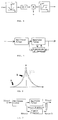
- Figure 5 shows the basic block diagram of the of the method according to the invention realized as a filter.
- the role of the non-linear filter 9 is the new point in the filter design. All data averaged with the recursive filter 10 is first filtered with a non-linear filter 9, which functions as a robust filter retaining the details.
- Figure 6 shows how the non-linear filter eliminates the pulses A and improves the possibility to recognize the edges, because the non-linear filter 9 retains the edges and attenuates the noise more strongly on the regular areas than on the edge areas, and the recursive filter 10 attenuates more effectively the noise distribution B with a low amplitude (short and medium tailed noise), because, as was mentioned above, the motion recognition interprets gross deviations as motion, and therefore the pulses are not filtered.
- the curve with the dot line in figure 6 represents the noise distribution 12 of the original unfiltered signal
- the curve with the broken line shows the noise distribution 13 filtered with a non-linear filter, e.g. a median filter
- the curve with the continuous line shows the noise distribution 14 filtered with the filter according to the invention.
- non-linear filter 9 several rank-order based filters can be advantageously used, among these e.g. all median filters (MF), weighted median filters (WM), multilayer median filters (MMF) and max/median filters, or these may be implemented as a part of the filter combination.
- the non-linear filter 9 can of course also be some other non-linear filter.
- the non-linear filter can span a one-, a two- or a three-dimensional window either in the picture plane or in the picture and time plane.
- a window is meant an environment comprising the examined sample and the adjacent neighboring pixels. The window is moved in the picture sequence in such a way that the value of each picture sequence is estimated based on the sample values contained in that window positioned according to the respective pixel.
- the filter uses for the calculation of a new value several pixels (samples), which can be selected so that they are located, in relation to each other, in one direction in the picture plane or in the time plane; then the window is one-dimensional. If the samples are located in relation to each other in two direction in the picture plane or in one direction in the picture plane and in the same time plane, then the window is two-dimensional. If the samples used for the calculation in the filter in relation to each other are located in two directions in the picture plane and further in different time planes, then the window is three-dimensional. Regarding the recursion efficiency this has a significance mainly in that e.g.
- Y med5 (x,y,t) MED(X(x,y,t-1) , X(x-1,y,t), X(x,y,t), X(x+1,y,t), X(x,y,t+1)), correlates very strongly regarding the time, containing continuous (streaking) areas.
- the recursive filter 10 attenuates correlating noise much less than noise non-correlating in time and produced by e.g. a picture plane spanning (spatial) five point median filter.
- a spatial filter does not increase the noise correlation in time. With larger non-linear filter windows and with a multilayer structure it is possible to obtain a milder noise correlation.
- the non-linear filter 9 retains the details of the picture, eliminates effectively the extremes of the noise distribution, improves the recursion factor efficiency, and further that the noise will not strongly correlate in the temporal direction.
- An LMS (Least Mean Square) optimizing method can be used to adapt the recursion factor controller 11, the method being known as the Back-propagation method.
- the method is generally known and the sigmoid can also be replaced by other functions, such as piecemeal linear functions.
- optimizing methods based on other error criteria, such as the LMA (Least Mean Absolute) optimizing method.
- LMA east Mean Absolute
- suitable optimizing methods are method using the L P -norm, which also includes the LMS and the LMA methods.
- the Back-propagation method is an optimizing method well suited for the purpose of the invention, and as variables of the sigmoid-function we could also use e.g.
- the difference picture x1
- and the previous recursion factor (the inverse) is x2 1/K(x,y,t-1) , which were found to represent remarkably well the local statistical characteristics of the sequence.
- the sigmoid-function can be replaced by some other non-linearity, which may give an almost similar result when approximated in a memory circuit.
- input signals for the sigmoid-function it is possible to use several different alternatives other than the difference picture.
- the filter according to the invention can be illustrated in more detail in figure 7, where the non-linear filter 9 protects the motion recognition against noise effects, the recursive filter 10 provides the averaging and the adaptation of the recursion factor is made with the sigmoid-function in the controller 11, whereby the Back-propagation method can be used to optimize the function parameters ⁇ i and ⁇ 0, and whereby in addition to the memory required by the non linear filter, one picture memory is required to store the previous picture. If it is desired to store any other information, it of course requires a memory.
- the output to the recursive filter 10 provided by the controller 11 is not necessarily the recursion factor K used here above and shown in figures 5 and 7, because in the same way as the sigmoid-function generates the inverse 1/K of the K, it is possible to use another presentation by changing the definition of the recursive filter. In any case it is essential that the controller 11 transmits to the filter 10 information about the mutual weighting of the previous information Y(x,y,t-1) and the new information X(x,y,t).
- recursion factor K(x-i,y-j,t-k) instead of the recursion factor K(x,y,t-1) used in the previous picture, which factor the controller 11 may use or may not use to adapt the recursion factor K.
- the controller 11 receives from the recursive filter via a memory (not shown) the recursion factor K(x,y,t-1) used in the filtering of the previous picture, or any other recursion factor K(x-i,y-j,t-k) or information corresponding to it.
- the adaptation of the parameters of the non-linear controller 11 can be made in advance of continuously during the filtering.
- difference picture information X(x,y,t) - Y(x,y,t-1) formed by the unfiltered information X(x,y,t) and the previous output information Y(x,y,t-1), or the absolute value
- the second input of the controller 11 must not necessarily be the input X(x,y,t) or the output M(x,y,t) of the non-linear filter 9, but it could be some other estimate or intermediate result provided by the non-linear filter 9, whereby this estimate or intermediate result can be generated in some other way on the basis of the non-linear filter 9 the input samples (not shown).
- the invention is characterized by a combination of the non-linear filter 9 and the recursive filter 10, and it is not limited to the embodiments shown here, but the recursive filter 10 could also be located inside the non-linear filter 9, whereby the non-linear filter is also recursive, e.g. a recursive median filter. Then the information of the previous picture is supplied to the filter 11 and also to the non-linear filter.
- the controller adapting the recursion factor may also be a part of the non-linear filter 9.
Landscapes
- Engineering & Computer Science (AREA)
- Physics & Mathematics (AREA)
- General Physics & Mathematics (AREA)
- Theoretical Computer Science (AREA)
- Multimedia (AREA)
- Signal Processing (AREA)
- Picture Signal Circuits (AREA)
Applications Claiming Priority (2)
| Application Number | Priority Date | Filing Date | Title |
|---|---|---|---|
| FI916162A FI89850C (fi) | 1991-12-30 | 1991-12-30 | Foerfarande och filter foer avlaegsning av brus fraon en bildsekvens |
| FI916162 | 1991-12-30 |
Publications (3)
| Publication Number | Publication Date |
|---|---|
| EP0550166A2 true EP0550166A2 (fr) | 1993-07-07 |
| EP0550166A3 EP0550166A3 (en) | 1993-11-10 |
| EP0550166B1 EP0550166B1 (fr) | 2000-09-06 |
Family
ID=8533742
Family Applications (1)
| Application Number | Title | Priority Date | Filing Date |
|---|---|---|---|
| EP19920311183 Expired - Lifetime EP0550166B1 (fr) | 1991-12-30 | 1992-12-08 | Procédé et filtre pour éliminer le bruit dans une séquence d'images |
Country Status (3)
| Country | Link |
|---|---|
| EP (1) | EP0550166B1 (fr) |
| DE (1) | DE69231417T2 (fr) |
| FI (1) | FI89850C (fr) |
Cited By (3)
| Publication number | Priority date | Publication date | Assignee | Title |
|---|---|---|---|---|
| EP0651351A1 (fr) * | 1993-10-29 | 1995-05-03 | Rautaruukki Oy | Appareil et procédé de filtrage |
| EP0666688A1 (fr) * | 1994-02-04 | 1995-08-09 | NOKIA TECHNOLOGY GmbH | Circuit pour l'accentuation de la netteté et l'atténuation du bruit d'une image vidéo |
| FR2736741A1 (fr) * | 1995-07-11 | 1997-01-17 | Khiplus | Procede de traitement d'une sequence source d'images numeriques bruitees |
Family Cites Families (8)
| Publication number | Priority date | Publication date | Assignee | Title |
|---|---|---|---|---|
| GB1594341A (en) * | 1976-10-14 | 1981-07-30 | Micro Consultants Ltd | Picture information processing system for television |
| DE3309715A1 (de) * | 1983-03-18 | 1984-09-20 | Robert Bosch Gmbh, 7000 Stuttgart | System zur verminderung des rauschens in einem fernsehsignal |
| FR2575886B1 (fr) * | 1985-01-04 | 1987-02-20 | Thomson Csf | Procede pour reduire la visibilite du bruit dans une suite d'images video et dispositif pour la mise en oeuvre de ce procede |
| DE3617827A1 (de) * | 1986-05-26 | 1987-12-03 | Hertz Inst Heinrich | Verfahren und schaltungsanordnung zur rauschreduktion degitalisierter fernsehsignale |
| JP2601810B2 (ja) * | 1986-12-22 | 1997-04-16 | 株式会社東芝 | 雑音低減回路 |
| JP2508442B2 (ja) * | 1987-06-09 | 1996-06-19 | ソニー株式会社 | ノイズ除去回路 |
| US4928258A (en) * | 1989-05-08 | 1990-05-22 | The United States Of America As Represented By The Secretary Of The Air Force | Recursive median filtering |
| DE4031785C2 (de) * | 1990-10-08 | 1996-07-04 | Broadcast Television Syst | Verfahren zur Reduktion von Rauschen in Videosignalen |
-
1991
- 1991-12-30 FI FI916162A patent/FI89850C/fi active
-
1992
- 1992-12-08 DE DE1992631417 patent/DE69231417T2/de not_active Expired - Fee Related
- 1992-12-08 EP EP19920311183 patent/EP0550166B1/fr not_active Expired - Lifetime
Cited By (6)
| Publication number | Priority date | Publication date | Assignee | Title |
|---|---|---|---|---|
| EP0651351A1 (fr) * | 1993-10-29 | 1995-05-03 | Rautaruukki Oy | Appareil et procédé de filtrage |
| US5485412A (en) * | 1993-10-29 | 1996-01-16 | Rautaruukki Oy | Method and apparatus for successive horizontal and vertical data filtering |
| EP0666688A1 (fr) * | 1994-02-04 | 1995-08-09 | NOKIA TECHNOLOGY GmbH | Circuit pour l'accentuation de la netteté et l'atténuation du bruit d'une image vidéo |
| FR2736741A1 (fr) * | 1995-07-11 | 1997-01-17 | Khiplus | Procede de traitement d'une sequence source d'images numeriques bruitees |
| WO1997003414A1 (fr) * | 1995-07-11 | 1997-01-30 | Key Concept | Procede de traitement d'une sequence source d'images numeriques bruitees |
| US6496604B1 (en) | 1995-07-11 | 2002-12-17 | Key Concept | Method for processing a noisy digital image source sequence |
Also Published As
| Publication number | Publication date |
|---|---|
| DE69231417T2 (de) | 2001-04-26 |
| EP0550166A3 (en) | 1993-11-10 |
| FI916162A0 (fi) | 1991-12-30 |
| DE69231417D1 (de) | 2000-10-12 |
| FI89850C (fi) | 1993-11-25 |
| FI89850B (fi) | 1993-08-13 |
| EP0550166B1 (fr) | 2000-09-06 |
Similar Documents
| Publication | Publication Date | Title |
|---|---|---|
| EP0592196B1 (fr) | Circuits d'élimination du bruit | |
| DE69125582T2 (de) | HDTV-Kodierer mit adaptiver Dämpfung | |
| DE4226845C2 (de) | System zum Auslöschen von Störbildern bei der NTSC-Fernsehübertragung | |
| US5038388A (en) | Method for adaptively sharpening electronic images | |
| DE69113522T2 (de) | Technik zur Geisterbildauslöschung für analoges Fernsehen. | |
| DE602004002618T2 (de) | Verfahren und System zur Kantenhervorhebung | |
| US5488421A (en) | Interlaced-to-progressive scanning converter with a double-smoother and a method therefor | |
| DE69411470T2 (de) | Methode und Vorrichtung zur Verbesserung der Schärfe einer einem kontinuierlichem Zoom unterworfenen Bildfolge | |
| DE60307942T2 (de) | Digitale Rauschverminderungstechniken | |
| EP0731601B2 (fr) | Dispositif de réduction de bruit vidéo | |
| US20090185753A1 (en) | Image processing method and apparatus | |
| JP3094387B2 (ja) | Tv受信機あるいはビデオレコーダに使用されるゴースト消去基準信号捕捉回路 | |
| US4504864A (en) | Nonlinear filtering of gray scale images | |
| US5121211A (en) | System for echo cancellation comprising an improved ghost cancellation reference signal | |
| DE69326051T2 (de) | Geisterbildauslöschung | |
| WO2006090370A2 (fr) | Amelioration de video comprimee | |
| KR920001011B1 (ko) | 이동적응형 휘도신호 색신호 분리장치 | |
| US5191419A (en) | Video noise reducer with detection of both total and temporal picture changes | |
| US5151785A (en) | HDTV transmission system with reduced susceptibility to NTSC cochannel interference | |
| EP0550166B1 (fr) | Procédé et filtre pour éliminer le bruit dans une séquence d'images | |
| US20070280352A1 (en) | Recursive filtering of a video image | |
| US4935812A (en) | Method for broadcasting high definition television programs using temporal attenuation | |
| EP0592932A2 (fr) | Procédé d'atténuation du bruit d'un signal vidéo, et réducteur de bruit | |
| EP0540100A2 (fr) | Système de télévision pour transmettre des images de télévision numérisées à partir d'un émetteur vers un récepteur | |
| JPH01215185A (ja) | 輪郭補償回路 |
Legal Events
| Date | Code | Title | Description |
|---|---|---|---|
| PUAI | Public reference made under article 153(3) epc to a published international application that has entered the european phase |
Free format text: ORIGINAL CODE: 0009012 |
|
| AK | Designated contracting states |
Kind code of ref document: A2 Designated state(s): DE ES FR GB IT NL SE |
|
| PUAL | Search report despatched |
Free format text: ORIGINAL CODE: 0009013 |
|
| AK | Designated contracting states |
Kind code of ref document: A3 Designated state(s): DE ES FR GB IT NL SE |
|
| 17P | Request for examination filed |
Effective date: 19940423 |
|
| 17Q | First examination report despatched |
Effective date: 19950321 |
|
| RIN1 | Information on inventor provided before grant (corrected) |
Inventor name: HAEMAELAEINEN, MATTI |
|
| RAP1 | Party data changed (applicant data changed or rights of an application transferred) |
Owner name: NOKIA KULUTUSELEKTRONIIKKA OY |
|
| GRAG | Despatch of communication of intention to grant |
Free format text: ORIGINAL CODE: EPIDOS AGRA |
|
| 17Q | First examination report despatched |
Effective date: 19990503 |
|
| GRAG | Despatch of communication of intention to grant |
Free format text: ORIGINAL CODE: EPIDOS AGRA |
|
| GRAG | Despatch of communication of intention to grant |
Free format text: ORIGINAL CODE: EPIDOS AGRA |
|
| GRAH | Despatch of communication of intention to grant a patent |
Free format text: ORIGINAL CODE: EPIDOS IGRA |
|
| GRAH | Despatch of communication of intention to grant a patent |
Free format text: ORIGINAL CODE: EPIDOS IGRA |
|
| RAP1 | Party data changed (applicant data changed or rights of an application transferred) |
Owner name: NOKIA MULTIMEDIA TERMINALS OY |
|
| GRAA | (expected) grant |
Free format text: ORIGINAL CODE: 0009210 |
|
| AK | Designated contracting states |
Kind code of ref document: B1 Designated state(s): DE ES FR GB IT NL SE |
|
| PG25 | Lapsed in a contracting state [announced via postgrant information from national office to epo] |
Ref country code: NL Free format text: LAPSE BECAUSE OF FAILURE TO SUBMIT A TRANSLATION OF THE DESCRIPTION OR TO PAY THE FEE WITHIN THE PRESCRIBED TIME-LIMIT Effective date: 20000906 Ref country code: IT Free format text: LAPSE BECAUSE OF FAILURE TO SUBMIT A TRANSLATION OF THE DESCRIPTION OR TO PAY THE FEE WITHIN THE PRE;WARNING: LAPSES OF ITALIAN PATENTS WITH EFFECTIVE DATE BEFORE 2007 MAY HAVE OCCURRED AT ANY TIME BEFORE 2007. THE CORRECT EFFECTIVE DATE MAY BE DIFFERENT FROM THE ONE RECORDED.SCRIBED TIME-LIMIT Effective date: 20000906 Ref country code: ES Free format text: THE PATENT HAS BEEN ANNULLED BY A DECISION OF A NATIONAL AUTHORITY Effective date: 20000906 |
|
| REF | Corresponds to: |
Ref document number: 69231417 Country of ref document: DE Date of ref document: 20001012 |
|
| PG25 | Lapsed in a contracting state [announced via postgrant information from national office to epo] |
Ref country code: SE Free format text: LAPSE BECAUSE OF FAILURE TO SUBMIT A TRANSLATION OF THE DESCRIPTION OR TO PAY THE FEE WITHIN THE PRESCRIBED TIME-LIMIT Effective date: 20001206 |
|
| ET | Fr: translation filed | ||
| NLV1 | Nl: lapsed or annulled due to failure to fulfill the requirements of art. 29p and 29m of the patents act | ||
| PLBE | No opposition filed within time limit |
Free format text: ORIGINAL CODE: 0009261 |
|
| 26N | No opposition filed | ||
| REG | Reference to a national code |
Ref country code: GB Ref legal event code: IF02 |
|
| PGFP | Annual fee paid to national office [announced via postgrant information from national office to epo] |
Ref country code: DE Payment date: 20051201 Year of fee payment: 14 |
|
| PGFP | Annual fee paid to national office [announced via postgrant information from national office to epo] |
Ref country code: GB Payment date: 20051207 Year of fee payment: 14 |
|
| PGFP | Annual fee paid to national office [announced via postgrant information from national office to epo] |
Ref country code: FR Payment date: 20051208 Year of fee payment: 14 |
|
| PG25 | Lapsed in a contracting state [announced via postgrant information from national office to epo] |
Ref country code: DE Free format text: LAPSE BECAUSE OF NON-PAYMENT OF DUE FEES Effective date: 20070703 |
|
| GBPC | Gb: european patent ceased through non-payment of renewal fee |
Effective date: 20061208 |
|
| REG | Reference to a national code |
Ref country code: FR Ref legal event code: ST Effective date: 20070831 |
|
| PG25 | Lapsed in a contracting state [announced via postgrant information from national office to epo] |
Ref country code: GB Free format text: LAPSE BECAUSE OF NON-PAYMENT OF DUE FEES Effective date: 20061208 |
|
| PG25 | Lapsed in a contracting state [announced via postgrant information from national office to epo] |
Ref country code: FR Free format text: LAPSE BECAUSE OF NON-PAYMENT OF DUE FEES Effective date: 20070102 |