EP0550221A1 - Verfahren und Vorrichtung zum Dekontaminieren von radioaktiven Materialien - Google Patents
Verfahren und Vorrichtung zum Dekontaminieren von radioaktiven Materialien Download PDFInfo
- Publication number
- EP0550221A1 EP0550221A1 EP92311567A EP92311567A EP0550221A1 EP 0550221 A1 EP0550221 A1 EP 0550221A1 EP 92311567 A EP92311567 A EP 92311567A EP 92311567 A EP92311567 A EP 92311567A EP 0550221 A1 EP0550221 A1 EP 0550221A1
- Authority
- EP
- European Patent Office
- Prior art keywords
- contaminant
- solution
- composition
- carbonate
- dissolved
- Prior art date
- Legal status (The legal status is an assumption and is not a legal conclusion. Google has not performed a legal analysis and makes no representation as to the accuracy of the status listed.)
- Granted
Links
- 239000000203 mixture Substances 0.000 title claims abstract description 85
- 238000000034 method Methods 0.000 title claims abstract description 63
- 238000005202 decontamination Methods 0.000 title description 19
- 230000003588 decontaminative effect Effects 0.000 title description 12
- 239000012857 radioactive material Substances 0.000 title description 3
- 239000000356 contaminant Substances 0.000 claims abstract description 74
- 239000000463 material Substances 0.000 claims abstract description 58
- BVKZGUZCCUSVTD-UHFFFAOYSA-L Carbonate Chemical compound [O-]C([O-])=O BVKZGUZCCUSVTD-UHFFFAOYSA-L 0.000 claims abstract description 33
- 230000002285 radioactive effect Effects 0.000 claims abstract description 32
- MHAJPDPJQMAIIY-UHFFFAOYSA-N Hydrogen peroxide Chemical compound OO MHAJPDPJQMAIIY-UHFFFAOYSA-N 0.000 claims abstract description 28
- HEMHJVSKTPXQMS-UHFFFAOYSA-M Sodium hydroxide Chemical compound [OH-].[Na+] HEMHJVSKTPXQMS-UHFFFAOYSA-M 0.000 claims abstract description 21
- KCXVZYZYPLLWCC-UHFFFAOYSA-N EDTA Chemical compound OC(=O)CN(CC(O)=O)CCN(CC(O)=O)CC(O)=O KCXVZYZYPLLWCC-UHFFFAOYSA-N 0.000 claims abstract description 15
- 229910052770 Uranium Inorganic materials 0.000 claims description 38
- JFALSRSLKYAFGM-UHFFFAOYSA-N uranium(0) Chemical compound [U] JFALSRSLKYAFGM-UHFFFAOYSA-N 0.000 claims description 38
- ZSLUVFAKFWKJRC-IGMARMGPSA-N 232Th Chemical compound [232Th] ZSLUVFAKFWKJRC-IGMARMGPSA-N 0.000 claims description 26
- 229910052776 Thorium Inorganic materials 0.000 claims description 26
- 239000003463 adsorbent Substances 0.000 claims description 16
- 229910052705 radium Inorganic materials 0.000 claims description 16
- HCWPIIXVSYCSAN-UHFFFAOYSA-N radium atom Chemical compound [Ra] HCWPIIXVSYCSAN-UHFFFAOYSA-N 0.000 claims description 16
- 230000003134 recirculating effect Effects 0.000 claims description 15
- 239000002738 chelating agent Substances 0.000 claims description 13
- XLYOFNOQVPJJNP-UHFFFAOYSA-N water Substances O XLYOFNOQVPJJNP-UHFFFAOYSA-N 0.000 claims description 13
- 229960001484 edetic acid Drugs 0.000 claims description 11
- 239000007800 oxidant agent Substances 0.000 claims description 11
- 238000001914 filtration Methods 0.000 claims description 10
- 238000005342 ion exchange Methods 0.000 claims description 9
- 238000001179 sorption measurement Methods 0.000 claims description 9
- 229910052778 Plutonium Inorganic materials 0.000 claims description 8
- OYEHPCDNVJXUIW-UHFFFAOYSA-N plutonium atom Chemical compound [Pu] OYEHPCDNVJXUIW-UHFFFAOYSA-N 0.000 claims description 8
- 238000005341 cation exchange Methods 0.000 claims description 6
- 230000003647 oxidation Effects 0.000 claims description 6
- 238000007254 oxidation reaction Methods 0.000 claims description 6
- MUBZPKHOEPUJKR-UHFFFAOYSA-N Oxalic acid Chemical compound OC(=O)C(O)=O MUBZPKHOEPUJKR-UHFFFAOYSA-N 0.000 claims description 5
- KRKNYBCHXYNGOX-UHFFFAOYSA-K Citrate Chemical compound [O-]C(=O)CC(O)(CC([O-])=O)C([O-])=O KRKNYBCHXYNGOX-UHFFFAOYSA-K 0.000 claims description 4
- QPCDCPDFJACHGM-UHFFFAOYSA-N N,N-bis{2-[bis(carboxymethyl)amino]ethyl}glycine Chemical compound OC(=O)CN(CC(O)=O)CCN(CC(=O)O)CCN(CC(O)=O)CC(O)=O QPCDCPDFJACHGM-UHFFFAOYSA-N 0.000 claims description 4
- 238000005349 anion exchange Methods 0.000 claims description 4
- 239000012530 fluid Substances 0.000 claims description 4
- 229960003330 pentetic acid Drugs 0.000 claims description 4
- 239000005725 8-Hydroxyquinoline Substances 0.000 claims description 3
- 229910052695 Americium Inorganic materials 0.000 claims description 3
- LXQXZNRPTYVCNG-UHFFFAOYSA-N americium atom Chemical compound [Am] LXQXZNRPTYVCNG-UHFFFAOYSA-N 0.000 claims description 3
- 229960003540 oxyquinoline Drugs 0.000 claims description 3
- MCJGNVYPOGVAJF-UHFFFAOYSA-N quinolin-8-ol Chemical compound C1=CN=C2C(O)=CC=CC2=C1 MCJGNVYPOGVAJF-UHFFFAOYSA-N 0.000 claims description 3
- 229940001468 citrate Drugs 0.000 claims description 2
- 229940039748 oxalate Drugs 0.000 claims description 2
- 230000001376 precipitating effect Effects 0.000 claims 1
- 239000000243 solution Substances 0.000 description 81
- 239000002689 soil Substances 0.000 description 46
- 238000011084 recovery Methods 0.000 description 28
- CURLTUGMZLYLDI-UHFFFAOYSA-N Carbon dioxide Chemical compound O=C=O CURLTUGMZLYLDI-UHFFFAOYSA-N 0.000 description 20
- 238000004090 dissolution Methods 0.000 description 15
- TZCXTZWJZNENPQ-UHFFFAOYSA-L barium sulfate Chemical compound [Ba+2].[O-]S([O-])(=O)=O TZCXTZWJZNENPQ-UHFFFAOYSA-L 0.000 description 14
- 238000011109 contamination Methods 0.000 description 12
- 229910052768 actinide Inorganic materials 0.000 description 11
- 150000001255 actinides Chemical class 0.000 description 11
- 238000000926 separation method Methods 0.000 description 11
- CDBYLPFSWZWCQE-UHFFFAOYSA-L Sodium Carbonate Chemical compound [Na+].[Na+].[O-]C([O-])=O CDBYLPFSWZWCQE-UHFFFAOYSA-L 0.000 description 10
- 229910002092 carbon dioxide Inorganic materials 0.000 description 10
- 239000002253 acid Substances 0.000 description 9
- 239000003153 chemical reaction reagent Substances 0.000 description 9
- 239000011347 resin Substances 0.000 description 9
- 229920005989 resin Polymers 0.000 description 9
- 239000000126 substance Substances 0.000 description 9
- 239000002585 base Substances 0.000 description 8
- 239000001569 carbon dioxide Substances 0.000 description 8
- 239000007788 liquid Substances 0.000 description 8
- 239000002699 waste material Substances 0.000 description 8
- 230000007613 environmental effect Effects 0.000 description 7
- 150000002500 ions Chemical class 0.000 description 7
- 239000002904 solvent Substances 0.000 description 7
- UHOVQNZJYSORNB-UHFFFAOYSA-N Benzene Chemical compound C1=CC=CC=C1 UHOVQNZJYSORNB-UHFFFAOYSA-N 0.000 description 6
- 230000002378 acidificating effect Effects 0.000 description 6
- 239000007789 gas Substances 0.000 description 6
- 238000002386 leaching Methods 0.000 description 6
- NUJOXMJBOLGQSY-UHFFFAOYSA-N manganese dioxide Chemical compound O=[Mn]=O NUJOXMJBOLGQSY-UHFFFAOYSA-N 0.000 description 6
- 238000005065 mining Methods 0.000 description 6
- 239000000470 constituent Substances 0.000 description 5
- 239000002244 precipitate Substances 0.000 description 5
- 229910000029 sodium carbonate Inorganic materials 0.000 description 5
- 235000017550 sodium carbonate Nutrition 0.000 description 5
- 239000007787 solid Substances 0.000 description 5
- 238000005406 washing Methods 0.000 description 5
- NWUYHJFMYQTDRP-UHFFFAOYSA-N 1,2-bis(ethenyl)benzene;1-ethenyl-2-ethylbenzene;styrene Chemical compound C=CC1=CC=CC=C1.CCC1=CC=CC=C1C=C.C=CC1=CC=CC=C1C=C NWUYHJFMYQTDRP-UHFFFAOYSA-N 0.000 description 4
- VEXZGXHMUGYJMC-UHFFFAOYSA-N Hydrochloric acid Chemical compound Cl VEXZGXHMUGYJMC-UHFFFAOYSA-N 0.000 description 4
- XEEYBQQBJWHFJM-UHFFFAOYSA-N Iron Chemical compound [Fe] XEEYBQQBJWHFJM-UHFFFAOYSA-N 0.000 description 4
- GRYLNZFGIOXLOG-UHFFFAOYSA-N Nitric acid Chemical compound O[N+]([O-])=O GRYLNZFGIOXLOG-UHFFFAOYSA-N 0.000 description 4
- UIIMBOGNXHQVGW-UHFFFAOYSA-M Sodium bicarbonate Chemical compound [Na+].OC([O-])=O UIIMBOGNXHQVGW-UHFFFAOYSA-M 0.000 description 4
- PPBRXRYQALVLMV-UHFFFAOYSA-N Styrene Chemical compound C=CC1=CC=CC=C1 PPBRXRYQALVLMV-UHFFFAOYSA-N 0.000 description 4
- BVKZGUZCCUSVTD-UHFFFAOYSA-N carbonic acid Chemical compound OC(O)=O BVKZGUZCCUSVTD-UHFFFAOYSA-N 0.000 description 4
- 230000006378 damage Effects 0.000 description 4
- 229910052751 metal Inorganic materials 0.000 description 4
- 239000002184 metal Substances 0.000 description 4
- 229910017604 nitric acid Inorganic materials 0.000 description 4
- 239000002245 particle Substances 0.000 description 4
- 239000002002 slurry Substances 0.000 description 4
- 229910052713 technetium Inorganic materials 0.000 description 4
- GKLVYJBZJHMRIY-UHFFFAOYSA-N technetium atom Chemical compound [Tc] GKLVYJBZJHMRIY-UHFFFAOYSA-N 0.000 description 4
- KWYUFKZDYYNOTN-UHFFFAOYSA-M Potassium hydroxide Chemical compound [OH-].[K+] KWYUFKZDYYNOTN-UHFFFAOYSA-M 0.000 description 3
- 238000010521 absorption reaction Methods 0.000 description 3
- 238000013019 agitation Methods 0.000 description 3
- 238000004458 analytical method Methods 0.000 description 3
- 150000001450 anions Chemical class 0.000 description 3
- 238000009835 boiling Methods 0.000 description 3
- 150000001768 cations Chemical class 0.000 description 3
- KRKNYBCHXYNGOX-UHFFFAOYSA-N citric acid Chemical compound OC(=O)CC(O)(C(O)=O)CC(O)=O KRKNYBCHXYNGOX-UHFFFAOYSA-N 0.000 description 3
- 239000012141 concentrate Substances 0.000 description 3
- 239000003456 ion exchange resin Substances 0.000 description 3
- 229920003303 ion-exchange polymer Polymers 0.000 description 3
- 239000006249 magnetic particle Substances 0.000 description 3
- 150000002739 metals Chemical class 0.000 description 3
- 230000007935 neutral effect Effects 0.000 description 3
- 230000001590 oxidative effect Effects 0.000 description 3
- 238000012545 processing Methods 0.000 description 3
- QGZKDVFQNNGYKY-UHFFFAOYSA-N Ammonia Chemical compound N QGZKDVFQNNGYKY-UHFFFAOYSA-N 0.000 description 2
- ATRRKUHOCOJYRX-UHFFFAOYSA-N Ammonium bicarbonate Chemical compound [NH4+].OC([O-])=O ATRRKUHOCOJYRX-UHFFFAOYSA-N 0.000 description 2
- VHUUQVKOLVNVRT-UHFFFAOYSA-N Ammonium hydroxide Chemical compound [NH4+].[OH-] VHUUQVKOLVNVRT-UHFFFAOYSA-N 0.000 description 2
- CIWBSHSKHKDKBQ-JLAZNSOCSA-N Ascorbic acid Chemical compound OC[C@H](O)[C@H]1OC(=O)C(O)=C1O CIWBSHSKHKDKBQ-JLAZNSOCSA-N 0.000 description 2
- 229910000831 Steel Inorganic materials 0.000 description 2
- 239000003929 acidic solution Substances 0.000 description 2
- 239000001099 ammonium carbonate Substances 0.000 description 2
- 235000012501 ammonium carbonate Nutrition 0.000 description 2
- 235000011114 ammonium hydroxide Nutrition 0.000 description 2
- 230000005587 bubbling Effects 0.000 description 2
- 150000005323 carbonate salts Chemical class 0.000 description 2
- 239000013522 chelant Substances 0.000 description 2
- 229920001429 chelating resin Polymers 0.000 description 2
- 238000006243 chemical reaction Methods 0.000 description 2
- 239000003638 chemical reducing agent Substances 0.000 description 2
- 238000010924 continuous production Methods 0.000 description 2
- 238000009472 formulation Methods 0.000 description 2
- XLYOFNOQVPJJNP-ZSJDYOACSA-N heavy water Substances [2H]O[2H] XLYOFNOQVPJJNP-ZSJDYOACSA-N 0.000 description 2
- 229910052742 iron Inorganic materials 0.000 description 2
- 239000012633 leachable Substances 0.000 description 2
- 239000011159 matrix material Substances 0.000 description 2
- 229910021645 metal ion Inorganic materials 0.000 description 2
- SIOXPEMLGUPBBT-UHFFFAOYSA-N picolinic acid Chemical compound OC(=O)C1=CC=CC=N1 SIOXPEMLGUPBBT-UHFFFAOYSA-N 0.000 description 2
- 229920000642 polymer Polymers 0.000 description 2
- 235000017557 sodium bicarbonate Nutrition 0.000 description 2
- 229910000030 sodium bicarbonate Inorganic materials 0.000 description 2
- 238000012421 spiking Methods 0.000 description 2
- 239000010959 steel Substances 0.000 description 2
- MCDQXPNKENBZEJ-UHFFFAOYSA-N (2,6-dihydroxyphenyl)arsonic acid Chemical compound OC1=CC=CC(O)=C1[As](O)(O)=O MCDQXPNKENBZEJ-UHFFFAOYSA-N 0.000 description 1
- LSNNMFCWUKXFEE-UHFFFAOYSA-M Bisulfite Chemical compound OS([O-])=O LSNNMFCWUKXFEE-UHFFFAOYSA-M 0.000 description 1
- BDAGIHXWWSANSR-UHFFFAOYSA-M Formate Chemical compound [O-]C=O BDAGIHXWWSANSR-UHFFFAOYSA-M 0.000 description 1
- 241000446313 Lamella Species 0.000 description 1
- 235000019738 Limestone Nutrition 0.000 description 1
- CBENFWSGALASAD-UHFFFAOYSA-N Ozone Chemical compound [O-][O+]=O CBENFWSGALASAD-UHFFFAOYSA-N 0.000 description 1
- 229910004369 ThO2 Inorganic materials 0.000 description 1
- GWEVSGVZZGPLCZ-UHFFFAOYSA-N Titan oxide Chemical compound O=[Ti]=O GWEVSGVZZGPLCZ-UHFFFAOYSA-N 0.000 description 1
- COQLPRJCUIATTQ-UHFFFAOYSA-N Uranyl acetate Chemical compound O.O.O=[U]=O.CC(O)=O.CC(O)=O COQLPRJCUIATTQ-UHFFFAOYSA-N 0.000 description 1
- WZECUPJJEIXUKY-UHFFFAOYSA-N [O-2].[O-2].[O-2].[U+6] Chemical compound [O-2].[O-2].[O-2].[U+6] WZECUPJJEIXUKY-UHFFFAOYSA-N 0.000 description 1
- 238000002835 absorbance Methods 0.000 description 1
- 150000007513 acids Chemical class 0.000 description 1
- 239000000654 additive Substances 0.000 description 1
- 238000001280 alpha-particle spectroscopy Methods 0.000 description 1
- 229910021529 ammonia Inorganic materials 0.000 description 1
- 239000000908 ammonium hydroxide Substances 0.000 description 1
- 239000003957 anion exchange resin Substances 0.000 description 1
- 238000013459 approach Methods 0.000 description 1
- 239000007864 aqueous solution Substances 0.000 description 1
- 229960005070 ascorbic acid Drugs 0.000 description 1
- 235000010323 ascorbic acid Nutrition 0.000 description 1
- 239000011668 ascorbic acid Substances 0.000 description 1
- QVGXLLKOCUKJST-UHFFFAOYSA-N atomic oxygen Chemical compound [O] QVGXLLKOCUKJST-UHFFFAOYSA-N 0.000 description 1
- PWHCIQQGOQTFAE-UHFFFAOYSA-L barium chloride dihydrate Chemical compound O.O.[Cl-].[Cl-].[Ba+2] PWHCIQQGOQTFAE-UHFFFAOYSA-L 0.000 description 1
- 239000003637 basic solution Substances 0.000 description 1
- 125000005587 carbonate group Chemical group 0.000 description 1
- 150000004649 carbonic acid derivatives Chemical class 0.000 description 1
- 239000003054 catalyst Substances 0.000 description 1
- 239000003729 cation exchange resin Substances 0.000 description 1
- 150000001767 cationic compounds Chemical class 0.000 description 1
- 239000003795 chemical substances by application Substances 0.000 description 1
- 239000002894 chemical waste Substances 0.000 description 1
- 239000011246 composite particle Substances 0.000 description 1
- 150000001875 compounds Chemical class 0.000 description 1
- 238000001816 cooling Methods 0.000 description 1
- 238000012937 correction Methods 0.000 description 1
- 238000010586 diagram Methods 0.000 description 1
- 239000006185 dispersion Substances 0.000 description 1
- 238000001035 drying Methods 0.000 description 1
- 238000000909 electrodialysis Methods 0.000 description 1
- 238000001983 electron spin resonance imaging Methods 0.000 description 1
- 238000005516 engineering process Methods 0.000 description 1
- 239000005447 environmental material Substances 0.000 description 1
- 238000001704 evaporation Methods 0.000 description 1
- 230000008020 evaporation Effects 0.000 description 1
- 238000002474 experimental method Methods 0.000 description 1
- 230000004992 fission Effects 0.000 description 1
- 230000005484 gravity Effects 0.000 description 1
- 231100001261 hazardous Toxicity 0.000 description 1
- 238000011065 in-situ storage Methods 0.000 description 1
- 229910001411 inorganic cation Inorganic materials 0.000 description 1
- 230000002452 interceptive effect Effects 0.000 description 1
- UQSXHKLRYXJYBZ-UHFFFAOYSA-N iron oxide Inorganic materials [Fe]=O UQSXHKLRYXJYBZ-UHFFFAOYSA-N 0.000 description 1
- 235000013980 iron oxide Nutrition 0.000 description 1
- VBMVTYDPPZVILR-UHFFFAOYSA-N iron(2+);oxygen(2-) Chemical class [O-2].[Fe+2] VBMVTYDPPZVILR-UHFFFAOYSA-N 0.000 description 1
- SZVJSHCCFOBDDC-UHFFFAOYSA-N iron(II,III) oxide Inorganic materials O=[Fe]O[Fe]O[Fe]=O SZVJSHCCFOBDDC-UHFFFAOYSA-N 0.000 description 1
- 239000006028 limestone Substances 0.000 description 1
- 238000007885 magnetic separation Methods 0.000 description 1
- 230000000873 masking effect Effects 0.000 description 1
- 238000001471 micro-filtration Methods 0.000 description 1
- 230000001473 noxious effect Effects 0.000 description 1
- 235000006408 oxalic acid Nutrition 0.000 description 1
- 239000001301 oxygen Substances 0.000 description 1
- 229910052760 oxygen Inorganic materials 0.000 description 1
- 239000011236 particulate material Substances 0.000 description 1
- 229940081066 picolinic acid Drugs 0.000 description 1
- OYEHPCDNVJXUIW-VENIDDJXSA-N plutonium-238 Chemical compound [238Pu] OYEHPCDNVJXUIW-VENIDDJXSA-N 0.000 description 1
- 235000011118 potassium hydroxide Nutrition 0.000 description 1
- 239000012286 potassium permanganate Substances 0.000 description 1
- OTYBMLCTZGSZBG-UHFFFAOYSA-L potassium sulfate Chemical compound [K+].[K+].[O-]S([O-])(=O)=O OTYBMLCTZGSZBG-UHFFFAOYSA-L 0.000 description 1
- 229910052939 potassium sulfate Inorganic materials 0.000 description 1
- 235000011151 potassium sulphates Nutrition 0.000 description 1
- 239000000047 product Substances 0.000 description 1
- 238000004445 quantitative analysis Methods 0.000 description 1
- 125000001453 quaternary ammonium group Chemical group 0.000 description 1
- 239000000941 radioactive substance Substances 0.000 description 1
- 239000002901 radioactive waste Substances 0.000 description 1
- 238000001223 reverse osmosis Methods 0.000 description 1
- 238000002791 soaking Methods 0.000 description 1
- 239000007790 solid phase Substances 0.000 description 1
- 238000000638 solvent extraction Methods 0.000 description 1
- 238000003756 stirring Methods 0.000 description 1
- QAOWNCQODCNURD-UHFFFAOYSA-N sulfuric acid Substances OS(O)(=O)=O QAOWNCQODCNURD-UHFFFAOYSA-N 0.000 description 1
- 239000002562 thickening agent Substances 0.000 description 1
- ZCUFMDLYAMJYST-UHFFFAOYSA-N thorium dioxide Chemical compound O=[Th]=O ZCUFMDLYAMJYST-UHFFFAOYSA-N 0.000 description 1
- VGBPIHVLVSGJGR-UHFFFAOYSA-N thorium(4+);tetranitrate Chemical compound [Th+4].[O-][N+]([O-])=O.[O-][N+]([O-])=O.[O-][N+]([O-])=O.[O-][N+]([O-])=O VGBPIHVLVSGJGR-UHFFFAOYSA-N 0.000 description 1
- OGIDPMRJRNCKJF-UHFFFAOYSA-N titanium oxide Inorganic materials [Ti]=O OGIDPMRJRNCKJF-UHFFFAOYSA-N 0.000 description 1
- 238000000108 ultra-filtration Methods 0.000 description 1
- -1 uranium oxide Chemical class 0.000 description 1
- 229910000439 uranium oxide Inorganic materials 0.000 description 1
- 229910000166 zirconium phosphate Inorganic materials 0.000 description 1
- LEHFSLREWWMLPU-UHFFFAOYSA-B zirconium(4+);tetraphosphate Chemical compound [Zr+4].[Zr+4].[Zr+4].[O-]P([O-])([O-])=O.[O-]P([O-])([O-])=O.[O-]P([O-])([O-])=O.[O-]P([O-])([O-])=O LEHFSLREWWMLPU-UHFFFAOYSA-B 0.000 description 1
Images
Classifications
-
- G—PHYSICS
- G21—NUCLEAR PHYSICS; NUCLEAR ENGINEERING
- G21F—PROTECTION AGAINST X-RADIATION, GAMMA RADIATION, CORPUSCULAR RADIATION OR PARTICLE BOMBARDMENT; TREATING RADIOACTIVELY CONTAMINATED MATERIAL; DECONTAMINATION ARRANGEMENTS THEREFOR
- G21F9/00—Treating radioactively contaminated material; Decontamination arrangements therefor
- G21F9/28—Treating solids
-
- G—PHYSICS
- G21—NUCLEAR PHYSICS; NUCLEAR ENGINEERING
- G21F—PROTECTION AGAINST X-RADIATION, GAMMA RADIATION, CORPUSCULAR RADIATION OR PARTICLE BOMBARDMENT; TREATING RADIOACTIVELY CONTAMINATED MATERIAL; DECONTAMINATION ARRANGEMENTS THEREFOR
- G21F9/00—Treating radioactively contaminated material; Decontamination arrangements therefor
- G21F9/001—Decontamination of contaminated objects, apparatus, clothes, food; Preventing contamination thereof
- G21F9/002—Decontamination of the surface of objects with chemical or electrochemical processes
Definitions
- Radioactive materials are a common problem.
- the problem may occur as a result of mining operations, such as for uranium, or contamination due to operation of nuclear facilities with inadequate environmental controls, or from the disposal of radioactive wastes.
- contamination may occur as a result of dispersion of uranium billets which have been used as a high density material in military or civil applications as a result of warfare or civil accident.
- radioactive elements can be recovered from environmental materials by mechanically washing with water with or without surface active additives.
- such procedures are generally limited to the mechanical separation of solids, and will not remove contaminants that are chemically bound to the solid phase.
- Previous reactor decontaminating solutions do not contain carbonate and are acidic, dissolving the iron oxides of the radioactive elements commonly found in contaminated reactor circuits.
- This nonselective metal dissolving capacity is a disadvantage of the acidic solutions and makes them unsuitable for decontamination of material such as soil that contains iron and other metals that are not intended to be recovered.
- Another disadvantage of acidic solutions is that materials such as concrete or limestone are subject to damage or dissolution in an acidic medium.
- these solutions contain too many nonselectively dissolved contaminants preventing subjection of the solution to recovery of contaminants and recirculation of the solution to accomplish further decontamination.
- uranium and transuranic radioactive elements can be dissolved in concentrated acidic (pH ⁇ 1) chemical systems.
- the acidity poses difficulties as discussed above.
- Uranium and sometimes thorium are recovered in mining operations in a concentrated basic medium containing carbonate.
- the use of concentrated solutions is motivated by the need to dissolve materials at a rate economic for mining operations, and such solutions are not particularly suitable where avoidance of secondary waste is of primary concern.
- uranium and plutonium can be dissolved in a dilute basic solution containing carbonate, citrate (as a chelating agent) and an oxidizing or reducing agent.
- Such solutions are not, however, suitable for the recovery of radium/barium sulfate because they do not form soluble complexes from barium sulfate.
- This invention relates to the recovery of radioactive elements, especially technetium, radium, and actinides such as thorium, uranium and transuranic elements, from certain types of contaminated materials.
- radioactive elements especially technetium, radium, and actinides such as thorium, uranium and transuranic elements.
- These materials could be natural, such as soil, or man-made materials, such as concrete or steel, which have become subject on a large scale to contamination.
- the process of the present invention provides that contaminated material is contacted with a dilute, basic, carbonate recirculating dissolving composition that dissolves radioactive contaminants.
- Contaminated material can be fed in to the process and cleaned material removed continuously therefrom.
- the contaminants are recovered from the solution by ion exchange, selective adsorption, reagent destruction, filtration or a combination of these techniques.
- the recovery steps concentrate the contaminants for recovery in such a way that non-residual reagent constituents do not build up in the system.
- the recirculating dissolving composition can be applied to small particulate materials such as soil in a contained vessel, or to large standing objects such as concrete walls, or steel structures.
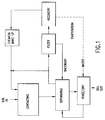
- Figure 1 is a schematic diagram of the preferred embodiment of the present invention.
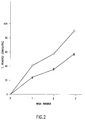
- Figure 2 is a graph showing the data from Example 1.
- the present invention provides a process for decontaminating radioactive material.
- the first step comprises contacting the material to be decontaminated with a dissolving composition.
- a typical process of the present invention for decontaminating soil is shown in Figure 1.
- the contactor device could be any one of a number of standard types - hydropulper, agitation tank, or any other device typically used or suitable for the contact of soils with a liquid medium.
- a counter current contactor is a standard system which allows solution to flow in the opposite direction to the soil through a series of contacts and solid/liquid separations. Thus the final contact is between emerging soil and uncontacted dissolving composition, the initial contact is between entering soil and already contacted dissolving composition.
- the contacting step of the dissolving process also includes the step of agitating the material with the dissolving composition.
- the dissolving composition comprises an effective amount of a dilute, basic, carbonate solution, sufficient to dissolve the contaminants in the material.
- the sources of carbonate include carbon dioxide gas, carbonic acid, sodium carbonate, sodium bicarbonate and other carbonate salts.
- the carbonate ions form a soluble complex with various actinides.
- Other anion radicals which are capable of forming soluble complexes with actinides and other radioactive elements can also be used.
- the dilute, basic, carbonate solution can further include an effective amount of a chelating agent sufficient to bind a large percentage of the radioactive contaminant.
- the chelating agent is any molecule that can bind to a radioactive metal ion to form a complex so as to keep the radioactive contaminant in solution. It has been found that a chelating agent is needed for the dissolution of plutonium and other transuranics.
- the chelating agents of the present process include ethylene diamine tetraacetic acid with an effective concentration of from .001 to 0.1 molar with the preferred concentration being about 0.03 molar. Diethylene triamine penta acetic acid, citrate, oxalate and 8-hydroxyquinoline can also be used as chelating agents in this invention.
- the dissolving solution has a basic pH, that is, any pH from 7 to 11, and preferably in the range of from about 9 to about 11, with the most preferred pH being about 10.
- the process includes the step of adjusting the pH of the dissolving composition to about 10 by adding an effective amount of a base, such as sodium hydroxide.
- a base such as sodium hydroxide.
- base includes any substance capable of raising the pH of a solution above pH 7 with the substance not otherwise interfering with the dissolving function of the dissolving composition.
- bases contemplated for use in the solution of the present invention include potassium hydroxide, ammonium hydroxide and ammonium carbonate.
- Ammonium carbonate is rather noxious, but has the added advantage for waste management that it can be evaporatively recovered from solution (carbon dioxide and ammonia).
- Any base could be used.
- the amount of base that will be effective to adjust the pH to the preferred range will depend on the specific base used, the other constituents of the solution, and the characteristics of the particular soil or other material being processed.
- the carbonate, oxidizing, chelant containing solution of the present process can be used for the dissolution of some actinides at neutral pH.
- the process can further include the step of generating carbonate by adding an effective amount of carbon dioxide gas to the dissolving solution prior to the contacting step.
- the process of bubbling carbon dioxide gas through the dissolving composition can also be used to adjust the pH of the composition to the appropriate range.
- the effective amount of carbon dioxide gas sufficient to generate carbonate and adjust the pH of the solution of the instant process can be determined by standard analytical methods.
- a carbonate solution of the present process can be made by adding an effective amount of a carbonate salt to the dissolving composition.
- the preferred concentration of carbonate is about 0.06 molar.
- the solution of the process can further include an effective amount of an oxidizing agent such as hydrogen peroxide at a concentration of about 1 to about 10 grams/liter of the dissolving composition with the preferred concentration being about 1-3 grams/liter.
- an oxidizing agent such as hydrogen peroxide at a concentration of about 1 to about 10 grams/liter of the dissolving composition with the preferred concentration being about 1-3 grams/liter.
- Other effective oxidizing agents include ozone, air and potassium permanganate.
- the preferred decontaminating solution of this invention comprises about 0.03 molar ethylene diamine tetraacetic acid, about 0.06 molar carbonate, about 3 grams/liter hydrogen peroxide and an effective amount of sodium hydroxide so that the solution can be adjusted to a pH from about 9 to about 11.
- Solutions comprising other effective amounts of the above constituents that are sufficient to dissolve radioactive contaminants in soil and other materials are also contemplated.
- Such solutions can comprise about 0.01 to about 0.05 molar ethylene diamine tetraacetic acid, about 0.02 to about 0.08 molar carbonate and about 1 to about 10 grams/liter hydrogen peroxide.
- the dissolving composition thus far described is effective at dissolving radioactive contaminants in soil and other materials when the basic, carbonate solution constitutes about two percent or less than two percent of the total concentration by weight of the dissolving composition.
- the dilute, basic, carbonate solution in accordance with the described invention is a solution that constitutes less than or about equal to two percent of the dissolving composition. Concentrations of up to 5% are also contemplated. Although higher concentrations of the solution will work, they can have the disadvantages of other concentrated solvent solutions.
- the balance of the dissolving composition can comprise a suitable liquid, such as water, that is preferably about neutral in pH and inert with regard to the radioactive contaminant.
- Uranium can be dissolved through carbonate chemistry, due to the solubility of the carbonate complexes of high oxidation states of uranium. Carbonate systems are preferred for dissolution in the present process, because they do not have the disadvantages of strong acid solvents. If uranium is present in an oxidation state lower than (VI), it is necessary to have an oxidizing agent present for dissolution to occur. Technetium is recoverable in solution under oxidizing conditions as the pertechnetate ion. For the dissolution of uranium and technetium, hydrogen peroxide is the preferred oxidizing agent.
- carbonate systems are not capable of achieving easy dissolution of transuranic elements in the absence of a chelating agent.
- Radium is rather insoluble in a carbonate system, but can be dissolved under alkaline conditions. In many cases of environmental contamination, radium is associated with barium sulfate, which has been added or formed while ore is being leached to recover uranium or thorium, with the purpose of holding radium back in the tailings.
- ethylene diamine tetraacetic acid, diethylene triamine penta acetic acid or similar chelants can be used to assist dissolution of the barium sulfate and hold radium in solution.
- Adjustment of the pH of such a solution by bubbling with carbon dioxide gas yields a solution at appropriate pH for the selective capture of radium by cation exchange. It is known that ethylene diamine tetraacetic acid complexes of alkaline earth elements have different stabilities, and use is made of this feature in analytical separations that cause heavier alkaline earth elements to be held on a cation exchange column while lighter ones are eluted as ethylene diamine tetraacetic acid complexes. (Lawrence B. Farabee in Oak Ridge Report ORNL-1932, September 1955.)
- the exact formulation of the dissolving composition will depend on the material to be decontaminated.
- the advantage of the decontamination of the present invention is that it minimizes dissolution of substances that are not intended to be recovered.
- a sample of the material to be decontaminated, such as soil is qualitatively and quantitatively analyzed in the laboratory and the dissolving composition is tailored to the character of the material sample.
- contacted material means material (soil or other) that has been subjected to the contacting step.
- the separating step of the decontamination process can be a continuous process that preferably includes the steps of removing a selected amount of the contacted material and replacing continuously the removed material with a selected amount of material to be contacted.
- the continuous process preferably includes the further steps of removing a selected amount of the dissolving composition that has contacted the material and replacing the removed dissolving composition with a selected amount of recirculated or, alternatively, previously uncontacted dissolving composition.
- Solid-liquid separating can be achieved by settler, lamella thickener, hydrocyclone, filter, or any other device typically used or suitable for solid-liquid separation of particles.
- the intent is to recover the contaminant while returning any entrained soil to the site.
- a magnetic separation recovery is used for collection of the contaminant.
- Selective magnetic particles e.g., composite particles consisting of magnetite and selective adsorbers
- the contaminant is removed from the solution by magnetic filtration recovery of the particles (and adsorbed contaminant).
- the amount of material and dissolving solution removed and replaced in the continuous separation step will be selected to ensure that the material is sufficiently decontaminated. In the present process, sufficient decontamination is considered to occur when removal from the material of up to 90% or more of the radioactive contaminants found in the material prior to the decontamination process is accomplished.
- Other continuous separation parameters include the frequency of removal and replacement of material and dissolving composition and the amount of the dissolving composition which is returned directly to the contacting step after separation from the material, as discussed below.
- the continuous separation parameters can be varied predictably in accordance with the nature of the particular contaminant or contaminants and their ease of dissolution in the dissolving composition of the contacting step.
- the separated material After separating a selected amount of the dissolving composition from a selected amount of the material, the separated material is in the form of a thick slurry.
- the thick slurry passes to a device for dewatering the material and a wash liquid, such as water, is used to remove residual dissolving composition from the material during the drying process.
- a wash liquid such as water
- the decontaminating solution can be contacted with the object's surface and separated by gravity from the object for passage to a recovering step.
- the recovering step includes filtering the dissolving composition that has been separated from the contacted material to remove particulates.
- the particulates of concern are particles of the material being decontaminated that are carried over with the dissolving composition from the separating step, which can interfere with the subsequent recovery steps.
- a backwashable filter is used in the filtering step.
- a further recovering step is the step of adsorbing the contaminants contained in the dissolving composition on an adsorbent ion exchange medium.
- the process of removing dissolved ions from solution by an ion exchange resin is usually termed adsorption.
- the adsorbents contemplated in the present process include the standard cation and anion exchangers, and selective adsorbents.
- the specific adsorbent can be chosen to result in either selective or nonselective adsorption of contaminants dissolved in the dissolving composition.
- ion exchangers include strong base anion exchanger such as AMBERLITE IRA 400 Rohm and Haas, Philadelphia, Pennsylvania), a type of quaternary ammonium functionalized styrene/divynyl benzene polymer.
- An example of a cation exchange resin is AMBERLITE IR-120 (Rohm and Haas, Philadelphia, Pennsylvania), a type of sulfonic acid functionalized styrene/divynyl benzene polymer.
- Inorganic cation exchangers, also called selective adsorbents include manganese dioxide, hydrous titanium oxide and zirconium phosphate.
- organic chelating ion exchangers e.g., resorcinol arsonic acid
- Ion exchange is one process used for concentrating the desired constituents from the leached solutions.
- the resin ion exchange technique involves the interchange of ions between the aqueous solution and a solid resin. This provides for a highly selective and quantitative method for recovery of uranium and radium and other actinides.
- Anion exchangers may be used for recovery of the thorium, uranium and transuranic complexes from solution. Anion exchange can also be used to recover the pertechnetate ion.
- Selective adsorbents can be formed as large particles in ion exchange columns for the adsorption of contaminants in the recirculating dissolving composition.
- Selective adsorbents operate by removing radioactive contaminants from the dissolving composition, but in other respects they do not significantly alter the process chemistry. They are thus particularly well-suited to use in the process of the present invention.
- the selective adsorbents can be added to the solution, or bound to magnetic particles and then filtered from the solution using conventional filtration techniques, micro- or ultrafiltration or magnetic filtration in the case where the ion exchange function is attached to a magnetic particle.
- the recovery step can further include the step of eluting the adsorbed contaminant from the resin or other matrix to obtain a concentrated solution of the contaminant. Eluting the contaminant is accomplished by means of a solution that removes the contaminant from the adsorbent.
- the eluting solution also known as an eluant
- a typical eluant is an acid such as nitric acid at an intermediate concentration of about 1.0 molar.
- the degree to which the contaminant is concentrated in the eluant can be varied according to the specific eluant used, but will, in any case, be more concentrated than in the unprocessed contaminated material.
- solvent extraction could be used for selective recovery of contaminants from the recirculating solution, but the consequent entrainment of solvent in the recirculating solution is a disadvantage of this approach.
- Other separation processes commonly used for solution separations such as reverse osmosis or electrodialysis could, in principle, also be used to achieve recovery of contaminants from the recirculating solution.
- recovery of contamination by reagent destruction is achieved by raising temperature to or approaching the boiling point of water. Raising temperature is particularly effective when hydrogen peroxide forms one part of the reagent system.
- the hydrogen peroxide is decomposed by heat (to oxygen and water) and will destructively oxidize chelants in the presence of a suitable metal ion catalyst at close to boiling temperature. Without the chelant present, the contaminant will no longer be soluble.
- the step of recovering radioactive contaminants can further include the step of recirculating to the contacting step the dissolving composition that has been separated from the contacted material. Specifically, the recirculating step calls for returning directly to the contacting step a selected amount of the dissolving composition that contains the dissolved contaminants. The step of recirculating also contemplates returning to the contacting step the dissolving composition from which the contaminants have been recovered in the recovery step.
- the parameters of the recirculating step include selecting the amount of dissolving composition that will be returned directly to the contacting step and selecting the amount that will proceed to the recovering step before being returned to the contacting step. These and other parameters can be predictably set based on the known characteristics of the material being processed and the nature and quantity of the radioactive contaminants involved. In a typical embodiment, about 10% of the dissolving composition will be recirculated after passing through the recovery step and about 90% will be returned directly to the contacting step.
- the invention also contemplates batch processing of the dissolving composition wherein the selected amount returned directly to the contacting step is about zero percent and the amount returned to the contacting step after processing through the recovery step is about one hundred percent.
- the present invention also provides means for controlling the fluid volume in the recirculating step.
- the control of fluid volume in the process can be achieved in two ways. Either the soil leaving the process can have a higher water content than that entering, or evaporation can be used to recover pure water from the dissolving solution. One of these or other suitable methods can be utilized to prevent the buildup of the fluid volume.
- the present invention also provides a composition for dissolving radioactive contaminants in a material, comprising a dilute solution having a basic pH and effective amounts of a chelating agent and a carbonate sufficient to dissolve radioactive contaminants.
- the composition of this invention can further include an effective amount of an oxidizing agent sufficient to raise the oxidation state of an actinide, such as uranium or other radioactive element.
- the preferred dissolving composition includes a solution of about 0.03 molar ethylene diamine tetraacetic acid, about 0.06 molar carbonate, about 3 grams/liter hydrogen peroxide and an effective amount of sodium hydroxide so that the solution can be adjusted to a pH from about 9 to about 11.
- the concentration of each constituent of the dilute solution of the dissolving composition of this invention can be varied in a manner such that the solution remains capable of dissolving radioactive contaminants in materials such as soil at a total concentration of about 2% or less than about 2% of the dissolving composition.
- Dissolving compositions containing up to 5% of the solution components can be effectively used.
- the balance of the dissolving composition not comprising the dilute basic carbonate solution can be comprised of water or some other liquid that is inert and has an approximately neutral pH.
- the analytical method employed Arsenazo III to develop complexes with uranium and thorium, which could then be determined from their colorimetric absorption at 665 nm (thorium) or 655 nm (uranium). Ascorbic acid was added as a reducing agent and the absorbance was measured at 2.5 molar acid to determine thorium first. Diethylene triamine pentaacetic acid was used as a masking agent to determine uranium at pH 2.0-2.1 and the absorption due to uranium was obtained by applying a correction for the absorption due to thorium. The results showed the soil sample to contain 656 ppm uranium and 35 ppm thorium.
- the soils were then "spiked" with uranium and thorium to increase the contamination level by the following procedure. 10 grams of dried soil was contacted with 10 cm3 of uranyl acetate and thorium nitrate solution, having 1,000 ppm of each contaminant. This was left to stand overnight. The spiking solution was separated from the soil sample by filtration and its uranium and thorium concentrations determined. The soil was then washed three times with 20 cm3 water and the uranium and thorium concentrations in the wash water were determined for all three washings, in order to establish that the contaminants were not being removed from soil by the water washing process alone. The final concentrations of uranium and thorium on the spiked soil were determined by the acid leaching procedure described above, yielding 1,398 ppm uranium and 1,086 ppm thorium.
- the soil was then contacted with a dissolving composition containing 0.05 moles per liter ethylene diamine tetraacetic acid and 0.2 moles per liter sodium carbonate, adjusted to pH 10 with sodium hydroxide.
- the dissolving composition was applied at the rate of 100 cm3 per 5 grams of soil.
- Three washes of the dissolving composition were applied (under agitation using a magnetic mixer), without rinsing between, to simulate the behavior in a countercurrent contactor.
- the concentrations of uranium and thorium in the dissolving composition were analyzed as described above and the amount recovered in each wash is shown in Figure 2.
- the first aliquot of dissolving composition was separated from the contacted soil.
- the uranium and thorium were recovered by passing the dissolving composition through a strong base anion exchange resin column in the carbonate form.
- the amount of uranium and thorium remaining in the dissolving composition after it was run through the column was analyzed, indicating 92% adsorption of thorium and 93% uranium on the column.
- the leachable uranium and thorium remaining in the soil after decontamination was determined by acid leaching of the soil as described above.
- the amounts of uranium and thorium dissolved by strong acid leaching were 528 and 232 ppm, and the experiment summary is shown in Table 1.
- the precipitate was agitated in a dissolving composition of 0.1 molar ethylene diamine tetraacetic acid and 0.1 molar sodium carbonate at pH 9.6.
- the precipitate had visibly dissolved after 20 minutes, and analysis of the dissolving composition by alpha spectroscopy indicated that the radium adsorbed on the barium sulfate precipitate was present in the dissolving composition.
- Radium in the dissolving composition can be recovered by selective cation exchange.
- a sample of soil (10 g) was spiked with plutonium-238 by soaking overnight in 0.1 molar nitric acid (10 ml) containing 2.7 nanocuries Pu-238. After separation from the soil by filtration, the spiking solution was shown to contain less than 1% of the original 2.7 nanocuries of plutonium.
- a 1 gram sample of the spiked soil was contacted with 250 ml of a dissolving composition which contained 0.02 moles (0.68 grams) per liter of hydrogen peroxide, 0.1 moles per liter citrate and carbon dioxide bubbled through to achieve a pH of 7. After 19 hours it was found that approximately 70% of the plutonium previously present on the soil was present in the dissolving composition that had been separated from the soil.
- Plutonium and americium can be recovered from the dissolving composition by the same method described in Example 1.
Landscapes
- Engineering & Computer Science (AREA)
- Physics & Mathematics (AREA)
- General Engineering & Computer Science (AREA)
- High Energy & Nuclear Physics (AREA)
- Electrochemistry (AREA)
- Chemical Kinetics & Catalysis (AREA)
- Chemical & Material Sciences (AREA)
- General Chemical & Material Sciences (AREA)
- Life Sciences & Earth Sciences (AREA)
- Food Science & Technology (AREA)
- Solid-Sorbent Or Filter-Aiding Compositions (AREA)
- Processing Of Solid Wastes (AREA)
- Detergent Compositions (AREA)
Applications Claiming Priority (2)
| Application Number | Priority Date | Filing Date | Title |
|---|---|---|---|
| US816467 | 1992-01-03 | ||
| US07/816,467 US5322644A (en) | 1992-01-03 | 1992-01-03 | Process for decontamination of radioactive materials |
Publications (2)
| Publication Number | Publication Date |
|---|---|
| EP0550221A1 true EP0550221A1 (de) | 1993-07-07 |
| EP0550221B1 EP0550221B1 (de) | 1999-06-16 |
Family
ID=25220704
Family Applications (1)
| Application Number | Title | Priority Date | Filing Date |
|---|---|---|---|
| EP92311567A Expired - Lifetime EP0550221B1 (de) | 1992-01-03 | 1992-12-17 | Verfahren zum Dekontaminieren von radioaktiven Materialien |
Country Status (11)
| Country | Link |
|---|---|
| US (1) | US5322644A (de) |
| EP (1) | EP0550221B1 (de) |
| AT (1) | ATE181451T1 (de) |
| CA (1) | CA2084049C (de) |
| CZ (1) | CZ284162B6 (de) |
| DE (1) | DE69229438T2 (de) |
| DK (1) | DK0550221T3 (de) |
| ES (1) | ES2134794T3 (de) |
| GR (1) | GR3031125T3 (de) |
| RU (1) | RU2122249C1 (de) |
| SK (1) | SK281361B6 (de) |
Cited By (10)
| Publication number | Priority date | Publication date | Assignee | Title |
|---|---|---|---|---|
| WO1994010689A1 (en) * | 1992-10-27 | 1994-05-11 | British Nuclear Fuels Plc | The treatment of solid organic wastes |
| EP0605136A3 (de) * | 1992-12-29 | 1994-10-05 | Westinghouse Electric Corp | Verfahren zur Entseuchung radioaktivkontaminierten Bodens. |
| GB2286716A (en) * | 1994-02-18 | 1995-08-23 | British Nuclear Fuels Plc | The treatment of solid wastes |
| WO1996019812A1 (en) * | 1994-12-22 | 1996-06-27 | Bradtec Limited | Process for decontaminating radioactive materials |
| US5570469A (en) * | 1995-01-06 | 1996-10-29 | Lockheed Martin Corporation | Method for removing metal contaminants from flue dust |
| US5573738A (en) * | 1994-07-08 | 1996-11-12 | Lockheed Martin Corporation | Method for removing depleted uranium from contaminated soils |
| RU2138869C1 (ru) * | 1996-06-17 | 1999-09-27 | Дзе Бабкок энд Вилкокс Компани | Раствор для очистки объектов от урановых соединений и способ очистки |
| WO2002083565A1 (de) * | 2001-04-11 | 2002-10-24 | Gkss-Forschungszentrum | Verfahren zur anreicherung von radium aus bariumsulfathaltigen mineralstoffgemischen |
| RU2340967C1 (ru) * | 2007-04-09 | 2008-12-10 | Федеральное государственное унитарное предприятие "Научно-исследовательский технологический институт имени А.П. Александрова" | Способ химической дезактивации оборудования атомных электрических станций |
| LU92324B1 (fr) * | 2013-12-04 | 2015-06-05 | Loës Pierre De | Procédé de dépollution des sols pollués |
Families Citing this family (62)
| Publication number | Priority date | Publication date | Assignee | Title |
|---|---|---|---|---|
| WO1995014191A1 (en) * | 1993-11-19 | 1995-05-26 | Phoenix Environmental, Ltd. | System for converting solid waste material into environmentally safe products |
| US5468456A (en) * | 1994-02-04 | 1995-11-21 | The University Of Chicago | Batch extracting process using magneticparticle held solvents |
| US5538701A (en) * | 1994-02-28 | 1996-07-23 | The Regents Of The University Of California, Office Of Technology Transfer | Process to remove actinides from soil using magnetic separation |
| US5640703A (en) * | 1994-04-18 | 1997-06-17 | British Nuclear Fuels Plc | Treatment of solid wastes |
| GB9407892D0 (en) * | 1994-04-21 | 1994-06-15 | British Nuclear Fuels Plc | Solvent extraction of metal containing species |
| US5457261A (en) * | 1994-07-08 | 1995-10-10 | O'brien & Gere Technical Svcs., Inc. | System and method for removing contaminants from solid surfaces and decontaminating waste |
| US5495062A (en) * | 1994-09-12 | 1996-02-27 | Commodore Laboratories, Inc. | Methods of decontaminating nuclear waste-containing soil |
| WO1996008324A1 (en) * | 1994-09-12 | 1996-03-21 | Commodore Applied Technologies, Inc. | Method of decontaminating nuclear waste-containing soil |
| US5678232A (en) * | 1995-07-31 | 1997-10-14 | Corpex Technologies, Inc. | Lead decontamination method |
| US5591270A (en) * | 1995-07-31 | 1997-01-07 | Corpex Technologies, Inc. | Lead oxide removal method |
| US5814204A (en) * | 1996-10-11 | 1998-09-29 | Corpex Technologies, Inc. | Electrolytic decontamination processes |
| GB9709882D0 (en) * | 1997-05-16 | 1997-07-09 | British Nuclear Fuels Plc | A method for cleaning radioactively contaminated material |
| US5863439A (en) * | 1997-06-06 | 1999-01-26 | Arch Development Corporation | Process for separation and preconcentration of radium from water |
| RU2168779C2 (ru) * | 1999-09-14 | 2001-06-10 | Государственное унитарное предприятие Научно-производственное объединение "Радиевый институт им. В.Г. Хлопина" | Способ сверхкритической флюидной экстракции металлов |
| UA74806C2 (uk) * | 1999-11-19 | 2006-02-15 | Айсолайсер Компані, Інк. | Спосіб очищення водного розчину, що містить водорозчинний полімер і радіоактивний матеріал |
| RU2177651C2 (ru) * | 2000-02-15 | 2001-12-27 | Открытое акционерное общество "Новосибирский завод химконцентратов" | Способ извлечения урана из отработанных фильтров и установка для его осуществления |
| US6527691B1 (en) * | 2000-04-04 | 2003-03-04 | Sandia Corporation | In situ formation of magnetite reactive barriers in soil for waste stabilization |
| SE517130C2 (sv) * | 2000-08-10 | 2002-04-16 | Studsvik Radwaste Ab | Förfarande och anordning för volymreduktion av radioaktivt oljescaleavfall |
| US7384529B1 (en) | 2000-09-29 | 2008-06-10 | The United States Of America As Represented By The United States Department Of Energy | Method for electrochemical decontamination of radioactive metal |
| RU2183871C1 (ru) * | 2000-11-14 | 2002-06-20 | Государственное предприятие "Всероссийский научно-исследовательский институт по эксплуатации атомных электростанций" | Способ дезактивации отработанного катионита установок обработки радиоактивных сред атомной электростанции |
| FR2817492B1 (fr) * | 2000-12-04 | 2003-07-18 | Commissariat Energie Atomique | Procede de dissolution des solides formes dans une installation nucleaire |
| RU2181550C1 (ru) * | 2000-12-21 | 2002-04-27 | Федоров Анатолий Федорович | Способ очистки белоксодержащих продуктов от вредных примесей |
| FR2826355B1 (fr) * | 2001-06-22 | 2003-08-15 | Commissariat Energie Atomique | Procede de traitement d'un effluent, notamment radioactif, contenant des matieres organiques |
| US9908788B1 (en) | 2001-09-26 | 2018-03-06 | Wrt International Llc | Radium removal from aqueous media using zeolite materials |
| US6497769B1 (en) | 2001-10-12 | 2002-12-24 | Bobolink, Inc. | Radioactive decontamination and translocation method |
| US6605158B1 (en) | 2001-10-12 | 2003-08-12 | Bobolink, Inc. | Radioactive decontamination and translocation method |
| WO2003065381A1 (en) * | 2002-02-01 | 2003-08-07 | Studsvik Radwaste Ab | Process and apparatus for volume reduction of oil scale waste |
| US7271310B1 (en) * | 2002-04-26 | 2007-09-18 | Sandia Corporation | Cask weeping mitigation |
| US7776362B2 (en) * | 2005-01-11 | 2010-08-17 | Clean Earth Technologies, Llc | Formulations for the decontamination of toxic chemicals |
| JP2009511016A (ja) * | 2005-10-07 | 2009-03-19 | ベクトン・ディキンソン・アンド・カンパニー | 希薄な過酸化水素を使用する核酸汚染の除去方法 |
| EA010791B1 (ru) * | 2006-03-23 | 2008-12-30 | Эм-Ай ПРОДАКШН КЕМИКАЛЗ ЮКей ЛИМИТЕД | Способ растворения нефтепромыслового шлака |
| FR2904888B1 (fr) * | 2006-08-11 | 2008-12-19 | Cezus Cie Europ Du Zirconium S | Methode de stabilisation du radium dans les effluents radiferes. |
| RU2326177C1 (ru) * | 2006-08-14 | 2008-06-10 | Российская Федерация, от имени которой выступает Государственный заказчик - Федеральное агентство по атомной энергии | Способ извлечения урана из руд |
| RU2335554C2 (ru) * | 2006-11-10 | 2008-10-10 | Федеральное государственное унитарное предприятие "Сибирский химический комбинат" | Способ извлечения америция в виде диоксида америция из растворов |
| WO2008064249A2 (en) * | 2006-11-20 | 2008-05-29 | Wrt International Llc | Transition metal-loaded zeolite materials for use in drinking water |
| WO2009134294A2 (en) | 2008-01-30 | 2009-11-05 | Integrity Consulting, Inc. | Destruction of mixed radioactive waste by catalyzed chemical oxidation |
| KR100961832B1 (ko) * | 2008-04-25 | 2010-06-08 | 한국원자력연구원 | 고 알카리 탄산염 용액 계를 사용하는 사용후핵연료의우라늄 분리회수방법과 그 장치 |
| RU2398903C1 (ru) * | 2009-03-30 | 2010-09-10 | Российская Федерация, от имени которой выступает государственный заказчик- Государственная корпорация по атомной энергии "Росатом" | Способ переработки упорных урановых содержащих пирит и благородные металлы материалов для извлечения урана и получения концентрата благородных металлов |
| RU2412262C1 (ru) * | 2009-08-05 | 2011-02-20 | Российская Федерация, от имени которой выступает Государственная корпорация по атомной энергии "Росатом" | Способ переработки упорных руд и концентратов |
| MX2012009164A (es) * | 2010-02-10 | 2013-05-20 | M I Drilling Fluids Uk Ltd | Metodo y sistema para descontaminar arena. |
| RU2441842C1 (ru) * | 2010-06-21 | 2012-02-10 | Открытое акционерное общество "Государственный научный центр Научно-исследовательский институт атомных реакторов" | Способ регенерации радия из его сульфата |
| JP2013538336A (ja) * | 2010-07-21 | 2013-10-10 | アトミック エナジー オブ カナダ リミテッド | 原子炉除染方法および除染薬剤 |
| US9283418B2 (en) | 2010-10-15 | 2016-03-15 | Avantech, Inc. | Concentrate treatment system |
| US10580542B2 (en) | 2010-10-15 | 2020-03-03 | Avantech, Inc. | Concentrate treatment system |
| RU2477758C1 (ru) * | 2011-08-17 | 2013-03-20 | Открытое акционерное общество "Сибирский химический комбинат" | Способ извлечения америция |
| RU2492536C2 (ru) * | 2011-11-22 | 2013-09-10 | Федеральное государственное унитарное предприятие "Научно-производственное объединение "Радиевый институт им. В.Г. Хлопина" | Способ переработки отработавших фильтров на основе ткани петрянова |
| RU2485193C1 (ru) * | 2012-03-20 | 2013-06-20 | Федеральное государственное бюджетное образовательное учреждение высшего профессионального образования "Национальный исследовательский Томский политехнический университет" | Способ извлечения урана из руд |
| RU2508413C1 (ru) * | 2012-08-31 | 2014-02-27 | Открытое акционерное общество "Сибирский химический комбинат" | Способ извлечения америция из отходов |
| RU2543122C2 (ru) * | 2012-09-27 | 2015-02-27 | Федеральное государственное автономное образовательное учреждение высшего профессионального образования "Национальный исследовательский ядерный университет "МИФИ" | Способ переработки упорных урановых руд, содержащих браннерит |
| RU2513206C1 (ru) * | 2012-10-30 | 2014-04-20 | Леонид Асхатович Мазитов | Способ разделения тория-228 и радия-224 |
| RU2572910C2 (ru) * | 2013-12-03 | 2016-01-20 | Зао "Далур" | Способ выщелачивания урана из руд |
| RU2571676C1 (ru) * | 2014-08-26 | 2015-12-20 | Открытое акционерное общество "Ведущий научно-исследовательский институт химической технологии" | Способ переработки полиметаллических руд |
| RU2603405C1 (ru) * | 2015-05-13 | 2016-11-27 | Российская Федерация, от имени которой выступает Государственная корпорация по атомной энергии "Росатом" | Способ выделения америция из жидких радиоактивных отходов и отделения его от редкоземельных элементов |
| RU2653400C2 (ru) * | 2016-08-04 | 2018-05-08 | Федеральное государственное автономное образовательное учреждение высшего образования "Севастопольский государственный университет" | Способ выщелачивания урана из пород с незначительным его содержанием |
| CN106710660B (zh) * | 2016-12-12 | 2018-04-03 | 北京师范大学 | 用于放射性污染土壤治理的固化吸附与磁分离反应器系统 |
| US11999628B2 (en) | 2019-06-05 | 2024-06-04 | Battelle Memorial Institute | Systems and methods for producing elements from mixtures, storage/generation vessels, and storage/generation vessel assemblies |
| EP3980163A4 (de) | 2019-06-05 | 2023-05-10 | Battelle Memorial Institute | Systeme und verfahren zur abscheidung von radium aus blei, wismut und thorium |
| MX2022002753A (es) | 2019-10-10 | 2022-04-06 | Alpha Tau Medical Ltd | Preparacion humeda de fuentes de radioterapia. |
| CN114829640A (zh) * | 2019-12-11 | 2022-07-29 | 巴特尔纪念研究院 | 用于由混合物生产元素的系统和方法、储存/发生容器以及储存/发生容器组件 |
| CN113990541A (zh) * | 2021-09-08 | 2022-01-28 | 中国辐射防护研究院 | 一种去除放射性污染沉积氧化物的方法 |
| CN114047274A (zh) * | 2021-09-22 | 2022-02-15 | 四川轻化工大学 | 用于放射性样品中核素的分离提取系统 |
| CN114133935A (zh) * | 2021-11-29 | 2022-03-04 | 北京师范大学 | 一种由三氯化铁和有机膦酸强化的草酸基清洗活性材料 |
Citations (6)
| Publication number | Priority date | Publication date | Assignee | Title |
|---|---|---|---|---|
| US3660287A (en) * | 1967-10-12 | 1972-05-02 | Frank J Quattrini | Aqueous reactive scale solvent |
| US4443268A (en) * | 1981-11-12 | 1984-04-17 | The Dow Chemical Company | Process for removing copper and copper oxide encrustations from ferrous surfaces |
| GB2191329A (en) * | 1986-06-04 | 1987-12-09 | British Nuclear Fuels Plc | Decontamination of surfaces |
| US4729855A (en) * | 1985-11-29 | 1988-03-08 | Westinghouse Electric Corp. | Method of decontaminating radioactive metal surfaces |
| GB2229312A (en) * | 1989-03-14 | 1990-09-19 | British Nuclear Fuels Plc | Actinide dissolution |
| WO1990011972A1 (en) * | 1989-04-03 | 1990-10-18 | Mobil Oil Corporation | Sulfate scale dissolution |
Family Cites Families (17)
| Publication number | Priority date | Publication date | Assignee | Title |
|---|---|---|---|---|
| US2864667A (en) * | 1953-06-16 | 1958-12-16 | Richard H Bailes | Anionic exchange process for the recovery of uranium and vanadium from carbonate solutions |
| US3000696A (en) * | 1956-07-27 | 1961-09-19 | Texaco Development Corp | Process for recovery of uranium from fossil fuels |
| US2841468A (en) * | 1957-06-14 | 1958-07-01 | Henry F Wilson | Recovery of uranium from carbonate leach liquors |
| US3047434A (en) * | 1958-03-28 | 1962-07-31 | Bendix Corp | Solutions and methods for radioactive decontamination |
| US3025131A (en) * | 1958-09-11 | 1962-03-13 | Gulf Research Development Co | Process for the removal of carbonates from carbonate-containing ores |
| US3080262A (en) * | 1959-04-07 | 1963-03-05 | Purex Corp | Process for removal of radioactive contaminants from surfaces |
| US3013909A (en) * | 1960-03-31 | 1961-12-19 | Guyon P Pancer | Method of chemical decontamination of stainless steel nuclear facilities |
| US3258429A (en) * | 1963-09-19 | 1966-06-28 | Ronald D Weed | Decontamination solution and method |
| US3873362A (en) * | 1973-05-29 | 1975-03-25 | Halliburton Co | Process for cleaning radioactively contaminated metal surfaces |
| US4200337A (en) * | 1978-06-15 | 1980-04-29 | Westinghouse Electric Corp. | Catalyses of uranium oxidation |
| US4226640A (en) * | 1978-10-26 | 1980-10-07 | Kraftwerk Union Aktiengesellschaft | Method for the chemical decontamination of nuclear reactor components |
| US4397819A (en) * | 1980-12-31 | 1983-08-09 | Mobil Oil Corporation | Rejuvenation of the anion exchanger used for uranium recovery |
| US4438077A (en) * | 1982-04-27 | 1984-03-20 | Mobil Oil Corporation | Two stage selective oxidative leach method to separately recover uranium and refractory uranium-mineral complexes |
| US4624792A (en) * | 1983-12-12 | 1986-11-25 | Jgc Corporation | Method for treating radioactive organic wastes |
| BE904139A (nl) * | 1986-01-30 | 1986-05-15 | Lemmens Godfried | Werkwijze voor de decontaminatie van radioaktief besmette materialen. |
| US5122268A (en) * | 1989-08-11 | 1992-06-16 | Westinghouse Electric Corp. | Apparatus for waste disposal of radioactive hazardous waste |
| US5205999A (en) * | 1991-09-18 | 1993-04-27 | British Nuclear Fuels Plc | Actinide dissolution |
-
1992
- 1992-01-03 US US07/816,467 patent/US5322644A/en not_active Expired - Fee Related
- 1992-11-27 CA CA002084049A patent/CA2084049C/en not_active Expired - Fee Related
- 1992-12-04 CZ CS923577A patent/CZ284162B6/cs not_active IP Right Cessation
- 1992-12-04 SK SK3577-92A patent/SK281361B6/sk unknown
- 1992-12-17 DK DK92311567T patent/DK0550221T3/da active
- 1992-12-17 AT AT92311567T patent/ATE181451T1/de not_active IP Right Cessation
- 1992-12-17 ES ES92311567T patent/ES2134794T3/es not_active Expired - Lifetime
- 1992-12-17 DE DE69229438T patent/DE69229438T2/de not_active Expired - Fee Related
- 1992-12-17 EP EP92311567A patent/EP0550221B1/de not_active Expired - Lifetime
- 1992-12-30 RU RU92016256A patent/RU2122249C1/ru not_active IP Right Cessation
-
1999
- 1999-09-01 GR GR990402209T patent/GR3031125T3/el unknown
Patent Citations (6)
| Publication number | Priority date | Publication date | Assignee | Title |
|---|---|---|---|---|
| US3660287A (en) * | 1967-10-12 | 1972-05-02 | Frank J Quattrini | Aqueous reactive scale solvent |
| US4443268A (en) * | 1981-11-12 | 1984-04-17 | The Dow Chemical Company | Process for removing copper and copper oxide encrustations from ferrous surfaces |
| US4729855A (en) * | 1985-11-29 | 1988-03-08 | Westinghouse Electric Corp. | Method of decontaminating radioactive metal surfaces |
| GB2191329A (en) * | 1986-06-04 | 1987-12-09 | British Nuclear Fuels Plc | Decontamination of surfaces |
| GB2229312A (en) * | 1989-03-14 | 1990-09-19 | British Nuclear Fuels Plc | Actinide dissolution |
| WO1990011972A1 (en) * | 1989-04-03 | 1990-10-18 | Mobil Oil Corporation | Sulfate scale dissolution |
Cited By (15)
| Publication number | Priority date | Publication date | Assignee | Title |
|---|---|---|---|---|
| WO1994010689A1 (en) * | 1992-10-27 | 1994-05-11 | British Nuclear Fuels Plc | The treatment of solid organic wastes |
| US5489736A (en) * | 1992-10-27 | 1996-02-06 | British Nuclear Fuels Plc | Treatment of solid organic wastes |
| EP0605136A3 (de) * | 1992-12-29 | 1994-10-05 | Westinghouse Electric Corp | Verfahren zur Entseuchung radioaktivkontaminierten Bodens. |
| GB2286716A (en) * | 1994-02-18 | 1995-08-23 | British Nuclear Fuels Plc | The treatment of solid wastes |
| GB2286716B (en) * | 1994-02-18 | 1998-02-04 | British Nuclear Fuels Plc | The treatment of solid wastes |
| US5573738A (en) * | 1994-07-08 | 1996-11-12 | Lockheed Martin Corporation | Method for removing depleted uranium from contaminated soils |
| WO1996019812A1 (en) * | 1994-12-22 | 1996-06-27 | Bradtec Limited | Process for decontaminating radioactive materials |
| AU689676B2 (en) * | 1994-12-22 | 1998-04-02 | Bradtec Ltd | Process for decontaminating radioactive materials |
| US5852786A (en) * | 1994-12-22 | 1998-12-22 | Bradtec Limited | Process for decontaminating radioactive materials |
| US5570469A (en) * | 1995-01-06 | 1996-10-29 | Lockheed Martin Corporation | Method for removing metal contaminants from flue dust |
| RU2138869C1 (ru) * | 1996-06-17 | 1999-09-27 | Дзе Бабкок энд Вилкокс Компани | Раствор для очистки объектов от урановых соединений и способ очистки |
| WO2002083565A1 (de) * | 2001-04-11 | 2002-10-24 | Gkss-Forschungszentrum | Verfahren zur anreicherung von radium aus bariumsulfathaltigen mineralstoffgemischen |
| RU2340967C1 (ru) * | 2007-04-09 | 2008-12-10 | Федеральное государственное унитарное предприятие "Научно-исследовательский технологический институт имени А.П. Александрова" | Способ химической дезактивации оборудования атомных электрических станций |
| LU92324B1 (fr) * | 2013-12-04 | 2015-06-05 | Loës Pierre De | Procédé de dépollution des sols pollués |
| WO2015082558A1 (fr) * | 2013-12-04 | 2015-06-11 | DE LOËS, Pierre | Procédé de dépollution des sols pollués |
Also Published As
| Publication number | Publication date |
|---|---|
| DE69229438D1 (de) | 1999-07-22 |
| CZ284162B6 (cs) | 1998-09-16 |
| ES2134794T3 (es) | 1999-10-16 |
| CZ357792A3 (en) | 1993-08-11 |
| RU2122249C1 (ru) | 1998-11-20 |
| DE69229438T2 (de) | 1999-12-23 |
| GR3031125T3 (en) | 1999-12-31 |
| ATE181451T1 (de) | 1999-07-15 |
| EP0550221B1 (de) | 1999-06-16 |
| AU2973892A (en) | 1993-07-08 |
| DK0550221T3 (da) | 1999-12-27 |
| SK281361B6 (sk) | 2001-02-12 |
| SK357792A3 (en) | 1995-03-08 |
| AU663743B2 (en) | 1995-10-19 |
| US5322644A (en) | 1994-06-21 |
| CA2084049C (en) | 1998-02-17 |
| CA2084049A1 (en) | 1993-07-04 |
Similar Documents
| Publication | Publication Date | Title |
|---|---|---|
| US5322644A (en) | Process for decontamination of radioactive materials | |
| JP3078670B2 (ja) | 土地改善法 | |
| Schulz et al. | The truex process and the management of liquid TRU uwaste | |
| US5852786A (en) | Process for decontaminating radioactive materials | |
| Horwitz et al. | The Truex process: A vital tool for disposal of US defense nuclear waste | |
| US5468456A (en) | Batch extracting process using magneticparticle held solvents | |
| JPS6141994A (ja) | 使用ずみ核燃料のための抽出再処理プロセスにおいて有価物質ウランを回収するための方法 | |
| Navratil et al. | Removal of actinides from selected nuclear fuel reprocessing wastes | |
| EP0705128B1 (de) | Lösungsmittelextraktion | |
| JP3104180B2 (ja) | 使用済核燃料からウラン、プルトニウム及びネプツニウムを相互に分離する方法 | |
| Nagar et al. | Recovery of plutonium from assorted laboratory wastes | |
| JPH03120499A (ja) | 高レベル廃棄物の処理方法 | |
| Brewer et al. | Selective partitioning of mercury from co-extracted actinides in a simulated acidic ICPP waste stream | |
| JPS60255623A (ja) | 有機のアクチニド含有放射性固体廃棄物に対する硫酸塩後処理法での回体残渣中に存在するアクチニドイオンを使用可能な状態に移行させる方法 | |
| JPH07159589A (ja) | 超プルトニウム元素の分離方法 |
Legal Events
| Date | Code | Title | Description |
|---|---|---|---|
| PUAI | Public reference made under article 153(3) epc to a published international application that has entered the european phase |
Free format text: ORIGINAL CODE: 0009012 |
|
| AK | Designated contracting states |
Kind code of ref document: A1 Designated state(s): AT BE CH DE DK ES FR GB GR IE IT LI LU MC NL PT SE |
|
| 17P | Request for examination filed |
Effective date: 19940106 |
|
| RAP1 | Party data changed (applicant data changed or rights of an application transferred) |
Owner name: BRADTEC LIMITED |
|
| 17Q | First examination report despatched |
Effective date: 19951117 |
|
| GRAG | Despatch of communication of intention to grant |
Free format text: ORIGINAL CODE: EPIDOS AGRA |
|
| GRAG | Despatch of communication of intention to grant |
Free format text: ORIGINAL CODE: EPIDOS AGRA |
|
| GRAH | Despatch of communication of intention to grant a patent |
Free format text: ORIGINAL CODE: EPIDOS IGRA |
|
| GRAH | Despatch of communication of intention to grant a patent |
Free format text: ORIGINAL CODE: EPIDOS IGRA |
|
| GRAA | (expected) grant |
Free format text: ORIGINAL CODE: 0009210 |
|
| AK | Designated contracting states |
Kind code of ref document: B1 Designated state(s): AT BE CH DE DK ES FR GB GR IE IT LI LU MC NL PT SE |
|
| REF | Corresponds to: |
Ref document number: 181451 Country of ref document: AT Date of ref document: 19990715 Kind code of ref document: T |
|
| REG | Reference to a national code |
Ref country code: CH Ref legal event code: EP |
|
| REF | Corresponds to: |
Ref document number: 69229438 Country of ref document: DE Date of ref document: 19990722 |
|
| ITF | It: translation for a ep patent filed | ||
| REG | Reference to a national code |
Ref country code: IE Ref legal event code: FG4D |
|
| REG | Reference to a national code |
Ref country code: CH Ref legal event code: NV Representative=s name: BOVARD AG PATENTANWAELTE |
|
| ET | Fr: translation filed | ||
| REG | Reference to a national code |
Ref country code: ES Ref legal event code: FG2A Ref document number: 2134794 Country of ref document: ES Kind code of ref document: T3 |
|
| REG | Reference to a national code |
Ref country code: PT Ref legal event code: SC4A Free format text: AVAILABILITY OF NATIONAL TRANSLATION Effective date: 19990831 |
|
| REG | Reference to a national code |
Ref country code: DK Ref legal event code: T3 |
|
| PLBE | No opposition filed within time limit |
Free format text: ORIGINAL CODE: 0009261 |
|
| STAA | Information on the status of an ep patent application or granted ep patent |
Free format text: STATUS: NO OPPOSITION FILED WITHIN TIME LIMIT |
|
| 26N | No opposition filed | ||
| REG | Reference to a national code |
Ref country code: GB Ref legal event code: IF02 |
|
| PGFP | Annual fee paid to national office [announced via postgrant information from national office to epo] |
Ref country code: IE Payment date: 20031111 Year of fee payment: 12 |
|
| PGFP | Annual fee paid to national office [announced via postgrant information from national office to epo] |
Ref country code: DE Payment date: 20031112 Year of fee payment: 12 |
|
| PGFP | Annual fee paid to national office [announced via postgrant information from national office to epo] |
Ref country code: PT Payment date: 20031114 Year of fee payment: 12 Ref country code: GR Payment date: 20031114 Year of fee payment: 12 |
|
| PGFP | Annual fee paid to national office [announced via postgrant information from national office to epo] |
Ref country code: GB Payment date: 20031121 Year of fee payment: 12 |
|
| PGFP | Annual fee paid to national office [announced via postgrant information from national office to epo] |
Ref country code: FR Payment date: 20031125 Year of fee payment: 12 |
|
| PGFP | Annual fee paid to national office [announced via postgrant information from national office to epo] |
Ref country code: LU Payment date: 20031127 Year of fee payment: 12 |
|
| PGFP | Annual fee paid to national office [announced via postgrant information from national office to epo] |
Ref country code: MC Payment date: 20031201 Year of fee payment: 12 |
|
| PGFP | Annual fee paid to national office [announced via postgrant information from national office to epo] |
Ref country code: CH Payment date: 20031211 Year of fee payment: 12 |
|
| PGFP | Annual fee paid to national office [announced via postgrant information from national office to epo] |
Ref country code: NL Payment date: 20031215 Year of fee payment: 12 |
|
| PGFP | Annual fee paid to national office [announced via postgrant information from national office to epo] |
Ref country code: SE Payment date: 20031216 Year of fee payment: 12 Ref country code: BE Payment date: 20031216 Year of fee payment: 12 |
|
| PGFP | Annual fee paid to national office [announced via postgrant information from national office to epo] |
Ref country code: ES Payment date: 20031222 Year of fee payment: 12 Ref country code: DK Payment date: 20031222 Year of fee payment: 12 Ref country code: AT Payment date: 20031222 Year of fee payment: 12 |
|
| PG25 | Lapsed in a contracting state [announced via postgrant information from national office to epo] |
Ref country code: LU Free format text: LAPSE BECAUSE OF NON-PAYMENT OF DUE FEES Effective date: 20041217 Ref country code: IE Free format text: LAPSE BECAUSE OF NON-PAYMENT OF DUE FEES Effective date: 20041217 Ref country code: GB Free format text: LAPSE BECAUSE OF NON-PAYMENT OF DUE FEES Effective date: 20041217 Ref country code: AT Free format text: LAPSE BECAUSE OF NON-PAYMENT OF DUE FEES Effective date: 20041217 |
|
| PG25 | Lapsed in a contracting state [announced via postgrant information from national office to epo] |
Ref country code: SE Free format text: LAPSE BECAUSE OF NON-PAYMENT OF DUE FEES Effective date: 20041218 Ref country code: ES Free format text: LAPSE BECAUSE OF NON-PAYMENT OF DUE FEES Effective date: 20041218 |
|
| PG25 | Lapsed in a contracting state [announced via postgrant information from national office to epo] |
Ref country code: MC Free format text: LAPSE BECAUSE OF NON-PAYMENT OF DUE FEES Effective date: 20041231 Ref country code: LI Free format text: LAPSE BECAUSE OF NON-PAYMENT OF DUE FEES Effective date: 20041231 Ref country code: CH Free format text: LAPSE BECAUSE OF NON-PAYMENT OF DUE FEES Effective date: 20041231 Ref country code: BE Free format text: LAPSE BECAUSE OF NON-PAYMENT OF DUE FEES Effective date: 20041231 |
|
| PG25 | Lapsed in a contracting state [announced via postgrant information from national office to epo] |
Ref country code: DK Free format text: LAPSE BECAUSE OF NON-PAYMENT OF DUE FEES Effective date: 20050103 |
|
| PG25 | Lapsed in a contracting state [announced via postgrant information from national office to epo] |
Ref country code: PT Free format text: LAPSE BECAUSE OF NON-PAYMENT OF DUE FEES Effective date: 20050617 |
|
| BERE | Be: lapsed |
Owner name: *BRADTEC LTD Effective date: 20041231 |
|
| PG25 | Lapsed in a contracting state [announced via postgrant information from national office to epo] |
Ref country code: NL Free format text: LAPSE BECAUSE OF NON-PAYMENT OF DUE FEES Effective date: 20050701 Ref country code: DE Free format text: LAPSE BECAUSE OF NON-PAYMENT OF DUE FEES Effective date: 20050701 |
|
| PG25 | Lapsed in a contracting state [announced via postgrant information from national office to epo] |
Ref country code: GR Free format text: LAPSE BECAUSE OF NON-PAYMENT OF DUE FEES Effective date: 20050704 |
|
| REG | Reference to a national code |
Ref country code: DK Ref legal event code: EBP |
|
| EUG | Se: european patent has lapsed | ||
| GBPC | Gb: european patent ceased through non-payment of renewal fee |
Effective date: 20041217 |
|
| REG | Reference to a national code |
Ref country code: CH Ref legal event code: PL |
|
| PG25 | Lapsed in a contracting state [announced via postgrant information from national office to epo] |
Ref country code: FR Free format text: LAPSE BECAUSE OF NON-PAYMENT OF DUE FEES Effective date: 20050831 |
|
| REG | Reference to a national code |
Ref country code: PT Ref legal event code: MM4A Effective date: 20050617 |
|
| NLV4 | Nl: lapsed or anulled due to non-payment of the annual fee |
Effective date: 20050701 |
|
| REG | Reference to a national code |
Ref country code: IE Ref legal event code: MM4A |
|
| REG | Reference to a national code |
Ref country code: FR Ref legal event code: ST |
|
| PG25 | Lapsed in a contracting state [announced via postgrant information from national office to epo] |
Ref country code: IT Free format text: LAPSE BECAUSE OF NON-PAYMENT OF DUE FEES Effective date: 20051217 |
|
| REG | Reference to a national code |
Ref country code: ES Ref legal event code: FD2A Effective date: 20041218 |
|
| BERE | Be: lapsed |
Owner name: *BRADTEC LTD Effective date: 20041231 |