EP0550865A2 - Méthode de reconnaissance automatique d'écriture manuscrite à méthode Markov cachée avec des paramètres continus - Google Patents
Méthode de reconnaissance automatique d'écriture manuscrite à méthode Markov cachée avec des paramètres continus Download PDFInfo
- Publication number
- EP0550865A2 EP0550865A2 EP92121696A EP92121696A EP0550865A2 EP 0550865 A2 EP0550865 A2 EP 0550865A2 EP 92121696 A EP92121696 A EP 92121696A EP 92121696 A EP92121696 A EP 92121696A EP 0550865 A2 EP0550865 A2 EP 0550865A2
- Authority
- EP
- European Patent Office
- Prior art keywords
- hidden markov
- updating
- characters
- model
- character
- Prior art date
- Legal status (The legal status is an assumption and is not a legal conclusion. Google has not performed a legal analysis and makes no representation as to the accuracy of the status listed.)
- Withdrawn
Links
Images




Classifications
-
- G—PHYSICS
- G06—COMPUTING OR CALCULATING; COUNTING
- G06F—ELECTRIC DIGITAL DATA PROCESSING
- G06F18/00—Pattern recognition
- G06F18/20—Analysing
- G06F18/29—Graphical models, e.g. Bayesian networks
- G06F18/295—Markov models or related models, e.g. semi-Markov models; Markov random fields; Networks embedding Markov models
Definitions
- the present invention relates generally to systems and methods for signal processing, and more particularly to systems and methods for handwriting recognition.
- Tappert teaches three steps. First, potential segmentation points are derived. Second, all combinations of the segments that could reasonably be a character are sent to a character recognizer to obtain ranked choices and corresponding scores. Third, the character sequences are combined so that the best candidate word wins.
- Tappert's recognition algorithm itself is a template matching algorithm based on dynamic programming. Each template is a fully formed character presumably representative of the writer's average way of forming this character, and the elastic matching scores of the current character are computed for each template. This strategy is vulnerable to the extensive variability that can be observed both across writers and across time.
- a prior unpublished European patent application No. 92116751.6 entitled, "A Statistical Mixture Approach To Automatic Handwriting Recognition” is directed to a fast algorithm for handwriting recognition having an acceptable degree of robustness.
- This prior application entails at least three crucial specifications: (i) the feature elements should be chosen such as to characterize handwriting produced in a discrete, run-on, cursive, or unconstrained mode equally well; (ii) these feature elements should be suitably processed so as to minimize redundancy and thereby maximize the information represented on a per-parameter basis; and (iii) the resulting feature parameters should be further analyzed to detect broad trends in handwriting and enable appropriate modeling of these trends.
- These specifications are not met by the elastic matching approach taught by Tappert, since (i) it is character-based, and (ii) it simply averages several instances of a character to obtain a character template.
- the signal processing front-end is a great deal more sophisticated than that of elastic matching. Rather than merely chopping the input data into segments, the signal is transformed onto a higher dimensional feature space (chirographic space), whose points represent all raw observations after non-redundant feature extraction. Using a Gaussian (as opposed to Euclidean) measure for a more refined clustering, the prototypes in this space are formed for robustness purposes. Hence, each prototype represents a small building block which may be common to many characters. Instead of character sequences, building block sequences are combined, each of which is assigned a true likelihood defined on a bona fide probability space (as opposed to just a distance score).
- the recognition algorithm itself is a maximum a posteriori decoder operating on this probability space.
- the formulation described in this prior application may be alternatively cast in terms of multi-arc, single state, hidden Markov models. This formulation, while being robust, may not adequately model the intra-character variation of the alphabet.
- the present invention is directed to a computer program for recognizing handwriting.
- the present invention includes a pre-processor, a front end, and a modeling component.
- the present invention operates as follows. First, the present invention identifies the lexemes for all characters of interest. The lexemes represent different writing styles for the same character. Second, the present invention performs a training phase in order to generate a hidden Markov model for each of the lexemes. Third, the present invention performs a decoding phase to recognize handwritten text.
- the present invention performs the training phase as follows.
- the present invention receives sample characters, wherein the sample characters are represented by training observation sequences.
- the present invention sorts the sample characters according to the lexemes by mapping the sample characters in lexographic space to find high-level variations in the sample characters.
- the present invention generates sequences of feature vectors for the sample characters associated with respective lexemes by mapping in chirographic space.
- the present invention generates a hidden Markov model for each of the lexemes.
- the hidden Markov models are generated by initializing model parameters and then updating the model parameters.
- the present invention initializes the model parameters as follows.
- the present invention sets a length for each of the hidden Markov models.
- the present invention initializes state transition probabilities of the hidden Markov models to be uniform.
- the present invention ties the output probability distributions for the emission transitions for each of the states.
- the present invention assigns a Gaussian density distribution for each codebook for each of the states.
- the present invention updates the model parameters by performing Viterbi alignment of the observation sequences in order to update the model parameters (that is, the output distributions, mixture coefficients, and state transition probabilities).
- the present invention performs the decoding phase as follows.
- the present invention receives test characters to be decoded (that is, to be recognized).
- the present invention generates sequences of feature vectors for the test characters by mapping in chirographic space.
- the present invention computes probabilities that the test character can be generated by the hidden Markov models.
- the present invention decodes the test character as the character associated with the hidden Markov model having the greatest probability.
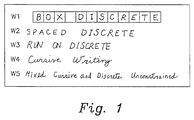
- handwritten characters generally fall into five groups depicted in FIGURE 1, the groups being depicted in increasing order of recognition complexity.
- these groups include a first type of writing (W1) known as box discrete wherein individual characters are formed within predefined areas, or boxes, thereby simplifying the task of character segmentation.
- a second type of writing (W2) is known as spaced discrete wherein the user of the present invention intentionally forms each character such that no character touches another.
- a third type of writing (W3) is known as run-on discrete wherein the user may form characters that touch, or "run-on" to, one another.
- a fourth type of writing (W4) is cursive writing wherein the user normally writes the whole word and subsequently crosses the t's and dots the i's and j's.
- a fifth type of writing (W5) is unconstrained writing wherein the user may use a mixture of run-on and cursive writing. This last type is the most difficult and presents the most complex segmentation and recognition task of the five styles depicted in Fig.
- Fig. 2 illustrates a hardware environment in which the present invention may operate.
- the hardware environment includes a computer platform 210.
- the computer platform 210 has hardware elements 216, such as a random access memory (RAM) 218, a central processing unit (CPU) 220, and an input/output interface 222.
- the computer platform 210 also has an operating system 212, and may have micro instruction code 214.
- the computer platform 210 is an IBM 3090/VF or an IBM RS 6000.
- the operating system 212 is any operating system adapted for use with the IBM 3090/VF or IBM RS 6000.
- peripherals such as a terminal 224, an electronic writing tablet 226 (having a stylus 232), a data storage device 228, and a printer 230. These elements are all well known in the art.
- the handwriting recognition program 202 includes a preprocessor 204, a front end 206, and a modeling component 208. While the present invention is described herein as a computer program, note that the present invention could be implemented in hardware only, or as a combination of hardware and software.
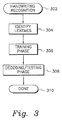
- Fig. 3 illustrates a handwriting recognition flowchart 302 which represents the operation of the handwriting recognition program 202.
- step 304 all possible lexemes for all characters of interest are identified.
- the characters of interest may be all upper case characters, all lower case characters, all digits, and certain punctuation characters.
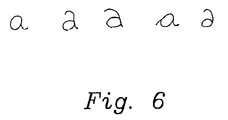
- Lexemes represent different styles for writing characters. Different lexemes of the same character represent significant differences in writing styles. For example, different lexemes may differ in shape, in the direction of pen movement of a stroke, or even in the number of strokes. Fig. 6 shows five different lexemes (that is, different writing styles) for writing the character "a". Note that for a given writer, it is typically possible to identify two, or perhaps three, lexemes per discrete character.
- the handwriting recognition program 202 represents each lexeme in terms of a left-to-right hidden Markov model (HMM).
- HMM left-to-right hidden Markov model
- Fig. 7 illustrates an example of a HMM.
- the nodes labeled s1 . . . s L represent the states of the HMM. Associated with each state is a set of transitions denoted in Fig. 7 by t1, t2 and t3. These transitions govern the path taken through the sequence of states.
- the transitions labeled t1 and t2 result in the emission of an observation feature vector while that labeled t3 is a null transition and results in no output.
- the state transition probabilities, p(s i , t j ) (which are equivalent to p(s i -> s i ) for t1 and p(s i -> S i+1 ) otherwise), and the output probability distributions p(x t
- the handwriting recognition program 202 receives text from a user and decodes the text by calculating, for each character in the text, the a posteriori (that is, empirical) probability based on the lexeme models which were determined in step 306.
- the decoded character is that character corresponding to the lexeme with the greatest a posteriori probability.
- the training phase 306 and the decoding/testing phase 308 are described in greater detail below.
- Fig. 4 illustrates the operation of step 306 in greater detail.
- the computer platform 210 receives character or stroke information produced by a user using the stylus 232 to write on the electronic tablet 226.
- the character or stroke information may be displayed on the electronic tablet 226 or another display device, such as the terminal 224.
- the character or stroke information produced by the user are also called sample characters or observations of characters.
- the sample characters which the user produces during this phase are collectively called training data.
- the training data are received by the handwriting recognition program 202 in the form of two-dimensional traces (that is, sequences of (x,y) coordinates).
- step 404 the preprocessor 204 organizes the sample characters according to the lexemes which were identified in step 304 (see Fig. 3). Specifically, the preprocessor 204 creates a bin for each lexeme. During step 404, the preprocessor 204 allocates the sample characters to the lexeme bins. The manner in which the preprocessor 204 operates during step 404 is described in greater detail in Section 2.1, below.
- step 406 the handwriting recognition program 202 selects the first lexeme (that is, the first bin) to process.
- step 408 the handwriting recognition program 202 selects the first sample character associated with the selected lexeme. In other words, the handwriting recognition program 202 selects the first sample character in the bin selected in step 406.
- the front end In step 410, the front end generates a sequence of feature vectors for the selected sample character using the two- dimensional trace associated with the selected sample character.
- the front end 206 splices the entire data set to obtain feature vectors and a covariance matrix. Analysis of the covariance matrix yields eigenvectors that are used to project the data onto a lower dimensional, more orthogonal space, called the chirographic space.
- the operation of the front end 206 during step 410 is further described in Section 2.2, below.
- the modeling component 208 uses the feature vectors associated with the selected lexeme to accumulate statistics which are later used to generate a hidden Markov model for the selected lexeme. During step 412, the modeling component 208 estimates the state transition probabilities, mixture coefficients, and output probability distributions as well as the number of states in the hidden Markov model for the selected lexeme. The operation of the modeling component 208 during step 412 is further described in Section 2.3, below.
- step 414 the handwriting recognition program 202 determines whether there are any more sample characters in the selected lexeme bin. If there are more sample characters, then the handwriting recognition program 202 performs step 420. Otherwise, the handwriting recognition program 202 performs step 415.
- step 420 the handwriting recognition program 202 selects the next sample character in the selected lexeme bin and then jumps back to step 410 to process the newly- selected sample character.
- step 415 the modeling component 208 uses the statistics accumulated in step 412 to generate a hidden Markov model for the selected lexeme.
- step 417 the handwriting recognition program 202 determines whether there are any more lexemes to process. If there are more lexemes to process, then the handwriting recognition program 202 performs step 422. Otherwise, the training step 306 is complete.
- step 422 the handwriting recognition program 202 selects the next lexeme and then jumps back to step 408 to process the newly-selected lexeme.
- step 404 the preprocessor 204 performs a fully automated procedure for (i) producing an objective, data-driven, morphologically motivated alphabet of lexemes, and (ii) consistently annotating handwriting data with this alphabet, i.e., using the same measure as was employed to derive the alphabet itself.
- the preprocessor 204 maps each observation of each character seen in the training data into a point in a suitable high-dimensional space called the lexographic space .
- this space is only marginally related to the chirographic space described in detail below with regard to step 410.
- the chirographic space is populated by frame-level feature vectors while the lexographic space contains only character-level feature vectors.
- the lexographic space is more appropriate for finding the high-level variations characterizing lexemes.
- the preprocessor 204 performs the annotation in the same lexographic space as defined in (i). Since, for a given character, lexemes represent a partition of the associated lexographic space into regions which correspond to different ways of writing this character, corpus annotation can be done simply after evaluating the contribution of each cluster to the current observation.
- the preprocessor 204 performs the following steps.
- the front end 206 implements the following algorithm while performing step 410.
- Step 412 Modeling Component Uses Current Feature Vectors To Accumulate Statistics For Hidden Markov Model For Selected Lexeme
- Step 412 The operation of the modeling component 208 during Step 412 is described in detail in this section.
- the modeling component 208 performs an initialization step and a hidden Markov modeling step.
- the modeling component 208 performs the initialization step to generate a single state mixture model (SSM).
- SSM single state mixture model
- the modeling component 208 performs the hidden Markov modeling step as follows.
- the modeling component 208 Given T observation sequences, x 1 . . . x T of a given lexeme the modeling component 208 obtains the corresponding HMM as follows.
- the length of the model L is set to be slightly longer than that corresponding to the observation sequence closest in length to the average length of the observed sequences. This prototypical (in length) sequence by x .
- the initial state transition probabilities are set to be uniform.
- the output probability distributions for transitions t1 and t2 for a given state are tied.
- the modeling component 208 combines P(x t
- the modeling component 208 assigns one Gaussian density distribution per codebook to each state (the first and second codebooks represent the spaces spanned by the R1 and R2 dimensional vectors of steps 8 and 9 of step 410, respectively). These are selected from the pool of Gaussians generated by the single state mixture model (SSM) (which was generated by the modeling component 208 during the initialization step).
- SSM single state mixture model
- the selection is done on the basis of the cluster memberships g k of the individual frames of the observation sequence ; the distribution "closest" to i , i.e., the ith frame of , is assigned to state i of the model (distribution A is "closer” to a vector x than distribution B if P( x
- the mixture coefficients may be initialized with the values obtained from the statistical mixture model. Since the latter is a single state model, initially all the states of the HMM would have identical sets of mixture coefficients.
- the modeling component 208 updates the model parameters by performing Viterbi alignment of the observation sequences to the model.
- the Viterbi algorithm is generally described in F. Jelinek, "The Development of an Experimental Discrete Dictation Recognizer," Proc. IEEE , Vol. 73, No. 11, pages 1616-1623 (November 1985), which is herein incorporated by reference in its entirety.
- the modeling component 208 may update the model parameters by using a well-known maximum likelihood alignment of the observation sequences of the model. This is also described in Jelinek, which was cited above.
- the modeling component 208 determines the most probable path through the model.
- the parameters are updated based on the relative frequencies of the various states transitions and of the observed values emitted during these transitions.
- the probability of observing a given feature vector x t at any state j is given by the following equation:
- the original set of Gaussian distributions remains unchanged throughout the training procedure; only the mixture coefficients that characterize each state are reestimated. But extension is straightforward and should be obvious to one skilled in the art.
- the distributions could be updated (that is, reestimated), using the following equations: where x t i is the ith component of the vector x t and E[ x t i] is its expected value. ⁇ ij 2 is the variance of distribution.
- s j ) and the transition probabilities p(s i ⁇ s j ) are updated at each iteration.
- the mixture coefficients are updated as follows:
- the mixture coefficients may also be updated according to either of the following equations:
- the transition probabilities are reestimated by: In general, 3 to 4 iterations are sufficient for the parameters to converge.
- Fig. 5 illustrates a decoding/testing flow chart which represents the operation of the handwriting recognition program 202 during step 308 (see Fig. 3).
- step 502 the computer platform 210 receives text which a user enters on the electronic tablet 226 by using the stylus 232.
- the text entered by the user is received by the handwriting recognition program 202 in the form of two- dimensional traces.
- step 503 the user selects the writing style corresponding to the text of the step 502. This information is essential to the search engine (step 506).
- step 504 the front end 206 generates, for each character in the text, a sequence of feature vectors by using the associated two-dimensional trace.
- the operation of the front end 206 during step 504 is the same as the operation of the front end 206 during step 410, with the exception that step 7 is not performed.
- Steps 8 and 9 are performed using the eigenvectors generated in step 410 (step 7) of the training phase.
- step 505 the search strategy is selected on the basis of the information in step 503. In the case of discrete writing the search strategy is considerably simplified.
- steps 506 and 516 the appropriate search engine is invoked.
- the sequence of feature vectors for each character is known. Therefore the "search” is limited to this sequence.
- a well-known A* type search alghorithm is employed.
- the A* search algorithm is described in Nilsson, N.J., Learning Machines , Ch. 4, McGraw Hill, New York, New York, 1965, which is herein incorporated by reference in its entirety.
- step 510 the handwriting recognition program 202 selects the first hidden Markov models to process. Recall that the hidden Markov models were generated during the training phase 306 such that there is a hidden Markov model for each lexeme identified in step 304 (see Fig. 3).
- step 512 the modeling component 208 computes and stores the probability that the sequence of feature vectors for the selected character was generated by the selected hidden Markov model. In other words, during step 512, the modeling component 208 calculates the a posterior probability for the character with regard to the selected HMM.
- the modeling component 208 performs step 512 by using the Viterbi algorithm.
- the total probability of the observed (test) sequence given a particular model, ⁇ i is approximated by the probability of the most likely path of the sequence through the selected hidden Markov model. In practice, this term is the dominant term and yields a reasonable approximation of the total probability. We will denote this as p ⁇ ( x test
- the modeling component 208 may perform step 512 by using a well-known maximum likelihood algorithm. In this alternate case, no approximation is made.
- step 514 the handwriting recognition program 202 determines whether there are any more hidden Markov models to process for the selected character. If there are more hidden Markov models to process, the handwriting recognition program 202 selects the next hidden Markov model (in step 513), and then loops back to step 512. Otherwise, the handwriting recognition program 202 performs step 516.
- Step 516 is related to step 506 and is part of the search engine. It is described above.
- step 516 the search is completed, then the handwriting recognition program 202 would perform step 518. Otherwise, the handwriting recognition program 202 would loop back to step 506.
- step 518 the handwriting recognition program 202 would decode the selected character as the character corresponding to the Markov model which yielded the highest probability in step 512. Specifically, during step 518, the modeling component 208 determines that the recognized character is the one that maximizes the a posteriori probabilities calculated in step 512: where f maps the lexeme identity, ⁇ i , to its associated discrete character, l ⁇ .
- step 520 the handwriting recognition program 202 determines whether there are any more characters to process. If there are no more characters to process, then the decoding/testing phase 308 is complete. Otherwise, the handwriting recognition program 202 performs step 521 to select the next character and then loops back to step 506.
Landscapes
- Engineering & Computer Science (AREA)
- Data Mining & Analysis (AREA)
- Theoretical Computer Science (AREA)
- Computer Vision & Pattern Recognition (AREA)
- Bioinformatics & Cheminformatics (AREA)
- Bioinformatics & Computational Biology (AREA)
- Artificial Intelligence (AREA)
- Evolutionary Biology (AREA)
- Evolutionary Computation (AREA)
- Physics & Mathematics (AREA)
- General Engineering & Computer Science (AREA)
- General Physics & Mathematics (AREA)
- Life Sciences & Earth Sciences (AREA)
- Character Discrimination (AREA)
Applications Claiming Priority (2)
| Application Number | Priority Date | Filing Date | Title |
|---|---|---|---|
| US07/818,193 US5544257A (en) | 1992-01-08 | 1992-01-08 | Continuous parameter hidden Markov model approach to automatic handwriting recognition |
| US818193 | 1997-03-14 |
Publications (2)
| Publication Number | Publication Date |
|---|---|
| EP0550865A2 true EP0550865A2 (fr) | 1993-07-14 |
| EP0550865A3 EP0550865A3 (en) | 1994-05-18 |
Family
ID=25224920
Family Applications (1)
| Application Number | Title | Priority Date | Filing Date |
|---|---|---|---|
| EP19920121696 Withdrawn EP0550865A3 (en) | 1992-01-08 | 1992-12-21 | A continuous parameter hidden markov model approach to automatic handwriting recognition |
Country Status (3)
| Country | Link |
|---|---|
| US (2) | US5544257A (fr) |
| EP (1) | EP0550865A3 (fr) |
| JP (1) | JP2669583B2 (fr) |
Cited By (3)
| Publication number | Priority date | Publication date | Assignee | Title |
|---|---|---|---|---|
| US5459798A (en) * | 1993-03-19 | 1995-10-17 | Intel Corporation | System and method of pattern recognition employing a multiprocessing pipelined apparatus with private pattern memory |
| US5560039A (en) * | 1993-02-25 | 1996-09-24 | Intel Corporation | Apparatus and method for a four address arithmetic unit |
| US5825921A (en) * | 1993-03-19 | 1998-10-20 | Intel Corporation | Memory transfer apparatus and method useful within a pattern recognition system |
Families Citing this family (46)
| Publication number | Priority date | Publication date | Assignee | Title |
|---|---|---|---|---|
| CA2089784C (fr) * | 1992-04-15 | 1996-12-24 | William Joseph Anderson | Appareil servant a eliminer l'ambiguite dans une file de travaux generee par une interface utilisateur a stylo, et methode connexe |
| EP0574937B1 (fr) * | 1992-06-19 | 2000-08-16 | United Parcel Service Of America, Inc. | Méthode et dispositif pour classification d'entrée utilisant un réseau neuronal |
| EP0612035B1 (fr) * | 1993-02-19 | 2002-01-30 | International Business Machines Corporation | Réseau neuronal pour la comparaison des traites des formes des images |
| AU7311994A (en) * | 1993-05-21 | 1994-12-20 | Arris Pharmaceutical Corporation | A machine-learning approach to modeling biological activity for molecular design and to modeling other characteristics |
| EP0654755B1 (fr) * | 1993-11-23 | 2000-08-02 | International Business Machines Corporation | Système et méthode pour la reconnaissance automatique d'écriture manuscrite avec un alphabet à label chirographique indépendant des utilisateurs |
| US5793891A (en) * | 1994-07-07 | 1998-08-11 | Nippon Telegraph And Telephone Corporation | Adaptive training method for pattern recognition |
| US5854855A (en) * | 1994-09-09 | 1998-12-29 | Motorola, Inc. | Method and system using meta-classes and polynomial discriminant functions for handwriting recognition |
| US5802205A (en) * | 1994-09-09 | 1998-09-01 | Motorola, Inc. | Method and system for lexical processing |
| US6137909A (en) * | 1995-06-30 | 2000-10-24 | The United States Of America As Represented By The Secretary Of The Navy | System and method for feature set reduction |
| US5796863A (en) * | 1995-08-08 | 1998-08-18 | Apple Computer, Inc. | Method for training an adaptive statistical classifier to balance unigram prior factors |
| GB2306739B (en) * | 1995-10-17 | 1999-10-13 | Ibm | Improvements relating to computerized correction of numeric data |
| IL115836A0 (en) * | 1995-10-31 | 1996-01-19 | Baron Tech Ltd | Continuous security system based on motion code |
| US5933525A (en) * | 1996-04-10 | 1999-08-03 | Bbn Corporation | Language-independent and segmentation-free optical character recognition system and method |
| US5960112A (en) * | 1996-11-26 | 1999-09-28 | Wen-Hsing Hsu | Method and device for the automatic matching of seal prints |
| US6256410B1 (en) * | 1998-07-30 | 2001-07-03 | International Business Machines Corp. | Methods and apparatus for customizing handwriting models to individual writers |
| RU2145115C1 (ru) * | 1998-08-10 | 2000-01-27 | Закрытое акционерное общество "Аби Программное обеспечение" | Групповой способ аби (abbyy) верификации компьютерных кодов с соответствующими им оригиналами |
| US6304673B1 (en) * | 1998-12-04 | 2001-10-16 | Shou-Min Tseng | Method and device for automatic matching of seal prints |
| DE60042165D1 (de) * | 1999-01-13 | 2009-06-18 | Computer Ass Think Inc | Unterschriften-erkennungs-system und -verfahren |
| KR100421740B1 (ko) * | 2000-11-14 | 2004-03-10 | 삼성전자주식회사 | 객체 활동 모델링 방법 |
| DE10123572C1 (de) * | 2001-05-08 | 2003-01-23 | Senslab Gmbh | Verfahren und Vorrichtung zur automatischen Online-Analyse von Meßreihen sowie ein entsprechendes Computerprogramm-Erzeugnis und ein entsprechendes computerlesbares Speichermedium |
| US7356466B2 (en) | 2002-06-28 | 2008-04-08 | Samsung Electronics Co., Ltd. | Method and apparatus for performing observation probability calculations |
| US20040006628A1 (en) * | 2002-07-03 | 2004-01-08 | Scott Shepard | Systems and methods for providing real-time alerting |
| US20040024598A1 (en) * | 2002-07-03 | 2004-02-05 | Amit Srivastava | Thematic segmentation of speech |
| US7292977B2 (en) * | 2002-10-17 | 2007-11-06 | Bbnt Solutions Llc | Systems and methods for providing online fast speaker adaptation in speech recognition |
| US20040186815A1 (en) * | 2002-12-20 | 2004-09-23 | Stockfisch Thomas P. | Method for accommodating missing descriptor and property data while training neural network models |
| US20040243531A1 (en) * | 2003-04-28 | 2004-12-02 | Dean Michael Anthony | Methods and systems for representing, using and displaying time-varying information on the Semantic Web |
| US7362892B2 (en) * | 2003-07-02 | 2008-04-22 | Lockheed Martin Corporation | Self-optimizing classifier |
| US20050276454A1 (en) * | 2004-06-14 | 2005-12-15 | Rodney Beatson | System and methods for transforming biometric image data to a consistent angle of inclination |
| US20060045344A1 (en) * | 2004-09-02 | 2006-03-02 | Adi, Llc | Handprint recognition test deck |
| EP1679876A1 (fr) * | 2005-01-05 | 2006-07-12 | Grand Advance Corp. | Télécopieur pour réseau informatique avec fonction d'enregistrement pour transmettre des fichiers video et procédé associé |
| US8280719B2 (en) * | 2005-05-05 | 2012-10-02 | Ramp, Inc. | Methods and systems relating to information extraction |
| US7646913B2 (en) * | 2005-12-19 | 2010-01-12 | Microsoft Corporation | Allograph based writer adaptation for handwritten character recognition |
| US8050500B1 (en) | 2006-07-06 | 2011-11-01 | Senapps, LLC | Recognition method and system |
| US8131536B2 (en) * | 2007-01-12 | 2012-03-06 | Raytheon Bbn Technologies Corp. | Extraction-empowered machine translation |
| US7903877B2 (en) | 2007-03-06 | 2011-03-08 | Microsoft Corporation | Radical-based HMM modeling for handwritten East Asian characters |
| US7983478B2 (en) * | 2007-08-10 | 2011-07-19 | Microsoft Corporation | Hidden markov model based handwriting/calligraphy generation |
| US7890539B2 (en) * | 2007-10-10 | 2011-02-15 | Raytheon Bbn Technologies Corp. | Semantic matching using predicate-argument structure |
| US8218859B2 (en) * | 2008-12-05 | 2012-07-10 | Microsoft Corporation | Transductive multi-label learning for video concept detection |
| US9880990B2 (en) * | 2013-03-14 | 2018-01-30 | Microsoft Technology Licensing, Llc | Leveraging previous instances of handwriting for handwriting beautification and other applications |
| US20140363082A1 (en) * | 2013-06-09 | 2014-12-11 | Apple Inc. | Integrating stroke-distribution information into spatial feature extraction for automatic handwriting recognition |
| US9495620B2 (en) | 2013-06-09 | 2016-11-15 | Apple Inc. | Multi-script handwriting recognition using a universal recognizer |
| US9898187B2 (en) | 2013-06-09 | 2018-02-20 | Apple Inc. | Managing real-time handwriting recognition |
| US9665769B2 (en) | 2015-08-18 | 2017-05-30 | International Business Machines Corporation | Handwriting recognition with natural user input on multitouch surfaces |
| DK179374B1 (en) | 2016-06-12 | 2018-05-28 | Apple Inc | Handwriting keyboard for monitors |
| CN108510057B (zh) * | 2017-02-27 | 2024-12-20 | 顾泽苍 | 一种超深度对抗学习的神经网络模型的构成方法 |
| US11194467B2 (en) | 2019-06-01 | 2021-12-07 | Apple Inc. | Keyboard management user interfaces |
Family Cites Families (13)
| Publication number | Priority date | Publication date | Assignee | Title |
|---|---|---|---|---|
| US3755780A (en) * | 1971-06-28 | 1973-08-28 | Pattern Analysis & Recognition | Method for recognizing characters |
| US4003025A (en) * | 1975-12-24 | 1977-01-11 | International Business Machines Corporation | Alphabetic character word upper/lower case print convention apparatus and method |
| US4553258A (en) * | 1983-12-30 | 1985-11-12 | International Business Machines Corporation | Segmentation algorithm for signature vertification |
| US5165007A (en) * | 1985-02-01 | 1992-11-17 | International Business Machines Corporation | Feneme-based Markov models for words |
| US4783804A (en) * | 1985-03-21 | 1988-11-08 | American Telephone And Telegraph Company, At&T Bell Laboratories | Hidden Markov model speech recognition arrangement |
| US4819271A (en) * | 1985-05-29 | 1989-04-04 | International Business Machines Corporation | Constructing Markov model word baseforms from multiple utterances by concatenating model sequences for word segments |
| US4977599A (en) * | 1985-05-29 | 1990-12-11 | International Business Machines Corporation | Speech recognition employing a set of Markov models that includes Markov models representing transitions to and from silence |
| GB8925479D0 (en) * | 1989-11-10 | 1989-12-28 | Howell David N L | Improvements in methods and apparatus for signature verification |
| JPS62231993A (ja) * | 1986-03-25 | 1987-10-12 | インタ−ナシヨナル ビジネス マシ−ンズ コ−ポレ−シヨン | 音声認識方法 |
| US4977598A (en) * | 1989-04-13 | 1990-12-11 | Texas Instruments Incorporated | Efficient pruning algorithm for hidden markov model speech recognition |
| JPH03113571A (ja) * | 1989-09-27 | 1991-05-14 | Nippon Telegr & Teleph Corp <Ntt> | パターン認識方法 |
| US5075896A (en) * | 1989-10-25 | 1991-12-24 | Xerox Corporation | Character and phoneme recognition based on probability clustering |
| US5062143A (en) * | 1990-02-23 | 1991-10-29 | Harris Corporation | Trigram-based method of language identification |
-
1992
- 1992-01-08 US US07/818,193 patent/US5544257A/en not_active Expired - Fee Related
- 1992-12-08 JP JP4328128A patent/JP2669583B2/ja not_active Expired - Fee Related
- 1992-12-21 EP EP19920121696 patent/EP0550865A3/en not_active Withdrawn
-
1995
- 1995-06-06 US US08/467,615 patent/US5636291A/en not_active Expired - Fee Related
Cited By (5)
| Publication number | Priority date | Publication date | Assignee | Title |
|---|---|---|---|---|
| US5560039A (en) * | 1993-02-25 | 1996-09-24 | Intel Corporation | Apparatus and method for a four address arithmetic unit |
| US5717908A (en) * | 1993-02-25 | 1998-02-10 | Intel Corporation | Pattern recognition system using a four address arithmetic logic unit |
| US5459798A (en) * | 1993-03-19 | 1995-10-17 | Intel Corporation | System and method of pattern recognition employing a multiprocessing pipelined apparatus with private pattern memory |
| US5825921A (en) * | 1993-03-19 | 1998-10-20 | Intel Corporation | Memory transfer apparatus and method useful within a pattern recognition system |
| US5881312A (en) * | 1993-03-19 | 1999-03-09 | Intel Corporation | Memory transfer apparatus and method useful within a pattern recognition system |
Also Published As
| Publication number | Publication date |
|---|---|
| EP0550865A3 (en) | 1994-05-18 |
| US5544257A (en) | 1996-08-06 |
| US5636291A (en) | 1997-06-03 |
| JPH05266256A (ja) | 1993-10-15 |
| JP2669583B2 (ja) | 1997-10-29 |
Similar Documents
| Publication | Publication Date | Title |
|---|---|---|
| US5544257A (en) | Continuous parameter hidden Markov model approach to automatic handwriting recognition | |
| EP0654755B1 (fr) | Système et méthode pour la reconnaissance automatique d'écriture manuscrite avec un alphabet à label chirographique indépendant des utilisateurs | |
| US5392363A (en) | On-line connected handwritten word recognition by a probabilistic method | |
| EP0539749B1 (fr) | Système et méthode pour la reconnaissance automatique d'écriture manuscrite | |
| US7227993B2 (en) | Learning-based system and process for synthesizing cursive handwriting | |
| US6052481A (en) | Automatic method for scoring and clustering prototypes of handwritten stroke-based data | |
| US6556712B1 (en) | Methods and apparatus for handwriting recognition | |
| EP0608708B1 (fr) | Reconnaissance automatique de caractères, utilisant des paramètres statiques et dynamiques | |
| Hu et al. | Writer independent on-line handwriting recognition using an HMM approach | |
| Fine et al. | The hierarchical hidden Markov model: Analysis and applications | |
| Kosmala et al. | On-line handwritten formula recognition using hidden Markov models and context dependent graph grammars | |
| US7903877B2 (en) | Radical-based HMM modeling for handwritten East Asian characters | |
| WO1997044758A9 (fr) | Procedes et appareils de reconnaissance de l'ecriture manuscrite | |
| US5757964A (en) | System and method for automatic subcharacter unit and lexicon generation for handwriting recognition | |
| Bellegarda et al. | A fast statistical mixture algorithm for on-line handwriting recognition | |
| Ponce-López et al. | Gesture and action recognition by evolved dynamic subgestures | |
| Rodríguez-Serrano et al. | Handwritten word image retrieval with synthesized typed queries | |
| Nathan et al. | Parameter tying in writer-dependent recognition of on-line handwriting | |
| Do et al. | Model selection with support vector machines | |
| Blondel et al. | Unsupervised Learning of Stroke Tagger for Online Kanji Handwriting Recognition | |
| Wangb et al. | A Learning-based Approach to Cursive Handwriting Synthesis | |
| AU5196701A (en) | Method and apparatuses for handwriting recognition | |
| Günter et al. | Ensembles of classifiers for handwritten word recognition specialized on individual handwriting style | |
| Radenen | Contextual Markovian Models | |
| Lavirotte et al. | On-Line Handwritten Formula Recognition using Hidden Markov Models and Context Dependent Graph Grammars |
Legal Events
| Date | Code | Title | Description |
|---|---|---|---|
| PUAI | Public reference made under article 153(3) epc to a published international application that has entered the european phase |
Free format text: ORIGINAL CODE: 0009012 |
|
| AK | Designated contracting states |
Kind code of ref document: A2 Designated state(s): DE FR GB |
|
| 17P | Request for examination filed |
Effective date: 19931119 |
|
| PUAL | Search report despatched |
Free format text: ORIGINAL CODE: 0009013 |
|
| AK | Designated contracting states |
Kind code of ref document: A3 Designated state(s): DE FR GB |
|
| 17Q | First examination report despatched |
Effective date: 19970704 |
|
| STAA | Information on the status of an ep patent application or granted ep patent |
Free format text: STATUS: THE APPLICATION IS DEEMED TO BE WITHDRAWN |
|
| 18D | Application deemed to be withdrawn |
Effective date: 19980115 |