EP0551153B1 - 2,4-Diamino-1,3,5-Triazinyl-6-Phosphonsäurederivate - Google Patents
2,4-Diamino-1,3,5-Triazinyl-6-Phosphonsäurederivate Download PDFInfo
- Publication number
- EP0551153B1 EP0551153B1 EP93200013A EP93200013A EP0551153B1 EP 0551153 B1 EP0551153 B1 EP 0551153B1 EP 93200013 A EP93200013 A EP 93200013A EP 93200013 A EP93200013 A EP 93200013A EP 0551153 B1 EP0551153 B1 EP 0551153B1
- Authority
- EP
- European Patent Office
- Prior art keywords
- general formula
- range
- alkyl
- hydrogen
- reaction
- Prior art date
- Legal status (The legal status is an assumption and is not a legal conclusion. Google has not performed a legal analysis and makes no representation as to the accuracy of the status listed.)
- Expired - Lifetime
Links
- 0 CC(C)(N=C(C)N=C(C)P(O*)(O*)=O)P(O*)(O*)=O Chemical compound CC(C)(N=C(C)N=C(C)P(O*)(O*)=O)P(O*)(O*)=O 0.000 description 9
Classifications
-
- C—CHEMISTRY; METALLURGY
- C08—ORGANIC MACROMOLECULAR COMPOUNDS; THEIR PREPARATION OR CHEMICAL WORKING-UP; COMPOSITIONS BASED THEREON
- C08K—Use of inorganic or non-macromolecular organic substances as compounding ingredients
- C08K5/00—Use of organic ingredients
- C08K5/49—Phosphorus-containing compounds
- C08K5/51—Phosphorus bound to oxygen
- C08K5/53—Phosphorus bound to oxygen bound to oxygen and to carbon only
- C08K5/5317—Phosphonic compounds, e.g. R—P(:O)(OR')2
- C08K5/5333—Esters of phosphonic acids
- C08K5/5373—Esters of phosphonic acids containing heterocyclic rings not representing cyclic esters of phosphonic acids
-
- C—CHEMISTRY; METALLURGY
- C07—ORGANIC CHEMISTRY
- C07F—ACYCLIC, CARBOCYCLIC OR HETEROCYCLIC COMPOUNDS CONTAINING ELEMENTS OTHER THAN CARBON, HYDROGEN, HALOGEN, OXYGEN, NITROGEN, SULFUR, SELENIUM OR TELLURIUM
- C07F9/00—Compounds containing elements of Groups 5 or 15 of the Periodic Table
- C07F9/02—Phosphorus compounds
- C07F9/547—Heterocyclic compounds, e.g. containing phosphorus as a ring hetero atom
- C07F9/6515—Heterocyclic compounds, e.g. containing phosphorus as a ring hetero atom having three nitrogen atoms as the only ring hetero atoms
- C07F9/6521—Six-membered rings
-
- C—CHEMISTRY; METALLURGY
- C07—ORGANIC CHEMISTRY
- C07F—ACYCLIC, CARBOCYCLIC OR HETEROCYCLIC COMPOUNDS CONTAINING ELEMENTS OTHER THAN CARBON, HYDROGEN, HALOGEN, OXYGEN, NITROGEN, SULFUR, SELENIUM OR TELLURIUM
- C07F9/00—Compounds containing elements of Groups 5 or 15 of the Periodic Table
- C07F9/02—Phosphorus compounds
- C07F9/547—Heterocyclic compounds, e.g. containing phosphorus as a ring hetero atom
- C07F9/6558—Heterocyclic compounds, e.g. containing phosphorus as a ring hetero atom containing at least two different or differently substituted hetero rings neither condensed among themselves nor condensed with a common carbocyclic ring or ring system
- C07F9/65583—Heterocyclic compounds, e.g. containing phosphorus as a ring hetero atom containing at least two different or differently substituted hetero rings neither condensed among themselves nor condensed with a common carbocyclic ring or ring system each of the hetero rings containing nitrogen as ring hetero atom
-
- C—CHEMISTRY; METALLURGY
- C07—ORGANIC CHEMISTRY
- C07F—ACYCLIC, CARBOCYCLIC OR HETEROCYCLIC COMPOUNDS CONTAINING ELEMENTS OTHER THAN CARBON, HYDROGEN, HALOGEN, OXYGEN, NITROGEN, SULFUR, SELENIUM OR TELLURIUM
- C07F9/00—Compounds containing elements of Groups 5 or 15 of the Periodic Table
- C07F9/02—Phosphorus compounds
- C07F9/547—Heterocyclic compounds, e.g. containing phosphorus as a ring hetero atom
- C07F9/6564—Heterocyclic compounds, e.g. containing phosphorus as a ring hetero atom having phosphorus atoms, with or without nitrogen, oxygen, sulfur, selenium or tellurium atoms, as ring hetero atoms
- C07F9/6571—Heterocyclic compounds, e.g. containing phosphorus as a ring hetero atom having phosphorus atoms, with or without nitrogen, oxygen, sulfur, selenium or tellurium atoms, as ring hetero atoms having phosphorus and oxygen atoms as the only ring hetero atoms
- C07F9/657163—Heterocyclic compounds, e.g. containing phosphorus as a ring hetero atom having phosphorus atoms, with or without nitrogen, oxygen, sulfur, selenium or tellurium atoms, as ring hetero atoms having phosphorus and oxygen atoms as the only ring hetero atoms the ring phosphorus atom being bound to at least one carbon atom
- C07F9/657181—Heterocyclic compounds, e.g. containing phosphorus as a ring hetero atom having phosphorus atoms, with or without nitrogen, oxygen, sulfur, selenium or tellurium atoms, as ring hetero atoms having phosphorus and oxygen atoms as the only ring hetero atoms the ring phosphorus atom being bound to at least one carbon atom the ring phosphorus atom and, at least, one ring oxygen atom being part of a (thio)phosphonic acid derivative
Definitions
- the present invention relates to phosphonic esters and acids of triazinic derivatives.
- the present invention relates to derivatives of 2,4-diamino-1,3,5-triazinyl-6-phosphonic acid.
- thermoplastic polymers or on polymers endowed with elastomeric properties, in particular olefinic polymers or copolymers, either alone, or together with small amounts of ammonium or amine phosphates and/or phosphonates.
- EP-A-0415371 describes self-extinguishing polymeric compositions comprising: (a) from 89 to 45 parts by weight of thermoplastic polymer, or of polymer endowed with elastomeric properties; (b) from 8 to 30 parts by weight of one or more ammonium and/or amine phosphate(s) and/or phosphonate(s); (c) from 3 to 25 parts by weight of one or more 2,4,6-triamino-1,3,5-triazine derivatives.
- radicals R in the general formula (I) are:
- radicals R 1 and R 2 are:
- heterocyclic radicals which may replace the moiety: are:
- divalent -Z- radicals are those which derive, by means of the removal of a hydrogen atom from each aminic group, from the following diaminic compounds:
- multivalent radicals are those which derive, by elimination of a hydrogen atom from each reacted amino group, from the following polyaminic compounds:
- the derivatives of triazinylphosphonic acid of general formula (I) in which the radicals R are different from hydrogen or C 3 -C 5 hydroxyalkyl can be synthetized by causing a cyanuric halide, e.g., cyanuric chloride, to react, at a temperature comprised within the range of from 0 to 200°C, in the presence, or less, of a suitable solvent (such as, e.g.
- phosphite examples include: trimethylphosphite; triethylphosphite; tripropylphosphite; triisopropylphosphite; tributylphosphite; triisobutylphosphite; triisopentylphosphite; triallylphosphite; trimethylallylphosphite; tricyclohexylphosphite; triphenylphosphite; tri(2-methylphenyl)phosphite; tri(3-methylphenyl)phosphite; tri(4-methylphenyl)phosphite; tri(2,6-dimethylphenyl)phosphite; tri(4-isopropenylphenyl)phosphite; tri-(4-tert-butenylphenyl)phosphite; 2-methoxy-1,3,2-dioxaphosphorinane; 2-methoxy
- Such an intermediate which may be separated or not, is caused to react, at a temperature comprised within the range of from 0 to 40°C, in a solvent (such as, e.g., ethyl alcohol, xylene, dimethylsulfoxide, dimethylformamide, and so forth), with a polyamine having the general formula (XVI): corresponding to one of the structures falling within the scope of the general formulae from (II) to (XIII), to yield the intermediate having the general formula (XVII): wherein R 11 is either hydrogen, or: and its meaning may vary within each repeating unit.
- a solvent such as, e.g., ethyl alcohol, xylene, dimethylsulfoxide, dimethylformamide, and so forth
- the intermediate of general formula (XVII) can alternatively be prepared by causing the cyanuric halide, e.g., cyanuric chloride, to react first with the polyamine having the general formula (XVI), to yield the intermediate of general formula (XIX): wherein R 12 is either hydrogen or: and its meaning may vary within each repeating unit, and subsequently the intermediate of general formula (XIX) to react with the phosphite having the general formula (XIV).
- the cyanuric halide e.g., cyanuric chloride
- a further alternative route consists in causing the cyanuric halide to react with the amine of general formula (XVIII) to yield the intermediate of general formula (XX): which is subsequently reacted with the phosphite of general formula (XIV), with the intermediate of general formula (XXI) being obtained: which, in its turn, is caused to react with the polyamine of general formula (XVI).
- the reaction of hydrolysis is preferably carried out by using the method described by T. Morita, Y. Okamoto and H. Sakurai, Bulletin of Chemical Society of Japan 54, 267-273 (1981), which makes it possible, under very mild conditions, triazinylphosphinic acids to be obtained with a good yield (higher than 70%).
- the separation as aniline or cyclohexylamine salts is not necessary, and the hydrolysis may also take place in water.
- the phosphonic ester is first reacted with trimethylchlorosilane and sodium or potassium iodide, in order to yield the polykis(trimethylsilyl)phosphonate of general formula (XXII): wherein R 13 is either hydrogen or: and its meaning may vary inside each repeating unit, at temperature comprised within the range of from 20 to 50°C in acetonitrile and the intermediate (XXII) is subsequently submitted to a reaction of hydrolysis by treatment with methyl alcohol or water, at temperatures comprised within the range of from 10 to 30°C, to yield the phosphonic acids of general formula (I).
- the dispersion is stirred at room temperature, then 498.5 g of triethylphosphite are fed during approximately 4 hours.
- the reaction is initially exothermic and the temperature reaches the value of 45°C; then, the temperature is kept at said value of 45°C, by heating the reaction mass from the outside.
- the solvent is then distilled off; the residue from the distillation of the product, after being cooled down to room temperature, is taken up with 300 cm 3 of n-hexane.
- the resulting product is filtered and is washed on the filter with n-hexane.
- the reaction mixture is kept stirred at room temperature for 24 hours.
- the solvent is then distilled off and the oil which constitutes the distillation residue is taken up with 300 cm 3 of a mixture constituted by n-hexane and ethyl ether in the ratio 1:3.
- the product which precipitates is filtered off and is washed on the filter with the same mixture.
- reaction mass is kept with stirring at room temperature for about 40 hours, then the formed product is precipitated by pouring the reaction mixture into 700 g of an ice-water mixture.
- the separated product is filtered off and is washed on the filter with water.
- reaction mixture is kept stirred at 5°C for a further 4 hours, then 200 cm 3 of cold water are added, the formed precipitate is filtered and is washed on the filter with water.
- the temperature of the mixture is gradually increased up to solvent boiling temperature, and the reaction mixture is kept refluxing for about 8 hours.
- a portion of the solvent is distilled off and the residue of distillation is first cooled down to room temperature and subsequently treated with 400 cm 3 of a mixture constituted by n-hexane/ethyl ether in the ratio 2:1.
- the resulting product is filtered off and is washed on the filter with the same mixture.
- the mixture is kept stirred at room temperature for about 40 hours, then the reaction solution is added to 400 g of an ice-water mixture.
- the product does not precipitate, so it is extracted with 4 portions of ethyl acetate, each portion being of 200 cm 3 .
- the organic extracts are thoroughly dried and the solvent is distilled off.
- a thick oil is obtained which, when treated with 300 cm 3 of a mixture constituted by ethyl ether/n-hexane in the ratio 3:1, yields a white precipitate.
- the resulting product is filtered off and is washed on the filter with the same mixture.
- the mixture is heated to 40°C and, with the temperature being kept at that value, 26.1 g of trimethylchlorosilane are fed during 40 minutes.
- reaction is kept stirred at 40°C for a further 2 hours, then is cooled to room temperature and the reaction mass is filtered, in order to remove sodium chloride formed during the reaction; the residue is washed on the filter with acetonitrile.
- the solvent is distilled off under reduced pressure, at about 40°C, and the distillation residue is treated with 200 cm 3 of methyl alcohol at room temperature.
- the resulting product is filtered off and is washed on the filter with methyl alcohol.
- the mixture is kept stirred at room temperature for 3 hours.
- the solvent is then distilled off and the oil which constitutes the distillation residue is taken up with 500 cm 3 of a mixture constituted by n-hexane and ethyl ether in the ratio 1:4.
- the separated product is filtered and is washed on the filter, with the same mixture.
- reaction mixture is kept stirred at room temperature for 42 hours, and then the process is continued according to the same operating modalities as disclosed in Example 1.
- the dispersion is heated to 80°C and during approximately 2 hours, 224 g trimethylphosphite are fed.
- the development of methyl chloride starts immediately.
- the reaction mixture is kept stirred at 80°C for a further hour, then is heated to its boiling temperature and is kept refluxing for about 1 hour, until the development of methyl chloride ceases. A homogeneous solution is obtained.
- reaction mixture is allowed to cool to room temperature; a precipitate forms as white crystals.
- the reaction mixture is further cooled to 5°C, the product is filtered off and is washed on the filter firstly With xylene and then with n-hexane.
- the reaction is kept stirred at room temperature for 20 hours.
- the solvent is then distilled off and the distillation residue is taken up with 250 cm 3 of a mixture constituted by n-hexane and ethyl ether in the ratio 1:3.
- the formed product is filtered off and is washed on the filter with the same mixture.
- reaction mixture is stirred until a solution is obtained, then the solution is cooled to 0-3°C from the outside, and the solution is saturated with ammonia gas.
- the temperature is allowed to rise to 10-15°C and the reaction is kept stirred for about 20 hours.
- a portion of the solvent is distilled off at room temperature under reduced pressure, and a precipitate is formed.
- the product is filtered off and is washed with ethyl alcohol on the filter.
- the mixture is heated to 40°C and, at such a temperature, 34.7 of trimethylchlorosilane are charged within a 1 hour time.
- the mixture is kept at 40°C for a further 4 hours.
- the silyl ester is insoluble in acetonitrile, so the reaction mixture is filtered, with both the resulting product and sodium chloride formed being separated.
- the mixture is kept stirred at room temperature for about 4 hours, then the resulting product is filtered off and is washed with water on the filter.
- the temperature is kept at 0-3°C for a further 3 hours, then the aqueous phase is separated.
- the reaction mixture is kept stirred for a further 2 hours, until the development of hydrogen chloride ends, then the solvent and unreacted phosphorus trichloride are distilled off.
- the residual product consisting of 408 g of a thick liquid, is submitted to a further fractional distillation, and at 60°C and 10 mmHg, 293.5 g of intermediate (XXX): containing 20.98% of chlorine (theoretical value: 21.07%) and 18.31% of phosphorus (theoretical value: 18.40%) are obtained.
- the reaction mixture is cooled to 5°C from the outside, and, with the temperature being kept comprised within the range of from 5 to 7°C, a solution constituted by 340 cm 3 of ethyl ether, 142.0 of pyridine and 54.4 of methyl alcohol is charged during approximately 1 hour.
- the temperature is allowed to increase to room temperature, and the reaction is kept stirred for 1 hour, then is heated to boiling temperature and is kept refluxing for a further hour.
- reaction mixture is cooled down to 15°C and then is filtered in order to separate pyridine chloride formed; the filter cake is washed on the filter with a little of ethyl ether.
- the solvent is distilled off and a residue is obtained, which consists of 316 g of a liquid which is submitted to fractional distillation.
- the fraction boiling at 62-64°C and 17 mmHg is collected. It is constituted by 254.8 g of the intermediate (XXXI): having the appearance of a colourless liquid containing 18.81% of phosphorus (theoretical value: 18.90%).
- the mixture is heated to 160°C; at about 140°C, the development of methyl chloride starts.
- the reaction mixture is kept at 160°C for 6 hours, until the development of methyl chloride ends.
- the reaction mixture is allowed to cool down to room temperature and a precipitate is formed.
- the product is filtered off and is washed on the filter with orthodichlorobenzene.
- the filter cake is taken up, inside the same reactor, with 400 cm 3 of n-hexane, and is kept with stirring for 30 minutes.
- the product is filtered off once more, and is washed on the filter with n-hexane.
- reaction mixture is kept 46 hours with stirring at room temperature, and then the separated product is filtered off and is washed on the filter with a little of solvent.
- the filter cake is treated, inside the same reactor, with 400 cm 3 of water, and is kept stirred for 30 minutes.
- the product is filtered off once more and is washed with water on the filter.
- Example 7 250 cm 3 of water, 13.4 g of sodium hydroxide and 56.8 g of the product of Example 7 are charged to a reactor of 0.5 l of capacity, equipped as in the preceding examples.
- the reaction mass is heated to 85°C and is kept 1 hour with stirring at that temperature.
- the temperature is decreased to room temperature and the pH value is adjusted at 5-6 by means of the addition of an aqueous solution of hydrochloric acid.
- the resulting product is filtered off and is washed with water on the filter.
- Specimens are obtained as small slabs of approximately 3 mm of thickness, and on them the level of self-extinguishment is determined by measuring the oxygen index (L.O.I. according to ASTM D-2863/77) on a STANTON REDCROFT instrument, and applying the "Vertical Burning Test", which makes it possible the material to be classified at the three levels 94 V-0, 94 V-1 and 94 V-2 according to UL 94 standards (published by "Underwriters Laboratories” - USA).
Landscapes
- Chemical & Material Sciences (AREA)
- Organic Chemistry (AREA)
- Health & Medical Sciences (AREA)
- Biochemistry (AREA)
- Molecular Biology (AREA)
- General Health & Medical Sciences (AREA)
- Life Sciences & Earth Sciences (AREA)
- Polymers & Plastics (AREA)
- Medicinal Chemistry (AREA)
- Chemical Kinetics & Catalysis (AREA)
- Compositions Of Macromolecular Compounds (AREA)
- Agricultural Chemicals And Associated Chemicals (AREA)
- Polymers With Sulfur, Phosphorus Or Metals In The Main Chain (AREA)
- Fireproofing Substances (AREA)
- Pharmaceuticals Containing Other Organic And Inorganic Compounds (AREA)
- Polyurethanes Or Polyureas (AREA)
- Saccharide Compounds (AREA)
- Cosmetics (AREA)
Claims (9)
- 2,4-Diamino-1,3,5-triazinyl-6-phosphonsäurederivate der allgemeinen Formel (I):
 die Reste R, die gleich oder voneinander verschieden sein können, Wasserstoff, C1-C5-Alkyl, C3-C5-Hydroxyalkyl, C3-C4-Alkenyl, Cyclohexyl, C6-C10-Aryl oder C7-C8-Aralkyl darstellen oder zusammengenommen eine cyclische Struktur bilden wie:
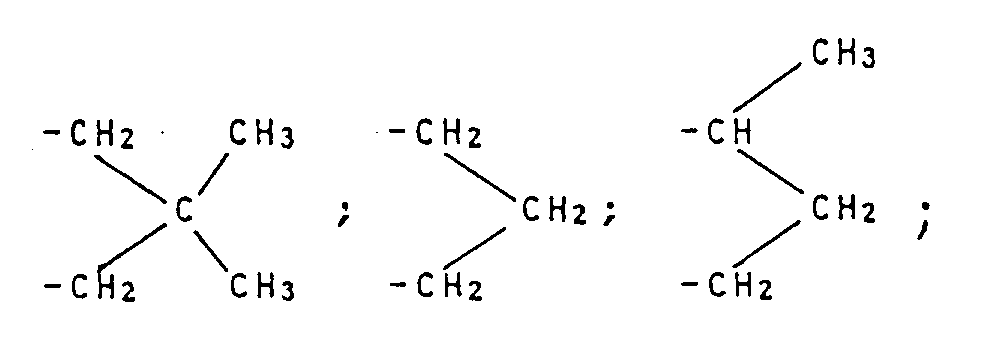 die Reste R1 und R2, die gleich oder verschieden sein können und auf jedem Triazinring unterschiedliche Bedeutung haben können, H, C1-C18-Alkyl, C2-C8-Alkenyl, C6-C16-Cycloalkyl oder Alkylcycloalkyl, sowie
-CH2 -[-CmH2m-]-O-R4;
 m eine ganze Zahl im Bereich von 1 bis 7 undp eine ganze Zahl im Bereich von 1 bis 5 ist,R4 H, C1-C8-Alkyl, C2-C6-Alkenyl oder -[CqH2q-]-O-R6 darstellt, worin q eine ganze Zahl im Bereich von 1 bis 4 und R6 H, C1-C4-Alkyl oder C6-C12-Cycloalkyl oder Alkylcycloalkyl ist,die Reste R5, die gleich oder verschieden sein können, H, C1-C8-Alkyl, C2-C6-Alkenyl, C6-C12-Cycloalkyl oder Alkylcycloalkyl oder C1-C4-Hydroxyalkyl darstellen, oder die Gruppe
oder in der allgemeinen Formel (I) die Gruppe a 0 oder 1,b 0 oder eine ganze Zahl im Bereich von 1 bis 5 undR3 Wasserstoff oderist, wobei R3 seine Bedeutung sich in jeder wiederkehrenden Einheit ändern kann,
und dann, wenn b 0 ist, Z ein unter eine der folgenden Formeln fallender, divalenter Rest ist:


oder, wenn andererseits b eine ganze Zahl im Bereich von 1 bis 5 ist, die Gruppe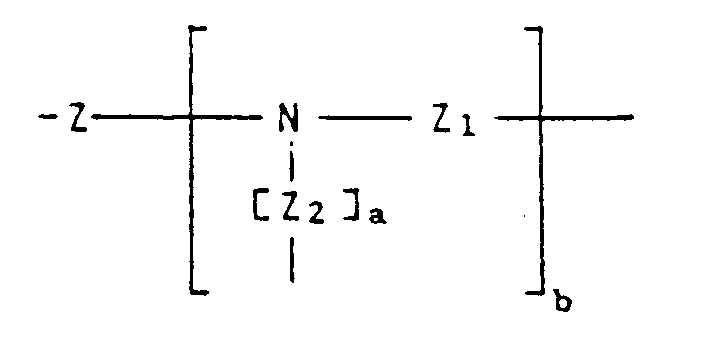


- 2,4-Diamino-1,3,5-triazinyl-6-phosphonsäurederivate gemäß Anspruch 1, in denen die Gruppe

- 2,4-Diamino-1,3,5-triazinyl-6-phosphonsäurederivate gemäß Anspruch 1, in denen die Gruppe

- Verfahren zur Herstellung von 2,4-Diamino-1,3,5-triazino-6-phosphonsäurederivaten der allgemeinen Formel (I) gemäß einem der Ansprüche 1 bis 3, dadurch gekennzeichnet, daß die Verbindungen ausgehend von Intermediaten der allgemeinen Formel (XVII)


durch Umsetzung derselben mit einem Amin der allgemeinen Formel (XVIII)
- Verfahren zur Herstellung von 2,4-Diamino-1,3,5-triazino-6-phosphonsäurederivaten der allgemeinen Formel (I) gemäß einem der Ansprüche 1 bis 3, dadurch gekennzeichnet, daß die Verbindungen durch Umsetzung eines Polyamins der allgemeinen Formel (XVI)


- Verfahren gemäß Anspruch 4 oder 5, bei dem die Umsetzung des Intermediats der allgemeinen Formel (XVII) mit dem Amin der allgemeinen Formel (XVIII) oder die Umsetzung des Polyamins der allgemeinen Formel (XVI) mit dem Intermediat der allgemeinen Formel (XXI) in einem Lösungsmittel wie Ethylalkohol, Xylol, Dimethylsulfoxid, Dimethylformamid bei einer Temperatur im Bereich von 0 bis 40 °C erfolgt.
- Verfahren zur Herstellung von 2,4-Diamino-1,3,5-triazino-6-phosphonsäurederivaten der allgemeinen Formel (I) gemäß einem der Ansprüche 1 bis 3, in denen R für Wasserstoff steht, dadurch gekennzeichnet, daß die Verbindungen durch Hydrolyse der entsprechenden Derivate, in denen R nicht Wasserstoff bedeutet und vorzugsweise ein C1-C2-Alkyl darstellt, erhalten werden.
- Verfahren nach Anspruch 7, bei dem die Hydrolyse durch Umsetzung des Derivats der allgemeinen Formel (I), in der R ein C1-C2-Alkyl ist, mit Trimethylchlorsilan veranlaßt, um das Polykis(trimethylsilyl)phosphonat der allgemeinen Formel (XXII)


- Verfahren gemäß Anspruch 8, bei dem die Umsetzung mit Trimethylchlorsilan in Anwesenheit von Acetonitril bei einer Temperatur im Bereich von 20 bis 50 °C erfolgt und die anschließende Reaktion des Intermediats der allgemeinen Formel (XXII) mit Methylalkohol oder Wasser bei einer Temperatur im Bereich von 10 bis 30 °C durchgeführt wird.
Applications Claiming Priority (2)
| Application Number | Priority Date | Filing Date | Title |
|---|---|---|---|
| ITMI920018 | 1992-01-10 | ||
| ITMI920018A IT1262920B (it) | 1992-01-10 | 1992-01-10 | Derivati dell'acido 2,4-diammino-1,3,5-triazinil-6-fosforico |
Publications (2)
| Publication Number | Publication Date |
|---|---|
| EP0551153A1 EP0551153A1 (de) | 1993-07-14 |
| EP0551153B1 true EP0551153B1 (de) | 1997-12-17 |
Family
ID=11361489
Family Applications (1)
| Application Number | Title | Priority Date | Filing Date |
|---|---|---|---|
| EP93200013A Expired - Lifetime EP0551153B1 (de) | 1992-01-10 | 1993-01-05 | 2,4-Diamino-1,3,5-Triazinyl-6-Phosphonsäurederivate |
Country Status (9)
| Country | Link |
|---|---|
| US (1) | US5296598A (de) |
| EP (1) | EP0551153B1 (de) |
| JP (1) | JPH06179689A (de) |
| AT (1) | ATE161263T1 (de) |
| AU (1) | AU652307B2 (de) |
| CA (1) | CA2086998A1 (de) |
| DE (1) | DE69315712T2 (de) |
| ES (1) | ES2111123T3 (de) |
| IT (1) | IT1262920B (de) |
Families Citing this family (5)
| Publication number | Priority date | Publication date | Assignee | Title |
|---|---|---|---|---|
| KR100553398B1 (ko) * | 2004-03-12 | 2006-02-16 | 한미약품 주식회사 | 티에노[3,2-c]피리딘 유도체의 제조 방법 및 이에사용되는 중간체 |
| EP2615073B1 (de) * | 2012-01-13 | 2018-04-04 | Construction Research & Technology GmbH | Dispergiermittel für anorganische Partikel |
| CA3039331C (en) | 2016-10-12 | 2021-08-31 | Bruag Fire Protection Ag | Flame retardants |
| CN109629024B (zh) * | 2018-12-10 | 2022-04-01 | 天津工业大学 | 树枝型磷氮系无卤阻燃剂及其制备方法和用途 |
| CN111688306A (zh) * | 2020-06-08 | 2020-09-22 | 浙江景程无纺布有限公司 | 一种阻燃、防水的聚丙烯sms复合无纺布 |
Citations (2)
| Publication number | Priority date | Publication date | Assignee | Title |
|---|---|---|---|---|
| EP0547714A1 (de) * | 1991-12-18 | 1993-06-23 | Ministero Dell' Universita' E Della Ricerca Scientifica E Tecnologica | Triazinylphosphonsäure und ihre Verwendung in selbstlöschenden polymerischen Zusammensetzungen |
| WO1993012173A2 (en) * | 1991-12-18 | 1993-06-24 | Courtaulds Plc | Phosphorus-containing triazine compounds and their use |
Family Cites Families (4)
| Publication number | Priority date | Publication date | Assignee | Title |
|---|---|---|---|---|
| US3213093A (en) * | 1963-12-12 | 1965-10-19 | American Cyanamid Co | Phosphino-s-triazines |
| DE2459492A1 (de) * | 1974-12-17 | 1976-06-24 | Bayer Ag | Gegenueber isocyanaten reaktive phosphorhaltige flammschutzmittel |
| AU627615B2 (en) * | 1989-08-28 | 1992-08-27 | Ministero Dell Universita E Della Ricerca Scientifica E Tecnologica | Self-extinguishing polymeric compositions |
| IT1246764B (it) * | 1990-07-11 | 1994-11-26 | Mini Ricerca Scient Tecnolog | Sali di composti triazinici con acidi ossigenati del fosforo e loro impiego in composizioni polimeriche autoestinguenti |
-
1992
- 1992-01-10 IT ITMI920018A patent/IT1262920B/it active IP Right Grant
-
1993
- 1993-01-05 AT AT93200013T patent/ATE161263T1/de not_active IP Right Cessation
- 1993-01-05 EP EP93200013A patent/EP0551153B1/de not_active Expired - Lifetime
- 1993-01-05 DE DE69315712T patent/DE69315712T2/de not_active Expired - Fee Related
- 1993-01-05 ES ES93200013T patent/ES2111123T3/es not_active Expired - Lifetime
- 1993-01-06 US US08/001,528 patent/US5296598A/en not_active Expired - Fee Related
- 1993-01-07 AU AU31066/93A patent/AU652307B2/en not_active Ceased
- 1993-01-08 CA CA002086998A patent/CA2086998A1/en not_active Abandoned
- 1993-01-11 JP JP5019289A patent/JPH06179689A/ja active Pending
Patent Citations (2)
| Publication number | Priority date | Publication date | Assignee | Title |
|---|---|---|---|---|
| EP0547714A1 (de) * | 1991-12-18 | 1993-06-23 | Ministero Dell' Universita' E Della Ricerca Scientifica E Tecnologica | Triazinylphosphonsäure und ihre Verwendung in selbstlöschenden polymerischen Zusammensetzungen |
| WO1993012173A2 (en) * | 1991-12-18 | 1993-06-24 | Courtaulds Plc | Phosphorus-containing triazine compounds and their use |
Also Published As
| Publication number | Publication date |
|---|---|
| ES2111123T3 (es) | 1998-03-01 |
| EP0551153A1 (de) | 1993-07-14 |
| US5296598A (en) | 1994-03-22 |
| AU652307B2 (en) | 1994-08-18 |
| ITMI920018A0 (it) | 1992-01-10 |
| CA2086998A1 (en) | 1993-07-11 |
| ATE161263T1 (de) | 1998-01-15 |
| ITMI920018A1 (it) | 1993-07-10 |
| AU3106693A (en) | 1993-07-15 |
| DE69315712T2 (de) | 1998-04-16 |
| DE69315712D1 (de) | 1998-01-29 |
| JPH06179689A (ja) | 1994-06-28 |
| IT1262920B (it) | 1996-07-22 |
Similar Documents
| Publication | Publication Date | Title |
|---|---|---|
| US5344931A (en) | Salts of triazinic compounds with phosphorus oxyacids, and use of said compounds in self-extinguishing polymeric compositions | |
| EP0466137B1 (de) | Salze von Triazinderivaten mit oxygenierter Phosphorsäure und ihre Verwendung in selbstlöschenden Polymerzusammensetzungen | |
| EP0415371A2 (de) | Selbstlöschende Polymerzusammensetzungen | |
| US5223560A (en) | Self-extinguishing polymeric compositions | |
| EP0453871B1 (de) | Triazinderivatsalze mit Oxasäuren des Phosphors | |
| US5210120A (en) | Self-extinguishing polymeric compositions comprising oligomeric 2,4-diamino-6-hydroxy-1,3,5-triazines and phosphates and/or phosphonates | |
| EP0475367B1 (de) | Diamino-s-Triazinonderivate und diese enthaltende selbstlöschende polymere Zusammensetzungen | |
| EP0551153A1 (de) | 2,4-Diamino-1,3,5-Triazinyl-6-Phosphonsäurederivate | |
| AU653087B2 (en) | Triazinylphosphonic acids and their use in self-extinguishing polymeric compositions | |
| EP0551154B1 (de) | Selbstverlöschende Polymerzusammensetzungen | |
| EP0448774B1 (de) | Triazinverbindungen | |
| US5371218A (en) | Salts of triazine compounds with cyanuric acid | |
| EP0707036A1 (de) | Flammgeschützte Polymerzusammensetzungen und Salze von Cyanursäure mit Triazinverbindungen die zur Herstellung dieser Zusammensetzungen verwendbar sind |
Legal Events
| Date | Code | Title | Description |
|---|---|---|---|
| PUAI | Public reference made under article 153(3) epc to a published international application that has entered the european phase |
Free format text: ORIGINAL CODE: 0009012 |
|
| AK | Designated contracting states |
Kind code of ref document: A1 Designated state(s): AT BE CH DE DK ES FR GB IT LI NL SE |
|
| 17P | Request for examination filed |
Effective date: 19931211 |
|
| RAP3 | Party data changed (applicant data changed or rights of an application transferred) |
Owner name: MINISTERO DELL' UNIVERSITA' E DELLA RICERCA SCIENT |
|
| 17Q | First examination report despatched |
Effective date: 19960805 |
|
| GRAG | Despatch of communication of intention to grant |
Free format text: ORIGINAL CODE: EPIDOS AGRA |
|
| GRAG | Despatch of communication of intention to grant |
Free format text: ORIGINAL CODE: EPIDOS AGRA |
|
| GRAH | Despatch of communication of intention to grant a patent |
Free format text: ORIGINAL CODE: EPIDOS IGRA |
|
| GRAH | Despatch of communication of intention to grant a patent |
Free format text: ORIGINAL CODE: EPIDOS IGRA |
|
| GRAA | (expected) grant |
Free format text: ORIGINAL CODE: 0009210 |
|
| AK | Designated contracting states |
Kind code of ref document: B1 Designated state(s): AT BE CH DE DK ES FR GB IT LI NL SE |
|
| PG25 | Lapsed in a contracting state [announced via postgrant information from national office to epo] |
Ref country code: LI Free format text: LAPSE BECAUSE OF FAILURE TO SUBMIT A TRANSLATION OF THE DESCRIPTION OR TO PAY THE FEE WITHIN THE PRESCRIBED TIME-LIMIT Effective date: 19971217 Ref country code: IT Free format text: LAPSE BECAUSE OF FAILURE TO SUBMIT A TRANSLATION OF THE DESCRIPTION OR TO PAY THE FEE WITHIN THE PRESCRIBED TIME-LIMIT;WARNING: LAPSES OF ITALIAN PATENTS WITH EFFECTIVE DATE BEFORE 2007 MAY HAVE OCCURRED AT ANY TIME BEFORE 2007. THE CORRECT EFFECTIVE DATE MAY BE DIFFERENT FROM THE ONE RECORDED. Effective date: 19971217 Ref country code: DK Free format text: LAPSE BECAUSE OF NON-PAYMENT OF DUE FEES Effective date: 19971217 Ref country code: CH Free format text: LAPSE BECAUSE OF FAILURE TO SUBMIT A TRANSLATION OF THE DESCRIPTION OR TO PAY THE FEE WITHIN THE PRESCRIBED TIME-LIMIT Effective date: 19971217 Ref country code: BE Free format text: LAPSE BECAUSE OF FAILURE TO SUBMIT A TRANSLATION OF THE DESCRIPTION OR TO PAY THE FEE WITHIN THE PRESCRIBED TIME-LIMIT Effective date: 19971217 |
|
| REF | Corresponds to: |
Ref document number: 161263 Country of ref document: AT Date of ref document: 19980115 Kind code of ref document: T |
|
| REG | Reference to a national code |
Ref country code: CH Ref legal event code: EP |
|
| REF | Corresponds to: |
Ref document number: 69315712 Country of ref document: DE Date of ref document: 19980129 |
|
| ET | Fr: translation filed | ||
| REG | Reference to a national code |
Ref country code: ES Ref legal event code: FG2A Ref document number: 2111123 Country of ref document: ES Kind code of ref document: T3 |
|
| REG | Reference to a national code |
Ref country code: CH Ref legal event code: PL |
|
| PLBE | No opposition filed within time limit |
Free format text: ORIGINAL CODE: 0009261 |
|
| STAA | Information on the status of an ep patent application or granted ep patent |
Free format text: STATUS: NO OPPOSITION FILED WITHIN TIME LIMIT |
|
| 26N | No opposition filed | ||
| PGFP | Annual fee paid to national office [announced via postgrant information from national office to epo] |
Ref country code: SE Payment date: 19990107 Year of fee payment: 7 Ref country code: GB Payment date: 19990107 Year of fee payment: 7 |
|
| PGFP | Annual fee paid to national office [announced via postgrant information from national office to epo] |
Ref country code: DE Payment date: 19990108 Year of fee payment: 7 |
|
| PGFP | Annual fee paid to national office [announced via postgrant information from national office to epo] |
Ref country code: FR Payment date: 19990111 Year of fee payment: 7 |
|
| PGFP | Annual fee paid to national office [announced via postgrant information from national office to epo] |
Ref country code: AT Payment date: 19990113 Year of fee payment: 7 |
|
| PGFP | Annual fee paid to national office [announced via postgrant information from national office to epo] |
Ref country code: ES Payment date: 19990125 Year of fee payment: 7 |
|
| PGFP | Annual fee paid to national office [announced via postgrant information from national office to epo] |
Ref country code: NL Payment date: 19990131 Year of fee payment: 7 |
|
| PG25 | Lapsed in a contracting state [announced via postgrant information from national office to epo] |
Ref country code: GB Free format text: LAPSE BECAUSE OF NON-PAYMENT OF DUE FEES Effective date: 20000105 Ref country code: AT Free format text: LAPSE BECAUSE OF NON-PAYMENT OF DUE FEES Effective date: 20000105 |
|
| PG25 | Lapsed in a contracting state [announced via postgrant information from national office to epo] |
Ref country code: SE Free format text: LAPSE BECAUSE OF NON-PAYMENT OF DUE FEES Effective date: 20000106 |
|
| PG25 | Lapsed in a contracting state [announced via postgrant information from national office to epo] |
Ref country code: ES Free format text: LAPSE BECAUSE OF NON-PAYMENT OF DUE FEES Effective date: 20000107 |
|
| PG25 | Lapsed in a contracting state [announced via postgrant information from national office to epo] |
Ref country code: NL Free format text: LAPSE BECAUSE OF NON-PAYMENT OF DUE FEES Effective date: 20000801 |
|
| GBPC | Gb: european patent ceased through non-payment of renewal fee |
Effective date: 20000105 |
|
| EUG | Se: european patent has lapsed |
Ref document number: 93200013.6 |
|
| PG25 | Lapsed in a contracting state [announced via postgrant information from national office to epo] |
Ref country code: FR Free format text: LAPSE BECAUSE OF NON-PAYMENT OF DUE FEES Effective date: 20000929 |
|
| NLV4 | Nl: lapsed or anulled due to non-payment of the annual fee |
Effective date: 20000801 |
|
| PG25 | Lapsed in a contracting state [announced via postgrant information from national office to epo] |
Ref country code: DE Free format text: LAPSE BECAUSE OF NON-PAYMENT OF DUE FEES Effective date: 20001101 |
|
| REG | Reference to a national code |
Ref country code: FR Ref legal event code: ST |
|
| REG | Reference to a national code |
Ref country code: ES Ref legal event code: FD2A Effective date: 20010910 |