EP0551938A1 - Copolymères alternant électriquement conducteur et procédé de fabrication d'un tel copolymère - Google Patents
Copolymères alternant électriquement conducteur et procédé de fabrication d'un tel copolymère Download PDFInfo
- Publication number
- EP0551938A1 EP0551938A1 EP93200051A EP93200051A EP0551938A1 EP 0551938 A1 EP0551938 A1 EP 0551938A1 EP 93200051 A EP93200051 A EP 93200051A EP 93200051 A EP93200051 A EP 93200051A EP 0551938 A1 EP0551938 A1 EP 0551938A1
- Authority
- EP
- European Patent Office
- Prior art keywords
- copolymer
- group
- alternating copolymer
- alternating
- monomer unit
- Prior art date
- Legal status (The legal status is an assumption and is not a legal conclusion. Google has not performed a legal analysis and makes no representation as to the accuracy of the status listed.)
- Granted
Links
- 229920005603 alternating copolymer Polymers 0.000 title claims abstract description 44
- 229920001577 copolymer Polymers 0.000 title claims description 20
- 238000000034 method Methods 0.000 title claims description 13
- PWEBUXCTKOWPCW-UHFFFAOYSA-N squaric acid Chemical compound OC1=C(O)C(=O)C1=O PWEBUXCTKOWPCW-UHFFFAOYSA-N 0.000 claims abstract description 28
- 238000006068 polycondensation reaction Methods 0.000 claims abstract description 16
- RBSLJAJQOVYTRQ-UHFFFAOYSA-N croconic acid Chemical compound OC1=C(O)C(=O)C(=O)C1=O RBSLJAJQOVYTRQ-UHFFFAOYSA-N 0.000 claims abstract description 14
- 150000004984 aromatic diamines Chemical class 0.000 claims abstract description 4
- WCJLIWFWHPOTAC-UHFFFAOYSA-N rhodizonic acid Chemical compound OC1=C(O)C(=O)C(=O)C(=O)C1=O WCJLIWFWHPOTAC-UHFFFAOYSA-N 0.000 claims abstract description 4
- 239000000178 monomer Substances 0.000 claims description 38
- 125000004435 hydrogen atom Chemical group [H]* 0.000 claims description 15
- 125000006702 (C1-C18) alkyl group Chemical group 0.000 claims description 11
- 125000002496 methyl group Chemical group [H]C([H])([H])* 0.000 claims description 11
- 239000002904 solvent Substances 0.000 claims description 9
- 125000000217 alkyl group Chemical group 0.000 claims description 8
- CBCKQZAAMUWICA-UHFFFAOYSA-N 1,4-phenylenediamine Chemical compound NC1=CC=C(N)C=C1 CBCKQZAAMUWICA-UHFFFAOYSA-N 0.000 claims description 6
- 125000003118 aryl group Chemical group 0.000 claims description 5
- 125000004432 carbon atom Chemical group C* 0.000 claims description 5
- 239000004020 conductor Substances 0.000 claims description 5
- 239000010410 layer Substances 0.000 claims description 5
- 125000004430 oxygen atom Chemical group O* 0.000 claims description 5
- 230000001588 bifunctional effect Effects 0.000 claims description 4
- 125000002887 hydroxy group Chemical group [H]O* 0.000 claims description 4
- 229910052760 oxygen Inorganic materials 0.000 claims description 4
- WDVSHHCDHLJJJR-UHFFFAOYSA-N Proflavine Chemical compound C1=CC(N)=CC2=NC3=CC(N)=CC=C3C=C21 WDVSHHCDHLJJJR-UHFFFAOYSA-N 0.000 claims description 3
- 125000003545 alkoxy group Chemical group 0.000 claims description 3
- 239000011241 protective layer Substances 0.000 claims description 3
- 229910052711 selenium Inorganic materials 0.000 claims description 3
- 125000006615 aromatic heterocyclic group Chemical group 0.000 claims description 2
- 125000003438 dodecyl group Chemical group [H]C([H])([H])C([H])([H])C([H])([H])C([H])([H])C([H])([H])C([H])([H])C([H])([H])C([H])([H])C([H])([H])C([H])([H])C([H])([H])C([H])([H])* 0.000 claims description 2
- 239000004065 semiconductor Substances 0.000 claims description 2
- 229910052717 sulfur Inorganic materials 0.000 claims 3
- ANRHNWWPFJCPAZ-UHFFFAOYSA-M thionine Chemical compound [Cl-].C1=CC(N)=CC2=[S+]C3=CC(N)=CC=C3N=C21 ANRHNWWPFJCPAZ-UHFFFAOYSA-M 0.000 claims 1
- -1 methyl-substituted benzodithiazole Chemical class 0.000 abstract description 8
- IYRGXJIJGHOCFS-UHFFFAOYSA-N neocuproine Chemical compound C1=C(C)N=C2C3=NC(C)=CC=C3C=CC2=C1 IYRGXJIJGHOCFS-UHFFFAOYSA-N 0.000 abstract description 6
- RWRXDIMAXLSQMK-UHFFFAOYSA-N 3h-1,2,3-benzodithiazole Chemical compound C1=CC=C2NSSC2=C1 RWRXDIMAXLSQMK-UHFFFAOYSA-N 0.000 abstract description 2
- 229920000642 polymer Polymers 0.000 description 31
- YXFVVABEGXRONW-UHFFFAOYSA-N Toluene Chemical compound CC1=CC=CC=C1 YXFVVABEGXRONW-UHFFFAOYSA-N 0.000 description 21
- 150000001875 compounds Chemical class 0.000 description 16
- 239000000370 acceptor Substances 0.000 description 12
- MVPPADPHJFYWMZ-UHFFFAOYSA-N chlorobenzene Chemical compound ClC1=CC=CC=C1 MVPPADPHJFYWMZ-UHFFFAOYSA-N 0.000 description 9
- KAESVJOAVNADME-UHFFFAOYSA-N Pyrrole Chemical compound C=1C=CNC=1 KAESVJOAVNADME-UHFFFAOYSA-N 0.000 description 8
- 239000000203 mixture Substances 0.000 description 6
- 239000007787 solid Substances 0.000 description 6
- 230000003647 oxidation Effects 0.000 description 5
- 238000007254 oxidation reaction Methods 0.000 description 5
- 238000002360 preparation method Methods 0.000 description 5
- LRHPLDYGYMQRHN-UHFFFAOYSA-N N-Butanol Chemical compound CCCCO LRHPLDYGYMQRHN-UHFFFAOYSA-N 0.000 description 4
- VNDXKMITHCJCOL-UHFFFAOYSA-N acridine-1,2-diamine Chemical compound C1=CC=CC2=CC3=C(N)C(N)=CC=C3N=C21 VNDXKMITHCJCOL-UHFFFAOYSA-N 0.000 description 4
- 150000003839 salts Chemical class 0.000 description 4
- XLYOFNOQVPJJNP-UHFFFAOYSA-N water Substances O XLYOFNOQVPJJNP-UHFFFAOYSA-N 0.000 description 4
- PVPBBTJXIKFICP-UHFFFAOYSA-N (7-aminophenothiazin-3-ylidene)azanium;chloride Chemical compound [Cl-].C1=CC(=[NH2+])C=C2SC3=CC(N)=CC=C3N=C21 PVPBBTJXIKFICP-UHFFFAOYSA-N 0.000 description 3
- IAZDPXIOMUYVGZ-UHFFFAOYSA-N Dimethylsulphoxide Chemical compound CS(C)=O IAZDPXIOMUYVGZ-UHFFFAOYSA-N 0.000 description 3
- HEMHJVSKTPXQMS-UHFFFAOYSA-M Sodium hydroxide Chemical compound [OH-].[Na+] HEMHJVSKTPXQMS-UHFFFAOYSA-M 0.000 description 3
- YTPLMLYBLZKORZ-UHFFFAOYSA-N Thiophene Chemical compound C=1C=CSC=1 YTPLMLYBLZKORZ-UHFFFAOYSA-N 0.000 description 3
- 229920001940 conductive polymer Polymers 0.000 description 3
- 229960001760 dimethyl sulfoxide Drugs 0.000 description 3
- 125000004108 n-butyl group Chemical group [H]C([H])([H])C([H])([H])C([H])([H])C([H])([H])* 0.000 description 3
- BZMZOJFOPWKCKG-UHFFFAOYSA-N octadecyl 4-chlorobenzenesulfonate Chemical compound CCCCCCCCCCCCCCCCCCOS(=O)(=O)C1=CC=C(Cl)C=C1 BZMZOJFOPWKCKG-UHFFFAOYSA-N 0.000 description 3
- BDERNNFJNOPAEC-UHFFFAOYSA-N propan-1-ol Chemical compound CCCO BDERNNFJNOPAEC-UHFFFAOYSA-N 0.000 description 3
- 125000004079 stearyl group Chemical group [H]C([*])([H])C([H])([H])C([H])([H])C([H])([H])C([H])([H])C([H])([H])C([H])([H])C([H])([H])C([H])([H])C([H])([H])C([H])([H])C([H])([H])C([H])([H])C([H])([H])C([H])([H])C([H])([H])C([H])([H])C([H])([H])[H] 0.000 description 3
- 125000001424 substituent group Chemical group 0.000 description 3
- AZQWKYJCGOJGHM-UHFFFAOYSA-N 1,4-benzoquinone Chemical compound O=C1C=CC(=O)C=C1 AZQWKYJCGOJGHM-UHFFFAOYSA-N 0.000 description 2
- ULUNQYODBKLBOE-UHFFFAOYSA-N 2-(1h-pyrrol-2-yl)-1h-pyrrole Chemical compound C1=CNC(C=2NC=CC=2)=C1 ULUNQYODBKLBOE-UHFFFAOYSA-N 0.000 description 2
- ZCYVEMRRCGMTRW-UHFFFAOYSA-N 7553-56-2 Chemical compound [I] ZCYVEMRRCGMTRW-UHFFFAOYSA-N 0.000 description 2
- LFQSCWFLJHTTHZ-UHFFFAOYSA-N Ethanol Chemical compound CCO LFQSCWFLJHTTHZ-UHFFFAOYSA-N 0.000 description 2
- JUJWROOIHBZHMG-UHFFFAOYSA-N Pyridine Chemical compound C1=CC=NC=C1 JUJWROOIHBZHMG-UHFFFAOYSA-N 0.000 description 2
- SMWDFEZZVXVKRB-UHFFFAOYSA-N Quinoline Chemical compound N1=CC=CC2=CC=CC=C21 SMWDFEZZVXVKRB-UHFFFAOYSA-N 0.000 description 2
- 238000010521 absorption reaction Methods 0.000 description 2
- CUFNKYGDVFVPHO-UHFFFAOYSA-N azulene Chemical compound C1=CC=CC2=CC=CC2=C1 CUFNKYGDVFVPHO-UHFFFAOYSA-N 0.000 description 2
- 125000005605 benzo group Chemical group 0.000 description 2
- 230000015572 biosynthetic process Effects 0.000 description 2
- 150000004870 dithiazoles Chemical class 0.000 description 2
- 239000002019 doping agent Substances 0.000 description 2
- 239000000975 dye Substances 0.000 description 2
- 229910052740 iodine Inorganic materials 0.000 description 2
- 239000011630 iodine Substances 0.000 description 2
- 238000005259 measurement Methods 0.000 description 2
- 239000002184 metal Substances 0.000 description 2
- 229910052751 metal Inorganic materials 0.000 description 2
- 125000003136 n-heptyl group Chemical group [H]C([H])([H])C([H])([H])C([H])([H])C([H])([H])C([H])([H])C([H])([H])C([H])([H])* 0.000 description 2
- GLDOVTGHNKAZLK-UHFFFAOYSA-N octadecan-1-ol Chemical compound CCCCCCCCCCCCCCCCCCO GLDOVTGHNKAZLK-UHFFFAOYSA-N 0.000 description 2
- 239000007800 oxidant agent Substances 0.000 description 2
- 230000001590 oxidative effect Effects 0.000 description 2
- 238000006116 polymerization reaction Methods 0.000 description 2
- 229920000128 polypyrrole Polymers 0.000 description 2
- 230000003252 repetitive effect Effects 0.000 description 2
- 239000000126 substance Substances 0.000 description 2
- 239000000725 suspension Substances 0.000 description 2
- UDSZGVPTVATORB-UHFFFAOYSA-N 2,3-dimethyl-2h-1,3-thiazole Chemical group CC1SC=CN1C UDSZGVPTVATORB-UHFFFAOYSA-N 0.000 description 1
- 229910021630 Antimony pentafluoride Inorganic materials 0.000 description 1
- 229910017049 AsF5 Inorganic materials 0.000 description 1
- 0 C*(*)C(CCC1N(C)**)CC1C(C)(C)C=C Chemical compound C*(*)C(CCC1N(C)**)CC1C(C)(C)C=C 0.000 description 1
- 229910004039 HBF4 Inorganic materials 0.000 description 1
- 229910021578 Iron(III) chloride Inorganic materials 0.000 description 1
- 239000007832 Na2SO4 Substances 0.000 description 1
- 239000004952 Polyamide Substances 0.000 description 1
- PMZURENOXWZQFD-UHFFFAOYSA-L Sodium Sulfate Chemical compound [Na+].[Na+].[O-]S([O-])(=O)=O PMZURENOXWZQFD-UHFFFAOYSA-L 0.000 description 1
- 238000000862 absorption spectrum Methods 0.000 description 1
- 230000002411 adverse Effects 0.000 description 1
- HSFWRNGVRCDJHI-UHFFFAOYSA-N alpha-acetylene Natural products C#C HSFWRNGVRCDJHI-UHFFFAOYSA-N 0.000 description 1
- 150000001450 anions Chemical class 0.000 description 1
- VBVBHWZYQGJZLR-UHFFFAOYSA-I antimony pentafluoride Chemical compound F[Sb](F)(F)(F)F VBVBHWZYQGJZLR-UHFFFAOYSA-I 0.000 description 1
- 150000001491 aromatic compounds Chemical class 0.000 description 1
- YBGKQGSCGDNZIB-UHFFFAOYSA-N arsenic pentafluoride Chemical compound F[As](F)(F)(F)F YBGKQGSCGDNZIB-UHFFFAOYSA-N 0.000 description 1
- 125000004429 atom Chemical group 0.000 description 1
- QVGXLLKOCUKJST-UHFFFAOYSA-N atomic oxygen Chemical compound [O] QVGXLLKOCUKJST-UHFFFAOYSA-N 0.000 description 1
- JXLHNMVSKXFWAO-UHFFFAOYSA-N azane;7-fluoro-2,1,3-benzoxadiazole-4-sulfonic acid Chemical compound N.OS(=O)(=O)C1=CC=C(F)C2=NON=C12 JXLHNMVSKXFWAO-UHFFFAOYSA-N 0.000 description 1
- 238000010533 azeotropic distillation Methods 0.000 description 1
- 229920001400 block copolymer Polymers 0.000 description 1
- 125000000484 butyl group Chemical group [H]C([*])([H])C([H])([H])C([H])([H])C([H])([H])[H] 0.000 description 1
- 239000002800 charge carrier Substances 0.000 description 1
- 238000000576 coating method Methods 0.000 description 1
- 239000003086 colorant Substances 0.000 description 1
- HPXRVTGHNJAIIH-UHFFFAOYSA-N cyclohexanol Chemical compound OC1CCCCC1 HPXRVTGHNJAIIH-UHFFFAOYSA-N 0.000 description 1
- 150000004985 diamines Chemical class 0.000 description 1
- 238000001035 drying Methods 0.000 description 1
- 238000001704 evaporation Methods 0.000 description 1
- 230000008020 evaporation Effects 0.000 description 1
- 238000001914 filtration Methods 0.000 description 1
- 239000011521 glass Substances 0.000 description 1
- 238000010438 heat treatment Methods 0.000 description 1
- 125000001072 heteroaryl group Chemical group 0.000 description 1
- 125000000623 heterocyclic group Chemical group 0.000 description 1
- 229920001519 homopolymer Polymers 0.000 description 1
- 239000011810 insulating material Substances 0.000 description 1
- 239000012212 insulator Substances 0.000 description 1
- RBTARNINKXHZNM-UHFFFAOYSA-K iron trichloride Chemical compound Cl[Fe](Cl)Cl RBTARNINKXHZNM-UHFFFAOYSA-K 0.000 description 1
- 230000031700 light absorption Effects 0.000 description 1
- 239000007788 liquid Substances 0.000 description 1
- 150000002739 metals Chemical class 0.000 description 1
- JZMJDSHXVKJFKW-UHFFFAOYSA-M methyl sulfate(1-) Chemical compound COS([O-])(=O)=O JZMJDSHXVKJFKW-UHFFFAOYSA-M 0.000 description 1
- GOQYKNQRPGWPLP-UHFFFAOYSA-N n-heptadecyl alcohol Natural products CCCCCCCCCCCCCCCCCO GOQYKNQRPGWPLP-UHFFFAOYSA-N 0.000 description 1
- 239000000615 nonconductor Substances 0.000 description 1
- 230000003287 optical effect Effects 0.000 description 1
- 239000012044 organic layer Substances 0.000 description 1
- 229920000620 organic polymer Polymers 0.000 description 1
- 239000001301 oxygen Substances 0.000 description 1
- VLTRZXGMWDSKGL-UHFFFAOYSA-M perchlorate Inorganic materials [O-]Cl(=O)(=O)=O VLTRZXGMWDSKGL-UHFFFAOYSA-M 0.000 description 1
- VLTRZXGMWDSKGL-UHFFFAOYSA-N perchloric acid Chemical compound OCl(=O)(=O)=O VLTRZXGMWDSKGL-UHFFFAOYSA-N 0.000 description 1
- 229920001197 polyacetylene Polymers 0.000 description 1
- 229920002647 polyamide Polymers 0.000 description 1
- 238000012643 polycondensation polymerization Methods 0.000 description 1
- 229920000123 polythiophene Polymers 0.000 description 1
- UMJSCPRVCHMLSP-UHFFFAOYSA-N pyridine Natural products COC1=CC=CN=C1 UMJSCPRVCHMLSP-UHFFFAOYSA-N 0.000 description 1
- 125000000168 pyrrolyl group Chemical group 0.000 description 1
- 239000000523 sample Substances 0.000 description 1
- 230000035945 sensitivity Effects 0.000 description 1
- 229910052938 sodium sulfate Inorganic materials 0.000 description 1
- 235000011152 sodium sulphate Nutrition 0.000 description 1
- 238000001228 spectrum Methods 0.000 description 1
- 238000004528 spin coating Methods 0.000 description 1
- 239000000758 substrate Substances 0.000 description 1
- 125000004434 sulfur atom Chemical group 0.000 description 1
- AKEJUJNQAAGONA-UHFFFAOYSA-N sulfur trioxide Chemical compound O=S(=O)=O AKEJUJNQAAGONA-UHFFFAOYSA-N 0.000 description 1
- UGNWTBMOAKPKBL-UHFFFAOYSA-N tetrachloro-1,4-benzoquinone Chemical compound ClC1=C(Cl)C(=O)C(Cl)=C(Cl)C1=O UGNWTBMOAKPKBL-UHFFFAOYSA-N 0.000 description 1
- 229930192474 thiophene Natural products 0.000 description 1
- 238000003828 vacuum filtration Methods 0.000 description 1
Images


Classifications
-
- C—CHEMISTRY; METALLURGY
- C08—ORGANIC MACROMOLECULAR COMPOUNDS; THEIR PREPARATION OR CHEMICAL WORKING-UP; COMPOSITIONS BASED THEREON
- C08F—MACROMOLECULAR COMPOUNDS OBTAINED BY REACTIONS ONLY INVOLVING CARBON-TO-CARBON UNSATURATED BONDS
- C08F234/00—Copolymers of cyclic compounds having no unsaturated aliphatic radicals in a side chain and having one or more carbon-to-carbon double bonds in a heterocyclic ring
-
- H—ELECTRICITY
- H01—ELECTRIC ELEMENTS
- H01B—CABLES; CONDUCTORS; INSULATORS; SELECTION OF MATERIALS FOR THEIR CONDUCTIVE, INSULATING OR DIELECTRIC PROPERTIES
- H01B1/00—Conductors or conductive bodies characterised by the conductive materials; Selection of materials as conductors
- H01B1/06—Conductors or conductive bodies characterised by the conductive materials; Selection of materials as conductors mainly consisting of other non-metallic substances
- H01B1/12—Conductors or conductive bodies characterised by the conductive materials; Selection of materials as conductors mainly consisting of other non-metallic substances organic substances
- H01B1/124—Intrinsically conductive polymers
- H01B1/127—Intrinsically conductive polymers comprising five-membered aromatic rings in the main chain, e.g. polypyrroles, polythiophenes
-
- C—CHEMISTRY; METALLURGY
- C08—ORGANIC MACROMOLECULAR COMPOUNDS; THEIR PREPARATION OR CHEMICAL WORKING-UP; COMPOSITIONS BASED THEREON
- C08G—MACROMOLECULAR COMPOUNDS OBTAINED OTHERWISE THAN BY REACTIONS ONLY INVOLVING UNSATURATED CARBON-TO-CARBON BONDS
- C08G61/00—Macromolecular compounds obtained by reactions forming a carbon-to-carbon link in the main chain of the macromolecule
- C08G61/12—Macromolecular compounds containing atoms other than carbon in the main chain of the macromolecule
-
- C—CHEMISTRY; METALLURGY
- C08—ORGANIC MACROMOLECULAR COMPOUNDS; THEIR PREPARATION OR CHEMICAL WORKING-UP; COMPOSITIONS BASED THEREON
- C08G—MACROMOLECULAR COMPOUNDS OBTAINED OTHERWISE THAN BY REACTIONS ONLY INVOLVING UNSATURATED CARBON-TO-CARBON BONDS
- C08G73/00—Macromolecular compounds obtained by reactions forming a linkage containing nitrogen with or without oxygen or carbon in the main chain of the macromolecule, not provided for in groups C08G12/00 - C08G71/00
- C08G73/06—Polycondensates having nitrogen-containing heterocyclic rings in the main chain of the macromolecule
- C08G73/0683—Polycondensates containing six-membered rings, condensed with other rings, with nitrogen atoms as the only ring hetero atoms
- C08G73/0688—Polycondensates containing six-membered rings, condensed with other rings, with nitrogen atoms as the only ring hetero atoms with only one nitrogen atom in the ring, e.g. polyquinolines
-
- H—ELECTRICITY
- H01—ELECTRIC ELEMENTS
- H01B—CABLES; CONDUCTORS; INSULATORS; SELECTION OF MATERIALS FOR THEIR CONDUCTIVE, INSULATING OR DIELECTRIC PROPERTIES
- H01B1/00—Conductors or conductive bodies characterised by the conductive materials; Selection of materials as conductors
- H01B1/06—Conductors or conductive bodies characterised by the conductive materials; Selection of materials as conductors mainly consisting of other non-metallic substances
- H01B1/12—Conductors or conductive bodies characterised by the conductive materials; Selection of materials as conductors mainly consisting of other non-metallic substances organic substances
- H01B1/124—Intrinsically conductive polymers
- H01B1/128—Intrinsically conductive polymers comprising six-membered aromatic rings in the main chain, e.g. polyanilines, polyphenylenes
Definitions
- the invention relates to a new group of intrinsically electrically conductive alternating copolymers.
- the invention also relates to a method of preparing such polymers.
- the invention further relates to the application of such copolymers.
- Organic polymers are generally electrical insulators and therefore they are used as insulating material in electrical and electronic components. It is known that the polymer obtains electrically conductive properties if it contains a poly-conjugated bond system of, for example, double bonds, triple bonds, aromatic or hetero-aromatic rings. Said conductivity is termed intrinsic conductivity. Examples of such polymers are polyacetylene, polythiophene and polypyrrole. In general, the conductivity of these polymers is low because these polymers are semiconductors having a relatively large band gap of 1.5-4 eV. The conductivity can be increased by (electro)chemically oxidizing or reducing the polymer. Said oxidation or reduction treatment is termed doping.
- alternating copolymer is to be understood to mean a polymer which is composed of two different monomers which are alternately incorporated in the polymer chain. In general, polymers are cheap and can be readily processed, so that it is attractive to use conductive polymers in conductive and semiconductive structures in (integrated) electronic circuits, electrodes for batteries, antistatic coatings and electromagnetic protective layers.
- a conductive alternating copolymer is known from an article by J. Kowalik et al., Synthetic Metals, 41-43 (1991) 435-438.
- a description is given of a semiconductive alternating copolymer on the basis of benzoquinone and pyrrole which are reacted to form poly(2-pyrrolyl-1,4-benzoquinone).
- the polymer obtained is p-type semiconductive and "disordered" and is produced by oxidative polymerization of pyrrole and benzoquinone.
- the band gap of the polymer formed is not mentioned in said article.
- a disadvantage of the known method is the presence of an oxidizing agent, namely p-chloranil, during the polymerization reaction, which causes the polymer obtained to be doped and p-type conductive. It is impossible or very difficult to obtain the undoped, i.e . intrinsically conductive polymer, from said polymer.
- a further disadvantage is the "disordered" polymer structure which adversely affects the conductivity.
- a further object of the invention is to provide a method of preparing such copolymers without using an oxidizing agent.
- this object is achieved by an alternating copolymer which is characterized in that the (semi)conductive copolymer can be obtained by reacting an acceptor monomer unit A having an unsaturated ring structure which is substituted with at least two double-bonded oxygen atoms and at least one hydroxy group, with a donor monomer unit D formed by a homo or heterocyclic aromatic compound comprising at least two active hydrogen atoms, a polycondensation reaction taking place in the presence of a solvent, thereby forming said alternating (semi)conductive copolymer.
- acceptor is to be understood to mean a unit which is capable of accepting a negative charge
- donor is to be understood to mean a unit which is capable of donating a negative charge
- active hydrogen atom is to be understood to mean a hydrogen atom which can be readily separated from the monomer during the polycondensation reaction.
- donor monomer units D comprising at least two active hydrogen atoms are given below.
- Suitable acceptor monomer units A are squaric acid (3,4-dihydroxy-3-cyclobutene-1,2-dione; see formula I of Fig. 1), croconic acid (4,5-dihydroxy-4-cyclopentene-1,2,3-trione; see formula II of Fig. 1) and 5,6-dihydroxy-5-cyclohexene-1,2,3,4-tetraone (see formula III of Fig. 1).
- Suitable donor monomer units D are compounds having (5-6-5) or (6-6-6) heterocyclic ring systems which are, for example, used in dye chemistry. A few examples thereof can be found in J. Fabian et al., "Light Absorption of Organic Colorants", Springer Verlag, Berlin, 1980, page 189. In said publication, these compounds are used to prepare biscyanine dyes.
- the general class of said suitable donor monomers D is shown in formulae IVA and IVB and VA, VB and VC in Fig. 2.
- X1 represents an -NR- group
- X2 represents an O-, S- or Se atom or an -NR-
- -CR CH-, -CHR-CH2- or -C(alkyl)2-group
- X1 may also represent an S- or O-atom
- X3 has the above-mentioned meaning
- R represents an H-atom or an alkyl or alkoxy substituent having 1-18 C-atoms.
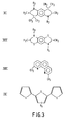
- the substituents R1 and R2 of the benzodihydropyrrole in accordance with formula VI of Fig. 3 denote a C1-C18 alkyl group such as a methyl, butyl, or octadecyl group.
- the substituents R3 and R4 of the benzodithiazole in accordance with formula VII of Fig. 3 also denote a C1-C18 alkyl group such as a methyl, n-heptyl, n-dodecyl or n-octadecyl group.
- substituents R those skilled in the art can widely vary the properties of the final copolymer, such as solubility, processibility and conductivity.
- a special example of a compound in accordance with formula VC of Fig. 2 is neocuproine (formula VIII of Fig. 3).
- Another suitable donor monomer D is azulene (an aromatic 5-7 ring) which may or may not be substituted with, for example, an alkyl group.
- Suitable donor monomers D are thiophene oligomers such as bithienyl and terthienyl (formula IX of Fig. 3).
- the thiophene ring may be substituted with a group R5 which is a C1-C18 alkyl group or a C1-C18 alkoxy group.
- Another class of suitable donor monomers D is that of the aromatic diamines.
- the general formula is shown in formula X of Fig. 4.
- A denotes an aromatic core and R6 and R7 denote an H-atom or a C1-C18 alkyl group.
- a few examples of the aromatic core A are shown in formulae XI, XII, XIII and XIV of Fig. 4.
- R8 and R9 represent an H-atom or a C1-C18 alkyl group;
- X2 and X3 represent an -NH- or an -N(alkyl)-group or an S-, Se- or O-atom.
- the alkyl group contains 1-18 carbon atoms.
- R represents an H-atom or an all or alkoxy substituent containing 1-18 carbon atoms. Representatives thereof are, for example, p-phenylene diamine, 3,6-diamino acridine (formula XV of Fig. 4) and thionine (formula XVI of Fig. 4).
- the polycondensation product of diamines and, for example, squaric acid surprisingly gives an electrically conductive polymer; after all, the polymer formed is a polyamide which, as a class, is known as an insulator.
- An example of an alternating copolymer in accordance with the invention is the polycondensation product of squaric acid (formula I of Fig. 1) and the compound in accordance with formula VI of Fig. 3, where R1 and R2 represent an n-octadecyl group (n-C18H37).
- the polymer formed has formula XVII of Fig. 5 as the repeating unit.
- the squaric acid unit is negatively charged and serves as the charge acceptor.
- the benzo(1,2,4,5)bis(N-octadecyl-2-methyl-3-bis-methyldihydropyrrole) unit is positively charged and serves as the charge donor.
- the alternating sequence of donor units and acceptor units in combination with an extensive conjugated system gives an intrinsically conductive "self-doped" polymer.
- the conductivity of the polymer in accordance with formula XVII of Fig. 5 is 3.10 ⁇ 5 S/cm at room temperature and the band gap is 1.0 eV.
- the polymer can be readily dissolved in various solvents, such as chlorobenzene. Instead of octadecyl groups, other all groups, such as the methyl, n-heptyl and n-dodecyl group, can be chosen for R1 and R2. In general, the solubility of the polymer in solvents increases as the length of the alkyl groups increases.
- an alternating copolymer in accordance with the invention is the polycondensation product of croconic acid (formula II of Fig. 1) and the compound in accordance with formula VII of Fig. 3, where R3 and R4 represent a methyl group.
- the polymer formed has formula XVIII of Fig. 5 as the repetitive unit.
- the croconic acid unit is negatively charged and serves as the charge acceptor.
- the benzo(1,2,4,5)bis(N-methyl-2-methylthiazole) unit is positively charged and serves as the charge donor.
- This "self-doped" polymer in accordance with formula XVIII of Fig. 5 has a conductivity of 10 ⁇ 5 S/cm at room temperature and of 2.5 ⁇ 10 ⁇ 3 S/cm at 250°C.
- the band gap of this polymer is 0.5 eV and, hence, this polymer has semiconductive properties.
- methyl groups such as the n-heptyl-, the n-dodecyl- and the n-octadecyl group can be chosen for R3 and R4, .
- squaric acid, croconic acid and 5,6-dihydroxy-5-cyclohexene-1,2,3,4-tetraon can also be copolymerized using neocuproine (formula VIII of Fig. 3), terthienyl (formula IX of Fig. 3) and 3,6 diamino acridine (formula XV of Fig. 4).
- neocuproine formula VIII of Fig. 3
- terthienyl formula IX of Fig. 3
- 3,6 diamino acridine formula XV of Fig. 4
- polycondensation leads to the formation of electrically conductive alternating copolymers, the compounds in accordance with formulae VIII, IX and XV serving as the donor unit in the polymer chains.
- the object of providing a method of preparing an alternating copolymer is achieved in accordance with the invention by a method which is characterized in that equimolar quantities of bifunctional acceptor monomer units A and bifunctional donor monomer units D are mixed in a solvent and polymerized by polycondensation, thereby forming the alternating copolymer comprising repeating unit AD.
- acceptor monomer unit A a compound having an unsaturated ring structure is used which is substituted with at least two double-bonded oxygen atoms and at least one hydroxy group.
- the donor monomer unit D a homo or heterocyctic aromatic compound having at least two active hydrogen atoms is used. Examples of the monomer units A and D have been mentioned above.
- the polycondensation reaction is carried out in a suitable solvent such as propanol, butanol, toluene or dimethyl sulphoxide.
- the alternating copolymers manufactured in accordance with the above method exhibit great thermal stability. In most of said copolymers no change can be observed after heating to 300°C in air. Consequently, the sensitivity to oxygen is very small.
- the conductivity of the alternating copolymers in accordance with the invention can be increased by means of dopants which are known per se .
- Dopants which are suitable for obtaining p-type conduction are, for example, I2, AsF5, SbF5, HBF4, perchlorate, sulphonate, SO3 and FeCl3.
- the alternating copolymers in accordance with the invention can also be used in antistatic layers or electromagnetic protective layers by dissolving the copolymer in question in a suitable solvent and, subsequently, providing it on the desired substrate by means of, for example, spin coating.
- German Patent Application DE-A-3246319 a description is given of the preparation of a copolymer of pyrrole and squaric acid by anodic oxidation of a solution of said compounds in the presence of a conducting salt.
- the polymer obtained is p-doped and also contains the anion of the conducting salt as the counterion.
- squaric acid is incorporated in the polypyrrole formed. In this manner no strictly alternating copolymer is formed but a block copolymer which, in addition to a sequence of pyrrole units, comprises squaric acid units, or a homopolymer is formed which consists of pyrrole doped with squaric acid.
- the compound in accordance with formula VI of Fig. 3 is prepared using a benzodipyrrole and stearyl-p-chlorobenzene sulphonate.
- Said dipyrrole is prepared according to the method described in Chemical Abstracts, Vol. 76, 1972, abstract No. 72434m, where it is indicated by formula III.
- the stearyl-p-chlorobenzene sulphonate is prepared from p-chlorobenzene sulphonchloride and stearyl alcohol.
- a mixture of 99 grams of stearyl-p-chlorobenzene sulphonate, 18 grams (75 mmol) of said dipyrrole and 100 ml of chlorobenzene are heated for three hours at a temperature of 120°C - 140°C.
- a quantity of 100 ml of chlorobenzene is added to the paste formed, thereby forming a suspension.
- Said suspension is heated at a temperature of 120°C-130°C for 16 hours and then cooled, after which 200 ml of toluene are added.
- the solid is filtrated by vacuum filtration after which said solid is stirred with 250 ml of toluene and then filtered again.
- the solid obtained is stirred with a mixture of 16 grams of NaOH, 500 ml of water and 500 ml of toluene for 5 hours after which all of the solid has dissolved.
- the liquid layers are separated and the organic layer is washed with 500 ml of water, after which said layer is dried over Na2SO4 and evaporated.
- the conductivity of said copolymer in accordance with formula XVII, measured on a film by means of a four-point measurement (also termed potential-probe measurement) is 3.10 ⁇ 5 S/cm.
- the band gap is 1.0 eV and is determined by the threshold of the continuous optical absorption in the near infrared (see C. Kittel, Introduction to Solid State Physics, 5th ed., John Wiley and Sons, 1976, page 210).
- the absorption spectrum is measured on a thin layer of the polymer on a glass plate, said polymer being provided from a solution in chlorobenzene.
- the salt of the compound in accordance with formula VII of Fig. 3 is prepared according to the method described in Chemical Abstracts, Vol. 71, 1969, abstract No. 81344f, where it is indicated by formula III (dithiazole salt of methyl sulphate). In this form the compound is used in the polycondensation reaction with croconic acid.
- a mixture of 324 mg (2.0 mmol) of croconic acid-monohydrate, 945 mg (2.0 mmol) of the above-mentioned dithiazole salt, 30 ml of n-propanol, 800 mg of pyridine and 30 ml of dimethyl sulphoxide are refluxed for 3 hours. After evaporation a residue is obtained which is further concentrated under a vacuum at 100°C to remove dimethyl sulphoxide. The residue thus obtained is mixed with a mixture of 50 ml of water and 50 ml of toluene for half an hour. Filtration by suction gives 900 mg of the alternating copolymer in accordance with formula XVIII of Fig. 5.
- the conductivity at room temperature is 10 ⁇ 5 S/cm and 2.5 ⁇ 10 ⁇ 3 S/cm at 250°C.
- the band gap is 0.5 eV.
- an alternating copolymer is obtained by using squaric acid.
- the conductivity of the copolymer formed is 5.10 ⁇ 5 S/cm. After doping with iodine vapour at a temperature of 80°C the conductivity is 10 ⁇ 2 S/cm.
- Alternating copolymers in accordance with the invention are intrinsically electrically conductive and have a band gap of maximally 1.5 eV.
Landscapes
- Chemical & Material Sciences (AREA)
- Health & Medical Sciences (AREA)
- Chemical Kinetics & Catalysis (AREA)
- Medicinal Chemistry (AREA)
- Polymers & Plastics (AREA)
- Organic Chemistry (AREA)
- Physics & Mathematics (AREA)
- Spectroscopy & Molecular Physics (AREA)
- Polyoxymethylene Polymers And Polymers With Carbon-To-Carbon Bonds (AREA)
- Macromolecular Compounds Obtained By Forming Nitrogen-Containing Linkages In General (AREA)
Applications Claiming Priority (2)
| Application Number | Priority Date | Filing Date | Title |
|---|---|---|---|
| EP92200097 | 1992-01-15 | ||
| EP92200097 | 1992-01-15 |
Publications (2)
| Publication Number | Publication Date |
|---|---|
| EP0551938A1 true EP0551938A1 (fr) | 1993-07-21 |
| EP0551938B1 EP0551938B1 (fr) | 1998-04-22 |
Family
ID=8210368
Family Applications (1)
| Application Number | Title | Priority Date | Filing Date |
|---|---|---|---|
| EP93200051A Expired - Lifetime EP0551938B1 (fr) | 1992-01-15 | 1993-01-11 | Copolymère alternant électriquement conducteur et procédé de fabrication d'un tel copolymère |
Country Status (6)
| Country | Link |
|---|---|
| US (1) | US5380807A (fr) |
| EP (1) | EP0551938B1 (fr) |
| JP (1) | JP3170081B2 (fr) |
| KR (1) | KR100242220B1 (fr) |
| DE (1) | DE69318045T2 (fr) |
| SG (1) | SG44785A1 (fr) |
Cited By (1)
| Publication number | Priority date | Publication date | Assignee | Title |
|---|---|---|---|---|
| WO2019210411A1 (fr) * | 2018-04-30 | 2019-11-07 | HYDRO-QUéBEC | Polymères à base d'acide squarique, leurs procédés de fabrication et leurs utilisations |
Families Citing this family (9)
| Publication number | Priority date | Publication date | Assignee | Title |
|---|---|---|---|---|
| EP0449117A3 (en) * | 1990-03-23 | 1992-05-06 | Matsushita Electric Industrial Co., Ltd. | Organic polymer and preparation and use thereof |
| JP2003155289A (ja) * | 2001-07-09 | 2003-05-27 | Merck Patent Gmbh | モノ、オリゴおよびポリジチエノピリジンおよびこれらの電荷移動物質としての使用 |
| US20060243965A1 (en) * | 2003-01-28 | 2006-11-02 | De Leeuw Dagobert M | Electronic device |
| US7879476B2 (en) * | 2007-05-08 | 2011-02-01 | Toyota Motor Engineering & Manufacturing North America, Inc. | Proton conducting electrolyte |
| US8039532B2 (en) * | 2007-08-16 | 2011-10-18 | Fujifilm Corporation | Heterocyclic compound, ultraviolet absorbent and composition containing the same |
| JP5450994B2 (ja) * | 2007-08-16 | 2014-03-26 | 富士フイルム株式会社 | ヘテロ環化合物 |
| JP5364311B2 (ja) * | 2007-08-16 | 2013-12-11 | 富士フイルム株式会社 | 紫外線吸収剤及びこれを含む組成物 |
| WO2009022738A1 (fr) * | 2007-08-16 | 2009-02-19 | Fujifilm Corporation | Composition colorante, encre pour enregistrement à jet d'encre et composé hétérocyclique |
| US8138231B2 (en) * | 2007-10-29 | 2012-03-20 | Sumitomo Chemical Company, Limited | Polymer having oxycarbon group, and use thereof |
Family Cites Families (1)
| Publication number | Priority date | Publication date | Assignee | Title |
|---|---|---|---|---|
| DE3246319A1 (de) * | 1982-12-15 | 1984-06-20 | Basf Ag, 6700 Ludwigshafen | Copolymere von pyrrolen mit quadratsaeure, verfahren zu ihrer herstellung sowie ihre verwendung |
-
1993
- 1993-01-08 US US08/002,432 patent/US5380807A/en not_active Expired - Fee Related
- 1993-01-11 DE DE69318045T patent/DE69318045T2/de not_active Expired - Fee Related
- 1993-01-11 EP EP93200051A patent/EP0551938B1/fr not_active Expired - Lifetime
- 1993-01-11 SG SG1996007577A patent/SG44785A1/en unknown
- 1993-01-12 KR KR1019930000293A patent/KR100242220B1/ko not_active Expired - Fee Related
- 1993-01-14 JP JP00515293A patent/JP3170081B2/ja not_active Expired - Fee Related
Non-Patent Citations (7)
| Title |
|---|
| CHEMICAL ABSTRACTS, vol. 117, no. 24, 14 December 1992, Columbus, Ohio, US; abstract no. 234647c, HAVINGA, E.E. ET AL. 'A new class of small band gap organic polymer conductors' * |
| CHEMICAL ABSTRACTS, vol. 71, no. 14, 6 October 1969, Columbus, Ohio, US; abstract no. 61825k, MANECKE,G. ET AL. 'Polar Polyamides' * |
| CHEMICAL ABSTRACTS, vol. 75, no. 10, 6 September 1971, Columbus, Ohio, US; abstract no. 64331q, GAUGER,J. ET AL. 'Polar superpolyamides' * |
| CHEMICAL ABSTRACTS, vol. 81, no. 24, 16 December 1974, Columbus, Ohio, US; abstract no. 152677m, NEUSE, E.W. ET AL. 'Poly(squaryl amides)' * |
| CHEMICAL ABSTRACTS, vol. 83, no. 4, 28 July 1975, Columbus, Ohio, US; abstract no. 28639c, MANECKE,G. ET AL. 'Squaric acid-1,3-polyamides' * |
| CHEMICAL ABSTRACTS, vol. 87, no. 19, 7 November 1977, Columbus, Ohio, US; abstract no. 151727q, EHRHARDT, H. ET AL. 'Amides and Thioamides of squaric acid:...' * |
| POLYMER BULLETIN vol. 16, no. 5, 1986, HEIDELBERG DE pages 419 - 425 CHEN,Y.-Y. ET AL. 'Polycondensation of squaric acid with...' * |
Cited By (6)
| Publication number | Priority date | Publication date | Assignee | Title |
|---|---|---|---|---|
| WO2019210411A1 (fr) * | 2018-04-30 | 2019-11-07 | HYDRO-QUéBEC | Polymères à base d'acide squarique, leurs procédés de fabrication et leurs utilisations |
| CN112041370A (zh) * | 2018-04-30 | 2020-12-04 | 魁北克电力公司 | 方酸基聚合物、它们的制造方法和它们的用途 |
| KR20210003781A (ko) * | 2018-04-30 | 2021-01-12 | 하이드로-퀘벡 | 스쿠아르 산-기반 폴리머, 이의 제조 방법 및 이의 용도 |
| EP3788093A4 (fr) * | 2018-04-30 | 2022-03-09 | Hydro-Québec | Polymères à base d'acide squarique, leurs procédés de fabrication et leurs utilisations |
| CN112041370B (zh) * | 2018-04-30 | 2024-02-13 | 魁北克电力公司 | 方酸基聚合物、它们的制造方法和它们的用途 |
| US12215190B2 (en) | 2018-04-30 | 2025-02-04 | HYDRO-QUéBEC | Squaric acid-based polymers, their manufacturing processes and their uses |
Also Published As
| Publication number | Publication date |
|---|---|
| JP3170081B2 (ja) | 2001-05-28 |
| KR100242220B1 (ko) | 2000-02-01 |
| JPH07252350A (ja) | 1995-10-03 |
| DE69318045D1 (de) | 1998-05-28 |
| KR930016455A (ko) | 1993-08-26 |
| US5380807A (en) | 1995-01-10 |
| EP0551938B1 (fr) | 1998-04-22 |
| DE69318045T2 (de) | 1998-10-29 |
| SG44785A1 (en) | 1997-12-19 |
Similar Documents
| Publication | Publication Date | Title |
|---|---|---|
| KR101575918B1 (ko) | 무극성 유기 용매에서의 신규한 폴리티오펜-다중음이온 착물 | |
| JP2010018812A (ja) | 中性化合物およびその使用 | |
| EP0551938B1 (fr) | Copolymère alternant électriquement conducteur et procédé de fabrication d'un tel copolymère | |
| CN114901719B (zh) | 聚合物和包含其的有机发光器件 | |
| EP0603939A2 (fr) | Polymère conducteur de type N et méthode de préparation d'un tel polymère | |
| EP0104059A2 (fr) | Polymères électriquement conductibles et procédé pour leur préparation | |
| EP2520618A2 (fr) | Polymère conducteur, composition de polymère conducteur, film de composition de polymère conducteur et dispositif photoélectrique l'utilisant | |
| KR100899683B1 (ko) | 전도성 폴리아닐린 및 그 합성방법 | |
| KR100589587B1 (ko) | 방향족 아민유도체, 가용성 도전성 화합물 및 전계발광소자 | |
| KR101284411B1 (ko) | 전계발광 물질 및 소자 | |
| JP4269113B2 (ja) | 芳香族アミン誘導体及び可溶性導電性化合物 | |
| US5407987A (en) | Polycyclic aromatic group - pendant polysilanes and conductive polymers derived therefrom | |
| KR102489570B1 (ko) | 신규한 고분자 및 이를 이용한 유기 발광 소자 | |
| US6852831B2 (en) | Alkylenedioxythiophenes and poly(alkylenedioxythiophene)s having urethane-containing side groups | |
| JP3256361B2 (ja) | ポリ(アルキル置換−2,5−ピリミジンジイル)及びその製造方法 | |
| EP0870304A1 (fr) | Polymere semi-conducteur | |
| US4877852A (en) | Thiophene derivative polymer and a polymer composition thereof | |
| KR101187041B1 (ko) | 술폰화된 폴리페닐실세스퀴옥산으로 도핑된 전도성 폴리아닐린 및 그의 제조 방법 | |
| US4597896A (en) | Carbazole-oxadiazole electroactive polymers | |
| JP2009224216A (ja) | インドロカルバゾール重合物を含有する電子デバイス用導電性材料 | |
| JP3164671B2 (ja) | アリーレンビニレン重合体およびその製造方法 | |
| JP3192851B2 (ja) | n−型導電性重合体及びその製造方法 | |
| US5863651A (en) | Poly-pyridinium salts | |
| US5554717A (en) | Synthesis of polyanilines and its co-polymers by melt condensation | |
| US4598139A (en) | Complexes of poly (3,6-N-alkylcarbazolyl alkenes) |
Legal Events
| Date | Code | Title | Description |
|---|---|---|---|
| PUAI | Public reference made under article 153(3) epc to a published international application that has entered the european phase |
Free format text: ORIGINAL CODE: 0009012 |
|
| AK | Designated contracting states |
Kind code of ref document: A1 Designated state(s): DE FR GB |
|
| 17P | Request for examination filed |
Effective date: 19940119 |
|
| 17Q | First examination report despatched |
Effective date: 19960814 |
|
| GRAG | Despatch of communication of intention to grant |
Free format text: ORIGINAL CODE: EPIDOS AGRA |
|
| GRAG | Despatch of communication of intention to grant |
Free format text: ORIGINAL CODE: EPIDOS AGRA |
|
| GRAH | Despatch of communication of intention to grant a patent |
Free format text: ORIGINAL CODE: EPIDOS IGRA |
|
| GRAH | Despatch of communication of intention to grant a patent |
Free format text: ORIGINAL CODE: EPIDOS IGRA |
|
| GRAA | (expected) grant |
Free format text: ORIGINAL CODE: 0009210 |
|
| AK | Designated contracting states |
Kind code of ref document: B1 Designated state(s): DE FR GB |
|
| REF | Corresponds to: |
Ref document number: 69318045 Country of ref document: DE Date of ref document: 19980528 |
|
| ET | Fr: translation filed | ||
| RAP4 | Party data changed (patent owner data changed or rights of a patent transferred) |
Owner name: KONINKLIJKE PHILIPS ELECTRONICS N.V. |
|
| REG | Reference to a national code |
Ref country code: FR Ref legal event code: CD |
|
| PLBE | No opposition filed within time limit |
Free format text: ORIGINAL CODE: 0009261 |
|
| STAA | Information on the status of an ep patent application or granted ep patent |
Free format text: STATUS: NO OPPOSITION FILED WITHIN TIME LIMIT |
|
| 26N | No opposition filed | ||
| PGFP | Annual fee paid to national office [announced via postgrant information from national office to epo] |
Ref country code: FR Payment date: 20010123 Year of fee payment: 9 |
|
| PGFP | Annual fee paid to national office [announced via postgrant information from national office to epo] |
Ref country code: GB Payment date: 20010130 Year of fee payment: 9 |
|
| PGFP | Annual fee paid to national office [announced via postgrant information from national office to epo] |
Ref country code: DE Payment date: 20010321 Year of fee payment: 9 |
|
| REG | Reference to a national code |
Ref country code: GB Ref legal event code: IF02 |
|
| PG25 | Lapsed in a contracting state [announced via postgrant information from national office to epo] |
Ref country code: GB Free format text: LAPSE BECAUSE OF NON-PAYMENT OF DUE FEES Effective date: 20020111 |
|
| PG25 | Lapsed in a contracting state [announced via postgrant information from national office to epo] |
Ref country code: DE Free format text: LAPSE BECAUSE OF NON-PAYMENT OF DUE FEES Effective date: 20020801 |
|
| GBPC | Gb: european patent ceased through non-payment of renewal fee |
Effective date: 20020111 |
|
| PG25 | Lapsed in a contracting state [announced via postgrant information from national office to epo] |
Ref country code: FR Free format text: LAPSE BECAUSE OF NON-PAYMENT OF DUE FEES Effective date: 20020930 |
|
| REG | Reference to a national code |
Ref country code: FR Ref legal event code: ST |