EP0552522A1 - Vitrocéramiques à constante diélectrique faible, fritté à températures basses - Google Patents
Vitrocéramiques à constante diélectrique faible, fritté à températures basses Download PDFInfo
- Publication number
- EP0552522A1 EP0552522A1 EP92300500A EP92300500A EP0552522A1 EP 0552522 A1 EP0552522 A1 EP 0552522A1 EP 92300500 A EP92300500 A EP 92300500A EP 92300500 A EP92300500 A EP 92300500A EP 0552522 A1 EP0552522 A1 EP 0552522A1
- Authority
- EP
- European Patent Office
- Prior art keywords
- glass
- weight
- composition
- sio2
- cao
- Prior art date
- Legal status (The legal status is an assumption and is not a legal conclusion. Google has not performed a legal analysis and makes no representation as to the accuracy of the status listed.)
- Granted
Links
Images

Classifications
-
- C—CHEMISTRY; METALLURGY
- C03—GLASS; MINERAL OR SLAG WOOL
- C03C—CHEMICAL COMPOSITION OF GLASSES, GLAZES OR VITREOUS ENAMELS; SURFACE TREATMENT OF GLASS; SURFACE TREATMENT OF FIBRES OR FILAMENTS MADE FROM GLASS, MINERALS OR SLAGS; JOINING GLASS TO GLASS OR OTHER MATERIALS
- C03C12/00—Powdered glass; Bead compositions
-
- C—CHEMISTRY; METALLURGY
- C03—GLASS; MINERAL OR SLAG WOOL
- C03C—CHEMICAL COMPOSITION OF GLASSES, GLAZES OR VITREOUS ENAMELS; SURFACE TREATMENT OF GLASS; SURFACE TREATMENT OF FIBRES OR FILAMENTS MADE FROM GLASS, MINERALS OR SLAGS; JOINING GLASS TO GLASS OR OTHER MATERIALS
- C03C10/00—Devitrified glass ceramics, i.e. glass ceramics having a crystalline phase dispersed in a glassy phase and constituting at least 50% by weight of the total composition
- C03C10/0009—Devitrified glass ceramics, i.e. glass ceramics having a crystalline phase dispersed in a glassy phase and constituting at least 50% by weight of the total composition containing silica as main constituent
-
- C—CHEMISTRY; METALLURGY
- C03—GLASS; MINERAL OR SLAG WOOL
- C03C—CHEMICAL COMPOSITION OF GLASSES, GLAZES OR VITREOUS ENAMELS; SURFACE TREATMENT OF GLASS; SURFACE TREATMENT OF FIBRES OR FILAMENTS MADE FROM GLASS, MINERALS OR SLAGS; JOINING GLASS TO GLASS OR OTHER MATERIALS
- C03C10/00—Devitrified glass ceramics, i.e. glass ceramics having a crystalline phase dispersed in a glassy phase and constituting at least 50% by weight of the total composition
- C03C10/0054—Devitrified glass ceramics, i.e. glass ceramics having a crystalline phase dispersed in a glassy phase and constituting at least 50% by weight of the total composition containing PbO, SnO2, B2O3
-
- C—CHEMISTRY; METALLURGY
- C03—GLASS; MINERAL OR SLAG WOOL
- C03C—CHEMICAL COMPOSITION OF GLASSES, GLAZES OR VITREOUS ENAMELS; SURFACE TREATMENT OF GLASS; SURFACE TREATMENT OF FIBRES OR FILAMENTS MADE FROM GLASS, MINERALS OR SLAGS; JOINING GLASS TO GLASS OR OTHER MATERIALS
- C03C14/00—Glass compositions containing a non-glass component, e.g. compositions containing fibres, filaments, whiskers, platelets, or the like, dispersed in a glass matrix
- C03C14/004—Glass compositions containing a non-glass component, e.g. compositions containing fibres, filaments, whiskers, platelets, or the like, dispersed in a glass matrix the non-glass component being in the form of particles or flakes
-
- C—CHEMISTRY; METALLURGY
- C03—GLASS; MINERAL OR SLAG WOOL
- C03C—CHEMICAL COMPOSITION OF GLASSES, GLAZES OR VITREOUS ENAMELS; SURFACE TREATMENT OF GLASS; SURFACE TREATMENT OF FIBRES OR FILAMENTS MADE FROM GLASS, MINERALS OR SLAGS; JOINING GLASS TO GLASS OR OTHER MATERIALS
- C03C8/00—Enamels; Glazes; Fusion seal compositions being frit compositions having non-frit additions
- C03C8/22—Enamels; Glazes; Fusion seal compositions being frit compositions having non-frit additions containing two or more distinct frits having different compositions
-
- H—ELECTRICITY
- H01—ELECTRIC ELEMENTS
- H01B—CABLES; CONDUCTORS; INSULATORS; SELECTION OF MATERIALS FOR THEIR CONDUCTIVE, INSULATING OR DIELECTRIC PROPERTIES
- H01B3/00—Insulators or insulating bodies characterised by the insulating materials; Selection of materials for their insulating or dielectric properties
- H01B3/02—Insulators or insulating bodies characterised by the insulating materials; Selection of materials for their insulating or dielectric properties mainly consisting of inorganic substances
- H01B3/08—Insulators or insulating bodies characterised by the insulating materials; Selection of materials for their insulating or dielectric properties mainly consisting of inorganic substances quartz; glass; glass wool; slag wool; vitreous enamels
- H01B3/087—Chemical composition of glass
-
- H—ELECTRICITY
- H10—SEMICONDUCTOR DEVICES; ELECTRIC SOLID-STATE DEVICES NOT OTHERWISE PROVIDED FOR
- H10W—GENERIC PACKAGES, INTERCONNECTIONS, CONNECTORS OR OTHER CONSTRUCTIONAL DETAILS OF DEVICES COVERED BY CLASS H10
- H10W70/00—Package substrates; Interposers; Redistribution layers [RDL]
- H10W70/60—Insulating or insulated package substrates; Interposers; Redistribution layers
- H10W70/67—Insulating or insulated package substrates; Interposers; Redistribution layers characterised by their insulating layers or insulating parts
- H10W70/69—Insulating materials thereof
-
- C—CHEMISTRY; METALLURGY
- C03—GLASS; MINERAL OR SLAG WOOL
- C03C—CHEMICAL COMPOSITION OF GLASSES, GLAZES OR VITREOUS ENAMELS; SURFACE TREATMENT OF GLASS; SURFACE TREATMENT OF FIBRES OR FILAMENTS MADE FROM GLASS, MINERALS OR SLAGS; JOINING GLASS TO GLASS OR OTHER MATERIALS
- C03C2214/00—Nature of the non-vitreous component
- C03C2214/04—Particles; Flakes
-
- H—ELECTRICITY
- H05—ELECTRIC TECHNIQUES NOT OTHERWISE PROVIDED FOR
- H05K—PRINTED CIRCUITS; CASINGS OR CONSTRUCTIONAL DETAILS OF ELECTRIC APPARATUS; MANUFACTURE OF ASSEMBLAGES OF ELECTRICAL COMPONENTS
- H05K1/00—Printed circuits
- H05K1/02—Details
- H05K1/03—Use of materials for the substrate
- H05K1/0306—Inorganic insulating substrates, e.g. ceramic, glass
Definitions
- This invention relates to low dielectric constant, low temperature fired glass ceramics especially useful in the manufacture of multilayer integrated circuits, thick film hybrid circuits and other electronic components, and comprising a glass from the CaO-B2O3-SiO2 glass system.
- CMC Cofired multilayer circuits
- Advances in information processing technology have resulted in ever increasing numbers of circuit elements per unit area.
- a concurrent need for CMC substrates satisfying certain performance criteria has arisen.
- the desirable characteristics that a CMC substrate should exhibit are a low dielectric constant, a thermal expansion coefficient (CTE) matching that of the chip, high thermal conductivity and amenability to be processed into cofired multilayer circuits at low temperatures.
- Multilayer circuits can be prepared from endless tapes containing dielectric material dispersed in a binder-solvent solution and cast onto an endless flexible film by techniques known in the art.
- Typical dielectric materials have included Al2O3 as a refractory filler or crystalline phase in a noncrystalline glass (glass/ceramic composite systems).
- Composite ceramics incorporating alumina have been used as substrates for a long time.
- Current conductor, resistor and dielectric systems have properties, such as the coefficient of thermal expansion, matched to that of alumina.
- Early ceramics employing alumina required temperatures of 1400 - 1500°C for sintering.
- Such high temperatures presented problems well-known in the art, such as limiting conductor metallurgy to refractory metals such as molybdenum and tungsten, the use of which presented the further problem of oxidizing at sintering temperatures.
- the oxidation of the conductor metals necessitated firing in a neutral H2 atmosphere.
- Glass ceramic composites were considered good candidates for CMC substrate materials because of low dielectric constants and low sintering temperatures. Glass ceramic composites, however, suffer the drawback of exhibiting low thermal conductivities.
- the current art is comprised of composite materials that are the result of judicious compromises among the various requirements.
- the speed of signal transmission in hybrid microelectronic circuits is affected by the dielectric constant of the insulating layer.
- Attempts at fabricating lower dielectric materials for use in thick film hybrid microcircuits have included polymeric dielectric materials, porous dielectric materials, and glass-ceramic composite dielectric materials.
- the glass-ceramic composite materials have also been good candidates for thick film substrates because of their superior mechanical, electrical, and hermetic properties compared to porous dielectrics. They also have superior mechanical, physicochemical, and refractory properties compared to polymeric dielectrics.
- the desirable characteristics that a glass-ceramic for use in thick film pastes should exhibit are a low dielectric constant, a thermal expansion coefficient (CTE) compatible with that of the substrate, excellent hermetic and insulating properties, compatibility with precious metal pastes, and amenability to be processed into thick film hybrid circuits at temperatures below about 950°C.
- CTE thermal expansion coefficient
- Thick film hybrid circuits can be prepared from inorganic powders made up into pastes with an organic vehicle; the pastes are applied to a suitable substrate, such as alumina, and then fired.
- Typical dielectric materials have included Al2O3 as a refractory filler or crystalline phase in a noncrystalline glass (noncrystallizing glass/ceramic composites).
- U.S. Patent No. 4,654,095 teaches such a dielectric composition for use in tapes in the fabrication of multilayer circuits wherein selected noncrystallizing glass having certain deformation and softening temperatures are mixed with a refractory filler that is insoluble in the glass, and then fired at 825-900°C.
- U.S. Patent No. 4,643,148 describes a multilayer system requiring a two-stage firing in which the substrate is composed of alumina, a crystallizable glass such as crystallizing spodumene or cordierite, and a noncrystallizing soft glass such as borosilicate or aluminosilicate glass.
- U.S. Patent No. 4,621,066 teaches low temperature fired (800°C to 1000°C) composite ceramics for use in electronic components wherein noncrystalline glass from the CaO-SiO2-Al2O3 system is mixed with 35 to 50% alumina.
- U.S. Patent No. 4,598,167 teaches composite ceramic substrate materials that are mixtures of a low temperature softening glass and various forms of SiO2, and sinterable at temperatures below about 900°C.
- the dielectric constants are reported to be in the range of 4-6, and the CTE in the range of 4.5 to 7.0 ppm/°C.
- U.S. Patent Nos. 4,413,061 and 4,301,324 describe two glass ceramic systems having spodumene and cordierite as the main crystallizing phase.
- the dielectric constants are reported as in the range of 5.0 to 6.5, and the CTE as in the range of 2.0 to 8.3 ppm/°C.
- U.S. Patent No. 3,816,172 teaches a partially crystallized dielectric comprising glass crystals in a glassy matrix.
- U.S. Patent No. 4,714,687 teaches a low k glass ceramic suitable for dielectric substrates and comprising willemite and cordierite.
- the invention provides a low dielectric constant, low temperature fired glass ceramic produced by firing at about 800 to 950°C, a mixture comprising at least one glass having a composition of, by weight percent, 0 to 50% B2O3, 35 to 65% CaO, and 10 to 65% SiO2, and selected from the CaO-B2O3-SiO2 glass system.
- the invention also provides a two-glass (binary) ceramic wherein a hard and a soft glass selected from the CaO-B2O3-SiO2 system are fired together to form a ceramic article.
- the invention further provides a noncrystallizing glass/glass ceramic comprising a crystallizable glass from the CaO-B2O3-SiO2 system having a composition of, by weight percent, about 18 to 32% B2O3, about 42 to 47% CaO, and about 28 to 40% SiO2, a noncrystallizing glass having a composition of, by weight percent, at least about 60% SiO2, about 10 to 35% B2O3, and up to about 6% alkali metal oxide.
- the CMC glass ceramics exhibit dielectric constant values of less than about 7.0.
- the dielectric constant of the thick film materials is less than about 5.2.
- the relative proportions of the glasses affect the final properties of the ceramic, such as the thermal expansion coefficient, so that the thick film ceramic can be made compatible with various substrates, such as alumina, mullite, and spinel.
- the noncrystallizing glass/glass thick film ceramic dielectric material is useful as a multilayer dielectric, a cross-over dielectric, a solder dam, or a hermetic seal.
- the glass ceramics of the present invention are useful in any electronic or mechanical components where a glass ceramic exhibiting the particular combinations of characteristics is desirable.
- the terms "hard” and "soft”, when applied to a pair of glasses in the CaO-B2O3-SiO2 glass system, are used in a relative sense and with reference to the CaO-B2O3-SiO2 glass system phase diagram, a hard glass being farther from the eutectic than its paired soft glass.
- Another relationship between a hard and a soft glass is that the hard glass has a liquidus temperature above that of the soft glass.
- the glass ceramic of the present invention is to be distinguished from noncrystallizing glass and ceramic (refractory) filler preparations of the prior art.
- the material of the present invention comprises a glass ceramic formed by the in situ crystallization of one or more crystallizable glasses from the same glass system.
- the present invention also provides a noncrystallizing glass/glass ceramic dielectric material which is a dielectric material wherein a ceramic phase is dispersed in a glassy matrix where the ceramic is formed by the crystallization of the glass ceramic.
- a noncrystallizing glass/glass ceramic dielectric material which is a dielectric material wherein a ceramic phase is dispersed in a glassy matrix where the ceramic is formed by the crystallization of the glass ceramic.
- this material of the present invention comprises a glass ceramic formed in situ by the crystallization of one glass in a noncrystallized matrix of another glass.
- the glass ceramic of the present invention is advantageous for use in cofired multilayer substrates because it does not require a refractory ceramic component that can contribute to an increase in the dielectric constant. Additionally, the glass ceramic of the present invention, being composed of one or more crystallizing glasses from the CaO-B2O3-SiO2 glass system, is free from problems caused by the interactions between refractory filler and glass. Yet when a refractory filler is needed or desired, the glasses are amenable to accepting such a filler.
- both glasses in the two-glass ceramic are crystallizing results in a ceramic that is stable after the first fire.
- the use of two crystallizing glasses gives many options in the fabrication of the ceramics, such as using different grain sizes to achieve different rates of crystallization so as to change the amount of residual glass.
- the binary glass ceramic of the present invention simulates the use of refractory filler without the drawbacks associated with a glass/ceramic system.
- a glass ceramic form a single glass from the CaO-B2O3-SiO2 glass system also offers flexibility in the fabrication of substrates, such as the addition of hard or soft glasses from other systems.
- This other glass may be a noncrystallizing glass.
- the preferred noncrystallizing glasses exhibit a flat viscosity-temperature curve.
- Preferred noncrystalline glasses have high amounts of silica, fairly high boron trioxide contents, and alkali contents below about 6% by weight.
- the glasses have a strain point between 440° and 480°C, an annealing point in the 480° to 530°C range, and a fiber softening point between 690° and 785°C.
- the one or two-glass ceramic of the present invention is lightweight, having a density lower than glass and alumina composite ceramic.
- the thermal conductivity of the glass ceramics is adequate for use in microcircuits, and the thermal expansion matches that of alumina to a degree where available inks usually used for alumina CMC substrates may also be used with these ceramics.
- the present glass ceramics enjoy compatibility with noble metals, so that silver, gold, and palladium, as well as copper conductors can be employed.
- the present ceramics Upon firing, the present ceramics exhibit adequate dimensional stability, with XY shrinkage in the 12% range. Additionally, when made up as thick films, they can be fired using a typical thick film firing profile.
- CMC substrates prepared with a single glass comprise 0 to 50% B2O3, 35 to 65% CaO, and 10 to 65% SiO2, more preferably comprise 0 to 40% B2O3, 35 to 55% CaO, and 10 to 50% SiO2.
- CMC substrates prepared from two glasses from the same system comprise up to about 50% by weight soft glass and about 50% by weight hard glass.
- the preferred composition comprises 40% of the eutectic glass, as on Table II, below, and 60% of the glass designated as CBS-1 on Table II and comprising 10% B2O3, 40% CaO, and 50% SiO2.
- CMC substrates fabricated from one crystallizing glass from the same system and a noncrystallizing glass from another system comprise about 50% by weight of each.
- Thick film dielectric inks are fabricated from a crystallizing glass from the system of the present invention comprising about 10 to 32% B2O3, 42 to 47% CaO, and 29 to 40% SiO2, and a noncrystallizing glass comprising at least about 60% SiO2, about 10 to 35% B2O3 and up to about 6% alkali metal, up to about 5% Al2O3 and MgO may be added to the glass composition.
- Preferred thick film dielectrics comprise a crystallizing glass of about 26% B2O3, about 42% CaO, and about 32% SiO2, and a noncrystallizing glass about 71% SiO2, 26% B2O3, 0.5% Na2O, 1.0% K2O, 0.5% Li2O and include a crystallizing agent which may be CaB2O4 and may be present in an amount of about 1% by weight. If a colorant is desired, the preferred colorant is Cr2O3 and is present in an amount of about 0.5% by weight.
- the glasses are in the form of powders, preferably having an average particle size of about 1 to 10 ⁇ m, and most preferably, 3 to 6 ⁇ m.
- the crystallizing agent for the thick film substrate is also in the form of a powder, preferably having an average particle size of 1 to 3 ⁇ m.
- Aluminum, silicon, or magnesium oxide may be also present in the composition, these incidental amounts of these oxides being picked up in the milling process.
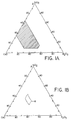
- Figure 1A is a phase diagram of the CaO-B2O3-SiO2 system showing the composition range of the four CMC substrates.
- Figure 1B is the phase diagram of the CaO-B2O3-SiO2 system showing the range for the thick film substrates.
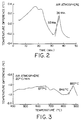
- Figure 2 is a thermogram of the dielectric paste composition of the present invention.
- Figure 3 is a graph of a differential thermal analysis of the dielectric paste composition of the present invention.
- Figure 4 is a graph like Figure 3.
- Figure 5 is a photomicrograph of the dielectric paste composition of the present invention.
- FIG. 1A there is shown a phase diagram of the CaO-B2O3-SiO2 system showing the composition range of the glasses for the CMC substrates of the present invention. (The eutectic for the glass system is marked on Figure 1B at 12.)
- one or two glasses having a composition lying on the phase diagram of Figure 1 and bounded by the limits of 0 to 50% B2O3, 35 to 65% CaO, and 10 to 65% SiO2 are milled to an appropriate size powder, about 1 to 10 ⁇ m average size, preferably in the range of 2 to 6 ⁇ m average size.
- the powdered glass, with or without further refractory filler is mixed with the binder and then cast into a tape of desired thickness using a doctor blade, all by techniques known in the art.
- the binder may include a solvent, surfactant, plasticizer. Typical binders include acrylic binders and polyvinyl compounds. Plasticizers may include any of the phthalates. Additionally, viscosity modifiers, anti-skinning agents and the like can be used, as is known in the art.
- Table I lists the properties of one and two glass dielectric composition cofired multilayer tapes.
- composition of the glasses in the glass system column (1) of Table I are identified in Table II.
- the glasses of Table I were prepared as in Example 1.
- the glass melting and milling procedure was of a type known in the art where glass was melted in a platinum crucible at 1400-1500°C for about one hour until it was fully melted and homogenized. The glass was poured through a set of rolls and rolled into flakes. The flakes were milled by known techniques to an average powder size of 2 to 6 ⁇ m.
- a binder solution was prepared from, by weight, acrylic binder 11.33%; phthalate plasticizer 3.97%; and a solvent recommended by the suppliers, in this case a mixture of methyl ethyl ketone/cyclohexane solvent, 84.7%. The powder was added to the binder so that the ratio of solids to liquid was about 60/40.
- the mixture was milled together in a ball mill with alumina media until a homogeneous slurry was obtained, that is for 2 to 24 hours.
- the resulting mixture was then degassed and cast into a tape using a doctor blade.
- the cast tape was dried and blanked.
- Blanked pieces were laminated in a laminating die at a temperature of about 70°C for 10 minutes at 3000 psi.
- the binder was burnt out at 350°C for 12 hours.
- the laminate was fired on a setter in the belt furnace in a standard thick film profile of 850°C/10 minutes on an alumina substrate.
- the resultant substrate was then subjected to the measurements recorded in Table I.
- Edge definition is listed in column (3) and is also a qualitative assessment.
- the coefficient of thermal expansion was measured as the samples were heated from room temperature to 300°C, 500°C and 800°C, respectively.
- the value of the coefficient is a reflection of the compatibility of inks and the like used for alumina technology and transferable to the present invention.
- CTE300 is about 64
- CTE800 is about 78 to 80.
- the K value in column (5) is the dielectric constant
- the D in column (6) is the dissipation factor or dielectric loss, both measured at 10 megahertz by known techniques.
- Sx and Sy in column (8) are shrinkage measurements made in the x and y directions of the CMC substrate.
- Sx should be as close to Sy as possible.
- Ingredient FS was a fused silica having an average powder size of 5 ⁇ m.
- Vycor is about 96% silica, 3% B2O and about 1% soda (available from Corning Glass).
- the Vycor used in the preparation of the CMC substrates of Table I had been leached of the soda.
- Ingredient “7070” is a noncrystallizing glass available from Corning Glass and believed to have a composition similar to "EJ-70,” available from Ferro Corporation and having a composition by weight percent, of at least about 60% SiO2, about 10 to 35% B2O3, and up to about 6% alkali metal oxide.
- “EJ-70” has a composition of 71% SiO2, 26% B2O3, 0.5% Na2O, 1.0% K2O, and 0.5% Li2O.
- Group I of substrates on Table I were prepared from single crystallizing glasses selected from the CaO-B2O3-SiO2 system bounded by the region about 0 to 50% B2O3, about 35 to 65% CaO, and about 10 to 65% SiO2. As noted previously, the composition of the individual glasses used to make the substrates is given in Table II.
- Substrates in Group II on Table I were prepared from two glasses selected from the CaO-B2O3-SiO2 system bounded by the same limits. Each of the glasses of the pair is a crystallizing glass.
- the third, Group III of substrates on Table I was prepared from a crystalline glass from the above-mentioned area of the CaO-B2O3-SiO2 system and a noncrystallizing glass from another system, such as fused silica, a hard noncrystallizing glass, leached Vycor, and "7070.”
- noncrystallizing glasses both hard and soft, from other glass systems will be found useful in combination with a glass or glasses from the CaO-B2O3-SiO2 system. Such glasses can alter the speed of crystallization in a known manner. Also, the incorporation of crystallizing agents is contemplated to affect the degree of crystallization of a particular substrate.
- low dielectric constant fillers such as mullite, cordierite and fosterite, and the like, will be satisfactorily incorporated into the dielectric material in a manner and with results known in the art.
- composition of the crystallizing glass of the thick film pastes lies in the shaded region of the CaO-B2O3-SiO2 glass system shown in Figure 1B.
- composition of the crystallizing glass preferred for thick film paste dielectric compositions for alumina substrates is marked as P on Figure 1.
- Thick film compositions are prepared by mixing inorganic powder of the appropriate size with an organic liquid.
- Any inert liquid can be used as the organic vehicle or dispensing medium in the practice of the invention.
- organic liquids are the aliphatic alcohols, their esters, for example the acetates and propionates; terpenes such as pine oil, terpineol and the like, solutions of resins such as the poly methacrylates of lower alcohols, or solutions of ethyl cellulose, in solvents such as pine oil, the monobutyl ether of ethylene glycol monoacetate, and Carbitol.
- Plasticizers such as dimethylphthalate, dibutyl phthalate, and various other phthalates could be employed.
- Suitable surfactants are sold under the trademarks Triton, Solsperse, and Duomeen.
- the vehicle or medium can contain or be composed of volatile liquids to promote fast setting after application of the paste to the substrate.
- a typical organic vehicle is composed as follows, the percentages being given by weight: Solvent(s) 65 to 90% Plasticizer 0 to 30% Thixotropic 0 to 5% Resin 4 to 10% Surfactant 0 to 5%
- a paste was prepared by passing the resultant mixture four times over a 3 roll mill.
- FIG. 2 is a thermogram of the paste composition of Example 2 on an alumina substrate.
- Figure 2 shows that the organic phase is completely volatilized in air before 550°C.
- the volatilization temperature is lower than the 680°C glass-transition temperature of the dielectric composition. Since under typical nonisothermal thick film processing conditions there is no significant sintering below the glass transition temperature, the organic phase is volatilized well before it can be trapped.
- FIG 3 is a differential thermal analysis (DTA) of the formulation of Example 2 on an alumina substrate. The DTA was performed at 20°C per minute in an air atmosphere. Figure 3 shows an endothermic step due to a glass transition at 677°C and an exothermic peak due to crystallization at 882°C.
- Figure 4 which is a DTA graph of the same formulation carried out in an air atmosphere by heating the material from 500°C to 850°C at 10°C per minute, and then holding at 850°C for 10 minutes.
- Dielectric pastes were prepared by and in the proportions listed in Table III.
- the glasses A and B were processed by known milling techniques as in Example 2 to an average powder size of 3 to 6 ⁇ m.
- Component C was likewise processed to an average powder size of 1 to 3 ⁇ m.
- Glass A was the preferred crystallizing glass having a composition of, by weight, about 26% B2O3, about 42% CaO, and about 32% SiO2 (Ferro Corporation Lot No. RC-5889-2).
- Glass B was the preferred noncrystallizing glass having a composition of, by weight, about 71% SiO2, 26% B2O3, 0.5% Na2O, 1.0% K2O, 0.5% Li2O, and 1% Al2O3 (available from the Ferro Corporation as glass EJ-70).
- Component C was the preferred crystallizing agent CaB2O4.
- the colorant when added, was either chromium oxide or a commercially available colorant, as are known in the art.
- the pastes were printed on to an alumina substrate using a 200 mesh screen with a 1 mil emulsion.
- the pastes were dried at 100°C for 7 minutes after leveling at room temperature for 5 to 10 minutes.
- the pastes were fired at 850°C for 10 minutes with a 30 minute total cycle time in an air atmosphere.
- two dielectric layers were printed, dried and fired separately between the top and the bottom conductors.
- 3066 gold paste available from Ferro Corporation, Cleveland, Ohio, was used as a conductor for initial evaluation of the dielectric properties.
- the thickness of the samples was about 35 to 40 ⁇ m.
- microstructure of the resulting fired dielectrics was assessed by examining a cross section under a sem microscope, as described in Example 4, above.
- the dielectric constant (k) and the dissipation factor measurements were made using a Model 1658 General Radio Bridge at 1 kHz.
- Breakdown voltage was measured by increasing the DC voltage across the sample until breakdown occurred.
- Leakage current was measured by using a standard electrolytic hermeticity test configuration in a 1 normal NaCl solution with 10 volts applied for 5 minutes.
- Warpage was measured using a standard test pattern and measured with a drop-dial gauge. TABLE IV Dielectric constant at 1 kHz 4.5 - 5.2 Dissipation factor at 1 kHz ⁇ 0.003 Insulation resistance at 200v D.C. >1011 ⁇ Breakdown voltage (D.C.) >1000v/mil Warpage at 10 layers ⁇ 1mil/inch Leakage current at 2 layers ⁇ 10 ⁇ A/cm2
- Table IV summarizes the properties of the preferred dielectric composition made in accordance with Example 2 by the method of Example 5. The dielectric properties were measured in a capacitor geometry with a 6 cm2 area.
- Warpage was measured on a sample having the composition LK-11H on Table III.
- the preferred dielectric formulation is suitable for use with alumina substrates is readily appreciable from the warpage data. Since warpage is governed by the coefficient of thermal expansion, small or negligible amounts indicate that the CTE of the dielectric is matched or essentially equal to the CTE of the alumina substrate. Matching or essentially equal in this context does not necessarily require mathematical precision, only a sufficient matching to allow the dielectric ceramic and the alumina substrate to operate together as a circuit.
Landscapes
- Chemical & Material Sciences (AREA)
- Engineering & Computer Science (AREA)
- Geochemistry & Mineralogy (AREA)
- Life Sciences & Earth Sciences (AREA)
- Chemical Kinetics & Catalysis (AREA)
- General Chemical & Material Sciences (AREA)
- Materials Engineering (AREA)
- Organic Chemistry (AREA)
- Ceramic Engineering (AREA)
- Dispersion Chemistry (AREA)
- Crystallography & Structural Chemistry (AREA)
- Inorganic Chemistry (AREA)
- Glass Compositions (AREA)
Priority Applications (1)
| Application Number | Priority Date | Filing Date | Title |
|---|---|---|---|
| DE1992623393 DE69223393T2 (de) | 1992-01-21 | 1992-01-21 | Glaskeramiken mit niedriger Dielektrizitätskonstante gebrannt bei niedrigen Temperaturen |
Applications Claiming Priority (2)
| Application Number | Priority Date | Filing Date | Title |
|---|---|---|---|
| US25830388A | 1988-10-14 | 1988-10-14 | |
| US07/604,344 US5164342A (en) | 1988-10-14 | 1990-10-24 | Low dielectric, low temperature fired glass ceramics |
Publications (2)
| Publication Number | Publication Date |
|---|---|
| EP0552522A1 true EP0552522A1 (fr) | 1993-07-28 |
| EP0552522B1 EP0552522B1 (fr) | 1997-12-03 |
Family
ID=26946559
Family Applications (1)
| Application Number | Title | Priority Date | Filing Date |
|---|---|---|---|
| EP92300500A Expired - Lifetime EP0552522B1 (fr) | 1988-10-14 | 1992-01-21 | Vitrocéramiques à constante diélectrique faible, frittées à des basses températures |
Country Status (2)
| Country | Link |
|---|---|
| US (1) | US5164342A (fr) |
| EP (1) | EP0552522B1 (fr) |
Cited By (1)
| Publication number | Priority date | Publication date | Assignee | Title |
|---|---|---|---|---|
| CN113372103A (zh) * | 2021-07-13 | 2021-09-10 | 中国振华集团云科电子有限公司 | 一种低介电低高频损耗ltcc陶瓷材料及其制备方法 |
Families Citing this family (20)
| Publication number | Priority date | Publication date | Assignee | Title |
|---|---|---|---|---|
| US6017835A (en) * | 1993-11-05 | 2000-01-25 | Owens Corning Fiberglas Technology, Inc. | Glass compositions for producing dual-glass fibers |
| US5453331A (en) * | 1994-08-12 | 1995-09-26 | University Of Chicago | Compliant sealants for solid oxide fuel cells and other ceramics |
| US5980680A (en) * | 1994-09-21 | 1999-11-09 | Owens Corning Fiberglas Technology, Inc. | Method of forming an insulation product |
| US5885390A (en) * | 1994-09-21 | 1999-03-23 | Owens-Corning Fiberglas Technology Inc. | Processing methods and products for irregularly shaped bicomponent glass fibers |
| JP3611160B2 (ja) * | 1997-02-10 | 2005-01-19 | 株式会社村田製作所 | 厚膜抵抗体ペースト |
| JP3904102B2 (ja) * | 1997-08-06 | 2007-04-11 | 日本電気硝子株式会社 | プラズマディスプレーパネル用誘電体形成材料 |
| TW524786B (en) * | 1998-01-23 | 2003-03-21 | Du Pont | Glass composition, castable dielectric composition and tape composition made therewith |
| US6531663B1 (en) * | 1998-01-30 | 2003-03-11 | Delphi Technologies, Inc. | Solder stop for an electrical connection and method therefor |
| JP3860336B2 (ja) * | 1998-04-28 | 2006-12-20 | 日本特殊陶業株式会社 | ガラスセラミック複合体 |
| US6743534B2 (en) | 2001-10-01 | 2004-06-01 | Heraeus Incorporated | Self-constrained low temperature glass-ceramic unfired tape for microelectronics and methods for making and using the same |
| US6881691B2 (en) | 2002-05-07 | 2005-04-19 | Uop Llc | Use of zeolites in preparing low temperature ceramics |
| US6737374B2 (en) | 2002-05-07 | 2004-05-18 | Uop Llc | Use of zeolites in preparing low temperature ceramics |
| KR100522135B1 (ko) * | 2003-04-02 | 2005-10-18 | 한국과학기술연구원 | 저유전율 저온소성 세라믹 조성물 |
| US20060278997A1 (en) * | 2004-12-01 | 2006-12-14 | Tessera, Inc. | Soldered assemblies and methods of making the same |
| US7230817B2 (en) * | 2005-04-15 | 2007-06-12 | Ferro Corporation | Y5V dielectric composition |
| US7858548B2 (en) * | 2006-09-13 | 2010-12-28 | Ferro Corporation | COG dielectric composition for use with nickel electrodes |
| US7687417B2 (en) * | 2005-11-16 | 2010-03-30 | E.I. Du Pont De Nemours And Company | Lead free glass(es), thick film paste(s), tape composition(s) and low temperature cofired ceramic devices made therefrom |
| US7547369B2 (en) * | 2006-08-31 | 2009-06-16 | Ferro Corporation | Method of making multilayer structures using tapes on non-densifying substrates |
| CN101663711B (zh) * | 2007-04-25 | 2013-02-27 | 费罗公司 | 含银和镍或银和镍合金的厚膜导体配方及由其制成的太阳能电池 |
| KR101543046B1 (ko) * | 2007-08-31 | 2015-08-07 | 헤레우스 프레셔스 메탈즈 노스 아메리카 콘쇼호켄 엘엘씨 | 태양 전지용 층상 컨택 구조 |
Citations (3)
| Publication number | Priority date | Publication date | Assignee | Title |
|---|---|---|---|---|
| EP0163155A1 (fr) * | 1984-06-01 | 1985-12-04 | Narumi China Corporation | Céramiques cuites à basse température |
| WO1990000966A1 (fr) * | 1988-07-19 | 1990-02-08 | Ferro Corporation | Compositions dielectriques pour couches epaisses |
| WO1991002363A1 (fr) * | 1989-08-04 | 1991-02-21 | Ferro Corporation | Compositions dielectriques poreuses |
Family Cites Families (28)
| Publication number | Priority date | Publication date | Assignee | Title |
|---|---|---|---|---|
| DE232767C (fr) * | ||||
| DE209776C (fr) * | ||||
| BE774822A (fr) * | 1970-11-04 | 1972-03-01 | Du Pont | Dielectriques de transition non-reductibles partiellement cristallises |
| AR207684A1 (es) * | 1975-04-07 | 1976-10-22 | Ferro Corp | Composicion de frita volatilizable |
| US4084976A (en) * | 1977-07-20 | 1978-04-18 | Champion Spark Plug Company | Lead-free glaze for alumina bodies |
| US4301324A (en) * | 1978-02-06 | 1981-11-17 | International Business Machines Corporation | Glass-ceramic structures and sintered multilayer substrates thereof with circuit patterns of gold, silver or copper |
| US4413061A (en) * | 1978-02-06 | 1983-11-01 | International Business Machines Corporation | Glass-ceramic structures and sintered multilayer substrates thereof with circuit patterns of gold, silver or copper |
| JPS5571646A (en) * | 1978-11-24 | 1980-05-29 | Hitachi Ltd | Glass composition |
| FR2451899A1 (fr) * | 1979-03-23 | 1980-10-17 | Labo Electronique Physique | Composition dielectrique, encre serigraphiable comportant une telle composition, et produits obtenus |
| JPS5747741A (en) * | 1980-09-01 | 1982-03-18 | Nippon Sheet Glass Co Ltd | Glass suitable for manufacturing fibrous wollastonite |
| JPS599992A (ja) * | 1982-07-08 | 1984-01-19 | 株式会社日立製作所 | 多層配線基板の製造方法 |
| JPS5911700A (ja) * | 1982-07-12 | 1984-01-21 | 株式会社日立製作所 | セラミツク多層配線回路板 |
| US4435511A (en) * | 1982-09-13 | 1984-03-06 | Owens-Illinois, Inc. | Glasses suitable for sealing ferrites |
| FR2548170B1 (fr) * | 1983-06-15 | 1988-03-11 | Corning Glass Works | Email decoratif pour vitroceramiques a faible coefficient de dilatation |
| US4547467A (en) * | 1983-06-22 | 1985-10-15 | Burroughs Corporation | Dielectric composition and devices using it |
| JPS6028296A (ja) * | 1983-07-27 | 1985-02-13 | 株式会社日立製作所 | セラミツク多層配線回路板 |
| JPS60221358A (ja) * | 1984-04-13 | 1985-11-06 | 日本碍子株式会社 | 電気絶縁体用セラミック組成物 |
| JPS60254697A (ja) * | 1984-05-31 | 1985-12-16 | 富士通株式会社 | 多層セラミック回路基板および製法 |
| US4752531A (en) * | 1985-03-25 | 1988-06-21 | E. I. Du Pont De Nemours And Company | Dielectric composition |
| US4654095A (en) * | 1985-03-25 | 1987-03-31 | E. I. Du Pont De Nemours And Company | Dielectric composition |
| US4593006A (en) * | 1985-04-11 | 1986-06-03 | Asahi Glass Company, Ltd. | Composition for multilayer printed wiring board |
| JPH0634452B2 (ja) * | 1985-08-05 | 1994-05-02 | 株式会社日立製作所 | セラミツクス回路基板 |
| JPS62113758A (ja) * | 1985-10-25 | 1987-05-25 | 株式会社住友金属セラミックス | 低温焼成セラミツクス |
| US4830988A (en) * | 1986-10-02 | 1989-05-16 | General Electric Company | Dielectric inks for multilayer copper circuits |
| US4714687A (en) * | 1986-10-27 | 1987-12-22 | Corning Glass Works | Glass-ceramics suitable for dielectric substrates |
| US4861646A (en) * | 1987-08-13 | 1989-08-29 | Ceramics Process Systems Corp. | Co-fired metal-ceramic package |
| US4816615A (en) * | 1987-08-20 | 1989-03-28 | General Electric Company | Thick film copper conductor inks |
| US4849379A (en) * | 1988-01-28 | 1989-07-18 | E. I. Du Pont De Nemours And Company | Dielectric composition |
-
1990
- 1990-10-24 US US07/604,344 patent/US5164342A/en not_active Expired - Lifetime
-
1992
- 1992-01-21 EP EP92300500A patent/EP0552522B1/fr not_active Expired - Lifetime
Patent Citations (3)
| Publication number | Priority date | Publication date | Assignee | Title |
|---|---|---|---|---|
| EP0163155A1 (fr) * | 1984-06-01 | 1985-12-04 | Narumi China Corporation | Céramiques cuites à basse température |
| WO1990000966A1 (fr) * | 1988-07-19 | 1990-02-08 | Ferro Corporation | Compositions dielectriques pour couches epaisses |
| WO1991002363A1 (fr) * | 1989-08-04 | 1991-02-21 | Ferro Corporation | Compositions dielectriques poreuses |
Non-Patent Citations (1)
| Title |
|---|
| PATENT ABSTRACTS OF JAPAN vol. 10, no. 366 (C-390)6 December 1986 & JP-A-61 163 141 ( NARUMI CHINA CORP ) 23 July 1986 * |
Cited By (2)
| Publication number | Priority date | Publication date | Assignee | Title |
|---|---|---|---|---|
| CN113372103A (zh) * | 2021-07-13 | 2021-09-10 | 中国振华集团云科电子有限公司 | 一种低介电低高频损耗ltcc陶瓷材料及其制备方法 |
| CN113372103B (zh) * | 2021-07-13 | 2023-01-20 | 中国振华集团云科电子有限公司 | 一种低介电低高频损耗ltcc陶瓷材料及其制备方法 |
Also Published As
| Publication number | Publication date |
|---|---|
| EP0552522B1 (fr) | 1997-12-03 |
| US5164342A (en) | 1992-11-17 |
Similar Documents
| Publication | Publication Date | Title |
|---|---|---|
| US5258335A (en) | Low dielectric, low temperature fired glass ceramics | |
| EP0552522A1 (fr) | Vitrocéramiques à constante diélectrique faible, fritté à températures basses | |
| US4621066A (en) | Low temperature fired ceramics | |
| US4749665A (en) | Low temperature fired ceramics | |
| EP0429965B1 (fr) | Verre cristallisable et compositions de film épais l'utilisant | |
| US5216207A (en) | Low temperature co-fired multilayer ceramic circuit boards with silver conductors | |
| EP1784367B1 (fr) | Pates conductrices en couches epaisses a base de metal exemptes de plomb et de cadmium | |
| EP1369397B1 (fr) | Composition de verre et de ruban à haute dilatation thermique | |
| EP0326093A2 (fr) | Compostion diélectrique | |
| JPH03257040A (ja) | 結晶化可能な低誘電率低誘電体損組成物 | |
| EP1505040B1 (fr) | Compositions diélectriques pour couches épaisses pour l'utilisation sur des substrats en nitrure d'aluminium | |
| US5210057A (en) | Partially crystallizable glass compositions | |
| US4788163A (en) | Devitrifying glass frits | |
| US5397830A (en) | Dielectric materials | |
| EP0498410B1 (fr) | Compositions de verres cristallisables partiellements | |
| US5070047A (en) | Dielectric compositions | |
| US6037045A (en) | Thick-film paste and ceramic circuit substrate using the same | |
| JPS63136410A (ja) | 厚膜銅ビア充填インキ | |
| EP0498409A1 (fr) | Compositions de verre partiellement cristallisables | |
| US4863517A (en) | Via fill ink composition for integrated circuits | |
| JPH0723252B2 (ja) | 低温焼結性低誘電率無機組成物 | |
| EP0422127A1 (fr) | Compositions dielectriques pour couches epaisses | |
| EP1509479B1 (fr) | Composition de bande ltcc | |
| JPH05116986A (ja) | 不透明化ガラスおよびこれにより得られた焼結積層セラミツク配線板 | |
| JP2500691B2 (ja) | 低温焼結性低誘電率無機組成物 |
Legal Events
| Date | Code | Title | Description |
|---|---|---|---|
| PUAI | Public reference made under article 153(3) epc to a published international application that has entered the european phase |
Free format text: ORIGINAL CODE: 0009012 |
|
| AK | Designated contracting states |
Kind code of ref document: A1 Designated state(s): DE FR GB |
|
| 17P | Request for examination filed |
Effective date: 19940113 |
|
| 17Q | First examination report despatched |
Effective date: 19950316 |
|
| GRAG | Despatch of communication of intention to grant |
Free format text: ORIGINAL CODE: EPIDOS AGRA |
|
| GRAG | Despatch of communication of intention to grant |
Free format text: ORIGINAL CODE: EPIDOS AGRA |
|
| GRAH | Despatch of communication of intention to grant a patent |
Free format text: ORIGINAL CODE: EPIDOS IGRA |
|
| GRAH | Despatch of communication of intention to grant a patent |
Free format text: ORIGINAL CODE: EPIDOS IGRA |
|
| GRAA | (expected) grant |
Free format text: ORIGINAL CODE: 0009210 |
|
| AK | Designated contracting states |
Kind code of ref document: B1 Designated state(s): DE FR GB |
|
| REF | Corresponds to: |
Ref document number: 69223393 Country of ref document: DE Date of ref document: 19980115 |
|
| ET | Fr: translation filed | ||
| PLBE | No opposition filed within time limit |
Free format text: ORIGINAL CODE: 0009261 |
|
| 26N | No opposition filed | ||
| REG | Reference to a national code |
Ref country code: GB Ref legal event code: IF02 |
|
| PGFP | Annual fee paid to national office [announced via postgrant information from national office to epo] |
Ref country code: DE Payment date: 20110127 Year of fee payment: 20 Ref country code: FR Payment date: 20110301 Year of fee payment: 20 |
|
| PGFP | Annual fee paid to national office [announced via postgrant information from national office to epo] |
Ref country code: GB Payment date: 20110125 Year of fee payment: 20 |
|
| REG | Reference to a national code |
Ref country code: DE Ref legal event code: R071 Ref document number: 69223393 Country of ref document: DE |
|
| REG | Reference to a national code |
Ref country code: DE Ref legal event code: R071 Ref document number: 69223393 Country of ref document: DE |
|
| REG | Reference to a national code |
Ref country code: GB Ref legal event code: PE20 Expiry date: 20120120 |
|
| PG25 | Lapsed in a contracting state [announced via postgrant information from national office to epo] |
Ref country code: DE Free format text: LAPSE BECAUSE OF EXPIRATION OF PROTECTION Effective date: 20120122 |
|
| PG25 | Lapsed in a contracting state [announced via postgrant information from national office to epo] |
Ref country code: GB Free format text: LAPSE BECAUSE OF EXPIRATION OF PROTECTION Effective date: 20120120 |