EP0554043A2 - Système de montage - Google Patents
Système de montage Download PDFInfo
- Publication number
- EP0554043A2 EP0554043A2 EP19930300542 EP93300542A EP0554043A2 EP 0554043 A2 EP0554043 A2 EP 0554043A2 EP 19930300542 EP19930300542 EP 19930300542 EP 93300542 A EP93300542 A EP 93300542A EP 0554043 A2 EP0554043 A2 EP 0554043A2
- Authority
- EP
- European Patent Office
- Prior art keywords
- editing
- data
- editing data
- roll
- reproducing apparatuses
- Prior art date
- Legal status (The legal status is an assumption and is not a legal conclusion. Google has not performed a legal analysis and makes no representation as to the accuracy of the status listed.)
- Withdrawn
Links
Images



Classifications
-
- G—PHYSICS
- G11—INFORMATION STORAGE
- G11B—INFORMATION STORAGE BASED ON RELATIVE MOVEMENT BETWEEN RECORD CARRIER AND TRANSDUCER
- G11B27/00—Editing; Indexing; Addressing; Timing or synchronising; Monitoring; Measuring tape travel
- G11B27/02—Editing, e.g. varying the order of information signals recorded on, or reproduced from, record carriers
- G11B27/022—Electronic editing of analogue information signals, e.g. audio or video signals
- G11B27/028—Electronic editing of analogue information signals, e.g. audio or video signals with computer assistance
-
- G—PHYSICS
- G11—INFORMATION STORAGE
- G11B—INFORMATION STORAGE BASED ON RELATIVE MOVEMENT BETWEEN RECORD CARRIER AND TRANSDUCER
- G11B27/00—Editing; Indexing; Addressing; Timing or synchronising; Monitoring; Measuring tape travel
- G11B27/10—Indexing; Addressing; Timing or synchronising; Measuring tape travel
- G11B27/34—Indicating arrangements
-
- G—PHYSICS
- G11—INFORMATION STORAGE
- G11B—INFORMATION STORAGE BASED ON RELATIVE MOVEMENT BETWEEN RECORD CARRIER AND TRANSDUCER
- G11B2220/00—Record carriers by type
- G11B2220/90—Tape-like record carriers
-
- G—PHYSICS
- G11—INFORMATION STORAGE
- G11B—INFORMATION STORAGE BASED ON RELATIVE MOVEMENT BETWEEN RECORD CARRIER AND TRANSDUCER
- G11B27/00—Editing; Indexing; Addressing; Timing or synchronising; Monitoring; Measuring tape travel
- G11B27/02—Editing, e.g. varying the order of information signals recorded on, or reproduced from, record carriers
- G11B27/022—Electronic editing of analogue information signals, e.g. audio or video signals
- G11B27/024—Electronic editing of analogue information signals, e.g. audio or video signals on tapes
Definitions
- This invention relates to an editing system.
- Fig.1 shows, as an example of such editing systems, a so-called A-, and B-roll type editing system.
- playback VTRs 1, 2 (A-roll VTR and a B-roll VTR, respectively) are connected to a post-production switcher 3, so that signals of the VTRs 1 or 2 as selected by switching at the post-production switcher 3 are transmitted to a recording master VTR 4.
- An editor 5 transmits control signals based on a preset editing list to each of the VTRs 1, 2 and 4 and to the post-production switcher 3. This controls the operation of the VTRs 1, 2 and 4 and the switcher 3 in accordance with the editing list to provide for an automatic editing.
- A-, and B roll system employing two playback VTRs shown in Fig.1 features the use of the post-production switcher enabling processing with high degree of completion through exploitation of image processing techniques.
- a tracing function or tracing operation is a function used when preparing an editing tape by dubbing signals from a source tape a plurality of number of times for minimizing deterioration otherwise caused by dubbing.
- the function consists in searching or tracing a tape of a material as close to the material of the source tape in the preparation of the editing tape.
- preset and prerecorded (or stored) editing data are read out and displayed on e.g. a digital making (DM) screen
- DM digital making
- an operator checks for and corrects individual data of a one-page editing data displayed on the DM screen and re-records the corrected data, and the tracing operation is performed on the re-recorded data.
- the result is the extremely complicated tracing operation.
- the original VTR for C-roll is operated in synchronism with the operation of the master VTR and is used for editing in which signals from the original VTR for the C-roll are inserted in the course of editing of the A, B roll.
- the data structure is such that the LIST operation can hardly be performed on the C-roll.
- the conventional editing data for the C-roll are simply recorded in a so-called NOTE sentence and, when performing the above-mentioned tracing operation, it is necessary for an operator to check and correct data one by one thus raising considerable difficulties in the tracing operation of the editing data for the C-roll.
- clean-up operation which is an operation in which, if, when recording signals from the original VTR for B-roll after signals from the original VTR for A-roll, the in-point of the B-roll is ahead of the out-point of the A-roll, the above-mentioned program is automatically changed to coincide the out-point of the A-roll with the in-point of the B-roll.
- the conventional editing system is of a data structure which renders it difficult to perform a LIST operation for the C-roll.
- an editing system for selectively recording play signals from plural reproducing apparatuses via a switcher comprising input means for inputting editing data, display means for displaying said editing data, correction means operative in an editing data setting mode for comparing source data of said editing data at an arbitrary time point of issuance of tracing instructions for automatically correcting the respective editing data to minimize the number of times of dubbing based on the results of comparison, storage means for storing said editing data corrected by said correction means, and control means for controlling the operation of said reproducing apparatuses, said recording apparatus and the switcher based on the editing data stored in said storage means.
- an editing system for selectively recording play signals from first, second and third reproducing apparatuses via a switcher, comprising input means for inputting first, second and third editing data to said first, second an the third reproducing apparatuses, display means for displaying said editing data for said first, second and third editing data, correction means operative in an editing data setting mode for comparing source data of said first, second and third editing data at an arbitrary time point of issuance of tracing instructions for automatically correcting the respective editing data to minimize the number of times of dubbing based on the results of comparison,d) storage means for storing said editing data corrected by said correction means, and control means for controlling the operation of said first, second and third reproducing apparatuses, said recording apparatus and the switcher based on the first, second and the third editing data stored in said storage means.
- an editing system for selectively recording play signals from first, second and third reproducing apparatuses via a switcher, comprising input means for inputting first and second editing data including in-point and out-point data of said first, second and third reproducing apparatuses, correction means operative on issuance of cleanup instructions for comparing the first and second edit data for automatically correcting the positions of said in-points and/or out-points of said first, second and the third reproducing apparatuses so that the in-point to out-point intervals of said first and second editing data are not overlapped with each other, storage means for storing said first and second editing data corrected by said correction means, and control means for controlling the operation of said first, second and third reproducing apparatuses, said recording apparatus and the switcher based on the first and second editing data stored in said storage means.
- An embodiment of the present invention enables an editing data tracing operation to be performed easily. Also, an embodiment of the present invention can enable the tracing operation of the editing data for the A-, B- and C-rolls to be performed easily. Further, an embodiment of the present invention can enable a clean-up operation of the editing data for the A-, B-and C-rolls to be performed easily.
- Figure 1 is a block diagram showing a typical conventional editing system.
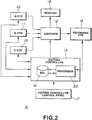
- FIG. 2 is a block diagram showing an embodiment of an editing system according to the present invention.
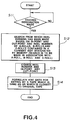
- Figures 3 and 4 are flow charts for illustrating the tracing operation by the editing system shown in Figure 2.
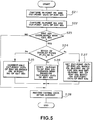
- Figure 5 is a flow chart for illustrating a clean-up processing operation by the editing system shown in Fig.2.
- Fig.6 is a diagrammatic view showing the clean-up processing operation by the editing system shown in Fig.2.
- an editing system 2 embodying the present invention transmits playback signals from plural players, such as an A-roll player 10, a B-roll player 11 etc. via a switcher 12 to a recorder 13 for recording under control by an editing controller 14.
- the editing data are displayed on a monitor for displaying a DM screen 18.
- the resource information of the respective editing data that is, reel numbers, in-points and out-points of the tapes loaded on the players, are compared by an editing controller 14 at an arbitrary time juncture at which a command for performing a tracing operation is issued. Based on the results of comparison, the editing controller 14 corrects the editing data for minimizing the number of times of dubbing operations.
- the editing system 6 of the embodiment illustrated is an editing system employing a C-roll player 19 in addition to the above-mentioned A-roll player 11 and the B-roll player 12.
- the C-roll player 19 is operated in synchronism with the operation of the master VTR and is used for editing in which signals from the original VTR for the C-roll are inserted in the course of editing of the A, and B roll.
- the data structure is such that the LIST operation can hardly be performed on the C-roll.
- the editing data for the C-roll in the conventional system is hardly more than that recorded in the so-called NOTE sentence so that it has been necessary for the operator to perform an operation of checking and correcting data one by one when performing the above-mentioned tracing operation.
- the LIST management operation such as tracing operation, may be enabled not only on the A-roll editing data and the B-roll editing data but also on the C-roll editing data in the course of the editing control operation.
- the editing system shown in Fig.2 includes the A-roll player (VTR) 10 and the B-roll player (VTR) 11, play data of which are transmitted to or recorded in recorder (VTR) 13 via switcher 12 in accordance with editing data.
- the editing system also includes the C-roll player (VTR) 19, the operation of which is started in synchronism with the recorder 13, and an editing controller 14 controlling these components.
- the editing controller 14 compares the source information of the editing data, such as reel numbers, at an arbitrary time juncture at which tracing designation command has been issued via an editing control panel, and automatically corrects the editing data, based on the results of comparison, so as to diminish the number of times of the dubbing operations to a minimum.
- play signals from the A-roll player 10, the B-roll player 11 and the C-roll player 19 are connected so as to be supplied to the switcher 12.
- the switcher 12 changes over play signals from the respective sources, that is the A-, B- and C-rolls, to output the signals from the selected source. It is also possible for the switcher 12 to perform a predetermined image converting operation, such as a so-called dissolve processing or wiping, on the video signals transmitted from the players, based on the editing data, to produce special effect images.
- An output from switcher 12 is supplied to recorder 13.
- the A-roll player 10, B-roll player 12, C-roll player 19 and the recorder 13 are also controlled in their operations, such as play start or recording start, by control signals from editing controller 14 based on the aforementioned editing data. More concretely, the operations of the players and the recorder are controlled on the basis of the time codes for the players and the time code for the recorder which are a part of the editing data. Meanwhile, the frame-by-frame time codes are employed in the present embodiment.
- Automatic editing is rendered possible by the operations of the players, recorder and the switcher being controlled in this manner by control signals from the editing controller 14 based on the above-mentioned editing data.
- the monitor 18 is connected to the switcher 12 to permit the operator to view an image being edited by the monitor 18.
- the DM screen may also be viewed in the setting mode for the editing data for the A-roll player 11, B-roll player 12 and the C-roll player 19.
- the source data of the editing data displayed on the monitor 18 in the setting mode for the editing data are compared and the editing data are corrected to minimize the number of times of the dubbing operations based on the results of comparison. That is, the editing system of the embodiment illustrated in the course of editing control operations handles the unrecorded editing data displayed on the DM screen at the time of editing input as if these data were a part of the recorded editing data to render it possible to perform the tracing operation on the unrecorded editing data displayed on the DM screen. In this manner, the tracing operation may be performed before recordal of the editing data.
- a processing section 20 responsible for the tracing operation the input editing data entered from the control panel 17 are analyzed in the setting mode of the respective editing data and necessary data, such as data of the reel number, in-point and the out-point, are taken out from the editing data for the A-roll, B-roll and the C-roll stored in the editing data storage memory 15 to enable execution of the tracing operation.
- the source data such as data of the reel number, in-point and the out-point
- the editing data is corrected to minimize the number of times of dubbing operations based on the results of comparison, that is, the tracing operation is performed, as indicated by a flow chart as hereinafter described.
- FIG.3 A flow chart for the tracing operation is shown in Fig.3.
- the edit number desired to be changed is designated at step S1.
- the editing data of the editing number desired to be changed is read out at this time from memory 15 so as to be displayed as the DM screen at step S2.
- step S3 the source data of the respective editing data, such as the reel number, in-point and the out-point, are compared on the basis of the data displayed on the Dm screen, and the editing data are automatically corrected, on the basis of the results of comparison, so as to give the minimum number of times of the dubbing operations, by way of performing the tracing operation.
- step S4 it is checked by the operator if the editing data of the original editing number should be exchanged by the editing data obtained by tracing on the DM screen. The operator then operates the control panel to make an entry as to whether or not such exchange should be made.
- step S4 If it is decided at step S4 that the original editing data should be exchanged by new editing data, control proceeds to step S7.
- step S7 a new set of editing data of the changed in-point, out-point and reel number is transmitted to memory 15.
- step S8 the new set of data is stored in substitution for the original editing data stored in memory 15.
- step S4 If it is decided at step S4 that the original editing data should not be exchanged by new editing data, control proceeds to step S5. At this step S5, a new set of editing data of the changed in-pint, out-point and reel number is transmitted to memory 15. At step S6, the new set of the editing data is stored in another storage area as another set of editing data.
- the editing control renders it possible to perform the tracing operation of unrecorded editing data displayed on the DM screen of the monitor 18 at the time of entry of the editing data, so that the tracing operation may be performed in the course of the formulation of the editing data to render it possible to formulate the editing data efficiently.
- the editing control renders it possible to perform a LIST management processing (tracing operation) not only on the editing data for the A-roll player 10 and the B-roll player 11, but also on the editing data for the C-roll player 19, there is no necessity for the operator to check and correct the editing contents to facilitate the tracing operation significantly.
- the source data of the respective editing data is compared at an arbitrary time juncture when the tracing designation command is issued at the time of setting the editing data for automatically correcting the editing data so as to minimize the number of times of the dubbing operations.
- the editing data indicating the editing operation employing the source closest to the original source may be automatically acquired before proceeding to recordal of the editing data. The result is that the operation for the operator to check and correct the editing contents one by one is eliminated to facilitate the tracing operation significantly.
- the tracing operation on the A-roll, B-roll and the C-roll is performed in the following manner.
- the editing data for the A-roll, B-roll and the C-roll, stored in memory 15 for storage of the editing data are processed page by page on the basis of the input editing data entered from the control panel 17. That is, the reel numbers, for example, of the editing data for the A-, B- and C-rolls are compared to one another and the editing data are corrected, that is the tracing operation is performed, for minimizing the number of times of dubbing based on the results of comparison. Subsequently, the designated pages of the corrected editing data are processed in their entirety.
- FIG.4 A flow chart for the tracing operation for the A-, B- and C-rolls is shown in Fig.4.
- step S11 it is checked at step S11 whether or not designation of the tracing operation has been made from the control panel 17. If it is decided at step S11 that the tracing has not been designated, the operation of step S11 is repeated. If it is decided at step S11 that the tracing has been designated, control proceeds to step S12.
- an operation of searching from which reel dubbing has been made is performed from the editing data stored in the memory 15 within the editing controller 14, on the basis of the in-point, out-point and the reel number for each of the A-, B- and C-rolls contained in the current edit designated for the tracing operation. Meanwhile, the tracing operation is performed on each of the A-, B- and C-rolls.
- step S12 control proceeds to step S13, where the previously designated reel number, in-point and the out-point of the editing data are exchanged for the reel number, in-point and the out-point of the traced source.
- step S13 control proceeds to step S14, where editing data are formulated for performing an editing using a tape (source) closest to the original source, as found by the above tracing operation.
- a LIST management processing (tracing operation) is performed by editing control not only on the editing data for the A-roll player 10 and the B-roll player 11, but also on the editing data for the C-roll player 19, so that there is no necessity for the operator to check and correct the editing contents one by one and consequently the tracing operation may be facilitated significantly.
- the editing data for the A-, B- and C-rolls, stored in editing data storage memory 15, are processed page by page on the basis of input editing data entered from control panel 17. That is, as indicated in a flow chart as hereinafter explained, the in-point, out-point and the editing type of the editing data for the A-, B- and C-rolls are compared with one another, and the respective editing data are corrected on the basis of the results of comparison. Subsequently, the designated pages of the corrected editing data are processed in their entirety.
- FIG.5 A flow chart for correction in the cleanup operation for the editing data for the A-, B- and C-rolls is shown in Fig.5.
- data (such as time codes) of an in-point IN1 and an out-point OUT1 of an edit ED1, which is an editing data showing an editing list, are captured at step S21, and data (such as time codes) of an in-point IN2 and an out-point OUT2 of an edit ED2, which is a second editing data, are captured at step S22.
- the edits ED1 and ED2 comprise data indicating e.g. the in-point and out-point of each of the A-, B- and C-rolls.
- step S23 it is checked from data of the edits ED1 and ED2 if there is any overlapping in the editing data. If it is found at step S23 that there is no overlapping, control passes to step S28 where recordal is made of the editing data following the cleanup operation. If it is found at step S23 that there is any overlapping in the editing data, control passes to step S24 to check the state of overlapping (type of overlapping).
- the three types of overlapping as shown in Fig.6 may be contemplated as the simplest examples. These three types consist in a type P R in which the front side of the edit ED2 is overlapped with a rear part of the edit ED1, a type P F in which a front side of the edit ED1 is overlapped with a rear part of the edit ED2, and a type P C in which the edit ED2 is overlapped within the interior of the edit ED1. Although other more complex states of overlapping in which these three are combined in a composite manner, solely the above-described three types are explained for simplicity.
- step S24 of the flow chart it is checked to which of the three types P R , P F and P C belongs the type of overlapping of the editing data.
- step S25 If the type of overlapping is found at step S24 to belong to type P R , control passes to step S25. Only the out-point OUT1 of the edit ED1 is corrected (that is, the time code is corrected) at step S25 based on the in-point IN2 of the edit ED2. That is, the out-points of the A-, B- and C-rolls are automatically corrected so that the out-points of one or more of the A-, B- and C-rolls are ahead of the in-point IN2 of the edit ED2.
- step S26 If the type of overlapping is found at step S24 to belong to type P F , control passes to step S26. At this step S26, the in-point IN1 is shifted rearward, based on the out-point OUT2 of the edit ED2. This proves to be a correction of shifting the in-points of the A-, B- and C-rolls rearward in their entirety on the basis of the out-point OUT2 of the edit ED2 (time code correction).
- the out-point OUT1 of the edit ED1 is set on the basis of the in-point IN2 of the out-point OUT1 of the edit ED1, while the n-point IN1 of the edit ED1 is set based on the out-point OUT2 of the edit ED2 (time code correction).
- This proves to be an operation of correcting the in- and out-points of the A-, B- and C-rolls so that these in- and out-points will meet the above-mentioned conditions.
- step S28 recordal is made of the post-cleanup editing data.
- the editing control achieves the LIST management processing operation (cleanup operation) not only on the editing data of the A-roll player 10 and the B-roll player 11 but also on the editing data of the C-roll player 19, it is unnecessary for an operator to perform an operation of rewriting data one by one, even in the case of changing the editing contents, so that the cleanup operation is facilitated remarkably.
Landscapes
- Engineering & Computer Science (AREA)
- General Engineering & Computer Science (AREA)
- Multimedia (AREA)
- Management Or Editing Of Information On Record Carriers (AREA)
Applications Claiming Priority (6)
| Application Number | Priority Date | Filing Date | Title |
|---|---|---|---|
| JP35739/92 | 1992-01-28 | ||
| JP35740/92 | 1992-01-28 | ||
| JP03573892A JP3153926B2 (ja) | 1992-01-28 | 1992-01-28 | 編集装置 |
| JP03574092A JP3153927B2 (ja) | 1992-01-28 | 1992-01-28 | 編集装置 |
| JP03573992A JP3178060B2 (ja) | 1992-01-28 | 1992-01-28 | 編集装置 |
| JP35738/92 | 1992-01-28 |
Publications (1)
| Publication Number | Publication Date |
|---|---|
| EP0554043A2 true EP0554043A2 (fr) | 1993-08-04 |
Family
ID=27288855
Family Applications (1)
| Application Number | Title | Priority Date | Filing Date |
|---|---|---|---|
| EP19930300542 Withdrawn EP0554043A2 (fr) | 1992-01-28 | 1993-01-26 | Système de montage |
Country Status (1)
| Country | Link |
|---|---|
| EP (1) | EP0554043A2 (fr) |
-
1993
- 1993-01-26 EP EP19930300542 patent/EP0554043A2/fr not_active Withdrawn
Similar Documents
| Publication | Publication Date | Title |
|---|---|---|
| US5051845A (en) | Closed-loop post production process | |
| US6236802B1 (en) | Editing apparatus and editing method | |
| US5640320A (en) | Method and apparatus for video editing and realtime processing | |
| US5825965A (en) | Editing apparatus | |
| US6314231B1 (en) | Editing apparatus | |
| EP0803873B1 (fr) | Appareil de commande de montage et commande de montage | |
| GB2235815A (en) | Digital dialog editor | |
| JPH09270992A (ja) | 画像編集装置 | |
| US7827489B2 (en) | Edit to tape | |
| US4706135A (en) | Video recording apparatus with editing and mixing of delayed monitored video signal using equidistant record, read and erase heads | |
| DE69415304T2 (de) | Digitales sprachwiedergabe- und digitales spracheditiergerät | |
| US6272279B1 (en) | Editing method of moving images, editing apparatus and storage medium storing its editing method program | |
| EP0205153B1 (fr) | Appareil pour éditer un signal vidéo | |
| US5781435A (en) | Edit-to-it | |
| US5940351A (en) | Information record medium as well as editing apparatus and reproducing apparatus for the same | |
| JP2974832B2 (ja) | 画像編集システム | |
| EP0554043A2 (fr) | Système de montage | |
| KR970006972B1 (ko) | 편집 장치 | |
| JPH0224802A (ja) | ビデオ磁気テープ録画装置のビデオ録画を再生する装置 | |
| US5712737A (en) | Method and apparatus for automatically editing audio signals | |
| EP0432759A1 (fr) | Procédé d'enregistrement de données, méhode de recherche de fin d'un enregistrement et procédé d'assemblage de données | |
| JPS58143477A (ja) | 編集装置 | |
| DE69912735T2 (de) | Datenaufzeichnungs-/-wiedergabegerät | |
| JP3178060B2 (ja) | 編集装置 | |
| JPH06295566A (ja) | 動画像編集装置 |
Legal Events
| Date | Code | Title | Description |
|---|---|---|---|
| PUAI | Public reference made under article 153(3) epc to a published international application that has entered the european phase |
Free format text: ORIGINAL CODE: 0009012 |
|
| AK | Designated contracting states |
Kind code of ref document: A2 Designated state(s): DE FR GB |
|
| 18W | Application withdrawn |
Withdrawal date: 19940913 |