EP0554908A1 - Particules fines d'alumine alpha, leur production et leur utilisation - Google Patents
Particules fines d'alumine alpha, leur production et leur utilisation Download PDFInfo
- Publication number
- EP0554908A1 EP0554908A1 EP93101862A EP93101862A EP0554908A1 EP 0554908 A1 EP0554908 A1 EP 0554908A1 EP 93101862 A EP93101862 A EP 93101862A EP 93101862 A EP93101862 A EP 93101862A EP 0554908 A1 EP0554908 A1 EP 0554908A1
- Authority
- EP
- European Patent Office
- Prior art keywords
- alpha alumina
- alumina
- particles
- alpha
- gel
- Prior art date
- Legal status (The legal status is an assumption and is not a legal conclusion. Google has not performed a legal analysis and makes no representation as to the accuracy of the status listed.)
- Granted
Links
- PNEYBMLMFCGWSK-UHFFFAOYSA-N Alumina Chemical compound [O-2].[O-2].[O-2].[Al+3].[Al+3] PNEYBMLMFCGWSK-UHFFFAOYSA-N 0.000 title claims abstract description 96
- 238000004519 manufacturing process Methods 0.000 title claims abstract description 12
- 239000002245 particle Substances 0.000 title claims description 97
- VYPSYNLAJGMNEJ-UHFFFAOYSA-N Silicium dioxide Chemical compound O=[Si]=O VYPSYNLAJGMNEJ-UHFFFAOYSA-N 0.000 claims abstract description 70
- 239000000843 powder Substances 0.000 claims abstract description 52
- FAHBNUUHRFUEAI-UHFFFAOYSA-M hydroxidooxidoaluminium Chemical compound O[Al]=O FAHBNUUHRFUEAI-UHFFFAOYSA-M 0.000 claims abstract description 36
- 229910001593 boehmite Inorganic materials 0.000 claims abstract description 34
- 239000000377 silicon dioxide Substances 0.000 claims abstract description 32
- 238000000034 method Methods 0.000 claims abstract description 31
- 230000008569 process Effects 0.000 claims abstract description 28
- 239000000463 material Substances 0.000 claims abstract description 19
- 239000002105 nanoparticle Substances 0.000 claims abstract description 9
- 238000005498 polishing Methods 0.000 claims abstract description 6
- 238000003980 solgel method Methods 0.000 claims abstract description 4
- 239000002002 slurry Substances 0.000 claims abstract 3
- 238000010304 firing Methods 0.000 claims description 19
- 238000006243 chemical reaction Methods 0.000 claims description 15
- 230000004888 barrier function Effects 0.000 claims description 13
- 230000015572 biosynthetic process Effects 0.000 claims description 10
- 239000007787 solid Substances 0.000 claims description 6
- 238000010438 heat treatment Methods 0.000 claims description 5
- 239000011164 primary particle Substances 0.000 claims description 5
- 238000001035 drying Methods 0.000 claims description 4
- 239000000203 mixture Substances 0.000 claims description 4
- 238000002441 X-ray diffraction Methods 0.000 claims description 3
- 239000002612 dispersion medium Substances 0.000 claims 2
- 239000007788 liquid Substances 0.000 claims 2
- 230000007704 transition Effects 0.000 claims 1
- 239000000499 gel Substances 0.000 description 23
- 239000000047 product Substances 0.000 description 22
- 239000013078 crystal Substances 0.000 description 10
- XLYOFNOQVPJJNP-UHFFFAOYSA-N water Substances O XLYOFNOQVPJJNP-UHFFFAOYSA-N 0.000 description 9
- 238000003801 milling Methods 0.000 description 7
- 238000005245 sintering Methods 0.000 description 7
- 239000000919 ceramic Substances 0.000 description 6
- 239000006185 dispersion Substances 0.000 description 4
- 230000005540 biological transmission Effects 0.000 description 3
- 239000011248 coating agent Substances 0.000 description 3
- 238000000576 coating method Methods 0.000 description 3
- KZHJGOXRZJKJNY-UHFFFAOYSA-N dioxosilane;oxo(oxoalumanyloxy)alumane Chemical compound O=[Si]=O.O=[Si]=O.O=[Al]O[Al]=O.O=[Al]O[Al]=O.O=[Al]O[Al]=O KZHJGOXRZJKJNY-UHFFFAOYSA-N 0.000 description 3
- 239000012467 final product Substances 0.000 description 3
- 239000010419 fine particle Substances 0.000 description 3
- 229910052863 mullite Inorganic materials 0.000 description 3
- 239000000126 substance Substances 0.000 description 3
- 238000004627 transmission electron microscopy Methods 0.000 description 3
- 239000002253 acid Substances 0.000 description 2
- 230000008901 benefit Effects 0.000 description 2
- 230000002902 bimodal effect Effects 0.000 description 2
- 238000001354 calcination Methods 0.000 description 2
- 239000008119 colloidal silica Substances 0.000 description 2
- 230000000052 comparative effect Effects 0.000 description 2
- 150000001875 compounds Chemical class 0.000 description 2
- 238000007796 conventional method Methods 0.000 description 2
- 230000001419 dependent effect Effects 0.000 description 2
- 239000011521 glass Substances 0.000 description 2
- 238000007496 glass forming Methods 0.000 description 2
- 239000000741 silica gel Substances 0.000 description 2
- 229910002027 silica gel Inorganic materials 0.000 description 2
- RMAQACBXLXPBSY-UHFFFAOYSA-N silicic acid Chemical compound O[Si](O)(O)O RMAQACBXLXPBSY-UHFFFAOYSA-N 0.000 description 2
- 238000001238 wet grinding Methods 0.000 description 2
- ZOXJGFHDIHLPTG-UHFFFAOYSA-N Boron Chemical compound [B] ZOXJGFHDIHLPTG-UHFFFAOYSA-N 0.000 description 1
- 241000640882 Condea Species 0.000 description 1
- 206010053759 Growth retardation Diseases 0.000 description 1
- FYYHWMGAXLPEAU-UHFFFAOYSA-N Magnesium Chemical compound [Mg] FYYHWMGAXLPEAU-UHFFFAOYSA-N 0.000 description 1
- GRYLNZFGIOXLOG-UHFFFAOYSA-N Nitric acid Chemical compound O[N+]([O-])=O GRYLNZFGIOXLOG-UHFFFAOYSA-N 0.000 description 1
- BOTDANWDWHJENH-UHFFFAOYSA-N Tetraethyl orthosilicate Chemical compound CCO[Si](OCC)(OCC)OCC BOTDANWDWHJENH-UHFFFAOYSA-N 0.000 description 1
- RTAQQCXQSZGOHL-UHFFFAOYSA-N Titanium Chemical compound [Ti] RTAQQCXQSZGOHL-UHFFFAOYSA-N 0.000 description 1
- QCWXUUIWCKQGHC-UHFFFAOYSA-N Zirconium Chemical compound [Zr] QCWXUUIWCKQGHC-UHFFFAOYSA-N 0.000 description 1
- 230000002411 adverse Effects 0.000 description 1
- 229910052910 alkali metal silicate Inorganic materials 0.000 description 1
- 229910000323 aluminium silicate Inorganic materials 0.000 description 1
- 238000004458 analytical method Methods 0.000 description 1
- 238000013459 approach Methods 0.000 description 1
- 238000010420 art technique Methods 0.000 description 1
- 238000000498 ball milling Methods 0.000 description 1
- 239000002585 base Substances 0.000 description 1
- 239000011230 binding agent Substances 0.000 description 1
- 230000036760 body temperature Effects 0.000 description 1
- 229910052796 boron Inorganic materials 0.000 description 1
- 230000015556 catabolic process Effects 0.000 description 1
- 239000003054 catalyst Substances 0.000 description 1
- 230000003197 catalytic effect Effects 0.000 description 1
- 230000008859 change Effects 0.000 description 1
- 239000000084 colloidal system Substances 0.000 description 1
- 239000002131 composite material Substances 0.000 description 1
- 230000001351 cycling effect Effects 0.000 description 1
- 230000003247 decreasing effect Effects 0.000 description 1
- 238000011161 development Methods 0.000 description 1
- 238000002050 diffraction method Methods 0.000 description 1
- HNPSIPDUKPIQMN-UHFFFAOYSA-N dioxosilane;oxo(oxoalumanyloxy)alumane Chemical compound O=[Si]=O.O=[Al]O[Al]=O HNPSIPDUKPIQMN-UHFFFAOYSA-N 0.000 description 1
- 238000009837 dry grinding Methods 0.000 description 1
- 238000002296 dynamic light scattering Methods 0.000 description 1
- 230000000694 effects Effects 0.000 description 1
- 230000008030 elimination Effects 0.000 description 1
- 238000003379 elimination reaction Methods 0.000 description 1
- 238000005516 engineering process Methods 0.000 description 1
- 238000001125 extrusion Methods 0.000 description 1
- 238000009472 formulation Methods 0.000 description 1
- 238000007499 fusion processing Methods 0.000 description 1
- 238000001879 gelation Methods 0.000 description 1
- 239000003349 gelling agent Substances 0.000 description 1
- 150000004677 hydrates Chemical class 0.000 description 1
- 230000007062 hydrolysis Effects 0.000 description 1
- 238000006460 hydrolysis reaction Methods 0.000 description 1
- 238000010335 hydrothermal treatment Methods 0.000 description 1
- 230000002401 inhibitory effect Effects 0.000 description 1
- 230000000670 limiting effect Effects 0.000 description 1
- 229910052749 magnesium Inorganic materials 0.000 description 1
- 239000011777 magnesium Substances 0.000 description 1
- 238000000691 measurement method Methods 0.000 description 1
- 230000007246 mechanism Effects 0.000 description 1
- 229910052914 metal silicate Inorganic materials 0.000 description 1
- 230000005012 migration Effects 0.000 description 1
- 238000013508 migration Methods 0.000 description 1
- 229910017604 nitric acid Inorganic materials 0.000 description 1
- 230000006911 nucleation Effects 0.000 description 1
- 238000010899 nucleation Methods 0.000 description 1
- 150000001282 organosilanes Chemical class 0.000 description 1
- 239000002243 precursor Substances 0.000 description 1
- 229910001404 rare earth metal oxide Inorganic materials 0.000 description 1
- 230000002787 reinforcement Effects 0.000 description 1
- 238000001228 spectrum Methods 0.000 description 1
- 238000004347 surface barrier Methods 0.000 description 1
- 239000004094 surface-active agent Substances 0.000 description 1
- 239000013077 target material Substances 0.000 description 1
- 229910052719 titanium Inorganic materials 0.000 description 1
- 239000010936 titanium Substances 0.000 description 1
- 150000004684 trihydrates Chemical class 0.000 description 1
- 229910052726 zirconium Inorganic materials 0.000 description 1
Images



Classifications
-
- C—CHEMISTRY; METALLURGY
- C01—INORGANIC CHEMISTRY
- C01F—COMPOUNDS OF THE METALS BERYLLIUM, MAGNESIUM, ALUMINIUM, CALCIUM, STRONTIUM, BARIUM, RADIUM, THORIUM, OR OF THE RARE-EARTH METALS
- C01F7/00—Compounds of aluminium
- C01F7/02—Aluminium oxide; Aluminium hydroxide; Aluminates
- C01F7/44—Dehydration of aluminium oxide or hydroxide, i.e. all conversions of one form into another involving a loss of water
- C01F7/441—Dehydration of aluminium oxide or hydroxide, i.e. all conversions of one form into another involving a loss of water by calcination
- C01F7/442—Dehydration of aluminium oxide or hydroxide, i.e. all conversions of one form into another involving a loss of water by calcination in presence of a calcination additive
-
- B—PERFORMING OPERATIONS; TRANSPORTING
- B82—NANOTECHNOLOGY
- B82Y—SPECIFIC USES OR APPLICATIONS OF NANOSTRUCTURES; MEASUREMENT OR ANALYSIS OF NANOSTRUCTURES; MANUFACTURE OR TREATMENT OF NANOSTRUCTURES
- B82Y30/00—Nanotechnology for materials or surface science, e.g. nanocomposites
-
- C—CHEMISTRY; METALLURGY
- C09—DYES; PAINTS; POLISHES; NATURAL RESINS; ADHESIVES; COMPOSITIONS NOT OTHERWISE PROVIDED FOR; APPLICATIONS OF MATERIALS NOT OTHERWISE PROVIDED FOR
- C09K—MATERIALS FOR MISCELLANEOUS APPLICATIONS, NOT PROVIDED FOR ELSEWHERE
- C09K3/00—Materials not provided for elsewhere
- C09K3/14—Anti-slip materials; Abrasives
- C09K3/1436—Composite particles, e.g. coated particles
-
- C—CHEMISTRY; METALLURGY
- C09—DYES; PAINTS; POLISHES; NATURAL RESINS; ADHESIVES; COMPOSITIONS NOT OTHERWISE PROVIDED FOR; APPLICATIONS OF MATERIALS NOT OTHERWISE PROVIDED FOR
- C09K—MATERIALS FOR MISCELLANEOUS APPLICATIONS, NOT PROVIDED FOR ELSEWHERE
- C09K3/00—Materials not provided for elsewhere
- C09K3/14—Anti-slip materials; Abrasives
- C09K3/1454—Abrasive powders, suspensions and pastes for polishing
- C09K3/1463—Aqueous liquid suspensions
-
- C—CHEMISTRY; METALLURGY
- C01—INORGANIC CHEMISTRY
- C01P—INDEXING SCHEME RELATING TO STRUCTURAL AND PHYSICAL ASPECTS OF SOLID INORGANIC COMPOUNDS
- C01P2004/00—Particle morphology
- C01P2004/01—Particle morphology depicted by an image
- C01P2004/04—Particle morphology depicted by an image obtained by TEM, STEM, STM or AFM
-
- C—CHEMISTRY; METALLURGY
- C01—INORGANIC CHEMISTRY
- C01P—INDEXING SCHEME RELATING TO STRUCTURAL AND PHYSICAL ASPECTS OF SOLID INORGANIC COMPOUNDS
- C01P2004/00—Particle morphology
- C01P2004/51—Particles with a specific particle size distribution
- C01P2004/52—Particles with a specific particle size distribution highly monodisperse size distribution
-
- C—CHEMISTRY; METALLURGY
- C01—INORGANIC CHEMISTRY
- C01P—INDEXING SCHEME RELATING TO STRUCTURAL AND PHYSICAL ASPECTS OF SOLID INORGANIC COMPOUNDS
- C01P2004/00—Particle morphology
- C01P2004/60—Particles characterised by their size
- C01P2004/64—Nanometer sized, i.e. from 1-100 nanometer
-
- C—CHEMISTRY; METALLURGY
- C01—INORGANIC CHEMISTRY
- C01P—INDEXING SCHEME RELATING TO STRUCTURAL AND PHYSICAL ASPECTS OF SOLID INORGANIC COMPOUNDS
- C01P2006/00—Physical properties of inorganic compounds
- C01P2006/12—Surface area
-
- Y—GENERAL TAGGING OF NEW TECHNOLOGICAL DEVELOPMENTS; GENERAL TAGGING OF CROSS-SECTIONAL TECHNOLOGIES SPANNING OVER SEVERAL SECTIONS OF THE IPC; TECHNICAL SUBJECTS COVERED BY FORMER USPC CROSS-REFERENCE ART COLLECTIONS [XRACs] AND DIGESTS
- Y10—TECHNICAL SUBJECTS COVERED BY FORMER USPC
- Y10S—TECHNICAL SUBJECTS COVERED BY FORMER USPC CROSS-REFERENCE ART COLLECTIONS [XRACs] AND DIGESTS
- Y10S977/00—Nanotechnology
- Y10S977/70—Nanostructure
- Y10S977/773—Nanoparticle, i.e. structure having three dimensions of 100 nm or less
- Y10S977/775—Nanosized powder or flake, e.g. nanosized catalyst
-
- Y—GENERAL TAGGING OF NEW TECHNOLOGICAL DEVELOPMENTS; GENERAL TAGGING OF CROSS-SECTIONAL TECHNOLOGIES SPANNING OVER SEVERAL SECTIONS OF THE IPC; TECHNICAL SUBJECTS COVERED BY FORMER USPC CROSS-REFERENCE ART COLLECTIONS [XRACs] AND DIGESTS
- Y10—TECHNICAL SUBJECTS COVERED BY FORMER USPC
- Y10S—TECHNICAL SUBJECTS COVERED BY FORMER USPC CROSS-REFERENCE ART COLLECTIONS [XRACs] AND DIGESTS
- Y10S977/00—Nanotechnology
- Y10S977/70—Nanostructure
- Y10S977/811—Of specified metal oxide composition, e.g. conducting or semiconducting compositions such as ITO, ZnOx
-
- Y—GENERAL TAGGING OF NEW TECHNOLOGICAL DEVELOPMENTS; GENERAL TAGGING OF CROSS-SECTIONAL TECHNOLOGIES SPANNING OVER SEVERAL SECTIONS OF THE IPC; TECHNICAL SUBJECTS COVERED BY FORMER USPC CROSS-REFERENCE ART COLLECTIONS [XRACs] AND DIGESTS
- Y10—TECHNICAL SUBJECTS COVERED BY FORMER USPC
- Y10S—TECHNICAL SUBJECTS COVERED BY FORMER USPC CROSS-REFERENCE ART COLLECTIONS [XRACs] AND DIGESTS
- Y10S977/00—Nanotechnology
- Y10S977/84—Manufacture, treatment, or detection of nanostructure
- Y10S977/89—Deposition of materials, e.g. coating, cvd, or ald
-
- Y—GENERAL TAGGING OF NEW TECHNOLOGICAL DEVELOPMENTS; GENERAL TAGGING OF CROSS-SECTIONAL TECHNOLOGIES SPANNING OVER SEVERAL SECTIONS OF THE IPC; TECHNICAL SUBJECTS COVERED BY FORMER USPC CROSS-REFERENCE ART COLLECTIONS [XRACs] AND DIGESTS
- Y10—TECHNICAL SUBJECTS COVERED BY FORMER USPC
- Y10T—TECHNICAL SUBJECTS COVERED BY FORMER US CLASSIFICATION
- Y10T428/00—Stock material or miscellaneous articles
- Y10T428/29—Coated or structually defined flake, particle, cell, strand, strand portion, rod, filament, macroscopic fiber or mass thereof
- Y10T428/2982—Particulate matter [e.g., sphere, flake, etc.]
- Y10T428/2991—Coated
- Y10T428/2993—Silicic or refractory material containing [e.g., tungsten oxide, glass, cement, etc.]
Definitions
- This invention relates to fine alpha alumina powders, their production and use.
- alpha alumina powders with a number average particle width below 50 nanometers will be termed for brevity "nano-sized” particles.
- width of such particles hereafter it is to be understood that, except where the context clearly indicates the contrary, it is intended to refer to the number average value of the largest dimension perpendicular to the longest dimension of a particle.
- the measurement technique is based on the use of a transmission electron microscope, (a JEOL 2000SX instrument).
- Alpha alumina is the hardest and densest form of alumina and is formed by heating other forms of alumina or hydrated alumina at elevated temperatures. It is therefore the form of alumina that is best adapted to abrasive or ceramic applications.
- Alpha alumina is conventionally formed by a fusion process in which an alumina hydrate is heated to above about 2000°C and then cooled and crushed. Heating at these high temperatures causes the crystals of alpha alumina to grow to several ⁇ m and to sinter together to produce an extremely hard material. The high density and the hardness of the alumina particles produced in this way make the crushing process very difficult. To get small particles, it is necessary to break the sinter bonds and, if even smaller particles are needed, perhaps of the order of a few ⁇ m or less in size, even to crush the primary crystals themselves. This is of course an extremely difficult task requiring much expenditure of energy. While the sinter bonds are very difficult to break, especially when sintering to essentially theoretical density has occurred, the fracture of the ultimate crystals themselves is even harder.
- sol-gel and particularly seeded sol-gel, processes have permitted the production of alumina with a microcrystalline structure in which the size of the ultimate crystals, (often called microcrystallites), is of the order of 0.1 ⁇ m.
- Such seeded processes incorporate seed particles that are capable of nucleating the conversion of boehmite, (alpha alumina monohydrate), to the alpha alumina phase at relatively low temperatures.
- the nature of the seed particle in terms of its crystal shape and lattice dimensions should be as close as possible to that of the target material for the nucleation to be efficient so that the logical choice is alpha alumina itself.
- the alpha phase in the form of particles comprising microcrystallites of alpha alumina less than one ⁇ m in size, there is a tendency for the particles to sinter together where they contact one another. This tendency accelerates with increasing temperature. Keeping the temperature of formation of the alpha phase low therefore minimizes the degree to which the particles are sintered together and thus makes crushing to the ultimate particles size somewhat easier.
- Finer crystallites can of course be obtained by the use of finer seed particles. If the size of the seed particles is of the order of 0.1 ⁇ m then the final product obtained will have a crystal size of about a ⁇ m or a little less. To obtain smaller crystals, it is necessary to use smaller seeds. It is apparent therefore that there is a need for alpha alumina seed particles that are nano-sized so as to drive down the microcrystallite size of seeded sol-gel aluminas and yield the optimum products available from this technology.
- fine alpha alumina powder is also important in the production of formed ceramic articles or monoliths.
- a fine alumina powder is heated until the particles sinter together and form a solid body. This can be done by heating the powder compressed into the desired form under pressure, as in a hot isostatic pressure, (or HIP), operation or simply by heating a cold pressed powder in the form of the desired object.
- HIP hot isostatic pressure
- fine alpha alumina powder is widely used as a polishing, or lapping abrasive. In such lapping applications, the finer and more uniform the particle size of the powder, the better the finish that can be attained. Fine alpha alumina powder is also used to modify the frictional characteristics of materials as diverse as magnetic tapes and cardboard. In most of such applications, especially those where uniformity and fineness are desirable, nano-sized alpha alumina powder would be a highly desirable commodity.
- alpha alumina in very fine form could be formed into a gel, it would be possible to form objects from the gel and then fire them to eliminate only the water associated with the gel without concern for the volume changes that would accompany changes of phase.
- the production of nano-sized alpha alumina powders would make this objective a feasible proposition.
- the present invention therefore provides alpha alumina with a very uniform particle size in the nanometer range with a wide spectrum of potential applications. This is done according to one aspect of the invention according to independent claim 1. Further advantageous features, aspects and details of this fine alumina powder are evident from the dependent claims, the description, examples and figures.
- the invention also provides preferred uses of the fine alumina powder as is especially evident from any one of independent claims 11 to 14.
- the present invention also provides a process that is adapted to provide alpha alumina in an extremely fine form that is very useful in a wide range of applications.
- a specific aspect of this process is evident from independent claims 4 and/or 9. Further advantageous features, aspects and details of the process are evident from the dependent claims, the description, examples and figures.
- the process is much more economical than prior art techniques and results in a much finer product than hitherto available that is of great versatility and value.
- the process of the present invention comprises according to a specific aspect, dispersing in a boehmite gel a material that forms a barrier around the boehmite particles, at a temperature below that at which boehmite converts to alpha alumina, said material being incorporated in an amount sufficient to inhibit particle size growth after formation of alpha alumina from the boehmite, then drying and firing the gel at a temperature to convert at least the major proportion of the alumina to the alpha phase in the form of loose aggregates of ultimate particles with sizes from about 20 to about 50 nanometers.
- the firing should not be at a temperature to cause significant growth or over-sintering of the particles, (which would of course cause them to be extremely difficult, if not impossible, to separate to the primary particles).
- the barrier coating makes the sintering of such products occur only at an elevated temperature of about 1400°C or higher and the usual firing temperature employed is about 1300°C.
- the barrier material is believed to form a very thin coating around the particles of boehmite in the gel which inhibits migration of alumina across the particle boundary and thus prevents, or at least significantly inhibits, growth of the particle as it is converted to the alpha phase. The result is therefore the formation of alpha alumina particles with sizes of the order of those in the originating boehmite gel.
- the barrier material is conveniently a glass.
- the preferred glass forming barrier material is most conveniently silica but other glass forming materials capable of acting in the above way are within the purview of the present invention. These could include boron containing materials such as borosilicates and the like. For the purposes of this description, the primary emphasis will be on the most readily available and easily usable materials based on silica.
- the amount incorporated is preferably from about 0.5 to about 5% by weight based on the weight of the alumina in the gel. It is usually preferred to disperse the silica in a sol or a gel of the boehmite so as to maximize the intimacy of the dispersion between the components.
- the boehmite can be any of those currently available which have dispersed particle sizes of the order of a few tens of nanometers or less. Clearly the boehmites with the most consistently fine particles sizes are preferred since these do not have the hard-to-disperse agglomerates that characterize some of the other commercial products.
- silica interacts with the surface of the boehmite particles, probably by formation of a glass, and this slows their conversion to alpha alumina and the subsequent growth of these alpha particles. Because of this particle growth suppression mechanism there is little reason to keep the temperature low. Thus more rapid conversion can be obtained using higher temperatures without adverse effect on the alpha crystal size.
- silica is an important preferred feature of the present invention since this permits a complete and uniform dispersion to be achieved.
- the silica becomes attached to the essentially colloidal sized boehmite particles which are inhibited from significant further growth. In this way it is possible to ensure that a powder with a highly-uniform, very fine particle size is obtained.
- the particles are in the form of loose agglomerates of primary particles with a width of about 50 nanometers or less and may appear under a scanning electron microscope to have the form of a series of rod-shaped or cluster agglomerates, or sometimes a rough network of elements comprising the primary particles.
- These loose agglomerates or aggregates are relatively easily broken down to the individual particles, for example by wet or dry milling. They are relatively easily broken up because of the formation of a silica-containing barrier phase at the crystal boundaries which inhibits the formation of a sinter bond between alpha alumina ultimate particles. This results in a product with a number average particle width of less than about 50 nanometers.
- a wet milling process can often lead to the formation of a minor amount of hydrated alumina, for example alumina trihydrate, by surface hydrolysis of the alpha alumina.
- alumina trihydrate Such hydrates will revert to alpha alumina upon firing of course and for the purposes of this specification, such surface modified alpha alumina is not distinguished from unmodified alpha alumina.
- the process of the invention leads to the production of alpha alumina particles of a novel, fine, uniform particle size.
- Prior art alpha alumina powders milled to give a high BET surface area are found to comprise a wide range of particle sizes to the extent that these often appear to be in a bimodal distribution.
- the present invention therefore also provides a fine alumina powder having a BET surface area of at least 50 m2/gm.
- the powder weight and at least about 95% of the total alumina phase weight is provided by particles of microcrystalline alpha alumina, and wherein at least 95% of the particles have widths of from about 20 to about 50 nanometers and less than 5% have ultimate particle widths greater than 100 nanometers.
- the fraction of these large particles is measured by a transmission electron microscope analysis of an ultramicrotomed sample and an assessment of the percentage of the total field occupied by particles, occupied by particles having ultimate particle widths greater than 100 nanometers.
- the balance of the powder weight is largely provided by the barrier material which, as indicated above, can be any material capable of inhibiting particle growth and/or sintering during the conversion to alpha alumina.
- the barrier comprises a silica-containing material such as a mullite this can represent as much as 15% by weight of the total weight or even more. Usually however, operating with the preferred minor amounts of silica sol specified above, the alpha alumina represents about 95% of the weight of the powder.
- non-alpha alumina in the final powder may be provided in part by alumina phases intermediate between the boehmite and alpha phases, such as gamma alumina.
- the amount of silica present should be carefully controlled because if too much is added there will be a tendency to react with the bulk of the alumina and much of the final product will have the relatively useless chemical composition of mullite or other silica-containing phase. On the other hand too little will not be effective to limit alpha particle growth. In practice it is found that an amount from about 0.5 to about 8, and preferably from about 1 to about 5 wt. % of the solids content of the gel should be silica. Generally it is preferred that the amount of silica-containing phase in the final product should be less than about 20 wt% and preferably should be less than about 10, and most preferably less than about 5 wt%.
- the silica can be added in the form of colloidal silica, a silica sol or a compound that under the reaction conditions will liberate such a colloid or sol and form a glassy coating around the alumina particles.
- Such compounds could include organosilanes such as tetraethyl orthosilicate, and certain metal silicates. Generally alkali metal silicates are less preferred.
- the form of the silica in the sol should preferably be of a particle size that is at least similar to, or preferably smaller than, that of the boehmite, that is, of the order of a few nanometers at most. Adding the silica in the form of a sol to the boehmite sol ensures the most uniform and effective distribution of the silica such a minimum amount can be used.
- the gel may be dried at lower temperatures before it is calcined, which is commonly done at a temperature of about 700°C, over a period of several hours.
- the calcination drives off the water in the gel, promotes formation of the glassy surface barrier and begins conversion of the boehmite to the gamma alumina phase.
- the calcination process can however be carried out under other conditions with higher or lower temperatures if desired, or even omitted altogether.
- Firing of the dried gel can occur under any conditions that will bring about an essentially complete phase conversion to alpha alumina.
- Generally unseeded boehmite will convert to the alpha phase at temperatures of from about 1100 to 1300°C with the time to accomplish the conversion decreasing with increasing temperature.
- the preferred firing temperature is from about 1200°C to 1400°C and the time taken at that temperature will be somewhat longer than would be usual for such aluminas due to the presence of the silica.
- the firing may require as much as 40 hours at the lower end of the temperature range and as little as one minute at the upper end of this range. It is preferred to operate at the lower end of the range such as from about 1200 to about 1300°C so as to minimize the tendency for the particles to form aggregates.
- a time at the firing temperature of from about 1 minute to about 40 hours is needed to reach the desired level of conversion to alpha alumina without formation of excessive amounts of intractable (as opposed to loose), agglomerates.
- the time at the firing temperature is very important.
- a slow ramp-up to the firing temperature may dictate the use of a shorter time at the firing temperature and this ramp-up is often a function of the equipment used.
- a rotary furnace needs a much shorter time to reach the desired temperature while a box furnace can take a significantly longer time.
- it may often be preferred to use a rotary furnace In addition a large sample will need longer to reach a uniform body temperature than a smaller one. The temperature/time schedule actually used will therefore be dictated by the circumstances, with the above considerations in mind.
- Comminution can be accomplished in a mill using conventional techniques such as wet or dry ball milling or the like.
- mullite or other aluminosilicate phases at the particle boundaries within the agglomerates to make comminution easier.
- Such phases will usually have different thermal expansion properties from alpha alumina and it is often possible to rupture such boundary layers by cycling the product through high and low temperatures to create expansion stresses. Such stresses may sometimes themselves be adequate to bring about comminution.
- the very fine particle sizes obtained by the process of the invention are believed to be unique in that they combine a high surface area in excess of 50, and more often 120 m2/gm. with a particle size distribution such that less than about 5% by weight of the particles have an ultimate particle size greater than 100 nm. Since milling is typically done using low purity alpha alumina media, it is believed that any 100 nm+ particles observed are more likely derived from attrition of the media and not from alpha alumina obtained by the conversion of the boehmite. By contrast products obtained by milling larger alpha alumina particles typically have a much wider spread of particle sizes with large number of particles greater than 100 nm in size.
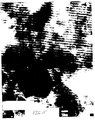
- Figure 1 shows a powder according to the invention. As can be seen it comprises highly uniform 20-50 nm particles with very few larger than 50 nm in width. Some appear to be loosely agglomerated but the individual particle structure is clearly visible.
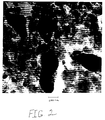
- Figure 2 shows the best commercial fine alumina powder currently available, (A-16SG from Alcoa Co.), milled to a surface area of about 124 m2/gm using conventional techniques. As can be seen the particles appear to have a bimodal distribution with some very small particles and a large proportion of particles with sizes over 100 nm. This wide particle size range leads to unsatisfactory results when such powders are used in very demanding lapping or polishing applications.
- A-16SG from Alcoa Co.
- Figure 3 shows the loosely agglomerated product obtained by firing the silica coated boehmite before milling to produce the separated particles, (shown in Figure 1).
- Figures 4 and 5 show the same materials as Figures 1 and 2 respectively, but at a higher magnification.
- a commercial submicron alpha alumina powder (45.36 kg (100 lb) of Alcoa Co. A-16SG), was milled with 771.1 kg (1700 lb) of water in a Sweco M-80 mill filled with 1.27cm (1/2") "Diamonite" low purity alumina media for 50 hours to obtain a product with a BET surface area of 66 m2/gm. which corresponds to a calculated average particle size of 22.7 nm. Milling was continued for a further 50 hours and the product was found to have a BET surface area of 124 m2/gm., corresponding to a calculated average particle size of 12.5 nm. Transmission electron microscopy of the product revealed the presence of a predominant weight fraction of single crystal alpha alumina particles with a size range of 100 - 200 nm. (See Figure 2).
- the sol was gelled by addition of 16.3 kg (36 lb) of nitric acid (containing 22 wt% of acid). The resulting gel was dried at 195°C and crushed to -50 mesh size. The crushed product was then fired in a rotary furnace at a rate of 1.59kg/hr (3.5 lb/hr) with an average residence time at the furnace temperature of 1300°C of about 10 minutes.
- the fired powder had a silica content of 1.95 wt% and a BET surface area of 20 m2/gm. and no transitional phases of alumina were found using X-Ray diffraction crystallography. Transmission electron microscopy, (see Figure 3), revealed aggregates of particles of alpha alumina with widths of from about 20 to about 50 nm. (See Figure 3).
- This alpha alumina powder (45.36 kg (100 lb)), was placed in the same mill used in Comparative Example 1 and milled with 771.1 kg (1700 lb) of water for 50 hours. At the end of this time the BET surface area was 120 m2/gm and a further milling for another ten hours produced a BET surface area of 133 m2/gm. Transmission electron microscopy of this product, ( Figure 1 of the Drawings), showed that substantially all of the particles had widths within the range of 20 - 50 nm and there was a substantial absence of particles over 100 nm.
- Silica doped boehmite gels were produced with silica contents of 1.5 wt% and 3.0 wt% respectively by essentially the technique described in Example 2.
- the 1.5% silica gel was fired at 1240°C, and the 3% silica gel was fired at 1260°C, each for 10 hours in a box furnace, to obtain essentially complete conversion to the alpha phase as determined by x-ray diffraction techniques.
- Each had the form of agglomerates of particles from about 20 to about 50 nm in size. These aggregates were broken up mechanically in a Sweco M-45 mill using a 4.54 kg (10 lb) powder charge with 90.72 kg (200 lb) of water.
- the uniformity of the particle size in the products according to the invention was much greater.
- alpha-sized alpha alumina powders include the use as a very fine and uniform polishing abrasive and as seeds for conversion of boehmite to alpha alumina by a seeded sol-gel process.
- shapeable, eg. by extrusion aqueous based dispersions, (called "alpha-gels") of high solids content, perhaps with the assistance of a surface active or gelling agent or a binder, and to use such dispersions to cast ceramics directly.
- Such alpha-gels could also be extruded into filaments for use as, for example, reinforcement in metallic composites, or be cut into filamentary abrasive particles or even comminuted to form more traditional abrasive particles.
- boemite sol a minor amount of an oxide of magnesium, zirconium, titanium, or a rare earth metal oxide, or a precursor of such an oxide, to confer on the final alpha powder a specific property or enhanced property.
Landscapes
- Chemical & Material Sciences (AREA)
- Engineering & Computer Science (AREA)
- Organic Chemistry (AREA)
- Materials Engineering (AREA)
- Nanotechnology (AREA)
- Composite Materials (AREA)
- Physics & Mathematics (AREA)
- Inorganic Chemistry (AREA)
- Condensed Matter Physics & Semiconductors (AREA)
- General Physics & Mathematics (AREA)
- Geology (AREA)
- Crystallography & Structural Chemistry (AREA)
- Life Sciences & Earth Sciences (AREA)
- Compounds Of Alkaline-Earth Elements, Aluminum Or Rare-Earth Metals (AREA)
- Compositions Of Oxide Ceramics (AREA)
- Finish Polishing, Edge Sharpening, And Grinding By Specific Grinding Devices (AREA)
- Manufacture Of Metal Powder And Suspensions Thereof (AREA)
Applications Claiming Priority (2)
| Application Number | Priority Date | Filing Date | Title |
|---|---|---|---|
| US83158892A | 1992-02-05 | 1992-02-05 | |
| US831588 | 1992-02-05 |
Publications (2)
| Publication Number | Publication Date |
|---|---|
| EP0554908A1 true EP0554908A1 (fr) | 1993-08-11 |
| EP0554908B1 EP0554908B1 (fr) | 1996-07-03 |
Family
ID=25259409
Family Applications (1)
| Application Number | Title | Priority Date | Filing Date |
|---|---|---|---|
| EP93101862A Expired - Lifetime EP0554908B1 (fr) | 1992-02-05 | 1993-02-05 | Particules fines d'alumine alpha, leur production et leur utilisation |
Country Status (9)
| Country | Link |
|---|---|
| US (1) | US6048577A (fr) |
| EP (1) | EP0554908B1 (fr) |
| JP (1) | JP2944839B2 (fr) |
| AT (1) | ATE139982T1 (fr) |
| AU (1) | AU650382B2 (fr) |
| BR (1) | BR9300492A (fr) |
| CA (1) | CA2088282C (fr) |
| DE (1) | DE69303383T2 (fr) |
| MX (1) | MX9300682A (fr) |
Cited By (22)
| Publication number | Priority date | Publication date | Assignee | Title |
|---|---|---|---|---|
| WO1995016645A1 (fr) * | 1993-12-16 | 1995-06-22 | Saint Gobain/Norton Industrial Ceramics Corporation | Combustion de poudres fines |
| US5489204A (en) * | 1993-12-28 | 1996-02-06 | Minnesota Mining And Manufacturing Company | Apparatus for sintering abrasive grain |
| US5516348A (en) * | 1993-12-28 | 1996-05-14 | Minnesota Mining And Manufacturing Company | Alpha alumina-based abrasive grain |
| US5547479A (en) * | 1993-12-28 | 1996-08-20 | Minnesota Mining And Manufacturing Company | Alpha abrasive alumina-based grain having an as sintered outer surface |
| EP0680929A4 (fr) * | 1993-11-25 | 1996-11-13 | Sumitomo Chemical Co | PROCEDE PERMETTANT DE PRODUIRE DE LA POUDRE D'ALUMINE -g(a). |
| US5728184A (en) * | 1996-06-26 | 1998-03-17 | Minnesota Mining And Manufacturing Company | Method for making ceramic materials from boehmite |
| EP0868543A4 (fr) * | 1995-10-10 | 1998-12-09 | Rodel Inc | Boues de polissage ameliorees et leurs procedes d'utilisation |
| WO1999023189A1 (fr) * | 1997-10-31 | 1999-05-14 | Nanogram Corporation | Particules abrasives pour polissage de surface |
| WO1999035089A1 (fr) * | 1998-01-08 | 1999-07-15 | Nissan Chemical Industries, Ltd. | Poudre d'alumine, procede de production et composition de polissage |
| EP1048617A1 (fr) * | 1999-04-30 | 2000-11-02 | Degussa-Hüls Aktiengesellschaft | Oxyde mixte de silicium et d'aluminium, procédé de sa préparation et son utilisation |
| WO2001025366A1 (fr) * | 1999-10-06 | 2001-04-12 | Saint-Gobain Ceramics & Plastics, Inc. | Produits de planarisation mecanico-chimique |
| WO2000069790A3 (fr) * | 1999-05-14 | 2001-04-26 | Fraunhofer Ges Forschung | Procede de production d'oxydes d'aluminium et produits obtenus a partir de ces derniers |
| WO2001029145A1 (fr) * | 1999-10-15 | 2001-04-26 | Saint-Gobain Ceramics & Plastics, Inc. | Produits de planarisation mecano-chimique ameliores |
| WO2001044142A1 (fr) * | 1999-12-14 | 2001-06-21 | Robert Bosch Gmbh | Dispersant a teneur en ceramique, son procede fabrication et son utilisation dans des pates a couches epaisses |
| US6455455B1 (en) | 1999-04-30 | 2002-09-24 | Degussa Ag | Silicon-aluminum mixed oxide |
| EP1262457A3 (fr) * | 2001-05-21 | 2003-06-25 | Sumitomo Chemical Company, Limited | Poudre d'alumine alpha fine et son procédé de production |
| US7022305B2 (en) | 2000-07-21 | 2006-04-04 | Leibniz-Institut Fuer Neue Materialien Gemeinnuetzige Gmbh | Nanoscale corundum powders, sintered compacts produced from these powders and method for producing the same |
| US8080231B2 (en) | 2003-04-02 | 2011-12-20 | Saint-Gobain Ceramics & Plastics, Inc. | Process for making nanoporous ultrafine alpha-alumina powder |
| EP3683016A1 (fr) * | 2014-12-30 | 2020-07-22 | Saint-Gobain Abrasives, Inc. | Articles abrasifs et leurs procédés de fabrication |
| EP3689822A1 (fr) * | 2019-01-29 | 2020-08-05 | Studiengesellschaft Kohle MbH | Procédé de préparation d'alumine alpha à grande surface et son utilisation |
| WO2020156891A3 (fr) * | 2019-01-29 | 2020-11-26 | Studiengesellschaft Kohle Mbh | Procédé de préparation d'alumine alpha de grande surface et son utilisation |
| EP3240655B1 (fr) | 2014-12-30 | 2022-09-28 | Saint-Gobain Abrasives, Inc. | Objets abrasifs et leurs procédés de formation |
Families Citing this family (78)
| Publication number | Priority date | Publication date | Assignee | Title |
|---|---|---|---|---|
| US6099798A (en) | 1997-10-31 | 2000-08-08 | Nanogram Corp. | Ultraviolet light block and photocatalytic materials |
| US7384680B2 (en) | 1997-07-21 | 2008-06-10 | Nanogram Corporation | Nanoparticle-based power coatings and corresponding structures |
| US6258141B1 (en) * | 1999-08-20 | 2001-07-10 | Saint-Gobain Industrial Ceramics, Inc. | Sol-gel alumina abrasive grain |
| US6919382B2 (en) | 2000-08-31 | 2005-07-19 | The Governors Of The University Of Alberta | Preparation and uses of conjugated solid supports for boronic acids |
| EP1234800A1 (fr) | 2001-02-22 | 2002-08-28 | Degussa Aktiengesellschaft | Wässrige Dispersion, Verfahren zu ihrer Herstellung und Verwendung |
| US6839362B2 (en) * | 2001-05-22 | 2005-01-04 | Saint-Gobain Ceramics & Plastics, Inc. | Cobalt-doped saturable absorber Q-switches and laser systems |
| US6638557B2 (en) * | 2001-08-14 | 2003-10-28 | Cerestar Holding B.V. | Dry, edible oil and starch composition |
| WO2003065996A2 (fr) | 2002-02-05 | 2003-08-14 | Cambridge Scientific, Inc. | Compositions osteoconductrices bioresorbables destinees a la regeneration osseuse |
| US20030168627A1 (en) * | 2002-02-22 | 2003-09-11 | Singh Rajiv K. | Slurry and method for chemical mechanical polishing of metal structures including refractory metal based barrier layers |
| JP2004123445A (ja) * | 2002-10-02 | 2004-04-22 | Sumitomo Chem Co Ltd | αアルミナ粉末およびその製造方法 |
| TW200422258A (en) * | 2003-02-26 | 2004-11-01 | Sumitomo Chemical Co | Method for producing α-alumina powder |
| US7422730B2 (en) * | 2003-04-02 | 2008-09-09 | Saint-Gobain Ceramics & Plastics, Inc. | Nanoporous ultrafine α-alumina powders and sol-gel process of preparing same |
| US20050061230A1 (en) * | 2003-09-23 | 2005-03-24 | Saint-Gobain Ceramics & Plastics, Inc. | Spinel articles and methods for forming same |
| US7326477B2 (en) * | 2003-09-23 | 2008-02-05 | Saint-Gobain Ceramics & Plastics, Inc. | Spinel boules, wafers, and methods for fabricating same |
| US7045223B2 (en) * | 2003-09-23 | 2006-05-16 | Saint-Gobain Ceramics & Plastics, Inc. | Spinel articles and methods for forming same |
| US7166271B2 (en) * | 2003-10-28 | 2007-01-23 | J.M. Huber Corporation | Silica-coated boehmite composites suitable for dentifrices |
| US7919815B1 (en) | 2005-02-24 | 2011-04-05 | Saint-Gobain Ceramics & Plastics, Inc. | Spinel wafers and methods of preparation |
| TWI262172B (en) * | 2005-03-21 | 2006-09-21 | Univ Nat Cheng Kung | Method for producing nano-scale theta-phase alumina microparticles |
| KR20070013213A (ko) | 2005-07-25 | 2007-01-30 | 스미또모 가가꾸 가부시키가이샤 | 미립 α 알루미나 |
| JP2007055888A (ja) * | 2005-07-25 | 2007-03-08 | Sumitomo Chemical Co Ltd | 微粒αアルミナ |
| US7678700B2 (en) * | 2006-09-05 | 2010-03-16 | Cabot Microelectronics Corporation | Silicon carbide polishing method utilizing water-soluble oxidizers |
| US7923111B2 (en) * | 2006-12-06 | 2011-04-12 | Saint-Gobain Ceramics & Plastics, Inc. | Treated alumina hydrate material and uses thereof |
| MX2009005975A (es) | 2006-12-06 | 2009-06-16 | Saint Gobain Ceramics | Material de hidrato de alumina tratado, y usos del mismo. |
| JP2010515656A (ja) * | 2007-01-15 | 2010-05-13 | サン−ゴバン セラミックス アンド プラスティクス,インコーポレイティド | セラミック粒状材料及び当該セラミック粒状材料を形成するための方法 |
| US8617456B1 (en) | 2010-03-22 | 2013-12-31 | The United States Of America As Represented By The Secretary Of The Air Force | Bulk low-cost interface-defined laminated materials and their method of fabrication |
| US9120245B1 (en) | 2007-05-09 | 2015-09-01 | The United States Of America As Represented By The Secretary Of The Air Force | Methods for fabrication of parts from bulk low-cost interface-defined nanolaminated materials |
| US9162931B1 (en) | 2007-05-09 | 2015-10-20 | The United States Of America As Represented By The Secretary Of The Air Force | Tailored interfaces between two dissimilar nano-materials and method of manufacture |
| US7959695B2 (en) * | 2008-03-21 | 2011-06-14 | Saint-Gobain Ceramics & Plastics, Inc. | Fixed abrasive articles utilizing coated abrasive particles |
| US8617306B2 (en) * | 2010-06-30 | 2013-12-31 | Transparent Materials, Llc | Silica-alumina mixed oxide compositions |
| WO2012092590A2 (fr) | 2010-12-31 | 2012-07-05 | Saint-Gobain Ceramics & Plastics, Inc. | Particules abrasives ayant des formes particulières et procédés de formation de telles particules |
| US9017811B2 (en) | 2011-06-29 | 2015-04-28 | Saint-Gobain Ceramics & Plastics, Inc. | Silica doped aluminous particulate materials |
| CN108262695A (zh) | 2011-06-30 | 2018-07-10 | 圣戈本陶瓷及塑料股份有限公司 | 包括氮化硅磨粒的磨料制品 |
| CN103764349B (zh) | 2011-06-30 | 2017-06-09 | 圣戈本陶瓷及塑料股份有限公司 | 液相烧结碳化硅研磨颗粒 |
| EP2760639B1 (fr) | 2011-09-26 | 2021-01-13 | Saint-Gobain Ceramics & Plastics, Inc. | Articles abrasifs contenant des particules abrasives, abrasifs enrobés utilisant les particules abrasives et procédés de formation associés |
| AU2012342118B2 (en) * | 2011-11-24 | 2017-08-10 | Indian Institute Of Technology | Multilayer organic-templated-boehmite-nanoarchitecture for water purification |
| KR102074138B1 (ko) | 2011-12-30 | 2020-02-07 | 생-고뱅 세라믹스 앤드 플라스틱스, 인코포레이티드 | 형상화 연마입자 및 이의 형성방법 |
| BR112014016159A8 (pt) | 2011-12-30 | 2017-07-04 | Saint Gobain Ceramics | formação de partículas abrasivas moldadas |
| EP2797716B1 (fr) | 2011-12-30 | 2021-02-17 | Saint-Gobain Ceramics & Plastics, Inc. | Particules abrasives de forme composite et procédé de formation de celles-ci |
| EP3705177A1 (fr) | 2012-01-10 | 2020-09-09 | Saint-Gobain Ceramics & Plastics Inc. | Particules abrasives dotées de formes complexes et méthodes pour former les mêmes |
| WO2013106602A1 (fr) | 2012-01-10 | 2013-07-18 | Saint-Gobain Ceramics & Plastics, Inc. | Particules abrasives ayant des formes particulières et procédés de mise en forme de telles particules |
| WO2013149209A1 (fr) | 2012-03-30 | 2013-10-03 | Saint-Gobain Abrasives, Inc. | Produits abrasifs ayant des fibres fibrillées |
| MX362092B (es) | 2012-04-17 | 2019-01-07 | Indian Institute Of Tech | Deteccion del caudal de agua con clusteres cuanticos. |
| KR102534897B1 (ko) | 2012-05-23 | 2023-05-30 | 생-고뱅 세라믹스 앤드 플라스틱스, 인코포레이티드 | 형상화 연마입자들 및 이의 형성방법 |
| US10106714B2 (en) | 2012-06-29 | 2018-10-23 | Saint-Gobain Ceramics & Plastics, Inc. | Abrasive particles having particular shapes and methods of forming such particles |
| KR101736085B1 (ko) | 2012-10-15 | 2017-05-16 | 생-고뱅 어브레이시브즈, 인코포레이티드 | 특정한 형태들을 가진 연마 입자들 및 이러한 입자들을 형성하는 방법들 |
| US9074119B2 (en) | 2012-12-31 | 2015-07-07 | Saint-Gobain Ceramics & Plastics, Inc. | Particulate materials and methods of forming same |
| CN105073343B (zh) | 2013-03-29 | 2017-11-03 | 圣戈班磨料磨具有限公司 | 具有特定形状的磨粒、形成这种粒子的方法及其用途 |
| JP6550374B2 (ja) | 2013-04-05 | 2019-07-24 | スリーエム イノベイティブ プロパティズ カンパニー | 焼結された研磨粒子、それを作製する方法、及びそれを含む研磨物品 |
| TW201502263A (zh) | 2013-06-28 | 2015-01-16 | Saint Gobain Ceramics | 包含成形研磨粒子之研磨物品 |
| CN105764653B (zh) | 2013-09-30 | 2020-09-11 | 圣戈本陶瓷及塑料股份有限公司 | 成形磨粒及其形成方法 |
| EP3089851B1 (fr) | 2013-12-31 | 2019-02-06 | Saint-Gobain Abrasives, Inc. | Article abrasif comprenant des particules abrasives façonnées |
| US9771507B2 (en) | 2014-01-31 | 2017-09-26 | Saint-Gobain Ceramics & Plastics, Inc. | Shaped abrasive particle including dopant material and method of forming same |
| WO2015160855A1 (fr) | 2014-04-14 | 2015-10-22 | Saint-Gobain Ceramics & Plastics, Inc. | Article abrasif comprenant des particules abrasives mises en forme |
| MX394114B (es) | 2014-04-14 | 2025-03-24 | Saint Gobain Ceramics | Articulo abrasivo que incluye particulas abrasivas conformadas. |
| US9902045B2 (en) | 2014-05-30 | 2018-02-27 | Saint-Gobain Abrasives, Inc. | Method of using an abrasive article including shaped abrasive particles |
| US9914864B2 (en) | 2014-12-23 | 2018-03-13 | Saint-Gobain Ceramics & Plastics, Inc. | Shaped abrasive particles and method of forming same |
| US9707529B2 (en) | 2014-12-23 | 2017-07-18 | Saint-Gobain Ceramics & Plastics, Inc. | Composite shaped abrasive particles and method of forming same |
| US9676981B2 (en) | 2014-12-24 | 2017-06-13 | Saint-Gobain Ceramics & Plastics, Inc. | Shaped abrasive particle fractions and method of forming same |
| CN116967949A (zh) | 2015-03-31 | 2023-10-31 | 圣戈班磨料磨具有限公司 | 固定磨料制品和其形成方法 |
| TWI634200B (zh) | 2015-03-31 | 2018-09-01 | 聖高拜磨料有限公司 | 固定磨料物品及其形成方法 |
| US10711171B2 (en) | 2015-06-11 | 2020-07-14 | Saint-Gobain Ceramics & Plastics, Inc. | Abrasive article including shaped abrasive particles |
| CN121249321A (zh) | 2016-05-10 | 2026-01-02 | 圣戈本陶瓷及塑料股份有限公司 | 磨料颗粒及其形成方法 |
| US11718774B2 (en) | 2016-05-10 | 2023-08-08 | Saint-Gobain Ceramics & Plastics, Inc. | Abrasive particles and methods of forming same |
| US20180029119A1 (en) * | 2016-07-28 | 2018-02-01 | Gamma Technology, LLC | Equipartition of Nano Particles in a Metallic Matrix to Form a Metal Matrix Composite (MMC) |
| US11230653B2 (en) | 2016-09-29 | 2022-01-25 | Saint-Gobain Abrasives, Inc. | Fixed abrasive articles and methods of forming same |
| US10759024B2 (en) | 2017-01-31 | 2020-09-01 | Saint-Gobain Ceramics & Plastics, Inc. | Abrasive article including shaped abrasive particles |
| US10563105B2 (en) | 2017-01-31 | 2020-02-18 | Saint-Gobain Ceramics & Plastics, Inc. | Abrasive article including shaped abrasive particles |
| EP3595811A1 (fr) * | 2017-03-17 | 2020-01-22 | Albemarle Corporation | Additif de catalyseur fcc avec de l'alumine mélangée |
| WO2018236989A1 (fr) | 2017-06-21 | 2018-12-27 | Saint-Gobain Ceramics & Plastics, Inc. | Matériaux particulaires et leurs procédés de formation |
| CN114761515B (zh) | 2019-10-11 | 2023-06-23 | 圣戈班磨料磨具有限公司 | 包括涂层的磨料颗粒、包括磨料颗粒的磨料制品以及形成方法 |
| WO2021133888A1 (fr) | 2019-12-27 | 2021-07-01 | Saint-Gobain Ceramics & Plastics, Inc. | Articles abrasifs et leurs procédés de formation |
| WO2021133876A1 (fr) | 2019-12-27 | 2021-07-01 | Saint-Gobain Ceramics & Plastics, Inc. | Articles abrasifs et leurs procédés de formation |
| US11926019B2 (en) | 2019-12-27 | 2024-03-12 | Saint-Gobain Ceramics & Plastics, Inc. | Abrasive articles and methods of forming same |
| JP6824455B2 (ja) * | 2020-02-21 | 2021-02-03 | 株式会社アドマテックス | アルミナ粒子材料及びその製造方法 |
| KR20240148817A (ko) | 2021-12-30 | 2024-10-11 | 세인트-고바인 아브라시브즈 인크. | 연마 물품 및 이의 형성 방법 |
| US12508688B2 (en) | 2021-12-30 | 2025-12-30 | Saint-Gobain Abrasives, Inc. | Abrasive articles and methods of forming same |
| CN118541241A (zh) | 2021-12-30 | 2024-08-23 | 圣戈班磨料磨具有限公司 | 磨料制品及其形成方法 |
| JP7517571B1 (ja) * | 2023-10-13 | 2024-07-17 | 株式会社レゾナック | 多結晶アルミナ質砥粒及びその製造方法、並びに砥石 |
Citations (4)
| Publication number | Priority date | Publication date | Assignee | Title |
|---|---|---|---|---|
| DE1240510B (de) * | 1963-07-30 | 1967-05-18 | Du Pont | Verfahren zur Herstellung von feinteiligem mikrokristallinem alpha-Aluminiumoxyd |
| EP0263810A2 (fr) * | 1986-10-03 | 1988-04-13 | Treibacher Chemische Werke Aktiengesellschaft | Matériau abrasif fritté à base d'alumine alpha |
| FR2651225A1 (fr) * | 1989-08-25 | 1991-03-01 | Mitsubishi Metal Corp | Procede de fabrication de poudre fine d'alumine alpha. |
| EP0152768B1 (fr) * | 1984-01-19 | 1993-06-09 | Norton Company | Grains abrasifs ou corps céramiques et leur procédé de fabrication |
Family Cites Families (11)
| Publication number | Priority date | Publication date | Assignee | Title |
|---|---|---|---|---|
| JPS5037806A (fr) * | 1973-06-27 | 1975-04-08 | ||
| US4012337A (en) * | 1974-03-13 | 1977-03-15 | Exxon Research And Engineering Company | High surface area alpha aluminas |
| US4062693A (en) * | 1976-09-29 | 1977-12-13 | Union Carbide Corporation | Dry liquid alumina trihydrate concentrates |
| FR2398540A1 (fr) * | 1977-07-29 | 1979-02-23 | Raffinage Cie Francaise | Procede de preparation d'alumines a porosite controlee et applications des alumines ainsi preparees |
| US4786555A (en) * | 1983-10-27 | 1988-11-22 | E. I. Du Pont De Nemours And Company | Support particles coated with or particles of precursors for or of biologically active glass |
| US4623364A (en) * | 1984-03-23 | 1986-11-18 | Norton Company | Abrasive material and method for preparing the same |
| IT1184114B (it) * | 1985-01-18 | 1987-10-22 | Montedison Spa | Alfa allumina sotto forma di particelle sferiche,non aggregate,a distribuzione granulometrica ristretta e di dimensioni inferiori a 2 micron,e processo per la sua preparazione |
| US4657754A (en) * | 1985-11-21 | 1987-04-14 | Norton Company | Aluminum oxide powders and process |
| US4737411A (en) * | 1986-11-25 | 1988-04-12 | University Of Dayton | Controlled pore size ceramics particularly for orthopaedic and dental applications |
| EP0325232B1 (fr) * | 1988-01-19 | 1996-09-11 | Fujimi Incorporated | Composition de polissage |
| US4997461A (en) * | 1989-09-11 | 1991-03-05 | Norton Company | Nitrified bonded sol gel sintered aluminous abrasive bodies |
-
1993
- 1993-01-26 AU AU32012/93A patent/AU650382B2/en not_active Ceased
- 1993-01-28 CA CA002088282A patent/CA2088282C/fr not_active Expired - Fee Related
- 1993-02-04 BR BR9300492A patent/BR9300492A/pt not_active IP Right Cessation
- 1993-02-05 JP JP5040754A patent/JP2944839B2/ja not_active Expired - Lifetime
- 1993-02-05 DE DE69303383T patent/DE69303383T2/de not_active Expired - Lifetime
- 1993-02-05 EP EP93101862A patent/EP0554908B1/fr not_active Expired - Lifetime
- 1993-02-05 AT AT93101862T patent/ATE139982T1/de active
- 1993-02-08 MX MX9300682A patent/MX9300682A/es unknown
-
1994
- 1994-02-04 US US08/191,737 patent/US6048577A/en not_active Expired - Lifetime
Patent Citations (4)
| Publication number | Priority date | Publication date | Assignee | Title |
|---|---|---|---|---|
| DE1240510B (de) * | 1963-07-30 | 1967-05-18 | Du Pont | Verfahren zur Herstellung von feinteiligem mikrokristallinem alpha-Aluminiumoxyd |
| EP0152768B1 (fr) * | 1984-01-19 | 1993-06-09 | Norton Company | Grains abrasifs ou corps céramiques et leur procédé de fabrication |
| EP0263810A2 (fr) * | 1986-10-03 | 1988-04-13 | Treibacher Chemische Werke Aktiengesellschaft | Matériau abrasif fritté à base d'alumine alpha |
| FR2651225A1 (fr) * | 1989-08-25 | 1991-03-01 | Mitsubishi Metal Corp | Procede de fabrication de poudre fine d'alumine alpha. |
Non-Patent Citations (1)
| Title |
|---|
| ADVANCED CERAMIC MATERIALS vol. 3, no. 4, July 1988, pages 387 - 392 MCARDLE ET AL * |
Cited By (34)
| Publication number | Priority date | Publication date | Assignee | Title |
|---|---|---|---|---|
| EP0680929A4 (fr) * | 1993-11-25 | 1996-11-13 | Sumitomo Chemical Co | PROCEDE PERMETTANT DE PRODUIRE DE LA POUDRE D'ALUMINE -g(a). |
| US6106800A (en) * | 1993-11-25 | 2000-08-22 | Sumitomo Chemical Co., Ltd. | Method for producing alpha-alumina powder |
| AU675897B2 (en) * | 1993-12-16 | 1997-02-20 | Saint-Gobain/Norton Industrial Ceramics Corporation | Firing fines |
| WO1995016645A1 (fr) * | 1993-12-16 | 1995-06-22 | Saint Gobain/Norton Industrial Ceramics Corporation | Combustion de poudres fines |
| US5547479A (en) * | 1993-12-28 | 1996-08-20 | Minnesota Mining And Manufacturing Company | Alpha abrasive alumina-based grain having an as sintered outer surface |
| US5567150A (en) * | 1993-12-28 | 1996-10-22 | Minnesota Mining And Manufacturing Company | Method for making sintered abrasive grain |
| US5516348A (en) * | 1993-12-28 | 1996-05-14 | Minnesota Mining And Manufacturing Company | Alpha alumina-based abrasive grain |
| US5489204A (en) * | 1993-12-28 | 1996-02-06 | Minnesota Mining And Manufacturing Company | Apparatus for sintering abrasive grain |
| EP0868543A4 (fr) * | 1995-10-10 | 1998-12-09 | Rodel Inc | Boues de polissage ameliorees et leurs procedes d'utilisation |
| US5728184A (en) * | 1996-06-26 | 1998-03-17 | Minnesota Mining And Manufacturing Company | Method for making ceramic materials from boehmite |
| WO1999023189A1 (fr) * | 1997-10-31 | 1999-05-14 | Nanogram Corporation | Particules abrasives pour polissage de surface |
| US7258706B2 (en) | 1997-10-31 | 2007-08-21 | Nanogram Corporation | Abrasive particles for surface polishing |
| US6290735B1 (en) | 1997-10-31 | 2001-09-18 | Nanogram Corporation | Abrasive particles for surface polishing |
| WO1999035089A1 (fr) * | 1998-01-08 | 1999-07-15 | Nissan Chemical Industries, Ltd. | Poudre d'alumine, procede de production et composition de polissage |
| US6440187B1 (en) | 1998-01-08 | 2002-08-27 | Nissan Chemical Industries, Ltd. | Alumina powder, process for producing the same and polishing composition |
| EP1048617A1 (fr) * | 1999-04-30 | 2000-11-02 | Degussa-Hüls Aktiengesellschaft | Oxyde mixte de silicium et d'aluminium, procédé de sa préparation et son utilisation |
| US6455455B1 (en) | 1999-04-30 | 2002-09-24 | Degussa Ag | Silicon-aluminum mixed oxide |
| WO2000069790A3 (fr) * | 1999-05-14 | 2001-04-26 | Fraunhofer Ges Forschung | Procede de production d'oxydes d'aluminium et produits obtenus a partir de ces derniers |
| US6841497B1 (en) | 1999-05-14 | 2005-01-11 | Fraunhofer-Gesellschaft Zur Foerderung Der Angewandten Forschung E.V. | Method of producing aluminum oxides and products obtained on the basis thereof |
| WO2001025366A1 (fr) * | 1999-10-06 | 2001-04-12 | Saint-Gobain Ceramics & Plastics, Inc. | Produits de planarisation mecanico-chimique |
| CN100396749C (zh) * | 1999-10-06 | 2008-06-25 | 圣戈本陶瓷及塑料股份有限公司 | 化学机械平整方法、氧化铝粉浆料的用途和定制加工的磨料 |
| WO2001029145A1 (fr) * | 1999-10-15 | 2001-04-26 | Saint-Gobain Ceramics & Plastics, Inc. | Produits de planarisation mecano-chimique ameliores |
| AU754328B2 (en) * | 1999-10-15 | 2002-11-14 | Saint-Gobain Ceramics And Plastics, Inc. | Improved CMP products |
| WO2001044142A1 (fr) * | 1999-12-14 | 2001-06-21 | Robert Bosch Gmbh | Dispersant a teneur en ceramique, son procede fabrication et son utilisation dans des pates a couches epaisses |
| US7022305B2 (en) | 2000-07-21 | 2006-04-04 | Leibniz-Institut Fuer Neue Materialien Gemeinnuetzige Gmbh | Nanoscale corundum powders, sintered compacts produced from these powders and method for producing the same |
| US7033567B2 (en) | 2001-05-21 | 2006-04-25 | Sumitomo Chemical Company, Limited | α-Alumina fine powder and a method of producing the same |
| EP1262457A3 (fr) * | 2001-05-21 | 2003-06-25 | Sumitomo Chemical Company, Limited | Poudre d'alumine alpha fine et son procédé de production |
| US8080231B2 (en) | 2003-04-02 | 2011-12-20 | Saint-Gobain Ceramics & Plastics, Inc. | Process for making nanoporous ultrafine alpha-alumina powder |
| EP3683016A1 (fr) * | 2014-12-30 | 2020-07-22 | Saint-Gobain Abrasives, Inc. | Articles abrasifs et leurs procédés de fabrication |
| EP3240655B1 (fr) | 2014-12-30 | 2022-09-28 | Saint-Gobain Abrasives, Inc. | Objets abrasifs et leurs procédés de formation |
| EP4140649A1 (fr) | 2014-12-30 | 2023-03-01 | Saint-Gobain Abrasives, Inc. | Objets abrasifs et leurs procédés de formation |
| EP3689822A1 (fr) * | 2019-01-29 | 2020-08-05 | Studiengesellschaft Kohle MbH | Procédé de préparation d'alumine alpha à grande surface et son utilisation |
| WO2020156891A3 (fr) * | 2019-01-29 | 2020-11-26 | Studiengesellschaft Kohle Mbh | Procédé de préparation d'alumine alpha de grande surface et son utilisation |
| AU2020213846B2 (en) * | 2019-01-29 | 2025-04-03 | Studiengesellschaft Kohle Mbh | A process for the preparation of high surface area alpha alumina and the use thereof |
Also Published As
| Publication number | Publication date |
|---|---|
| JPH05345611A (ja) | 1993-12-27 |
| DE69303383D1 (de) | 1996-08-08 |
| AU650382B2 (en) | 1994-06-16 |
| JP2944839B2 (ja) | 1999-09-06 |
| DE69303383T2 (de) | 1997-02-06 |
| CA2088282A1 (fr) | 1993-08-06 |
| AU3201293A (en) | 1993-08-12 |
| BR9300492A (pt) | 1993-08-10 |
| US6048577A (en) | 2000-04-11 |
| EP0554908B1 (fr) | 1996-07-03 |
| ATE139982T1 (de) | 1996-07-15 |
| MX9300682A (es) | 1994-07-29 |
| CA2088282C (fr) | 2000-06-06 |
Similar Documents
| Publication | Publication Date | Title |
|---|---|---|
| EP0554908B1 (fr) | Particules fines d'alumine alpha, leur production et leur utilisation | |
| JP2812928B2 (ja) | セラミックス成形体およびその製法 | |
| CA1250130A (fr) | Poudres d'oxyde d'alumine, et produits connexes | |
| US5383945A (en) | Abrasive material and method | |
| AU754060B2 (en) | CMP products | |
| US4623364A (en) | Abrasive material and method for preparing the same | |
| US5395407A (en) | Abrasive material and method | |
| US5641469A (en) | Production of alpha alumina | |
| US4960441A (en) | Sintered alumina-zirconia ceramic bodies | |
| EP1608593B1 (fr) | Poudres nanoporeuses d'alpha-alumine ultrafine et procede de lyophilisation de sa preparation | |
| US5114891A (en) | Sintered material based on aluminum oxide | |
| CN101247911B (zh) | 基于α-氧化铝的纳米结晶的烧结体、其制备方法及其用途 | |
| US5681658A (en) | Gelation-resistant alumina | |
| JPH06104816B2 (ja) | 焼結アルミナ砥粒及びその製造方法 | |
| EP0324513B1 (fr) | Objet céramique moule et méthodes pour sa fabrication | |
| JPH06171931A (ja) | α−アルミナ粉末の製造方法 | |
| JP4281943B2 (ja) | 板状アルミナ粒子の製造方法 | |
| JPH05117636A (ja) | α−三酸化アルミニウムを基礎とする多結晶性の焼結研磨粒子、この研磨粒子からなる研磨剤、研磨粒子の製造法および耐火性セラミツク製品の製造法 | |
| JPS60231462A (ja) | 研摩材料および製法 | |
| JPH02293371A (ja) | α―Al↓2O↓3焼結物体の製造 | |
| CA1326688C (fr) | Materiau abrasif et methode connexe | |
| JP3030356B2 (ja) | 双晶アルミナ粒子およびその製造方法 |
Legal Events
| Date | Code | Title | Description |
|---|---|---|---|
| PUAI | Public reference made under article 153(3) epc to a published international application that has entered the european phase |
Free format text: ORIGINAL CODE: 0009012 |
|
| AK | Designated contracting states |
Kind code of ref document: A1 Designated state(s): AT DE FR GB |
|
| 17P | Request for examination filed |
Effective date: 19940111 |
|
| 17Q | First examination report despatched |
Effective date: 19950612 |
|
| GRAH | Despatch of communication of intention to grant a patent |
Free format text: ORIGINAL CODE: EPIDOS IGRA |
|
| GRAA | (expected) grant |
Free format text: ORIGINAL CODE: 0009210 |
|
| AK | Designated contracting states |
Kind code of ref document: B1 Designated state(s): AT DE FR GB |
|
| REF | Corresponds to: |
Ref document number: 139982 Country of ref document: AT Date of ref document: 19960715 Kind code of ref document: T |
|
| REF | Corresponds to: |
Ref document number: 69303383 Country of ref document: DE Date of ref document: 19960808 |
|
| GRAH | Despatch of communication of intention to grant a patent |
Free format text: ORIGINAL CODE: EPIDOS IGRA |
|
| ET | Fr: translation filed | ||
| PLBE | No opposition filed within time limit |
Free format text: ORIGINAL CODE: 0009261 |
|
| STAA | Information on the status of an ep patent application or granted ep patent |
Free format text: STATUS: NO OPPOSITION FILED WITHIN TIME LIMIT |
|
| 26N | No opposition filed | ||
| REG | Reference to a national code |
Ref country code: GB Ref legal event code: IF02 |
|
| PGFP | Annual fee paid to national office [announced via postgrant information from national office to epo] |
Ref country code: GB Payment date: 20110223 Year of fee payment: 19 |
|
| PGFP | Annual fee paid to national office [announced via postgrant information from national office to epo] |
Ref country code: FR Payment date: 20120306 Year of fee payment: 20 |
|
| PGFP | Annual fee paid to national office [announced via postgrant information from national office to epo] |
Ref country code: DE Payment date: 20120228 Year of fee payment: 20 |
|
| GBPC | Gb: european patent ceased through non-payment of renewal fee |
Effective date: 20120205 |
|
| PG25 | Lapsed in a contracting state [announced via postgrant information from national office to epo] |
Ref country code: GB Free format text: LAPSE BECAUSE OF NON-PAYMENT OF DUE FEES Effective date: 20120205 |
|
| REG | Reference to a national code |
Ref country code: DE Ref legal event code: R071 Ref document number: 69303383 Country of ref document: DE |
|
| REG | Reference to a national code |
Ref country code: DE Ref legal event code: R071 Ref document number: 69303383 Country of ref document: DE |
|
| REG | Reference to a national code |
Ref country code: AT Ref legal event code: MK07 Ref document number: 139982 Country of ref document: AT Kind code of ref document: T Effective date: 20130205 |
|
| PGFP | Annual fee paid to national office [announced via postgrant information from national office to epo] |
Ref country code: AT Payment date: 20120119 Year of fee payment: 20 |
|
| PG25 | Lapsed in a contracting state [announced via postgrant information from national office to epo] |
Ref country code: DE Free format text: LAPSE BECAUSE OF EXPIRATION OF PROTECTION Effective date: 20130206 |