EP0555714A2 - Regelung von Konzentrationen bei thermischen Trennverfahren - Google Patents
Regelung von Konzentrationen bei thermischen Trennverfahren Download PDFInfo
- Publication number
- EP0555714A2 EP0555714A2 EP93101494A EP93101494A EP0555714A2 EP 0555714 A2 EP0555714 A2 EP 0555714A2 EP 93101494 A EP93101494 A EP 93101494A EP 93101494 A EP93101494 A EP 93101494A EP 0555714 A2 EP0555714 A2 EP 0555714A2
- Authority
- EP
- European Patent Office
- Prior art keywords
- pressure
- temperature
- function
- concentrations
- control
- Prior art date
- Legal status (The legal status is an assumption and is not a legal conclusion. Google has not performed a legal analysis and makes no representation as to the accuracy of the status listed.)
- Granted
Links
- 238000000926 separation method Methods 0.000 title claims abstract description 8
- 238000000034 method Methods 0.000 claims abstract description 23
- ZMXDDKWLCZADIW-UHFFFAOYSA-N N,N-Dimethylformamide Chemical compound CN(C)C=O ZMXDDKWLCZADIW-UHFFFAOYSA-N 0.000 claims description 18
- 238000004821 distillation Methods 0.000 claims description 11
- XLYOFNOQVPJJNP-UHFFFAOYSA-N water Substances O XLYOFNOQVPJJNP-UHFFFAOYSA-N 0.000 claims description 10
- 239000000126 substance Substances 0.000 claims description 6
- 239000000203 mixture Substances 0.000 claims description 5
- BDAGIHXWWSANSR-UHFFFAOYSA-N methanoic acid Natural products OC=O BDAGIHXWWSANSR-UHFFFAOYSA-N 0.000 claims description 4
- OSWFIVFLDKOXQC-UHFFFAOYSA-N 4-(3-methoxyphenyl)aniline Chemical compound COC1=CC=CC(C=2C=CC(N)=CC=2)=C1 OSWFIVFLDKOXQC-UHFFFAOYSA-N 0.000 claims description 3
- 235000019253 formic acid Nutrition 0.000 claims description 2
- 230000001105 regulatory effect Effects 0.000 abstract description 4
- 238000005516 engineering process Methods 0.000 abstract description 2
- 238000010327 methods by industry Methods 0.000 abstract description 2
- 238000005265 energy consumption Methods 0.000 description 4
- 229920000642 polymer Polymers 0.000 description 4
- UHOVQNZJYSORNB-UHFFFAOYSA-N Benzene Chemical compound C1=CC=CC=C1 UHOVQNZJYSORNB-UHFFFAOYSA-N 0.000 description 3
- MTHSVFCYNBDYFN-UHFFFAOYSA-N diethylene glycol Chemical compound OCCOCCO MTHSVFCYNBDYFN-UHFFFAOYSA-N 0.000 description 3
- 238000006116 polymerization reaction Methods 0.000 description 3
- BZHJMEDXRYGGRV-UHFFFAOYSA-N Vinyl chloride Chemical compound ClC=C BZHJMEDXRYGGRV-UHFFFAOYSA-N 0.000 description 2
- 239000000498 cooling water Substances 0.000 description 2
- 238000010586 diagram Methods 0.000 description 2
- 239000007788 liquid Substances 0.000 description 2
- 238000004519 manufacturing process Methods 0.000 description 2
- LYCAIKOWRPUZTN-UHFFFAOYSA-N Ethylene glycol Chemical compound OCCO LYCAIKOWRPUZTN-UHFFFAOYSA-N 0.000 description 1
- 206010038743 Restlessness Diseases 0.000 description 1
- 239000012190 activator Substances 0.000 description 1
- 230000003044 adaptive effect Effects 0.000 description 1
- 238000009530 blood pressure measurement Methods 0.000 description 1
- 238000009529 body temperature measurement Methods 0.000 description 1
- 150000004649 carbonic acid derivatives Chemical class 0.000 description 1
- 238000006243 chemical reaction Methods 0.000 description 1
- 238000010924 continuous production Methods 0.000 description 1
- 230000001419 dependent effect Effects 0.000 description 1
- 230000002349 favourable effect Effects 0.000 description 1
- 238000010438 heat treatment Methods 0.000 description 1
- 239000000463 material Substances 0.000 description 1
- 238000005259 measurement Methods 0.000 description 1
- BLLFVUPNHCTMSV-UHFFFAOYSA-N methyl nitrite Chemical compound CON=O BLLFVUPNHCTMSV-UHFFFAOYSA-N 0.000 description 1
- 239000012454 non-polar solvent Substances 0.000 description 1
- 238000012856 packing Methods 0.000 description 1
- -1 polycondensates Substances 0.000 description 1
- 238000006068 polycondensation reaction Methods 0.000 description 1
- 229920002635 polyurethane Polymers 0.000 description 1
- 239000004814 polyurethane Substances 0.000 description 1
- 229920000915 polyvinyl chloride Polymers 0.000 description 1
- 239000004800 polyvinyl chloride Substances 0.000 description 1
Images

Classifications
-
- B—PERFORMING OPERATIONS; TRANSPORTING
- B01—PHYSICAL OR CHEMICAL PROCESSES OR APPARATUS IN GENERAL
- B01D—SEPARATION
- B01D3/00—Distillation or related exchange processes in which liquids are contacted with gaseous media, e.g. stripping
- B01D3/42—Regulation; Control
- B01D3/4211—Regulation; Control of columns
- B01D3/4283—Bottom stream
-
- Y—GENERAL TAGGING OF NEW TECHNOLOGICAL DEVELOPMENTS; GENERAL TAGGING OF CROSS-SECTIONAL TECHNOLOGIES SPANNING OVER SEVERAL SECTIONS OF THE IPC; TECHNICAL SUBJECTS COVERED BY FORMER USPC CROSS-REFERENCE ART COLLECTIONS [XRACs] AND DIGESTS
- Y10—TECHNICAL SUBJECTS COVERED BY FORMER USPC
- Y10S—TECHNICAL SUBJECTS COVERED BY FORMER USPC CROSS-REFERENCE ART COLLECTIONS [XRACs] AND DIGESTS
- Y10S203/00—Distillation: processes, separatory
- Y10S203/19—Sidestream
Definitions
- the technical problem of the present invention was to find a new control principle for a large working range - and which can also be used in the vacuum and low-pressure range - which has great flexibility and also can be used for other procedural operations.
- T * f (T, P) is referred to below as pressure-compensated temperature.
- Suitable process engineering operations are operations in the field of thermal separation technology, ie distillation and rectification.
- Distillation columns are, for example, bubble-cap columns, packing columns, sieve-plate columns.
- the substance systems contain two or more substance components, in particular three to seven substance components in such concentration ratios that one component is a low boiler compared to the others.
- Suitable substance components are in liquid or gaseous form, are organic or inorganic and can be both polymers and oligomers and low-molecular substances.
- Examples are benzene, monoethylene glycol, diethylene glycol, aprotic apolar solvents, polycondensates, polyurethanes and their precomponents, polymers and other polyaddition products, dialkyl carbonates, methyl nitrite.
- the temperature T is measured at a point in the system part to be controlled which is selected by the previously known methods, for example in the stripping part or in the rectifying part of the distillation column.
- the pressure P is recorded in the geometric vicinity of this temperature measuring point for the system part, for example on the same distillation tray or up to three trays removed. P is therefore physically related to the measured temperature T.
- For determining sizes A1, A2 and the setpoint T * (target) is usually carried out by experimentally determining temperatures T1, T2 Vietnamese and the corresponding pressures P1, P2 Vietnamese for the system part to be controlled in the work area of interest .
- the constants A1 and A2 and T * (target) are determined with these measured values by regression.
- Suitable controllers are P controllers, PI controllers, PID controllers, switching controllers, two-point controllers with and without hysteresis, three-point controllers with and without hysteresis, cascade controllers, adaptive controllers, state controllers, frequency-dependent controllers, non-linear controllers, predictive controllers, model-based controls, multivariable controls, decoupling controls.
- thermometers thermocouples, resistance thermometers, PT100, infrared measurement.
- a ternary mixture consisting of water, dimethylformamide (DMF) and formic acid (AS) is to be separated in a distillation column 1 (FIG. 1).
- the concentrations of the material system entering the column at 2 are: water 13 - 17% by weight DMF 83 - 87% by weight AS 100-5000 ppm by weight.
- the fluctuations in the feed quantity are in the range from 30 to 100%.
- the column is to be operated in such a way that the water obtained at the top 3 of the column contains a DMF fraction of approximately 50 ppm by weight.
- the product DMF and AS drawn off from the sump 4 is said to have a water content of not more than 500 ppm.
- the column must be operated in such a way that the specified product specifications are met with minimal energy consumption.
- the pressure-compensated temperature T * determined from the currently measured pressure and temperature values at measuring point 5 should be used as a substitute control variable.
- T * (target) 78.2 ° C.
- T * (ist) T - 1377 / (7.010678 - log (P)).
- T is the currently measured temperature in ° C and P is the associated currently measured pressure in mbar.
- the actual value T * (actual) and the target value T * (target) calculated by the computer 9 according to (i) are fed to the PID controller 6, which uses the amount of steam (control valve 7) and the heat exchanger 8 via the heating power at the bottom of the Column intervenes on the column.
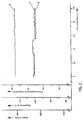
- the diagram contains the time profile of the currently measured temperature with the associated pressure and the actual value of the pressure-compensated temperature determined from it (i).
- the diagram shows the very quiet course of the pressure-compensated temperature compared to pressure and temperature. This makes it clear that the column can be operated in a very stable and calm state close to the specification limit and thus with minimal energy consumption.
Landscapes
- Chemical & Material Sciences (AREA)
- Chemical Kinetics & Catalysis (AREA)
- Vaporization, Distillation, Condensation, Sublimation, And Cold Traps (AREA)
- Organic Low-Molecular-Weight Compounds And Preparation Thereof (AREA)
- Crystals, And After-Treatments Of Crystals (AREA)
- Feedback Control In General (AREA)
- Control Of Non-Electrical Variables (AREA)
Abstract
Description
- Bei der Regelung von nicht direkt on-line meßbaren Konzentrationen in thermischen Trennvorgängen werden in vielen Fallen Temperaturen als Ersatzregelgröße verwendet. Um eine genügend gute Korrelation mit der Regelgröße "Konzentration" zu erhalten, ist in der Vergangenheit häufig das Konzept der druckkompensierten Temperatur verwendet worden, in welchem die durch Druckschwankungen bedingten Temperaturänderungen Berücksichtigung finden und die verbleibenden Temperaturänderungen ein besseres Maß für die zu regelnde Konzentration darstellen (siehe zum Beispiel F. F. Rhiel, R. Perne, S. Pauen und F. Steffens, "Model-Based Control Systems For Destillation Columns", Maastrich, DYCORD+'89, Seiten 31 bis 35).
- Dieses Konzept hat insbesondere nützliche Anwendungen im Bereich der Regelung von Sumpfkonzentrationen in Destillationskolonnen gefunden. Durch einen begrenzten Arbeitsbereich sowie die Beschränkung auf Drücke oberhalb des Normaldrucks ist dieses Regelungsverfahren aber leider nur begrenzt einsetzbar.
- Generell betrifft das Problem der konstanten, geregelten Reaktionsführung bei der Herstellung von Polymeren alle Polymerisations-, Polykondensations- und Polyadditionsverfahren, in denen verfahrensbedingte Druck- bzw. Temperaturschwankungen und Druck- bzw. Temperaturstörungen die Konstanz der Qualität des Polymeren beeinflussen. Konventionelle Regelkonzepte haben generell den Nachteil, daß sie den Prozeßtrend zu spät erkennen und damit nicht mehr den rechtzeitigen Eingriff in den Herstellprozeß durch Stellgrößen ermöglichen.
- Das in DE 36 27 287 beschriebene Verfahren, in welchem speziell für die kontinuierliche Herstellung von Polyvinylchlorid die Reaktorinnentemperatur durch die Kühlwassermenge und die Zulaufmenge an Aktivatorlösung durch die Kühlwasserrücklauftemperatur geregelt wird, wodurch die Polymerisationstemperatur auf einem festgelegten Wert konstant gehalten wird und der Polymerisationsdruck stets unterhalb des Sättigungsdrucks des Vinylchlorids liegt und durch Feinregulierung der Zulaufmenge an flüssigem Vinylchlorid variiert wird, versucht, einige dieser Nachteile zu beheben.
- Um die Nachteile der bisher bei thermischen Trennverfahren bekannten Regelungskonzepte zu beheben, bestand die technische Aufgabe der vorliegenden Erfindung darin, ein neues Regelungsprinzip für einen großen Arbeitsbereich - und zusätzlich auch anwendbar im Vakuum- und Niederdruckbereich - zu finden, welches eine hohe Flexibilität hat und auch für andere verfahrenstechnische Operationen einsetzbar ist.
- Gegenstand der vorliegenden Erfindung ist ein Verfahren zur Regelung der Konzentrationen eines Mehrstoffgemisches am Ausgang eines thermischen Trennapparates, bei dem eine Funktion T* = f(T,P) als Ersatzregelgröße für wenigstens eine Konzentration benutzt wird, wobei T und P die im Trennapparat gemessenen Temperatur- und Druckwerte sind und erfindungsgemäß die Funktion f(T,P) nach folgender Beziehung gebildet wird:

wobei die Konstanten
A1, A2 empirisch vor dem Beginn der Regelung bestimmt werden. - Die Funktion T* = f(T,P) wird im folgenden als druckkompensierte Temperatur bezeichnet.
- Vorteile der vorliegenden Erfindung sind unter anderem:
- a) Der Arbeitsbereich der neuen Regelung ist hinsichtlich Druck (P)- und Temperatur (T)-Bereich nicht beschränkt.
- b) Es ist ein unkritischer Regelprozeß; auch große Störungen können leicht abgefangen werden.
- c) Es können einfache Regler verwendet werden.
- d) Das Verfahren ermöglicht das genaue Einhalten von Produktspezifikationen bei geringem Energieeinsatz und ist daher wirtschaftlich günstig.
- Als geeignete verfahrenstechnische Operationen kommen Operationen aus dem Bereich der thermischen Trenntechnik in Frage, also Destillation und Rektifikation. Destillationskolonnen sind zum Beispiel Glockenbodenkolonnen, Packungskolonnen, Siebbodenkolonnen.
- Die Stoffsysteme enthalten zwei oder mehr Stoffkomponenten, insbesondere drei bis sieben Stoffkomponenten in solchen Konzentrationsverhältnissen, daß eine Komponente im Vergleich zu den anderen ein Leichtsieder ist. Geeignete Stoffkomponenten liegen flüssig oder gasförmig vor, sind organisch oder anorganisch und können sowohl Polymere wie Oligomere, wie niedermolekulare Substanzen sein.
- Beispiele sind Benzol, Monoethylenglykol, Diethylenglykol, aprotische apolare Lösungsmittel, Polykondensate, Polyurethane und deren Vorkomponenten, Polymerisate und andere Polyadditionsprodukte, Dialkylcarbonate, Methylnitrit.
- Die Temperatur T wird gemessen an einer nach den bisher bekannten Verfahren ausgewählten Stelle des zu regelnden Systemteils, zum Beispiel im Abtriebsteil oder im Verstärkerteil der Destillationskolonne.
- Der Druck P wird in der geometrischen Nähe dieser Temperaturmeßstelle für den Systemteil erfaßt, zum Beispiel auf dem gleichen Destillationsboden oder bis zu drei Böden entfernt. P steht damit in physikalischem Zusammenhang mit der gemessenen Temperatur T.
- Zur Bestimmung der Größen A1, A2 sowie des Sollwertes T*(Soll) geht man in der Regel so vor, daß man für den zu regelnden Systemteil in dem interessierenden Arbeitsbereich zu verschiedenen Zeitpunkten Temperaturen T1, T2 ..... und die entsprechenden Drücke P1, P2 ..... experimentell bestimmt. Je größer der betrachtete Arbeitsbereich ist, um so mehr - über den gesamten Arbeitsbereich ausgewählte - Meßpunkte Ti und Pi werden bestimmt. Im allgemeinen nimmt man zwischen drei und zehn Meßwerte Ti und Pi.
- Unter Verwendung der erfindungsgemäßen Funktion f(T,P) werden mit diesen Meßwerten die Konstanten A1 und A2 sowie T*(Soll) durch Regression bestimmt.
- Geeignete Regler sind P-Regler, PI-Regler, PID-Regler, schaltende Regler, Zweipunkt-Regler mit und ohne Hysterese, Dreipunkt-Regler mit und ohne Hysterese, Kaskadenregelungen, adaptive Regler, Zustandsregler, frequenzabhängige Regler, nichtlineare Regler, prädiktive Regler, modellgestützte Regelungen, Mehrgrößenregler, Entkopplungsregler.
- Zur Messung der Temperatur T kommen als Meßfühler in Frage: Thermometer, Thermoelemente, Widerstandsthermometer, PT100, Infrarotmessung.
- Das nachfolgende, an Hand von Zeichnungen erläuterte Beispiel belegt für eine Destillationsaufgabe die Nützlichkeit des erfindungsgemäßen Verfahrens.
- Es zeigen:
- Fig. 1
- eine Destillationskolonne mit dem erfindungsgemäßen Regelkreis und
- Fig. 2
- die Meßgrößen T und P und die als Regelgröße benutzte, druckkompensierte Temperatur T* = f(T,P) als Funktion der Zeit bei dem nachfolgend beschriebenen Prozeßbeispiel.
- In einer Destillationskolonne 1 (Fig. 1) ist ein ternäres Gemisch, bestehend aus Wasser, Dimethylformamid (DMF) und Ameisensäure (AS), zu trennen. Die Konzentrationen des der Kolonne bei 2 zulaufenden Stoffsystems sind:
Wasser 13 - 17 Gew.-% DMF 83 - 87 Gew.-% AS 100 - 5000 Gew.-ppm. - Die Schwankungen der Zulaufmenge liegen im Bereich von 30 bis 100 %.
- Die Kolonne soll so gefahren werden, daß das am Kopf 3 der Kolonne anfallende Wasser einen DMF-Anteil von ca. 50 Gew.-ppm enthalt. Das vom Sumpf 4 abgezogene Produkt DMF und AS soll einen Wassergehalt von nicht mehr als 500 ppm besitzen.
- Unter den genannten Bedingungen ist die Kolonne so zu betreiben, daß die vorgegebenen Produktspezifikationen mit minimalem Energieeinsatz eingehalten werden.
- Zur Regelung der Wasserkonzentation im Sumpfprodukt soll die aus den aktuell gemessenen Druck- und Temperaturwerten an der Meßstelle 5 bestimmte, druckkompensierte Temperatur T* als Ersatzregelgröße verwendet werden.
- Um die Größen A1 und A2 zu ermitteln, wurde die Kolonne zunächst bei unterschiedlichen Lastfällen so betrieben, daß an der Meßstelle 5 konstante Wasserkonzentrationen im jeweils stationären Zustand vorlagen. Folgende Druck- und Temperaturwerte wurden dabei gemessen:
Druck (mbar) 150 180 210 250 280 300 Temperatur (°C) 89,7 94,4 98,6 103,4 106,6 108,6 - Aus diesen Wertepaaren wurden durch Regression ermittelt:
A1 = 1377, A2 = 7,010678. - Für die geforderte, konstant zu haltende Wasserkonzentration ergab sich folgender Sollwert für die druckkompensierte Temperatur:

- Der Ist-Wert der druckkompensierten Temperatur T*(ist) wird jeweils aus den aktuellen Druck- und Temperaturmeßwerten nach der folgenden Gleichung bestimmt:

- In dieser Gleichung sind T die aktuell gemessene Temperatur in °C und P der dazugehörende aktuell gemessene Druck in mbar. Der vom Rechner 9 gemäß (i) berechnete Istwert T*(ist) und der Sollwert T*(soll) werden dem PID-Regler 6 zugeführt, der über die Dampfmenge (Stellventil 7) und mittels des Wärmeaustauschers 8 über die Heizleistung am Sumpf der Kolonne auf die Kolonne eingreift.
- Mit dieser Regeleinrichtung konnte die Wasserkonzentration im Sumpfprodukt in sehr engen Grenzen gehalten und die Kolonne damit näher an der Spezifikationsgrenze gefahren werden. Das Diagramm (Fig. 2) enthält den zeitlichen Verlauf der aktuell gemessenen Temperatur mit dem dazugehörenden Druck sowie dem daraus nach (i) bestimmten Istwert der druckkompensierten Temperatur. Das Diagramm läßt den im Vergleich zu Druck und Temperatur sehr ruhigen Verlauf der druckkompensierten Temperatur erkennen. Dies macht deutlich, daß die Kolonne in einem sehr stabilen und ruhigen Zustand nahe an der Spezifikationsgrenze und damit mit minimalem Energieeinsatz gefahren werden kann.
- Anstelle der erfindungsgemäß verwendeten Funktion f(T,P) wird eine lineare, druckkompensierte Temperatur nach der Beziehung

verwendet. Dies ergab Abweichungen der Wasserkonzentration von über 200 ppm. Aufgrund dieser Abweichung und der unruhigen Kolonnenfahrweise lag der Arbeitspunkt in einem größeren Abstand von der Spezifikationsgrenze. Der Energieverbrauch war mindestens 10 % höher als im erfindungsgemäßen Beispiel.
Claims (8)
- Verfahren zur Regelung der Konzentrationen eines Mehrstoffgemisches am Ausgang eines thermischen Trennapparates, bei dem eine Funktion T* = f(T,P) als Ersatsregelgröße für wenigstens eine Konzentration benutzt wird, wobei T die gemessene Temperatur und P der gemessene Druck sind, dadurch gekennzeichnet, daß die Funktion f(T,P) nach folgender Beziehung gebildet wird:

wobei
A1, A2 empirisch vor dem Beginn der Regelung bestimmt werden. - Verfahren nach Anspruch 1, dadurch gekennzeichnet, daß die Regelung bei einem Destillationsverfahren eingesetzt wird.
- Verfahren nach Anspruch 1, dadurch gekennzeichnet, daß die Regelung bei einem Rektifikationsverfahren eingesetzt wird.
- Verfahren nach Ansprüchen 1 bis 3, dadurch gekennzeichnet, daß das Mehrstoffgemisch mindestens zwei Komponenten enthält.
- Verfahren nach Ansprüchen 1 bis 4, dadurch gekennzeichnet, daß das Mehrstoffgemisch als Komponenten überwiegend Dimethylformamid, Wasser und Ameisensäure enthält.
- Verfahren nach Ansprüchen 1 bis 5, dadurch gekennzeichnet, daS die Größe A1 in der Funktion f(T,P) einen Wert zwischen 1000 und 2000 hat.
- Verfahren nach Ansprüchen 1 bis 6, dadurch gekennzeichnet, daß die Größe A2 in der Funktion f(T,P) einen Wert von 2 bis 10 hat.
- Verfahren nach Anspruch 2, dadurch gekennzeichnet, daß als Destillationskolonne eine Siebbodenkolonne verwendet wird.
Applications Claiming Priority (2)
| Application Number | Priority Date | Filing Date | Title |
|---|---|---|---|
| DE4203999 | 1992-02-12 | ||
| DE4203999A DE4203999A1 (de) | 1992-02-12 | 1992-02-12 | Regelung von konzentrationen bei thermischen trennverfahren |
Publications (3)
| Publication Number | Publication Date |
|---|---|
| EP0555714A2 true EP0555714A2 (de) | 1993-08-18 |
| EP0555714A3 EP0555714A3 (en) | 1995-01-11 |
| EP0555714B1 EP0555714B1 (de) | 1998-06-17 |
Family
ID=6451434
Family Applications (1)
| Application Number | Title | Priority Date | Filing Date |
|---|---|---|---|
| EP93101494A Expired - Lifetime EP0555714B1 (de) | 1992-02-12 | 1993-02-01 | Regelung von Konzentrationen bei thermischen Trennverfahren |
Country Status (5)
| Country | Link |
|---|---|
| US (1) | US5368699A (de) |
| EP (1) | EP0555714B1 (de) |
| JP (1) | JPH0612131A (de) |
| DE (2) | DE4203999A1 (de) |
| ES (1) | ES2118146T3 (de) |
Cited By (1)
| Publication number | Priority date | Publication date | Assignee | Title |
|---|---|---|---|---|
| EP3643376A1 (de) * | 2018-10-24 | 2020-04-29 | Covestro Deutschland AG | Thermisches trennverfahren mit soft-sensor |
Families Citing this family (9)
| Publication number | Priority date | Publication date | Assignee | Title |
|---|---|---|---|---|
| DE19926758A1 (de) * | 1999-06-11 | 2000-12-14 | Basf Ag | Verfahren zur Verhinderung unerwünschter Polymerisation in einem ethylenisch ungesättigte Verbindungen enthaltenden Stoffgemisch |
| DE10312918A1 (de) * | 2003-03-22 | 2004-09-30 | Oxeno Olefinchemie Gmbh | Verfahren zur Abtrennung von 2-Butanol aus tert.-Butanol/Wasser-Gemischen |
| DE10312917A1 (de) * | 2003-03-22 | 2004-09-30 | Oxeno Olefinchemie Gmbh | Verfahren zur Ausschleusung von 2-Butanol aus tert.-Butanol/Wasser-Gemischen |
| US20130255484A1 (en) * | 2012-03-29 | 2013-10-03 | Alstom Technology Ltd | System and method for control of a stripper tower |
| US20140262741A1 (en) * | 2013-03-14 | 2014-09-18 | Elwha Llc | Heat transfer in distillation columns |
| DE102014219182A1 (de) | 2014-09-23 | 2016-03-24 | Wacker Chemie Ag | Regelung einer Destillationskolonne |
| KR102416360B1 (ko) * | 2016-08-04 | 2022-07-04 | 코베스트로 도이칠란트 아게 | 정류 컬럼 제어 방법 |
| GB202015833D0 (en) | 2020-10-06 | 2020-11-18 | Bp Chem Int Ltd | Separation process and apparatus |
| US11702381B1 (en) | 2022-02-23 | 2023-07-18 | Covestro Deutschland Ag | Method for operating a rectification column |
Family Cites Families (18)
| Publication number | Priority date | Publication date | Assignee | Title |
|---|---|---|---|---|
| SU47912A1 (ru) * | 1935-10-23 | 1936-07-31 | С.И. Бушлин | Машина дл калибровки кишек |
| US2994643A (en) * | 1956-02-08 | 1961-08-01 | Exxon Research Engineering Co | Method for detecting the change in the isothermal heat transfer capacity of a material in a fractionation system |
| US3268420A (en) * | 1961-12-27 | 1966-08-23 | Exxon Research Engineering Co | Process for controlling the loading and heat input of fractionating columns |
| US3238111A (en) * | 1962-06-08 | 1966-03-01 | Phillips Petroleum Co | Minimization of time lag in the automatic control of a fractional distillation system |
| US3417014A (en) * | 1966-10-04 | 1968-12-17 | Phillips Petroleum Co | Method and apparatus for emulsion control |
| US3464895A (en) * | 1968-04-08 | 1969-09-02 | Universal Oil Prod Co | Method of optimizing heat input to a fractionation column |
| US3619377A (en) * | 1969-08-04 | 1971-11-09 | Phillips Petroleum Co | Control of composition of overhead vaporous product in a partially condensing fractionation column |
| SU365375A1 (ru) * | 1971-03-17 | 1973-01-08 | Способ автоматического управления | |
| SU507637A1 (ru) * | 1973-03-02 | 1976-03-25 | Всесоюзный Проектно-Конструкторский И Научно-Исследовательский Институт Автоматизации Пищевой Промышленности "Пищепромавтоматика" | Способ автоматического управлени ректификационной колонной |
| SU460062A1 (ru) * | 1973-03-09 | 1975-02-15 | Способ автоматического управлени процессом ректификации | |
| SU535091A1 (ru) * | 1974-12-25 | 1976-11-15 | Специальное Конструкторское Бюро По Автоматике В Нефтепереработке И Нефтехимии | Устройство дл автоматического регулировани ректификационной колонны с несколькими вводами сырь |
| SU725683A1 (ru) * | 1977-12-05 | 1980-04-05 | Предприятие П/Я В-8296 | Устройство дл автоматического регулировани процессом ректификации |
| US4578151A (en) * | 1982-07-23 | 1986-03-25 | Phillips Petroleum Company | Reid Vapor Pressure determination and control in fractional distillation |
| JPS6038001A (ja) * | 1983-08-09 | 1985-02-27 | Nippon Zeon Co Ltd | 蒸溜塔の制御方法 |
| US4722769A (en) * | 1986-04-24 | 1988-02-02 | Allied Corporation | Process for recovery of acetone |
| US4676870A (en) * | 1986-06-02 | 1987-06-30 | Phillips Petroleum Company | Automatic control of a multiple-effect evaporator |
| DE3627287A1 (de) * | 1986-08-12 | 1988-02-18 | Huels Chemische Werke Ag | Verfahren zur verbesserten einhaltung des k-wertes und zur besseren erhaltung der leistung bei der kontinuierlichen polymerisation von vinylchlorid in emulsion |
| US5047125A (en) * | 1988-02-16 | 1991-09-10 | Conoco Inc. | Fractionating column control apparatus and methods |
-
1992
- 1992-02-12 DE DE4203999A patent/DE4203999A1/de not_active Withdrawn
-
1993
- 1993-02-01 EP EP93101494A patent/EP0555714B1/de not_active Expired - Lifetime
- 1993-02-01 ES ES93101494T patent/ES2118146T3/es not_active Expired - Lifetime
- 1993-02-01 DE DE59308677T patent/DE59308677D1/de not_active Expired - Fee Related
- 1993-02-03 US US08/012,685 patent/US5368699A/en not_active Expired - Fee Related
- 1993-02-05 JP JP5040645A patent/JPH0612131A/ja active Pending
Cited By (2)
| Publication number | Priority date | Publication date | Assignee | Title |
|---|---|---|---|---|
| EP3643376A1 (de) * | 2018-10-24 | 2020-04-29 | Covestro Deutschland AG | Thermisches trennverfahren mit soft-sensor |
| WO2020083830A1 (de) * | 2018-10-24 | 2020-04-30 | Covestro Deutschland Ag | Thermisches trennverfahren mit soft-sensor |
Also Published As
| Publication number | Publication date |
|---|---|
| EP0555714B1 (de) | 1998-06-17 |
| JPH0612131A (ja) | 1994-01-21 |
| US5368699A (en) | 1994-11-29 |
| DE59308677D1 (de) | 1998-07-23 |
| EP0555714A3 (en) | 1995-01-11 |
| DE4203999A1 (de) | 1993-08-19 |
| ES2118146T3 (es) | 1998-09-16 |
Similar Documents
| Publication | Publication Date | Title |
|---|---|---|
| DE60010522T2 (de) | Verfahren zur kontrollierten herstellung von polyethylen und seinen copolymeren | |
| DE3526050C2 (de) | Verfahren zum Betreiben eines Extruders | |
| DE69511291T2 (de) | Mehrgrössenprozesssteuermethode und gerät | |
| EP0555714B1 (de) | Regelung von Konzentrationen bei thermischen Trennverfahren | |
| DE1549397B2 (de) | Verfahren zur automatischen steuerung chemischer anlagen | |
| DE2751225B2 (de) | Vorrichtung mit einer nach dem Siebpaket eines Schneckenextruders angeordneten Schmelzindex-Meßeinrichtung und Verfahren zum Regeln der Viskosität von aufgeschmolzenem und auszuformendem Kunststoff | |
| DE69421089T2 (de) | Verfahren zur herstellung von polyolefinen in einem autoclavreaktor | |
| CH674820A5 (de) | ||
| DE2317292A1 (de) | Verfahren zur grenzwertregelung des betriebs einer anlage | |
| DE2823762A1 (de) | Verfahren zur kontinuierlichen herstellung von thermoplastischen polyurethanen | |
| DE1157772B (de) | Verfahren zur Herstellung von thermoplastisch verformbaren Kunststoffen | |
| DE69509311T2 (de) | Vorhersagemethoden und unscharfe Logik verwendende Methode und Vorrichtung zur Regelung eines Parameters innerhalb eines zulässigen Bereichs | |
| DE2048166C3 (de) | Regelsystem für eine rohrf örmige Äthylenpolymerisationsanlage | |
| WO2003020849A1 (de) | Verfahren zur kontrolle einer extraktivdestillationsanlage, prozessleitsystem und extraktivdestillationsanlage | |
| EP0514717B1 (de) | Verfahren zum Trennen von Mehrstoffsystemen mit zwischensiedenden Substanzen in Trenn-kolonnen mit Seitenabzug | |
| EP3803523A1 (de) | Verfahren und system zur steuerung und/oder regelung einer zur herstellung von thermoplastischem kunststoff eingerichteten produktionsanlage | |
| WO2003024556A1 (de) | Verfahren zur prozessführung der trennung von mehrstoffgemischen | |
| DE2063248A1 (de) | Vinylidenfluorid Homopolymerisate, Verfahren zu ihrer Herstellung und ihre Verwendung in Formmassen und Beschichtungs massen | |
| DE102020130325A1 (de) | Verfahren zum Betreiben einer Ultraschallschweißmaschine | |
| DE3789111T2 (de) | Reaktor-Steuersystem zur Herstellung von schlagfestem Propylencopolymer. | |
| EP4323101B1 (de) | Verfahren zur regelung der temperatur in einem verfahrenstechnischen apparat | |
| DE3430247A1 (de) | Verfahren zur herstellung thermoplastischer copolymerisate | |
| DE3534734C2 (de) | Verfahren zum Steuern einer Mehrextruderanlage | |
| DE1101764B (de) | Verfahren zur Herstellung isoolefinhaltiger Polymerisate | |
| EP3571168B1 (de) | Verfahren zur kontinuierlichen salzsäureneutralisation |
Legal Events
| Date | Code | Title | Description |
|---|---|---|---|
| PUAI | Public reference made under article 153(3) epc to a published international application that has entered the european phase |
Free format text: ORIGINAL CODE: 0009012 |
|
| AK | Designated contracting states |
Kind code of ref document: A2 Designated state(s): BE DE ES FR GB IT NL |
|
| PUAL | Search report despatched |
Free format text: ORIGINAL CODE: 0009013 |
|
| AK | Designated contracting states |
Kind code of ref document: A3 Designated state(s): BE DE ES FR GB IT NL |
|
| 17P | Request for examination filed |
Effective date: 19950704 |
|
| 17Q | First examination report despatched |
Effective date: 19960528 |
|
| GRAG | Despatch of communication of intention to grant |
Free format text: ORIGINAL CODE: EPIDOS AGRA |
|
| GRAG | Despatch of communication of intention to grant |
Free format text: ORIGINAL CODE: EPIDOS AGRA |
|
| GRAH | Despatch of communication of intention to grant a patent |
Free format text: ORIGINAL CODE: EPIDOS IGRA |
|
| GRAH | Despatch of communication of intention to grant a patent |
Free format text: ORIGINAL CODE: EPIDOS IGRA |
|
| GRAA | (expected) grant |
Free format text: ORIGINAL CODE: 0009210 |
|
| AK | Designated contracting states |
Kind code of ref document: B1 Designated state(s): BE DE ES FR GB IT NL |
|
| REF | Corresponds to: |
Ref document number: 59308677 Country of ref document: DE Date of ref document: 19980723 |
|
| ITF | It: translation for a ep patent filed | ||
| GBT | Gb: translation of ep patent filed (gb section 77(6)(a)/1977) |
Effective date: 19980724 |
|
| REG | Reference to a national code |
Ref country code: ES Ref legal event code: FG2A Ref document number: 2118146 Country of ref document: ES Kind code of ref document: T3 |
|
| ET | Fr: translation filed | ||
| PLBE | No opposition filed within time limit |
Free format text: ORIGINAL CODE: 0009261 |
|
| STAA | Information on the status of an ep patent application or granted ep patent |
Free format text: STATUS: NO OPPOSITION FILED WITHIN TIME LIMIT |
|
| 26N | No opposition filed | ||
| REG | Reference to a national code |
Ref country code: GB Ref legal event code: IF02 |
|
| PGFP | Annual fee paid to national office [announced via postgrant information from national office to epo] |
Ref country code: DE Payment date: 20020121 Year of fee payment: 10 |
|
| PGFP | Annual fee paid to national office [announced via postgrant information from national office to epo] |
Ref country code: GB Payment date: 20020130 Year of fee payment: 10 |
|
| PGFP | Annual fee paid to national office [announced via postgrant information from national office to epo] |
Ref country code: ES Payment date: 20020207 Year of fee payment: 10 |
|
| PGFP | Annual fee paid to national office [announced via postgrant information from national office to epo] |
Ref country code: FR Payment date: 20020211 Year of fee payment: 10 |
|
| PGFP | Annual fee paid to national office [announced via postgrant information from national office to epo] |
Ref country code: NL Payment date: 20020228 Year of fee payment: 10 Ref country code: BE Payment date: 20020228 Year of fee payment: 10 |
|
| PG25 | Lapsed in a contracting state [announced via postgrant information from national office to epo] |
Ref country code: GB Free format text: LAPSE BECAUSE OF NON-PAYMENT OF DUE FEES Effective date: 20030201 |
|
| PG25 | Lapsed in a contracting state [announced via postgrant information from national office to epo] |
Ref country code: ES Free format text: LAPSE BECAUSE OF NON-PAYMENT OF DUE FEES Effective date: 20030203 |
|
| PG25 | Lapsed in a contracting state [announced via postgrant information from national office to epo] |
Ref country code: BE Free format text: LAPSE BECAUSE OF NON-PAYMENT OF DUE FEES Effective date: 20030228 |
|
| PG25 | Lapsed in a contracting state [announced via postgrant information from national office to epo] |
Ref country code: NL Free format text: LAPSE BECAUSE OF NON-PAYMENT OF DUE FEES Effective date: 20030901 |
|
| PG25 | Lapsed in a contracting state [announced via postgrant information from national office to epo] |
Ref country code: DE Free format text: LAPSE BECAUSE OF NON-PAYMENT OF DUE FEES Effective date: 20030902 |
|
| GBPC | Gb: european patent ceased through non-payment of renewal fee | ||
| PG25 | Lapsed in a contracting state [announced via postgrant information from national office to epo] |
Ref country code: FR Free format text: LAPSE BECAUSE OF NON-PAYMENT OF DUE FEES Effective date: 20031031 |
|
| NLV4 | Nl: lapsed or anulled due to non-payment of the annual fee |
Effective date: 20030901 |
|
| REG | Reference to a national code |
Ref country code: FR Ref legal event code: ST |
|
| REG | Reference to a national code |
Ref country code: ES Ref legal event code: FD2A Effective date: 20030203 |
|
| PG25 | Lapsed in a contracting state [announced via postgrant information from national office to epo] |
Ref country code: IT Free format text: LAPSE BECAUSE OF NON-PAYMENT OF DUE FEES;WARNING: LAPSES OF ITALIAN PATENTS WITH EFFECTIVE DATE BEFORE 2007 MAY HAVE OCCURRED AT ANY TIME BEFORE 2007. THE CORRECT EFFECTIVE DATE MAY BE DIFFERENT FROM THE ONE RECORDED. Effective date: 20050201 |