EP0556684A1 - Verfahren zur Herstellung von 2-Chlor-5-alkylaminomethyl-pyridinen - Google Patents
Verfahren zur Herstellung von 2-Chlor-5-alkylaminomethyl-pyridinen Download PDFInfo
- Publication number
- EP0556684A1 EP0556684A1 EP93101949A EP93101949A EP0556684A1 EP 0556684 A1 EP0556684 A1 EP 0556684A1 EP 93101949 A EP93101949 A EP 93101949A EP 93101949 A EP93101949 A EP 93101949A EP 0556684 A1 EP0556684 A1 EP 0556684A1
- Authority
- EP
- European Patent Office
- Prior art keywords
- chloro
- formula
- process according
- appropriate
- alkyl
- Prior art date
- Legal status (The legal status is an assumption and is not a legal conclusion. Google has not performed a legal analysis and makes no representation as to the accuracy of the status listed.)
- Granted
Links
- 238000000034 method Methods 0.000 title claims abstract description 31
- 238000002360 preparation method Methods 0.000 title claims abstract description 9
- BDAGIHXWWSANSR-UHFFFAOYSA-N methanoic acid Natural products OC=O BDAGIHXWWSANSR-UHFFFAOYSA-N 0.000 claims abstract description 18
- XPARFBOWIYMLMY-UHFFFAOYSA-N (6-chloropyridin-3-yl)methanamine Chemical compound NCC1=CC=C(Cl)N=C1 XPARFBOWIYMLMY-UHFFFAOYSA-N 0.000 claims abstract description 13
- 125000000217 alkyl group Chemical group 0.000 claims abstract description 11
- 150000001875 compounds Chemical class 0.000 claims abstract description 11
- 239000003085 diluting agent Substances 0.000 claims abstract description 10
- 150000008044 alkali metal hydroxides Chemical class 0.000 claims abstract description 9
- OSWFIVFLDKOXQC-UHFFFAOYSA-N 4-(3-methoxyphenyl)aniline Chemical compound COC1=CC=CC(C=2C=CC(N)=CC=2)=C1 OSWFIVFLDKOXQC-UHFFFAOYSA-N 0.000 claims abstract description 8
- 239000002253 acid Substances 0.000 claims abstract description 8
- 235000019253 formic acid Nutrition 0.000 claims abstract description 8
- 239000002168 alkylating agent Substances 0.000 claims abstract description 7
- 229940100198 alkylating agent Drugs 0.000 claims abstract description 7
- DPFJSSDKNZREPF-UHFFFAOYSA-N n-[(6-chloropyridin-3-yl)methyl]formamide Chemical compound ClC1=CC=C(CNC=O)C=N1 DPFJSSDKNZREPF-UHFFFAOYSA-N 0.000 claims abstract description 7
- 150000003222 pyridines Chemical class 0.000 claims abstract description 6
- 238000010992 reflux Methods 0.000 claims abstract description 6
- 238000011065 in-situ storage Methods 0.000 claims abstract description 4
- 125000000484 butyl group Chemical group [H]C([*])([H])C([H])([H])C([H])([H])C([H])([H])[H] 0.000 claims description 6
- 125000001495 ethyl group Chemical group [H]C([H])([H])C([H])([H])* 0.000 claims description 6
- 125000000959 isobutyl group Chemical group [H]C([H])([H])C([H])(C([H])([H])[H])C([H])([H])* 0.000 claims description 6
- 125000001449 isopropyl group Chemical group [H]C([H])([H])C([H])(*)C([H])([H])[H] 0.000 claims description 6
- 125000002496 methyl group Chemical group [H]C([H])([H])* 0.000 claims description 6
- 125000001436 propyl group Chemical group [H]C([*])([H])C([H])([H])C([H])([H])[H] 0.000 claims description 6
- 125000002914 sec-butyl group Chemical group [H]C([H])([H])C([H])([H])C([H])(*)C([H])([H])[H] 0.000 claims description 6
- 239000003054 catalyst Substances 0.000 claims description 5
- 125000004432 carbon atom Chemical group C* 0.000 claims description 4
- 239000007864 aqueous solution Substances 0.000 claims description 3
- 230000015572 biosynthetic process Effects 0.000 claims description 3
- 229910052736 halogen Inorganic materials 0.000 claims description 3
- 238000009413 insulation Methods 0.000 claims description 2
- 239000003444 phase transfer catalyst Substances 0.000 claims description 2
- 125000005843 halogen group Chemical group 0.000 claims 1
- 239000000543 intermediate Substances 0.000 abstract description 6
- 238000002955 isolation Methods 0.000 abstract description 2
- 239000013543 active substance Substances 0.000 abstract 1
- 238000004821 distillation Methods 0.000 abstract 1
- YXFVVABEGXRONW-UHFFFAOYSA-N Toluene Chemical compound CC1=CC=CC=C1 YXFVVABEGXRONW-UHFFFAOYSA-N 0.000 description 21
- 238000006243 chemical reaction Methods 0.000 description 16
- HEMHJVSKTPXQMS-UHFFFAOYSA-M sodium hydroxide Inorganic materials [OH-].[Na+] HEMHJVSKTPXQMS-UHFFFAOYSA-M 0.000 description 14
- 239000000243 solution Substances 0.000 description 9
- KWYUFKZDYYNOTN-UHFFFAOYSA-M potassium hydroxide Inorganic materials [OH-].[K+] KWYUFKZDYYNOTN-UHFFFAOYSA-M 0.000 description 8
- XLYOFNOQVPJJNP-UHFFFAOYSA-N water Substances O XLYOFNOQVPJJNP-UHFFFAOYSA-N 0.000 description 7
- 239000000203 mixture Substances 0.000 description 6
- 239000000370 acceptor Substances 0.000 description 5
- DGAQECJNVWCQMB-PUAWFVPOSA-M Ilexoside XXIX Chemical compound C[C@@H]1CC[C@@]2(CC[C@@]3(C(=CC[C@H]4[C@]3(CC[C@@H]5[C@@]4(CC[C@@H](C5(C)C)OS(=O)(=O)[O-])C)C)[C@@H]2[C@]1(C)O)C)C(=O)O[C@H]6[C@@H]([C@H]([C@@H]([C@H](O6)CO)O)O)O.[Na+] DGAQECJNVWCQMB-PUAWFVPOSA-M 0.000 description 4
- -1 alkaline earth metal carbonates Chemical class 0.000 description 4
- 238000009835 boiling Methods 0.000 description 4
- PNDPGZBMCMUPRI-UHFFFAOYSA-N iodine Chemical compound II PNDPGZBMCMUPRI-UHFFFAOYSA-N 0.000 description 4
- KNCHDRLWPAKSII-UHFFFAOYSA-N 4-ethyl-2-methylpyridine Chemical group CCC1=CC=NC(C)=C1 KNCHDRLWPAKSII-UHFFFAOYSA-N 0.000 description 3
- UHOVQNZJYSORNB-UHFFFAOYSA-N Benzene Chemical compound C1=CC=CC=C1 UHOVQNZJYSORNB-UHFFFAOYSA-N 0.000 description 3
- WKBOTKDWSSQWDR-UHFFFAOYSA-N Bromine atom Chemical compound [Br] WKBOTKDWSSQWDR-UHFFFAOYSA-N 0.000 description 3
- ZMANZCXQSJIPKH-UHFFFAOYSA-N Triethylamine Chemical compound CCN(CC)CC ZMANZCXQSJIPKH-UHFFFAOYSA-N 0.000 description 3
- 229910052783 alkali metal Inorganic materials 0.000 description 3
- 150000001340 alkali metals Chemical class 0.000 description 3
- HTZCNXWZYVXIMZ-UHFFFAOYSA-M benzyl(triethyl)azanium;chloride Chemical compound [Cl-].CC[N+](CC)(CC)CC1=CC=CC=C1 HTZCNXWZYVXIMZ-UHFFFAOYSA-M 0.000 description 3
- 238000001816 cooling Methods 0.000 description 3
- VLKZOEOYAKHREP-UHFFFAOYSA-N n-Hexane Chemical compound CCCCCC VLKZOEOYAKHREP-UHFFFAOYSA-N 0.000 description 3
- JUJWROOIHBZHMG-UHFFFAOYSA-N pyridine Substances C1=CC=NC=C1 JUJWROOIHBZHMG-UHFFFAOYSA-N 0.000 description 3
- 239000007858 starting material Substances 0.000 description 3
- RFFLAFLAYFXFSW-UHFFFAOYSA-N 1,2-dichlorobenzene Chemical compound ClC1=CC=CC=C1Cl RFFLAFLAYFXFSW-UHFFFAOYSA-N 0.000 description 2
- XALCOJXGWJXWBL-UHFFFAOYSA-N 1-(6-chloropyridin-3-yl)-n-methylmethanamine Chemical compound CNCC1=CC=C(Cl)N=C1 XALCOJXGWJXWBL-UHFFFAOYSA-N 0.000 description 2
- VTYYLEPIZMXCLO-UHFFFAOYSA-L Calcium carbonate Chemical compound [Ca+2].[O-]C([O-])=O VTYYLEPIZMXCLO-UHFFFAOYSA-L 0.000 description 2
- HEDRZPFGACZZDS-UHFFFAOYSA-N Chloroform Chemical compound ClC(Cl)Cl HEDRZPFGACZZDS-UHFFFAOYSA-N 0.000 description 2
- BZLVMXJERCGZMT-UHFFFAOYSA-N Methyl tert-butyl ether Chemical compound COC(C)(C)C BZLVMXJERCGZMT-UHFFFAOYSA-N 0.000 description 2
- BAVYZALUXZFZLV-UHFFFAOYSA-N Methylamine Chemical compound NC BAVYZALUXZFZLV-UHFFFAOYSA-N 0.000 description 2
- JLTDJTHDQAWBAV-UHFFFAOYSA-N N,N-dimethylaniline Chemical compound CN(C)C1=CC=CC=C1 JLTDJTHDQAWBAV-UHFFFAOYSA-N 0.000 description 2
- IMNFDUFMRHMDMM-UHFFFAOYSA-N N-Heptane Chemical compound CCCCCCC IMNFDUFMRHMDMM-UHFFFAOYSA-N 0.000 description 2
- GDTBXPJZTBHREO-UHFFFAOYSA-N bromine Substances BrBr GDTBXPJZTBHREO-UHFFFAOYSA-N 0.000 description 2
- 229910052794 bromium Inorganic materials 0.000 description 2
- MVPPADPHJFYWMZ-UHFFFAOYSA-N chlorobenzene Chemical compound ClC1=CC=CC=C1 MVPPADPHJFYWMZ-UHFFFAOYSA-N 0.000 description 2
- 150000002367 halogens Chemical class 0.000 description 2
- SHFJWMWCIHQNCP-UHFFFAOYSA-M hydron;tetrabutylazanium;sulfate Chemical compound OS([O-])(=O)=O.CCCC[N+](CCCC)(CCCC)CCCC SHFJWMWCIHQNCP-UHFFFAOYSA-M 0.000 description 2
- WMFOQBRAJBCJND-UHFFFAOYSA-M lithium hydroxide Inorganic materials [Li+].[OH-] WMFOQBRAJBCJND-UHFFFAOYSA-M 0.000 description 2
- UAEPNZWRGJTJPN-UHFFFAOYSA-N methylcyclohexane Chemical compound CC1CCCCC1 UAEPNZWRGJTJPN-UHFFFAOYSA-N 0.000 description 2
- 239000003960 organic solvent Substances 0.000 description 2
- SCVFZCLFOSHCOH-UHFFFAOYSA-M potassium acetate Chemical compound [K+].CC([O-])=O SCVFZCLFOSHCOH-UHFFFAOYSA-M 0.000 description 2
- BWHMMNNQKKPAPP-UHFFFAOYSA-L potassium carbonate Chemical compound [K+].[K+].[O-]C([O-])=O BWHMMNNQKKPAPP-UHFFFAOYSA-L 0.000 description 2
- 239000000047 product Substances 0.000 description 2
- 239000011541 reaction mixture Substances 0.000 description 2
- 229910052708 sodium Inorganic materials 0.000 description 2
- 239000002904 solvent Substances 0.000 description 2
- VZGDMQKNWNREIO-UHFFFAOYSA-N tetrachloromethane Chemical compound ClC(Cl)(Cl)Cl VZGDMQKNWNREIO-UHFFFAOYSA-N 0.000 description 2
- IMNIMPAHZVJRPE-UHFFFAOYSA-N triethylenediamine Chemical compound C1CN2CCN1CC2 IMNIMPAHZVJRPE-UHFFFAOYSA-N 0.000 description 2
- GETQZCLCWQTVFV-UHFFFAOYSA-N trimethylamine Chemical compound CN(C)C GETQZCLCWQTVFV-UHFFFAOYSA-N 0.000 description 2
- SCZNXLWKYFICFV-UHFFFAOYSA-N 1,2,3,4,5,7,8,9-octahydropyrido[1,2-b]diazepine Chemical compound C1CCCNN2CCCC=C21 SCZNXLWKYFICFV-UHFFFAOYSA-N 0.000 description 1
- SGUVLZREKBPKCE-UHFFFAOYSA-N 1,5-diazabicyclo[4.3.0]-non-5-ene Chemical compound C1CCN=C2CCCN21 SGUVLZREKBPKCE-UHFFFAOYSA-N 0.000 description 1
- GQHTUMJGOHRCHB-UHFFFAOYSA-N 2,3,4,6,7,8,9,10-octahydropyrimido[1,2-a]azepine Chemical compound C1CCCCN2CCCN=C21 GQHTUMJGOHRCHB-UHFFFAOYSA-N 0.000 description 1
- SKCNYHLTRZIINA-UHFFFAOYSA-N 2-chloro-5-(chloromethyl)pyridine Chemical compound ClCC1=CC=C(Cl)N=C1 SKCNYHLTRZIINA-UHFFFAOYSA-N 0.000 description 1
- NJBCRXCAPCODGX-UHFFFAOYSA-N 2-methyl-n-(2-methylpropyl)propan-1-amine Chemical compound CC(C)CNCC(C)C NJBCRXCAPCODGX-UHFFFAOYSA-N 0.000 description 1
- NTSLROIKFLNUIJ-UHFFFAOYSA-N 5-Ethyl-2-methylpyridine Chemical compound CCC1=CC=C(C)N=C1 NTSLROIKFLNUIJ-UHFFFAOYSA-N 0.000 description 1
- AFWWKZCPPRPDQK-UHFFFAOYSA-N 6-chloropyridine-3-carbaldehyde Chemical compound ClC1=CC=C(C=O)C=N1 AFWWKZCPPRPDQK-UHFFFAOYSA-N 0.000 description 1
- QTBSBXVTEAMEQO-UHFFFAOYSA-N Acetic acid Chemical compound CC(O)=O QTBSBXVTEAMEQO-UHFFFAOYSA-N 0.000 description 1
- BVKZGUZCCUSVTD-UHFFFAOYSA-M Bicarbonate Chemical compound OC([O-])=O BVKZGUZCCUSVTD-UHFFFAOYSA-M 0.000 description 1
- BMTAFVWTTFSTOG-UHFFFAOYSA-N Butylate Chemical compound CCSC(=O)N(CC(C)C)CC(C)C BMTAFVWTTFSTOG-UHFFFAOYSA-N 0.000 description 1
- VEXZGXHMUGYJMC-UHFFFAOYSA-M Chloride anion Chemical compound [Cl-] VEXZGXHMUGYJMC-UHFFFAOYSA-M 0.000 description 1
- ZAMOUSCENKQFHK-UHFFFAOYSA-N Chlorine atom Chemical compound [Cl] ZAMOUSCENKQFHK-UHFFFAOYSA-N 0.000 description 1
- XDTMQSROBMDMFD-UHFFFAOYSA-N Cyclohexane Chemical compound C1CCCCC1 XDTMQSROBMDMFD-UHFFFAOYSA-N 0.000 description 1
- XBPCUCUWBYBCDP-UHFFFAOYSA-N Dicyclohexylamine Chemical compound C1CCCCC1NC1CCCCC1 XBPCUCUWBYBCDP-UHFFFAOYSA-N 0.000 description 1
- WHXSMMKQMYFTQS-UHFFFAOYSA-N Lithium Chemical compound [Li] WHXSMMKQMYFTQS-UHFFFAOYSA-N 0.000 description 1
- JGFZNNIVVJXRND-UHFFFAOYSA-N N,N-Diisopropylethylamine (DIPEA) Chemical compound CCN(C(C)C)C(C)C JGFZNNIVVJXRND-UHFFFAOYSA-N 0.000 description 1
- CTQNGGLPUBDAKN-UHFFFAOYSA-N O-Xylene Chemical compound CC1=CC=CC=C1C CTQNGGLPUBDAKN-UHFFFAOYSA-N 0.000 description 1
- ZLMJMSJWJFRBEC-UHFFFAOYSA-N Potassium Chemical compound [K] ZLMJMSJWJFRBEC-UHFFFAOYSA-N 0.000 description 1
- PMZURENOXWZQFD-UHFFFAOYSA-L Sodium Sulfate Chemical compound [Na+].[Na+].[O-]S([O-])(=O)=O PMZURENOXWZQFD-UHFFFAOYSA-L 0.000 description 1
- DKGAVHZHDRPRBM-UHFFFAOYSA-N Tert-Butanol Chemical compound CC(C)(C)O DKGAVHZHDRPRBM-UHFFFAOYSA-N 0.000 description 1
- 125000001931 aliphatic group Chemical group 0.000 description 1
- 239000003513 alkali Substances 0.000 description 1
- 229910000272 alkali metal oxide Inorganic materials 0.000 description 1
- 229910052784 alkaline earth metal Inorganic materials 0.000 description 1
- 229910001860 alkaline earth metal hydroxide Inorganic materials 0.000 description 1
- 150000003973 alkyl amines Chemical class 0.000 description 1
- 125000005277 alkyl imino group Chemical group 0.000 description 1
- 125000003118 aryl group Chemical group 0.000 description 1
- KXHPPCXNWTUNSB-UHFFFAOYSA-M benzyl(trimethyl)azanium;chloride Chemical compound [Cl-].C[N+](C)(C)CC1=CC=CC=C1 KXHPPCXNWTUNSB-UHFFFAOYSA-M 0.000 description 1
- 239000011230 binding agent Substances 0.000 description 1
- CODNYICXDISAEA-UHFFFAOYSA-N bromine monochloride Chemical compound BrCl CODNYICXDISAEA-UHFFFAOYSA-N 0.000 description 1
- 229910000019 calcium carbonate Inorganic materials 0.000 description 1
- 235000010216 calcium carbonate Nutrition 0.000 description 1
- AXCZMVOFGPJBDE-UHFFFAOYSA-L calcium dihydroxide Chemical compound [OH-].[OH-].[Ca+2] AXCZMVOFGPJBDE-UHFFFAOYSA-L 0.000 description 1
- 239000000920 calcium hydroxide Substances 0.000 description 1
- 229910001861 calcium hydroxide Inorganic materials 0.000 description 1
- BVKZGUZCCUSVTD-UHFFFAOYSA-N carbonic acid Chemical class OC(O)=O BVKZGUZCCUSVTD-UHFFFAOYSA-N 0.000 description 1
- WOWHHFRSBJGXCM-UHFFFAOYSA-M cetyltrimethylammonium chloride Chemical compound [Cl-].CCCCCCCCCCCCCCCC[N+](C)(C)C WOWHHFRSBJGXCM-UHFFFAOYSA-M 0.000 description 1
- 239000003795 chemical substances by application Substances 0.000 description 1
- 239000000460 chlorine Substances 0.000 description 1
- 229910052801 chlorine Inorganic materials 0.000 description 1
- 239000012973 diazabicyclooctane Substances 0.000 description 1
- VAYGXNSJCAHWJZ-UHFFFAOYSA-N dimethyl sulfate Chemical compound COS(=O)(=O)OC VAYGXNSJCAHWJZ-UHFFFAOYSA-N 0.000 description 1
- XXBDWLFCJWSEKW-UHFFFAOYSA-N dimethylbenzylamine Chemical compound CN(C)CC1=CC=CC=C1 XXBDWLFCJWSEKW-UHFFFAOYSA-N 0.000 description 1
- 238000001035 drying Methods 0.000 description 1
- 150000002170 ethers Chemical class 0.000 description 1
- 239000000284 extract Substances 0.000 description 1
- 238000000605 extraction Methods 0.000 description 1
- 239000000706 filtrate Substances 0.000 description 1
- 150000008282 halocarbons Chemical class 0.000 description 1
- 238000004128 high performance liquid chromatography Methods 0.000 description 1
- 239000002917 insecticide Substances 0.000 description 1
- 239000013067 intermediate product Substances 0.000 description 1
- ZXEKIIBDNHEJCQ-UHFFFAOYSA-N isobutanol Chemical compound CC(C)CO ZXEKIIBDNHEJCQ-UHFFFAOYSA-N 0.000 description 1
- 238000004519 manufacturing process Methods 0.000 description 1
- GYNNXHKOJHMOHS-UHFFFAOYSA-N methyl-cycloheptane Natural products CC1CCCCCC1 GYNNXHKOJHMOHS-UHFFFAOYSA-N 0.000 description 1
- XKBGEWXEAPTVCK-UHFFFAOYSA-M methyltrioctylammonium chloride Chemical compound [Cl-].CCCCCCCC[N+](C)(CCCCCCCC)CCCCCCCC XKBGEWXEAPTVCK-UHFFFAOYSA-M 0.000 description 1
- VLDUMLMCDDLHCN-UHFFFAOYSA-N n-[(6-chloropyridin-3-yl)methyl]ethanamine Chemical compound CCNCC1=CC=C(Cl)N=C1 VLDUMLMCDDLHCN-UHFFFAOYSA-N 0.000 description 1
- XRKQMIFKHDXFNQ-UHFFFAOYSA-N n-cyclohexyl-n-ethylcyclohexanamine Chemical compound C1CCCCC1N(CC)C1CCCCC1 XRKQMIFKHDXFNQ-UHFFFAOYSA-N 0.000 description 1
- 229910017464 nitrogen compound Inorganic materials 0.000 description 1
- 150000002830 nitrogen compounds Chemical class 0.000 description 1
- TVMXDCGIABBOFY-UHFFFAOYSA-N octane Chemical compound CCCCCCCC TVMXDCGIABBOFY-UHFFFAOYSA-N 0.000 description 1
- 229960003975 potassium Drugs 0.000 description 1
- 235000011056 potassium acetate Nutrition 0.000 description 1
- 235000015497 potassium bicarbonate Nutrition 0.000 description 1
- 229910000027 potassium carbonate Inorganic materials 0.000 description 1
- 235000011181 potassium carbonates Nutrition 0.000 description 1
- 229940086066 potassium hydrogencarbonate Drugs 0.000 description 1
- BDAWXSQJJCIFIK-UHFFFAOYSA-N potassium methoxide Chemical compound [K+].[O-]C BDAWXSQJJCIFIK-UHFFFAOYSA-N 0.000 description 1
- 238000000746 purification Methods 0.000 description 1
- UMJSCPRVCHMLSP-UHFFFAOYSA-N pyridine Natural products COC1=CC=CN=C1 UMJSCPRVCHMLSP-UHFFFAOYSA-N 0.000 description 1
- LMHHRCOWPQNFTF-UHFFFAOYSA-N s-propan-2-yl azepane-1-carbothioate Chemical compound CC(C)SC(=O)N1CCCCCC1 LMHHRCOWPQNFTF-UHFFFAOYSA-N 0.000 description 1
- 239000011734 sodium Substances 0.000 description 1
- 235000015424 sodium Nutrition 0.000 description 1
- 239000001632 sodium acetate Substances 0.000 description 1
- 235000017281 sodium acetate Nutrition 0.000 description 1
- CDBYLPFSWZWCQE-UHFFFAOYSA-L sodium carbonate Substances [Na+].[Na+].[O-]C([O-])=O CDBYLPFSWZWCQE-UHFFFAOYSA-L 0.000 description 1
- 229910000029 sodium carbonate Inorganic materials 0.000 description 1
- NVIFVTYDZMXWGX-UHFFFAOYSA-N sodium metaborate Chemical compound [Na+].[O-]B=O NVIFVTYDZMXWGX-UHFFFAOYSA-N 0.000 description 1
- 229910052938 sodium sulfate Inorganic materials 0.000 description 1
- 235000011152 sodium sulphate Nutrition 0.000 description 1
- 239000000126 substance Substances 0.000 description 1
- 238000010189 synthetic method Methods 0.000 description 1
- HVZJRWJGKQPSFL-UHFFFAOYSA-N tert-Amyl methyl ether Chemical compound CCC(C)(C)OC HVZJRWJGKQPSFL-UHFFFAOYSA-N 0.000 description 1
- JRMUNVKIHCOMHV-UHFFFAOYSA-M tetrabutylammonium bromide Chemical compound [Br-].CCCC[N+](CCCC)(CCCC)CCCC JRMUNVKIHCOMHV-UHFFFAOYSA-M 0.000 description 1
- IMFACGCPASFAPR-UHFFFAOYSA-N tributylamine Chemical compound CCCCN(CCCC)CCCC IMFACGCPASFAPR-UHFFFAOYSA-N 0.000 description 1
- YFTHZRPMJXBUME-UHFFFAOYSA-N tripropylamine Chemical compound CCCN(CCC)CCC YFTHZRPMJXBUME-UHFFFAOYSA-N 0.000 description 1
- 238000010626 work up procedure Methods 0.000 description 1
- 239000008096 xylene Substances 0.000 description 1
Classifications
-
- C—CHEMISTRY; METALLURGY
- C07—ORGANIC CHEMISTRY
- C07D—HETEROCYCLIC COMPOUNDS
- C07D213/00—Heterocyclic compounds containing six-membered rings, not condensed with other rings, with one nitrogen atom as the only ring hetero atom and three or more double bonds between ring members or between ring members and non-ring members
- C07D213/02—Heterocyclic compounds containing six-membered rings, not condensed with other rings, with one nitrogen atom as the only ring hetero atom and three or more double bonds between ring members or between ring members and non-ring members having three double bonds between ring members or between ring members and non-ring members
- C07D213/04—Heterocyclic compounds containing six-membered rings, not condensed with other rings, with one nitrogen atom as the only ring hetero atom and three or more double bonds between ring members or between ring members and non-ring members having three double bonds between ring members or between ring members and non-ring members having no bond between the ring nitrogen atom and a non-ring member or having only hydrogen or carbon atoms directly attached to the ring nitrogen atom
- C07D213/60—Heterocyclic compounds containing six-membered rings, not condensed with other rings, with one nitrogen atom as the only ring hetero atom and three or more double bonds between ring members or between ring members and non-ring members having three double bonds between ring members or between ring members and non-ring members having no bond between the ring nitrogen atom and a non-ring member or having only hydrogen or carbon atoms directly attached to the ring nitrogen atom with hetero atoms or with carbon atoms having three bonds to hetero atoms with at the most one bond to halogen, e.g. ester or nitrile radicals, directly attached to ring carbon atoms
- C07D213/61—Halogen atoms or nitro radicals
Definitions
- the invention relates to a new process for the preparation of 2-chloro-5-alkylaminomethyl-pyridines.
- 2-chloro-5-methylaminomethyl-pyridine can be obtained by reacting 2-chloro-5-chloromethyl-pyridine with methylamine (cf. EP-A 366085, EP-A 376279, GB-A 2228003, EP -A 425030).
- 2-chloro-5-alkylaminomethylpyridines of the formula (I) can be obtained in very good yields and in high purity by the process according to the invention, although three reaction steps are carried out, with no intermediate isolation and therefore no purification of intermediate products.
- the 2-chloro-5-aminomethylpyridine of the formula (II) to be used as the starting compound is already known (cf. EP-A 391205).
- the 2-chloro-5-formylaminomethyl-pyridine of the formula (III) formed in the first reaction step is not yet known from the literature and is the subject of the present patent application as a new compound.
- the starting materials of formula (IV) are known organic synthetic chemicals.
- R preferably represents straight-chain or branched alkyl having 1 to 6 carbon atoms, in particular methyl, ethyl, propyl, isopropyl, butyl, isobutyl or sec-butyl.
- the first steps of the process according to the invention are preferably carried out in the presence of a diluent.
- a diluent Practically all inert organic solvents can be used. These preferably include aliphatic and aromatic, optionally halogenated hydrocarbons such as hexane, heptane, octane, cyclohexane, methylcyclohexane, benzene, toluene, xylene, chloroform, carbon tetrachloride, chlorobenzene and o-dichlorobenzene, and ethers such as methyl tert-butyl ether and methyl tert- pentyl ether. Toluene is very particularly preferred as a diluent.
- reaction temperatures can in the first phase of the process according to the invention - to form the 2-chloro-5-formylaminomethyl-pyridine of the formula (III) - can be varied over a wide range. In general, temperatures between 20 ° C and 200 ° C, preferably between 50 ° C and 150 ° C.
- the process according to the invention is generally carried out under normal pressure. However, it is also possible to work under increased or reduced pressure between 0.1 bar and 10 bar.
- 1 mol of 2-chloro-5-aminomethylpyridine of the formula (II) is generally employed between 1 and 2 mol of formic acid, preferably between 1.1 and 1.5 mol of formic acid.
- the 2-chloro-5-aminomethyl-pyridine, the formic acid and the diluent are generally mixed at room temperature and the mixture is then heated to boiling, preferably with the water formed being removed on a water separator, until the reaction is complete. After cooling to room temperature, the reaction solution is used immediately to carry out the second phase of the process according to the invention.
- the second phase of the process according to the invention - formation of 2-chloro-5- (N-alkyl-N-formylaminomethyl) pyridines of the formula (V) - is preferably carried out in the presence of an acid acceptor.
- Alkali metal and alkaline earth metal hydroxides such as lithium, sodium, potassium and calcium hydroxide
- alkali metal and alkaline earth metal carbonates and hydrogen carbonates such as sodium and potassium carbonate or hydrogen carbonate and calcium carbonate, alkali metal acetates, are preferably used.
- Alkali metal hydroxides in particular sodium hydroxide and potassium hydroxide, preferably as a 20% to 50% aqueous solution, are particularly preferred as acid acceptors.
- the second phase of the process according to the invention is optionally carried out in the presence of a catalyst.
- the catalysts used here are in particular the so-called phase transfer catalysts, such as triethylbenzylammonium chloride (TEBA) and trimethylbenzylammonium chloride monium chloride, trimethyl hexadecyl ammonium chloride, trioctyl methyl ammonium chloride, tetrabutyl ammonium bromide and tetrabutyl ammonium hydrogen sulfate are suitable.
- TEBA triethylbenzylammonium chloride
- TEBA trimethylbenzylammonium chloride monium chloride
- trimethyl hexadecyl ammonium chloride trimethyl hexadecyl ammonium chloride
- trioctyl methyl ammonium chloride tetrabutyl ammonium bromide and tetrabutyl ammonium hydrogen sulfate
- reaction temperatures can be varied over a wide range in the second phase of the process according to the invention. In general, temperatures between 0 ° C and 100 ° C, preferably between 10 ° C and 80 ° C.
- alkylating agent of formula (IV) based on 1 mol of the 2-chloro-5-aminomethylpyridine of the formula (II) initially used, generally between 1 and 2 mol, preferably between 1.1 and 1.5 Mol, alkylating agent of formula (IV).
- reaction solution resulting from the first process phase is mixed with the catalyst and the alkylating agent of the formula (IV), further diluent optionally being added; then the acid acceptor is slowly metered in and the reaction mixture is stirred until the reaction has ended; then it is concentrated. The remaining residue is used immediately to carry out the last reaction step.
- the third phase of the process according to the invention - preparation of the 2-chloro-5-alkylaminomethyl-pyridines of the formula (I) - is carried out using an aqueous alkali metal hydroxide solution.
- aqueous alkali metal hydroxide solution Preferably 10% to 50% aqueous solutions of alkali metal hydroxides, especially sodium hydroxide or potassium hydroxide, are used.
- reaction temperatures can be varied over a wide range in the third phase of the process according to the invention. In general, temperatures from 20 ° C to reflux temperature, preferably between 50 ° C and reflux temperature.
- the workup can be carried out in the usual way.
- the organic solvent such as toluene, which is practically immiscible with water
- the solvent is carefully distilled off from the extraction solution, if appropriate after drying, under reduced pressure.
- the remaining residue which essentially contains the product of formula (I), can be further purified in the usual way or directly for others Implementations are used.
- the 2-chloro-5-alkylaminomethylpyridines of the formula (I) to be prepared by the process according to the invention can be used as intermediates for insecticides (cf. EP-A 302389, EP-A 366085, EP-A 376279).
- a mixture of 21.5 g (0.15 mol) of 2-chloro-5-aminomethyl-pyridine, 8.3 g (0.18 mol) of formic acid and 90 ml of toluene is heated to boiling for 1 hour on a water separator.
- the mixture is then cooled to room temperature (about 20 ° C.) and 0.5 g of triethylbenzylammonium chloride and a solution of 22.7 g (0.18 mol) of dimethyl sulfate in 70 ml of toluene are added.
- a solution of 30 g (0.75 mol) of sodium hydroxide in 65 ml of water is then slowly metered in and the reaction mixture is stirred at 20 ° C.
- the compound 2-chloro-5-ethylaminomethyl-pyridine can be obtained in an analogous manner from the boiling point 89-91 ° C. at 0.1 to 0.3 bar.
Landscapes
- Chemical & Material Sciences (AREA)
- Organic Chemistry (AREA)
- Pyridine Compounds (AREA)
- Pharmaceuticals Containing Other Organic And Inorganic Compounds (AREA)
- Organic Low-Molecular-Weight Compounds And Preparation Thereof (AREA)
- Low-Molecular Organic Synthesis Reactions Using Catalysts (AREA)
Abstract
Description
- Die Erfindung betrifft ein neues Verfahren zur Herstellung von 2-Chlor-5-alkylaminomethyl-pyridinen.
- Es ist bekannt, daß man 2-Chlor-5-alkylaminomethyl-pyridine erhält, wenn man 2-Chlor-pyridin-5-carboxaldehyd zunächst mit Alkylaminen umsetzt und die dabei erhaltenen Alkyliminoverbindungen in einer zweiten Stufe mit Hydrierungsmitteln, wie z.B. Natriumboranat, behandelt (vgl. EP-A 302389).
- Weiter ist bekannt, daß 2-Chlor-5-methylaminomethyl-pyridin durch Umsetzung von 2-Chlor-5-chlormethyl-pyridin mit Methylamin erhalten werden kann (vgl. EP-A 366085, EP-A 376279, GB-A 2228003, EP-A 425030).
- Bei den beiden bekannten Synthesemethoden sind jedoch die erzielbaren Ausbeuten und die Qualitäten der Produkte nicht immer zufriedenstellend.
- Es wurde nun gefunden, daß man 2-Chlor-5-alkylaminomethyl-pyridine der allgemeinen Formel (I)

in welcher - R
- für Alkyl steht,
- X
- für Halogen oder die Gruppierung -O-SO₂-O-R steht und
- R
- die oben angegebene Bedeutung hat,
- R
- die oben angegebene Bedeutung hat,
- Überraschenderweise können nach dem erfindungsgemäßen Verfahren 2-Chlor-5-alkylaminomethyl-pyridine der Formel (I) in sehr guten Ausbeuten und in hoher Reinheit erhalten werden, obwohl dabei drei Reaktionsschritte durchlaufen werden, wobei keine Zwischenisolierung und damit auch keine Reinigung von Zwischenprodukten erfolgt.
- Der Reaktionsablauf beim erfindungsgemäßen Verfahren kann beispielsweise durch das folgende Formelschema skizziert werden:

- Das erfindungsgemäße Verfahren betrifft vorzugsweise die Herstellung von Verbindungen der Formel (I), in welcher
- R
- für geradkettiges oder verzweigtes Alkyl mit 1 bis 6 Kohlenstoffatomen steht.
- Inbesondere werden nach dem erfindungsgemäßen Verfahren Verbindungen der Formel (I) hergestellt, in welcher
- R
- für Methyl, Ethyl, Propyl, Isopropyl, Butyl, Isobutyl oder sec-Butyl steht.
- Das als Ausgangsverbindung zu verwendende 2-Chlor-5-aminomethyl-pyridin der Formel (II) ist bereits bekannt (vgl. EP-A 391205).
- Das beim ersten Reaktionsschritt gebildete 2-Chlor-5-formylaminomethyl-pyridin der Formel (III) ist noch nicht aus der Literatur bekannt und als neue Verbindung Gegenstand der vorliegenden Patentanmeldung.
- Die beim zweiten Reaktionsschritt als Ausgangsstoffe zu verwendenden Alkylierungsmittel sind durch die Formel (IV) allgemein definiert. In Formel (IV) stehen vorzugsweise
- X
- für Chlor, Brom oder Iod, oder für die Gruppierung -O-SO₂-O-R, und
- R
- für geradkettiges oder verzweigtes Alkyl mit 1 bis 6 Kohlenstoffatomen.
- Insbesondere stehen in Formel (IV)
- X
- für Brom oder Iod, oder für die Gruppierung -O-SO₂-O-R, und
- R
- für Methyl, Ethyl, Propyl, Isopropyl, Butyl, Isobutyl oder sec-Butyl.
- Die Ausgangsstoffe der Formel (IV) sind bekannte organische Synthesechemikalien.
- Die beim zweiten Reaktionsschritt gebildeten 2-Chlor-5-(N-alkyl-N-formyl-aminomethyl)-pyridine der Formel (V) sind noch nicht aus der Literatur bekannt und sind als neue Verbindungen Gegenstand der vorliegenden Patentanmeldung.
- In Formel (V) steht R vorzugsweise für geradkettiges oder verzweigtes Alkyl mit 1 bis 6 Kohlenstoffatomen, insbesondere für Methyl, Ethyl, Propyl, Isopropyl, Butyl, Isobutyl oder sec-Butyl.
- Die ersten Schritte des erfindungsgemäßen Verfahrens werden Vorzugsweise in Gegenwart eines Verdünnungsmittels durchgeführt. Es kommen hierbei praktisch alle inerten organischen Lösungsmittel in Betracht. Hierzu gehören vorzugsweise aliphatische und aromatische, gegebenenfalls halogenierte Kohlenwasserstoffe wie Hexan, Heptan, Octan, Cyclohexan, Methylcyclohexan, Benzol, Toluol, Xylol, Chloroform, Tetrachlormethan, Chlorbenzol und o-Dichlorbenzol, sowie Ether wie Methyl-tert-butylether und Methyl-tert-pentylether. Toluol wird als Verdünnungsmittel ganz besonders bevorzugt.
- Die Reaktionstemperaturen können in der ersten Phase des erfindungsgemäßen Verfahrens - zur Bildung des 2-Chlor-5-formylaminomethyl-pyridins der Formel (III) - in einem größeren Bereich variiert werden. Im allgemeinen arbeitet man bei Temperaturen zwischen 20°C und 200°C, vorzugsweise zwischen 50°C und 150°C.
- Das erfindungsgemäße Verfahren wird im allgemeinen unter Normaldruck durchgeführt. Es ist jedoch auch möglich, unter erhöhtem oder vermindertem Druck zwischen 0,1 bar und 10 bar zu arbeiten.
- Zur Durchführung der ersten Phase des erfindungsgemäßen Verfahrens setzt man auf 1 Mol 2-Chlor-5-aminomethyl-pyridin der Formel (II) im allgemeinen zwischen 1 und 2 Mol Ameisensäure, vorzugsweise zwischen 1,1 und 1,5 Mol Ameisensäure ein.
- Das 2-Chlor-5-aminomethyl-pyridin, die Ameisensäure und das Verdünnungsmittel werden im allgemeinen bei Raumtemperatur vermischt und die Mischung wird dann, vorzugsweise unter Auskreisen des gebildeten Wassers am Wasserabscheider, zum Sieden erhitzt, bis die Umsetzung abgeschlossen ist. Die Reaktionslösung wird nach Abkühlen auf Raumtemperatur unmittelbar zur Durchführung der zweiten Phase des erfindungsgemäßen Verfahrens eingesetzt.
- Die zweite Phase des erfindungsgemäßen Verfahrens - Bildung von 2-Chlor-5-(N-alkyl-N-formyl-aminomethyl)-pyridinen der Formel (V) - wird vorzugsweise in Gegenwart eines Säureakzeptors durchgeführt.
- Als Säureakzeptoren können hierbei alle üblicherweise für derartige Umsetzungen verwendbaren Säurebindemittel eingesetzt werden. Vorzugsweise in Frage kommen Alkalimetall- und Erdalkalimetall-hydroxide, wie Lithium-, Natrium-, Kalium- und Calcium-hydroxid, Alkalimetall- und Erdalkalimetall-carbonate und -hydrogencarbonate, wie Natrium- und Kalium-carbonat oder -hydrogencarbonat sowie Calciumcarbonat, Alkalimetallacetate, wie Natrium- und Kalium-acetat, Alkalimetallalkoholate, wie Natrium- und Kalium-methylat, -ethylat, -propylat, -isopropylat, -butylat, -isobutylat und tert-butylat, ferner basische Stickstoffverbindungen, wie Trimethylamin, Triethylamin, Tripropylamin, Tributylamin, Diisobutylamin, Dicyclohexylamin, Ethyldiisopropylamin, Ethyldicyclohexylamin, N,N-Dimethylbenzylamin, N,N-Dimethyl-anilin, Pyridin, 2-Methyl-, 3-Methyl-, 4-Methyl-, 2,4-Dimethyl-, 2,6-Dimethyl-, 2-Ethyl-, 4-Ethyl- und 5-Ethyl-2-methyl-pyridin, 1,5-Diazabicyclo-[4,3,0]-non-5-en (DBN), 1,8-Diazabicyclo-[5,4,0]-undec-7-en (DBU) und 1,4-Diazabicyclo-[2,2,2]-octan (DABCO).
- Alkalimetallhydroxide, insbesondere Natriumhydroxid und Kaliumhydroxid, vorzugsweise als 20%ige bis 50%ige wäßrige Lösung, werden als Säureakzeptoren besonders bevorzugt.
- Die zweite Phase des erfindungsgemäßen Verfahrens (Bildung von Verbindungen der Formel (V)) wird gegebenenfalls in Gegenwart eines Katalysators durchgeführt. Als Katalysatoren sind hierbei insbesondere die sogenannten Phasentransfer-Katalysatoren, wie z.B. Triethyl-benzylammoniumchlorid (TEBA), Trimethyl-benzylammoniumchlorid moniumchlorid, Trimethyl-hexadecylammoniumchlorid, Trioctyl-methylammoniumchlorid, Tetrabutylammoniumbromid und Tetrabutyl-ammonium-hydrogensulfat geeignet.
- Die Reaktionstemperaturen können in der zweiten Phase des erfindungsgemäßen Verfahrens in einem größeren Bereich variiert werden. Im allgemeinen arbeitet man bei Temperaturen zwischen 0°C und 100°C, vorzugsweise zwischen 10°C und 80°C.
- Zur Durchführung der zweiten Phase des erfindungsgemäßen Verfahrens setzt man, bezogen auf 1 Mol des anfangs eingesetzten 2-Chlor-5-aminomethyl-pyridins der Formel (II), im allgemeinen zwischen 1 und 2 Mol, vorzugsweise zwischen 1,1 und 1,5 Mol, Alkylierungsmittel der Formel (IV) ein.
- Die aus der ersten Verfahrensphase resultierende Reaktionslösung wird mit dem Katalysator und dem Alkylierungsmittel der Formel (IV) versetzt, wobei gegebenenfalls weiteres Verdünnungsmittel zugeführt wird; dann wird der Säureakzeptor langsam zudosiert und das Reaktionsgemisch bis zum Ende der Umsetzung gerührt; anschließend wird eingeengt. Der verbleibende Rückstand wird unmittelbar zur Durchführung des letzten Reaktionsschrittes eingesetzt.
- Die dritte Phase des erfindungsgemäßen Verfahrens - Herstellung der 2-Chlor-5-alkylaminomethyl-pyridine der Formel (I) - wird unter Verwendung einer wäßrigen Alkalilauge durchgeführt. Vorzugsweise werden 10%ige bis 50%ige wäßrige Lösungen von Alkalimetallhydroxiden, insbesondere von Natriumhydroxid oder Kaliumhydroxid, eingesetzt.
- Die Reaktionstemperaturen können in der dritten Phase des erfindungsgemäßen Verfahrens in einem größeren Bereich variiert werden. Im allgemeinen arbeitet man bei Temperaturen von 20°C bis Rückflußtemperatur, vorzugsweise zwischen 50°C und Rückflußtemperatur.
- Zur Durchführung der dritten Phase des erfindungsgemäßen Verfahrens setzt man, bezogen auf 1 Mol des anfangs eingesetzten 2-Chlor-5-aminomethyl-pyridins der Formel (II), im allgemeinen zwischen 1 und 5 Mol, vorzugsweise zwischen 1,5 und 2,5 Mol Alkalimetallhydroxid ein.
- Der aus der zweiten Verfahrensphase resultierende Rückstand, welcher im wesentlichen das Zwischenprodukt der Formel (V) enthält, wird mit der wäßrigen Alkalilauge versetzt und das Gemisch wird dann bei der erforderlichen Reaktionstemperatur bis zum Ende der Umsetzung gerührt.
- Die Aufarbeitung kann auf übliche Weise durchgeführt werden. Beispielsweise wird nach dem Abkühlen mit einem mit Wasser praktisch nicht mischbaren organischen Lösungsmittel, wie z.B. Toluol, extrahiert und von der Extraktionslösung gegebenenfalls nach Trocknen, das Lösungsmittel unter vermindertem Druck sorgfältig abdestilliert. Der verbleibende Rückstand, welcher im wesentlichen das Produkt der Formel (I) enthält, kann auf übliche Weise weiter gereinigt oder direkt für weitere Umsetzungen verwendet werden.
- Die nach dem erfindungsgemäßen Verfahren herzustellenden 2-Chlor-5-alkylaminomethyl-pyridine der Formel (I) können als Zwischenprodukte für Insektizide verwendet werden (vgl. EP-A 302389, EP-A 366085, EP-A 376279).
-

- Eine Mischung aus 21,5 g (0,15 Mol) 2-Chlor-5-aminomethyl-pyridin, 8,3 g (0,18 Mol) Ameisensäure und 90 ml Toluol wird am Wasserabscheider 1 Stunde zum Sieden erhitzt. Anschließend wird auf Raumtemperatur (ca. 20°C) abgekühlt und es werden 0,5 g Triethyl-benzylammoniumchlorid und eine Lösung von 22,7 g (0,18 Mol) Dimethyl-sulfat in 70 ml Toluol dazu gegeben. Dann wird eine Lösung von 30 g (0,75 Mol) Natriumhydroxid in 65 ml Wasser langsam eindosiert und die Reaktionsmischung wird noch 30 Minuten bei 20°C gerührt; das Toluol wird dann abdestilliert. Zum Rückstand wird eine Lösung von 12 g (0,3 Mol) Natriumhydroxid in 48 ml Wasser gegeben und das Gemisch wird 2 Stunden unter Rückfluß erhitzt. Nach dem Erkalten wird mit 2x 100 ml Toluol extrahiert, die organischen Extrakte vereinigt, mit Natriumsulfat getrocknet und filtriert. Vom Filtrat wird das Lösungsmittel, zunächst im Wasserstrahlvakuum, dann im Ölpumpenvakuum sorgfältig abdestilliert.
- Man erhält 22,5 g 2-Chlor-5-methylaminomethyl-pyridin als öligen Rückstand. Siedepunkt: 100-103°C bei 3 bis 4 bar.
- Gehalt nach HPLC: 90%; damit errechnet sich eine Ausbeute von 92% der Theorie.
- In analoger Weise ist die Verbindung 2-Chlor-5-ethylaminomethyl-pyridin vom Siedepunkt 89-91°C bei 0,1 bis 0,3 bar erhältlich.
2-Chlor-5-aminomethyl-pyridin der Formel (II)
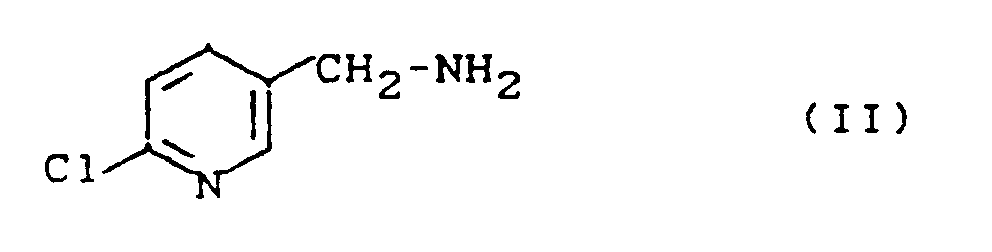
mit Ameisensäure, gegebenenfalls in Gegenwart eines Verdünnungsmittels, bei Temperaturen zwischen 20°C und 200°C umsetzt,
das hierbei gebildete 2-Chlor-5-formylaminomethyl-pyridin der Formel (III)

ohne Zwischenisolierung (in situ) mit Alkylierungsmitteln der allgemeinen Formel (IV)
R-X (IV)
in welcher
und schließlich die so gebildeten 2-Chlor-5-(N-alkyl-N-formyl-aminomethyl)-pyridine der allgemeinen Formel (V)

in welcher
Claims (10)
- Verfahren zur Herstellung von 2-Chlor-5-alkylaminomethyl-pyridinen der allgemeinen Formel (I)
 R für Alkyl steht,dadurch gekennzeicnet, daß man 2-Chlor-5-aminomethyl-pyridin der Formel (II)

das hierbei gebildete 2-Chlor-5-formylaminomethyl-pyridin der Formel (III)
R-X (IV)
in welcherX für Halogen oder die Gruppierung -O-SO₂-O-R steht undR die oben angegebene Bedeutung hat,gegebenenfalls in Gegenwart eines Säureakzeptors, gegebenenfalls in Gegenwart eines Katalysators und gegebenenfalls in Gegenwart eines Verdünnungsmittel, bei Temperaturen zwischen 0°C und 100°C umsetzt und schließlich die so gebildeten 2-Chlor-5-(N-alkyl-N-formyl-aminomethyl)-pyridine der allgemeinen Formel (V) R die oben angegebene Bedeutung hat,gegebenenfalls nach Abdestillieren flüchtiger Komponenten, mit wäßriger Alkalilauge bei Temperaturen zwischen 20°C und Rückflußtemperatur umsetzt.
- Verfahren gemäß Anspruch 1 zur Herstellung von Verbindungen der Formel (I), in welcherR für geradkettiges oder verzweigtes Alkyl mit 1 bis 6 Kohlenstoffatomen steht.
- Verfahren gemäß Anspruch 1 zur Herstellung von Verbindungen der Formel (I), in welcherR für Methyl, Ethyl, Propyl, Isopropyl, Butyl, Isobutyl oder sec-Butyl steht.
- Verfahren gemäß Ansprüchen 1 bis 3, dadurch gekennzeichnet, daß man pro Mol 2-Chlor-5-aminomethylpyridin der Formel (II) 1 bis 2 Mol Ameisensäure einsetzt.
- Verfahren gemäß Ansprüchen 1 bis 3, dadurch gekennzeichnet, daß man die Bildung von Verbindungen der Formel (V) in Gegenwart von Phasentransfer-Katalysatoren durchführt.
- Verfahren gemäß Ansprüchen 1 bis 4, dadurch gekennzeichnet, daß man bei der Bildung der Verbindungen der Formel (V) bezogen auf 1 Mol des anfangs eingesetzten 2-Chlor-5-aminomethyl-pyridins (II) zwischen 1 und 2 Mol Alkylierungsmittel der Formel (IV) einsetzt.
- Verfahren gemäß Ansprüchen 1 bis 3, dadurch gekennzeichnet, daß man in der dritten Phase des Verfahrens bezogen auf 1 Mol des anfangs eingesetzten 2-Chlor-5-aminomethyl-pyridins (II) zwischen 1 und 5 Mol Alkalimetallhydroxid einsetzt.
- Verfahren gemäß Anspruch 7, dadurch gekennzeichnet, daß man eine 10 bis 50%ige wäßrige Lösung von Alkalimetallhydroxiden einsetzt.
- 2-Chlor-5-formylaminomethyl-pyridin der Formel (III)

- 2-Chlor-5-(N-alkyl-N-formyl-aminomethyl)-pyridine der Formel (IV)
 R für Alkyl steht.
Applications Claiming Priority (2)
| Application Number | Priority Date | Filing Date | Title |
|---|---|---|---|
| DE4204919 | 1992-02-19 | ||
| DE4204919A DE4204919A1 (de) | 1992-02-19 | 1992-02-19 | Verfahren zur herstellung von 2-chlor-5-alkylaminomethyl-pyridinen |
Publications (2)
| Publication Number | Publication Date |
|---|---|
| EP0556684A1 true EP0556684A1 (de) | 1993-08-25 |
| EP0556684B1 EP0556684B1 (de) | 1996-05-22 |
Family
ID=6452016
Family Applications (1)
| Application Number | Title | Priority Date | Filing Date |
|---|---|---|---|
| EP93101949A Expired - Lifetime EP0556684B1 (de) | 1992-02-19 | 1993-02-08 | Verfahren zur Herstellung von 2-Chlor-5-alkylaminomethyl-pyridinen |
Country Status (11)
| Country | Link |
|---|---|
| US (1) | US5382671A (de) |
| EP (1) | EP0556684B1 (de) |
| JP (1) | JP3205634B2 (de) |
| KR (1) | KR100244880B1 (de) |
| CN (2) | CN1042934C (de) |
| AT (1) | ATE138368T1 (de) |
| DE (2) | DE4204919A1 (de) |
| DK (1) | DK0556684T3 (de) |
| ES (1) | ES2087584T3 (de) |
| HU (1) | HU209808B (de) |
| TW (1) | TW221423B (de) |
Cited By (4)
| Publication number | Priority date | Publication date | Assignee | Title |
|---|---|---|---|---|
| EP0691331A1 (de) | 1994-07-04 | 1996-01-10 | Bayer Ag | Verfahren zur Herstellung N-acylierter 2-Chlor-5-aminomethylpyridine |
| EP0722933A1 (de) * | 1994-12-23 | 1996-07-24 | Bayer Ag | Verfahren zur Herstellung von Chlormethylpyridin Derivaten und Acylaminomethylpyridine als Zwischenprodukte |
| EP2383269A2 (de) | 2006-10-26 | 2011-11-02 | Bayer Pharma AG | Substituierte Dihydropyrazolone zur Behandlung von Herz-Kreislauf-Erkrankungen |
| US9533972B2 (en) | 2010-11-18 | 2017-01-03 | Bayer Intellectual Property Gmbh | Substituted sodium-1H-pyrazole-5-olate |
Families Citing this family (3)
| Publication number | Priority date | Publication date | Assignee | Title |
|---|---|---|---|---|
| ATE200665T1 (de) * | 1995-09-08 | 2001-05-15 | Nippon Soda Co | Verfahren zur herstellung von 3-(aminomethyl)-6- chlorpyridinen |
| KR100527624B1 (ko) * | 2003-08-21 | 2005-11-22 | 한기종 | 질소에 포밀기를 갖는 아민유도체의 새로운 제조방법 |
| CN102827070B (zh) * | 2012-08-27 | 2016-08-10 | 安徽常泰化工有限公司 | 一种合成n-(6-氯-3-吡啶甲基)-甲胺的改进工艺 |
Citations (3)
| Publication number | Priority date | Publication date | Assignee | Title |
|---|---|---|---|---|
| EP0379928A2 (de) * | 1989-01-26 | 1990-08-01 | Bayer Ag | Aryl- und Heteroarylethanol-pyridylalkylamine, Verfahren zu ihrer Herstellung und ihre Verwendung als Leistungsförderer bei Tieren und als Mittel gegen Adipositas |
| EP0425030A2 (de) * | 1989-10-27 | 1991-05-02 | Shell Internationale Researchmaatschappij B.V. | Butenon-Verbindungen, ihre Herstellung und Verwendung als Schädlingsbekämpfungsmittel |
| EP0302389B1 (de) * | 1987-08-01 | 1993-12-22 | Takeda Chemical Industries, Ltd. | Alpha-ungesättigte Amine, ihre Herstellung und Verwendung |
Family Cites Families (2)
| Publication number | Priority date | Publication date | Assignee | Title |
|---|---|---|---|---|
| IN170284B (de) * | 1988-10-26 | 1992-03-07 | Takeda Chemical Industries Ltd | |
| IE960441L (en) * | 1988-12-27 | 1990-06-27 | Takeda Chemical Industries Ltd | Guanidine derivatives, their production and insecticides |
-
1992
- 1992-02-19 DE DE4204919A patent/DE4204919A1/de not_active Withdrawn
-
1993
- 1993-01-21 TW TW082100380A patent/TW221423B/zh not_active IP Right Cessation
- 1993-02-08 DE DE59302634T patent/DE59302634D1/de not_active Expired - Lifetime
- 1993-02-08 EP EP93101949A patent/EP0556684B1/de not_active Expired - Lifetime
- 1993-02-08 ES ES93101949T patent/ES2087584T3/es not_active Expired - Lifetime
- 1993-02-08 AT AT93101949T patent/ATE138368T1/de not_active IP Right Cessation
- 1993-02-08 DK DK93101949.1T patent/DK0556684T3/da active
- 1993-02-09 US US08/015,507 patent/US5382671A/en not_active Expired - Lifetime
- 1993-02-12 JP JP04602593A patent/JP3205634B2/ja not_active Expired - Lifetime
- 1993-02-16 KR KR1019930002131A patent/KR100244880B1/ko not_active Expired - Lifetime
- 1993-02-18 HU HU9300444A patent/HU209808B/hu unknown
- 1993-02-19 CN CN93101763A patent/CN1042934C/zh not_active Expired - Lifetime
-
1997
- 1997-12-30 CN CN97123446A patent/CN1085204C/zh not_active Expired - Lifetime
Patent Citations (3)
| Publication number | Priority date | Publication date | Assignee | Title |
|---|---|---|---|---|
| EP0302389B1 (de) * | 1987-08-01 | 1993-12-22 | Takeda Chemical Industries, Ltd. | Alpha-ungesättigte Amine, ihre Herstellung und Verwendung |
| EP0379928A2 (de) * | 1989-01-26 | 1990-08-01 | Bayer Ag | Aryl- und Heteroarylethanol-pyridylalkylamine, Verfahren zu ihrer Herstellung und ihre Verwendung als Leistungsförderer bei Tieren und als Mittel gegen Adipositas |
| EP0425030A2 (de) * | 1989-10-27 | 1991-05-02 | Shell Internationale Researchmaatschappij B.V. | Butenon-Verbindungen, ihre Herstellung und Verwendung als Schädlingsbekämpfungsmittel |
Cited By (7)
| Publication number | Priority date | Publication date | Assignee | Title |
|---|---|---|---|---|
| EP0691331A1 (de) | 1994-07-04 | 1996-01-10 | Bayer Ag | Verfahren zur Herstellung N-acylierter 2-Chlor-5-aminomethylpyridine |
| US5580983A (en) * | 1994-07-04 | 1996-12-03 | Bayer Aktiengesellschaft | Process for the preparation of N-acylated 2-chloro-5-aminomethylpyridines |
| EP0722933A1 (de) * | 1994-12-23 | 1996-07-24 | Bayer Ag | Verfahren zur Herstellung von Chlormethylpyridin Derivaten und Acylaminomethylpyridine als Zwischenprodukte |
| US5623076A (en) * | 1994-12-23 | 1997-04-22 | Bayer Aktiengesellschaft | Process for the preparation of chloromethylpyridines |
| EP2383269A2 (de) | 2006-10-26 | 2011-11-02 | Bayer Pharma AG | Substituierte Dihydropyrazolone zur Behandlung von Herz-Kreislauf-Erkrankungen |
| EP2546253A1 (de) | 2006-10-26 | 2013-01-16 | Bayer Intellectual Property GmbH | Substituierte dihydropyrazolone zur behandlung kardiovaskulärer und hämatologischer erkrankungen |
| US9533972B2 (en) | 2010-11-18 | 2017-01-03 | Bayer Intellectual Property Gmbh | Substituted sodium-1H-pyrazole-5-olate |
Also Published As
| Publication number | Publication date |
|---|---|
| DK0556684T3 (da) | 1996-09-23 |
| US5382671A (en) | 1995-01-17 |
| DE59302634D1 (de) | 1996-06-27 |
| EP0556684B1 (de) | 1996-05-22 |
| DE4204919A1 (de) | 1993-08-26 |
| ES2087584T3 (es) | 1996-07-16 |
| JPH0616635A (ja) | 1994-01-25 |
| CN1220989A (zh) | 1999-06-30 |
| ATE138368T1 (de) | 1996-06-15 |
| HUT64025A (en) | 1993-11-29 |
| HU209808B (en) | 1994-11-28 |
| TW221423B (de) | 1994-03-01 |
| CN1075958A (zh) | 1993-09-08 |
| CN1042934C (zh) | 1999-04-14 |
| JP3205634B2 (ja) | 2001-09-04 |
| KR930017875A (ko) | 1993-09-20 |
| CN1085204C (zh) | 2002-05-22 |
| HU9300444D0 (en) | 1993-05-28 |
| KR100244880B1 (ko) | 2000-03-02 |
Similar Documents
| Publication | Publication Date | Title |
|---|---|---|
| EP0776889B1 (de) | Verfahren zur Herstellung von 1,3-Dimethyl-5-fluor-pyrazol-4-carboxaniliden | |
| DE102004033525A1 (de) | Verbessertes Verfahren zur Herstellung kernfluorierter Aromaten | |
| EP0370317B1 (de) | Verfahren zur Herstellung von substituierten 2-Chlorpyridinen | |
| EP0556684B1 (de) | Verfahren zur Herstellung von 2-Chlor-5-alkylaminomethyl-pyridinen | |
| DE3514450A1 (de) | Verfahren zur herstellung von imidaten sowie neue arylsubstituierte imidate | |
| EP0324174B1 (de) | Verfahren zur Herstellung von 2-Chlor-5-methyl-pyridin | |
| EP0439745B1 (de) | Verfahren zur Herstellung von 2-Chlor-5-methyl-pyridin | |
| DE2652810C3 (de) | Verfahren zur Herstellung von aromatischen Fluorverbindungen | |
| EP0591624B1 (de) | Verfahren zur Herstellung von reinem 2,5-Dichlorpyridin sowie Gewinnung des als Nebenprodukt anfallenden 2,3-Dichlorpyrdins | |
| EP0411364B1 (de) | Verfahren zur Herstellung von chlorierten Nicotinaldehyden | |
| EP0584491B1 (de) | Verfahren zur Herstellung von 2,5-disubstituierten Pyridinen | |
| DE10222330A1 (de) | Verfahren zur katalysatorfreien Herstellung von Alkoxybenzonitrilen | |
| EP0820981B1 (de) | Verfahren zur Herstellung von 2-Trifluormethoxy-anilin | |
| EP1280752A1 (de) | Verfahren zur herstellung von 2-alkyl-3-chlorphenolen | |
| EP0705815B1 (de) | Verfahren zur Herstellung von N-Arylaminoacrylsäurederivaten | |
| EP0373463B1 (de) | Verfahren zur Herstellung von 2-Chlor-5-chlormethylpyridin | |
| EP0508217B1 (de) | Verfahren zur Herstellung von 2-Chlorpyridinen | |
| EP1102749B1 (de) | Verfahren zur herstellung von 2-halogennikotinsäurederivaten und 2-chlornikotinsäure-n-butylester als zwischenprodukt | |
| DE3939965C2 (de) | Verfahren zur Herstellung von 6-Alkoxy-2-alkyl-4-hydroxy-pyrimidinen über Carbamoylessigsäure-alkanoylimidester | |
| EP0033885B1 (de) | Verfahren zur Herstellung von (2-Chlor-4-trifluormethyl-phenyl)-(3-methoxy-phenyl)-ether | |
| EP0904267A1 (de) | Verfahren zur herstellung von substituierten arylpyrazolen | |
| EP0662474B1 (de) | Verfahren zur herstellung von chlorpyridinen | |
| DE69010130T2 (de) | Verfahren zur Herstellung von p-Hydroxyneophyl-m-phenoxybenzylether. | |
| DE3715704A1 (de) | Ss-fluoracyl-ss-halogenvinylalkylether | |
| EP0764642A2 (de) | Verfahren zur Herstellung von 1-Aryl-4-carbamoyl-tetrazolinonen |
Legal Events
| Date | Code | Title | Description |
|---|---|---|---|
| PUAI | Public reference made under article 153(3) epc to a published international application that has entered the european phase |
Free format text: ORIGINAL CODE: 0009012 |
|
| AK | Designated contracting states |
Kind code of ref document: A1 Designated state(s): AT BE CH DE DK ES FR GB IT LI NL |
|
| 17P | Request for examination filed |
Effective date: 19931125 |
|
| 17Q | First examination report despatched |
Effective date: 19950828 |
|
| GRAA | (expected) grant |
Free format text: ORIGINAL CODE: 0009210 |
|
| AK | Designated contracting states |
Kind code of ref document: B1 Designated state(s): AT BE CH DE DK ES FR GB IT LI NL |
|
| REF | Corresponds to: |
Ref document number: 138368 Country of ref document: AT Date of ref document: 19960615 Kind code of ref document: T |
|
| REG | Reference to a national code |
Ref country code: ES Ref legal event code: BA2A Ref document number: 2087584 Country of ref document: ES Kind code of ref document: T3 |
|
| REG | Reference to a national code |
Ref country code: CH Ref legal event code: NV Representative=s name: E. BLUM & CO. PATENTANWAELTE |
|
| REF | Corresponds to: |
Ref document number: 59302634 Country of ref document: DE Date of ref document: 19960627 |
|
| ITF | It: translation for a ep patent filed | ||
| REG | Reference to a national code |
Ref country code: ES Ref legal event code: FG2A Ref document number: 2087584 Country of ref document: ES Kind code of ref document: T3 |
|
| GBT | Gb: translation of ep patent filed (gb section 77(6)(a)/1977) |
Effective date: 19960618 |
|
| ET | Fr: translation filed | ||
| REG | Reference to a national code |
Ref country code: DK Ref legal event code: T3 |
|
| PLBE | No opposition filed within time limit |
Free format text: ORIGINAL CODE: 0009261 |
|
| STAA | Information on the status of an ep patent application or granted ep patent |
Free format text: STATUS: NO OPPOSITION FILED WITHIN TIME LIMIT |
|
| 26N | No opposition filed | ||
| REG | Reference to a national code |
Ref country code: GB Ref legal event code: IF02 |
|
| PGFP | Annual fee paid to national office [announced via postgrant information from national office to epo] |
Ref country code: NL Payment date: 20070204 Year of fee payment: 15 |
|
| PGFP | Annual fee paid to national office [announced via postgrant information from national office to epo] |
Ref country code: AT Payment date: 20070213 Year of fee payment: 15 |
|
| PGFP | Annual fee paid to national office [announced via postgrant information from national office to epo] |
Ref country code: CH Payment date: 20070214 Year of fee payment: 15 |
|
| PGFP | Annual fee paid to national office [announced via postgrant information from national office to epo] |
Ref country code: DK Payment date: 20070215 Year of fee payment: 15 |
|
| PGFP | Annual fee paid to national office [announced via postgrant information from national office to epo] |
Ref country code: ES Payment date: 20070327 Year of fee payment: 15 |
|
| REG | Reference to a national code |
Ref country code: CH Ref legal event code: PFA Owner name: BAYER AG Free format text: BAYER AG# #51368 LEVERKUSEN (DE) -TRANSFER TO- BAYER AG# #51368 LEVERKUSEN (DE) |
|
| PGFP | Annual fee paid to national office [announced via postgrant information from national office to epo] |
Ref country code: BE Payment date: 20070417 Year of fee payment: 15 |
|
| PGFP | Annual fee paid to national office [announced via postgrant information from national office to epo] |
Ref country code: FR Payment date: 20070208 Year of fee payment: 15 |
|
| BERE | Be: lapsed |
Owner name: *BAYER A.G. Effective date: 20080228 |
|
| REG | Reference to a national code |
Ref country code: DK Ref legal event code: EBP |
|
| REG | Reference to a national code |
Ref country code: CH Ref legal event code: PL |
|
| PG25 | Lapsed in a contracting state [announced via postgrant information from national office to epo] |
Ref country code: LI Free format text: LAPSE BECAUSE OF NON-PAYMENT OF DUE FEES Effective date: 20080229 Ref country code: CH Free format text: LAPSE BECAUSE OF NON-PAYMENT OF DUE FEES Effective date: 20080229 |
|
| NLV4 | Nl: lapsed or anulled due to non-payment of the annual fee |
Effective date: 20080901 |
|
| PG25 | Lapsed in a contracting state [announced via postgrant information from national office to epo] |
Ref country code: NL Free format text: LAPSE BECAUSE OF NON-PAYMENT OF DUE FEES Effective date: 20080901 Ref country code: AT Free format text: LAPSE BECAUSE OF NON-PAYMENT OF DUE FEES Effective date: 20080208 |
|
| REG | Reference to a national code |
Ref country code: FR Ref legal event code: ST Effective date: 20081031 |
|
| PG25 | Lapsed in a contracting state [announced via postgrant information from national office to epo] |
Ref country code: DK Free format text: LAPSE BECAUSE OF NON-PAYMENT OF DUE FEES Effective date: 20080229 |
|
| PG25 | Lapsed in a contracting state [announced via postgrant information from national office to epo] |
Ref country code: BE Free format text: LAPSE BECAUSE OF NON-PAYMENT OF DUE FEES Effective date: 20080228 |
|
| PG25 | Lapsed in a contracting state [announced via postgrant information from national office to epo] |
Ref country code: FR Free format text: LAPSE BECAUSE OF NON-PAYMENT OF DUE FEES Effective date: 20080229 |
|
| REG | Reference to a national code |
Ref country code: ES Ref legal event code: FD2A Effective date: 20080209 |
|
| PG25 | Lapsed in a contracting state [announced via postgrant information from national office to epo] |
Ref country code: ES Free format text: LAPSE BECAUSE OF NON-PAYMENT OF DUE FEES Effective date: 20080209 |
|
| PGFP | Annual fee paid to national office [announced via postgrant information from national office to epo] |
Ref country code: DE Payment date: 20120131 Year of fee payment: 20 |
|
| PGFP | Annual fee paid to national office [announced via postgrant information from national office to epo] |
Ref country code: IT Payment date: 20120127 Year of fee payment: 20 Ref country code: GB Payment date: 20120208 Year of fee payment: 20 |
|
| REG | Reference to a national code |
Ref country code: DE Ref legal event code: R071 Ref document number: 59302634 Country of ref document: DE |
|
| REG | Reference to a national code |
Ref country code: GB Ref legal event code: PE20 Expiry date: 20130207 |
|
| PG25 | Lapsed in a contracting state [announced via postgrant information from national office to epo] |
Ref country code: GB Free format text: LAPSE BECAUSE OF EXPIRATION OF PROTECTION Effective date: 20130207 Ref country code: DE Free format text: LAPSE BECAUSE OF EXPIRATION OF PROTECTION Effective date: 20130209 |