EP0557247A1 - Verfahren zur photochemischen und thermischen Stabilisierung von ungefärbten und gefärbten oder bedruckten Polyesterfasermaterialien - Google Patents
Verfahren zur photochemischen und thermischen Stabilisierung von ungefärbten und gefärbten oder bedruckten Polyesterfasermaterialien Download PDFInfo
- Publication number
- EP0557247A1 EP0557247A1 EP19930810090 EP93810090A EP0557247A1 EP 0557247 A1 EP0557247 A1 EP 0557247A1 EP 19930810090 EP19930810090 EP 19930810090 EP 93810090 A EP93810090 A EP 93810090A EP 0557247 A1 EP0557247 A1 EP 0557247A1
- Authority
- EP
- European Patent Office
- Prior art keywords
- formula
- ethoxy
- compound
- bis
- dyed
- Prior art date
- Legal status (The legal status is an assumption and is not a legal conclusion. Google has not performed a legal analysis and makes no representation as to the accuracy of the status listed.)
- Granted
Links
- 239000002657 fibrous material Substances 0.000 title claims abstract description 23
- 238000000034 method Methods 0.000 title claims abstract description 21
- 229920000728 polyester Polymers 0.000 title claims abstract description 17
- 230000006641 stabilisation Effects 0.000 title claims abstract description 5
- 150000001875 compounds Chemical class 0.000 claims abstract description 27
- 238000004043 dyeing Methods 0.000 claims abstract description 21
- 229910052739 hydrogen Inorganic materials 0.000 claims abstract description 9
- 239000001257 hydrogen Substances 0.000 claims abstract description 7
- 238000011105 stabilization Methods 0.000 claims abstract description 4
- -1 1,3,5-triazine compound Chemical class 0.000 claims description 20
- 238000007639 printing Methods 0.000 claims description 18
- 125000004178 (C1-C4) alkyl group Chemical group 0.000 claims description 6
- 125000001495 ethyl group Chemical group [H]C([H])([H])C([H])([H])* 0.000 claims description 6
- 125000002496 methyl group Chemical group [H]C([H])([H])* 0.000 claims description 6
- 229910052783 alkali metal Inorganic materials 0.000 claims description 3
- 125000001797 benzyl group Chemical group [H]C1=C([H])C([H])=C(C([H])=C1[H])C([H])([H])* 0.000 claims description 3
- 229910052736 halogen Inorganic materials 0.000 claims description 3
- 150000002367 halogens Chemical class 0.000 claims description 3
- 125000001997 phenyl group Chemical group [H]C1=C([H])C([H])=C(*)C([H])=C1[H] 0.000 claims description 3
- 150000001340 alkali metals Chemical class 0.000 claims description 2
- 238000002360 preparation method Methods 0.000 claims description 2
- 125000004435 hydrogen atom Chemical group [H]* 0.000 claims 2
- 150000002431 hydrogen Chemical class 0.000 claims 1
- UFHFLCQGNIYNRP-UHFFFAOYSA-N Hydrogen Chemical compound [H][H] UFHFLCQGNIYNRP-UHFFFAOYSA-N 0.000 abstract description 7
- 238000000859 sublimation Methods 0.000 abstract description 2
- 230000008022 sublimation Effects 0.000 abstract description 2
- 229920002301 cellulose acetate Polymers 0.000 abstract 1
- WSFSSNUMVMOOMR-UHFFFAOYSA-N Formaldehyde Chemical compound O=C WSFSSNUMVMOOMR-UHFFFAOYSA-N 0.000 description 40
- 239000000975 dye Substances 0.000 description 23
- 239000006096 absorbing agent Substances 0.000 description 17
- ISWSIDIOOBJBQZ-UHFFFAOYSA-N Phenol Chemical compound OC1=CC=CC=C1 ISWSIDIOOBJBQZ-UHFFFAOYSA-N 0.000 description 12
- LYCAIKOWRPUZTN-UHFFFAOYSA-N ethylene glycol Natural products OCCO LYCAIKOWRPUZTN-UHFFFAOYSA-N 0.000 description 11
- XLYOFNOQVPJJNP-UHFFFAOYSA-N water Substances O XLYOFNOQVPJJNP-UHFFFAOYSA-N 0.000 description 11
- 239000000203 mixture Substances 0.000 description 10
- IAYPIBMASNFSPL-UHFFFAOYSA-N Ethylene oxide Chemical group C1CO1 IAYPIBMASNFSPL-UHFFFAOYSA-N 0.000 description 8
- KKEYFWRCBNTPAC-UHFFFAOYSA-N Terephthalic acid Chemical compound OC(=O)C1=CC=C(C(O)=O)C=C1 KKEYFWRCBNTPAC-UHFFFAOYSA-N 0.000 description 8
- 239000007859 condensation product Substances 0.000 description 8
- 239000002253 acid Substances 0.000 description 7
- OKKJLVBELUTLKV-UHFFFAOYSA-N Methanol Chemical compound OC OKKJLVBELUTLKV-UHFFFAOYSA-N 0.000 description 6
- HEMHJVSKTPXQMS-UHFFFAOYSA-M Sodium hydroxide Chemical compound [OH-].[Na+] HEMHJVSKTPXQMS-UHFFFAOYSA-M 0.000 description 6
- 239000006185 dispersion Substances 0.000 description 6
- 150000002148 esters Chemical class 0.000 description 6
- 150000001298 alcohols Chemical class 0.000 description 5
- IGFHQQFPSIBGKE-UHFFFAOYSA-N 4-nonylphenol Chemical compound CCCCCCCCCC1=CC=C(O)C=C1 IGFHQQFPSIBGKE-UHFFFAOYSA-N 0.000 description 4
- DGAQECJNVWCQMB-PUAWFVPOSA-M Ilexoside XXIX Chemical compound C[C@@H]1CC[C@@]2(CC[C@@]3(C(=CC[C@H]4[C@]3(CC[C@@H]5[C@@]4(CC[C@@H](C5(C)C)OS(=O)(=O)[O-])C)C)[C@@H]2[C@]1(C)O)C)C(=O)O[C@H]6[C@@H]([C@H]([C@@H]([C@H](O6)CO)O)O)O.[Na+] DGAQECJNVWCQMB-PUAWFVPOSA-M 0.000 description 4
- XSQUKJJJFZCRTK-UHFFFAOYSA-N Urea Chemical compound NC(N)=O XSQUKJJJFZCRTK-UHFFFAOYSA-N 0.000 description 4
- 150000007513 acids Chemical class 0.000 description 4
- 229920002678 cellulose Polymers 0.000 description 4
- 239000002270 dispersing agent Substances 0.000 description 4
- 239000000835 fiber Substances 0.000 description 4
- 229910052500 inorganic mineral Inorganic materials 0.000 description 4
- QQVIHTHCMHWDBS-UHFFFAOYSA-N isophthalic acid Chemical compound OC(=O)C1=CC=CC(C(O)=O)=C1 QQVIHTHCMHWDBS-UHFFFAOYSA-N 0.000 description 4
- 239000000463 material Substances 0.000 description 4
- 239000011707 mineral Substances 0.000 description 4
- 235000010755 mineral Nutrition 0.000 description 4
- 229910052708 sodium Inorganic materials 0.000 description 4
- 239000011734 sodium Substances 0.000 description 4
- 235000015424 sodium Nutrition 0.000 description 4
- QTBSBXVTEAMEQO-UHFFFAOYSA-N Acetic acid Chemical compound CC(O)=O QTBSBXVTEAMEQO-UHFFFAOYSA-N 0.000 description 3
- 229920002134 Carboxymethyl cellulose Polymers 0.000 description 3
- LFQSCWFLJHTTHZ-UHFFFAOYSA-N Ethanol Chemical compound CCO LFQSCWFLJHTTHZ-UHFFFAOYSA-N 0.000 description 3
- 229920001732 Lignosulfonate Polymers 0.000 description 3
- MUBZPKHOEPUJKR-UHFFFAOYSA-N Oxalic acid Chemical compound OC(=O)C(O)=O MUBZPKHOEPUJKR-UHFFFAOYSA-N 0.000 description 3
- DKGAVHZHDRPRBM-UHFFFAOYSA-N Tert-Butanol Chemical compound CC(C)(C)O DKGAVHZHDRPRBM-UHFFFAOYSA-N 0.000 description 3
- 239000000654 additive Substances 0.000 description 3
- 125000002947 alkylene group Chemical class 0.000 description 3
- 238000009835 boiling Methods 0.000 description 3
- 239000001768 carboxy methyl cellulose Substances 0.000 description 3
- 235000010948 carboxy methyl cellulose Nutrition 0.000 description 3
- 239000008112 carboxymethyl-cellulose Substances 0.000 description 3
- 239000001913 cellulose Substances 0.000 description 3
- 239000003795 chemical substances by application Substances 0.000 description 3
- KRKNYBCHXYNGOX-UHFFFAOYSA-N citric acid Chemical compound OC(=O)CC(O)(C(O)=O)CC(O)=O KRKNYBCHXYNGOX-UHFFFAOYSA-N 0.000 description 3
- 238000004140 cleaning Methods 0.000 description 3
- 238000004519 manufacturing process Methods 0.000 description 3
- 239000007800 oxidant agent Substances 0.000 description 3
- 230000002829 reductive effect Effects 0.000 description 3
- 150000003839 salts Chemical class 0.000 description 3
- JVBXVOWTABLYPX-UHFFFAOYSA-L sodium dithionite Chemical compound [Na+].[Na+].[O-]S(=O)S([O-])=O JVBXVOWTABLYPX-UHFFFAOYSA-L 0.000 description 3
- 239000007858 starting material Substances 0.000 description 3
- 239000002562 thickening agent Substances 0.000 description 3
- IXPNQXFRVYWDDI-UHFFFAOYSA-N 1-methyl-2,4-dioxo-1,3-diazinane-5-carboximidamide Chemical compound CN1CC(C(N)=N)C(=O)NC1=O IXPNQXFRVYWDDI-UHFFFAOYSA-N 0.000 description 2
- JKTAIYGNOFSMCE-UHFFFAOYSA-N 2,3-di(nonyl)phenol Chemical compound CCCCCCCCCC1=CC=CC(O)=C1CCCCCCCCC JKTAIYGNOFSMCE-UHFFFAOYSA-N 0.000 description 2
- XJVGSAAMTCEDFY-UHFFFAOYSA-N 2-[4-(2-ethoxyethoxy)-6-(2-hydroxy-4-methoxyphenyl)-1,3,5-triazin-2-yl]-5-methoxyphenol Chemical compound N=1C(OCCOCC)=NC(C=2C(=CC(OC)=CC=2)O)=NC=1C1=CC=C(OC)C=C1O XJVGSAAMTCEDFY-UHFFFAOYSA-N 0.000 description 2
- AKDSNABDSYPNTC-UHFFFAOYSA-N 2-[4-(2-hydroxy-4-methoxyphenyl)-6-(2-methoxyethoxy)-1,3,5-triazin-2-yl]-5-methoxyphenol Chemical compound N=1C(OCCOC)=NC(C=2C(=CC(OC)=CC=2)O)=NC=1C1=CC=C(OC)C=C1O AKDSNABDSYPNTC-UHFFFAOYSA-N 0.000 description 2
- QOKHQUDKXDAZQK-UHFFFAOYSA-N 2-[4-(2-hydroxy-4-methoxyphenyl)-6-(2-propoxyethoxy)-1,3,5-triazin-2-yl]-5-methoxyphenol Chemical compound N=1C(OCCOCCC)=NC(C=2C(=CC(OC)=CC=2)O)=NC=1C1=CC=C(OC)C=C1O QOKHQUDKXDAZQK-UHFFFAOYSA-N 0.000 description 2
- IVVPXWRMUXMTOB-UHFFFAOYSA-N 2-[4-(2-hydroxy-4-propoxyphenyl)-6-(2-methoxyethoxy)-1,3,5-triazin-2-yl]-5-propoxyphenol Chemical compound OC1=CC(OCCC)=CC=C1C1=NC(OCCOC)=NC(C=2C(=CC(OCCC)=CC=2)O)=N1 IVVPXWRMUXMTOB-UHFFFAOYSA-N 0.000 description 2
- FRUTWOGJLNYVSR-UHFFFAOYSA-N 2-[4-[2-(2-ethoxyethoxy)ethoxy]-6-(2-hydroxy-4-methoxyphenyl)-1,3,5-triazin-2-yl]-5-methoxyphenol Chemical compound CCOCCOCCOc1nc(nc(n1)-c1ccc(OC)cc1O)-c1ccc(OC)cc1O FRUTWOGJLNYVSR-UHFFFAOYSA-N 0.000 description 2
- IEZGLQLYKGRESO-UHFFFAOYSA-N 2-[4-butoxy-6-(4-ethoxy-2-hydroxyphenyl)-1,3,5-triazin-2-yl]-5-ethoxyphenol Chemical compound N=1C(OCCCC)=NC(C=2C(=CC(OCC)=CC=2)O)=NC=1C1=CC=C(OCC)C=C1O IEZGLQLYKGRESO-UHFFFAOYSA-N 0.000 description 2
- WKXCPKDAGJLIAX-UHFFFAOYSA-N 2-[5-[2-[2-(2-ethoxyethoxy)ethoxy]ethoxy]-6-(2-hydroxy-4-methoxyphenyl)triazin-4-yl]-5-methoxyphenol Chemical compound OC1=C(C=CC(=C1)OC)C1=NN=NC(=C1OCCOCCOCCOCC)C1=C(C=C(C=C1)OC)O WKXCPKDAGJLIAX-UHFFFAOYSA-N 0.000 description 2
- MSXVEPNJUHWQHW-UHFFFAOYSA-N 2-methyl-2-butanol Substances CCC(C)(C)O MSXVEPNJUHWQHW-UHFFFAOYSA-N 0.000 description 2
- YEYKMVJDLWJFOA-UHFFFAOYSA-N 2-propoxyethanol Chemical compound CCCOCCO YEYKMVJDLWJFOA-UHFFFAOYSA-N 0.000 description 2
- YEJRWHAVMIAJKC-UHFFFAOYSA-N 4-Butyrolactone Chemical compound O=C1CCCO1 YEJRWHAVMIAJKC-UHFFFAOYSA-N 0.000 description 2
- FTEDJZCPPISJAP-UHFFFAOYSA-N 5-ethoxy-2-[4-(2-ethoxyethoxy)-6-(4-ethoxy-2-hydroxyphenyl)-1,3,5-triazin-2-yl]phenol Chemical compound N=1C(OCCOCC)=NC(C=2C(=CC(OCC)=CC=2)O)=NC=1C1=CC=C(OCC)C=C1O FTEDJZCPPISJAP-UHFFFAOYSA-N 0.000 description 2
- HHVLUUIGYQTPNJ-UHFFFAOYSA-N 5-ethoxy-2-[4-(4-ethoxy-2-hydroxyphenyl)-6-(2-ethoxypropoxy)-1,3,5-triazin-2-yl]phenol Chemical compound N=1C(OCC(C)OCC)=NC(C=2C(=CC(OCC)=CC=2)O)=NC=1C1=CC=C(OCC)C=C1O HHVLUUIGYQTPNJ-UHFFFAOYSA-N 0.000 description 2
- KOEXKVIAHBUXCE-UHFFFAOYSA-N 5-ethoxy-2-[4-(4-ethoxy-2-hydroxyphenyl)-6-(2-methoxyethoxy)-1,3,5-triazin-2-yl]phenol Chemical compound OC1=CC(OCC)=CC=C1C1=NC(OCCOC)=NC(C=2C(=CC(OCC)=CC=2)O)=N1 KOEXKVIAHBUXCE-UHFFFAOYSA-N 0.000 description 2
- WSMJSYYMSWDXPY-UHFFFAOYSA-N 5-ethoxy-2-[4-[2-(2-ethoxyethoxy)ethoxy]-6-(4-ethoxy-2-hydroxyphenyl)-1,3,5-triazin-2-yl]phenol Chemical compound CCOCCOCCOc1nc(nc(n1)-c1ccc(OCC)cc1O)-c1ccc(OCC)cc1O WSMJSYYMSWDXPY-UHFFFAOYSA-N 0.000 description 2
- JXTKRCUMRDZPOZ-UHFFFAOYSA-N 5-ethoxy-2-[4-[2-[2-(2-ethoxyethoxy)ethoxy]ethoxy]-6-(4-ethoxy-2-hydroxyphenyl)-1,3,5-triazin-2-yl]phenol Chemical compound N=1C(OCCOCCOCCOCC)=NC(C=2C(=CC(OCC)=CC=2)O)=NC=1C1=CC=C(OCC)C=C1O JXTKRCUMRDZPOZ-UHFFFAOYSA-N 0.000 description 2
- RTZKZFJDLAIYFH-UHFFFAOYSA-N Diethyl ether Chemical compound CCOCC RTZKZFJDLAIYFH-UHFFFAOYSA-N 0.000 description 2
- KFZMGEQAYNKOFK-UHFFFAOYSA-N Isopropanol Chemical compound CC(C)O KFZMGEQAYNKOFK-UHFFFAOYSA-N 0.000 description 2
- LRHPLDYGYMQRHN-UHFFFAOYSA-N N-Butanol Chemical compound CCCCO LRHPLDYGYMQRHN-UHFFFAOYSA-N 0.000 description 2
- NBIIXXVUZAFLBC-UHFFFAOYSA-N Phosphoric acid Chemical compound OP(O)(O)=O NBIIXXVUZAFLBC-UHFFFAOYSA-N 0.000 description 2
- GOOHAUXETOMSMM-UHFFFAOYSA-N Propylene oxide Chemical compound CC1CO1 GOOHAUXETOMSMM-UHFFFAOYSA-N 0.000 description 2
- QAOWNCQODCNURD-UHFFFAOYSA-N Sulfuric acid Chemical compound OS(O)(=O)=O QAOWNCQODCNURD-UHFFFAOYSA-N 0.000 description 2
- VJMAITQRABEEKP-UHFFFAOYSA-N [6-(phenylmethoxymethyl)-1,4-dioxan-2-yl]methyl acetate Chemical compound O1C(COC(=O)C)COCC1COCC1=CC=CC=C1 VJMAITQRABEEKP-UHFFFAOYSA-N 0.000 description 2
- 229920006221 acetate fiber Polymers 0.000 description 2
- 230000002378 acidificating effect Effects 0.000 description 2
- BFNBIHQBYMNNAN-UHFFFAOYSA-N ammonium sulfate Chemical compound N.N.OS(O)(=O)=O BFNBIHQBYMNNAN-UHFFFAOYSA-N 0.000 description 2
- 229910052921 ammonium sulfate Inorganic materials 0.000 description 2
- 235000011130 ammonium sulphate Nutrition 0.000 description 2
- 238000010923 batch production Methods 0.000 description 2
- 229910052799 carbon Inorganic materials 0.000 description 2
- 125000004432 carbon atom Chemical group C* 0.000 description 2
- 238000010014 continuous dyeing Methods 0.000 description 2
- 238000001816 cooling Methods 0.000 description 2
- 235000014113 dietary fatty acids Nutrition 0.000 description 2
- USIUVYZYUHIAEV-UHFFFAOYSA-N diphenyl ether Chemical class C=1C=CC=CC=1OC1=CC=CC=C1 USIUVYZYUHIAEV-UHFFFAOYSA-N 0.000 description 2
- 239000003995 emulsifying agent Substances 0.000 description 2
- 239000000194 fatty acid Substances 0.000 description 2
- 229930195729 fatty acid Natural products 0.000 description 2
- 150000004665 fatty acids Chemical class 0.000 description 2
- 150000002191 fatty alcohols Chemical class 0.000 description 2
- 238000009472 formulation Methods 0.000 description 2
- 238000009998 heat setting Methods 0.000 description 2
- 238000010438 heat treatment Methods 0.000 description 2
- ZXEKIIBDNHEJCQ-UHFFFAOYSA-N isobutanol Chemical compound CC(C)CO ZXEKIIBDNHEJCQ-UHFFFAOYSA-N 0.000 description 2
- BDAGIHXWWSANSR-UHFFFAOYSA-N methanoic acid Natural products OC=O BDAGIHXWWSANSR-UHFFFAOYSA-N 0.000 description 2
- WSFSSNUMVMOOMR-NJFSPNSNSA-N methanone Chemical compound O=[14CH2] WSFSSNUMVMOOMR-NJFSPNSNSA-N 0.000 description 2
- UHOVQNZJYSORNB-UHFFFAOYSA-N monobenzene Natural products C1=CC=CC=C1 UHOVQNZJYSORNB-UHFFFAOYSA-N 0.000 description 2
- PSZYNBSKGUBXEH-UHFFFAOYSA-N naphthalene-1-sulfonic acid Chemical compound C1=CC=C2C(S(=O)(=O)O)=CC=CC2=C1 PSZYNBSKGUBXEH-UHFFFAOYSA-N 0.000 description 2
- 150000002989 phenols Chemical class 0.000 description 2
- 239000003755 preservative agent Substances 0.000 description 2
- 239000000047 product Substances 0.000 description 2
- 239000010453 quartz Substances 0.000 description 2
- 239000003352 sequestering agent Substances 0.000 description 2
- VYPSYNLAJGMNEJ-UHFFFAOYSA-N silicon dioxide Inorganic materials O=[Si]=O VYPSYNLAJGMNEJ-UHFFFAOYSA-N 0.000 description 2
- 229920002545 silicone oil Polymers 0.000 description 2
- 239000000661 sodium alginate Substances 0.000 description 2
- 235000010413 sodium alginate Nutrition 0.000 description 2
- 229940005550 sodium alginate Drugs 0.000 description 2
- 239000004753 textile Substances 0.000 description 2
- 239000003799 water insoluble solvent Substances 0.000 description 2
- 210000002268 wool Anatomy 0.000 description 2
- 229910052724 xenon Inorganic materials 0.000 description 2
- FHNFHKCVQCLJFQ-UHFFFAOYSA-N xenon atom Chemical compound [Xe] FHNFHKCVQCLJFQ-UHFFFAOYSA-N 0.000 description 2
- ALSTYHKOOCGGFT-KTKRTIGZSA-N (9Z)-octadecen-1-ol Chemical compound CCCCCCCC\C=C/CCCCCCCCO ALSTYHKOOCGGFT-KTKRTIGZSA-N 0.000 description 1
- BGJSXRVXTHVRSN-UHFFFAOYSA-N 1,3,5-trioxane Chemical compound C1OCOCO1 BGJSXRVXTHVRSN-UHFFFAOYSA-N 0.000 description 1
- KBPLFHHGFOOTCA-UHFFFAOYSA-N 1-Octanol Chemical compound CCCCCCCCO KBPLFHHGFOOTCA-UHFFFAOYSA-N 0.000 description 1
- KJCVRFUGPWSIIH-UHFFFAOYSA-N 1-naphthol Chemical compound C1=CC=C2C(O)=CC=CC2=C1 KJCVRFUGPWSIIH-UHFFFAOYSA-N 0.000 description 1
- SBASXUCJHJRPEV-UHFFFAOYSA-N 2-(2-methoxyethoxy)ethanol Chemical group COCCOCCO SBASXUCJHJRPEV-UHFFFAOYSA-N 0.000 description 1
- DJCYDDALXPHSHR-UHFFFAOYSA-N 2-(2-propoxyethoxy)ethanol Chemical group CCCOCCOCCO DJCYDDALXPHSHR-UHFFFAOYSA-N 0.000 description 1
- WKVMOQXBMPYPGK-UHFFFAOYSA-N 2-[bis(carboxymethyl)amino]acetic acid;sodium Chemical compound [Na].OC(=O)CN(CC(O)=O)CC(O)=O WKVMOQXBMPYPGK-UHFFFAOYSA-N 0.000 description 1
- YIWUKEYIRIRTPP-UHFFFAOYSA-N 2-ethylhexan-1-ol Chemical compound CCCCC(CC)CO YIWUKEYIRIRTPP-UHFFFAOYSA-N 0.000 description 1
- BZSXEZOLBIJVQK-UHFFFAOYSA-N 2-methylsulfonylbenzoic acid Chemical compound CS(=O)(=O)C1=CC=CC=C1C(O)=O BZSXEZOLBIJVQK-UHFFFAOYSA-N 0.000 description 1
- OSWFIVFLDKOXQC-UHFFFAOYSA-N 4-(3-methoxyphenyl)aniline Chemical compound COC1=CC=CC(C=2C=CC(N)=CC=2)=C1 OSWFIVFLDKOXQC-UHFFFAOYSA-N 0.000 description 1
- FBWSRAOCSJQZJA-UHFFFAOYSA-N 4-iminonaphthalen-1-one Chemical compound C1=CC=C2C(=N)C=CC(=O)C2=C1 FBWSRAOCSJQZJA-UHFFFAOYSA-N 0.000 description 1
- 229910000984 420 stainless steel Inorganic materials 0.000 description 1
- SODLLMREPICYOF-UHFFFAOYSA-N 5-methoxy-2-(1,3,5-triazin-2-yl)phenol Chemical compound OC1=C(C=CC(=C1)OC)C1=NC=NC=N1 SODLLMREPICYOF-UHFFFAOYSA-N 0.000 description 1
- HWTDMFJYBAURQR-UHFFFAOYSA-N 80-82-0 Chemical compound OS(=O)(=O)C1=CC=CC=C1[N+]([O-])=O HWTDMFJYBAURQR-UHFFFAOYSA-N 0.000 description 1
- GDALETGZDYOOGB-UHFFFAOYSA-N Acridone Natural products C1=C(O)C=C2N(C)C3=CC=CC=C3C(=O)C2=C1O GDALETGZDYOOGB-UHFFFAOYSA-N 0.000 description 1
- USFZMSVCRYTOJT-UHFFFAOYSA-N Ammonium acetate Chemical compound N.CC(O)=O USFZMSVCRYTOJT-UHFFFAOYSA-N 0.000 description 1
- 239000005695 Ammonium acetate Substances 0.000 description 1
- LSNNMFCWUKXFEE-UHFFFAOYSA-M Bisulfite Chemical compound OS([O-])=O LSNNMFCWUKXFEE-UHFFFAOYSA-M 0.000 description 1
- DLUHRCRLXHFHCD-UHFFFAOYSA-N CN(C(c(c(N)c1C(c2ccccc22)=O)c3c(N)c1C2=O)=O)C3=O Chemical compound CN(C(c(c(N)c1C(c2ccccc22)=O)c3c(N)c1C2=O)=O)C3=O DLUHRCRLXHFHCD-UHFFFAOYSA-N 0.000 description 1
- 239000004215 Carbon black (E152) Substances 0.000 description 1
- 229920003043 Cellulose fiber Polymers 0.000 description 1
- 229920000742 Cotton Polymers 0.000 description 1
- SNRUBQQJIBEYMU-UHFFFAOYSA-N Dodecane Natural products CCCCCCCCCCCC SNRUBQQJIBEYMU-UHFFFAOYSA-N 0.000 description 1
- WHXSMMKQMYFTQS-UHFFFAOYSA-N Lithium Chemical compound [Li] WHXSMMKQMYFTQS-UHFFFAOYSA-N 0.000 description 1
- OFOBLEOULBTSOW-UHFFFAOYSA-N Malonic acid Chemical compound OC(=O)CC(O)=O OFOBLEOULBTSOW-UHFFFAOYSA-N 0.000 description 1
- AMQJEAYHLZJPGS-UHFFFAOYSA-N N-Pentanol Chemical compound CCCCCO AMQJEAYHLZJPGS-UHFFFAOYSA-N 0.000 description 1
- 229930040373 Paraformaldehyde Natural products 0.000 description 1
- 239000004952 Polyamide Substances 0.000 description 1
- 239000002202 Polyethylene glycol Substances 0.000 description 1
- ZLMJMSJWJFRBEC-UHFFFAOYSA-N Potassium Chemical compound [K] ZLMJMSJWJFRBEC-UHFFFAOYSA-N 0.000 description 1
- 229920000297 Rayon Polymers 0.000 description 1
- 125000000066 S-methyl group Chemical group [H]C([H])([H])S* 0.000 description 1
- VMHLLURERBWHNL-UHFFFAOYSA-M Sodium acetate Chemical compound [Na+].CC([O-])=O VMHLLURERBWHNL-UHFFFAOYSA-M 0.000 description 1
- 229920002472 Starch Polymers 0.000 description 1
- 241000779819 Syncarpia glomulifera Species 0.000 description 1
- 241001584775 Tunga penetrans Species 0.000 description 1
- YIMQCDZDWXUDCA-UHFFFAOYSA-N [4-(hydroxymethyl)cyclohexyl]methanol Chemical compound OCC1CCC(CO)CC1 YIMQCDZDWXUDCA-UHFFFAOYSA-N 0.000 description 1
- 235000011054 acetic acid Nutrition 0.000 description 1
- FZEYVTFCMJSGMP-UHFFFAOYSA-N acridone Chemical compound C1=CC=C2C(=O)C3=CC=CC=C3NC2=C1 FZEYVTFCMJSGMP-UHFFFAOYSA-N 0.000 description 1
- 150000007933 aliphatic carboxylic acids Chemical class 0.000 description 1
- 125000001931 aliphatic group Chemical group 0.000 description 1
- 150000001346 alkyl aryl ethers Chemical class 0.000 description 1
- 229910000147 aluminium phosphate Inorganic materials 0.000 description 1
- 150000001412 amines Chemical class 0.000 description 1
- 235000019257 ammonium acetate Nutrition 0.000 description 1
- 229940043376 ammonium acetate Drugs 0.000 description 1
- PYKYMHQGRFAEBM-UHFFFAOYSA-N anthraquinone Natural products CCC(=O)c1c(O)c2C(=O)C3C(C=CC=C3O)C(=O)c2cc1CC(=O)OC PYKYMHQGRFAEBM-UHFFFAOYSA-N 0.000 description 1
- 150000004056 anthraquinones Chemical class 0.000 description 1
- 125000000751 azo group Chemical group [*]N=N[*] 0.000 description 1
- 229930188620 butyrolactone Natural products 0.000 description 1
- 239000004202 carbamide Substances 0.000 description 1
- 239000000969 carrier Substances 0.000 description 1
- 238000005119 centrifugation Methods 0.000 description 1
- 235000015165 citric acid Nutrition 0.000 description 1
- 238000004040 coloring Methods 0.000 description 1
- 238000009833 condensation Methods 0.000 description 1
- 230000005494 condensation Effects 0.000 description 1
- 238000010924 continuous production Methods 0.000 description 1
- 229920001577 copolymer Polymers 0.000 description 1
- 150000001896 cresols Chemical class 0.000 description 1
- MGNCLNQXLYJVJD-UHFFFAOYSA-N cyanuric chloride Chemical compound ClC1=NC(Cl)=NC(Cl)=N1 MGNCLNQXLYJVJD-UHFFFAOYSA-N 0.000 description 1
- 229940028356 diethylene glycol monobutyl ether Drugs 0.000 description 1
- XXJWXESWEXIICW-UHFFFAOYSA-N diethylene glycol monoethyl ether Chemical group CCOCCOCCO XXJWXESWEXIICW-UHFFFAOYSA-N 0.000 description 1
- BNIILDVGGAEEIG-UHFFFAOYSA-L disodium hydrogen phosphate Chemical compound [Na+].[Na+].OP([O-])([O-])=O BNIILDVGGAEEIG-UHFFFAOYSA-L 0.000 description 1
- 229910000397 disodium phosphate Inorganic materials 0.000 description 1
- 235000019800 disodium phosphate Nutrition 0.000 description 1
- 239000000986 disperse dye Substances 0.000 description 1
- GRWZHXKQBITJKP-UHFFFAOYSA-L dithionite(2-) Chemical compound [O-]S(=O)S([O-])=O GRWZHXKQBITJKP-UHFFFAOYSA-L 0.000 description 1
- 125000003438 dodecyl group Chemical group [H]C([H])([H])C([H])([H])C([H])([H])C([H])([H])C([H])([H])C([H])([H])C([H])([H])C([H])([H])C([H])([H])C([H])([H])C([H])([H])C([H])([H])* 0.000 description 1
- 238000000921 elemental analysis Methods 0.000 description 1
- 150000002193 fatty amides Chemical class 0.000 description 1
- 235000019253 formic acid Nutrition 0.000 description 1
- 238000007646 gravure printing Methods 0.000 description 1
- 125000003187 heptyl group Chemical group [H]C([*])([H])C([H])([H])C([H])([H])C([H])([H])C([H])([H])C([H])([H])C([H])([H])[H] 0.000 description 1
- 229930195733 hydrocarbon Natural products 0.000 description 1
- 239000005457 ice water Substances 0.000 description 1
- 125000001972 isopentyl group Chemical group [H]C([H])([H])C([H])(C([H])([H])[H])C([H])([H])C([H])([H])* 0.000 description 1
- 125000001449 isopropyl group Chemical group [H]C([H])([H])C([H])(*)C([H])([H])[H] 0.000 description 1
- 229910052744 lithium Inorganic materials 0.000 description 1
- 235000012054 meals Nutrition 0.000 description 1
- 229910000403 monosodium phosphate Inorganic materials 0.000 description 1
- 235000019799 monosodium phosphate Nutrition 0.000 description 1
- 125000004108 n-butyl group Chemical group [H]C([H])([H])C([H])([H])C([H])([H])C([H])([H])* 0.000 description 1
- 125000000740 n-pentyl group Chemical group [H]C([H])([H])C([H])([H])C([H])([H])C([H])([H])C([H])([H])* 0.000 description 1
- 125000004123 n-propyl group Chemical group [H]C([H])([H])C([H])([H])C([H])([H])* 0.000 description 1
- 239000001005 nitro dye Substances 0.000 description 1
- AAAUMZZBNYAFHL-UHFFFAOYSA-N nitro nitroformate Chemical compound [O-][N+](=O)OC(=O)[N+]([O-])=O AAAUMZZBNYAFHL-UHFFFAOYSA-N 0.000 description 1
- 125000001400 nonyl group Chemical group [H]C([*])([H])C([H])([H])C([H])([H])C([H])([H])C([H])([H])C([H])([H])C([H])([H])C([H])([H])C([H])([H])[H] 0.000 description 1
- 125000002347 octyl group Chemical group [H]C([*])([H])C([H])([H])C([H])([H])C([H])([H])C([H])([H])C([H])([H])C([H])([H])C([H])([H])[H] 0.000 description 1
- 239000003921 oil Substances 0.000 description 1
- 229940055577 oleyl alcohol Drugs 0.000 description 1
- XMLQWXUVTXCDDL-UHFFFAOYSA-N oleyl alcohol Natural products CCCCCCC=CCCCCCCCCCCO XMLQWXUVTXCDDL-UHFFFAOYSA-N 0.000 description 1
- 150000007524 organic acids Chemical class 0.000 description 1
- 235000005985 organic acids Nutrition 0.000 description 1
- 235000006408 oxalic acid Nutrition 0.000 description 1
- JCGNDDUYTRNOFT-UHFFFAOYSA-N oxolane-2,4-dione Chemical compound O=C1COC(=O)C1 JCGNDDUYTRNOFT-UHFFFAOYSA-N 0.000 description 1
- 229920002866 paraformaldehyde Polymers 0.000 description 1
- DGBWPZSGHAXYGK-UHFFFAOYSA-N perinone Chemical compound C12=NC3=CC=CC=C3N2C(=O)C2=CC=C3C4=C2C1=CC=C4C(=O)N1C2=CC=CC=C2N=C13 DGBWPZSGHAXYGK-UHFFFAOYSA-N 0.000 description 1
- 150000003014 phosphoric acid esters Chemical class 0.000 description 1
- 239000001739 pinus spp. Substances 0.000 description 1
- 229920001467 poly(styrenesulfonates) Polymers 0.000 description 1
- 229920002239 polyacrylonitrile Polymers 0.000 description 1
- 229920002647 polyamide Polymers 0.000 description 1
- 229920001223 polyethylene glycol Polymers 0.000 description 1
- 150000007519 polyprotic acids Polymers 0.000 description 1
- 239000011970 polystyrene sulfonate Substances 0.000 description 1
- 229910052700 potassium Inorganic materials 0.000 description 1
- 239000011591 potassium Substances 0.000 description 1
- BDERNNFJNOPAEC-UHFFFAOYSA-N propan-1-ol Chemical compound CCCO BDERNNFJNOPAEC-UHFFFAOYSA-N 0.000 description 1
- 239000011814 protection agent Substances 0.000 description 1
- IZMJMCDDWKSTTK-UHFFFAOYSA-N quinoline yellow Chemical compound C1=CC=CC2=NC(C3C(C4=CC=CC=C4C3=O)=O)=CC=C21 IZMJMCDDWKSTTK-UHFFFAOYSA-N 0.000 description 1
- 230000005855 radiation Effects 0.000 description 1
- 239000011541 reaction mixture Substances 0.000 description 1
- 238000010022 rotary screen printing Methods 0.000 description 1
- 229920006395 saturated elastomer Polymers 0.000 description 1
- 229930195734 saturated hydrocarbon Natural products 0.000 description 1
- 125000002914 sec-butyl group Chemical group [H]C([H])([H])C([H])([H])C([H])(*)C([H])([H])[H] 0.000 description 1
- 239000001632 sodium acetate Substances 0.000 description 1
- 235000017281 sodium acetate Nutrition 0.000 description 1
- YZHUMGUJCQRKBT-UHFFFAOYSA-M sodium chlorate Chemical compound [Na+].[O-]Cl(=O)=O YZHUMGUJCQRKBT-UHFFFAOYSA-M 0.000 description 1
- AJPJDKMHJJGVTQ-UHFFFAOYSA-M sodium dihydrogen phosphate Chemical compound [Na+].OP(O)([O-])=O AJPJDKMHJJGVTQ-UHFFFAOYSA-M 0.000 description 1
- 159000000000 sodium salts Chemical class 0.000 description 1
- 239000002904 solvent Substances 0.000 description 1
- 235000015096 spirit Nutrition 0.000 description 1
- 239000008107 starch Substances 0.000 description 1
- 235000019698 starch Nutrition 0.000 description 1
- 238000010025 steaming Methods 0.000 description 1
- 238000003756 stirring Methods 0.000 description 1
- 125000003011 styrenyl group Chemical class [H]\C(*)=C(/[H])C1=C([H])C([H])=C([H])C([H])=C1[H] 0.000 description 1
- 125000005504 styryl group Chemical group 0.000 description 1
- 239000000126 substance Substances 0.000 description 1
- BDHFUVZGWQCTTF-UHFFFAOYSA-M sulfonate Chemical compound [O-]S(=O)=O BDHFUVZGWQCTTF-UHFFFAOYSA-M 0.000 description 1
- 150000003871 sulfonates Chemical class 0.000 description 1
- 150000003457 sulfones Chemical class 0.000 description 1
- 235000007586 terpenes Nutrition 0.000 description 1
- 125000000999 tert-butyl group Chemical group [H]C([H])([H])C(*)(C([H])([H])[H])C([H])([H])[H] 0.000 description 1
- UWHCKJMYHZGTIT-UHFFFAOYSA-N tetraethylene glycol Chemical compound OCCOCCOCCOCCO UWHCKJMYHZGTIT-UHFFFAOYSA-N 0.000 description 1
- UEUXEKPTXMALOB-UHFFFAOYSA-J tetrasodium;2-[2-[bis(carboxylatomethyl)amino]ethyl-(carboxylatomethyl)amino]acetate Chemical compound [Na+].[Na+].[Na+].[Na+].[O-]C(=O)CN(CC([O-])=O)CCN(CC([O-])=O)CC([O-])=O UEUXEKPTXMALOB-UHFFFAOYSA-J 0.000 description 1
- 230000008719 thickening Effects 0.000 description 1
- 229920006304 triacetate fiber Polymers 0.000 description 1
- ZIBGPFATKBEMQZ-UHFFFAOYSA-N triethylene glycol Chemical compound OCCOCCOCCO ZIBGPFATKBEMQZ-UHFFFAOYSA-N 0.000 description 1
- 229940036248 turpentine Drugs 0.000 description 1
- 125000002948 undecyl group Chemical group [H]C([*])([H])C([H])([H])C([H])([H])C([H])([H])C([H])([H])C([H])([H])C([H])([H])C([H])([H])C([H])([H])C([H])([H])C([H])([H])[H] 0.000 description 1
- 239000000984 vat dye Substances 0.000 description 1
- 239000000080 wetting agent Substances 0.000 description 1
- 239000002759 woven fabric Substances 0.000 description 1
Classifications
-
- D—TEXTILES; PAPER
- D06—TREATMENT OF TEXTILES OR THE LIKE; LAUNDERING; FLEXIBLE MATERIALS NOT OTHERWISE PROVIDED FOR
- D06P—DYEING OR PRINTING TEXTILES; DYEING LEATHER, FURS OR SOLID MACROMOLECULAR SUBSTANCES IN ANY FORM
- D06P1/00—General processes of dyeing or printing textiles, or general processes of dyeing leather, furs, or solid macromolecular substances in any form, classified according to the dyes, pigments, or auxiliary substances employed
- D06P1/44—General processes of dyeing or printing textiles, or general processes of dyeing leather, furs, or solid macromolecular substances in any form, classified according to the dyes, pigments, or auxiliary substances employed using insoluble pigments or auxiliary substances, e.g. binders
- D06P1/64—General processes of dyeing or printing textiles, or general processes of dyeing leather, furs, or solid macromolecular substances in any form, classified according to the dyes, pigments, or auxiliary substances employed using insoluble pigments or auxiliary substances, e.g. binders using compositions containing low-molecular-weight organic compounds without sulfate or sulfonate groups
- D06P1/642—Compounds containing nitrogen
- D06P1/6426—Heterocyclic compounds
-
- D—TEXTILES; PAPER
- D06—TREATMENT OF TEXTILES OR THE LIKE; LAUNDERING; FLEXIBLE MATERIALS NOT OTHERWISE PROVIDED FOR
- D06P—DYEING OR PRINTING TEXTILES; DYEING LEATHER, FURS OR SOLID MACROMOLECULAR SUBSTANCES IN ANY FORM
- D06P5/00—Other features in dyeing or printing textiles, or dyeing leather, furs, or solid macromolecular substances in any form
- D06P5/02—After-treatment
- D06P5/04—After-treatment with organic compounds
- D06P5/06—After-treatment with organic compounds containing nitrogen
-
- C—CHEMISTRY; METALLURGY
- C07—ORGANIC CHEMISTRY
- C07D—HETEROCYCLIC COMPOUNDS
- C07D251/00—Heterocyclic compounds containing 1,3,5-triazine rings
- C07D251/02—Heterocyclic compounds containing 1,3,5-triazine rings not condensed with other rings
- C07D251/12—Heterocyclic compounds containing 1,3,5-triazine rings not condensed with other rings having three double bonds between ring members or between ring members and non-ring members
- C07D251/14—Heterocyclic compounds containing 1,3,5-triazine rings not condensed with other rings having three double bonds between ring members or between ring members and non-ring members with hydrogen or carbon atoms directly attached to at least one ring carbon atom
- C07D251/22—Heterocyclic compounds containing 1,3,5-triazine rings not condensed with other rings having three double bonds between ring members or between ring members and non-ring members with hydrogen or carbon atoms directly attached to at least one ring carbon atom to two ring carbon atoms
-
- C—CHEMISTRY; METALLURGY
- C08—ORGANIC MACROMOLECULAR COMPOUNDS; THEIR PREPARATION OR CHEMICAL WORKING-UP; COMPOSITIONS BASED THEREON
- C08K—Use of inorganic or non-macromolecular organic substances as compounding ingredients
- C08K5/00—Use of organic ingredients
- C08K5/16—Nitrogen-containing compounds
- C08K5/34—Heterocyclic compounds having nitrogen in the ring
- C08K5/3467—Heterocyclic compounds having nitrogen in the ring having more than two nitrogen atoms in the ring
- C08K5/3477—Six-membered rings
- C08K5/3492—Triazines
-
- D—TEXTILES; PAPER
- D06—TREATMENT OF TEXTILES OR THE LIKE; LAUNDERING; FLEXIBLE MATERIALS NOT OTHERWISE PROVIDED FOR
- D06P—DYEING OR PRINTING TEXTILES; DYEING LEATHER, FURS OR SOLID MACROMOLECULAR SUBSTANCES IN ANY FORM
- D06P1/00—General processes of dyeing or printing textiles, or general processes of dyeing leather, furs, or solid macromolecular substances in any form, classified according to the dyes, pigments, or auxiliary substances employed
- D06P1/44—General processes of dyeing or printing textiles, or general processes of dyeing leather, furs, or solid macromolecular substances in any form, classified according to the dyes, pigments, or auxiliary substances employed using insoluble pigments or auxiliary substances, e.g. binders
- D06P1/64—General processes of dyeing or printing textiles, or general processes of dyeing leather, furs, or solid macromolecular substances in any form, classified according to the dyes, pigments, or auxiliary substances employed using insoluble pigments or auxiliary substances, e.g. binders using compositions containing low-molecular-weight organic compounds without sulfate or sulfonate groups
- D06P1/642—Compounds containing nitrogen
Definitions
- the present invention relates to a method for the photochemical and thermal stabilization of undyed and dyed or printed polyester fiber materials.
- Dyed or printed polyester fiber materials are damaged under the influence of light and especially when exposed to heat.
- effective protection of undyed and dyed or printed fiber materials from UV radiation is essential.
- C1-C12alkyl are straight-chain or branched hydrocarbon radicals such as methyl, ethyl, n-propyl, isopropyl, n-butyl, sec-butyl, tert-butyl, amyl, isoamyl or tert-amyl, Heptyl, octyl, isooctyl, nonyl, undecyl or dodecyl.
- the starting compounds corresponding to formula (2) are known, e.g. from CH-436,285.
- the preparation of these starting compounds can e.g. analogous to the process described in EP-A-0,395,938 by reacting cyanuric chloride with C1-C4alkyl mercaptan and the corresponding benzene compound.
- the alkali metal salts of alcohols of the general formula (3a) H- (OCH2CH2) n -OR1 are the alkali metal salts of alcohols of the general formula (3a) H- (OCH2CH2) n -OR1 to understand.
- Polyethylene glycol monoalkyl ethers with 1 to 5, preferably 1 to 3, ethylene oxide units are suitable. Examples include ethylene glycol monoalkyl ethers such as methyl, ethyl or propyl cellosolve or diethylene glycol monomethyl, diethylene glycol monoethyl, diethylene glycol monopropyl or diethylene glycol monobutyl ether or the corresponding tri, tetra or pentaethylene glycol monoalkyl ether.
- Saturated, branched and unbranched aliphatic C1-C5monoalcohols can also be used, e.g. Methanol, ethanol, propanol, isopropanol, butanol, iso-butanol, tert-butyl alcohol or amyl alcohol.
- the alcohols are used in the form of their lithium, potassium or sodium salts, the corresponding sodium alcoholates being preferred.
- Preferred compounds of the formula (1 ') are those in which R'1 and R'2 independently of one another are C1-C4alkyl.
- the UV absorbers according to the invention are used in an amount of 0.5 to 7.5% by weight, preferably 0.2 to 3, and in particular 0.5 to 2% by weight of the weight of the fiber material.
- the UV absorbers according to the invention are sparingly soluble in water and are therefore applied in dispersed form. To do this, they are mixed with an appropriate dispersant e.g. ground to a fineness of 1-2 ⁇ m with the help of quartz balls and a high-speed mixer.
- an appropriate dispersant e.g. ground to a fineness of 1-2 ⁇ m with the help of quartz balls and a high-speed mixer.
- Dispersions which are only slightly soluble in water are suitable as dyes. For this reason, they are largely present in the dye liquor in the form of a fine dispersion. They can belong to different classes of dyes, for example the acridone, azo, anthraquinone, coumarin, methine, perinone, naphthoquinone imine, quinophthalone, styryl or nitro dyes. Mixtures of disperse dyes can also be used according to the invention.
- Polyester fiber material that can be dyed or printed and treated with the UV absorbers mentioned is, for example, cellulose ester fibers, such as cellulose 21 ⁇ 2-acetate fibers and triacetate fibers and particularly linear polyester fibers, which may also be acid-modified, to be understood, for example, by Condensation of terephthalic acid with ethylene glycol or of isophthalic acid or terephthalic acid with 1,4-bis (hydroxymethyl) cyclohexane can be obtained, as well as copolymers of terephthalic and isophthalic acid and ethylene glycol.
- the linear polyester fiber material used almost exclusively in industry so far consists of terephthalic acid and ethylene glycol.
- the fiber materials can also be used as a blend with one another or with other fibers, e.g. Mixtures of polyacrylonitrile / polyester, polyamide / polyester, polyester / cotton, polyester / viscose and polyester / wool, and can be colored or printed discontinuously or continuously by known methods.
- the textile material can be presented in various forms.
- Piece goods such as knitted or woven fabrics or yarn on cross-wound bobbins, warp beams, etc., are preferably used.
- the dyeings are carried out from an aqueous liquor using a continuous or batch process.
- the liquor ratio can be chosen in a wide range, e.g. 1: 4 to 1: 100, preferably 1: 6 to 1:50.
- the temperature at which dyeing is carried out is at least 50 ° C and generally it is not higher than 140 ° C. It is preferably in the range from 80 to 135 ° C.
- the dyeing liquors which in addition to the dyes may optionally contain other auxiliaries, are applied to the piece material by, for example, padding or splashing and developed by means of heat-setting or HT steaming processes.
- Linear polyester fibers and cellulose fibers are preferably dyed by the so-called high-temperature process in closed and pressure-resistant apparatus at temperatures> 100 ° C., preferably between 110 ° and 135 ° C. and, if appropriate, under pressure.
- Circulation devices such as cross-wound or tree dyeing machines, reel runners, jet or drum dyeing machines, muff dyeing machines, paddles or jiggers are suitable as closed vessels, for example.
- foulards or paddles are used, the development is carried out by hot air in the tenter or in HT dampers.
- Cellulose-21 ⁇ 2-acetate fibers are preferably dyed at temperatures of 80-85 ° C.
- the application is such that the fiber material is first mixed with these compounds treated and then the dyeing or preferably simultaneously treated the fiber material with the UV absorber and the dye in the dye bath.
- the UV absorber can also be applied subsequently to the finished dyeing by means of heat setting, for example at 190 to 230 ° C. in a period from 30 seconds to 5 minutes.
- the dye liquors can also contain other additives, e.g. Dyeing aids, dispersants, carriers, wool protection and wetting agents and also defoamers.
- the dye baths can also contain mineral acids, e.g. Contain sulfuric acid or phosphoric acid, or expediently organic acids, for example aliphatic carboxylic acids such as formic acid, acetic acid, oxalic acid or citric acid and / or salts such as ammonium acetate, ammonium sulfate or sodium acetate.
- mineral acids e.g. Contain sulfuric acid or phosphoric acid
- organic acids for example aliphatic carboxylic acids such as formic acid, acetic acid, oxalic acid or citric acid and / or salts such as ammonium acetate, ammonium sulfate or sodium acetate.
- the acids are used primarily to adjust the pH of the liquors used according to the invention, which is between 4 and 5.
- the fiber material is preferably allowed to run for 5 minutes at 40 to 80 ° C. in the bath, which contains the dye, the UV absorber and, if appropriate, further additives and is adjusted to a pH of 4.5 to 5.5 the temperature within 10 to 20 minutes to 125 to 130 ° C and treated for 15 to 90 minutes, preferably 30 minutes, at this temperature.
- the dyeings are completed by cooling the dye liquor to 50 to 80 ° C., rinsing the dyeings with water and, if appropriate, cleaning in a customary manner in an alkaline medium under reductive conditions. The dyeings are then rinsed again and dried.
- vat dyes for the cellulose part, the goods are treated in the usual way first with hydrosulfite at a pH of 6 to 12.5 and then with an oxidizing agent and finally washed out.
- the UV absorbers according to the invention are added to the printing pastes in the form of their aqueous dispersions.
- the printing paste contains the corresponding UV absorber in amounts of 0.5 to 5%, preferably 1 to 2%, based on the weight of the printing paste.
- the amount of dyes added to the printing pastes depends on the desired color shade; in general, amounts of 0.01 to 15, preferably 0.02 to 10 weight percent, based on the textile material used, proven.
- the printing pastes advantageously contain acid-stable thickeners, preferably of natural origin such as seed meal derivatives, in particular sodium alginate, alone or in a mixture with modified cellulose, in particular with preferably 20 to 25 percent by weight carboxymethyl cellulose.
- the printing pastes can also contain acid donors such as butyrolactone or sodium hydrogen phosphate, preservatives, sequestering agents, emulsifiers, water-insoluble solvents, oxidizing agents or deaerating agents.
- Particularly suitable preservatives are formaldehyde-releasing agents, such as Paraformaldehyde or trioxane, especially aqueous, about 30 to 40 percent by weight formaldehyde solutions, as sequestering agents e.g. Sodium nitrilotriacetic acid, sodium ethylenediaminetetraacetic acid, especially sodium polymethaphosphate, especially sodium hexamethaphosphate, as emulsifiers, especially adducts of an alkylene oxide and a fatty alcohol, especially an adduct of oleyl alcohol and ethylene oxide, as water-insoluble solvents, high-boiling, saturated hydrocarbons, especially paraffins Boiling range from about 160 to 210 ° C (so-called mineral spirits), as an oxidizing agent, for example an aromatic nitro compound, especially an aromatic mono- or dinitrocarboxylic acid or sulfonic acid, which is optionally present as an alkylene oxide adduct, in particular a
- high-boiling solvents especially turpentine oils, higher alcohols, preferably C8 to C10 alcohols, terpene alcohols or deaerators based on mineral and / or silicone oils, in particular commercial formulations of about 15 to 25 percent by weight of a mineral and silicone oil mixture and about 75 to 85 percent by weight a C8 alcohol such as 2-ethyl-n-hexanol.
- the printing paste is applied over the entire surface or in places directly to the fiber material, with printing machines of the usual type, e.g. Gravure printing, rotary screen printing and flat film printing machines are used.
- the fiber material is dried at temperatures up to 150 ° C., preferably 80 ° to 120 ° C.
- the fixation is then carried out by heat treatment of the material at temperatures of preferably 100 ° to 220 ° C.
- the heat treatment is generally carried out using superheated steam under atmospheric pressure.
- the fixation can take place for 20 seconds to 10 minutes, preferably 4 to 8 minutes.
- the prints are also finished in the usual way by rinsing with water and can, if appropriate, be carried out by additional cleaning in an alkaline medium under reductive conditions, e.g. be made with sodium dithionite. In the latter case, the printing stains are again rinsed, dewatered and dried.
- the percentages relate to the weight.
- the amounts relate to pure substance for the dyes and for the UV absorbers.
- Examples 2 to 14 The following compounds (102) to (114) are prepared by the process described in Example 1. (Table 1)
- 15 samples of 10 g each of a PES jersey are dyed in an HT dyeing machine, for example a ®Turbomat (company Mathis, Niederhasli) at a liquor ratio of 1:10.
- the liquors contain 2 g / l ammonium sulfate, 0.5 g / l of a dyeing aid, for example ®Univadin 3-flex and the dyes of the formulas (I) to (IV) in the following amounts: 0.05% of the dye of the formula 0.025% of the dye of the formula 0.03% of the dye of the formula and 0.025% of the dye of the formula
- the jersey pieces are dyed in pressure bombs in the dispersed liquors. This is done at 70 ° C. and, after a treatment time of 5 minutes, heated to 100 ° C. in 10 minutes and finally to 130 ° C. in 20 minutes. At this temperature is dyed for 30 minutes, cooled to 50 ° C and rinsed warm and cold. This is followed by reductive cleaning at 70 ° C., which is carried out within 30 minutes using 2 ml / l sodium hydroxide solution 36 Bé and 3 g / l sodium dithionite. Then it is rinsed again warm and cold, centrifuged and dried.
- the pre-cleaned PES jersey patterns are printed on a printing table according to Zimmer (manufacturer Zimmer, Klagenfurt / Austria). These samples are dried and steamed with superheated steam at 180 ° C for 8 minutes. It is then rinsed with cold water and reductively cleaned at 70 ° C. for 30 minutes in baths with 2 ml / l sodium hydroxide solution 36 ° Bé and 3 g / l sodium dithionite. Finally, it is rinsed warm and cold and dried at 80 ° C after centrifugation.
Landscapes
- Chemical & Material Sciences (AREA)
- Organic Chemistry (AREA)
- Engineering & Computer Science (AREA)
- Textile Engineering (AREA)
- Health & Medical Sciences (AREA)
- Chemical Kinetics & Catalysis (AREA)
- Medicinal Chemistry (AREA)
- Polymers & Plastics (AREA)
- Coloring (AREA)
- Treatments For Attaching Organic Compounds To Fibrous Goods (AREA)
- Artificial Filaments (AREA)
- Decoration Of Textiles (AREA)
Abstract
Description
- Die vorliegende Erfindung betrifft ein Verfahren zur photochemischen und thermischen Stabilisierung von ungefärbten und gefärbten oder bedruckten Polyesterfasermaterialien.
- Gefärbte oder bedruckte Polyesterfasermaterialien werden unter Lichteinfluss und insbesondere bei gleichzeitiger Wärmeeinwirkung geschädigt. Für den Einsatz im Automotive-Sektor beispielsweise ist ein wirkungsvoller Schutz von ungefärbten und gefärbten oder bedruckten Fasermaterialien vor UV-Strahlung unerläßlich.
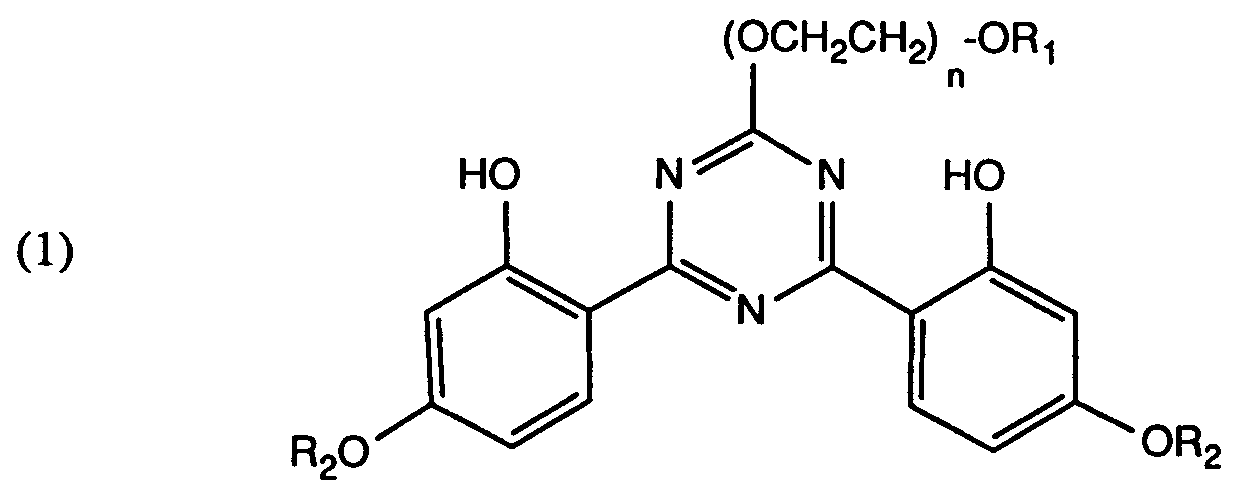
- Gegenstand der vorliegenden Erfindung ist demnach ein Verfahren zur photochemischen und thermischen Stabilisierung von ungefärbten und gefärbten oder bedruckten Polyesterfasermaterialien, das dadurch gekennzeichnet ist, dass man das Fasermaterial mit einer Verbindung der Formel

behandelt, worin - R₁
- Wasserstoff oder C₁-C₅Alkyl,
- R₂
- C₁-C₁₂Alkyl und
- n
- 0 bis 5 bedeuten.
- C₁-C₁₂Alkyl sind geradkettige oder verzweigte Kohlenwasserstoffreste wie z.B. Methyl, Ethyl, n-Propyl, Isopropyl, n-Butyl, sek.Butyl, tert.Butyl, Amyl, Isoamyl oder tert.Amyl, Heptyl, Octyl, Isooctyl, Nonyl, Undecyl oder Dodecyl.
- Bevorzugt werden Verbindungen der Formel (1) eingesetzt, bei denen R₁ und R₂ unabhängig voneinander C₁-C₄Alkyl bedeuten.
- Von besonderem Interesse sind dabei solche Verbindungen, bei denen R₁ und R₂ unabhängig voneinander Methyl oder Ethyl, und ganz besonders solche Verbindungen, bei denen
n = 1 bis 3 bedeutet. - Als Beispiele für Verbindungen der Formel (1) seien genannt:
- 4,6-Bis(2-hydroxy-4-methoxyphenyl)-2-(2-propoxy-ethoxy)-1,3,5-triazin
- 4,6-Bis(2-hydroxy-4-propoxyphenyl)-2-(2-methoxy-ethoxy)-1,3,5-triazin
- 4,6-Bis(2-hydroxy-4-ethoxyphenyl)-2-(2-methoxy-ethoxy)-1,3,5-triazin
- 4,6-Bis(2-hydroxy-4-methoxyphenyl)-2-(2-methoxy-ethoxy)-1,3,5-triazin
- 4,6-Bis(2-hydroxy-4-methoxyphenyl)-2-(2-ethoxy-ethoxy)-1,3,5-triazin
- 4,6-Bis(2-hydroxy-4-methoxyphenyl)-2-[2-(2-ethoxy-ethoxy)-ethoxy]-1,3,5-triazin
- 4,6-Bis(2-hydroxy-4-ethoxyphenyl)-2-(2-ethoxy-ethoxy)-1,3,5-triazin
- 4,6-Bis(2-hydroxy-4-ethoxyphenyl)-2-[2-(2-ethoxy-ethoxy)-ethoxy]-1,3,5-triazin
- 4,6-Bis(2-hydroxy-4-ethoxyphenyl)-2-(2-ethoxy-2-methylethoxy)-1,3,5-triazin
- 4,6-Bis(2-hydroxy-4-methoxyphenyl)-2-{2-[2-(2-ethoxy)ethoxy]ethoxy}ethoxy-triazin
- 4,6-Bis(2-hydroxy-4-ethoxyphenyl)-2-{2-[2-(2-ethoxy)ethoxy]ethoxy}ethoxy-1,3,5-triazin
- 4,6-Bis(2-hydroxy-4-ethoxyphenyl)-2-butoxy-1,3,5-triazin
- Die Herstellung der Verbindungen der Formel (1) geschieht in an sich bekannter Weise durch Umsetzung einer 4,6-Bis(2-hydroxy-4-alkoxyphenyl)-1,3,5-triazinverbindung der Formel
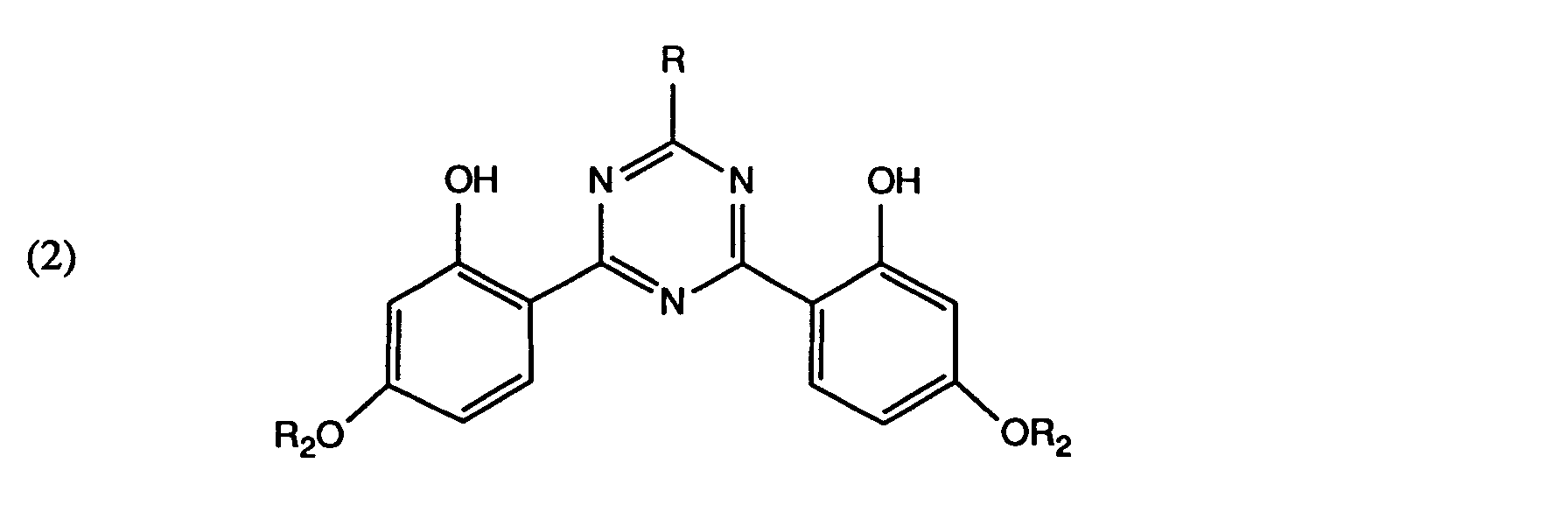
mit einer Verbindung der Formel
(3) M-(OCH₂CH₂)n-OR₁
nach folgendem Schema: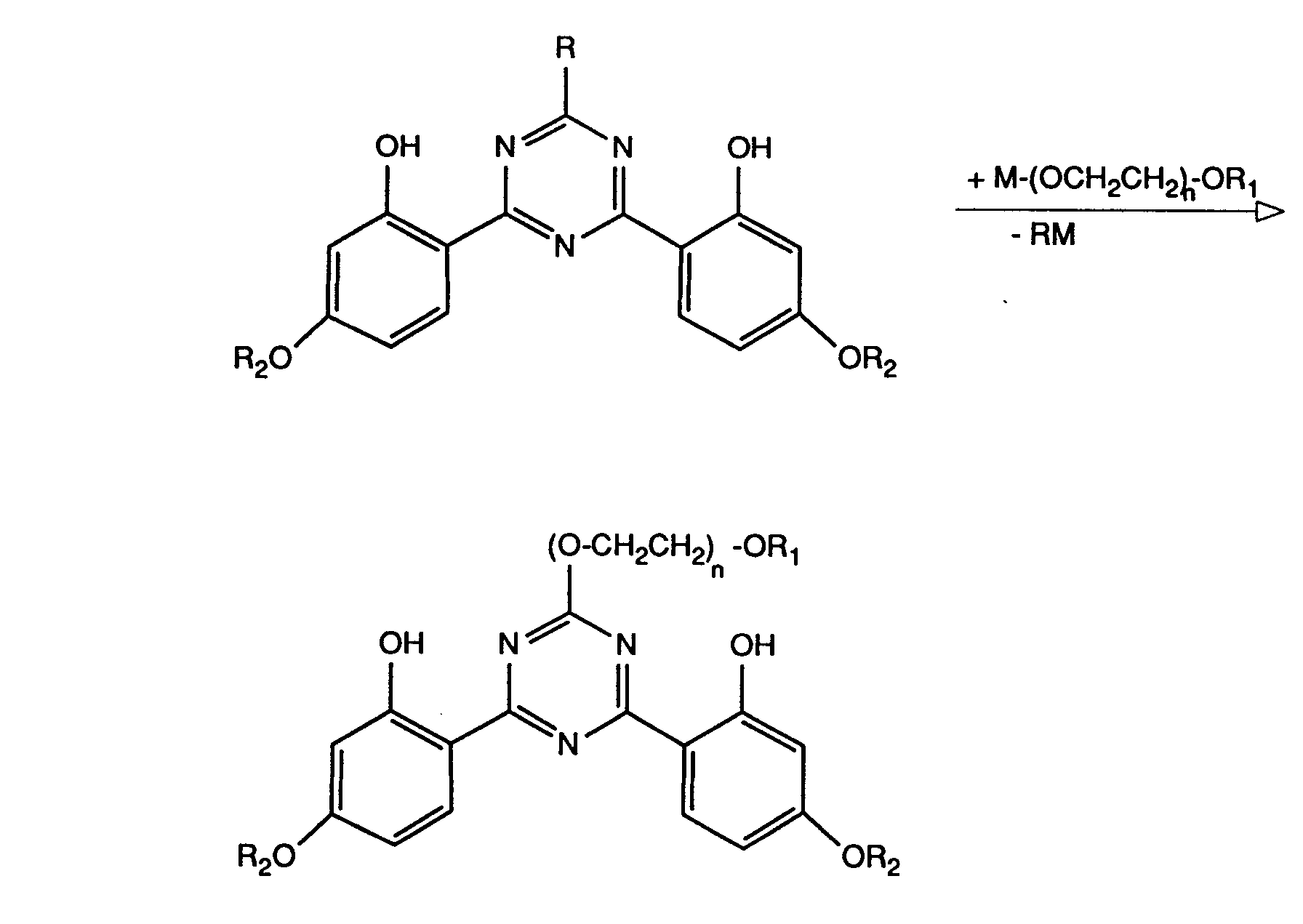
worin - R
- Halogen oder einen Rest der Formel S-R',
- R'
- C₁-C₄Alkyl, Phenyl oder Benzyl,
- R₁
- Wasserstoff oder C₁-C₅Alkyl,
- R₂
- C₁-C₁₂Alkyl,
- M
- Alkalimetall und
- n
- 0 bis 5 bedeuten.
- Vorzugsweise verwendet man Ausgangsverbindungen der Formel (2), bei denen R Thio-C₁-C₄Alkyl, und insbesondere Thiomethyl bedeutet.
- Die Ausgangsverbindungen entsprechend Formel (2) sind bekannt, z.B. aus der CH-436,285. Die Herstellung dieser Ausgangsverbindungen kann z.B. analog dem in der EP-A-0,395,938 beschriebenen Verfahren durch Umsetzung von Cyanurchlorid mit C₁-C₄Alkylmercaptan und der entsprechenden Benzolverbindung erfolgen.
- Unter den Verbindungen der Formel (3) sind die Alkalimetallsalze von Alkoholen der allgemeinen Formel
(3a) H-(OCH₂CH₂)n-OR₁
zu verstehen. In Betracht kommen Polyethylenglykolmonoalkylether mit 1 bis 5, vorzugsweise 1 bis 3 Ethylenoxideinheiten. Als Beispiele seien Ethylenglykolmonoalkylether wie Methyl-, Ethyl- oder Propylcellosolve oder Diethylenglykolmonomethyl-, Diethylenglykolmonoethyl-, Diethylenglykolmonopropyl- oder Diethylenglykolmonobutylether oder die entsprechenden Tri-, Tetra- oder Pentaethylenglykolmonoalkylether genannt. - Ferner können auch gesättige, verzweigte und unverzweigte aliphatische C₁-C₅Monoalkohole eingesetzt werden, wie z.B. Methanol, Ethanol, Propanol, Isopropanol, Butanol, Iso-Butanol, tert.Butylalkohol oder Amylalkohol.
- Die Alkohole werden in Form ihrer Lithium-, Kalium- oder Natriumalsalze eingesetzt, wobei die entsprechenden Natriumalkoholate bevorzugt sind.
- Die Verbindungen der Formel (1) sind teilweise bekannt, z.B. aus der CH-436,285, zum Teil stellen sie auch neue Verbindungen dar.
- Die neuen Verbindungen entsprechen der Formel

worin - R'₁
- Wasserstoff oder C₁-C₅Alkyl,
- R'₂
- C₁-C₁₂Alkyl und
- n'
- 1 bis 5 bedeuten.
- Bevorzugt sind Verbindungen der Formel (1'), worin R'₁ und R'₂ unabhängig voneinander C₁-C₄Alkyl bedeuten.
- Von besonderm Interesse sind solche Verbindungen, bei denen R'₁ und R'₂ unabhängig voneinander Methyl oder Ethyl bedeuten und ganz besonders solche Verbindungen, bei denen
n'= 1 bis 3 bedeutet. - Die erfindungsgemässen UV-Absorber werden in einer Menge von 0,5 bis 7,5 Gew.-%, vorzugsweise 0,2 bis 3, und insbesondere 0,5 bis 2 Gew.-% vom Gewicht des Fasermaterials eingesetzt.
- Die erfindungsgemässen UV-Absorber sind in Wasser schwerlöslich und werden daher in dispergierter Form appliziert. Dazu werden sie mit einem entsprechenden Dispergator z.B. mit Hilfe von Quarzkugeln und einem Schnellrührgerät auf eine Feinheit von 1-2 µm gemahlen.
- Als Dispergatoren für die UV-Absorber der Formel (1) kommen in Betracht:
- saure Ester oder deren Salze von Alkylenoxidaddukten, wie z.B. saure Ester oder deren Salze eines Polyadduktes von 4 bis 40 Mol Ethylenoxid an 1 Mol eines Phenols, oder Phosphorsäureester der Addukte von 6 bis 30 Mol Ethylenoxid an 1 Mol 4-Nonylphenol, 1 Mol Dinonylphenol oder besonders an 1 Mol von Verbindungen, die durch Anlagerung von 1 bis 3 Mol von Styrolen an 1 Mol Phenol hergestellt werden,
- Polystyrolsulfonate,
- Fettsäuretauride,
- alkylierte Diphenyloxid-mono- oder -di-sulfonate,
- Sulfonate von Polycarbonsäureestern,
- mit einer organischen Dicarbonsäure, oder einer anorganischen mehrbasischen Säure in einen sauren Ester übergeführte Anlagerungsprodukte von 1 bis 60, vorzugsweise 2 bis 30 Mol Ethylenoxid und/oder Propylenoxid an Fettamine, Fettamide, Fettsäuren oder Fettalkohole mit je 8 bis 22 Kohlenstoffatomen oder an drei- bis sechswertige Alkohole mit 3 bis 6 Kohlenstoffatomen,
- Ligninsulfonate, und ganz besonders
- Formaldehyd-Kondensationsprodukte wie z.B. Kondensationsprodukte von Ligninsulfonaten und/oder Phenol und Formaldehyd, Kondensationsprodukte von Formaldehyd mit aromatischen Sulfonsäuren, wie z.B. Kondensationsprodukte von Ditolylethersulfonaten und Formaldehyd, Kondensationsprodukte von Naphthalinsulfonsäure und/oder Naphthol- oder Naphthylaminsulfonsäuren mit Formaldehyd, Kondensationsprodukte von Phenolsulfonsäuren und/oder sulfoniertem Dihydroxydiphenylsulfon und Phenolen bzw. Kresolen mit Formaldehyd und/oder Harnstoff, sowie Kondensationsprodukte von Diphenyloxid-disulfonsäure-Derivaten mit Formaldehyd.
- Als Farbstoffe kommen in Wasser nur gering lösliche Dispersionsfarbstoffe in Betracht. Sie liegen deshalb in der Färbeflotte zum größten Teil in Form einer feinen Dispersion vor. Sie können verschiedenen Farbstoffklassen angehören, beispielsweise den Acridon-, Azo-, Anthrachinon-, Cumarin-, Methin-, Perinon-, Naphthochinonimin-, Chinophthalon-, Styryl-, oder Nitrofarbstoffen. Es können auch Mischungen von Dispersionsfarbstoffen erfindungsgemäss eingesetzt werden.
- Als Polyesterfasermaterial, das gefärbt oder bedruckt und mit den genannten UV-Absorbern behandelt werden kann, sind z.B. Celluloseesterfasern, wie z.B. Cellulose-2½-acetatfasern und -triacetatfasern und besonders lineare Polyesterfasern, die eventuell auch sauer modifiziert sind, zu verstehen, die z.B. durch Kondensation von Terephthalsäure mit Ethylenglykol oder von Isophthalsäure oder Terephthalsäure mit 1,4-Bis(hydroxymethyl)-cyclohexan erhalten werden, sowie Mischpolymere aus Terephthal- und Isophthalsäure und Ethylenglykol. Das in der Industrie bisher fast ausschließlich eingesetzte lineare Polyesterfasermaterial besteht aus Terephthalsäure und Ethylenglykol.
- Die Fasermaterialien können auch als Mischgewebe untereinander oder mit anderen Fasern verwendet werden, wie z.B. Mischungen aus Polyacrylnitril/Polyester, Polyamid/Polyester, Polyester/Baumwolle, Polyester/Viskose und Polyester/Wolle, und nach bekannten Verfahren diskontinuierlich oder kontinuierlich gefärbt oder auch bedruckt werden.
- Das Textilmaterial kann in verschiedenen Aufmachungsformen vorliegen. Vorzugsweise kommt Stückware, wie Gewirke oder Gewebe oder auch Garn auf Kreuzspulen, Kettbäumen usw. in Betracht.
- Die Färbungen erfolgen aus wässriger Flotte nach einem kontinuierlichen oder diskontinuierlichen Verfahren. Beim diskontinuierlichen Verfahren kann das Flottenverhältnis in einem weiten Bereich gewählt werden, z.B. 1:4 bis 1:100, vorzugsweise 1:6 bis 1:50. Die Temperatur, bei der gefärbt wird, beträgt mindestens 50°C und in der Regel ist sie nicht höher als 140°C. Vorzugsweise liegt sie im Bereich von 80 bis 135°C.
- Bei kontinuierlichen Färbeverfahren werden die Färbeflotten, die neben den Farbstoffen gegebenenfalls weitere Hilfsmittel enthalten können, auf das Stückmaterial durch beispielsweise Foulardieren oder Pflatschen aufgebracht und mittels Thermofixier- oder HT-Dämpfprozessen entwickelt.
- Lineare Polyesterfasern und Cellulosefasern färbt man vorzugsweise nach dem sogenannten Hochtemperaturverfahren in geschlossenen und druckbeständigen Apparaten bei Temperaturen >100°C, bevorzugt zwischen 110° und 135°C und gegebenenfalls unter Druck. Als geschlossene Gefäße eignen sich beispielsweise Zirkulationsapparaturen wie Kreuzspul- oder Baumfärbeapparate, Haspelkufen, Düsen- oder Trommelfärmaschinen, Muff-Färbeapparate, Paddeln oder Jigger.
- Zum kontinuierlichen Färben werden Foulard oder Pflatschwerke eingesetzt, die Entwicklung erfolgt durch Heissluft im Spannrahmen oder in HT-Dämpfern.
- Cellulose-2½-acetatfasern färbt man vorzugsweise bei Temperaturen von 80-85°C.
- Werden die erfindungsgemässen UV-Absorber in der Färbeapplikation eingesetzt, so erfolgt die Anwendung so, dass man das Fasermaterial zunächst mit diesen Verbindungen behandelt und anschliessend die Färbung durchführt oder vorzugsweise gleichzeitig das Fasermaterial mit dem UV-Absorber und dem Farbstoff im Färbebad behandelt. Die Applikation des UV-Absorbers kann jedoch auch nachträglich auf die fertig hergestellte Färbung mittels Thermofixierung, z.B. bei 190 bis 230°C in einem Zeitraum von 30 Sekunden bis 5 Minuten erfolgen.
- Die Färbeflotten können auch weitere Zusätze, wie z.B. Färbereihilfsmittel, Dispergiermittel, Carrier, Wollschutz- und Netzmittel sowie auch Entschäumer enthalten.
- Die Färbebäder können desweiteren Mineralsäuren, wie z.B. Schwefelsäure oder Phosphorsäure , oder zweckmässigerweise organische Säuren, zum Beispiel aliphatische Carbonsäuren wie Ameisensäure, Essigsäure, Oxalsäure oder Zitronensäure und/oder Salze wie Ammoniumacetat, Ammoniumsulfat oder Natriumacetat enthalten. Die Säuren dienen vor allem der Einstellung des pH-Wertes der erfindungsgemäss verwendeten Flotten, der zwischen 4 und 5 liegt.
- Vorzugsweise lässt man das Fasermaterial während 5 Minuten bei 40 bis 80°C im Bad, das den Farbstoff, den UV-Absorber und gegebenenfalls weitere Zusätze enthält und auf einen pH-Wert von 4,5 bis 5,5 eingestellt ist, vorlaufen, erhöht die Temperatur innerhalb von 10 bis 20 Minuten auf 125 bis 130°C und behandelt für 15 bis 90 Minuten, vorzugsweise 30 Minuten, bei dieser Temperatur weiter.
- Die Fertigstellung der Färbungen erfolgt durch Abkühlen der Färbeflotte auf 50 bis 80°C, Spülen der Färbungen mit Wasser und gegebenenfalls durch Reinigung auf übliche Weise im alkalischen Medium unter reduktiven Bedingungen. Die Färbungen werden dann wiederum gespült und getrocknet. Bei Verwendung von Küpenfarbstoffen für den Celluloseanteil wird die Ware auf übliche Weise zuerst mit Hydrosulfit bei einem pH-Wert von 6 bis 12,5 und dann mit einem Oxidationsmittel behandelt und schließlich ausgewaschen.
- Für die Herstellung von Drucken werden die erfindungsgemässen UV-Absorber in Form ihrer wässrigen Dispersionen den Druckpasten beigemischt. Die Druckpaste enthält dabei den entsprechenden UV-Absorber in Mengen von 0,5 bis 5 %, vorzugsweise 1 bis 2%, bezogen auf das Gewicht der Druckpaste.
- Die Menge der Farbstoffe, die den Druckpasten zugesetzt werden, richtet sich nach der gewünschten Farbnuance; im allgemeinen haben sich Mengen von 0,01 bis 15, vorzugsweise 0,02 bis 10 Gewichtsprozent, bezogen auf das eingesetzte Textilmaterial, bewährt.
- Die Druckpasten enthalten neben den Farbstoffen und der wässrigen UV-Absorber-Dispersion zweckmässigerweise säurestabile Verdickungsmittel, vorzugsweise natürlicher Herkunft wie Kernmehlabkömmlinge, insbesondere Natriumalginat für sich allein oder im Gemisch mit modifizierter Cellulose, insbesondere mit vorzugsweise 20 bis 25 Gewichtsprozent Carboxymethylcellulose. Daneben können die Druckpasten noch Säurespender wie Butyrolacton oder Natriumhydrogenphosphat, Konservierungsmittel, Sequestrier-mittel, Emulgatoren, wasserunlösliche Lösungsmittel, Oxidationsmittel oder Entlüftungsmittel enthalten.
- In Betracht kommen als Konservierungsmittel vor allem Formaldehyd abgebende Mittel, wie z.B. Paraformaldehyd oder Trioxan, vor allem wässrige, etwa 30 bis 40-gewichtsprozentige Formaldehydlösungen, als Sequestriermittel z.B. nitrilotriessigsaures Natrium, ethylendiamintetraessigsaures Natrium, vor allem Natrium-Polymethaphosphat, insbesondere Natrium-Hexamethaphosphat, als Emulgatoren vor allem Addukte aus einem Alkylenoxid und einem Fettalkohol, insbesondere einem Addukt aus Oleylalkohol und Ethylenoxid, als wasserunlösliche Lösungsmittel hochsiedende, gesättigte Kohlenwasserstoffe, vor allem Paraffine mit einem Siedebereich von etwa 160 bis 210°C (sogenannte Lackbenzine), als Oxidationsmittel z.B. eine aromatische Nitroverbindung, vor allem eine aromatische Mono- oder Dinitrocarbonsäure oder -sulfonsäure, die gegebenenfalls als Alkylenoxidaddukt vorliegt, insbesondere eine Nitrobenzolsulfonsäure und als Entlüftungsmittel z.B. hochsiedende Lösungsmittel, vor allem Terpentinöle, höhere Alkohole, vorzugsweise C₈- bis C₁₀-Alkohole, Terpenalkohole oder Entlüftungsmittel auf Basis von Mineral- und/oder Silikonölen, insbesondere Handelsformulierungen aus etwa 15 bis 25 Gewichtsprozent eines Mineral- und Silikonölgemisches und etwa 75 bis 85 Gewichtsprozent eines C₈-Alkohols wie z.B. 2-Ethyl-n-hexanol.
- Beim Bedrucken der Fasermaterialien wird die Druckpaste ganzflächig oder stellenweise direkt auf das Fasermaterial aufgebracht wobei zweckmässigerweise Druckmaschinen üblicher Bauart, z.B. Tiefdruck-, Rotationssiebdruck- und Flachfilmdruckmaschinen eingesetzt werden.
- Das Fasermaterial wird nach dem Bedrucken bei Temperaturen bis 150°C, vorzugsweise 80° bis 120°C getrocknet.
- Anschliessend erfolgt die Fixierung durch eine Wärmebehandlung des Materials bei Temperaturen von vorzugsweise 100° bis 220°C. Die Wärmebehandlung erfolgt im allgemeinen mit überhitztem Wasserdampf unter atmosphärischem Druck.
- Je nach Temperatur kann die Fixierung 20 Sekunden bis 10 Minuten, vorzugsweise 4 bis 8 Minuten erfolgen.
- Die Fertigstellung der Drucke erfolgt ebenfalls auf übliche Weise durch Spülen mit Wasser und kann gegebenenfalls durch zusätzliche Reinigung im alkalischen Medium unter reduktiven Bedingungen, z.B. mittels Natriumdithionit vorgenommen werden. Im letzteren Fall werden die Druckfärbungen wiederum gespült, entwässert und getrocknet.
- Mit dem erfindungsgemässen Verfahren lassen sich hochlichtechte und sublimationsbeständige Polyester-Färbungen und Drucke erzielen. Eine gezielte Vor- oder Nachbehandlung des Fasermaterials ist mit dem erfindungsgemässen Verfahren nicht erforderlich.
- In den folgenden Herstellungsverfahren und Applikationsbeispielen beziehen sich die Prozentsätze auf das Gewicht. Die Mengen beziehen sich bei den Farbstoffen und bei den UV-Absorbem auf Reinsubstanz.
- 3,5 g (0,15 Mol) Natrium werden in 180 ml Propylcellosolve gelöst. Unter Rühren werden 18,6 g (0,05 Mol) 2-Thiomethyl-4,6-bis(2-hydroxy-4-methoxyphenyl)1,3,5-triazin zugegeben und während 4 Stunden bei 83-85°C gerührt. Dann wird die Reaktionsmischung nach dem Abkühlen auf Raumtemperatur auf 200 ml Eiswasser und 170 ml 1n HCl gegossen und abfiltriert. Es wird dann mit Methanol gewaschen und bei 80°C im Vakuumschrank getrocknet. Man erhält 20,6 g eines hellen Produktes der Formel

Ausbeute: 96,4% d.Th.
Fp. 119-120°C
λmax 296/351 nmElementaranalyse: Gefunden: 61,70%C; 5,9% H; 9,9%N Berechnet als C₂₂H₂₅N₃O₆: 61,82%C; 5,89%H; 9,83%N; - Beispiele 2 bis 14: Nach dem in Beispiel 1 beschriebenen Verfahren werden die nachfolgenden Verbindungen (102) bis (114) hergestellt. (Tabelle 1)

- Es werden 15 Muster von je 10 g eines PES-Trikots in einem HT-Färbeapparat, z.B. einem ®Turbomat (Firma Mathis, Niederhasli) bei einem Flottenverhältnis von 1:10 gefärbt. Die Flotten enthalten 2g/l Ammoniumsulfat, 0,5 g/l eines Färbereihilfsmittels, z.B. ®Univadin 3-flex und die Farbstoffe der Formeln (I) bis (IV) in folgenden Mengen:
0,05% des Färbstoffs der Formel
0,025% des Farbstoffs der Formel
0,03% des Farbstoffes der Formel
und
0,025% des Farbstoffes der Formel
- Während die Flotte 1 keine weiteren Zusätze enthält, werben den Flotten 2 bis 15 zusätzlich noch jeweils 2% der formulierten Verbindungen (101) bis (114) zugesetzt.
- Die UV-Absorber werden vor dem Einsatz in der Färbeflotte oder als Druckpaste formuliert. Dazu werden
- die jeweiligen Verbindungen,
- das als Dispergator eingesetzte Kondensationsprodukt aus Naphthalinsulfonsäure und Formaldehyd im Verhältnis 1:1,
- die 2-4 fache Menge Wasser und
- die vierfache Menge Quarzkugeln (⌀ 1mm)
- Die Trikotstücke werden in den dispergierten Flotten in Druckbomben gefärbt. Dazu wird bei 70°C eingegangen und nach einer Behandlungszeit von 5 Minuten innerhalb von 10 Minuten auf 100°C und schließlich innerhalb von 20 Minuten auf 130°C erhitzt. Bei dieser Temperatur färbt man 30 Minuten, kühlt auf 50°C ab und spült warm und kalt. Es folgt eine reduktive Nachreinigung bei 70°C, die innerhalb von 30 Minuten mit 2 ml/l Natronlauge 36 Bé und 3 g/l Natriumdithionit durchgeführt wird. Danach wird erneut warm und kalt gespült, zentrifugiert und getrocknet.
- Zur Ermittlung der Lichtechtheiten werden die Färbungen nach DIN 75.202 (FAKRA) und nach SAE J 1885 belichtet. Die Ergebnisse sind in Tabelle 2 aufgeführt.
Tabelle 2: Lichtechtheiten nach Färbung (Flotte Nr.) FAKRA 3 Cyclen FAKRA 5 cyclen SAE 420 KJ ohne Zusatz 2-3 2 H 1-2 (1) + Verbindung (101) 4 3-4 H 3 H (2) + Verbindung (102) 4 3-4 H 3 H (3) + Verbindung (103) 4 3-4 H 3 H (4) + Verbindung (104) 4 3-4 H 3 H (5) + Verbindung (105) 4 3-4 H 3 H (6) + Verbindung (106) 4 3-4 H 3 H (7) + Verbindung (107) 4 3-4 H 3 H (8) + Verbindung (108) 4 3-4 H 3 H (9) + Verbindung (109) 4 3-4 H 3 H (10) + Verbindung (110) 3-4 3 H 2-3 H (11) + Verbindung (111) 3-4 3 H 2-3 (12) + Verbindung (112) 3-4 3 H 2-3 (13) + Verbindung (113) 4 3 2-3 (14) + Verbindung (114) 4 2-3 2-3 - Aus Tabelle 2 ist ersichtlich, dass die Hellgraufärbungen bei Verwendung der UV-Absorber (101)-(114) hinsichtlich ihrer Lichtechtheitseigenschaften deutlich verbessert werden.
- Zur Bedruckung von PES-Autopolsterstoff werden Druckpasten mit folgender Zusammensetzung verwendet:
750 Teile einer Stammverdickung enthaltend - 9
- Teile Stärkeether als Verdickungsmittel
- 18
- Teile Natriumalginat als Verdickungsmittel
- 3,75
- Teile Natriumdihydrogenphosphat
- 2,48
- Teile Natriumchlorat und
- 716,77
- Teile Wasser.
- Diese Stammverdickung wird vermischt mit
- 6,4
- Teilen des Farbstoffgemisches bestehend aus
- 2,0
- Teilen des Farbstoffes der Formel

- 1,4
- Teilen des Farbstoffes der Formel

- 2,0
- Teilen des Farbstoffes der Formel

- 1,0
- Teilen des Farstoffes der Formel

- 213,6
- Teilen Wasser und
- 30
- Teilen der gemäss Beispiel 15 dispergierten 30%igen UV-Absorberformulierung enthaltend jeweils die Verbindungen (101), (103), (109), (113) und (114).
- Mit diesen Druckpasten werden die vorgereinigten PES-Trikotmuster auf einem Drucktisch nach Zimmer (Hersteller Firma Zimmer, Klagenfurt/Österreich) bedruckt. Diese Muster werden getrocknet und mit überhitztem Dampf bei 180°C während 8 Minuten gedämpft. Danach wird mit kaltem Wasser gespült und bei 70°C 30 Minuten in Bädern mit 2 ml/l Natronlauge 36° Bé und 3 g/l Natriumdithionit reduktiv gereinigt. Abschliessend wird warm und kalt gespült und nach dem Zentrifugieren bei 80°C getrocknet. Die Muster werden auf ihre Lichtechtheiten nach SN-ISO 105 B02 (XENON), nach DM 75.202 (FAKRA) und nach SAE J 1885 (SAE) geprüft. Die Ergebnisse sind in Tabelle 3 zusammengestellt.
Tabelle 3: Lichtechtheiten nach Drucke XENON 800 h FAKRA 4 Cyclen SAE 489 KJ SAE 600 KJ ohne Zusatz 7-8 1-2 RH 1 RH 1 RH (1) + Verbindung (101) 7-8 4 3-4 H 3-4 H (2) + Verbindung (103) 7-8 4 3-4 H 3 H (3) + Verbindung (109) 8 4 3-4 H 3 H (4) + Verbindung (113) 7-8 3 2-3 2-3 (5) + Verbindung (114) 8 3-4 H 3 H 2-3 H - Aus den Ergebnissen der Tabelle 3 ist ersichtlich, dass die eingesetzten UV-Absorber eine deutliche Verbesserung der Heisslichtechtheiten bewirken.
mit einem Schnellrührer so lange gemahlen, bis das Produkt eine Feinheit von 1-2 Nm aufweist. Die Dispersion wird mit einem feinen Maschensieb abgetrennt und mit 0,5% Carboxymethylcellulose stabilisiert und auf 30% eingestellt.
Claims (13)
- Verfahren zur photochemischen und thermischen Stabilisierung von ungefärbten und gefärbten oder bedruckten Polyesterfasermaterialien, dadurch gekennzeichnet, dass man das Fasermaterial mit der Verbindung der Formel
 R₁ Wasserstoff oder C₁-C₅Alkyl,R₂ C₁-C₁₂Alkyl undn 0 bis 5 bedeuten.
 - Verfahren gemäss Anspruch 1, dadurch gekennzeichnet, dass R₁ und R₂ unabhängig voneinander C₁-C₄Alkyl bedeuten.
- Verfahren gemäss Anspruch 1 oder 2, dadurch gekennzeichnet, dass R₁und R₂ unabhängig voneinander Methyl oder Ethyl bedeuten.
- Verfahren gemäss einem der Ansprüche 1 bis 3, dadurch gekennzeichnet, dass n 1 bis 3 bedeutet.
- Verfahren gemäss einem der Ansprüche 1 bis 4, dadurch gekennzeichnet, dass man die Verbindung der Formel (1) in einer Menge von 0,5 bis 7,5 Gew.-% des Fasermaterials verwendet.
- Verfahren gemäss einem der Ansprüche 1 bis 5, dadurch gekennzeichnet, dass man die Verbindung der Formel (1) in der Färbeapplikation direkt dem Färbebad oder der Foulardflotte zusetzt.
- Verfahren gemäss einem der Ansprüche 1 bis 6, dadurch gekennzeichnet, dass man die Verbindung der Formel (1) bei der Drückapplikation der Druckpaste beimischt.
- Verfahren zur Herstellung einer 1,3,5-Triazinverbindung der Formel (1), dadurch gekennzeichnet, dass man eine Triazinverbindung der Formel


 R Halogen oder einen Rest der Formel S-R',R' C₁-C₄Alkyl, Phenyl oder Benzyl,R₁ Wasserstoff oder C₁-C₅Alkyl,R₂ C₁-C₁₂Alkyl,M Alkalimetall undn 0 bis 5 bedeuten.
 - Das gemäss einem der Ansprüche 1 bis 7 behandelte Fasermaterial.
- Hydroxyphenyl-1,3,5-triazinverbindung der Formel
 R'₁ Wasserstoff, C₁-C₅Alkyl,R'₂ C₁-C₁₂Alkyl undn' 1 bis 5 bedeutet.
 - Hydroxyphenyl-1-3-5-triazin gemäss Anspruch 10, dadurch gekennzeichnet, dass R'₁ und R'₂ unabhängig voneinander C₁-C₄Alkyl bedeuten.
- Verbindungen gemäss Anspruch 10 oder 11, dadurch gekennzeichnet, dass R'₁und R'₂ unabhängig voneinander Methyl oder Ethyl bedeuten.
- Verbindungen gemäss einem der Ansprüche 10 bis 12, dadurch gekennzeichnet, dass n' 1 bis 3 bedeutet.
Applications Claiming Priority (2)
| Application Number | Priority Date | Filing Date | Title |
|---|---|---|---|
| CH54192 | 1992-02-21 | ||
| CH541/92 | 1992-02-21 |
Publications (2)
| Publication Number | Publication Date |
|---|---|
| EP0557247A1 true EP0557247A1 (de) | 1993-08-25 |
| EP0557247B1 EP0557247B1 (de) | 1997-03-26 |
Family
ID=4189381
Family Applications (1)
| Application Number | Title | Priority Date | Filing Date |
|---|---|---|---|
| EP93810090A Expired - Lifetime EP0557247B1 (de) | 1992-02-21 | 1993-02-12 | Verfahren zur photochemischen und thermischen Stabilisierung von ungefärbten und gefärbten oder bedruckten Polyesterfasermaterialien |
Country Status (8)
| Country | Link |
|---|---|
| US (2) | US5298030A (de) |
| EP (1) | EP0557247B1 (de) |
| JP (1) | JP3258113B2 (de) |
| KR (1) | KR930018096A (de) |
| AT (1) | ATE150813T1 (de) |
| BR (1) | BR9300628A (de) |
| DE (1) | DE59305918D1 (de) |
| ES (1) | ES2100509T3 (de) |
Cited By (4)
| Publication number | Priority date | Publication date | Assignee | Title |
|---|---|---|---|---|
| US5585422A (en) * | 1995-09-20 | 1996-12-17 | Ciba-Geigy Corporation | Hybrid s-triazine light stabilizers substituted by benzotriazole or benzophenone moieties and compositions stabilized therewith |
| EP0949251A1 (de) * | 1998-04-09 | 1999-10-13 | Ciba SC Holding AG | Diresorcinyltriazine als Lichtschutzmittel |
| EP1736593A3 (de) * | 2005-06-24 | 2007-11-14 | ALCANTARA S.p.A. | Mikrofaseriges, wildlederartiges Vliesstoff mit einer hoher Lichtechtheit und Verfahren zu dessen Herstellung |
| WO2010081625A2 (en) | 2009-01-19 | 2010-07-22 | Basf Se | Organic black pigments and their preparation |
Families Citing this family (38)
| Publication number | Priority date | Publication date | Assignee | Title |
|---|---|---|---|---|
| US5721287A (en) | 1993-08-05 | 1998-02-24 | Kimberly-Clark Worldwide, Inc. | Method of mutating a colorant by irradiation |
| US5681380A (en) | 1995-06-05 | 1997-10-28 | Kimberly-Clark Worldwide, Inc. | Ink for ink jet printers |
| US5865471A (en) | 1993-08-05 | 1999-02-02 | Kimberly-Clark Worldwide, Inc. | Photo-erasable data processing forms |
| US6211383B1 (en) | 1993-08-05 | 2001-04-03 | Kimberly-Clark Worldwide, Inc. | Nohr-McDonald elimination reaction |
| US5700850A (en) | 1993-08-05 | 1997-12-23 | Kimberly-Clark Worldwide | Colorant compositions and colorant stabilizers |
| US5733693A (en) | 1993-08-05 | 1998-03-31 | Kimberly-Clark Worldwide, Inc. | Method for improving the readability of data processing forms |
| US6017471A (en) | 1993-08-05 | 2000-01-25 | Kimberly-Clark Worldwide, Inc. | Colorants and colorant modifiers |
| US5645964A (en) | 1993-08-05 | 1997-07-08 | Kimberly-Clark Corporation | Digital information recording media and method of using same |
| US6017661A (en) | 1994-11-09 | 2000-01-25 | Kimberly-Clark Corporation | Temporary marking using photoerasable colorants |
| US5773182A (en) | 1993-08-05 | 1998-06-30 | Kimberly-Clark Worldwide, Inc. | Method of light stabilizing a colorant |
| CH686305A5 (de) * | 1993-09-28 | 1996-02-29 | Ciba Geigy Ag | Verfahren zur Herstellung von 1,3,5-Triazinen. |
| US5685754A (en) | 1994-06-30 | 1997-11-11 | Kimberly-Clark Corporation | Method of generating a reactive species and polymer coating applications therefor |
| US6242057B1 (en) | 1994-06-30 | 2001-06-05 | Kimberly-Clark Worldwide, Inc. | Photoreactor composition and applications therefor |
| US6071979A (en) | 1994-06-30 | 2000-06-06 | Kimberly-Clark Worldwide, Inc. | Photoreactor composition method of generating a reactive species and applications therefor |
| CA2144792C (en) * | 1994-07-14 | 2000-05-02 | Masato Nakamae | Aqueous emulsion |
| US6008268A (en) | 1994-10-21 | 1999-12-28 | Kimberly-Clark Worldwide, Inc. | Photoreactor composition, method of generating a reactive species, and applications therefor |
| US5837429A (en) | 1995-06-05 | 1998-11-17 | Kimberly-Clark Worldwide | Pre-dyes, pre-dye compositions, and methods of developing a color |
| US5786132A (en) | 1995-06-05 | 1998-07-28 | Kimberly-Clark Corporation | Pre-dyes, mutable dye compositions, and methods of developing a color |
| AU5535296A (en) | 1995-06-28 | 1997-01-30 | Kimberly-Clark Worldwide, Inc. | Novel colorants and colorant modifiers |
| US5782963A (en) | 1996-03-29 | 1998-07-21 | Kimberly-Clark Worldwide, Inc. | Colorant stabilizers |
| US6099628A (en) | 1996-03-29 | 2000-08-08 | Kimberly-Clark Worldwide, Inc. | Colorant stabilizers |
| US5855655A (en) | 1996-03-29 | 1999-01-05 | Kimberly-Clark Worldwide, Inc. | Colorant stabilizers |
| PL321573A1 (en) | 1995-11-28 | 1997-12-08 | Kimberly Clark Co | Improved stabilising agents for dyes |
| US5891229A (en) | 1996-03-29 | 1999-04-06 | Kimberly-Clark Worldwide, Inc. | Colorant stabilizers |
| US20020019183A1 (en) * | 1997-02-12 | 2002-02-14 | Demott Roy P. | Release barrier fabrics |
| EP0864687A3 (de) * | 1997-03-11 | 1999-11-24 | Ciba SC Holding AG | Verfahren zur Verbesserung der photochemischen Stabilität von Färbungen und Drucken auf Polyesterfasern |
| US6524379B2 (en) | 1997-08-15 | 2003-02-25 | Kimberly-Clark Worldwide, Inc. | Colorants, colorant stabilizers, ink compositions, and improved methods of making the same |
| AU4320799A (en) | 1998-06-03 | 1999-12-20 | Kimberly-Clark Worldwide, Inc. | Neonanoplasts and microemulsion technology for inks and ink jet printing |
| SK1552000A3 (en) | 1998-06-03 | 2000-08-14 | Kimberly Clark Co | Novel photoinitiators and applications therefor |
| US6228157B1 (en) | 1998-07-20 | 2001-05-08 | Ronald S. Nohr | Ink jet ink compositions |
| CA2353685A1 (en) | 1998-09-28 | 2000-04-06 | Kimberly-Clark Worldwide, Inc. | Chelates comprising chinoid groups as photoinitiators |
| WO2000042110A1 (en) | 1999-01-19 | 2000-07-20 | Kimberly-Clark Worldwide, Inc. | Novel colorants, colorant stabilizers, ink compositions, and improved methods of making the same |
| US6331056B1 (en) | 1999-02-25 | 2001-12-18 | Kimberly-Clark Worldwide, Inc. | Printing apparatus and applications therefor |
| US6294698B1 (en) | 1999-04-16 | 2001-09-25 | Kimberly-Clark Worldwide, Inc. | Photoinitiators and applications therefor |
| US6368395B1 (en) | 1999-05-24 | 2002-04-09 | Kimberly-Clark Worldwide, Inc. | Subphthalocyanine colorants, ink compositions, and method of making the same |
| KR101045388B1 (ko) * | 2009-04-30 | 2011-06-30 | 웅진케미칼 주식회사 | 항균성을 부여한 염색방법 |
| TWI835843B (zh) * | 2018-10-03 | 2024-03-21 | 瑞士商亨斯邁紡織染化(瑞士)有限公司 | 新的經吡啶及經嘧啶取代之三uv吸收劑 |
| JP6923211B2 (ja) * | 2018-12-27 | 2021-08-18 | 東英産業株式会社 | 繊維部材、ブラシ部材、フィルター部材、シール部材及び画像形成装置 |
Citations (2)
| Publication number | Priority date | Publication date | Assignee | Title |
|---|---|---|---|---|
| FR1386624A (fr) * | 1963-01-25 | 1965-01-22 | Ciba Geigy | Nouvelles aryl-1, 3, 5-triazines, leur procédé d'obtention et leur emploi |
| EP0395938A2 (de) * | 1989-04-21 | 1990-11-07 | Ciba-Geigy Ag | Verfahren zur Herstellung von 2-(2',4'-Dihydroxyphenyl)-4,6-diaryl-s-triazinen |
Family Cites Families (6)
| Publication number | Priority date | Publication date | Assignee | Title |
|---|---|---|---|---|
| CH436285A (de) | 1963-01-25 | 1967-05-31 | Ciba Geigy | Verwendung von neuen Aryl-1,3,5-triazinen als Schutzmittel gegen Ultraviolettstrahlung für nicht-textile organische Materialien |
| AU573053B2 (en) * | 1984-12-07 | 1988-05-26 | Commonwealth Scientific And Industrial Research Organisation | Sulfonated triazine as photostabilisers on fibres and leather |
| US4831068A (en) * | 1987-02-27 | 1989-05-16 | Ciba-Geigy Corporation | Process for improving the photochemical stability of dyeings on polyester fibre materials |
| US4950304A (en) * | 1987-10-02 | 1990-08-21 | Ciba-Geigy Corporation | Process for quenching or suppressing the fluorescence of substrates treated with fluorescent whitening agents |
| WO1991010006A1 (en) * | 1990-01-02 | 1991-07-11 | Invicta Group Industries Pty Ltd | Textile treatment |
| DE59108923D1 (de) * | 1990-09-13 | 1998-02-19 | Ciba Geigy Ag | Photochemisches Stabilisieren von Wolle |
-
1993
- 1993-02-10 US US08/015,948 patent/US5298030A/en not_active Expired - Fee Related
- 1993-02-12 AT AT93810090T patent/ATE150813T1/de not_active IP Right Cessation
- 1993-02-12 EP EP93810090A patent/EP0557247B1/de not_active Expired - Lifetime
- 1993-02-12 ES ES93810090T patent/ES2100509T3/es not_active Expired - Lifetime
- 1993-02-12 DE DE59305918T patent/DE59305918D1/de not_active Expired - Fee Related
- 1993-02-18 BR BR9300628A patent/BR9300628A/pt not_active Application Discontinuation
- 1993-02-19 KR KR1019930002303A patent/KR930018096A/ko not_active Withdrawn
- 1993-02-19 JP JP02952993A patent/JP3258113B2/ja not_active Expired - Fee Related
- 1993-12-30 US US08/175,801 patent/US5387683A/en not_active Expired - Fee Related
Patent Citations (2)
| Publication number | Priority date | Publication date | Assignee | Title |
|---|---|---|---|---|
| FR1386624A (fr) * | 1963-01-25 | 1965-01-22 | Ciba Geigy | Nouvelles aryl-1, 3, 5-triazines, leur procédé d'obtention et leur emploi |
| EP0395938A2 (de) * | 1989-04-21 | 1990-11-07 | Ciba-Geigy Ag | Verfahren zur Herstellung von 2-(2',4'-Dihydroxyphenyl)-4,6-diaryl-s-triazinen |
Non-Patent Citations (1)
| Title |
|---|
| CHEMICAL ABSTRACTS, vol. 77, no. 4, 24. Juli 1972, Columbus, Ohio, US; abstract no. 21432, KUSUSE ET AL. 'Triazine antistatiic agents for sythetic fibers.' Seite 107 ; * |
Cited By (4)
| Publication number | Priority date | Publication date | Assignee | Title |
|---|---|---|---|---|
| US5585422A (en) * | 1995-09-20 | 1996-12-17 | Ciba-Geigy Corporation | Hybrid s-triazine light stabilizers substituted by benzotriazole or benzophenone moieties and compositions stabilized therewith |
| EP0949251A1 (de) * | 1998-04-09 | 1999-10-13 | Ciba SC Holding AG | Diresorcinyltriazine als Lichtschutzmittel |
| EP1736593A3 (de) * | 2005-06-24 | 2007-11-14 | ALCANTARA S.p.A. | Mikrofaseriges, wildlederartiges Vliesstoff mit einer hoher Lichtechtheit und Verfahren zu dessen Herstellung |
| WO2010081625A2 (en) | 2009-01-19 | 2010-07-22 | Basf Se | Organic black pigments and their preparation |
Also Published As
| Publication number | Publication date |
|---|---|
| US5298030A (en) | 1994-03-29 |
| KR930018096A (ko) | 1993-09-21 |
| ES2100509T3 (es) | 1997-06-16 |
| EP0557247B1 (de) | 1997-03-26 |
| DE59305918D1 (de) | 1997-04-30 |
| ATE150813T1 (de) | 1997-04-15 |
| BR9300628A (pt) | 1993-08-24 |
| JP3258113B2 (ja) | 2002-02-18 |
| US5387683A (en) | 1995-02-07 |
| JPH062271A (ja) | 1994-01-11 |
Similar Documents
| Publication | Publication Date | Title |
|---|---|---|
| EP0557247B1 (de) | Verfahren zur photochemischen und thermischen Stabilisierung von ungefärbten und gefärbten oder bedruckten Polyesterfasermaterialien | |
| EP0490819B1 (de) | Wässrige Dispersion schwerlöslicher UV-Absorber | |
| EP0280653A1 (de) | Verfahren zur Verbesserung der fotochemischen Stabilität von Färbungen auf Polyesterfasermaterialien | |
| EP0280654B1 (de) | Verfahren zur Verbesserung der fotochemischen Stabilität von Färbungen auf Polyesterfasermaterialien | |
| CH666275A5 (de) | Acetylerythromycinstearat, verfahren zu dessen herstellung und dieses enthaltende arzneimittel. | |
| EP0382138B1 (de) | Hilfsmittelgemisch und seine Verwendung beim Färben von synthetischen Fasermaterialien | |
| DE2520527B2 (de) | Wäßrige Präparate von in Wasser unlöslichen bis schwerlöslichen Farbstoffen oder optischen Aufhellern sowie deren Herstellung und Verwendung | |
| EP0584044B1 (de) | Verfahren zur photochemischen und thermischen Stabilisierung von ungefärbten und gefärbten Polyesterfasermaterialien | |
| EP0474595B1 (de) | Wässrige Dispersion schwerlöslicher UV-Absorber | |
| EP0657577A1 (de) | Verfahren zur photochemischen und thermischen Stabilisierung von ungefärbten und gefärbten oder bedruckten Polyesterfasermaterialien | |
| EP0964096A2 (de) | Verfahren zur Verbesserung der photochemischen und thermischen Stabilität von Färbungen und Drucken auf Polyesterfasermaterialien | |
| EP0523006B1 (de) | Verfahren zum Bedrucken und photochemischen Stabilisieren von Polyesterfasermaterialien | |
| CH516967A (de) | Zusatzgerät an einem Schneidbrenner | |
| CH680791A5 (de) | ||
| EP0279272B1 (de) | Mischungen von Monoazofarbstoffen | |
| EP0354174A1 (de) | Stabile, wässrige Zusammensetzung zur Verbesserung der Lichtechtheit | |
| EP0414631A1 (de) | Hilfsmittelgemisch und seine Verwendung beim Färben von Polyesterfasermaterialien | |
| EP0064029B1 (de) | Hilfsmittelgemisch und seine Verwendung als Faltenfreimittel beim Färben oder optischen Aufhellen von Polyesterfasern enthaltenden Textilmaterialien | |
| EP0864687A2 (de) | Verfahren zur Verbesserung der photochemischen Stabilität von Färbungen und Drucken auf Polyesterfasern | |
| EP0507732B1 (de) | Asymmetrisches Oxalsäure-diarylamid | |
| EP0962586A1 (de) | Verfahren zur Verbesserung der photochemischen und thermischen Stabilität von Färbungen und Drucken auf Polyesterfasermaterialien | |
| DE1644500C3 (de) | 15.04.65 Schweiz 5304-65 Verfahren zur Herstellung von Dispersionsfarbstoffen der Anthrachinonreihe | |
| DE2724644B2 (de) | Verfahren zum Farben von wollhaltigen Fasermaterialien | |
| AT230839B (de) | Verfahren zum Färben und Bedrucken von synthetischem Fasermaterial | |
| DE1278637B (de) | Farbstoffe und deren Verwendung zum Faerben und Bedrucken von synthetischen Fasermaterialien |
Legal Events
| Date | Code | Title | Description |
|---|---|---|---|
| PUAI | Public reference made under article 153(3) epc to a published international application that has entered the european phase |
Free format text: ORIGINAL CODE: 0009012 |
|
| AK | Designated contracting states |
Kind code of ref document: A1 Designated state(s): AT BE CH DE ES FR GB IT LI SE |
|
| RIN1 | Information on inventor provided before grant (corrected) |
Inventor name: REINEHR, DIETER, DR. Inventor name: REINERT, GERHARD, DR. Inventor name: BURDESKA, KURT, DR. |
|
| 17P | Request for examination filed |
Effective date: 19940124 |
|
| 17Q | First examination report despatched |
Effective date: 19941216 |
|
| GRAG | Despatch of communication of intention to grant |
Free format text: ORIGINAL CODE: EPIDOS AGRA |
|
| GRAH | Despatch of communication of intention to grant a patent |
Free format text: ORIGINAL CODE: EPIDOS IGRA |
|
| GRAH | Despatch of communication of intention to grant a patent |
Free format text: ORIGINAL CODE: EPIDOS IGRA |
|
| RAP1 | Party data changed (applicant data changed or rights of an application transferred) |
Owner name: CIBA SC HOLDING AG |
|
| GRAA | (expected) grant |
Free format text: ORIGINAL CODE: 0009210 |
|
| RAP3 | Party data changed (applicant data changed or rights of an application transferred) |
Owner name: CIBA SPECIALTY CHEMICALS HOLDING INC. |
|
| ITF | It: translation for a ep patent filed | ||
| AK | Designated contracting states |
Kind code of ref document: B1 Designated state(s): AT BE CH DE ES FR GB IT LI SE |
|
| REF | Corresponds to: |
Ref document number: 150813 Country of ref document: AT Date of ref document: 19970415 Kind code of ref document: T |
|
| REG | Reference to a national code |
Ref country code: CH Ref legal event code: EP |
|
| ET | Fr: translation filed | ||
| REF | Corresponds to: |
Ref document number: 59305918 Country of ref document: DE Date of ref document: 19970430 |
|
| GBT | Gb: translation of ep patent filed (gb section 77(6)(a)/1977) |
Effective date: 19970516 |
|
| REG | Reference to a national code |
Ref country code: ES Ref legal event code: FG2A Ref document number: 2100509 Country of ref document: ES Kind code of ref document: T3 |
|
| PGFP | Annual fee paid to national office [announced via postgrant information from national office to epo] |
Ref country code: SE Payment date: 19980105 Year of fee payment: 6 |
|
| PGFP | Annual fee paid to national office [announced via postgrant information from national office to epo] |
Ref country code: GB Payment date: 19980121 Year of fee payment: 6 |
|
| PLBE | No opposition filed within time limit |
Free format text: ORIGINAL CODE: 0009261 |
|
| STAA | Information on the status of an ep patent application or granted ep patent |
Free format text: STATUS: NO OPPOSITION FILED WITHIN TIME LIMIT |
|
| PGFP | Annual fee paid to national office [announced via postgrant information from national office to epo] |
Ref country code: ES Payment date: 19980217 Year of fee payment: 6 |
|
| PGFP | Annual fee paid to national office [announced via postgrant information from national office to epo] |
Ref country code: AT Payment date: 19980227 Year of fee payment: 6 |
|
| 26N | No opposition filed | ||
| PG25 | Lapsed in a contracting state [announced via postgrant information from national office to epo] |
Ref country code: GB Free format text: LAPSE BECAUSE OF NON-PAYMENT OF DUE FEES Effective date: 19990212 Ref country code: AT Free format text: LAPSE BECAUSE OF NON-PAYMENT OF DUE FEES Effective date: 19990212 |
|
| PG25 | Lapsed in a contracting state [announced via postgrant information from national office to epo] |
Ref country code: SE Free format text: LAPSE BECAUSE OF NON-PAYMENT OF DUE FEES Effective date: 19990213 Ref country code: ES Free format text: LAPSE BECAUSE OF NON-PAYMENT OF DUE FEES Effective date: 19990213 |
|
| GBPC | Gb: european patent ceased through non-payment of renewal fee |
Effective date: 19990212 |
|
| EUG | Se: european patent has lapsed |
Ref document number: 93810090.6 |
|
| REG | Reference to a national code |
Ref country code: ES Ref legal event code: FD2A Effective date: 20010503 |
|
| PGFP | Annual fee paid to national office [announced via postgrant information from national office to epo] |
Ref country code: FR Payment date: 20020110 Year of fee payment: 10 Ref country code: CH Payment date: 20020110 Year of fee payment: 10 |
|
| PGFP | Annual fee paid to national office [announced via postgrant information from national office to epo] |
Ref country code: DE Payment date: 20020121 Year of fee payment: 10 |
|
| PGFP | Annual fee paid to national office [announced via postgrant information from national office to epo] |
Ref country code: BE Payment date: 20020418 Year of fee payment: 10 |
|
| PG25 | Lapsed in a contracting state [announced via postgrant information from national office to epo] |
Ref country code: LI Free format text: LAPSE BECAUSE OF NON-PAYMENT OF DUE FEES Effective date: 20030228 Ref country code: CH Free format text: LAPSE BECAUSE OF NON-PAYMENT OF DUE FEES Effective date: 20030228 Ref country code: BE Free format text: LAPSE BECAUSE OF NON-PAYMENT OF DUE FEES Effective date: 20030228 |
|
| PG25 | Lapsed in a contracting state [announced via postgrant information from national office to epo] |
Ref country code: DE Free format text: LAPSE BECAUSE OF NON-PAYMENT OF DUE FEES Effective date: 20030902 |
|
| REG | Reference to a national code |
Ref country code: CH Ref legal event code: PL |
|
| PG25 | Lapsed in a contracting state [announced via postgrant information from national office to epo] |
Ref country code: FR Free format text: LAPSE BECAUSE OF NON-PAYMENT OF DUE FEES Effective date: 20031031 |
|
| REG | Reference to a national code |
Ref country code: FR Ref legal event code: ST |
|
| PG25 | Lapsed in a contracting state [announced via postgrant information from national office to epo] |
Ref country code: IT Free format text: LAPSE BECAUSE OF NON-PAYMENT OF DUE FEES;WARNING: LAPSES OF ITALIAN PATENTS WITH EFFECTIVE DATE BEFORE 2007 MAY HAVE OCCURRED AT ANY TIME BEFORE 2007. THE CORRECT EFFECTIVE DATE MAY BE DIFFERENT FROM THE ONE RECORDED. Effective date: 20050212 |