EP0559100A2 - Datenverteilungsverfahren und -gerät - Google Patents
Datenverteilungsverfahren und -gerät Download PDFInfo
- Publication number
- EP0559100A2 EP0559100A2 EP19930103099 EP93103099A EP0559100A2 EP 0559100 A2 EP0559100 A2 EP 0559100A2 EP 19930103099 EP19930103099 EP 19930103099 EP 93103099 A EP93103099 A EP 93103099A EP 0559100 A2 EP0559100 A2 EP 0559100A2
- Authority
- EP
- European Patent Office
- Prior art keywords
- data
- group
- devices
- information
- memories
- Prior art date
- Legal status (The legal status is an assumption and is not a legal conclusion. Google has not performed a legal analysis and makes no representation as to the accuracy of the status listed.)
- Granted
Links
Images




Classifications
-
- G—PHYSICS
- G06—COMPUTING OR CALCULATING; COUNTING
- G06F—ELECTRIC DIGITAL DATA PROCESSING
- G06F12/00—Accessing, addressing or allocating within memory systems or architectures
-
- G—PHYSICS
- G06—COMPUTING OR CALCULATING; COUNTING
- G06F—ELECTRIC DIGITAL DATA PROCESSING
- G06F9/00—Arrangements for program control, e.g. control units
- G06F9/06—Arrangements for program control, e.g. control units using stored programs, i.e. using an internal store of processing equipment to receive or retain programs
- G06F9/46—Multiprogramming arrangements
- G06F9/50—Allocation of resources, e.g. of the central processing unit [CPU]
- G06F9/5083—Techniques for rebalancing the load in a distributed system
Definitions
- the present invention relates to a data distribution method for use in a data distribution apparatus which is capable of equally distributing the data processing loads of a large amount of data or work units over a group of memories and enabling efficient parallel processing of a large amount of data or work units.
- Fig. 4 illustrates the coupling units employed in the data distribution apparatus proposed in Japanese Patent Application No.185561/90.
- reference numeral 1 denotes a coupling unit
- numerals 2 and 3 two data input lines of the coupling unit
- numerals 4 and 5 two data output lines of the coupling unit
- numeral 6 a switch for switching the data connecting patterns in the coupling unit
- numeral 7 a group of counters corresponding to each kind of data or work unit
- numeral 8 the control unit which serves to control the group of counters and switch the data connecting patterns in accordance with the contents of the counter group 7.
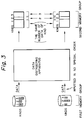
- FIG. 5 illustrates two data connection patterns that are realized by the switch 6 in the coupling unit 1.
- the upper pattern corresponds to "parallel pattern”
- the lower pattern corresponds to "cross pattern”.
- Fig. 6 illustrates the general constitution of the conventional data distribution apparatus.
- reference numeral 9 denotes a data distribution apparatus, numeral 10 a first memory group and numeral 11 a second memory group.
- coupling units 1 are arranged in a matrix comprising 4 ⁇ 3 rows.
- a data distributing apparatus comprising a group of coupling units which are arranged in a matrix of (N/2) x log2N rows.
- the first memory group is adapted to store at a minimum the data or the work units to be processed.
- the second memory group is used as a tentative storage area for processing the data or the work units stored in the first memory group.
- a plurality of coupling units 1 are used for equally distributing in the second memory group 11 the data or work units that are stored in the first memory group 10.
- each of the data belongs to any of the kinds from 0 to K-1.
- Nx/N number of data for each memory are transferred to the second group 11 of memories.
- Each coupling unit 1 in the first row sets either one of the two connection patterns for the switch 6 shown in Fig. 5, according to the instruction from the control circuit 8, to move the input data in accordance with the switch 6 which has been set and transfer the data to the coupling units in the second row which is connected to the coupling unit 1 concerned, through either of the data output lines 4 or 5, thence repeats this operation.
- the respective coupling units 1 in the second row and those in the subsequent rows also repeat a similar operation. Data that are output through either of the data output lines 4 or 5 of each coupling unit 1 belonging to the final row are stored separately in the respective corresponding memories in the second memory group 2 while being arranged according to kind.
- the count of the X-th counter in the counter group 7 is positive at a certain point in time, it means that the majority of the data of the X-th kind output from the coupling unit 1 up to that time was delivered through the data output line 4.
- the count of the counter in the counter group 7 is "0" it means that only half of the number of the data of the X-th kind output from this coupling unit 1 up to that time were delivered through the data output line 4, and the remaining half of the data were delivered through the data output line 5. It is therefore to be noted that as a result, data belonging to the X kind are equally distributed and output as far as this coupling unit 1 is concerned.
- the count of the counter in the counter group 7 is negative, it means that the majority of the data was delivered through the data output line 5.
- the counts of the counters in the counter group 7 are "1", "5", "0", and "-2" respectively.
- the counter group 7 controls the condition of local distribution of the data delivered through the two output lines 4 and 5 of the coupling unit 1 concerned for each kind of data. It is necessary, in order to realize equal distribution of data for each kind, to output the same number of data for each kind to each of the output lines in the coupling unit, which is equivalent to the fact that the counts of all the counters in the group 7 are all "0" at the time of completion of data distribution.
- the control circuit 8 of the respective coupling unit seeks the difference in the counter values corresponding to the kind of incoming data each time data are transmitted to the data input line 2 or the data input line 3. If the counter value is positive or zero, the control unit 8 connects the data input lines 2 or 3 to the data output lines 5 or 4, respectively. If said value is negative, the control circuit connects the data input lines 2 and 3 to the data output lines 4 and 5, respectively, thereby determining the connection patterns for the switch 6.
- the data which have been sent to the data input lines 2 or 3 are delivered to the data output lines 4 and 5 in accordance with the thus determined connection patterns for the switch 6, and further delivered to the group of coupling units connected to these data output lines.
- the number of data or work units may be equally distributed.
- the processing load of the data or the work units varies depending on their contents, the processing load will not be equal if, in actuality, the data processing is executed by the second group 11 of memories.
- the processing time is determined by completion of processing by the memory in the second memory group 11 which is the most heavily loaded and takes the longest processing time, resulting in extended processing time. It was also a problem that many of the memories in the second memory group caused the working efficiency to be lowered. Under these circumstances, if a large number of data or work units are to be processed, the processing efficiency is lowered.
- the present invention has been proposed to eliminate the problems pointed out above, and it is an object of the present invention to provide a data distribution method which improves the efficiency of processing a large amount of data by equalizing not the number of data or work units, but the processing load of the data or the work units distributed between the memories in the second memory group 11.
- the data distribution method of the present invention which includes a plurality of coupling units which are provided between a first group of memories and a second group of memories and adapted to distribute a plurality of data or work units from the first group of memories to the second group of memories in accordance with a predetermined rule, said data distributing method further including a group of memories 12 adapted to add the weighted values representing the data processing load for each kind of data or work unit to be distributed to said second group of memories and store the cumulative values of said weighted values for each kind of data, and a control means (the control circuit 13) to switch and control the data connecting patterns of said coupling units in accordance with the contents stored in said group of memories, wherein said control means is adapted to detect any deviation in the processing load of the data or the work units distributed to said second group of memories and compensate said deviation by switching the data connecting pattern of said coupling units, thereby so controlling such that the data processing load at the second group of memories may be equalized.
- the data distributing method includes a group of memories 12 for each coupling unit 1 whereby the cumulative values of the weighted values of the processing load of the data or the work units output from said coupling units are stored for each kind of data.
- the control circuit 13 for each coupling unit is adapted to detect any deviation in the processing load of the data or the work units transferred from the first group of memories to the second group of memories in accordance with the contents stored in said group of memories, switch the data connection patterns of the coupling units so as to compensate said deviation and so control the distribution of the data or the work units in the second group of memories.
- weighted values representing the processing load of the data or the work units are input to the coupling units together with the data or the work units, and the data or the work units are distributed in the coupling units in such a manner that the processing load of the data or the work units may be equalized for each kind of data or work unit by accumulating not the number of data or work units, but the weighted values of the data or the work units.
- Fig. 1 illustrates the constitution of the coupling units employed in the data distribution apparatus which utilizes the data distribution method according to an embodiment of the present invention.
- Fig. 2 is a flow chart illustrating the operation of the control circuit shown in Fig. 1.
- Fig. 3 illustrates the constitution showing the concept of Fig. 1 to explain the difference of the present invention from a prior art.
- Fig. 4 illustrates the constitution of the coupling units provided in a conventional data distribution apparatus.
- Fig. 5 illustrates the constitution explaining the data connecting patterns in the coupling units shown in Fig. 4.
- Fig. 6 illustrates the overall constitution of a conventional data distribution apparatus.
- Fig. 1 illustrates a coupling unit to be provided in the data distributing apparatus which employs the data distributing method of the present invention.
- reference numeral 1 denotes a coupling unit for distributing data or work units from a first group of memories 10 to a second group of memories 11, numerals 2 and 3 two data input lines of the coupling unit 1, numerals 4 and 5 two data output lines of the coupling unit, numeral 6 a switch for switching the data connecting patterns in the coupling unit, numeral 12 a group of memories which accumulate weighted values for each kind of data or work unit, and numeral 13 a control circuit which controls said group of memories and changes over the data connecting patterns in accordance with the content in the group of memories 12.
- Fig. 2 is a flow chart illustrating operation of the control circuit according to this embodiment. It should be noted that the general constitution of the data distributing apparatus in accordance with this embodiment is the same as that shown in Fig. 3 except for the coupling unit, and a description thereof is therefore omitted.
- each coupling unit 1 in the first row sets either one of the two patterns for the switch 6 shown in Fig. 5 according to an instruction from the control circuit 13, moves the input data along the set switch 6 and transfers the data to the coupling unit in the second row through the data output lines 4 or 5 which are connected to the coupling unit. This operation is repeated.
- the coupling units 1 in the second row and those in the subsequent rows repeat a similar operation.
- the data which have been output from the data output lines 4 or 5 of the respective coupling unit in the final row are separately stored in the respective corresponding memories in the second memory group while being arranged according to kind.
- the value in the X-th memory in the group of memories 12 is positive at a certain point in time, it means that the majority of the processing load of the data of the X-th kind output from this coupling unit up to that time was delivered from the data output line 4.
- the count is "zero', the data of X-th kind output from the coupling unit up to that time were delivered through the data output lines 4 or 5 so that the total processing load of the data may be equalized.
- the count is negative, it means that more than half of the processing load has been delivered from the data output line 5.
- the counts of the group of memories 12 at a certain point in time are "2", "11", "0", "-7" respectively.
- counts mean that the number of data of the 0-th kind that were delivered to the data output line 4 is greater than those delivered to the data output line 5 by two, the number of data of the first kind that were delivered to the data output line 4 is greater than those delivered to the data output line 5 by eleven, the number of data of the second kind that were delivered to the data output line 4 is equal to those delivered to the data output line 5, and the number of data of the third kind that were delivered to the data output line 4 is less than those delivered to the data output line 5 by seven.
- the group of memories 12 it is possible by means of the group of memories 12 to control the condition of local distribution of the data load delivered through two data output lines 4, 5 from the coupling unit 1 for each kind of data.
- the respective coupling units In order to attain equal distribution for each kind of data, it is necessary for the respective coupling units to output to the respective output lines an equal total processing load for each kind of data, which is equivalent to the fact that the counts of all the memories 12 in the respective coupling units are 0 at the time of completion of data distribution.
- the coupling unit itself can identify the kind of data by extracting three low-order bits.
- the definition of kinds of data is complicated, it is possible to identify the kind of each piece of data, for example, by arithmetically obtaining the kind of data immediately before the data is delivered from the first memory group 10, adding such information to the top of the data, and referring to the top of the data in the coupling unit 1.
- the value indicating the processing load of each data is predetermined by an estimation method which does not relate to this invention and added to corresponding data as a field for carrying the estimated value as a code and so on.
- the value in the field may be read and manipulated by the control circuit 13.
- control circuit 13 Each time when data are delivered to the data input lines 2 and 3, the control circuit 13 of the respective coupling units calculates the values in the memories corresponding to the kind of data input to the data input line 3 subtracted from the values in the memories corresponding to the kind of data input to the data input line 2 (Steps S1 - S3), and further seeks the sum of the weighted values associated with the data input to the data input lines 2 and 3. These values are here assumed to be W, V respectively. If
- the corresponding values in the group 12 of memories are "1" for data of 0-th kind and "16" for data of the first kind, resulting in greater deviation of the data distribution.
- the value of W which is obtained by subtracting the value of the data input line 3 from the corresponding value in the group 12 of memories of the data input to the data input line 2
- the values W obtained by subtracting the values in the memories corresponding to the kind of data input to the data input line 3 from the values in the memories corresponding to the kind of data input to the data input line 2, and the sum V of the weighted values associated with the data input to the data input lines 2 and 3, are searched at the time of connection according to the connecting patterns, and the connecting patterns are determined by executing a simple calculation. Alternatively, a further mathematically equivalent calculation may be executed for this purpose.
- the processing time of the data or the work units distributed to the second group of memories after such distribution of the data or the work units may be equalized, and as a consequence, the processing time as a whole of the second group of memories may be improved and the operational efficiency of the second group of memories may be enhanced. Furthermore, repetition of data distribution and data processing enables a large amount of data to be executed and the efficiency in data processing to be enhanced.
Landscapes
- Engineering & Computer Science (AREA)
- Theoretical Computer Science (AREA)
- Software Systems (AREA)
- Physics & Mathematics (AREA)
- General Engineering & Computer Science (AREA)
- General Physics & Mathematics (AREA)
- Data Exchanges In Wide-Area Networks (AREA)
- Multi Processors (AREA)
- Information Retrieval, Db Structures And Fs Structures Therefor (AREA)
- Two-Way Televisions, Distribution Of Moving Picture Or The Like (AREA)
- Emergency Protection Circuit Devices (AREA)
- Remote Monitoring And Control Of Power-Distribution Networks (AREA)
Applications Claiming Priority (3)
| Application Number | Priority Date | Filing Date | Title |
|---|---|---|---|
| JP04478092A JP3289939B2 (ja) | 1992-03-02 | 1992-03-02 | データ分配方式 |
| JP44780/92 | 1992-03-02 | ||
| JP4478092 | 1992-03-02 |
Publications (3)
| Publication Number | Publication Date |
|---|---|
| EP0559100A2 true EP0559100A2 (de) | 1993-09-08 |
| EP0559100A3 EP0559100A3 (en) | 1993-10-13 |
| EP0559100B1 EP0559100B1 (de) | 1999-11-10 |
Family
ID=12700927
Family Applications (1)
| Application Number | Title | Priority Date | Filing Date |
|---|---|---|---|
| EP93103099A Expired - Lifetime EP0559100B1 (de) | 1992-03-02 | 1993-02-26 | Datenverteilungsverfahren und -gerät |
Country Status (6)
| Country | Link |
|---|---|
| US (1) | US5396628A (de) |
| EP (1) | EP0559100B1 (de) |
| JP (1) | JP3289939B2 (de) |
| KR (1) | KR0122307B1 (de) |
| CA (1) | CA2090567C (de) |
| DE (1) | DE69326968T2 (de) |
Cited By (8)
| Publication number | Priority date | Publication date | Assignee | Title |
|---|---|---|---|---|
| WO2000010084A3 (en) * | 1998-08-17 | 2000-06-29 | Microsoft Corp | Object load balancing |
| US6385724B1 (en) | 1998-11-30 | 2002-05-07 | Microsoft Corporation | Automatic object caller chain with declarative impersonation and transitive trust |
| US6442620B1 (en) | 1998-08-17 | 2002-08-27 | Microsoft Corporation | Environment extensibility and automatic services for component applications using contexts, policies and activators |
| US6473791B1 (en) | 1998-08-17 | 2002-10-29 | Microsoft Corporation | Object load balancing |
| US6487665B1 (en) | 1998-11-30 | 2002-11-26 | Microsoft Corporation | Object security boundaries |
| US6574736B1 (en) | 1998-11-30 | 2003-06-03 | Microsoft Corporation | Composable roles |
| US6748555B1 (en) | 1999-09-09 | 2004-06-08 | Microsoft Corporation | Object-based software management |
| US7076784B1 (en) | 1997-10-28 | 2006-07-11 | Microsoft Corporation | Software component execution management using context objects for tracking externally-defined intrinsic properties of executing software components within an execution environment |
Families Citing this family (2)
| Publication number | Priority date | Publication date | Assignee | Title |
|---|---|---|---|---|
| JP3201219B2 (ja) * | 1995-05-29 | 2001-08-20 | 三菱電機株式会社 | 入出力処理システム |
| EP1744566A1 (de) * | 2005-07-12 | 2007-01-17 | Hewlett-Packard Development Company, L.P. | Ein Verfahren und eine Signalisierungs-Netzübergangseinrichtung zur Verteilung von Daten zwischen einer Vielzahl von Applikations-Server-Prozessen |
Family Cites Families (2)
| Publication number | Priority date | Publication date | Assignee | Title |
|---|---|---|---|---|
| JPS61224046A (ja) * | 1985-03-29 | 1986-10-04 | Nec Corp | 並列論理シミユレ−シヨン装置 |
| KR940005348B1 (ko) * | 1989-11-06 | 1994-06-17 | 마사루 기쯔레가와 | 데이터 분배방법 및 그 장치 |
-
1992
- 1992-03-02 JP JP04478092A patent/JP3289939B2/ja not_active Expired - Lifetime
-
1993
- 1993-02-23 KR KR1019930002476A patent/KR0122307B1/ko not_active Expired - Lifetime
- 1993-02-26 EP EP93103099A patent/EP0559100B1/de not_active Expired - Lifetime
- 1993-02-26 CA CA002090567A patent/CA2090567C/en not_active Expired - Lifetime
- 1993-02-26 DE DE69326968T patent/DE69326968T2/de not_active Expired - Lifetime
- 1993-02-26 US US08/024,188 patent/US5396628A/en not_active Expired - Lifetime
Cited By (13)
| Publication number | Priority date | Publication date | Assignee | Title |
|---|---|---|---|---|
| US7076784B1 (en) | 1997-10-28 | 2006-07-11 | Microsoft Corporation | Software component execution management using context objects for tracking externally-defined intrinsic properties of executing software components within an execution environment |
| US7389514B2 (en) | 1997-10-28 | 2008-06-17 | Microsoft Corporation | Software component execution management using context objects for tracking externally-defined intrinsic properties of executing software components within an execution environment |
| US6473791B1 (en) | 1998-08-17 | 2002-10-29 | Microsoft Corporation | Object load balancing |
| WO2000010084A3 (en) * | 1998-08-17 | 2000-06-29 | Microsoft Corp | Object load balancing |
| US6442620B1 (en) | 1998-08-17 | 2002-08-27 | Microsoft Corporation | Environment extensibility and automatic services for component applications using contexts, policies and activators |
| US6487665B1 (en) | 1998-11-30 | 2002-11-26 | Microsoft Corporation | Object security boundaries |
| US6574736B1 (en) | 1998-11-30 | 2003-06-03 | Microsoft Corporation | Composable roles |
| US6604198B1 (en) | 1998-11-30 | 2003-08-05 | Microsoft Corporation | Automatic object caller chain with declarative impersonation and transitive trust |
| US6606711B2 (en) | 1998-11-30 | 2003-08-12 | Microsoft Corporation | Object security boundaries |
| US6385724B1 (en) | 1998-11-30 | 2002-05-07 | Microsoft Corporation | Automatic object caller chain with declarative impersonation and transitive trust |
| US6748555B1 (en) | 1999-09-09 | 2004-06-08 | Microsoft Corporation | Object-based software management |
| US7240244B2 (en) | 1999-09-09 | 2007-07-03 | Microsoft Corporation | Object-based software management |
| US7243271B2 (en) | 1999-09-09 | 2007-07-10 | Microsoft Corporation | Wrapped object for observing object events |
Also Published As
| Publication number | Publication date |
|---|---|
| EP0559100A3 (en) | 1993-10-13 |
| CA2090567A1 (en) | 1993-09-03 |
| EP0559100B1 (de) | 1999-11-10 |
| JPH06231028A (ja) | 1994-08-19 |
| CA2090567C (en) | 1996-10-08 |
| DE69326968D1 (de) | 1999-12-16 |
| US5396628A (en) | 1995-03-07 |
| JP3289939B2 (ja) | 2002-06-10 |
| KR0122307B1 (ko) | 1997-11-21 |
| KR930020296A (ko) | 1993-10-19 |
| DE69326968T2 (de) | 2000-05-31 |
Similar Documents
| Publication | Publication Date | Title |
|---|---|---|
| US11580369B2 (en) | Inference apparatus, convolution operation execution method, and program | |
| US4099233A (en) | Electronic data-processing system with data transfer between independently operating miniprocessors | |
| US5396628A (en) | Method of and apparatus for data distribution of processing load | |
| DE59106450D1 (de) | Verfahren zum Einrichten von virtuellen Verbindungen in nach einem asynchronen Transfermodus arbeitenden Vermittlungseinrichtungen. | |
| CN1137130A (zh) | 代表性值选择器及其实施方法 | |
| EP3839740A1 (de) | Nachrichtenbasiertes verarbeitungssystem und verfahren zum betrieb davon | |
| US6647615B2 (en) | Parts mounting system | |
| US5603028A (en) | Method and apparatus for data distribution | |
| CA1194190A (en) | Common channel interoffice signaling system | |
| US20030061184A1 (en) | Method and a system for calculating the values of the neurons of a neural network | |
| EP0530791B1 (de) | Datenübertragungsverfahren | |
| US5237683A (en) | Method and apparatus for data distribution | |
| US5604842A (en) | Fuzzy reasoning processor and method, and rule setting apparatus and method | |
| US5159590A (en) | Multi-slot call relocation control method and system | |
| CN116402106A (zh) | 神经网络加速方法、神经网络加速器、芯片及电子设备 | |
| JP2960123B2 (ja) | データ分配方式 | |
| CN111836139B (zh) | Otn环形网络业务优化方法、计算机系统与服务器 | |
| JPH0771162B2 (ja) | 信号リンク負荷分散方法 | |
| GB2288708A (en) | Communication system | |
| KR20230122975A (ko) | 부동소수점 데이터 타입에 대한 외적 기반 행렬곱 연산 방법 및 장치 | |
| CN121073313A (zh) | 货物分拣车辆的停靠处理方法及相关设备 | |
| Gil-Aluja | Theoretical elements of the Hungarian algorithm | |
| Sun et al. | An O (n) parallel algorithm for solving the traffic control problem on crossbar switch networks | |
| JPH06339165A (ja) | 自動mdfにおける接続優先順位決定方法 | |
| JPS62118652A (ja) | 通信回線・スケジユ−ル処理方式 |
Legal Events
| Date | Code | Title | Description |
|---|---|---|---|
| PUAI | Public reference made under article 153(3) epc to a published international application that has entered the european phase |
Free format text: ORIGINAL CODE: 0009012 |
|
| PUAL | Search report despatched |
Free format text: ORIGINAL CODE: 0009013 |
|
| 17P | Request for examination filed |
Effective date: 19930226 |
|
| AK | Designated contracting states |
Kind code of ref document: A2 Designated state(s): DE FR GB |
|
| RIN1 | Information on inventor provided before grant (corrected) |
Inventor name: FUSHIMI, SHINYA, C/O MITSUBISHI DENKI K.K. Inventor name: KITSUREGAWA,MASARU |
|
| AK | Designated contracting states |
Kind code of ref document: A3 Designated state(s): DE FR GB |
|
| 17Q | First examination report despatched |
Effective date: 19970721 |
|
| GRAG | Despatch of communication of intention to grant |
Free format text: ORIGINAL CODE: EPIDOS AGRA |
|
| GRAG | Despatch of communication of intention to grant |
Free format text: ORIGINAL CODE: EPIDOS AGRA |
|
| GRAH | Despatch of communication of intention to grant a patent |
Free format text: ORIGINAL CODE: EPIDOS IGRA |
|
| GRAH | Despatch of communication of intention to grant a patent |
Free format text: ORIGINAL CODE: EPIDOS IGRA |
|
| GRAA | (expected) grant |
Free format text: ORIGINAL CODE: 0009210 |
|
| AK | Designated contracting states |
Kind code of ref document: B1 Designated state(s): DE FR GB |
|
| REF | Corresponds to: |
Ref document number: 69326968 Country of ref document: DE Date of ref document: 19991216 |
|
| ET | Fr: translation filed | ||
| PLBE | No opposition filed within time limit |
Free format text: ORIGINAL CODE: 0009261 |
|
| STAA | Information on the status of an ep patent application or granted ep patent |
Free format text: STATUS: NO OPPOSITION FILED WITHIN TIME LIMIT |
|
| 26N | No opposition filed | ||
| REG | Reference to a national code |
Ref country code: GB Ref legal event code: IF02 |
|
| PGFP | Annual fee paid to national office [announced via postgrant information from national office to epo] |
Ref country code: FR Payment date: 20120221 Year of fee payment: 20 |
|
| PGFP | Annual fee paid to national office [announced via postgrant information from national office to epo] |
Ref country code: DE Payment date: 20120222 Year of fee payment: 20 |
|
| PGFP | Annual fee paid to national office [announced via postgrant information from national office to epo] |
Ref country code: GB Payment date: 20120222 Year of fee payment: 20 |
|
| REG | Reference to a national code |
Ref country code: DE Ref legal event code: R071 Ref document number: 69326968 Country of ref document: DE |
|
| REG | Reference to a national code |
Ref country code: DE Ref legal event code: R071 Ref document number: 69326968 Country of ref document: DE |
|
| REG | Reference to a national code |
Ref country code: GB Ref legal event code: PE20 Expiry date: 20130225 |
|
| PG25 | Lapsed in a contracting state [announced via postgrant information from national office to epo] |
Ref country code: GB Free format text: LAPSE BECAUSE OF EXPIRATION OF PROTECTION Effective date: 20130225 Ref country code: DE Free format text: LAPSE BECAUSE OF EXPIRATION OF PROTECTION Effective date: 20130227 |