EP0559982A2 - Bildkompression - Google Patents
Bildkompression Download PDFInfo
- Publication number
- EP0559982A2 EP0559982A2 EP92308888A EP92308888A EP0559982A2 EP 0559982 A2 EP0559982 A2 EP 0559982A2 EP 92308888 A EP92308888 A EP 92308888A EP 92308888 A EP92308888 A EP 92308888A EP 0559982 A2 EP0559982 A2 EP 0559982A2
- Authority
- EP
- European Patent Office
- Prior art keywords
- vector
- quantization
- dct
- inverse
- coefficients
- Prior art date
- Legal status (The legal status is an assumption and is not a legal conclusion. Google has not performed a legal analysis and makes no representation as to the accuracy of the status listed.)
- Granted
Links
Images



Classifications
-
- H—ELECTRICITY
- H04—ELECTRIC COMMUNICATION TECHNIQUE
- H04N—PICTORIAL COMMUNICATION, e.g. TELEVISION
- H04N5/00—Details of television systems
- H04N5/76—Television signal recording
- H04N5/91—Television signal processing therefor
- H04N5/92—Transformation of the television signal for recording, e.g. modulation, frequency changing; Inverse transformation for playback
- H04N5/926—Transformation of the television signal for recording, e.g. modulation, frequency changing; Inverse transformation for playback by pulse code modulation
- H04N5/9261—Transformation of the television signal for recording, e.g. modulation, frequency changing; Inverse transformation for playback by pulse code modulation involving data reduction
- H04N5/9264—Transformation of the television signal for recording, e.g. modulation, frequency changing; Inverse transformation for playback by pulse code modulation involving data reduction using transform coding
-
- H—ELECTRICITY
- H03—ELECTRONIC CIRCUITRY
- H03M—CODING; DECODING; CODE CONVERSION IN GENERAL
- H03M7/00—Conversion of a code where information is represented by a given sequence or number of digits to a code where the same, similar or subset of information is represented by a different sequence or number of digits
-
- H—ELECTRICITY
- H04—ELECTRIC COMMUNICATION TECHNIQUE
- H04N—PICTORIAL COMMUNICATION, e.g. TELEVISION
- H04N19/00—Methods or arrangements for coding, decoding, compressing or decompressing digital video signals
- H04N19/10—Methods or arrangements for coding, decoding, compressing or decompressing digital video signals using adaptive coding
- H04N19/102—Methods or arrangements for coding, decoding, compressing or decompressing digital video signals using adaptive coding characterised by the element, parameter or selection affected or controlled by the adaptive coding
- H04N19/124—Quantisation
-
- H—ELECTRICITY
- H04—ELECTRIC COMMUNICATION TECHNIQUE
- H04N—PICTORIAL COMMUNICATION, e.g. TELEVISION
- H04N19/00—Methods or arrangements for coding, decoding, compressing or decompressing digital video signals
- H04N19/10—Methods or arrangements for coding, decoding, compressing or decompressing digital video signals using adaptive coding
- H04N19/134—Methods or arrangements for coding, decoding, compressing or decompressing digital video signals using adaptive coding characterised by the element, parameter or criterion affecting or controlling the adaptive coding
- H04N19/136—Incoming video signal characteristics or properties
- H04N19/14—Coding unit complexity, e.g. amount of activity or edge presence estimation
-
- H—ELECTRICITY
- H04—ELECTRIC COMMUNICATION TECHNIQUE
- H04N—PICTORIAL COMMUNICATION, e.g. TELEVISION
- H04N19/00—Methods or arrangements for coding, decoding, compressing or decompressing digital video signals
- H04N19/10—Methods or arrangements for coding, decoding, compressing or decompressing digital video signals using adaptive coding
- H04N19/134—Methods or arrangements for coding, decoding, compressing or decompressing digital video signals using adaptive coding characterised by the element, parameter or criterion affecting or controlling the adaptive coding
- H04N19/146—Data rate or code amount at the encoder output
- H04N19/147—Data rate or code amount at the encoder output according to rate distortion criteria
-
- H—ELECTRICITY
- H04—ELECTRIC COMMUNICATION TECHNIQUE
- H04N—PICTORIAL COMMUNICATION, e.g. TELEVISION
- H04N19/00—Methods or arrangements for coding, decoding, compressing or decompressing digital video signals
- H04N19/10—Methods or arrangements for coding, decoding, compressing or decompressing digital video signals using adaptive coding
- H04N19/134—Methods or arrangements for coding, decoding, compressing or decompressing digital video signals using adaptive coding characterised by the element, parameter or criterion affecting or controlling the adaptive coding
- H04N19/146—Data rate or code amount at the encoder output
- H04N19/15—Data rate or code amount at the encoder output by monitoring actual compressed data size at the memory before deciding storage at the transmission buffer
-
- H—ELECTRICITY
- H04—ELECTRIC COMMUNICATION TECHNIQUE
- H04N—PICTORIAL COMMUNICATION, e.g. TELEVISION
- H04N19/00—Methods or arrangements for coding, decoding, compressing or decompressing digital video signals
- H04N19/10—Methods or arrangements for coding, decoding, compressing or decompressing digital video signals using adaptive coding
- H04N19/134—Methods or arrangements for coding, decoding, compressing or decompressing digital video signals using adaptive coding characterised by the element, parameter or criterion affecting or controlling the adaptive coding
- H04N19/154—Measured or subjectively estimated visual quality after decoding, e.g. measurement of distortion
-
- H—ELECTRICITY
- H04—ELECTRIC COMMUNICATION TECHNIQUE
- H04N—PICTORIAL COMMUNICATION, e.g. TELEVISION
- H04N19/00—Methods or arrangements for coding, decoding, compressing or decompressing digital video signals
- H04N19/10—Methods or arrangements for coding, decoding, compressing or decompressing digital video signals using adaptive coding
- H04N19/169—Methods or arrangements for coding, decoding, compressing or decompressing digital video signals using adaptive coding characterised by the coding unit, i.e. the structural portion or semantic portion of the video signal being the object or the subject of the adaptive coding
- H04N19/17—Methods or arrangements for coding, decoding, compressing or decompressing digital video signals using adaptive coding characterised by the coding unit, i.e. the structural portion or semantic portion of the video signal being the object or the subject of the adaptive coding the unit being an image region, e.g. an object
- H04N19/172—Methods or arrangements for coding, decoding, compressing or decompressing digital video signals using adaptive coding characterised by the coding unit, i.e. the structural portion or semantic portion of the video signal being the object or the subject of the adaptive coding the unit being an image region, e.g. an object the region being a picture, frame or field
-
- H—ELECTRICITY
- H04—ELECTRIC COMMUNICATION TECHNIQUE
- H04N—PICTORIAL COMMUNICATION, e.g. TELEVISION
- H04N19/00—Methods or arrangements for coding, decoding, compressing or decompressing digital video signals
- H04N19/10—Methods or arrangements for coding, decoding, compressing or decompressing digital video signals using adaptive coding
- H04N19/169—Methods or arrangements for coding, decoding, compressing or decompressing digital video signals using adaptive coding characterised by the coding unit, i.e. the structural portion or semantic portion of the video signal being the object or the subject of the adaptive coding
- H04N19/17—Methods or arrangements for coding, decoding, compressing or decompressing digital video signals using adaptive coding characterised by the coding unit, i.e. the structural portion or semantic portion of the video signal being the object or the subject of the adaptive coding the unit being an image region, e.g. an object
- H04N19/176—Methods or arrangements for coding, decoding, compressing or decompressing digital video signals using adaptive coding characterised by the coding unit, i.e. the structural portion or semantic portion of the video signal being the object or the subject of the adaptive coding the unit being an image region, e.g. an object the region being a block, e.g. a macroblock
-
- H—ELECTRICITY
- H04—ELECTRIC COMMUNICATION TECHNIQUE
- H04N—PICTORIAL COMMUNICATION, e.g. TELEVISION
- H04N19/00—Methods or arrangements for coding, decoding, compressing or decompressing digital video signals
- H04N19/10—Methods or arrangements for coding, decoding, compressing or decompressing digital video signals using adaptive coding
- H04N19/169—Methods or arrangements for coding, decoding, compressing or decompressing digital video signals using adaptive coding characterised by the coding unit, i.e. the structural portion or semantic portion of the video signal being the object or the subject of the adaptive coding
- H04N19/18—Methods or arrangements for coding, decoding, compressing or decompressing digital video signals using adaptive coding characterised by the coding unit, i.e. the structural portion or semantic portion of the video signal being the object or the subject of the adaptive coding the unit being a set of transform coefficients
-
- H—ELECTRICITY
- H04—ELECTRIC COMMUNICATION TECHNIQUE
- H04N—PICTORIAL COMMUNICATION, e.g. TELEVISION
- H04N19/00—Methods or arrangements for coding, decoding, compressing or decompressing digital video signals
- H04N19/10—Methods or arrangements for coding, decoding, compressing or decompressing digital video signals using adaptive coding
- H04N19/189—Methods or arrangements for coding, decoding, compressing or decompressing digital video signals using adaptive coding characterised by the adaptation method, adaptation tool or adaptation type used for the adaptive coding
- H04N19/196—Methods or arrangements for coding, decoding, compressing or decompressing digital video signals using adaptive coding characterised by the adaptation method, adaptation tool or adaptation type used for the adaptive coding being specially adapted for the computation of encoding parameters, e.g. by averaging previously computed encoding parameters
-
- H—ELECTRICITY
- H04—ELECTRIC COMMUNICATION TECHNIQUE
- H04N—PICTORIAL COMMUNICATION, e.g. TELEVISION
- H04N19/00—Methods or arrangements for coding, decoding, compressing or decompressing digital video signals
- H04N19/60—Methods or arrangements for coding, decoding, compressing or decompressing digital video signals using transform coding
-
- H—ELECTRICITY
- H04—ELECTRIC COMMUNICATION TECHNIQUE
- H04N—PICTORIAL COMMUNICATION, e.g. TELEVISION
- H04N19/00—Methods or arrangements for coding, decoding, compressing or decompressing digital video signals
- H04N19/90—Methods or arrangements for coding, decoding, compressing or decompressing digital video signals using coding techniques not provided for in groups H04N19/10-H04N19/85, e.g. fractals
- H04N19/94—Vector quantisation
-
- H—ELECTRICITY
- H04—ELECTRIC COMMUNICATION TECHNIQUE
- H04N—PICTORIAL COMMUNICATION, e.g. TELEVISION
- H04N19/00—Methods or arrangements for coding, decoding, compressing or decompressing digital video signals
- H04N19/10—Methods or arrangements for coding, decoding, compressing or decompressing digital video signals using adaptive coding
- H04N19/134—Methods or arrangements for coding, decoding, compressing or decompressing digital video signals using adaptive coding characterised by the element, parameter or criterion affecting or controlling the adaptive coding
- H04N19/146—Data rate or code amount at the encoder output
-
- H—ELECTRICITY
- H04—ELECTRIC COMMUNICATION TECHNIQUE
- H04N—PICTORIAL COMMUNICATION, e.g. TELEVISION
- H04N5/00—Details of television systems
- H04N5/76—Television signal recording
- H04N5/78—Television signal recording using magnetic recording
- H04N5/782—Television signal recording using magnetic recording on tape
- H04N5/783—Adaptations for reproducing at a rate different from the recording rate
Definitions
- the present invention relates to image compression.
- video information compressing technology has been used in processing a video signal as digital data in a digital video apparatus such as a digital VCR (video cassette recorder), HDTV (high-definition television), a digital video camera or a video phone.
- a digital video apparatus such as a digital VCR (video cassette recorder), HDTV (high-definition television), a digital video camera or a video phone.
- a complicated portion of an image requires a relatively large amount of bits and a simple portion relatively few bits. Accordingly, when video signals corresponding to one picture or one segment thereof are to be encoded and recorded in a track having a limited length of magnetic tape, and if the number of encoded bits exceeds one track, a conventional digital VCR method records the excess encoded bits in a next track or, if the number of encoded bits reaches the number of set bits, stops coding the remaining part which is discarded.
- the recording method of the excess encoded bits in a next track has difficulty in a special playback or high speed search, and the coding stop method deteriorates the quality of a reproduced picture because of partial loss of its picture information.
- preferred embodiments of the present invention aim to provide an image compression coding method and apparatus therefor which, using a multilevel compression method, more compactly compresses lower levels of an image to output a result having a constant number of bits and outputs an encoded result having components leading to a more elaborate picture quality in higher levels, so that one picture has a constant bit rate.
- Another aim is to provide an image compression decoding method and apparatus therefor which records, on magnetic tape, codes produced by a multilevel compression method which more compactly compresses lower levels of an image to output a result having a constant number of bits and outputs an encoded result having components leading to a more elaborate picture in higher levels, and decodes only the lower level codes in a special playback mode such as a high speed search differently from a normal playback mode where the entire code is decoded, thereby enabling a special playback function.
- DC coefficients of a DCT block are scalar-quantized and AC coefficients are classified-vector-quantized (CVQ).
- Respective DCT blocks are classified by the least value of the square of the result that part of or all the AC coefficients among horizontal AC coefficients including a first AC coefficient according to a zigzag scanning sequence of a DCT block, and vertical AC coefficients including a second AC coefficient, are subtracted from a representative value of a preset reference class.
- lowest level codes are vector-partitioned by P-units at equal intervals with respect to each classified DCT block, and code books of representative vectors corresponding to the partitioned vectors are provided. Indices of corresponding representative vectors in respective code books and the classified codes are provided as encoding data corresponding to AC coefficients to keep a constant number of bits. Then, errors created in a preceding level are obtained. Code books of S-units of representative vectors corresponding to the errors are provided again.
- the multilevel CVQ of the method providing corresponding indices and parity data in the respective code books is performed to be encoded.
- codes are output in which an image is more compactly compressed in lower levels, and higher levels have a more elaborate picture. Decoding is performed in the reverse sequence of encoding. During a high speed search, only the lowest level codes having a constant number of bits are restored regardless of the complexity of the picture so that a high speed search does not lead to deterioration of picture quality.
- edge direction is detected according to the least value of the square of the value in which the AC coefficients are subtracted from representative values for preset reference classes, and according to the detected results, each DCT block is classified.
- vectors are partitioned by equal interval sampling.
- vectors are partitioned by three equal interval samplings, and in said repeating multilevel quantization step, vectors are partitioned by nine equal interval samplings.
- variables n, m, p, and g have 8, 8, 3, and 7 bits, respectively, so that the overall number of bits is 32 for every block.
- all the representative vectors are sorted according to their statistic values such as activity and dispersion value, and the vector search area is set within a certain region according to an activity or dispersion value of input vectors so as to reduce calculation time.
- said parameter is determined by a comparison result of the reference bits with the encoding result of the video signal of a preceding image.
- the reference bits are satisfied by being differentially encoded according to weights and by image sections.
- a sync block is a tape recording unit which comprises a sync signal for indicating the beginning and end of said sync block, an index signal for indicating a position within a frame, a first level quantization encoding code contained in an independent decodable code IDC area, an error correction code (ECC) for error-correcting the code loaded on the IDC area, a plurality of multilevel vector quantization encoding codes contained in a dependent decodable code (DDC) area, and an error correction code (ECC) for error- correcting the code loaded on the DDC area.
- ECC error correction code
- a compression encoder for partitioning a two-dimensional video signal into DCT blocks and encoding a transform coefficient of each DCT block at a predetermined compression rate
- the encoder comprising: DC encoding means for scalar-quantizing the DC coefficient of said each DCT block; classifier means for classifying AC coefficients of said each DCT block into m classes; lowest level quantization means for approximating the classified AC coefficients of said each DCT block to f representative vectors set for each class classified by said classifier means and vector-quantizing the approximated AC coefficients with a g-bit index of each representative vector; a plurality of multilevel vector quantization means for approximating the difference between the representative vector value from a preceding level vector quantization means and all the AC coefficients of said each DCT block, that is, errors produced from a preceding level encoding step, to h representative vectors set for each classified class, and vector-quantizing the approximated errors with a g-bit index
- a compression decoding method in which DCT blocks are classified by edge direction, a code book is set for each class, lower levels are more compactly compressed, and a video signal compressed by a multilevel compression method having a plurality of level codes is decoded at a decompression rate to perform inverse-DCT, said method comprising: a lowest vector inverse-quantization step of scalar-inverse quantizing DC codes to be decoded, and decoding the lowest code with corresponding representative vector value according to code books corresponding to the class codes; a repeating vector inverse quantization step of decoding each level code as a corresponding representative vector value according to code books corresponding to the class codes; and a step of recognizing whether a current mode is a trick playback or normal playback mode, and if a normal playback mode, inverse-DCT-transforming the result where the results of said lowest vector inverse quantization step and repeating vector inverse quantization steps are added, and if a special playback mode,
- a compression decoder in which DCT blocks are classified by edge direction, a code book is set for each class, lower levels are more compactly compressed, and a video signal compressed by a multilevel compression method having a plurality of level codes is decoded at a decompression rate to perform inverse-DCT
- said decoder comprising: DC decoder means for scalar-inverse quantizing DC codes to be decoded; lowest vector inverse-quantization means for decoding the lowest code as a corresponding representative vector value according to code books corresponding to the class codes; a plurality of vector inverse-quantization means for decoding each level code as a corresponding representative vector value according to code books corresponding to the class codes; and controller means for, if a normal playback mode, controlling to inverse-DCT- transform the outputs of said DC decoder means, lowest level inverse-quantization means, and plurality of vector inverse-quantization means, and if a special playback mode, controlling to
- said controller means comprises: first adder means for adding the outputs of said DC decoder means and lowest vector inverse quantization means; second adder means for adding the outputs of said plurality of vector inverse quantization means; third adder means for adding the outputs of said first and second adder means to output the result to be inverse-DCT-transformed; and mode selector means for, according to normal playback or special playback modes selected by a user key input, controlling not to transfer the output of said second adder means to said third adder means during a special playback mode.
- image compression encoding and decoding method and/or apparatus which compresses DCT blocks by steps, using classified vector quantization via a multilevel compression method so that, during a special playback mode (e.g. high speed search), only the lowest level image having a fixed number of bits is reproduced, thereby reducing degradation of picture quality during the special playback mode.
- a special playback mode e.g. high speed search
- Image compression encoding and decoding method and/or apparatus as above may further comprise any one or more of the features disclosed in the accompanying specification, claims, abstract and/or drawings, in any combination.
- Y, R-Y, and B-Y video signals (4:2:2) input from a signal input source are subsampled with respect to a chrominance difference signal by a buffer 10 to be changed into 4:2:0 form.
- a 4:2:2 form represents Y (width: 720 pixels; length: 480 pixels), and R-Y and B-Y (width: 360 pixels; length: 480 pixels) for one picture
- a 4:2:0 form represents Y (width: 720 pixels, length: 480 pixels), and R-Y and B-Y (width: 360 pixels, length: 240 pixels) for one picture.
- a DCT block 20 divides the two-dimensional video signal output from buffer 10 into N by N blocks (e.g. 8 by 8) and DCT-transforms each block to generate DCT coefficients.
- a DC encoder 30 scalar-quantizes (SQ) the DC values of DCT block 20 by eight bits and, for decoding, records them on tape.
- a classifier 41 selects part of or all the AC coefficients (k) (here, x01 and y01) among horizontal AC coefficients including a first AC coefficient according to the zigzag scanning sequence of a DCT block and vertical AC coefficients including a second AC coefficient.
- edge direction is detected according to the minimum value of the square of the value from which are subtracted representative values Yj of eight reference classes preset in the horizontal, vertical, diagonal and opposing diagonal directions.
- each DCT block is classified into eight classes.
- class C, Yc ⁇ min dis(Yj,X) (O ⁇ j ⁇ 7)
- each DCT block is classified into a most approximate class by the V and H values on the coordinates of Figure 3.
- value j is more favorable as it becomes larger but may be selected according to the complexity of classifier 41.
- these class codes are recorded on tape by three bits.
- a first code book 42 contains 21 components and 128 vectors according to each class.
- a clustering algorithm (LBG algorithm) is used with respect to a transform coefficient relating to an edge characteristic, among DCT coefficients.
- LBG algorithm is disclosed in "An Algorithm for Vector Quantizer Design” (Y. Linde, A. Buzo and R. M. Gray, IEEE Trans. on Comm., vol. COM-28, pp. 84-95, Jan. 1980).
- a first level vector quantization block 43 selects a code vector having the smallest error by comparing DCT input vectors with vectors of the code book, and outputs addresses that are indices of the vector as 7-bit compressed codes.
- the input DCT blocks are vector-partitioned by equal interval sampling to form three vectors. That is, as shown in Figure 2, an 8-by-8 DCT block is zigzag-scanned and one-dimensionally arranged as follows.
- VECTOR 0 (0, 3, 6, 9, 12, 15, 18, 21, 24, 27, 30, 33, 36, 39, 42, 45, 48, 51, 54, 57, 60)
- VECTOR 1 (1, 4, 7, 10, 13, 16, 19, 22, 25, 31, 34, 37, 40, 43, 46, 49, 52, 55, 58, 61)
- VECTOR 2 (2, 5, 8, 11, 14, 17, 20, 23, 26, 32, 35, 38, 41, 44, 47, 50, 53, 56, 59, 62) This is based upon "Asymptotic Performance of Block Quantizers with Difference Distortion Measure" (Y. Yamada, S. Tazaki and R. M. Gray, IEEE Trans. inform. Theory, Vol.IT-26, pp.6-14, Jan. 1980).
- the vector is partitioned because, when the values of the vector consist of both low-frequency components and high-frequency components of the DCT block, the value ⁇ g2 becomes smaller.
- the illustrated embodiment of the present invention is composed of three vectors to improve picture quality by about 2dB.
- all 128 vectors are usually compared, which requires a considerable amount of operation.
- all the vectors of code books 42, 44, and 47 are sorted according to a mathematic statistical value such as an activity or dispersion value.
- a mathematic statistical value such as an activity or dispersion value.
- a first level code which is the output of a first level vector quantization block 43, is compressed to 1/16.
- special playback such as a high speed search, only the first level code is reproduced.
- the first level code is reproduced along with a higher level code. Even with only the first level code being reproduced, the image can be obtained.
- the first level code is recorded at equal intervals on an independent decodable code (IDC) region.
- the code for tape-recording has a total of 21 bits where each vector has seven bits, and decoding requires at least 32 bits (8 DC bits + 3 class bits + 21 vector bits).
- Second and third code books 44 and 47 each have seven components and 128 vectors.
- a first subtracter 45 subtracts an encoding result in first level vector quantization block 43, that is, the vectors of first code book 42 corresponding to selected indices, from all the AC coefficients of DCT block 20 and excluding its DC coefficients, and encodes errors produced during the lowest level encoding.
- a second level vector quantization block 46 vector-partitions the input DCT block by equal interval sampling to form nine vectors.
- a second subtracter 48 subtracts an encoding result in second level vector quantization block 46, from all the AC coefficients from DCT block 20 and excluding its DC coefficients, and encodes errors produced during the second level encoding in third level vector quantization block 49. In other words, an image cannot be reproduced with only the second and third level vector codes.
- the second and third level vector codes should be necessarily reproduced along with the lowest level code to obtain an image.
- a parameter determiner 50 determines an encoding parameter of the image of a current picture, based upon an encoding result of the video signal of a preceding picture.
- the value of the parameter is controlled to require a larger number of bits in encoding a current image
- the value of the parameter is controlled to require a smaller number of bits in encoding a current image.
- a data transmission speed M of digital VCR is 20 megabits per second (Mbps).
- a number b (reference bits for one frame) is M/30. In other words, if the difference between the number of required bits and reference bits is larger than a preset value, the parameter is determined while considering the reference bit number using the vector distribution according to its activity.
- An intraframe vector allocator 60 adaptively allocates vectors by the parameter determined by parameter determiner 50.
- the threshold value is determined by the encoding state of a preceding image, that is to say, the transfer vectors from second and third level vector quantization blocks 46 and 49, are represented as follows. Though the number of bits of the second and third level encoding codes is fixed for one frame, they can be varied in units of a sync block.
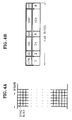
- one frame has four tracks and here one sync block has six DCT blocks.
- Each sync block comprises a sync signal for indicating its beginning and end, an index signal for indicating its position in a frame, a first level quantization encoding code contained in an IDC area, an error correction code (ECC) for error-correcting the code loaded on the IDC area, a plurality of vector quantization encoding codes contained in a dependent decodable code (DDC) area, and an ECC for error-correcting the code loaded on the DDC area.
- ECC error correction code
- the amount of bits in the periphery of the image is forced to be reduced.
- the image on the periphery is reproduced using only the lowest level code. This means that the center and the periphery of an image are encoded using different weights. This is possible because normal human vision will concentrate mainly on the center of an image.
- Higher level codes are sequentially recorded on the DDC area shown in Figure 4B when recorded on tape.
- the second level needs 9-bit parity data and the third level needs parity data having the number of bits equaling the number of actual transfer vectors for the second level.
- the parity data indicates to a decoder which vector is actually recorded on a tape.
- the reference bits are satisfied by only using differential encoding according to weights and by image sections. Good picture quality can be obtained even if the image is divided into a plurality of levels from its center to its periphery, so that the lowest level is uniformly encoded and higher levels are encoded by varying their parameters for each level.
- a DC decoder 110 inverse-scalar-quantizes an input 8-bit DC code reproduced from a tape, and decodes it as DC coefficients.
- a first code book 121 which is the same as code book 42 of Figure 1, has 21 components and 128 vectors.
- Second and third code books 123 and 125 which are the same as code books 44 and 47 of Figure 1, each have 7 components and 128 vectors.
- Each code book 121, 123 and 125 outputs its vector according to an input class code.
- a first level vector inverse-quantization block 122 outputs a corresponding vector component by comparing an input first level code and the code of code book 121.
- the decoding result of the first level code as well as the DC coefficients are supplied to a first adder 127.
- Second and third level vector inverse-quantization blocks 124 and 126 output a corresponding vector component by the comparison of second and third level codes loaded on the DDC area with the codes of code books 123 and 125.
- the decoding results of the second and third level codes are supplied to a second adder 128.
- a mode selector 130 supplies the outputs of second and third level vector inverse-quantization blocks 124 and 126 to a third adder 129, during normal playback.
- mode selector 130 supplies a null signal to third adder 129.
- Third adder 129 adds the DC and the decoding results of the respective levels, and an inverse-DCT block 140 inverse-DCT-transforms the added outputs to be converted into an original two-dimensional video signal.
- a buffer 150 changes the inverse-DCT result into an appropriate output form, that is, changes a 4:2:0 form into a 4:2:2 form.
- the image compression encoding and decoding method and apparatus described above compresses DCT blocks by steps, using classified vector quantization via a multilevel compression method so that, during a special playback mode such as high speed search, only the lowest level image having a fixed number of bits is reproduced, thereby causing no degradation of picture quality during the special playback mode.
Landscapes
- Engineering & Computer Science (AREA)
- Multimedia (AREA)
- Signal Processing (AREA)
- Theoretical Computer Science (AREA)
- Computing Systems (AREA)
- Compression Or Coding Systems Of Tv Signals (AREA)
- Compression, Expansion, Code Conversion, And Decoders (AREA)
- Television Signal Processing For Recording (AREA)
- Compression Of Band Width Or Redundancy In Fax (AREA)
Applications Claiming Priority (2)
| Application Number | Priority Date | Filing Date | Title |
|---|---|---|---|
| US85101992A | 1992-03-13 | 1992-03-13 | |
| US851019 | 1992-03-13 |
Publications (3)
| Publication Number | Publication Date |
|---|---|
| EP0559982A2 true EP0559982A2 (de) | 1993-09-15 |
| EP0559982A3 EP0559982A3 (en) | 1994-09-14 |
| EP0559982B1 EP0559982B1 (de) | 1999-05-26 |
Family
ID=25309742
Family Applications (1)
| Application Number | Title | Priority Date | Filing Date |
|---|---|---|---|
| EP92308888A Expired - Lifetime EP0559982B1 (de) | 1992-03-13 | 1992-09-30 | Bildkompression |
Country Status (5)
| Country | Link |
|---|---|
| US (1) | US5533138A (de) |
| EP (1) | EP0559982B1 (de) |
| JP (1) | JP3280717B2 (de) |
| KR (1) | KR0132894B1 (de) |
| DE (1) | DE69229260T2 (de) |
Cited By (5)
| Publication number | Priority date | Publication date | Assignee | Title |
|---|---|---|---|---|
| EP0707727A4 (de) * | 1993-05-10 | 1996-10-02 | Competitive Tech Inc | Gerät und verfahren zur bild-kodierung und -dekodierung |
| EP0734164A3 (de) * | 1995-03-20 | 1998-04-29 | Daewoo Electronics Co., Ltd | Verfahren und Vorrichtung zur Bildsignalkodierung mit einer Klassifizieranlage |
| GB2341031A (en) * | 1998-08-31 | 2000-03-01 | Daewoo Electronics Co Ltd | Adaptively coding video signals |
| GB2353426A (en) * | 1999-08-17 | 2001-02-21 | British Broadcasting Corp | Mutiple output variable bit rate encoding |
| US6370279B1 (en) | 1997-04-10 | 2002-04-09 | Samsung Electronics Co., Ltd. | Block-based image processing method and apparatus therefor |
Families Citing this family (37)
| Publication number | Priority date | Publication date | Assignee | Title |
|---|---|---|---|---|
| US5726711A (en) * | 1993-01-13 | 1998-03-10 | Hitachi America, Ltd. | Intra-coded video frame data processing methods and apparatus |
| US5719958A (en) * | 1993-11-30 | 1998-02-17 | Polaroid Corporation | System and method for image edge detection using discrete cosine transforms |
| JP3013698B2 (ja) * | 1994-04-20 | 2000-02-28 | 松下電器産業株式会社 | ベクトル量子化符号化装置と復号化装置 |
| FI98162C (fi) * | 1994-05-30 | 1997-04-25 | Tecnomen Oy | HMM-malliin perustuva puheentunnistusmenetelmä |
| JP3046224B2 (ja) * | 1994-07-26 | 2000-05-29 | 三星電子株式会社 | 固定ビット率の符号化方法および装置とこれを利用した高速探索のためのトラッキング方法 |
| US5742892A (en) | 1995-04-18 | 1998-04-21 | Sun Microsystems, Inc. | Decoder for a software-implemented end-to-end scalable video delivery system |
| US5754742A (en) * | 1995-05-12 | 1998-05-19 | Intel Corporation | Setting quantization level to match DCT coefficients |
| US5909513A (en) * | 1995-11-09 | 1999-06-01 | Utah State University | Bit allocation for sequence image compression |
| US6094453A (en) | 1996-10-11 | 2000-07-25 | Digital Accelerator Corporation | Digital data compression with quad-tree coding of header file |
| KR100438801B1 (ko) * | 1996-10-30 | 2004-07-16 | 삼성전자주식회사 | 랜덤에러에견고한부호화및복호화장치 |
| US5960120A (en) * | 1997-01-30 | 1999-09-28 | Samsung Electronics Co., Ltd. | Apparatus for quantizing classified vectors of image signals using four-band linear phase para-unitary filter group |
| US5974182A (en) * | 1997-04-24 | 1999-10-26 | Eastman Kodak Company | Photographic image compression method and system |
| AU728938B2 (en) * | 1997-09-29 | 2001-01-18 | Canon Kabushiki Kaisha | A method for data compression |
| US6246801B1 (en) * | 1998-03-06 | 2001-06-12 | Lucent Technologies Inc. | Method and apparatus for generating selected image views from a larger image having dependent macroblocks |
| US6337882B1 (en) | 1998-03-06 | 2002-01-08 | Lucent Technologies Inc. | Method and apparatus for generating unlimited selected image views from a larger image |
| US6323910B1 (en) | 1998-03-26 | 2001-11-27 | Clark, Iii William T. | Method and apparatus for producing high-fidelity images by synchronous phase coherent digital image acquisition |
| JP2002142192A (ja) * | 2000-11-01 | 2002-05-17 | Sony Corp | 信号処理装置および方法、ならびに、記録装置および方法 |
| US7453936B2 (en) * | 2001-11-09 | 2008-11-18 | Sony Corporation | Transmitting apparatus and method, receiving apparatus and method, program and recording medium, and transmitting/receiving system |
| KR100411348B1 (ko) * | 2001-12-29 | 2003-12-18 | 엘지전자 주식회사 | 에지 검출 방법과 장치 |
| US7650031B2 (en) * | 2004-11-23 | 2010-01-19 | Microsoft Corporation | Method and system for detecting black frames in a sequence of frames |
| US7925080B2 (en) * | 2006-01-13 | 2011-04-12 | New Jersey Institute Of Technology | Method for identifying marked images based at least in part on frequency domain coefficient differences |
| US8224017B2 (en) * | 2006-01-13 | 2012-07-17 | New Jersey Institute Of Technology | Method for identifying marked content |
| JP4920045B2 (ja) * | 2006-01-13 | 2012-04-18 | ニュー ジャージー インスティチュート オブ テクノロジー | 周波数領域係数差分に少なくとも部分的に基づいてマーク付き画像を識別する方法 |
| US8270469B2 (en) * | 2006-12-15 | 2012-09-18 | Precoad Inc. | Encoding video at multiple resolution levels |
| US8023747B2 (en) * | 2007-02-09 | 2011-09-20 | New Jersey Institute Of Technology | Method and apparatus for a natural image model based approach to image/splicing/tampering detection |
| US8406296B2 (en) | 2008-04-07 | 2013-03-26 | Qualcomm Incorporated | Video refresh adaptation algorithms responsive to error feedback |
| US20090320081A1 (en) * | 2008-06-24 | 2009-12-24 | Chui Charles K | Providing and Displaying Video at Multiple Resolution and Quality Levels |
| US8238419B2 (en) * | 2008-06-24 | 2012-08-07 | Precoad Inc. | Displaying video at multiple resolution levels |
| US8385670B2 (en) * | 2008-08-20 | 2013-02-26 | Microsoft Corporation | Image restoration by vector quantization utilizing visual patterns |
| WO2010023809A1 (ja) * | 2008-09-01 | 2010-03-04 | 日本電気株式会社 | 画像特徴量抽出装置 |
| JP5482655B2 (ja) * | 2008-09-01 | 2014-05-07 | 日本電気株式会社 | 画像同一性尺度算出システム |
| US20100098156A1 (en) | 2008-10-16 | 2010-04-22 | Qualcomm Incorporated | Weighted prediction based on vectorized entropy coding |
| KR101512643B1 (ko) * | 2008-10-22 | 2015-04-16 | 에스케이 텔레콤주식회사 | 동영상 부호화 장치 및 이를 위한 영상 신호의 2차원 정렬 변환 장치 및 방법, 및 이를 위한 기록 매체 |
| US8411751B2 (en) * | 2009-12-15 | 2013-04-02 | Nvidia Corporation | Reducing and correcting motion estimation artifacts during video frame rate conversion |
| US9106918B2 (en) * | 2012-01-20 | 2015-08-11 | Sony Corporation | Coefficient coding harmonization in HEVC |
| CN107315717B (zh) * | 2016-04-26 | 2020-11-03 | 中科寒武纪科技股份有限公司 | 一种用于执行向量四则运算的装置和方法 |
| US9712830B1 (en) | 2016-09-15 | 2017-07-18 | Dropbox, Inc. | Techniques for image recompression |
Family Cites Families (6)
| Publication number | Priority date | Publication date | Assignee | Title |
|---|---|---|---|---|
| FR2608864B1 (fr) * | 1986-12-17 | 1991-10-31 | France Etat | Procedes de codage et de transmission d'un signal numerique, par rafraichissement temporel selectif d'un quantificateur vectoriel |
| JP2828997B2 (ja) * | 1988-07-22 | 1998-11-25 | 株式会社日立製作所 | 適応型変換符号化装置 |
| US5051840A (en) * | 1988-12-14 | 1991-09-24 | Fuji Photo Film Co., Ltd. | Device for coding a picture signal by compression |
| KR930004311B1 (ko) * | 1989-04-18 | 1993-05-22 | 미쯔비시덴끼 가부시끼가이샤 | 동화상 부호화 복호화장치 |
| US5121216A (en) * | 1989-07-19 | 1992-06-09 | Bell Communications Research | Adaptive transform coding of still images |
| US5122875A (en) * | 1991-02-27 | 1992-06-16 | General Electric Company | An HDTV compression system |
-
1992
- 1992-08-12 KR KR1019920014466A patent/KR0132894B1/ko not_active Expired - Fee Related
- 1992-09-30 DE DE69229260T patent/DE69229260T2/de not_active Expired - Fee Related
- 1992-09-30 EP EP92308888A patent/EP0559982B1/de not_active Expired - Lifetime
- 1992-10-01 JP JP26348192A patent/JP3280717B2/ja not_active Expired - Fee Related
-
1994
- 1994-05-09 US US08/239,848 patent/US5533138A/en not_active Expired - Lifetime
Cited By (7)
| Publication number | Priority date | Publication date | Assignee | Title |
|---|---|---|---|---|
| EP0707727A4 (de) * | 1993-05-10 | 1996-10-02 | Competitive Tech Inc | Gerät und verfahren zur bild-kodierung und -dekodierung |
| EP0734164A3 (de) * | 1995-03-20 | 1998-04-29 | Daewoo Electronics Co., Ltd | Verfahren und Vorrichtung zur Bildsignalkodierung mit einer Klassifizieranlage |
| US6370279B1 (en) | 1997-04-10 | 2002-04-09 | Samsung Electronics Co., Ltd. | Block-based image processing method and apparatus therefor |
| GB2341031A (en) * | 1998-08-31 | 2000-03-01 | Daewoo Electronics Co Ltd | Adaptively coding video signals |
| GB2341031B (en) * | 1998-08-31 | 2001-05-02 | Daewoo Electronics Co Ltd | Method and apparatus for adaptively coding video signals |
| US6466620B1 (en) | 1998-08-31 | 2002-10-15 | Daewoo Electronics Co., Ltd. | Method and apparatus for adaptively coding video signals |
| GB2353426A (en) * | 1999-08-17 | 2001-02-21 | British Broadcasting Corp | Mutiple output variable bit rate encoding |
Also Published As
| Publication number | Publication date |
|---|---|
| DE69229260D1 (de) | 1999-07-01 |
| KR930020860A (ko) | 1993-10-20 |
| JPH05292462A (ja) | 1993-11-05 |
| US5533138A (en) | 1996-07-02 |
| DE69229260T2 (de) | 1999-12-09 |
| EP0559982A3 (en) | 1994-09-14 |
| EP0559982B1 (de) | 1999-05-26 |
| HK1014324A1 (en) | 1999-09-24 |
| KR0132894B1 (ko) | 1998-10-01 |
| JP3280717B2 (ja) | 2002-05-13 |
Similar Documents
| Publication | Publication Date | Title |
|---|---|---|
| EP0559982B1 (de) | Bildkompression | |
| US5724097A (en) | Adaptive quantization of video based on edge detection | |
| US5416604A (en) | Image compression method for bit-fixation and the apparatus therefor | |
| US6006276A (en) | Enhanced video data compression in intelligent video information management system | |
| US5583573A (en) | Video encoder and encoding method using intercomparisons of pixel values in selection of appropriation quantization values to yield an amount of encoded data substantialy equal to nominal amount | |
| US5301032A (en) | Digital image compression and decompression method and apparatus using variable-length coding | |
| US5434623A (en) | Method and apparatus for image data compression using combined luminance/chrominance coding | |
| US5136371A (en) | Digital image coding using random scanning | |
| US5374958A (en) | Image compression based on pattern fineness and edge presence | |
| US6144763A (en) | Method and apparatus for compression coding of image data representative of a color image and digital camera including the same | |
| US8411741B2 (en) | Picture processing apparatus, picture processing method, picture processing program and recording medium | |
| US7149249B2 (en) | Color video codec method and system | |
| US7397852B2 (en) | Image processing apparatus and method, and image processing program | |
| EP0921685B1 (de) | Bildbearbeitungsverfahren, Bildverarbeitungsgerät und Datenspeichermedium | |
| JP2003531553A (ja) | 固定圧縮率を使用する効率的なビデオデータアクセス | |
| JPH07236142A (ja) | 高能率符号化装置及び復号化装置 | |
| JPWO2002080575A1 (ja) | 画像処理装置、画像処理方法、画像処理プログラムおよび記録媒体 | |
| HK1014324B (en) | Image compression | |
| JPH0678297A (ja) | ディジタルビデオ信号の符号化方法 | |
| CA2326674C (en) | Video compression in information system | |
| JP3190164B2 (ja) | 符号量見積り装置 | |
| JP3218744B2 (ja) | ディジタル画像信号の伝送装置 | |
| JPH0646369A (ja) | 映像信号処理装置 | |
| JPH04367183A (ja) | 画像符号化装置 | |
| JPH04367184A (ja) | 画像符号化装置 |
Legal Events
| Date | Code | Title | Description |
|---|---|---|---|
| PUAI | Public reference made under article 153(3) epc to a published international application that has entered the european phase |
Free format text: ORIGINAL CODE: 0009012 |
|
| AK | Designated contracting states |
Kind code of ref document: A2 Designated state(s): DE FR GB |
|
| PUAL | Search report despatched |
Free format text: ORIGINAL CODE: 0009013 |
|
| AK | Designated contracting states |
Kind code of ref document: A3 Designated state(s): DE FR GB |
|
| 17P | Request for examination filed |
Effective date: 19950307 |
|
| 17Q | First examination report despatched |
Effective date: 19961213 |
|
| GRAG | Despatch of communication of intention to grant |
Free format text: ORIGINAL CODE: EPIDOS AGRA |
|
| GRAG | Despatch of communication of intention to grant |
Free format text: ORIGINAL CODE: EPIDOS AGRA |
|
| GRAH | Despatch of communication of intention to grant a patent |
Free format text: ORIGINAL CODE: EPIDOS IGRA |
|
| GRAH | Despatch of communication of intention to grant a patent |
Free format text: ORIGINAL CODE: EPIDOS IGRA |
|
| GRAA | (expected) grant |
Free format text: ORIGINAL CODE: 0009210 |
|
| AK | Designated contracting states |
Kind code of ref document: B1 Designated state(s): DE FR GB |
|
| REF | Corresponds to: |
Ref document number: 69229260 Country of ref document: DE Date of ref document: 19990701 |
|
| ET | Fr: translation filed | ||
| PLBE | No opposition filed within time limit |
Free format text: ORIGINAL CODE: 0009261 |
|
| 26N | No opposition filed | ||
| REG | Reference to a national code |
Ref country code: GB Ref legal event code: IF02 |
|
| PGFP | Annual fee paid to national office [announced via postgrant information from national office to epo] |
Ref country code: FR Payment date: 20080915 Year of fee payment: 17 |
|
| PGFP | Annual fee paid to national office [announced via postgrant information from national office to epo] |
Ref country code: DE Payment date: 20081014 Year of fee payment: 17 |
|
| PGFP | Annual fee paid to national office [announced via postgrant information from national office to epo] |
Ref country code: GB Payment date: 20081001 Year of fee payment: 17 |
|
| GBPC | Gb: european patent ceased through non-payment of renewal fee |
Effective date: 20090930 |
|
| REG | Reference to a national code |
Ref country code: FR Ref legal event code: ST Effective date: 20100531 |
|
| PG25 | Lapsed in a contracting state [announced via postgrant information from national office to epo] |
Ref country code: FR Free format text: LAPSE BECAUSE OF NON-PAYMENT OF DUE FEES Effective date: 20090930 Ref country code: DE Free format text: LAPSE BECAUSE OF NON-PAYMENT OF DUE FEES Effective date: 20100401 |
|
| PG25 | Lapsed in a contracting state [announced via postgrant information from national office to epo] |
Ref country code: GB Free format text: LAPSE BECAUSE OF NON-PAYMENT OF DUE FEES Effective date: 20090930 |