EP0560023B1 - Dispositif pour la classification d'une forme, en particulier d'un billet de banque ou d'une pièce de monnaie - Google Patents
Dispositif pour la classification d'une forme, en particulier d'un billet de banque ou d'une pièce de monnaie Download PDFInfo
- Publication number
- EP0560023B1 EP0560023B1 EP93100829A EP93100829A EP0560023B1 EP 0560023 B1 EP0560023 B1 EP 0560023B1 EP 93100829 A EP93100829 A EP 93100829A EP 93100829 A EP93100829 A EP 93100829A EP 0560023 B1 EP0560023 B1 EP 0560023B1
- Authority
- EP
- European Patent Office
- Prior art keywords
- alci
- activity
- agii
- mci
- test
- Prior art date
- Legal status (The legal status is an assumption and is not a legal conclusion. Google has not performed a legal analysis and makes no representation as to the accuracy of the status listed.)
- Expired - Lifetime
Links
Images


Classifications
-
- G—PHYSICS
- G06—COMPUTING OR CALCULATING; COUNTING
- G06V—IMAGE OR VIDEO RECOGNITION OR UNDERSTANDING
- G06V10/00—Arrangements for image or video recognition or understanding
- G06V10/40—Extraction of image or video features
- G06V10/42—Global feature extraction by analysis of the whole pattern, e.g. using frequency domain transformations or autocorrelation
-
- G—PHYSICS
- G06—COMPUTING OR CALCULATING; COUNTING
- G06F—ELECTRIC DIGITAL DATA PROCESSING
- G06F18/00—Pattern recognition
- G06F18/20—Analysing
- G06F18/21—Design or setup of recognition systems or techniques; Extraction of features in feature space; Blind source separation
-
- G—PHYSICS
- G06—COMPUTING OR CALCULATING; COUNTING
- G06F—ELECTRIC DIGITAL DATA PROCESSING
- G06F18/00—Pattern recognition
- G06F18/20—Analysing
- G06F18/25—Fusion techniques
- G06F18/254—Fusion techniques of classification results, e.g. of results related to same input data
Definitions
- the invention relates to a device for Classification of a pattern, especially a banknote or of a coin which is in the preamble of claim 1 Art.
- Such devices are advantageous in vending machines, Currency exchange machines and the like are used where on the one hand by value, for example between one, two and Five dollar bills, and / or otherwise between originals and copies (fakes) is classified.
- EP-A-0 294 497 discloses a method of identification of stamps from which a vector is obtained, the measured Reproduces the properties of a stamp to be identified, then the Mahalanobis distance between them Vector and individual target vectors are measured, each represent a corresponding known stamp, and finally the measured distances with corresponding predetermined ones Values are compared to identify the stamp.
- the invention has for its object a device to build up in the preamble of claim 1, that a pattern inexpensive and within acceptable response time can be classified with the desired certainty.
- the invention is in independent claim featured. Training the invention result from the dependent claims.
- Fig. 1 means a recording system which in essentially an inlet 2 and a not drawn Transport system for a test object 3 and a sensor group 4 with which a sample of the test object 3 is measured.
- the Recording system 1 is on a feature channel 5 having at least one preprocessing activity 6 Preprocessing system 7 connected.
- a learning Classification system 8 is via an input channel 9 with the Preprocessing system 7 and via a first output channel 10a connected to a service system 11.
- the recording system 1, the preprocessing system 7, the classification system 8 and the service system 11 are thus channels in essentially connected to a cascade, which by the Service system 11 is completed.
- an initialization system 12 it is possible for an initialization system 12 to have a Initialization channel 13 with the classification system 8 connected is.
- FIG. 2 shows the basic structure of the classification system 8 based on a data flow diagram.
- a circle means an activity, an arrow a communication channel (channel) for transmission of data and / or events, the arrowhead pointing into the shows essential data flow direction.
- a data store which is generally available in several activities represented by two equally long, parallel lines. in the Another is, for example, an arrangement of two by one Activities associated with a single communication channel Activity that fulfills all tasks of the two activities, equivalent to.
- Each activity is known as an electronic one Circuit or software as a process, a piece of program or built as a routine.
- the input channel 9 leads to a first activity 14, which via a first channel 15 with a second activity 16 and via a second channel 17 with a third activity 18 is connected, which in turn via a third channel 19 with the second activity 16 and via a fourth channel 20 a fourth activity 21 is linked, from which a fifth channel 22 leads to the second activity 16, which on Output channel 10a is connected.
- a data store 23 which contains a database of the classification system 8 is over a sixth channel 24 with the first activity 14, via a seventh channel 25 with the second activity 16, via an eighth Channel 26 with the third activity 18, through a ninth Channel 27 with the fourth activity 21 and with the Initialization channel 13 connected.
- a sensor 4.1, 4.2 to 4.N has a Number of N sensors existing sensor group 4 a number M Feature outputs 4.1.1, 4.1.2 to 4.1.M or 4.2.1, 4.2.2 to 4.2.M or 4.N.1, 4.N.2 to 4.N.M on.
- the number N as well as the Number M are independent of one another and freely selectable. For example, the number N and the number M are three.
- DUT 3 - in the example a banknote - is at entrance 2 (Fig. 1) handed over to the transport system that the test object 3rd passes sensor group 4 for the purpose of recording measured values, which discrete the pattern of the test specimen 3 in a known manner Measures time 1.
- the sensors 4.1 to 4.N are advantageous parallel to the transport plane of the test object 3 and perpendicular to whose direction of transport is arranged side by side, so that a Number N of parallel tracks of the test specimen 3 can be measured, whereby each of the sensors 4.1 to 4.N each M different features measures.
- the total of the values mc (l) is at least a sample a number of a physical characteristic of the device under test 3.
- the pattern consists of the number N rows of one Number of L values, each row comprising the number of M features.
- the number L for the observed length of the test specimen is through the sampling rate selected for the measurement with the times l and the selected speed of the test object 3 in the transport system given and is thirteen or in the example twenty four.
- each sensor 4.1 or 4.2 or 4.N (Fig. 3) are to the Time 1 the values of the characteristics as vectors mc1 (l) or mc2 (l) or mcN (l) at the feature outputs 4.1.1 to 4.1.M and 4.2.1 to 4.2.M or 4.N.1 to 4.N.M available.
- the times 1 are from Numbered 1 to L.
- the sensor measures 4.1 or 4.2 or 4.N for a safe classification with Advantage the intensity values of one of the image parts of the at least one light source illuminated specimen reflected electromagnetic radiation at any time l - or at position 1 of the test object related to the Sensor group 4 - in the three spectral ranges green, red and Infrared.
- intensity values of green at the feature outputs 4.1.1, 4.2.1 and 4.N.1 as well Intensity values of red at the feature outputs 4.1.2, 4.2.2 and 4.N.2 and of infrared at the feature outputs 4.1.3, 4.2.3 and 4.N.3.
- sensor group 4 can also do other things - for example have magnetic or acoustic sensors. If one Coin is checked, its pattern can also be from the sound levels selected frequencies (instead of positions 1) of the sound spectrum which is when the coin hits results.
- Each of the measured vectors has the number M components, or the dimension of the measured vectors mci (l) is M.
- the definition (G1) the measured vector mci (l) transposes, d. H. as a line vector written.
- the superscript letter T in the name of a Vectors has in definition (G1) as well as below a transposed representation of the vector.
- the measured vectors mci (l) are transferred from the recording system 1 (FIG. 1) via the feature channel 5 to the preprocessing system 7, whereupon the preprocessing activity 6 forms local feature vectors ALCi (l) from the measured vectors mci (l) by means of transformations Fi.
- a transformation Fi is linear or non-linear.
- the dimension K of the local feature vectors ALCi (l) is the same or different from the dimension M of the measured vectors mci (l).
- One of the transformations Fi is, for example, a normalization of a spectral range and can be for the first component of ALC2 (l):
- each of the measured vectors mci (l) has a component for the spectral range green, one for the spectral range red and one for the spectral range infrared, for example the first components mci 1 (l) If an intensity value of the spectral range green is assigned to the second components mci 2 (l) an intensity value of the spectral range red and the third components mci 3 (l) an intensity value of the spectral range infrared, the measured vectors mci (l) are also used for a reliable classification Advantage transformed into local feature vectors ALCi (l) as follows:
- each local feature vector ALCi (l) contains the brightness of the sensor 4.i, for i in the range from 1..N, at time l, for l in the range from 1..L, as a sum of all intensity values of the measured spectra:
- ALCi 1 (l) mci 1 (l) + mci 2nd (l) + mci 3rd (l)
- Another component e.g. B. the one with the index two, contains the normalized intensity value of the spectral range green of the sensor 4.i at time 1:
- ALCi 2nd (l) mci 1 (l) mci 1 (l) + mci 2nd (l) + mci 3rd (l)
- a third component e.g. B. the one with the index three, contains the normalized intensity value of the spectral range red of the sensor 4.i at time 1:
- ALCi 3rd (l) mci 2nd (l) mci 1 (l) + mci 2nd (l) + mci 3rd (l)
- a fourth component e.g. B. the one with the index four, contains the intensity value of the spectral range green normalized via the track of the sensor 4.i at time 1:
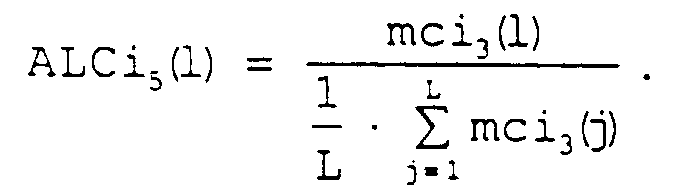
- a fifth component e.g. B. the one with the index five, contains the intensity value of the infrared spectral range normalized via the track of the sensor 4.i at time 1:
- Classification system 8 is a special case assumed in which it is checked whether the device under test 3 is too accurate belongs to a certain target class or not.
- everyone here Classification problems of interest are in individual cases divisible, in which the DUT 3 each with exactly one Target class is checked, what the special case described corresponds.
- the classification described is used for What is needed for each of the possible target classes known type of a single classification system 8 in a loop or, if the classification system 8 has multiple instances, concurrently is executable, the check being terminated immediately can, if the class of candidate 3 is determined, but at the latest is canceled if the test object with all target classes has been compared.
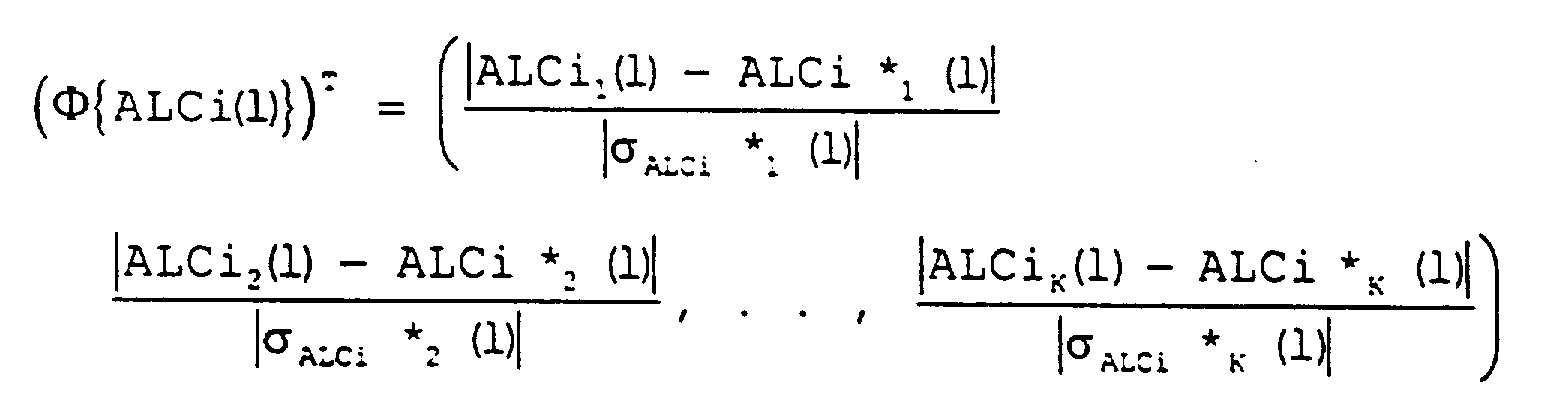
- the first activity 14 compares each of the local feature vectors ALCi (l) transformed with an operator ⁇ ⁇ with a predefined associated vector setpoint quantity Q ALCi (l). All of the N ⁇ L vectorial target quantities Q ALCi (l) have the same dimension K as the local feature vectors ALC 1 (l) and only real, positive components.
- the first check is only successfully fulfilled (true) if the following Boolean statement is true for all N ⁇ L local feature vectors ALCi (l): ⁇ ⁇ ALCi (l) ⁇ ⁇ Q ALCi (l) which means that each of the K components of the transformed vector ⁇ ⁇ ALCi (l) ⁇ is less than or equal to the corresponding component of the vectorial setpoint Q ALCi (l).
- the first vectorial estimates ALCi * (l) and the second vectorial estimates ⁇ ALCi * (l) are stored from the dimension K and in the database in the data memory 23, which is accessible via the sixth channel 24 for the first activity 14.
- the estimates ALCi * (l) and ⁇ ALCi * (l) are initialized by the initialization system 12 via the initialization channel 13.
- the first activity 14 transmits the second activity 16 the first channel 15 the result of the first test and if the first test is successful, calculated from the N ⁇ L local feature vectors ALCi (l) a set with the number N global row feature vectors AGIi of the same dimension K.
- a global line feature vector AGIi expressing the scatter results from the application of an operator EA ⁇ to all K components of the corresponding local feature vector ALCi (l):
- AGIi) T (EA ⁇ ALCi 1 (l) ⁇ , EA ⁇ ALCi 2nd (l) ⁇ , .. , EA ⁇ ALCi k (l) ⁇ ) where the operator EA ⁇ is defined as follows:
- the definition (G12) the line feature vector AGIi transposed, d. H. as a line vector written.
- the index j is in the range 1 to K.
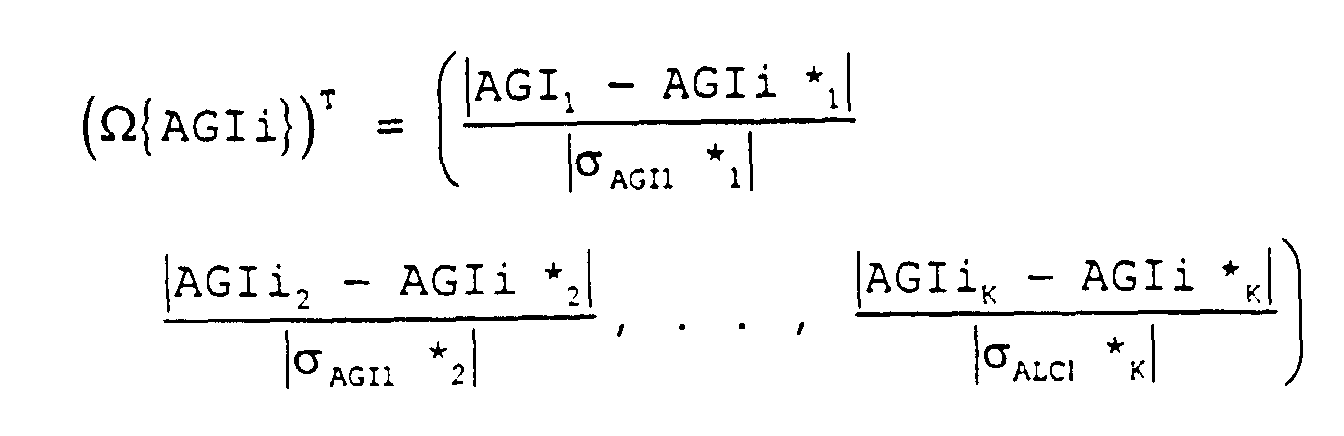
- the N line feature vectors AGIi are transferred via the second channel 17 to the third activity 18, which, in a second test, compares each of the global line feature vectors AGIi transformed with an operator ⁇ ⁇ to a predefined associated vector setpoint quantity Q AGIi .
- All of the N vectorial target quantities Q AGIi have the same dimension K as the line feature vectors AGIi and only real, positive components.
- the second check is only successfully fulfilled if the following Boolean statement is true for all N global row feature vectors AGIi: ⁇ ⁇ AGIi ⁇ ⁇ Q AGIi which means that each of the K components of the transformed vector ⁇ ⁇ AGIi ⁇ is less than or equal to the corresponding component of the vectorial setpoint Q AGIi .
- the third vectorial estimates AGIi * and the fourth vectorial estimates ⁇ AGIi * are of the dimension K and are stored in the data store 23 in the database accessible via the eighth channel 26 for the third activity 18.
- the estimates AGIi * and ⁇ AGIi * are initialized by the initialization system 12 via the initialization channel 13.
- the third activity 18 transmits the result of the second check to the second activity 16 via the third channel 19 and, if the second check is successful, calculates a single global area feature vector AGF of the same dimension K according to the N global row feature vectors AGIi following formula:
- the third activity 18 transmits the area feature vector AGF via the fourth channel 20 of the fourth activity 21, which the distance d 2 of Mahalanobis known in the literature between the area feature vector AGF and a fifth vectorial average estimate AGF * of the area feature vector AGF calculated and in a third test compares the calculated distance d 2 with a scalar target value Q a 2 .
- the covariance matrix C AGF * and the fifth estimate AGF * are stored in the database in the data memory 23, which is available for the fourth activity 21 via the ninth channel 27.
- the covariance matrix C AGF * and the estimate AGF * are advantageously initialized by the initialization system 12 via the initialization channel 13.
- the result of the third test becomes the second activity 16 passed through the fifth channel 22.
- the second activity 16 evaluates the results of the three tests and transmits the result via a second, with the Recording system connected output channel 10b to the recording system 1, which the test specimen 3 out either a cash register passes or rejects. Only if the first exam as well as the second exam and also the third exam are successful, the associated target class of the examinee 3 is certain what the second activity to the service system 11 via the first output channel 10a - preferably by transmitting the determined class of the examinee - announces what the Service system 11 can perform a service.
- ALCi * (l) t p ⁇ ⁇ ALCi * (l) t-1 + ( ⁇ / 2) 1/2 ⁇
- AGIi * t p ⁇ ⁇ AGIi * t-1 + ( ⁇ / 2) 1/2 ⁇
- the weighting factor p generally has in the equations (G20), (G21), (G21a), (G22), (G23) and (G24) each have a different one current value.
- the formula (G23) and (G24) instead of calculating the square root from the difference between the two squared amounts of two vectors, as is known, the formula (G23) and (G24) use ⁇ ALCi * (l) t and ⁇ AGIi * t to calculate the new estimate The amount of the difference between two vectors multiplied by the factor ( ⁇ / 2) 1/2 , which significantly reduces the effort with the large number of new estimates that are calculated after each successful classification. With the same conditions, for example, the computing time for the described update of the estimates is reduced ten times.
- the flow chart in Fig. 4 shows the most important Operations carried out by the classification system 8 for the Subject to each of the target classes depending on the course of the Classification necessarily between a beginning 28 and one end 29 are executed or skipped.
- a first Branch 30 is either an action block 31 or a first one Calculation block 32, which is followed by a second branch 33.
- the second branch 33 either leads to action block 31 or a second calculation block 34, which is a third Branch 35 connects, the successor of which is action block 31 or a third calculation block 36 which is like that Action block 31 with the end 29 is completed.
- the first test is decisive for the first branch 30; only if the associated Boolean statement (G10) is true, are calculated in the first calculation block 32 according to the formula (G12) the N * L local feature vectors ALCi (l) the N row feature vectors AGIi calculated, otherwise the classification no longer possible, so that you can use action block 31 is completed.
- the second branch 33 is through the controlled second exam. Only if your Boolean statement (G14) is true, is in the second calculation block 34 according to the formula (G16) a single one out of the N global line feature vectors global area feature vector AGF is calculated, otherwise the unsuccessful classification with action block 31 completed.
- the third branch is through the third exam determines what is true if the Boolean statement (G19) is the third Calculation block 36 and otherwise action block 31 executed becomes.
- the successful classification is transmitted to the service system 11 and the database with new estimates for ALCi * (l) according to the formula (G20), for AGIi * according to the formula (G21), for AGF * according to the formula (G21a) updated for Cov * (m, n) according to the formula (G22), for ⁇ ALCi * (l) according to the formula (G23) and for ⁇ AGIi * according to the formula (G24).
- Recording system 1 signals the unsuccessful classification.
- the classification system 8 described enables by the three exams, each with differently linked ones Characteristics of the test object (3) is carried out a safe Classification.
- the classification system can carry out further tests such as for example, checking the length or width of the Test object 3, evaluate.
Landscapes
- Engineering & Computer Science (AREA)
- Theoretical Computer Science (AREA)
- Data Mining & Analysis (AREA)
- Computer Vision & Pattern Recognition (AREA)
- General Physics & Mathematics (AREA)
- Physics & Mathematics (AREA)
- General Engineering & Computer Science (AREA)
- Evolutionary Biology (AREA)
- Evolutionary Computation (AREA)
- Bioinformatics & Computational Biology (AREA)
- Bioinformatics & Cheminformatics (AREA)
- Artificial Intelligence (AREA)
- Life Sciences & Earth Sciences (AREA)
- Multimedia (AREA)
- Image Analysis (AREA)
- Inspection Of Paper Currency And Valuable Securities (AREA)
- Testing Of Coins (AREA)
- Information Retrieval, Db Structures And Fs Structures Therefor (AREA)
- Image Processing (AREA)
- Investigating Or Analysing Biological Materials (AREA)
Claims (9)
- Dispositif comprenant un système de chargement (1), un système de traitement préliminaire (7) et un système de classification (8) adaptatif comportant une base de données, destiné à la classification d'un modèle, en particulier un billet de banque ou une pièce ce monnaie, à l'appui des valeurs des caractéristiques physiques, qui sont fournies par le système de chargement (1), le système de chargement (1), le système de traitement préliminaire (7) et le système de classification (8) étant montés en série sensiblement dans l'ordre cité, à la sortie duquel est raccordé un système de prestation de services (11), caractériséchaque activité étant réalisée comme un circuit électronique ou, sur le plan d'un logiciel, comme un processus, une partie de programme ou comme une routine.[a] en ce que le système de traitement préliminaire (7)[a.a] comporte une activité de traitement préliminaire (6), qui transforme les valeurs des caractéristiques physiques en plusieurs vecteurs caractéristiques locaux ALC1(l),[b] en ce que le système de classification (8) comporte plusieurs activités (14 ; 16 ; 18 ; 21) avec un accès à la base de données, parmi lesquelles[b.a] une première activité (14)[b.a.a] exécute, dans un premier examen pour chaque vecteur caractéristique local ALC1(l), transformé avec un opérateur Φ{}, une comparaison avec une valeur théorique vectorielle QALC1(l) et[b.a.b] communique le résultat du premier examen à une deuxième activité (16) par l'intermédiaire d'un premier canal de données (15), qui relie la première activité (14) à la deuxième activité (16), et[b.a.c] calcule, à partir des vecteurs caractéristiques locaux ALC1(l), à l'aide des premières évaluations vectorielles ALC1*(l) correspondantes, stockées dans la base de données et des deuxièmes évaluations vectorielles σALC1*(l) correspondantes, stockées dans la base de données, un vecteur caractéristique de lignes global AGIT, et ensuite[b.b] tous les vecteurs caractéristiques de lignes globaux AGI1 sont transmis à une troisième activité (18) par l'intermédiaire d'un deuxième canal de données (17), qui relie la première activité (14) à la troisième activité (18), la combinaison des étapes [b.a.c] et [b.b] étant exécutée à la seule condition que le premier examen ait donné des résultats satisfaisants,[b.c] en ce que la troisième activité (18)[b.c.a] exécute, dans un deuxième examen pour chaque vecteur caractéristique de lignes global AGI1, transformé avec un opérateur Ω{} - utilisant une troisième évaluation vectorielle AGIi* et une quatrième évaluation vectorielle σAGI1* - une comparaison avec une autre valeur théorique vectorielle QAGI1 et[b.c.b] communique le résultat du deuxième examen à la deuxième activité (16) par l'intermédiaire d'un troisième canal de données (19), qui relie la troisième activité (18) à la deuxième activité (16), et[b.c.c] calcule, à partir des vecteurs caractéristiques de lignes globaux AGI1, un seul vecteur caractéristique de surface global AGF, et ensuite[b.d] le vecteur caractéristique de surface global AGF est transmis à une quatrième activité (21) par l'intermédiaire d'un quatrième canal de données (20), qui relie la troisième activité (18) à la quatrième activité (21), la combinaison des étapes [b.c.c] et [b.d] étant exécutée à la seule condition que le deuxième examen ait donné des résultats satisfaisants,[b.e] en ce que la quatrième activité (21)[b.e.a] calcule la distance d2 selon Mahalanobis, entre le vecteur caractéristique de surface global AGF et une cinquième évaluation vectorielle AGF*, stockée dans la base de données, à l'aide d'une matrice de covariance CAGF*, et[b.e.b] exécute dans un troisième examen une comparaison avec une valeur théorique dmax 2, et [b.e.c] communique le résultat du troisième examen à la deuxième activité (16) par l'intermédiaire d'un cinquième canal de données (22), qui relie la quatrième activité (21) à la deuxième activité (16),[b.f] en ce que la deuxième activité (16) calcule, à la seule condition que les trois examens aient été exécutés avec succès,[b.f.a] d'une part,[b.f.a.a] de nouvelles premières évaluations ALCi*(l),[b.f.a.b] de nouvelles deuxièmes évaluations σALCi* (l),[b.f.a.c] de nouvelles troisièmes évaluations AGIi*,[b.f.a.d] de nouvelles quatrièmes évaluations σAGI1* et[b.f.a.e] une nouvelle cinquièrme évaluation AGF*, ainsi que[b.f.a.f] une nouvelle matrice de covairance CAGF*, et à partir de là[b.f.b] actualise la base de données et,[b.f.c] d'autre part, communique au système de prestation de services (11) la classe déterminée du modèle,
- Dispositif selon la revendication 1, caractérisé en ce que l'opérateur Φ{} utilisé par la première activité (14) pour le premier examen, est défini pardans laquelle la lettre T en exposant signifie une représentation transposée.
- Dispositif selon la revendication 1 ou 2, caractérisé en ce que l'opérateur Ω{} utilisé par la troisième activité (18) pour le deuxième examen, est défini par
- Dispositif selon l'une quelconque des revendications 1 à 3, caractérisé en ce que la troisième activité (18) calcule le vecteur caractéristique de surface global AGF à partir d'un nombre (N) de vecteurs de lignes AGIi, selon la formule suivante :

- Dispositif selon l'une quelconque des revendications 1 à 4, caractérisé en ce que la deuxième activité (16) calcule les nouvelles deuxièmes évaluations σALC1*(l)t de manière approximative selon la formule suivante :
- Dispositif selon l'une quelconque des revendications 1 à 5, caractérisé en ce que la deuxième activité (16) calcule les nouvelles quatrièmes évaluations σAGI1*t de manière approximative selon la formule suivante :
- Dispositif selon l'une quelconque des revendications 1 à 6, destiné à la classification d'un billet de banque ou d'une pièce de monnaie, caractérisé en ce que le système de chargement (1), destiné à enregistrer les caractéristiques physiques, comporte un groupe de capteurs (4) formé par un nombre (N) de capteurs, chaque capteur mesurant, sur un nombre (L) relativement grand de parties d'image, chaque valeur d'intensité réfléchie du domaine spectral pour le vert, le rouge et l'infrarouge.
- Dispositif selon la revendication 7, caractérisé en ce que les caractéristiques physiques enregistrées sont groupées en tant que vecteurs tridimensionnels mci(l) mesurés pour le traitement ultérieur, la définition (mci(l))T = (mci1(l), mci2(l), mci3(l)), dans laquelle i = 1 jusqu'à N et l = 1 ... L, étant applicable aux vecteurs mci(l), et les composantes avec l'indice 1 contenant des valeurs d'intensité du domaine spectral vert, les composantes avec l'indice 2 les valeurs du domaine spectral rouge et les composantes avec l'indice 3 les valeurs d'intensité du domaine spectral infrarouge.
- Dispositif selon la revendication 8, caractérisé en ce que l'activité de traitement préliminaire (6) calcule les premières composantes des vecteurs caractéristiques locaux ALCi(l) avecet les cinquièmes composantes avec

Applications Claiming Priority (2)
| Application Number | Priority Date | Filing Date | Title |
|---|---|---|---|
| CH753/92 | 1992-03-10 | ||
| CH753/92A CH684222A5 (de) | 1992-03-10 | 1992-03-10 | Einrichtung zur Klassifizierung eines Musters, insbesondere von einer Banknote oder von einer Münze. |
Publications (2)
| Publication Number | Publication Date |
|---|---|
| EP0560023A1 EP0560023A1 (fr) | 1993-09-15 |
| EP0560023B1 true EP0560023B1 (fr) | 1998-06-17 |
Family
ID=4194394
Family Applications (1)
| Application Number | Title | Priority Date | Filing Date |
|---|---|---|---|
| EP93100829A Expired - Lifetime EP0560023B1 (fr) | 1992-03-10 | 1993-01-21 | Dispositif pour la classification d'une forme, en particulier d'un billet de banque ou d'une pièce de monnaie |
Country Status (9)
| Country | Link |
|---|---|
| US (2) | US5503262A (fr) |
| EP (1) | EP0560023B1 (fr) |
| JP (1) | JPH0644377A (fr) |
| CA (1) | CA2088349A1 (fr) |
| CH (1) | CH684222A5 (fr) |
| DE (1) | DE59308678D1 (fr) |
| ES (1) | ES2118142T3 (fr) |
| HK (1) | HK1011834A1 (fr) |
| NO (1) | NO930867L (fr) |
Families Citing this family (37)
| Publication number | Priority date | Publication date | Assignee | Title |
|---|---|---|---|---|
| US5729623A (en) * | 1993-10-18 | 1998-03-17 | Glory Kogyo Kabushiki Kaisha | Pattern recognition apparatus and method of optimizing mask for pattern recognition according to genetic algorithm |
| GB2284293B (en) * | 1993-11-30 | 1998-06-03 | Mars Inc | Article classifying method and apparatus |
| JP2700440B2 (ja) * | 1994-04-19 | 1998-01-21 | エヌ・ティ・ティ・データ通信株式会社 | 物品識別システム |
| JP3745373B2 (ja) * | 1994-05-13 | 2006-02-15 | 株式会社日本コンラックス | 分散処理装置 |
| DE4429689C2 (de) * | 1994-08-22 | 2003-06-26 | Whd Elektron Prueftech Gmbh | Prüfanordnung und Verfahren zur Prüfung von Dokumenten in Bearbeitungsmaschinen |
| US5931277A (en) * | 1995-05-09 | 1999-08-03 | Mars, Incorporated | Money validation system using acceptance criteria |
| RU2168210C2 (ru) * | 1995-05-11 | 2001-05-27 | Гизеке Унд Девриент Гмбх | Устройство и способ обработки листового материала, в частности банкнот |
| GB2309299B (en) | 1996-01-16 | 2000-06-07 | Mars Inc | Sensing device |
| SE9602829D0 (sv) * | 1996-07-19 | 1996-07-19 | Yngve Johnsson | Förfarande och anordning för betalningsmedelshantering jämte betalningsmedel |
| DE19646454A1 (de) * | 1996-11-11 | 1998-05-14 | Giesecke & Devrient Gmbh | Verfahren zur Bearbeitung von Blattgut, wie z. B. Banknoten |
| GB9703191D0 (en) * | 1997-02-15 | 1997-04-02 | Ncr Int Inc | Method and apparatus for screening documents |
| GB9714083D0 (en) * | 1997-07-04 | 1997-09-10 | Ncr Int Inc | Document recognition apparatus |
| US6067374A (en) * | 1997-11-13 | 2000-05-23 | Xerox Corporation | Seal detection system and method |
| GB2344446A (en) * | 1998-12-02 | 2000-06-07 | Mars Inc | Classifying currency items |
| DE19909851C2 (de) * | 1999-03-08 | 2003-09-04 | Zimmermann Gmbh & Co Kg F | Vorrichtung zur Unterscheidung falscher von echten Münzen |
| AUPQ136299A0 (en) * | 1999-07-02 | 1999-07-22 | Microsystem Controls Pty Ltd | Coin validation |
| JP2001160165A (ja) | 1999-12-03 | 2001-06-12 | Toshiba Corp | 検知装置と検知対象物の処理装置 |
| JP2001175912A (ja) * | 1999-12-21 | 2001-06-29 | Laurel Bank Mach Co Ltd | 硬貨判別装置 |
| GB2366371A (en) * | 2000-09-04 | 2002-03-06 | Mars Inc | Sensing documents such as currency items |
| DE10045360A1 (de) * | 2000-09-14 | 2002-03-28 | Giesecke & Devrient Gmbh | Verfahren zur Klassifizierung von Dokumenten |
| EP1324280A1 (fr) * | 2001-12-28 | 2003-07-02 | Mars Incorporated | Procédé et appareil pour classifier des articles monétaires |
| ES2426416T3 (es) * | 2002-05-22 | 2013-10-23 | Mei, Inc | Dispositivo de validación de moneda |
| DE10248621A1 (de) * | 2002-10-18 | 2004-04-29 | Giesecke & Devrient Gmbh | Verfahren und System zur Bearbeitung von Banknoten |
| DE10314071B3 (de) | 2003-03-28 | 2004-09-30 | Koenig & Bauer Ag | Verfahren zur qualitativen Beurteilung eines Materials mit mindestens einem Erkennungsmerkmal |
| DE102004038153B4 (de) * | 2004-08-06 | 2006-05-11 | National Rejectors, Inc. Gmbh | Verfahren zur Prüfung von Münzen auf Echtheit in einem Münzgerät |
| EP1868166A3 (fr) | 2006-05-31 | 2007-12-26 | MEI, Inc. | Procédé et appareil de validation des billets de banque |
| ES2381860T3 (es) * | 2006-07-28 | 2012-06-01 | Mei, Inc. | Clasificación utilizando máquinas de vectores de soporte y selección de variables |
| DE102006053788A1 (de) | 2006-11-15 | 2008-05-21 | Giesecke & Devrient Gmbh | Verfahren zur Erkennung von Verschmutzungen im Bereich von Farbübergängen auf Wertdokumenten und Mittel zur Durchführung des Verfahrens |
| US9036890B2 (en) | 2012-06-05 | 2015-05-19 | Outerwall Inc. | Optical coin discrimination systems and methods for use with consumer-operated kiosks and the like |
| US8668069B1 (en) | 2012-11-30 | 2014-03-11 | Outerwall Inc. | Differential detection coin discrimination systems and methods for use with consumer-operated kiosks and the like |
| ES2812794T3 (es) | 2012-12-05 | 2021-03-18 | Penblade Inc | Dispositivo de corte de seguridad |
| JP6037125B2 (ja) * | 2013-02-18 | 2016-11-30 | 株式会社サタケ | 光学式粒状物選別機 |
| US8739955B1 (en) * | 2013-03-11 | 2014-06-03 | Outerwall Inc. | Discriminant verification systems and methods for use in coin discrimination |
| US9022841B2 (en) | 2013-05-08 | 2015-05-05 | Outerwall Inc. | Coin counting and/or sorting machines and associated systems and methods |
| US9443367B2 (en) | 2014-01-17 | 2016-09-13 | Outerwall Inc. | Digital image coin discrimination for use with consumer-operated kiosks and the like |
| JP6277350B2 (ja) * | 2014-12-16 | 2018-02-14 | 旭精工株式会社 | 硬貨識別装置 |
| US10665011B1 (en) * | 2019-05-31 | 2020-05-26 | Adobe Inc. | Dynamically estimating lighting parameters for positions within augmented-reality scenes based on global and local features |
Family Cites Families (8)
| Publication number | Priority date | Publication date | Assignee | Title |
|---|---|---|---|---|
| CH640433A5 (de) * | 1979-03-16 | 1984-01-13 | Sodeco Compteurs De Geneve | Vorrichtung zur unterscheidung von pruefobjekten. |
| JPS5665291A (en) * | 1979-10-31 | 1981-06-02 | Tokyo Shibaura Electric Co | Discriminator for printed matter |
| DE3174151D1 (en) * | 1980-12-16 | 1986-04-24 | Toshiba Kk | Pattern discriminating apparatus |
| DE3174234D1 (en) * | 1981-06-22 | 1986-05-07 | Toshiba Kk | System for identifying currency note |
| US4482971A (en) * | 1982-01-18 | 1984-11-13 | The Perkin-Elmer Corporation | World wide currency inspection |
| US4881268A (en) * | 1986-06-17 | 1989-11-14 | Laurel Bank Machines Co., Ltd. | Paper money discriminator |
| EP0294497B1 (fr) * | 1987-06-08 | 1993-03-31 | Nec Corporation | Appareil pour l'identification de timbres-poste |
| US5167313A (en) * | 1990-10-10 | 1992-12-01 | Mars Incorporated | Method and apparatus for improved coin, bill and other currency acceptance and slug or counterfeit rejection |
-
1992
- 1992-03-10 CH CH753/92A patent/CH684222A5/de not_active IP Right Cessation
-
1993
- 1993-01-21 DE DE59308678T patent/DE59308678D1/de not_active Expired - Fee Related
- 1993-01-21 ES ES93100829T patent/ES2118142T3/es not_active Expired - Lifetime
- 1993-01-21 EP EP93100829A patent/EP0560023B1/fr not_active Expired - Lifetime
- 1993-01-28 CA CA002088349A patent/CA2088349A1/fr not_active Abandoned
- 1993-02-04 US US08/013,708 patent/US5503262A/en not_active Expired - Fee Related
- 1993-03-08 JP JP5045600A patent/JPH0644377A/ja not_active Withdrawn
- 1993-03-09 NO NO93930867A patent/NO930867L/no unknown
-
1994
- 1994-11-23 US US08/344,456 patent/US5522491A/en not_active Expired - Lifetime
-
1998
- 1998-12-01 HK HK98112621A patent/HK1011834A1/xx not_active IP Right Cessation
Also Published As
| Publication number | Publication date |
|---|---|
| US5522491A (en) | 1996-06-04 |
| US5503262A (en) | 1996-04-02 |
| CH684222A5 (de) | 1994-07-29 |
| CA2088349A1 (fr) | 1993-09-11 |
| NO930867D0 (no) | 1993-03-09 |
| ES2118142T3 (es) | 1998-09-16 |
| JPH0644377A (ja) | 1994-02-18 |
| NO930867L (no) | 1993-09-13 |
| DE59308678D1 (de) | 1998-07-23 |
| EP0560023A1 (fr) | 1993-09-15 |
| HK1011834A1 (en) | 1999-07-16 |
Similar Documents
| Publication | Publication Date | Title |
|---|---|---|
| EP0560023B1 (fr) | Dispositif pour la classification d'une forme, en particulier d'un billet de banque ou d'une pièce de monnaie | |
| DE69332692T2 (de) | Verfahren und Vorrichtung zur Artikelklassifizierung | |
| DE2824849C2 (de) | Verfahren und Vorrichtung zur Feststellung des Zustandes und/oder der Echtheit von Blattgut | |
| DE2844156C2 (fr) | ||
| DE69432125T2 (de) | Geldprüfer | |
| DE69925155T2 (de) | Verfahren und Vorrichtung zum Klassifizieren von Gegenständen | |
| DE2612613C3 (de) | Verfahren und Schaltungsanordnung zum Identifizieren von Gegenständen, insbesondere von Münzen oder Wertpapieren | |
| WO1996036931A2 (fr) | Dispositif et procede pour le traitement d'objets sous forme de feuilles tels que des billets de banque | |
| DE69405105T3 (de) | Echtheitsprüfung von wertträgern | |
| WO2013091855A1 (fr) | Procédé et dispositif de contrôle d'un élément de sécurité d'un document de valeur | |
| CH640433A5 (de) | Vorrichtung zur unterscheidung von pruefobjekten. | |
| DE102018216032A1 (de) | Qualitätsprüfung für ein Radom | |
| EP0844591A1 (fr) | Procédé de détermination des facteurs d'échelle pour le codage fractal d'image | |
| EP1897067B1 (fr) | Procede et dispositif de detection d'une monnaie par utilisation de son image estampee | |
| DE10045360A1 (de) | Verfahren zur Klassifizierung von Dokumenten | |
| DE102016105023B4 (de) | Verfahren zum Erfassen zumindest eines Objekts in einer Umgebung eines Kraftfahrzeugs durch Zusammenlegen von Objektmerkmalen, Steuereinrichtung, Fahrerassistenzsystem | |
| EP1567991B1 (fr) | Procede et dispositif permettant de verifier des documents de valeur | |
| EP3969291B1 (fr) | Contrôle de l'intensité de champ coercitif de pigments magnétiques | |
| EP0710927A2 (fr) | Méthode de reconnaissance orientée-objet d'objets mouvants | |
| DE10128722C1 (de) | Vorrichtung zur Kontrolle von Objekten | |
| DE19600670B3 (de) | Verfahren zum Anpassen eines Bildes und eines Modells | |
| DE102024132185A1 (de) | Verfahren und Vorrichtung zum Auswerten von Wertdokumenten | |
| DE10361838B3 (de) | Verfahren zur Bewertung von Ähnlichkeiten realer Objekte | |
| DE3406694C2 (fr) | ||
| DE102024116746A1 (de) | Verfahren zum Prüfen eines Wertdokuments mit einem optischen Merkmals, das eine magnetische Eigenschaft hat, und Mittel zur Durchführung |
Legal Events
| Date | Code | Title | Description |
|---|---|---|---|
| PUAI | Public reference made under article 153(3) epc to a published international application that has entered the european phase |
Free format text: ORIGINAL CODE: 0009012 |
|
| AK | Designated contracting states |
Kind code of ref document: A1 Designated state(s): CH DE ES FR GB IT LI NL SE |
|
| RAP1 | Party data changed (applicant data changed or rights of an application transferred) |
Owner name: MARS INCORPORATED |
|
| 17P | Request for examination filed |
Effective date: 19940311 |
|
| GRAG | Despatch of communication of intention to grant |
Free format text: ORIGINAL CODE: EPIDOS AGRA |
|
| 17Q | First examination report despatched |
Effective date: 19960131 |
|
| GRAG | Despatch of communication of intention to grant |
Free format text: ORIGINAL CODE: EPIDOS AGRA |
|
| GRAH | Despatch of communication of intention to grant a patent |
Free format text: ORIGINAL CODE: EPIDOS IGRA |
|
| GRAH | Despatch of communication of intention to grant a patent |
Free format text: ORIGINAL CODE: EPIDOS IGRA |
|
| GRAA | (expected) grant |
Free format text: ORIGINAL CODE: 0009210 |
|
| AK | Designated contracting states |
Kind code of ref document: B1 Designated state(s): CH DE ES FR GB IT LI NL SE |
|
| REG | Reference to a national code |
Ref country code: CH Ref legal event code: NV Representative=s name: KIRKER & CIE SA Ref country code: CH Ref legal event code: EP |
|
| REF | Corresponds to: |
Ref document number: 59308678 Country of ref document: DE Date of ref document: 19980723 |
|
| ITF | It: translation for a ep patent filed | ||
| REG | Reference to a national code |
Ref country code: ES Ref legal event code: FG2A Ref document number: 2118142 Country of ref document: ES Kind code of ref document: T3 |
|
| ET | Fr: translation filed | ||
| GBT | Gb: translation of ep patent filed (gb section 77(6)(a)/1977) |
Effective date: 19980915 |
|
| PLBE | No opposition filed within time limit |
Free format text: ORIGINAL CODE: 0009261 |
|
| STAA | Information on the status of an ep patent application or granted ep patent |
Free format text: STATUS: NO OPPOSITION FILED WITHIN TIME LIMIT |
|
| 26N | No opposition filed | ||
| PGFP | Annual fee paid to national office [announced via postgrant information from national office to epo] |
Ref country code: SE Payment date: 20010105 Year of fee payment: 9 |
|
| PGFP | Annual fee paid to national office [announced via postgrant information from national office to epo] |
Ref country code: NL Payment date: 20010131 Year of fee payment: 9 |
|
| PGFP | Annual fee paid to national office [announced via postgrant information from national office to epo] |
Ref country code: CH Payment date: 20010219 Year of fee payment: 9 |
|
| REG | Reference to a national code |
Ref country code: GB Ref legal event code: IF02 |
|
| PG25 | Lapsed in a contracting state [announced via postgrant information from national office to epo] |
Ref country code: SE Free format text: LAPSE BECAUSE OF NON-PAYMENT OF DUE FEES Effective date: 20020122 |
|
| PG25 | Lapsed in a contracting state [announced via postgrant information from national office to epo] |
Ref country code: LI Free format text: LAPSE BECAUSE OF NON-PAYMENT OF DUE FEES Effective date: 20020131 Ref country code: CH Free format text: LAPSE BECAUSE OF NON-PAYMENT OF DUE FEES Effective date: 20020131 |
|
| PG25 | Lapsed in a contracting state [announced via postgrant information from national office to epo] |
Ref country code: NL Free format text: LAPSE BECAUSE OF NON-PAYMENT OF DUE FEES Effective date: 20020801 |
|
| EUG | Se: european patent has lapsed |
Ref document number: 93100829.6 |
|
| REG | Reference to a national code |
Ref country code: CH Ref legal event code: PL |
|
| NLV4 | Nl: lapsed or anulled due to non-payment of the annual fee |
Effective date: 20020801 |
|
| PGFP | Annual fee paid to national office [announced via postgrant information from national office to epo] |
Ref country code: GB Payment date: 20030115 Year of fee payment: 11 |
|
| PGFP | Annual fee paid to national office [announced via postgrant information from national office to epo] |
Ref country code: ES Payment date: 20030130 Year of fee payment: 11 Ref country code: DE Payment date: 20030130 Year of fee payment: 11 |
|
| PG25 | Lapsed in a contracting state [announced via postgrant information from national office to epo] |
Ref country code: GB Free format text: LAPSE BECAUSE OF NON-PAYMENT OF DUE FEES Effective date: 20040121 |
|
| PG25 | Lapsed in a contracting state [announced via postgrant information from national office to epo] |
Ref country code: ES Free format text: LAPSE BECAUSE OF NON-PAYMENT OF DUE FEES Effective date: 20040122 |
|
| PG25 | Lapsed in a contracting state [announced via postgrant information from national office to epo] |
Ref country code: DE Free format text: LAPSE BECAUSE OF NON-PAYMENT OF DUE FEES Effective date: 20040803 |
|
| GBPC | Gb: european patent ceased through non-payment of renewal fee |
Effective date: 20040121 |
|
| PGFP | Annual fee paid to national office [announced via postgrant information from national office to epo] |
Ref country code: FR Payment date: 20050110 Year of fee payment: 13 |
|
| PG25 | Lapsed in a contracting state [announced via postgrant information from national office to epo] |
Ref country code: IT Free format text: LAPSE BECAUSE OF NON-PAYMENT OF DUE FEES;WARNING: LAPSES OF ITALIAN PATENTS WITH EFFECTIVE DATE BEFORE 2007 MAY HAVE OCCURRED AT ANY TIME BEFORE 2007. THE CORRECT EFFECTIVE DATE MAY BE DIFFERENT FROM THE ONE RECORDED. Effective date: 20050121 |
|
| REG | Reference to a national code |
Ref country code: ES Ref legal event code: FD2A Effective date: 20040122 |
|
| PG25 | Lapsed in a contracting state [announced via postgrant information from national office to epo] |
Ref country code: FR Free format text: LAPSE BECAUSE OF NON-PAYMENT OF DUE FEES Effective date: 20060131 |
|
| REG | Reference to a national code |
Ref country code: FR Ref legal event code: ST Effective date: 20060929 |