EP0561441A1 - Verfahren zur Herstellung von Epichlorhydrin - Google Patents
Verfahren zur Herstellung von Epichlorhydrin Download PDFInfo
- Publication number
- EP0561441A1 EP0561441A1 EP93200566A EP93200566A EP0561441A1 EP 0561441 A1 EP0561441 A1 EP 0561441A1 EP 93200566 A EP93200566 A EP 93200566A EP 93200566 A EP93200566 A EP 93200566A EP 0561441 A1 EP0561441 A1 EP 0561441A1
- Authority
- EP
- European Patent Office
- Prior art keywords
- dichloropropanols
- trichloropropane
- extraction
- impurities
- epichlorohydrin
- Prior art date
- Legal status (The legal status is an assumption and is not a legal conclusion. Google has not performed a legal analysis and makes no representation as to the accuracy of the status listed.)
- Granted
Links
- BRLQWZUYTZBJKN-UHFFFAOYSA-N Epichlorohydrin Chemical compound ClCC1CO1 BRLQWZUYTZBJKN-UHFFFAOYSA-N 0.000 title claims abstract description 51
- 238000000034 method Methods 0.000 title claims abstract description 51
- 238000004519 manufacturing process Methods 0.000 title claims abstract description 5
- CFXQEHVMCRXUSD-UHFFFAOYSA-N 1,2,3-Trichloropropane Chemical compound ClCC(Cl)CCl CFXQEHVMCRXUSD-UHFFFAOYSA-N 0.000 claims abstract description 142
- XEPXTKKIWBPAEG-UHFFFAOYSA-N 1,1-dichloropropan-1-ol Chemical class CCC(O)(Cl)Cl XEPXTKKIWBPAEG-UHFFFAOYSA-N 0.000 claims abstract description 92
- 238000000605 extraction Methods 0.000 claims abstract description 71
- 239000012535 impurity Substances 0.000 claims abstract description 66
- OSDWBNJEKMUWAV-UHFFFAOYSA-N Allyl chloride Chemical compound ClCC=C OSDWBNJEKMUWAV-UHFFFAOYSA-N 0.000 claims abstract description 28
- 239000003960 organic solvent Substances 0.000 claims abstract description 15
- 238000007033 dehydrochlorination reaction Methods 0.000 claims abstract description 14
- 239000007864 aqueous solution Substances 0.000 claims description 38
- 238000004821 distillation Methods 0.000 claims description 29
- 239000002904 solvent Substances 0.000 claims description 27
- 238000000926 separation method Methods 0.000 claims description 23
- 239000008346 aqueous phase Substances 0.000 claims description 20
- XLYOFNOQVPJJNP-UHFFFAOYSA-N water Substances O XLYOFNOQVPJJNP-UHFFFAOYSA-N 0.000 claims description 20
- 239000012074 organic phase Substances 0.000 claims description 17
- 238000005406 washing Methods 0.000 claims description 14
- 239000012071 phase Substances 0.000 claims description 12
- 239000000243 solution Substances 0.000 claims description 8
- 238000000746 purification Methods 0.000 claims description 7
- 238000004508 fractional distillation Methods 0.000 claims description 6
- 239000000203 mixture Substances 0.000 claims description 6
- FGUUSXIOTUKUDN-IBGZPJMESA-N C1(=CC=CC=C1)N1C2=C(NC([C@H](C1)NC=1OC(=NN=1)C1=CC=CC=C1)=O)C=CC=C2 Chemical compound C1(=CC=CC=C1)N1C2=C(NC([C@H](C1)NC=1OC(=NN=1)C1=CC=CC=C1)=O)C=CC=C2 FGUUSXIOTUKUDN-IBGZPJMESA-N 0.000 claims description 5
- 238000004064 recycling Methods 0.000 claims description 4
- 150000007514 bases Chemical class 0.000 claims description 3
- 239000012045 crude solution Substances 0.000 claims description 3
- 239000003795 chemical substances by application Substances 0.000 claims description 2
- 230000003301 hydrolyzing effect Effects 0.000 claims 1
- 238000006243 chemical reaction Methods 0.000 description 14
- 239000000047 product Substances 0.000 description 11
- 150000001875 compounds Chemical class 0.000 description 10
- 150000002170 ethers Chemical class 0.000 description 9
- HEMHJVSKTPXQMS-UHFFFAOYSA-M Sodium hydroxide Chemical compound [OH-].[Na+] HEMHJVSKTPXQMS-UHFFFAOYSA-M 0.000 description 6
- 229950005499 carbon tetrachloride Drugs 0.000 description 6
- VZGDMQKNWNREIO-UHFFFAOYSA-N tetrachloromethane Chemical compound ClC(Cl)(Cl)Cl VZGDMQKNWNREIO-UHFFFAOYSA-N 0.000 description 6
- 150000001298 alcohols Chemical class 0.000 description 5
- -1 des dichloropropanols Chemical class 0.000 description 4
- 238000011084 recovery Methods 0.000 description 4
- 238000000638 solvent extraction Methods 0.000 description 4
- AVGQTJUPLKNPQP-UHFFFAOYSA-N 1,1,1-trichloropropane Chemical compound CCC(Cl)(Cl)Cl AVGQTJUPLKNPQP-UHFFFAOYSA-N 0.000 description 3
- 239000006227 byproduct Substances 0.000 description 3
- 238000010908 decantation Methods 0.000 description 3
- 238000005265 energy consumption Methods 0.000 description 3
- 238000000622 liquid--liquid extraction Methods 0.000 description 3
- 238000005192 partition Methods 0.000 description 3
- ZAMOUSCENKQFHK-UHFFFAOYSA-N Chlorine atom Chemical compound [Cl] ZAMOUSCENKQFHK-UHFFFAOYSA-N 0.000 description 2
- VEXZGXHMUGYJMC-UHFFFAOYSA-N Hydrochloric acid Chemical compound Cl VEXZGXHMUGYJMC-UHFFFAOYSA-N 0.000 description 2
- CDBYLPFSWZWCQE-UHFFFAOYSA-L Sodium Carbonate Chemical compound [Na+].[Na+].[O-]C([O-])=O CDBYLPFSWZWCQE-UHFFFAOYSA-L 0.000 description 2
- 239000012223 aqueous fraction Substances 0.000 description 2
- 230000015572 biosynthetic process Effects 0.000 description 2
- 239000000460 chlorine Substances 0.000 description 2
- 229910052801 chlorine Inorganic materials 0.000 description 2
- 238000002485 combustion reaction Methods 0.000 description 2
- 238000001514 detection method Methods 0.000 description 2
- 230000007062 hydrolysis Effects 0.000 description 2
- 238000006460 hydrolysis reaction Methods 0.000 description 2
- 239000002609 medium Substances 0.000 description 2
- 229920006395 saturated elastomer Polymers 0.000 description 2
- 238000011282 treatment Methods 0.000 description 2
- 125000003903 2-propenyl group Chemical group [H]C([*])([H])C([H])=C([H])[H] 0.000 description 1
- SSZWWUDQMAHNAQ-UHFFFAOYSA-N 3-chloropropane-1,2-diol Chemical compound OCC(O)CCl SSZWWUDQMAHNAQ-UHFFFAOYSA-N 0.000 description 1
- VEXZGXHMUGYJMC-UHFFFAOYSA-M Chloride anion Chemical compound [Cl-] VEXZGXHMUGYJMC-UHFFFAOYSA-M 0.000 description 1
- 238000010795 Steam Flooding Methods 0.000 description 1
- 150000001335 aliphatic alkanes Chemical class 0.000 description 1
- 239000012670 alkaline solution Substances 0.000 description 1
- 150000001348 alkyl chlorides Chemical class 0.000 description 1
- 239000012736 aqueous medium Substances 0.000 description 1
- 238000009835 boiling Methods 0.000 description 1
- AXCZMVOFGPJBDE-UHFFFAOYSA-L calcium dihydroxide Chemical compound [OH-].[OH-].[Ca+2] AXCZMVOFGPJBDE-UHFFFAOYSA-L 0.000 description 1
- 239000000920 calcium hydroxide Substances 0.000 description 1
- 229910001861 calcium hydroxide Inorganic materials 0.000 description 1
- 238000005119 centrifugation Methods 0.000 description 1
- 239000003153 chemical reaction reagent Substances 0.000 description 1
- 238000009833 condensation Methods 0.000 description 1
- 230000005494 condensation Effects 0.000 description 1
- 230000006378 damage Effects 0.000 description 1
- 239000006185 dispersion Substances 0.000 description 1
- 230000008030 elimination Effects 0.000 description 1
- 238000003379 elimination reaction Methods 0.000 description 1
- 238000004817 gas chromatography Methods 0.000 description 1
- 229910052500 inorganic mineral Inorganic materials 0.000 description 1
- 239000007788 liquid Substances 0.000 description 1
- 230000014759 maintenance of location Effects 0.000 description 1
- 239000011707 mineral Substances 0.000 description 1
- 230000003472 neutralizing effect Effects 0.000 description 1
- 238000005191 phase separation Methods 0.000 description 1
- 239000002243 precursor Substances 0.000 description 1
- 238000010926 purge Methods 0.000 description 1
- 239000000376 reactant Substances 0.000 description 1
- 238000010992 reflux Methods 0.000 description 1
- 230000001172 regenerating effect Effects 0.000 description 1
- 230000008929 regeneration Effects 0.000 description 1
- 238000011069 regeneration method Methods 0.000 description 1
- 150000003839 salts Chemical class 0.000 description 1
- 229910000029 sodium carbonate Inorganic materials 0.000 description 1
- 238000003786 synthesis reaction Methods 0.000 description 1
Images
Classifications
-
- C—CHEMISTRY; METALLURGY
- C07—ORGANIC CHEMISTRY
- C07D—HETEROCYCLIC COMPOUNDS
- C07D301/00—Preparation of oxiranes
- C07D301/02—Synthesis of the oxirane ring
- C07D301/24—Synthesis of the oxirane ring by splitting off HAL—Y from compounds containing the radical HAL—C—C—OY
- C07D301/26—Y being hydrogen
-
- C—CHEMISTRY; METALLURGY
- C07—ORGANIC CHEMISTRY
- C07C—ACYCLIC OR CARBOCYCLIC COMPOUNDS
- C07C29/00—Preparation of compounds having hydroxy or O-metal groups bound to a carbon atom not belonging to a six-membered aromatic ring
- C07C29/64—Preparation of compounds having hydroxy or O-metal groups bound to a carbon atom not belonging to a six-membered aromatic ring by simultaneous introduction of -OH groups and halogens
- C07C29/66—Preparation of compounds having hydroxy or O-metal groups bound to a carbon atom not belonging to a six-membered aromatic ring by simultaneous introduction of -OH groups and halogens by addition of hypohalogenous acids, which may be formed in situ, to carbon-to-carbon unsaturated bonds
-
- C—CHEMISTRY; METALLURGY
- C07—ORGANIC CHEMISTRY
- C07C—ACYCLIC OR CARBOCYCLIC COMPOUNDS
- C07C29/00—Preparation of compounds having hydroxy or O-metal groups bound to a carbon atom not belonging to a six-membered aromatic ring
- C07C29/74—Separation; Purification; Use of additives, e.g. for stabilisation
- C07C29/76—Separation; Purification; Use of additives, e.g. for stabilisation by physical treatment
- C07C29/86—Separation; Purification; Use of additives, e.g. for stabilisation by physical treatment by liquid-liquid treatment
Definitions
- Patent application EP-A-0359331 to Shell discloses a process for reducing the content of chloroalkanes and chloroaliphatic ethers in an aqueous solution of dichloropropanols, by contacting this solution with tetrachloromethane. After separation of the aqueous phase, the solvent loaded with impurities is washed with water to remove the dichloropropanols therefrom also extracted, then regenerated by distillation and recycled to the extraction stage.
- This known method has the drawback of necessarily having a step of regenerating the solvent used, resulting in an increase in energy consumption.
- the organic phase which contains the major part of trichloropropane and unidentified organic impurities, as well as appreciable amounts of epichlorohydrin and dichloropropanols is subjected to a stage of conversion of epichlorohydrin into monochlorohydrin or to a stage of distillation of the epichlorohydrin. These steps are followed by the recovery of the mono- and / or dichloropropanols by extraction with water and the residual organic phases then containing mainly trichloropropane and the unidentified organic impurities are discarded. This process does not improve the quality of the aqueous effluents from the step of dehydrochlorination of dichloropropanols to epichlorohydrin.
- the invention aims to remedy the drawbacks of known methods for preparing epichlorohydrin by providing a method for preparing epichlorohydrin from allyl chloride, via dichloropropanols, comprising a step of purifying the crude aqueous solution of dichloropropanols by extraction liquid-liquid using an extraction solvent clearly more effective than tetrachloromethane.
- the yields are very good, the process is simple to carry out and it makes it possible to reduce energy consumption.
- the direct aqueous effluents from the process contain very few chlorinated organic impurities, which makes it possible to avoid certain subsequent stages which are too complex or too energy consuming to purify them before rejecting them.
- the purity of the epichlorohydrin obtained is very well suited to subsequent uses of the product without the need for additional costly and energy-consuming steps.
- the chlorinated organic impurities are concentrated and can therefore be treated economically, either with a view to their subsequent recovery or with a view to their elimination.
- the invention relates to a process for the production of epichlorohydrin from allyl chloride, comprising a step of hypochlorination of allyl chloride to form a crude aqueous solution of dichloropropanols, a step of purifying the solution.
- crude aqueous dichloropropanols to chlorinated organic impurities to form a purified aqueous solution of dichloropropanols and a step of hydrolysis of dichloropropanols, characterized in that the purification of the crude aqueous solution of dichloropropanols is carried out by extraction using a solvent recycled organic extract, rich in 1,2,3-trichloropropane.
- the chlorinated organic impurities present in the crude aqueous solution of dichloropropanols obtained by hypochlorination of allyl chloride into dichloropropanols essentially comprise, on the one hand, chlorinated alkanes, including mainly 1,2,3-trichloropropane and, on the other hand , other impurities hereinafter called chloroaliphatic impurities which mainly comprise chloroaliphatic ethers such as in particular polychlorodipropyl ethers, polychlorohexylpropyl ethers, and polychlorononylpropyl ethers and chloroaliphatic alcohols such as in particular polychlorohexanols or diolols or polychlorosols or diolols.
- chloroaliphatic impurities which mainly comprise chloroaliphatic ethers such as in particular polychlorodipropyl ethers, polychlorohexylpropyl
- organic solvent rich in 1,2,3-trichloropropane is meant, for the purposes of the present invention, a solvent comprising at least about 30% by weight of 1,2,3-trichloropropane.
- this recycled organic solvent comprises at least about 50% by weight of 1,2,3-trichloropropane.
- the process according to the invention can use a recycled organic solvent consisting solely of 1,2,3-trichloropropane, in practice, a mixture of products which can comprise up to about 95% is used as recycled extraction solvent. of 1,2,3-trichloropropane, the balance consisting of various compounds conventionally used or formed during the synthesis of epichlorohydrin from allyl chloride.
- the nature of the compounds other than 1,2,3-trichloropropane present in the recycled organic solvent and their content depend on the mode of implementation of the method according to the invention. Typically, these compounds are primarily dichloropropanols.
- the recycled organic solvent can comprise from 0.5 to 60% by weight of dichloropropanols.
- the recycled organic solvent can also optionally comprise slight amounts of epichlorohydrin, for example, from 0.1 to 5% by weight and small amounts of chloroaliphatic impurities, for example from 0.1 to 5% by weight.
- the method according to the invention appears to be particularly advantageous.
- the majority of chloroaliphatic impurities present in the crude aqueous solution of dichloropropanols are clearly more soluble in 1,2,3-trichloropropane than in the extraction solvents used in known processes, such as tetrachloromethane.
- 1,2,3-Trichloropropane therefore appears to be a particularly effective solvent for extracting chloroaliphatic impurities such as chloroaliphatic ethers and alcohols present in the crude aqueous solution of dichloropropanols.
- the purified aqueous solution of dichloropropanols obtained in the process according to the invention contains larger amounts of 1,2,3-trichloropropane.
- the presence of these amounts of 1,2,3-trichloropropane practically does not affect, at the subsequent stage of dehydrochlorination of dichloropropanols, the content of chlorinated organic impurities in the aqueous effluents, which are therefore generally highly purified in chlorinated organic impurities generated in the hypochlorination step of allyl chloride.
- 1,2,3-trichloropropane is usually produced in non-negligible quantities during the hypochlorination of allyl chloride to dichloropropanols
- existing methods generally have a device intended to recover and purify 1,2,3- trichloropropane for subsequent recovery. Most often, the purification of 1,2,3-trichloropropane is carried out by distillation. Recycling at least part of a stream containing 1,2,3-trichloropropane from such distillation for use as a solvent for extracting chlorinated organic impurities present in the crude aqueous solution of dichloropropanols therefore requires no additional investment and virtually no increase in energy consumption.
- the process according to the invention also has the advantage of carrying out in a single step, consisting of fractional distillation, the purification of the by-product 1,2,3-trichloropropane, the regeneration of the extraction solvent to be recycled and the concentration, with a view to their destruction, of the chloroaliphatic impurities extracted from the crude aqueous solution of dichloropropanols.
- This preferred embodiment of the process allows products lighter than epichlorohydrin possibly present in the washed organic extract to be removed from the process, without having to resort to an additional purge.
- the 1,2,3-trichloropropane contained in the overhead cut obtained in step f) by separation by distillation of the organic extract washed and sent to step d) of separation by distillation of epichlorohydrin crude constitutes, with the unconverted dichloropropanols and with the 1,2,3-trichloropropane dissolved in the aqueous phase in step b) of extraction, almost all of the heavy residual fraction of the separation by distillation of epichlorohydrin crude produced in step d), which residual heavy fraction is recycled to extraction step b), where it constitutes, in this preferred embodiment of the process according to the invention, the organic extraction solvent recycled, rich in 1,2,3-trichloropropane, brought into contact with the crude aqueous solution of dichloropropanols.
- this preferred embodiment of the method according to the invention has the additional advantage of not comprising a step of reconversion of epichlorohydrin into dichloropropanols.
- part of the purified 1,2,3-trichloropropane, corresponding to the mean cut obtained in step f) of separation by distillation of the extract organic washed can be added to the residual heavy fraction obtained in stage d) of separation by distillation of the crude epichlorohydrin, the mixture obtained being recycled in stage b) of extraction, as organic solvent of recycled extraction.
- the separation by distillation of the washed organic extract from step e), carried out in step f), is carried out in such a way that the top cut sent to step d) of separation by distillation of the epichlorohydrin contains from 50 to 98% of 1,2,3-trichloropropane, the balance being consisting of lighter compounds than 1,2,3-trichloropropane.
- Lighter compounds than 1,2,3-trichloropropane i.e. those whose boiling point at normal pressure is below 156 ° C, mainly include certain products such as impurities present in the chloride allyl and allyl chloride which would not have reacted during hypochlorination.
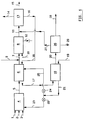
- the allyl chloride, the chlorine and the water introduced respectively through the conduits 1, 2 and 3 react in the reaction zone 4, to form, by hypochlorination of the allyl chloride, dichloropropanols as well as small amounts of numerous impurities chlorinated organic.
- the reaction zone 4 consists of one or more reactors which are consecutive or arranged in parallel, such as agitated reactors, recirculation reactors, venturi reactors or any other type of reactor allowing rapid and efficient dispersion of the reactants.
- the hypochlorination reaction generally takes place at a temperature of 20 to 70 ° C.
- the crude aqueous solution of dichloropropanols is brought to an extraction zone 6 where it is brought into intimate contact with an organic solvent of recycled extraction, rich in 1,2,3-trichloropropane, introduced via line 16.
- the crude aqueous solution of dichloropropanols and the extraction solvent are brought into contact in one or more stages, using n ' any conventional liquid-liquid extraction device, for example by intimate contact by means of a stirred reactor, a rotary disc extractor, a centrifugal extractor or a column with perforated trays, operating either against the current or co-current.
- the extraction can be carried out continuously or discontinuously. Preferably, it is carried out continuously.
- chloroaliphatic impurities, and more particularly chloroaliphatic ethers and alcohols is of course a function of various parameters, in particular of the liquid-liquid extraction device used and of the 1,2,3-trichloropropane content in the solvent extraction. In general, however, it can be said that good results can be obtained when this ratio is greater than about 0.001. Preferably, this ratio is greater than about 0.002. Particularly preferably, it is greater than about 0.005. Generally, this ratio is less than about 0.1. Preferably, it is less than about 0.05. Particularly preferably, it is less than about 0.03.
- the organic phase mainly comprises 1,2,3-trichloropropane enriched in chloroaliphatic impurities, but also contains a non-negligible amount of dichloropropanols. Its composition most often corresponds to the equilibrium composition, determined by the partition coefficients of the different compounds between water and 1,2,3-trichloropropane.
- the aqueous phase contains most of the dichloropropanols.
- aqueous solution purified from dichloropropanols.
- the aqueous phase obtained in extraction zone 6 is particularly well purified from chloroaliphatic impurities. It has an extremely low residual content of these impurities, which is impossible to achieve solely by the known methods cited above.
- an alkaline aqueous solution it is possible to use, in particular, a solution of sodium hydroxide, calcium hydroxide or alternatively sodium carbonate.
- the solution obtained is then immediately transferred to a steam drive column 8, fed at its base with a flow of steam 10.
- This crude epichlorohydrin mainly contains, in addition to epichlorohydrin, a little water, unprocessed dichloropropanols, 1,2,3-trichloropropane dissolved in the phase in the extraction zone 6 and the residual chloroaliphatic impurities, not extracted from the aqueous phase in the extraction zone 6.
- the aqueous effluents are discharged, containing in particular the mineral salts generated by the hydrolysis.
- the load of chloroaliphatic impurities generated in the hypochlorination step of allyl chloride is particularly low, which makes their purification easier.
- the distillation zone 13 consisting of one or, preferably, several distillation columns makes it possible to eliminate the crude epichlorohydrin conveyed by the line 11, on the one hand, a light fraction comprising the water and the compounds relatively volatile, which are evacuated via line 14 to a treatment unit where they are generally destroyed, for example by combustion and, on the other hand, a residual heavy fraction consisting mainly of 1,2,3-trichloropropane, of non-dichloropropanols converted and chloroaliphatic impurities not extracted from the aqueous phase in the extraction zone 6.
- this heavy fraction constitutes, in this preferred mode of carrying out the process according to invention, the organic extraction solvent recycled, rich in 1,2,3-trichloropropane.
- the recycling of this heavy fraction also makes it possible to recover the dichloropropanols which are optionally not hydrolysed during the dehydrochlorination step and entrained in the crude epichlorohydrin.
- this heavy fraction can comprise, in addition to 1,2,3-trichloropropane, from 0.5 to 60% by weight of dichloropropanols and from 0.1 to 5% of chloroaliphatic impurities.
- it comprises from 1 to 40% of dichloropropanols and from 0.5 to 3% of chloroaliphatic impurities.
- the organic phase obtained in the extraction zone 6 mainly contains 1,2,3-trichloropropane, on the one hand coming from the recycled organic extraction solvent introduced in the extraction step 6 via line 16 and on the other hand, formed during the hypochlorination of allyl chloride in reaction zone 4 and chloroaliphatic impurities, including chloroaliphatic ethers and alcohols, also formed during the hypochlorination of allyl chloride.
- the organic phase however, also contains non-negligible quantities of dichloropropanols extracted from the crude aqueous solution of dichloropropanols by the organic extraction solvent during extraction step 6, as well as small quantities of products such as chloride impurities. allyl and, optionally, allyl chloride not converted in reaction zone 4.
- this organic phase is transferred via line 17 to a washing zone 18 where it is washed with water.
- washing is carried out in one or more stages in any conventional liquid-liquid extraction device, by bringing the organic phase brought through the line 17 into intimate contact with water, which is introduced into the zone 18 via line 19.
- the amount of water required to carry out this washing depends on the efficiency of the device used.
- This washing can be carried out continuously or batchwise. Preferably, it is carried out continuously. In this case, the volume ratio between the flow of washing water and the flow of organic extract is generally between 5: 1 and 20: 1.
- the washing water After washing and separation of the phases, the washing water is generally saturated with 1,2,3-trichloropropane and it can contain from 1 to 10% by weight of dichloropropanols. It is sent, via line 21, valve 22 and line 23 to reaction zone 4, where it can replace part of the water introduced through line 3. If the dichloropropanol content of this washing water is sufficiently high, it is preferably sent directly to the extraction zone 6 via the conduit 21, the valve 24 and the conduit 25.
- the washed organic extract contains practically no more dichloropropanols. It mainly comprises 1,2,3-trichloropropane and generally from 3 to 25% of chloroaliphatic impurities. This washed organic extract is transferred via line 20 into the distillation zone 26.
- the washed organic extract is separated into an overhead section containing the compounds lighter than 1,2,3 -trichloropropane and 1,2,3-trichloropropane, which top cut is conveyed, via conduits 27 and 11, to the distillation zone of epichlorohydrin 13, in an average cut consisting of 1,2,3- trichloropropane of purity on the order of 99%, which medium cut leaves the process via line 28, and a tail cut consisting essentially of chloroaliphatic impurities, which tail cut is discharged through line 29. Obtained in this way in concentrated form, the chloroaliphatic impurities can be eliminated economically by various known techniques, for example by combustion.
- the distillation carried out at 26 is carried out in such a way that the head section recovered by the conduit 27 contains at least approximately 50% of 1 , 2,3-trichloropropane. Most preferably, its 1,2,3-trichloropropane content is greater than about 70%. Very good results have been obtained with a 1,2,3-trichloropropane content in this top cut of the order of 80 to 98%. In addition to 1,2,3-trichloropropane, this top cut mainly comprises the lighter compounds than 1,2,3-trichloropropane, mainly certain products such as the impurities present in allyl chloride and allyl chloride who would not have reacted during hypochlorination.
- the invention also relates to a process for extracting chloroaliphatic impurities from a crude aqueous solution of dichloropropanols obtained by hypochlorination of allyl chloride, characterized in that the extraction is carried out by means of an organic solvent of recycled extraction, rich in 1,2,3-trichloropropane.
- the invention also relates to the aqueous solution of dichloropropanols. highly purified in chloroaliphatic impurities, obtained by the process of the invention.
- the invention relates to the use of a recycled extraction solvent rich in 1,2,3-trichloropropane as an agent for extracting chloroaliphatic impurities contained in a crude solution of dichloropropanols.
- a crude aqueous solution of dichloropropanols, obtained by hypochlorination of allyl chloride, is firstly decanted to remove the fraction of chlorinated organic impurities which can be easily separated.
- the table shows the concentration of different chloroaliphatic impurities present in the aqueous phase after decantation, identified by their crude formula, the different isomers being distinguished by their retention time in gas chromatography.
- the table gives, for each extraction solvent used, the partition coefficient calculated between the organic phase and the aqueous phase, that is to say the ratio between the concentration of each impurity in the organic phase and its concentration in the aqueous phase, after extraction.
Landscapes
- Chemical & Material Sciences (AREA)
- Organic Chemistry (AREA)
- Organic Low-Molecular-Weight Compounds And Preparation Thereof (AREA)
- Epoxy Compounds (AREA)
Applications Claiming Priority (2)
| Application Number | Priority Date | Filing Date | Title |
|---|---|---|---|
| BE9200259 | 1992-03-17 | ||
| BE9200259A BE1005719A3 (fr) | 1992-03-17 | 1992-03-17 | Procede de production d'epichlorhydrine. |
Publications (2)
| Publication Number | Publication Date |
|---|---|
| EP0561441A1 true EP0561441A1 (de) | 1993-09-22 |
| EP0561441B1 EP0561441B1 (de) | 1996-11-06 |
Family
ID=3886189
Family Applications (1)
| Application Number | Title | Priority Date | Filing Date |
|---|---|---|---|
| EP93200566A Expired - Lifetime EP0561441B1 (de) | 1992-03-17 | 1993-03-01 | Verfahren zur Herstellung von Epichlorhydrin |
Country Status (5)
| Country | Link |
|---|---|
| US (1) | US5344945A (de) |
| EP (1) | EP0561441B1 (de) |
| JP (1) | JPH069589A (de) |
| BE (1) | BE1005719A3 (de) |
| DE (1) | DE69305766T2 (de) |
Cited By (16)
| Publication number | Priority date | Publication date | Assignee | Title |
|---|---|---|---|---|
| WO2006100311A3 (fr) * | 2005-05-20 | 2006-11-23 | Solvay | Procede de fabrication d'un epoxyde |
| FR2885903A1 (fr) * | 2005-05-20 | 2006-11-24 | Solvay | Procede de fabrication d'epichlorhydrine |
| WO2008101866A3 (en) * | 2007-02-20 | 2009-11-05 | Solvay (Societe Anonyme) | Process for manufacturing epichlorohydrin |
| US8124814B2 (en) | 2006-06-14 | 2012-02-28 | Solvay (Societe Anonyme) | Crude glycerol-based product, process for its purification and its use in the manufacture of dichloropropanol |
| US8197665B2 (en) | 2007-06-12 | 2012-06-12 | Solvay (Societe Anonyme) | Aqueous composition containing a salt, manufacturing process and use |
| US8258350B2 (en) | 2007-03-07 | 2012-09-04 | Solvay (Societe Anonyme) | Process for the manufacture of dichloropropanol |
| US8273923B2 (en) | 2007-06-01 | 2012-09-25 | Solvay (Societe Anonyme) | Process for manufacturing a chlorohydrin |
| US8314205B2 (en) | 2007-12-17 | 2012-11-20 | Solvay (Societe Anonyme) | Glycerol-based product, process for obtaining same and use thereof in the manufacturing of dichloropropanol |
| US8378130B2 (en) | 2007-06-12 | 2013-02-19 | Solvay (Societe Anonyme) | Product containing epichlorohydrin, its preparation and its use in various applications |
| US8471074B2 (en) | 2007-03-14 | 2013-06-25 | Solvay (Societe Anonyme) | Process for the manufacture of dichloropropanol |
| US8507643B2 (en) | 2008-04-03 | 2013-08-13 | Solvay S.A. | Composition comprising glycerol, process for obtaining same and use thereof in the manufacture of dichloropropanol |
| US8536381B2 (en) | 2008-09-12 | 2013-09-17 | Solvay Sa | Process for purifying hydrogen chloride |
| US8715568B2 (en) | 2007-10-02 | 2014-05-06 | Solvay Sa | Use of compositions containing silicon for improving the corrosion resistance of vessels |
| US8795536B2 (en) | 2008-01-31 | 2014-08-05 | Solvay (Societe Anonyme) | Process for degrading organic substances in an aqueous composition |
| US9309209B2 (en) | 2010-09-30 | 2016-04-12 | Solvay Sa | Derivative of epichlorohydrin of natural origin |
| US9663427B2 (en) | 2003-11-20 | 2017-05-30 | Solvay (Société Anonyme) | Process for producing epichlorohydrin |
Families Citing this family (14)
| Publication number | Priority date | Publication date | Assignee | Title |
|---|---|---|---|---|
| JP3337311B2 (ja) * | 1994-03-11 | 2002-10-21 | 高砂香料工業株式会社 | 新規オキソ−チタン錯体、その製造方法およびその錯体を用いたβ−ヒドロキシケトンまたはα−ヒドロキシカルボン酸エステルの製造方法 |
| BE1011576A3 (fr) * | 1997-11-27 | 1999-11-09 | Solvay | Produit a base d'epichlorhydrine et procede de fabrication de ce produit. |
| US6522952B1 (en) | 1999-06-01 | 2003-02-18 | Japan As Represented By Secretary Of Agency Of Industrial Science And Technology | Method and system for controlling cooperative object-transporting robot |
| RU2198882C1 (ru) * | 2001-07-19 | 2003-02-20 | Ошин Леонид Андреевич | Способ получения эпихлоргидрина |
| US7910781B2 (en) * | 2004-07-21 | 2011-03-22 | Dow Global Technologies Llc | Process for the conversion of a crude glycerol, crude mixtures of naturally derived multihydroxylated aliphatic hydrocarbons or esters thereof to a chlorohydrin |
| US7906690B2 (en) * | 2004-07-21 | 2011-03-15 | Dow Global Technologies Inc. | Batch, semi-continuous or continuous hydrochlorination of glycerin with reduced volatile chlorinated hydrocarbon by-products and chloracetone levels |
| DE602005018778D1 (de) * | 2004-07-21 | 2010-02-25 | Dow Global Technologies Inc | Umwandlung eines mehrfach hydroxylierten aliphatischen kohlenwasserstoffes oder esters daraus in ein chlorhydrin |
| KR20080037613A (ko) | 2005-05-20 | 2008-04-30 | 솔베이(소시에떼아노님) | 폴리히드록실화 지방족 탄화수소의 클로로히드린으로의전환 방법 |
| CN102219644B (zh) | 2005-11-08 | 2013-11-06 | 索尔维公司 | 通过甘油的氯化制备二氯丙醇的方法 |
| US7930651B2 (en) | 2007-01-18 | 2011-04-19 | Research In Motion Limited | Agenda display in an electronic device |
| FR2918058A1 (fr) * | 2007-06-28 | 2009-01-02 | Solvay | Produit a base de glycerol, procede pour sa purification et son utilisation dans la fabrication de dichloropropanol |
| EP2537837A1 (de) * | 2008-02-26 | 2012-12-26 | Dow Global Technologies LLC | Verfahren und aparatur zur reinigung von epichlorhydrinen |
| FR2939434B1 (fr) * | 2008-12-08 | 2012-05-18 | Solvay | Procede de traitement de glycerol. |
| CN111018665A (zh) * | 2019-12-17 | 2020-04-17 | 山东民基化工有限公司 | 环氧氯丙烷重组分中三氯丙烷的回收利用方法 |
Citations (1)
| Publication number | Priority date | Publication date | Assignee | Title |
|---|---|---|---|---|
| EP0359331A1 (de) * | 1988-09-09 | 1990-03-21 | Shell Internationale Researchmaatschappij B.V. | Kontinuierliches Verfahren zur Herstellung von Dichlorhydrin |
Family Cites Families (8)
| Publication number | Priority date | Publication date | Assignee | Title |
|---|---|---|---|---|
| US3061615A (en) * | 1962-10-30 | Process for the production of alpha-epichlorhydrin | ||
| US2714123A (en) * | 1951-05-31 | 1955-07-26 | Shell Dev | Production of dichlorohydrin from allyl chloride |
| DE1158953B (de) * | 1961-03-18 | 1963-12-12 | Solvay | Verfahren zur Herstellung von ª‡-Epichlorhydrin |
| NL125348C (de) * | 1962-02-12 | |||
| NL7405988A (nl) * | 1973-07-13 | 1975-01-15 | Vetco Offshore Ind Inc | Apparatuur voor opstelling op een schip dat aan een tengevolge van golfwerking optrendende dei- nign is onderworpen. |
| SU789479A1 (ru) * | 1977-05-11 | 1980-12-23 | Предприятие П/Я Р-6751 | Способ получени дихлоргидринов глицерина |
| TW223052B (de) * | 1991-10-10 | 1994-05-01 | Shell Internat Res Schappej B V | |
| EP0537846B1 (de) * | 1991-10-10 | 1996-03-27 | Shell Internationale Researchmaatschappij B.V. | Herstellung von Dichlorhydrin |
-
1992
- 1992-03-17 BE BE9200259A patent/BE1005719A3/fr not_active IP Right Cessation
-
1993
- 1993-03-01 DE DE69305766T patent/DE69305766T2/de not_active Expired - Fee Related
- 1993-03-01 EP EP93200566A patent/EP0561441B1/de not_active Expired - Lifetime
- 1993-03-12 US US08/030,559 patent/US5344945A/en not_active Expired - Fee Related
- 1993-03-15 JP JP5053832A patent/JPH069589A/ja active Pending
Patent Citations (1)
| Publication number | Priority date | Publication date | Assignee | Title |
|---|---|---|---|---|
| EP0359331A1 (de) * | 1988-09-09 | 1990-03-21 | Shell Internationale Researchmaatschappij B.V. | Kontinuierliches Verfahren zur Herstellung von Dichlorhydrin |
Non-Patent Citations (4)
| Title |
|---|
| CHEMICAL ABSTRACTS, vol. 107, no. 8, 24 Août 1987, Columbus, Ohio, US; abstract no. 61007, V. SAULI, SCHEJBAL I. 'Epichlorohydrin manufacture' page 109 ; * |
| CHEMICAL ABSTRACTS, vol. 69, no. 22, 25 Novembre 1968, Columbus, Ohio, US; abstract no. 90301, URBANCOVA, L. 'Liquid-liquid equilibrium in systems 1,3-dichloro-2-propanol-1,2,3-t richloropropane-water.' page 8461 ; * |
| DATABASE WPI Week 7541, 1975 Derwent Publications Ltd., London, GB; AN 75-68268W & JP-B-50 028 408 (OSAKA) 16 Septembre 1975 * |
| DATABASE WPI Week 8137, 1981 Derwent Publications Ltd., London, GB; AN 81-67350D & SU-A-789 479 (SHAROV V G) 24 Décembre 1980 * |
Cited By (20)
| Publication number | Priority date | Publication date | Assignee | Title |
|---|---|---|---|---|
| US9663427B2 (en) | 2003-11-20 | 2017-05-30 | Solvay (Société Anonyme) | Process for producing epichlorohydrin |
| FR2885903A1 (fr) * | 2005-05-20 | 2006-11-24 | Solvay | Procede de fabrication d'epichlorhydrine |
| US7557253B2 (en) | 2005-05-20 | 2009-07-07 | Solvay (Societe Anonyme) | Method for converting polyhydroxylated aliphatic hydrocarbons into chlorohydrins |
| US7615670B2 (en) | 2005-05-20 | 2009-11-10 | Solvay (Société Anonyme) | Method for making chlorohydrin in liquid phase in the presence of heavy compounds |
| EA018479B1 (ru) * | 2005-05-20 | 2013-08-30 | Солвей (Сосьете Аноним) | Способ получения эпоксида |
| WO2006100311A3 (fr) * | 2005-05-20 | 2006-11-23 | Solvay | Procede de fabrication d'un epoxyde |
| US8124814B2 (en) | 2006-06-14 | 2012-02-28 | Solvay (Societe Anonyme) | Crude glycerol-based product, process for its purification and its use in the manufacture of dichloropropanol |
| WO2008101866A3 (en) * | 2007-02-20 | 2009-11-05 | Solvay (Societe Anonyme) | Process for manufacturing epichlorohydrin |
| US8258350B2 (en) | 2007-03-07 | 2012-09-04 | Solvay (Societe Anonyme) | Process for the manufacture of dichloropropanol |
| US8471074B2 (en) | 2007-03-14 | 2013-06-25 | Solvay (Societe Anonyme) | Process for the manufacture of dichloropropanol |
| US8273923B2 (en) | 2007-06-01 | 2012-09-25 | Solvay (Societe Anonyme) | Process for manufacturing a chlorohydrin |
| US8378130B2 (en) | 2007-06-12 | 2013-02-19 | Solvay (Societe Anonyme) | Product containing epichlorohydrin, its preparation and its use in various applications |
| US8399692B2 (en) | 2007-06-12 | 2013-03-19 | Solvay (Societe Anonyme) | Epichlorohydrin, manufacturing process and use |
| US8197665B2 (en) | 2007-06-12 | 2012-06-12 | Solvay (Societe Anonyme) | Aqueous composition containing a salt, manufacturing process and use |
| US8715568B2 (en) | 2007-10-02 | 2014-05-06 | Solvay Sa | Use of compositions containing silicon for improving the corrosion resistance of vessels |
| US8314205B2 (en) | 2007-12-17 | 2012-11-20 | Solvay (Societe Anonyme) | Glycerol-based product, process for obtaining same and use thereof in the manufacturing of dichloropropanol |
| US8795536B2 (en) | 2008-01-31 | 2014-08-05 | Solvay (Societe Anonyme) | Process for degrading organic substances in an aqueous composition |
| US8507643B2 (en) | 2008-04-03 | 2013-08-13 | Solvay S.A. | Composition comprising glycerol, process for obtaining same and use thereof in the manufacture of dichloropropanol |
| US8536381B2 (en) | 2008-09-12 | 2013-09-17 | Solvay Sa | Process for purifying hydrogen chloride |
| US9309209B2 (en) | 2010-09-30 | 2016-04-12 | Solvay Sa | Derivative of epichlorohydrin of natural origin |
Also Published As
| Publication number | Publication date |
|---|---|
| US5344945A (en) | 1994-09-06 |
| BE1005719A3 (fr) | 1993-12-28 |
| EP0561441B1 (de) | 1996-11-06 |
| DE69305766D1 (de) | 1996-12-12 |
| DE69305766T2 (de) | 1997-05-22 |
| JPH069589A (ja) | 1994-01-18 |
Similar Documents
| Publication | Publication Date | Title |
|---|---|---|
| EP0561441B1 (de) | Verfahren zur Herstellung von Epichlorhydrin | |
| EP1885673B1 (de) | Verfahren zur herstellung von chlorhydrin in flüssiger phase in gegenwart von schweren verbindungen | |
| FR2919609A1 (fr) | Procede de fabrication de glycidol | |
| FR2528417A1 (fr) | Procede de preparation de l'ethylene-glycol a partir d'une solution aqueuse d'oxyde d'ethylene, par extraction par du dioxyde de carbone et hydrolyse | |
| FR2913684A1 (fr) | Procede de fabrication de dichloropropanol | |
| EP0061393B1 (de) | Kontinuierliches Verfahren zur Herstellung von Propylenoxid | |
| EP0965562A1 (de) | Verfahren und Anlage zur Herstellung einer wässerigen Wasserstoffperoxydlösung und wässerige Wasserstoffperoxydlösung | |
| FR2742150A1 (fr) | Procede de production d'oxyde de propylene a partir d'hydroperoxyde d'ethylbenzene et de propylene | |
| US7186866B1 (en) | Process for recovery of cumene hydroperoxide decomposition products by distillation | |
| EP1299369B1 (de) | Verfahren zur herstellung von oxiranen | |
| FR2885903A1 (fr) | Procede de fabrication d'epichlorhydrine | |
| EP1299370B1 (de) | Kontinuierliches verfahren zur herstellung von oxiranen | |
| EP0084286B1 (de) | Verfahren zur Herstellung von epsilon-Caprolacton | |
| EP1028934B1 (de) | Verfahren zur abtrennung einer organischen verbindung aus einem wässerigen medium | |
| JPS6052733B2 (ja) | ヒドロキノンの製造方法 | |
| EP0712392B1 (de) | Verfahren zur herstellung von cumenhydroperoxyd | |
| EP0037349B1 (de) | Verfahren zur Herstellung des O,O-Dimethyl-phosphordithioats von Ethyl-mercaptosuccinat (Malathion(R)) | |
| FR2529196A1 (fr) | Purification de phenol | |
| JPH02115136A (ja) | ジクロロヒドリンの連続的製造方法 | |
| CN101341139B (zh) | 环氧丙烷的提纯和回收 | |
| EP0296990B1 (de) | Verfahren zur Herstellung von hydroxyliertem Polybutadien | |
| EP1165475B1 (de) | Verfahren zur abtrennung von fluorwasserstoff aus seinen mischungen mit 1,1,1,3,3-pentafluorbutan und verfahren zur herstellung von pentafluorbutan | |
| BE496062A (de) | ||
| EP0172761B1 (de) | Verfahren zur Herstellung von reinen Hydraten von Fluoral und Hexafluoraceton aus Hemiacetalen | |
| BE1011531A3 (fr) | Procede de fabrication d'un compose organique. |
Legal Events
| Date | Code | Title | Description |
|---|---|---|---|
| PUAI | Public reference made under article 153(3) epc to a published international application that has entered the european phase |
Free format text: ORIGINAL CODE: 0009012 |
|
| AK | Designated contracting states |
Kind code of ref document: A1 Designated state(s): DE FR NL |
|
| 17P | Request for examination filed |
Effective date: 19940228 |
|
| 17Q | First examination report despatched |
Effective date: 19950504 |
|
| GRAG | Despatch of communication of intention to grant |
Free format text: ORIGINAL CODE: EPIDOS AGRA |
|
| GRAH | Despatch of communication of intention to grant a patent |
Free format text: ORIGINAL CODE: EPIDOS IGRA |
|
| GRAH | Despatch of communication of intention to grant a patent |
Free format text: ORIGINAL CODE: EPIDOS IGRA |
|
| GRAA | (expected) grant |
Free format text: ORIGINAL CODE: 0009210 |
|
| AK | Designated contracting states |
Kind code of ref document: B1 Designated state(s): DE FR NL |
|
| REF | Corresponds to: |
Ref document number: 69305766 Country of ref document: DE Date of ref document: 19961212 |
|
| PLBE | No opposition filed within time limit |
Free format text: ORIGINAL CODE: 0009261 |
|
| STAA | Information on the status of an ep patent application or granted ep patent |
Free format text: STATUS: NO OPPOSITION FILED WITHIN TIME LIMIT |
|
| 26N | No opposition filed | ||
| PGFP | Annual fee paid to national office [announced via postgrant information from national office to epo] |
Ref country code: DE Payment date: 20050224 Year of fee payment: 13 |
|
| PGFP | Annual fee paid to national office [announced via postgrant information from national office to epo] |
Ref country code: NL Payment date: 20050303 Year of fee payment: 13 |
|
| PGFP | Annual fee paid to national office [announced via postgrant information from national office to epo] |
Ref country code: FR Payment date: 20050308 Year of fee payment: 13 |
|
| PG25 | Lapsed in a contracting state [announced via postgrant information from national office to epo] |
Ref country code: NL Free format text: LAPSE BECAUSE OF NON-PAYMENT OF DUE FEES Effective date: 20061001 |
|
| PG25 | Lapsed in a contracting state [announced via postgrant information from national office to epo] |
Ref country code: DE Free format text: LAPSE BECAUSE OF NON-PAYMENT OF DUE FEES Effective date: 20061003 |
|
| NLV4 | Nl: lapsed or anulled due to non-payment of the annual fee |
Effective date: 20061001 |
|
| REG | Reference to a national code |
Ref country code: FR Ref legal event code: ST Effective date: 20061130 |
|
| PG25 | Lapsed in a contracting state [announced via postgrant information from national office to epo] |
Ref country code: FR Free format text: LAPSE BECAUSE OF NON-PAYMENT OF DUE FEES Effective date: 20060331 |