EP0561497A1 - Connecteur électrique et blindage pour montage sur une surface plate - Google Patents
Connecteur électrique et blindage pour montage sur une surface plate Download PDFInfo
- Publication number
- EP0561497A1 EP0561497A1 EP93300980A EP93300980A EP0561497A1 EP 0561497 A1 EP0561497 A1 EP 0561497A1 EP 93300980 A EP93300980 A EP 93300980A EP 93300980 A EP93300980 A EP 93300980A EP 0561497 A1 EP0561497 A1 EP 0561497A1
- Authority
- EP
- European Patent Office
- Prior art keywords
- electrical connector
- shield
- terminals
- housing
- metal
- Prior art date
- Legal status (The legal status is an assumption and is not a legal conclusion. Google has not performed a legal analysis and makes no representation as to the accuracy of the status listed.)
- Granted
Links
- 239000002184 metal Substances 0.000 claims abstract description 36
- 238000005476 soldering Methods 0.000 claims abstract description 7
- 125000006850 spacer group Chemical group 0.000 claims description 6
- 210000002105 tongue Anatomy 0.000 claims description 6
- 239000012530 fluid Substances 0.000 claims description 3
- 238000004140 cleaning Methods 0.000 claims description 2
- 239000004020 conductor Substances 0.000 abstract description 6
- 238000003780 insertion Methods 0.000 abstract description 5
- 230000037431 insertion Effects 0.000 abstract description 5
- 230000013011 mating Effects 0.000 description 13
- 229910000679 solder Inorganic materials 0.000 description 4
- 238000010276 construction Methods 0.000 description 2
- 230000000994 depressogenic effect Effects 0.000 description 2
- 239000007788 liquid Substances 0.000 description 2
- 230000014759 maintenance of location Effects 0.000 description 2
- 238000012986 modification Methods 0.000 description 2
- 230000004048 modification Effects 0.000 description 2
- 230000009977 dual effect Effects 0.000 description 1
- 239000007789 gas Substances 0.000 description 1
- 230000000717 retained effect Effects 0.000 description 1
Images



Classifications
-
- H—ELECTRICITY
- H01—ELECTRIC ELEMENTS
- H01R—ELECTRICALLY-CONDUCTIVE CONNECTIONS; STRUCTURAL ASSOCIATIONS OF A PLURALITY OF MUTUALLY-INSULATED ELECTRICAL CONNECTING ELEMENTS; COUPLING DEVICES; CURRENT COLLECTORS
- H01R12/00—Structural associations of a plurality of mutually-insulated electrical connecting elements, specially adapted for printed circuits, e.g. printed circuit boards [PCB], flat or ribbon cables, or like generally planar structures, e.g. terminal strips, terminal blocks; Coupling devices specially adapted for printed circuits, flat or ribbon cables, or like generally planar structures; Terminals specially adapted for contact with, or insertion into, printed circuits, flat or ribbon cables, or like generally planar structures
- H01R12/70—Coupling devices
- H01R12/71—Coupling devices for rigid printing circuits or like structures
- H01R12/72—Coupling devices for rigid printing circuits or like structures coupling with the edge of the rigid printed circuits or like structures
-
- H—ELECTRICITY
- H01—ELECTRIC ELEMENTS
- H01R—ELECTRICALLY-CONDUCTIVE CONNECTIONS; STRUCTURAL ASSOCIATIONS OF A PLURALITY OF MUTUALLY-INSULATED ELECTRICAL CONNECTING ELEMENTS; COUPLING DEVICES; CURRENT COLLECTORS
- H01R12/00—Structural associations of a plurality of mutually-insulated electrical connecting elements, specially adapted for printed circuits, e.g. printed circuit boards [PCB], flat or ribbon cables, or like generally planar structures, e.g. terminal strips, terminal blocks; Coupling devices specially adapted for printed circuits, flat or ribbon cables, or like generally planar structures; Terminals specially adapted for contact with, or insertion into, printed circuits, flat or ribbon cables, or like generally planar structures
- H01R12/70—Coupling devices
- H01R12/7005—Guiding, mounting, polarizing or locking means; Extractors
- H01R12/7011—Locking or fixing a connector to a PCB
- H01R12/707—Soldering or welding
-
- H—ELECTRICITY
- H01—ELECTRIC ELEMENTS
- H01R—ELECTRICALLY-CONDUCTIVE CONNECTIONS; STRUCTURAL ASSOCIATIONS OF A PLURALITY OF MUTUALLY-INSULATED ELECTRICAL CONNECTING ELEMENTS; COUPLING DEVICES; CURRENT COLLECTORS
- H01R12/00—Structural associations of a plurality of mutually-insulated electrical connecting elements, specially adapted for printed circuits, e.g. printed circuit boards [PCB], flat or ribbon cables, or like generally planar structures, e.g. terminal strips, terminal blocks; Coupling devices specially adapted for printed circuits, flat or ribbon cables, or like generally planar structures; Terminals specially adapted for contact with, or insertion into, printed circuits, flat or ribbon cables, or like generally planar structures
- H01R12/70—Coupling devices
- H01R12/7005—Guiding, mounting, polarizing or locking means; Extractors
- H01R12/7011—Locking or fixing a connector to a PCB
- H01R12/7017—Snap means
- H01R12/7023—Snap means integral with the coupling device
-
- H—ELECTRICITY
- H01—ELECTRIC ELEMENTS
- H01R—ELECTRICALLY-CONDUCTIVE CONNECTIONS; STRUCTURAL ASSOCIATIONS OF A PLURALITY OF MUTUALLY-INSULATED ELECTRICAL CONNECTING ELEMENTS; COUPLING DEVICES; CURRENT COLLECTORS
- H01R13/00—Details of coupling devices of the kinds covered by groups H01R12/70 or H01R24/00 - H01R33/00
- H01R13/648—Protective earth or shield arrangements on coupling devices, e.g. anti-static shielding
-
- H—ELECTRICITY
- H01—ELECTRIC ELEMENTS
- H01R—ELECTRICALLY-CONDUCTIVE CONNECTIONS; STRUCTURAL ASSOCIATIONS OF A PLURALITY OF MUTUALLY-INSULATED ELECTRICAL CONNECTING ELEMENTS; COUPLING DEVICES; CURRENT COLLECTORS
- H01R13/00—Details of coupling devices of the kinds covered by groups H01R12/70 or H01R24/00 - H01R33/00
- H01R13/648—Protective earth or shield arrangements on coupling devices, e.g. anti-static shielding
- H01R13/658—High frequency shielding arrangements, e.g. against EMI [Electro-Magnetic Interference] or EMP [Electro-Magnetic Pulse]
-
- H—ELECTRICITY
- H01—ELECTRIC ELEMENTS
- H01R—ELECTRICALLY-CONDUCTIVE CONNECTIONS; STRUCTURAL ASSOCIATIONS OF A PLURALITY OF MUTUALLY-INSULATED ELECTRICAL CONNECTING ELEMENTS; COUPLING DEVICES; CURRENT COLLECTORS
- H01R12/00—Structural associations of a plurality of mutually-insulated electrical connecting elements, specially adapted for printed circuits, e.g. printed circuit boards [PCB], flat or ribbon cables, or like generally planar structures, e.g. terminal strips, terminal blocks; Coupling devices specially adapted for printed circuits, flat or ribbon cables, or like generally planar structures; Terminals specially adapted for contact with, or insertion into, printed circuits, flat or ribbon cables, or like generally planar structures
- H01R12/70—Coupling devices
- H01R12/71—Coupling devices for rigid printing circuits or like structures
- H01R12/72—Coupling devices for rigid printing circuits or like structures coupling with the edge of the rigid printed circuits or like structures
- H01R12/722—Coupling devices for rigid printing circuits or like structures coupling with the edge of the rigid printed circuits or like structures coupling devices mounted on the edge of the printed circuits
- H01R12/724—Coupling devices for rigid printing circuits or like structures coupling with the edge of the rigid printed circuits or like structures coupling devices mounted on the edge of the printed circuits containing contact members forming a right angle
-
- H—ELECTRICITY
- H01—ELECTRIC ELEMENTS
- H01R—ELECTRICALLY-CONDUCTIVE CONNECTIONS; STRUCTURAL ASSOCIATIONS OF A PLURALITY OF MUTUALLY-INSULATED ELECTRICAL CONNECTING ELEMENTS; COUPLING DEVICES; CURRENT COLLECTORS
- H01R25/00—Coupling parts adapted for simultaneous co-operation with two or more identical counterparts, e.g. for distributing energy to two or more circuits
- H01R25/006—Coupling parts adapted for simultaneous co-operation with two or more identical counterparts, e.g. for distributing energy to two or more circuits the coupling part being secured to apparatus or structure, e.g. duplex wall receptacle
Definitions
- the present invention relates to an electrical connector for mounting to a circuit board and to a metal shield therefor.
- U.S. Patent No. 5,037,330 discloses a right angle electrical connector having a metal shield having side walls from which project struck out flanges which engage in external grooves in insulating housings of the connector which are received within the shield. With the bowed mounting feet project from bottom edges of the shield side walls for insertion through holes in a circuit board to retain the connector thereon.
- the electrical connector of the above construction has the following advantages.
- the metal shield covers the entirety of the upper and lower electrical connector bodies while providing a pair of mounting legs for ready assembly. Additionally, the shield has detent members which provide a stable structural connection to the electrical connectors.
- the electrical connector having the above construction has the following disadvantages.
- the connector lacks board mounts on the bottom electrical connector and is therefore not firmly retained in place until the metal shield covers it. Further, the metal shield's mounting legs do not firmly fix the electrical connector to the printed circuit board because they have only one leg each. Additionally, the single leg design has the chance of being bent or otherwise damaged.
- the instant invention overcomes the above-mentioned problems.
- the object of the present invention is to provide a multi-leg board lock which firmly fixes the connector assembly to a printed circuit board. Further, the shield's legs are soldered to the board lock in a way that eliminates the need for another hole in the printed circuit board.
- an electrical connector for mounting on a circuit board and includes a housing having a bottom wall with a bottom face for engaging against the circuit board, the bottom wall having formed therein a through bore opening into said bottom face.
- a hollow board lock supported in the through bore has locking legs projecting below the bottom face for insertion in a first hole in the circuit board.
- a header in the housing carries electrical terminals with terminal legs thereof projecting from the header and terminating in soldering tails depending below the bottom face of the housing for insertion into second holes in the circuit board with the bottom face of the housing engaging it.
- a metal shield covering the terminal legs has depending therefrom a grounding tab projecting through the board lock and between the locking legs thereof.
- the board lock and the soldering tails are soldered to respective ground and signal conductors on the underside of the board.
- the grounding tab which projects between the locking legs of the board lock, is soldered to the same grounding conductor.
- the drilling program for the board is thereby simplified and lining metal is saved.
- the board lock serves to protect the grounding tab from stubbing against the board when the connector is being mounted thereto, or the grounding tab being otherwise damaged when the connector is being handled.
- the bores for the board locks may be formed in spaced, rudimentary bottom walls of the housing, the housing having a top wall and the shield having a top flap resiliently engaging beneath the top wall of the housing whereby the side walls of the shield, from which the grounding tabs project, are resilient urged against said bottom walls of the housing.
- the shield may be received between side walls projecting from a front wall of the housing in which the header is fixed, a side wall of the shield having latching tongues engaged in grooves in the housing side walls.
- the shield is moved down vertically between the side walls, so that the grounding tabs enter the board locks and the latching tongues engage the grooves, the flap being resiliently depressed and located beneath the top wall of the housing.
- the grounding tabs are offset inwardly from the side walls of the shield.
- a right angle electrical connector for mounting on a circuit board comprises a die-cast metal housing having a front wall formed with upper and lower through openings. Side walls project from opposite lateral ends of the front wall rearwardly thereof, board engaging bottom walls extending towards each other from inner faces of the side walls. Projections depend from the bottom walls for electrically connecting the diecast metal housing to ground by way of the circuit board.
- a first drawn metal shell defining a through aperture is secured in the upper through opening of the metal housing and a second drawn metal shell is secured in the lower through opening of the metal housing.
- a first insulating header is received in the aperture of the first drawn shell and a second insulating header is received in the aperture of the second drawn shell.
- Each header has a mating face exposed in the forward direction of the housing front wall and a terminal receiving face directed rearwardly of the housing front wall.
- the first header comprises a first group of electrical terminals, the second header comprising a second group of electrical terminals.
- Each terminal has a mating portion within the header which is exposed towards the mating face of the header, a terminal leg projecting obliquely downwardly and rearwardly beyond the terminal receiving face of the header and between the housing side walls and a soldering tail projecting downwardly below the bottom walls of the housing.
- the solder tails of the terminals of each group of terminals are arranged in at least one row, all of said rows being parallel.
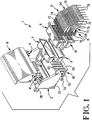
- a shielded, stacked, right angle, electrical connector 1, for mounting on a circuit board PCB, is shown in the exploded perspective view of Figure 1.
- the connector which may be used in the computer field as an input/output port, comprises a die cast metal housing 2, receiving upper and lower drawn metal shells 4 and 6 respectively, the shells 4 and 6 receiving insulating upper and lower header inserts 8 and 10, respectively, the inserts 8 and 10, in turn receiving upper and lower groups 12 and 14, respectively of an array of electrical terminals.
- the connector 1 further comprises a terminal tail spacer plate 16 and a metal shield 18 covering the rear of the housing 2.
- the die cast housing 2 comprises a front wall 20 and opposite side walls 22 tapering rearwardly from opposite ends of the front wall 20, each side wall 22 having a downwardly inclined upper edges 24, a horizontal bottom edge 26 extending at right angles to the front wall 20 and a vertical rear edge 28 joining the edges 24 and 26, parallel with the wall 20.
- the housing 2 is best seen in Figures 3 and 6.
- the housing 2 has a pair of board engaging members in the form of opposed, rudimentary, bottom walls 30 projecting inwardly of the housing 2, from the side walls 22, proximate to their bottom edges 26.
- Each wall 30 has a board engaging bottom face 31 ( Figures 5, 10 and 11).
- the housing 2 also has a rudimentary forward top wall 32 extending rearwardly from the upper end of the front wall 20 and spanning the side walls 22.
- Each edge 24 is joined to the top wall 32 at a short, horizontal top edge 33.
- the front wall 20 is formed with a pair of spaced keys 36 cast therein or threadably securable thereto with key 36 being representative of both versions, near its upper end, each key 36 being located proximate to a respective side wall 22. Below each key 36 the front wall 20 is formed with threaded screw-locks 38. The keys 36 and the screw-locks 38 are provided for cooperation with complimentary key-ways and jack screws, respectively, of an electrical connector (not shown) for mating with the connector 1.
- Keys 36 may have a threaded shank receivable in a threaded aperture in front wall 20 or may be cast into housing 2. Keys 36 project forwardly of wall 20 and have a keying rib 87 thereon. Typically the keys are provided in pairs with the rib 87 on each key 36 oriented in the coordinated directions. The rib 87 may take on other angular positions. Typical positions are at equal angular orientations such as vertically as shown, both laterally outwardly - the rib on the left key to the left and the rib on the right key to the right -, and both vertically downward. The central bore of the key may be threaded to receive a jackscrew. The same structure as key 36, without rib 87, forms a screwlock.
- the front wall 20 is formed with an upper, laterally elongate, through opening 35, and between the keyways 38, with a lower, lateral, elongate through opening 133, as shown in Figure 6.
- Each bottom wall 30 is formed with an inwardly projecting lower step 40 extending the full length thereof and has a central through bore 39 extending through the board engaging face 31 of the wall 30, in which is secured a hollow board lock 41, in the manner described in, and being constructed according to, the teaching, U.S. Patent No. 4,842,552 which is hereby incorporated herein by reference.
- Each board lock 41 comprises an annular strap supported in the respective bore 39 and from which strap depend below the face 31 four locking legs 37.
- each board lock 41 there depends from each bottom wall 30 of the housing 2, on each side of each board lock 41 therein, a board mounting protrusion 43.
- the inner face of each side wall 22 is formed, just above the respective bottom wall 30, with a longitudinal latching groove 42 extending the full length of the side wall 22.
- the drawn shells 4 and 6, which are constructed according to the teach of U.S. Patent No. 4,808,125 which is hereby incorporated herein by reference, are secured in the openings 35 and 133 respectively, according to the teaching of that U.S. Patent. In this manner, both shells 4 and 6 are electrically commoned with housing 2.
- a shielded mating connector engaging either shell 4 or 6 is grounded to a circuit board on which connector 1 is mounted through housing 2 and boardlock 41 to a ground trace on the circuit board.
- the headers 8 and 10 are secured in the shells 4 and 6, respectively, also in the manner taught by U.S. Patent No. 4,808,125.
- Each header 8 and 10 has an upper row of terminal receiving, through cavities 46. Each cavity 44 and 46 opens into a front mating face 48, and a rear terminal receiving face 50, of the respective header 8 and 10.
- the terminal tail spacer place 16 is constructed according to the teaching of U.S. Patent Application Serial No. 757,086 filed on September 10, 1991, and which is hereby incorporated herein by reference.
- the plate 16 rests upon the steps 40 of the bottom walls 30 and has lugs 52 and 54 at each end of the plate 16, which engage in complimentary recesses of the inner faces 56 of the walls 30.
- the plate 16 has a rear 63, extending the full length thereof.
- the group 12 of terminals comprises an upper row of first terminals 64 and a lower row of second terminals 66, the group 14 of terminals comprising an upper row of third terminals 68 and a lower row of fourth terminals 70.
- Each terminal 64, 66, 68, 70 is uniplanar and comprises a forked, forward mating portion 72, a retention portion 74 extending rearwardly therefrom, the portions 72 and 74 being rectilinear and being longitudinally aligned with each other, a rectilinear leg 76 extending rearwardly from the portion 74 and being downwardly angled with respect thereto, and terminating in a solder tail 78 depending from the bottom of the leg 76 at right angles to the portions 72 and 74.
- the mating portions 72 of the terminals 64 are received in respective cavities 44 of the upper row of cavities of the header 8, the mating portions 72 of the terminals 66, being received the cavities 44 of the lower row of cavities 46 of the header 8.
- the mating portions 72 of the terminals 68 are received in respective cavities 44 of the upper row of cavities of the header 10, the mating portions 72 of the terminals 70 being received in the cavities 46 of the lower row of cavities of the header 10.
- the retention portions 74 of the terminals each of which portions is transversely enlarged, in its own plane, serve to retain the terminals in the cavities, with the forked mating portions 72 of the terminals projecting towards the respective mating faces 48.
- the legs 76 of the terminals 64 are longer than those of the terminals 66, the legs 76 of the terminals 66 being longer than those of the terminals 68 and the legs 76 of the terminals 68 being longer than the legs 76 of the terminals 70.
- the downward angle of the legs 76 of the terminals 64 may be less than that of the legs 76 of the terminals 76, the angle of the legs 76 of the terminals 66 being less than that of the terminals 68 and the angle of the legs 76 of the terminals 68 being less than that of the legs of the terminals 70.
- the solder tails 78 of the terminals 64 extend through the holes of the rearmost row of holes 62 in the plate 16, the tails 78 of the terminals 66 extending through the holes of the next rearmost row of holes 62, the tails 78 of the terminals 68 extending through the holes of next row of holes 62 in the forward direction and the tails 78 of the terminals 70 extending through the holes of the foremost row of holes 62 in the plate 16.
- the spacer plate 16 is pressed over the tails 78 according to the teaching of the Patent Application mentioned above.
- shield 18 which has been stamped and formed from a single piece of sheet metal stock, comprises opposite side walls 80 of substantially triangular shape, a rear wall generally referenced 82 and a top wall in the form of a forwardly projecting cantilever flap 84 which is free of the walls 80, the shield 18 being open forwardly.
- the rear wall 82 comprises a rearwardly, and downwardly, inclined upper forward portion 86, a lower rear portion 88, and a lowermost rear portion 90 depending below the side walls 80 and having a bottom edge 91.
- the side walls 80 are connected only by the wall portions 86 and 88.
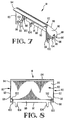
- the side walls 80 have vertical forward edges 92, surmounted by forwardly and downwardly inclined edge portions 94 configured to allow resilient flexure of the flap 84 as will best be apparent from Figure 9.
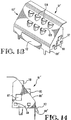
- Each sidewall 80 may have a lateral positioning window 97 (shown in Figures 9, 13 and 14) to prevent lateral movement of shield 18 in housing 2 prior to soldering.
- the window engages the inner surface of sidewalls 22 to prevent the lateral motion, and concomitantly provide additional points of electrical continuity therebetween.
- the side walls 80 have bottom edges 96. Each side wall 80 has, proximate to its bottom edge 96, a pair of struck out, outwardly and upwardly inclined, latching tongues 98. Between its tongues 98, each side wall 80 has a central, flat, grounding tab 100, connected to the edge 96 of the wall 80 by a horizontal strap 102 normally thereof. Each tab 100 is thereby offset inwardly of the respective wall 80 in parallel relationship therewith. There may depend from the bottom edge 91 of the wall portion 88 pair of further flat grounding tabs 104, which are coplanar therewith and the planes of which extend at right angles with those of the tabs 100. The free ends of the tabs 104 may lie below those of the tabs 100.
- the shield 18 In order to mount the shield 18, to the partially completed connector shown in Figure 3, the shield 18 is moved down vertically with its tabs 100 and 104 leading, into the die-cast metal housing 2, so that the latching tongues 98 on each side wall 80 of the shield 18 are initially pressed inwardly and then resile outwardly to latch into respective grooves 42 in the side walls 22 of the housing 2. Windows 97, if present, are pressed inwardly but biasingly engage the inner surface of walls 22.
- the flap 84 of the shield 18 is simultaneously resiliently depressed and inserted under the top wall 32 of the housing 2.
- each tab 100 thereof projects through the annular strap of a respective one of the board locks 41, and extends between the locking legs 37 thereof, as best seen in Figure 10.
- the resilient engagement of the flap 84 against the top wall 32 urges the bottom edge 96 of the shield 18 down against the bottom walls 30.
- the complete connector 1 is shown in Figures 2, and 4 to 6.
- the circuit board PCB ( Figure 2) upon which the assembly 1 is to be surface mounted, has provided therein an array of smaller, plated through holes H1 for receiving the terminal tails 78, two larger, plated through holes H2 for receiving the board locks 41, two further, plated through holes H3 for receiving the tabs 104, four further through, unplated holes H4 for receiving the mounting protrusions 43 of the housing 2.
- shield 18 When shield 18 has as many tabs 100 (or 104) as the connector has boardlocks, there are no additional through holes required solely to accommodate additional shield grounding tabs. When shield 18 has more tabs 100 (or 104) than boardlocks, the number of through holes required can be minimized by having at least some of the through holes perform a dual function of providing a boardlocking function, and possibly concomitantly grounding through the boardlock, as well as providing a path to ground for a ground tab on shield 18.
- the board locks 41 serve to protect the tabs 100 from stubbing against the board PCB when the connector 1 is being mounted thereto, or being otherwise damaged when the connector 1 is being handled.
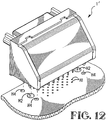
- the connector 1' shown in Figure 12 is the same as connector 1 described above, excepting that the tabs 104 of the shield are not provided. The provision of the holes H3 in the circuit board is accordingly avoided.
- a shield 18' is the same as the shield 18, excepting that the wall portion 86' of the rear wall 82' is formed with rows of holes 108 provided with struck out, semi-circular funnels 110 extending thereabout for the introduction of cleaning fluids, which may be liquids or gases, to flush out debris from beneath the terminal tail spacer plate.
- cleaning fluids which may be liquids or gases
- the liquids may flush out debris that might otherwise short between solder tails; air may be used to dry. This may be achieved with shield 18' in place.
- the wall portion 88' is provided with a rearwardly inclined flap 112 to allow for the egress of the said fluids.
Landscapes
- Details Of Connecting Devices For Male And Female Coupling (AREA)
- Coupling Device And Connection With Printed Circuit (AREA)
Applications Claiming Priority (4)
| Application Number | Priority Date | Filing Date | Title |
|---|---|---|---|
| US07/853,649 US5161999A (en) | 1992-03-18 | 1992-03-18 | Surface mount electrical cohnnector and shield therefor |
| US853565 | 1992-03-18 | ||
| US07/853,565 US5167531A (en) | 1992-03-18 | 1992-03-18 | Stacked electrical connector with diecast housing and drawn shells |
| US853649 | 1992-03-18 |
Publications (2)
| Publication Number | Publication Date |
|---|---|
| EP0561497A1 true EP0561497A1 (fr) | 1993-09-22 |
| EP0561497B1 EP0561497B1 (fr) | 1997-04-16 |
Family
ID=27127170
Family Applications (1)
| Application Number | Title | Priority Date | Filing Date |
|---|---|---|---|
| EP93300980A Expired - Lifetime EP0561497B1 (fr) | 1992-03-18 | 1993-02-11 | Connecteur électrique et blindage pour montage sur une surface plate |
Country Status (4)
| Country | Link |
|---|---|
| EP (1) | EP0561497B1 (fr) |
| JP (1) | JP2892903B2 (fr) |
| KR (1) | KR0183463B1 (fr) |
| DE (1) | DE69309761T2 (fr) |
Cited By (9)
| Publication number | Priority date | Publication date | Assignee | Title |
|---|---|---|---|---|
| WO1995035017A1 (fr) * | 1994-06-10 | 1995-12-21 | Telefonaktiebolaget Lm Ericsson | Connecteur electrique et plaquette a circuits imprimes |
| EP0774807A3 (fr) * | 1995-11-16 | 1998-07-22 | Molex Incorporated | Connecteur électrique |
| EP1026786A1 (fr) * | 1999-02-04 | 2000-08-09 | Molex Incorporated | Connecteur électrique mis à la terre avec une partie pour aligner |
| NL1012365C2 (nl) * | 1999-06-16 | 2000-12-19 | Berg Electronics Mfg | Connector. |
| WO2000077887A1 (fr) * | 1999-06-16 | 2000-12-21 | Fci 's-Hertogenbosch B.V. | Connecteur, procede de fabrication d'un tel connecteur, et element de contact pour un connecteur |
| EP1333532A3 (fr) * | 2001-10-02 | 2004-07-14 | Molex Incorporated | Connecteur électrique avec dispositif d'alignement des contacts |
| WO2009083757A1 (fr) * | 2007-12-28 | 2009-07-09 | Fci | Connecteur électrique et enveloppe pour celui-ci |
| CN106471683A (zh) * | 2014-05-30 | 2017-03-01 | 莫列斯有限公司 | 具有端子座的电连接器 |
| CN119231218A (zh) * | 2024-09-03 | 2024-12-31 | 上海航天科工电器研究院有限公司 | 共面安装形式的高速连接器 |
Families Citing this family (15)
| Publication number | Priority date | Publication date | Assignee | Title |
|---|---|---|---|---|
| GB9621497D0 (en) * | 1996-10-15 | 1996-12-04 | Amp Holland | Board lock for electrical connector |
| JPH11135187A (ja) * | 1997-10-30 | 1999-05-21 | Fujitsu Takamisawa Component Ltd | コネクタ集成体 |
| MY121506A (en) * | 2000-02-10 | 2006-01-28 | Molex Inc | Electric combination connector set |
| US7168987B1 (en) * | 2005-07-12 | 2007-01-30 | Fujitsu Component Limited | Right angle type connector used for balanced transmission of data signals |
| JP4861055B2 (ja) * | 2006-05-24 | 2012-01-25 | 矢崎総業株式会社 | コネクタ |
| DE102017127482A1 (de) * | 2017-11-21 | 2019-05-23 | Phoenix Contact Gmbh & Co. Kg | Steckverbinder |
| JP7222178B2 (ja) * | 2018-03-23 | 2023-02-15 | I-Pex株式会社 | 防塵カバー、及びコネクタ |
| US10797417B2 (en) | 2018-09-13 | 2020-10-06 | Amphenol Corporation | High performance stacked connector |
| CN208862209U (zh) | 2018-09-26 | 2019-05-14 | 安费诺东亚电子科技(深圳)有限公司 | 一种连接器及其应用的pcb板 |
| CN117175250A (zh) | 2019-01-25 | 2023-12-05 | 富加宜(美国)有限责任公司 | 被配置用于线缆连接到中板的i/o连接器 |
| WO2020154507A1 (fr) | 2019-01-25 | 2020-07-30 | Fci Usa Llc | Connecteur d'e/s configuré pour une connexion de câble à une carte intermédiaire |
| CN119447888A (zh) | 2019-09-27 | 2025-02-14 | 富加宜(美国)有限责任公司 | 高性能堆叠式连接器 |
| CN113258325A (zh) | 2020-01-28 | 2021-08-13 | 富加宜(美国)有限责任公司 | 高频中板连接器 |
| US12212100B2 (en) | 2021-04-30 | 2025-01-28 | Amphenol Corporation | Miniaturized high speed connector |
| DE102021134344A1 (de) | 2021-12-22 | 2023-06-22 | HARTING Electronics GmbH | Leiterkartensteckverbinder mit sensierbarem Formelement |
Citations (5)
| Publication number | Priority date | Publication date | Assignee | Title |
|---|---|---|---|---|
| EP0292144A2 (fr) * | 1987-05-18 | 1988-11-23 | Hirose Electric Co., Ltd. | Connecteur électrique |
| DE4015915A1 (de) * | 1989-05-22 | 1990-11-29 | Hosiden Electronics Co | Steckdose fuer eine mehrpolige steckverbindung |
| EP0412331A1 (fr) * | 1989-08-10 | 1991-02-13 | Siemens Aktiengesellschaft | Assemblage pour connecter électriquement des éléments de blindage de connecteurs multipolaires avec la couche de terre d'un panneau de câblage |
| US5037331A (en) * | 1989-09-27 | 1991-08-06 | Itt Corporation | Shielded interface connector |
| US5161999A (en) * | 1992-03-18 | 1992-11-10 | Amp Incorporated | Surface mount electrical cohnnector and shield therefor |
Family Cites Families (1)
| Publication number | Priority date | Publication date | Assignee | Title |
|---|---|---|---|---|
| US4902242A (en) | 1989-05-31 | 1990-02-20 | Amp Incorporated | Panel mount, cable terminable connector with die cast housing and drawn shell |
-
1993
- 1993-02-11 EP EP93300980A patent/EP0561497B1/fr not_active Expired - Lifetime
- 1993-02-11 DE DE69309761T patent/DE69309761T2/de not_active Expired - Fee Related
- 1993-03-08 KR KR1019930003406A patent/KR0183463B1/ko not_active Expired - Fee Related
- 1993-03-18 JP JP5085620A patent/JP2892903B2/ja not_active Expired - Fee Related
Patent Citations (5)
| Publication number | Priority date | Publication date | Assignee | Title |
|---|---|---|---|---|
| EP0292144A2 (fr) * | 1987-05-18 | 1988-11-23 | Hirose Electric Co., Ltd. | Connecteur électrique |
| DE4015915A1 (de) * | 1989-05-22 | 1990-11-29 | Hosiden Electronics Co | Steckdose fuer eine mehrpolige steckverbindung |
| EP0412331A1 (fr) * | 1989-08-10 | 1991-02-13 | Siemens Aktiengesellschaft | Assemblage pour connecter électriquement des éléments de blindage de connecteurs multipolaires avec la couche de terre d'un panneau de câblage |
| US5037331A (en) * | 1989-09-27 | 1991-08-06 | Itt Corporation | Shielded interface connector |
| US5161999A (en) * | 1992-03-18 | 1992-11-10 | Amp Incorporated | Surface mount electrical cohnnector and shield therefor |
Cited By (15)
| Publication number | Priority date | Publication date | Assignee | Title |
|---|---|---|---|---|
| WO1995035017A1 (fr) * | 1994-06-10 | 1995-12-21 | Telefonaktiebolaget Lm Ericsson | Connecteur electrique et plaquette a circuits imprimes |
| US5944539A (en) * | 1994-06-10 | 1999-08-31 | Telefonaktiebolaget Lm Ericsson | Electrical connector and a printed circuit board |
| EP0774807A3 (fr) * | 1995-11-16 | 1998-07-22 | Molex Incorporated | Connecteur électrique |
| US6287146B1 (en) | 1999-02-04 | 2001-09-11 | Molex Incorporated | Grounded electrical connector with tail aligner |
| EP1026786A1 (fr) * | 1999-02-04 | 2000-08-09 | Molex Incorporated | Connecteur électrique mis à la terre avec une partie pour aligner |
| KR100344049B1 (ko) * | 1999-02-04 | 2002-07-20 | 몰렉스 인코포레이티드 | 미부 정렬기를 구비한 접지 전기 커넥터 |
| SG97835A1 (en) * | 1999-02-04 | 2003-08-20 | Molex Inc | Grounded electrical connector with tail aligner |
| NL1012365C2 (nl) * | 1999-06-16 | 2000-12-19 | Berg Electronics Mfg | Connector. |
| WO2000077887A1 (fr) * | 1999-06-16 | 2000-12-21 | Fci 's-Hertogenbosch B.V. | Connecteur, procede de fabrication d'un tel connecteur, et element de contact pour un connecteur |
| EP1333532A3 (fr) * | 2001-10-02 | 2004-07-14 | Molex Incorporated | Connecteur électrique avec dispositif d'alignement des contacts |
| WO2009083757A1 (fr) * | 2007-12-28 | 2009-07-09 | Fci | Connecteur électrique et enveloppe pour celui-ci |
| CN106471683A (zh) * | 2014-05-30 | 2017-03-01 | 莫列斯有限公司 | 具有端子座的电连接器 |
| EP3149810A4 (fr) * | 2014-05-30 | 2018-03-28 | Molex Incorporated | Connecteur électrique avec support de borne |
| US10014605B2 (en) | 2014-05-30 | 2018-07-03 | Molex, Llc | Electrical connector with terminal holder |
| CN119231218A (zh) * | 2024-09-03 | 2024-12-31 | 上海航天科工电器研究院有限公司 | 共面安装形式的高速连接器 |
Also Published As
| Publication number | Publication date |
|---|---|
| KR930020771A (ko) | 1993-10-20 |
| JP2892903B2 (ja) | 1999-05-17 |
| DE69309761T2 (de) | 1997-11-13 |
| JPH0629061A (ja) | 1994-02-04 |
| EP0561497B1 (fr) | 1997-04-16 |
| DE69309761D1 (de) | 1997-05-22 |
| KR0183463B1 (ko) | 1999-05-15 |
Similar Documents
| Publication | Publication Date | Title |
|---|---|---|
| US5167531A (en) | Stacked electrical connector with diecast housing and drawn shells | |
| US5161999A (en) | Surface mount electrical cohnnector and shield therefor | |
| EP0561497B1 (fr) | Connecteur électrique et blindage pour montage sur une surface plate | |
| US6343951B1 (en) | Electrical connector | |
| US6007381A (en) | Circuit board connector with improved mounting characteristics | |
| US6210218B1 (en) | Electrical connector | |
| EP0496082A2 (fr) | Connecteur électrique bundé pour circuit imprimé | |
| US5415566A (en) | Shielded electrical connector assembly | |
| US6227879B1 (en) | Electrical connector with grounding shroud having board-locks for grasping a circuit board | |
| US4080041A (en) | Electrical connector | |
| US5709556A (en) | Connector with auxiliary alignment plate | |
| US6210226B1 (en) | Electrical connector having enhanced sideward impact resisting structure | |
| US20010049209A1 (en) | Electrical connector with electrical shield having latch and mounting arms | |
| US6089916A (en) | Cable assembly connector | |
| US6086429A (en) | Low profile connector | |
| US5137472A (en) | Means for securing ground plates to electrical connector housing | |
| US20050287860A1 (en) | Interlocking member for an electrical connector | |
| US6508665B1 (en) | Electrical connector having printed circuit board mounted therein | |
| US6036506A (en) | Right angle electrical connector | |
| EP0507166B1 (fr) | Connecteur électrique de mise à la terre | |
| US6190183B1 (en) | Electrical connector | |
| GB2316550A (en) | PCB-mounted SMT connector | |
| US5174771A (en) | Electrical connector having externally mounted ground plates | |
| US7351097B2 (en) | Electric connector with right-angled contacts | |
| US20040224567A1 (en) | Electrical connector with improved locking device |
Legal Events
| Date | Code | Title | Description |
|---|---|---|---|
| PUAI | Public reference made under article 153(3) epc to a published international application that has entered the european phase |
Free format text: ORIGINAL CODE: 0009012 |
|
| AK | Designated contracting states |
Kind code of ref document: A1 Designated state(s): DE FR GB IT NL |
|
| 17P | Request for examination filed |
Effective date: 19940317 |
|
| 17Q | First examination report despatched |
Effective date: 19950810 |
|
| GRAG | Despatch of communication of intention to grant |
Free format text: ORIGINAL CODE: EPIDOS AGRA |
|
| GRAH | Despatch of communication of intention to grant a patent |
Free format text: ORIGINAL CODE: EPIDOS IGRA |
|
| GRAH | Despatch of communication of intention to grant a patent |
Free format text: ORIGINAL CODE: EPIDOS IGRA |
|
| GRAA | (expected) grant |
Free format text: ORIGINAL CODE: 0009210 |
|
| AK | Designated contracting states |
Kind code of ref document: B1 Designated state(s): DE FR GB IT NL |
|
| ITF | It: translation for a ep patent filed | ||
| REF | Corresponds to: |
Ref document number: 69309761 Country of ref document: DE Date of ref document: 19970522 |
|
| ET | Fr: translation filed | ||
| PLBE | No opposition filed within time limit |
Free format text: ORIGINAL CODE: 0009261 |
|
| STAA | Information on the status of an ep patent application or granted ep patent |
Free format text: STATUS: NO OPPOSITION FILED WITHIN TIME LIMIT |
|
| 26N | No opposition filed | ||
| PGFP | Annual fee paid to national office [announced via postgrant information from national office to epo] |
Ref country code: NL Payment date: 19981222 Year of fee payment: 7 |
|
| PGFP | Annual fee paid to national office [announced via postgrant information from national office to epo] |
Ref country code: DE Payment date: 19991229 Year of fee payment: 8 |
|
| PGFP | Annual fee paid to national office [announced via postgrant information from national office to epo] |
Ref country code: FR Payment date: 20000207 Year of fee payment: 8 |
|
| PG25 | Lapsed in a contracting state [announced via postgrant information from national office to epo] |
Ref country code: NL Free format text: LAPSE BECAUSE OF NON-PAYMENT OF DUE FEES Effective date: 20000901 |
|
| NLV4 | Nl: lapsed or anulled due to non-payment of the annual fee |
Effective date: 20000901 |
|
| PG25 | Lapsed in a contracting state [announced via postgrant information from national office to epo] |
Ref country code: FR Free format text: LAPSE BECAUSE OF NON-PAYMENT OF DUE FEES Effective date: 20011031 |
|
| REG | Reference to a national code |
Ref country code: FR Ref legal event code: ST |
|
| PG25 | Lapsed in a contracting state [announced via postgrant information from national office to epo] |
Ref country code: DE Free format text: LAPSE BECAUSE OF NON-PAYMENT OF DUE FEES Effective date: 20011201 |
|
| REG | Reference to a national code |
Ref country code: GB Ref legal event code: IF02 |
|
| PG25 | Lapsed in a contracting state [announced via postgrant information from national office to epo] |
Ref country code: IT Free format text: LAPSE BECAUSE OF NON-PAYMENT OF DUE FEES;WARNING: LAPSES OF ITALIAN PATENTS WITH EFFECTIVE DATE BEFORE 2007 MAY HAVE OCCURRED AT ANY TIME BEFORE 2007. THE CORRECT EFFECTIVE DATE MAY BE DIFFERENT FROM THE ONE RECORDED. Effective date: 20050211 |
|
| PGFP | Annual fee paid to national office [announced via postgrant information from national office to epo] |
Ref country code: GB Payment date: 20060223 Year of fee payment: 14 |
|
| GBPC | Gb: european patent ceased through non-payment of renewal fee |
Effective date: 20070211 |
|
| PG25 | Lapsed in a contracting state [announced via postgrant information from national office to epo] |
Ref country code: GB Free format text: LAPSE BECAUSE OF NON-PAYMENT OF DUE FEES Effective date: 20070211 |