EP0562005B1 - Extraction combinee a membrane/au solvant avec recyclage du retentat pour ameliorer la production de raffinat - Google Patents
Extraction combinee a membrane/au solvant avec recyclage du retentat pour ameliorer la production de raffinat Download PDFInfo
- Publication number
- EP0562005B1 EP0562005B1 EP92902700A EP92902700A EP0562005B1 EP 0562005 B1 EP0562005 B1 EP 0562005B1 EP 92902700 A EP92902700 A EP 92902700A EP 92902700 A EP92902700 A EP 92902700A EP 0562005 B1 EP0562005 B1 EP 0562005B1
- Authority
- EP
- European Patent Office
- Prior art keywords
- solvent
- extraction
- aromatics
- membrane
- retentate
- Prior art date
- Legal status (The legal status is an assumption and is not a legal conclusion. Google has not performed a legal analysis and makes no representation as to the accuracy of the status listed.)
- Expired - Lifetime
Links
Images
Classifications
-
- C—CHEMISTRY; METALLURGY
- C10—PETROLEUM, GAS OR COKE INDUSTRIES; TECHNICAL GASES CONTAINING CARBON MONOXIDE; FUELS; LUBRICANTS; PEAT
- C10G—CRACKING HYDROCARBON OILS; PRODUCTION OF LIQUID HYDROCARBON MIXTURES, e.g. BY DESTRUCTIVE HYDROGENATION, OLIGOMERISATION, POLYMERISATION; RECOVERY OF HYDROCARBON OILS FROM OIL-SHALE, OIL-SAND, OR GASES; REFINING MIXTURES MAINLY CONSISTING OF HYDROCARBONS; REFORMING OF NAPHTHA; MINERAL WAXES
- C10G53/00—Treatment of hydrocarbon oils, in the absence of hydrogen, by two or more refining processes
- C10G53/02—Treatment of hydrocarbon oils, in the absence of hydrogen, by two or more refining processes plural serial stages only
- C10G53/04—Treatment of hydrocarbon oils, in the absence of hydrogen, by two or more refining processes plural serial stages only including at least one extraction step
-
- C—CHEMISTRY; METALLURGY
- C07—ORGANIC CHEMISTRY
- C07C—ACYCLIC OR CARBOCYCLIC COMPOUNDS
- C07C7/00—Purification; Separation; Use of additives
- C07C7/005—Processes comprising at least two steps in series
-
- C—CHEMISTRY; METALLURGY
- C07—ORGANIC CHEMISTRY
- C07C—ACYCLIC OR CARBOCYCLIC COMPOUNDS
- C07C7/00—Purification; Separation; Use of additives
- C07C7/10—Purification; Separation; Use of additives by extraction, i.e. purification or separation of liquid hydrocarbons with the aid of liquids
-
- C—CHEMISTRY; METALLURGY
- C07—ORGANIC CHEMISTRY
- C07C—ACYCLIC OR CARBOCYCLIC COMPOUNDS
- C07C7/00—Purification; Separation; Use of additives
- C07C7/144—Purification; Separation; Use of additives using membranes, e.g. selective permeation
-
- C—CHEMISTRY; METALLURGY
- C10—PETROLEUM, GAS OR COKE INDUSTRIES; TECHNICAL GASES CONTAINING CARBON MONOXIDE; FUELS; LUBRICANTS; PEAT
- C10G—CRACKING HYDROCARBON OILS; PRODUCTION OF LIQUID HYDROCARBON MIXTURES, e.g. BY DESTRUCTIVE HYDROGENATION, OLIGOMERISATION, POLYMERISATION; RECOVERY OF HYDROCARBON OILS FROM OIL-SHALE, OIL-SAND, OR GASES; REFINING MIXTURES MAINLY CONSISTING OF HYDROCARBONS; REFORMING OF NAPHTHA; MINERAL WAXES
- C10G21/00—Refining of hydrocarbon oils, in the absence of hydrogen, by extraction with selective solvents
- C10G21/28—Recovery of used solvent
Definitions
- the yield of saturates/1-ring aromatics rich raffinate obtained by the solvent extraction of a hydrocarbon feed is increased by a process involving the steps of solvent extracting a hydrocarbon feed to produce a raffinate phase and an extract phase, removing the extraction solvent from the extract phase by, for example, distillation to produce an extract oil passing the extract oil to a membrane separation process wherein a saturates/1-ring aromatics rich retentate is produced as is a 2+ ring aromatics rich permeate phase and recycling the saturates/1-ring aromatics rich retentate back to the solvent extraction process for addition to the hydrocarbon feed for processing in the solvent extraction process.
- the amount of saturates/1-ring aromatics rich raffinate obtained by this integrated process is greatly enhanced as compared to the yield obtained without the recycle of the membrane produced retentate phase to the solvent extraction zone.
- the typical way to remove aromatic hydrocarbons from hydrocarbon feeds is by solvent extraction.
- the hydrocarbon feed is introduced into an extraction zone and contacted with a selective aromatic extraction solvent moving counter currently.
- Typical aromatics extraction solvents include phenol, furfural, sulfolane, and N-methyl 2-pyrrolidone (NMP).
- the solvent extraction process produces a raffinate rich in saturates and an extract lean in saturates and rich in aromatics present in the extraction solvent.
- the raffinate is recovered for use as a lubes base stock while the extract, following solvent recovery to yield an extract oil, is used as cat cracker feed, burnt as fuel or sent to a coker.
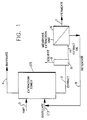
- Figure 1 is a schematic of the integrated process of the present invention showing retentate phase recycle to produce enhanced yield of raffinate.
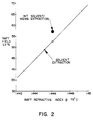
- Figure 2 graphically shows the raffinate yield credit, for practicing the integrated retentate recycle process of the present invention, as a function of constant raffinate quality.
- the yield of valuable raffinate material recovered from a conventional solvent extraction process can be increased by a process comprising the steps of integrating the solvent extraction process with a membrane separation process which uses the solvent free extract oil as feed to the membrane unit to produce a saturates/1-ring aromatics rich retentate phase for recycling to the solvent extraction zone.
- the retentate is recycled to the solvent extraction zone in an amount ranging from 5 to 50 wt.%, preferably 20 to 33 wt.% based on feed, expressed differently, the feed to retentate ratio ranges from 20 to 1 to 1 to 1, preferably 5/1 to 3/1.
- the process therefore, comprises the steps of passing an aromatics containing hydrocarbon feed to a solvent extraction zone, contacting the feed with an aromatics selective extraction solvent to produce a saturate rich raffinate and an aromatics rich extract, removing the solvent from the extract phase by, for example, distillation to recover an extract oil passing the extract oil to a membrane separation zone wherein the saturates and 1-ring aromatics are concentrated in a retentate phase and the 2+ ring aromatics are concentrated as a permeate phase and recycling the retentate phase to the solvent extraction zone for combining with the hydrocarbon feed in said zone and subjecting the combined feed to solvent extraction producing a raffinate phase of increased yield.
- the process of the present invention may be practiced on any aromatics containing hydrocarbon feed stream from which it is desired to remove the aromatics and produce a saturate rich raffinate.
- the hydrocarbon stream can be any light to heavy material coming from any source, natural petroleum or synthetic stream such as coal liquefaction products, tar sands, or shale oil products.
- the hydrocarbon feed will be any light to heavy fraction, usually a distillate fraction boiling in the 160 to 593°C (about 320 to about 1100°F) range. This embraces the jet and kerosene fraction 160-260°C (320-500°F) through diesel 204-343°C (400-650°F) into lube 316-593°C (600 to 1100°F) including Bright Stock.
- Selective aromatics extraction solvents which may be used in the solvent extraction process include any of the well known materials such as phenol, furfural, sulfolane, and n-methyl-2-pyrrolidone (NMP).
- the extract oil from the solvent extraction process is sent as feed to a membrane separation zone wherein a retentate rich in saturates and 1-ring aromatics is produced and a permeate rich in 2+ ring aromatics is produced.
- the membrane separation zone can include the system described in U.S. Patent 3,370,102 which separates aromatics from saturates in a wide variety of feed mixtures including various petroleum fractions, naphthas, oils, and other hydrocarbon mixtures. Expressly recited in '102 is the separation of aromatics from kerosene. The process produces a permeate stream and a retentate stream and employs a sweep liquid to remove the permeate from the face of the membrane to thereby maintain the concentration gradient driving force.
- U.S. Patent 2,958,656 teaches the separation of hydrocarbons by type i.e.
- U.S. Patent 2,930,754 teaches a method for separating hydrocarbons by type, i.e. aromatics and/or olefins from gasoline boiling range mixtures by the selective permeation of the aromatics through certain cellulose ester non-porous membranes. The permeated hydrocarbons are continuously removed from the permeate zone using a sweep gas or liquid.
- U.S. Patent 4,115,465 teaches the use of polyurethane membranes to selectively separate aromatics from saturates via pervaporation.
- U.S. Patent 4,914,064 teaches polyurea/urethane membranes and their use for the separation of aromatics from non-aromatic hydrocarbon.
- Thin film composites can be prepared either from suspension deposition as taught in U.S. Patent 4,861,628 or from solution deposition as taught in U.S. Patent 4,837,054.
- Isocyanurate crosslinked polyurethane membranes and their use for the separation of aromatics from non-aromatics is the subject of U.S. Patent 4,929,357.
- U.S. Patent 4,962,271 teaches the selective separation of multi-ring aromatic hydrocarbons from distillates by perstraction.
- the multi-ring aromatics are characterized by having less than 75 mole % aromatic carbon content.
- Perstractive separation is through any selective membrane, preferably the aforesaid polyurea/urethane, polyurethane imides or polyurethane isocyanurates.
- membranes and processes are all useful for separating aromatics from non-aromatics/saturates mixtures from a variety of feeds. It is herein envisioned that such membranes and processes can be practiced on a selective extraction extract oil to produce a multi-ring aromatics enrich permeate and a saturates rich retentate and that, in accordance with the teaching of the present specification, the retentate can be recycled to the solvent extraction zone for further extraction in combination with fresh feed to produce an enhance raffinate yield.
- a preferred membrane separation procedure is the subject of U.S. Patent 5,045.206.
- multi-ring aromatics i.e. 2+ ring aromatics containing alkyl and heteroatom alkyl side chains and even heteroatom containing multi-ring aromatics such as benzo thiophene and dibenzo thiophene and quinoline
- a hydrocarbon feed such as distillate or even a solvent extraction extract oil
- a selective extraction solvent such as phenol, furfural, acetonitrile sulfolane, N-methyl 2-pyrrolidone
- an aliphatic polyamine such as ethylene diamine, diethylene triamine or triethylene tetramine, dimethylsulfoxide (DMSO) etc. and mixtures thereof.
- the multi-ring aromatic selectively permeates through the
- the alkyl substituted and alkyl/heteroatom substituted multi-ring aromatics and heteroatom containing multi ring aromatics have less than 75 mole % aromatic carbon.
- the multi-ring aromatics have at least 2, preferably 3 or more rings, preferably fused rings and one or more alkyl side chains of about 6 to 12 carbon atoms or more in length.
- the term multi-ring aromatics is used in this specification and the appended claims is meant to include condensed and fused ring aromatics as well as molecules such as biphenyl, diphenyl methane, tri phenyl methane, quinoline, carbozol, phenyl thiophene, benzo-thiophene, dibenzo thiophene etc. and spiro system aromatics consisting of two rings sharing a common atom.
- the process makes use of a highly porous partition barrier.
- the barrier may be an ultrafiltration membrane made of ceramic, sintered glass or metal or of a polymeric material such as polyethylene, polypropylene, teflon, cellulose, nylon, etc. and generally has a pore size in the range 100 to 5000 ⁇ .
- the membrane is, preferably, hydrophobic in nature.
- the extract oil feed and extraction solvent can be contacted at any temperature so long as both the feed and solvent are in the liquid state. Because the separation process is driven by the affinity of the extraction solvent for the aromatic molecules, the process can be run at atmospheric pressure. Indeed, because of the high porosity of the membrane partition barrier the existence of a pressure differential, either by the direct application of pressure on the feed or solvent side or the creation of a vacuum on either side is undesirable as such a pressure differential would physically force feed or solvent across the barrier and thus defeat its purpose.
- the multi-ring aromatics rich permeate phase in the extraction solvent may be separated from said solvent by any known technique such as distillation or selective permeation of the solvent through a membrane.
- the selective separation of extraction solvents from aromatic extracts is the subject of U.S. Patent 4,510,047 which shows such selective solvent permeation through a regenerated cellulose membrane and U.S. patent 5,173,191 which teaches the recovery of extraction solvent using interfacially polymerized membranes.
- the retentate which is a saturates/1-ring aromatics rich phase is recycled in an amount ranging from 5 to 50 wt.% based on feed, (i.e. a feed/retentate rate of 20/1 to 1/1) a feed/retentate rate of preferably 20 to 33 wt.% based on feed, , preferably 5/1 to 3/1 to the solvent extraction zone wherein, in combination with fresh feed, it is re-extracted.
- the yield of raffinate is increased.
- the extract from the zone is subjected to membrane separation and the retentate is recycled, thus giving rise to an integrated continuous process.
- Fresh distillate feed is introduced via line (1) into the solvent extraction zone (2).
- Selective extraction solvent in this case NMP is introduced via line (3) into zone (2) and countercurrently contacts the feed.
- a saturates rich raffinate phase is recovered via line (4).
- the aromatics rich extract phase is sent via line (5) to solvent recovery in separator (5) to yield recovered solvent in line (9) and an extract oil in line (10).
- the extract oil is recovered via line (10) and sent to a membrane separation unit (6) wherein a multi ring aromatics rich permeate is produced and recovered via line 7.
- the saturates/1-ring aromatics rich retentate phase is recovered via line 8 and recycled to the extraction zone in an amount ranging from 5 to 50 wt.%, preferably 20 to 33 wt.% based on fresh feed, expressed differently, the fresh feed to recycle retentate ratio of the hydrocarbon fed to the extraction zone following start up, ranges from 20/1 to 1/1, preferably 5/1 to 3/1.
- the ratio employed in practice is controlled to a major degree by the amount of extract solution recovered from the extraction tower and the amount of retentate produced in the membrane unit, and these are controlled by the nature of the fresh distillate feed sent to the extraction tower.
- an extract oil sample 100N was procured and subjected to membrane extraction; the retentate produced from membrane extraction was then solvent extracted in an admixture with a distillate feed. More specifically, in this study, in the membrane separation step, membrane extraction as described in U.S. Patent 5,045,206 was practiced to segregate the saturates and 1-ring aromatics from the 2+ ring aromatics in the extract, although perstraction or any other aromatics selective process could also be used to achieve the desired aromatics/saturates separation. A blend of 75 wt% 100N distillate/25 wt% retentate from the membrane extraction run was then prepared and submitted for solvent extraction with N-methyl pyrrolidone (NMP). NMP solvent extraction runs were also made on the MCT-5 distillate feed neat to determine the base case raffinate yield.
- NMP N-methyl pyrrolidone
- Celgard 2500 which is a polypropylene membrane with 0.04 x 0.20 micrometer pores was used in the membrane separation step, although other micro-porous membranes such as nylon 6,6 or teflon could also have been used.
- the purpose of the micro-porous membrane was to partition the extract feed from the extraction solvent while still maintaining intimate contact between the two phases.
- the extraction solvent used in the membrane extraction step was acetonitrile although the process can be extended to other solvents.
- the separation was carried out at 50°C.
- mass spec. completed on the permeate and retentate confirm that the desired aromatics/saturates separation was successful by membrane extraction.
Landscapes
- Chemical & Material Sciences (AREA)
- Organic Chemistry (AREA)
- Oil, Petroleum & Natural Gas (AREA)
- Engineering & Computer Science (AREA)
- Analytical Chemistry (AREA)
- Water Supply & Treatment (AREA)
- Chemical Kinetics & Catalysis (AREA)
- General Chemical & Material Sciences (AREA)
- Separation Using Semi-Permeable Membranes (AREA)
- Production Of Liquid Hydrocarbon Mixture For Refining Petroleum (AREA)
- Organic Low-Molecular-Weight Compounds And Preparation Thereof (AREA)
Abstract
Claims (8)
- Procedé permettant d'augmenter le rendement de raffinat produit dans l'extraction par solvant d'hydrocarbures, ledit procédé comprenant les stades suivants : on met en contact une charge hydrocarbonée avec un solvant d'extraction d'aromatiques sélectif pour produire une phase de raffinat riche en saturés et une phase de solution d'extraction riche en aromatiques dans une zone d'extraction par solvant, on élimine le solvant d'extraction de la phase de solution d'extraction pour récupérer du solvant et produire une huile d'extraction, on soumet l'huile d'extraction à un procédé de séparation à membrane dans lequel on produit un rétentat riche en aromatiques à noyau unique et en saturés et un perméat riche en aromatiques à 2 noyaux et plus et on recycle le rétentat de saturés et d'aromatiques à noyau unique à nouveau au stade d'extraction par solvant pour l'additionner à la charge hydrocarbonée afin de traiter l'ensemble dans le stade d'extraction par solvant sélectif, en sorte de récupérer les saturés/aromatiques à noyau unique présents dans la phase de rétentat en tant que partie du raffinat de la zone d'extraction par solvant.
- Procédé selon la revendication 1, dans lequel le procédé de séparation à membrane consiste à faire passer l'huile extraite le long d'une face d'une membrane à barrière séparatrice poreuse non sélective tout en mettant en contact simultanément la face opposée de ladite membrane avec un solvant d'extraction sélectif d'aromatiques, dans lequel les aromatiques à noyaux multiples passent de manière sélective à travers la membrane séparatrice poreuse en réponse au solvant d'extraction d'aromatiques sélectif, en obtenant de la sorte un rétentat riche en saturés et en aromatiques à noyau unique et un perméat riche en aromatiques à 2 noyaux et plus.
- Procédé selon la revendication 2, dans lequel le solvant d'extraction d'aromatiques sélectif utilisé dans le procédé de séparation à membrane est choisi parmi le phénol, le furfural, le sulfolane, la N-méthyl 2-pyrrolidone et les polyamines aliphatiques.
- Procédé selon la revendication 2, dans lequel la barrière séparatrice poreuse a un calibre de pores dans la plage de 100 à 5000 Å.
- Procédé selon la revendication 4, dans lequel la barrière séparatrice poreuse est une membrane d'ultrafiltration choisie parmi les membranes de polyéthylène, de polypropylène, de teflon et de cellulose.
- Procédé selon la revendication 1, dans lequel le solvant d'extraction d'aromatiques sélectif est récupéré, dans la phase de solution d'extraction provenant du stade d'extraction par solvant, par distillation.
- Procédé selon la revendication 1, dans lequel le rétentat est recylé à la zone d'extraction par solvant en quantité allant de 5 à 50 % en poids sur base de l'alimentation.
- Procédé selon la revendication 1, dans lequel la charge hydrocarbonée a un point d'ébullition dans la plage d'environ 160°C (320°F) à 593°C (1100°F).
Applications Claiming Priority (3)
| Application Number | Priority Date | Filing Date | Title |
|---|---|---|---|
| US07/624,807 US5120900A (en) | 1990-12-05 | 1990-12-05 | Integrated solvent extraction/membrane extraction with retentate recycle for improved raffinate yield |
| PCT/US1991/008956 WO1992010448A1 (fr) | 1990-12-05 | 1991-11-27 | Extraction combinee a membrane/au solvant avec recyclage du retentat pour ameliorer la production de raffinat |
| US624807 | 2000-07-24 |
Publications (3)
| Publication Number | Publication Date |
|---|---|
| EP0562005A1 EP0562005A1 (fr) | 1993-09-29 |
| EP0562005A4 EP0562005A4 (en) | 1993-11-03 |
| EP0562005B1 true EP0562005B1 (fr) | 1995-05-17 |
Family
ID=24503390
Family Applications (1)
| Application Number | Title | Priority Date | Filing Date |
|---|---|---|---|
| EP92902700A Expired - Lifetime EP0562005B1 (fr) | 1990-12-05 | 1991-11-27 | Extraction combinee a membrane/au solvant avec recyclage du retentat pour ameliorer la production de raffinat |
Country Status (5)
| Country | Link |
|---|---|
| US (1) | US5120900A (fr) |
| EP (1) | EP0562005B1 (fr) |
| JP (1) | JPH06503599A (fr) |
| CA (1) | CA2096656A1 (fr) |
| WO (1) | WO1992010448A1 (fr) |
Families Citing this family (23)
| Publication number | Priority date | Publication date | Assignee | Title |
|---|---|---|---|---|
| US5234597A (en) * | 1990-11-05 | 1993-08-10 | Exxon Research & Engineering Company | Solvent extraction process involving membrane separation of extract phase and/or intermediate zone phase with pseudo extract/pseudo raffinate recycle, preferably employing interfacially polymerized membranes |
| NL9300322A (nl) * | 1992-02-24 | 1993-09-16 | Shell Int Research | Werkwijze voor het behandelen van zuur vloeibaar gemaakt petroleumgas. |
| KR950013568A (ko) * | 1993-11-29 | 1995-06-15 | 미우라 아끼라 | 침투 기화법에 의한 혼합액체의 분리방법 및 침투 기화막 분리장치 |
| US6019902A (en) * | 1998-04-03 | 2000-02-01 | Durr Environmental, Inc. | Fluid recovery system |
| US6320090B1 (en) * | 1999-03-10 | 2001-11-20 | Miami University | Method of removing contaminants from petroleum distillates |
| US6416655B1 (en) * | 1999-07-23 | 2002-07-09 | Exxonmobil Research And Engineering Company | Selective extraction using mixed solvent system |
| US6551642B2 (en) * | 2001-03-08 | 2003-04-22 | Cocotech, Inc. | Process for removing oil from foodstuffs using a membrane filter |
| US7122709B2 (en) * | 2003-03-13 | 2006-10-17 | 3M Innovative Properties Company | Method for obtaining ethanol |
| US7105089B2 (en) * | 2003-03-13 | 2006-09-12 | 3M Innovative Properties Company | Liquid—liquid extraction system and method |
| US20060231459A1 (en) * | 2005-03-28 | 2006-10-19 | Swan George A Iii | FCC process combining molecular separation with staged conversion |
| US7642393B2 (en) * | 2006-10-05 | 2010-01-05 | General Electric Company | Process for removing at least benzene from hydrocarbon streams |
| US20080303565A1 (en) * | 2007-06-08 | 2008-12-11 | Yen-Hsun Hsu | Dll circuit and related method for avoiding stuck state and harmonic locking utilizing a frequency divider and an inverter |
| US8272442B2 (en) * | 2007-09-20 | 2012-09-25 | Green Source Energy Llc | In situ extraction of hydrocarbons from hydrocarbon-containing materials |
| US8101812B2 (en) * | 2007-09-20 | 2012-01-24 | Green Source Energy Llc | Extraction of hydrocarbons from hydrocarbon-containing materials |
| US8404108B2 (en) | 2007-09-20 | 2013-03-26 | Green Source Energy Llc | Extraction of hydrocarbons from hydrocarbon-containing materials and/or processing of hydrocarbon-containing materials |
| US20120000829A1 (en) * | 2010-06-30 | 2012-01-05 | Exxonmobil Research And Engineering Company | Process for the preparation of group ii and group iii lube base oils |
| US8258363B2 (en) * | 2010-09-27 | 2012-09-04 | Phillips 66 Company | Separation of aromatics with pervaporation membrane |
| US9345826B2 (en) | 2011-09-15 | 2016-05-24 | Deka Products Limited Partnership | Recirculating fluid filtration system |
| FR2982778A1 (fr) * | 2011-11-21 | 2013-05-24 | Centre Nat Rech Scient | Procede de separation membranaire en regime discontinu. |
| US9394495B1 (en) | 2013-09-18 | 2016-07-19 | Thomas George Murray | Post hydrotreatment finishing of lubricant distillates |
| US8961780B1 (en) | 2013-12-16 | 2015-02-24 | Saudi Arabian Oil Company | Methods for recovering organic heteroatom compounds from hydrocarbon feedstocks |
| US9169446B2 (en) | 2013-12-30 | 2015-10-27 | Saudi Arabian Oil Company | Demulsification of emulsified petroleum using carbon dioxide and resin supplement without precipitation of asphaltenes |
| US9688923B2 (en) * | 2014-06-10 | 2017-06-27 | Saudi Arabian Oil Company | Integrated methods for separation and extraction of polynuclear aromatic hydrocarbons, heterocyclic compounds, and organometallic compounds from hydrocarbon feedstocks |
Family Cites Families (29)
| Publication number | Priority date | Publication date | Assignee | Title |
|---|---|---|---|---|
| US2958656A (en) * | 1954-07-16 | 1960-11-01 | American Oil Co | Method of separating hydrocarbons using ethyl cellulose permselective membrane |
| US2930754A (en) * | 1954-07-16 | 1960-03-29 | Pan American Refining Corp | Method of separating hydrocarbons |
| US2947687A (en) * | 1954-10-29 | 1960-08-02 | American Oil Co | Separation of hydrocarbons by permeation membrane |
| US3244763A (en) * | 1960-12-29 | 1966-04-05 | Exxon Research Engineering Co | Semi-permeable membrane extraction |
| US3370102A (en) * | 1967-05-05 | 1968-02-20 | Abcor Inc | Isothermal-liquid-liquid permeation separation systems |
| US3476681A (en) * | 1967-12-22 | 1969-11-04 | Texaco Inc | Method of solvent recovery in refining hydrocarbon mixtures with n-methyl-2-pyrrolidone |
| US3843515A (en) * | 1972-03-15 | 1974-10-22 | Exxon Research Engineering Co | Countercurrent lube extraction with dual solvent system |
| US3956112A (en) * | 1973-01-02 | 1976-05-11 | Allied Chemical Corporation | Membrane solvent extraction |
| US4057491A (en) * | 1976-03-26 | 1977-11-08 | Exxon Research & Engineering Co. | Solvent recovery process for N-methyl-2-pyrrolidone in hydrocarbon extraction |
| DE2627629C3 (de) * | 1976-06-19 | 1979-12-20 | Bayer Ag, 5090 Leverkusen | Verfahren zur Abtrennung von aromatischen* Kohlenwasserstoffen aus Gemischen mit anderen organischen Verbindungen mit Hilfe von Kunststoffmembranen |
| US4168226A (en) * | 1977-04-08 | 1979-09-18 | Exxon Research & Engineering Co. | Thermal stabilization of N-methyl-2-pyrrolidone |
| US4125458A (en) * | 1977-10-31 | 1978-11-14 | Exxon Research & Engineering Co. | Simultaneous deasphalting-extraction process |
| US4532347A (en) * | 1978-07-28 | 1985-07-30 | Varen Technology | Membrane solvent extraction process |
| US4311583A (en) * | 1980-02-27 | 1982-01-19 | Texaco, Inc. | Solvent extraction process |
| US4328092A (en) * | 1980-03-07 | 1982-05-04 | Texaco Inc. | Solvent extraction of hydrocarbon oils |
| NL193983C (nl) * | 1982-03-04 | 2001-04-03 | Shell Int Research | Werkwijze voor het scheiden van een vloeibaar mengsel. |
| US4510047A (en) * | 1983-12-14 | 1985-04-09 | Exxon Research And Engineering Co. | Selective extraction solvent recovery using regenerated cellulose membrane under reverse osmosis conditions |
| US4592832A (en) * | 1984-09-06 | 1986-06-03 | Exxon Research And Engineering Co. | Process for increasing Bright Stock raffinate oil production |
| FR2595370B1 (fr) * | 1986-03-10 | 1988-05-20 | British Petroleum Co | Procede a effets multiples avec recyclage et utilisation d'un plateau de soutirage pour l'extraction selective par solvant de melanges d'hydrocarbures |
| FR2595371B1 (fr) * | 1986-03-10 | 1988-05-20 | British Petroleum Co | Procede a effets multiples avec recyclage pour l'extraction selective par solvant de melanges d'hydrocarbures |
| US4966707A (en) * | 1986-05-13 | 1990-10-30 | Celanese Corporation | Liquid/liquid extractions with microporous membranes |
| US4879044A (en) * | 1987-10-14 | 1989-11-07 | Exxon Research And Engineering Company | Highly aromatic anisotropic polyurea/urethane membranes and their use for the separation of aromatics from non aromatics |
| US4828773A (en) * | 1987-10-14 | 1989-05-09 | Exxon Research And Engineering Company | Highly aromatic anisotropic polyurea/urethane membranes and their use for the separation of aromatics from non-aromatics |
| US4861628A (en) * | 1987-10-14 | 1989-08-29 | Exxon Research And Engineering Company | Thin film composite membrane prepared by suspension deposition |
| US4837054A (en) * | 1987-10-14 | 1989-06-06 | Exxon Research And Engineering Company | Thin film composite membrane prepared by deposition from a solution |
| US4914064A (en) * | 1987-10-14 | 1990-04-03 | Exxon Research And Engineering Company | Highly aromatic polyurea/urethane membranes and their use for the separation of aromatics from non-aromatics |
| US4929357A (en) * | 1989-08-09 | 1990-05-29 | Exxon Research And Engineering Company | Isocyanurate crosslinked polyurethane membranes and their use for the separation of aromatics from non-aromatics |
| US4929358A (en) * | 1989-08-09 | 1990-05-29 | Exxon Research And Engineering Company | Polyurethane-imide membranes and their use for the separation of aromatics from non-aromatics |
| US4962271A (en) * | 1989-12-19 | 1990-10-09 | Exxon Research And Engineering Company | Selective separation of multi-ring aromatic hydrocarbons from distillates by perstraction |
-
1990
- 1990-12-05 US US07/624,807 patent/US5120900A/en not_active Expired - Fee Related
-
1991
- 1991-11-27 WO PCT/US1991/008956 patent/WO1992010448A1/fr not_active Ceased
- 1991-11-27 JP JP4502823A patent/JPH06503599A/ja active Pending
- 1991-11-27 EP EP92902700A patent/EP0562005B1/fr not_active Expired - Lifetime
- 1991-11-27 CA CA002096656A patent/CA2096656A1/fr not_active Abandoned
Also Published As
| Publication number | Publication date |
|---|---|
| WO1992010448A1 (fr) | 1992-06-25 |
| CA2096656A1 (fr) | 1992-06-06 |
| JPH06503599A (ja) | 1994-04-21 |
| EP0562005A4 (en) | 1993-11-03 |
| EP0562005A1 (fr) | 1993-09-29 |
| US5120900A (en) | 1992-06-09 |
Similar Documents
| Publication | Publication Date | Title |
|---|---|---|
| EP0562005B1 (fr) | Extraction combinee a membrane/au solvant avec recyclage du retentat pour ameliorer la production de raffinat | |
| EP0145126B1 (fr) | Récupération de solvant d'extraction sélective par osmose inverse utilisant des membranes de cellulose régénérée | |
| EP1102734B1 (fr) | Recuperation d'hydrocarbures aromatiques a l'aide de membranes traitees avec une huile lubrifiante | |
| US5396019A (en) | Fluorinated polyolefin membranes for aromatics/saturates separation | |
| US5256297A (en) | Multi-stage ultrafiltration process (OP-3711) | |
| US5045206A (en) | Selective multi-ring aromatics extraction using a porous, non-selective partition membrane barrier | |
| KR100671576B1 (ko) | 과여과 조건하에서 방향족 용매를 회수하기 위한폴리이미드 멤브레인 | |
| US4617126A (en) | Membrane separation of hydrocarbons | |
| US4368112A (en) | Solvent recovery from foots oil using modified regenerated cellulose membranes | |
| US5107056A (en) | Selective separation of naphthenes from paraffins by membrane extraction | |
| EP0485077B1 (fr) | Procédé d'extraction par solvant combiné avec la séparation du solvant par une membrane et/ou phase intermédiaire avec recyclage du pseudo liquide d'extraction/pseudo raffinat | |
| US4797200A (en) | Upgrading heavy oils by solvent dissolution and ultrafiltration | |
| EP4229151A1 (fr) | Récupération d'hydrocarbures aliphatiques | |
| US5107059A (en) | Iso/normal paraffin separation by membrane extraction | |
| US3556991A (en) | Method for the solvent extraction of aromatic hydrocarbons | |
| ITMI972125A1 (it) | Processo di purificazione del benzene comprendente due stadi di permeazione | |
| GB2268186A (en) | Membrane/hydrocracking process for improved feedstock utilization in the production of reduced emissions gasoline | |
| US5107058A (en) | Olefin/paraffin separation via membrane extraction | |
| CA1317890C (fr) | Procede de separation d'un melange fluide contenant des hydrocarbures et un solvant organique | |
| US5095170A (en) | Intergrated membrane pre-extraction/solvent extraction of distillates | |
| EP0160142A1 (fr) | Combinaison d'extraction par membranes et de déparaffinage d'huiles lubrifiantes | |
| US4432866A (en) | Membrane separation process | |
| US4305813A (en) | Method of extractive purification of residues from crude oil refining and heavy ends thereof | |
| GB2190398A (en) | Oil deasphalting process | |
| EP0143129A1 (fr) | Procédé de séparation d'un mélange par décantation et perméation à travers une membrane |
Legal Events
| Date | Code | Title | Description |
|---|---|---|---|
| PUAI | Public reference made under article 153(3) epc to a published international application that has entered the european phase |
Free format text: ORIGINAL CODE: 0009012 |
|
| 17P | Request for examination filed |
Effective date: 19930605 |
|
| AK | Designated contracting states |
Kind code of ref document: A1 Designated state(s): FR GB IT |
|
| A4 | Supplementary search report drawn up and despatched |
Effective date: 19930916 |
|
| AK | Designated contracting states |
Kind code of ref document: A4 Designated state(s): FR GB IT |
|
| RHK1 | Main classification (correction) |
Ipc: C07C 7/00 |
|
| 17Q | First examination report despatched |
Effective date: 19940630 |
|
| GRAA | (expected) grant |
Free format text: ORIGINAL CODE: 0009210 |
|
| AK | Designated contracting states |
Kind code of ref document: B1 Designated state(s): FR GB IT |
|
| ET | Fr: translation filed | ||
| ITF | It: translation for a ep patent filed | ||
| PGFP | Annual fee paid to national office [announced via postgrant information from national office to epo] |
Ref country code: GB Payment date: 19950930 Year of fee payment: 5 |
|
| PGFP | Annual fee paid to national office [announced via postgrant information from national office to epo] |
Ref country code: FR Payment date: 19951113 Year of fee payment: 5 |
|
| PLBE | No opposition filed within time limit |
Free format text: ORIGINAL CODE: 0009261 |
|
| STAA | Information on the status of an ep patent application or granted ep patent |
Free format text: STATUS: NO OPPOSITION FILED WITHIN TIME LIMIT |
|
| 26N | No opposition filed | ||
| PG25 | Lapsed in a contracting state [announced via postgrant information from national office to epo] |
Ref country code: GB Effective date: 19961127 |
|
| GBPC | Gb: european patent ceased through non-payment of renewal fee |
Effective date: 19961127 |
|
| PG25 | Lapsed in a contracting state [announced via postgrant information from national office to epo] |
Ref country code: FR Effective date: 19970731 |
|
| REG | Reference to a national code |
Ref country code: FR Ref legal event code: ST |
|
| PG25 | Lapsed in a contracting state [announced via postgrant information from national office to epo] |
Ref country code: IT Free format text: LAPSE BECAUSE OF NON-PAYMENT OF DUE FEES;WARNING: LAPSES OF ITALIAN PATENTS WITH EFFECTIVE DATE BEFORE 2007 MAY HAVE OCCURRED AT ANY TIME BEFORE 2007. THE CORRECT EFFECTIVE DATE MAY BE DIFFERENT FROM THE ONE RECORDED. Effective date: 20051127 |