EP0562301A1 - Méthode de configuration des puits d'eau - Google Patents
Méthode de configuration des puits d'eau Download PDFInfo
- Publication number
- EP0562301A1 EP0562301A1 EP93103167A EP93103167A EP0562301A1 EP 0562301 A1 EP0562301 A1 EP 0562301A1 EP 93103167 A EP93103167 A EP 93103167A EP 93103167 A EP93103167 A EP 93103167A EP 0562301 A1 EP0562301 A1 EP 0562301A1
- Authority
- EP
- European Patent Office
- Prior art keywords
- borehole
- well
- boreholes
- flushed
- areas
- Prior art date
- Legal status (The legal status is an assumption and is not a legal conclusion. Google has not performed a legal analysis and makes no representation as to the accuracy of the status listed.)
- Granted
Links
- 238000000034 method Methods 0.000 title claims abstract description 28
- XLYOFNOQVPJJNP-UHFFFAOYSA-N water Substances O XLYOFNOQVPJJNP-UHFFFAOYSA-N 0.000 title description 10
- 239000002689 soil Substances 0.000 claims description 19
- 239000007788 liquid Substances 0.000 claims description 13
- 239000000463 material Substances 0.000 claims description 6
- 238000005553 drilling Methods 0.000 claims description 5
- 238000011010 flushing procedure Methods 0.000 claims description 5
- 239000000945 filler Substances 0.000 claims description 4
- 229910010293 ceramic material Inorganic materials 0.000 claims description 3
- 239000007789 gas Substances 0.000 claims description 3
- 244000005700 microbiome Species 0.000 claims description 3
- 239000000126 substance Substances 0.000 claims description 3
- 239000000470 constituent Substances 0.000 claims description 2
- 239000012530 fluid Substances 0.000 claims description 2
- 238000011835 investigation Methods 0.000 claims description 2
- 238000001179 sorption measurement Methods 0.000 claims description 2
- 238000007599 discharging Methods 0.000 claims 1
- 238000012856 packing Methods 0.000 claims 1
- 238000004140 cleaning Methods 0.000 description 9
- 239000003673 groundwater Substances 0.000 description 8
- 239000013049 sediment Substances 0.000 description 4
- 239000000919 ceramic Substances 0.000 description 3
- 238000004519 manufacturing process Methods 0.000 description 3
- 239000004576 sand Substances 0.000 description 3
- 235000020188 drinking water Nutrition 0.000 description 2
- 239000003651 drinking water Substances 0.000 description 2
- 238000003780 insertion Methods 0.000 description 2
- 230000037431 insertion Effects 0.000 description 2
- 238000005067 remediation Methods 0.000 description 2
- 235000020681 well water Nutrition 0.000 description 2
- 239000002349 well water Substances 0.000 description 2
- 238000010276 construction Methods 0.000 description 1
- 230000007423 decrease Effects 0.000 description 1
- 230000003111 delayed effect Effects 0.000 description 1
- 238000013461 design Methods 0.000 description 1
- 238000000605 extraction Methods 0.000 description 1
- 238000005259 measurement Methods 0.000 description 1
- 230000035699 permeability Effects 0.000 description 1
- 239000011148 porous material Substances 0.000 description 1
- 238000003825 pressing Methods 0.000 description 1
- 238000010992 reflux Methods 0.000 description 1
- 239000000523 sample Substances 0.000 description 1
- 239000007787 solid Substances 0.000 description 1
- 238000012360 testing method Methods 0.000 description 1
- 238000009423 ventilation Methods 0.000 description 1
Images


Classifications
-
- E—FIXED CONSTRUCTIONS
- E03—WATER SUPPLY; SEWERAGE
- E03B—INSTALLATIONS OR METHODS FOR OBTAINING, COLLECTING, OR DISTRIBUTING WATER
- E03B3/00—Methods or installations for obtaining or collecting drinking water or tap water
- E03B3/06—Methods or installations for obtaining or collecting drinking water or tap water from underground
- E03B3/08—Obtaining and confining water by means of wells
- E03B3/15—Keeping wells in good condition, e.g. by cleaning, repairing, regenerating; Maintaining or enlarging the capacity of wells or water-bearing layers
-
- E—FIXED CONSTRUCTIONS
- E21—EARTH OR ROCK DRILLING; MINING
- E21B—EARTH OR ROCK DRILLING; OBTAINING OIL, GAS, WATER, SOLUBLE OR MELTABLE MATERIALS OR A SLURRY OF MINERALS FROM WELLS
- E21B37/00—Methods or apparatus for cleaning boreholes or wells
-
- E—FIXED CONSTRUCTIONS
- E21—EARTH OR ROCK DRILLING; MINING
- E21B—EARTH OR ROCK DRILLING; OBTAINING OIL, GAS, WATER, SOLUBLE OR MELTABLE MATERIALS OR A SLURRY OF MINERALS FROM WELLS
- E21B43/00—Methods or apparatus for obtaining oil, gas, water, soluble or meltable materials or a slurry of minerals from wells
- E21B43/14—Obtaining from a multiple-zone well
-
- E—FIXED CONSTRUCTIONS
- E21—EARTH OR ROCK DRILLING; MINING
- E21B—EARTH OR ROCK DRILLING; OBTAINING OIL, GAS, WATER, SOLUBLE OR MELTABLE MATERIALS OR A SLURRY OF MINERALS FROM WELLS
- E21B43/00—Methods or apparatus for obtaining oil, gas, water, soluble or meltable materials or a slurry of minerals from wells
- E21B43/30—Specific pattern of wells, e.g. optimising the spacing of wells
Definitions
- the invention relates to a method for designing well areas to promote well effectiveness.
- the invention has for its object to design well bores so that their operating time is increased significantly.
- the method according to the invention ensures that a high flow velocity of the liquid flowing into the well pipe results in the suction area of a well.
- the braking caused by a conventional gravel lining of different densities does not apply. This significantly reduces silting of the well pipe environment compared to conventional wells.
- a more or less large-scale horizontal desludging can also be achieved in different soil layers that are spaced apart in the vertical direction.
- the application of this method is particularly suitable for well systems for cleaning contaminated soil areas and groundwater on the spot, where a liquid flow is forced in the soil between well pipe wall areas that are vertically spaced apart.
- large, flushed-out floor areas can advantageously and subsequently be at least partially filled up again with pourable, flushable fillers, the size and material properties of which may depend on the purpose of the well in question.
- bodies with a large surface area made of ceramic material, for example, which are suitable for the adsorption of gases and dissolved substances and / or for the nesting of microorganisms can be chosen as the filling body.
- commercially available filter bodies can also be flushed in as fillers.
- the important process step of rinsing out areas of the liquid-bearing soil layers can be favored by making several additional bores around the first borehole at a distance that still allows rinsing out, and later using the central first borehole as a well bore.
- a rinsing-out distance is to be understood as the distance to be selected in which, by pressing into the outer borehole in the area of the central borehole serving as a reflux borehole, the liquid flow is so strong that the pressure between the boreholes is due to the pressure difference created Connection channels are created and ultimately a flushing out of soil material is achieved around the central borehole.
- a drill pipe used to inject liquid or to discharge the pressure fluid and the dissolved solids can be continuously moved forward.
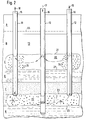
- a central borehole and, at a short distance from it, two additional boreholes 11 and 12 are driven into the bottom 13 on both sides for carrying out the method mentioned at the beginning.
- drill pipes 14, 15 and 16 can be used, which are screwed or driven into the ground and with which the method can be carried out after removing the drill core.
- Drill pipes can later also function as well pipes.
- the drill core provides information about the nature of the various perforated soil layers, which are designated by letters AF in FIG. 2.
- the boreholes 10 to 12 formed can, however, also be introduced after removing the drill cores from the boreholes 14-16 measuring probes, not shown, with which the groundwater permeability of the individual soil layers AF can be determined, for example, using groundwater measurement samples.
- the well system chosen as an example is of interest to two layers of soil that are at a vertical distance from one another and are relatively well permeable to water. These are the soil layers C and F, which are mainly sediment layers consisting of sand and gravel.
- the first step is to gradually drill hole 10. As soon as the removed core shows that a first well-drained soil layer, here layer C, has been reached, the other two holes 11 and 12 are also drilled to the same height . If it turns out that the bottom layer C has also been hit by these holes and that it is not just a small sand and gravel lens, the rinsing of the bottom layer C in the area of the holes drilled begins. Water is pressed under high pressure into the middle drill pipe 14, as indicated in FIG. 2 by the downward arrow 17. At the same time, groundwater is extracted from the two other drill pipes 15 and 16 together with the sand and gravel material loosened by the pressurized water 17 pressed into the central bore 10, as indicated by the two upward arrows 18 and 19.
- this step of the method it is possible, in particular at the beginning, to switch between the three drill pipes 14 to 16 with the entry of pressurized water, thereby loosening the sediment material is facilitated.
- the drill pipe introducing pressurized water can be moved forward over the height of the bottom layer C during the pressurized water entry.
- this rinsing creates a more or less homogeneous cavity 20, the limitation of which is indicated in FIG. 1 and FIG. 2 by a dash-dotted or solid line 21.
- the central bore 10 is driven further with the central drill pipe 14 until the second, well water-bearing bottom layer F is reached.
- the rinsing process described above is repeated there and a second, more or less homogeneous cavity 22 with the boundary line 23 is created.
- the two cavities 20 and 22 formed are then filled with granular ceramic material with a large pore surface, which is flushed into the cavities with water.
- the ceramic grains can be populated with soil-cleaning microorganisms.
- the central borehole 10 is drilled out into the region of the cavity 20 to a much larger diameter, which allows the insertion of a cylindrical soil remediation device 25.
- a production pipe 26 is inserted, which ends at the bottom in the cavity 22 filled with the ceramic grains 24.
- the upper end of the conveyor pipe 26 is expanded to an insertion funnel 27 arranged just above the upper cavity 20.
- the remediation device 25 consists of a tubular casing 28 inserted into the enlarged bore part, which is closed with a cover 29 on its upper end projecting above the earth's surface 60.
- the tubular jacket 28 is open at its lower end located in the cavity 20.
- a cleaning insert 30 can be introduced into the tubular jacket 28, the construction of which is not of interest in the context of the present invention and the mode of operation of which is described in German patent application P 42 03 382.9.
- This cleaning insert 30 ends both below and above with a concentric pipe section 55 and 54.
- the lower pipe section 55 can be pushed tightly into the conveying pipe 26 by the conically widened upper end 27, while the upper pipe section 54 follows through a central opening of the cover 29 protrudes outside.
- the cover 29 has an additional opening for the connection of a fan 40 for generating a negative pressure in the upper part of the casing tube 28.
- An electrically operated feed pump 50 is arranged in the cleaning insert, by means of which groundwater is conveyed from the bottom layer F through the filled tube 22 through the filled cavity 22 into the cleaning area of the cleaning insert 30. Subsequently, the groundwater flows out through a filter area filled below the inner end of the tubular body 28, which is filled with filter bodies 35. Through the filter area, which is not absolutely necessary, the groundwater can flow further into the cavity 20 in the bottom layer C, which is at least partially filled with ceramic grains 24, and a liquid cycle is forced between the bottom layers C and F over the intermediate bottom layers D and E.
- the two adjacent bores 11 and 12 can remain piped according to FIG. 3 and can be used for various purposes, here for example for feeding treatment substances, treatment gases or microbes into the cavities 20 and 22.
- the bores can also serve as ventilation bores.
- two additional bores 51 and 52 are indicated with dash-dotted lines, with the aid of which larger cavities which are more concentric with the central bore 10 can be flushed out during the implementation of the method, the delimitation of which is indicated by a dash-dotted line 53.
- a dash-dotted line 53 In the case of well systems for the extraction of drinking water, as a rule only a single well water-bearing soil layer is drilled, in which the rinsing and - depending on the nature of the soil - a subsequent support and filter filling is then carried out. Subsequent drilling of the hole selected for water production can then generally be omitted, which considerably reduces the cost of drilling the well.
- the diameter of the well pipe used depends on the drill pipe diameter.
Landscapes
- Engineering & Computer Science (AREA)
- Life Sciences & Earth Sciences (AREA)
- Geology (AREA)
- Mining & Mineral Resources (AREA)
- Environmental & Geological Engineering (AREA)
- Geochemistry & Mineralogy (AREA)
- Physics & Mathematics (AREA)
- Fluid Mechanics (AREA)
- General Life Sciences & Earth Sciences (AREA)
- Water Supply & Treatment (AREA)
- Public Health (AREA)
- Hydrology & Water Resources (AREA)
- Health & Medical Sciences (AREA)
- Treatment Of Biological Wastes In General (AREA)
- Geophysics And Detection Of Objects (AREA)
- Liquid Crystal (AREA)
- Design And Manufacture Of Integrated Circuits (AREA)
- Transition And Organic Metals Composition Catalysts For Addition Polymerization (AREA)
Applications Claiming Priority (2)
| Application Number | Priority Date | Filing Date | Title |
|---|---|---|---|
| DE4209329 | 1992-03-23 | ||
| DE4209329 | 1992-03-23 |
Publications (2)
| Publication Number | Publication Date |
|---|---|
| EP0562301A1 true EP0562301A1 (fr) | 1993-09-29 |
| EP0562301B1 EP0562301B1 (fr) | 1996-05-01 |
Family
ID=6454753
Family Applications (1)
| Application Number | Title | Priority Date | Filing Date |
|---|---|---|---|
| EP93103167A Expired - Lifetime EP0562301B1 (fr) | 1992-03-23 | 1993-02-27 | Méthode de configuration des puits d'eau |
Country Status (4)
| Country | Link |
|---|---|
| US (1) | US5322128A (fr) |
| EP (1) | EP0562301B1 (fr) |
| AT (1) | ATE137562T1 (fr) |
| DE (1) | DE59302417D1 (fr) |
Families Citing this family (6)
| Publication number | Priority date | Publication date | Assignee | Title |
|---|---|---|---|---|
| RU2186955C2 (ru) * | 2000-08-15 | 2002-08-10 | Открытое акционерное общество "Татнефть" им. В.Д.Шашина | Способ разработки неоднородного участка нефтяной залежи |
| SE525025C2 (sv) * | 2000-12-15 | 2004-11-09 | Arlington Trading Corp S A C O | Anordning och förfarande för att skapa minst en reaktionszon i en akvifär |
| US7361209B1 (en) | 2003-04-03 | 2008-04-22 | Ada Environmental Solutions, Llc | Apparatus and process for preparing sorbents for mercury control at the point of use |
| DE102005029910B4 (de) * | 2005-03-22 | 2008-03-06 | Stadtwerke Steinfurt Gmbh | Verfahren zum Betreiben eines Horizontalfilterbrunnens sowie Brunnenanordnung |
| CA2681043A1 (fr) * | 2007-03-28 | 2008-10-02 | Shell Canada Limited | Procede d'interconnexion de trous de forage souterrains |
| US20110277992A1 (en) * | 2010-05-14 | 2011-11-17 | Paul Grimes | Systems and methods for enhanced recovery of hydrocarbonaceous fluids |
Citations (3)
| Publication number | Priority date | Publication date | Assignee | Title |
|---|---|---|---|---|
| DE71479C (de) * | O. lilienthal in Berlin so., Köpenickerstr. 113 | Verfahren zur Ueberführung von Abwässern in den Erdboden | ||
| US4254831A (en) * | 1979-12-27 | 1981-03-10 | Layne-Western Company, Inc. | Method and apparatus for restoring and maintaining underground aquifer water system |
| US4669542A (en) * | 1984-11-21 | 1987-06-02 | Mobil Oil Corporation | Simultaneous recovery of crude from multiple zones in a reservoir |
Family Cites Families (12)
| Publication number | Priority date | Publication date | Assignee | Title |
|---|---|---|---|---|
| DE511302C (de) * | 1930-10-29 | Hermann Loeck | Doppelschlitzrohrfilter | |
| DE2359231C2 (de) * | 1973-11-28 | 1975-07-24 | Ferdinand Aufschlaeger Kg, 8000 Muenchen | Verfahren zum Herstellen eines Filterbrunnens |
| AT324233B (de) * | 1973-11-29 | 1975-08-25 | Ferdinand Aufschlaeger K G | Verfahren zum herstellen eines filterbrunnens |
| US4398602A (en) * | 1981-08-11 | 1983-08-16 | Mobil Oil Corporation | Gravity assisted solvent flooding process |
| US4522260A (en) * | 1982-04-08 | 1985-06-11 | Atlantic Richfield Company | Method for creating a zone of increased permeability in hydrocarbon-containing subterranean formation penetrated by a plurality of wellbores |
| US4465136A (en) * | 1982-07-28 | 1984-08-14 | Joseph D. Windisch | Process for enhanced oil recovery from subterranean formations |
| US4637468A (en) * | 1985-09-03 | 1987-01-20 | Derrick John M | Method and apparatus for multizone oil and gas production |
| AT389135B (de) * | 1986-04-14 | 1989-10-25 | Meister Karl Ing | Filterbrunnen |
| DE3612468A1 (de) * | 1986-04-14 | 1987-10-15 | Meister Karl | Verfahren zum herstellen eines filterbrunnens und filterbrunnen mit grossem fassungsraum |
| US4651825A (en) * | 1986-05-09 | 1987-03-24 | Atlantic Richfield Company | Enhanced well production |
| US4754808A (en) * | 1986-06-20 | 1988-07-05 | Conoco Inc. | Methods for obtaining well-to-well flow communication |
| SU1719563A1 (ru) * | 1990-01-05 | 1992-03-15 | А.Б.Островский, Б.В.Боревский, Л.В.Боревский, В.И.Гор ев, Н.Я.Мелентьев и В.П.Стрепетов | Способ разведки и эксплуатации месторождени подземных вод |
-
1993
- 1993-02-27 DE DE59302417T patent/DE59302417D1/de not_active Expired - Fee Related
- 1993-02-27 EP EP93103167A patent/EP0562301B1/fr not_active Expired - Lifetime
- 1993-02-27 AT AT93103167T patent/ATE137562T1/de not_active IP Right Cessation
- 1993-03-18 US US08/033,138 patent/US5322128A/en not_active Expired - Fee Related
Patent Citations (3)
| Publication number | Priority date | Publication date | Assignee | Title |
|---|---|---|---|---|
| DE71479C (de) * | O. lilienthal in Berlin so., Köpenickerstr. 113 | Verfahren zur Ueberführung von Abwässern in den Erdboden | ||
| US4254831A (en) * | 1979-12-27 | 1981-03-10 | Layne-Western Company, Inc. | Method and apparatus for restoring and maintaining underground aquifer water system |
| US4669542A (en) * | 1984-11-21 | 1987-06-02 | Mobil Oil Corporation | Simultaneous recovery of crude from multiple zones in a reservoir |
Non-Patent Citations (1)
| Title |
|---|
| SOVIET INVENTIONS ILLUSTRATED Week 9306, Derwent Publications Ltd., London, GB; AN 93-051797 & SU-A-1 719 563 (OSTROVSKII) * |
Also Published As
| Publication number | Publication date |
|---|---|
| DE59302417D1 (de) | 1996-06-05 |
| ATE137562T1 (de) | 1996-05-15 |
| EP0562301B1 (fr) | 1996-05-01 |
| US5322128A (en) | 1994-06-21 |
Similar Documents
| Publication | Publication Date | Title |
|---|---|---|
| DE4037059C2 (fr) | ||
| DE3739126C2 (fr) | ||
| DE3941763C2 (fr) | ||
| DE3309031C2 (de) | Bohrgerät zum Erdbohren und Testen von Grundwasserhorizonten | |
| DE4235069A1 (de) | Anordnung zum reinigen von grundwasser | |
| DE4217184C2 (de) | Verfahren zum Ausbringen von Ölresten oder ölhaltigen Flüssigkeiten aus verseuchten Bodenschichten | |
| EP0301060B1 (fr) | Dispositif pour ouvrir des sources de gaz dans des depots d'ordures et pour explorer et assainir des decharges et des sols contamines | |
| EP0562301B1 (fr) | Méthode de configuration des puits d'eau | |
| WO1988004352A2 (fr) | Procede pour realiser un puits | |
| EP2334874B1 (fr) | Dispositif et procédé d'activation ou de nettoyage de puits | |
| EP0560150A1 (fr) | Procédé et appareil pour déterminer la perméabilité geohydraulique d'une surface traversée par des eaux souterraines | |
| DE3108331C2 (de) | Verfahren und Vorrichtung zur Ausbildung eines Gesteinsfilters in einem der Grundwassergewinnung oder -absenkung dienenden Bohrbrunnen | |
| DE10361983A1 (de) | Verfahren und Vorrichtung zur Intensivierung der Durchlässigkeit von bohrungsnahen Bodenschichten sowie von Filterkörpern und Filterschichten in Brunnen und anderen Förderbohrungen | |
| DE2541439A1 (de) | Strahlpumpe | |
| DE102005029910B4 (de) | Verfahren zum Betreiben eines Horizontalfilterbrunnens sowie Brunnenanordnung | |
| EP3643872B1 (fr) | Procédé de réduction de la porosité hydrauliquement active d'une matrice solide poreuse | |
| DE3734537A1 (de) | Filterbrunnen | |
| DE60023201T2 (de) | Verfahren zum Entwässern eines gering durchlässigen Bodens | |
| DE4243303C1 (de) | Verfahren zum Reinigen eines Brunnenschachtes | |
| EP0105225A2 (fr) | Procédé de nettoyage d'un élément de filtration pour les substances liquides et du dispositif de séparation renfermant cet élément | |
| DE2318102C3 (de) | Brunnen zum Umschichten von Grundwasser aus einem Grundwasserhorizont in einen durch eine undurchlässige Sperrschicht davon getrennten zweiten Grundwasserhorizont | |
| DE3841316C2 (fr) | ||
| DE4335164A1 (de) | Vorrichtung zur Beeinflussung von im Erdreich befindlicher Flüssigkeit | |
| EP0637569A1 (fr) | Procédé et dispositif pour influencer un liquide contenu dans le sol | |
| DE102015108704B4 (de) | Spüllanze |
Legal Events
| Date | Code | Title | Description |
|---|---|---|---|
| PUAI | Public reference made under article 153(3) epc to a published international application that has entered the european phase |
Free format text: ORIGINAL CODE: 0009012 |
|
| AK | Designated contracting states |
Kind code of ref document: A1 Designated state(s): AT CH DE ES FR GB IT LI NL SE |
|
| 17P | Request for examination filed |
Effective date: 19940223 |
|
| 17Q | First examination report despatched |
Effective date: 19950630 |
|
| GRAH | Despatch of communication of intention to grant a patent |
Free format text: ORIGINAL CODE: EPIDOS IGRA |
|
| GRAA | (expected) grant |
Free format text: ORIGINAL CODE: 0009210 |
|
| AK | Designated contracting states |
Kind code of ref document: B1 Designated state(s): AT CH DE ES FR GB IT LI NL SE |
|
| PG25 | Lapsed in a contracting state [announced via postgrant information from national office to epo] |
Ref country code: NL Free format text: LAPSE BECAUSE OF FAILURE TO SUBMIT A TRANSLATION OF THE DESCRIPTION OR TO PAY THE FEE WITHIN THE PRESCRIBED TIME-LIMIT Effective date: 19960501 Ref country code: IT Free format text: LAPSE BECAUSE OF FAILURE TO SUBMIT A TRANSLATION OF THE DESCRIPTION OR TO PAY THE FEE WITHIN THE PRE;WARNING: LAPSES OF ITALIAN PATENTS WITH EFFECTIVE DATE BEFORE 2007 MAY HAVE OCCURRED AT ANY TIME BEFORE 2007. THE CORRECT EFFECTIVE DATE MAY BE DIFFERENT FROM THE ONE RECORDED.SCRIBED TIME-LIMIT Effective date: 19960501 Ref country code: GB Effective date: 19960501 Ref country code: FR Effective date: 19960501 Ref country code: ES Free format text: THE PATENT HAS BEEN ANNULLED BY A DECISION OF A NATIONAL AUTHORITY Effective date: 19960501 |
|
| REF | Corresponds to: |
Ref document number: 137562 Country of ref document: AT Date of ref document: 19960515 Kind code of ref document: T |
|
| REF | Corresponds to: |
Ref document number: 59302417 Country of ref document: DE Date of ref document: 19960605 |
|
| PG25 | Lapsed in a contracting state [announced via postgrant information from national office to epo] |
Ref country code: SE Effective date: 19960801 |
|
| EN | Fr: translation not filed | ||
| NLV1 | Nl: lapsed or annulled due to failure to fulfill the requirements of art. 29p and 29m of the patents act | ||
| GBV | Gb: ep patent (uk) treated as always having been void in accordance with gb section 77(7)/1977 [no translation filed] |
Effective date: 19960501 |
|
| PG25 | Lapsed in a contracting state [announced via postgrant information from national office to epo] |
Ref country code: AT Free format text: LAPSE BECAUSE OF NON-PAYMENT OF DUE FEES Effective date: 19970227 |
|
| PG25 | Lapsed in a contracting state [announced via postgrant information from national office to epo] |
Ref country code: LI Effective date: 19970228 Ref country code: CH Effective date: 19970228 |
|
| PLBE | No opposition filed within time limit |
Free format text: ORIGINAL CODE: 0009261 |
|
| STAA | Information on the status of an ep patent application or granted ep patent |
Free format text: STATUS: NO OPPOSITION FILED WITHIN TIME LIMIT |
|
| 26N | No opposition filed | ||
| REG | Reference to a national code |
Ref country code: CH Ref legal event code: PL |
|
| PG25 | Lapsed in a contracting state [announced via postgrant information from national office to epo] |
Ref country code: DE Effective date: 19971101 |