EP0562369B1 - Polysiloxanes - Google Patents
Polysiloxanes Download PDFInfo
- Publication number
- EP0562369B1 EP0562369B1 EP93103882A EP93103882A EP0562369B1 EP 0562369 B1 EP0562369 B1 EP 0562369B1 EP 93103882 A EP93103882 A EP 93103882A EP 93103882 A EP93103882 A EP 93103882A EP 0562369 B1 EP0562369 B1 EP 0562369B1
- Authority
- EP
- European Patent Office
- Prior art keywords
- epoxy
- polysiloxanes
- groups
- residue
- functional
- Prior art date
- Legal status (The legal status is an assumption and is not a legal conclusion. Google has not performed a legal analysis and makes no representation as to the accuracy of the status listed.)
- Expired - Lifetime
Links
- PASGJCBZZLEJKW-UHFFFAOYSA-N CCCC(C)C(C)CN=C Chemical compound CCCC(C)C(C)CN=C PASGJCBZZLEJKW-UHFFFAOYSA-N 0.000 description 1
- 0 CCCCCC(C)*1(C)C(C)CC(*CCC)C2C1CC2 Chemical compound CCCCCC(C)*1(C)C(C)CC(*CCC)C2C1CC2 0.000 description 1
Classifications
-
- C—CHEMISTRY; METALLURGY
- C08—ORGANIC MACROMOLECULAR COMPOUNDS; THEIR PREPARATION OR CHEMICAL WORKING-UP; COMPOSITIONS BASED THEREON
- C08G—MACROMOLECULAR COMPOUNDS OBTAINED OTHERWISE THAN BY REACTIONS ONLY INVOLVING UNSATURATED CARBON-TO-CARBON BONDS
- C08G18/00—Polymeric products of isocyanates or isothiocyanates
- C08G18/06—Polymeric products of isocyanates or isothiocyanates with compounds having active hydrogen
- C08G18/70—Polymeric products of isocyanates or isothiocyanates with compounds having active hydrogen characterised by the isocyanates or isothiocyanates used
- C08G18/71—Monoisocyanates or monoisothiocyanates
-
- C—CHEMISTRY; METALLURGY
- C08—ORGANIC MACROMOLECULAR COMPOUNDS; THEIR PREPARATION OR CHEMICAL WORKING-UP; COMPOSITIONS BASED THEREON
- C08G—MACROMOLECULAR COMPOUNDS OBTAINED OTHERWISE THAN BY REACTIONS ONLY INVOLVING UNSATURATED CARBON-TO-CARBON BONDS
- C08G18/00—Polymeric products of isocyanates or isothiocyanates
- C08G18/06—Polymeric products of isocyanates or isothiocyanates with compounds having active hydrogen
- C08G18/28—Polymeric products of isocyanates or isothiocyanates with compounds having active hydrogen characterised by the compounds used containing active hydrogen
- C08G18/40—High-molecular-weight compounds
- C08G18/61—Polysiloxanes
-
- C—CHEMISTRY; METALLURGY
- C08—ORGANIC MACROMOLECULAR COMPOUNDS; THEIR PREPARATION OR CHEMICAL WORKING-UP; COMPOSITIONS BASED THEREON
- C08G—MACROMOLECULAR COMPOUNDS OBTAINED OTHERWISE THAN BY REACTIONS ONLY INVOLVING UNSATURATED CARBON-TO-CARBON BONDS
- C08G59/00—Polycondensates containing more than one epoxy group per molecule; Macromolecules obtained by polymerising compounds containing more than one epoxy group per molecule using curing agents or catalysts which react with the epoxy groups
- C08G59/18—Macromolecules obtained by polymerising compounds containing more than one epoxy group per molecule using curing agents or catalysts which react with the epoxy groups ; e.g. general methods of curing
- C08G59/20—Macromolecules obtained by polymerising compounds containing more than one epoxy group per molecule using curing agents or catalysts which react with the epoxy groups ; e.g. general methods of curing characterised by the epoxy compounds used
- C08G59/22—Di-epoxy compounds
- C08G59/30—Di-epoxy compounds containing atoms other than carbon, hydrogen, oxygen and nitrogen
- C08G59/306—Di-epoxy compounds containing atoms other than carbon, hydrogen, oxygen and nitrogen containing silicon
-
- C—CHEMISTRY; METALLURGY
- C08—ORGANIC MACROMOLECULAR COMPOUNDS; THEIR PREPARATION OR CHEMICAL WORKING-UP; COMPOSITIONS BASED THEREON
- C08G—MACROMOLECULAR COMPOUNDS OBTAINED OTHERWISE THAN BY REACTIONS ONLY INVOLVING UNSATURATED CARBON-TO-CARBON BONDS
- C08G59/00—Polycondensates containing more than one epoxy group per molecule; Macromolecules obtained by polymerising compounds containing more than one epoxy group per molecule using curing agents or catalysts which react with the epoxy groups
- C08G59/18—Macromolecules obtained by polymerising compounds containing more than one epoxy group per molecule using curing agents or catalysts which react with the epoxy groups ; e.g. general methods of curing
- C08G59/20—Macromolecules obtained by polymerising compounds containing more than one epoxy group per molecule using curing agents or catalysts which react with the epoxy groups ; e.g. general methods of curing characterised by the epoxy compounds used
- C08G59/32—Epoxy compounds containing three or more epoxy groups
- C08G59/3254—Epoxy compounds containing three or more epoxy groups containing atoms other than carbon, hydrogen, oxygen or nitrogen
-
- C—CHEMISTRY; METALLURGY
- C08—ORGANIC MACROMOLECULAR COMPOUNDS; THEIR PREPARATION OR CHEMICAL WORKING-UP; COMPOSITIONS BASED THEREON
- C08G—MACROMOLECULAR COMPOUNDS OBTAINED OTHERWISE THAN BY REACTIONS ONLY INVOLVING UNSATURATED CARBON-TO-CARBON BONDS
- C08G77/00—Macromolecular compounds obtained by reactions forming a linkage containing silicon with or without sulfur, nitrogen, oxygen or carbon in the main chain of the macromolecule
- C08G77/04—Polysiloxanes
- C08G77/38—Polysiloxanes modified by chemical after-treatment
- C08G77/382—Polysiloxanes modified by chemical after-treatment containing atoms other than carbon, hydrogen, oxygen or silicon
- C08G77/388—Polysiloxanes modified by chemical after-treatment containing atoms other than carbon, hydrogen, oxygen or silicon containing nitrogen
Definitions
- the invention relates to epoxy-functional, free-radically curable polysiloxanes and their preparation.
- polyorganosiloxanes Due to their chemical structure, polyorganosiloxanes have a number of specific properties, such as chemical and thermal stability, UV stability, flexibility, elasticity, low water absorption, good dielectric properties and non-toxic behavior. Because of these properties and possible combinations of properties, polyorganosiloxanes are used in many areas of technology. It is particularly noteworthy that linear polymeric polysiloxanes are molten up to molar masses of approximately 150,000 and are therefore particularly suitable for use in impregnation and coating systems, adhesives, release agents, resists, masking compounds, reflective and protective layers and for other special purposes, in particular also in medicine and medical technology.
- the range of properties of the polyorganosiloxanes can be changed in a targeted manner by varying the chain-containing organic radicals or by introducing suitable functional groups or adapt to different technical requirements. It is known to prepare liquid-crystalline polysiloxanes by introducing mesogenic groups ("Mol. Cryst. Liq. Cryst. Inc. Nonlin. Opt.”, Vol. 157 (1988), pages 193 to 202; “Polymer”, Vol. 29 ( 1988), pages 1318 to 1322; “Makromol. Chem.”, Vol. 188 (1987), pages 2759 to 2767).
- polysiloxanes By introducing photocrosslinkable residues, such as acrylate, methacrylate and maleimide residues, polysiloxanes can be adjusted to be photocrosslinkable or photostructurable.
- photocrosslinkable residues such as acrylate, methacrylate and maleimide residues
- polysiloxanes By crosslinking such modified polyorganosiloxanes, selectively transporting layers ("Makromol. Chem., Rapid Commun.”, Vol. 9 (1988), pages 35 to 38; “J. Polym. Sci., Part A: Polym. Chem.”, Vol. 27 (1989), pages 1439 to 1443) and biocompatible layers (US Pat. No. 4,822,741) and layers with abhesive behavior (DE-OS 33 16 166, EP-OS 0 281 681 and US Pat. No. 4,576,999) manufactured.
- an epoxy compound for example allyl glycidyl ether, vinylcyclohexene oxide, vinyl norbornene oxide or limonene oxide
- an epoxy compound for example allyl glycidyl ether, vinylcyclohexene oxide, vinyl norbornene oxide or limonene oxide
- acrylic or methacrylic acid or derivatives thereof is particularly easy to carry out in the first step and the addition of acrylic or methacrylic acid or derivatives thereof to the oxirane ring in the second step (see: DE-OS 30 44 317 , DE-OS 33 16 166, EP-OS 0 269 114, EP-OS 0 281 681, US-PS 4,293,678, US-PS 4,331,704 and US-PS 4,576,999).
- 4,576,999 is partial conversion described, i.e. Products are manufactured which, in addition to acrylate ester groups, also contain epoxy groups. In the case of photo crosslinking, these epoxy groups are then activated by adding onium salt photoinitiators and included in the crosslinking.
- the object of the invention is to provide easily accessible, storage-stable and easily processable free-radically photocrosslinkable polysiloxanes with the highest possible epoxy content.
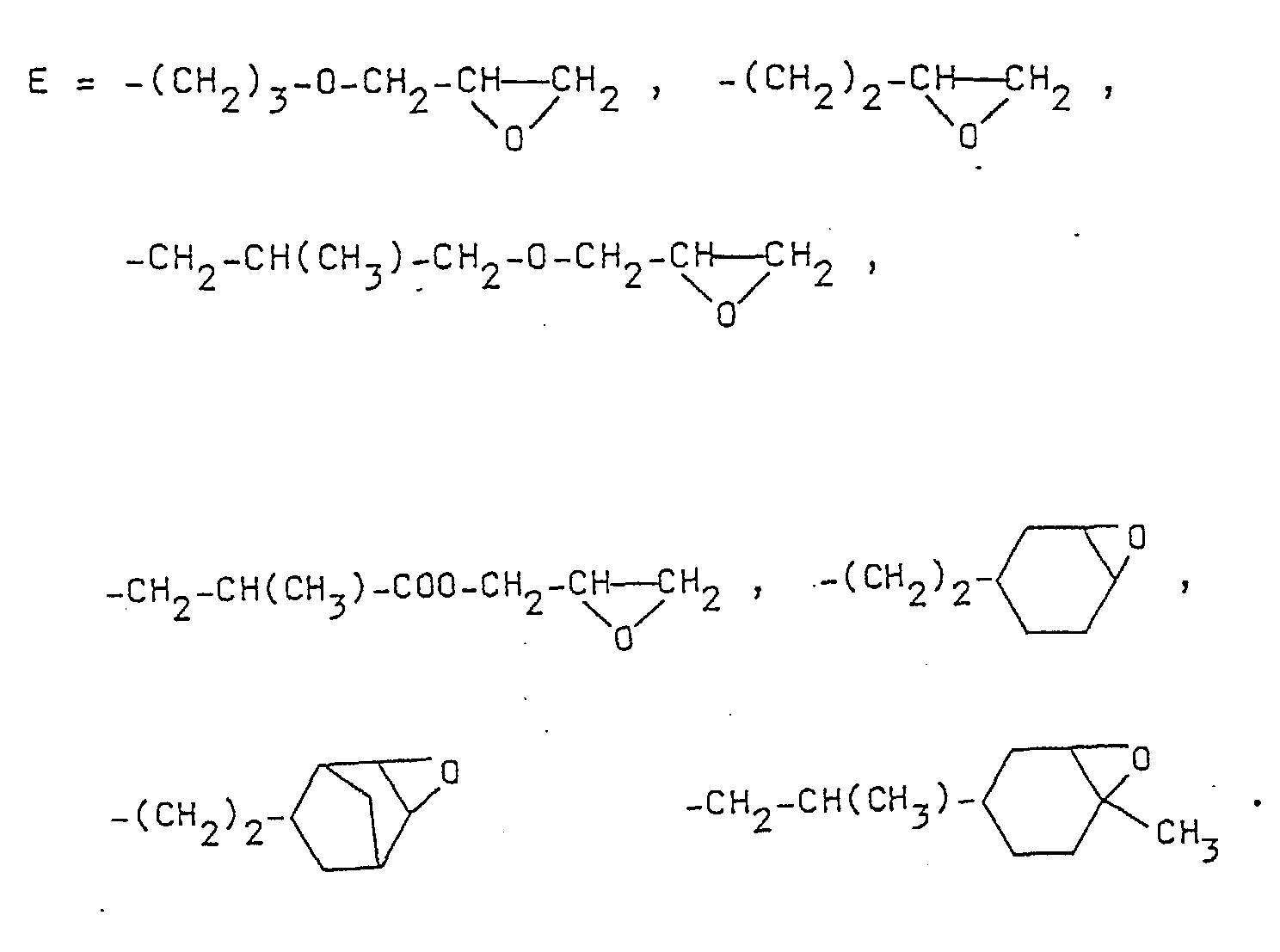
- the epoxy-functional radical E is preferably one of the following radicals:
- the epoxy-functional polysiloxanes according to the invention are prepared in such a way that polysiloxanes containing epoxy groups are reacted in a molar ratio ⁇ 1, based on the epoxy groups, with an olefinically unsaturated compound containing hydroxyl or carboxyl groups, and that a monoisocyanate is formed on the hydroxyl groups formed in the process or monoisothiocyanate is added.
- Suitable epoxy compounds are in particular allyl glycidyl ether, 2-methyl-allyl glycidyl ether, epoxybutene, methacrylic acid glycidyl ester, vinylcyclohexene oxide, vinyl norbornene oxide and limonene oxide.
- the same or very similar polysiloxanes can also be obtained by epoxidation of polysiloxanes with chain-linked ⁇ -alkenyl, ⁇ -alkenyl ether and ⁇ -alkenyl ester groups.
- Olefinically unsaturated compounds which are suitable for reaction with the epoxy groups of the polysiloxanes prepared in the manner mentioned are in particular acrylic acid, methacrylic acid, hydroxyethyl acrylate, hydroxyethyl methacrylate, hydroxyethyl maleimide, cinnamic acid, glycerol diacrylate and glycerol dimethacrylate or mixtures of these compounds.
- acrylic acid and methacrylic acid can also be used in a mixture with the corresponding anhydrides.
- the compounds according to the invention are obtained by reacting the products formed in the addition of the olefinically unsaturated compounds to the polysiloxanes containing epoxy groups with monoisocyanate or monoisothiocyanate.
- the iso (thio) cyanates react with the vicinal hydroxyl group, which was formed by opening the oxirane ring in the previous addition reaction.
- Propyl isocyanate is preferably used as the monoisocyanate.
- Other possible compounds are, for example, butyl isocyanate and phenyl isocyanate and propyl isothiocyanate and phenyl isothiocyanate.
- the colorless liquid obtained becomes at 70 ° C within 6 to 7 h to a solution of the amount of freshly distilled epoxide specified in Table 1, ie allyl glycidyl ether (AGE), vinylcyclohexene oxide (VCHO) or limonene oxide (LO), 0.13 g H 2 PtCl 6 .6 H 2 O and 0.5 ml of tert-butanol in 250 ml of toluene were added dropwise. The reaction mixture is then stirred at 70 ° C. until a minimum conversion of 95% is reached (control by volumetric SiH determination).
- the parts by mass of products 1 and 2 given in table 2 are treated under yellow light with the parts by weight also given in table 2 of acrylic acid (AS) and methacrylic acid (MAS) together with 2.5 g of diethyl phosphite as stabilizer and 2.5 g of N, N, N ', N'-tetramethyl-4,4'-diaminodiphenylmethane as catalyst dissolved in 500 ml of anhydrous toluene, then the mixture is stirred at 50 ° C. for 10 to 11 h. After cooling, the reaction mixture is mixed with acidic Al 2 O 3 to remove the catalyst, stirred for 2 hours and pressure filtered through a membrane filter with a pore diameter of 1.2 ⁇ m. The solvent and volatile constituents are removed at room temperature in a vacuum (0.1 mbar). The products obtained are unstable and gel already when refurbished or when stored in the refrigerator.
- AS acrylic acid
- MAS methacrylic acid
- the parts by mass of products 1 to 5 given in Table 3 are, as described in Examples 6 to 8, with acrylic or methacrylic acid, 2.5 g of diethyl phosphite and 2.5 g of N, N, N ', N'-tetramethyl -4,4'-diaminodiphenylmethane reacted in toluene.
- the solution freed from the catalyst is not concentrated, but instead 14.2 g of propyl isocyanate and 20 drops of dibutyltin dilaurate are added and the mixture is stirred at room temperature for 120 h.
Landscapes
- Chemical & Material Sciences (AREA)
- Health & Medical Sciences (AREA)
- Chemical Kinetics & Catalysis (AREA)
- Medicinal Chemistry (AREA)
- Polymers & Plastics (AREA)
- Organic Chemistry (AREA)
- General Chemical & Material Sciences (AREA)
- Silicon Polymers (AREA)
- Macromonomer-Based Addition Polymer (AREA)
- Processes Of Treating Macromolecular Substances (AREA)
- Compositions Of Macromolecular Compounds (AREA)
Claims (5)
- Polysiloxanes à fonctionnalité époxy répondant à la structure:
 E représente un radical à fonctionnalité époxy contenant de 4 à 20 atomes de carbone,Z représente un radical apte à une photopolymérisation, contenant de 8 à 40 atomes de carbone, que l'on obtient par addition d'un composé apte à une photopolymérisation sous forme d'un composé à insaturation oléfinique contenant des groupes hydroxyle ou carboxyle à un radical E se trouvant sur la chaîne siloxane et par addition ultérieure d'un monoisocyanate ou d'un monoisothiocyanate aliphatique, cycloaliphatique ou aromatique contenant de 2 à 10 atomes de carbone au groupe OH secondaire obtenu lors de l'ouverture du noyau époxyde,R1 représente un groupe alkyle contenant de 1 à 4 atomes de carbone ou encore un groupe phényle,R2 représente R1, E ou Z,x est égal à 50-1000, y = 10-300, z = 3-8.
 - Siloxanes à fonctionnalité époxy selon la revendication 1, caractérisés en ce que le radical E représente ce qui suit:
- Procédé pour la préparation de polysiloxanes à fonctionnalité époxy selon la revendication 1 ou 2, caractérisé en ce qu'on amène à réagir des polysiloxanes présentant des groupes époxydes dans un rapport molaire < 1, rapporté aux groupes époxydes, avec un composé à insaturation oléfinique contenant des groupes hydroxyle ou carboxyle, et en ce qu'on fixe par addition aux groupes hydroxyle obtenus en l'occurrence, un monoisocyanate ou un monoisothiocyanate.
- Procédé selon la revendication 3, caractérisé en ce qu'on utilise, comme composé à insaturation oléfinique, l'acide acrylique, l'acide méthacrylique, l'acrylate d'hydroxyéthyle, le méthacrylate d'hydroxyéthyle, le maléimide d'hydroxyéthyle, l'acide cinnamique, le diacrylate de glycérol, le diméthacrylate de glycérol ou encore un mélange de deux de ces composés ou plus.
- Procédé selon la revendication 3 ou 4, caractérisé en ce qu'on utilise, comme monoisocyanate, l'isocyanate de propyle.
Applications Claiming Priority (2)
| Application Number | Priority Date | Filing Date | Title |
|---|---|---|---|
| DE4209387 | 1992-03-23 | ||
| DE4209387 | 1992-03-23 |
Publications (2)
| Publication Number | Publication Date |
|---|---|
| EP0562369A1 EP0562369A1 (fr) | 1993-09-29 |
| EP0562369B1 true EP0562369B1 (fr) | 1997-09-10 |
Family
ID=6454794
Family Applications (1)
| Application Number | Title | Priority Date | Filing Date |
|---|---|---|---|
| EP93103882A Expired - Lifetime EP0562369B1 (fr) | 1992-03-23 | 1993-03-10 | Polysiloxanes |
Country Status (5)
| Country | Link |
|---|---|
| EP (1) | EP0562369B1 (fr) |
| JP (1) | JP3418636B2 (fr) |
| AT (1) | ATE158001T1 (fr) |
| CA (1) | CA2092047A1 (fr) |
| DE (1) | DE59307297D1 (fr) |
Cited By (1)
| Publication number | Priority date | Publication date | Assignee | Title |
|---|---|---|---|---|
| WO2004009677A1 (fr) * | 2002-07-18 | 2004-01-29 | Siemens Aktiengesellschaft | Couche d'immobilisation pour des biocapteurs |
Families Citing this family (5)
| Publication number | Priority date | Publication date | Assignee | Title |
|---|---|---|---|---|
| AU2003255530A1 (en) * | 2002-07-18 | 2004-02-09 | Siemens Aktiengesellschaft | Hydrophilic polyorganosiloxanes |
| DE10232828A1 (de) * | 2002-07-19 | 2004-02-05 | Goldschmidt Ag | Verwendung von Antioxidantien in strahlenhärtbaren Beschichtungsmassen für die Herstellung von abhäsiven Beschichtungen |
| JP4841529B2 (ja) * | 2007-10-22 | 2011-12-21 | 旭化成ケミカルズ株式会社 | 変性ポリシロキサン |
| JP6143359B2 (ja) * | 2013-11-19 | 2017-06-07 | 日本化薬株式会社 | シリコーン変性エポキシ樹脂およびその組成物 |
| JP2025156802A (ja) * | 2024-04-02 | 2025-10-15 | 信越化学工業株式会社 | 側鎖に、長鎖アルキル基、及び、チオウレア基又はウレア基を有するポリオルガノシロキサン、並びにその製造方法 |
Family Cites Families (3)
| Publication number | Priority date | Publication date | Assignee | Title |
|---|---|---|---|---|
| US3032530A (en) * | 1958-10-13 | 1962-05-01 | Dow Corning | Method of preparing polysiloxane gums |
| US4293678A (en) | 1979-11-26 | 1981-10-06 | Union Carbide Corporation | Radiation-curable acrylated epoxy silicone compositions |
| JPH0647619B2 (ja) * | 1986-11-27 | 1994-06-22 | 東レ・ダウコ−ニング・シリコ−ン株式会社 | アクリロキシ基含有オルガノポリシロキサン、その製造方法およびその用途 |
-
1993
- 1993-03-10 EP EP93103882A patent/EP0562369B1/fr not_active Expired - Lifetime
- 1993-03-10 DE DE59307297T patent/DE59307297D1/de not_active Expired - Fee Related
- 1993-03-10 AT AT93103882T patent/ATE158001T1/de not_active IP Right Cessation
- 1993-03-19 CA CA002092047A patent/CA2092047A1/fr not_active Abandoned
- 1993-03-22 JP JP08796593A patent/JP3418636B2/ja not_active Expired - Fee Related
Cited By (1)
| Publication number | Priority date | Publication date | Assignee | Title |
|---|---|---|---|---|
| WO2004009677A1 (fr) * | 2002-07-18 | 2004-01-29 | Siemens Aktiengesellschaft | Couche d'immobilisation pour des biocapteurs |
Also Published As
| Publication number | Publication date |
|---|---|
| CA2092047A1 (fr) | 1993-09-24 |
| ATE158001T1 (de) | 1997-09-15 |
| JPH069785A (ja) | 1994-01-18 |
| JP3418636B2 (ja) | 2003-06-23 |
| DE59307297D1 (de) | 1997-10-16 |
| EP0562369A1 (fr) | 1993-09-29 |
Similar Documents
| Publication | Publication Date | Title |
|---|---|---|
| EP0336141B1 (fr) | Procédé de revêtement de structures planes par un organopolysiloxane modifié par des groupes d'acide (méth)acrylique | |
| EP0202594B1 (fr) | Objets en caoutchouc de silicone hydrophile et procédé de fabrication de ces objets | |
| DE3013827C2 (fr) | ||
| DE69213193T2 (de) | Fotohärtbare Harzzusammensetzung | |
| EP0632329A1 (fr) | Photoinitiateur fonctionnalisé, macromères et leur usage | |
| DE60020430T2 (de) | Perfluoro-Gruppe enthaltende Verbindungen und gehärtetes Polymer aus diesen | |
| EP0205888B1 (fr) | Caoutchouc de polysiloxanes modifiés, leur emploi dans la fabrication de lentilles et les lentilles fabriquées | |
| EP0399199A2 (fr) | Composés organosiliciques ayant des groupes isocyanurates | |
| EP0562369B1 (fr) | Polysiloxanes | |
| DE2324822B2 (de) | Durch UV-Strahlen härtbare Masse | |
| DE3786924T2 (de) | Silikon enthaltende Vinylpolymere und deren Herstellung. | |
| EP0715630B1 (fr) | Procede de production d'epoxysiloxanes | |
| EP0283896B1 (fr) | Revêtement primaire pour fibre optique, à base d'organopolysiloxanes possédant des groupes esters acryliques | |
| DE19534594B4 (de) | Kationisch härtende, flexible Epoxidharzmassen und ihre Verwendung zum Auftragen dünner Schichten | |
| EP0687280B1 (fr) | Matieres plastiques contenant des groupes silane, ether, urethanne et uree et leur utilisation comme compositions dentaires | |
| US5057587A (en) | Radiation-curable liquid resin for secondary coating of lightwave guides | |
| DE4439769B4 (de) | Kunststoffe mit einem Gehalt an Silan-, Ether- und Urethangruppen und ihre Verwendung als Abformmassen | |
| EP0206158B1 (fr) | Photopolymères à base de polyéther | |
| DE3123676A1 (de) | Cyclische benzoinorganopolysiloxane und verfahren zu deren herstellung | |
| EP0606634B1 (fr) | Organopolysiloxane, modifié avec esters d'acide insaturés et groupes quaternaires d'ammonium, leur préparation et usage | |
| US5015709A (en) | Radiation-curable liquid resin for secondary coating lightwave guides | |
| EP0362140B1 (fr) | Compositions de résines époxy | |
| EP0443370B1 (fr) | Matériaux dentaires | |
| EP0617094A2 (fr) | Composition de revêtement antiadhésive avec additif influant sur le degré d'antiadhésion | |
| EP0259726A2 (fr) | Photopolymères à base d'époxyde |
Legal Events
| Date | Code | Title | Description |
|---|---|---|---|
| PUAI | Public reference made under article 153(3) epc to a published international application that has entered the european phase |
Free format text: ORIGINAL CODE: 0009012 |
|
| AK | Designated contracting states |
Kind code of ref document: A1 Designated state(s): AT CH DE FR GB IT LI NL SE |
|
| 17P | Request for examination filed |
Effective date: 19940329 |
|
| 17Q | First examination report despatched |
Effective date: 19950929 |
|
| GRAG | Despatch of communication of intention to grant |
Free format text: ORIGINAL CODE: EPIDOS AGRA |
|
| GRAH | Despatch of communication of intention to grant a patent |
Free format text: ORIGINAL CODE: EPIDOS IGRA |
|
| GRAH | Despatch of communication of intention to grant a patent |
Free format text: ORIGINAL CODE: EPIDOS IGRA |
|
| GRAA | (expected) grant |
Free format text: ORIGINAL CODE: 0009210 |
|
| AK | Designated contracting states |
Kind code of ref document: B1 Designated state(s): AT CH DE FR GB IT LI NL SE |
|
| REF | Corresponds to: |
Ref document number: 158001 Country of ref document: AT Date of ref document: 19970915 Kind code of ref document: T |
|
| REG | Reference to a national code |
Ref country code: CH Ref legal event code: EP |
|
| REG | Reference to a national code |
Ref country code: CH Ref legal event code: NV Representative=s name: SIEMENS SCHWEIZ AG |
|
| REF | Corresponds to: |
Ref document number: 59307297 Country of ref document: DE Date of ref document: 19971016 |
|
| ITF | It: translation for a ep patent filed | ||
| GBT | Gb: translation of ep patent filed (gb section 77(6)(a)/1977) |
Effective date: 19971119 |
|
| ET | Fr: translation filed | ||
| PGFP | Annual fee paid to national office [announced via postgrant information from national office to epo] |
Ref country code: GB Payment date: 19980211 Year of fee payment: 6 |
|
| PGFP | Annual fee paid to national office [announced via postgrant information from national office to epo] |
Ref country code: AT Payment date: 19980310 Year of fee payment: 6 |
|
| PGFP | Annual fee paid to national office [announced via postgrant information from national office to epo] |
Ref country code: NL Payment date: 19980320 Year of fee payment: 6 |
|
| PGFP | Annual fee paid to national office [announced via postgrant information from national office to epo] |
Ref country code: SE Payment date: 19980325 Year of fee payment: 6 |
|
| PGFP | Annual fee paid to national office [announced via postgrant information from national office to epo] |
Ref country code: FR Payment date: 19980327 Year of fee payment: 6 |
|
| PLBE | No opposition filed within time limit |
Free format text: ORIGINAL CODE: 0009261 |
|
| 26N | No opposition filed | ||
| PG25 | Lapsed in a contracting state [announced via postgrant information from national office to epo] |
Ref country code: GB Free format text: LAPSE BECAUSE OF NON-PAYMENT OF DUE FEES Effective date: 19990310 Ref country code: AT Free format text: LAPSE BECAUSE OF NON-PAYMENT OF DUE FEES Effective date: 19990310 |
|
| PG25 | Lapsed in a contracting state [announced via postgrant information from national office to epo] |
Ref country code: SE Free format text: LAPSE BECAUSE OF NON-PAYMENT OF DUE FEES Effective date: 19990311 |
|
| PG25 | Lapsed in a contracting state [announced via postgrant information from national office to epo] |
Ref country code: NL Free format text: LAPSE BECAUSE OF NON-PAYMENT OF DUE FEES Effective date: 19991001 |
|
| EUG | Se: european patent has lapsed |
Ref document number: 93103882.2 |
|
| GBPC | Gb: european patent ceased through non-payment of renewal fee |
Effective date: 19990310 |
|
| REG | Reference to a national code |
Ref country code: CH Ref legal event code: PL |
|
| PG25 | Lapsed in a contracting state [announced via postgrant information from national office to epo] |
Ref country code: FR Free format text: LAPSE BECAUSE OF NON-PAYMENT OF DUE FEES Effective date: 19991130 |
|
| NLV4 | Nl: lapsed or anulled due to non-payment of the annual fee |
Effective date: 19991001 |
|
| EUG | Se: european patent has lapsed |
Ref document number: 93103882.2 |
|
| REG | Reference to a national code |
Ref country code: FR Ref legal event code: ST |
|
| REG | Reference to a national code |
Ref country code: CH Ref legal event code: AEN Free format text: DAS PATENT IST AUFGRUND DES WEITERBEHANDLUNGSANTRAGS VOM 21.12.1999 REAKTIVIERT WORDEN. |
|
| PGFP | Annual fee paid to national office [announced via postgrant information from national office to epo] |
Ref country code: CH Payment date: 20020610 Year of fee payment: 10 |
|
| PG25 | Lapsed in a contracting state [announced via postgrant information from national office to epo] |
Ref country code: LI Free format text: LAPSE BECAUSE OF NON-PAYMENT OF DUE FEES Effective date: 20030331 Ref country code: CH Free format text: LAPSE BECAUSE OF NON-PAYMENT OF DUE FEES Effective date: 20030331 |
|
| REG | Reference to a national code |
Ref country code: CH Ref legal event code: PL |
|
| PGFP | Annual fee paid to national office [announced via postgrant information from national office to epo] |
Ref country code: DE Payment date: 20040517 Year of fee payment: 12 |
|
| PG25 | Lapsed in a contracting state [announced via postgrant information from national office to epo] |
Ref country code: IT Free format text: LAPSE BECAUSE OF NON-PAYMENT OF DUE FEES Effective date: 20050310 |
|
| PG25 | Lapsed in a contracting state [announced via postgrant information from national office to epo] |
Ref country code: DE Free format text: LAPSE BECAUSE OF NON-PAYMENT OF DUE FEES Effective date: 20051001 |