EP0562383A2 - Verfahren zum kontinuierlichen Transport von Werkstücken durch eine Reihe von Arbeitsstationen - Google Patents
Verfahren zum kontinuierlichen Transport von Werkstücken durch eine Reihe von Arbeitsstationen Download PDFInfo
- Publication number
- EP0562383A2 EP0562383A2 EP93103988A EP93103988A EP0562383A2 EP 0562383 A2 EP0562383 A2 EP 0562383A2 EP 93103988 A EP93103988 A EP 93103988A EP 93103988 A EP93103988 A EP 93103988A EP 0562383 A2 EP0562383 A2 EP 0562383A2
- Authority
- EP
- European Patent Office
- Prior art keywords
- sheet material
- segment
- work
- work station
- segments
- Prior art date
- Legal status (The legal status is an assumption and is not a legal conclusion. Google has not performed a legal analysis and makes no representation as to the accuracy of the status listed.)
- Granted
Links
Images


Classifications
-
- D—TEXTILES; PAPER
- D05—SEWING; EMBROIDERING; TUFTING
- D05B—SEWING
- D05B25/00—Sewing units consisting of combinations of several sewing machines
-
- D—TEXTILES; PAPER
- D10—INDEXING SCHEME ASSOCIATED WITH SUBLASSES OF SECTION D, RELATING TO TEXTILES
- D10B—INDEXING SCHEME ASSOCIATED WITH SUBLASSES OF SECTION D, RELATING TO TEXTILES
- D10B2503/00—Domestic or personal
- D10B2503/06—Bed linen
- D10B2503/062—Fitted bedsheets
Definitions
- the invention disclosed herein generally relates to a method of continuously conveying segments of flexible sheet material progressively through a series of work stations.
- An apparatus for conveying segments, especially a hemming apparatus, is disclosed further. More particularly, the invention relates to a method of forming fitted bed sheets and to a method of temporarily accumulating a portion of a segment of sheet material.
- Fitted bed sheets which are applied in form- fitting relationship with respect to a bed mattress usually include elastic band extending along the edges of the head and foot portions of the skirt of the bed sheet or along the edges of the side portions of the skirt of the bed sheet which draw the skirt of the sheet tight about the bed mattress.
- the usual prior art procedure for sewing the corner structures and for applying the elastic bands to fitted bed sheets comprises manual handling of the segments of sheet material as the sewing steps are performed.
- the elastic bands are stretched and sewn to the cut head and foot edge portions of the segments of sheet material.
- the side edge portions or the head and foot edge portions can be folded over into overlying relationship with the segment and a diagonal line stitch formed at all four corners of the segment of sheet material, thereby completing the fitted bed sheet.
- One of the more expensive aspects of the fabrication of fitted sheets is the manual handling of the bed sheet as it is sewn by the operator in a sewing machine.
- such prior art procedures require the operator to manipulate the large segments of sheet material when performing the sewing functions.
- US Patent GB-A-2 133 052 and German Patent DE-A-3 542 394 both disclose an automated method and apparatus for sewing the corner structures and applying elastic bands to fitted sheets. Both of these references, however, still require manual manipulation of the bed sheet during finishing in the folding and trimming of the corners of the bed sheet to finish the bed sheet. Thus, while the methods and apparatus taught by these references eliminate the manual handling of the bed sheets during several processing steps, manual handling of the bed sheets is still required by both UK Patent GB-A-2 133 052 and German Patent DE-A-3 542 394 to fold the edges and trim away excess material to finish the bed sheets.
- the present invention comprises a method of continuously conveying segments of flexible sheet material progressively through a series of work station characterized by the steps of:
- a method, finally, of temporarily accumulating a portion of a segment of sheet material as the segment moves between a first and a second work station comprises the steps of:
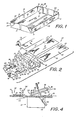
- Fig. 1 illustrates a fitted bed sheet of a type that is to be mounted in form fitting relationship about a bed mattress.
- Fig. 1 illustrates the fitted bed sheet 10 in an inverted position, showing the main body portion 11 that is to cover the upper surface of the mattress, and side skirts 12 and 13 and head and foot skirts 14 and 15. Corner structures 16, 17, 18 and 19 are formed between the respective head, side, foot and side skirts.
- An elastic band 20 is attached along its length by stitching or similar connection means 22 to the free edge of head skirt 14, and a similar elastic band 21 is attached along its length to the free edge of foot skirt 15.
- each corner structure is formed by the head or foot skirt 14 or 15 being turned at 90 degrees to begin the formation of the side skirt.
- the side skirt 12 or 13 is folded at a diagonal 24 and is sewn to head or footskirt 14 and 15 by a line of chain stitching 25.
- the chain stitching 25 extends over the end portions of the elastic bands 20 and 21 at each corner structure, and anchors the ends of the elastic bands 20 and 21 and the stitching 22 formed through the elastic bands at the free edges of the head and foot skirts 14 and 15.
- the triangular folded portion 23 of the fitted sheet is cut away, as later disclosed.
- the fitted bedsheet 10 of Fig. 1 is formed by advancing sheet material 30 along its length as indicated by arrow 31 from a supply 32 to a cutting station 34.
- a segment 35 of the sheet material is cut from the supply by a conventional rotary cutter 36 that moves across and cuts through the sheet material.
- the segment 35 is then moved parallel to its cut edge in the direction indicated by arrow 38 into a temporary sheet accumulation station 39, then through a first sewing station 40 where the elastic bands 20 and 21 are sewn by needles 41 to the cut head and foot edge portions 26 and 27.
- the sheet material continues to advance from the first sewing station 40 through the folding station 42 and then through the second sewing station 43.
- the head and foot edge portions 26 and 27 of each are folded at the folding station 42 into overlying relationship so as to form the head and foot skirts 14 and 15 which overlie the next adjacent edge portions 44 and 45 of the main body portion 11.
- the main body portion 11 as well as the head and foot edge portions 26 and 27 move through a 90 degree angle, from a horizontal direction of movement to a vertical direction of movement, as indicated by arrow 48.
- the main body portion 11 then moves through a 180 degree turn as indicated by arrows 49 so as to begin a downward movement.
- the head and foot edge portions 26 and 27 each progress through a 90 degree turn 50 and 51 so as to be turned laterally inwardly toward the main body portion 11.
- the head and foot edge portions each turn through a second 90 degree turn 53 and 54 so as to begin a downward movement with the main body portion 11.
- This causes the head and foot edge portions 26 and 27 to become folded in overlying relationship with respect to the main body portion 11, shown at 55 and 66, thereby forming the head and foot skirts 14 and 15.
- the main body portion 11 and head and foot skirts 14 and 15 are turned through a 90 degree turn 54 so as to change directions from downward vertical movement into longitudinal horizontal movement, so that the segment can continue on through the processing path.
- the needles 58 form the sewn line of chain stitching 25 at the trailing and leading corners of the folded segment of sheet material.
- the needles 58 and 59 are positioned adjacent the folds 28 and 29 of the folded segment of sheet material, and as the trailing edge 37 of a segment 35 is detected by a photo cell, the needles 58 and 59 begin their sewing function and the needles are carried inwardly from the folds 28 and 29.
- the combined motion of the needles moving inwardly from the folds 28 and 29 toward the main body portion 11 and of the movement of the segment of sheet material along the processing path results in a diagonal line of chain stitching 25 being formed across the trailing corners of the segments of sheet material.
- the fitted sheet hemmer 65 includes a work table 66 at the cutting station 34.
- Sheet material puller 68 is mounted above work table 66 and is arranged to travel across the work table and grasp the previously cut leading edge 69 of the sheet material 30 and pull the sheet material rapidly along its length from an accumulation feeder (not shown) into the cutting station 34.
- the sheet material puller includes a pair of grasping arms 70 and 71 that are movable toward and away from each other by pneumatic cylinders 72.
- the grasping arms 70 and 71 are suspended from conveyor chain assemblies 74 and 75 which move the grasping arms back and forth across the cutting station 34.
- the movement of the sheet material puller 68 and its grasping function are controlled by photo cells (not shown) strategically located at positions along the processing path.
- photo cell 78 determines when the leading cut edge 69 of the supply of sheet material has been pulled the proper distance into the cutting station 34, whereupon the movement of the sheet material puller will be terminated, clamp 79 closed about the sheet and the operation of the rotary cutter 36 will begin so as to cut the segment 35 free from the supply of sheet material.
- Infeed conveyor 80 is located over the processing path and overlaps cutting station 34.
- Infeed conveyor includes driven roll 81 which is rotated as indicated by arrow 82 by drive system 84.
- the supporting framework for driven roll 81 is not disclosed.
- the tilt frame 85 of the infeed conveyor 80 is mounted to the axle 86 at opposite ends of the driven roll 81, and the tilt frame supports moveable axle 88 which extends laterally across the processing path.
- a plurality of conveyor tape rollers 89 are mounted on the moveable axle 88, and conveyor tapes 90 extend about driven roll 81 and about a conveyor tape roller 89.
- Fluid actuated cylinders 95 are mounted to the framework (not shown) and to the tilt frame 85 at opposite sides of the infeed conveyor 80 and function to tilt the infeed conveyor as indicated by arrows 96.
- Work table 66 which extends from the cutting station 34 beneath the infeed conveyor 80 includes a moveable section 98 that is capable of moving downwardly away from the end feed conveyor 80.
- the moveable section 98 of the work table is hingedly supported at one end 99 and is movably supported by pneumatic cylinders 100 at opposite sides of the worktable.
- the cylinders 100 tilt the section 98 of the worktable toward and away from the infeed Conveyor 80. It will be noted that the entrance end 101 of the infeed conveyor is positioned over the stationary portion of worktable 66, while the delivery end 102 is positioned over the moveable section 98 of the worktable.
- the infeed conveyor 80 When the sheet material puller 68 (Fig. 3) is to be operated to travel over the worktable 66 and grasp the previously cut edge portion 69 of the sheet material 30 and then pull the sheet material out into the cutting station, the infeed conveyor 80 will be tilted to its up position (Fig. 4) to permit the passage beneath the infeed conveyor of the sheet material puller.
- the infeed conveyor When the sheet material puller has reached its home position and is out of the way of the infeed conveyor 80 the infeed conveyor will be tilted downwardly by its cylinders 95 so that its entrance end 101 is urged against the stationary portion of the worktable 66 (Fig. 5). In the meantime, the delivery end 102 of the infeed conveyor retains its position since the delivery end is mounted at the support axle 86.
- the infeed conveyor 80 When the segment of sheet material 35 has been properly drawn out and cut at cutting station 34 (Fig. 4), the infeed conveyor 80 will be moved from its raised position (Fig. 4) to its lowered position (Fig. 5) and its tapes set in motion by the rotation of driven roll 81.
- the lower flights of the conveyor tapes 90 engage and move the adjacent side edge portion of the segment 35, thereby pulling the entire segment in a stretched out, flat configuration across the worktable 66, across its moveable section 98 and into the first sewing station 40.
- the movements of the system are timed by a control system so that when the leading edge of the segment 35 has moved across the moveable section 98 of the work table into the sewing station 40, the cylinders 100 are actuated so as to drop the moveable section 98 of the worktable (Fig. 6).
- a photo cell 104 (Fig. 5) can detect the presence of the segment, if desired.
- the conveyor tapes 105 are driven by tape rolls 106 across the stationary portion of the worktable 66 and the leading edge of the segment of sheet material is advanced on to the conveyor tapes 105.
- Moveable presser feet 108 are positioned over each conveyor tape 105, and pneumatic cylinders 109 raise and lower the moveable presser feet.
- the cylinders 109 are actuated to move the presser feet 108 downwardly into engagement with the segment 35, pressing the segment into positive relationship with the moving conveyor tapes 105, causing the leading portion of the segment to be positively carried through the first sewing station 40.
- Stationary presser feet 110 also assists in pressing the segment 35 of sheet material against the conveyor tapes, to make sure that the segment is positively carried on through the first sewing station.
- the infeed conveyor 80 operates at a surface velocity that is 4 or 5 times faster than the feed velocity of the sewing stations. With this arrangement, the infeed conveyor will rapidly advance the segments 35 of sheet material out of the cutting station 34 so that the cycle of drawing out and cutting an additional segment of sheet material can be accomplished very soon after the previously cut segment has been formed. In the meantime, the previously cut moving segment of sheet material will not be allowed to overrun the sewing station 40 because of the downward movement of the section 98 of the worktable which permits the rapidly moving trailing portion of the segment 35 of sheet material to fall downwardly into an accumulation bin 112 located beneath moveable section 98 at the temporary sheet accumulation station 39.
- the first sewing station 40 includes a pair of sewing machines 115 and 116 located at opposite sides of the processing path. Sewing machines 115 and 116 operate to attach the elastic bands 20 and 21 to the cut head and foot edge portions 26 and 27 of the segment 35 of sheet material.
- the sewing machines 115 and 116 are Wilcox and Gibbs overedge machines with an elastic attachment. These are conventional in the art.
- the sewing machines 115 and 116 operate continuously during the operation of the fitted sheet hemmer 65, so that the bands 20 not only are attached to the head and foot edge portions of the segment of sheet material but also extend between adjacent segments. In normal operation it is expected that the gaps between adjacent segments of sheet material will be from 2 to 4 inches.
- Figs. 7 and 8 illustrate the operation of one-half of the folder apparatus 118 which is positioned in the folding station 42.
- Fig. 7 illustrates the segment 35 of sheet material advancing in the direction of arrow 119 into the folder apparatus 118.
- the sheet material is carried by the surface conveyor tapes 105 and the stationary presser feet 110 until the leading edge of the sheet segment is introduced beneath the lower infeed roll 120 of the folder apparatus.
- Central feed belt 124 and side folder belts 125 on each side of the central feed belt (only one shown) move downwardly and then about infeed roll 120 and then in an upward direction.
- the belts 124 and 125 then pass about the fold plate assembly 126.
- the segment of sheet material is carried in unison with the belts, and the segment as well as the belts are driven in unison with the infeed roll 120.
- Fold plate assembly 126 is partially illustrated in expanded format in Fig. 8.
- the fold plate assembly includes outer and inner bevel plate assemblies 128 and 129 positioned at the edge of that path of each segment of the sheet material.
- Central fold plate assembly 130 spans the gap between the bevel plate assemblies 128 and 129 at each side of the folder apparatus.
- Outer bevel plate assembly 128 includes guide sheet 131 that has a horizontal span (132) and a vertical span 134 that is formed by the bend 135 in the guide sheet.
- Vertical span 134 includes an upper beveled bend 136 that is oriented at a 45 degree angle with respect to the vertical edge 138 of the guide sheet.
- the beveled bend 136 is an inverted U-shape and forms a rounded surface on which the side folder belt 125 can move.
- Inner bevel plate assembly 129 includes a pair of beveled guide plates 140 and 141 that are of similar shape and which are closely spaced from each other.
- Each beveled guide plate 140 and 141 include an upper sloped bend 142 and 143 sloped at 45 degrees from vertical, with the bends extending from the vertical span 144 and 145, and with the bend 142 curving over the bend 143.
- central fold plate assembly 130 includes a guide sheet 146 that includes a horizontal span 147 and a vertical span 148, with an intermediate 90 degree bend 149.
- the upper end portion of vertical span 148 terminates in an inverted U-shape bend 150.
- a span bar 151 extends coextensively with upper bend 150 and extends across the folder apparatus to the other side of the processing path and joins to the guide sheet at the opposite central fold plate assembly.
- Side folder belt 125 moves upwardly from infeed roll 120 and moves about the beveled bend 136 (Fig. 8) of the outer beveled plate assembly 128. Because of the 45 degree angle of the bend 136, the side folder belt 125 turns 90 degrees and begins a lateral movement from the outer bevel plate assembly 128 toward the inner bevel plate assembly 129. The side folder belt 125 enters the space between adjacent beveled guide plates 140 and 141 and then curves about the beveled bend 143 of the beveled guide plate 141. As the side folder belt moves about the beveled bend 143, it makes a 90 degree turn, beginning its downward movement from the inner bevel plate assembly toward the outfeed roll 152.
- outfeed roll 152 is formed in segments, with end segments 152a rotating in one direction and central segment 152b rotating in the opposite direction, so that the directions of rotation of the outfeed roll are compatible with the movements of the side folder belt.
- Central feed belt 124 also moves downwardly and then about infeed roll 120 and picks up the main body portion 11 of the segment 35 of sheet material, moving the segment upwardly and then through a U-turn over the upper bend 150 of the guide sheet 146.
- the central feed belt then moves downwardly, then around the lower portion of outfeed roll 152 so as to make a U-turn and begin its upward run back over the upper return roll 158 and then back down to the infeed roll 120.
- the central feed belt 124 causes the main body portion 11 of the segment of sheet material to move through an inverted U-shaped turn.
- the side folder belts 125 engage and move the head and foot edge portions of the segment, which eventually become the head and foot skirts 14 and 15 of the fitted sheet, and carry those portions of the segment first through the 90 degree position with respect to the segment, and then through a second 90 degree turn where the skirts are aligned with the main body portion of the segment 35.
- the side folder belts 125 are first applied to the top surface of the segment of sheet material and carry the head and foot edge portions into folded relationship with the main body portion 11 of the segment of sheet material, and then emerge from the folder beneath the segment of sheet material and are turned at 90 degrees to run out from beneath the segment of sheet material, and then make another 90 degree turn whereupon the return flight is aligned with the entrance flight.
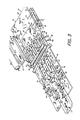
- moveable sewing machines 164 and 165 are located on opposite sides of the processing path, with the sewing needles 58 and 59 located so as to sew the corner structures of the segments of sheet material.
- the sewing machines 164 and 165 are placed in slots, such as slot 166, in the work table, and a pneumatic cylinder (not shown) that is positioned beneath each sewing machine is arranged to move the sewing machines back and forth (as indicated by arrows 168 and 169) toward and away from the segments of sheet material being processed through the fitted sheet hemmer.
- a control system including photo cells 170 and 171 (Fig. 10), is used to control the movements of the sewing machines 164 and 165.
- cutter drum 178 When the photo cell 171 detects the trailing edge of a segment of sheet material, cutter drum 178 is rotated in the direction as indicated by arrow 179, and its spiral cutting rib 180, which works against a cylindrical cutting surface (not shown) is rotated so as to engage and cut a segment of sheet material 35, to remove the triangular cutout 23 (Fig. 10) adjacent the line of stitching 25 formed by the sewing machine.
- a spiral cutting drum 178 is located on each side of the machine at the edge of the path of travel of the segments of sheet material.
- the cutting drum 178 rotates only 180 degrees in response to the signal received from photo cell 171.
- the cutter drum When photo cell 172 detects the on-coming edge of a segment of sheet material 35, the cutter drum is activated again and rotates another 180 degrees in the direction as indicated by arrow 179, and its other spiral cutting rib engages and cuts the corner of the on-coming segment, to remove the triangular cutout 23 adjacent the line of chain stitching 25.
- photo cell 173 When photo cell 173 detects the trailing edge of a segment of sheet material 35, it activates a pair of rotary cutters 184, so that the cutting blade revolves 360 degrees in the direction as indicated by arrow 186 and works against a similar backing drum (not shown).
- the cutting blade 185 engages and cuts the elastic band 20 in the gap between adjacent segments of sheet material.
- surface conveyor tapes 188 are driven by the conveyor drive system (not shown) along the work table and a presser ski assembly 189 urges the segments of sheet material into frictional engagement with the conveyor tapes so that the segments are moved in unison with the conveyor tapes.
- the segments of sheet material When the photo cell 174 has counted a predetermined number of the teeth of a gear 175 of the conveyor system, the segments of sheet material will have moved a predetermined distance. When the count has been completed, the sewing machines 164 and 165 will be moved inwardly from adjacent the processing path into sewing engagement with the segment of sheet Laterial so as to begin the sewing of the diagonal line of chain stitching 25 at the corners of the trailing edge of the segment of sheet material. This causes the lines of stitching at the corners of the segments of sheet material to be a certain distance apart without regard to the length of the segment of sheet material. Therefore, if the segments of sheet material that are supplied to the system are slightly too long or slightly too short, the fitted bed sheet formed by the system will be accurately formed to fit the standard mattress.
- the sewing machines 164 and 165 can be operated continuously, if desired.
- the thread chain 190 (Fig. 10) from the sewing machine runs off the segment of sheet material when the sewing machines are moved outwardly with respect to the processing path. It is desirable to cut thread chains 190 when the thread chains run off the segments of sheet material.
- oscillating cutters 191, vacuum conduit 192, guide rolls 193 and guide plate 194 are placed at the side edges of the processing path downstream of the sewing machines 164 and 165. As the segment of sheet material moves through the system and when the sewing machines run off the edges of the segment of sheet material, the thread chain 190 will be guided by guide plate 194 toward guide rolls 193.
- Guide rolls 193 are angled so that as they rotate and pass the thread chain therebetween, they also move the thread chain laterally away from the processing path and into the slot 195 at the inlet of the vacuum conduit 192.
- the thread chain is then further drawn by the segment of sheet material toward the oscillating cutters 191, where the thread chain is cut.
- the vacuum conduit 192 draws the now free end of the thread chain into the vacuum conduit, where the thread chain moves toward a collection area.
- the sewing machines continue to operate and the thread chain formed from the sewing machines are carried to the vacuum conduits until the sewing machine moves back into sewing engagement with the segment of sheet material.
- the oscillating cutters 191 will again cut the protruding end portion of the thread chain 190 so that the previously collected length of thread chain in vacuum conduit 192 will not be pulled out of the conduit and carried away with the segment of sheet material.
- the sheets are completed and can be everted so as to be right-side out and ready for folding, packaging and delivery to the retail store.
- the span or bar 151 that forms the curved surface of the U-turn about which the main body portion 11 of the segment passes has mounted thereto one or more fluid actuated cylinders 198 which are arranged to raise and lower the bar 151.
- the outer bevel plate assembly 128 and inner bevel plate assembly 129 on opposite sides of the bar 151 remain stationary.
- the raising and lowering of the guide bar 151 tends to lengthen or shorten the length of the U-turn about which the central span or main body portion 11 of the sheet material passes.
- the central span of the segment travels a shorter distance, and its leading edge 33 advances from the solid line position to the, dash line position 176.
- the leading edge 33 for the central body portion will move further than the leading edges of the head and foot edge portions, so that the central span of the segment will extend beyond the leading edges of the folded side skirts 12 and 13 and the head and foot leading edge portions will not hang out and form misaligned edges.
- a photo cell (not shown) or other control mechanism will be utilized to determine the positions of the leading and trailing edges of the segments of sheet material passing through the folder.
- the position of the guide bar as controlled by the fluid actuated cylinder 194 is adjusted just before a trailing edge 37 begins its movement about the U-shaped guide 151.
- the U-shaped guide is raised so as to lengthen the U-shape, thereby tending to retard the movement of the trailing edge 37 of the central portion of the segment of the sheet material with respect to the trailing edges of the side skirts 12 and 13.
- the U-shaped guide bar is lowered so as to shorten the length of the U-turn.
- This causes the on-coming leading edge 33 to be advanced with respect to the side skirts 12 and 13, causing the leading edge 33 of the central portion of the segment to extend beyond the leading edges of the side skirts.
- this avoids the presence of a mismatch effect where the leading edges and trailing edges of the side skirts might extend out beyond the leading or trailing edges of the central portion of the segment of sheet material.
- the central feed belt 124 (Fig. 7) tends to stretch and contract during the raising and lowering of the central guide 151.
- a tension roll can be added to the central feed belt so as to compensate for the raising and lowering of the central feed belt, as may be necessary.
- the invention has been described as applying the elastic bands 21 to the head and foot skirts 14 and 15; however, it will be understood that fitted sheets can be cut and sewn so that cut segments of sheet material are moved parallel to their side edges instead of the end edges and the elastic bands are applied to the side skirts instead of the head and foot skirts. Therefore, the terms "head and foot edge portions” and similar references to the head and foot of the product generally refer to the edges of the segments of sheet material that extend parallel to the processing path through the sewing machines and the "side edges" and similar references to the sides of the product refer to the edges of the segments of sheet material that extend at a right angle to the processing path.
Landscapes
- Engineering & Computer Science (AREA)
- Textile Engineering (AREA)
- Sewing Machines And Sewing (AREA)
- External Artificial Organs (AREA)
- Treatment Of Fiber Materials (AREA)
- Electrical Discharge Machining, Electrochemical Machining, And Combined Machining (AREA)
- Attitude Control For Articles On Conveyors (AREA)
- Constituent Portions Of Griding Lathes, Driving, Sensing And Control (AREA)
- Making Paper Articles (AREA)
- Electrotherapy Devices (AREA)
- Folding Of Thin Sheet-Like Materials, Special Discharging Devices, And Others (AREA)
- Registering Or Overturning Sheets (AREA)
Applications Claiming Priority (3)
| Application Number | Priority Date | Filing Date | Title |
|---|---|---|---|
| US07/111,915 US4773341A (en) | 1987-10-21 | 1987-10-21 | Fitted sheet hemmer |
| EP88909870A EP0339073B1 (de) | 1987-10-21 | 1988-10-20 | Vorrichtung zum säumen von angepassten textil-flächengebilden |
| US111915 | 1998-07-08 |
Related Parent Applications (2)
| Application Number | Title | Priority Date | Filing Date |
|---|---|---|---|
| EP88909870A Division EP0339073B1 (de) | 1987-10-21 | 1988-10-20 | Vorrichtung zum säumen von angepassten textil-flächengebilden |
| EP88909870.3 Division | 1988-10-20 |
Publications (3)
| Publication Number | Publication Date |
|---|---|
| EP0562383A2 true EP0562383A2 (de) | 1993-09-29 |
| EP0562383A3 EP0562383A3 (en) | 1994-08-17 |
| EP0562383B1 EP0562383B1 (de) | 1998-08-19 |
Family
ID=22341114
Family Applications (2)
| Application Number | Title | Priority Date | Filing Date |
|---|---|---|---|
| EP93103988A Expired - Lifetime EP0562383B1 (de) | 1987-10-21 | 1988-10-20 | Verfahren zum kontinuierlichen Transport von Werkstücken durch eine Reihe von Arbeitsstationen |
| EP88909870A Expired - Lifetime EP0339073B1 (de) | 1987-10-21 | 1988-10-20 | Vorrichtung zum säumen von angepassten textil-flächengebilden |
Family Applications After (1)
| Application Number | Title | Priority Date | Filing Date |
|---|---|---|---|
| EP88909870A Expired - Lifetime EP0339073B1 (de) | 1987-10-21 | 1988-10-20 | Vorrichtung zum säumen von angepassten textil-flächengebilden |
Country Status (8)
| Country | Link |
|---|---|
| US (1) | US4773341A (de) |
| EP (2) | EP0562383B1 (de) |
| JP (1) | JPH02501897A (de) |
| AT (1) | ATE169972T1 (de) |
| CA (1) | CA1329515C (de) |
| DE (2) | DE3886521T2 (de) |
| DK (1) | DK303389A (de) |
| WO (1) | WO1989003907A1 (de) |
Cited By (1)
| Publication number | Priority date | Publication date | Assignee | Title |
|---|---|---|---|---|
| ITVR20090195A1 (it) * | 2009-11-19 | 2011-05-20 | Vi Be Mac Spa | Dispositivo trasportatore e macchina da cucire comprendente tale dispositivo |
Families Citing this family (12)
| Publication number | Priority date | Publication date | Assignee | Title |
|---|---|---|---|---|
| DE3710025A1 (de) * | 1987-03-27 | 1988-10-13 | Schmale Carl Gmbh & Co Kg | Verfahren und vorrichtung zur vollautomatischen herstellung von an ihren raendern eingefassten textilerzeugnissen |
| US4922842A (en) * | 1988-03-02 | 1990-05-08 | Union Special Corporation | Hemmer seamer assembly |
| US5133273A (en) * | 1991-09-19 | 1992-07-28 | Sew Simple Systems, Inc. | Fitted sheet hemmer |
| US5476053A (en) * | 1994-09-27 | 1995-12-19 | Sew Simple Systems, Inc. | Flat sheet hemming method and folding and separating apparatus |
| US5816177A (en) * | 1995-12-04 | 1998-10-06 | Sew Simple Systems, Inc. | Material feeding, aligning cutting and edge finishing system |
| DE19831992C2 (de) * | 1998-07-16 | 2000-07-13 | Schmale Holding Gmbh & Co | Verfahren und Vorrichtung zum Transport von aus einer textilen Bahn vereinzelten Textilstücken |
| US6802271B2 (en) * | 2003-01-08 | 2004-10-12 | Atlanta Attachment Company | Automatic border sewing system |
| US7984681B1 (en) | 2007-11-20 | 2011-07-26 | Atlanta Attachment Company | Automatic panel sewing and flanging system |
| US8990981B2 (en) | 2013-07-18 | 2015-03-31 | Ubimed, Inc. | Fitted sheet |
| CN106400323A (zh) * | 2016-10-12 | 2017-02-15 | 武汉纺织大学 | 一种直角床单全自动生产线 |
| CN106350947A (zh) * | 2016-10-12 | 2017-01-25 | 江苏圣夫岛纺织生物科技有限公司 | 一种全自动直角床单生产设备 |
| DE102017113666A1 (de) * | 2017-06-21 | 2018-12-27 | Schmale-Holding Gmbh & Co. | Verfahren zur Herstellung von Spannbetttüchern |
Family Cites Families (22)
| Publication number | Priority date | Publication date | Assignee | Title |
|---|---|---|---|---|
| US825741A (en) * | 1905-03-11 | 1906-07-10 | Andrew Alexander Mackenzie | Sewing-machine. |
| US1435661A (en) * | 1917-10-08 | 1922-11-14 | Union Special Machine Co | Guiding device for sewing machines |
| US2546831A (en) * | 1947-06-21 | 1951-03-27 | Edward C Newell | Method and apparatus for automatically making rectangular sheets of fabric |
| US2642827A (en) * | 1948-11-09 | 1953-06-23 | Ardsley Curtain Co Inc | Hemmer |
| US3160080A (en) * | 1962-06-27 | 1964-12-08 | Johnson & Johnson | Apparatus for making box-type product |
| US3273524A (en) * | 1964-01-21 | 1966-09-20 | Leo H Koltun | Sewing machine method for producing an envelope |
| US3869997A (en) * | 1967-03-30 | 1975-03-11 | Sidney German | Web cutting sewing machine and process |
| GB1239736A (de) * | 1969-01-15 | 1971-07-21 | ||
| FR2121896A5 (de) * | 1971-01-11 | 1972-08-25 | Centre Tech Ind Habillement | |
| US3862610A (en) * | 1974-01-17 | 1975-01-28 | Riegel Textile Corp | Apparatus for cutting and finishing segments of a traveling web |
| US3906878A (en) * | 1974-02-15 | 1975-09-23 | Perry E Burton | Hemming method and apparatus |
| US3955515A (en) * | 1974-10-07 | 1976-05-11 | Nemo Industries, Inc. | Folding and hemming method and apparatus |
| DE2544409C3 (de) * | 1975-10-03 | 1979-05-10 | Conrad 8741 Saal Arbter | Vorrichtung an Nähanlagen zum Bilden eines doppelten Umschlages an den Schnittkanten von flach aufliegenden Materialbahnen |
| US4154180A (en) * | 1977-05-23 | 1979-05-15 | Opelika Manufacturing Corporation | Cutting and hemming system |
| US4214541A (en) * | 1977-12-29 | 1980-07-29 | Fieldcrest Mills, Inc. | Method for manufacturing pillowcases |
| US4269130A (en) * | 1978-11-01 | 1981-05-26 | Opelika Manufacturing Corporation | Sheet production system |
| US4462322A (en) * | 1980-05-27 | 1984-07-31 | Opelika Manufacturing Corporation | Sheet production system with hem expander |
| IT1159812B (it) * | 1983-01-06 | 1987-03-04 | Bassetti Spa | Metodo per la realizzazione di fodere amovibili per rivestire in modo aderente manufatti a dimensione tridimensionale |
| US4589361A (en) * | 1984-09-28 | 1986-05-20 | Cannon Mills Company | Apparatus and method for automatically guiding, trimming, splitting and side hemming continuous textile material |
| US4594956A (en) * | 1985-02-19 | 1986-06-17 | The Singer Company | Method and apparatus for sewing mitered corners of box type articles |
| DE3542394C1 (de) * | 1985-11-30 | 1987-02-26 | Texpa Arbter Maschb Gmbh | Vorrichtung zur Herstellung von teilweise konfektionierten Spannbettuechern oder dergleichen Schonbezuegen |
| US4754717A (en) * | 1987-07-31 | 1988-07-05 | Texpa-Arbter Maschinenbau Gmbh | Sewing arrangement for covers made of textile material, e.g. pillow cases, slip covers or the like |
-
1987
- 1987-10-21 US US07/111,915 patent/US4773341A/en not_active Expired - Lifetime
-
1988
- 1988-10-19 CA CA000580657A patent/CA1329515C/en not_active Expired - Fee Related
- 1988-10-20 WO PCT/US1988/003684 patent/WO1989003907A1/en not_active Ceased
- 1988-10-20 AT AT93103988T patent/ATE169972T1/de active
- 1988-10-20 EP EP93103988A patent/EP0562383B1/de not_active Expired - Lifetime
- 1988-10-20 DE DE88909870T patent/DE3886521T2/de not_active Expired - Fee Related
- 1988-10-20 EP EP88909870A patent/EP0339073B1/de not_active Expired - Lifetime
- 1988-10-20 JP JP63509154A patent/JPH02501897A/ja active Pending
- 1988-10-20 DE DE3856244T patent/DE3856244T2/de not_active Expired - Fee Related
-
1989
- 1989-06-20 DK DK303389A patent/DK303389A/da not_active Application Discontinuation
Cited By (6)
| Publication number | Priority date | Publication date | Assignee | Title |
|---|---|---|---|---|
| ITVR20090195A1 (it) * | 2009-11-19 | 2011-05-20 | Vi Be Mac Spa | Dispositivo trasportatore e macchina da cucire comprendente tale dispositivo |
| CN102071544A (zh) * | 2009-11-19 | 2011-05-25 | 维比麦克Spa公司 | 传送装置及包含所述装置的缝纫机 |
| EP2325363A1 (de) * | 2009-11-19 | 2011-05-25 | VI.BE.MAC. S.p.A. | Transportsvorrichtung und Nähmaschine mit dieser Vorrichtung |
| TWI383078B (zh) * | 2009-11-19 | 2013-01-21 | Vi Be Mac Spa | Sewing machine with conveyor |
| US8567328B2 (en) | 2009-11-19 | 2013-10-29 | Vi.Be.Mac. S.P.A. | Conveying device and sewing machine comprising said device |
| CN102071544B (zh) * | 2009-11-19 | 2013-12-18 | 维比麦克Spa公司 | 传送装置及包含所述装置的缝纫机 |
Also Published As
| Publication number | Publication date |
|---|---|
| EP0339073A1 (de) | 1989-11-02 |
| EP0339073B1 (de) | 1993-12-22 |
| DE3886521D1 (de) | 1994-02-03 |
| DK303389D0 (da) | 1989-06-20 |
| EP0562383A3 (en) | 1994-08-17 |
| WO1989003907A1 (en) | 1989-05-05 |
| DK303389A (da) | 1989-08-15 |
| ATE169972T1 (de) | 1998-09-15 |
| EP0339073A4 (de) | 1990-02-26 |
| DE3886521T2 (de) | 1994-04-21 |
| EP0562383B1 (de) | 1998-08-19 |
| DE3856244D1 (de) | 1998-09-24 |
| US4773341A (en) | 1988-09-27 |
| CA1329515C (en) | 1994-05-17 |
| DE3856244T2 (de) | 1999-04-22 |
| JPH02501897A (ja) | 1990-06-28 |
Similar Documents
| Publication | Publication Date | Title |
|---|---|---|
| US4624198A (en) | Method and apparatus for fabricating pillowcases with attached hems | |
| US4621585A (en) | Apparatus for fabricating pillowcases | |
| EP0562383B1 (de) | Verfahren zum kontinuierlichen Transport von Werkstücken durch eine Reihe von Arbeitsstationen | |
| JP2706438B2 (ja) | シート材料切断システム、シート材料切断装置およびその方法ならびにシート材料のセグメント仕上げ方法 | |
| US3906878A (en) | Hemming method and apparatus | |
| US8042478B2 (en) | Automatic panel cutting and seaming system | |
| US3871309A (en) | Shirt front assembly, method and apparatus | |
| US4856442A (en) | Fitted sheet hemmer | |
| US5133273A (en) | Fitted sheet hemmer | |
| US3477397A (en) | Flat article processing apparatus having a common blank supply feeding a plurality of worklines | |
| US20010020433A1 (en) | Apparatus and method for producing draperies | |
| IT8347785A1 (it) | Metodo ed apparecchio per allineare, piegare, rifilare e cucire automaticamente un foglio di tessuto, in particolare per la produzione di tasche | |
| US5572940A (en) | Folding and sewing apparatus | |
| US5390614A (en) | Method and apparatus for automatically attaching a collarette display and label to a garment body by using a two step sewing operation | |
| US4856439A (en) | Apparatus for manufacturing pillowcases | |
| US5522332A (en) | Waist band attachment system | |
| EP0052142B1 (de) | System zum herstellen blattförmiger stücke mit saumexpander | |
| US5540166A (en) | Edge steer finishing device and method | |
| US5476053A (en) | Flat sheet hemming method and folding and separating apparatus | |
| US5031553A (en) | Method and assembly for producing protective covers for mattresses including: sewing elastic bands, corner seams, hemming, measuring, conveying & positioning fabric & having adjustable sewing needle trajectories | |
| US4271767A (en) | Sheet production system | |
| US4462322A (en) | Sheet production system with hem expander | |
| US6499416B2 (en) | Method and apparatus for manufacturing a valance | |
| CA1339460C (en) | Fitted sheet hemmer | |
| CA1338130C (en) | Fitted sheet hemmer |
Legal Events
| Date | Code | Title | Description |
|---|---|---|---|
| PUAI | Public reference made under article 153(3) epc to a published international application that has entered the european phase |
Free format text: ORIGINAL CODE: 0009012 |
|
| 17P | Request for examination filed |
Effective date: 19930408 |
|
| AC | Divisional application: reference to earlier application |
Ref document number: 339073 Country of ref document: EP |
|
| AK | Designated contracting states |
Kind code of ref document: A2 Designated state(s): AT BE CH DE FR GB IT LI LU NL SE |
|
| PUAL | Search report despatched |
Free format text: ORIGINAL CODE: 0009013 |
|
| AK | Designated contracting states |
Kind code of ref document: A3 Designated state(s): AT BE CH DE FR GB IT LI LU NL SE |
|
| 17Q | First examination report despatched |
Effective date: 19961213 |
|
| GRAG | Despatch of communication of intention to grant |
Free format text: ORIGINAL CODE: EPIDOS AGRA |
|
| GRAG | Despatch of communication of intention to grant |
Free format text: ORIGINAL CODE: EPIDOS AGRA |
|
| GRAH | Despatch of communication of intention to grant a patent |
Free format text: ORIGINAL CODE: EPIDOS IGRA |
|
| GRAH | Despatch of communication of intention to grant a patent |
Free format text: ORIGINAL CODE: EPIDOS IGRA |
|
| ITF | It: translation for a ep patent filed | ||
| GRAA | (expected) grant |
Free format text: ORIGINAL CODE: 0009210 |
|
| AC | Divisional application: reference to earlier application |
Ref document number: 339073 Country of ref document: EP |
|
| AK | Designated contracting states |
Kind code of ref document: B1 Designated state(s): AT BE CH DE FR GB IT LI LU NL SE |
|
| PG25 | Lapsed in a contracting state [announced via postgrant information from national office to epo] |
Ref country code: NL Free format text: LAPSE BECAUSE OF FAILURE TO SUBMIT A TRANSLATION OF THE DESCRIPTION OR TO PAY THE FEE WITHIN THE PRESCRIBED TIME-LIMIT Effective date: 19980819 Ref country code: LI Free format text: LAPSE BECAUSE OF FAILURE TO SUBMIT A TRANSLATION OF THE DESCRIPTION OR TO PAY THE FEE WITHIN THE PRESCRIBED TIME-LIMIT Effective date: 19980819 Ref country code: FR Free format text: LAPSE BECAUSE OF FAILURE TO SUBMIT A TRANSLATION OF THE DESCRIPTION OR TO PAY THE FEE WITHIN THE PRESCRIBED TIME-LIMIT Effective date: 19980819 Ref country code: CH Free format text: LAPSE BECAUSE OF FAILURE TO SUBMIT A TRANSLATION OF THE DESCRIPTION OR TO PAY THE FEE WITHIN THE PRESCRIBED TIME-LIMIT Effective date: 19980819 Ref country code: BE Free format text: LAPSE BECAUSE OF FAILURE TO SUBMIT A TRANSLATION OF THE DESCRIPTION OR TO PAY THE FEE WITHIN THE PRESCRIBED TIME-LIMIT Effective date: 19980819 Ref country code: AT Free format text: LAPSE BECAUSE OF FAILURE TO SUBMIT A TRANSLATION OF THE DESCRIPTION OR TO PAY THE FEE WITHIN THE PRESCRIBED TIME-LIMIT Effective date: 19980819 |
|
| REF | Corresponds to: |
Ref document number: 169972 Country of ref document: AT Date of ref document: 19980915 Kind code of ref document: T |
|
| REG | Reference to a national code |
Ref country code: CH Ref legal event code: EP |
|
| REF | Corresponds to: |
Ref document number: 3856244 Country of ref document: DE Date of ref document: 19980924 |
|
| PG25 | Lapsed in a contracting state [announced via postgrant information from national office to epo] |
Ref country code: LU Free format text: LAPSE BECAUSE OF NON-PAYMENT OF DUE FEES Effective date: 19981020 |
|
| PG25 | Lapsed in a contracting state [announced via postgrant information from national office to epo] |
Ref country code: GB Free format text: LAPSE BECAUSE OF NON-PAYMENT OF DUE FEES Effective date: 19981119 |
|
| EN | Fr: translation not filed | ||
| NLV1 | Nl: lapsed or annulled due to failure to fulfill the requirements of art. 29p and 29m of the patents act | ||
| REG | Reference to a national code |
Ref country code: CH Ref legal event code: PL |
|
| PLBE | No opposition filed within time limit |
Free format text: ORIGINAL CODE: 0009261 |
|
| GBPC | Gb: european patent ceased through non-payment of renewal fee |
Effective date: 19981119 |
|
| 26N | No opposition filed | ||
| PGFP | Annual fee paid to national office [announced via postgrant information from national office to epo] |
Ref country code: SE Payment date: 20011003 Year of fee payment: 14 |
|
| PGFP | Annual fee paid to national office [announced via postgrant information from national office to epo] |
Ref country code: DE Payment date: 20011004 Year of fee payment: 14 |
|
| PG25 | Lapsed in a contracting state [announced via postgrant information from national office to epo] |
Ref country code: SE Free format text: LAPSE BECAUSE OF NON-PAYMENT OF DUE FEES Effective date: 20021021 |
|
| PG25 | Lapsed in a contracting state [announced via postgrant information from national office to epo] |
Ref country code: DE Free format text: LAPSE BECAUSE OF NON-PAYMENT OF DUE FEES Effective date: 20030501 |
|
| EUG | Se: european patent has lapsed | ||
| PG25 | Lapsed in a contracting state [announced via postgrant information from national office to epo] |
Ref country code: IT Free format text: LAPSE BECAUSE OF NON-PAYMENT OF DUE FEES;WARNING: LAPSES OF ITALIAN PATENTS WITH EFFECTIVE DATE BEFORE 2007 MAY HAVE OCCURRED AT ANY TIME BEFORE 2007. THE CORRECT EFFECTIVE DATE MAY BE DIFFERENT FROM THE ONE RECORDED. Effective date: 20051020 |