EP0562390A2 - Kassettenmagnetbandantrieb mit automatischem Vorladen - Google Patents
Kassettenmagnetbandantrieb mit automatischem Vorladen Download PDFInfo
- Publication number
- EP0562390A2 EP0562390A2 EP93104045A EP93104045A EP0562390A2 EP 0562390 A2 EP0562390 A2 EP 0562390A2 EP 93104045 A EP93104045 A EP 93104045A EP 93104045 A EP93104045 A EP 93104045A EP 0562390 A2 EP0562390 A2 EP 0562390A2
- Authority
- EP
- European Patent Office
- Prior art keywords
- cartridge
- housing
- tape drive
- carriage
- access door
- Prior art date
- Legal status (The legal status is an assumption and is not a legal conclusion. Google has not performed a legal analysis and makes no representation as to the accuracy of the status listed.)
- Withdrawn
Links
Images








Classifications
-
- G—PHYSICS
- G11—INFORMATION STORAGE
- G11B—INFORMATION STORAGE BASED ON RELATIVE MOVEMENT BETWEEN RECORD CARRIER AND TRANSDUCER
- G11B15/00—Driving, starting or stopping record carriers of filamentary or web form; Driving both such record carriers and heads; Guiding such record carriers or containers therefor; Control thereof; Control of operating function
- G11B15/675—Guiding containers, e.g. loading, ejecting cassettes
- G11B15/6751—Guiding containers, e.g. loading, ejecting cassettes with movement of the cassette parallel to its main side, i.e. front loading
- G11B15/67521—Guiding containers, e.g. loading, ejecting cassettes with movement of the cassette parallel to its main side, i.e. front loading of cassette with internal belt drive
-
- G—PHYSICS
- G11—INFORMATION STORAGE
- G11B—INFORMATION STORAGE BASED ON RELATIVE MOVEMENT BETWEEN RECORD CARRIER AND TRANSDUCER
- G11B15/00—Driving, starting or stopping record carriers of filamentary or web form; Driving both such record carriers and heads; Guiding such record carriers or containers therefor; Control thereof; Control of operating function
- G11B15/18—Driving; Starting; Stopping; Arrangements for control or regulation thereof
- G11B15/1883—Driving; Starting; Stopping; Arrangements for control or regulation thereof for record carriers inside containers
Definitions
- the present invention relates to a cartridge tape drive, and more particularly, to a cartridge tape drive in which a rectangular tape cartridge can be inserted endwise.
- a magnetic tape cartridge such as the standard one-quarter inch tape cartridge defined by the industry standard ANSI X3.55-1977 is well suited as such a storage device.
- An example of such a tape cartridge is the DC300XL cartridge manufactured by Minnesota Mining and Manufacturing and described in U.S. Patent No. 3,692,255.
- the ANSI cartridge measures approximately six inches in length and four inches in width. Further, the cartridge has a pivoting access door along one of its longitudinal edges which must be swung open to allow access to the magnetic tape within the cartridge. With the door fully open, the width of the cartridge is increased to approximately five and three-quarter inches.
- one drive which is designed to use the cartridge has a drawer-like design. That is, the drive is designed to slide out of the cabinet like a drawer. This provides access to the side of the drive and allows edgewise insertion of the cartridge into the side of the drive.
- a drawer-like design that is, the drive is designed to slide out of the cabinet like a drawer. This provides access to the side of the drive and allows edgewise insertion of the cartridge into the side of the drive.
- such a system requires a large number of moving parts which are subject to failure.
- sensitive elements of the drive may be exposed to damage or contamination which may impair the performance of the drive.
- the sliding drive requires specially designed electrical busses or connectors which are likely to wear and possibly fail with extended use.
- another drive designed for use with the cartridge employs a stationary housing.
- the cartridge is inserted endwise through the front of the drive.
- a slidable tray extends partially out of the front of the drive.
- the cartridge is placed on the tray and manually pushed into the drive.
- a telescoping, pivoting, spring loaded arm partially opens the cartridge access door to expose the tape.
- the magnetic head of the tape drive is mounted on a pivoting frame within the drive. When the tray and cartridge are in place within the drive, a lever situated on the front of the drive is rotated to pivot the frame, bringing the magnetic head into contact with the tape.
- This drive contains a large number of moving parts which are subject to wear and prone to fail. Further, as with the drawer-like drive, the electrical connections to the head and other elements mounted on the pivoting frame typically are designed to allow for movement as the frame is pivoted. As a result, they are subject to wear and failure.
- a further object of the invention is to provide a cartridge tape drive which allows for the precise and repeatable positioning of the tape with respect to the head.
- Another object of the invention is to provide a cartridge tape drive which has an uncomplicated structure, is reliable, easy to manufacture, and simple to operate.
- Another object of the invention is to provide a cartridge tape drive that is more operator-comfortable and allows the operator to insert the cartridge partially into the bezel slot to activate a pre-loading mechanism by automatically drawing the cartridge into the tape drive.
- Another object of the invention is to provide a cartridge tape drive that is more operator comfortable and simpler to design, easier to assemble and manufacture.
- Another object of the invention is to provide a cartridge tape drive that is more operator-comfortable and with better strengthening of the deck where surface stability is needed in the middle.
- a cartridge tape drive in accordance with a preferred embodiment of the present invention has a housing with an opening dimension to allow endwise insertion of a rectangular cartridge having an access door along a side edge thereof.
- the cartridge is supported on a stationary support within the housing.
- the cartridge tape drive is provided with a mechanism which opens the access door, and a mechanism which moves the cartridge laterally within the housing into operative engagement with a magnetic head.
- the magnetic head as a result may be attached to a stationary support.
- the cartridge tape drive mechanism which first moves the cartridge rearwardly, then laterally within the housing into operative engagement with a magnetic head further has a gripper mechanism to grip the cartridge and a pre-loading mechanism to draw the cartridge into the tape drive with a portion of the cartridge still remaining outside the tape drive.
- a loading mechanism then brings the tape of the cartridge into contact with the magnetic head attached to a stationary support.
- the cartridge tape drive includes a mechanism, which allows for manual removal of the cartridge from the drive.
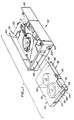
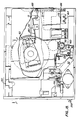
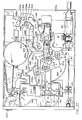
- a cartridge tape drive in accordance with a preferred embodiment of the present invention is indicated in Figure 1 at reference numeral 30.
- a tape cartridge for use with the drive 30 is indicated as reference numeral 32.
- the illustrated tape cartridge conforms with ANSI specification X3.55-1977, and is well known to those skilled in the art.
- the cartridge 32 is inserted into the cartridge tape drive 30 through a bezel door 65 ( Figures 1 and 2). While within the cartridge tape drive 30, the cartridge is supported by a stationary support tray 58. Upon insertion, the cartridge is gripped between the indexing block 112 and retractable indexing block 122 which engage indexing notches 44a and 44b, respectively ( Figures 6-10). Indexing block 112 and retractable indexing block 122 are attached to a sliding carriage 70. In this manner, the cartridge 32 moves on the support tray 58 when the sliding carriage 70 moves. A door opening mechanism opens an access door 52 of the cartridge 32 while the cartridge 32 is within the drive 30 ( Figures 11-14).
- a moving mechanism which is activated after the cartridge is within the drive, moves the sliding carriage 70, and hence the cartridge 32, within the drive 30 from a forward position ( Figure 6) to a rear position ( Figure 15).
- the path of the carriage 70 is first rearward toward the back of the drive 30 and then laterally toward a side of the drive 30.
- the path is defined by the interaction of posts 72 and 98 with slots 74 and 96, respectively ( Figures 2, 3, 7, and 16).
- the cartridge 32 is moved into a position in which a magnetic head 158 engages a portion of a magnetic tape 48 exposed by the open access door 52 ( Figures 15 and 16).
- the details of the cartridge 32 and the cartridge tape drive 10 are described below.
- the cartridge has a metal base plate 34, a top cover 36, two end walls 38, a rear side wall 40, and a front side wall 42.
- the end walls 38 are inset slightly from the end edge of the base plate 34 and the top cover 36.
- the front and rear ends of the baseplate 34 are each provided with an indexing notch 44a and 44b, respectively, which extends from the edge of the base plate 34 inward to the end wall 38.
- a pair of spools 46 are rotatably mounted within the cartridge 32.
- a magnetic tape 48 is wrapped around the spools 46 with a portion extending between the spools 46.
- the tape path between the spools 46 is defined by idler rollers (not shown) such that a portion of the tape between the spools 46 extends lengthwise within the cartridge 32 slightly behind the front side wall 42.
- a capstan roller 50 which is accessible through a cut away portion of the cartridge, drives a drive belt (not shown) which rotates the spools 46 to move the tape 48 from one spool to the other.
- the cartridge 32 has a cut away portion which receives an access door 52.
- the access door 52 pivots about hinge 54 to allow access to a portion of the magnetic tape 48.
- the cartridge 32 measures approximately six inches in length and four inches in width. With the access door 52 fully open, the cartridge 32 measures approximately five and three-quarter inches in width.
- the cartridge tape drive 30 has a housing 56 whose width, height, and length are such that housing will fit within the industry five and one-quarter inch form factor. In the illustrated embodiment, the housing will fit within the half height form factor.
- the housing of the illustrated embodiment includes a support tray 58, side walls 60, and a front wall 62.
- the term "housing” refers to the general support structure and frame of the cartridge tape drive 30 and not necessarily to any type of enclosure. Similarly, when a component is described as being "within the housing” it means that the item would fit within an imaginary box defined by the form factor.
- the housing 56 will typically be open and allow free access to the internal components of the drive 30. This is because the drive 30 is typically installed within a cavity in a cabinet of a larger computer system. In such an environment the cabinet will provide a protective enclosure. However, should an enclosure be required for a particular application of the tape drive it could be readily fabricated and integrated into the illustrated housing by one skilled in the art.
- the front wall 62 is provided with an opening 64 through which the cartridge 32 can be inserted endwise.
- the opening 64 is covered by a bezel door 66 to prevent dust and other contaminants from entering the drive.
- the bezel door 66 is suspended from a hinge 68 along the top of the opening 64.
- the hinge 68 is spring loaded so that the bezel door 66 is normally urged into the closed position. However, the spring force can easily be overcome and the bezel door 66 can be manually opened by inserting the cartridge 32 through the opening 64.
- a sliding carriage 70 is provided to move the cartridge 32 within the drive 30. As best seen in Figure 3, the sliding carriage 70 is suspended below the support tray 58. The sliding carriage 70 is maintained against the lower surface of the support tray 58 by means of posts 72 which are fixed to the lower surface of the support tray 58, and extend through slots 74 in the carriage. A washer 76 is held in place on the end of each post 72 by a split ring 78. In this manner the sliding carriage 70 is sandwiched between the support tray 58 and the washers 76. The distance between the support tray 58 and the washers 76 is slightly greater than the thickness of the sliding carriage 70. This allows the sliding carriage 70 to slide freely along a path determined by the shape of the slots 74.
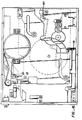
- Movement of the sliding carriage 70 is accomplished by means of a drive mechanism, the components of which are best seen in Figures 2 and 3.
- the drive mechanism includes a drive motor 80 and a worm gear 82 attached to the output shaft of the drive motor 80.
- the worm gear 82 drive drives a first reduction gear 84 which drives a second reduction gear 86 which drives a third reduction gear 88.
- the third reduction gear 88 drives the main drive gear 90 and an overtravel mechanism 100.
- the main drive gear 90 and the overtravel mechanism 100 are mounted in a recess 92 formed in the top surface of the support tray 58.
- the recess 92 is of a depth such that the top of the main drive gear 90 and the overtravel mechanism 100 are below the top surface of the support tray 58 and do not interfere with the insertion of the cartridge 32.
- the main drive gear 90 is provided with an aperture 94 and the support carriage 58 is provided with a slot 96 which corresponds to the path defined by slots 74 in the sliding carriage 70.
- a guide post 98 extends upward from the sliding carriage 70 through the slot 96 and the aperture 94 where it is received by the overtravel mechanism 100.
- the overtravel mechanism 100 allows for slight disparities in the movement of the sliding carriage 70 and the drive mechanism.
- the overtravel mechanism 100 includes two legs 102 and 104 which are pivotably mounted on the center axis of the main drive gear 90.
- the legs 102 and 104 are configured in a manner similar to the two parts of a pair of scissors.
- a spring 106 extends from the short end of leg 102 to the short end of leg 104 and urges both the short ends and the long ends of the legs together.
- a post 108 extends upward from the top of the main drive gear 90 and is received between the long ends of the legs 102 and 104.
- the post 108 serves two major functions. First, it maintains a slight amount of separation between the long ends of legs 102 and 104, thereby defining a radial slot within which the guide post 98 is received. Second, because the post 108 is fixed to the main drive gear 90, it causes the overtravel mechanism 102 to rotate as the main drive gear 90 rotates. In this manner, the legs 102 and 104 of the overtravel 100 move the guide post 98, and hence the sliding carriage 70, along the path defined by slot 96 as the main drive gear 90 rotates. The action of the posts 72 within the slots 74 helps to assure a smooth uniform movement and prevent binding as the sliding carriage 70 is moved by rotation of the main drive gear 90.
- the base plate 34 slides along the top surface of the support tray 58 until the end wall 38 of the cartridge 32 encounters an arm 110.
- the arm 110 is pivotably mounted on an indexing block 112 which is fixed to the sliding carriage 70. As the cartridge 32 is pushed further into the drive 30 it presses against the arm 110 causing it to pivot about axis 114 until the arm 110 is generally parallel to the cartridge end wall 38 as shown in Figure 6.
- the end of the arm 110 is provided with a roller 116 which allows the arm 110 to slide freely along the end wall 38 as the arm 110 pivots.
- the arm 110 is provided with a spring 118 which biases arm 110 into a position against a stop 120. In this manner, the arm 110 pushes against the end wall 38 to assist in ejecting the cartridge 32 during the eject procedure described below.
- indexing block 112 Upon further insertion of the cartridge 32, indexing block 112 is received in cartridge indexing notch 44a. With the indexing block 112 received in the indexing notch 44a and abutting the leading edge of the base plate 34, further insertion of the cartridge 32 requires movement of the sliding carriage 70. However, until the drive motor 80 is activated it serves as a brake and resists manual movement of the main drive gear 90.
- the carriage 70 can move slightly as a result of the overtravel mechanism 100.
- the sliding carriage 70 can be moved slightly by applying pressure to the cartridge 32. The movement is accomplished by overcoming the force of the overtravel spring 106 to spread the legs 102 and 104 of the overtravel mechanism 100. During the slight manual movement of the sliding carriage 70 allowed by the overtravel mechanism 100, three events occur.
- a retractable indexing block 122 moves from its retracted position ( Figures 2 and 8) to its engaged position is in the engaged position, the cartridge is gripped between the retractable indexing block and the indexing block. This allows the cartridge to be moved by moving the sliding carriage to which the retractable are attached.
- the retractable indexing block 122 is hingedly mounted to the upper surface of the sliding carriage 70.
- a spring 124 biases the retractable indexing block 122 upward.
- a stud 126 extends downward from the retractable indexing block 122 through aperture 128 in the sliding carriage 70. Extending from the wall 62 below the sliding carriage 70 is a block 130.
- Block 130 is positioned such that when the sliding carriage 70 is in the forward position, illustrated in Figures 2 and 8, the block 130 engages the stud 126 to overcome the force of the spring 124 and maintain the retractable indexing block 122 in its retracted position so as not to obstruct insertion of the cartridge 32.
- the stud 126 moves out of engagement with the block 130, thereby allowing the retractable indexing block 122 to move under the force of spring 124 to the engaged position as shown in Figures 6 and 9.
- the retractable indexing block 122 is received by indexing notch 44b.
- a switch mechanism 132 is mounted to the side wall 60. Extending upward from the stitch mechanism 132 is a spring loaded switch actuator 134. When the sliding carriage 70 is in the forward position it is directly above the switch actuator 134, as seen in Figure 3, and maintains the actuator 134 in a depressed position. However, as the sliding carriage 70 moves rearward, it moves away from the switch actuator 134 allowing the spring loaded switch actuator 134 to move to a raised position.
- a ramp 136 is provided to ensure a smooth transition as the switch actuator 134 moves between the depressed position and the raised position.
- the movement of the switch actuator 134 from the depressed position to the raised position activates the drive motor 80, which, as explained above, drives the main drive gear 90 to move the sliding carriage inward. Because the cartridge 32 is held firmly between the indexing block 112 and the retractable indexing block 122, the cartridge 32 is pulled inward with the sliding carriage 70 along a path defined by slots 74 and 96. Cutout areas 137 and 139 are provided in the support tray 58 to accommodate the indexing block, retractable indexing block, and the access door opening mechanism as the sliding carriage moves during the loading process.
- the access door opening mechanism includes a pivoting member 138 rotatably mounted on a shaft 140 which extends upward from the sliding carriage 70. Shaft 140 is positioned such that it is generally coaxial with the hinge 54 of the access door 52 when the cartridge 32 is gripped between the indexing block 112 and the retractable indexing block 122. A spring 146 biases the pivoting member 138 in the clockwise (as viewed from the top) direction.
- a receiving block 148 having an angled cam surface 150 extends rearward from the front wall 62 below the level of the sliding carriage 70.
- a stud 142 extends downward from the pivoting member 138 through an arcuate slot 144 provided in the sliding carriage 790 and, when in the forward position (illustrated in Figure 12), engages an edge of the receiving block 148.
- the stud 142 follows the angled cam surface 150, thereby allowing the pivoting member 138 to pivot under the force of spring 146.
- the pivoting member 138 is provided with a finger 152 which, as the pivoting member 138 pivots, engages the rear extension 154 of the access door 52 to push the access door open.
- the biasing force of spring 146 must be greater than that of the spring which maintains the access door 52 in the closed position.
- the degree to which the pivoting member 138 is allowed to pivot, and hence the degree to which the access door 52 is opened, is limited by the engagement of the stud 142 with the angled surface 150.
- the opening of the access door 52 is limited by the door contacting corner positioning block 156.
- the opening of the door by the pivoting member 138 is limited by the engagement of the stud 142 with the end of the arcuate slot 144 of the sliding carriage 70, as seen best in Figure 14. It should be appreciated that it is not necessary for the access door to be completely open. Rather, as shown in Figure 15, the access door 52 needs to open only far enough to allow the magnetic head 158 to access the magnetic tape 48.
- the main drive gear 90 automatically moves the sliding carriage 70, and hence the cartridge 32 which is gripped between the indexing block 112 and the retractable indexing block 122, inward along the path defined by slots 74 and 94. Initially this path is straight back toward the rear of the tape drive 30. However, as the posts 72 and the guide post 98 follow slots 74 and 94, the path of travel curves to move the sliding carriage 58 and the cartridge 32 laterally toward a side of the drive 30. In this manner, the portion of the magnetic tape 48 revealed by the open access door is brought into contact with the magnetic head 158 and the capstan roller 50 is brought into contact with the capstan drive 160. Additionally, the cartridge is correctly positioned with respect to the end-of-tape/beginning-of-tape sensor 162 and the file protect sensor 164.
- the final position of the cartridge 32 is defined by the corner positioning blocks 156 and 166 and the edge positioning block 168.
- Each of the corner positioning blocks 156 and 166 receives a corner of the base plate 34 and limits movement of the cartridge 32 in the direction of the head 158 or sideways with respect to the head 158.
- a switch actuator 178 (located directly below and hidden in the drawings by the file protect sensor 164) is positioned such that it is depressed by the base plate 34 when the base plate abuts the inner surface of corner positioning blocks 156 and 166. Depression of the switch actuator 178 stops the drive motor 80. However, the spring force of the overtravel mechanism 100 biases the cartridge against the inner surface of the corner positioning blocks to ensure accurate positioning of the cartridge.
- each corner block is provided with a ball bearing 170 situated within an aperture 172 in the support tray 58.
- the ball bearing 170 is seated on a leaf spring 174.
- the distance between the top of the ball bearing 170 and the inside top surface 176 of the corner positioning block is slightly less than the thickness of the base plate 34.
- the leaf spring 174 flexes and presses the base plate 34 firmly against top surface 176. In this manner two corners of the cartridge are firmly and precisely positioned in as predictable and repeatable manner.
- the edge positioning block 168 defines a third positioning point.
- a ball bearing 170a is situated within an aperture 172a and mounted on a leaf spring 174a.
- a slender rod 180 is positioned immediately above the leaf spring 174a.
- the slender rod is received by a pivotably mounted collar 182 and extends within a recess provided in the support tray from the ball bearing 170a to the main drive gear 90.
- a stud 184 is positioned on the main drive 90 such that as the cartridge reaches its final position the stud 184 engages one end of the slender rod 180.
- the two corner positioning blocks 156 and 166 and the edge positioning block 168 accurately define three precise points, and hence a plane, which determine an accurate and repeatable final position for the cartridge. Further, because the corner positioning blocks 155 and 166, the end positioning block 168, and the magnetic head 158 are all mounted on the stationary support tray 58, there is no relative movement therebetween and the accuracy of the position of the cartridge with respect to the head is greatly enhanced. This accurate relationship between the position of the head and the tape is necessary to ensure proper functioning of the drive during the transfer of information to or from the tape.
- the capstan drive 160, the end-of-tape/beginning-of-tape sensor 162, and the file protect sensor 164 are also fixed to the stationary support tray.
- the electrical connections to these elements can be less complex and more reliable than those necessary to connect to movable elements.
- this invention is directed mainly to the mechanical features of the drive 30.
- the capstan drive 160 there is no detailed description of the function and operation of the capstan drive 160, the end-of-tape/beginning-of-tape sensor 162, and the file protect sensor 164.
- the logic and control elements associated with the present drive there is no detailed description of the logic and control elements associated with the present drive.
- the magnetic head is mounted to the support tray in such a manner as to allow the head to be moved between various tracks on the tape, there is no detailed description of the mounting or track adjusting mechanism. This is because these elements are well known to those skilled in the art.
- the function and operation of these elements may vary widely depending on the desired function of any given drive embodying the present invention.
- the space below the sliding carriage 70 is designed to receive the necessary circuitry associated with these elements.
- the drive is provided with a mechanism which locks the bezel door 66 when the sliding carriage is in the rear position.
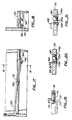
- the mechanism which is shown best in Figures 15-18, includes an elongate member 190 mounted on the support tray 58.
- the elongate member 190 is pivotable about pin 192.
- a leaf spring 194 is mounted to the bottom of the support tray 58 in engagement with a first end 196 of the elongate member 190. The leaf spring 194 biases the elongate member 190 into the plane of the support tray 58.
- a post 198 extends from the first end of the elongate member 190 in a direction parallel to and slightly separate from the lower surface of the support tray 58.
- the sliding carriage is provided with a beveled portion 200 positioned to engage the post 198 and urge the first end of the elongate member, against the force of the spring 194, away from the lower surface of the support tray. This causes the elongate member 190 to pivot about pin 192 such that the second end of the elongate member is raised from the upper surface of the support tray 58. In the raised position, the second end of the elongate member blocks the bezel door 66 to prevent a second cartridge from being inserted therethrough.
- the process of removing the cartridge from the drive is substantially the reverse of the insertion process.
- the operator presses a button 202 provided of the exterior of the front wall 62. Pressing the button 202 activates the drive motor 80 in the reverse direction.
- the drive motor 80 drives the main drive gear 90 in the reverse direction to reverse the travel path of the sliding carriage 58 and the cartridge 32.
- the travel path is substantially in a lateral direction away from the head 158.
- the bezel door 65 is unlocked in the reverse of the locking process described above.
- an arm 204 is pivotably mounted to pin 206 which extends from a block 208 ( Figure 3) attached to the underside of the support tray 58.
- a follower 210 is mounted to the arm 204 on one side of the pin 206.
- the arm extends past the lower portion of a side edge of the bezel door 66.
- a pin 212 extends from the arm 204 to engage the outside of the bezel door.
- the sliding carriage is provided with a double beveled surface 214 which is positioned to slide past the follower 210.
- the arm 204 pivots upward and inward and pin 212 opens the bezel door 66 ( Figure 5).
- the arm 204 returns to the original position.
- the cartridge 32 will be beneath the bezel door 66 so that the bezel door 66 swings down until it contacts the top cover 36 of the cartridge. The bezel door 66 swings completely closed when the cartridge is removed from the opening 64.
- the step of opening the bezel door is not necessary during the loading sequence because during loading insertion of the cartridge pushed the bezel door open. However, it should be noted that although the door is already open because the cartridge is inserted therethrough, the action of the arm is the same during insertion of the tape as during removal.
- FIG. 22-24 An alternative embodiment of the drive mechanism of the present invention is illustrated in Figures 22-24.
- a spur gear 222 is attached to the output shaft 224 of the drive motor 220.
- Spur gear 222 drives spur gear 226 at a two-to-one reduction in speed.
- Spur gear 226, spur gear 228, and worm gear 230 are all fixed to a common shaft 232.
- Worm gear 230 drives worm gear 234 which rotates about shaft 242 and has spur gear 236 affixed thereto.
- Spur gear 236 drives the main drive gear 90 which operates substantially as described above.
- a bracket 240 mounted to the lower surface of support tray 58 supports shaft 232 and the lower end of shaft 242.
- the upper end of shaft 242 is received in a recess provided in the lower surface of support tray 58.
- the support tray 58 is further provided with recesses configured to receive gear 236 and allow rotation of gears 222, 226, and 224.
- the drive mechanism illustrated in Figures 22-25 is also provided with a mechanism allowing for manual removal of the cartridge from the drive. This feature advantageously allows retrieval of the cartridge from the drive should the motorized drive mechanism be disabled by a power failure or the like.
- the manual removal mechanism includes a rotatable drive shaft 244 which extends rearward from the front wall 62 through an aperture in the bracket 240 and is generally coaxial with the output shaft 224.
- the front end of the drive shaft 244 is received within a button 246 which is received in an aperture 250 provided in the front wall 62.
- the button 246 is received within aperture 250 in a manner that allows for both rotational and longitudinal movement of the button within the aperture.
- An enlarged ring 258 is provided on the rear end of the button 246. The enlarged ring is larger than the aperture 250 and thereby prevents the button 246 from passing completely through the aperture 250.
- the button is further provided with a slot 260 ( Figure 25) which allows the button to be rotated by means of a screwdriver or the like.
- a spur gear 248 is affixed to the rear end of the drive shaft 244.
- Spur gear 248 is provided with a concentric cavity 262, illustrated in phantom.
- Spring 252 is mounted coaxially on the drive shaft. One end of spring 252 abuts against bracket 240 and the other against collar 254. The collar 254 is positioned on the drive shaft 244 by stop 256 such that the spring 252 is slightly compressed. In this manner, spring 252 biases the drive shaft 244 toward the front of the drive. Forward movement of the drive shaft 244 is limited by reason of the enlarged ring 258 abutting the front wall 62.
- a screwdriver or the like is inserted into slot 260. Axial pressure is applied to the screwdriver to overcome the force of spring 252 and move the drive shaft 244 longitudinally inward, to an engaged position as illustrated in Figure 24. In the engaged position, the end of the output shaft 224 is received in cavity 262 and spur gear 248 engages spur gear 228. While in the engaged position, the cartridge can be removed from the drive by twisting the screwdriver to turn the drive shaft 244 and spur gear 248.
- Spur gear 248 drives spur gear 228 which is fixed to the same shaft 232 as worm gear 230.
- Worm gear 230 drives spur gear 234 which is fixed to spur gear 236 which drives main drive gear 90 to move the sliding carriage 70 and eject cartridge 32.
- drive shaft 244 drives spur gear 228 with a two-to-one increase in speed.
- speedy and convenient withdrawal of the cartridge is facilitated because it is necessary to turn the drive shaft only one-fourth the number of turns that the motor must turn.
- the slot 260 may be configured with two diametrically opposed raised quarters 264 with opposing sides 266 of the quarters 264 having sloped walls. This well known configuration, illustrated in Figure 25, allows the screwdriver to engage the slot only when it is rotated the appropriate direction.
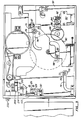
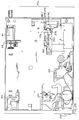
- a cartridge tape drive 30a in accordance with a second preferred embodiment of the present invention is shown in Figures 26-27.
- the cartridge tape drive mechanism 268 which moves the cartridge rearwardly, then laterally within the housing into operative engagement with a magnetic head 158, has a gripper mechanism 270 and a pre-loading mechanism 272 to grip and to draw the cartridge into the tape drive respectively, with a portion of the cartridge 32 still remaining outside the bezel door 66 of the tape drive 30a.
- a loading mechanism 273 then brings the tape of the cartridge into contact with the magnetic head attached to a stationary support.
- the solid lines e.g., the gripper mechanism 270, the half-width indexing block 112a, the slot 74, the cart gripper mounting slide 288) indicate the cartridge tape drive mechanism 268 is in a loading mode (i.e., the loading mechanism 273 has been activated after the gripper mechanism 270 and pre-loading mechanism 272 have completed their operation).
- the broken lines show the cartridge tape drive mechanism 218 in an initial position.
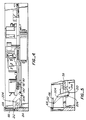
- the sliding carriage 70a is suspended below the support tray 58a.
- the sliding carriage 70a is maintained against the lower surface of the support tray 58a by means of posts 72 and 72a which are fixed to the lower surface of the support tray 58a, and extend through slots 74 and 74a ( Figure 28) in the carriage.
- a washer 76 is either held in place on the end of each post 72 and 72a by a split ring 78 or fused to the post. In this way, the sliding carriage 70a is sandwiched between the support tray 58a and the washer 76.
- the distance between the support tray 58a and the washer 76 is slightly greater than the thickness of the sliding carriage 70a. This allows the sliding carriage 70a to slide freely along a path determined by the shape of the slots 74 and 74a.
- the top surface of the end away from the bezel door 66 of the sliding carriage tape drive 70a has a half-width indexing block 112a.
- the base plate 34 Upon insertion of the cartridge 32 into the drive 30a, the base plate 34 is received and supported by the upper surface of the stationary tray 58a.
- a gripping mechanism 270 is provided to grip the cartridge 32 and a pre-loading mechanism 272 is then used to draw the cartridge into the tape drive 30a with a portion of the cartridge, e.g. 0.75 inches, still remaining outside the bezel door 66 of the tape drive.
- the gripping mechanism 270 is provided with a cart gripper tower 274 to which a pivot finger 276 is connected by means of the pivot finger pin 278.
- a retainer 280 is used at the end of the pivot finger pin 278 to hold it in place.
- the posterior end 282 of the sliding carriage 70a is modified to provide a sliding groove 284 upon which a rail 274a at the bottom of the cart gripping tower 274 slides as the pre-loading mechanism 272 is activated to draw the cartridge 32 inward.
- the lower end 290 of the pivot finger 276 is sandwiched between a cart gripper limit slide 286 and a cart gripper mounting slide 288. This provides a positive tension exerted by the pivot finger 276 on the cartridge 32 upon insertion of the cartridge as the lower end 290 of the pivot finger 276 is being pressed against the cart gripper limit slide 286.
- the cart-gripper limit slide 286 is maintained at the front end 296a against the lower surface of the sliding carriage 70a by means of a slide pin 292 which is fixed to the lower surface of the sliding carriage 70a and extended through a slot 294 in the cart-gripper limit slide 286.
- the cart-gripper limit slide 286 is maintained against the lower surface of the sliding carriage 70a by means of the slide guide 298 extended down from the cart gripper tower 274.
- the cart gripper mounting slide 288 is maintained at the front end 288a against the lower surface of the sliding carriage 70a by means of a slide pin 300 which is fixed to the lower surface of the sliding carriage 70a and extended through a slot 302 in the cart-gripper mounting slide 288.
- the cart-gripper mounting slide is maintained against the lower surface of the sliding carriage 70a by means of a screw 304.
- the screw 304 and an orientation pins 306 are also used to hold a L-shaped light blocker 308, which is part of the gripper tower.
- the drive mechanism 268 includes a drive motor 80 that drives a worm 82 (not shown) via two drive belts 83.
- the worm 82 then drives worm gear 84 having a lower gear 84a (not shown) which in turn drives the main drive gear 90 and a pre-loading carrier mechanism 272.
- the main drive gear 90 is mounted in a recess 92 formed in the bottom surface of the support tray 58a.
- the recess 92 is of a depth about the thickness of the main drive gear 90.
- the pre-loading carrier mechanism 272 includes a carrier load arm 310 in the shape of a distorted-L, with a very wide bottom 310a.
- the carrier load arm 310 is maintained against the lower surface of the sliding carriage 70a by means of a pre-loading arm actuator pin 312 and a pivot pin 314.
- a slot 316 is provided in the carrier load arm for the pre-loading arm activator pin 312 to slide during pre-loading.
- a carrier driver pin 318 connected to a carrier driver roller 320 ( Figure 28) through a slot 322 in the main drive gear 90 is used to provide movement of the sliding carriage 70a after the pre-loading has been completed.
- the narrower portion 310b of the carrier load arm 310 has three openings 324a, 324b, and 324c.
- a spring 326a is connected to the top opening 324a at one end and the other end to an opening 328 of the cart gripper mounting slide.
- Two other springs 326b and 326c are connected to the two openings 324b and 324c on the carrier load arm 310 at one end, and the other end to two openings 330a and 330b in a metal clip 330 mounted to the edge of the sliding carriage 70a.
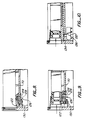
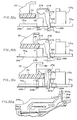
- the base plate 34 slides along the top surface of the support tray 58a until the end wall 38 of the cartridge 32 encounters the pivot finger 276 of the gripper mechanism 270 (See Figures 30a-d).
- the pivot finger 276 is pivotably mounted on the cart gripper tower 274 by means of the pivot finger pin 278.
- the distance d between the cart gripper mounting slide 288 and the cart gripper limit slide 286 widens thereby reducing the tension exerted by the cart gripper mounting slide 288 on the lower end 290 of the pivot finger 276.
- the arrow pointing to the right indicates the direction of the cart gripper limit and mounting slides' movement, while the arrow pointing to the left indicates the direction of the spring force.
- the vertical section 308a of the L-shaped light blocker 308 during standby is normally positioned in the light path of a photo-cell connected to a circuit board (not shown here).
- the L-shaped light blocker 308 is being moved out of its light-blocking position. This generally occurs when a portion of the cartridge 32, e.g. about 0.75 inches, still remains outside the bezel door of the tape drive.
- the photo cell is being activated which in turns triggers the firmware logic of the tape drive 32. This initiates the pre-loading mechanism.
- the pre-loading occurs by first activating the drive motor 80, which, as explained above, drives the main drive gear 90 to move the carrier load arm 310 rearward along the slot 316.
- the sliding carriage 70a remains stationary.
- the movement of the carrier load arm 310 from the forward to the rearward position in turn moves the cart gripper limit slide 286 rearward along slot 294 of the cart gripper limit slide 286.
- the cart gripper limit slide 286 moves rearward, it pushes the cart gripper mounting slide 288 towards the half-width indexing block 112a.
- This pushing of the cart gripper mounting slide 288 rearwardly is accomplished as the cart gripper limit slide 288b pushes on the lower end 290 of the pivot finger 276.
- the pivot finger normally would be pivoted forward. However, since the metal base plate 34 of the cartridge 32 is already engaged by the pivot finger 276 during gripping, the pivot finger 276 cannot pivot forward any further.
- the loading mechanism and sequence initiates and a number of events occur.
- a retractable indexing block 122 moves from its retracted position to its engaged position. This is similar to the situation in the first embodiment of the invention, with the exception that the cartridge 32, is gripped between the retractable indexing block 122, and the half-width indexing block and the cart gripper tower 274 with the pivot finger 276. As discussed earlier, this allows the cartridge 32 to be moved rearwardly and then laterally by moving the sliding carriage 70a to which the retractable are attached.
- the characteristic and operation of the retractable indexing block 122 have already been discussed earlier in the specification at page 16, lines 8-27.
- the drive motor 80 is being activated. Either firmware stored in the tape drive circuitry or a switch mechanism similar to the first embodiment of the invention discussed in the specification at page 16, line 31 to page 17, line 8, is used to trigger the drive motor 80. As discussed earlier, as the drive motor activates, it in turn drives the main drive gear 90 to move the sliding carriage 70a inward. Because the cartridge 32 is held firmly between the half-width indexing block 112a and the gripper mechanism 270, and the retractable indexing block 122, the cartridge 32 is pulled inward with the sliding carriage 70a along a path defined by slots 74a. Cutout areas are provided in the support tray 58a to accommodate the half-width indexing block 112a and the gripper mechanism 270, retractable indexing block 122, and the access door opening mechanism as the sliding carriage 70a moves during the loading process.
- a complicated "scissor" mechanism is used in the drive to move the sliding carriage 70 and hence the cartridge 72 rearwardly and then laterally.
- the sliding carriage 70a is moved rearwardly, then laterally by the action of the drive motor 80 acting on the main drive gear 90.
- the carrier load arm 310 swings from its initial position to a driving position by means of the carrier driver roller 320 in slot 322 of the main drive gear.
- the springs 326a, 326b, and 326c are being extended.
- the final position of the cartridge 32 is defined by the corner positioning blocks 156 and 166 and the edge positioning block 168.
- Other features and operation characteristics of the tape drive including ball bearings, edge positioning block, corner positioning blocks, capstan drive, the end-of-tape/beginning-of tape sensor, the file protect sensor, door locking mechanism, and the mechanism allowing for manual removal of the cartridge from the drive, have all been described in great detail earlier in this specification.
- the process of removing the cartridge from the drive is substantially the reverse of the insertion process.
- the operator presses a button 202 provided of the exterior of the front wall 62. Pressing the button 202 activates the loading mechanism 273, the pre-loading mechanism 272 and the gripper mechanism 270 in the reverse direction. Since after loading, in the second embodiment of the invention, the springs 326a, 326b and 326c are in an extended state, the tension of the spring 326a will move the cartridge 32 back out the bezel door 66 until the cartridge comes to rest at about 0.75 inches beyond the bezel door.
- An additional feature of the automatic loading tape drive is that the cartridge can be loaded or unloaded remotely by firmware, such as a SCSI command stored in the firmware without operator intervention.
- the SCSI command feature permits system control over the cartridge tape drive mechanism 268 such that the first time a cartridge is loaded, the gripper mechanism 270 moves the cartridge 32 to either the loaded position or an intermediate position. At the intermediate or loaded position, the bezel door 66 remains locked in the closed position thereby denying unauthorized access to the tape cartridge or inadvertently attempting to insert a second cartridge into the tape drive by the operator.
- a host generates, for example, under control of the SYTOS program, a signal that instruct the drive's firmware to interrupt the unload operation at the intermediate position in response to the stop signal.
- a cartridge thus can be remotely loaded and unloaded in a cyclic fashion controlled by the sequence of the SCSI commands so that operator intervention is not required to append data to tape.
- a signal is generated by the removal of the tape from the head that triggers a counter.
- This counter can either be implemented in firmware, hardware or software and generates a "termination signal" after a preselected number has been reached.
Landscapes
- Automatic Tape Cassette Changers (AREA)
Applications Claiming Priority (2)
| Application Number | Priority Date | Filing Date | Title |
|---|---|---|---|
| US85847992A | 1992-03-27 | 1992-03-27 | |
| US858479 | 1992-03-27 |
Publications (2)
| Publication Number | Publication Date |
|---|---|
| EP0562390A2 true EP0562390A2 (de) | 1993-09-29 |
| EP0562390A3 EP0562390A3 (en) | 1994-11-17 |
Family
ID=25328408
Family Applications (1)
| Application Number | Title | Priority Date | Filing Date |
|---|---|---|---|
| EP19930104045 Withdrawn EP0562390A3 (en) | 1992-03-27 | 1993-03-12 | Magnetic tape cartridge drive with automatic pre-loading |
Country Status (2)
| Country | Link |
|---|---|
| EP (1) | EP0562390A3 (de) |
| JP (1) | JPH06176462A (de) |
Cited By (9)
| Publication number | Priority date | Publication date | Assignee | Title |
|---|---|---|---|---|
| WO1996030910A1 (de) * | 1995-03-31 | 1996-10-03 | Nsm Aktiengesellschaft | Wiedergabe-/aufzeichnungs- und/oder ausgabegerät für informationsträger |
| EP0823830A1 (de) * | 1996-08-06 | 1998-02-11 | Samsung Electronics Co., Ltd. | Mikrowellenofen mit verbesserter Tür |
| EP0866459A3 (de) * | 1994-05-16 | 1999-02-03 | Imation Corp. | Antrieb für Informationsspeichermedienkassetten verschiedener Abmessungen und Kassetten dafür |
| EP0884725A3 (de) * | 1997-06-10 | 1999-02-03 | Alps Electric Co., Ltd. | Magnetaufzeichnungs-/Wiedergabegerät |
| WO2000016324A1 (en) * | 1998-09-10 | 2000-03-23 | Onstream, Inc. | Apparatus for writing and/or reading information |
| US6081405A (en) * | 1997-07-17 | 2000-06-27 | Alps Electric Co., Ltd. | Magnetic recording and reproducing device having a driving roller rotated by a motor of low torque which is press contracted with a transfer roller of a cartridge and transfers a magnetic tape |
| EP0938093A3 (de) * | 1998-02-24 | 2001-06-13 | Aiwa Co., Ltd. | Verschiebbare Bandantriebsanordnung |
| US6270030B1 (en) | 1999-09-28 | 2001-08-07 | Imation Corp. | System for controlling compatibility of tape cartridges having the same form factor |
| CN115771664A (zh) * | 2022-12-24 | 2023-03-10 | 安徽新隆泰包装股份有限公司 | 一种包装箱 |
Family Cites Families (7)
| Publication number | Priority date | Publication date | Assignee | Title |
|---|---|---|---|---|
| EP0125765A3 (de) * | 1983-05-13 | 1985-08-28 | Cipher Data Products, Inc. | Kassetten-Ausrichtmechanismus für Bandantrieb |
| US4673995A (en) * | 1984-07-06 | 1987-06-16 | Kennedy Company | Cartridge tape drive with friction roller to open cartridge door |
| NO853559L (no) * | 1984-09-17 | 1986-03-18 | Archive Corp | Drivverk for b¨ndkassett. |
| EP0241238A3 (de) * | 1986-04-07 | 1990-06-20 | Archive Corporation | Kassettenladegerät |
| US5109308A (en) * | 1989-04-25 | 1992-04-28 | Archive Corporation | Stationary head tape drive with a movable door opening mechanism |
| US5025334A (en) * | 1989-09-12 | 1991-06-18 | Cipher Data Products, Inc. | Auto-loading transport for tape cartridge with tape access door and belt capstan roller |
| DE4025155A1 (de) * | 1989-11-09 | 1991-05-16 | Wangtek | Bandkassetten-antrieb |
-
1993
- 1993-03-12 EP EP19930104045 patent/EP0562390A3/en not_active Withdrawn
- 1993-03-29 JP JP5093673A patent/JPH06176462A/ja active Pending
Cited By (13)
| Publication number | Priority date | Publication date | Assignee | Title |
|---|---|---|---|---|
| US6079653A (en) * | 1994-05-16 | 2000-06-27 | Imation Corp. | Drive for handling multiple size information storage media cartridges and cartridges therefor |
| EP0866459A3 (de) * | 1994-05-16 | 1999-02-03 | Imation Corp. | Antrieb für Informationsspeichermedienkassetten verschiedener Abmessungen und Kassetten dafür |
| US6220539B1 (en) | 1994-05-16 | 2001-04-24 | Imation Corp. | Drive for handling multiple size information storage media cartridges and cartridges therefor |
| WO1996030910A1 (de) * | 1995-03-31 | 1996-10-03 | Nsm Aktiengesellschaft | Wiedergabe-/aufzeichnungs- und/oder ausgabegerät für informationsträger |
| EP0823830A1 (de) * | 1996-08-06 | 1998-02-11 | Samsung Electronics Co., Ltd. | Mikrowellenofen mit verbesserter Tür |
| CN1105267C (zh) * | 1996-08-06 | 2003-04-09 | 三星电子株式会社 | 带改进炉门的微波炉 |
| EP0884725A3 (de) * | 1997-06-10 | 1999-02-03 | Alps Electric Co., Ltd. | Magnetaufzeichnungs-/Wiedergabegerät |
| US6081405A (en) * | 1997-07-17 | 2000-06-27 | Alps Electric Co., Ltd. | Magnetic recording and reproducing device having a driving roller rotated by a motor of low torque which is press contracted with a transfer roller of a cartridge and transfers a magnetic tape |
| EP0938093A3 (de) * | 1998-02-24 | 2001-06-13 | Aiwa Co., Ltd. | Verschiebbare Bandantriebsanordnung |
| WO2000016324A1 (en) * | 1998-09-10 | 2000-03-23 | Onstream, Inc. | Apparatus for writing and/or reading information |
| US6270030B1 (en) | 1999-09-28 | 2001-08-07 | Imation Corp. | System for controlling compatibility of tape cartridges having the same form factor |
| CN115771664A (zh) * | 2022-12-24 | 2023-03-10 | 安徽新隆泰包装股份有限公司 | 一种包装箱 |
| CN115771664B (zh) * | 2022-12-24 | 2024-05-24 | 安徽新隆泰包装股份有限公司 | 一种包装箱 |
Also Published As
| Publication number | Publication date |
|---|---|
| EP0562390A3 (en) | 1994-11-17 |
| JPH06176462A (ja) | 1994-06-24 |
Similar Documents
| Publication | Publication Date | Title |
|---|---|---|
| US5204792A (en) | Cartridge tape drive | |
| US5025334A (en) | Auto-loading transport for tape cartridge with tape access door and belt capstan roller | |
| US3766327A (en) | Tape cassette holding and positioning unit | |
| EP0394581B1 (de) | Festkopf-Bandantrieb | |
| US7269834B2 (en) | Disc type recording and/or reproducing apparatus | |
| US5652683A (en) | Magnetic tape cartridge drive with automatic loading | |
| US4586095A (en) | Fail-safe locking mechanism for tape cartridge drive with movable read/write head | |
| US5237469A (en) | Stationary head cartridge tape drive with moveable x-y table and method | |
| US5371639A (en) | Magnetic tape cartridge drive with automatic loading | |
| EP0855705B1 (de) | Lademechanismus für Speichermedien sowie Aufnahme- und/oder Wiedergabegerät mit einem solchen Mechanismus | |
| JPH06176462A (ja) | 自動予備装填機構を持つ磁気テープ・カートリッジの駆動装置 | |
| JPS61292261A (ja) | カ−トリツジ取扱装置 | |
| EP0241238A2 (de) | Kassettenladegerät | |
| US5345349A (en) | Magazine latching and ejection mechanism for a cassette autoloader | |
| EP0488760B1 (de) | Kassettenbandantriebsvorrichtung | |
| JPS61287068A (ja) | デイスク駆動装置 | |
| US5053903A (en) | Disk clamp positioning apparatus for information storage disk drive system | |
| US4344097A (en) | Lock mechanism for use in tape player | |
| US5543993A (en) | Door opening mechanism for magnetic tape cartridge with tension control | |
| US20070277188A1 (en) | Insertion-proof device for optical disk drive | |
| US6707638B2 (en) | Slider impedance mechanism to prevent cartridge ejection during operation | |
| US6229440B1 (en) | Cartridge drive door system | |
| JP2001216704A (ja) | 薄型フロッピーディスクドライブ | |
| JP3109371B2 (ja) | ディスク装置 | |
| US5493461A (en) | Storage media lockout device for a computer mass storage media drive |
Legal Events
| Date | Code | Title | Description |
|---|---|---|---|
| PUAI | Public reference made under article 153(3) epc to a published international application that has entered the european phase |
Free format text: ORIGINAL CODE: 0009012 |
|
| AK | Designated contracting states |
Kind code of ref document: A2 Designated state(s): BE DE ES FR GB IT LU |
|
| PUAL | Search report despatched |
Free format text: ORIGINAL CODE: 0009013 |
|
| AK | Designated contracting states |
Kind code of ref document: A3 Designated state(s): BE DE ES FR GB IT LU |
|
| 18W | Application withdrawn |
Withdrawal date: 19950629 |