EP0562813B1 - System und Verfahren zur Umwandlung von Halbtonbildern in Bilder mit kontinuierlichen Tönen - Google Patents
System und Verfahren zur Umwandlung von Halbtonbildern in Bilder mit kontinuierlichen Tönen Download PDFInfo
- Publication number
- EP0562813B1 EP0562813B1 EP93302186A EP93302186A EP0562813B1 EP 0562813 B1 EP0562813 B1 EP 0562813B1 EP 93302186 A EP93302186 A EP 93302186A EP 93302186 A EP93302186 A EP 93302186A EP 0562813 B1 EP0562813 B1 EP 0562813B1
- Authority
- EP
- European Patent Office
- Prior art keywords
- image
- sigma
- filter
- halftone
- images
- Prior art date
- Legal status (The legal status is an assumption and is not a legal conclusion. Google has not performed a legal analysis and makes no representation as to the accuracy of the status listed.)
- Expired - Lifetime
Links
- 238000000034 method Methods 0.000 title claims description 62
- 238000001914 filtration Methods 0.000 claims description 26
- 238000012545 processing Methods 0.000 claims description 26
- 238000012935 Averaging Methods 0.000 claims description 13
- 230000003247 decreasing effect Effects 0.000 claims description 6
- 238000012360 testing method Methods 0.000 description 10
- 238000006243 chemical reaction Methods 0.000 description 9
- 238000009792 diffusion process Methods 0.000 description 7
- 241000519995 Stachys sylvatica Species 0.000 description 4
- 230000003044 adaptive effect Effects 0.000 description 4
- 238000009499 grossing Methods 0.000 description 4
- 240000005002 Erythronium dens canis Species 0.000 description 3
- 206010027146 Melanoderma Diseases 0.000 description 3
- 230000000694 effects Effects 0.000 description 3
- 239000011159 matrix material Substances 0.000 description 3
- 238000002474 experimental method Methods 0.000 description 2
- 238000004321 preservation Methods 0.000 description 2
- 238000013459 approach Methods 0.000 description 1
- 238000002955 isolation Methods 0.000 description 1
- 238000004519 manufacturing process Methods 0.000 description 1
- 230000008447 perception Effects 0.000 description 1
Images


Classifications
-
- H—ELECTRICITY
- H04—ELECTRIC COMMUNICATION TECHNIQUE
- H04N—PICTORIAL COMMUNICATION, e.g. TELEVISION
- H04N1/00—Scanning, transmission or reproduction of documents or the like, e.g. facsimile transmission; Details thereof
- H04N1/40—Picture signal circuits
- H04N1/40075—Descreening, i.e. converting a halftone signal into a corresponding continuous-tone signal; Rescreening, i.e. combined descreening and halftoning
Definitions
- the present invention relates to image processing systems and methods having a capability for processing halftone images to retrieve continuous tone images and more particularly to systems and methods for converting halftone images without screen structure and other halftone images to continuous tone images.
- Continuous tone images are converted to halftone or binary images to enable the production of printed copies.
- the image In binary form, the image has pixels which are either black or white and which are printed by applying ink or not applying ink.
- the halftone image is first reconverted to a continuous tone image to enable processing and thereafter reconverted to a halftone image for printing.
- Image processing systems used with printers in reprographic systems typically require a capability for converting halftone images to continuous tone images to meet reconversion needs and for converting scanned halftone images to continuous tone images that can then be processed by any of a large variety of enhance-ment algorithms commonly available for continuous tone images.
- the halftoning process loses some image information in the conversion of the original continuous tone image to a halftone image.
- the reconversion of a halftone image to a continuous tone image accordingly is essentially an estimation process since the halftoning process cannot be reversed exactly to reproduce a continuous tone image identical to the original image.
- ordered dithering is a process in which a scanned continuous signal from a continuous tone image is converted to a series of black (1 or ink) or white (0 or no ink) pixels with the pixel values determined by the pattern of a threshold or dither matrix to which the scanned signal is applied.
- error diffusion Another process used to convert continuous tone images to halftone images is called error diffusion.
- No special thresholding matrix is used in the error diffusion process. Instead, a single threshold is applied to the whole image.
- image pixels are processed sequentially, i.e., the first pixel is made either 1 or 0 according to whether its gray level is above or below a predetermined threshold value such as 0.5.
- the first pixel error is then carried forward and added to the gray value of the unprocessed surrounding pixels in determining whether these pixels are above or below the threshold value.
- the resultant errors are then carried forward, and the process is continued until the image is completely processed.
- Error diffused images normally can only be printed by very high resolution printers.
- the classic prior art method for converting halftone images to continuous tone images i.e., for "unscreening" continuous tone images from halftone images, applies a low-pass filter to the halftone image data.
- the low-pass filter method by its nature typically blurs image edges or at least loses fidelity of edge information (fine detail) as a result of the filter conversion process.
- US-A-4,630,125 to Roetling discloses a method of reconstructing a continuous tone image for grayscale values that have been converted to a halftone image of black and white spots.
- the reconstruction method involves isolation of each spot of a halftone image along with a neighborhood of surrounding spots, and, for each neighborhood, comparing a maximum screen pattern value producing a white spot with a minimum screen value producing a black spot.
- the grayscale pixel value of the isolated spot is the average of the maximum and minimum screen values just described. If the minimum screen value giving a black spot is less than the maximum screen value giving a white spot, then the process is repeated after deleting that portion of the neighborhood of surrounding spots containing the maximum or minimum screen value furtherest from the isolated spot.
- Use of the Roetling scheme is limited to orthographic or digitally created and stored dithered images since it is based on the regularity of dots in a half-tone image created with a dither.
- US-A-4,841,377 issued to Hiratsuka et al, discloses a method for estimating an original continuous tone image from a stored binary image.
- the method involves, inter alia, setting a plurality of scanning apertures in a binary image formed of a dither matrix, selecting one scanning aperture satisfying a predetermined condition for each picture element of a continuous image to be estimated, and estimating the continuous image on the basis of the number of white or black picture elements in the scanning aperture selected.
- the Hiratsuka method is similarly limited to dithered halftone images.
- the prior art In summary of the prior art, it has generally had shortcomings in preserving edge smoothing and avoiding edge blurring in the "unscreening" of continuous tone images from halftone images. Further, the prior art generally has had no effective capability for converting halftone images created by error diffusion to continuous tone images.
- An object of the present invention is to provide an improved image processing system and method in which filtering is employed to convert screen structured or unstructured halftone images to continuous tone images with better edge preservation.
- An image processing system 10 shown in FIGURE 1 includes a conventional printer 12 that is operated in accordance with the invention by printer controls 14 under the control of a system computer 16.
- Input halftone images are obtained from a scanner 18 or from a first memory 20.
- Another memory 22 is used to store converted images for output.
- input black and white images are first converted or "unscreened” to continuous tone images, and thereafter reconverted to halftone images for print processing.
- unprocessed halftone images can be stored in another memory (not shown) for subsequent conversion and processing in accordance with the present invention.
- the scanned or stored input images may be error-diffused or other images with no screen structure or they may be dithered images with a screen structure.
- the present invention is most effective in processing error-diffused images.
- the image processing system 10 incorporates a Sigma filter algorithm to provide improved image conversion with improved edge-preserving smoothing.
- Image conversion is preferably implemented with an iterative Sigma filter procedure, with different filter parameters employed with each iteration. Since the algorithm requires no information about screen properties of an image being converted, it is especially suitable for use with halftone images with no screen structure, i.e., error-diffused halftone images or halftone images scanned in low resolution.
- halftones are defined to have pixel values of 0 and 1
- grey images are defined to have pixel values in the range of 0 to 1.
- the Sigma filter smooths the noise by averaging those neighborhood pixels that have intensities within the ⁇ range.
- the Sigma filtering can be described more specifically as the following procedures:
- ⁇ can be chosen as 1/4, if a 2x2 window was used in the first step, so that any edges with contrast greater than one quantized grey level in the initial result will not be smoothed out in the second step.
- ⁇ is progressively decreased, and the window size is gradually increased.
- the overall effect of the above filtering is the concatenation of a series of averaging filters.
- the high intensity and low intensity regions have sparser data and thus require more smoothing. This can be accomplished by increasing window size or doing one more iteration in these regions.
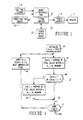
- FIGURES 2-4 program procedures are illustrated for the preferred embodiment as applied to error diffused images.
- a flow chart 30 in FIGURE 2 provides an overview of a Sigma filtering process for converting halftone images to continuous tone images with improved edge preserving smoothing in accordance with the present invention.
- pixel data is obtained for a halftone image to be converted to a continuous tone image.
- a test block 35 checks the iteration number in an iterative procedure to be followed. In the first iteration of an error diffusion image, an adaptive averaging procedure is executed on the image by a block 37. Otherwise, the program flow goes to a block 36.
- a Sigma filtering operation is performed for the pixel currently being processed in the current iteration.
- a test block 38 determines whether the current iteration is the last iteration, i.e., whether it is equal to a preset value for the number of iterations to be executed.
- a block 40 advances an iteration counter to the next value, and the block 36 is reexecuted using pixel data produced by the preceding iteration.
- the output image is generated by an output block 42 for storage or print processing.
- the present invention is especially useful in processing OR "unscreening" images having no screen structure, such as error diffused images.
- an adaptive averaging is preferably used for the first iteration as just described.
- a large window of size NI X NI is used in very dark or very bright regions of an image being processed. In other regions, a smaller window of size Ns X Ns is used.
- a preset threshold T in the range 0 to 0.5 defines "very bright" and "very dark" regions. Typically, the value of T can be set equal to 1/8. A region with an average pixel value no greater than T is considered to be very dark. A region having an average pixel value less than (1 - T) is considered to be very bright.
- the image is processed in a block 44 with large overlapping windows, having a size (I 1 x I 2 ) and centered at a pixel (m, n), to calculate the average pixel value for each window.
- a test block 46 determines whether the average pixel value for the currently processed window corresponds to a very bright or very dark region. If it does, a return indicated by a reference character 50 is followed to a test block 47 where a check is made to determine whether more pixels need to be processed. If so, a return is made to process the next pixel in the image.
- a block 48 processes the image with smaller overlapping windows having a size (s 1 x s 2 ) and centered at pixel (m, n) to calculate the average pixel value for each window. Thereafter, the program flow follows the path 50 to the test block for further image processing as already described. When all of the pixels in the image have been processed, the procedure 37 is ended and the Sigma filter processing proceeds as described for FIGURE 2.
- a block 59 first initializes pixel counter (m,n) values at (0,0) and a block 60 initializes to 0 a value counter SUM 0 for pixel values within the Sigma difference range, a value counter SUM 1 for pixel values outside the Sigma difference range, and a processed pixel counter COUNT for number of pixels within the Sigma range.
- the image is processed with the use of overlapping windows having a size, Ni X Ni, and the windows are processed sequentially by the procedure 36.
- Each window is structured so that the pixel being processed (m,n) is centered in the window.
- the window is appropriately located relative to the pixel to be processed.
- the pixel being processed can be located in the upper left hand corner of the window.
- the windows are rectangular or square in shape, and the overlapping arrangement is such that as the procedure sequentially calculates values for successive pixels in each pixel row, the window that is used is correspondingly sequenced along the row pixel by pixel.
- a pixel in the window being processed is selected for valuation.
- a test block 64 determines whether the selected pixel is within or outside the Sigma difference range. If it is within the range, the SUM 0 counter is advanced by the binary value of the pixel as indicated by reference character 66 and the COUNT counter is advanced by 1. If it is outside the Sigma difference range, the SUM 1 counter is advanced by the value of the pixel as indicated by reference character 68.
- a test block 70 determines whether more pixels need to be processed for the current window. If so, a return is made to the block 62 and the process just described is repeated for the next pixel. The process continues to be repeated until the block 70 indicates that all of the pixels in the current window have been processed.
- the Sigma difference range is a grey range within which pixel values are counted in an averaging process that preserves edges and avoids the edge smearing commonly found in the prior art. If the window being processed is in a smooth image region, all pixels within the window will be in range and the effect for that window will be the same as simple averaging. However, if an edge exists within the window, the valuation count includes values of only those pixels on the side of the edge on which the pixel being processed is located. As a result, there is no blurring of edges.
- the effect of the iterative Sigma filtering procedure described herein for the preferred embodiment is to build up the grey tones with successive iterations wherein successive iterations preferably have gradually increasing window sizes and gradually decreasing ⁇ values.
- successive iterations preferably have gradually increasing window sizes and gradually decreasing ⁇ values.
- the process takes considerably more time. Therefore, in later iterations, larger windows are preferred to speed up the process consistently with avoidance of edge blurring.
- the ⁇ value in the first iteration preferably is large enough to enable effective averaging to occur.
- the ⁇ value preferably is smaller to avoid edge blurring. As previously indicated, a total of three or four iterations is usually sufficient to good unscreening results.
- a block 74 sets the average pixel value for the current window equal to SUM 0/COUNT. If COUNT is less than Ki, the average pixel value is made equal to the sum (SUM 0 + SUM 1) divided by the total number of pixels in the window.
- a test block 75 checks for more pixels. If the image is completed, a return is made to the block 38 (FIGURE 2). Otherwise, the pixel counter values are advanced by a block 77 and the next pixel is processed in the manner just described.
- Image 1 is a halftone image generated by error diffusion.
- Image 3 is a scanned halftone with a scanning resolution of 200 spi (spots per inch) (8 spots per mm).
- Images 2 and 4 show the unscreening results.
- Four iterations were used for both experiments with the parameter set listed in Table 1, with the exception that a varying window size scheme was adopted for image 1 in its initial step.
- a 4x4 window was chosen for the regions with grey ⁇ 1/8 or > 7/8.
Landscapes
- Engineering & Computer Science (AREA)
- Multimedia (AREA)
- Signal Processing (AREA)
- Image Processing (AREA)
- Facsimile Image Signal Circuits (AREA)
Claims (8)
- Bildverarbeitungssystem (10) zum Wandeln von Halbton-Bildern in Bilder mit kontinuierlicher Tönung, welches System umfaßt:dadurch gekennzeichnet, daß das Mittel zum Filtern des Halbton-Bildes jedes Bildpixel Sigma-filtert mit einem vorgegebenen Satz von Filter-Parametern, der die Filterfenstergrößen und einen Sigma-Differenzbereich enthält, welcher angewendet wird, um zu bestimmen, welche Pixel in dem Filterfenster bei der Bestimmung von Fenster-Durchschnittspixelwerten gezählt werden, und daß Mittel (37) vorgesehen sind zum iterativen Anlegen des von der Sigma-Filterung ausgegebenen Bildes für eine vorgegebene Anzahl von Iterationen an den Eingang derselben, wobei das erzeugte kontinuierlich getönte Ausgabebild das Sigma-gefilterte Bild von der letzten Iteration ist.Mittel (30) zum fortlaufenden Erzeugen von Wertedaten für aufeinanderfolgende Pixel eines Halbton-Bildes;Mittel (36) zum Filtern des Halbton-Bildes; undMittel (16) zum Erzeugen eines Ausgabebildes mit kontinuierlicher Tönung zum Speichern oder Verarbeiten zu einer Halbton-Kopie oder einem Halbton-Druck;
- Bildverarbeitungs-System nach Anspruch 1, bei der die Fenstergröße in mindestens einigen der aufeinanderfolgenden Sigma-Filteriterationen erhöht wird und der Sigma-Differenzbereich in mindestens einigen der aufeinanderfolgenden Sigma-Filter-Iterationen vermindert wird.
- Bildverarbeitungs-System nach Anspruch 1 oder 2, bei dem in jeder aufeinanderfolgenden Sigma-Filteriteration die Fenstergröße erhöht und der Sigma-Differenzbereich vermindert wird.
- Bildverarbeitungs-System nach jedem der vorangehenden Ansprüche, bei dem ein Parameter Ki einen vorgewählten Wert gleich einem Schwellwert gezählter Pixel in dem Filterfenster aufweist, und bei dem alle gezählten Pixel beim Bestimmen des Fenster-Durchschnittspixelwertes benutzt werden, wenn die Pixelzählung kleiner als Ki ist, und nur Pixel innerhalb des Sigma-Differenzbereiches beim Bestimmen des Fenster-Durchschnittspixelwertes benutzt werden, falls die Pixelzählung gleich oder großer als Ki ist.
- Bildverarbeitungs-System nach einem der vorangehenden Ansprüche, bei dem das Halbton-Bild ein fehlerdiffundiertes Bild ist und bei dem Mittel zum Verarbeiten des fehlerdiffundierten Halbton-Bildes mit einem Durchschnitts-Filter in einer ersten Iteration vorgesehen sind, wobei die Ausgabe von dem Durchschnitts-Filter mit einer variablen Fenstergröße an den Eingang des Sigma-Filtermittels angelegt wird zur iterativen Sigma-Filterung in darauffolgenden Iterationen, bis die vorgegebene Anzahl von Iterationen ausgeführt wurde.
- Verfahren zum Wandeln von Halbton-Bildern in kontinuierlich getönte Bilder, welches Verfahren die Schritte umfaßt:dadurch gekennzeichnet, daß der Filterungsschritt die Sigma-Filterung jedes Bildpixels mit einem vorgegebenen Satz von Filter-Parametern umfaßt, der die Filter-Fenstergröße und einen Sigma-Differenzbereich einschließt, der angewendet wird, um zu bestimmen, welche Pixel in dem Filterfenster bei dem Bestimmen von Fenster-Durchschnittspixelwerten gezählt werden, und daß das Verfahren den weiteren Schritt des iterativen Anwendens des Ausgabebildes von der Sigma-Filterung an den Eingang derselben für eine vorgegebene Anzahl von Iterationen umfaßt, wobei das erzeugte Ausgabebild kontinuierlicher Tönung das Sigma-gefilterte Bild von der letzten Iteration ist.des fortlaufenden Erzeugens von Wertedaten für aufeinanderfolgende Pixel eines Halbton-Bildes;des Filterns des Halbton-Bildes; unddes Erzeugens eines kontinuierlich getönten Ausgabebildes zum Speichern oder zur Verarbeitung zu einer Halbton-Kopie oder einem -Druck;
- Verfahren nach Anspruch 6, das die Schritte enthält:(1) des Erhöhens der Fenstergröße; und(2) des Verminderns des Sigma-Differenzbereiches in mindestens einigen der aufeinanderfolgenden Sigma-Filter-Iterationen.
- Verfahren nach Anspruch 6 oder 7, das die Schritte des Erhöhens der Fenstergröße und des Verminderns des Sigma-Differenzbereiches in jeder aufeinanderfolgenden Sigma-Filter-Iteration enthält.
Applications Claiming Priority (2)
| Application Number | Priority Date | Filing Date | Title |
|---|---|---|---|
| US07/857,557 US5243444A (en) | 1992-03-25 | 1992-03-25 | Image processing system and method with improved reconstruction of continuous tone images from halftone images including those without a screen structure |
| US857557 | 1992-03-25 |
Publications (2)
| Publication Number | Publication Date |
|---|---|
| EP0562813A1 EP0562813A1 (de) | 1993-09-29 |
| EP0562813B1 true EP0562813B1 (de) | 1998-06-03 |
Family
ID=25326260
Family Applications (1)
| Application Number | Title | Priority Date | Filing Date |
|---|---|---|---|
| EP93302186A Expired - Lifetime EP0562813B1 (de) | 1992-03-25 | 1993-03-23 | System und Verfahren zur Umwandlung von Halbtonbildern in Bilder mit kontinuierlichen Tönen |
Country Status (4)
| Country | Link |
|---|---|
| US (1) | US5243444A (de) |
| EP (1) | EP0562813B1 (de) |
| JP (1) | JPH0614195A (de) |
| DE (1) | DE69318876T2 (de) |
Families Citing this family (44)
| Publication number | Priority date | Publication date | Assignee | Title |
|---|---|---|---|---|
| US5317419A (en) * | 1991-08-07 | 1994-05-31 | Konica Corporation | Image recognition apparatus |
| JP2811623B2 (ja) * | 1992-07-27 | 1998-10-15 | テクトロニクス・インコーポレイテッド | 印刷装置 |
| JPH06105160A (ja) * | 1992-08-04 | 1994-04-15 | Matsushita Electric Ind Co Ltd | イメージコントローラ |
| US5444552A (en) * | 1992-09-28 | 1995-08-22 | Xerox Corporation | Method for compressing, processing, and storing grayscale bitmaps |
| US5631977A (en) * | 1992-12-08 | 1997-05-20 | Fuji Xerox Co., Ltd. | Encoding device for encoding an image along an order determined by resolution tone level |
| US5506699A (en) * | 1993-04-27 | 1996-04-09 | Wong; Ping W. | Method and apparatus for converting a halftone image into a continuous tone image |
| US5359676A (en) * | 1993-07-19 | 1994-10-25 | Xerox Corporation | Decompression of standard ADCT-compressed document images |
| US5592592A (en) * | 1994-07-01 | 1997-01-07 | Seiko Epson Corporation | Method and apparatus for minimizing artifacts in images produced by error diffusion halftoning utilizing ink reduction processing |
| US5692109A (en) * | 1994-07-01 | 1997-11-25 | Seiko Epson Corporation | Method and apparatus for minimizing artifacts in images produced by error diffusion halftoning |
| JP3381755B2 (ja) * | 1994-10-11 | 2003-03-04 | セイコーエプソン株式会社 | 画像の粒状性を減らすための改良された適応性のあるフィルタリングおよび閾値設定の方法及び装置 |
| US5798846A (en) * | 1996-05-28 | 1998-08-25 | Hewlett-Packard Company | Apparatus and method for selectively processing a scanned image |
| US5799112A (en) * | 1996-08-30 | 1998-08-25 | Xerox Corporation | Method and apparatus for wavelet-based universal halftone image unscreening |
| US6163629A (en) * | 1998-01-30 | 2000-12-19 | Compaq Computer Corporation | Method for low complexity low memory inverse dithering |
| US6101285A (en) * | 1998-03-23 | 2000-08-08 | Xerox Corporation | Filter for producing continuous tone images from halftone digital images data |
| AUPQ289099A0 (en) * | 1999-09-16 | 1999-10-07 | Silverbrook Research Pty Ltd | Method and apparatus for manipulating a bayer image |
| US6864994B1 (en) | 2000-01-19 | 2005-03-08 | Xerox Corporation | High-speed, high-quality descreening system and method |
| US7495805B1 (en) | 2000-02-25 | 2009-02-24 | The Hong Kong University Of Science And Technology | Enhancing an image, such as an image having bi-valued pixel values |
| US6975427B1 (en) * | 2000-03-27 | 2005-12-13 | International Business Machines Corporation | Method, system, and program for using look-up tables to filter raster data |
| US20020016750A1 (en) * | 2000-06-20 | 2002-02-07 | Olivier Attia | System and method for scan-based input, storage and retrieval of information over an interactive communication network |
| US6839152B2 (en) | 2000-12-06 | 2005-01-04 | Xerox Corporation | Adaptive filtering method and apparatus for descreening scanned halftoned image representations |
| US6947178B2 (en) * | 2001-02-26 | 2005-09-20 | International Business Machines Corporation | De-screening halftones using sigma filters |
| US7262879B2 (en) * | 2001-03-28 | 2007-08-28 | Sharp Laboratories Of America, Inc. | Method for screening of halftone images |
| JP2003219171A (ja) * | 2002-01-24 | 2003-07-31 | Dainippon Screen Mfg Co Ltd | 網点面積変更方法ならびに網点面積変更プログラム |
| US7085015B2 (en) | 2002-02-01 | 2006-08-01 | Seiko Epson Corporation | Inverse halftoning for multi-level halftones |
| US7156311B2 (en) * | 2003-07-16 | 2007-01-02 | Scanbuy, Inc. | System and method for decoding and analyzing barcodes using a mobile device |
| US7242816B2 (en) * | 2003-08-11 | 2007-07-10 | Scanbuy, Inc. | Group average filter algorithm for digital image processing |
| EP1719068B1 (de) * | 2003-12-04 | 2010-09-15 | Scanbuy, Inc. | Auf sektionen basierender algorithmus zur bildverbesserung |
| US7387250B2 (en) * | 2003-12-04 | 2008-06-17 | Scanbuy, Inc. | System and method for on the spot purchasing by scanning barcodes from screens with a mobile device |
| US7296747B2 (en) | 2004-04-20 | 2007-11-20 | Michael Rohs | Visual code system for camera-equipped mobile devices and applications thereof |
| US7822285B2 (en) * | 2004-05-20 | 2010-10-26 | Omnivision Technologies, Inc. | Methods and systems for locally adaptive image processing filters |
| US7309015B2 (en) * | 2004-07-14 | 2007-12-18 | Scanbuy, Inc. | Mobile device gateway providing access to instant information |
| US20060103892A1 (en) * | 2004-11-18 | 2006-05-18 | Schulze Mark A | System and method for a vector difference mean filter for noise suppression |
| DE102005032997A1 (de) * | 2005-07-14 | 2007-01-18 | Giesecke & Devrient Gmbh | Gitterbild und Verfahren zu seiner Herstellung |
| US7676074B2 (en) * | 2005-09-12 | 2010-03-09 | Purdue Research Foundation | Systems and methods for filtering data in a medical imaging system |
| US8016187B2 (en) * | 2006-02-21 | 2011-09-13 | Scanbury, Inc. | Mobile payment system using barcode capture |
| US7590298B2 (en) * | 2006-04-12 | 2009-09-15 | Xerox Corporation | Decompression with reduced ringing artifacts |
| US8150163B2 (en) | 2006-04-12 | 2012-04-03 | Scanbuy, Inc. | System and method for recovering image detail from multiple image frames in real-time |
| US7991235B2 (en) | 2007-02-27 | 2011-08-02 | Xerox Corporation | Light compression for color images using error diffusion |
| US7688333B2 (en) * | 2007-02-28 | 2010-03-30 | Lsi Corporation | Method and/or apparatus for color space reduction for transcoding subpicture elements |
| US8437043B2 (en) * | 2007-07-19 | 2013-05-07 | Xerox Corporation | Compression of grayscale image data using multi-bit halftoning |
| JP4906673B2 (ja) * | 2007-10-24 | 2012-03-28 | 株式会社リコー | 画像処理装置、画像処理方法及び画像処理プログラム |
| US8289573B2 (en) * | 2009-01-12 | 2012-10-16 | Xerox Corporation | Method for reducing registration defects in color printing |
| US8330990B2 (en) * | 2009-01-12 | 2012-12-11 | Xerox Corporation | Method and system for modifying a multi-bit rasterized digital image to reduce registration artifacts |
| JP6668502B2 (ja) | 2016-04-08 | 2020-03-18 | ジェイエルジー インダストリーズ インク.Jlg Industries Inc. | プラットフォーム荷重検知システム |
Family Cites Families (11)
| Publication number | Priority date | Publication date | Assignee | Title |
|---|---|---|---|---|
| JPS5814270A (ja) * | 1981-07-17 | 1983-01-27 | Fuji Photo Film Co Ltd | 画像走査記録方法 |
| US4503461A (en) * | 1983-02-22 | 1985-03-05 | The Board Of Trustees Of The Leland, Stanford Junior University | Multiple measurement noise reducing system using space-variant filters |
| US4630125A (en) * | 1983-06-01 | 1986-12-16 | Xerox Corporation | Unscreening of stored digital halftone images |
| IL70213A (en) * | 1983-11-13 | 1988-02-29 | Paul Fenster | Digital fluorographic image enhancement system |
| US4651287A (en) * | 1984-06-14 | 1987-03-17 | Tsao Sherman H | Digital image processing algorithm for output devices with discrete halftone gray scale capability |
| JPS6110360A (ja) * | 1984-06-26 | 1986-01-17 | Canon Inc | 画像処理装置 |
| EP0187724B1 (de) * | 1985-01-10 | 1992-09-30 | Nippon Telegraph And Telephone Corporation | Halbtonbildverarbeitungseinrichtung |
| JPS62118676A (ja) * | 1985-11-18 | 1987-05-30 | Sharp Corp | 画像処理方式 |
| US4841377A (en) * | 1986-06-14 | 1989-06-20 | Konishiroku Photo Industry Co., Ltd. | Continuous image estimation method |
| US5027078A (en) * | 1989-10-10 | 1991-06-25 | Xerox Corporation | Unscreening of stored digital halftone images by logic filtering |
| US5001429A (en) * | 1989-11-21 | 1991-03-19 | General Electric Company | Removal of truncation artifacts in NMR imaging |
-
1992
- 1992-03-25 US US07/857,557 patent/US5243444A/en not_active Expired - Fee Related
-
1993
- 1993-03-11 JP JP5077750A patent/JPH0614195A/ja active Pending
- 1993-03-23 EP EP93302186A patent/EP0562813B1/de not_active Expired - Lifetime
- 1993-03-23 DE DE69318876T patent/DE69318876T2/de not_active Expired - Fee Related
Also Published As
| Publication number | Publication date |
|---|---|
| DE69318876D1 (de) | 1998-07-09 |
| DE69318876T2 (de) | 1998-12-10 |
| EP0562813A1 (de) | 1993-09-29 |
| JPH0614195A (ja) | 1994-01-21 |
| US5243444A (en) | 1993-09-07 |
Similar Documents
| Publication | Publication Date | Title |
|---|---|---|
| EP0562813B1 (de) | System und Verfahren zur Umwandlung von Halbtonbildern in Bilder mit kontinuierlichen Tönen | |
| US5343309A (en) | Image processing system and method employing adaptive filtering to provide improved reconstruction of continuous tone images from halftone images including those without a screen structure | |
| US6101285A (en) | Filter for producing continuous tone images from halftone digital images data | |
| US5920653A (en) | Multiple spatial channel printing | |
| US6864994B1 (en) | High-speed, high-quality descreening system and method | |
| EP0560872B1 (de) | Verfahren und gerät zur halbtonwiedergabe von grautonbildern unter verwendung einer maskierung mit blauem rauschen | |
| DE69228917T2 (de) | Halbtonrasterung mit Fehlerrückkopplung und bildabhängiger Verbesserung | |
| DE69521381T2 (de) | Fehlerdiffusionhalbtonrasterung mit homogener Ausgabe in Bildbereichen hoher/niedriger Intensität | |
| EP0651557B1 (de) | Verfahren und Gerät für willkürliche binäre Auflösungsveränderung | |
| US5339170A (en) | Image processing system and method employing hybrid filtering to provide improved reconstruction of continuous tone images from halftone screen-structured images | |
| JPH0696198A (ja) | エラー拡散を利用したビットマップ画像の非量子化解像度変換 | |
| US20020093686A1 (en) | Adaptive filtering method and apparatus for descreening scanned halftoned image representations | |
| DE69712572T2 (de) | Fehlerdiffusionsverfahren mit symmetrischer Verbesserung | |
| EP0402162B1 (de) | Bildverarbeitung mit Rauschanreicherungsoperatoren für Moiré-Verringerung und/oder Zufallspunkterzeugung | |
| US5970178A (en) | Adaptive halftoning based on image content | |
| EP0977424B1 (de) | Drucken gerasterter Halbtöne unter Verwendung von torischen Filtern | |
| US7262879B2 (en) | Method for screening of halftone images | |
| DE69615878T2 (de) | Verarbeitung von halbtongerasterten Farbbildern | |
| JPH04354470A (ja) | 画像処理方法と、前記方法を行うための走査/印刷システムと、前記走査/印刷システム用の画像選択装置 | |
| EP1798951B1 (de) | Verfahren, Apparat und Computerprogramm für die Halbtonrasterung digitaler Bilder | |
| Siddiqui et al. | Training-based descreening | |
| JP3700357B2 (ja) | 画像処理装置 | |
| US6025930A (en) | Multicell clustered mask with blue noise adjustments | |
| US5822469A (en) | Post-filter for improving halftone image sharpness | |
| JP2777202B2 (ja) | 画像処理装置 |
Legal Events
| Date | Code | Title | Description |
|---|---|---|---|
| PUAI | Public reference made under article 153(3) epc to a published international application that has entered the european phase |
Free format text: ORIGINAL CODE: 0009012 |
|
| AK | Designated contracting states |
Kind code of ref document: A1 Designated state(s): DE FR GB |
|
| 17P | Request for examination filed |
Effective date: 19940228 |
|
| 17Q | First examination report despatched |
Effective date: 19960404 |
|
| GRAG | Despatch of communication of intention to grant |
Free format text: ORIGINAL CODE: EPIDOS AGRA |
|
| GRAG | Despatch of communication of intention to grant |
Free format text: ORIGINAL CODE: EPIDOS AGRA |
|
| GRAH | Despatch of communication of intention to grant a patent |
Free format text: ORIGINAL CODE: EPIDOS IGRA |
|
| GRAH | Despatch of communication of intention to grant a patent |
Free format text: ORIGINAL CODE: EPIDOS IGRA |
|
| GRAA | (expected) grant |
Free format text: ORIGINAL CODE: 0009210 |
|
| AK | Designated contracting states |
Kind code of ref document: B1 Designated state(s): DE FR GB |
|
| REF | Corresponds to: |
Ref document number: 69318876 Country of ref document: DE Date of ref document: 19980709 |
|
| ET | Fr: translation filed | ||
| PLBE | No opposition filed within time limit |
Free format text: ORIGINAL CODE: 0009261 |
|
| STAA | Information on the status of an ep patent application or granted ep patent |
Free format text: STATUS: NO OPPOSITION FILED WITHIN TIME LIMIT |
|
| 26N | No opposition filed | ||
| PGFP | Annual fee paid to national office [announced via postgrant information from national office to epo] |
Ref country code: DE Payment date: 19991231 Year of fee payment: 8 |
|
| PGFP | Annual fee paid to national office [announced via postgrant information from national office to epo] |
Ref country code: FR Payment date: 20000310 Year of fee payment: 8 |
|
| PGFP | Annual fee paid to national office [announced via postgrant information from national office to epo] |
Ref country code: GB Payment date: 20000322 Year of fee payment: 8 |
|
| PG25 | Lapsed in a contracting state [announced via postgrant information from national office to epo] |
Ref country code: GB Free format text: LAPSE BECAUSE OF NON-PAYMENT OF DUE FEES Effective date: 20010323 |
|
| GBPC | Gb: european patent ceased through non-payment of renewal fee |
Effective date: 20010323 |
|
| PG25 | Lapsed in a contracting state [announced via postgrant information from national office to epo] |
Ref country code: FR Free format text: LAPSE BECAUSE OF NON-PAYMENT OF DUE FEES Effective date: 20011130 |
|
| REG | Reference to a national code |
Ref country code: FR Ref legal event code: ST |
|
| PG25 | Lapsed in a contracting state [announced via postgrant information from national office to epo] |
Ref country code: DE Free format text: LAPSE BECAUSE OF NON-PAYMENT OF DUE FEES Effective date: 20020101 |