EP0562855B1 - Dérivés de carbapénème en tant qu'antibiotiques - Google Patents
Dérivés de carbapénème en tant qu'antibiotiques Download PDFInfo
- Publication number
- EP0562855B1 EP0562855B1 EP93302296A EP93302296A EP0562855B1 EP 0562855 B1 EP0562855 B1 EP 0562855B1 EP 93302296 A EP93302296 A EP 93302296A EP 93302296 A EP93302296 A EP 93302296A EP 0562855 B1 EP0562855 B1 EP 0562855B1
- Authority
- EP
- European Patent Office
- Prior art keywords
- formula
- hydroxyethyl
- pyrrolidin
- ylthio
- methylcarbapenem
- Prior art date
- Legal status (The legal status is an assumption and is not a legal conclusion. Google has not performed a legal analysis and makes no representation as to the accuracy of the status listed.)
- Expired - Lifetime
Links
- 0 C*C(C(C)(C(*)*1C2*)I)N1C2=O Chemical compound C*C(C(C)(C(*)*1C2*)I)N1C2=O 0.000 description 4
Classifications
-
- C—CHEMISTRY; METALLURGY
- C07—ORGANIC CHEMISTRY
- C07D—HETEROCYCLIC COMPOUNDS
- C07D487/00—Heterocyclic compounds containing nitrogen atoms as the only ring hetero atoms in the condensed system, not provided for by groups C07D451/00 - C07D477/00
- C07D487/02—Heterocyclic compounds containing nitrogen atoms as the only ring hetero atoms in the condensed system, not provided for by groups C07D451/00 - C07D477/00 in which the condensed system contains two hetero rings
- C07D487/04—Ortho-condensed systems
-
- C—CHEMISTRY; METALLURGY
- C07—ORGANIC CHEMISTRY
- C07D—HETEROCYCLIC COMPOUNDS
- C07D207/00—Heterocyclic compounds containing five-membered rings not condensed with other rings, with one nitrogen atom as the only ring hetero atom
- C07D207/02—Heterocyclic compounds containing five-membered rings not condensed with other rings, with one nitrogen atom as the only ring hetero atom with only hydrogen or carbon atoms directly attached to the ring nitrogen atom
- C07D207/04—Heterocyclic compounds containing five-membered rings not condensed with other rings, with one nitrogen atom as the only ring hetero atom with only hydrogen or carbon atoms directly attached to the ring nitrogen atom having no double bonds between ring members or between ring members and non-ring members
- C07D207/10—Heterocyclic compounds containing five-membered rings not condensed with other rings, with one nitrogen atom as the only ring hetero atom with only hydrogen or carbon atoms directly attached to the ring nitrogen atom having no double bonds between ring members or between ring members and non-ring members with hetero atoms or with carbon atoms having three bonds to hetero atoms with at the most one bond to halogen, e.g. ester or nitrile radicals, directly attached to ring carbon atoms
- C07D207/16—Carbon atoms having three bonds to hetero atoms with at the most one bond to halogen, e.g. ester or nitrile radicals
-
- A—HUMAN NECESSITIES
- A61—MEDICAL OR VETERINARY SCIENCE; HYGIENE
- A61P—SPECIFIC THERAPEUTIC ACTIVITY OF CHEMICAL COMPOUNDS OR MEDICINAL PREPARATIONS
- A61P31/00—Antiinfectives, i.e. antibiotics, antiseptics, chemotherapeutics
- A61P31/04—Antibacterial agents
-
- C—CHEMISTRY; METALLURGY
- C07—ORGANIC CHEMISTRY
- C07D—HETEROCYCLIC COMPOUNDS
- C07D403/00—Heterocyclic compounds containing two or more hetero rings, having nitrogen atoms as the only ring hetero atoms, not provided for by group C07D401/00
- C07D403/02—Heterocyclic compounds containing two or more hetero rings, having nitrogen atoms as the only ring hetero atoms, not provided for by group C07D401/00 containing two hetero rings
- C07D403/12—Heterocyclic compounds containing two or more hetero rings, having nitrogen atoms as the only ring hetero atoms, not provided for by group C07D401/00 containing two hetero rings linked by a chain containing hetero atoms as chain links
-
- C—CHEMISTRY; METALLURGY
- C07—ORGANIC CHEMISTRY
- C07D—HETEROCYCLIC COMPOUNDS
- C07D409/00—Heterocyclic compounds containing two or more hetero rings, at least one ring having sulfur atoms as the only ring hetero atoms
- C07D409/02—Heterocyclic compounds containing two or more hetero rings, at least one ring having sulfur atoms as the only ring hetero atoms containing two hetero rings
- C07D409/12—Heterocyclic compounds containing two or more hetero rings, at least one ring having sulfur atoms as the only ring hetero atoms containing two hetero rings linked by a chain containing hetero atoms as chain links
-
- C—CHEMISTRY; METALLURGY
- C07—ORGANIC CHEMISTRY
- C07D—HETEROCYCLIC COMPOUNDS
- C07D409/00—Heterocyclic compounds containing two or more hetero rings, at least one ring having sulfur atoms as the only ring hetero atoms
- C07D409/14—Heterocyclic compounds containing two or more hetero rings, at least one ring having sulfur atoms as the only ring hetero atoms containing three or more hetero rings
-
- C—CHEMISTRY; METALLURGY
- C07—ORGANIC CHEMISTRY
- C07D—HETEROCYCLIC COMPOUNDS
- C07D477/00—Heterocyclic compounds containing 1-azabicyclo [3.2.0] heptane ring systems, i.e. compounds containing a ring system of the formula:, e.g. carbapenicillins, thienamycins; Such ring systems being further condensed, e.g. 2,3-condensed with an oxygen-, nitrogen- or sulphur-containing hetero ring
- C07D477/10—Heterocyclic compounds containing 1-azabicyclo [3.2.0] heptane ring systems, i.e. compounds containing a ring system of the formula:, e.g. carbapenicillins, thienamycins; Such ring systems being further condensed, e.g. 2,3-condensed with an oxygen-, nitrogen- or sulphur-containing hetero ring with hydrogen atoms, hydrocarbon or substituted hydrocarbon radicals, directly attached in position 4, and with a carbon atom having three bonds to hetero atoms with at the most one bond to halogen, e.g. an ester or nitrile radical, directly attached in position 2
- C07D477/12—Heterocyclic compounds containing 1-azabicyclo [3.2.0] heptane ring systems, i.e. compounds containing a ring system of the formula:, e.g. carbapenicillins, thienamycins; Such ring systems being further condensed, e.g. 2,3-condensed with an oxygen-, nitrogen- or sulphur-containing hetero ring with hydrogen atoms, hydrocarbon or substituted hydrocarbon radicals, directly attached in position 4, and with a carbon atom having three bonds to hetero atoms with at the most one bond to halogen, e.g. an ester or nitrile radical, directly attached in position 2 with hydrogen atoms, hydrocarbon or substituted hydrocarbon radicals, attached in position 6
- C07D477/16—Heterocyclic compounds containing 1-azabicyclo [3.2.0] heptane ring systems, i.e. compounds containing a ring system of the formula:, e.g. carbapenicillins, thienamycins; Such ring systems being further condensed, e.g. 2,3-condensed with an oxygen-, nitrogen- or sulphur-containing hetero ring with hydrogen atoms, hydrocarbon or substituted hydrocarbon radicals, directly attached in position 4, and with a carbon atom having three bonds to hetero atoms with at the most one bond to halogen, e.g. an ester or nitrile radical, directly attached in position 2 with hydrogen atoms, hydrocarbon or substituted hydrocarbon radicals, attached in position 6 with hetero atoms or carbon atoms having three bonds to hetero atoms with at the most one bond to halogen, e.g. an ester or nitrile radical, directly attached in position 3
- C07D477/20—Sulfur atoms
-
- C—CHEMISTRY; METALLURGY
- C07—ORGANIC CHEMISTRY
- C07F—ACYCLIC, CARBOCYCLIC OR HETEROCYCLIC COMPOUNDS CONTAINING ELEMENTS OTHER THAN CARBON, HYDROGEN, HALOGEN, OXYGEN, NITROGEN, SULFUR, SELENIUM OR TELLURIUM
- C07F9/00—Compounds containing elements of Groups 5 or 15 of the Periodic Table
- C07F9/02—Phosphorus compounds
- C07F9/547—Heterocyclic compounds, e.g. containing phosphorus as a ring hetero atom
- C07F9/553—Heterocyclic compounds, e.g. containing phosphorus as a ring hetero atom having one nitrogen atom as the only ring hetero atom
- C07F9/568—Four-membered rings
Definitions
- the present invention relates to carbapenems and in particular to such compounds containing a thienyl, phenyl or naphthyl group substituted with certain acidic groups.
- This invention further relates to processes for their preparation, to intermediates in their preparation, to their use as therapeutic agents and to pharmaceutical compositions containing them.
- the compounds of this invention are antibiotics and can be used in the treatment of any disease that is conventionally treated with antibiotics for example in the treatment of bacterial infection in mammals including humans.
- imipenem N-formimidoyl thienamycin
- This compound has a broad spectrum of antibacterial activity.
- the present invention provides compounds with a broad spectrum of antibacterial activity including against both Gram positive and negative, aerobic and anaerobic bacteria. They exhibit good stability to beta-lactamases. In addition representative compounds of this invention exhibit favourable pharmacokinetics.
- alkyl includes all straight and branched chain structures, for example, C 1-4 alkyl includes n -butyl and 2-methylpropyl.
- R 1 is 1-hydroxyethyl.
- R 2 is hydrogen or C 1-4 alkyl for example methyl, ethyl, n -propyl, 1-methylethyl and n-butyl.
- R 2 is hydrogen or methyl.
- R 2 is methyl.
- R 3 is hydrogen or C 1-4 alkyl for example methyl, ethyl, n-propyl, isopropyl and n-butyl.
- R 3 is hydrogen or methyl. In particular R 3 is hydrogen.
- Z is sulfonic acid, tetrazol-5-yl, C 1-4 alkylsulfonylcarbamoyl, phenylsulfonylcarbamoyl or cyanocarbamoyl.
- Z is sulfonic acid or tetrazol-5-yl.
- Z is sulfonic acid
- P is of the formula (IA) and (IB) and Z and optional substituents on P are as hereinbefore defined, provided that when P is of the formula (IB), Z is not carboxy.
- P is of the formula (IB), optional substituents on P are as hereinbefore defined and Z is carboxy.
- the optional substituents are selected from halo, cyano, C 1-4 alkyl, nitro, hydroxy, C 1-4 alkoxy, carbamoyl, amino and trifluoromethyl.
- Suitable substituents for P include, for example:- for halo fluoro, chloro, bromo and iodo; for C 1-4 alkyl methyl, ethyl, propyl, 1-methylethyl, butyl and 2-methylpropyl; for C 1-4 alkoxy methoxy, ethoxy, propoxy, 1-methylethoxy, butoxy and 2-methylpropoxy; for C 1-4 alkylcarbamoyl methylcarbamoyl, ethylcarbamoyl and propylcarbamoyl; for di-C 1-4 alkylcarbamoyl dimethylcarbamoyl and diethylcarbamoyl; for C 1-4 alkylamino methylamino, ethylamino and propylamino; for di-C 1-4 alkylamino dimethylamino, diethylamino and methylethylamino; for C 1-4 alkylS(
- the present invention covers all epimeric, diastereoisomeric and tautomeric forms of the compounds of the formula (I) wherein the absolute stereochemistry at the 5-position is as illustrated in formula (I).
- a bond is represented as a wedge, this indicates that in three dimensions the bond would be coming forward out of the paper and when a bond is represented as hatched, this indicates that in three dimensions the bond would be going back into the paper.
- the compounds of the formula (I) have a number of other stereocentres, namely: within the group R 1 (when R 1 is 1-hydroxyethyl or 1-fluoroethyl); at the 6-position; at the 1-position (when R 2 is C 1-4 alkyl); and at the 2' and 4' positions in the pyrrolidine ring:
- Preferred compounds are those in which the beta-lactam protons are in trans configuration with respect to one another.
- R 1 is 1-hydroxyethyl or 1-fluoroethyl it is preferred that the 8-substituent has the R-configuration.
- a preferred class of compounds is that of the formula (III): and pharmaceutically acceptable salts and in vivo hydrolysable esters thereof, wherein P, R 2 , R 3 and optional substituents on P are as hereinbefore defined.
- R 2 is C 1-4 alkyl, for example methyl, it is preferred that the compound is in the form of the 1R configuration.
- Preferred compounds are those in which the pyrrolidine ring has the following absolute stereochemistry at the 2'- and 4'-positions:
- a suitable class of compounds of the present invention is that of the formula (IV): and pharmaceutically acceptable salts and in vivo hydrolysable esters thereof; wherein P, R 3 and optional substituents on P are as defined hereinbefore in formula (I).
- a suitable class of compounds are the compounds of the formula (IV) wherein R 3 is hydrogen, methyl or ethyl; and Z on P and optional substituents on P are as defined hereinabove in formula (I).
- a particular class of compounds of the present invention is that of the formula (IV) wherein:
- Z is sulfonic acid
- P is of the formula (IA) or (IB) and is optionally further substituted by one or two substituents selected from methyl, ethyl, hydroxy, cyano, fluoro, chloro, bromo, nitro, methoxy, ethoxy, carbamoyl and propoxy
- R 3 is as hereinbefore defined in formula (I).
- a suitable class of compounds is that of the compounds of the formula (IV) wherein R 3 is hydrogen, methyl or ethyl and Z is carboxy, sulfonic acid, tetrazol-5-yl, C 1-4 alkylsulfonylcarbamoyl, phenylsulfonylcarbamoyl or cyanocarbamoyl; and optional substituents on P are as hereinbefore defined.
- a suitable class of compounds is that of the compounds of the formula (IV) wherein Z is carboxy, sulfonic acid, tetrazol-5-yl, C 1-4 alkylsulfonylcarbamoyl, phenylsulfonylcarbamoyl or cyanocarbamoyl; and P is optionally further substituted by one or two substituents selected from methyl, ethyl, hydroxy, cyano, fluoro, chloro, bromo, carbamoyl, nitro, methoxy, ethoxy and propoxy; and R 3 and P are as defined hereinbefore in formula (I).
- a preferred class of compounds of the present invention is that of the formula (IV) wherein: R 3 is hydrogen; and Z is carboxy, sulfonic acid, tetrazol-5-yl, methylsulfonylcarbamoyl, phenylsulfonylcarbamoyl or cyanocarbamoyl; and P is optionally further substituted by one or two substituents selected from methyl, hydroxy and methoxy.
- R 3 is hydrogen; and Z is carboxy, sulfonic acid, tetrazol-5-yl, methylsulfonylcarbamoyl, phenylsulfonylcarbamoyl or cyanocarbamoyl; and P is not further substituted.
- Suitable pharmaceutically acceptable salts include acid addition salts such as hydrochloride, hydrobromide, citrate, maleate and salts formed with phosphoric and sulphuric acid.
- suitable salts are base salts such as an alkali metal salt for example sodium or potassium, an alkaline earth metal salt for example calcium or magnesium, an organic amine salt for example triethylamine, morpholine, N-methylpiperidine, N-ethylpiperidine, procaine, dibenzylamine, N,N-dibenzylethylamine or aminoacids, for example, lysine.
- Preferred pharmaceutically acceptable salts are sodium and potassium salts. However, to facilitate isolation of the salt during preparation, more insoluble salts may be preferred.
- In vivo hydrolysable esters are those pharmaceutically acceptable esters that hydrolyse in the human body to produce the parent hydroxy or carboxy compound. Such esters can be identified by administering, eg. intravenously to a test animal, the compound under test and subsequently examining the test animal's body fluids.
- Suitable in vivo hydrolysable ester forming groups for hydroxy include aceteyl, propionyl, pivaloyl, C 1-4 alkoxycarbonyl for example ethoxycarbonyl and phenylacetyl.
- Suitable in vivo hydrolysable esters for carboxy include C 1-6 alkoxymethyl esters for example methoxymethyl; C 1-6 alkanoyloxymethyl esters for example pivaloyloxymethyl; C 3-8 cycloalkoxycarbonyloxyC 1-6 alkyl, for example 1-cyclohexyloxycarbonyloxyethyl; 1,3-dioxolen-2-onylmethyl esters for example 5-methyl-1,3-dioxolen-2-onylmethyl; phthalidyl esters and C 1-6 alkoxycarbonyloxyethyl esters for example 1-methoxycarbonyloxyethyl and may be formed at any carboxy group in the compounds of this invention.
- a compound of the formula (I) or a pharmaceutically acceptable salt or in vivo hydrolysable ester thereof for the therapeutic treatment of mammals including humans, in particular in treating infection, it is normally formulated in accordance with standard pharmaceutical practice as a pharmaceutical composition.
- the present invention provides a pharmaceutical composition which comprises a compound of the formula (I) or a pharmaceutically acceptable salt or in vivo hydrolysable ester thereof and a pharmaceutically acceptable carrier.
- the compounds of the present invention may be formulated as dry powder filled vials, which may contain the compound of the present invention alone or as a dry blended mixture.
- an acidic compound of the present invention may be dry blended with an alkali metal carbonate or bicarbonate. Freeze dried formulations of compounds of the present invention, alone or as a mixture with standard excipients, are possible.
- Standard excipients include structure formers, cryoprotectants and pH modifiers, such as, mannitol, sorbitol, lactose, glucose, sodium chloride, dextran, sucrose, maltose, gelatin, bovine serum albumin (BSA), glycine, mannose, ribose, polyvinylpyrrolidine (PVP), cellulose derivatives, glutamine, inositol, potassium glutamate, erythritol, serine and other amino acids and buffer agents e.g. disodium hydrogen phosphate and potassium citrate.
- pH modifiers such as, mannitol, sorbitol, lactose, glucose, sodium chloride, dextran, sucrose, maltose, gelatin, bovine serum albumin (BSA), glycine, mannose, ribose, polyvinylpyrrolidine (PVP), cellulose derivatives, glutamine, inositol, potassium glutamate, erythrito
- compositions of this invention may be administered in standard manner for the disease condition that it is desired to treat, for example by oral, rectal or parenteral administration.
- the compounds of this invention may be formulated by means known in the art into the form of, for example, tablets, capsules, aqueous or oily solutions or suspensions, emulsions, dispersible powders, suppositories and sterile injectable aqueous or oily solutions or suspensions.
- the pharmaceutical composition of this invention may also contain, or be co-administered with, one or more known drugs selected from other clinically useful antibacterial agents (for example other beta-lactams or aminoglycosides), inhibitors of beta-lactamase (for example clavulanic acid), renal tubular blocking agents (e.g. probenecid) and inhibitors of metabolising enzymes (for example inhibitors of dehydropeptidases, for example Z-2-acylamino-3-substituted propenoates such as cilastatin) and N -acylated amino acids such as betamipron (also see EP-A-178911).
- drugs selected from other clinically useful antibacterial agents (for example other beta-lactams or aminoglycosides), inhibitors of beta-lactamase (for example clavulanic acid), renal tubular blocking agents (e.g. probenecid) and inhibitors of metabolising enzymes (for example inhibitors of dehydropeptidases, for example Z-2-acy
- a suitable pharmaceutical composition of this invention is one suitable for oral administration in unit dosage form, for example a tablet or capsule which contains between 100mg and 1g of the compound of this invention.
- a preferred pharmaceutical composition of the invention is one suitable for intravenous, subcutaneous or intramuscular injection, for example a sterile injectable composition containing between 1 and 50% w/w of the compound of this invention.
- compositions which are constituted as a 1% solution in water, freeze dried and may be made up by adding 0.9% aqueous sodium chloride solution to give the required concentration, preferably 1mg-10mg/ml, are as follows: Composition 1 Compound of Example 1 50mg Composition 2 Compound of Example 1 50mg Glycine 31mg
- compositions are as above, but where the compound of example 1 is replaced by any one of examples 2 to 12.
- compositions of the invention will normally be administered to man in order to combat infections caused by bacteria, in the same general manner as that employed for imipenem due allowance being made in terms of dose levels for the pharmacokinetics of the compound of the present invention relative to the clinical use of imipenem.
- each patient will receive a daily intravenous, subcutaneous or intramuscular dose of 0.05 to 5g, and preferably 0.1 to 2.5g, of the compound of this invention, the composition being administered 1 to 4 times per day, preferably 1 or 2 times a day.
- the intravenous, subcutaneous and intramuscular dose may be given by means of a bolus injection. Alternatively the intravenous dose may be given by continuous infusion over a period of time.
- each patient will receive a daily oral dose which is approximately equivalent to the daily parenteral dose.
- a suitable daily oral dose is 0.05 to 5g. of the compound of this invention, the composition being administered 1 to 4 times per day.
- the present invention provides a process for preparing the compounds of the formula (I) or a pharmaceutically acceptable salt or in vivo hydrolysable ester thereof which process comprises deprotecting a compound of the formula (V) wherein P 1 is optionally further substituted as for P in formula (I): wherein R 2 is as hereinbefore defined; R 10 is a group R 3 or an amino protecting group; R 13 is a group R 1 , protected hydroxymethyl or 1-(protected hydroxy)ethyl; R 11 is hydrogen or a carboxy protecting group; R 12 is hydrogen or an amino protecting group;
- Protecting groups may in general be chosen from any of the groups described in the literature or known to the skilled chemist as appropriate for the protection of the group in question, and may be introduced by conventional methods.
- Protecting groups may be removed by any convenient method as described in the literature or known to the skilled chemist as appropriate for the removal of the protecting group in question, such methods being chosen so as to effect removal of the protecting group with minimum disturbance of groups elsewhere in the molecule.
- the compounds of the formula (V) are novel and form another aspect of the invention.
- protecting groups are given below for the sake of convenience, in which "lower” signifies that the group to which it is applied preferably has 1-4 carbon atoms. It will be understood that these examples are not exhaustive. Where specific examples of methods for the removal of protecting groups are given below these are similarly not exhaustive. The use of protecting groups and methods of deprotection not specifically mentioned is of course within the scope of the invention.
- hydroxy protecting groups include lower alkenyl groups (eg allyl); lower alkanoyl groups (eg acetyl); lower alkoxycarbonyl groups (eg t -butoxycarbonyl); lower alkenyloxycarbonyl groups (eg allyloxycarbonyl); aryl lower alkoxycarbonyl groups (eg benzoyloxycarbonyl, p -methoxybenzyloxycarbonyl, o -nitrobenzyloxycarbonyl, p -nitrobenzyloxycarbonyl); tri lower alkylsilyl (eg trimethylsilyl, t -butyldimethylsilyl); diaryl(lower alkyl)silyl (eg t -butyldiphenylsilyl) and aryl lower alkyl (eg benzyl) groups.
- lower alkenyl groups eg allyl
- lower alkanoyl groups eg acetyl
- amino protecting groups include formyl, aralkyl groups (eg benzyl and substituted benzyl, eg p -methoxybenzyl, nitrobenzyl and 2,4-dimethoxybenzyl, and triphenylmethyl); di- p -anisylmethyl and furylmethyl groups; lower alkoxycarbonyl (eg t -butoxycarbonyl); lower alkenyloxycarbonyl (eg allyloxycarbonyl); aryl lower alkoxycarbonyl groups (eg benzyloxycarbonyl, p -methoxybenzyloxycarbonyl, o -nitrobenzyloxycarbonyl, p -nitrobenzyloxycarbonyl); trialkylsilyl (eg trimethylsilyl and t -butyldimethylsilyl); diaryl(lower alkyl)silyl (eg t -butyldiphenylsilyl); alkylidene (
- Methods appropriate for removal of hydroxy and amino protecting groups include, for example, acid-, base-, metal- or enzymically-catalysed hydrolysis, for groups such as p -nitrobenzyloxycarbonyl, hydrogenation and for groups such as o -nitrobenzyloxycarbonyl, photolytically.
- a carboxy protecting group may be the residue of an ester-forming aliphatic or araliphatic alcohol or of an ester-forming silanol (the said alcohol or silanol preferably containing 1-20 carbon atoms).
- carboxy protecting groups include straight or branched chain (1-12C)alkyl groups (eg isopropyl, t -butyl); lower alkoxy lower alkyl groups (eg methoxymethyl, ethoxymethyl, isobutoxymethyl); lower aliphatic acyloxy lower alkyl groups, (eg acetoxymethyl, propionyloxymethyl, butyryloxymethyl, pivaloyloxymethyl); lower alkoxycarbonyloxy lower alkyl groups (eg 1-methoxycarbonyloxyethyl, 1-ethoxycarbonyloxyethyl); aryl lower alkyl groups (eg p -methoxybenzyl, o -nitrobenzyl, p -nitrobenzyl, benzhydryl and phthalidyl); tri(lower alkyl)silyl groups (eg trimethylsilyl and t -butyldimethylsilyl); tri(lower alkyl)silyl lower alky
- Methods particularly appropriate for the removal of carboxyl protecting groups include for example acid-, base-, metal- or enzymically-catalysed hydrolysis, for groups such as p -nitrobenzyloxycarbonyl, hydrogenation and for groups such as o -nitrobenzyloxycarbonyl, photolytically.
- Preferred protecting groups for carboxy and hydroxy groups in compounds of the formula (I) are the groups allyl and p -nitrobenzyl.
- a preferred method for removal of the allyl group is by palladium catalysis using tetrakis(triphenylphosphine)palladium and Meldrum's acid, in DMF or a dipolar aprotic solvent tetrahydrofuran mixture, such as dimethylsulphoxide/tetrahydrofuran or 1,3-dimethyl-2-oxo-tetrahydropyrimidine/tetrahydrofuran, or an alcohol/tetrahydrofuran mixture such as isopropanol/tetrahydrofuran or ethanol/tetrahydrofuran, preferably at ambient temperature.
- methylaniline may be used in place of Meldrum's acid, in dichloromethane.
- a preferred method for removal of the p -nitrobenzyl group is hydrogenation using a palladium catalyst.
- L is the reactive ester of a hydroxy group such as a sulfonate (for example C 1-6 alkanesulfonyloxy, trifluoromethanesulfonyloxy, benzenesulfonyloxy, toluenesulfonyloxy), a phosphoric ester (for example a diarylphosphoric ester such as diphenylphosphoric ester) or L is a halide (for example chloride).
- L is diphenylphosphoric ester (-OP(O)(OPh) 2 ).
- the reaction between the compounds of the formulae (VI) and (VII) is typically performed in the presence of a base such as an organic amine for example di-isopropylethylamine or an inorganic base for example an alkali metal carbonate such as potassium carbonate.
- a base such as an organic amine for example di-isopropylethylamine or an inorganic base for example an alkali metal carbonate such as potassium carbonate.
- the reaction is conveniently performed at a temperature between -25°C and ambient, suitable at about 0°C.
- the reaction is generally performed in an organic solvent such as acetonitrile or dimethylformamide.
- the reaction is generally performed in a manner similar to that described in the literature for similar reactions.
- the compounds of the formula (VII) are novel and form another aspect of the present invention.
- the compounds of the formula (VII) may be prepared by the deprotection of a compound of the formula (IX): wherein P 1 , R 10 and R 12 are as hereinbefore defined, optional substituents on P 1 are as hereinbefore defined and R 17 is a protecting group, for example C 1-6 alkanoyl, C 1-6 alkoxycarbonyl or benzoyl. Preferred values for R 17 are acetyl and t -butoxycarbonyl.
- the compounds of the formula (IX) can be converted to the compounds of the formula (VII) by standard methods of deprotection, for example acetyl groups can be removed by basic hydrolysis in aqueous alkanol, alkenol for example allyl alcohol, or tetrahydrofuran.
- the compounds of the formula (IX) are novel and form another aspect of the present invention.
- the compounds of the formula (IX) may be prepared by the reaction of an activated derivative of a compound of the formula (X), which may be formed in situ , with a compound of the formula (XI): wherein P 1 , R 10 , R 12 and R 17 are as hereinbefore defined and optional substituents on P 1 are as hereinbefore defined.
- Activated derivatives of the compound of the formula (X) include acid halides, anhydrides and 'activated' esters such as 1 H -benzol-1,2,3-triazol-1-yl, pentafluorophenyl and 2,4,5-trichlorophenyl esters or the benzimidazol-2-yl ester of the thiocarboxylic acid corresponding to (X).
- the reaction of the compounds of the formulae (X) and (XI) is performed under standard methods, for example, in the presence of sulfonyl chloride at ambient temperature.
- R 14 , R 15 and R 16 are independently selected from C 1-6 alkoxy such as methoxy, ethoxy, isopropoxy, n-propoxy or n-butoxy; aryloxy such as optionally substituted phenoxy; di-C 1-6 alkylamino such as dimethylamino or diethylamino; diarylamino such as diphenylamino or any two of R 14 -R 16 represent o -phenylenedioxy.
- each of R 14 -R 16 have the same value and are C 1-6 alkoxy for example methoxy, ethoxy, isopropoxy or n -butoxy or are phenoxy.
- the compounds of the formula (VIII) are cyclized under conventional conditions known in the art to form compounds of the formula (V). Typical conditions are heating in a substantially inert organic solvent such as toluene, xylene or ethyl acetate at temperatures in the region 60-150°C. Typically the reaction is performed in an atmosphere of nitrogen and is carried out in the presence of a radical scavenger for example hydroquinone.
- a radical scavenger for example hydroquinone.
- the compounds of the formula (VIII) may be formed and cyclized in situ .
- the compounds of the formula (VIII) may conveniently be prepared by reacting compounds of the formulae (XII) and (XIII): PR 14 R 15 R 16 wherein P 1 , R 2 , R 10 -R 16 are as hereinbefore defined and optional substituents on P 1 are as hereinbefore defined.
- the compound of the formula (XIII) is a phosphite or is the functional equivalent of such a compound.
- reaction between the compounds of the formulae (XII) and (XIII) is conveniently performed in an organic solvent such as toluene, xylene, ethyl acetate, chloroform, dichloromethane, acetonitrile or dimethylformamide. Typically the reaction is carried out at an elevated temperature for example 60-150°C.
- the compounds of the formula (XII) may be prepared by a number of methods known in the art.
- the compounds of the formula (XII) may be prepared by the acylation of a compound of the formula (XIV): wherein P 1 , R 2 , R 10 , R 12 and R 13 are as hereinbefore defined and optional substituents on P 1 are as hereinbefore defined with a compound of the formula (XV): Cl-CO-COOR 11 wherein R 11 is as hereinbefore defined.
- the compounds of the formula (XIV) may be prepared by reacting compounds of the formulae (XVI) and (VII): wherein R 2 and R 13 are as hereinbefore defined.
- the compounds of the formula (XVI) are known in the art and may be reacted with the compounds of the formula (VII) under conventional acylation methods known in the art.
- the pharmaceutically acceptable carbapenem compounds of the present invention are useful antibacterial agents having a broad spectrum of activity in vitro against standard laboratory microorganisms, both Gram-negative and Gram-positive, which are used to screen for activity against pathogenic bacteria.
- the antibacterial spectrum and potency of a particular compound may be determined in a standard test system.
- the carbapenems of the present invention show good stability to beta-lactamases and have a particularly good elimination half life in mammals. In general compounds show significant improvement over imipenem.
- the antibacterial properties of the compounds of the invention may also be demonstrated in vivo in conventional tests.
- Carbapenem compounds have generally been found to be relatively non-toxic to warm-blooded animals, and this generalisation holds true for the compounds of the present invention.
- Compounds representative of the present invention were administered to mice at doses in excess of those required to afford protection against bacterial infections, and no overt toxic symptoms or side effects attributable to the administered compounds were noted.
- (2S,4S)-1-(4-Nitrobenzyloxycarbonyl)-4-acetylthio-2-carboxypyrrolidine (1.5 g, 4 mmol) was treated with thionyl chloride (12 ml) at ambient temperature. The mixture was stirred at ambient temperature for 5 hours, the thionyl chloride evaporated and the residue dissolved in dichloromethane/toluene (1:1). The solvent was evaporated and the residual oil dried under vacuum for 1 hour and dissolved in dry dichloromethane (10 ml).
- the title compound was prepared from 4-nitrobenzyl (1R,5R, 6S,8R,2'S,4'S)-2-(1-(4-nitrobenzyloxycarbonyl)-2-(2-hydroxy-5-sulfophenylcarbapenem-3-carboxylate diisopropylethylamine salt, using a similar method to that of example 1, except the solvent used in the hydrogenation was water.
- the title compound was prepared from 4-nitrobenzyl (1R,5R, 6S,8R,2'S,4'S)-2-(1-(4-nitrobenzyloxycarbonyl)-2-(2-sulfophenylcarbamoyl)pyrrolidin-4-ylthio)-6-(1-hydroxyethyl)-1-methylcarbapenem-3-carboxylate diisopropylethylamine salt using a similar method to that of example 1, except the solvent used in the hydrogenation was water/ethyl acetate (3:1).
- the title compound was prepared from 4-nitrobenzyl (1R,5R,6S, 8R,2'S,4'S)-2-(1-(4-nitrobenzyloxycarbonyl)-2-(2-hydroxy-4-sulfo-1-naphthylcarbamoyl)pyrrolidin-4-ylthio)-6-(1-hydroxyethyl)-1-methylcarbapenem-3-carboxylate diisopropylethylamine salt using a similar method to that of example 1.
- the title compound was prepared from 1-amino-2-hydroxynaphthylenesulfonic acid using a similar method to that of example 1.
- NHR DHSO-d 6 + AcOD-d 4 ): ⁇ 1.35 (m, 15H); 2.15 (m, 1H); 2.3 (s, 3H); 2.8 (m, 1H); 3.15 (q, 2H); 3.35 (m, 1H); 3.6 (m, 2H); 3.9-4.25 (m, 2H); 7.0-7.5 (m, 2H); 7.5-8.0 (m, 4H); 8.15 (d, 2H); 8.75 (m, 1H).
- the resulting suspension was stirred in an atmosphere of hydrogen for 2 hours.
- the catalyst was removed by filtration through a millipore 0.2 ⁇ m syringe filter and the filtrate partitioned between ethyl acetate and water (50 ml of each).
- the ethyl acetate layer was extracted with more water and the combined aqueous extracts washed with ether and partially evaporated (high vacuum & 'Drikold' condenser).
- the concentrated aqueous layer (approximately 30 ml) was freeze-dried overnight to give the crude title compound (350 mg).
- the starting material was prepared as follows:-
- the palladium catalyst was filtered and a further 200 mg of catalyst added to the filtrate, which was hydrogenated in an atmosphere of hydrogen for 3 hours.
- the catalyst was again filtered, the filtrate extracted with ethyl acetate (25 ml) and ether (20 ml) and the aqueous layer freeze-dried to give a brown solid (240 mg).
- the solid was dissolved in water (40 ml) with sodium hydrogen carbonate (120 mg) and purified by chromatography on DIAION HP20SS resin (110 ml), eluting with water. The solvent was reduced, by evaporation, to 20 ml then freeze-dried to give the title product (130 mg).
- the starting material was prepared as follows:-
- the title compound was prepared from (1R,5S,6S,8R,2'S,4'S)-2-(1-(4-nitrobenzyloxycarbonyl)-2-(2-carboxy-3-naphthylcarbamoyl)-pyrrolidin-4-ylthio)-6-(1-hydroxyethyl)-1-methylcarbapenem-3-carboxylic acid dipotassium salt using the method of example 8.
- the title compound was prepared from allyl (1R,5R,6S,8R,2'S, 4'S)-2-(1-(4-nitrobenzyloxycarbonyl-2-(2-carboxy-3-naphthylcarbamoyl)-pyrrolidin-4-ylthio)-6-(1-hydroxyethyl)-1-methylcarbapenem-3-carboxylate (diisopropylethyl amine salt) using a similar method to that of example 8.
- the catalyst was removed by filtration through a Whatman No.50 paper.
- the aqueous layer was separated and partially evaporated (high vacuum & solid carbon dioxide condenser).
- the concentrated aqueous layer was freeze-dried overnight to give the crude title compound (550 mg) which was dissolved in a little water, sodium hydrogen carbonate (250 mg) was added, and the solution passed down a column of Diaion HP20SS resin (300 x 30 mm), eluting with water, then water/acetonitrile. Fractions containing the required product were combined and freeze-dried overnight to give the title compound (150 mg), which contained a little diphenylphosphoric acid.
- the starting material was prepared as follows:-
Landscapes
- Chemical & Material Sciences (AREA)
- Organic Chemistry (AREA)
- Health & Medical Sciences (AREA)
- Life Sciences & Earth Sciences (AREA)
- General Health & Medical Sciences (AREA)
- Molecular Biology (AREA)
- Biochemistry (AREA)
- Oncology (AREA)
- Nuclear Medicine, Radiotherapy & Molecular Imaging (AREA)
- Pharmacology & Pharmacy (AREA)
- Medicinal Chemistry (AREA)
- Animal Behavior & Ethology (AREA)
- General Chemical & Material Sciences (AREA)
- Public Health (AREA)
- Veterinary Medicine (AREA)
- Chemical Kinetics & Catalysis (AREA)
- Communicable Diseases (AREA)
- Pharmaceuticals Containing Other Organic And Inorganic Compounds (AREA)
- Nitrogen Condensed Heterocyclic Rings (AREA)
Claims (10)
- Composé de formule (I) :ou sel acceptable du point de vue pharmaceutique ou ester hydrolysable in vivo de celui-ci, dans laquelle :
 à condition que lorsque P est un cycle de formule (IA) et que Z est soit un groupe acide sulfonique ou soit un groupe N-alcane en C1-4-sulfonamido, le cycle ne soit pas substitué par un groupe carboxy ; et lorsque P est représenté par la formule (IA), Z ne soit pas un groupe carboxy ;R1 est un groupe 1-hydroxyéthyle, 1-fluoroéthyle ou hydroxyméthyle ;R2 est un atome d'hydrogène ou un groupe alkyle en C1-4 ;R3 est un atome d'hydrogène ou un groupe alkyle en C1-4 ;P est représenté par la formule (IA) ou (IB) :et dans la formule (IB) le groupe naphtyle peut être lié à l'atome d'azote du groupe carbamoyle de liaison au niveau de l'un quelconque des cycles Z est un groupe carboxy, acide sulfonique, acide sulfinique, alcanamidosulfonyle en C1-4 (-SO2NHCO alkyle en C1-3), benzamidosulfonyle, alkyl en C1-4-sulfonylcarbamoyle (-CONHSO2 alkyle en C1-4), phénylsulfonylcarbamoyle, alcoxy en C1-4-carbamoyle, hydroxycarbamoyle, sulfonamino, N-alcane en C1-4-sulfonamido, cyanocarbamoyle, cyanosulfamoyle, tétrazol-5-yle, 3-hydroxyisoxazol-4-yle et 3-hydroxyisoxazol-5-yle ;
 et P est éventuellement de plus substitué par un ou deux substituants choisis parmi les groupes halo, cyano, alkyle en C1-4, nitro, hydroxy, carboxy, alcoxy en C1-4, trifluorométhyle, alcoxy en C1-4-carbonyle, amino, alkyl en C1-4-amino, di-alkyl en C1-4-amino, acide sulfonique, alkyl en C1-4-S(O)n- (où n est 0 à 2), alcanoyl en C1-4-amino, alcanoyl en C1-4-(N-alkyl en C1-4)amino, carbamoyle, alkyl en C1-4-carbamoyle et di-alkyl en C1-4-carbamoyle ;
 - Composé suivant la revendication 1, dans lequel R1 est un groupe 1-hydroxyéthyle et R2 est un groupe méthyle.
- Composé suivant la revendication 1 ou la revendication 2, de formule (IV):dans laquelle P, R3 et des substituants éventuels sur P sont tels que définis dans la revendication 1.

- Composé suivant la revendication 3, dans lequel le substituant Z sur le cycle P est un groupe acide sulfonique, tétrazol-5-yle, alkyl en C1-4-sulfonylcarbamoyle, phénylsulfonylcarbamoyle ou cyanocarbamoyle.
- Composé suivant la revendication 3, dans lequel des substituants éventuels sur P sont choisis parmi les groupes halo, cyano, alkyle en C1-4, nitro, hydroxy, alcoxy en C1-4, carbamoyle, amino et trifluorométhyle.
- Composé suivant la revendication 1, qui est :et leurs sels acceptables du point de vue pharmaceutique.l'acide (1R,5S,6S,8R,2'S,4'S)-2-(2-(3-sulfophénylcarbamoyl)pyrrolidin-4-ylthio)-6-(1-hydroxyéthyl)-1-méthylcarbapénèm-3-carboxylique ;l'acide (1R,5S,6S,8R,2'S,4'S)-2-(2-(3-méthylsulfonylcarbamoylphénylcarbamoyl)-pyrrolidin-4-ylthio)-6-(1-hydroxyéthyl)-1-méthylcarbapénèm-3-carboxylique ;l'acide (1R,5S,6S,8R,2'S,4'S)-2-(2-(2-(3-1H-tétrazol-5-yl)-phénylcarbamoyl)pyrrolidin-4-ylthio)-6-(1-hydroxyéthyl)-1-méthylcarbapénèm-3-carboxylique ;l'acide (1R,55,65,8R,2'S,4'S)-2-(2-(2-hydroxy-5-sulfophénylcarbamoyl)-pyrrolidin-4-ylthio)-6-(1-hydroxyéthyl)-1-méthylcarbapénèm-3-carboxylique ;l'acide (1R,5S,6S,8R,2'S,4'S)-2-(2-(2-méthoxy-5-méthyl-4-sulfophénylcarbamoyl)pyrrolidin-4-ylthio)-6-(1-hydroxyéthyl)-1-méthylcarbapénèm-3-carboxylique ;l'acide (1R,5S,6S,8R,2'S,4'S)-2-(2-(3-phénylsulfonylcarbamoylphénylcarbamoyl)pyrrolidin-4-ylthio)-6-(1-hydroxyéthyl)1-méthylcarbapénèm-3-carboxylique ;l'acide (1R,5S,6S,8R,2'S,4'S)-2-(2-(1-carboxy-3-naphtylcarbamoyl)-pyrrolidin-4-ylthio)-6-(1-hydroxyéthyl)-1-méthylcarbapénèm-3-carboxylique ;l'acide (1R,5S,6S,8R,2'S,4'S)-2-(2-(2-carboxy-3-naphtylcarbamoyl)-pyrrolidin-4-ylthio)-6-(1-hydroxyéthyl)-1-méthylcarbapénèm-3-carboxylique ;l'acide (1R,5S,6S,8R,2'S,4'S)-2-(2-(2-sulfophénylcarbamoyl)pyrrolidin-4-ylthio)-6-(1-hydroxyéthyl)-1-méthylcarbapénèm-3-carboxylique ; oul'acide (1R,5S,6S,8R,2'S,4'S)-2-(2-(2-hydroxy-4-sulfo-1-naphtylcarbamoyl)pyrrolidin-4-ylthio)-6-(1-hydroxyéthyl)-1-méthylcarbapénèm-3-carboxylique ;
- Composition pharmaceutique qui comprend un composé suivant l'une quelconque des revendications 1 à 6, et un support acceptable du point de vue pharmaceutique.
- Procédé pour la préparation d'un composé suivant la revendication 1, qui comprend la déprotection d'un composé de formule (V) :dans laquelle R2 est tel que défini dans la revendication 1 ; R10 est un groupe R3 (tel que défini dans la revendication 1) ou un groupe amino protecteur ; R13 est un groupe R1 (tel que défini dans la revendication 1), un groupe hydroxyméthyle protégé ou un groupe 1-(hydroxy protégé)éthyle ; R11 est un atome d'hydrogène ou un groupe carboxy protecteur ; R12 est un atome d'hydrogène ou un groupe amino protecteur :
 P1 est de formule (ID) ou (IE) :et dans la formule (IE), le groupe naphtyle peut être lié à l'atome d'azote du groupe carbamoyle de liaison au niveau de l'un quelconque des cycles ;
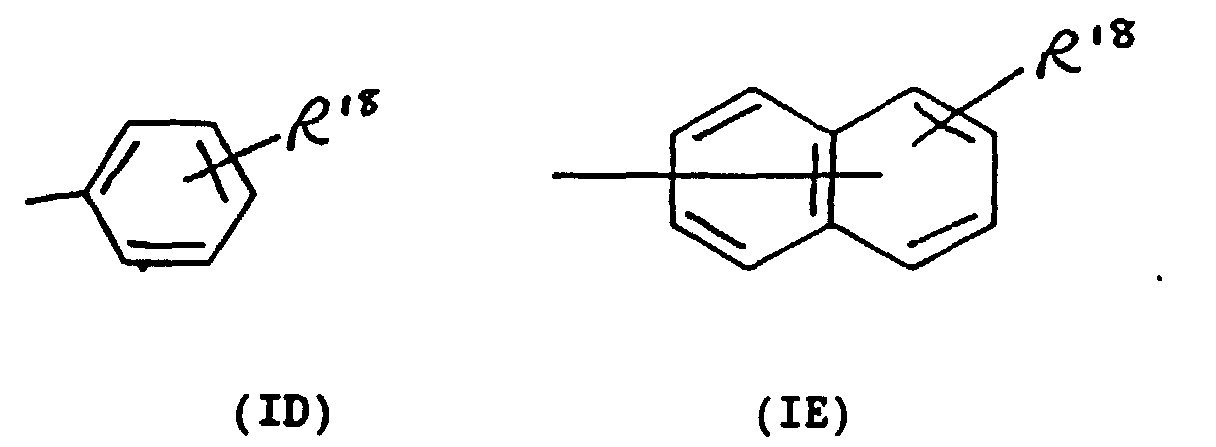 R18 est un groupe Z ou un groupe Z protégé et où un quelconque substituant éventuel sur P1 est tel que défini dans la revendication 1 et est éventuellement protégé ;et où au moins un groupe protecteur est présent ; et ensuite, si cela est nécessaire ;(i) la formation d'un sel acceptable du point de vue pharmaceutique,(ii) l'estérification pour former un ester hydrolysable in vivo.
 - Procédé pour préparer un composé suivant la revendication 1 ou un composé de formule (V) suivant la revendication 8, qui comprend :(a) la réaction des composés de formules (VI) et (VII) :où P1, R2, R10, R11, R12 et R13 sont tels que définis dans la revendication 8, les substituants éventuels sur P1 sont tels que définis dans la revendication 8 et L est un groupe mobile, ou
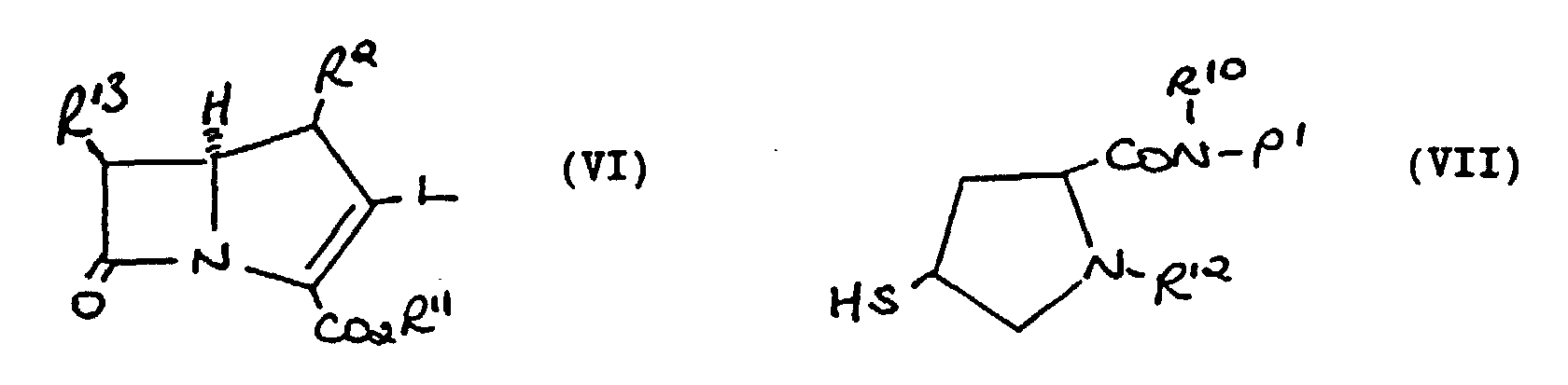 (b) la cyclisation d'un composé de formule (VIII) :dans laquelle P1, R2, R10, R11, R12 et R13 sont tels que définis dans la revendication 8, les substituants éventuels sur P1 sont tels que définis dans la revendication 8 et R14, R15 et R16 sont indépendamment choisis parmi les groupes alcoxy en C1-6, aryloxy, di-alkyl en C1-6-amino et diarylamino ou deux quelconques des R14 à R16 représentent un radical o-phénylènedioxy ou bien l'un des R14 à R16 est un groupe alkyle en C1-4, allyle, benzyle ou phényle et les deux autres valeurs sont indépendamment choisies parmi un groupe alkyle en C1-4, trifluorométhyle ou phényle, où un quelconque groupe phényle est éventuellement substitué par un groupe alkyle en C1-3 ou alcoxy en C1-3 ; et dans laquelle un quelconque groupe fonctionnel est éventuellement protégé et ensuite, si cela est nécessaire :
 (i) l'élimination de quelconques groupes protecteurs ;(ii) la formation d'un sel acceptable du point de vue pharmaceutique ;(iii) l'estérification pour former un ester hydrolysable in vivo.
 - Composé de formule (V) tel que défini dans la revendication 8, de formule (VII) ou de formule (VIII) tel que défini dans la revendication 9 ou de formule (IX), (XII) ou (XIV) :
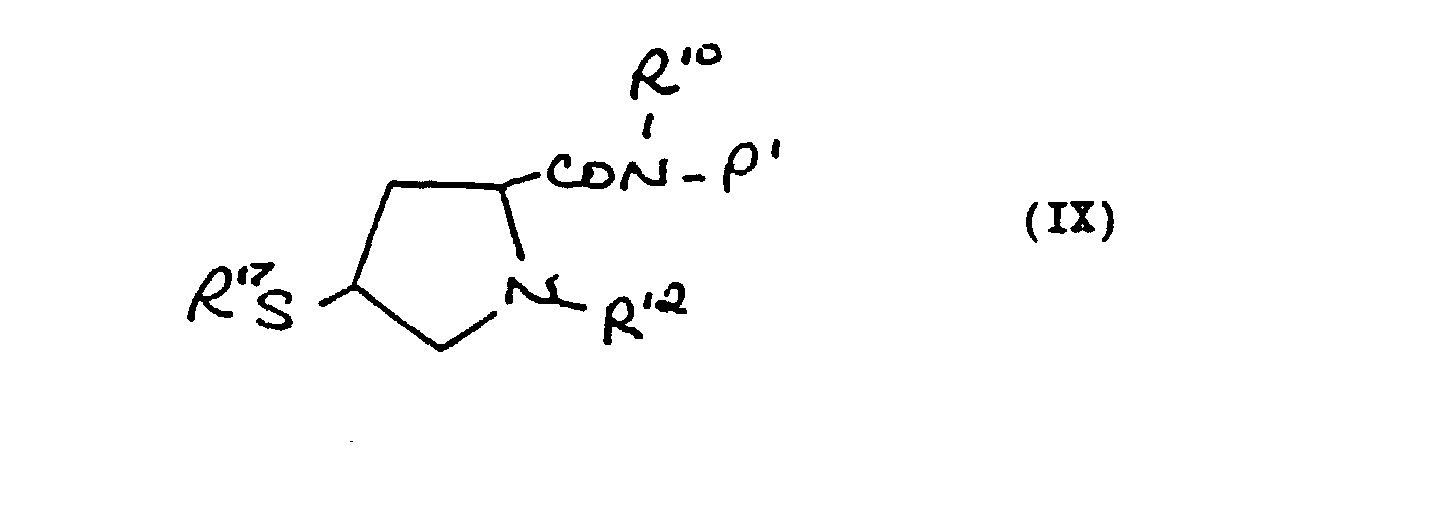
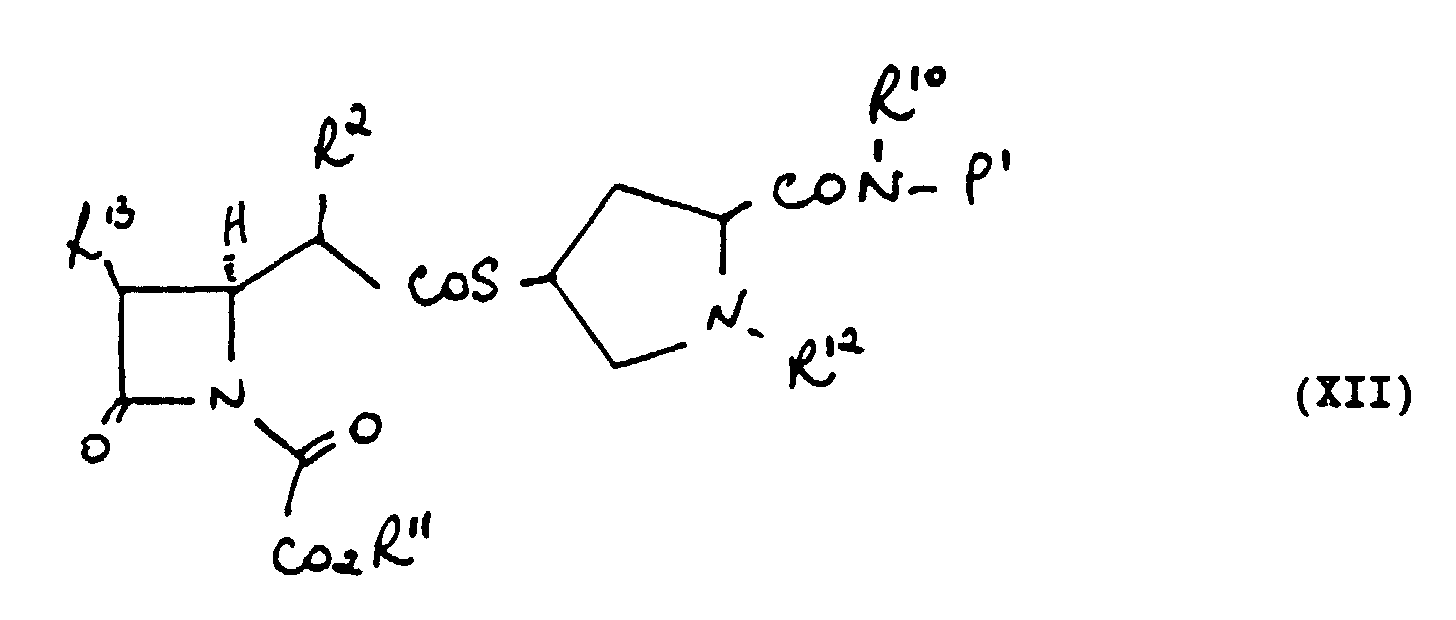 où P1, R2, R10 à R13 sont tels que définis dans la revendication 8, et R17 est un groupe protecteur.
Priority Applications (1)
| Application Number | Priority Date | Filing Date | Title |
|---|---|---|---|
| EP93302296A EP0562855B1 (fr) | 1992-03-26 | 1993-03-25 | Dérivés de carbapénème en tant qu'antibiotiques |
Applications Claiming Priority (7)
| Application Number | Priority Date | Filing Date | Title |
|---|---|---|---|
| EP92400837 | 1992-03-26 | ||
| EP92400839 | 1992-03-26 | ||
| EP92400837 | 1992-03-26 | ||
| EP92400839 | 1992-03-26 | ||
| EP92402700 | 1992-10-02 | ||
| EP92402700 | 1992-10-02 | ||
| EP93302296A EP0562855B1 (fr) | 1992-03-26 | 1993-03-25 | Dérivés de carbapénème en tant qu'antibiotiques |
Publications (2)
| Publication Number | Publication Date |
|---|---|
| EP0562855A1 EP0562855A1 (fr) | 1993-09-29 |
| EP0562855B1 true EP0562855B1 (fr) | 1999-05-12 |
Family
ID=27234858
Family Applications (1)
| Application Number | Title | Priority Date | Filing Date |
|---|---|---|---|
| EP93302296A Expired - Lifetime EP0562855B1 (fr) | 1992-03-26 | 1993-03-25 | Dérivés de carbapénème en tant qu'antibiotiques |
Country Status (8)
| Country | Link |
|---|---|
| US (1) | US5571805A (fr) |
| EP (1) | EP0562855B1 (fr) |
| JP (1) | JPH0625244A (fr) |
| KR (1) | KR100287040B1 (fr) |
| AT (1) | ATE179978T1 (fr) |
| CA (1) | CA2091309A1 (fr) |
| DE (1) | DE69324846T2 (fr) |
| ES (1) | ES2133358T3 (fr) |
Families Citing this family (13)
| Publication number | Priority date | Publication date | Assignee | Title |
|---|---|---|---|---|
| GB9202298D0 (en) * | 1992-02-04 | 1992-03-18 | Ici Plc | Antibiotic compounds |
| JP4182545B2 (ja) * | 1994-02-25 | 2008-11-19 | 萬有製薬株式会社 | カルバペネム誘導体 |
| GB9515975D0 (en) | 1995-08-04 | 1995-10-04 | Zeneca Ltd | Chemical compounds |
| HRP970281B1 (en) * | 1996-05-28 | 2002-04-30 | Merck & Co Inc | Carbapenem antibiotic, composition and method of preparation |
| AU4020897A (en) | 1996-08-17 | 1998-03-06 | Zeneca Limited | 3-mercaptopyrrolidines as farnesyl protein transferase inhibitors |
| KR100881472B1 (ko) | 1999-02-04 | 2009-02-05 | 어플라이드 머티어리얼스, 인코포레이티드 | 소정 기판 상에 놓여져 있는 패턴화된 마스크 표면 위로 적층 구조물을 증착하기 위한 방법 |
| GB9930318D0 (en) | 1999-12-22 | 2000-02-09 | Zeneca Ltd | Novel compounds |
| GB9930317D0 (en) | 1999-12-22 | 2000-02-09 | Zeneca Ltd | Novel compounds |
| AR035728A1 (es) * | 2001-01-16 | 2004-07-07 | Merck & Co Inc | Proceso perfeccionado para la sintesis de carbapenem |
| GB2376313A (en) * | 2001-06-04 | 2002-12-11 | Hewlett Packard Co | Indicating to a user if they are connected to a trusted computer platform |
| CN101367815B (zh) * | 2007-06-28 | 2012-07-04 | 山东轩竹医药科技有限公司 | 六元环甲酰胺取代的巯基吡咯烷碳青霉烯化合物 |
| CN101362757A (zh) * | 2007-08-09 | 2009-02-11 | 山东轩竹医药科技有限公司 | 磺酰基取代的碳青霉烯类化合物 |
| JP7845223B2 (ja) * | 2023-02-21 | 2026-04-14 | 信越化学工業株式会社 | オニウム塩、レジスト組成物、及びパターン形成方法 |
Family Cites Families (5)
| Publication number | Priority date | Publication date | Assignee | Title |
|---|---|---|---|---|
| EP0017992A1 (fr) * | 1979-04-19 | 1980-10-29 | Merck & Co. Inc. | Acides 1-carbadéthiapén-2-èm-carboxyliques substitués en position 2 et 6, procédés pour les préparer, compositions pharmaceutiques antibiotiques les contenant et procédé pour préparer des intermédiaires |
| CA1283906C (fr) * | 1983-05-09 | 1991-05-07 | Makoto Sunagawa | COMPOSE DE .beta.-LACTAM ET PROCEDE DE PRODUCTION |
| JPS60202886A (ja) * | 1984-03-27 | 1985-10-14 | Sankyo Co Ltd | 1―置換カルバペネム―3―カルボン酸誘導体 |
| CA1281720C (fr) * | 1984-11-08 | 1991-03-19 | Makoto Sunagawa | Composes de carbapenem et leur production |
| GB9107341D0 (en) * | 1991-04-08 | 1991-05-22 | Ici Plc | Antibiotic compounds |
-
1993
- 1993-03-09 CA CA002091309A patent/CA2091309A1/fr not_active Abandoned
- 1993-03-25 KR KR1019930004664A patent/KR100287040B1/ko not_active Expired - Fee Related
- 1993-03-25 ES ES93302296T patent/ES2133358T3/es not_active Expired - Lifetime
- 1993-03-25 EP EP93302296A patent/EP0562855B1/fr not_active Expired - Lifetime
- 1993-03-25 AT AT93302296T patent/ATE179978T1/de active
- 1993-03-25 DE DE69324846T patent/DE69324846T2/de not_active Expired - Fee Related
- 1993-03-26 JP JP5068076A patent/JPH0625244A/ja active Pending
-
1994
- 1994-09-08 US US08/302,394 patent/US5571805A/en not_active Expired - Fee Related
Also Published As
| Publication number | Publication date |
|---|---|
| CA2091309A1 (fr) | 1993-09-27 |
| ES2133358T3 (es) | 1999-09-16 |
| ATE179978T1 (de) | 1999-05-15 |
| KR100287040B1 (ko) | 2001-05-02 |
| DE69324846T2 (de) | 1999-09-16 |
| EP0562855A1 (fr) | 1993-09-29 |
| KR940005626A (ko) | 1994-03-22 |
| JPH0625244A (ja) | 1994-02-01 |
| DE69324846D1 (de) | 1999-06-17 |
| US5571805A (en) | 1996-11-05 |
Similar Documents
| Publication | Publication Date | Title |
|---|---|---|
| EP0579826B1 (fr) | Carbapenemes contenant un groupe phenyle a substitution carboxy, procedes et intermediaires destines a leur preparation, et leur utilisation comme antibiotiques | |
| US5541178A (en) | Carbapenem antibiotic compounds | |
| EP0586663B1 (fr) | Derives de carbapenem utilises comme antibiotiques et leurs intermediaires | |
| US5571805A (en) | Antibiotic compounds | |
| US5441949A (en) | Carbapenem antibiotic compounds | |
| EP0581501B1 (fr) | Dérivés de carbapénème antibiotiques | |
| US5444057A (en) | Carbapenem-antibiotic compounds | |
| EP0581502B1 (fr) | Dérivés de carbapénème antibiotiques | |
| EP0592167B1 (fr) | Dérivés de pyrrolidinyl-thio-pénème antibiotiques | |
| US5527793A (en) | Antibiotic carbapenem compounds | |
| HK1013998B (en) | Carbapenems containing a carboxy substituted phenyl group, processes for their preparation, intermediates and use as antibiotics | |
| HRP931189A2 (en) | Antibiotic compounds |
Legal Events
| Date | Code | Title | Description |
|---|---|---|---|
| PUAI | Public reference made under article 153(3) epc to a published international application that has entered the european phase |
Free format text: ORIGINAL CODE: 0009012 |
|
| AK | Designated contracting states |
Kind code of ref document: A1 Designated state(s): AT BE CH DE DK ES FR GB GR IE IT LI LU MC NL PT SE |
|
| RAP1 | Party data changed (applicant data changed or rights of an application transferred) |
Owner name: ZENECA PHARMA S.A. Owner name: ZENECA LIMITED |
|
| 17P | Request for examination filed |
Effective date: 19940223 |
|
| 17Q | First examination report despatched |
Effective date: 19970225 |
|
| GRAG | Despatch of communication of intention to grant |
Free format text: ORIGINAL CODE: EPIDOS AGRA |
|
| GRAG | Despatch of communication of intention to grant |
Free format text: ORIGINAL CODE: EPIDOS AGRA |
|
| GRAG | Despatch of communication of intention to grant |
Free format text: ORIGINAL CODE: EPIDOS AGRA |
|
| GRAH | Despatch of communication of intention to grant a patent |
Free format text: ORIGINAL CODE: EPIDOS IGRA |
|
| GRAH | Despatch of communication of intention to grant a patent |
Free format text: ORIGINAL CODE: EPIDOS IGRA |
|
| GRAA | (expected) grant |
Free format text: ORIGINAL CODE: 0009210 |
|
| AK | Designated contracting states |
Kind code of ref document: B1 Designated state(s): AT BE CH DE DK ES FR GB IE IT LI LU MC NL PT SE |
|
| PG25 | Lapsed in a contracting state [announced via postgrant information from national office to epo] |
Ref country code: SE Free format text: THE PATENT HAS BEEN ANNULLED BY A DECISION OF A NATIONAL AUTHORITY Effective date: 19990512 Ref country code: NL Free format text: LAPSE BECAUSE OF FAILURE TO SUBMIT A TRANSLATION OF THE DESCRIPTION OR TO PAY THE FEE WITHIN THE PRESCRIBED TIME-LIMIT Effective date: 19990512 Ref country code: LI Free format text: LAPSE BECAUSE OF FAILURE TO SUBMIT A TRANSLATION OF THE DESCRIPTION OR TO PAY THE FEE WITHIN THE PRESCRIBED TIME-LIMIT Effective date: 19990512 Ref country code: CH Free format text: LAPSE BECAUSE OF FAILURE TO SUBMIT A TRANSLATION OF THE DESCRIPTION OR TO PAY THE FEE WITHIN THE PRESCRIBED TIME-LIMIT Effective date: 19990512 Ref country code: BE Free format text: LAPSE BECAUSE OF FAILURE TO SUBMIT A TRANSLATION OF THE DESCRIPTION OR TO PAY THE FEE WITHIN THE PRESCRIBED TIME-LIMIT Effective date: 19990512 Ref country code: AT Free format text: LAPSE BECAUSE OF FAILURE TO SUBMIT A TRANSLATION OF THE DESCRIPTION OR TO PAY THE FEE WITHIN THE PRESCRIBED TIME-LIMIT Effective date: 19990512 |
|
| REF | Corresponds to: |
Ref document number: 179978 Country of ref document: AT Date of ref document: 19990515 Kind code of ref document: T |
|
| REG | Reference to a national code |
Ref country code: CH Ref legal event code: EP |
|
| REG | Reference to a national code |
Ref country code: IE Ref legal event code: FG4D |
|
| REF | Corresponds to: |
Ref document number: 69324846 Country of ref document: DE Date of ref document: 19990617 |
|
| ET | Fr: translation filed | ||
| PG25 | Lapsed in a contracting state [announced via postgrant information from national office to epo] |
Ref country code: PT Free format text: LAPSE BECAUSE OF FAILURE TO SUBMIT A TRANSLATION OF THE DESCRIPTION OR TO PAY THE FEE WITHIN THE PRESCRIBED TIME-LIMIT Effective date: 19990812 Ref country code: DK Free format text: LAPSE BECAUSE OF FAILURE TO SUBMIT A TRANSLATION OF THE DESCRIPTION OR TO PAY THE FEE WITHIN THE PRESCRIBED TIME-LIMIT Effective date: 19990812 |
|
| REG | Reference to a national code |
Ref country code: ES Ref legal event code: FG2A Ref document number: 2133358 Country of ref document: ES Kind code of ref document: T3 |
|
| REG | Reference to a national code |
Ref country code: CH Ref legal event code: PL |
|
| PLBE | No opposition filed within time limit |
Free format text: ORIGINAL CODE: 0009261 |
|
| STAA | Information on the status of an ep patent application or granted ep patent |
Free format text: STATUS: NO OPPOSITION FILED WITHIN TIME LIMIT |
|
| PG25 | Lapsed in a contracting state [announced via postgrant information from national office to epo] |
Ref country code: LU Free format text: LAPSE BECAUSE OF NON-PAYMENT OF DUE FEES Effective date: 20000325 Ref country code: IE Free format text: LAPSE BECAUSE OF NON-PAYMENT OF DUE FEES Effective date: 20000325 |
|
| 26N | No opposition filed | ||
| PG25 | Lapsed in a contracting state [announced via postgrant information from national office to epo] |
Ref country code: MC Free format text: LAPSE BECAUSE OF NON-PAYMENT OF DUE FEES Effective date: 20000930 |
|
| REG | Reference to a national code |
Ref country code: IE Ref legal event code: MM4A |
|
| REG | Reference to a national code |
Ref country code: GB Ref legal event code: 732E |
|
| REG | Reference to a national code |
Ref country code: GB Ref legal event code: IF02 |
|
| PGFP | Annual fee paid to national office [announced via postgrant information from national office to epo] |
Ref country code: GB Payment date: 20020205 Year of fee payment: 10 |
|
| PGFP | Annual fee paid to national office [announced via postgrant information from national office to epo] |
Ref country code: FR Payment date: 20020228 Year of fee payment: 10 |
|
| PGFP | Annual fee paid to national office [announced via postgrant information from national office to epo] |
Ref country code: ES Payment date: 20020313 Year of fee payment: 10 |
|
| PGFP | Annual fee paid to national office [announced via postgrant information from national office to epo] |
Ref country code: DE Payment date: 20020327 Year of fee payment: 10 |
|
| PG25 | Lapsed in a contracting state [announced via postgrant information from national office to epo] |
Ref country code: GB Free format text: LAPSE BECAUSE OF NON-PAYMENT OF DUE FEES Effective date: 20030325 |
|
| PG25 | Lapsed in a contracting state [announced via postgrant information from national office to epo] |
Ref country code: ES Free format text: LAPSE BECAUSE OF NON-PAYMENT OF DUE FEES Effective date: 20030326 |
|
| PG25 | Lapsed in a contracting state [announced via postgrant information from national office to epo] |
Ref country code: DE Free format text: LAPSE BECAUSE OF NON-PAYMENT OF DUE FEES Effective date: 20031001 |
|
| GBPC | Gb: european patent ceased through non-payment of renewal fee |
Effective date: 20030325 |
|
| PG25 | Lapsed in a contracting state [announced via postgrant information from national office to epo] |
Ref country code: FR Free format text: LAPSE BECAUSE OF NON-PAYMENT OF DUE FEES Effective date: 20031127 |
|
| REG | Reference to a national code |
Ref country code: FR Ref legal event code: ST |
|
| REG | Reference to a national code |
Ref country code: ES Ref legal event code: FD2A Effective date: 20030326 |
|
| PG25 | Lapsed in a contracting state [announced via postgrant information from national office to epo] |
Ref country code: IT Free format text: LAPSE BECAUSE OF NON-PAYMENT OF DUE FEES Effective date: 20050325 |