EP0562878B1 - Composition d'organopolysiloxane durcissable à température ambiante et produits durcis - Google Patents
Composition d'organopolysiloxane durcissable à température ambiante et produits durcis Download PDFInfo
- Publication number
- EP0562878B1 EP0562878B1 EP93302373A EP93302373A EP0562878B1 EP 0562878 B1 EP0562878 B1 EP 0562878B1 EP 93302373 A EP93302373 A EP 93302373A EP 93302373 A EP93302373 A EP 93302373A EP 0562878 B1 EP0562878 B1 EP 0562878B1
- Authority
- EP
- European Patent Office
- Prior art keywords
- groups
- group
- composition
- composition according
- integer
- Prior art date
- Legal status (The legal status is an assumption and is not a legal conclusion. Google has not performed a legal analysis and makes no representation as to the accuracy of the status listed.)
- Expired - Lifetime
Links
Images
Classifications
-
- C—CHEMISTRY; METALLURGY
- C08—ORGANIC MACROMOLECULAR COMPOUNDS; THEIR PREPARATION OR CHEMICAL WORKING-UP; COMPOSITIONS BASED THEREON
- C08K—Use of inorganic or non-macromolecular organic substances as compounding ingredients
- C08K5/00—Use of organic ingredients
- C08K5/54—Silicon-containing compounds
-
- C—CHEMISTRY; METALLURGY
- C08—ORGANIC MACROMOLECULAR COMPOUNDS; THEIR PREPARATION OR CHEMICAL WORKING-UP; COMPOSITIONS BASED THEREON
- C08L—COMPOSITIONS OF MACROMOLECULAR COMPOUNDS
- C08L83/00—Compositions of macromolecular compounds obtained by reactions forming in the main chain of the macromolecule a linkage containing silicon with or without sulfur, nitrogen, oxygen or carbon only; Compositions of derivatives of such polymers
- C08L83/04—Polysiloxanes
-
- C—CHEMISTRY; METALLURGY
- C08—ORGANIC MACROMOLECULAR COMPOUNDS; THEIR PREPARATION OR CHEMICAL WORKING-UP; COMPOSITIONS BASED THEREON
- C08G—MACROMOLECULAR COMPOUNDS OBTAINED OTHERWISE THAN BY REACTIONS ONLY INVOLVING UNSATURATED CARBON-TO-CARBON BONDS
- C08G77/00—Macromolecular compounds obtained by reactions forming a linkage containing silicon with or without sulfur, nitrogen, oxygen or carbon in the main chain of the macromolecule
- C08G77/04—Polysiloxanes
- C08G77/14—Polysiloxanes containing silicon bound to oxygen-containing groups
- C08G77/16—Polysiloxanes containing silicon bound to oxygen-containing groups to hydroxy groups
-
- C—CHEMISTRY; METALLURGY
- C08—ORGANIC MACROMOLECULAR COMPOUNDS; THEIR PREPARATION OR CHEMICAL WORKING-UP; COMPOSITIONS BASED THEREON
- C08G—MACROMOLECULAR COMPOUNDS OBTAINED OTHERWISE THAN BY REACTIONS ONLY INVOLVING UNSATURATED CARBON-TO-CARBON BONDS
- C08G77/00—Macromolecular compounds obtained by reactions forming a linkage containing silicon with or without sulfur, nitrogen, oxygen or carbon in the main chain of the macromolecule
- C08G77/04—Polysiloxanes
- C08G77/20—Polysiloxanes containing silicon bound to unsaturated aliphatic groups
-
- C—CHEMISTRY; METALLURGY
- C08—ORGANIC MACROMOLECULAR COMPOUNDS; THEIR PREPARATION OR CHEMICAL WORKING-UP; COMPOSITIONS BASED THEREON
- C08G—MACROMOLECULAR COMPOUNDS OBTAINED OTHERWISE THAN BY REACTIONS ONLY INVOLVING UNSATURATED CARBON-TO-CARBON BONDS
- C08G77/00—Macromolecular compounds obtained by reactions forming a linkage containing silicon with or without sulfur, nitrogen, oxygen or carbon in the main chain of the macromolecule
- C08G77/04—Polysiloxanes
- C08G77/22—Polysiloxanes containing silicon bound to organic groups containing atoms other than carbon, hydrogen and oxygen
- C08G77/24—Polysiloxanes containing silicon bound to organic groups containing atoms other than carbon, hydrogen and oxygen halogen-containing groups
-
- C—CHEMISTRY; METALLURGY
- C08—ORGANIC MACROMOLECULAR COMPOUNDS; THEIR PREPARATION OR CHEMICAL WORKING-UP; COMPOSITIONS BASED THEREON
- C08G—MACROMOLECULAR COMPOUNDS OBTAINED OTHERWISE THAN BY REACTIONS ONLY INVOLVING UNSATURATED CARBON-TO-CARBON BONDS
- C08G77/00—Macromolecular compounds obtained by reactions forming a linkage containing silicon with or without sulfur, nitrogen, oxygen or carbon in the main chain of the macromolecule
- C08G77/70—Siloxanes defined by use of the MDTQ nomenclature
Definitions
- the present invention relates to a room temperature curable organopolysiloxane composition which readily cures under the action of moisture, and to a cured product of said composition. More particularly, the invention relates to a composition which does not cause contamination on surfaces of a cured product thereof or in the surroundings when used outdoors and which permits easy removal of fungi, if any, from surfaces of the cured product.
- room temperature curable organopolysiloxane compositions which remain stable with a flowing property under hermetically sealed conditions but which, under the action of moisture in air, cure at room temperature to form a rubber-like elastic material.
- This type of composition is in extensive use as sealing material, coating material and adhesive in construction, machine and electric industries.
- these room temperature curable organopolysiloxane compositions have the disadvantage that when used as sealing material or coating material, they are liable to cause contamination on surfaces thereof or in the surroundings, thereby damaging the appearance of a building.
- a variety of additives have been investigated and a number of methods have been proposed. For instance, there are known a method in which a surface active agent having a polyoxyethylene group, a residue group of sorbitan or a residue group of a disaccharide is used (Refer to Japanese Pre-examination Patent Publication (KOKAI) Nos.
- cured elastic materials obtained from known room temperature curable organopolysiloxane compositions have the drawback as follows. Although they exhibit good appearance upon application thereof, they are susceptible to contamination by various contaminants (dirt from human bodies, detergents, foods) where they are applied in a bathroom, kitchen or toilet. Where these compositions are used in highly humid environments, in particular, the appearance of the applied compositions are liable to be damaged by propagation of fungi thereon.
- Japanese Pre-examination Patent Publication (KOKAI) No. 54-43260 discloses addition of a benzimidazolyl alkyl carbamate to the composition
- Japanese Pre-examination Patent Publication (KOKAI) No. 57-18758 discloses addition of an organosilicon compound having a tetraorganoguanidyl group.
- compositions thus provided with a mildewproofing property are incapable of retaining the mildew-proofing property for a long time, because the mildew-proofing agent used will exude from the composition in the presence of water.
- US-A-5 013 800 describes a room temperature-curable organopolysiloxane-based composition capable of giving a surface coating resistant to stain on prolonged exposure comprising an organopolysiloxane block copolymer, an organosilane, and an oxyalkylene group-containing organopolysiloxane.
- the present invention provides a room temperature curable organopolysiloxane composition comprising:
- the present invention also provides a cured product obtained by curing the above composition.
- the composition of the present invention is used as sealing material or coating material, it is possible to greatly reduce contamination of surfaces of cured products of the composition and in the surroundings.
- the composition according to the present invention is applied in a bathroom, kitchen or toilet where contamination by such contaminants as dirt from human bodies, detergents or foods, and propagation of fungi tend to occur due to poor ventilation and high humidity, the composition permits easy removal of fungi.
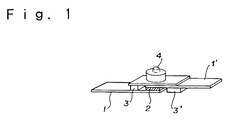
- Figure 1 is a perspective view of a specimen used in measurement of adhesive strength under shear in Examples.
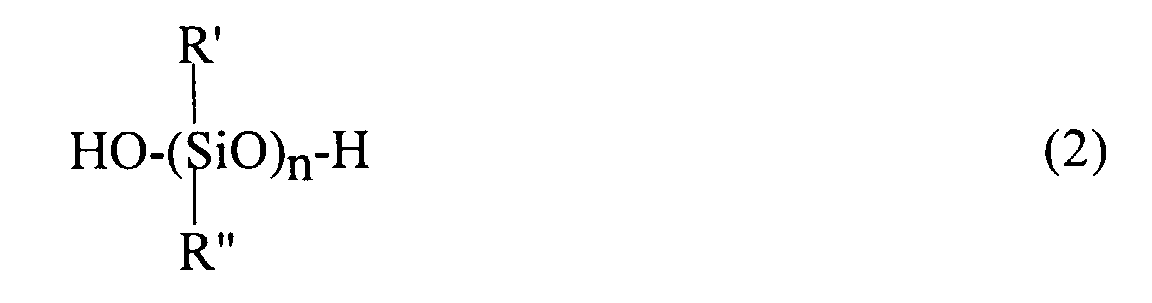
- the diorganopolysiloxane blocked by hydroxyl group at both terminal ends of its molecule, used as the component (A), is a compound having the following general formula (2): wherein R' and R" may be the same or different from each other and are each an alkyl group such as methyl, ethyl, propyl; a cycloalkyl group such as cyclohexyl; an alkenyl group such as vinyl, allyl; an aryl group such as phenyl, tolyl; or a group derived from these groups by substitution of halogen atoms for part of the hydrogen atoms of these groups; and n is an integer of 10 or above, preferably an integer such that the viscosity at 25°C of the diorganopolysiloxane is in the range from 25 to 500,000 mm 2 /sec (cSt), more preferably from 1,000 to 100,000 mm 2 /sec (cSt).
- the organosilicon compound having at least three silicon-bonded hydrolyzable groups in its molecule or partially hydrolyzed product of the same, constituting the component (B) of the composition according to the present invention, is an indispensable component which is required for room-temperature cure of the composition in the presence of moisture.
- the hydrolyzable groups include, for example, alkoxyl groups, ketoxime groups, acyloxyl groups, amino groups, amido groups, aminoxyl groups, and alkenyloxyl groups.
- the organosilicon compound may be a silane or a siloxane compound.
- organosilicon compound examples include the following compounds: alkoxysilanes such as methyltrimethoxysilane, vinyltriethoxysilane, 3-chloropropyltrimethoxysilane, 3-aminopropyltriethoxysilane; ketoxime-silanes such as methyltris(dimethyl ketoxime)silane, methyltris( methyl ethyl ketoxime)silane, vinyltris(methyl ethyl ketoxime)silane, tetra(methyl ethyl ketoxime)silane; acyloxysilanes such as vinyltriacetoxysilane, methyltriacetoxysilane, phenyltriacetoxysilane; amidosilanes such as phenyltris(N-methylacetamido)silane, vinyltris(N-methylacetamido)silane, aminosilanes such as vinyltris(N-butyl
- organosilicon compounds and partially hydrolyzed products thereof may be used either singly or in combination of two or more.
- the component (B) should be used in an amount of from 0.5 to 30 parts by weight per 100 parts by weight of the component (A). If the amount of the component (B) is less than 0.5 part by weight, the composition will gel during production or storage thereof, and elastic materials obtained therefrom will not exhibit the physical properties intended. If the amount is more than 30 parts by weight, on the other hand, the composition will show an excessively high ratio of shrinkage upon cure and, further, elasticity of cured products is lowered. More preferably, the component (B) is used in an amount of from 3 to 15 parts by weight.
- the unsubstituted or halogen-substituted monovalent hydrocarbon groups of from 1 to 8 carbon atoms represented by R 1 and R 2 include, for example, alkyl groups such as methyl, ethyl, propyl; cycloalkyl groups such as cyclopentyl, cyclohexyl; alkenyl groups such as vinyl, allyl; aryl groups such as phenyl, tolyl; and groups derived from these groups by substitution of halogen atoms for part of the hydrogen atoms of these groups.
- the divalent groups represented by R 3 include, for example, alkylene groups such as methylene, ethylene, propylene; cycloalkylene groups such as cyclopentylene, cyclohexylene; arylene groups such as phenylene; the groups represented by -R 4 OR 5 - or -R 4 CONHR 5 -, wherein R 4 and R 5 may be the same or different from each other and are each an alkylene group such as methylene, ethylene, propylene; a cycloalkylene group such as cyclopentylene, cyclohexylene; or an arylene group such as phenylene.
- Rf is a divalent perfluoroalkylene group or a divalent perfluoropolyether group.
- Specific examples include the groups having the general formula (3): wherein e and i may be the same or different from each other and are each either 0 or 1, f and h may be the same or different from each other and are each an integer from 0 to 30, and g is an integer from 0 to 8, provided the above e, f, g, h and i are integers such that (e + f + g + h + i) ⁇ 1, and a plurality of Y groups may be the same or different from each other and are each a fluorine atom or the group -CF 3 ; the groups having the following general formula (4): wherein m is an integer from 0 to 10, n is an integer from 2 to 50, and a plurality of X groups may be the same or different from each other and are each a fluorine atom or the group -CF 3 ;
- Rf group examples include the following: -C 4 F 8 -, -C 6 F 12 - , -CF 2 CF 2 OCF 2 (CF 2 ) 2 CF 2 OCF 2 CF 2 - , -CF 2 CF 2 O-(CF 2 CF 2 CF 2 O) 5 -CF 2 CF 2 - ,
- the component (C) is added in an amount of from 0.1 to 15, preferably from 0.5 to 5, parts by weight per 100 parts by weight of the component (A). If the amount of the component (C) is less than 0.1 part by weight, satisfactory coatings are not formed on the surfaces of cured rubber products of the composition of the present invention. If the amount is more than 15 parts by weight, on the other hand, physical properties of rubber-like elastic materials obtained by curing the composition are lowered, and use of such amount is disadvantageous economically.
- composition according to the present invention can be obtained as a one-pack type room temperature curable composition by uniformly mixing predetermined amounts of the above components (A) to (C).
- the composition may be prepared as a two-pack type composition having a uniform mixture of the components (A) and (C) in one pack and the component (B) in the other, the contents of the two packs being mixed at the time of using the composition.
- compositions When the composition is exposed to air, moisture in air causes a crosslinking reaction to proceed, whereby the composition is cured to be a rubber-like elastic material.
- the composition may be added those known catalysts which accelerate this kind of reaction, for example, amine compounds, quaternary ammonium salts, organometallic compounds, titanium chelate compounds, and guanidyl group-containing compounds.
- amine compounds quaternary ammonium salts
- organometallic compounds for example, titanium chelate compounds, and guanidyl group-containing compounds.
- guanidyl group-containing compounds a variety of additives may be added to the composition according to the present invention.
- the additives which can be used include, for example, inorganic fillers for controlling physical properties of the desired rubber-like elastic material, for instance, known powder-form fillers serving as reinforcing agent, such as fumed silica, precipitated silica, titanium dioxide, aluminum oxide, ground quartz and talc, fibrous fillers such as asbestos, glass fibers and organic fibers, oil resistance improving agents such as potassium methacrylate, coloring agents, heat resistance improving agents such as red oxide, cold resistance improving agents, thixotropic agents such as polyether, dehydrating agents, and adhesive property improving agents such as gamma-aminopropyltriethoxysilane.
- inorganic fillers for controlling physical properties of the desired rubber-like elastic material
- known powder-form fillers serving as reinforcing agent such as fumed silica, precipitated silica, titanium dioxide, aluminum oxide, ground quartz and talc
- fibrous fillers such as asbestos, glass fibers and organic fibers
- oil resistance improving agents such as potassium methacrylate
- composition of the present invention is non-contaminating and ensures easy removal of fungi from surfaces of cured products thereof. Because of these characteristics, the composition is of use as a sealant or coating material for exterior surfaces of buildings, or a sealant or coating material for places where propagation of fungi is likely to occur, such as bathrooms and kitchens.
- components (A) and (B) are compounds which are known as components of room temperature curable silicone rubber compositions.
- the composition according to the present invention turns to be a rubber-like elastic material through condensation between the hydroxyl group in the component (A) and the hydrolyzable group in the component (B).
- the action of the component (C) ensures that when the composition of the present invention is used as a sealant or coating material, no contamination occurs on surfaces of cured products of the composition or in the surroundings. It is also ensured that even if the composition is used in bathrooms, kitchens, toilets or other places where contamination by such contaminants as dirt from human bodies, detergents and foods, and propagation of fungi tend to occur under poor ventilation and highly humid conditions, the fungi can be easily removed.
- parts means “parts by weight” and viscosity is given in values measured at 25°C.
- composition I One hundred parts of a dimethylpolysiloxane blocked by hydroxyl group at both terminal ends of its molecular chain and having a viscosity of 20,200 mm 2 /sec (cSt) was mixed with 12 parts of fumed silica whose surfaces have been treated with hexamethyldisilazane and which has a specific surface area of 150 m 2 /g and 1.5 parts of titanium dioxide. The resulting mixture was passed once through a three-roll mill. To the composition thus treated, 7 parts of methyltributanoximesilane and 0.1 part of dibutyltin dioctoate were added, followed by mixing with defoaming under water-free conditions, to prepare a composition (Composition I).
- composition I obtained above was admixed with 1.0 part, 3.0 parts, and 5.0 parts, respectively, of a perfluoropolyether-silane having the following structural formula: to prepare three compositions-Composition II, Composition III, and Composition IV.
- compositions I, II, III and IV prepared as above were formed into 2 mm thick sheets.
- each of the sheets was cured to be a rubber-like elastic material.
- all of the compositions I, II, III and IV remained stable for 6 months or more when left at room temperature under hermetically sealed conditions.
- the compositions I, II, III and IV having thus been left under the hermetically sealed conditions for 6 months were formed into 2 mm thick sheets and the sheets were cured under the same conditions as above, each of the sheets was cured to be a rubber-like elastic material.
- a sealant 2 consisting of the above-described composition I was applied, in an area of 25 x 10 mm, to an end portion on one side of an adherend 1, measuring 100 x 25 x 10 mm.
- Two 1-mm-thick Teflon plates were placed on the adherend 1 as spacers 3 and 3' on opposite sides of the sealant 2; then, another adherend 1' made of the same material as the adherend 1 was placed on the spacers 3 and 3', and a 500-g weight 4 was placed thereon.
- the assembly thus formed was left to stand in an atmosphere of 20°C and 55% RH for 7 days to cure the sealant, thereby preparing a specimen.
- compositions II, III and IV specimens were prepared in the same manner as with the composition I.
- adherend 1 (1') sheets of a glass, aluminum, iron, and an epoxy resin were used.
- adhesive strength under shear was measured by pulling both ends of the specimen in opposite directions. The results are shown in Table 3.
- Table 3 Comp.Ex. 1 Ex. 1 Ex. 2 Ex. 3
- Adherend Composition I Composition II
- Composition III Composition IV Glass 10 9 11 9 Aluminum 11 10 10 11 Iron 9 9 11 9 Epoxy resin 10 9 10 10 10
- Cured sheets formed from the compositions I, II, III and IV in the same manner as in the above tests of mechanical properties were respectively blanked into circular disks of 30 mm in diameter, which were subjected to measurement of fungal resistance by the "Methods of testing fungal resistance" according to JIS Z 2911.
- Methods of testing fungal resistance according to JIS Z 2911.
- composition V One hundred parts of a dimethylpolysiloxane blocked by hydroxyl group at both terminal ends of its molecular chain and having a viscosity of 20,500 mm 2 /sec (cSt) was mixed with 12 parts of fumed silica whose surfaces have been treated with hexamethyldisilazane and which has a specific surface area of 150 m 2 /g and 1.5 parts of titanium dioxide. The resulting mixture was passed once through a three-roll mill. To the composition thus treated, 6 parts of methyltriisopropenoxysilane and 0.5 part of a guanidyl-containing silane having the following structural formula: were added, followed by mixing with defoaming under water-free conditions, to prepare a composition (Composition V).
- composition V obtained above was admixed with 1.0 part, 3.0 parts, and 5.0 parts, respectively, of a perfluoropolyether-silane having the following structural formula: to prepare three compositions-Composition VI, Composition VII, and Composition VIII.
- compositions V, VI, VII and VIII prepared as above were formed into 2 mm thick sheets.
- each of the sheets was cured to be a rubber-like elastic material.
- all of the compositions V, VI, VII and VIII remained stable for 6 months or more when left at room temperature under hermetically sealed conditions.
- the compositions V, VI, VII and VIII having thus been left under the hermetically sealed conditions for 6 months were formed into 2 mm thick sheets and the sheets were cured under the same conditions as above, each of the sheets was cured to be a rubber-like elastic material.
- Cured sheets formed of the compositions V, VI, VII and VIII were respectively blanked into circular disks of 30 mm in diameter, which were subjected to measurement of fungal resistance by the "Methods of testing fungal resistance" according to JIS Z 2911.
- Methods of testing fungal resistance according to JIS Z 2911.
- removability of fungi deposited on the back side of each of the cured sheets was evaluated in the same manner as in Example 1. The results are shown in Table 12.
- composition A One hundred parts of a dimethylpolysiloxane blocked by hydroxyl group at both terminal ends of its molecular chain and having a viscosity of 21,200 mm 2 /sec (cSt) was mixed with 12 parts of fumed silica whose surfaces have been treated with hexamethyldisilazane and which has a specific surface area of 120 m 2 /g and 1.5 parts of titanium dioxide. The resulting mixture was passed once through a three-roll mill. To the composition thus treated, 6 parts of methyltributanoxysilane and 0.1 part of dibutyltin dioctoate were added, followed by mixing with defoaming under water-free conditions, to prepare a composition (Composition A).
- composition A thus obtained was admixed respectively with 3 parts each of perfluoropolyethersilanes having the following formulas:
- Composition X
- composition XI Composition XI:
- compositions-Composition IX, Composition X, Composition XI, and Composition XII were prepared four compositions-Composition IX, Composition X, Composition XI, and Composition XII.
- compositions IX, X, XI and XII thus obtained were subjected to outdoor exposure tests and fungal resistance tests in the same manner as in Example 1. The results are shown in Tables 13 and 14 below. Table 13 Contamination, measured after Example Composition 3 months 6 months 12 months Comparative Example 3 Composition XII B B C Example 7 Composition IX A A B Example 8 Composition X A A A Example 9 Composition XI A A B Notes: A - No contamination observed. B - Slight contamination observed. C - Heavy contamination observed.
Landscapes
- Chemical & Material Sciences (AREA)
- Health & Medical Sciences (AREA)
- Chemical Kinetics & Catalysis (AREA)
- Medicinal Chemistry (AREA)
- Polymers & Plastics (AREA)
- Organic Chemistry (AREA)
- Compositions Of Macromolecular Compounds (AREA)
Claims (10)
- Composition d'organopolysiloxane durcissable à la température ambiante, comprenant :(A) 100 parties en poids d'un diorganopolysiloxane bloqué par un groupe hydroxyle en les deux extrémités terminales de sa molécule,(B) de 0,5 à 30 parties en poids d'un composé organique du silicium ayant dans sa molécule au moins trois groupes hydrolysables liés au silicium, ou un produit partiellement hydrolysé de ce composé organique du silicium, autre qu'un alcoxysilane ayant la formule générale (1) ci-dessous,(C) de 0,1 à 15 parties en poids d'un alcoxysilane ayant la formule générale (1) ci-après :

- Composition selon la revendication 1, dans laquelle ledit constituant (A) comprend un composé ayant la formule générale (2) ci-après:
- Composition selon la revendication 1, dans laquelle ledit groupe hydrolysable dudit constituant (B) est au moins un groupe alcoxy, cétoxime, acyloxy, amino, amide, aminoxy et alcényloxy.
- Composition selon la revendication 1, dans laquelle ledit groupe R1, dans la formule générale (1) ci-dessus, est au moins un groupe alkyle, un groupe cycloalkyle, un groupe alcényle, un groupe aryle, et un groupe qui dérive de ces groupes par remplacement, par des atomes d'halogène, d'une partie des atomes d'hydrogène de ces groupes.
- Composition selon la revendication 1, dans laquelle ledit groupe R2, dans la formule générale (1) ci-dessus, est au moins un groupe alkyle, un groupe cycloalkyle, un groupe alcényle, un groupe aryle, et un groupe qui dérive de ces groupes par remplacement, par des atomes d'halogène, d'une partie des atomes d'hydrogène de ces groupes.
- Composition selon la revendication 1, dans laquelle ledit groupe R3, dans la formule générale (1) ci-dessus, est au moins un groupe alkylène, un groupe cycloalkylène, un groupe arylène, et un groupe ayant les formules:
-R4OR5-,
et
-R4CONHR5-
où R4 et R5 peuvent être identiques ou différents l'un de l'autre et sont chacun au moins un groupe alkylène, cycloalkylène ou arylène. - Composition selon la revendication 1, dans laquelle le groupe Rf a l'une des formules générales (3) à (5) ci-après :


-CF2CF2O-(CF2CF2CF2O)k-CF2CF2- (5)
où k est un entier de 1 à 100. - Composition selon la revendication 1, dans laquelle ledit constituant (B) est présent en une quantité de 3 à 15 parties en poids.
- Composition selon la revendication 1, dans laquelle ledit constituant (C) est présent en une quantité de 0,5 à 5 parties en poids.
- Produit durci obtenu par durcissement de la composition selon la revendication 1.
Applications Claiming Priority (2)
| Application Number | Priority Date | Filing Date | Title |
|---|---|---|---|
| JP14087892 | 1992-03-27 | ||
| JP140878/92 | 1992-03-27 |
Publications (3)
| Publication Number | Publication Date |
|---|---|
| EP0562878A2 EP0562878A2 (fr) | 1993-09-29 |
| EP0562878A3 EP0562878A3 (fr) | 1993-10-27 |
| EP0562878B1 true EP0562878B1 (fr) | 1997-05-14 |
Family
ID=15278869
Family Applications (1)
| Application Number | Title | Priority Date | Filing Date |
|---|---|---|---|
| EP93302373A Expired - Lifetime EP0562878B1 (fr) | 1992-03-27 | 1993-03-26 | Composition d'organopolysiloxane durcissable à température ambiante et produits durcis |
Country Status (3)
| Country | Link |
|---|---|
| US (1) | US5314981A (fr) |
| EP (1) | EP0562878B1 (fr) |
| DE (1) | DE69310594T2 (fr) |
Cited By (3)
| Publication number | Priority date | Publication date | Assignee | Title |
|---|---|---|---|---|
| CN103013430A (zh) * | 2012-12-24 | 2013-04-03 | 成都硅宝科技股份有限公司 | 一种环保型有机硅密封胶及其制造方法 |
| CN104610906A (zh) * | 2015-01-12 | 2015-05-13 | 饶玉明 | 一种用于玻璃幕墙的无色玻璃胶的制备方法 |
| CN104629675A (zh) * | 2015-01-12 | 2015-05-20 | 饶玉明 | 一种用于玻璃幕墙的无色玻璃胶 |
Families Citing this family (13)
| Publication number | Priority date | Publication date | Assignee | Title |
|---|---|---|---|---|
| JP2816930B2 (ja) * | 1993-11-08 | 1998-10-27 | 信越化学工業株式会社 | 室温硬化性オルガノポリシロキサン組成物 |
| JP2849043B2 (ja) * | 1994-06-17 | 1999-01-20 | 信越化学工業株式会社 | 有機ケイ素化合物 |
| TW393498B (en) * | 1995-04-04 | 2000-06-11 | Novartis Ag | The preparation and use of Polysiloxane-comprising perfluoroalkyl ethers |
| WO1996034067A1 (fr) * | 1995-04-24 | 1996-10-31 | Silicon Resources, Inc. | Compositions et procedes permettant de deshydrater, de passiver et de rendre etanche des systemes |
| EP0745604A3 (fr) * | 1995-05-29 | 1998-07-29 | Shin-Etsu Chemical Co., Ltd. | Composition de fluoropolymères durcissable à température ambiante; composés organosiliciques contenant du fluor, procédé pour les préparer et composition de silicone durcissable à température ambiante les contenant |
| US6451396B1 (en) | 1998-02-13 | 2002-09-17 | Gore Enterprise Holdings, Inc. | Flexure endurant composite elastomer compositions |
| JP4803342B2 (ja) * | 2004-10-19 | 2011-10-26 | 信越化学工業株式会社 | 耐擦傷性表面被膜形成用シリコーンコーティング組成物及びそれを用いた被覆物品 |
| US7847015B2 (en) * | 2006-11-15 | 2010-12-07 | Shin-Etsu Chemical Co., Ltd. | Coating composition |
| JP2010254832A (ja) * | 2009-04-27 | 2010-11-11 | Shin-Etsu Chemical Co Ltd | 防汚塗料組成物及び防汚方法 |
| US8889801B2 (en) * | 2009-10-28 | 2014-11-18 | Momentive Performance Materials, Inc. | Surface protective coating and methods of use thereof |
| KR102365533B1 (ko) * | 2016-05-16 | 2022-02-21 | 솔베이 스페셜티 폴리머스 이태리 에스.피.에이. | (퍼)플루오로폴리에테르 유도체 |
| US10544260B2 (en) | 2017-08-30 | 2020-01-28 | Ppg Industries Ohio, Inc. | Fluoropolymers, methods of preparing fluoropolymers, and coating compositions containing fluoropolymers |
| CN108329820B (zh) * | 2018-01-03 | 2020-05-08 | 中车青岛四方机车车辆股份有限公司 | 一种聚氨酯涂料 |
Family Cites Families (5)
| Publication number | Priority date | Publication date | Assignee | Title |
|---|---|---|---|---|
| US4057566A (en) * | 1976-01-08 | 1977-11-08 | Dow Corning Corporation | Fluorocarbon siloxane compositions |
| DE3583707D1 (de) * | 1984-06-26 | 1991-09-12 | Asahi Glass Co Ltd | Durchsichtiger schwer schmutzender gegenstand mit niedriger reflexion. |
| JPH01154740A (ja) * | 1987-12-11 | 1989-06-16 | Shin Etsu Chem Co Ltd | 粘着性構造体 |
| US5013800A (en) * | 1988-10-28 | 1991-05-07 | Shin-Etsu Chemical Co., Ltd. | Room temperature-curable organopolysiloxane-based coating composition |
| JPH0786175B2 (ja) * | 1990-11-29 | 1995-09-20 | 信越化学工業株式会社 | 離型耐久性に優れたシリコーンゴム組成物 |
-
1993
- 1993-03-26 EP EP93302373A patent/EP0562878B1/fr not_active Expired - Lifetime
- 1993-03-26 US US08/037,322 patent/US5314981A/en not_active Expired - Fee Related
- 1993-03-26 DE DE69310594T patent/DE69310594T2/de not_active Expired - Fee Related
Cited By (5)
| Publication number | Priority date | Publication date | Assignee | Title |
|---|---|---|---|---|
| CN103013430A (zh) * | 2012-12-24 | 2013-04-03 | 成都硅宝科技股份有限公司 | 一种环保型有机硅密封胶及其制造方法 |
| CN104610906A (zh) * | 2015-01-12 | 2015-05-13 | 饶玉明 | 一种用于玻璃幕墙的无色玻璃胶的制备方法 |
| CN104629675A (zh) * | 2015-01-12 | 2015-05-20 | 饶玉明 | 一种用于玻璃幕墙的无色玻璃胶 |
| CN104610906B (zh) * | 2015-01-12 | 2017-06-20 | 广东大友建材科技有限公司 | 一种用于玻璃幕墙的无色玻璃胶的制备方法 |
| CN104629675B (zh) * | 2015-01-12 | 2017-07-25 | 湖北恒盛有机硅有限责任公司 | 一种用于玻璃幕墙的无色玻璃胶 |
Also Published As
| Publication number | Publication date |
|---|---|
| EP0562878A2 (fr) | 1993-09-29 |
| US5314981A (en) | 1994-05-24 |
| DE69310594D1 (de) | 1997-06-19 |
| DE69310594T2 (de) | 1998-01-15 |
| EP0562878A3 (fr) | 1993-10-27 |
Similar Documents
| Publication | Publication Date | Title |
|---|---|---|
| US5314981A (en) | Room temperature curable organopolysiloxane composition and cured product of the same | |
| EP0438222B1 (fr) | Compositions d'étanchéité avec module bas à base de siloxanes | |
| EP0438221B1 (fr) | Masses d'étanchéité à base de siloxanes ayant une adhésion améliorée | |
| US4395443A (en) | Method of forming silicone films | |
| EP0760830B1 (fr) | Compositions pour des caoutchoucs de silicone vulcanisables a temperature ambiante comprenant des cetoximinosilanes substitues par des groupes aminohydrocarbyle | |
| JP2782406B2 (ja) | 室温硬化性組成物 | |
| EP0926206A2 (fr) | Compositions RTV à fonction alkoxy rapidement durcissables | |
| CN111788261A (zh) | 可缩合固化组合物 | |
| US5266631A (en) | Process of producing room temperature curable organopolysiloxane composition | |
| US20020091220A1 (en) | Room temperature curable organopolysiloxane compositions | |
| JP2687038B2 (ja) | 室温硬化性組成物 | |
| EP0626426A2 (fr) | Composition d'organopolysiloxane réticulable à température ambiante | |
| EP0649878A2 (fr) | Composition d'organopolysiloxane à durcissement rapide à température ambiante et ayant une bonne résistance à l'eau | |
| US4477606A (en) | Water resistant room temperature vulcanizable polyorganosiloxane compositions and method for preparing same | |
| KR910000146B1 (ko) | 실온 경화성 조성물 | |
| JPH01292061A (ja) | 室温硬化性組成物 | |
| JPH0616940A (ja) | 室温硬化性オルガノポリシロキサン組成物及びその硬化物 | |
| US6107435A (en) | Silica filled RTV compositions having adhesion to glass and ceramic materials | |
| JP3407815B2 (ja) | 室温硬化型オルガノポリシロキサン組成物 | |
| JPH07207161A (ja) | 自己融着性シリコーンゴム組成物 | |
| JPS63108058A (ja) | 室温硬化性組成物 | |
| JP3350347B2 (ja) | 室温硬化性組成物 | |
| JP2816930B2 (ja) | 室温硬化性オルガノポリシロキサン組成物 | |
| JP2553233B2 (ja) | 室温硬化性組成物およびその硬化物 | |
| JP2501049B2 (ja) | 室温硬化性オルガノポリシロキサン組成物の製造方法 |
Legal Events
| Date | Code | Title | Description |
|---|---|---|---|
| PUAI | Public reference made under article 153(3) epc to a published international application that has entered the european phase |
Free format text: ORIGINAL CODE: 0009012 |
|
| PUAL | Search report despatched |
Free format text: ORIGINAL CODE: 0009013 |
|
| AK | Designated contracting states |
Kind code of ref document: A2 Designated state(s): DE FR GB |
|
| AK | Designated contracting states |
Kind code of ref document: A3 Designated state(s): DE FR GB |
|
| 17P | Request for examination filed |
Effective date: 19940426 |
|
| R17P | Request for examination filed (corrected) |
Effective date: 19940331 |
|
| 17Q | First examination report despatched |
Effective date: 19960118 |
|
| GRAG | Despatch of communication of intention to grant |
Free format text: ORIGINAL CODE: EPIDOS AGRA |
|
| GRAH | Despatch of communication of intention to grant a patent |
Free format text: ORIGINAL CODE: EPIDOS IGRA |
|
| GRAH | Despatch of communication of intention to grant a patent |
Free format text: ORIGINAL CODE: EPIDOS IGRA |
|
| GRAA | (expected) grant |
Free format text: ORIGINAL CODE: 0009210 |
|
| AK | Designated contracting states |
Kind code of ref document: B1 Designated state(s): DE FR GB |
|
| REF | Corresponds to: |
Ref document number: 69310594 Country of ref document: DE Date of ref document: 19970619 |
|
| ET | Fr: translation filed | ||
| PGFP | Annual fee paid to national office [announced via postgrant information from national office to epo] |
Ref country code: FR Payment date: 19980310 Year of fee payment: 6 |
|
| PGFP | Annual fee paid to national office [announced via postgrant information from national office to epo] |
Ref country code: GB Payment date: 19980317 Year of fee payment: 6 |
|
| PLBE | No opposition filed within time limit |
Free format text: ORIGINAL CODE: 0009261 |
|
| STAA | Information on the status of an ep patent application or granted ep patent |
Free format text: STATUS: NO OPPOSITION FILED WITHIN TIME LIMIT |
|
| PGFP | Annual fee paid to national office [announced via postgrant information from national office to epo] |
Ref country code: DE Payment date: 19980403 Year of fee payment: 6 |
|
| 26N | No opposition filed | ||
| PG25 | Lapsed in a contracting state [announced via postgrant information from national office to epo] |
Ref country code: GB Free format text: LAPSE BECAUSE OF NON-PAYMENT OF DUE FEES Effective date: 19990326 |
|
| GBPC | Gb: european patent ceased through non-payment of renewal fee |
Effective date: 19990326 |
|
| PG25 | Lapsed in a contracting state [announced via postgrant information from national office to epo] |
Ref country code: FR Free format text: LAPSE BECAUSE OF NON-PAYMENT OF DUE FEES Effective date: 19991130 |
|
| REG | Reference to a national code |
Ref country code: FR Ref legal event code: ST |
|
| PG25 | Lapsed in a contracting state [announced via postgrant information from national office to epo] |
Ref country code: DE Free format text: LAPSE BECAUSE OF NON-PAYMENT OF DUE FEES Effective date: 20000101 |