EP0564300A1 - Brise-lame immergé utilisé pour la retenue du sable - Google Patents
Brise-lame immergé utilisé pour la retenue du sable Download PDFInfo
- Publication number
- EP0564300A1 EP0564300A1 EP93302612A EP93302612A EP0564300A1 EP 0564300 A1 EP0564300 A1 EP 0564300A1 EP 93302612 A EP93302612 A EP 93302612A EP 93302612 A EP93302612 A EP 93302612A EP 0564300 A1 EP0564300 A1 EP 0564300A1
- Authority
- EP
- European Patent Office
- Prior art keywords
- module
- breakwater
- base
- sand
- recited
- Prior art date
- Legal status (The legal status is an assumption and is not a legal conclusion. Google has not performed a legal analysis and makes no representation as to the accuracy of the status listed.)
- Withdrawn
Links
Images

Classifications
-
- E—FIXED CONSTRUCTIONS
- E02—HYDRAULIC ENGINEERING; FOUNDATIONS; SOIL SHIFTING
- E02B—HYDRAULIC ENGINEERING
- E02B3/00—Engineering works in connection with control or use of streams, rivers, coasts, or other marine sites; Sealings or joints for engineering works in general
- E02B3/04—Structures or apparatus for, or methods of, protecting banks, coasts, or harbours
- E02B3/06—Moles; Piers; Quays; Quay walls; Groynes; Breakwaters ; Wave dissipating walls; Quay equipment
-
- Y—GENERAL TAGGING OF NEW TECHNOLOGICAL DEVELOPMENTS; GENERAL TAGGING OF CROSS-SECTIONAL TECHNOLOGIES SPANNING OVER SEVERAL SECTIONS OF THE IPC; TECHNICAL SUBJECTS COVERED BY FORMER USPC CROSS-REFERENCE ART COLLECTIONS [XRACs] AND DIGESTS
- Y02—TECHNOLOGIES OR APPLICATIONS FOR MITIGATION OR ADAPTATION AGAINST CLIMATE CHANGE
- Y02A—TECHNOLOGIES FOR ADAPTATION TO CLIMATE CHANGE
- Y02A10/00—TECHNOLOGIES FOR ADAPTATION TO CLIMATE CHANGE at coastal zones; at river basins
- Y02A10/11—Hard structures, e.g. dams, dykes or breakwaters
Definitions
- the present invention relates to breakwaters that are used as perches to reduce the amount of nourishment sand that is lost due to eddy/wave action.
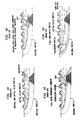
- FIGs 1A, 1B, 1C, and 1D graphically show the progression of erosion of nourishment sand when a conventional breakwater structure is used.
- this figure depicts the initial situation just after nourishment sand has been filled behind a conventional breakwater to raise the sand profile. At this time, there is no erosion of the nourishment sand behind the breakwater. Beach replenishment in this fashion is cost effective only as long as the nourishment sand is retained for a reasonable period of time.
- the wave eddy and backwash cause progressive erosion in the landward direction of the nourishment sand behind the breakwater.
- the wave eddy and backwash also progressively scour deeper down behind the breakwater at the beachward face of the breakwater.
- the nourishment sand that is scoured from behind the breakwater due to the progressive erosion is transported by the combined eddy/backwash action to the seaward side of the breakwater.
- This sand may be deposited on, or seaward of, the seaward face of the breakwater. The depositing of this sand, as shown in Figure 1C, results in reducing the efficiency of the breakwater.
- FIG. 1D the final equilibrium sand profile is shown for the situation when a conventional breakwater is used as a perch. As is shown in Figure 1D, more than half of the nourishment sand has been lost due to the eddy/backwash action scouring nourishment sand from behind the breakwater. This scouring and nourishment sand loss extends all the way landward to the water's edge.
- the present invention is a submerged modular breakwater that may be used as a perch for retaining nourishment sand that has been supplied to a beach to raise the sand profile.
- the breakwater of the present invention is formed from a plurality of modules. Each module includes a base suitable for supporting the module on the seabed, a gently sloping seaward face that extends above the base from one end, and a sloping beachward face that extends above the base from the opposite end.
- the tops of the seaward and backward faces meet to form a top section that has features important to the present invention.
- the seaward face has a transversely extending concave surface at its top portion. This concave surface is for directing fluid currents over the top edge of the module and away from the beachward face. The concave surface also reduces the velocity of the waves passing over the breakwater and this minimizes the velocity of currents that may reach the nourishment sand behind the breakwater via any eddy.
- the seaward face also has a plurality of parallel, spaced apart, transversely disposed wave dissipation grooves disposed between the seaward toe of the seaward face and the bottom of the transversely disposed concave surface.
- the beachward face has a plurality of sand retaining/wave dissipation grooves disposed across a center portion.
- the top portion of the beachward face has a transversely disposed concave cutout that extends across the beachward face.
- the cutout has two spaced apart, vertically extending concave channels that connect to respective openings in the top of the breakwater module. These concave channels direct backwash water through the openings in the top of the module.
- the concave cutout causes backwash water that enters it to move in a swirling motion. This removes a significant amount of sand nourishment from this backwash water. Some of the backwash water in the concave cutout is forced in the concave channels and form high pressure streams that exit through the openings in the top of the breakwater module. These high pressure streams allow backwash water to pass seaward over the breakwater module but significantly reduce the amount of nourishment sand that accompanies the backwash water that passes over the breakwater in the seaward direction.
- the breakwater of the present invention also has a means that is disposed across the openings between adjacent modules so that sand that accompanies backwash water does not pass between modules. This assists in retaining the nourishment sand that ordinarily would be lost.
- Figures 1A, 1B, 1C, and 1D depict the problems associated with using a conventional breakwater as a perch to retain nourishment sand that has been filled behind the breakwater to raise the sand profile.
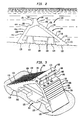
- Figure 2 is a left end view of a module of the breakwater of the present invention.
- Figure 3 is a top right rear perspective view of a module of the breakwater of the present invention.
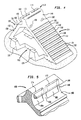
- Figure 4 is a top left front perspective view of a module of the breakwater of the present invention.
- Figure 5 is a cut away perspective view of the top portion of the beachward face of a module of the breakwater of the present invention.
- Figure 6 is a rear view of the top portion of the beachward face of a module of the breakwater of the present invention.
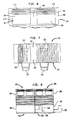
- Figure 7 is a top perspective view of a module of the breakwater of the present invention showing the tenons and mortises (in phantom) that are used for connecting adjacent modules.
- Figure 8 is a rear view of adjacently coupled modules of the breakwater of the present invention.
- Figure 9 shows the equilibrium condition and the resulting sand profile for a beach when the nourishment sand has been retained by the modular breakwater of the present invention.
- the present invention is a modular breakwater that is used as a perch for retaining nourishment sand of the beach.
- the modular breakwater of the present invention consists of a plurality of coupled modules. These modules when coupled form the continuous breakwater of the present invention.
- This breakwater of the present invention performs wave dissipation and wave directing functions as well as reducing the amount of nourishment sand that is lost due to eddy/backwash action caused by waves that pass over the breakwater.
- the modules that form the breakwater of the present invention will be described referring to Figures 2 to 8.
- Figure 9 which shows the equilibrium condition sand profile for a beach where the breakwater of the present invention is used, will then be discussed.
- Module 100 has base 102, gentle sloping seaward face 104, and sloping beachward face 106. As shown, module 100, formed by base 102, seaward face 104, and beachward face 106, generally has a triangular-prismatic shape. The seaward and beachward faces meet to form top section 108 that is configured for reducing the amount of nourishment sand in the backwash that is able to pass over the breakwater to seaward.
- Base 102 is configured to rest on the sea bottom.
- Base 102 has anchoring structures 120 disposed at the bottom that assist in keeping each module in the location where it is placed.
- anchoring structures 120 are in the form of anchoring or gripping feet such as those shown in Figure 2. These feet have a saw tooth configuration and extend across the width of the module. Because objects positioned on the sea bottom have a tendency to be drawn seaward by wave backwash and the modules are subject to incoming wave action, anchoring or gripping feet 120 are pointed seaward and beachward.
- Base 102 has tenons 122 and 124 that extend from the left side.
- Base 102 also has mortises 220 and 222 ( Figure 3) disposed in the right side. The mortises and tenons, and their interlocking relationship will be described more fully when discussing Figures 7 and 8.
- seaward face 104 of module 100 will be described.
- Seaward face 104 of module 100 has wave dissipation means transversely disposed across it.
- These wave dissipation means are in the form of parallel, spaced apart, triangular grooves 130 that are separated by lands 132.
- Wave dissipation grooves 130 with lands 132 therebetween serve to dissipate the wave energy of incoming waves as these waves run up seaward face 104. Wave dissipation grooves 130 do this without creating secondary reflective wave energy.
- a washboard configuration or a system of small surface protrusions or bumps may be used to replace the configuration of transversely disposed parallel, spaced apart, grooves with lands therebetween that are part of module 100 shown in Figures 2 and 4.
- Wave dissipation grooves 130 with lands 132 therebetween also serve to release silt or sand that is suspended in the water such that the silt and sand slide down the seaward face to replenish the sand that has been removed from adjacent the seaward toe of module 100. This overcomes the affect of toe scour at the seaward toe.
- Seaward face 104 has transversely disposed deflector 140 that is located between the top of the series of wave dissipation grooves 130 and the top of module 100.
- deflector 140 is in the form of a transversely disposed, recessed, concave member. As shown in Figures 2 and 4, concave deflector 140 extends the entire width of seaward face 104 and has a substantially constant radius of curvature.
- concave deflector 140 The curvature of concave deflector 140 is such that an incoming wave is deflected over the top of module 100 and away from the nourishment sand behind the breakwater of the present invention.
- a line tangent to the upper most portion of concave deflector 140 forms an angle with a vertical line that is normal to the plane of base 102 of at least 30 degrees.
- concave deflector 140 prevents high velocity currents and eddies from developing any sufficient strength at the beachward face of module 100.
- Beachward face 106 will be described referring to Figures 2 and 3. Beachward face 106 forms a steeper angle with base 102 than seaward face 104. A center portion of beachward face 106 has a plurality of transversely disposed, parallel, spaced apart, triangular grooves 150 extending the width of module 100. Grooves 150 have lands 152 between them. Grooves 150 are sand retaining/wave dissipating grooves that are used to catch sand, silt, or the like in the backwash to help retain the nourishment sand behind the breakwater and dissipate the backwash to some degree.
- the top portion of beachward face 106, above transversely disposed grooves 150 at top section 108, will be described referring to Figures 2, 3, 4, 5, and 6.
- the top portion of beachward face 106 at top section 108 includes transversely disposed concave cutout 160.
- Concave cutout 160 is much deeper than concave deflector 140. Concave cutout 160 caused the backwash water that enters it to move in a swirling motion. This causes the captured backwash water to release a significant amount of the nourishment sand that it is carrying.
- Concave cutout 160 has vertically disposed concave channels 162 and 164 cut into it.
- Channel 162 is defined by side member 166 and center member 168
- channel 164 is defined by side member 170 and center member 168.
- Center member 168 separates the two concave channels.
- Channel 162 reduces in rectangular cross-sectional size as it approaches opening 172 at the top of module 100.
- channel 164 reduces in rectangular cross-sectional size as it approaches rectangular opening 174.
- the shape of these channels will cause a portion of backwash water in concave cutout 160 to be forced into them.
- This backwash water will be emitted from rectangular openings 172 and 174 at high velocity.
- the high velocity flows formed from the backwash will allow backwash to flow over module 100 to seaward but reduce the amount of nourishment sand that accompanies this backwash.
- the nourishment sand from the backwash that is retained falls behind the module near the beachward face to replenish some of the scour that occurs. Also some of this nourishment sand is picked up by the next wave and carried landward and adds to the sand profile behind the breakwater.
- Beachward face 106 at top section 108 has pertruding ledge 180 disposed from the top of concave cutout 160.
- Pertruding ledge 180 extends the width of the module and assists in channeling backwash water into concave cutout 160, and also concave channels 162 and 164 in cutout 160, and reducing the scour affects of any eddies that are formed.
- the preferred embodiment of the present invention includes concave cutout 160, and concave channels 162 and 164 that connect to rectangular openings 172 and 174, respectively, it is to be understood that the top section of module 100 may have any configuration that results is substantially reducing the amounts of nourishment sand in the backwash that passes over the breakwater to seaward.
- module 100 of the breakwater of the present invention being configured to reduce the amount of nourishment sand being lost, some is lost.
- the velocity of the sand as it comes over module 100 is greatly reduced and in many cases will fall onto the seaward face of module 100.
- the next wave rides up the seaward face and over the top of module 100, much of this sand is brought back over the module and added to the sand profile. This will be described in greater detail in discussing Figure 9.
- the breakwater of the present invention consists of a plurality of modules 100 that are adjacently disposed. These adjacently disposed modules are connected via tenons 122 and 124 that extend from the left side of base 102 and mortises 220 and 222 configured in the right side of base 102. Tenons 122 and 124 of one module fit into mortises 220 and 222 of an adjacent module, thereby disposing the modules in a side-by-side relationship as shown in Figure 8. Tenons 122 and 124 are L-shaped. Mortises 220 and 222 are shown in phantom in Figures 7 and 8 and are formed in base 102 and an opening is provided in the base through which the vertical portion of the tenon extends.
- each module has two tenons and mortises.
- the number of mortises and tenons may be increased or decreased.
- the breakwater When the breakwater is formed from the plurality of adjacently disposed modules 100, there are small areas of separation between these adjacent modules. These separations can permit backwash water and the nourishment sand that it carries to flow through them. These flows can amount to significant amounts of nourishment sand being lost as the breakwater becomes longer and longer.
- a flexible material is disposed either over each seam between adjacent modules or a long sheet of this material is extended along the entire length of the breakwater over the beachward faces of the plurality of modules. In each case, however, the beachward face of the breakwater presents a continuous surface containing no areas of separation between adjacent modules.
- the material has a thickness and flexibility that will allow it to conform to the shape of the beachward face.
- This material is disposed below the concave cutout 160 and extends over grooves 150 in beachward face 106.
- This material in response to backwash water, will conform to the shape of these grooves, thereby the purpose of the grooves is not affected by the material.
- this material is a filter fabric that is commercially available from EXXON Corporation.
- Each module has holes 190 and 192 disposed in the seaward face at concave deflector 140. These holes are used for lifting the module for its placement in its position in the submerged breakwater of the present invention. Lifting straps or lifting cables can be inserted through holes 190 and 192 for the purpose of placement of the modules.
- each of the modules is prepared using micro-silica concrete having a compression strength of 8000 PSI. This material provides a long life in the seawater environment for the modules made from it.
- base 102 is approximately 18 feet long and the module is approximately 8 feet high.
- seaward face 104 forms an angle of about 25 degrees with base 102 and beachward face 106 forms an angle of about 40 degrees with base 102.
- Tenons 122 and 124 extend approximately 2 feet from the left side of base 102, and mortises 220 and 224 have a maximum depth of a little over 2 feet.
- Concave deflector 140 has a radius of curvature of about 36 degrees and concave cutout 160 has a radius of curvature of about 180 degrees.
- Each module weighs approximately 20 tons.
- Figure 9 depicts an equilibrium condition sand profile for a beach that has used the breakwater of the present invention as a perch.
- the initial sand profile for such a beach is similar to that shown in Figure 1A, but a breakwater of the present invention is used.
- FIG 300 shows that erosion behind the breakwater as shown at 300 in Figure 9.
- a comparison of Figures 1D and 9 shows that erosion is significantly reduced when the breakwater of the present invention is used.
- the erosion or scour behind the breakwater of the present invention in the landward direction extends 1 1/2 to 2 times the length of module. This scour will also extend down about 1/2 of the length of the beachward face.
- sand that is returned to the beachward side of the breakwater from the seaward face increases the sand profile as shown at 302. Therefore, the breakwater of the present invention significantly improves the retention of nourishment sand when it is used as a perch.
Landscapes
- Engineering & Computer Science (AREA)
- General Engineering & Computer Science (AREA)
- Environmental & Geological Engineering (AREA)
- Ocean & Marine Engineering (AREA)
- Mechanical Engineering (AREA)
- Civil Engineering (AREA)
- Structural Engineering (AREA)
- Revetment (AREA)
Applications Claiming Priority (2)
| Application Number | Priority Date | Filing Date | Title |
|---|---|---|---|
| US07/862,852 US5238326A (en) | 1992-04-03 | 1992-04-03 | Submerged breakwater for use as a perch for sand retention |
| US862852 | 1992-04-03 |
Publications (1)
| Publication Number | Publication Date |
|---|---|
| EP0564300A1 true EP0564300A1 (fr) | 1993-10-06 |
Family
ID=25339543
Family Applications (1)
| Application Number | Title | Priority Date | Filing Date |
|---|---|---|---|
| EP93302612A Withdrawn EP0564300A1 (fr) | 1992-04-03 | 1993-04-01 | Brise-lame immergé utilisé pour la retenue du sable |
Country Status (6)
| Country | Link |
|---|---|
| US (1) | US5238326A (fr) |
| EP (1) | EP0564300A1 (fr) |
| BR (1) | BR9301437A (fr) |
| CA (1) | CA2093285A1 (fr) |
| IL (1) | IL105282A (fr) |
| ZA (1) | ZA932396B (fr) |
Cited By (1)
| Publication number | Priority date | Publication date | Assignee | Title |
|---|---|---|---|---|
| KR20200063828A (ko) * | 2018-11-28 | 2020-06-05 | 한국해양과학기술원 | 국지적인 해빈침식을 방지하는 호형 모래조형물 및 그 시공방법 |
Families Citing this family (22)
| Publication number | Priority date | Publication date | Assignee | Title |
|---|---|---|---|---|
| US5509755A (en) * | 1993-12-27 | 1996-04-23 | Olsen; Glenn C. | Sand dune and shore-line erosion prevention system |
| US5536112A (en) * | 1995-03-16 | 1996-07-16 | Oertel, Ii; George F. | Breakwater generating apparatus and process for controlling coastal erosion |
| US5879105A (en) * | 1996-12-18 | 1999-03-09 | Bishop; Robert | Wave energy dispersion system |
| USD403780S (en) * | 1996-12-18 | 1999-01-05 | Robert Bishop | Wave energy extraction module |
| US5899632A (en) * | 1997-03-03 | 1999-05-04 | David J. Eardley | Beach restoration structure and method |
| US5863150A (en) * | 1997-10-01 | 1999-01-26 | Wells; Raymond | Wind directing sea wall |
| JP2002522664A (ja) * | 1998-08-07 | 2002-07-23 | ホール,アレシア,ロザリンド,メラニー | 人工岩礁ユニットを形成する方法 |
| ATE336618T1 (de) * | 2000-08-29 | 2006-09-15 | Artificial Surf Reefs Ltd | Methode zum küstenschutz |
| US20020132539A1 (en) * | 2000-11-09 | 2002-09-19 | Smith Dennis G. | Ribbed module for wave energy dispersion |
| US6669403B2 (en) * | 2002-04-06 | 2003-12-30 | Wave Control Systems Inc. | Wave attenuator |
| ES2222087B1 (es) * | 2003-05-15 | 2005-12-16 | Universidad Politecnica De Valencia | Dique modular para la proteccion de costas. |
| US8287209B2 (en) * | 2008-12-11 | 2012-10-16 | Boris Feldman | Protective flood barrier system |
| JP6786203B2 (ja) * | 2015-09-10 | 2020-11-18 | 五洋建設株式会社 | 潜堤構築材料およびこの材料を用いた潜堤構造 |
| KR101697605B1 (ko) * | 2016-03-09 | 2017-01-19 | 조준호 | 표사제어용 블럭체 |
| US10400406B2 (en) | 2016-05-10 | 2019-09-03 | COWI Marine North America | Wave dissipation systems, modules and methods for constructing the same |
| DE102017108979B3 (de) * | 2017-04-26 | 2018-05-24 | Klaus Schäfer | Wellenbrechervorrichtung für den Küsten- und Uferschutz |
| CN110258437A (zh) * | 2019-05-27 | 2019-09-20 | 交通运输部天津水运工程科学研究所 | 内河航道工程中鱼类栖息地的构建方法 |
| US20210115638A1 (en) * | 2019-10-22 | 2021-04-22 | Pepsy M. Kettavong | Smart breakwall diversion system |
| US11661716B1 (en) | 2019-12-09 | 2023-05-30 | David Jonassen | Erosion control system for preventing shoreline erosion |
| JP6829758B2 (ja) * | 2019-12-26 | 2021-02-10 | 五洋建設株式会社 | 潜堤構築材料およびこの材料を用いた潜堤構造 |
| CN216948072U (zh) * | 2022-03-01 | 2022-07-12 | 丰和营造集团股份有限公司 | 一种海岸带生态防护墙及其生态防护治理结构 |
| IT202400004192A1 (it) | 2024-02-27 | 2025-08-27 | Antonio Mele | Sistema multifunzionale bioispirato per la protezione delle linee di costa e produzione energia |
Citations (4)
| Publication number | Priority date | Publication date | Assignee | Title |
|---|---|---|---|---|
| FR1215413A (fr) * | 1957-12-02 | 1960-04-19 | Christiani & Nielsen As | Dispositif statique pour contrôler le comportement des matières solides en suspension au-dessus du fond de la mer ou des lacs |
| US3875750A (en) * | 1974-01-04 | 1975-04-08 | Herbert Campbell | Modular erosion control device |
| WO1989009308A1 (fr) * | 1988-03-22 | 1989-10-05 | Grant, Michael, John | Procede et dispositif dissipant l'energie vibrationnelle et controlant l'erosion sur les littoraux |
| EP0449624A1 (fr) * | 1990-03-30 | 1991-10-02 | Breakwaters International, Inc. | Brise-lames |
Family Cites Families (7)
| Publication number | Priority date | Publication date | Assignee | Title |
|---|---|---|---|---|
| US4502816A (en) * | 1983-06-27 | 1985-03-05 | Creter Vault Corp. | Shoreline breakwater |
| US4498805A (en) * | 1983-11-29 | 1985-02-12 | Weir Frederick E | Breakwater module and means for protecting a shoreline therewith |
| US4818141A (en) * | 1984-12-24 | 1989-04-04 | Rauch Hans G | Prefabricated erosion prevention wall |
| US4804294A (en) * | 1986-06-03 | 1989-02-14 | Barthel Ted F | Method and means for improved erosion control |
| US4784521A (en) * | 1987-02-03 | 1988-11-15 | Martin David T | Ocean diversion wall |
| US5011328A (en) * | 1989-01-23 | 1991-04-30 | Atkinson Francis S | Permeable breakwater |
| US5120156A (en) * | 1990-08-31 | 1992-06-09 | Rauch Hans G | Submerged breakwater and barrier reef |
-
1992
- 1992-04-03 US US07/862,852 patent/US5238326A/en not_active Expired - Lifetime
-
1993
- 1993-04-01 EP EP93302612A patent/EP0564300A1/fr not_active Withdrawn
- 1993-04-02 ZA ZA932396A patent/ZA932396B/xx unknown
- 1993-04-02 CA CA002093285A patent/CA2093285A1/fr not_active Abandoned
- 1993-04-02 IL IL10528293A patent/IL105282A/en not_active IP Right Cessation
- 1993-04-05 BR BR9301437A patent/BR9301437A/pt not_active Application Discontinuation
Patent Citations (4)
| Publication number | Priority date | Publication date | Assignee | Title |
|---|---|---|---|---|
| FR1215413A (fr) * | 1957-12-02 | 1960-04-19 | Christiani & Nielsen As | Dispositif statique pour contrôler le comportement des matières solides en suspension au-dessus du fond de la mer ou des lacs |
| US3875750A (en) * | 1974-01-04 | 1975-04-08 | Herbert Campbell | Modular erosion control device |
| WO1989009308A1 (fr) * | 1988-03-22 | 1989-10-05 | Grant, Michael, John | Procede et dispositif dissipant l'energie vibrationnelle et controlant l'erosion sur les littoraux |
| EP0449624A1 (fr) * | 1990-03-30 | 1991-10-02 | Breakwaters International, Inc. | Brise-lames |
Cited By (1)
| Publication number | Priority date | Publication date | Assignee | Title |
|---|---|---|---|---|
| KR20200063828A (ko) * | 2018-11-28 | 2020-06-05 | 한국해양과학기술원 | 국지적인 해빈침식을 방지하는 호형 모래조형물 및 그 시공방법 |
Also Published As
| Publication number | Publication date |
|---|---|
| BR9301437A (pt) | 1993-10-05 |
| US5238326A (en) | 1993-08-24 |
| CA2093285A1 (fr) | 1993-10-04 |
| IL105282A (en) | 1996-01-31 |
| ZA932396B (en) | 1994-10-03 |
| IL105282A0 (en) | 1993-08-18 |
Similar Documents
| Publication | Publication Date | Title |
|---|---|---|
| US5238326A (en) | Submerged breakwater for use as a perch for sand retention | |
| US5102257A (en) | Breakwater | |
| US4367978A (en) | Device for preventing beach erosion | |
| KR100757558B1 (ko) | 호안 블록 및 매트 | |
| US3913333A (en) | Means and apparatus for controlling fluid currents and selectively preserving and modifying topography subjected thereto | |
| US3886750A (en) | Oil containment apparatus | |
| US4657433A (en) | Shoreline erosion control mat and method of use therefor | |
| US3938340A (en) | Fish holding chamber | |
| US3768656A (en) | Oil accumulator | |
| JP4856801B2 (ja) | 富栄養化した湖沼等における藻類を減少又はその増殖を抑制する方法、及びそのための装置 | |
| AU674670B2 (en) | Apparatus for dissipating wave energy | |
| AU9344101A (en) | Cleaning system for swimming pools and the like | |
| KR102354095B1 (ko) | 발전소 취수구의 해양생물 유입차단 그물망 | |
| EP0407432B1 (fr) | Procede et dispositif dissipant l'energie vibrationnelle et controlant l'erosion sur les littoraux | |
| CN109750647A (zh) | 水表漂浮垃圾回收装置及方法 | |
| Nicolas et al. | Hydrosedimentary classification of natural and engineered backwaters of a large river, the lower Rhône: possible applications for the maintenance of high fish biodiversity | |
| KR200202705Y1 (ko) | 트롤형 자치어그물 | |
| CA1328997C (fr) | Article de peche fixe et passif | |
| CN216839261U (zh) | 一种生态护岸结构 | |
| Weisman et al. | Maintaining tidal inlet channels by fluidization | |
| KR20220088064A (ko) | 국지적인 해안침식을 예방하기 위한 투과성 호형 이안제 | |
| KR101074679B1 (ko) | 해안침식방지블록 | |
| Kumar et al. | Inlet sequence formed by the migration of Fire Island inlet, Long Island, New York | |
| KR101161424B1 (ko) | 생태하천의 생태보호시설 | |
| CN216892595U (zh) | 一种水利工程用清淤装置 |
Legal Events
| Date | Code | Title | Description |
|---|---|---|---|
| PUAI | Public reference made under article 153(3) epc to a published international application that has entered the european phase |
Free format text: ORIGINAL CODE: 0009012 |
|
| AK | Designated contracting states |
Kind code of ref document: A1 Designated state(s): BE DE ES FR GB GR IT NL PT |
|
| 17P | Request for examination filed |
Effective date: 19940323 |
|
| 17Q | First examination report despatched |
Effective date: 19950622 |
|
| GRAG | Despatch of communication of intention to grant |
Free format text: ORIGINAL CODE: EPIDOS AGRA |
|
| GRAG | Despatch of communication of intention to grant |
Free format text: ORIGINAL CODE: EPIDOS AGRA |
|
| GRAG | Despatch of communication of intention to grant |
Free format text: ORIGINAL CODE: EPIDOS AGRA |
|
| GRAH | Despatch of communication of intention to grant a patent |
Free format text: ORIGINAL CODE: EPIDOS IGRA |
|
| 18D | Application deemed to be withdrawn |
Effective date: 19980717 |