EP0565082A2 - Plancher élastique - Google Patents
Plancher élastique Download PDFInfo
- Publication number
- EP0565082A2 EP0565082A2 EP93105769A EP93105769A EP0565082A2 EP 0565082 A2 EP0565082 A2 EP 0565082A2 EP 93105769 A EP93105769 A EP 93105769A EP 93105769 A EP93105769 A EP 93105769A EP 0565082 A2 EP0565082 A2 EP 0565082A2
- Authority
- EP
- European Patent Office
- Prior art keywords
- flooring according
- load distribution
- layer
- sports
- sports flooring
- Prior art date
- Legal status (The legal status is an assumption and is not a legal conclusion. Google has not performed a legal analysis and makes no representation as to the accuracy of the status listed.)
- Withdrawn
Links
Images



Classifications
-
- E—FIXED CONSTRUCTIONS
- E04—BUILDING
- E04F—FINISHING WORK ON BUILDINGS, e.g. STAIRS, FLOORS
- E04F15/00—Flooring
- E04F15/22—Resiliently-mounted floors, e.g. sprung floors
-
- E—FIXED CONSTRUCTIONS
- E04—BUILDING
- E04F—FINISHING WORK ON BUILDINGS, e.g. STAIRS, FLOORS
- E04F15/00—Flooring
- E04F15/18—Separately-laid insulating layers; Other additional insulating measures; Floating floors
- E04F15/20—Separately-laid insulating layers; Other additional insulating measures; Floating floors for sound insulation
- E04F15/203—Separately-laid layers for sound insulation
Definitions
- the invention relates to a sports floor, in particular for gymnastics and multi-purpose halls, with mutually spaced resilient elements for supporting a load distribution layer formed by panels or the like made of wood or similar material on an underbody.
- a sports floor of the type mentioned is known from DE 38 38 733 A1. With this sports floor, a reduction in the deflection of the load distribution layer is advantageously achieved.
- the invention is based on the object to improve the sports floor of the type mentioned in such a way that it shows a higher response.
- the invention provides a sports floor in which the grooves or saw cuts made in the load distribution layer create a high response behavior in that the mass of the individual areas impacted by impacts or the like is reduced. Decoupling of adjacent areas is achieved by means of the grooves or saw cuts, and consequently a reduction in the load, based on a point or a surface of the sports floor that is subjected to an acting force.
- the sports floor has a load distribution layer, on the underside of which, in the area of the grooves, resilient elements which are adapted in profile are inserted.
- the height of the resilient elements is selected such that a predetermined distance between the load distribution layer and the underbody is maintained in the unloaded state of the sports floor.
- the resilient elements which are made of an elastic material, compress, the deflection of the load distribution layer being limited when the load distribution layer comes to rest on the sub-floor.
- the grooves or saw cuts which are made in a grid-like structure from the underside of the load distribution layer, preferably run centrally above the resilient elements.
- an elastic mat is additionally provided between the resilient elements, which is attached to the load distribution layer, for example glued on, and maintains a predetermined distance from the underbody in the unloaded state of the sports floor as well as the resilient elements.
- the resilient elements are fastened, for example glued, to the lower surface of the load distribution layer, that is to say they are placed directly on the lower surface of the load distribution layer in the region of the lattice-shaped grooves which are designed as saw cuts.
- an elastic mat attached to the lower surface of the load distribution layer and having the same height as the resilient elements can be provided.
- the vibrating floor according to the invention has surface elastic properties and a very uniform and relatively small deformation trough.
- the elasticity of the vibrating floor responds quickly even at low loads, for example when exposed to children.
- the elasticity curve is markedly progressive, which means that it decreases rapidly as the load increases.
- the response of the elasticity and the ball reflection of the vibrating floor are decisively determined by the mass of the surface, i.e. the load distribution layer together with the top covering.
- a mass that is too high that is, a surface that is too thick, too heavy, and also too rigid, makes the resilience and thus the force reduction desired by the athlete when running and jumping insufficiently effective.
- the loss of force is hardly or not at all effective with high-mass floors.
- the vibrating floor according to the invention also has a high level of functional stability.
- Wood which has many advantages, is preferably used as the load distribution layer, in particular it is a healthy material, physiologically and ecologically problem-free.
- Figure 1 shows a first embodiment of a sports floor.
- the sports floor consists of a load distribution layer 1, on which an upper surface is provided.
- Grooves 6, 7, preferably in a lattice-shaped structure, are formed on the underside of the load distribution layer 1, the grooves 6, 7 being able to be provided by saw cuts in the form of saw cuts, ie grooves of comparable width.
- Resilient elements 3, 4 are inserted into these grooves 6, 7 in a manner to be described.
- the arrangement described above is located on an underbody designated by 14.
- an elastic layer 26 is arranged between the downward-facing surface of the load distribution layer 1 and the surface of the underbody 14, which in the embodiment shown completely fills the space between the load distribution layer 1 and the underbody.
- the resilient elements 3, 4 are strip-shaped or block-shaped elements, ie the resilient elements 3, 4 can completely or only partially fill the grooves 6, 7.
- the plates 21, 22 which fix the load distribution layer 1 are provided with tongue sections 23 and groove sections 24, whereby the plates 21, 22 can be inserted into one another in the horizontal direction.
- the elastic elements 3, 4 are inserted into the grooves 6, 7 of the carrier plate.
- An additional mat in the form of the elastic layer 26 is arranged between the underbody 14 and the load distribution layer 1, the thickness of which is 50 as the elastic elements 3, 4 project beyond the underside of the load distribution layer or carrier plate 1.
- the elasticity of the layer 26 is greater than that of the resilient elements 3, 4.
- a support block 20 is arranged below the tongue and groove connection 23, 24, the height of which corresponds to the height of the layer 26, i. H. the support blocks 20 lie in the region of the joint between adjacent plates 21, 22 below the load distribution layer 1 and support adjacent plates 21, 22.
- the load distribution layer 1 is preferably made of plywood, chipboard or wood fiber boards, possibly also made of plastic and has a thickness of 15 mm, for example.
- the resilient elements 3, 4 have a height such that in the embodiment shown they protrude from the lower surface 12 of the load distribution layer by a height of 5 mm. As can be seen from FIG. 1, the elements 3, 4 rest on the underbody 14.
- the elements 3, 4 are preferably firmly connected to the load distribution layer 1 by adhesive or the like. Linoleum or the like is usually used as the top covering 2, the underbody 14 is generally designed in the form of a screed layer.
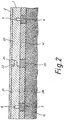
- Figure 2 shows in section a further embodiment of a sports floor.
- the sports flooring according to FIG. 2 has essentially the same layered structure as was described in connection with FIG. 1.
- the grooves 6, 7, which extend into the layer 1 from the lower surface of the load distribution layer 1 are relatively small Have width and are preferably formed in the form of saw cuts on the lower layer of the load distribution layer 1.
- the elements 3, 4 are each arranged approximately centrally below the saw cuts 6, 7 and firmly connected to the load distribution layer 1 by adhesive or the like.
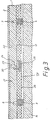
- FIG. 1 shows in section a further embodiment of a sports floor.
- the elements 3, 4 can be strip-shaped or block-shaped.
- an elastic layer 26 is provided between the load distribution layer 1 and the underbody 14, which fills all or most of the space between the load distribution layer 1 and the underbody 14 on the side of the elements 3, 4. 2, the thickness of the layer 26 is equal to the height of the resilient elements 3, 4.
- the elasticity of the elements 3, 4, on the other hand, is different from that of the layer 26, as described in connection with FIG. 1.
- support blocks 20 are arranged on the joints or tongue-and-groove connections 23, 24 of the plates of the load distribution layer 1, which are arranged below the adjoining plates which form the load distribution layer 1 and have the same height like elements 3, 4 or layer 26.
- the material of the support blocks 20 preferably has the same elasticity as that of elements 3, 4.
- FIGS. 1 and 2 represent so-called non-ventilated sports floors
- so-called ventilated sports floors according to the invention are described below with reference to FIGS. 3 and 4.
- FIG. 3 corresponds essentially to the embodiment of Figure 2, but with the proviso that the layer 26 has a smaller thickness than the height of the elements 3, 4, so that in the unloaded state of the sports floor, an air gap designated 27 between the upper surface of the underbody 14 and the downward facing surface of the layer 26 is set.
- Layer 26 is e.g. B. attached by adhesive bonding to the lower surface of the load distribution layer.
- a strip 30 is attached to the plate 21 from below on each plate 21, e.g. B. by screwing.
- the strip 30 protrudes laterally over the plate 21 in the direction of the adjacent plate 22, so that the strip 30 engages under the plate 22, as illustrated in FIG. 3.
- the strip 30 can be glued to the plate 22, for example.
- a support block 20 can be provided below the bar 30, which has a height which is reduced by the thickness of the bar 30 compared to the height of the elastic layer 26, as a result of which the support block 20 maintains a distance from the underbody 14 in the unloaded state of the sports floor .
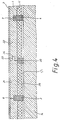
- FIG. 4 shows an embodiment of a sports floor which essentially has the structure described in connection with FIG. 1, but with the difference that, analogously to the embodiment according to FIG. 3, the layer 26 maintains a distance 27 from the underbody 14 in the unloaded state of the floor. This is achieved in that the layer 26 has a smaller thickness compared to the distance between the lower surface of the load distribution layer 1 and the upper surface of the underbody 14.
- the resilient elements 3, 4 in the embodiment according to FIG. 4 are analogous to the embodiment according to FIG 1 inserted in grooves 6, 7, the width of the grooves 6, 7 being approximately equal to that of the elements 3, 4.
- the plates 21, 22 are supported in the area of their tongue and groove connection 23, 24 by support blocks 20 on the underbody 14.
- the support blocks 20 have a thickness that corresponds to the distance between the load distribution layer 1 and the sub-floor 14 and is therefore greater than the thickness of the layer 26.
- the resilient elements 3, 4 have a height in comparison to the support blocks 20 that by Depth of the grooves 6, 7 is greater.
- FIG. 5 shows a further embodiment of the sports floor according to the invention in the area of the edge connection between the two plates 21, 22.
- a step 25 is formed between the plates 21, 22, as can be seen from Figure 5.
- Such a step or interlock 25 between the plates 21, 22 is supplemented by a bar 30, preferably attached to the underside of the plate 22, which projects laterally in the direction of the plate 21 and engages under the plate 21.
- a support block 20 can be provided which, with its surface facing downward, is aligned with the lower surface of the layer 26.
- the grooves 6, 7 have a lattice-like structure and cause a decoupling of adjacent areas of the load distribution layer 1. This results in a higher elasticity or a higher response behavior of the sports floor when point or surface forces occur.
- the resilient elements 3, 4 have, for example, the form of strips which are provided parallel to or in the grooves 6, 7. If the elements 3, 4 are designed as blocks, they are positioned at a distance from one another on the grid-shaped structure of the grooves 6, 7.
- the height of the elements 3, 4 is selected such that the distance between the load distribution layer 1 and the sub-floor 14 is preferably 5 mm when the sports floor is unloaded.
- the layer 26 preferably consists of materials such as polyurethane, polyethylene, polyurethane-bound rubber granulate.
- Resilient elements 3, 4 are those made of polyurethane-bonded rubber granules or the like.
- a material is preferably used as the elastic layer, which additionally has sound-insulating and / or heat-insulating and / or moisture-insulating properties, insofar as such properties are desired for the application.
- the top covering 2 is usually made of linoleum, but can also consist of PVC, parquet or PUR coating.
- the load distribution layer 1 is supported by the elastic layer 26 on the underbody 14 in the event of heavy loads.
- the layer 26 thereby supports or reinforces the progressive suspension of the sports floor and is in the actual function of the sports floor, i. H. included in the elasticity and the loss of power as well as in the resilience of the sports floor.
- a sports floor with the construction described above results in a small-area elastic floor that fulfills the requirements in terms of sports and protection functions as well as in terms of building physics.
- the structure of the sports floor according to the invention is simple and safe and more cost-effective than known surface-elastic swing floors.
- the load distribution layer 1 is relatively flexible due to the construction described and speaks quickly when loaded on, ie it reacts quickly even at low loads and is therefore very well suited for children, adolescents on the one hand and adults on the other.
- the grooves or saw cuts 6, 7 are preferably provided at a distance of about 25 cm and extend from the lower surface of the layer 1 up to about half the thickness of the load distribution layer 1. In all embodiments, the elements 3, 4 protrude from the Lower edge of the load distribution layer or the elastic layer 26 of approximately 3 mm is preferred.
- the total height of the sports floor with a 2mm thick PVC covering as the top covering is preferably about 30mm.
- the load distribution layer consists of plates 21, 22 with a thickness of 15 mm, the grooves 6, 7 have a depth of approximately 7 mm and the width of the grooves is approximately 10 mm or, in the case of saw cuts, approximately 3 mm.
- the thickness of the layer 26 is preferably 10 mm, the elastic elements or strips 3, 4 have a width of 10 mm and a height as follows: Embodiment according to Figure 1 17mm Embodiment according to Figure 2 10mm Embodiment according to Figure 3 15mm Embodiment according to Figure 4 22mm
- the support block 20 is preferably made of the same material as the elements 3, 4.
- an elastic layer 26 is provided below the load distribution layer 1 in the described embodiments, this is at least partially recessed in the area of the elements 3, 4 or applied around these elements 3, 4.
- the distance between adjacent support elements 3, 4 is always the same, ie the Support block 20 is additionally located between the elements 3, 4 as soon as there is a joint between adjacent plates 21, 22, as is shown, for example, in FIGS. 1 to 4. If there is no joint between the elements 3, 4, the support block 20 is omitted.
- the support block 20 consists of a material that is harder than the elements 3, 4.
- the elements 3, 4 consist, for example, of polyurethane-bonded rubber granulate and the layer 26 of PURPE or PP foam.
- the grid-shaped grooves and the associated elastic strips each have the same spacing.
- the joints of the plates 21, 22 and the tongue and groove connections 23, 24 and / or the support blocks 20 are preferably arranged approximately centrally between the grooves 6, 7, so that the first groove 6, 7 at half the distance of the grooves 6, 7 on Edge area of the carrier plate is milled or provided.
- FIG. 6 Another modification of the sports flooring according to the invention is described with reference to FIG.
- the sports floor shown in FIG. 6 has a structure as described in connection with FIGS. 3 to 5.
- the gap 27 (FIG. 4) that results from this in relation to the underbody 14 is filled in by an additional layer 28.
- an additional elastic layer 28 is thus provided below the elastic layer 26, which can be glued to the layer 26, for example, and thus in comparison to the constructions with the air gap 27 prevents the definition of a cavity.
- the layer 28 thus has a sound-absorbing or sound-absorbing and additionally heat-insulating effect.
- the layer 28 preferably has a density which is less than that of the layer 26.
- the degree of elasticity of the layer 28 is preferably higher than that of the elastic layer 26.
Landscapes
- Engineering & Computer Science (AREA)
- Architecture (AREA)
- Civil Engineering (AREA)
- Structural Engineering (AREA)
- Floor Finish (AREA)
Applications Claiming Priority (2)
| Application Number | Priority Date | Filing Date | Title |
|---|---|---|---|
| DE4211848A DE4211848C2 (de) | 1992-04-08 | 1992-04-08 | Sportboden |
| DE4211848 | 1992-04-08 |
Publications (2)
| Publication Number | Publication Date |
|---|---|
| EP0565082A2 true EP0565082A2 (fr) | 1993-10-13 |
| EP0565082A3 EP0565082A3 (en) | 1994-11-23 |
Family
ID=6456410
Family Applications (1)
| Application Number | Title | Priority Date | Filing Date |
|---|---|---|---|
| EP19930105769 Withdrawn EP0565082A3 (en) | 1992-04-08 | 1993-04-07 | Sprung floor |
Country Status (2)
| Country | Link |
|---|---|
| EP (1) | EP0565082A3 (fr) |
| DE (1) | DE4211848C2 (fr) |
Cited By (13)
| Publication number | Priority date | Publication date | Assignee | Title |
|---|---|---|---|---|
| EP0690185A1 (fr) * | 1994-06-29 | 1996-01-03 | Geroclair | Latte de parquet |
| EP1026340A3 (fr) * | 1999-02-02 | 2000-11-02 | Kronospan AG | Panneaux pour former un revêtement de sol |
| EP1255000A3 (fr) * | 2001-05-04 | 2003-01-08 | Gummiwerk Kraiburg Relastec GmbH | Elément de revêtement de sol avec couche inférieure en matériau déformable élastiquement |
| EP1621699A1 (fr) * | 2004-07-27 | 2006-02-01 | Getzner Werkstoffe Holding GmbH | Moyens d'amortissement des vibrations et d'isolation thermique pour revêtement de sol flottant et structure de sol utilisant ces moyens |
| DE102007036267A1 (de) | 2007-08-02 | 2009-02-19 | Hamberger Industriewerke Gmbh | Flächenelastischer Boden und zugehörige Fußbodenplatte |
| WO2011144362A1 (fr) * | 2010-05-17 | 2011-11-24 | Tarkett Gdl | Revêtement de sol de base et système de revêtement de sol |
| EP2118373B1 (fr) * | 2007-03-15 | 2013-05-08 | Holz-Speckmann GmbH | Plaque de sol |
| EP2529062A4 (fr) * | 2010-01-29 | 2015-03-18 | Connor Sport Court International Llc | Carreau de sol synthétique ayant une structure de support partiellement flexible |
| US9089732B2 (en) | 2011-06-09 | 2015-07-28 | Vuly Trampolines Pty, Ltd. | Trampolines |
| WO2016179287A1 (fr) * | 2015-05-04 | 2016-11-10 | Connor Sports Flooring, Llc | Système de plancher amortisseur de vibrations |
| US9656110B2 (en) | 2001-11-20 | 2017-05-23 | Board & Batten International Inc. | Edge fittings for soft-edged trampolines |
| AT520639A4 (de) * | 2017-11-22 | 2019-06-15 | Getzner Werkstoffe Holding Gmbh | Trittschalldämmelement |
| WO2022171928A1 (fr) * | 2021-02-15 | 2022-08-18 | Suomen Betonilattiat Oy | Dalle de béton et procédé de fabrication d'un plancher en béton |
Families Citing this family (3)
| Publication number | Priority date | Publication date | Assignee | Title |
|---|---|---|---|---|
| DE29506406U1 (de) | 1995-04-13 | 1995-06-01 | Polysport + Elaku Sportbaustoffe GmbH, 70176 Stuttgart | Elastischer Fußboden |
| DE19811999C2 (de) * | 1998-03-19 | 2000-10-05 | Alfred Braig | Vorrichtung für Kunsttanzdarbietungen |
| DE102005013342B4 (de) * | 2005-03-21 | 2009-08-20 | Magg, Jürgen | Flick-Flack-Bahn |
Family Cites Families (7)
| Publication number | Priority date | Publication date | Assignee | Title |
|---|---|---|---|---|
| DK59329C (da) * | 1938-10-12 | 1941-12-22 | Bjoern Valeur Larsen | Fjedrende Gulv. |
| DE2335912A1 (de) * | 1973-07-14 | 1975-01-30 | Lieselotte Hofmann | Schwingboden |
| AT388958B (de) * | 1984-05-29 | 1989-09-25 | Weitzer & Soehne Holzverarbeit | Blindboden |
| DE3838733A1 (de) * | 1988-11-15 | 1990-05-17 | Osterwald Sportboden Gmbh | Sportboden |
| DE8901805U1 (de) * | 1989-02-16 | 1989-08-03 | Pooch, Hans-Dieter, 3000 Hannover | Schwingboden |
| DE8904346U1 (de) * | 1989-04-07 | 1989-06-08 | conlastic (R) kautschuk vertriebsgesellschaft mbH, 4005 Meerbusch | Pflasterelement |
| NO169185C (no) * | 1990-05-02 | 1992-05-20 | Boen Bruk As | Fjaerende idrettsgulv |
-
1992
- 1992-04-08 DE DE4211848A patent/DE4211848C2/de not_active Expired - Fee Related
-
1993
- 1993-04-07 EP EP19930105769 patent/EP0565082A3/de not_active Withdrawn
Cited By (19)
| Publication number | Priority date | Publication date | Assignee | Title |
|---|---|---|---|---|
| EP0690185A1 (fr) * | 1994-06-29 | 1996-01-03 | Geroclair | Latte de parquet |
| FR2721957A1 (fr) * | 1994-06-29 | 1996-01-05 | Geraud Pierre | Latte de parquet |
| EP1026340A3 (fr) * | 1999-02-02 | 2000-11-02 | Kronospan AG | Panneaux pour former un revêtement de sol |
| EP1255000A3 (fr) * | 2001-05-04 | 2003-01-08 | Gummiwerk Kraiburg Relastec GmbH | Elément de revêtement de sol avec couche inférieure en matériau déformable élastiquement |
| US9656110B2 (en) | 2001-11-20 | 2017-05-23 | Board & Batten International Inc. | Edge fittings for soft-edged trampolines |
| EP1621699A1 (fr) * | 2004-07-27 | 2006-02-01 | Getzner Werkstoffe Holding GmbH | Moyens d'amortissement des vibrations et d'isolation thermique pour revêtement de sol flottant et structure de sol utilisant ces moyens |
| EP2118373B1 (fr) * | 2007-03-15 | 2013-05-08 | Holz-Speckmann GmbH | Plaque de sol |
| DE102007036267A1 (de) | 2007-08-02 | 2009-02-19 | Hamberger Industriewerke Gmbh | Flächenelastischer Boden und zugehörige Fußbodenplatte |
| EP2529062A4 (fr) * | 2010-01-29 | 2015-03-18 | Connor Sport Court International Llc | Carreau de sol synthétique ayant une structure de support partiellement flexible |
| CN102906356A (zh) * | 2010-05-17 | 2013-01-30 | 塔吉特Gdl公司 | 基底地板和地板系统 |
| WO2011144362A1 (fr) * | 2010-05-17 | 2011-11-24 | Tarkett Gdl | Revêtement de sol de base et système de revêtement de sol |
| US8931226B2 (en) | 2010-05-17 | 2015-01-13 | Tarkett Gdl S.A. | Shock-absorbing prefabricated wood flooring |
| CN102906356B (zh) * | 2010-05-17 | 2015-09-23 | 塔吉特Gdl公司 | 基底地板和地板系统 |
| US9089732B2 (en) | 2011-06-09 | 2015-07-28 | Vuly Trampolines Pty, Ltd. | Trampolines |
| WO2016179287A1 (fr) * | 2015-05-04 | 2016-11-10 | Connor Sports Flooring, Llc | Système de plancher amortisseur de vibrations |
| US9803379B2 (en) | 2015-05-04 | 2017-10-31 | Connor Sports Flooring, Llc | Vibration damping floor system |
| AT520639A4 (de) * | 2017-11-22 | 2019-06-15 | Getzner Werkstoffe Holding Gmbh | Trittschalldämmelement |
| AT520639B1 (de) * | 2017-11-22 | 2019-06-15 | Getzner Werkstoffe Holding Gmbh | Trittschalldämmelement |
| WO2022171928A1 (fr) * | 2021-02-15 | 2022-08-18 | Suomen Betonilattiat Oy | Dalle de béton et procédé de fabrication d'un plancher en béton |
Also Published As
| Publication number | Publication date |
|---|---|
| DE4211848C2 (de) | 1994-07-07 |
| EP0565082A3 (en) | 1994-11-23 |
| DE4211848A1 (de) | 1993-10-14 |
Similar Documents
| Publication | Publication Date | Title |
|---|---|---|
| DE69100736T2 (de) | Federnder Sportboden. | |
| EP0098886B1 (fr) | Matelas d'un matériau élastique | |
| EP0565082A2 (fr) | Plancher élastique | |
| CH687715A5 (de) | Bodenbelag, insbesondere Sportplatzbelag. | |
| DE3838733C2 (fr) | ||
| EP2801662B1 (fr) | Pavé en bois et revêtement de surface en bois correspondant | |
| EP2839095A2 (fr) | Élément de sol et sol | |
| DE3106784A1 (de) | Elastisch nachgiebige sicherheitsbelagsplatte | |
| DE19938184A1 (de) | Plattenelement, insbesondere zur Verwendung als Fußbodenbelag oder Wandverkleidung | |
| DE10038534C2 (de) | Unterbau für Sportplätze, insbesondere Reitplätze | |
| EP0369423B1 (fr) | Plancher élastique | |
| DE3801445A1 (de) | Flaechenelastisches fussbodenelement | |
| EP1985175B1 (fr) | Plaque de revêtement de sol pour une étable | |
| EP1183138A1 (fr) | Lamelle de parquet, son utilisation pour produire un panneau ou un element de parquet, et element de parquet ainsi obtenu ainsi que procede pour produire une lamelle de parquet | |
| EP0105950B1 (fr) | Panneau constitué d'un matériau élastique | |
| DE8518543U1 (de) | Sportboden | |
| CH672431A5 (fr) | ||
| DE1993872U (de) | Fussbodenbelagplatte fuer turn- und sportstaetten. | |
| DE19746549A1 (de) | Belagelement | |
| DE102020105822A1 (de) | Elastische Unterlage | |
| DE3522899A1 (de) | Sportboden | |
| DE112006000319T5 (de) | Gleit- oder Rollbrett mit Verbundstruktur | |
| DE7524423U (de) | Bodenplatte fuer sportboeden | |
| DE202004017217U1 (de) | Mattenbelag für einen Stallboden und Stallbodenbelag | |
| DE2832074A1 (de) | Fussbodenbelag, insbesondere fuer sportraeume |
Legal Events
| Date | Code | Title | Description |
|---|---|---|---|
| PUAI | Public reference made under article 153(3) epc to a published international application that has entered the european phase |
Free format text: ORIGINAL CODE: 0009012 |
|
| AK | Designated contracting states |
Kind code of ref document: A2 Designated state(s): AT BE CH DE LI NL |
|
| PUAL | Search report despatched |
Free format text: ORIGINAL CODE: 0009013 |
|
| AK | Designated contracting states |
Kind code of ref document: A3 Designated state(s): AT BE CH DE LI NL |
|
| 18D | Application deemed to be withdrawn |
Effective date: 19950524 |