EP0566225A2 - Procédé de saisie de données dans une machine d'affranchissement et ensemble pour traiter le courrier et pour produire une image d'affranchissement à chaque fois à l'office de traitement de courrier - Google Patents
Procédé de saisie de données dans une machine d'affranchissement et ensemble pour traiter le courrier et pour produire une image d'affranchissement à chaque fois à l'office de traitement de courrier Download PDFInfo
- Publication number
- EP0566225A2 EP0566225A2 EP93250112A EP93250112A EP0566225A2 EP 0566225 A2 EP0566225 A2 EP 0566225A2 EP 93250112 A EP93250112 A EP 93250112A EP 93250112 A EP93250112 A EP 93250112A EP 0566225 A2 EP0566225 A2 EP 0566225A2
- Authority
- EP
- European Patent Office
- Prior art keywords
- franking machine
- franking
- chip card
- data
- machine
- Prior art date
- Legal status (The legal status is an assumption and is not a legal conclusion. Google has not performed a legal analysis and makes no representation as to the accuracy of the status listed.)
- Granted
Links
Images




Classifications
-
- G—PHYSICS
- G07—CHECKING-DEVICES
- G07B—TICKET-ISSUING APPARATUS; FARE-REGISTERING APPARATUS; FRANKING APPARATUS
- G07B17/00—Franking apparatus
- G07B17/00016—Relations between apparatus, e.g. franking machine at customer or apparatus at post office, in a franking system
- G07B17/00024—Physical or organizational aspects of franking systems
-
- G—PHYSICS
- G07—CHECKING-DEVICES
- G07B—TICKET-ISSUING APPARATUS; FARE-REGISTERING APPARATUS; FRANKING APPARATUS
- G07B17/00—Franking apparatus
- G07B17/00016—Relations between apparatus, e.g. franking machine at customer or apparatus at post office, in a franking system
- G07B17/0008—Communication details outside or between apparatus
-
- G—PHYSICS
- G07—CHECKING-DEVICES
- G07B—TICKET-ISSUING APPARATUS; FARE-REGISTERING APPARATUS; FRANKING APPARATUS
- G07B17/00—Franking apparatus
- G07B17/00185—Details internally of apparatus in a franking system, e.g. franking machine at customer or apparatus at post office
- G07B17/00193—Constructional details of apparatus in a franking system
-
- G—PHYSICS
- G07—CHECKING-DEVICES
- G07B—TICKET-ISSUING APPARATUS; FARE-REGISTERING APPARATUS; FRANKING APPARATUS
- G07B17/00—Franking apparatus
- G07B17/00185—Details internally of apparatus in a franking system, e.g. franking machine at customer or apparatus at post office
- G07B17/00314—Communication within apparatus, personal computer [PC] system, or server, e.g. between printhead and central unit in a franking machine
-
- G—PHYSICS
- G07—CHECKING-DEVICES
- G07B—TICKET-ISSUING APPARATUS; FARE-REGISTERING APPARATUS; FRANKING APPARATUS
- G07B17/00—Franking apparatus
- G07B17/00185—Details internally of apparatus in a franking system, e.g. franking machine at customer or apparatus at post office
- G07B17/00362—Calculation or computing within apparatus, e.g. calculation of postage value
-
- G—PHYSICS
- G07—CHECKING-DEVICES
- G07B—TICKET-ISSUING APPARATUS; FARE-REGISTERING APPARATUS; FRANKING APPARATUS
- G07B17/00—Franking apparatus
- G07B17/00016—Relations between apparatus, e.g. franking machine at customer or apparatus at post office, in a franking system
- G07B17/00024—Physical or organizational aspects of franking systems
- G07B2017/00032—Determining the location of apparatus
-
- G—PHYSICS
- G07—CHECKING-DEVICES
- G07B—TICKET-ISSUING APPARATUS; FARE-REGISTERING APPARATUS; FRANKING APPARATUS
- G07B17/00—Franking apparatus
- G07B17/00016—Relations between apparatus, e.g. franking machine at customer or apparatus at post office, in a franking system
- G07B17/0008—Communication details outside or between apparatus
- G07B2017/00112—Wireless
- G07B2017/0012—Wireless in a mobile phone system
-
- G—PHYSICS
- G07—CHECKING-DEVICES
- G07B—TICKET-ISSUING APPARATUS; FARE-REGISTERING APPARATUS; FRANKING APPARATUS
- G07B17/00—Franking apparatus
- G07B17/00016—Relations between apparatus, e.g. franking machine at customer or apparatus at post office, in a franking system
- G07B17/0008—Communication details outside or between apparatus
- G07B2017/00153—Communication details outside or between apparatus for sending information
- G07B2017/00177—Communication details outside or between apparatus for sending information from a portable device, e.g. a card or a PCMCIA
-
- G—PHYSICS
- G07—CHECKING-DEVICES
- G07B—TICKET-ISSUING APPARATUS; FARE-REGISTERING APPARATUS; FRANKING APPARATUS
- G07B17/00—Franking apparatus
- G07B17/00185—Details internally of apparatus in a franking system, e.g. franking machine at customer or apparatus at post office
- G07B17/00193—Constructional details of apparatus in a franking system
- G07B2017/00241—Modular design
-
- G—PHYSICS
- G07—CHECKING-DEVICES
- G07B—TICKET-ISSUING APPARATUS; FARE-REGISTERING APPARATUS; FRANKING APPARATUS
- G07B17/00—Franking apparatus
- G07B17/00185—Details internally of apparatus in a franking system, e.g. franking machine at customer or apparatus at post office
- G07B17/00314—Communication within apparatus, personal computer [PC] system, or server, e.g. between printhead and central unit in a franking machine
- G07B2017/00346—Power handling, e.g. power-down routine
-
- G—PHYSICS
- G07—CHECKING-DEVICES
- G07B—TICKET-ISSUING APPARATUS; FARE-REGISTERING APPARATUS; FRANKING APPARATUS
- G07B17/00—Franking apparatus
- G07B17/00185—Details internally of apparatus in a franking system, e.g. franking machine at customer or apparatus at post office
- G07B17/00362—Calculation or computing within apparatus, e.g. calculation of postage value
- G07B2017/00379—Calculation of different sending options for a mail piece
-
- G—PHYSICS
- G07—CHECKING-DEVICES
- G07B—TICKET-ISSUING APPARATUS; FARE-REGISTERING APPARATUS; FRANKING APPARATUS
- G07B17/00—Franking apparatus
- G07B17/00185—Details internally of apparatus in a franking system, e.g. franking machine at customer or apparatus at post office
- G07B17/00362—Calculation or computing within apparatus, e.g. calculation of postage value
- G07B2017/00395—Memory organization
-
- G—PHYSICS
- G07—CHECKING-DEVICES
- G07B—TICKET-ISSUING APPARATUS; FARE-REGISTERING APPARATUS; FRANKING APPARATUS
- G07B17/00—Franking apparatus
- G07B17/00185—Details internally of apparatus in a franking system, e.g. franking machine at customer or apparatus at post office
- G07B17/00362—Calculation or computing within apparatus, e.g. calculation of postage value
- G07B2017/00395—Memory organization
- G07B2017/00403—Memory zones protected from unauthorized reading or writing
-
- G—PHYSICS
- G07—CHECKING-DEVICES
- G07B—TICKET-ISSUING APPARATUS; FARE-REGISTERING APPARATUS; FRANKING APPARATUS
- G07B17/00—Franking apparatus
- G07B17/00459—Details relating to mailpieces in a franking system
- G07B17/00508—Printing or attaching on mailpieces
- G07B2017/00572—Details of printed item
- G07B2017/00604—Printing of advert or logo
-
- G—PHYSICS
- G07—CHECKING-DEVICES
- G07B—TICKET-ISSUING APPARATUS; FARE-REGISTERING APPARATUS; FRANKING APPARATUS
- G07B17/00—Franking apparatus
- G07B17/00459—Details relating to mailpieces in a franking system
- G07B17/00661—Sensing or measuring mailpieces
- G07B2017/00701—Measuring the weight of mailpieces
Definitions
- the invention relates to a method for entering data into a franking machine, an arrangement for franking mail and for generating a franking image assigned to a cost center in accordance with the type specified in the preamble of the claims.
- a franking machine is used for franking mail and is equipped with at least one input means, in particular with a chip card read / write unit, an input / output control means and an output means.
- Chip cards are already known which have a plurality of non-volatile memories or separately accessible memory areas and a microprocessor in order to transmit data representing different information into the franking machine and to read data from the franking machine.
- a postage billing system known from DE 39 03 718 A1 has a read / write unit for chip cards, which is connected to a franking machine via a control unit. A franking machine usage information is written into the chip card, which is later read out with a personal computer for billing.
- DE 40 33 164 has already proposed a franking strip dispenser system with a chip card read / write unit in the common housing.
- There are 2 memory areas in the non-volatile data memory of the chip card the first memory area containing the current postage credit data and the second memory area containing the data for an individual advertising slogan.
- the chip card assigned to a user can also be used in a known manner for charging or crediting the franking machine and has a transport and billing function for the exchange of data for billing as well as a reloading function for an advertising slogan.
- the second storage area for the individual advertising cliché can be controlled separately in the chip card from the 1st storage area for postage credit and is only read if there is a need.
- billing data date, number and value of the imprints
- the memory space of the chip card is completely booked out by the additional image data, so that no further data can be stored.
- the franking machines remain blocked for use until the chip card is inserted into a corresponding read / write unit, whereby the authorization of the user is initiated.
- DE OS 41 29 302 describes a solution variant for increasing the fee credit in the residual value memory of the franking machines by means of a reload credit carrying chip card proposed, which can then be deleted again deleted.
- the credit stored in the chip card is debited step by step. However, no further data can be called up from the chip card.
- a pluggable EPROM is used in a device-fixed socket.
- An exchangeable memory contains a postage fee table, from which the postage amount may be calculated when entering the weight of a postal item.
- a disadvantage is the effort that arises if, due to the entry into force of a new tariff, the fee values in the table of the memory have to be changed. There is no guarantee that the user of the device will have the memory replaced for updating in good time.
- the franking machine known from US 41 38 735 has a rate PROM which can be equipped with a current postage fee table by radio or telephone.
- the possibility for a non-simultaneous transfer of a postage fee table results from a single addressing of each franking machine.
- Another disadvantage is that it cannot be avoided that the memories of the postage meter machine are filled with a lot of data that is not required.
- Another way of circumventing the limited storage space available on a chip card would be to use several chip cards inserted simultaneously in read / write units.
- accounting data is already stored in the postage meter machine, but previously had to be additionally stored in a chip card in order to transport this accounting data to a personal computer equipped with a chip card reader and to print out a accounting protocol via a printer connected to it.
- a printer in franking machines, however, variable print images can be generated.
- Conventional franking machines have input options to set values or specifications or to enter commands. Either many keys are used or a few keys have to be used several times and pressed sequentially.
- each advertising cliché electronically stored in the machine is assigned a number. After calling up the selected number by pressing a key, a function key for the function cliché setting is pressed in order to change the advertising cliché according to the selected number.
- the object of the invention is to make the setting of a franking machine in a straightforward manner for a number of users.
- Another requirement was to create a suitable interface for the large number of other users, on the one hand the use of the franking machine being traceably registered and on the other hand preventing an unauthorized user from reading the data from the other cost centers.
- the invention is based on the further object of providing security against fraudulent manipulation of any kind and franking according to valid postal tariffs depending on the weight and format of the mail item that can be entered in an arrangement for franking mail, preferably a portable franking machine of the type mentioned that can be operated independently of location guarantee.
- Another task is to set up an advertising cliché on a franking machine for a number of users in order to print an individual advertising cliché depending on the user.
- Another requirement was to create a suitable interface for the large number of other users, on the one hand the use of the franking machine being traceably registered and on the other hand preventing an unauthorized user from reading the data from the other cost centers.
- the invention is based on considering one sentence to provide the user with different data cards and to use them for a sequential cost center-dependent setting of the franking machine via a single chip card read / write unit.
- the invention is further based on the consideration that the operating system of the franking machine in connection with a communication and operating system of the card is able to access the memory of the chip card and read its content when one of the users of the franking machine enters his personal chip card the chip card read / write unit is inserted.
- the invention is based on the fact that the timely transmission of the new tariff to all, in particular to the portable franking machines that have not been switched on or are not operational in the meantime, has to be buffered in a transmission medium and automatically taken over current tariff required by the franking machines during switching on.
- the invention is further based on the consideration of planning the early preparation of postage fee tables with the intention of changing the tariff of the postage fee values, so that these are made available to all postal customers well before their entry into force. It is important to provide the majority of the participants with a current postage fee table in good time instead of at the same time as before.
- a table with additional functions for security or for checking errors and fraudulent manipulations and for increasing ease of use is also loaded in good time when the franking machine is started up or switched on.
- the invention is based on the consideration of using a personal chip card of the user for a cost center-dependent setting of an advertising slogan. This advantageously eliminates the otherwise required user-relevant settings of the cost center and the advertising slogan via the keyboard of the franking machine.
- the invention is based on the assumption that no advertising slogan is loaded from the chip card and that the input of an identification code to be entered by the user is not a prerequisite for reading data from the chip card that selects the advertising slogan.
- One advantage of this is that a user who is not legitimized by having a chip card no longer has the option on the T 1000 to call up data from other cost centers at the push of a button.
- Another advantage of the solution according to the invention is that all modules, except for the weighing module, in one housing can be arranged.
- the franking machine is equipped with a non-volatile memory for a number of advertising clichés assigned to the cost center of the user and with a chip card read / write unit and enables frequent card changes for a large number of users.
- An existing franking machine for example T1000 from Francotyp-Postalia, can be equipped with a known chip card read / write unit.
- the interface board of the chip card read / write unit is connected to the serial interface of the franking machine.
- the contacting device has at least 6 contacts and the data exchange between the unprotected and / or the protected card storage area and a non-volatile memory of the program storage means of the franking machine is carried out automatically as part of a communication protocol as soon as the chip card has been inserted into the insertion slot.
- the chip card is used primarily for entering data depending on the cost center and possibly also for billing data.
- input and output means 4, 8, 20, 22, 23 are connected via an input / output control means 6, 61 to a processor system 3, 5, 9, 14, 100, 101 having a post-technical security area, directly or via a bus .
- the processor system consists of at least one memory means 3, a control means 5 having a pressure controller (DS) 14 and a processing unit (CPU), a special circuit 100, 101 or program means and a clock / date module 9.
- the special circuit and / or program means 100, 101 are preferably part of a battery-backed memory (CMOS-RAM) in the clock / date module 9 and / or a non-volatile memory (EEPROM) in the memory means 3.
- CMOS-RAM battery-backed memory
- EEPROM non-volatile memory
- the base of the franking machine consists of a printer module 7 and a power electronics / actuator sensor module 11, which contains a power supply and control for the drives (paper transport, printer, tape, strip dispenser).
- a printer module 7 contains a power supply and control for the drives (paper transport, printer, tape, strip dispenser).
- Can on the processor system also other peripheral input / output means 21 - not shown in detail - can be connected. These are coupled to the processor system 3, 5, 9, 14, 100, 101 directly and / or via the input / output control means 6.
- the storage means 3 consists in the usual way of several permanent and temporary non-volatile memories. Part of the memory, together with the CPU 5, forms a protected postal area within the processor system in a known manner.
- a permanent memory of the storage means 3 of the franking machine 1 has programs for communication via interfaces 20, 21, 22, 23 with the external input means. The input means establish the connection to transmission means 10, 13.
- the first transmission means 10 is used for a country-specific provision of additional functions and current information for a permanent and / or temporary configuration of at least one franking machine and that the second transmission means 13 is used for user-specific setting of the franking machine.
- a communication network is used as the first transmission means 10, which contains a memory with the data and / or flags that can be called up for reloading additional functions and information into the franking machine.
- the control center transfers the data to a decentralized memory of the transmission means and is called up from there by each franking machine at different times.
- the connection is established decentrally from each franking machine to the memory in the transmission medium.
- the franking machine has second means in its control module that come from the central one Select an offer.
- an external MODEM is connected to the predetermined interface 23, which establishes the connection to the memory in the communication network.
- a first variant shown in FIG. 2 — after a first configuration using a selected special configuration chip card A, the franking machine is set using a selected special user chip card B.
- a number of such chip cards ICCA1 to ICCAi can be used for a special configuration of the franking machine.
- the desired setting is made with a selected special ICCAi chip card within a certain time window, ie while it is being put into operation.
- these are a special circuit 100, 101 for a time and sequence control and in another variant, program means, ie special control types for the processing unit and / or flags, the state of which activate or deactivate program parts. These work together with the pressure control DS 14.
- the machine functions that can be configured by such programs and / or flags current information is also transferred to the franking machine.
- the machine functions and / or information are preferably stored in tabular form in the chip card.
- chip cards can be inserted one after the other into the read / write unit in a manner not shown in FIG. 2 in order to load their data content sequentially into the franking machine.
- the setting of the franking machine that can be achieved in this way is indicated on the chip card surface in an easily understandable form and is displayed by its display unit after loading into the franking machines.
- the configuration achieved is made clear to the user in a clear representation and / or by means of symbols before the old chip card is removed and the next chip card is inserted into the slot.
- the last temporary configuration remains stored in the franking machine only until it is switched off.
- the current information and permanent configurations remain stored until the next overwriting of data (UPDATING) by transmission means 10, 13 and are available again when the device is switched on again.
- an external balance is to be connected to the franking machine and franking is to be carried out with a franking value determined in the franking machine on the basis of weighing and on the basis of a current postage fee table.
- Chip card P 42 13 278.9
- Such Chip card is inserted into the associated insertion slot 26 of the franking machine. After switching on, their data contents a3 and a4 are loaded into the memory module 3 of the franking machine within a time window.
- the ICCAi chip card is removed. Now the readable prompt “CARD B INPUT” appears in display 4.
- a user chip card ICCBj containing one of the above-mentioned data contents b1 to b9 is selected by the user and inserted into the associated slot of the franking machine so that the printer of the franking machine performs the desired printing function.
- the cost center number is required for billing and especially for the "Franking" print function for the selection of the advertising slogan.
- an external modem is to be connected to the interface 23 of the franking machine in order to have the remote value specification of a credit made automatically in the future.
- the special configuration chip card ICCA1 is inserted into the read / write unit and the franking machine switched on. As a result, automatic post-loading with data for the adaptation of the franking machine is carried out and the last set KST number is deleted. The franking machine can now be set to a corresponding “franking” printing function.
- a special ICCB1 user chip card is inserted to reload the KST number and can be removed when the KST number and the number of the selected print function have been displayed.
- additional functions and / or information are to be loaded into the franking machine by means of a transmission means 10, preferably by means of a user chip card ICCBj.
- Standard work is often carried out, for example only standard letters should be franked, so that one or more extensive data contents do not have to be reloaded. Then no ICCA chip card is inserted within the time window.
- a part of the above-mentioned first data contents a4 to a14 can also be stored in table form in the user chip card ICCBj, as shown in FIG. 6, which are automatically entered into the storage means 3 of the franking machine 1 under predetermined conditions. It may also be necessary to manually enter the PIN code or password as an additional condition.
- This key figure can be an openly accessible or a secret PIN CODE or a password.
- a password can change daily so that individual functions or additional information can be rented to the customer temporarily against a fee to be paid in advance.
- the machine only takes the tables from the memory to which a correctly entered password is assigned. A large number of invalid passwords at the time of the respective date prevents a targeted search for the correct password by unauthorized users. Above a certain number of unsuccessful attempts automatically block the loading of additional information or functions.
- An advantageous option is to load one partly other keyboard layout adapted to the individual countries. This is particularly possible if softkeys are used, since these can easily be assigned a function name shown in an advertisement.
- the sending country for which the franking machine is approved and the advertising slogans that are assigned to the cost center are specified and stored in the franking machine, only the user name is required in order to have access authorization for a specific cost center and thus also for the assigned advertising cliché.
- Such an additional function can also be additionally stored in the chip card 10 as a temporary additional function.
- Another temporary additional function whereby there is no need to switch to a service mode and only a name needs to be entered, especially since the date is automatically specified by the franking machine, is the authorization to print out all cost center-related accounting data.
- Another advantageous possibility is the selection of different forms of cost center-related billing reports to be created with the printer of the franking machine by entering a name and / or password.
- An alternative to the franking function is an additional possible printing function, for example printing an entry stamp, by entering a name and / or password.
- the franking machine is advantageously used several times: entry stamp function, accounting reports on the use of the franking machine for each cost center, advertising slogan prints and business cards.
- entry stamp function entry stamp function
- accounting reports on the use of the franking machine for each cost center advertising slogan prints and business cards.
- a country-specific font or presentation is selected and transmitted when the password valid at the time is entered.
- the chip card 10 thus contains more information than is usually required. At least two conditions (name and country, name and date or country and date) must be met to access this information. With the help of temporarily valid passwords, which can be communicated to the user on request when payment is guaranteed, additional, special functions or information can be used. By changing the chip card, the additional functions can be updated or information can be brought up to date without the programs in the franking machine having to be changed.
- the franking machine can also be used advantageously to generate further print images that are not used for franking.
- ETR and other thermal transfer printing processes have long been used as high-quality, non-impact printing processes for a wide variety of applications on the market.
- the ribbons used here enable printing on plain paper, for example to print a cost center accounting report or to print addresses, postmark, company logos or barcodes on envelopes or self-adhesive franking strips (labels).
- Ribbon and operating costs depend on the type and number of uses. This means that the cost center number in the last chip card to be inserted is the basis for billing for the consumption of ribbon and / or label.
- the program stored in the non-volatile memory of the storage means 3 for communication via the chip card device with the chip card can, however, be formed in a further variant by a software means 101 which has an addressable table with at least one password in order to automatically exchange data between a protected card storage area and the non-volatile memory of the storage means 3 serially in the context of a communication protocol as soon as the chip card 10 has been inserted into the insertion slot 26.
- the card allows three attempts to enter a password.
- the automatic entry of the passwords stored in the table can be assumed to be error-free. This means that input attempts are unnecessary and a maximum of 3 passwords can be assigned to the different user groups.
- the three user groups form the user group.
- the franking machine program now determines which user group the owner of the inserted chip card belongs to and releases corresponding functions or blocks functions for unauthorized users.
- the franking machine is blocked by inserting a chip card that does not belong to the user group.
- FIG. 2 A corresponding flow chart is shown in FIG. After the start and the usual initialization routine of the franking machine, the chip card information is first queried, as shown in FIGS. 2 or 3, before the system administration routine begins.
- the configuration chip card Ai can still be inserted into the insertion slot 26 within a time window. However, if the end of this period has been reached without a configuration chip card Ai being inserted, the old configuration of the franking machine remains set and the prompt "CARD B INPUT" appears on the display.
- the franking machine cannot be used, i.e. the feed motor for a sheet of paper, a letter or similar does not start.
- a command sequence is called, which begins with the commands RESYNCHRONIZATION, SELECT APPLICATION, POWER ON, SELECT ICC-APPLICATION shown in FIG. 5 and further commands, among others for switching to the security mode of the chip card and for entering passwords. Only then can the data be called up to automatically set the user cost center and the associated other functions mentioned above.
- the franking machine enters its normal operating mode via the system administration routine.
- a print function is now possible with the set date and date, with the printout taking place as if the print function had been set using the keyboard.
- the cost center functions are also carried out as if they had been set using the keyboard.
- the buttons previously used for setting have no function. Among other things, also prevents the erroneous or deliberately incorrect setting of an external cost center.
- the print control unit (DS) 14 is equipped with a means 15 for electronic orthogonal pixel memory field rotation in order to carry out internal cost center printing in accordance with a specific format.
- FIG. 7 shows a view of the T 1000 franking machine.
- the franking machine T1000 has on the front a compartment 40 provided with a cover 45 for the ink ribbon cassette and the electronic printer 7 and a keyboard 8 and an LCD display unit 4.
- An operator key 12, a mains connection 61 and a connection 22 for a further input means, in particular a balance, are arranged on the back of the T 1000.
- the good accessibility results from the position of the opening in the upper third on the back of the franking machine opposite the LCD display unit 3.
- a special visual monitoring when inserting the chip card 13 is not necessary since the chip card 13 is inserted from above and is at the same height as the LCD display unit when inserted.
- FIG. 8 A corresponding flowchart is shown in FIG. 8 when a user chip card ICCB is to be used. After the start and the usual initialization routine of the postage meter machine, the chip card information is queried again before the system administration routine begins.
- T 1000 The basic structure of a franking machine, for example T 1000, which contains the arrangement according to the invention, is explained in FIG. 9 on the basis of a block diagram.
- input and output means 4 to 8 are connected via an input / output control means 6 to a processor system 111, which has a post-technical security area, directly or via a BUS, on which at least one memory means 3 and a processing unit (CPU) 5 and a clock / date module 9 are connected.
- the base of the franking machine consists of a printer module 7 and power electronics 11, which contains a power supply and control for the drives (paper transport, printer, tape, strip dispenser).
- Further peripheral input / output means 2 can also be connected to the processor system 111. These are coupled to the processor system 111 directly and / or via the input / output control means 6.
- the storage means 3 consists in the usual way of several permanent, temporary and non-volatile memories. A part of the memory, together with the CPU 8, forms a protected postal area within the processor system 111 in a known manner.
- a permanent memory of the memory means 3 of the postage meter machine has programs for communication with the input means 20. The programs for a user interface and addressable tables with addressable data are also stored in the permanent memory of the postage meter machine, each table being callable in association with a specific function. These programs form software means 100 which, after inserting a chip card 10, 13 into an opening provided in the franking machine, automatically carry out the setting of the user cost center and the associated advertising clichés and prevent the retrieval of external cost center data.
- the first input means 8 comprising a keyboard and the first output means 4 containing an LCD are connected to the input / output control means 6, which has an LCD controller and a parallel interface 51.
- the output means 4 is used to display a user interface and the first input means 8 to select functions and / or to set the parameters which are required to carry out franking.
- the franking machine is equipped in a known manner with at least one further input means 2 and with at least one second output means, namely the printer module 7 of the T 1000 franking machine. Both means 20 and 7 are each connected to the input / output control means 6 via a serial interface.
- the port outputs of the microprocessor 5 of the processor system 111 are coupled to the corresponding serial interfaces of the input / output control means 6 via a demultiplexer which is contained in the input / output control means 6 and which is not shown in FIG. 9 and has gate circuits.
- some port outputs of the microprocessor 5 of the processor system 111 are coupled to a bus or directly to the corresponding input or output means.
- the input means is a chip card read / write unit 20 and, in addition to a connection 22 for an external balance arranged in a known manner on the rear of the housing of the franking machine, can also have a modem connection 23 for an external modem and / or others - in FIG. 9 - not shown - include connections for input means, each of which is coupled to a connection on the associated serial interface of the input / output control means 6.
- a communication connection to the telephone network is provided in addition to the connection for the external balance.
- a function key M of the keyboard 1 can be used as a modem function key.
- a contacting device 25 is connected via a first connection ST1 to an interface board 24 of the chip card read / write unit 20.
- a second connection ST2 of the interface board 24 is with the power supply circuit of the T1000 and a third connection ST3 with the associated serial Interface 54 coupled.
- the CARD READER ENHANCED ADAPTER MODULE (CREAM) from ORGA can be used as the chip card read / write unit 20, for example.
- the CREAM consists of an interface board 24 and a contacting device 25 for ISO chip cards based on the push / pull principle.
- the contacting device is manufactured by Amphenol-Tuchel Electronics GmbH in Heilbronn (order no .: C 702 10 M 008 0xx3). The same manufacturer sells the interface under the order no. C 705 10 M 008 0011.
- the interface has its own processor (80C31) and memory in order to be able to run standard software for all common chip cards.
- the interface is accessed via a serial standard interface (V.24 with TTL level), which is connected to the serial interface of the T1000.
- the interface board is connected to the 5 volt power supply and to a V24 driver of the T1000.
- the V24 driver has a level converter from + 5V to ⁇ 12V in the T1000.
- the contacting device 25 of the chip card read / write unit 20 is equipped with 8 electrical contacts defined in the ISO standard (ISO 7816) and enables a frequent change of cards for a large number of other users.
- the chip card 10, 13 used contains a corresponding contact set of 8 contacts, a processor and a memory.
- the communication and operating system of the card enables the implementation of communication protocols and the DES algorithm.
- the communication protocol controls access to the card's memory.
- the operating system of the T1000 is therefore able to access the memory of the chip card and read and write its contents.
- the software means 100 contained in the franking machine carry out a corresponding signaling or message in the LCD display 4 and block franking with the franking machine until the chip card 10, 13 for setting the user cost center and the associated advertising clichés is inserted.
- a franking is now with the set data, i.e. Postage value and date possible, whereby the printing of the advertising cliché takes place as if it had been set via the keyboard.
- the cost center functions are also carried out as if they had been set using the keyboard.
- buttons previously used to set the advertising slogan and the cost center have no function. This prevents the erroneous or deliberately incorrect setting of an external cost center. A user who is not legitimized by having a chip card no longer has the option of accessing third-party cost center data at the push of a button.
- the dialog - shown in FIG. 5 - between the operating system of the T1000 and the chip card interface takes place according to a master / slave principle.
- the T1000 issues commands as a master and receives responses from the chip card interface as a slave.
- the dialog routine is always executed in the background. It consists of five commands.
- the T 1000 sends a first data record D1 containing 4 bytes. This puts the chip card in a defined state.
- This data record D1 contains an address in the first byte, a byte (control byte) for a control word with a counter reading for each protocol unit (PDU), a byte for the data length and a check byte.
- the data length is initially 00.
- the check byte is used to save errors in the transmission.
- the response of the chip card device is a data record D2 containing 4 bytes, with the mirrored address in the first byte, the control byte, the byte for the data length and the check byte.
- the master After receiving a positive response, the master transmits a select application sequence with a third data record D3, with the address in the first byte, the counter reading or Control byte, the byte for the data length.
- the data length 02 indicates the following of two bytes of data content.
- the first byte is the SELECT APPLICATION command code.
- the data content of the second byte is 00.
- the check byte again forms the end.
- a return code is returned by the chip card unit, from which it can be seen that the chip card is inserted.
- the data record D4 for the return code again has the mirrored address in the first byte.
- a subsequent control byte is counted again in the upper nibble (nibble).
- a third byte for the data length indicates the data length 01. This is followed by a fourth byte, which forms the actual return code for the inserted but voltage-free chip card.
- the check byte follows again.
- Data record D5 has 5 bytes and has the same structure as data record D4, with the address in the first byte, the control byte, the byte for the data length, the fourth byte and the check byte.
- the fourth byte contains the information that the voltage is switched on.
- the fourth command SELECT ICC-APPLICATION contains an identifier of the card manufacturer for the ICC (Integrated Chip Card).
- Data set D7 contains several nested layers.
- the first layer comprises the address in the first byte, the control byte, the byte for the data length, followed by a further 20 bytes, which begin with a control byte to which an address byte is attached, connect a control byte and a byte for the data length in the second layer, with the check byte and another byte then a third layer begins with a command byte F1 and a byte 0B for the data length of 11 bytes that follow, which is the above-mentioned identifier of the card manufacturer contained in the form of ASCII-encoded data.
- the said 11 bytes stand for the following identifier: 9280ICC-3/3. It ends with two check bytes.
- the fifth command READ TOKEN requests the chip card to output data from an unprotected area.
- the first and second layers of the 13-byte data record D9 are structured analogously to the fourth command, the eighth to eleventh bytes containing the actual command for READ TOKEN and two check bytes from the end.
- a 64-byte data record D10 is expected with the mirrored address in the first byte, the control byte, the byte for the data length, etc. and the check byte at the end.
- the twelfth byte contains the data for the chip card number card #
- the thirteenth byte contains the data for the cost center number KST #
- the fourteenth byte contains the data for the plate number AD #.
- the unsecured memory area of the chip card is first queried, and then the data from the secured memory area is transferred to the memory of the postage meter machine.
- This data can modify the function of the franking machine and / or reload a current postage fee table, as was already described in the application.
- Data is stored in addressable tables, each table being assigned to a specific function and can be called up and transferred to the memory of the franking machine.
- FIG. 10 shows a simplified block diagram of the franking machine 1 according to the invention with a chip card read / write unit 2.
- a storage means 3 is connected to a display means 4 and via a BUS to a control module 5, as well as to an input / output means 6, to which a printer module 7, an input means 8 and the chip card disk-reading unit 2 are connected.
- a connection of a weighing module 14 via the BUS directly or via the input / output means 6, not shown in FIG. 1, is provided.
- a programmable battery-based clock module 9 in each franking machine is assumed, the accuracy and programming of which is such that the correct date data are generated in order to load the storage means 3 of the franking machine with the current and future specific date data for the postage fee tables associated with its entry into force.
- the programming relates in particular to the time to be taken into account in different locations, the time zones of the earth which essentially depend on the longitude, and the date limit to be taken into account.
- the franking arrangement contains a programmable clock module 9, which supplies the respective local time or franking time including date based on a defined actual or future location information.
- a one-time factory setting of the clock is sufficient if the local time can be set by entering the location.
- a memory area is provided for the clock module, which contains the relevant locations with the associated local time shift for setting the clock. The local time difference is added to Greenwich Mean Time.
- the franking machine 1 in the control module 5 has means which, when the franking machine 1 is started up, load at least one postage fee table for the franking machine 1 from the chip card 10 via the receiving means 2 and 6 into a predetermined memory space of the storage means 3 and contains further means in the control module 5, via means 3, 4, 8, 9 and 2 based on the country or place of dispatch entered and of the date, select the current postage fee table in force, which will be used to determine the respective postage fee.
- These means are manufactured in hardware and / or software as a fixed or freely programmable logic module or program of a microprocessor control.
- the chip card 10 is intended for use as a debit card with a national or international validity, but this should in no way preclude other billing methods for monetary data. It is preferably implemented in the European Community. A service center for the national postal authorities, for example, pays and bills the fees.
- further functions are stored in the chip card 10 so that they can be called up by the current date supplied by the clock module 9.
- the information for the further functions to be loaded into the franking machine is linked to a condition (date, time, location).
- the security against fraudulent manipulations can be increased by the fact that during the update a number of functions assigned to the update date can be loaded into the franking machine 1 and the further triggerable functions to be loaded are specified in a variety of ways and not selectable.
- the national postal authority to which the respective sending location belongs can provide a printout that can only be machine-read by the respective national postal authority. This printout can be, for example, the transaction number for an authorization check in a barcode representation or another agreed character which is used on a defined one using the same or a further printer Place is printed on the mail.
- the input means 8 can be used to enter the place of dispatch, the location of the mailbox or the responsible post office and / or the respective postal authority, etc. therefore be provided in order to make a further selection from among the functions loaded into the franking machine.
- FIG. 11 shows a memory area with a memory section assigned to an update date for the current and for the future postage fee table.
- at least one postage fee table is available. This enables the charges to be set correctly for each machine using the information stored in the transmission medium.
- Each postage fee table applicable to a national postal authority is divided into zones for the mailing of mail from the place of dispatch, ie the post office to which the mailbox to be franked with postage is assigned to the place of receipt.
- the zones assigned to the distances and / or domestic or foreign countries or the distance from the sending location to the receiving location can be stored as an additional function in a further memory area A, B, C, ..., not shown, for each country and can be called up by the control means corresponding zone of the current table is addressed.
- the postal customer can choose from among the services of the type of delivery (letter, reply postcard, printed matter, letterhead, parcel ...) agreed by the franking machine manufacturer with the respective national post offices, the type of delivery (value, registered mail, personal delivery, return receipt , Cash on delivery, express delivery, airmail, fast delivery, post-warehousing, ...), and additional services (advance order) or similar imprints (Cliché, advertising ).
- the postage fee corresponding to the zones can be taken out automatically.
- Further future postage fee tables for further, preferably for each of the national postal authorities, which are valid from the current further update date and are not shown in FIG. 2, are stored in memory areas.
- the control means For each of the tables, the control means must compare the date to be entered of the date stamp appearing on the postal item with the update date for the entry into force of the table.
- FIGS. 12 and 13 show the additional function tables which are stored in the further memory areas and are assigned to a sending country A, B or location and / or a current date.
- a first selection is made manually or automatically from among the functions to be loaded into the franking machine and is loaded into its storage means when the franking machine is started up.
- the additional functions F1 (payment for express delivery from 6 a.m. to 10 p.m.), F2 (payment for express delivery from 10 p.m. to 6 a.m.), F3 (payment for express delivery), Fn
- the additional functions F1 (payment for express delivery from 6 a.m. to 10 p.m.), F2 (payment for express delivery from 10 p.m. to 6 a.m.), F3 (payment for express delivery), Fn
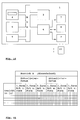
- Figure 12 shows the additional function tables which are stored in the further memory areas and are assigned to a sending country A, B or location and / or a current date.
- FIG. 6 relates to a table for a number of additional functions to be transmitted to the franking machine and then freely selectable thereafter.
- mail is picked up when a franking machine is in stationary operation. It can also be arranged with the post office to attach an in-house stationary mailbox.
- the data for continuously open mailboxes serving as receiving points for mail in public places, ports, airports, train stations, traffic stations, etc., nodes listed in another updatable directory, not shown, are suitable for calling up stored information or making functions available after in In a field, this data for open acceptance points and the date are entered manually. A further memory area is provided for this. If a number of functions cannot be selected due to the location, another sending location that enables these functions can be determined.
- FIG. 13 relates to a table for the additional functions that have been agreed upon to be transferred to the franking machine on the basis of a condition.
- the additional functions that provide additional labeling serve, for example, to ensure the detection of a pre-dating in future mail, i.e. Post that is prepaid in advance.
- Such functions have been agreed by the franking machine manufacturer with the postal authority and are defined by the time the post is delivered to the place of dispatch.
- GSM networks In a further variant of the solution according to the invention, shown in FIG. 14, cellular communication networks, in particular Groupe Speciale Mobile networks (GSM networks), are used as transmission means.
- GSM networks have a radio switching system (SSS) with transitions on the one hand to other radio or fixed networks (NETZ), in particular (PSTN, ISDN, PDN), and on the other hand to the mobile subscribers (FM) via a radio base station system (BSS) .
- SSS radio switching system
- NETZ radio or fixed networks
- PSTN public switched telephone network
- ISDN ISDN
- PDN mobile subscribers
- FM mobile subscribers
- BSS radio base station system
- TCE transcoder unit
- BCE BSS control devices
- Operating and maintenance centers of the radio switching system (OMC / SSS) or such operating and maintenance centers (OMC / BSS) of the base station radio system (BSS) or the associated control device (BCE) are equipped with a storage means 300, 301 or 302, which memory sections for the retrievable published postage fee and non-secret additional function tables and for further service and additional information.
- the entry of the sending country or place and the country or local time can preferably be done automatically for portable franking machines when mobile radio (D network) is used.
- D network mobile radio
- An information field - shown in FIG. 15 - for the date, place of dispatch, weight, format, postage fee and other usual information as well as for the additional functions permitted by the respective national postal authority can be shown in the display means 4 or 400 of the respective Franking machine 1 and 100 are shown to make a selection of the functions.
Landscapes
- Physics & Mathematics (AREA)
- General Physics & Mathematics (AREA)
- Engineering & Computer Science (AREA)
- Mathematical Physics (AREA)
- Theoretical Computer Science (AREA)
- Computer Hardware Design (AREA)
- General Engineering & Computer Science (AREA)
- Devices For Checking Fares Or Tickets At Control Points (AREA)
- Management, Administration, Business Operations System, And Electronic Commerce (AREA)
- Data Exchanges In Wide-Area Networks (AREA)
- Computer And Data Communications (AREA)
Priority Applications (1)
| Application Number | Priority Date | Filing Date | Title |
|---|---|---|---|
| EP99250017A EP0911767B1 (fr) | 1992-04-16 | 1993-04-16 | Procédé d'entrée de données dans une machine d'affranchissement et dispositif d'affranchissement de courrier |
Applications Claiming Priority (6)
| Application Number | Priority Date | Filing Date | Title |
|---|---|---|---|
| DE4213278 | 1992-04-16 | ||
| DE4213278A DE4213278C2 (de) | 1992-04-16 | 1992-04-16 | Anordnung zum Frankieren von Postgut |
| DE19934302097 DE4302097A1 (de) | 1993-01-20 | 1993-01-20 | Anordnung zur Erzeugung eines jeweils einer Kostenstelle zugeordneten Frankierbildes |
| DE4302097 | 1993-01-20 | ||
| DE4312894 | 1993-04-16 | ||
| DE19934312894 DE4312894A1 (de) | 1993-04-16 | 1993-04-16 | Verfahren zur Dateneingabe in eine Frankiermaschine |
Related Child Applications (1)
| Application Number | Title | Priority Date | Filing Date |
|---|---|---|---|
| EP99250017A Division EP0911767B1 (fr) | 1992-04-16 | 1993-04-16 | Procédé d'entrée de données dans une machine d'affranchissement et dispositif d'affranchissement de courrier |
Publications (3)
| Publication Number | Publication Date |
|---|---|
| EP0566225A2 true EP0566225A2 (fr) | 1993-10-20 |
| EP0566225A3 EP0566225A3 (fr) | 1995-04-05 |
| EP0566225B1 EP0566225B1 (fr) | 1999-08-04 |
Family
ID=27203657
Family Applications (2)
| Application Number | Title | Priority Date | Filing Date |
|---|---|---|---|
| EP93250112A Expired - Lifetime EP0566225B1 (fr) | 1992-04-16 | 1993-04-16 | Procédé de saisie de données dans une machine d'affranchissement et ensemble pour traiter le courrier et pour produire une image d'affranchissement à chaque fois à l'office de traitement de courrier |
| EP99250017A Expired - Lifetime EP0911767B1 (fr) | 1992-04-16 | 1993-04-16 | Procédé d'entrée de données dans une machine d'affranchissement et dispositif d'affranchissement de courrier |
Family Applications After (1)
| Application Number | Title | Priority Date | Filing Date |
|---|---|---|---|
| EP99250017A Expired - Lifetime EP0911767B1 (fr) | 1992-04-16 | 1993-04-16 | Procédé d'entrée de données dans une machine d'affranchissement et dispositif d'affranchissement de courrier |
Country Status (2)
| Country | Link |
|---|---|
| EP (2) | EP0566225B1 (fr) |
| DE (2) | DE59310378D1 (fr) |
Cited By (13)
| Publication number | Priority date | Publication date | Assignee | Title |
|---|---|---|---|---|
| EP0658861A1 (fr) * | 1993-12-16 | 1995-06-21 | Francotyp-Postalia GmbH | Procédé d'exploitation d'une machine à affranchir |
| DE4447404A1 (de) * | 1994-12-23 | 1996-06-27 | Francotyp Postalia Gmbh | Verfahren zur Dateneingabe in eine Waage |
| DE19617473A1 (de) * | 1996-05-02 | 1997-11-06 | Francotyp Postalia Gmbh | Verfahren und Anordnung zur Datenverarbeitung in einem Postverarbeitungssystem mit einer Frankiermaschine |
| DE19617557A1 (de) * | 1996-05-02 | 1997-11-06 | Francotyp Postalia Gmbh | Verfahren zur Ermittlung des günstigsten Beförderers und Postverarbeitungssystem mit Personalcomputer und mit einem Verfahren zur Datenverarbeitung |
| DE19617586A1 (de) * | 1996-05-02 | 1997-11-06 | Francotyp Postalia Gmbh | Verfahren zur Datenverarbeitung in einem Postverarbeitungssystem mit einer Frankiermaschine und Anordnung |
| US5710158A (en) * | 1991-05-10 | 1998-01-20 | Rhone-Poulenc Rorer Pharmaceuticals Inc. | Aryl and heteroaryl quinazoline compounds which inhibit EGF and/or PDGF receptor tyrosine kinase |
| EP0780803A3 (fr) * | 1995-12-22 | 1999-10-20 | Francotyp-Postalia AG & Co. | Procédé et dispositif d'entrée de données dans une machine d'affranchissement |
| EP1037169A2 (fr) | 1999-03-17 | 2000-09-20 | Francotyp-Postalia Aktiengesellschaft & Co. | Procédé et dispositif d'entrée d'image de marquage dans une machine à affranchir |
| EP1067482A1 (fr) | 1999-07-05 | 2001-01-10 | Francotyp-Postalia Aktiengesellschaft & Co. | Image imprimée |
| US6418422B1 (en) * | 1997-12-15 | 2002-07-09 | Francotype-Postalia Ag & Co. | Postage meter machine with a chip card write/read unit and method for operating same |
| US6915280B1 (en) * | 1998-12-01 | 2005-07-05 | Pitney Bowes Inc. | Method and apparatus for printing postage |
| EP1828974A4 (fr) * | 2004-11-23 | 2011-08-03 | Pitney Bowes Inc | Selection automatique de slogans publicitaires imprimes sur une piece de courrier |
| CN113212011A (zh) * | 2021-04-21 | 2021-08-06 | 成都四平软件有限公司 | 智能印章的防伪方法、装置、系统和智能印章 |
Families Citing this family (6)
| Publication number | Priority date | Publication date | Assignee | Title |
|---|---|---|---|---|
| US6227445B1 (en) * | 1996-04-23 | 2001-05-08 | Ascom Hasler Mailing Systems, Inc. | Secure smart card access to pre-paid metering funds in meter |
| WO1997040600A2 (fr) * | 1996-04-23 | 1997-10-30 | Ascom Hasler Mailing Systems, Inc. | Systeme d'identification de l'utilisateur d'une machine a affranchir |
| DE19731304B4 (de) * | 1997-07-14 | 2005-02-24 | Francotyp-Postalia Ag & Co. Kg | Verfahren zur Statistikmodusnachladung und zur statistischen Erfassung nach Statistikklassen bei der Speicherung eines Datensatzes |
| DE19925194B4 (de) | 1999-06-01 | 2010-08-12 | Francotyp-Postalia Gmbh | Verfahren zur Postgutverarbeitung und Postgutverarbeitungssystem |
| FR2850776A1 (fr) * | 2003-01-31 | 2004-08-06 | Neopost Ind | Dispositif de peremption pour systeme d'affranchissement |
| DE102006060700A1 (de) | 2006-12-18 | 2008-06-19 | Francotyp-Postalia Gmbh | Verfahren zur Datenverarbeitung mit Bereitstellung von Portogebührentabellen und zu deren Auswahl aus einer Datenbank eines Datenzentrums sowie Anordnung zur Durchführung des Verfahrens |
Family Cites Families (5)
| Publication number | Priority date | Publication date | Assignee | Title |
|---|---|---|---|---|
| US4802218A (en) * | 1986-11-26 | 1989-01-31 | Wright Technologies, L.P. | Automated transaction system |
| ATE160456T1 (de) * | 1986-09-02 | 1997-12-15 | Pitney Bowes Inc | Automatisiertes transaktionssystem mit einsteckbaren karten zum übertragen von kontodaten |
| CA1301334C (fr) * | 1988-02-08 | 1992-05-19 | Pitney Bowes Inc. | Systeme de comptabilisation des droits postaux |
| CA1328927C (fr) * | 1988-02-08 | 1994-04-26 | Glynn M. Brasington | Systeme de comptabilite d'affranchissement postal |
| FR2649230B1 (fr) * | 1989-06-30 | 1993-11-26 | Alcatel Satmam | Machine a affranchir miniature |
-
1993
- 1993-04-16 DE DE59310378T patent/DE59310378D1/de not_active Expired - Fee Related
- 1993-04-16 EP EP93250112A patent/EP0566225B1/fr not_active Expired - Lifetime
- 1993-04-16 EP EP99250017A patent/EP0911767B1/fr not_active Expired - Lifetime
- 1993-04-16 DE DE59309710T patent/DE59309710D1/de not_active Expired - Lifetime
Cited By (16)
| Publication number | Priority date | Publication date | Assignee | Title |
|---|---|---|---|---|
| US5710158A (en) * | 1991-05-10 | 1998-01-20 | Rhone-Poulenc Rorer Pharmaceuticals Inc. | Aryl and heteroaryl quinazoline compounds which inhibit EGF and/or PDGF receptor tyrosine kinase |
| US5600562A (en) * | 1993-12-16 | 1997-02-04 | Francotyp-Postalia Ag & Co. | Method for the operation of a postage meter machine |
| EP0658861A1 (fr) * | 1993-12-16 | 1995-06-21 | Francotyp-Postalia GmbH | Procédé d'exploitation d'une machine à affranchir |
| DE4447404A1 (de) * | 1994-12-23 | 1996-06-27 | Francotyp Postalia Gmbh | Verfahren zur Dateneingabe in eine Waage |
| EP0724141A1 (fr) * | 1994-12-23 | 1996-07-31 | Francotyp-Postalia Aktiengesellschaft & Co. | Méthode d'entrées de données pour une balance |
| DE4447404C2 (de) * | 1994-12-23 | 1998-08-20 | Francotyp Postalia Gmbh | Verfahren zur Dateneingabe in eine Waage und Anordnung zur Durchführung des Verfahrens |
| EP0780803A3 (fr) * | 1995-12-22 | 1999-10-20 | Francotyp-Postalia AG & Co. | Procédé et dispositif d'entrée de données dans une machine d'affranchissement |
| DE19617473A1 (de) * | 1996-05-02 | 1997-11-06 | Francotyp Postalia Gmbh | Verfahren und Anordnung zur Datenverarbeitung in einem Postverarbeitungssystem mit einer Frankiermaschine |
| DE19617586A1 (de) * | 1996-05-02 | 1997-11-06 | Francotyp Postalia Gmbh | Verfahren zur Datenverarbeitung in einem Postverarbeitungssystem mit einer Frankiermaschine und Anordnung |
| DE19617557A1 (de) * | 1996-05-02 | 1997-11-06 | Francotyp Postalia Gmbh | Verfahren zur Ermittlung des günstigsten Beförderers und Postverarbeitungssystem mit Personalcomputer und mit einem Verfahren zur Datenverarbeitung |
| US6418422B1 (en) * | 1997-12-15 | 2002-07-09 | Francotype-Postalia Ag & Co. | Postage meter machine with a chip card write/read unit and method for operating same |
| US6915280B1 (en) * | 1998-12-01 | 2005-07-05 | Pitney Bowes Inc. | Method and apparatus for printing postage |
| EP1037169A2 (fr) | 1999-03-17 | 2000-09-20 | Francotyp-Postalia Aktiengesellschaft & Co. | Procédé et dispositif d'entrée d'image de marquage dans une machine à affranchir |
| EP1067482A1 (fr) | 1999-07-05 | 2001-01-10 | Francotyp-Postalia Aktiengesellschaft & Co. | Image imprimée |
| EP1828974A4 (fr) * | 2004-11-23 | 2011-08-03 | Pitney Bowes Inc | Selection automatique de slogans publicitaires imprimes sur une piece de courrier |
| CN113212011A (zh) * | 2021-04-21 | 2021-08-06 | 成都四平软件有限公司 | 智能印章的防伪方法、装置、系统和智能印章 |
Also Published As
| Publication number | Publication date |
|---|---|
| EP0566225B1 (fr) | 1999-08-04 |
| EP0911767A3 (fr) | 2000-09-27 |
| EP0566225A3 (fr) | 1995-04-05 |
| EP0911767A2 (fr) | 1999-04-28 |
| DE59310378D1 (de) | 2005-10-06 |
| DE59309710D1 (de) | 1999-09-09 |
| EP0911767B1 (fr) | 2005-08-31 |
Similar Documents
| Publication | Publication Date | Title |
|---|---|---|
| EP0566225B1 (fr) | Procédé de saisie de données dans une machine d'affranchissement et ensemble pour traiter le courrier et pour produire une image d'affranchissement à chaque fois à l'office de traitement de courrier | |
| DE4213278C2 (de) | Anordnung zum Frankieren von Postgut | |
| EP0805420B1 (fr) | Procédé et arrangement pour le traitement de l'information dans un système de traitement de courrier avec une machine d'affranchissement | |
| EP0780803B1 (fr) | Procédé et dispositif d'entrée de données dans une machine d'affranchissement | |
| DE19581420B4 (de) | Porto-Speichervorrichtung | |
| DE4447404C2 (de) | Verfahren zur Dateneingabe in eine Waage und Anordnung zur Durchführung des Verfahrens | |
| DE19617557A1 (de) | Verfahren zur Ermittlung des günstigsten Beförderers und Postverarbeitungssystem mit Personalcomputer und mit einem Verfahren zur Datenverarbeitung | |
| DE68926034T2 (de) | Frankiermaschine | |
| DE4221270A1 (de) | Anordnung und Verfahren zur Klischeetextteiländerung für Frankiermaschinen | |
| EP0805421A2 (fr) | Procédé et arrangement pour le traitement de l'information dans un système de traitement de courrier avec une machine d'affranchissement | |
| DE3841394A1 (de) | Sicherheitssystem fuer die ausgabe von postgebuehren | |
| EP0805419A2 (fr) | Procédé pour le traitement de l'information dans un système de traitement de courrier avec une machine d'affranchissement et un arrangement | |
| EP0747864A2 (fr) | Dispositif et procédé pour déterminer le transporteur postal le plus économique et pour le traitement des envois postals | |
| EP0927968A2 (fr) | Machine à affranchir avec dispositif de lecture/écriture de cartes à puce | |
| EP1073018A1 (fr) | Machine d'affranchissement à pré-paiement et post-paiement | |
| EP0930586B1 (fr) | Dispositif et méthode pour l'échange de données entre une machine d'affranchissement et des cartes à puce | |
| EP0809215B1 (fr) | Module calculateur d'affranchissement interchangeable et procédé pour transmission de données | |
| EP0927970B1 (fr) | Machine à affranchir avec dispositif de lecture/écriture de cartes à puce | |
| DE19711998A1 (de) | Postverarbeitungssystem mit einer über Personalcomputer gesteuerten druckenden Maschinen-Basisstation | |
| EP0927971B1 (fr) | Procédé et dispositif postal avec une unité de lecture/écriture de cartes à puce pour le rechargement de données de changement dans une carte à puce | |
| EP0927969B1 (fr) | Machine à affranchir avec dispositif de lecture/écriture de cartes à puce | |
| EP1037172B1 (fr) | Procédé pour l'installation automatique de machines à affranchir et dispositif pour sa mise en oeuvre | |
| DE4302097A1 (de) | Anordnung zur Erzeugung eines jeweils einer Kostenstelle zugeordneten Frankierbildes | |
| DE4312894A1 (de) | Verfahren zur Dateneingabe in eine Frankiermaschine | |
| EP1037169A2 (fr) | Procédé et dispositif d'entrée d'image de marquage dans une machine à affranchir |
Legal Events
| Date | Code | Title | Description |
|---|---|---|---|
| PUAI | Public reference made under article 153(3) epc to a published international application that has entered the european phase |
Free format text: ORIGINAL CODE: 0009012 |
|
| AK | Designated contracting states |
Kind code of ref document: A2 Designated state(s): CH DE FR GB IT LI |
|
| RAP1 | Party data changed (applicant data changed or rights of an application transferred) |
Owner name: FRANCOTYP-POSTALIA GMBH |
|
| PUAL | Search report despatched |
Free format text: ORIGINAL CODE: 0009013 |
|
| AK | Designated contracting states |
Kind code of ref document: A3 Designated state(s): CH DE FR GB IT LI |
|
| 17P | Request for examination filed |
Effective date: 19950502 |
|
| RAP1 | Party data changed (applicant data changed or rights of an application transferred) |
Owner name: FRANCOTYP-POSTALIA AKTIENGESELLSCHAFT & CO. |
|
| RAP3 | Party data changed (applicant data changed or rights of an application transferred) |
Owner name: FRANCOTYP-POSTALIA AKTIENGESELLSCHAFT & CO. |
|
| 17Q | First examination report despatched |
Effective date: 19970730 |
|
| GRAG | Despatch of communication of intention to grant |
Free format text: ORIGINAL CODE: EPIDOS AGRA |
|
| GRAG | Despatch of communication of intention to grant |
Free format text: ORIGINAL CODE: EPIDOS AGRA |
|
| GRAH | Despatch of communication of intention to grant a patent |
Free format text: ORIGINAL CODE: EPIDOS IGRA |
|
| GRAH | Despatch of communication of intention to grant a patent |
Free format text: ORIGINAL CODE: EPIDOS IGRA |
|
| GRAA | (expected) grant |
Free format text: ORIGINAL CODE: 0009210 |
|
| AK | Designated contracting states |
Kind code of ref document: B1 Designated state(s): CH DE FR GB IT LI |
|
| REG | Reference to a national code |
Ref country code: CH Ref legal event code: EP |
|
| REF | Corresponds to: |
Ref document number: 59309710 Country of ref document: DE Date of ref document: 19990909 |
|
| REG | Reference to a national code |
Ref country code: CH Ref legal event code: NV Representative=s name: ROTTMANN, ZIMMERMANN + PARTNER AG |
|
| ITF | It: translation for a ep patent filed | ||
| GBT | Gb: translation of ep patent filed (gb section 77(6)(a)/1977) |
Effective date: 19991021 |
|
| ET | Fr: translation filed | ||
| PLBE | No opposition filed within time limit |
Free format text: ORIGINAL CODE: 0009261 |
|
| 26N | No opposition filed | ||
| REG | Reference to a national code |
Ref country code: GB Ref legal event code: IF02 |
|
| REG | Reference to a national code |
Ref country code: CH Ref legal event code: PFA Owner name: FRANCOTYP-POSTALIA AKTIENGESELLSCHAFT & CO. Free format text: FRANCOTYP-POSTALIA AKTIENGESELLSCHAFT & CO.#TRIFTWEG 21-26#16547 BIRKENWERDER (DE) -TRANSFER TO- FRANCOTYP-POSTALIA AKTIENGESELLSCHAFT & CO.#TRIFTWEG 21-26#16547 BIRKENWERDER (DE) |
|
| PGFP | Annual fee paid to national office [announced via postgrant information from national office to epo] |
Ref country code: CH Payment date: 20120420 Year of fee payment: 20 Ref country code: DE Payment date: 20120209 Year of fee payment: 20 |
|
| PGFP | Annual fee paid to national office [announced via postgrant information from national office to epo] |
Ref country code: FR Payment date: 20120507 Year of fee payment: 20 Ref country code: GB Payment date: 20120419 Year of fee payment: 20 |
|
| PGFP | Annual fee paid to national office [announced via postgrant information from national office to epo] |
Ref country code: IT Payment date: 20120424 Year of fee payment: 20 |
|
| REG | Reference to a national code |
Ref country code: DE Ref legal event code: R071 Ref document number: 59309710 Country of ref document: DE |
|
| REG | Reference to a national code |
Ref country code: CH Ref legal event code: PL |
|
| REG | Reference to a national code |
Ref country code: GB Ref legal event code: PE20 Expiry date: 20130415 |
|
| PG25 | Lapsed in a contracting state [announced via postgrant information from national office to epo] |
Ref country code: DE Free format text: LAPSE BECAUSE OF EXPIRATION OF PROTECTION Effective date: 20130417 Ref country code: GB Free format text: LAPSE BECAUSE OF EXPIRATION OF PROTECTION Effective date: 20130415 |