EP0566848A2 - System zur automatischen Analyse von Zusammengesetzten Wörtern - Google Patents
System zur automatischen Analyse von Zusammengesetzten Wörtern Download PDFInfo
- Publication number
- EP0566848A2 EP0566848A2 EP93103641A EP93103641A EP0566848A2 EP 0566848 A2 EP0566848 A2 EP 0566848A2 EP 93103641 A EP93103641 A EP 93103641A EP 93103641 A EP93103641 A EP 93103641A EP 0566848 A2 EP0566848 A2 EP 0566848A2
- Authority
- EP
- European Patent Office
- Prior art keywords
- components
- compound
- computer system
- nouns
- compound word
- Prior art date
- Legal status (The legal status is an assumption and is not a legal conclusion. Google has not performed a legal analysis and makes no representation as to the accuracy of the status listed.)
- Withdrawn
Links
Images

Classifications
-
- G—PHYSICS
- G06—COMPUTING OR CALCULATING; COUNTING
- G06F—ELECTRIC DIGITAL DATA PROCESSING
- G06F40/00—Handling natural language data
- G06F40/10—Text processing
- G06F40/191—Automatic line break hyphenation
-
- G—PHYSICS
- G06—COMPUTING OR CALCULATING; COUNTING
- G06F—ELECTRIC DIGITAL DATA PROCESSING
- G06F40/00—Handling natural language data
- G06F40/20—Natural language analysis
- G06F40/253—Grammatical analysis; Style critique
-
- G—PHYSICS
- G06—COMPUTING OR CALCULATING; COUNTING
- G06F—ELECTRIC DIGITAL DATA PROCESSING
- G06F40/00—Handling natural language data
- G06F40/20—Natural language analysis
- G06F40/268—Morphological analysis
-
- G—PHYSICS
- G06—COMPUTING OR CALCULATING; COUNTING
- G06F—ELECTRIC DIGITAL DATA PROCESSING
- G06F40/00—Handling natural language data
- G06F40/20—Natural language analysis
- G06F40/279—Recognition of textual entities
- G06F40/284—Lexical analysis, e.g. tokenisation or collocates
Definitions
- the invention concerns a computer system for the automated analysis of words composed of several components, comprising a memory storing the components of the compound words, as well as a suitable method for the automated analysis of words with the aid of a computer system.
- Another approach for analyzing words composed of several components is to store only the components rather than all compound words as such in the memory of the computer system. This reduces the memory space for storing compound words considerably. At the same time, this approach requires that the computer system be capable of correctly decomposing or segmenting a compound word into its individual components.
- the computer system is unable to correctly decompose many compound words, in particular many compound nouns of the German language, into their individual components.
- a computer system of the above-described kind stores in its memory a rank order of particular component characteristics, with said rank order depending upon the frequency of occurrence of the respective characteristics.
- prepositions rank rather low.
- the stored rank order allows the computer system to decide whether a compound word to be analyzed has been correctly or incorrectly decomposed. If the computer system decides that a particular decomposition is incorrect, it is able to carry out further decompositions and decide accordingly, with the correct decomposition being found by comparing the various decompositions that have been made.
- a method of the previously described kind successively compares a compound word to be analyzed according to a rank order of particular component characteristics, which is stored in the memory.
- the rank order of the component characteristics is considered during the comparison of the word to be analyzed with the stored components.
- the comparison initially uses only those stored components whose characteristics rank highest in the rank order. In the German language, these would be nouns including an "s" as a connective element in the front of the compound. Thus, only those nouns are searched in the memory and used for comparison which occur with the connective element "s" in a compound. If this comparison yields no match between the compound word and the word to be analyzed, those components in the memory of the computer system are searched and used for comparison whose characteristics rank second in the stored order. This is continued until a match is found. Then, the remainder of the compound word to be analyzed is searched and compared with the components at the top of the rank order.
- the computer system When processing the above-mentioned compound word "Dichterkongreß” from the back, the computer system will first identify the noun “Kongreß” as a component of the compound word “Dichterkongreß". As the remaining letters do not include an "s, a comparison with nouns including an "s" as a connective element and which by virtue of this are at the top of the stored rank order will yield no match. The computer system thus compares the remaining letters of the compound word to be analyzed only with those nouns which, holding rank two in the described order, do not have an additional connective element in compound words. Components of this kind include the noun "Dichter”. This will prompt the computer system to find a match between that noun and the remaining letters of the compound word. As the component thus found ranks very high in the rank order, the computer system will conclude that the compound word "Dichterkongreß” to be analyzed most probably decomposes into the components "Dichter” and "Kongreß”.
- An embodiment of the invention provides for a rank order of the number of components of a compound word corresponding to the number of letters of which the compound word to be analyzed consists to be stored in the memory of the computer system, with the rank order depending upon the frequency of occurrence.
- This order may be used on its own, that means independently of the rank order associated with the component characteristics.
- the computer system prior to decomposing a compound word to be analyzed into its components, the computer system is able to count the number of letters of the compound word, deducing from the stored rank order the number of components of which the compound most probably consists.
- the compound word “SteckMIS" for example, has a total number of 15 letters. According to the stored rank order, a word having 15 letters most probably consists of two components. This information tells the computer system that the word “SteckENS" does not decompose into the components "steck", “Verb”, "in”, and "Dung”.
- rank orders are made available to the computer system which enable the computer system to distinguish between incorrect and correct decompositions of compound words to be analyzed.
- the rank orders are dependent upon the respective natural language.
- the invention may be used to particular advantage for compound nouns of the German language and similar languages. It is obvious that the invention is not only suitable for text processing by means of a computer system but also for translating texts of a natural language with the aid of the computer as well as for recognizing text uttered by a human being with the aid of the computer.
- the German language has a large number of nouns consisting of two or more components. Such components may be nouns or verbs, adverbs, adjectives, prepositions, etc.
- the compound nouns "Abschlußprüferbericht” and “Geistesblitz”, containing the nouns “Abschluß”, “Prüfer”, “Bericht”, as well as “Geist”, “Blitz”, will be used as examples below .
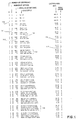
- Fig. 1 shows a table in which the number of letters and the number of components of compound nouns are associated with each other, along with the respective rank orders.
- Column 110 of Fig. 1 lists the number of components of the associated compound noun
- column 111 the number of letters of the associated noun
- column 112 the absolute occurrence of such compound nouns
- column 114 gives an example of an associated compound noun
- column 115 shows the distribution in percent of the associated compound nouns with respect to the number of components in column 110
- column 116 a rank order of associated compound nouns for each of the number of letters listed in column 116.
- the table of Fig. 1 is not complete.
- the table of Fig. 1 is based on a study for which all compound nouns starting with A and B were classified on the basis of a text corpus consisting of some 60 million words of running text. The total number of compound nouns examined was about 68 000 which occurred in the text corpus roughly three million times. It is assumed that the results obtained are representative ones, which means that they also apply to compound nouns with other initials.
- the aera of the table of Fig. 1 designated as 118 lists those compound nouns which, according to column 111, consist of 14 letters. Column 112 shows that 5 060 of the examined nouns consist of 14 letters and two components. 853 of the examined nouns consist of 14 letters and three components. Only four compound nouns consist of 14 letters and 4 components.
- the compound noun “Armeelastwagen” is given as an example of a noun with 14 letters and three components and the noun “Autobahnneubau” as a noun with 14 letters and four components.
- the compound noun “Autobahnneubau” is made up of the nouns “Auto”, “Bahn” and “Bau” as well as the adjective "neu”.
- Column 115 of the table of Fig. 1 shows the distribution in percent of the number of components in compound nouns with 14 letters. This distribution is based on the absolute occurrence according to column 112 as related to the total number of nouns with 14 letters, which is obtained by addition yielding 5 917. Thus, the 5 060 compound nouns with 14 letters and two components account for some 85 percent of the compound nouns with 14 letters. In accordance therewith, some 14 % of all compound nouns with 14 letters have three components. Only 0.06 % of all nouns with 14 letters has four components.
- the associated information according to Fig. 1 is graphically represented in the diagram of Fig. 2.
- the abscissa or x-coordinate 120 of the coordinate system indicates the number of letters according to column 111 of Fig. 1 and coordinate 121 the absolute occurrence according to column 112 of Fig. 1.
- the coordinate system there are three curves 123, 124 and 125, curve 123 representing all compound nouns with two components, curve 124 all nouns with three components and the relatively flat curve 125 all compound nouns with four components.
- Fig. 2 shows quite clearly that compound nouns with 14 letters most frequently consist of two components. This corresponds to rank "1" according to column 116 of the table of Fig. 1.
- the diagram of Fig. 2 also shows that there is still some probability of a noun with 14 letters consisting of three components, according to rank "2" or the distribution of 15 % in columns 116 and 115 of the table of Fig. 1.
- the diagram of Fig. 2 finally shows that a compound noun with 14 letters is extremely unlikely to consist of four components. This corresponds to the lowest rank "3" of column 116 in the table of Fig. 1.
- the memory of the computer systems stores data indicating at least how the number of components according to column 110, the number of letters according to column 111, and the rank order according to column 116 are interrelated.
- a rank order of the number of components of the compound noun is stored for each number of letters of a compound noun. For a compound noun with a particular number of letters, this rank order enables the computer system to read the most probable number of the compound noun's components from its memory.
- the absolute occurrence according to column 112 of Fig. 1 may be stored in the memory of the computer system. This allows the computer system to determine the most probable number of components of a compound noun as well as the relevant probability value.
- the computer system If the computer system has to analyze, for example, the compound noun "Abschlußprüferbericht", it first of all counts the number of letters of this noun. This is 23. From the rank order stored in its memory the computer system concludes that a compound noun with 23 letters most probably consists of three components. This information may be used by the computer system for its further analysis of the compound noun.
- the computer system For analyzing the compound noun "Geistesblitz", the computer system counts the letters of this noun and concludes from the associated information in its memory that a compound noun with 12 letters most probably consists of two components. This information may then also be taken into account during the further analysis of the compound noun.
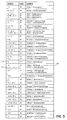
- Fig. 3 shows a table explaining the codes for components of compound nouns.
- the codes are consecutively numbered from “01" to "29”.
- Column 130 gives the meaning of the codes and column 132 contains one or several examples of these codes.
- code "01”, for example, indicates that a component with this code within a compound word does not have to be changed.
- An example of this code “01” is given in column 132 and concerns the component “Tisch” which is contained unchanged in the compound noun “Tischbein”.
- column 130 indicates that a component with this code appears in a compound noun with an umlaut and in plural form.
- An example of this is given in column 132 with the component "Bruder” which in the compound noun “Brüderêt” appears in plural form and with an umlaut.
- code “07” indicates that the letters "+es" are affixed to a component with this code to form the genitive.
- the table of Fig. 3 classifies the components of compound nouns with regard to particular characteristics, adding connective elements or omitting final letters when such components occur in a front position.
- the table of Fig. 3 is not complete, which means that there may be further characteristics of compound nouns which could be classified by further codes.
- the table of Fig. 3 is stored in this or in another suitable form in the memory of the computer system.
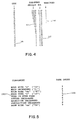
- Fig. 4 shows the rank order of the components for nouns.
- Column 140 lists the codes of the components, which correspond to those in column 131 of Fig. 3.
- Column 141 specifies the absolute occurrence and column 142 the ocurrence in percent of components of the respective associated codes with regard to the total number of components examined.
- column 143 gives a rank order corresponding to the frequency of occurrence of the components with the respective associated code. Again, the rank order of Fig. 4 is not complete.
- Fig. 4 shows that the highest rank "1" is assigned to components with the code "13", i.e. those to which an "s" is affixed in compound nouns according to the table of Fig. 3.
- the reason for this is that more than 30 % of the components of compound nouns examined had an affixed "s".
- Some 25 % of the components examined remained unchanged within compound nouns; such components are ranked "2", followed by components with the codes "07” and "10” ranked "3" and "4", respectively.
- Fig. 5 indicates the components of compound nouns in column 150 and their associated rank in column 151.
- Fig. 5 the rank order of Fig. 5 is not complete, which means that there may be additional ranks for components with other characteristics. In addition, there may be slight changes in ranks after components with other initials have been considered. It is assumed however that the first four ranks in the rank order of Fig. 5 will remain unchanged regardless of whether components with other initials are considered.
- the computer system For analyzing the compound noun "Abschlußprüferbericht", the computer system will examine this noun letter for letter back to front, irrespective of the manner in which it is input. The computer system will thus start with the last three letters of the noun, looking for a matching component in its memory. In the present case, the memory of the computer system contains no component with the letters "cht". This prompts the computer system to search its memory for a component matching the last four, five, etc. letters of the compound noun to be analzyed. In the present case, the first matching component found will be "Bericht". This component "Bericht" is stored by the computer system in some manner as the first component found for the compound noun "Abschlußprüferbericht".
- the computer system If the computer system is given the compound noun "Geistesblitz" for analysis, it will compare this noun letter for letter back to front with components stored in its memory. In the present case, the computer system will find the component "Blitz" as the first component of the compound noun "Geistesblitz".
- the stored rank orders may not be used for the compare and search operations required for this purpose, because the characteristics of the components of Fig. 5 invariably refer to components in the initial position and to positions other than the final one.
- rank "4" according to Fig. 5 designates a noun to which the letter "n” is added in a compound noun.
- code "10” denotes, for example, that the component “Schwalbe” is suffixed by an "n” in the compound noun “Schwalbennest”.
- Such changes, i.e. the addition or deletion of letters never occur in the last component of a compound noun but always and exclusively in the preceding components. Therefore, the rank order of Fig. 5 cannot be used to identify the last component of the compound noun "Geistesblitz" but only the preceding one.
- the computer system when searching for the last but one component of the compound noun "Geistesblitz", will compare only those components which correspond to the respective rank of the order of Fig. 5.
- the computer system will initially consider only all nouns with a connective element "s". Any other components will not be considered in this first compare step. If no matching component is found by the computer system in this first step, a second compare step for the compound noun to be analyzed will consider only those nouns that occur unchanged in a compound noun. If no matching component is found, a further compare step will again involve only nouns with the connective element "es". According to the rank order of Fig. 5, this continues until a match between the remaining letters of the compound noun to be analyzed and components stored in the memory of the computer system has been found.
- a first step the computer system compares all nouns with a connective element "s" with the remaining letters of the compound noun "Geistesblitz". In this step no match will be found by the computer system, since, as previously mentioned, the last but one component of this noun is the component "Geist” to which the connective element "es” rather than "s” is added in compound nouns. As previously explained, this compare operation will only consider components with "s" as a connective element.
- the computer system will compare all stored nouns occurring unchanged in a compound noun with the remaining letters of the compound noun "Geistesblitz". This compare step of the computer system will yield no match either, since, as previously mentioned, the memory contains the component "Geist” rather than the letters "Geistes”. This step, too, will leave components other than those corresponding to rank "2" unconsidered.
- a third step all compound nouns including the connective element "es” will be compared with the remaining letters of the compound noun "Geistesblitz".
- the component "Geist” is stored in the memory of the computer system. In compound nouns, this component occurs with the connective element "es” according to code "07” of Fig. 3.
- the computer system will find that the component "Geist” stored in its memory and the associated connective element "es" match the remaining letters of the compound noun "Geistesblitz" to be analyzed.
- the computer system decomposes the compound noun "Geistesblitz” into two components.
- nouns with 12 letters most probably consist of two components.
- the compound noun “Geistesblitz” has 12 letters, its decomposition into two components by the computer system is thus confirmed.
- the computer system has correctly decomposed the compound noun “Geistesblitz” into its components "Geist” and “Blitz", taking account of the fact that the component "Geist” is accompanied by the connective element "es" in compound nouns.
Landscapes
- Engineering & Computer Science (AREA)
- Theoretical Computer Science (AREA)
- Health & Medical Sciences (AREA)
- Artificial Intelligence (AREA)
- Audiology, Speech & Language Pathology (AREA)
- Computational Linguistics (AREA)
- General Health & Medical Sciences (AREA)
- Physics & Mathematics (AREA)
- General Engineering & Computer Science (AREA)
- General Physics & Mathematics (AREA)
- Machine Translation (AREA)
- Document Processing Apparatus (AREA)
Applications Claiming Priority (2)
| Application Number | Priority Date | Filing Date | Title |
|---|---|---|---|
| DE4213533 | 1992-04-22 | ||
| DE4213533A DE4213533C2 (de) | 1992-04-22 | 1992-04-22 | Verfahren und Computersystem zum Zerlegen von zusammengesetzten Wörtern |
Publications (2)
| Publication Number | Publication Date |
|---|---|
| EP0566848A2 true EP0566848A2 (de) | 1993-10-27 |
| EP0566848A3 EP0566848A3 (en) | 1994-05-18 |
Family
ID=6457417
Family Applications (1)
| Application Number | Title | Priority Date | Filing Date |
|---|---|---|---|
| EP19930103641 Withdrawn EP0566848A3 (en) | 1992-04-22 | 1993-03-08 | System for the automated analysis of compound words |
Country Status (2)
| Country | Link |
|---|---|
| EP (1) | EP0566848A3 (de) |
| DE (1) | DE4213533C2 (de) |
Cited By (4)
| Publication number | Priority date | Publication date | Assignee | Title |
|---|---|---|---|---|
| WO1997004406A1 (de) * | 1995-07-19 | 1997-02-06 | Daimler Benz Ag | Verfahren zur erzeugung von deskriptoren für die klassifikation von texten |
| US6349282B1 (en) | 1999-04-20 | 2002-02-19 | Larnout & Hauspie Speech Products N.V. | Compound words in speech recognition systems |
| US7610189B2 (en) | 2001-10-18 | 2009-10-27 | Nuance Communications, Inc. | Method and apparatus for efficient segmentation of compound words using probabilistic breakpoint traversal |
| US10713426B2 (en) | 2013-11-14 | 2020-07-14 | Elsevier B.V. | Systems, computer-program products and methods for annotating multiple controlled vocabulary-defined concepts in single noun phrases |
Families Citing this family (2)
| Publication number | Priority date | Publication date | Assignee | Title |
|---|---|---|---|---|
| DE10149141A1 (de) * | 2001-10-05 | 2003-04-24 | Bosch Gmbh Robert | Verfahren zur Verarbeitung von Text und Rechnereinheit |
| CN108763468B (zh) * | 2018-05-29 | 2021-06-22 | 周宇 | 字典排序处理方法、装置及电子学习设备 |
Family Cites Families (5)
| Publication number | Priority date | Publication date | Assignee | Title |
|---|---|---|---|---|
| US4028677A (en) * | 1975-07-16 | 1977-06-07 | International Business Machines Corporation | Digital reference hyphenation matrix apparatus for automatically forming hyphenated words |
| US4887212A (en) * | 1986-10-29 | 1989-12-12 | International Business Machines Corporation | Parser for natural language text |
| JPS63157262A (ja) * | 1986-12-16 | 1988-06-30 | インターナシヨナル・ビジネス・マシーンズ・コーポレーシヨン | ワードの類似性をランク付けする方法 |
| US4868750A (en) * | 1987-10-07 | 1989-09-19 | Houghton Mifflin Company | Collocational grammar system |
| NL9101285A (nl) * | 1991-07-23 | 1993-02-16 | Oce Nederland Bv | Inrichting en werkwijze voor het bepalen van gegevens van samengestelde woorden. |
-
1992
- 1992-04-22 DE DE4213533A patent/DE4213533C2/de not_active Expired - Fee Related
-
1993
- 1993-03-08 EP EP19930103641 patent/EP0566848A3/en not_active Withdrawn
Cited By (5)
| Publication number | Priority date | Publication date | Assignee | Title |
|---|---|---|---|---|
| WO1997004406A1 (de) * | 1995-07-19 | 1997-02-06 | Daimler Benz Ag | Verfahren zur erzeugung von deskriptoren für die klassifikation von texten |
| US6038527A (en) * | 1995-07-19 | 2000-03-14 | Daimler Benz Ag | Method for generating descriptors for the classification of texts |
| US6349282B1 (en) | 1999-04-20 | 2002-02-19 | Larnout & Hauspie Speech Products N.V. | Compound words in speech recognition systems |
| US7610189B2 (en) | 2001-10-18 | 2009-10-27 | Nuance Communications, Inc. | Method and apparatus for efficient segmentation of compound words using probabilistic breakpoint traversal |
| US10713426B2 (en) | 2013-11-14 | 2020-07-14 | Elsevier B.V. | Systems, computer-program products and methods for annotating multiple controlled vocabulary-defined concepts in single noun phrases |
Also Published As
| Publication number | Publication date |
|---|---|
| DE4213533C2 (de) | 1996-01-25 |
| EP0566848A3 (en) | 1994-05-18 |
| DE4213533A1 (de) | 1993-10-28 |
Similar Documents
| Publication | Publication Date | Title |
|---|---|---|
| Kukich | Techniques for automatically correcting words in text | |
| CA1300272C (en) | Word annotation system | |
| US7243305B2 (en) | Spelling and grammar checking system | |
| US4868750A (en) | Collocational grammar system | |
| US5890103A (en) | Method and apparatus for improved tokenization of natural language text | |
| US5680628A (en) | Method and apparatus for automated search and retrieval process | |
| US20020010726A1 (en) | Method and apparatus for updating database of automatic spelling corrections | |
| US5678051A (en) | Translating apparatus with special display mode for supplemented words | |
| US5062143A (en) | Trigram-based method of language identification | |
| US7680649B2 (en) | System, method, program product, and networking use for recognizing words and their parts of speech in one or more natural languages | |
| EP0415000A2 (de) | Verfahren und Vorrichtung zur Erkennung und Korrektur von Rechschreibfehlern | |
| WO1997004405A9 (en) | Method and apparatus for automated search and retrieval processing | |
| EP0836144A2 (de) | Verfahren und System zum Identifizieren und Richtigstellen von oft missverstandenen Worten in einem Parser für natürliche Sprachen | |
| EP0031493A1 (de) | Buchstaben-Inhalts-Vorkontrollverfahren und System zur automatischen Korrektur orthographischer Fehler | |
| JP2000507008A (ja) | テキスト・ベース型情報ソースのコレクションの中の情報を捜し出すためのシステム、ソフトウエア及び方法 | |
| KR100798752B1 (ko) | 한국어 맞춤법 검사기 및 검사방법 | |
| US5357430A (en) | System for text translation | |
| EP0566848A2 (de) | System zur automatischen Analyse von Zusammengesetzten Wörtern | |
| US7072827B1 (en) | Morphological disambiguation | |
| JPH0351022B2 (de) | ||
| WO2003003241A1 (en) | Predictive cascading algorithm for multi-parser architecture | |
| EP1076305A1 (de) | Ein phonetisches Verfahren um elektronische Informationen von grossen Informationsquellen wiederaufzufinden und zu präsentieren, ein Gerät um dieses Verfahren auszuführen, ein rechnerlesbares Medium, und ein Rechnerprogrammelement | |
| JPH08180066A (ja) | インデックス作成方法、文書検索方法及び文書検索装置 | |
| EP0562334A2 (de) | Rechnersystem und Verfahren zur automatischen Analyse von Texten | |
| Piotrowski | Handling Spelling Variation |
Legal Events
| Date | Code | Title | Description |
|---|---|---|---|
| PUAI | Public reference made under article 153(3) epc to a published international application that has entered the european phase |
Free format text: ORIGINAL CODE: 0009012 |
|
| AK | Designated contracting states |
Kind code of ref document: A2 Designated state(s): AT BE CH DE DK FR GB IT LI LU NL SE |
|
| 17P | Request for examination filed |
Effective date: 19931227 |
|
| PUAL | Search report despatched |
Free format text: ORIGINAL CODE: 0009013 |
|
| AK | Designated contracting states |
Kind code of ref document: A3 Designated state(s): AT BE CH DE DK FR GB IT LI LU NL SE |
|
| 18W | Application withdrawn |
Withdrawal date: 19960712 |
|
| R18W | Application withdrawn (corrected) |
Effective date: 19960715 |