EP0568020A2 - Système décentralisé d'entrée de données pour hôpitaux - Google Patents
Système décentralisé d'entrée de données pour hôpitaux Download PDFInfo
- Publication number
- EP0568020A2 EP0568020A2 EP93106827A EP93106827A EP0568020A2 EP 0568020 A2 EP0568020 A2 EP 0568020A2 EP 93106827 A EP93106827 A EP 93106827A EP 93106827 A EP93106827 A EP 93106827A EP 0568020 A2 EP0568020 A2 EP 0568020A2
- Authority
- EP
- European Patent Office
- Prior art keywords
- screen
- flat screen
- arrangement according
- patient
- television
- Prior art date
- Legal status (The legal status is an assumption and is not a legal conclusion. Google has not performed a legal analysis and makes no representation as to the accuracy of the status listed.)
- Withdrawn
Links
Images
Classifications
-
- H—ELECTRICITY
- H04—ELECTRIC COMMUNICATION TECHNIQUE
- H04M—TELEPHONIC COMMUNICATION
- H04M11/00—Telephonic communication systems specially adapted for combination with other electrical systems
- H04M11/02—Telephonic communication systems specially adapted for combination with other electrical systems with bell or annunciator systems
- H04M11/027—Annunciator systems for hospitals
-
- G—PHYSICS
- G06—COMPUTING OR CALCULATING; COUNTING
- G06F—ELECTRIC DIGITAL DATA PROCESSING
- G06F3/00—Input arrangements for transferring data to be processed into a form capable of being handled by the computer; Output arrangements for transferring data from processing unit to output unit, e.g. interface arrangements
- G06F3/01—Input arrangements or combined input and output arrangements for interaction between user and computer
- G06F3/03—Arrangements for converting the position or the displacement of a member into a coded form
- G06F3/033—Pointing devices displaced or positioned by the user, e.g. mice, trackballs, pens or joysticks; Accessories therefor
Definitions
- the invention relates to an arrangement according to the preamble of claim 1.
- An input of data by the doctor or by the staff is provided for them, the arrangement being to be arranged, for example, in the doctor's room or in the treatment room.
- the screen itself can be used for data input, for example by recognizing the position of a light pen in front of the screen function fields displayed on the screen can be selected in this way.
- touch panels are known, for example, from American Piltot projects, which serve as input points for entering organizational data, for example. These "touch panels” react touch-sensitive, so that the desired data is displayed on the screen after pressing a finger on a certain symbol field or the input of data is possible.
- a disadvantage of the known “touch panels” is that they are arranged either in a hospital corridor or in a hospital room for several patients. For example, when accessing medication for a particular patient, data protection can hardly be maintained. In addition, this cannot be done from the bedside and the operating personnel must constantly walk back and forth. If such "touch panels" were set up on each patient bed, this would result in overloading the patient bed with technical equipment, which on the one hand takes up an undesirable amount of space and on the other hand is often not desired by the patient for psychological reasons.
- This arrangement is also disadvantageous in that the patient-specific information, which is sometimes patient-specific, is arranged on a shared screen within a hospital room, and that the television sets are usually arranged as a central screen for all patients in a hospital room.
- the invention has for its object to improve a generic arrangement in such a way that on the one hand data entry for each communication participant within the hospital, hotel or similar facility is also possible for the patient, hotel guest or the like, without the number of participants anyway available devices to increase.
- the invention makes it possible to provide a separate television screen for the patient on each patient bed and also to use this television screen as a communication terminal for data input. Since the size of conventional television screens with a cathode ray tube is too large and requires too much space on the patient bed, the use of a flat screen is proposed, which makes it possible to assign a separate screen to each patient bed.
- the arrangement according to the invention ensures improved data protection since not everyone present in the room can read this data, as is the case, for example, with a television screen which is centrally available and visible to all patients in the room .
- Various individually selectable television programs in the patient room are also possible for several patients, which has not been possible with centrally arranged television sets that can be viewed by all patients. Results for the patient it is therefore not the impression of undesirable overloading with too many and other devices, but the impression of greater individuality.
- Mutual interference is significantly reduced. In the jointly existing television set, it could occur, for example, in that a patient felt disturbed by the bright screen, which is largely excluded by the arrangement according to the invention.
- the television screen can either be switched to an input menu or to symbol fields, whereby the triggering of such a symbol field can take place either without contact, for example by means of a light pen, or by tapping for example with a pen, a finger or other suitable objects, so that the term "pen "is broad and includes objects that are not necessarily elongated and shaped like a pen.
- the arrangement can be designed such that a nurse carries such a pen with him and inserts it into the patient's devices. As a result, it is possible to automatically switch from television mode to operation of the in-hospital communication, so that, for example, a menu or symbol fields appear on the screen.
- a light-sensitive sensor at the tip of the pen can determine the position of the pen.
- the pen can use logic to provide information from the control of the screen, e.g. by evaluating the line frequency control of the pixels, and then determine the current position of the pen.
- a certain menu item can therefore be selected and executed.
- the pen can also be equipped with a capacitive, resistive or inductive sensor, which can specify the position via a suitable detection mask in the LCD screen.
- a thin transparent film with matrix properties is also conceivable, which is stretched over the LCD screen and which is characterized by physical properties sensitive to pressure or light, so that position detection is made possible, for example, by finger pressure or with the aid of a suitable simple input device, e.g. B. a simple pen equipped without sensors.
- a suitable simple input device e.g. B. a simple pen equipped without sensors.
- a bidirectional data connection is possible when using the RF network already installed in the hospital as an antenna network to supply the individual patient rooms with partly foreign and partly in-house radio and television offers or when using the existing telephone network.
- the user can confirm directly by changing the color of the selected menu mask be made visible.
- the arrangement according to the invention can also serve to provide in-hospital communication for the patient.
- his television screen can be switched centrally to a display selected by the hospital center.
- the individual lunch options available for the following day can be displayed and individually selected by each patient and compiled into a menu. Depending on the state of care, such a prompt can also be suppressed for certain patients.
- the transmission of data can also include the transmission of moving images in the manner of a video telephone.
- the central computer asks for the individual television sets in which the data entered are temporarily stored. After this query, the individual television screens can be switched back to television operation. This can also be done from the central computer again, so that the patient in this renewed switchover recognizes that his entered data has been retrieved.
- a particularly good freedom of movement is made possible for the patient in that the data connection from the television set to other components of the hospital communication device is wireless, for example by radio or via infrared signals.
- the data connection from the television set to other components of the hospital communication device is wireless, for example by radio or via infrared signals.
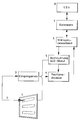
- FIG. 1 indicates a flat screen, for example an LCD screen of a television set, which is arranged on the patient's bed.
- a flat screen for example an LCD screen of a television set, which is arranged on the patient's bed.
- options are displayed on the screen 1, for example several commands in the form of a command menu or several alternatives of the lunch to be selected for the coming day or the like.
- a pen indicated schematically by 2 points to one of the selectable options.
- the indicated pin 2 can be a light pen, for example, an input circuit 3 being assigned to this pin, which evaluates the signal of the pin.
- This signal processing is made available by the input circuit 3 to a position detector 4, which detects the position of the stylus 2 on the screen 1 on the basis of the information transmitted.
- An LCD control module 5 is provided in the television set and is used to control the pixels of the screen. Furthermore, a microprocessor board is located in the television set or at least associated with the television set, which receives information from the position detector and, on account of its connection to the module 5, recognizes which of the points to be selected on the pen 2 on the screen 1. In this way, the micro processor board 6 recognizes which command is entered. A confirmation of the entered command can be made, for example, by the microprocessor itself accessing the control module 5 and producing a color change on the screen in the area of the selected and entered command, so that a confirmation of the entered command is visible to the patient.
- the microprocessor board has a bidirectional data connection via the data network 7, which is connected to a central computer 8.
- the color change for confirmation to the patient only takes place after the central computer system 8 has accepted the command.
- the number of lunches available may not be sufficient, or the patient may have selected a dish that does not fit their diet plan.
- a renewed prompt may be given or a message may be displayed that the command received is not accepted.
Landscapes
- Engineering & Computer Science (AREA)
- General Engineering & Computer Science (AREA)
- Theoretical Computer Science (AREA)
- Human Computer Interaction (AREA)
- Physics & Mathematics (AREA)
- General Physics & Mathematics (AREA)
- Signal Processing (AREA)
- Position Input By Displaying (AREA)
Applications Claiming Priority (2)
| Application Number | Priority Date | Filing Date | Title |
|---|---|---|---|
| DE19924214143 DE4214143A1 (de) | 1992-04-29 | 1992-04-29 | Anordnung zur dezentralen datenaufnahme in krankenhaeusern |
| DE4214143 | 1992-04-29 |
Publications (2)
| Publication Number | Publication Date |
|---|---|
| EP0568020A2 true EP0568020A2 (fr) | 1993-11-03 |
| EP0568020A3 EP0568020A3 (en) | 1997-04-09 |
Family
ID=6457761
Family Applications (1)
| Application Number | Title | Priority Date | Filing Date |
|---|---|---|---|
| EP93106827A Withdrawn EP0568020A3 (en) | 1992-04-29 | 1993-04-27 | Distributed data entry system for hospitals |
Country Status (2)
| Country | Link |
|---|---|
| EP (1) | EP0568020A3 (fr) |
| DE (1) | DE4214143A1 (fr) |
Cited By (4)
| Publication number | Priority date | Publication date | Assignee | Title |
|---|---|---|---|---|
| US6481688B1 (en) | 1992-11-30 | 2002-11-19 | Hill-Rom Services, Inc. | Hospital bed communication and control device |
| US6486792B1 (en) | 1998-04-14 | 2002-11-26 | Hill-Rom Services, Inc. | Communication and bed function control apparatus |
| US8717181B2 (en) | 2010-07-29 | 2014-05-06 | Hill-Rom Services, Inc. | Bed exit alert silence with automatic re-enable |
| US10363182B2 (en) | 2014-07-14 | 2019-07-30 | Hill-Rom Services, Inc. | Patient control arm with phone dock and head of bed lockout |
Families Citing this family (1)
| Publication number | Priority date | Publication date | Assignee | Title |
|---|---|---|---|---|
| DE19747353A1 (de) * | 1997-10-27 | 1999-04-29 | Axel Laumer | System zur Überwachung der Behandlung von Patienten |
Citations (1)
| Publication number | Priority date | Publication date | Assignee | Title |
|---|---|---|---|---|
| US4303937A (en) * | 1979-07-30 | 1981-12-01 | Cook Tommy D | Communication system for supplementing off-air or cable TV signals with locally generated video messages |
Family Cites Families (6)
| Publication number | Priority date | Publication date | Assignee | Title |
|---|---|---|---|---|
| DE3210893C2 (de) * | 1982-03-25 | 1984-01-05 | Standard Elektrik Lorenz Ag, 7000 Stuttgart | Geräteanordnung mit einem Fernsehempfangsgerät und einem Videdoaufnahme- und/oder -wiedergabegerät |
| DE3320680A1 (de) * | 1983-06-06 | 1984-12-13 | AV - Hähnel Gesellschaft für elektronische Bild- und Tonanlagen mbH, 5000 Köln | Krankenhaus-informations-, kommunikations- und abrechnungsanordnung |
| DE3436390A1 (de) * | 1984-10-04 | 1986-04-10 | Heinz Georg Baus | Produktionformations- und display-system |
| US4725694A (en) * | 1986-05-13 | 1988-02-16 | American Telephone And Telegraph Company, At&T Bell Laboratories | Computer interface device |
| DE3722973C1 (en) * | 1987-07-11 | 1988-09-15 | Telefonbau & Normalzeit Gmbh | Hospital information system |
| DE3914499A1 (de) * | 1989-05-02 | 1990-11-08 | Bza Biometrisches Zentrum Aach | Verfahren zur eingabe von eingabedaten sowie verfahren zur zuordnung von neuen patientendaten zu vorhandenen daten sowie eingabesystem |
-
1992
- 1992-04-29 DE DE19924214143 patent/DE4214143A1/de not_active Ceased
-
1993
- 1993-04-27 EP EP93106827A patent/EP0568020A3/de not_active Withdrawn
Patent Citations (1)
| Publication number | Priority date | Publication date | Assignee | Title |
|---|---|---|---|---|
| US4303937A (en) * | 1979-07-30 | 1981-12-01 | Cook Tommy D | Communication system for supplementing off-air or cable TV signals with locally generated video messages |
Cited By (7)
| Publication number | Priority date | Publication date | Assignee | Title |
|---|---|---|---|---|
| US6481688B1 (en) | 1992-11-30 | 2002-11-19 | Hill-Rom Services, Inc. | Hospital bed communication and control device |
| US6486792B1 (en) | 1998-04-14 | 2002-11-26 | Hill-Rom Services, Inc. | Communication and bed function control apparatus |
| US6781517B2 (en) | 1998-04-14 | 2004-08-24 | Hill-Rom Services, Inc. | Communication and bed function control apparatus |
| US8717181B2 (en) | 2010-07-29 | 2014-05-06 | Hill-Rom Services, Inc. | Bed exit alert silence with automatic re-enable |
| US10363182B2 (en) | 2014-07-14 | 2019-07-30 | Hill-Rom Services, Inc. | Patient control arm with phone dock and head of bed lockout |
| US11571347B2 (en) | 2014-07-14 | 2023-02-07 | Hill-Rom Services, Inc. | Patient control arm with phone dock and head-of-bed lockout |
| US11712385B2 (en) | 2014-07-14 | 2023-08-01 | Hill-Rom Services, Inc. | Patient bed having head-of-bed lockout and stay-in-bed indicator |
Also Published As
| Publication number | Publication date |
|---|---|
| EP0568020A3 (en) | 1997-04-09 |
| DE4214143A1 (de) | 1993-11-04 |
Similar Documents
| Publication | Publication Date | Title |
|---|---|---|
| DE3751557T2 (de) | Kompaktes Computerterminal. | |
| DE4431438C2 (de) | Einrichtung zur Kommunikation eines Fernsehempfängers mit einem Telefonapparat | |
| DE19781691B4 (de) | Computerisiertes Augenpatienten-Untersuchungs- und medizinisches Praxismanagement-System | |
| DE69222944T2 (de) | Vorrichtung zur überwachung des psychophysiologischen zustands | |
| DE19911416B4 (de) | Taschenmonitor für Patientenkarten | |
| DE60001631T2 (de) | Interaktives anzeigesystem | |
| EP0176959A2 (fr) | Dispositif pour mettre en mémoire et restituer une quantité d'informations | |
| EP0796591B1 (fr) | Dispositif d'affichage de forme d'onde d'une station centrale ayant des aires de messages dédicacés pour utilisateur | |
| EP0047870A1 (fr) | Ensemble d'appareils, comprenant un nombre donné d'appareils de surveillance et au moins un dispositif central pour ces appareils | |
| DE4011067A1 (de) | Fernbedienungs-sender | |
| EP2083736A2 (fr) | Système de reproduction d'images médicales | |
| DE112015006232T5 (de) | Anzeigevorrichtung für keuchbezogene Informationen | |
| DE69418188T2 (de) | Patientengesundheitsvorsorge- und kommunikationssystem | |
| WO1994018790A1 (fr) | Commande automatique de luminance dependant de la lumiere ambiante pour ecrans de visualisation | |
| DE10148821A1 (de) | Bekleidungsstück mit integrierter Anzeigeeinheit | |
| DE102022113994A1 (de) | Vorrichtungen für berührungslose, gestenbasierte Kundenassistenzsysteme | |
| WO2005016164A1 (fr) | Unite de commande, conçue en particulier pour des appareils techniques medicaux | |
| CN108805774B (zh) | 一种校园电子班牌及走班排课系统及方法 | |
| DE9409202U1 (de) | Vorrichtung zur Überwachung von zu sichernden Bereichen | |
| DE4214143A1 (de) | Anordnung zur dezentralen datenaufnahme in krankenhaeusern | |
| CN206400521U (zh) | 一种基于眼睛控制的自助护理系统 | |
| DE202019005756U1 (de) | Überwachungseinrichtung, Sensoreinrichtung, sowie System zum Überwachen einer Person | |
| CH660956A5 (en) | Control device for physically handicapped persons | |
| DE102024106875A1 (de) | Medizinisches Visualisierungssystem mit einer Benutzeroberfläche | |
| EP2456186B1 (fr) | Station de porte d'un système de communication interne |
Legal Events
| Date | Code | Title | Description |
|---|---|---|---|
| PUAI | Public reference made under article 153(3) epc to a published international application that has entered the european phase |
Free format text: ORIGINAL CODE: 0009012 |
|
| AK | Designated contracting states |
Kind code of ref document: A2 Designated state(s): AT BE CH DE ES FR GB IT LI NL SE |
|
| RAP1 | Party data changed (applicant data changed or rights of an application transferred) |
Owner name: SKT SCHMELTER GMBH & CO. KG, GESETZLICH VERTRETEN |
|
| RAP1 | Party data changed (applicant data changed or rights of an application transferred) |
Owner name: RVE RATIONELLE VERWERTUNGS- UND ENTSORGUNGSGESELLS |
|
| PUAL | Search report despatched |
Free format text: ORIGINAL CODE: 0009013 |
|
| AK | Designated contracting states |
Kind code of ref document: A3 Designated state(s): AT BE CH DE ES FR GB IT LI NL SE |
|
| 17P | Request for examination filed |
Effective date: 19971002 |
|
| 17Q | First examination report despatched |
Effective date: 19991019 |
|
| 18D | Application deemed to be withdrawn |
Effective date: 20001101 |