EP0568295A2 - Wiedereinsetzungssystem für Übertragungsnetze - Google Patents
Wiedereinsetzungssystem für Übertragungsnetze Download PDFInfo
- Publication number
- EP0568295A2 EP0568295A2 EP93303224A EP93303224A EP0568295A2 EP 0568295 A2 EP0568295 A2 EP 0568295A2 EP 93303224 A EP93303224 A EP 93303224A EP 93303224 A EP93303224 A EP 93303224A EP 0568295 A2 EP0568295 A2 EP 0568295A2
- Authority
- EP
- European Patent Office
- Prior art keywords
- circuit
- restoration
- node
- manager
- message
- Prior art date
- Legal status (The legal status is an assumption and is not a legal conclusion. Google has not performed a legal analysis and makes no representation as to the accuracy of the status listed.)
- Withdrawn
Links
Images

Classifications
-
- H—ELECTRICITY
- H04—ELECTRIC COMMUNICATION TECHNIQUE
- H04Q—SELECTING
- H04Q3/00—Selecting arrangements
- H04Q3/0016—Arrangements providing connection between exchanges
- H04Q3/0062—Provisions for network management
- H04Q3/0075—Fault management techniques
- H04Q3/0079—Fault management techniques involving restoration of networks, e.g. disaster recovery, self-healing networks
-
- H—ELECTRICITY
- H04—ELECTRIC COMMUNICATION TECHNIQUE
- H04Q—SELECTING
- H04Q2213/00—Indexing scheme relating to selecting arrangements in general and for multiplex systems
- H04Q2213/13521—Indexing scheme relating to selecting arrangements in general and for multiplex systems fault management
-
- H—ELECTRICITY
- H04—ELECTRIC COMMUNICATION TECHNIQUE
- H04Q—SELECTING
- H04Q2213/00—Indexing scheme relating to selecting arrangements in general and for multiplex systems
- H04Q2213/13535—Indexing scheme relating to selecting arrangements in general and for multiplex systems distributed systems - also domains in service creation
-
- H—ELECTRICITY
- H04—ELECTRIC COMMUNICATION TECHNIQUE
- H04Q—SELECTING
- H04Q2213/00—Indexing scheme relating to selecting arrangements in general and for multiplex systems
- H04Q2213/13565—Indexing scheme relating to selecting arrangements in general and for multiplex systems restoration, e.g. disaster recovery, self-healing networks
Definitions
- This invention relates to distributed control systems for restoring disrupted communication functionality in a network of digital cross-connect systems, and, more particularly, to systems for use in a network experiencing massive communication disruption.
- Communications networks are susceptible to damage caused by a variety of natural and man-made disasters. Such damage typically occurs in either the digital cross-connect systems of the network or in the transport facilities that interconnect the digital cross-connect systems to each other. In either case, the damage causes communications failures at the trunk level, e.g., DS1, DS3, STS-N (SONET), or corresponding international rates, and all communication circuits passing over a failed trunk are disrupted.
- the trunk level e.g., DS1, DS3, STS-N (SONET), or corresponding international rates
- Each network level includes digital cross-connect systems (DCSs) 107, 109, and 110 that switch communication signals at a particular trunk level in the transmission hierarchy, e.g. DS0, DS1 or DS3.
- DCS digital cross-connect systems
- Such digital cross-connect systems are exemplified by the DACS product line available from the American Telephone and Brass Company.
- Each digital cross-connect system (DCS) is a node of network 100.
- Network 100 includes links 111-1 through 111-12 (collectively links 111) and links 113-1 through 113-6 (collectively links 113) which interconnect digital cross-connect systems 107, 109 and 110 in the manner shown.
- Each of links 111 represents at least one DS3 trunk and each of links 113 represent at least one DS1 trunk.
- the actual configuration of any particular embodiment of network 100 is at the discretion of the implementer. Such a configuration would be based on the particular communications needs of the owner of the network. Methods for determining such needs, as well as techniques for designing, developing and implementing such networks, are well known in the art.
- Network level 101 includes digital crossconnect systems 107-1 through 107-3, which are referred to herein collectively as DACS III-2000 107 and individually as DACS III-2000 107-X, where X is a number having a value of 1, 2 or 3.
- DACS III-2000 107 switches signals internally at the DS3 level and each has at least two DS3 interfaces.
- Links 111-1 through 111-3 interconnect DACS III-2000 107 via their DS3 interfaces.
- Network level 103 includes digital cross-connect systems DACS IV-2000 109-1 through 109-6, which are referred to herein collectively as DACS IV-2000 109 and individually as DACS IV-2000 109-Y, where Y is a number having a value from 1 to 6.
- DACS IV-2000 109 switches signals internally at the DS1 level and each can have DS1 and DS3 interfaces.
- Links 111-10 through 111-12 interconnect DACS IV-2000 109-1 through 109-6 via their DS3 interfaces.
- Network level 105 includes digital cross-connect systems 110-1 through 110-3, which are referred to herein collectively as DACS II 110 and individually as DACS II 110-Z, where Z is a number having a value of 1, 2 or 3.
- DACS II 110 switches signals internally at the DS0 level and each has at least two DS1 interfaces.
- Links 113-1 through 113-2 interconnect DACS II 110-1 through 110-3 via DS1 interfaces. It is noted that DS3 interfaces are also available for DACS II.
- Links 111-4 through 111-9 connect DACS III-2000 107 to DACS IV-2000 109-2 through 109-6 across the boundary between network levels 101 and 103. Also, DACS IV-2000 109-1 through 109-3 are connected via links 113-3 through 113-6 to DACS II 110-2 through 110-3 across the boundary between network levels 103 and 105. Both the cross-connections (interconnection paths) through each DCS and the channels on each link between DCSs are known as network resources. Network resources are also referred to as capacity for providing transport functions for circuits.
- PBX 131 is connected to DACS II 110-3 via link 113-8.
- MUX 133 is connected to DACS II 110-2 via link 113-7.
- Telephones 135-1 and 135-2 are interconnected to PBX 131 via links 139.
- Links 141 connect MUX 133 with exemplary data sources 137-1 and 137-2.
- Links 139 also connect MUX 133 with telephone 135-3.
- a circuit in network 100 is defined as an end-to-end bi-directional connection to interconnect elements outside of network 100.
- a circuit in particular one of network layers 101, 103 and 105 is defined as an end-to-end bi-directional connection provisioned wholly within the particular network layer to interconnect elements outside of that network layer.
- the source node of a circuit is the node that terminates the circuit in network 100--or in the particular one of network layers 101, 103 or 105--and from which circuit was initially provisioned.
- the destination node is the other node which terminates the circuit in network 100--or in the particular one of network layers 101, 103 or 105.
- All other nodes along the path over which a circuit is carried from a source node to a destination node are intermediate nodes for that circuit.
- Other circuits that could be implemented in network 100 are one way circuits and multipoint circuits. Extension of the invention to such circuits will be obvious to those skilled in the art.
- Each of DACS III-2000 107, DACS IV-2000 109 and DACS II 110 is connected to one of restoration processors (processor) 115-1 through 115-12--collectively restoration processors 115--via one of control links 117.
- Each of restoration processors 115 are identically organized. In other embodiments, more than one digital cross-connect system may be controlled by a single restoration processor.
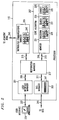
- FIG. 2 depicts, in simplified block diagram form, a more detailed view of an exemplary one of restoration processors 115.
- restoration processor 115 includes: a) user interface manager module 201, b) digital cross-connect system (DCS) manager module 203, c) distributed communications manager module 205 and d) core algorithm module 207. Links 209, 211, 213 and 215, respectively, interface one of the modules to restoration manager 217.
- DCS digital cross-connect system
- modules 201, 203, 205, 207 is an independent process, as is restoration manager 217.
- the independent processes may be implemented either on independent processors or as separate, time multiplexed, tasks running on a single processor.
- core algorithm module 207 includes at least monitor function 219, takedown function 221, search function 223 and connect function 225. These functions are also independent processes that may be implemented either on independent processors or as separate, time multiplexed, tasks running on a single processor.
- Link 237 connects user interface manager module 201 to exemplary user interface 239.
- a user interface is a protocol by which a person exerts control over and retrieves information from restoration processor 115.
- the inputs and outputs of a user interface may relate to a) only restoration processor 115, b) the DCS controlled by the restoration processor 115, or c) other nodes in network 100.
- user interface 239 is based on a computer type terminal. The design of user interfaces for managing and controlling information is well known.
- DCS manager module 203 transmits commands to its associated DCS over link 241. These commands control the interconnections in the DCS.
- Link 241 also transports responses from the DCS to DCS manager module 203.
- Link 241 is a part of link 117.
- Link 243 connects distributed communications manager module 205 to distributed communications manager modules 205 of other restoration processors 115 that are associated with DCSs which share a direct connection via one of links 111 or 113 to the particular DCS that the restoration processor 115 is associated with.
- Link 243 transports a plurality of channels, at least one channel for each restoration processor 115 of such adjacent DCSs.
- the channels of link 243 are bundled together and they are also carried over link 117.
- Each channel of link 243 is terminated at its associated DCS so that the contents of each channel can be transmitted over predetermined network resources to the adjacent nodes.
- the channels may be implemented as virtual circuits.
- each channel is an X.25 connection.
- it is possible that the messages carried over link 243 could be transmitted over-another shared or dedicated network, such as a packet network, or as SONET overhead.
- Restoration processors 115 work separately, simultaneously, and in concert, on various aspects of the process necessary to achieve the restoration of a circuit.
- modules 201, 203, 205, and 207 restoration manager 217 and functions 219, 221, 223, 225 may be performing their respective aspects of the restoration process for different circuits.
- Each of restoration processors 115 passes messages to inform modules in other ones of restoration processors 115 about the outcome of their particular aspect of the process.
- Each circuit can be undergoing processing simultaneously in each of search function 223, takedown function 221, and connect function 225 at different ones of restoration processors 115.
- restoration manager 217 integrates and controls the overall restoration process for a circuit in each of restoration processors 115.
- restoration manager 217 is responsible for maintaining and managing CIRCUIT_STATE elements.
- a CIRCUIT_STATE element is a description of a circuit.
- the parameters in each CIRCUIT_STATE element are determined by the circuit provisioner when the circuit is provisioned.
- the specifying of such parameters for each circuit is part of the network design process. Again, network design is well known.
- a CIRCUIT_STATE element is a description of a circuit.
- a typical CIRCUIT_STATE element includes parameters for each circuit such as: a) the circuit identifier, b) restoration priority, c) preemption authorization, d) number of segments limit, e) bandwidth, f) trunk conditioning and g) circuit type.
- the circuit identifier is a label for identifying each particular circuit and, as noted, each circuit identifier is unique throughout the network.
- the restoration priority is an indicator specifying the level of priority that should be given to restoring a circuit, relative to other circuits, should the circuit need to be restored.
- Preemption authorization is an indicator specifying whether or not a circuit is authorized, upon its failure, to preempt network resources that already are being used by circuits having lower restoration priorities, for use in re-establishing itself.
- the number of segments limit specifies the maximum number of cross-connections that are permitted to be employed when provisioning or restoring the circuit.
- Bandwidth and trunk conditioning are indicators for the circuit of those properties of the same name, and they are well known in the art. Circuit types are also well known in the art and include: a) point-to-point circuits and b) point-to-multipoint circuits.
- the CIRCUIT_STATE element of a circuit is extensively employed during the distributed processing necessary to achieve restoration of that circuit.
- Restoration manager 217 manages the CIRCUIT_STATE elements by: a) obtaining information relating to each CIRCUIT_STATE element that is required by the module or function to which the element is to be supplied and b) distributing the CIRCUIT_STATE elements to the appropriate module or function.
- Distributed communications manager 205 is responsible for at least: a) receiving/decoding and encoding/transmitting inter-restoration processor 115 messages, b) managing flow control for inter-restoration processor 115 messages and c) managing initialization and recovery for inter-restoration processor 115 communications without affecting other modules within the restoration processor 115.
- User interface manager module 201 is responsible for managing the information flow of the user interface (UI) to and from the system/network modules via restoration manager 217. This includes at least: a) presenting information to user interface 239, e.g., prompting a user/operator to confirm alarms and to select routes, b) receiving requests for information from user interface 239 concerning the DCS associated with the restoration processor or network 100, c) distributing, via restoration manager 217 the requests from user interface 239 to the appropriate module, and d) receiving, via restoration manager 217, processed information from the other manger modules of restoration processor 115 and presenting that information to user interface 239 for display.
- user interface 239 and its associated user interface manager moiule 201 are logically distinct from the rest of restoration processor 115, so that new technologies may change user interface 239 with minimal effect on restoration processor 115.
- a change in the display device employed in user interface 239 would necessitate a change in a device driver located in user interface manager module 201 but would not require a change in any other module of restoration processor 115.
- Core algorithm module 207 provides a distributed circuit restoration functionality. It receives work items from restoration manager 217 and processes them in the manner described below.
- Restoration manager 217 receives, reformats, if necessary, and properly routes inter-module messages from user interface manager module 201, digital cross-connect system interface (DCS) manager module 203, distributed communications manager module 205 and core algorithm module 207. In addition to routing such messages, restoration manager 217 may retrieve additional information from storage (not shown) to augment the information received in the message if such information is necessary for the function or module to which the message being routed is destined.
- DCS digital cross-connect system interface
- Takedown function 221, search function 223, and connect function 225 of core algorithm 207 each has at least one set of work lists. These sets of work lists are, respectively, takedown set of work lists 229, search set of work lists 231 and connect set of work lists 235.
- Each work list of sets of work lists 229, 231 and 235 stores CIRCUIT_STATE elements supplied by restoration manager 217. These CIRCUIT_STATE elements contain the necessary information that is needed for the processing of the circuit by the function maintaining the work list.
- Each of the work lists is arranged as a queue. The bottom of each work list is the tail of the queue onto which CIRCUIT_STATE elements are added to await eventual processing.
- each work list is the head of the queue from which CIRCUIT_STATE elements are removed to be processed.
- the CIRCUIT_STATE element processed is the one at the top of the highest priority non-empty work list of the set of work lists for that function.
- Each work list of sets of work lists 229, 231 and 235 has a predetermined priority level. These priority levels correspond to the restoration priorities of the circuits in network 100. Also, at least one of the work lists of each of sets of work lists 229, 231 and 235 must have an additional work list having a priority level higher than the restoration priority of any circuit, i.e., a super high (SH) priority level. Furthermore, one of the work lists of search set of work lists 231 must have a priority level lower than the restoration priority of any circuit, i.e., a super low (SL) priority level. As shown in FIG. 2, the work lists not having either SH or SL priority level of each of sets of work lists 229, 231 and 235 have priority high (H), medium (M), and low (L).
- SH super high
- M medium
- L low
- Distributed communications manager module 205 also has set of work lists 249, a structure identical to search set of work lists 231.
- DCS manager 203 has single work list 247 arranged as a queue.
- an exemplary circuit carried over a path from PBX 131 to MUX 133 along link 113-8 through DACS II 110-3 onto link 113-5, through DACS IV-2000 109-2 onto link 111-12, through DACS IV-2000 109-3 onto link 113- 4, and through DACS II 110-2 onto link 113-7 is deemed to have failed and require restoration.
- DACS II 110-3 is the source node and DACS II 110-2 is the destination node for this circuit.
- each respective DCS manager 203 in each of restoration processors 115-11, 115-4, 115-5 and 115-10 is associated with DACS II 110-3, DACS IV-2000 109-2, DACS IV-2000 109-3, and DACS II 110-2, respectively, receives an alarm indicating circuit failure.
- An alarm is a trigger that indicates that at least a portion of a particular circuit has failed and restoration of that circuit is required.
- Such an alarm can be supplied from the DCS itself, e.g., the well known carrier group alarm (CGA), a user (operator) via user interface 239, or another operation support system external to the network (not shown) or network layer, e.g., another DCS manager in cascaded restoration which is described below.
- CGA carrier group alarm
- user interface 239 e.g., the well known carrier group alarm (CGA)
- another operation support system external to the network (not shown) or network layer, e.g., another DCS manager in cascaded restoration which is described below.
- Operation support systems are well-known in the art.
- each DCS manager 203 along the path detects the failure by receiving a failure indication message via link 241 and supplies an appropriate message indicating the detection of the failure to restoration manager 217.
- Restoration manager 217 retrieves a record for the failed link and supplies the record and a message indicating the type of failure to monitor function 219.
- Monitor function 219 "ages" the alarm, i.e., it holds the alarm for a predetermined length of time, to determine if the alarm indicates a true failure.
- Alarms that have a duration lasting less than the predetermined length of time tend to indicate transient and self-correcting network problems.
- One such type of transient problem is disruption of a microwave link caused by electromagnetic disturbances during a thunderstorm.
- the length of the predetermined time for aging is selected by the implementer in accordance with well known principles.
- An exemplary predetermined length of time that may be employed for microwave links is ten seconds. A shorter length of time would be appropriate for fiber optic based links.
- the length of time to age an alarm is predetermined on a link-by-link basis.
- Failures at each DCS can be divided into two types.
- the first type of failure is where a DCS is directly connected to a link indicating failure.
- DACS II 110-3 and DACS IV-2000 109-2 would detect such first type of failures.
- the second type of failure occurs where a circuit which failed at a link not directly connected to a DCS passes through that DCS. Such second type of failure would be detected by DACS IV-2000 109-3 and DACS II 110-2 for the exemplary circuit and failure described above. It is also possible to trigger restoration by the meeting of predetermined thresholds for particular network performance parameters, such as bit error rate (BER), instead of alarms.
- BER bit error rate
- monitor function 219 sends a message to DCS manager 203 of the restoration processor 115 associated with that DCS, via restoration manager 217, commanding it to disconnect all the cross-connects (interconnections) that go to the digroup (port) of the DCS on which the alarm is detected.
- monitor function 219 of restoration processors 115-11 and 115-4 disconnect all the failed connections to link 113-5 in DACS II 110-3 and in DACS IV-2000 109-2. All connections for non-failed circuits that pass through DACS II 110-3 and DACS IV 109-2 are left intact.
- Each DCS manager 203 is responsible for forming appropriate messages to be transmitted to its respective DCS, e.g., DACS III-2000 107, DACS IV-2000 109 or DACS II 110, over links 241.
- Restoration manager 217 checks each circuit that was carried on the disconnected link to determine if its associated DCS was the source for that circuit, the destination for that circuit, or merely an intermediate node for that circuit. For the circuit described above, restoration manager 217 of restoration processor 115-11 determines that its associated DCS, DACS II 110-3 is the source node. Similarly, restoration manager 217 of restoration processor 115-4 determines that its associated DCS, DACS IV-2000 109-2 is an intermediate node for the circuit. Via its distributed communications manager 205, restoration processor 115-5 of DACS IV-2000 109-3 determines that it is an intermediate node for the circuit. Similarly, restoration processor 115-10 determines that its associated DACS II 110-2, is the destination node for the failed circuit.
- a CIRCUIT_STATE element is supplied by restoration manager 217 to search function 223, via link 215.
- Search function 223 places each of the CIRCUIT_STATE element at the bottom of the work list of search set of work lists 231 that has the same priority level as the restoration priority of the circuit specified.
- restoration manager 217 For each disrupted circuit that a DCS associated with a DCS manager 203 is an intermediate node, in this example DACS IV-2000 109-2 and 109-3, restoration manager 217 sends takedown information, with the appropriate CIRCUIT_STATE element, to distributed communications manager 205, for transmission to distributed communication manager 205 of adjacent restoration processors 115 of nodes that this circuit traverses.
- distributed communication manager 205 for DACS IV-2000 109-2 will transmit a takedown message to distributed communication manager 205 for DACS IV-2000 109-3.
- Takedown information indicates a particular circuit should be disconnected, i.e., taken down, and includes: 1) circuit identifier, 2) restoration priority, 3) from node, 4) to node, 5) source node and 6) destination node.
- the takedown information for each circuit is placed at the bottom of the appropriate priority work list of DCM set of work lists 249.
- a takedown message for one of the circuits passing over link 113-5 is received by restoration processor 115-5 for DACS IV-2000 109-3, via distributed communications manager 205, from restoration processor 115-4.
- Restoration processor 115-5 determines that DACS IV-2000 109-3 is an intermediate node for the circuit.
- Restoration manager 217 of restoration processor 115-5 inserts a CIRCUIT_STATE element for the circuit to be taken down at the bottom of the work list of corresponding priority of takedown function 221.
- takedown function 221 knows how the circuit is cross-connected in DACS IV-2000 109-3, i.e., restoration manager 217 knows from which input digroup and channel and to which output digroup and channel the circuit is cross-connected in DACS IV-2000 109-3.
- the cross-connection information is supplied by takedown function 221 to DCS manager 203 via restoration manager 217.
- DCS manager 203 develops a disconnect command for the determined connections and places the command in its first in, first out (FIFO) work list 247. When the message reaches the head of work list 247, it is transmitted to DACS IV-2000 109-3, which responds by disconnecting the specified connection. It is noted that a circuit could be a NxDSn circuit and, therefore, it may be supported by multiple connections in a DCS. Upon successful disconnection of the cross-connection by DACS IV-2000 109-3, an acknowledgment message will be received by restoration processor 115-5.
- Distributed communications manager 205 of restoration processor 115-5 receives a takedown message from distributed communications manager 205 of restoration processor 115-4, because their respective DCS are adjacent. Since DACS IV-2000 109-3 is an intermediate node of the circuit described above, distributed communications manager 205 of restoration processor 115-5 forwards the takedown message to the distributed communications manager 205 of restoration processor 115-10. Thereafter, distributed communications manager 205 forwards the message to restoration manager 217, which passes the appropriate CIRCUIT_STATE element to takedown function 221. Takedown function 221 places the CIRCUIT_STATE element on the corresponding priority work list of takedown set of work lists 229. Eventually, the CIRCUIT_STATE element will be processed to takedown the cross-connections via DCS manager 203, as described above.
- Distributed communications manager 205 of restoration processor 115-10 receives a takedown message from distributed communications manager 205 of restoration processor 115-5, because their respective DCS are adjacent. Since DACS II 110-2 is the destination node of the circuit described above, distributed communications manager 205 of restoration processor 115-10 does not forward the takedown message anywhere else. Takedown function 221 places the CIRCUIT_STATE element on the corresponding priority work list of takedown set of work lists 229. Eventually, the CIRCUIT_STATE element will be processed to takedown the cross connections via DCS manager 203, as described above.
- Search function 223 performs essentially the same process whether the node associated with it is an intermediate node or a source node for the failed circuit.
- the source of the information upon which search function 223 operates is derived from takedown 229, via restoration manager 217, if a takedown message was received from an adjacent node.
- the source of the information processed by search function 223 is from monitor function 219, via restoration manager 217, if the failure was detected directly at the associated node of the restoration processor.
- Search function 223 removes the top CIRCUIT_STATE element from the highest priority nonempty work list of search set of work lists 231 and checks to determine if there are available resources that would allow a connection to be established between its associated DCS and a neighboring DCS.
- One source of available resources is spare capacity.
- Another source of available resources is capacity that can be preempted. Such preemptable capacity is only available if the circuit being restored has preemption authority.
- Search function 223 will initially look for spare capacity and only if none is available will it check for preemptable capacity. It is also possible to implement the restoration in such a way that only particular circuit types could preempt other particular circuit types, leaving the spare capacity to higher priority circuits. In this embodiment, spare capacity is checked first, for all circuit types.
- search function 223 transmits a search message, via restoration manager 217 and distributed communications manager 205, to each adjacent restoration processor to which a connection exits.
- This search message includes at least a list of the nodes, taken by the search message from the source node of the circuit until the adjacent node, i.e., the nodal pathway traversed by the search message, and an associated cost of using that nodal pathway.
- the cost of using a nodal pathway is the sum of the costs of using the resources that interconnect the nodes of the pathway up through and including the current node.
- the cost for using each resource is predetermined and each cost is designated by the implementer.
- minimax factor is included as a part of each search message, in accordance with an aspect of the invention.
- the minimax factor is updated at each node in the nodal pathway.
- the minimax factor is the minimum, over all the nodes in the pathway, of the maximum number of spare channels available between each node in the pathway and the next node in the pathway to which it connects.
- the minimax factor is the maximum number of spare channels between the source node and each respective adjacent node.
- Each intermediate node employs as the minimax factor, the minimum of the minimax factor that it received from the preceding node and the maximum number of spare channels that it has available to the next node in the pathway.
- the minimax factor is used by the destination node as a tie breaker for selecting between nodal pathways found, as a result of the searching process, that are of equal cost.
- the destination node chooses to reconnect the circuit over the one of the equal cost pathways having the highest minimax factor.
- the route having the higher minimax factor is.considered to have the lower cost and the most available capacity.
- Restoration manager 217 manages the insertion of the connect elements into the CIRCUIT_STATE element, and thus, the collection of routes ordered by minimax factors.
- restoration manager 217 When restoration manager 217 receives a message containing search information for a circuit from a neighboring intermediate node, via one of distributed communications manager 205, it forms a CIRCUIT_STATE element appropriate for use by search function 223. In this embodiment of the invention, restoration manager 217 extracts the information for the CIRCUIT_STATE elements from the search message. In other embodiments, some of the information may be obtained by restoration manager 217 from a storage facility (not shown) with which it is associated. This CIRCUIT_STATE element is placed on the bottom of the work list of search set of work lists 231 that has the same priority level as the restoration priority level of the circuit.
- search function 223 will prepare messages for the CIRCUIT_STATE element at the top of the highest priority nonempty work list of search set of work lists 231 for transmission to each of its neighbors to which it has spare or preemptable capacity.
- Each intermediate node may receive a plurality of messages containing search information for any particular circuit. This is because there may be multiple routes from the source node to the destination node of a circuit that pass through any particular intermediate node. Therefore, when preparing messages for each adjacent node, search function 223 will compare the minimum previously transmitted cost for a circuit with the cost for the circuit to be included in the message being prepared. If the minimum previously sent cost was less than the cost of the message being prepared, the message being prepared is discarded. If the cost of the message prepared is less than that of the previously transmitted minimum cost message, the current message will be transmitted.
- restoration processor 115-5 for DACS IV- 2000 109-3 will receive search messages from restoration processors 115-3, 115-4 and 115-2 for DACS IV-2000 109-1, DACS IV-2000 109-2 and DACS III-2000 107-2 respectively. It is assumed, for ease of exposition, that the cost of employing any link in network 100 is 1. Therefore, all updated costs will simply be one more than the received costs and the received costs can be examined for comparison purposes. It is also assumed that all channels in link 113-5 have failed.
- restoration processor 115-5 for DACS IV-2000 109-3 first receives a search message having route 1 as its nodal pathway, that message is updated and forwarded to the restoration processors of adjacent nodes DACS III-2000 107-2 and destination node DACS II 110-2. If, thereafter, restoration processor 115-5 receives a search message having route 2 as its nodal pathway, since the associated cost of route 2 is greater than that of route 1, the search message specifying route 2 is discarded.
- restoration processor 115-5 receives a search message having route 3 as its nodal pathway, since the associated cost of route 3 is less than that of route 1, the search message specifying route 2 is updated and forwarded to the restoration processors of adjacent nodes DACS III-2000 107-2 and destination node DACS II 110-2.
- Each search message received in an intermediate node is prepared by: a) replacing the received cost with the new cost, b) replacing the received minimax factor with the new minimax factor and c) updating the nodal pathway by adding to it the destination node of the message.
- This message is supplied to distributed communications manager 205 via restoration manager 217 and placed on the work list of distributed communications set of work lists having the same priority level as the restoration priority of the circuit.
- a search message becomes the top of the highest priority non-empty work list of set of work lists 249, it will be transmitted to the appropriate adjacent one of restoration processors 115.
- distributed communications manager 205 of restoration processor 115 of the destination node will receive at least one search message.
- search messages would be received by restoration processor 115-10.
- the received information is supplied as a CIRCUIT_STATE element to search function 223, via restoration manager 217, and placed on the work list of search set of work lists 231, of proper priority, as for any received search message.
- search 223 retrieves it and determines that its associated node is the destination node.
- Restoration manager 217 stores the nodal pathway received, the associated cost of employing that pathway and determines if the received nodal pathway is valid. The determination of the validity of nodal pathways is discussed below.
- a time-out that source nodes in prior art systems employ to indicate that no routes to the destination node can be found is eliminated, in accordance with the aspect of the invention, by assuring that a search message always arrives at the destination from the source if there is connectivity between the source and destination.
- Connectivity is defined as the existence of an available path for carrying messages between ones of restoration processors 115.
- a search message arrives at the destination, thereby indicating that there is connectivity between the source and destination, there may not be any capacity available to support a circuit from the source node to the destination node along the nodal pathway taken by the message.
- the search information is updated and forwarded to the adjacent node via distributed communications manager 205, as described above, but with an infinite cost. Furthermore, the information is placed on the super low priority list of distributed communications manager set of work lists 249.
- This infinite cost message indicates that at least one point along the nodal pathway taken by that message from the source to the destination has no capacity, even though there is guaranteed connectivity between the source and destination.
- an infinite number may be indicated by a predetermined symbol or the largest number that will fit in a predetermined numeric field.
- the nodal pathway specified in a message having infinite cost is not a valid pathway over which to restore a circuit.
- restoration manager 217 of the destination node knows that an unsuccessful search attempt has taken place upon receipt of an infinite cost route.
- the received search information is stored in restoration processor 115 of the destination node by restoration manager 217. For example, if no capacity existed between DACS II 110-3 and 110-2 via link 113-2, a search message would be sent from restoration processor 115-11 to restoration processor 115-10 having an infinite cost.
- restoration manager 217 supplies to connect function 225 the search information, in the form of a CIRCUIT_STATE element, including at least a) the nodal pathway, b) the trunk code, and c) the preemption authorization.
- Connect function 225 places the CIRCUIT_STATE element on the bottom of the work list of connect set of work lists 235 having the same priority level as the circuit to be restored.
- Restoration manager 217 does not place CIRCUIT_STATE elements on connect set of work lists 235 for nodal pathways having an infinite cost.
- restoration manager 217 recognizes that, if the destination node receives an infinite cost pathway from an adjacent node, there is no capacity available between the source node and the destination node over that path.
- restoration manager 217, of the restoration processor 115 associated with the destination node will send a search complete message, which is a search message having a failure indication flag set and an infinite cost, toward the restoration processor 115 associated with the source node. This indicates that the search failed because there was no available capacity to connect the source and destination nodes.
- the message to the source node is sent from the destination node via the nodal pathway having infinite cost.
- restoration manager 217 of the source node upon receipt of a search message with a set failure indication flag, places the particular circuit which has failed on a failed restoration circuit list.
- restoration manager 217 of the source node increments a search counter for the circuit upon receipt of a search message with a set failure indication flag.
- the search counter indicates the number of times that a search for a valid nodal pathway for the circuit has been undertaken by the source node. Also, provided that a predetermined value for the number of seaiches conducted is not exceeded, restoration manager 217 of the source node places the circuit on super low priority list of search set of work lists 231. If the predetermined value for the number of searches conducted is exceeded, restoration manager 217 of the source node places the circuit on a failed restoration circuit list.
- restoration manager 217 of the destination node receives a new search message after it has sent a search complete message with a set failure indication flag, one of the following actions is taken. 1) If the later received search message is for a nodal pathway having a finite cost, i.e., a valid nodal pathway, restoration manager 217 places the CIRCUIT_STATE element for the circuit on connect set of work lists 235. Once the circuit is successfully connected back to the source node, connect function 225 of the source node checks if a CIRCUIT_STATE element for the circuit was listed on the SL work list of search set of work lists 231, or on the failed restoration circuit list and, if so, it is deleted therefrom.
- search function 223 prepares a search complete message to be sent to the source node along the nodal pathway of the just received search message. At the source node, upon receipt of the search complete message, search function 223 increments the search count.
- restoration manager 217 For each circuit in the destination node, restoration manager 217 stores the nodal pathways of the routes found that have at least connectivity to the source node. Up to predetermined maximum number of routes are stored. The number of routes stored is at the discretion of the implementer. One possible implementation stores five routes. The routes are arranged according to cost from lowest to highest. As described above, the minimax factor is employed as a tie breaker. Also, restoration manager 217 keeps track of which of the routes in the list were supplied to connect function 225.
- connect function 225 checks its associated DCS for an available digroup and channel to connect the destination to the immediately preceding node. As noted, it is assumed that there is not a valid pathway directly between source node DACS II 110-3 and destination node DACS II 110-2. However, valid search messages were received by destination node DACS II 110-2 from source node DACS II 115-11 via links 113-6, 111-10 and 113-4. Therefore, restoration processor 115-10 checks DACS II 110-2 for an available digroup and channel that connect back to DACS IV-2000 109-3 via link 113-4.
- connect function 225 of the destination node sends to DCS manager 203, via restoration manager 217, a message requesting that the destination be connected to the immediately preceding node in the nodal pathway. It is assumed that the original capacity, over which the circuit had initially been provisioned from DACS II 115-10 to DACS II 110-3, i.e., via DACS IV-2000 109-3 and link 113-4, is still available after having been taken down during the takedown phase of the process.
- DCS manager 203 formulates an appropriate message to establish a cross-connection between the selected input and output digroup and channel of its associated DCS. It supplies the message to the DCS via link 241. The DCS implements the actual connection upon receipt of the message.
- DACS II 110-2 would reconnect the channel in link 113-7, from which the circuit originates, to the same channel of link 113-4 in which the circuit was previously carried. For other failures, the connection could be to any channel reaching DACS IV-2000 109-3.
- restoration manager 217 supplies the selected digroup and channel information, to distributed communications manager 205. This is done even before the connection information is supplied to DCS manager 203, so that the one of restoration processors 115 of the node next specified in the selected nodal pathway, over which the circuit is intended to be restored, can immediately begin the appropriate processing to establish the connections required of it. Such immediate processing decreases the restoration time for the entire circuit and thereby reduces the chances that all the resources between any nodes that are expected to be employed become unavailable.
- this digroup and channel information is placed on the super high priority work list of distributed communications set of work lists 249 rather than on the bottom of the work list having the same priority level as the restoration priority of the circuit. Placing information for a message on the super high priority list is known as "broadcast". Broadcasting of a message essentially guarantees that the broadcasted message is the next message transmitted.
- all takedown messages received from a previous node and all connect messages further destined to another node are broadcast by distributed communications manager 205. In the case of takedown messages, the takedown message is placed on the super high priority list of distributed communications set of work lists 249 even before it is supplied to takedown function 221.
- connect function 225 has restoration manager 217 check in takedown set of work lists 229 (excluding the SH priority list) to determine if any capacity to the next node in the pathway is to be made available by being taken down. If such capacity exists, the corresponding CIRCUIT_STATE element is placed in the super high priority work list of takedown set of work lists 229. Therefore, that capacity is essentially processed and taken down immediately. By freeing the resource immediately, the connecting circuit need not preempt another circuit nor need it quit because of no capacity to the node. This checking and increasing of priority is called the "peek ahead" function.
- An advantage of the peek ahead function is that circuit disruption is minimized if it has already been determined that a circuit must be taken down and the resources it had employed are to, thereby, be released.
- connect function 225 searches for regular capacity that can be preempted, if the circuit being restored is authorized to preempt. If such regular preemptable capacity is found, connect function 225 requests restoration manager 217 to invoke takedown function 221 for the CIRCUIT_STATE element specifying which circuit is to be taken down. This CIRCUIT_STATE element is placed in the super high priority work list of takedown set of work lists 229. Thereafter, connect function 225 supplies the connect information, via restoration manager 217, to distributed communications manager 205 for broadcast to the next node in the received nodal pathway.
- Connect function 225 will also send the required cross-connect information to DCS manager 203, via restoration manager 217, which commands the associated DCS to configure the required connections. Note that when a takedown message is sent to the next node in the nodal pathway, it retains its super high priority for processing in the next node. However, any further nodes will process the takedown of this circuit, according to its regular restoration priority.
- restoration processor 115-5 associated with DACS IV 109-3, for the circuit described above that failed in link 113-5. If the nodal pathway of the received connect message specifies that the circuit is to be restored via links 111-10 through DACS IV-2000 109-1 to link 113-6, restoration processor 115-5 will seek capacity to connect the digroup and channel on which the circuit arrives at DACS IV 109-3 from link 113-4 to an available digroup and channel of link 111-10. If capacity is available, restoration processor 115-5 broadcasts the digroup and channel to restoration processor 115-3 associated with DACS IV-2000 109-1.
- DCS manager 203 of restoration processor 115-5 that, when sent via link 241 to DACS IV-2000 109-3, will cause the cross-connection of the digroup and channel on which the circuit arrives from link 113-4 to the found available capacity.
- restoration processor 115-5 peeks ahead into its takedown set of work lists 229 (excluding the SH priority list) to determine if there is a CIRCUIT_STATE element indicating that a currently in use channel between DACS IV-2000 109-3 and DACS IV-2000 109-1 is to be taken down. If a channel is to be taken down, the corresponding CIRCUIT_STATE element is placed on the super high priority list of takedown set of work lists 229 of restoration processor 115-5. The connect information, indicating that the circuit will be restored over the channel being taken down in link 111-10, is broadcast to restoration processor 115-3. Again, the takedown information must be broadcast to restoration processor 115-5.
- Connect 225 of restoration processor 115-5 establishes the cross-connection. If there is no capacity on link 111-10 to be taken down, and the circuit being restored did not have preemption authorization, the restoration fails. A failure message specifying lack of capacity is transmitted to restoration processor 115-10, which is associated with the destination node of the circuit. The destination node can then try the next route on its list of routes.
- connect 225 tests to determine if there is any capacity on link 111-10 that can be preempted. If there is no capacity on link 111-10 that can be preempted, the restoration fails. A failure message specifying lack of capacity is transmitted to restoration processor 115-10 associated with the destination node of the circuit. The destination node can then try the next route on its list.
- restoration manager 217 places a CIRCUIT_STATE element for the circuit employing that capacity, at the request of connect function 225, on the super high priority work list of takedown set of work lists 229 in restoration processor 115-5. This causes the circuit employing the channel being preempted to be taken down, thereby releasing the channel for use by the circuit being restored. Also, a takedown message is sent with super high priority to restoration processor 115-3. However, any further nodes will process the takedown of this circuit according to its restoration priority, not with super high priority.
- restoration manager 217 places a corresponding CIRCUIT_STATE element on the work list of connect set of work lists 235 that has the same priority as the restoration priority of the circuit to be restored.
- connect function 225 tests to determine if the selected channel in the link to the node from which the connect message originated is still spare. If it is, connect 225 proceeds as it did in the destination node.
- a glare condition exists.
- Such a glare condition is caused when each of two circuits that are being or restored from opposite ends of the same link simultaneously attempt to employ the same desired channel for connecting between a pair of nodes.
- a predetermined strategy is employed to resolve the contention by choosing one of the circuits as the winner and awarding to it the resource contended for. The circuit that is not chosen as the winner is the losing circuit. The losing circuit must be taken down to make the resource available to the winner.
- restoration manager 217 When a glare condition is resolved, restoration manager 217 will receive the connect information for the losing circuit and, in accordance with an aspect of the invention, will insert it back into work list of connect set of work lists 235 having a corresponding priority level to be processed again. Reinsertion occurs up to a predetermined maximum number of times, e.g., 3.
- Improved glare processing has the advantages of reducing the number of search messages in the network and improving the connect rate. The connect rate is improved because the chances of not contending for resources are better the second or third time that a circuit tries to connect from the same node.
- an improved contention resolution strategy is as follows. If both circuits are a single channel, the winning circuit is the one of the contenders that can clearly be distinguished on the basis of having the first listed one of the following characteristics: higher restoration priority, most hops to the point of contention, most glare attempts, lowest circuit identifier. If one circuit is wideband and the other is a single channel, then the circuit with the higher restoration priority wins. If the circuits both have the same restoration priority, the circuit with the greater number of channels wins.
- the winning circuit is that one of the contenders which can clearly be distinguished on the basis of having the first listed one of the following characteristics: higher restoration priority, most hops to the point of contention multiplied by the number of channels per circuit, most glare attempts, most search attempts, lowest circuit identifier.
- the circuit losing the glare resolution is required to yield the channel contended for by taking down the cross-connection through the DCS to the channel.
- a CIRCUIT_STATE element for the circuit to be taken down is placed in the super high priority work list of takedown set of work lists 229. This causes the cross-connection which initially caused the contention to be taken down. It also causes the transmission of a takedown message specifying glare to the preceding node in the nodal pathway of the circuit which lost the glare resolution.
- Distributed communications manager 205 of the previous node of the circuit losing the glare contention receives the circuit takedown message specifying glare and forwards it immediately to restoration manager 217 for placement on the super high priority work list of takedown set of work lists 229.
- Takedown function 221 sends a message to restoration manager 217, to increase the glare attempts number for the circuit.
- restoration manager 217 sends a message to connect function 225 to attempt to reconnect the glared circuit back to the node from which it was just disconnected.
- Connect function 225 places the circuit to be reestablished on its set of work lists 235 in the usual manner.
- connect function 225 looks for any spare or preemptable capacity to the next node, i.e., the one in which the glare previously occurred and to which the circuit wishes to reconnect. If capacity is available, connection proceeds in the usual manner as described above.
- the CIRCUIT_STATE element for the glare losing circuit for which there is no capacity is placed on the work list of takedown set of work lists 229.
- takedown messages are broadcasted along the nodal pathway back to the destination node of the circuit which lost the glare contention. The reason specified as the cause of the failure is no capacity available.
- All the connections on the circuit from the destination node of the glare losing circuit to the node in which the glare contention was lost are taken down, as described above for a failed circuit.
- the one of restoration processors 115 at the destination node can try to restore the circuit over an alternate nodal pathway from its list of nodal pathways stored in its restoration manager 217.
- Each circuit is processed through a takedown phase and a search phase.
- the destination nodes of each circuit identifies the single available path.
- the first circuit connects from link 113-7 to link 113-4 and the second circuit connects from link 113-8 to link 113-6. If the second circuit connects through DACS IV-2000 109-1 to the available channel on link 111-10, before the first circuit can connect to it, when the first circuit arrives at restoration processor 115-3, it will see that the channel that it intended to connect to is no longer available. Therefore, the circuits glare with each other and glare processing is invoked.
- Restoration processor 115-5 will determine that the first circuit has a higher restoration priority. Therefore, it is the winner of the contention resolution and should be granted access to the channel, which is already the case at DACS IV-2000 109-3. As a result, restoration processor 115-5 does nothing. Furthermore, the CIRCUIT_STATE element for the second circuit will be placed on the super high priority work list of takedown set of work lists 229 in restoration processor 115-3. Connect 225 of restoration processor 115-5 can thereafter connect link 113-4 to the channel on link 111-10 through DACS IV-2000 109-3, in the fashion described above.
- Restoration processor 115-3 will determine that the second circuit should yield the glared resources to the first circuit, and, therefore, it will disconnect those resources. Thereafter, it places a CIRCUIT_STATE element for the second circuit on its work list of connect set of work lists 235 that has the same priority as the second circuit. This is so that it can reattempt to connect the second circuit to DACS IV-2000 109-3 as described above. However, if there are no further changes in the network, when the CIRCUIT_STATE element for the second circuit reaches the top of the highest priority nonempty work list of connect set of work lists 235, connect 225 of restoration processor 115-3 will determine that there is no available capacity.
- a CIRCUIT_STATE element for the second circuit will be placed on the bottom of the work list of takedown set of work lists 229 that has the same priority level. This will eventually cause the second circuit to be taken down back to DACS II 110-3, its destination node.
- Restoration processor 115-11 may choose to attempt to restore the second circuit via an alternate route. However, all possible alternate routes will return no capacity available. Since the first circuit is connecting over the same path from which the second circuit is being taken down, it is possible in that the connection through DACS IV-2000 109-1 or DACS II 110-3 would not yet have been taken down at the time that the first circuit attempts to connect through them. In that case the peek ahead function would be invoked and the second circuit would wait until the takedown was complete.
- the source node of a circuit e.g., DACS II 110-3, for the first circuit, upon receiving the connect message, connects the channel and digroup connected to the source multiplexer to the preceding intermediate node in the same manner as described above. Thereafter, restoration manager 217 of the restoration processor 115 associated with the source node logs successful restoration of the circuit and the duration of the circuit disruption.
- a so-called "quick fix one" is attempted prior to the process of searching for a path over which the failed circuit can be restored.
- the restoration processor 115 associated with source node tests to determine if the destination node is an immediate neighbor of the source node. If the destination is an immediate neighbor, the source node looks for spare or preemptable capacity directly to the destination node. If capacity is available, the process of searching for a valid nodal pathway between source and destination is skipped. Instead, restoration manager 217 of the source node supplies information concerning the available capacity, as a nodal pathway to connect function 225. Thereafter the source node functions in the role described above for a destination node to establish a connection to the actual destination node, which functions in the role of a source node.
- restoration processor 115-11 associated with the source node of the circuit, determines that the destination node of the circuit, DACS II 110-2 is directly adjacent to source node DACS II 110-3 via link 113-2.
- Restoration processor 115-11 tests to determine, via connect function 225, if there is any spare or preemptable capacity on link 113-2 over which a direct connection could be established. Until this point, it has been assumed that no such capacity exists. Therefore, the entire restoration process was needed to restore the circuit. If such capacity exists, however, connect function 225 is supplied with a CIRCUIT_STATE element specifying the destination, DACS II 110-3, as the nodal pathway.
- Restoration processor 115-11 thereafter acts as if it were the restoration processor or associated with a destination node.
- a so-called "quick fix two" is attempted.
- a quick fix two directly restores the circuits between the nodes detecting the failure.
- One node becomes a pseudo source node and one becomes a pseudo destination node, in accordance with a predetermined protocol that is defined by the implementer. Which node becomes the pseudo source and which node becomes the pseudo destination is immaterial as long as there is only one pseudo source node for all circuits between the nodes and one pseudo destination for all circuits between the nodes.
- a quick fix one is then attempted for each circuit between the pseudo source and the pseudo destination. Those circuits that cannot be restored via a quick fix two are thereafter processed by the entire restoration procedure as described above.
- the network is divided into network layers 101, 103 and 105, as described above.
- the layers are arranged hierarchically, the ordering criterion of the hierarchy being the transmission resources available in each layer.
- network layer 101 is the highest level, having transmission and switching at the DS3 rate
- network layer 103 is the intermediate level, having transmission at the DS3 level
- network layer 105 is the lowest level having transmission at the DS1 level and switching at the DS0 level and, optionally at the subrate level.
- restoration is cascaded by causing the highest level of the network to be restored first. Thereafter, restoration precedes sequentially downward to each lower network level.
- the boundaries between each of network levels 101, 103 and 105 are employed to define source and destination nodes, as noted above.
- cascaded restoration there is a dialog to coordinate the restoration process between neighboring restoration processors of the different network levels.
- the highest network level tells the lower network levels to wait while it attempts restoration of failed circuits at its level. If the highest network level fails to achieve restoration of all the disrupted circuits, it informs the next lower level network to attempt restoration of any remaining disrupted circuits. The process continues until the lowest network level is reached or all the disrupted circuits are restored.
- each lower network level is designed to wait before attempting restoration until it is commanded to do so by a higher network level.
- restoration processors in network level 103 succeed in restoring four of these five DS 1 circuits.
- restoration processor 115-4 will tell restoration processor 115-11 that the circuits on only one of the DS1s in alarm require restoration. Restoration processor 115-11 will then begin the restoration of those circuits on that failed DS1.
- a DCS time-out employed in the prior art is eliminated from the algorithm by keeping the DCS continually busy.
- DCS manager 203 maintains a predetermined number N of DCS commands outstanding during times of restoration.
- DCS manager 203 transmits DCS query messages to the DCS, so as to continually keep N messages outstanding.
- Acknowledgment by the DCS of the (i+1)st message before the ith message indicates loss of the ith message.
- Such an acknowledgment indicates the loss or failure of the command within the ith message.
Landscapes
- Engineering & Computer Science (AREA)
- Computer Networks & Wireless Communication (AREA)
- Data Exchanges In Wide-Area Networks (AREA)
Applications Claiming Priority (2)
| Application Number | Priority Date | Filing Date | Title |
|---|---|---|---|
| US07/874,773 US5444693A (en) | 1992-04-27 | 1992-04-27 | System for restoration of communications networks |
| US874773 | 1997-06-13 |
Publications (2)
| Publication Number | Publication Date |
|---|---|
| EP0568295A2 true EP0568295A2 (de) | 1993-11-03 |
| EP0568295A3 EP0568295A3 (de) | 1995-01-25 |
Family
ID=25364547
Family Applications (1)
| Application Number | Title | Priority Date | Filing Date |
|---|---|---|---|
| EP93303224A Withdrawn EP0568295A3 (de) | 1992-04-27 | 1993-04-26 | Wiedereinsetzungssystem für Übertragungsnetze. |
Country Status (3)
| Country | Link |
|---|---|
| US (2) | US5444693A (de) |
| EP (1) | EP0568295A3 (de) |
| CA (1) | CA2094738C (de) |
Cited By (5)
| Publication number | Priority date | Publication date | Assignee | Title |
|---|---|---|---|---|
| EP0782801A1 (de) | 1994-09-19 | 1997-07-09 | Crosskeys Systems Corporation | Integriertes management mehrerer netze mit unterschiedlicher topologie |
| WO1998029998A3 (en) * | 1996-12-30 | 1998-10-22 | Mci Communications Corp | Method and system of distributed network restoration with multiple failures |
| WO1998030000A3 (en) * | 1996-12-30 | 1998-10-22 | Mci Communications Corp | Method and system of distributed network restoration using preferred routes |
| WO1998029999A3 (en) * | 1996-12-30 | 1998-11-19 | Mci Communications Corp | Method and system for selecting preferred nodes for distributed network restoration |
| EP0855813A3 (de) * | 1997-01-23 | 2001-02-14 | AT&T Corp. | Wiedereinsetzungsarchitektur für Telekommunikationsnetzwerk |
Families Citing this family (72)
| Publication number | Priority date | Publication date | Assignee | Title |
|---|---|---|---|---|
| US5640505A (en) * | 1994-09-07 | 1997-06-17 | British Telecommunications Public Limited Company | Operational support structure for a telecommunications network |
| US5581543A (en) * | 1995-02-27 | 1996-12-03 | Motorola, Inc. | Communication network and method which respond to a failed link |
| US5657320A (en) * | 1995-06-06 | 1997-08-12 | Mci Corporation | Method and system for resolving contention of spare capacity circuits of a telecommunications network |
| US5661725A (en) * | 1995-09-12 | 1997-08-26 | At&T | Trunk-conditioning for reconfigurable T1 access to nodal services |
| CA2161847A1 (en) * | 1995-10-31 | 1997-05-01 | Wayne D. Grover | Method for preconfiguring a network to withstand anticipated failures |
| JP2943677B2 (ja) * | 1995-12-06 | 1999-08-30 | 日本電気株式会社 | 非同期転送モード通信方式における回線迂回制御システム |
| US5787083A (en) * | 1996-03-29 | 1998-07-28 | Nec Corporation | Path setting system for broadcast service in switching network |
| US5828847A (en) * | 1996-04-19 | 1998-10-27 | Storage Technology Corporation | Dynamic server switching for maximum server availability and load balancing |
| US5748617A (en) * | 1996-05-01 | 1998-05-05 | Mci Corporation | Method and apparatus for emulating a digital cross-connect switch network |
| US5867689A (en) * | 1996-05-01 | 1999-02-02 | Mci Communications Corporation | Method and apparatus for emulating a digital cross-connect switch network using a flexible topology to test MCS network management |
| US5809286A (en) * | 1996-05-01 | 1998-09-15 | Mci Communications Corporation | Method and apparatus for emulating a dynamically configured digital cross-connect switch network |
| US5850536A (en) * | 1996-05-01 | 1998-12-15 | Mci Communications Corporation | Method and system for simulated multi-tasking |
| US5781535A (en) * | 1996-06-14 | 1998-07-14 | Mci Communications Corp. | Implementation protocol for SHN-based algorithm restoration platform |
| US5734811A (en) * | 1996-06-26 | 1998-03-31 | Mci Corporation | Segment substitution/swap for network restoration pre-plans |
| US5812826A (en) * | 1996-06-27 | 1998-09-22 | Mci Communications Corporation | Method and apparatus for emulating a network of state monitoring devices |
| US5732206A (en) * | 1996-07-23 | 1998-03-24 | International Business Machines Corporation | Method, apparatus and program product for disruptive recovery in a data processing system |
| US5835698A (en) * | 1996-09-20 | 1998-11-10 | Novell, Inc. | Unilaterally-controlled, time-insensitive, data-link recovery apparatus and method |
| US5995485A (en) * | 1996-11-26 | 1999-11-30 | Mci Communications Corporation | Method and apparatus for isolating network failures by correlating paths issuing alarms with failure spans |
| US5854930A (en) * | 1996-12-30 | 1998-12-29 | Mci Communications Corporations | System, method, and computer program product for script processing |
| US5954829A (en) * | 1996-12-30 | 1999-09-21 | Mci Communications Corporation | System, method, and computer program product for digital cross connect testing |
| US6421349B1 (en) * | 1997-07-11 | 2002-07-16 | Telecommunications Research Laboratories | Distributed preconfiguration of spare capacity in closed paths for network restoration |
| US6604137B2 (en) * | 1997-07-31 | 2003-08-05 | Mci Communications Corporation | System and method for verification of remote spares in a communications network when a network outage occurs |
| US6377543B1 (en) | 1997-08-13 | 2002-04-23 | Telecommunications Research Laboratories | Path restoration of networks |
| US6047385A (en) * | 1997-09-10 | 2000-04-04 | At&T Corp | Digital cross-connect system restoration technique |
| US6148410A (en) * | 1997-09-15 | 2000-11-14 | International Business Machines Corporation | Fault tolerant recoverable TCP/IP connection router |
| US6061735A (en) * | 1997-10-23 | 2000-05-09 | Mci Communications Corporation | Network restoration plan regeneration responsive to network topology changes |
| US5870383A (en) * | 1997-10-27 | 1999-02-09 | At&T Corp | Provisioning technique for customer service |
| US7013467B1 (en) | 1997-12-09 | 2006-03-14 | Mci Communications Corporation | System and method for managing computer system resources using command control vectors |
| US6256659B1 (en) | 1997-12-09 | 2001-07-03 | Mci Communications Corporation | System and method for performing hybrid preemptive and cooperative multi-tasking in a computer system |
| US5974532A (en) * | 1997-12-09 | 1999-10-26 | Mci Communications Corporation | System and method for generating responses for inputs using a hybrid state engine table |
| US6262975B1 (en) * | 1998-07-09 | 2001-07-17 | Lucent Technologies Inc. | Method of auditing cross-connections related to concatenated signals in a synchronous optical network |
| US6404734B1 (en) | 1998-10-06 | 2002-06-11 | Telecommuncations Research Laboratories | Scalable network restoration device |
| US7502315B2 (en) * | 1998-12-21 | 2009-03-10 | At&T Intellectual Property Ii, L.P. | Method for hybrid network planning |
| US6496941B1 (en) | 1998-12-29 | 2002-12-17 | At&T Corp. | Network disaster recovery and analysis tool |
| US7200110B1 (en) * | 1999-03-24 | 2007-04-03 | Alcatel Canada Inc. | Method and apparatus for prioritized release of connections in a communications network |
| US6826146B1 (en) * | 1999-06-02 | 2004-11-30 | At&T Corp. | Method for rerouting intra-office digital telecommunications signals |
| US6549513B1 (en) * | 1999-10-12 | 2003-04-15 | Alcatel | Method and apparatus for fast distributed restoration of a communication network |
| US6947376B1 (en) * | 1999-10-21 | 2005-09-20 | At&T Corp. | Local information-based restoration arrangement |
| US6697856B1 (en) * | 1999-11-19 | 2004-02-24 | Cisco Technology, Inc. | Healing of incomplete circuits in networks |
| US7167444B1 (en) | 1999-12-29 | 2007-01-23 | At&T Corp. | Family ring protection technique |
| US6490244B1 (en) | 2000-03-09 | 2002-12-03 | Nortel Networks Limited | Layer 3 routing in self-healing networks |
| US6392989B1 (en) | 2000-06-15 | 2002-05-21 | Cplane Inc. | High speed protection switching in label switched networks through pre-computation of alternate routes |
| US6745235B2 (en) | 2000-07-17 | 2004-06-01 | Teleservices Solutions, Inc. | Intelligent network providing network access services (INP-NAS) |
| US6760762B2 (en) | 2000-07-17 | 2004-07-06 | Tele Services Solutions, Inc | Intelligent network providing network access services (INP-NAS) |
| US7496652B2 (en) * | 2000-07-17 | 2009-02-24 | Teleservices Solutions, Inc. | Intelligent network providing network access services (INP-NAS) |
| EP1193997B1 (de) * | 2000-09-29 | 2004-01-07 | Alcatel | Aufgabenpriorisierer einer Kreuzverbindungsmatrix |
| US7072303B2 (en) * | 2000-12-11 | 2006-07-04 | Acme Packet, Inc. | System and method for assisting in controlling real-time transport protocol flow through multiple networks |
| WO2002054815A1 (en) * | 2000-12-27 | 2002-07-11 | Sanyo Electric Co., Ltd. | Radio base system, method for controlling transmission of synchronization burst, and transmission control program |
| US7133410B2 (en) * | 2001-02-12 | 2006-11-07 | Tellabs Operations, Inc. | Method and system for designing ring-based telecommunications networks |
| US8086738B2 (en) | 2007-05-24 | 2011-12-27 | Russell Fish | Distributed means of organizing an arbitrarily large number of computers |
| US20030009509A1 (en) * | 2001-06-22 | 2003-01-09 | Fish Russell H. | Distributed means of organizing an arbitrarily large number of computers |
| US8762568B1 (en) | 2001-07-06 | 2014-06-24 | Cisco Technology, Inc. | Method and apparatus for inter-zone restoration |
| EP1326375A1 (de) * | 2002-01-08 | 2003-07-09 | Alcatel | System zur Wiederherstellung |
| US8463947B2 (en) * | 2002-08-28 | 2013-06-11 | Tellabs Operations, Inc. | Method of finding rings for optimal routing of digital information |
| US7346709B2 (en) * | 2002-08-28 | 2008-03-18 | Tellabs Operations, Inc. | Methods for assigning rings in a network |
| US20040139142A1 (en) * | 2002-12-31 | 2004-07-15 | International Business Machines Corporation | Method and apparatus for managing resource contention |
| US7228351B2 (en) * | 2002-12-31 | 2007-06-05 | International Business Machines Corporation | Method and apparatus for managing resource contention in a multisystem cluster |
| US7451340B2 (en) * | 2003-03-31 | 2008-11-11 | Lucent Technologies Inc. | Connection set-up extension for restoration path establishment in mesh networks |
| US7646706B2 (en) * | 2003-03-31 | 2010-01-12 | Alcatel-Lucent Usa Inc. | Restoration time in mesh networks |
| US8867333B2 (en) * | 2003-03-31 | 2014-10-21 | Alcatel Lucent | Restoration path calculation considering shared-risk link groups in mesh networks |
| US7689693B2 (en) * | 2003-03-31 | 2010-03-30 | Alcatel-Lucent Usa Inc. | Primary/restoration path calculation in mesh networks based on multiple-cost criteria |
| US7643408B2 (en) * | 2003-03-31 | 2010-01-05 | Alcatel-Lucent Usa Inc. | Restoration time in networks |
| US7545736B2 (en) * | 2003-03-31 | 2009-06-09 | Alcatel-Lucent Usa Inc. | Restoration path calculation in mesh networks |
| US7606237B2 (en) * | 2003-03-31 | 2009-10-20 | Alcatel-Lucent Usa Inc. | Sharing restoration path bandwidth in mesh networks |
| US8296407B2 (en) * | 2003-03-31 | 2012-10-23 | Alcatel Lucent | Calculation, representation, and maintenance of sharing information in mesh networks |
| US7290218B2 (en) * | 2003-04-03 | 2007-10-30 | At&T Bls Intellectual Property, Inc. | Method of providing a user interface for a digital cross-connect system |
| US7500013B2 (en) | 2004-04-02 | 2009-03-03 | Alcatel-Lucent Usa Inc. | Calculation of link-detour paths in mesh networks |
| US8111612B2 (en) | 2004-04-02 | 2012-02-07 | Alcatel Lucent | Link-based recovery with demand granularity in mesh networks |
| CA2591601C (en) * | 2004-12-22 | 2014-06-03 | Telefonaktiebolaget Lm Ericsson (Publ) | Data flow control with duplicate acknowledgment |
| US8223926B2 (en) * | 2005-02-11 | 2012-07-17 | Cisco Technology, Inc. | Resilient registration with a call manager |
| US20060268679A1 (en) * | 2005-05-25 | 2006-11-30 | Mei Deng | Local information-based restoration arrangement |
| US7835271B2 (en) * | 2005-12-29 | 2010-11-16 | Alcatel-Lucent Usa Inc. | Signaling protocol for p-cycle restoration |
Family Cites Families (9)
| Publication number | Priority date | Publication date | Assignee | Title |
|---|---|---|---|---|
| US4665520A (en) * | 1985-02-01 | 1987-05-12 | International Business Machines Corporation | Optimistic recovery in a distributed processing system |
| CA1291549C (en) * | 1987-11-06 | 1991-10-29 | Wayne D. Grover | Method and apparatus for self-healing and self-provisioning networks |
| JPH0624366B2 (ja) * | 1988-11-24 | 1994-03-30 | 日本電気株式会社 | ネットワーク障害回復方式 |
| IE920032A1 (en) * | 1991-01-11 | 1992-07-15 | Marconi Gec Ltd | Parallel processing apparatus |
| JPH04351032A (ja) * | 1991-05-28 | 1992-12-04 | Fujitsu Ltd | ネットワーク切替制御方法 |
| US5307354A (en) * | 1991-05-31 | 1994-04-26 | International Business Machines Corporation | Method and apparatus for remote maintenance and error recovery in distributed data processing networks |
| JPH05260081A (ja) * | 1992-01-17 | 1993-10-08 | Nec Corp | 通信網管理方式 |
| US5295133A (en) * | 1992-02-12 | 1994-03-15 | Sprint International Communications Corp. | System administration in a flat distributed packet switch architecture |
| US5436891A (en) * | 1993-01-14 | 1995-07-25 | Motorola, Inc. | Method and system for traffic management in cell relay networks |
-
1992
- 1992-04-27 US US07/874,773 patent/US5444693A/en not_active Expired - Lifetime
-
1993
- 1993-04-23 CA CA002094738A patent/CA2094738C/en not_active Expired - Fee Related
- 1993-04-26 EP EP93303224A patent/EP0568295A3/de not_active Withdrawn
-
1995
- 1995-05-04 US US08/435,030 patent/US5706276A/en not_active Expired - Lifetime
Cited By (6)
| Publication number | Priority date | Publication date | Assignee | Title |
|---|---|---|---|---|
| EP0782801A1 (de) | 1994-09-19 | 1997-07-09 | Crosskeys Systems Corporation | Integriertes management mehrerer netze mit unterschiedlicher topologie |
| WO1998029998A3 (en) * | 1996-12-30 | 1998-10-22 | Mci Communications Corp | Method and system of distributed network restoration with multiple failures |
| WO1998030000A3 (en) * | 1996-12-30 | 1998-10-22 | Mci Communications Corp | Method and system of distributed network restoration using preferred routes |
| WO1998029999A3 (en) * | 1996-12-30 | 1998-11-19 | Mci Communications Corp | Method and system for selecting preferred nodes for distributed network restoration |
| US6031819A (en) * | 1996-12-30 | 2000-02-29 | Mci Communications Corporation | Method and system of distributed network restoration using preferred routes |
| EP0855813A3 (de) * | 1997-01-23 | 2001-02-14 | AT&T Corp. | Wiedereinsetzungsarchitektur für Telekommunikationsnetzwerk |
Also Published As
| Publication number | Publication date |
|---|---|
| EP0568295A3 (de) | 1995-01-25 |
| CA2094738A1 (en) | 1993-10-28 |
| CA2094738C (en) | 1997-06-17 |
| US5706276A (en) | 1998-01-06 |
| US5444693A (en) | 1995-08-22 |
Similar Documents
| Publication | Publication Date | Title |
|---|---|---|
| US5444693A (en) | System for restoration of communications networks | |
| US5781535A (en) | Implementation protocol for SHN-based algorithm restoration platform | |
| US6600719B1 (en) | Method and apparatus for restoring a network | |
| KR960007668B1 (ko) | 통신 회로망용 서비스 복구 시스템 및 통신 회로망의 대체 트래픽 경로 설정 방법 | |
| US5495471A (en) | System and method for restoring a telecommunications network based on a two prong approach | |
| US7424035B2 (en) | Method for routing information over a network | |
| US7339889B2 (en) | Control plane architecture for automatically switched optical network | |
| US4862496A (en) | Routing of network traffic | |
| CA2220790C (en) | Automatic learning of network routing using random routes | |
| US7551553B2 (en) | Method and apparatus for restoring a network | |
| US5796718A (en) | Method of and system for intelligent access line protect switching | |
| US5943314A (en) | Method and system of distributed network restoration with multiple failures | |
| GB2331208A (en) | Restoring failed telecoms. links using software agents | |
| EP0822678B1 (de) | Wiederherstellungstechnik mit Alternativring | |
| WO2002099946A1 (en) | A system and method of fault restoration in communication networks | |
| EP1613123B1 (de) | Verfahren zur Wiederherstellung von Zusatzverkehr unterstützenden Transportnetzwerken | |
| JPH11507487A (ja) | 予備容量の実質的に同時の両方向リクエストを解決するためのシステム及び方法 | |
| US5768256A (en) | Communications system and method providing optimal restoration of failed-paths | |
| US6031819A (en) | Method and system of distributed network restoration using preferred routes | |
| Cidon et al. | A distributed control architecture of high-speed networks | |
| WO1998030000A9 (en) | Method and system of distributed network restoration using preferred routes | |
| US8547849B2 (en) | ATM telecommunications systems and method for routing narrow band traffic | |
| EP1289208A2 (de) | Eine Verfahren zur Datenwegewahlsteuerung in einem Netz | |
| JP2845189B2 (ja) | Atm交換網呼受付制御方法とその装置 | |
| WO2000031986A2 (en) | Quick path survivability for meshed communications networks |
Legal Events
| Date | Code | Title | Description |
|---|---|---|---|
| PUAI | Public reference made under article 153(3) epc to a published international application that has entered the european phase |
Free format text: ORIGINAL CODE: 0009012 |
|
| AK | Designated contracting states |
Kind code of ref document: A2 Designated state(s): DE FR GB |
|
| RAP3 | Party data changed (applicant data changed or rights of an application transferred) |
Owner name: AT&T CORP. |
|
| PUAL | Search report despatched |
Free format text: ORIGINAL CODE: 0009013 |
|
| AK | Designated contracting states |
Kind code of ref document: A3 Designated state(s): DE FR GB |
|
| 17P | Request for examination filed |
Effective date: 19950713 |
|
| STAA | Information on the status of an ep patent application or granted ep patent |
Free format text: STATUS: THE APPLICATION HAS BEEN WITHDRAWN |
|
| 18W | Application withdrawn |
Withdrawal date: 19990210 |