EP0568875A2 - ABS masses - Google Patents
ABS masses Download PDFInfo
- Publication number
- EP0568875A2 EP0568875A2 EP93106627A EP93106627A EP0568875A2 EP 0568875 A2 EP0568875 A2 EP 0568875A2 EP 93106627 A EP93106627 A EP 93106627A EP 93106627 A EP93106627 A EP 93106627A EP 0568875 A2 EP0568875 A2 EP 0568875A2
- Authority
- EP
- European Patent Office
- Prior art keywords
- weight
- parts
- bis
- acrylonitrile
- gew
- Prior art date
- Legal status (The legal status is an assumption and is not a legal conclusion. Google has not performed a legal analysis and makes no representation as to the accuracy of the status listed.)
- Granted
Links
Classifications
-
- C—CHEMISTRY; METALLURGY
- C08—ORGANIC MACROMOLECULAR COMPOUNDS; THEIR PREPARATION OR CHEMICAL WORKING-UP; COMPOSITIONS BASED THEREON
- C08L—COMPOSITIONS OF MACROMOLECULAR COMPOUNDS
- C08L25/00—Compositions of, homopolymers or copolymers of compounds having one or more unsaturated aliphatic radicals, each having only one carbon-to-carbon double bond, and at least one being terminated by an aromatic carbocyclic ring; Compositions of derivatives of such polymers
- C08L25/02—Homopolymers or copolymers of hydrocarbons
- C08L25/04—Homopolymers or copolymers of styrene
- C08L25/08—Copolymers of styrene
- C08L25/12—Copolymers of styrene with unsaturated nitriles
-
- C—CHEMISTRY; METALLURGY
- C08—ORGANIC MACROMOLECULAR COMPOUNDS; THEIR PREPARATION OR CHEMICAL WORKING-UP; COMPOSITIONS BASED THEREON
- C08L—COMPOSITIONS OF MACROMOLECULAR COMPOUNDS
- C08L55/00—Compositions of homopolymers or copolymers, obtained by polymerisation reactions only involving carbon-to-carbon unsaturated bonds, not provided for in groups C08L23/00 - C08L53/00
- C08L55/02—ABS [Acrylonitrile-Butadiene-Styrene] polymers
-
- C—CHEMISTRY; METALLURGY
- C08—ORGANIC MACROMOLECULAR COMPOUNDS; THEIR PREPARATION OR CHEMICAL WORKING-UP; COMPOSITIONS BASED THEREON
- C08L—COMPOSITIONS OF MACROMOLECULAR COMPOUNDS
- C08L2205/00—Polymer mixtures characterised by other features
- C08L2205/02—Polymer mixtures characterised by other features containing two or more polymers of the same C08L -group
Definitions
- ABS polymers are characterized by a balanced property profile and have therefore been used in large quantities for years as a thermoplastic resin for the production of all types of molded parts.
- ABS materials With increasing use of these polymers, however, the requirements placed on ABS materials also increase, especially if new parts are to be produced from them or new areas of application are to be developed using these thermoplastic materials.
- ABS materials that have each of the required properties individually are known.
- ABS polymers described with high toughness in EP-A 116 330 however, only products without good surface gloss with low heat resistance and very low hardness are available,
- ABS polymers with very good flowability by adding large amounts of lubricant is also known, but at the same time this additive deteriorates the other properties.
- the mixtures (molding compositions) according to the invention can be prepared by mixing A, B, C and D in the melt, optionally with the addition of customary additives, until a homogeneous state is achieved.
- a preferred method for producing the molding compositions is to first mix B, C and D and then to mix this mixture with A.
- molding compositions can be prepared by mixing A, B, C, D, and E in the melt, optionally with the addition of customary additives, until a homogeneous state is achieved.
- a preferred method for producing these molding compositions is to first mix B, C and D and then to mix this mixture with A and E.
- molding compositions can be prepared by mixing A, B, C, D and F in the melt, optionally with the addition of customary additives, until a homogeneous state is achieved.
- a preferred method for producing these compositions is first to mix B, C and D and then to mix this mixture with A and F,
- Thermoplastic polymers A suitable according to the invention consist of any combination of polymerized styrene, ⁇ -methylstyrene, methyl methacrylate, acrylonitrile.
- Particularly preferred polymers A are made from Styrene / acrylonitrile mixtures, ⁇ -methylstyrene / acrylonitrile mixtures and styrene / ⁇ -methylstyrene / acrylonitrile mixtures were obtained.
- the polymers A are known and can be prepared by radical polymerization, in particular by emulsion, suspension, solution or bulk polymerization (DE-OS 2 619 969).
- M ⁇ w molecular weights from 70,000 to 150,000, preferably from 75,000 to 120,000, have their molecular non-uniformity M ⁇ w / M ⁇ n -1 is 1 to 5, preferably ⁇ 2.
- Thermoplastic polymers B suitable according to the invention are obtained by polymerization of 60 to 95% by weight, preferably 65 to 85% by weight, styrene and / or ⁇ -methylstyrene and 40 to 5% by weight, preferably 35 to 15% by weight. %, Acrylonitrile.
- the polymers B are known and can be prepared by radical polymerization, in particular by emulsion, suspension, solution or bulk polymerization (for example in accordance with DE-OS 2 619 969); they can also arise, for example, from the graft polymerization carried out in emulsion, suspension, solution or mass in the form of polymers which are not chemically bonded to the graft base (generally rubber).
- M ⁇ w ) have from 25,000 to 60,000, preferably from 30,000 to 55,000, their molecular non-uniformity M ⁇ w / M ⁇ n -1 is 1 to 5, preferably ⁇ 2.
- Thermoplastic polymers C suitable according to the invention are obtained by polymerizing any mixtures of styrene, ⁇ -methylstyrene, methyl methacrylate, acrylonitrile. Particularly preferred polymers C are obtained from styrene / acrylonitrile mixtures, ⁇ -methylstyrene / acrylonitrile mixtures, styrene / ⁇ -methylstyrene / acrylonitrile mixtures.
- the polymers C are known and can be prepared by radical polymerization, in particular by emulsion, suspension, solution or bulk polymerization (for example according to DE-OS 2 619 969 using compounds which regulate molecular weight). You need average molecular weights ( M ⁇ w ) from 1,500 to 6,000, preferably from 2,000 to 6,000.
- Suitable rubbers for the preparation of the grafted rubbers D with a glass transition temperature of ⁇ 10 ° C. are in particular polybutadiene, butadiene / styrene copolymers, butadiene / acrylonitrile copolymers, polyisoprene or alkyl acrylate rubbers based on C1-C8-alkyl acrylates, especially ethyl, butyl , Ethylhexyl acrylate.
- the alkyl acrylate rubbers can optionally contain up to 30% by weight (based on rubber) of monomers such as vinyl acetate, acrylonitrile, styrene, methyl methacrylate and / or vinyl ether in copolymerized form.
- the alkyl acrylate rubbers can also polymerize smaller amounts, preferably up to 5% by weight (based on rubber) of crosslinking ethylenically unsaturated monomers contain.
- crosslinkers are, for example, alkylene diol diacrylates and methacrylates, polyester diacrylates and methacrylates, divinylbenzene, trivinylbenzene, triallyl cyanurate, allyl acrylate, allyl methacrylate, butadiene or isoprene.
- Acrylate rubbers with a core / shell structure with a core made of cross-linked diene rubber are also suitable (as a graft base).
- the preferred rubber for producing the graft rubbers D) is polybutadiene.
- the rubbers are present in the graft rubber D in the form of at least partially crosslinked particles having an average particle diameter (d50) of 0.05 to 0.50 ⁇ m, preferably 0.10 to 0.45 ⁇ m.
- the graft rubbers D contain 15 to 80 parts by weight, preferably 20 to 75 parts by weight, of a polymer of styrene, methyl methacrylate, acrylonitrile or mixtures thereof per 100 parts by weight of rubber.
- the graft rubbers D are obtained by radical polymerization of the monomers specified above (styrene, ⁇ -methylstyrene, methyl methacrylate, acrylonitrile or mixtures) in the presence of the rubbers, preferably by emulsion polymerization, (DE-OS 1 300 241).
- ABS polymers are particularly preferred graft rubbers D.
- the polycarbonates E can be linear or branched, they can contain aromatically bound halogen, preferably bromine and / or chlorine, but they can also be halogen-free.
- the polycarbonates E can be used individually or as mixtures.
- diphenols of the formulas (I) and (II) are known from the literature or can be prepared by processes known from the literature (see, for example, EP-A 0 359 953).
- the preparation of the polycarbonates E suitable according to the invention is known and is e.g. possible with phosgene using the phase interface process or with phosgene using the homogeneous phase process (the so-called pyridine process), the molecular weight being able to be adjusted in a known manner by an appropriate amount of known chain terminators.
- Suitable chain terminators are e.g. Phenol, p-tert-butylphenol, long-chain alkylphenols such as 4- (1,3-tetramethyl-butyl) phenol according to DE-OS 2 842 005, monoalkylphenols, dialkylphenols with a total of 8 to 20 C atoms in the alkyl substituents according to DE-OS 3,506,472 such as p-nonylphenol, 2,5-di-tert-butylphenol, p-tert-octylphenol, p-dodecylphenol, 2- (3,5-dimethylheptyl) phenol and 4- (3,5- Dimethylheptyl) phenol.
- the amount of chain terminators required is generally 0.5 to 10 mol%, based on the sum of the diphenols (I) and (II).
- the polycarbonates E suitable according to the invention can be branched in a known manner, preferably by incorporating 0.05 to 2.0 mol%, based on the sum of the diphenols used, of three- or more than three-functional compounds, e.g. those with three or more than three phenolic OH groups.
- M ⁇ w average molecular weights (( M ⁇ w ), weight average) determined, for example, by ultracentrifugation or scattered light measurement from 10,000 to 200,000, preferably from 20,000 to 80,000.
- Suitable diphenols of the formulas (I) and (II) are, for example, hydroquinone, resorcinol, 4,4'-dihydroxydiphenyl, 2,2-bis (4-hydroxyphenyl) propane, 2,4-bis (4-hydroxyphenyl) - 2 - methylbutane, 2,2-bis (4-hydroxy-3,5-dimethylphenyl) propane, 2,2-bis (4-hydroxy-3,5-dichlorophenyl) propane, 2,2-bis (4-hydroxy-3,5-dibromophenyl) propene, 1,1-bis (4-hydroxyphenyl) cyclohexane, 1,1-bis (4-hydroxyphenyl) -3,3,5-trimethylcyclohexane, 1, 1-bis (4-hydroxyphenyl) -3,3-dimethylcyclohexane, 1,1-bis (4-hydroxyphenyl) -3,3,5,5-tetramethylcyclohexane or 1,1-bis (4-hydroxyphenyl) -
- Preferred diphenols of the formula (I) are 2,2-bis (4-hydroxyphenyl) propane and 1,1-bis (4-hydroxyphenyl) cyclohexane, the preferred phenol of the formula (II) is 1,1-bis (4-hydroxyphenyl) -3,3,5-trimethylcyclohexane.
- Mixtures of diphenols can also be used.
- Suitable polyalkylene terephthalates E are reaction products of aromatic dicarboxylic acids or their reactive derivatives (eg dimethyl esters or anhydrides) and aliphatic, cycloaliphatic or arylaliphatic diols and mixtures of such reaction products.
- Preferred polyalkylene terephthalates E can be prepared from terephthalic acids (or their reactive derivatives) and aliphatic or cycloaliphatic diols having 2 to 10 carbon atoms by known methods (Kunststoff-Handbuch, Volume VIII, p. 695 ff, Carl Hanser Verlag, Kunststoff 1973).
- polyalkylene terephthalates E 80 to 100, preferably 90 to 100 mol% of the dicarboxylic acid residues, terephthalic acid residues and 80 to 100, preferably 90 to 100 mol% of the diol residues are ethylene glycol and / or 1,4-butanediol residues.
- the preferred polyalkylene terephthalates E may contain, in addition to ethylene glycol or 1,4-butanediol residues, 0 to 20 mol% residues of other aliphatic diols with 3 to 12 C atoms or cycloaliphatic diols with 6 to 12 C atoms, e.g.
- the polyalkylene terephthalates E can, by incorporation, relatively small amounts of trihydric or tetravalent alcohols or trihydric or tetravalent carboxylic acids, as described in DE-OS 1 900 270 and US Pat. No. 3,692,744, are branched Examples of preferred branching agents are trimesic acid, trimellitic acid, trimethylolethane and -propane and pentaerythritol. It is advisable not to use more than 1 mol% of the branching agent, based on the acid component.
- polyalkylene terephthalates E which have been produced solely from terephthalic acid and its reactive derivatives (e.g. its dialkyl esters) and ethylene glycol and / or 1,4-butanediol, and mixtures of these polyalkylene terephthalates.
- Preferred polyalkylene terephthalates E are also copolyesters which are produced from at least two of the abovementioned alcohol components; particularly preferred copolyesters are poly (ethylene glycol butanediol 1,4) terephthalates.
- the polyalkylene terephthalates preferably used as component E generally have an intrinsic viscosity of 0.4 to 1.5 dl / g, preferably 0.5 to 1.3 dl / g, in particular 0.6 to 1.2 dl / g, each measured in phenol / o-dichlorobenzene (1: 1 part by weight) at 25 ° C.
- the mixtures according to the invention containing A, B, C, D and E and, if appropriate, conventional additives such as lubricants, stabilizers, pigments, mold release agents, antistatic agents, fillers (for example glass fibers, glass balls, silica gel) are prepared by simultaneously or in a known manner the respective constituents successively mixed and then melt-compounded or melt-extruded at temperatures of 150 ° C to 300 ° C in common units such as internal kneaders, extruders or twin-screw screws.
- a preferred method for producing the molding compositions by mixing special combinations of individual components is described above; This process enables the production of molding compounds which lead to molded parts with a particularly good surface quality.
- Suitable thermoplastic polyurethanes F are products which have been obtained by reacting at least one diisocyanate, at least one preferably short-chain chain extender (in particular diols) and at least one higher molecular weight compound containing hydroxyl groups or amino groups. Such products are known.
- Diisocyanates to be used according to the invention are the aliphatic, cycloaliphatic, araliphatic, aromatic and heterocyclic diisocyanates known per se.
- Diisocyanates preferred according to the invention are aromatic diisocyanates, naphthylene-1,5-diisocyanate, 3,3'-dimethyl-4,4'-diisocyanatodiphenyl (TODI), 1,4-diisocyanatobenzene and the correspondingly hydrogenated product, tolylene diisocyanates and in particular the diphenylmethane diisocyanate isomers .
- the diisocyanates mentioned can optionally be used together with up to about 15 mol% (based on diisocyanate) of a higher-functionality polyisocyanate; however, the amount of the higher-functionality polyisocyanate must be limited so that a meltable or thermoplastic polyurethane elastomer is obtained.
- a larger amount of higher-functional isocyanates generally has to be compensated for by using on average less than difunctional hydroxyl or amino compounds or else monoisocyanates, so that chemical crosslinking of the product which is too extensive is avoided. Examples of higher-functional isocyanates and monofunctional compounds can be found in the prior art.
- Examples include monoamines such as butyl or dibutylamine, hydroxylamine, stearylamine, N-methylstearylamine, and monoalcohols such as butanol-1, 2-ethylhexanol-1, dodecanol-1, isobutanol or tert-butanol, cyclohexanol or ethylene glycol monomethyl ether and stearyl alcohol.
- monoamines such as butyl or dibutylamine, hydroxylamine, stearylamine, N-methylstearylamine
- monoalcohols such as butanol-1, 2-ethylhexanol-1, dodecanol-1, isobutanol or tert-butanol, cyclohexanol or ethylene glycol monomethyl ether and stearyl alcohol.
- Preferred chain extenders are, for example, the compounds described in DE-A 2 302 564, 2 423 764, 2 549 372, 2 402 840, 2 457 387 and 2 854 384.
- These are in particular low molecular weight polyalcohols, preferably diols, diamines, in particular aliphatic Diamines, hydrazines and hydrazide derivatives. Diethyl toluenediamines or isophoronediamine may be mentioned as diamines.
- Amino alcohols such as ethanolamine, diethanolamine, n-methyldiethanolamine, 3-aminopropanol or compounds such as hydrazine (hydrate) or carbodihydrazide are also suitable according to the invention.
- Preferred chain extenders are diols such as, for example, ethylene glycol, di- and triethylene glycol, 1,6-hexanediol and hydroquinone-di- ⁇ -hydroxyethyl ether, and particularly preferably 1,4-butanol, optionally in mixtures with other diols, in particular 1,6-hexanediol . Mixtures of 96 to 80 mol% 1,4-butanediol with 4 to 20 mol% 1,6-hexanediol are preferred.
- the molecular weight of the chain extenders is 32 to 399, preferably 62 to 220.
- monofunctional compounds in minor proportions e.g. from 0.01 to 4% by weight, based on polyurethane solid, can also be used as so-called chain terminators.
- chain terminators e.g. from 0.01 to 4% by weight, based on polyurethane solid.
- monoalcohols such as butanol, 2-ethylhexanol, isobutyl alcohol, octanol-1, stearyl alcohol or monoamines such as aniline, dibutylamine, N-methylstearylamine or piperidine.
- Preferred higher molecular weight compounds containing hydroxyl groups are polyester, polyester carbonate and polyether diols, for example polyester diols composed of straight-chain or branched aliphatic and / or cycloaliphatic diols and aliphatic dicarboxylic acids, in particular adipic acid.
- polyester diols composed of straight-chain or branched aliphatic and / or cycloaliphatic diols and aliphatic dicarboxylic acids, in particular adipic acid.
- they can also be subordinate Contain amounts of aromatic dicarboxylic acids, especially phthalic acid and optionally also terephthalic acid, and their hydrogenation products.
- Hydroxypolycarbonates and hydroxypolycaprolactones are also suitable.
- butanediol-1,4-adipate with a molecular weight of 1,500 to 3,000 is used.
- hydroxy ether diols based on ethylene oxide, propylene oxide or mixed polyethers made of propylene oxide and / or ethylene oxide and / or tetrahydrofuran e.g. Hydroxyether diols based on tetrahydrofuran with a molecular weight of 1,000 to 3,000.
- Suitable polyols are e.g. in DE-OS 2 302 564, 2 423 764, 2 549 372 (US-PS 3 963 679), DE-OS 2 402 840 (US-PS 3 984 607), DE-AS 2 457 387 (US-PS 4 035 213) and in DE-OS 2 854 384, 2 920 501 and 3 405 531.
- higher molecular weight polyamino compounds preferably with primary aromatic amino groups
- Preferred representatives are produced, for example, by hydrolysis of corresponding NCO prepolymers based on higher molecular weight polyhydroxy compounds and excess aromatic diisocyanates by (preferably basic) hydrolysis. Examples of these processes are given in DE-OS 2 948 419, DE-OS 3 039 600, DE-OS 3 112 118, EP-A 61 627, EP-A 71 132 and EP-A 97 869.
- aminopolyethers are suitable for the process according to the invention. Further manufacturing processes are described in DE-AS 1 694 152, FR-PS 1 415 317 and DE-AS 1 155 907.
- the mixtures according to the invention containing A, B, C, D, optionally E or F, and, if appropriate, conventional additives such as lubricants, stabilizers, pigments, mold release agents, antistatic agents, fillers (for example glass fibers, glass balls, silica gel) are prepared by adding the respective constituents in in a known manner, simultaneously or successively mixed at room temperature or at a higher temperature and then melt-compounded or melt-extruded at temperatures of 150 ° C. to 300 ° C. in conventional units such as internal kneaders, extruders or twin-screw screws.
- a preferred method for producing the molding compositions by mixing special combinations of individual components is described above; This process enables the production of molding compounds which lead to molded parts with a particularly good surface quality.
- the molding compositions of the present invention can be used for the production of moldings of any type, in which case conventional production methods can be used; They are particularly suitable for the production of parts in which a combination of high toughness, high hardness, good surface gloss, good heat resistance and very good thermoplastic processability is required, e.g. Large cladding for the vehicle interior with long flow paths or housing for radio and television sets or computers, e.g. have a lot of ribs.
- the molding compositions are preferably processed by injection molding, but can also be e.g. be carried out by deep drawing from plates or films previously produced by known processes.
- the particle sizes given above always mean average particle diameter d50, determined by ultracentrifuge measurements according to W. Scholtan et al., Kolloid-Z. ⁇ Polymers 250 (1972), 782 to 796.
- Statistical styrene / acrylonitrile 72:28 copolymer with one M ⁇ w of approx. 41,000, obtained by "secondary polymerization" of styrene and acrylonitrile (styrene / acrylonitrile copolymer not grafted on) in the production of a graft rubber by radical emulsion polymerization.
- Statistical styrene / acrylonitrile 72:28 copolymer with one M ⁇ w of approx. 31,000, obtained by "co-polymerization" of styrene and acrylonitrile (non-grafted styrene / acrylonitrile copolymer) during manufacture of a graft rubber by radical emulsion polymerization.
- the AD products are mixed together in a 1.3 l internal mixer at temperatures of 160 ° C to 220 ° C, test specimens are obtained by injection molding at 240 ° C.
- the notched impact strength was determined at room temperature (a k RT ) and at -40 ° C (a k -40 ° C ) according to ISO 180 / 1A (unit: kJ / m2), the hardness was determined according to DIN 53 456 (unit: N / mm2) and the heat resistance according to Vicat (method B) according to DIN 53 460 (unit: ° C) measured.
- the processability was characterized by measuring the volume flow index MVI according to DIN 53 735 U (unit: cm3 / 10 min) and the required filling pressure (see F.
- Table 1 shows the compositions of the masses tested, and Table 2 shows the measurement data obtained.
- the mixtures according to the invention have high toughness, high hardness, high heat resistance, high gloss and good processability, while the comparison mixtures are significantly poorer in at least one property.
- Statistical styrene / acrylonitrile 72:28 copolymer with one M ⁇ w of approx. 41,000, obtained by "secondary polymerization" of styrene and acrylonitrile (styrene / acrylonitrile copolymer not grafted on) in the production of a graft rubber by radical emulsion polymerization.
- Statistical styrene / acrylonitrile 72:28 copolymer with one M ⁇ w of approx. 31,000, obtained by "secondary polymerization" of styrene and acrylonitrile (non-grafted styrene / acrylonitrile copolymer) in the production of a graft rubber by radical emulsion polymerization.
- Aromatic polycarbonate resin E.1 Aromatic polycarbonate resin E.1
- the products A-E are mixed in a 1.3 l internal mixer at temperatures of 180 ° C to 240 ° C by melting together. Test specimens are obtained by injection molding at 260 ° C.
- the notched impact strength was determined at room temperature (a k RT ) and at -40 ° C (ak -40 ° C ) according to ISO 180 / 1A (unit: kJ / m2), the heat resistance according to Vicat (method B) according to DIN 53 460 ( Unit: ° C).
- the processability was characterized by measuring the volume flow index MVI according to DIN 53 735 U (unit; cm3 / 10 min); the gloss measurement was carried out in accordance with DIN 67 530 on a flat plate at a reflection angle of 60 ° C. (reflectometer value) with the aid of the multi-angle reflectometer "Multi-Gloss" from Byk-Mallinckrodt.
- Table 3 shows the compositions of the masses tested, and Table 4 shows the measurement data obtained.
- the mixtures according to the invention have high values for toughness, heat resistance and gloss and very good processability, while the comparison mixtures are significantly poorer in at least one property.
- Statistical styrene / acrylonitrile 72:28 copolymer with one M ⁇ w of approx. 41,000, obtained by "secondary polymerization" of styrene and acrylonitrile (styrene / acrylonitrile copolymer not grafted on) in the production of a graft rubber by radical emulsion polymerization.
- Products A-F are mixed in a 1.3 l internal mixer at temperatures between 160 ° C and 200 ° C by melting them together. Test specimens are obtained by injection molding at 220 ° C.
- the notched impact strength was determined at room temperature (a k RT ) and at -40 ° C (a k -40 ° C ) according to ISO 180 / 1A (unit: kJ / m2), the hardness was determined according to DIN 53 456 (unit: N / mm2) and the heat resistance according to Vicat (method B) measured according to DIN 53 460 (unit: ° C), the processability was characterized by measuring the volume flow index MVI according to DIN 53 735 U (unit: cm3 / 10 min); the gloss measurement was carried out on a flat plate in accordance with DIN 67 530 Reflection angle of 60 ° C (reflectometer value) carried out with the help of the multi-angle reflectometer "Multi-Gloss" from Byk-Mallinckrodt.
- Table 5 shows the compositions of the masses tested, and Table 6 shows the measurement data obtained.
- the mixtures according to the invention have good values for toughness, hardness and heat resistance, high gloss and very good processability, while the comparison mixtures are significantly poorer in at least one property.
Landscapes
- Chemical & Material Sciences (AREA)
- Health & Medical Sciences (AREA)
- Chemical Kinetics & Catalysis (AREA)
- Medicinal Chemistry (AREA)
- Polymers & Plastics (AREA)
- Organic Chemistry (AREA)
- Compositions Of Macromolecular Compounds (AREA)
- Telephone Set Structure (AREA)
Abstract
Thermoplastische Massen enthaltend
- A) 5 bis 80 Gew.-Teile thermoplastisches Co- oder Terpolymerisat aus den Monomeren Styrol, α-Methylstyrol, Methylmethacrylat, Acrylnitril mit einem mittleren Molekulargewicht (

- B) 1 bis 30 Gew.-Teile thermoplastisches Copolymerisat aus 60 bis 95 Gew.-% Styrol und/ oder α-Methylstyrol und 40 bis 5 Gew.-% Acrylnitril mit einem mittleren Molekulargewicht (

- C) 0,1 bis 10 Gew.-Teile thermoplastisches Co- oder Terpolymerisat aus den Monomeren Styrol, α-Methylstyrol, Methylmethacrylat, Acrylnitril mit einem mittleren Molekulargewicht (

- D) 0,5 bis 50 Gew.-Teile teilchenförmigen gepfropften Kautschuk mit einer Glasübergangstemperatur ≦ 10°C und einem mittleren Teilchendurchmesser (d₅₀) von 0,05 bis 0,50 µm, der pro 100 Gew.-Teile Kautschuk 15 bis 80 Gew.-Teile eines Polymerisats aus Styrol, Methylmethacrylat, Acrylnitril oder Mischungen daraus chemisch gebunden enthält, sowie gegebenenfalls
- E) 10 bis 300 Gew.-Teile pro 100 Gew.-Teile A+B+C+D aromatisches Polycarbonat und/oder Palyalkylenterephthalat, oder
- F) 1 bis 40 Gew.-Teile thermoplastisches Polyurethan.
- A) 5 to 80 parts by weight of thermoplastic copolymer or terpolymer made from the monomers styrene, α-methylstyrene, methyl methacrylate, acrylonitrile with an average molecular weight (
- B) 1 to 30 parts by weight of thermoplastic copolymer of 60 to 95% by weight of styrene and / or α-methylstyrene and 40 to 5% by weight of acrylonitrile with an average molecular weight (
- C) 0.1 to 10 parts by weight of thermoplastic copolymer or terpolymer made from the monomers styrene, α-methylstyrene, methyl methacrylate, acrylonitrile with an average molecular weight (
- D) 0.5 to 50 parts by weight of particulate grafted rubber with a glass transition temperature ≦ 10 ° C and an average particle diameter (d₅₀) of 0.05 to 0.50 µm, which contains 15 to 80 parts by weight of a polymer of styrene, methyl methacrylate, acrylonitrile or mixtures thereof per 100 parts by weight of rubber, and optionally
- E) 10 to 300 parts by weight per 100 parts by weight of A + B + C + D aromatic polycarbonate and / or polyalkylene terephthalate, or
- F) 1 to 40 parts by weight of thermoplastic polyurethane.
Description
ABS-Polymerisate zeichnen sich durch ein ausgewogenes Eigenschaftsbild aus und werden daher schon seit Jahren in großen Mengen als thermoplastisches Harz für die Herstellung von Formteilen aller Art eingesetzt.ABS polymers are characterized by a balanced property profile and have therefore been used in large quantities for years as a thermoplastic resin for the production of all types of molded parts.
Mit zunehmendem Einsatz dieser Polymerisate steigen jedoch auch die Anforderungen an die ABS-Werkstoffe, insbesondere dann, wenn daraus neuartige Teile hergestellt werden oder neue Anwendungsbereiche unter Einsatz dieser thermoplastischen Werkstoffe erschlossen werden sollen.With increasing use of these polymers, however, the requirements placed on ABS materials also increase, especially if new parts are to be produced from them or new areas of application are to be developed using these thermoplastic materials.
So werden für neuartige Anwendungen, z.B. für die Herstellung großflächiger Teile oder Teile mit langen Fließwegen (beim Spritzguß), Materialien benötigt, die gleichzeitig hohe Zähigkeit, genügend hohe Wärmeformbeständigkeit, hohen Oberflächenglanz und sehr gute thermoplastische Verarbeitbarkeit aufweisen.For new applications, e.g. for the production of large-area parts or parts with long flow paths (for injection molding), materials that also have high toughness, sufficiently high heat resistance, high surface gloss and very good thermoplastic processability.
ABS-Werkstoffe, die jede der geforderten Eigenschaften einzeln besitzen, sind bekannt. Z.B. werden ABS-Polymerisate mit hoher Zähigkeit in der EP-A 116 330 beschrieben; allerdings sind hierbei nur Produkte ohne guten Oberflächenglanz mit geringen Wärmeformbeständigkeiten und sehr niedriger Härte erhältlich,ABS materials that have each of the required properties individually are known. For example, ABS polymers described with high toughness in EP-A 116 330; however, only products without good surface gloss with low heat resistance and very low hardness are available,
Die Herstellung von ABS-Polymerisaten mit sehr guter Fließfähigkeit durch Zusatz großer Gleitmittelmengen ist ebenfalls bekannt, gleichzeitig werden durch diesen Zusatz jedoch die sonstigen Eigenschaften verschlechtert.The production of ABS polymers with very good flowability by adding large amounts of lubricant is also known, but at the same time this additive deteriorates the other properties.
Es wurde gefunden, daß die folgenden Mischungen vom ABS-Typ gleichzeitig sehr hohe Zähigkeit, hohe Wärmeformbeständigkeit, gute Härte, guten Oberflächenglanz und sehr gute thermoplastische Verarbeitbarkeit besitzen:
- A) 5 bis 80 Gew.-Teile, vorzugsweise 20 bis 70 Gew.-Teile, thermoplastisches Co- oder Terpolymerisat, aus den Monomeren Styrol, α-Methylstyrol, Methylmethacrylat, Acrylnitril mit einem mittleren Molekulargewicht (

- B) 1 bis 30 Gew.-Teile, vorzugsweise 4 bis 20 Gew.-Teile, thermoplastisches Copolymerisat, aus 60 bis 95 Gew.-%, vorzugsweise 65 bis 85 Gew.-%, Styrol und/oder α-Methylstyrol und 40 bis 5 Gew.-%, vorzugsweise 35 bis 15 Gew.-%, Acrylnitril mit einem mittleren Molekulargewicht (

- C) 0,1 bis 10 Gew.-Teile, vorzugsweise 0,5 bis 5 Gew.-Teile, thermoplastisches Co- oder Terpolymerisat, aus den Monomeren Styrol, α-Methylstyrol, Methylmethacrylat, Acrylnitril mit einem mittleren Molekulargewicht (

- D) 0,5 bis 50 Gew.-Teile, vorzugsweise 1 bis 40 Gew.-Teile, insbesondere 12 bis 35 Gew.-Teile, teilchenförmiger gepfropfter Kautschuk mit einer Glasübergangstemperatur ≦ 10°C und einem mittleren Teilchendurchmesser (d₅₀) von 0,05 bis 0,50 µm, vorzugsweise von 0,10 bis 0,45 µm, der pro 100 Gew.-Teile Kautschuk 15 bis 80 Gew.-Teile, vorzugsweise 20 bis 75 Gew.-Teile, eines Polymerisats aus Styrol, Methylmethacrylat, Acrylnitril oder Mischungen daraus chemisch gebunden enthält.
- A) 5 to 80 parts by weight, preferably 20 to 70 parts by weight, thermoplastic copolymer or terpolymer, from the monomers styrene, α-methylstyrene, methyl methacrylate, acrylonitrile with an average molecular weight (
- B) 1 to 30 parts by weight, preferably 4 to 20 parts by weight, thermoplastic copolymer, of 60 to 95% by weight, preferably 65 to 85% by weight, styrene and / or α-methylstyrene and 40 to 5 wt .-%, preferably 35 to 15 wt .-%, acrylonitrile with an average molecular weight (
- C) 0.1 to 10 parts by weight, preferably 0.5 to 5 parts by weight, thermoplastic copolymer or terpolymer, from the monomers styrene, α-methylstyrene, methyl methacrylate, acrylonitrile with an average molecular weight (
- D) 0.5 to 50 parts by weight, preferably 1 to 40 parts by weight, in particular 12 to 35 parts by weight, of particulate grafted rubber with a glass transition temperature ≦ 10 ° C. and an average particle diameter (d₅₀) of 0, 05 to 0.50 μm, preferably from 0.10 to 0.45 μm, of 15 to 80 parts by weight, preferably 20 to 75 parts by weight, of a polymer of styrene, methyl methacrylate per 100 parts by weight of rubber, Contains acrylonitrile or mixtures thereof chemically bound.
Die erfindungsgemäßen Mischungen (Formmassen) können hergestellt werden durch Vermischen von A, B, C und D in der Schmelze, gegebenenfalls unter Zusatz üblicher Additive, bis ein homogener Zustand erreicht ist.The mixtures (molding compositions) according to the invention can be prepared by mixing A, B, C and D in the melt, optionally with the addition of customary additives, until a homogeneous state is achieved.
Ein bevorzugtes Verfahren zur Herstellung der Formmassen ist, zunächst B, C und D zu mischen und anschließend diese Mischung mit A zu vermischen.A preferred method for producing the molding compositions is to first mix B, C and D and then to mix this mixture with A.
In einer bevorzugten Ausführungsform enthalten die Mischungen zusätzlich
- E) 10 bis 300 Gew.-Teile, vorzugsweise 25 bis 200 Gew.-Teile, und besonders bevorzugt 25 bis 150 Gew.-Teile pro 100 Gew.-Teile A+B+C+D, aromatisches Polycarbonat und/oder Polyalkylenterephathalat.
- E) 10 to 300 parts by weight, preferably 25 to 200 parts by weight, and particularly preferably 25 to 150 parts by weight per 100 parts by weight of A + B + C + D, aromatic polycarbonate and / or polyalkylene terephthalate.
Diese Massen haben bevorzugt die folgende Zusammensetzung:
- A) 5 bis 60 Gew.-Teile, vorzugsweise 10 bis 50 Gew.-Teile, thermoplastisches Co- oder Terpolymerisat aus den Monomeren Styrol, α-Methylstyrol, Methylmethacrylat, Acrylnitril mit einem mittleren Molekulargewicht (

- B) 1 bis 15 Gew.-Teile, vorzugsweise 2 bis 10 Gew.-Teile, thermoplastisches Copolymerisat aus 60 bis 95 Gew.-%, vorzugsweise 65 bis 85 Gew.-%, Styrol und/oder α-Methylstyrol und 40 bis 5 Gew.-%, vorzugsweise 35 bis 15 Gew.-%, Acrylnitril mit einem mittleren Molekulargewicht (

- C) 0,1 bis 5 Gew.-Teile, vorzugsweise 0,5 bis 2,5 Gew.-Teile, thermoplastisches Co- oder Terpolymerisat, aus den Monomeren, Styrol, α-Methylstyrol, Methylmethacrylat, Acrylnitril mit einem mittleren Molekulargewicht (

- D) 0,5 bis 40 Gew.-Teile, vorzugsweise 1 bis 35 Gew.-Teile, insbesondere 5 bis 35 Gew.-Teile, teilchenförmiger gepfropfter Kautschuk mit einer Glasübergangstemperatur ≦ 10°C und einem mittleren Teilchendurchmesser (d₅₀) von 0,05 bis 0,50 µm, vorzugsweise von 0,10 bis 0,45 µm, der pro 100 Gew.-Teile Kautschuk 15 bis 80 Gew.-Teile, vorzugsweise 20 bis 75 Gew.-Teile, eines Polymerisats aus Styrol, Methylmethacrylat, Acrylnitril oder Mischungen daraus chemisch gebunden enthält und
- E) 10 bis 300 Gew.-Teile, vorzugsweise 25 bis 200 Gew.-Teile, und besonders bevorzugt 25 bis 150 Gew.-Teile pro 100 Gew.-Teile A+B+D+C, aromatisches Polycarbonat und/oder Polyalkylenterephthalat.
- A) 5 to 60 parts by weight, preferably 10 to 50 parts by weight, thermoplastic copolymer or terpolymer made of the monomers styrene, α-methylstyrene, methyl methacrylate, acrylonitrile with an average molecular weight (
- B) 1 to 15 parts by weight, preferably 2 to 10 parts by weight, thermoplastic copolymer of 60 to 95% by weight, preferably 65 to 85% by weight, styrene and / or α-methylstyrene and 40 to 5 % By weight, preferably 35 to 15% by weight, of acrylonitrile with an average molecular weight (
- C) 0.1 to 5 parts by weight, preferably 0.5 to 2.5 parts by weight, thermoplastic copolymer or terpolymer, from the monomers, styrene, α-methylstyrene, methyl methacrylate, acrylonitrile with an average molecular weight (
- D) 0.5 to 40 parts by weight, preferably 1 to 35 parts by weight, in particular 5 to 35 parts by weight, of particulate grafted rubber with a glass transition temperature ≦ 10 ° C. and an average particle diameter (d₅₀) of 0, 05 to 0.50 μm, preferably from 0.10 to 0.45 μm, of 15 to 80 parts by weight, preferably 20 to 75 parts by weight, of a polymer of styrene, methyl methacrylate per 100 parts by weight of rubber, Contains acrylonitrile or mixtures thereof chemically bound and
- E) 10 to 300 parts by weight, preferably 25 to 200 parts by weight, and particularly preferably 25 to 150 parts by weight per 100 parts by weight of A + B + D + C, aromatic polycarbonate and / or polyalkylene terephthalate.
Diese bevorzugten Mischungen (Formmassen) können hergestellt werden durch Vermischen von A, B, C, D, und E in der Schmelze, gegebenenfalls unter Zusatz üblicher Additive, bis ein homogener Zustand erreicht ist.These preferred mixtures (molding compositions) can be prepared by mixing A, B, C, D, and E in the melt, optionally with the addition of customary additives, until a homogeneous state is achieved.
Ein bevorzugtes Verfahren zur Herstellung dieser Formmassen ist, zunächst B, C und D zu mischen und anschließend diese Mischung mit A und E zu vermischen.A preferred method for producing these molding compositions is to first mix B, C and D and then to mix this mixture with A and E.
In einer weiteren bevorzugten Ausführungsform enthalten diese Massen zusätzlich
- F) 1 bis 40 Gew.-Teile, vorzugsweise 2,5 bis 30 Gew.-Teile, und besonders bevorzugt 2,5 bis 15 Gew.-Teile, thermoplastisches Polyurethan.
- F) 1 to 40 parts by weight, preferably 2.5 to 30 parts by weight, and particularly preferably 2.5 to 15 parts by weight, thermoplastic polyurethane.
Diese Massen haben bevorzugt die folgende Zusammensetzung
- A) 10 bis 80 Gew.-Teile, vorzugsweise 20 bis 70 Gew.-Teile, thermoplastisches Co- oder Terpolymerisat, aus den Monomeren, Styrol, α-Methylstyrol, Methylmethacrylat, Acryl itril mit einem mittleren Molekulargewicht (

- B) 1 bis 30 Gew.-Teile, vorzugsweise 4 bis 20 Gew.-Teile, thermoplastisches Copolymerisat aus 60 bis 95 Gew.-%, vorzugsweise 65 bis 85 Gew.-%, Styrol und/oder α-Methylstyrol und 40 bis 5 Gew.-%, vorzugsweise 35 bis 15 Gew.-%, Acrylnitril mit einem mittleren Molekulargewicht (

- C) 0,1 bis 5 Gew.-Teile, vorzugsweise 0,5 bis 2,5 Gew.-Teile, thermoplastisches Co- oder Terpolymerisat, aus den Monomeren Styrol, α-Methylstyrol, Methylmethacrylat, Acrylnitril mit einem mittleren Molekulargewicht (

- D) 0,5 bis 50 Gew.-Teile, vorzugsweise 1 bis 40 Gew.-Teile, insbesondere 12 bis 35 Gew.-Teile, teilchenförmiger gepfropfter Kautschuk mit einer Glasübergangstemperatur ≦ 10°C und einem mittleren Teilchendurchmesser (d₅₀) von 0,05 bis 0,50 µm, vorzugsweise von 0,10 bis 0,45 µm, der pro 100 Gew.-Teile Kautschuk 15 bis 80 Gew.-Teile, vorzugsweise 20 bis 75 Gew.-Teile, eines Polymerisats aus Styrol, Methylmethacrylat, Acrylnitril oder Mischungen daraus chemisch gebunden enthält und
- F) 1 bis 40 Gew.-Teile, vorzugsweise 2,5 bis 30 Gew.-Teile, und besonders bevorzugt 2,5 bis 15 Gew.-Teile, thermoplastisches Polyurethan.
- A) 10 to 80 parts by weight, preferably 20 to 70 parts by weight, thermoplastic copolymer or terpolymer, from the monomers, styrene, α-methylstyrene, methyl methacrylate, acrylic itrile with an average molecular weight (
- B) 1 to 30 parts by weight, preferably 4 to 20 parts by weight, thermoplastic copolymer of 60 to 95% by weight, preferably 65 to 85% by weight, styrene and / or α-methylstyrene and 40 to 5 % By weight, preferably 35 to 15% by weight, of acrylonitrile with an average molecular weight (
- C) 0.1 to 5 parts by weight, preferably 0.5 to 2.5 parts by weight, thermoplastic copolymer or terpolymer, from the monomers styrene, α-methylstyrene, methyl methacrylate, acrylonitrile with an average molecular weight (
- D) 0.5 to 50 parts by weight, preferably 1 to 40 parts by weight, in particular 12 to 35 parts by weight, of particulate grafted rubber with a glass transition temperature ≦ 10 ° C. and an average particle diameter (d₅₀) of 0, 05 to 0.50 μm, preferably from 0.10 to 0.45 μm, of 15 to 80 parts by weight, preferably 20 to 75 parts by weight, of a polymer of styrene, methyl methacrylate per 100 parts by weight of rubber, Contains acrylonitrile or mixtures thereof chemically bound and
- F) 1 to 40 parts by weight, preferably 2.5 to 30 parts by weight, and particularly preferably 2.5 to 15 parts by weight, thermoplastic polyurethane.
Diese bevorzugten Mischungen (Formmassen) können hergestellt weden durch Vermischen von A, B, C, D und F in der Schmelze, gegebenenfalls unter Zusatz üblicher Additive, bis ein homogener Zustand erreicht ist.These preferred mixtures (molding compositions) can be prepared by mixing A, B, C, D and F in the melt, optionally with the addition of customary additives, until a homogeneous state is achieved.
Ein bevorzugtes Verfahren zur Herstellung dieser Massen ist zunächst B, C, und D zu mischen und anschließend diese Mischung mit A und F zu vermischen,A preferred method for producing these compositions is first to mix B, C and D and then to mix this mixture with A and F,
Erfindungsgemäß geeignete thermoplastische Polymerisate A bestehen aus beliebigen Kombinationen von polymerisiertem Styrol, α-Methylstyrol, Methylmethacrylat, Acrylnitril, Besonders bevorzugte Polymerisate A werden aus Styrol/Acrylnitril-Gemischen, α-Methylstyrol/Acrylnitril-Gemischen und Styrol/α-Methylstyrol/Acrylnitril-Gemischen gewonnen.Thermoplastic polymers A suitable according to the invention consist of any combination of polymerized styrene, α-methylstyrene, methyl methacrylate, acrylonitrile. Particularly preferred polymers A are made from Styrene / acrylonitrile mixtures, α-methylstyrene / acrylonitrile mixtures and styrene / α-methylstyrene / acrylonitrile mixtures were obtained.
Die Polymerisate A sind bekannt und lassen sich durch radikalische Polymerisation, insbesondere durch Emulsions-, Suspensions-, Lösungs- oder Massepolymerisation herstellen (DE-OS 2 619 969).The polymers A are known and can be prepared by radical polymerization, in particular by emulsion, suspension, solution or bulk polymerization (DE-OS 2 619 969).
Sie müssen mittlere Molekulargewichte (


Erfindungsgemäß geeignete thermoplastische Polymerisate B werden erhalten durch Polymerisation von 60 bis 95 Gew.- %, vorzugsweise 65 bis 85 Gew.-%, Styrol und/oder α- Methylstyrol und 40 bis 5 Gew.-%, vorzugsweise 35 bis 15 Gew.-%, Acrylnitril.Thermoplastic polymers B suitable according to the invention are obtained by polymerization of 60 to 95% by weight, preferably 65 to 85% by weight, styrene and / or α-methylstyrene and 40 to 5% by weight, preferably 35 to 15% by weight. %, Acrylonitrile.
Die Polymerisate B sind bekannt und können durch radikalische Polymerisation, insbesondere durch Emulsions-, Suspensions-, Lösungs- oder Massepolymerisation hergestellt werden (z.B. gemäß DE-OS 2 619 969); sie können z.B. auch bei der in Emulsion, Suspension, Lösung oder Masse durchgeführten Pfropfpolymerisation in Form von nicht chemisch an die Pfropfgrundlage (im allgemeinen Kautschuk) gebundenen Polymeren entstehen, Sie müssen mittlere Molekulargewichte (


Erfindungsgemäß geeignete thermoplastische Polymerisate C werden erhalten durch Polymerisation beliebiger Mischungen von Styrol, α-Methylstyrol, Methylmethacrylat, Acrylnitril. Besonders bevorzugte Polymerisate C werden aus Styrol/Acrylnitril-Gemischen, α-Methylstyrol/Acrylnitril-Gemischen, Styrol/α-Methylstyrol/ Acrylnitril-Gemischen gewonnen.Thermoplastic polymers C suitable according to the invention are obtained by polymerizing any mixtures of styrene, α-methylstyrene, methyl methacrylate, acrylonitrile. Particularly preferred polymers C are obtained from styrene / acrylonitrile mixtures, α-methylstyrene / acrylonitrile mixtures, styrene / α-methylstyrene / acrylonitrile mixtures.
Die Polymerisate C sind bekannt und lassen sich durch radikalische Polymerisation, insbesondere durch Emulsions-, Suspensions-, Lösungs- oder Massepolymerisation herstellen (z.B. gemäß DE-OS 2 619 969 unter Verwendung molekulargewichtsregelnder Verbindungen). Sie müssen mittlere Molekulargewichte (
Zur Herstellung der gepfropften Kautschuke D geeignete Kautschuke mit einer Glastemperatur ≦ 10°C sind insbesondere Polybutadien, Butadien/Styrol-Copolymerisate, Butadien/Acrylnitril-Copolymerisate, Polyisopren oder Alkylacrylatkautschuke auf der Basis von C₁-C₈-Alkylacrylaten, insbesondere Ethyl-, Butyl-, Ethylhexylacrylat.Suitable rubbers for the preparation of the grafted rubbers D with a glass transition temperature of ≦ 10 ° C. are in particular polybutadiene, butadiene / styrene copolymers, butadiene / acrylonitrile copolymers, polyisoprene or alkyl acrylate rubbers based on C₁-C₈-alkyl acrylates, especially ethyl, butyl , Ethylhexyl acrylate.
Die Alkylacrylatkautschuke können gegebenenfalls bis zu 30 Gew.-% (bezogen auf Kautschuk) Monomere wie Vinylacetat, Acrylnitril, Styrol, Methylmethacrylat und/oder Vinylether copolymerisiert enthalten. Die Alkylacrylatkautschuke können weiterhin kleinere Mengen, vorzugsweise bis zu 5 Gew.-% (bezogen auf Kautschuk) vernetzend wirkender ethylenisch ungesättigter Monomerer einpolymerisiert enthalten. Solche Vernetzer sind z.B. Alkylendioldiacrylate und -methacrylate, Polyester-diacrylate und -methacrylate, Divinylbenzol, Trivinylbenzol, Triallylcyanurat, Allylacrylat, Allylmethacrylat, Butadien oder Isopren.The alkyl acrylate rubbers can optionally contain up to 30% by weight (based on rubber) of monomers such as vinyl acetate, acrylonitrile, styrene, methyl methacrylate and / or vinyl ether in copolymerized form. The alkyl acrylate rubbers can also polymerize smaller amounts, preferably up to 5% by weight (based on rubber) of crosslinking ethylenically unsaturated monomers contain. Such crosslinkers are, for example, alkylene diol diacrylates and methacrylates, polyester diacrylates and methacrylates, divinylbenzene, trivinylbenzene, triallyl cyanurate, allyl acrylate, allyl methacrylate, butadiene or isoprene.
Geeignet (als Pfropfgrundlage) sind auch Acrylatkautschuke mit Kern/Mantel-Struktur mit einem Kern aus vernetztem Dienkautschuk (Polymerisat aus einem oder mehreren konjugierten Dienen, wie Polybutadien, oder Copolymerisat eines konjugierten Diens mit einem ethylenisch ungesättigten Monomer wie Styrol und/oder Acrylnitril).Acrylate rubbers with a core / shell structure with a core made of cross-linked diene rubber (polymer from one or more conjugated dienes, such as polybutadiene, or copolymer of a conjugated diene with an ethylenically unsaturated monomer such as styrene and / or acrylonitrile) are also suitable (as a graft base).
Bevorzugter Kautschuk zur Herstellung der Pfropfkautschuke D) ist Polybutadien.The preferred rubber for producing the graft rubbers D) is polybutadiene.
Die Kautschuke liegen im Pfropfkautschuk D in Form wenigstens partiell vernetzter Teilchen eines mittleren Teilchendurchmessers (d₅₀) von 0,05 bis 0,50 µm, bevorzugt von 0,10 bis 0,45 µm, vor.The rubbers are present in the graft rubber D in the form of at least partially crosslinked particles having an average particle diameter (d₅₀) of 0.05 to 0.50 μm, preferably 0.10 to 0.45 μm.
Die Pfropfkautschuke D enthalten pro 100 Gew.-Teile Kautschuk 15 bis 80 Gew.-Teile, vorzugsweise 20 bis 75 Gew.-Teile, eines Polymerisats aus Styrol, Methylmethacrylat, Acrylnitril oder Mischungen daraus chemisch gebunden.The graft rubbers D contain 15 to 80 parts by weight, preferably 20 to 75 parts by weight, of a polymer of styrene, methyl methacrylate, acrylonitrile or mixtures thereof per 100 parts by weight of rubber.
Die Pfropfkautschuke D werden durch radikalische Polymerisation der oben angegebenen Monomeren (Styrol, α-Methylstyrol, Methylmethacrylat, Acrylnitril oder Gemische) in Gegenwart der Kautschuke, vorzugsweise durch Emulsionspolymerisation, hergestellt (DE-OS 1 300 241).The graft rubbers D are obtained by radical polymerization of the monomers specified above (styrene, α-methylstyrene, methyl methacrylate, acrylonitrile or mixtures) in the presence of the rubbers, preferably by emulsion polymerization, (DE-OS 1 300 241).
Besonders bevorzugte Pfropfkautschuke D sind die ABS-Polymerisate.ABS polymers are particularly preferred graft rubbers D.
Geeignete thermoplastische Polycarbonate E sind Homopolycarbonate und Copolycarbonate aus den Diphenolen der Formeln (I) und (II)

worin
- A
- eine Einfachbindung, C₁-C₅-Alkylen, C₂-C₅-Alkyliden, C₅-C₆-Cycloalkyliden, -O-, -S- oder -SO₂-ist,
- R⁵ und R⁶
- unabhängig voneinander für Wasserstoff, Methyl oder Halogen, insbesondere für Wasserstoff, Methyl, Chlor oder Brom stehen,
- R¹ und R²
- unabhängig voneinander Wasserstoff, Halogen bevorzugt Chlor oder Brom, C₁-C₈-Alkyl, bevorzugt Methyl, Ethyl, C₅-C₆-Cycloalkyl, bevorzugt Cyclohexyl, C₆-C₁₀-Aryl, bevorzugt Phenyl, oder C₇-C₁₂-Aralkyl, bevorzugt Phenyl-C₁-C₄-alkyl, insbesondere Benzyl, bedeuten,
- m
- eine ganze Zahl von 4 bis 7, bevorzugt 4 oder 5, ist,
- R³ und R⁴
- für jedes X individuell wählbar sind und unabhängig voneinander Wasserstoff oder C₁-C₆-Alkyl bedeuten und
- X
- Kohlenstoff bedeutet.
wherein
- A
- is a single bond, C₁-C₅-alkylene, C₂-C₅-alkylidene, C₅-C₆-cycloalkylidene, -O-, -S- or -SO₂-,
- R⁵ and R⁶
- independently of one another represent hydrogen, methyl or halogen, in particular hydrogen, methyl, chlorine or bromine,
- R1 and R2
- independently of one another hydrogen, halogen preferably chlorine or bromine, C₁-C₈-alkyl, preferably methyl, ethyl, C₅-C₆-cycloalkyl, preferably cyclohexyl, C₆-C₁₀-aryl, preferably phenyl, or C₇-C₁₂-aralkyl, preferably phenyl-C₁ -C₄-alkyl, in particular benzyl, mean
- m
- is an integer from 4 to 7, preferably 4 or 5,
- R³ and R⁴
- are individually selectable for each X and are independently hydrogen or C₁-C₁-alkyl and
- X
- Carbon means.
Die Polycarbonate E können linear oder verzweigt sein, sie können aromatisch gebundenes Halogen, vorzugsweise Brom und/oder Chlor enthalten, sie können aber auch halogenfrei sein.The polycarbonates E can be linear or branched, they can contain aromatically bound halogen, preferably bromine and / or chlorine, but they can also be halogen-free.
Die Polycarbonate E können einzeln oder als Gemische eingesetzt werden.The polycarbonates E can be used individually or as mixtures.
Die Diphenole der Formeln (I) und (II) sind literaturbekannt oder nach literaturbekannten Verfahren herstellbar (siehe z.B. EP-A 0 359 953).The diphenols of the formulas (I) and (II) are known from the literature or can be prepared by processes known from the literature (see, for example, EP-A 0 359 953).
Die Herstellung der erfindungsgemäß geeigneten Polycarbonate E ist bekannt und z.B. mit Phosgen nach dem Phasengrenzflächenverfahren oder mit Phosgen nach dem Verfahren in homogener Phase (dem sogenannten Pyridinverfahren) möglich, wobei das Molekulargewicht in bekannter Weise durch eine entsprechende Menge an bekannten Kettenabbrechern eingestellt werden kann.The preparation of the polycarbonates E suitable according to the invention is known and is e.g. possible with phosgene using the phase interface process or with phosgene using the homogeneous phase process (the so-called pyridine process), the molecular weight being able to be adjusted in a known manner by an appropriate amount of known chain terminators.
Geeignete Kettenabbrecher sind z.B. Phenol, p-tert.-Butylphenol, langkettige Alkylphenole wie 4-(1,3-Tetramethyl-butyl)phenol gemäß DE-OS 2 842 005, Monoalkylphenole, Dialkylphenole mit insgesamt 8 bis 20 C-Atomen in den Alkylsubstituenten gemäß DE-OS 3 506 472, wie p-Nonylphenol, 2,5-di-tert.-Butylphenol, p-tert.-Octylphenol, p-Dodecylphenol, 2-(3,5-Dimethylheptyl)-phenol und 4-(3,5-Dimethylheptyl)-phenol. Die erforderliche Menge an Kettenabbrechern ist im allgemeinen 0,5 bis 10 Mol-%, bezogen auf die Summe der Diphenole (I) und (II).Suitable chain terminators are e.g. Phenol, p-tert-butylphenol, long-chain alkylphenols such as 4- (1,3-tetramethyl-butyl) phenol according to DE-OS 2 842 005, monoalkylphenols, dialkylphenols with a total of 8 to 20 C atoms in the alkyl substituents according to DE-OS 3,506,472 such as p-nonylphenol, 2,5-di-tert-butylphenol, p-tert-octylphenol, p-dodecylphenol, 2- (3,5-dimethylheptyl) phenol and 4- (3,5- Dimethylheptyl) phenol. The amount of chain terminators required is generally 0.5 to 10 mol%, based on the sum of the diphenols (I) and (II).
Die erfindungsgemäß geeigneten Polycarbonate E können in bekannter Weise verzweigt sein, und zwar vorzugsweise durch den Einbau von 0,05 bis 2,0 Mol-%, bezogen auf die Summe der eingesetzten Diphenole, an drei- oder mehr als dreifunktionellen Verbindungen, z.B. solchen mit drei oder mehr als drei phenolischen OH-Gruppen.The polycarbonates E suitable according to the invention can be branched in a known manner, preferably by incorporating 0.05 to 2.0 mol%, based on the sum of the diphenols used, of three- or more than three-functional compounds, e.g. those with three or more than three phenolic OH groups.
Sie haben mittlere Molekulargewichte ((
Geeignete Diphenole der Formeln (I) und (II) sind z.B. Hydrochinon, Resorcin, 4,4'-Dihydroxydiphenyl, 2,2-Bis-(4-hydroxyphenyl)-propan, 2,4-Bis-(4-hydroxyphenyl)-2-methylbutan, 2,2-Bis-(4-hydroxy-3,5-dimethylphenyl)-propan, 2,2-Bis-(4-hydroxy-3,5-dichlorphenyl)-propan, 2,2-Bis-(4-hydroxy-3,5-dibromphenyl)-propen, 1,1-Bis-(4-hydroxyphenyl)-cyclohexan, 1,1-Bis-(4-hydroxyphenyl)-3,3,5-trimethylcyclohexan, 1,1-Bis-(4-hydroxyphenyl)-3,3-dimethylcyclohexan, 1,1-Bis-(4-hydroxyphenyl)-3,3,5,5-tetramethylcyclohexan oder 1,1-Bis-(4-hydroxyphenyl)-2,4,4-trimethylcyclopentan.Suitable diphenols of the formulas (I) and (II) are, for example, hydroquinone, resorcinol, 4,4'-dihydroxydiphenyl, 2,2-bis (4-hydroxyphenyl) propane, 2,4-bis (4-hydroxyphenyl) - 2 - methylbutane, 2,2-bis (4-hydroxy-3,5-dimethylphenyl) propane, 2,2-bis (4-hydroxy-3,5-dichlorophenyl) propane, 2,2-bis (4-hydroxy-3,5-dibromophenyl) propene, 1,1-bis (4-hydroxyphenyl) cyclohexane, 1,1-bis (4-hydroxyphenyl) -3,3,5-trimethylcyclohexane, 1, 1-bis (4-hydroxyphenyl) -3,3-dimethylcyclohexane, 1,1-bis (4-hydroxyphenyl) -3,3,5,5-tetramethylcyclohexane or 1,1-bis (4-hydroxyphenyl) - 2,4,4-trimethylcyclopentane.
Bevorzugte Diphenole der Formel (I) sind 2,2-Bis-(4-hydroxyphenyl)-propan und 1,1-Bis-(4-hydroxyphenyl)-cyclohexan, bevorzugtes Phenol der Formel (II) ist 1,1-Bis-(4-hydroxyphenyl)-3,3,5-trimethylcyclohexan.Preferred diphenols of the formula (I) are 2,2-bis (4-hydroxyphenyl) propane and 1,1-bis (4-hydroxyphenyl) cyclohexane, the preferred phenol of the formula (II) is 1,1-bis (4-hydroxyphenyl) -3,3,5-trimethylcyclohexane.
Es können auch Mischungen von Diphenolen eingesetzt werden.Mixtures of diphenols can also be used.
Geeignete Polyalkylenterephthalate E sind Reaktionsprodukte aus aromatischen Dicarbonsäuren oder ihren reaktionsfähigen Derivaten (z.B. Dimethylestern oder Anhydriden) und aliphatischen, cycloaliphatischen oder arylaliphatischen Diolen und Mischungen solcher Reaktionsprodukte.Suitable polyalkylene terephthalates E are reaction products of aromatic dicarboxylic acids or their reactive derivatives (eg dimethyl esters or anhydrides) and aliphatic, cycloaliphatic or arylaliphatic diols and mixtures of such reaction products.
Bevorzugte Polyalkylenterephthalate E lassen sich aus Terephthalsäuren (oder ihren reaktionsfähigen Derivaten) und aliphatischen oder cycloaliphatischen Diolen mit 2 bis 10 C-Atomen nach bekannten Methoden herstellen (Kunststoff-Handbuch, Band VIII, S. 695 ff, Carl Hanser Verlag, München 1973).Preferred polyalkylene terephthalates E can be prepared from terephthalic acids (or their reactive derivatives) and aliphatic or cycloaliphatic diols having 2 to 10 carbon atoms by known methods (Kunststoff-Handbuch, Volume VIII, p. 695 ff, Carl Hanser Verlag, Munich 1973).
In bevorzugten Polyalkylenterephthalaten E sind 80 bis 100, vorzugsweise 90 bis 100 Mol-% der Dicarbonsäurereste, Terephthalsäurereste und 80 bis 100, vorzugsweise 90 bis 100 Mol-% der Diolreste, Ethylenglykol- und/oder Butandiol-1,4-Reste.In preferred polyalkylene terephthalates E, 80 to 100, preferably 90 to 100 mol% of the dicarboxylic acid residues, terephthalic acid residues and 80 to 100, preferably 90 to 100 mol% of the diol residues are ethylene glycol and / or 1,4-butanediol residues.
Die bevorzugten Polyalkylenterephthalate E können neben Ethylenglykol- bzw. Butandiol-1,4-Resten 0 bis 20 Mol-% Reste anderer aliphatischer Diole mit 3 bis 12 C-Atomen oder cycloaliphatischer Diole mit 6 bis 12 C-Atomen enthalten, z.B. Reste von Propandiol-1,3, 2-Ethylpropandiol-1,3, Neopentylglykol, Pentandiol-1,5, Hexandiol-1,6, Cyclohexandi-methanol-1,4, 3-Methylpentandiol-1,3 und -1,6, 2-Ethylhexandiol-1,3, 2,2-Diethylpropandiol-1,3, Hexandiol-2,5, 1,4-Di(β-hydroxyethoxy)-benzol, 2,2-Bis-4-hydroxycyclohexyl)-propan, 2,4-Dihydroxy-1,1,3,3-tetramethylcyclobutan, 2,2-Bis-(3-β-hydroxyethoxyphenyl)-propan und 2,2-Bis-(4-hydroxypropoxyphenyl)-propan (DE-OS 2 407 647, 2 407 776, 2 715 932).The preferred polyalkylene terephthalates E may contain, in addition to ethylene glycol or 1,4-butanediol residues, 0 to 20 mol% residues of other aliphatic diols with 3 to 12 C atoms or cycloaliphatic diols with 6 to 12 C atoms, e.g. Residues of 1,3-propanediol, 1,3-2-ethyl-propanediol, neopentyl glycol, 1,5-pentanediol, 1,6-hexanediol, 1,4-cyclohexanediol, 1,3-3-methylpentanediol and 1,6 , 2-ethylhexanediol-1,3, 2,2-diethylpropanediol-1,3, hexanediol-2,5, 1,4-di (β-hydroxyethoxy) benzene, 2,2-bis-4-hydroxycyclohexyl) propane , 2,4-dihydroxy-1,1,3,3-tetramethylcyclobutane, 2,2-bis (3-β-hydroxyethoxyphenyl) propane and 2,2-bis (4-hydroxypropoxyphenyl) propane (DE-OS 2 407 647, 2 407 776, 2 715 932).
Die Polyalkylenterephthalate E können durch Einbau, relativ kleiner Mengen 3- oder 4-wertiger Alkohole oder 3- oder 4-basiger Carbonsäuren, wie sie in der DE-OS 1 900 270 und der US-PS 3 692 744 beschrieben sind, verzweigt werden Beispiele bevorzugter Verzweigungsmittel sind Trimesinsäure, Trimellithsäure, Trimethylolethan und -propan und Pentaerythrit. Es ist ratsam, nicht mehr als 1 Mol-% des Verzweigungsmittels, bezogen auf die Säurekomponente, zu verwenden.The polyalkylene terephthalates E can, by incorporation, relatively small amounts of trihydric or tetravalent alcohols or trihydric or tetravalent carboxylic acids, as described in DE-OS 1 900 270 and US Pat. No. 3,692,744, are branched Examples of preferred branching agents are trimesic acid, trimellitic acid, trimethylolethane and -propane and pentaerythritol. It is advisable not to use more than 1 mol% of the branching agent, based on the acid component.
Besonders bevorzugt sind Polyalkylenterephthalate E, die allein aus Terephthalsäure und deren reaktionsfähigen Derivaten (z.B. deren Dialkylestern) und Ethylenglykol und/oder Butandiol-1,4 hergestellt worden sind, und Mischungen dieser Polyalkylenterephthalate.Particularly preferred are polyalkylene terephthalates E which have been produced solely from terephthalic acid and its reactive derivatives (e.g. its dialkyl esters) and ethylene glycol and / or 1,4-butanediol, and mixtures of these polyalkylene terephthalates.
Bevorzugte Polyalkylenterephthalate E sind auch Copolyester, die aus mindestens zwei der obengenannten Alkoholkomponenten hergestellt sind; besonders bevorzugte Copolyester sind Poly-(ethylenglykolbutandiol-1,4)-terephthalate.Preferred polyalkylene terephthalates E are also copolyesters which are produced from at least two of the abovementioned alcohol components; particularly preferred copolyesters are poly (ethylene glycol butanediol 1,4) terephthalates.
Die als Komponente E vorzugsweise verwendeten Polyalkylenterephthalate besitzen im allgemeinen eine Intrinsic-Viskosität von 0,4 bis 1,5 dl/g, vorzugsweise 0,5 bis 1,3 dl/g, insbesondere 0,6 bis 1,2 dl/g, jeweils gemessen in Phenol/o-Dichlorbenzol (1:1 Gew.-Tl.) bei 25°C.The polyalkylene terephthalates preferably used as component E generally have an intrinsic viscosity of 0.4 to 1.5 dl / g, preferably 0.5 to 1.3 dl / g, in particular 0.6 to 1.2 dl / g, each measured in phenol / o-dichlorobenzene (1: 1 part by weight) at 25 ° C.
Die erfindungsgemäßen Mischungen enthaltend A, B, C, D und E sowie gegebenenfalls übliche Zusatzstoffe wie Gleitmittel, Stabilisatoren, Pigmente, Entformungsmittel, Antistatika, Füllstoffe (z.B. Glasfasern, Glaskugeln, Kieselgel) werden hergestellt, indem man die jeweiligen Bestandteile in bekannter Weise simultan oder sukzessive vermischt und danach bei Temperaturen von 150°C bis 300°C in gebräuchlichen Aggregaten wie Innenknetern, Extrudern oder Doppelwellenschnecken schmelzcompoundiert oder schmelzextrudiert.The mixtures according to the invention containing A, B, C, D and E and, if appropriate, conventional additives such as lubricants, stabilizers, pigments, mold release agents, antistatic agents, fillers (for example glass fibers, glass balls, silica gel) are prepared by simultaneously or in a known manner the respective constituents successively mixed and then melt-compounded or melt-extruded at temperatures of 150 ° C to 300 ° C in common units such as internal kneaders, extruders or twin-screw screws.
Ein bevorzugtes Verfahren zur Herstellung der Formmassen durch Vermischen spezieller Kombinationen von Einzelkomponenten ist oben beschrieben; durch dieses Verfahren gelingt die Erzeugung von Formmassen, die zu Formteilen mit besonders guter Oberflächenqualität führen.A preferred method for producing the molding compositions by mixing special combinations of individual components is described above; This process enables the production of molding compounds which lead to molded parts with a particularly good surface quality.
Geeignete thermoplastische Polyurethane F sind Produkte, die durch Reaktion von mindestens einem Diisocyanat, mindestens einem vorzugsweise kurzkettigen Kettenverlängerer (insbesondere Diole) und mindestens einer Hydroxylgruppen oder Aminogruppen enthaltenden höhermolekularen Verbindungen erhalten wurden. Derartige Produkte sind bekannt.Suitable thermoplastic polyurethanes F are products which have been obtained by reacting at least one diisocyanate, at least one preferably short-chain chain extender (in particular diols) and at least one higher molecular weight compound containing hydroxyl groups or amino groups. Such products are known.
Erfindungsgemäß zu verwendende Diisocyanate sind die an sich bekannten aliphatischen, cycloaliphatischen, araliphatischen, aromatischen und heterocyclischen Diisocyanate. Erfindungsgemäß bevorzugte Diisocyanate sind aromatische Diisocyanate, Naphthylen-1,5-diisocyanat, 3,3'-Dimethyl-4,4'-diisocyanatodiphenyl (TODI), 1,4-Diisocyanatobenzol und das entsprechend hydrierte Produkt, Toluylendiisocyanate und insbesondere die Diphenylmethandiisocyanat-Isomeren. Besonders bevorzugt ist das 4,4'-Diisocyanatodiphenylmethan oder sein Isomerengemisch mit bis zu 5 Mol-%, vorzugsweise 1 bis 4 Mol-%, des 2,4'-Diisocyanatodiphenylmethans, zumeist begleitet von sehr geringen Mengen des 2,2'-Diisocyanato-diphenylmethan-Isomeren.Diisocyanates to be used according to the invention are the aliphatic, cycloaliphatic, araliphatic, aromatic and heterocyclic diisocyanates known per se. Diisocyanates preferred according to the invention are aromatic diisocyanates, naphthylene-1,5-diisocyanate, 3,3'-dimethyl-4,4'-diisocyanatodiphenyl (TODI), 1,4-diisocyanatobenzene and the correspondingly hydrogenated product, tolylene diisocyanates and in particular the diphenylmethane diisocyanate isomers . 4,4'-diisocyanatodiphenylmethane or is particularly preferred his isomer mixture with up to 5 mol%, preferably 1 to 4 mol%, of the 2,4'-diisocyanatodiphenylmethane, usually accompanied by very small amounts of the 2,2'-diisocyanatodiphenylmethane isomer.
Die genannten Diisocyanate können gegebenenfalls zusammen mit bis etwa 15 Mol-% (bezogen auf Diisocyanat) eines höherfunktionellen Polyisocyanates eingesetzt werden; die Menge des höherfunktionellen Polyisocyanats muß jedoch so begrenzt werden, daß ein noch schmelzbares bzw. thermoplastisches Polyurethanelastomeres erhalten wird. Eine größere Menge an höherfunktionellen Isocyanaten muß im allgemeinen durch die Mitverwendung von im Durchschnitt weniger als difunktionellen Hydroxyl- bzw. Aminoverbindungen bzw. auch von Monoisocyanaten ausgeglichen werden, so daß eine zu weit gehende chemische Vernetzung des Produktes vermieden wird. Beispiele für höherfunktionelle Isocyanate und monofunktionelle Verbindungen sind dem Stand der Technik zu entnehmen. Beispielsweise seien Monoamine wie Butyl-oder Dibutylamin, Hydroxylamin, Stearylamin, N-Methylstearylamin, sowie Monoalkohole wie Butanol-1, 2-Ethylhexanol-1, Dodecanol-1, Isobutanol oder tert.-Butanol, Cyclohexanol oder Ethylenglykolmonomethylether und Stearylalkohol erwähnt.The diisocyanates mentioned can optionally be used together with up to about 15 mol% (based on diisocyanate) of a higher-functionality polyisocyanate; however, the amount of the higher-functionality polyisocyanate must be limited so that a meltable or thermoplastic polyurethane elastomer is obtained. A larger amount of higher-functional isocyanates generally has to be compensated for by using on average less than difunctional hydroxyl or amino compounds or else monoisocyanates, so that chemical crosslinking of the product which is too extensive is avoided. Examples of higher-functional isocyanates and monofunctional compounds can be found in the prior art. Examples include monoamines such as butyl or dibutylamine, hydroxylamine, stearylamine, N-methylstearylamine, and monoalcohols such as butanol-1, 2-ethylhexanol-1, dodecanol-1, isobutanol or tert-butanol, cyclohexanol or ethylene glycol monomethyl ether and stearyl alcohol.
Bevorzugte Kettenverlängerungsmittel sind z.B. die in DE-A 2 302 564, 2 423 764, 2 549 372, 2 402 840, 2 457 387 und 2 854 384 beschriebenen Verbindungen. Es sind dies insbesondere niedermolekulare Polyalkohole, vorzugsweise Diole, Diamine, insbesondere aliphatische Diamine, Hydrazine und Hydrazidderivate. Als Diamine seien Diethyl-toluylendiamine oder Isophorondiamin genannt. Auch Aminoalkohole wie Ethanolamin, Diethanolamin, n-Methyldiethanolamin, 3-Aminopropanol oder Verbindungen wie Hydrazin (Hydrat) oder Carbodihydrazid kommen erfindungsgemäß in Frage. Bevorzugte Kettenverlängerungsmittel sind Diole wie z.B. Ethylenglykol, Di- und Triethylenglykol, Hexandiol-1,6 und Hydrochinon-di-β-hydroxyethylether, sowie besonders bevorzugt das Butanol-1,4, gegebenenfalls in Gemischen mit anderen Diolen, insbesondere Hexandiol-1,6. Bevorzugt werden Gemische von 96 bis 80 Mol-% Butandiol-1,4 mit 4 bis 20 Mol-% Hexandiol-1,6. Das Molekulargewicht der Kettenverlängerer liegt bei 32 bis 399, bevorzut bei 62 bis 220.Preferred chain extenders are, for example, the compounds described in DE-A 2 302 564, 2 423 764, 2 549 372, 2 402 840, 2 457 387 and 2 854 384. These are in particular low molecular weight polyalcohols, preferably diols, diamines, in particular aliphatic Diamines, hydrazines and hydrazide derivatives. Diethyl toluenediamines or isophoronediamine may be mentioned as diamines. Amino alcohols such as ethanolamine, diethanolamine, n-methyldiethanolamine, 3-aminopropanol or compounds such as hydrazine (hydrate) or carbodihydrazide are also suitable according to the invention. Preferred chain extenders are diols such as, for example, ethylene glycol, di- and triethylene glycol, 1,6-hexanediol and hydroquinone-di-β-hydroxyethyl ether, and particularly preferably 1,4-butanol, optionally in mixtures with other diols, in particular 1,6-hexanediol . Mixtures of 96 to 80 mol% 1,4-butanediol with 4 to 20 mol% 1,6-hexanediol are preferred. The molecular weight of the chain extenders is 32 to 399, preferably 62 to 220.
Ferner können in bekannter Weise monofunktionelle Verbindungen in untergeordneten Anteilen, z.B. von 0,01 bis 4 Gew.-%, bezogen auf Polyurethan-Feststoff, als sogenannte Kettenabbrecher mitverwendet werden. Beispiele sind Monoalkohole wie Butanol, 2-Ethylhexanol, Isobutylalkohol, Octanol-1, Stearylalkohol oder Monoamine wie Anilin, Dibutylamin, N-Methylstearylamin oder Piperidin.Furthermore, monofunctional compounds in minor proportions, e.g. from 0.01 to 4% by weight, based on polyurethane solid, can also be used as so-called chain terminators. Examples are monoalcohols such as butanol, 2-ethylhexanol, isobutyl alcohol, octanol-1, stearyl alcohol or monoamines such as aniline, dibutylamine, N-methylstearylamine or piperidine.
Bevorzugte Hydroxylgruppen-haltige höhermolekulare Verbindungen sind Polyester-, Polyestercarbonat- und Polyetherdiole, z.B. Polyesterdiole aus geradkettigen oder verzweigten aliphatischen und/oder cycloaliphatischen Diolen und aliphatischen Dicarbonsäuren, insbesondere Adipinsäure. Sie können jedoch auch untergeordnete Mengen an aromatischen Dicarbonsäuren, insbesondere Phthalsäure und gegebenenfalls auch Terephthalsäure, sowie deren Hydrierungsprodukte enthalten.Preferred higher molecular weight compounds containing hydroxyl groups are polyester, polyester carbonate and polyether diols, for example polyester diols composed of straight-chain or branched aliphatic and / or cycloaliphatic diols and aliphatic dicarboxylic acids, in particular adipic acid. However, they can also be subordinate Contain amounts of aromatic dicarboxylic acids, especially phthalic acid and optionally also terephthalic acid, and their hydrogenation products.
Ferner sind geeignet Hydroxypolycarbonate und Hydroxypolycaprolactone. In einer besonders bevorzugten Ausführungsform wird Butandiol-1,4-adipat vom Molekulargewicht 1.500 bis 3.000 verwendet.Hydroxypolycarbonates and hydroxypolycaprolactones are also suitable. In a particularly preferred embodiment, butanediol-1,4-adipate with a molecular weight of 1,500 to 3,000 is used.
Bevorzugt werden ferner Hydroxyetherdiole auf Basis Ethylenoxid, Propylenoxid oder Mischpolyether aus Propylenoxid und/oder Ethylenoxid und/oder Tetrahydrofuran, so z.B. Hydroxyetherdiole auf Basis Tetrahydrofuran mit einem Molekulargewicht von 1.000 bis 3.000. Geeignete Polyole werden z.B. in den DE-OS 2 302 564, 2 423 764, 2 549 372 (US-PS 3 963 679), DE-OS 2 402 840 (US-PS 3 984 607), DE-AS 2 457 387 (US-PS 4 035 213) und in der DE-OS 2 854 384, 2 920 501 und 3 405 531 eingehend beschrieben.Also preferred are hydroxy ether diols based on ethylene oxide, propylene oxide or mixed polyethers made of propylene oxide and / or ethylene oxide and / or tetrahydrofuran, e.g. Hydroxyether diols based on tetrahydrofuran with a molecular weight of 1,000 to 3,000. Suitable polyols are e.g. in DE-OS 2 302 564, 2 423 764, 2 549 372 (US-PS 3 963 679), DE-OS 2 402 840 (US-PS 3 984 607), DE-AS 2 457 387 (US-PS 4 035 213) and in DE-OS 2 854 384, 2 920 501 and 3 405 531.
Gegebenenfalls können auch höhermolekulare Polyaminoverbindungen, vorzugsweise mit primären aromatischen Aminogruppen eingesetzt werden. Bevorzugte Vertreter werden beispielsweise durch Hydrolyse von entsprechenden NCO-Prepolymeren auf der Basis von höhermolekularen Polyhydroxyverbindungen und überschüssigen aromatischen Diisocyanaten durch (vorzugsweise basische) Hydrolyse hergestellt. Beispiele für diese Verfahren werden in DE-OS 2 948 419, DE-OS 3 039 600, DE-OS 3 112 118, EP-A 61 627, EP-A 71 132 und EP-A 97 869 angegeben. In der erstgenannten Schrift werden auch weitere Verfahren zur Herstellung von aromatischen Aminoverbindungen höhermolekularer Struktur, sogenannter Aminopolyether, genannt, wie sie für das erfindungsgemäße Verfahren geeignet sind. Weitere Herstellungsverfahren werden in der DE-AS 1 694 152, FR-PS 1 415 317 und DE-AS 1 155 907 beschrieben.Optionally, higher molecular weight polyamino compounds, preferably with primary aromatic amino groups, can also be used. Preferred representatives are produced, for example, by hydrolysis of corresponding NCO prepolymers based on higher molecular weight polyhydroxy compounds and excess aromatic diisocyanates by (preferably basic) hydrolysis. Examples of these processes are given in DE-OS 2 948 419, DE-OS 3 039 600, DE-OS 3 112 118, EP-A 61 627, EP-A 71 132 and EP-A 97 869. In the The first-mentioned document also mentions other processes for producing aromatic amino compounds of higher molecular structure, so-called aminopolyethers, as are suitable for the process according to the invention. Further manufacturing processes are described in DE-AS 1 694 152, FR-PS 1 415 317 and DE-AS 1 155 907.
Die erfindungsgemäßen Mischungen enthaltend A, B, C, D, gegebenenfalls E oder F, sowie gegebenenfalls übliche Zusatzstoffe wie Gleitmittel, Stabilisatoren, Pigmente, Entformungsmittel, Antistatika, Füllstoffe (z.B. Glasfasern, Glaskugeln, Kieselgel) werden hergestellt, indem man die jeweiligen Bestandteile in bekannter Weise simultan oder sukzessive bei Raumtemperatur oder bei höherer Temperatur vermischt und danach bei Temperaturen von 150°C bis 300°C in gebräuchlichen Aggregaten wie Innenknetern, Extrudern oder Doppelwellenschnecken schmelzcompoundiert oder schmelzextrudiert.The mixtures according to the invention containing A, B, C, D, optionally E or F, and, if appropriate, conventional additives such as lubricants, stabilizers, pigments, mold release agents, antistatic agents, fillers (for example glass fibers, glass balls, silica gel) are prepared by adding the respective constituents in in a known manner, simultaneously or successively mixed at room temperature or at a higher temperature and then melt-compounded or melt-extruded at temperatures of 150 ° C. to 300 ° C. in conventional units such as internal kneaders, extruders or twin-screw screws.
Ein bevorzugtes Verfahren zur Herstellung der Formmassen durch Vermischen spezieller Kombinationen von Einzelkomponenten ist oben beschrieben; durch dieses Verfahren gelingt die Erzeugung von Formmassen, die zu Formteilen mit besonders guter Oberflächenqualität führen.A preferred method for producing the molding compositions by mixing special combinations of individual components is described above; This process enables the production of molding compounds which lead to molded parts with a particularly good surface quality.
Die Formmassen der vorliegenden Erfindung können zur Herstellung von Formkörpern jeder Art verwendet werden, wobei übliche Herstellungsweisen benutzt werden können; insbesondere eignen sie sich zur Herstellung von solchen Teilen, bei denen eine Kombination aus hoher Zähigkeit, hoher Härte, gutem Oberflächenglanz, guter Wärmeformbeständigkeit und sehr guter thermoplastischer Verarbeitbarkeit gefordert wird wie z.B. großflächige Verkleidungen für den Kfz.-Innenraum mit langen Fließwegen oder Gehäuse für Radio- und Fernsehgeräte oder Computer, die z.B. sehr viele Rippen aufweisen.The molding compositions of the present invention can be used for the production of moldings of any type, in which case conventional production methods can be used; They are particularly suitable for the production of parts in which a combination of high toughness, high hardness, good surface gloss, good heat resistance and very good thermoplastic processability is required, e.g. Large cladding for the vehicle interior with long flow paths or housing for radio and television sets or computers, e.g. have a lot of ribs.
Die Verarbeitung der Formmassen zu Formkörpern erfolgt vorzugsweise durch Spritzgießen, kann aber auch z.B. durch Tiefziehen aus vorher nach bekannten Verfahren hergestellten Platten oder Folien durchgeführt werden.The molding compositions are preferably processed by injection molding, but can also be e.g. be carried out by deep drawing from plates or films previously produced by known processes.
Die oben angegebenen Teilchengrößen bedeuten immer mittlerer Teilchendurchmesser d₅₀, ermittelt durch Ultrazentrifugenmessungen nach W. Scholtan et al., Kolloid-Z. u.Z. Polymere 250 (1972), 782 bis 796.The particle sizes given above always mean average particle diameter d₅₀, determined by ultracentrifuge measurements according to W. Scholtan et al., Kolloid-Z. µ Polymers 250 (1972), 782 to 796.
Statistisches Styrol/Acrylnitril = 72:28-Copolymerisat mit einem 

Statistisches Styrol/Acrylnitril = 72:28-Copolymerisat mit einem 

Statistisches Styrol/Acrylnitril = 72:28-Copolymerisat mit einem 
Statistisches Styrol/Acrylnitril = 72:28-Copolymerisat mit einem 
Statistisches Styrol/Acrylnitril = 72:28-Copolymerisat mit einem 
Pfropfkautschuk erhalten durch radikalische Emulsionspolymerisation eines Styrol/Acrylnitril = 72:28-Gemisches unter Verwendung eines teilchenförmigen Polybutadiens, wobei ein mittlerer Teilchendurchmesser (d₅₀) von ca. 0,38 µm resultiert und pro 100 Gew.-Teile Polybutadien 62 Gew.-Teile Styrol/Acrylnitril-Copolymerisat chemisch an das Polybutadien gebunden sind.Graft rubber obtained by radical emulsion polymerization of a styrene / acrylonitrile = 72:28 mixture using a particulate polybutadiene, which results in an average particle diameter (d₅₀) of approximately 0.38 μm and 62 parts by weight of styrene per 100 parts by weight of polybutadiene / Acrylonitrile copolymer chemically bound to the polybutadiene.
Pfropfkautschuk erhalten durch radikalische Emulsionspolymerisation eines Styrol/Acrylnitril = 72:28-Gemisches unter Verwendung eines teilchenförmigen Polybutadiens, wobei ein mittlerer Teilchendurchmesser (d₅₀) von ca. 0,38 µm resultiert und pro 100 Gew.-Teile Polybutadien 21 Gew.-Teile Styrol/Acrylnitril-Copolymerisat chemisch an das Polybutadien gebunden sind.Graft rubber obtained by radical emulsion polymerization of a styrene / acrylonitrile = 72:28 mixture using a particulate polybutadiene, which results in an average particle diameter (d₅₀) of about 0.38 μm and 21 parts by weight of styrene per 100 parts by weight of polybutadiene / Acrylonitrile copolymer chemically bound to the polybutadiene.
Die Produkte A-D werden in einem 1,3 l Innenkneter bei Temperaturen von 160°C bis 220°C durch Zusammenschmelzen vermischt, Prüfkörper werden durch Spritzgießen bei 240°C erhalten.The AD products are mixed together in a 1.3 l internal mixer at temperatures of 160 ° C to 220 ° C, test specimens are obtained by injection molding at 240 ° C.
Die Kerbschlagzähigkeit wurde bei Zimmertemperatur (ak RT) und bei -40°C (ak -40°C) nach ISO 180/1A (Einheit: kJ/m²) ermittelt, die Härte wurde nach DIN 53 456 (Einheit: N/mm²) und die Wärmeformbeständigkeit nach Vicat (Methode B) gemäß DIN 53 460 (Einheit: °C) gemessen. Die Verarbeitbarkeit wurde durch Messung des Volumen-Fließindex MVI nach DIN 53 735 U (Einheit: cm³/10 min) sowie des notwendigen Fülldruckes (siehe F. Johannaber, Kunststoffe 74 (1984), 1, Seiten 2 bis 5) charakterisiert; die Glanzmessung wurde entsprechend DIN 67 530 an einer ebenen Platte bei einem Reflektionswinkel von 60° (Reflektometerwert) mit Hilfe des Mehrwinkel-Reflektometers "Multi-Gloss" der Firma Byk-Mallinckrodt durchgeführt.The notched impact strength was determined at room temperature (a k RT ) and at -40 ° C (a k -40 ° C ) according to ISO 180 / 1A (unit: kJ / m²), the hardness was determined according to DIN 53 456 (unit: N / mm²) and the heat resistance according to Vicat (method B) according to DIN 53 460 (unit: ° C) measured. The processability was characterized by measuring the volume flow index MVI according to DIN 53 735 U (unit: cm³ / 10 min) and the required filling pressure (see F. Johannaber, Kunststoffe 74 (1984), 1, pages 2 to 5); the gloss measurement was carried out in accordance with DIN 67 530 on a flat plate at a reflection angle of 60 ° (reflectometer value) using the multi-angle reflectometer "Multi-Gloss" from Byk-Mallinckrodt.
In Tabelle 1 sind die Zusammensetzungen der untersuchten Massen, in Tabelle 2 die erhaltenen Meßdaten zusammengestellt. Die erfindungsgemäßen Mischungen weisen gleichzeitig hohe Zähigkeit, hohe Härte, hohe Wärmeformbeständigkeit, hohen Glanz und gute Verarbeitbarkeit auf, während die Vergleichsmischungen in mindestens einer Eigenschaft deutlich schlechter sind.


Statistisches Styrol/Acrylnitril = 72:28-Copolymerisat mit einem 

Statistisches Styrol/Acrylnitril = 72:28-Copolymerisat mit einem 

Statistisches Styrol/Acrylnitril = 72:28-Copolymerisat mit einem 
Statistisches Styrol/Acrylnitril = 72:28-Copolymerisat mit einem 
Statistisches Styrol/Acrylnitril = 72:28-Copolymerisat mit einem 
Pfropfkautschuk erhalten durch radikalische Emulsionspolymerisation eines Styrol/Acrylnitril = 72:28-Gemisches unter Verwendung eines teilchenförmigen Polybutadiens, wobei ein mittlerer Teilchendurchmesser (d₅₀) von ca. 0,38 µm resultiert und pro 100 Gew.-Teile Polybutadien 62 Gew.-Teile Styrol/Acrylnitril-Copolymerisat chemisch an das Polybutadien gebunden sind.Graft rubber obtained by radical emulsion polymerization of a styrene / acrylonitrile = 72:28 mixture using a particulate polybutadiene, which results in an average particle diameter (d₅₀) of approximately 0.38 μm and 62 parts by weight of styrene per 100 parts by weight of polybutadiene / Acrylonitrile copolymer chemically bound to the polybutadiene.
Pfropfkautschuk erhalten durch radikalische Emulsionspolymerisation eines Styrol/Acrylnitril = 72:28-Gemisches unter Verwendung eines teilchenförmigen Polybutadiens, wobei ein mittlerer Teilchendurchmesser (d₅₀) von ca. 0,38 µm resultiert und pro 100 Gew.-Teile Polybutadien 21 Gew.-Teile Styrol/Acrylnitril-Copolymerisat chemisch an das Polybutadien gebunden sind.Graft rubber obtained by radical emulsion polymerization of a styrene / acrylonitrile = 72:28 mixture using a particulate polybutadiene, which results in an average particle diameter (d₅₀) of about 0.38 μm and 21 parts by weight of styrene per 100 parts by weight of polybutadiene / Acrylonitrile copolymer chemically bound to the polybutadiene.
Aromatisches Polycarbonat aus 2,2-Bis-(4-hydroxyphenyl)-propan (Bisphenol A) mit einer relativen Viskosität von 1,26 (gemessen in CH₂Cl₂ bei 25°C in Form einer 0,5 gew.-%igen Lösung).Aromatic polycarbonate from 2,2-bis (4-hydroxyphenyl) propane (bisphenol A) with a relative viscosity of 1.26 (measured in CH₂Cl₂ at 25 ° C in the form of a 0.5 wt .-% solution).
Die Produkte A-E werden in einem 1,3 l Innenkneter bei Temperaturen von 180°C bis 240°C durch Zusammenschmelzen gemischt. Prüfkörper werden durch Spritzgießen bei 260°C erhalten.The products A-E are mixed in a 1.3 l internal mixer at temperatures of 180 ° C to 240 ° C by melting together. Test specimens are obtained by injection molding at 260 ° C.
Die Kerbschlagzähigkeit wurde bei Zimmertemperatur (ak RT) und bei -40°C (ak-40°C) nach ISO 180/1A (Einheit: kJ/m²) ermittelt, die Wärmeformbeständigkeit nach Vicat (Methode B) gemäß DIN 53 460 (Einheit: °C). Die Verarbeitbarkeit wurde durch Messung des Volumen-Fließindex MVI nach DIN 53 735 U (Einheit; cm³/10 min) charakterisiert; die Glanzmessung wurde entsprechend DIN 67 530 an einer ebenen Platte bei einem Reflektionswinkel von 60°C (Reflektometerwert) mit Hilfe des Mehrwinkel-Reflektometers "Multi-Gloss" der Firma Byk-Mallinckrodt durchgeführt.The notched impact strength was determined at room temperature (a k RT ) and at -40 ° C (ak -40 ° C ) according to ISO 180 / 1A (unit: kJ / m²), the heat resistance according to Vicat (method B) according to DIN 53 460 ( Unit: ° C). The processability was characterized by measuring the volume flow index MVI according to DIN 53 735 U (unit; cm³ / 10 min); the gloss measurement was carried out in accordance with DIN 67 530 on a flat plate at a reflection angle of 60 ° C. (reflectometer value) with the aid of the multi-angle reflectometer "Multi-Gloss" from Byk-Mallinckrodt.
In Tabelle 3 sind die Zusammensetzungen der untersuchten Massen, in Tabelle 4 die erhaltenen Meßdaten zusammengestellt. Die erfindungsgemäßen Mischungen weisen gleichzeitig hohe Werte für Zähigkeit, Wärmeformbeständigkeit und Glanz und sehr gute Verarbeitbarkeit auf, während die Vergleichsmischungen in mindestens einer Eigenschaft deutlich schlechter sind.
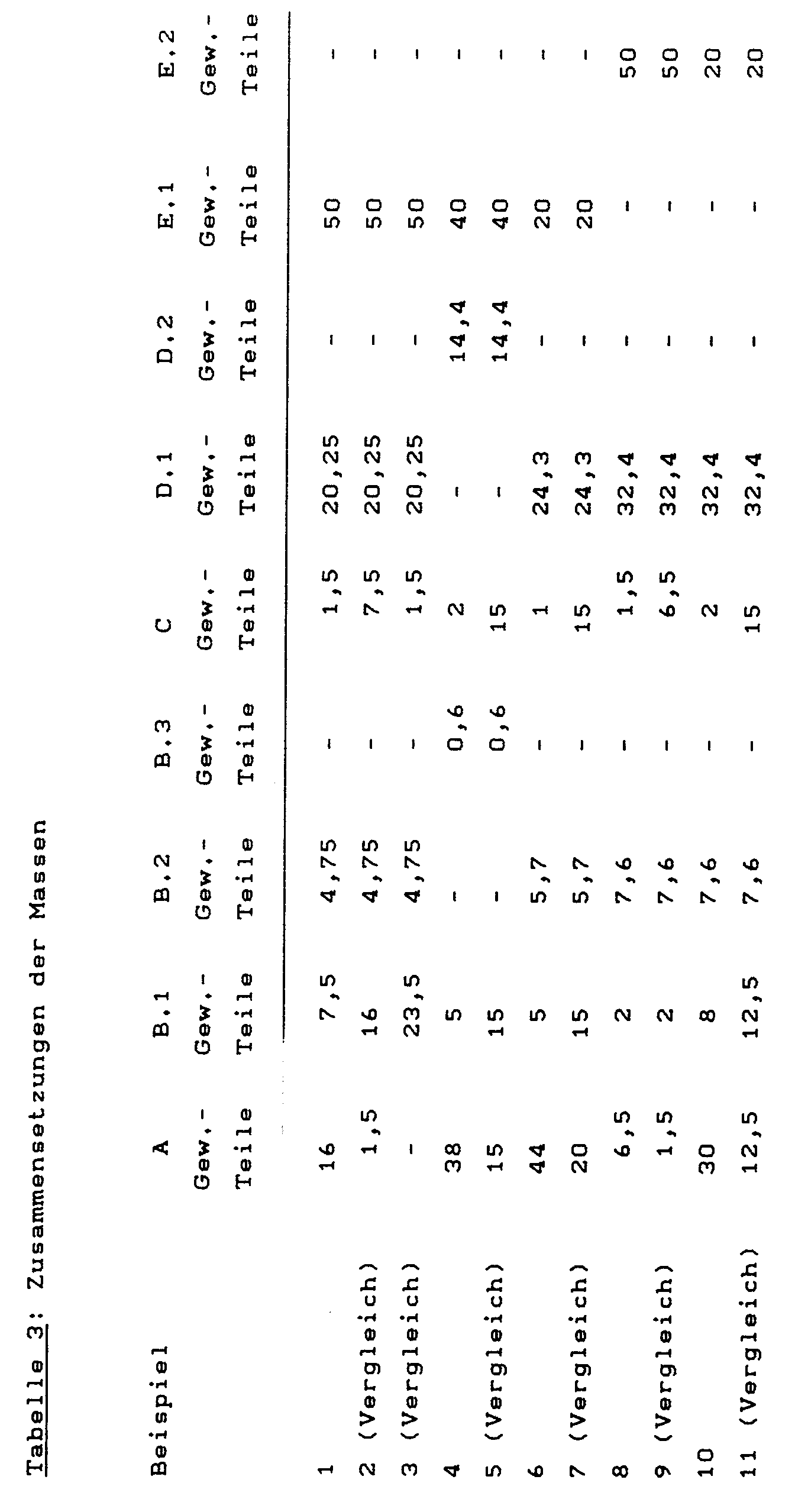

Statistisches Styrol/Acrylnitril = 72:28-Copolymerisat mit einem 

Statistisches Styrol/Acrylnitril = 72:28-Copolymerisat mit einem 

Statistisches Styrol/Acrylnitril = 72:28-Copolymerisat mit einem 
Statistisches Styrol/Acrylnitril = 72:28-Copolymerisat mit einem 
Pfropfkautschuk erhalten durch radikalische Emulsionspolymerisation eines Styrol/Acrylnitril = 72:28-Gemisches unter Verwendung eines teilchenförmigen Polybutadiens, wobei ein mittlerer Teilchendurchmesser (d₅₀) von ca. 0,38 µm resultiert und pro 100 Gew.-Teile Polybutadien 62 Gew.-Teile Styrol/Acrylnitril-Copolymerisat chemisch an das Polybutadien gebunden sind.Graft rubber obtained by radical emulsion polymerization of a styrene / acrylonitrile = 72:28 mixture using a particulate polybutadiene, which results in an average particle diameter (d₅₀) of approximately 0.38 μm and 62 parts by weight of styrene per 100 parts by weight of polybutadiene / Acrylonitrile copolymer chemically bound to the polybutadiene.
Die Produkte A-F werden in einem 1,3 l Innenkneter bei Temperaturen zwischen 160°C und 200°C durch Zusammenschmelzen vermischt. Prüfkörper werden durch Spritzgießen bei 220°C erhalten.Products A-F are mixed in a 1.3 l internal mixer at temperatures between 160 ° C and 200 ° C by melting them together. Test specimens are obtained by injection molding at 220 ° C.
Die Kerbschlagzähigkeit wurde bei Zimmertemperatur (ak RT) und bei -40°C (ak -40°C) nach ISO 180/1A (Einheit: kJ/m²) ermittelt, die Härte wurde nach DIN 53 456 (Einheit: N/mm²) und die Wärmeformbeständigkeit nach Vicat (Methode B) gemäß DIN 53 460 (Einheit: °C) gemessen, Die Verarbeitbarkeit wurde durch Messung des Volumen-Fließindex MVI nach DIN 53 735 U (Einheit: cm³/10 min) charakterisiert; die Glanzmessung wurde entsprechend DIN 67 530 an einer ebenen Platte bei einem Reflektionswinkel von 60°C (Reflektometerwert) mit Hilfe des Mehrwinkel-Reflektometers "Multi-Gloss" der Firma Byk-Mallinckrodt durchgeführt.The notched impact strength was determined at room temperature (a k RT ) and at -40 ° C (a k -40 ° C ) according to ISO 180 / 1A (unit: kJ / m²), the hardness was determined according to DIN 53 456 (unit: N / mm²) and the heat resistance according to Vicat (method B) measured according to DIN 53 460 (unit: ° C), the processability was characterized by measuring the volume flow index MVI according to DIN 53 735 U (unit: cm³ / 10 min); the gloss measurement was carried out on a flat plate in accordance with DIN 67 530 Reflection angle of 60 ° C (reflectometer value) carried out with the help of the multi-angle reflectometer "Multi-Gloss" from Byk-Mallinckrodt.
In Tabelle 5 sind die Zusammensetzungen der untersuchten Massen, in Tabelle 6 die erhaltenen Meßdaten zusammengestellt. Die erfindungsgemäßen Mischungen weisen gleichzeitig gute Werte für Zähigkeit, Härte und Warmeformbeständigkeit, hohen Glanz und eine sehr gute Verarbeitbarkeit auf, wahrend die Vergleichsmischungen in mindestens einer Eigenschaft deutlich schlechter sind.

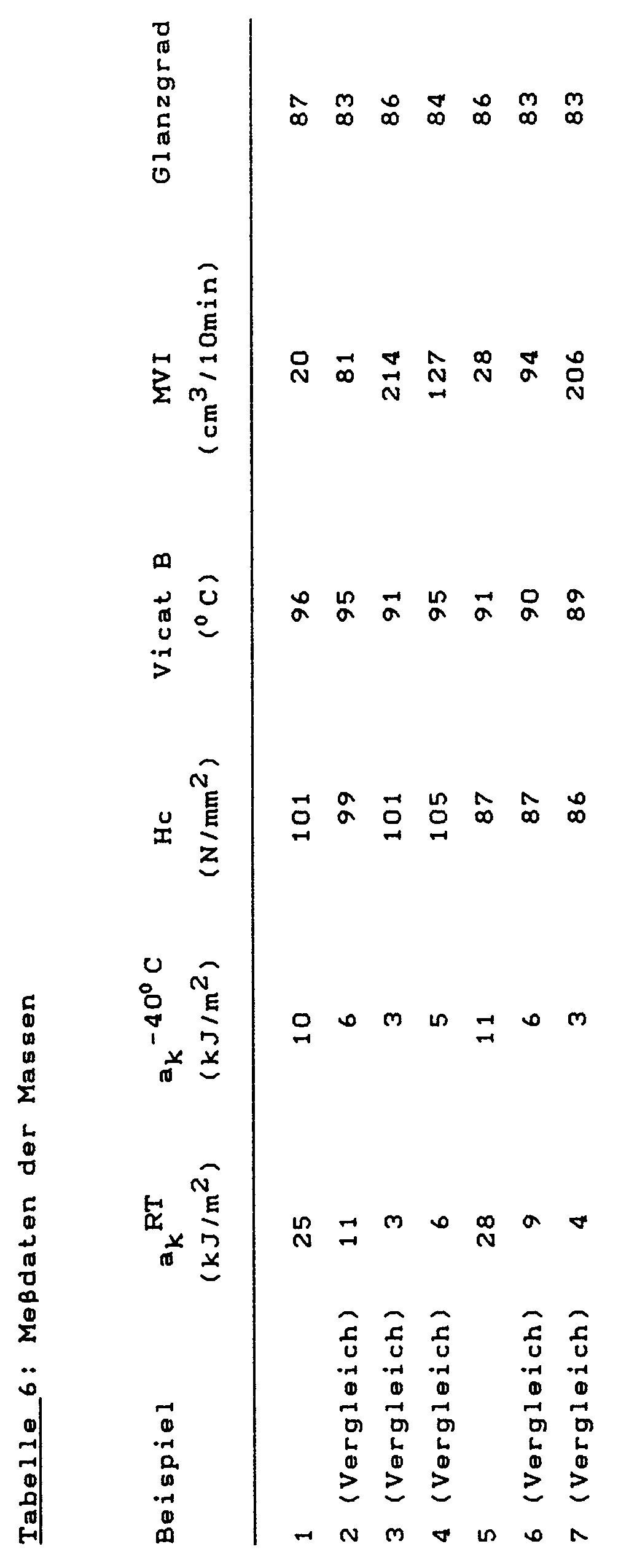
Claims (8)


20 bis 70 Gew.-Teile A) mit einem mittleren Molekulargewicht (

4 bis 20 Gew.-Teile B) aus 65 bis 85 Gew.-% Styrol und/oder α-Methylstyrol und 35 bis 15 Gew.-% Acrylnitril mit einem mittleren Molekulargewicht (

0,5 bis 5 Gew.-Teile C) mit einem mittleren Molekulargewicht (

1 bis 40 Gew.-Teile D) mit einem mittleren Teilchendurchmesser (d₅₀) von 0,10 bis 0,45 µm, und pro 100 Gew.-Teile Kautschuk 20 bis 75 Gew.-Teile des Polymerisats.Thermoplastic compositions according to claim 1 containing
20 to 70 parts by weight of A) with an average molecular weight (
4 to 20 parts by weight B) of 65 to 85% by weight of styrene and / or α-methylstyrene and 35 to 15% by weight of acrylonitrile with an average molecular weight (
0.5 to 5 parts by weight of C) with an average molecular weight (
1 to 40 parts by weight D) with an average particle diameter (d₅₀) of 0.10 to 0.45 microns, and 20 to 75 parts by weight of the polymer per 100 parts by weight of rubber.


Applications Claiming Priority (6)
| Application Number | Priority Date | Filing Date | Title |
|---|---|---|---|
| DE19924214940 DE4214940A1 (en) | 1992-05-06 | 1992-05-06 | ABS-type compsn. for high surface area mouldings |
| DE4214939 | 1992-05-06 | ||
| DE19924214942 DE4214942A1 (en) | 1992-05-06 | 1992-05-06 | ABS-type compsn. for high surface area mouldings |
| DE19924214939 DE4214939A1 (en) | 1992-05-06 | 1992-05-06 | ABS-type compsn. for high surface area mouldings |
| DE4214940 | 1992-05-06 | ||
| DE4214942 | 1992-05-06 |
Publications (3)
| Publication Number | Publication Date |
|---|---|
| EP0568875A2 true EP0568875A2 (en) | 1993-11-10 |
| EP0568875A3 EP0568875A3 (en) | 1994-03-30 |
| EP0568875B1 EP0568875B1 (en) | 1996-01-17 |
Family
ID=27203711
Family Applications (1)
| Application Number | Title | Priority Date | Filing Date |
|---|---|---|---|
| EP93106627A Expired - Lifetime EP0568875B1 (en) | 1992-05-06 | 1993-04-23 | ABS masses |
Country Status (4)
| Country | Link |
|---|---|
| EP (1) | EP0568875B1 (en) |
| JP (1) | JP3456661B2 (en) |
| DE (1) | DE59301433D1 (en) |
| ES (1) | ES2083220T3 (en) |
Cited By (1)
| Publication number | Priority date | Publication date | Assignee | Title |
|---|---|---|---|---|
| EP0984040A1 (en) * | 1998-09-02 | 2000-03-08 | Bayer Corporation | Transparent thermoplastic composition |
Family Cites Families (2)
| Publication number | Priority date | Publication date | Assignee | Title |
|---|---|---|---|---|
| DE4122871A1 (en) | 1990-11-29 | 1992-06-04 | Bayer Ag | ABS MOLDS |
| DE4122870A1 (en) * | 1990-11-29 | 1992-06-04 | Bayer Ag | ABS MOLDS |
-
1993
- 1993-04-23 DE DE59301433T patent/DE59301433D1/en not_active Expired - Lifetime
- 1993-04-23 ES ES93106627T patent/ES2083220T3/en not_active Expired - Lifetime
- 1993-04-23 EP EP93106627A patent/EP0568875B1/en not_active Expired - Lifetime
- 1993-04-28 JP JP12513893A patent/JP3456661B2/en not_active Expired - Fee Related
Cited By (1)
| Publication number | Priority date | Publication date | Assignee | Title |
|---|---|---|---|---|
| EP0984040A1 (en) * | 1998-09-02 | 2000-03-08 | Bayer Corporation | Transparent thermoplastic composition |
Also Published As
| Publication number | Publication date |
|---|---|
| JP3456661B2 (en) | 2003-10-14 |
| ES2083220T3 (en) | 1996-04-01 |
| EP0568875A3 (en) | 1994-03-30 |
| JPH0687995A (en) | 1994-03-29 |
| EP0568875B1 (en) | 1996-01-17 |
| DE59301433D1 (en) | 1996-02-29 |
Similar Documents
| Publication | Publication Date | Title |
|---|---|---|
| EP0576950B1 (en) | Thermoplastic moulding materials | |
| EP0320836B1 (en) | Halogen-free flame-resistant moulding compositions, process for their preparation une their use | |
| EP0707045B1 (en) | Flame resistant thermoplastic polycarbonate moulding compositions | |
| EP0488932B1 (en) | ABS moulding compositions | |
| EP0704488B2 (en) | Polycarbonate moulding compositions with improved toughness | |
| EP0657480B1 (en) | Three-stage graft copolymers and weather-resistant, matt thermoplastic moulding compositions with high cold impact strength containing the same | |
| EP0488930B1 (en) | ABS moulding compositions | |
| DE3735754A1 (en) | THERMOPLASTIC MOLDING METHOD, METHOD FOR THEIR PRODUCTION AND THEIR USE | |
| DE3521407A1 (en) | THERMOPLASTIC MOLDS WITH IMPROVED FLOW SEAM STRENGTH | |
| EP0568875B1 (en) | ABS masses | |
| DE19626156A1 (en) | Flame retardant, thermoplastic molding compounds | |
| EP0207327B1 (en) | Thermoplastic moulding compositions | |
| EP0601473B1 (en) | Thermoplastic moulding materials based on polycarbonates, graft polymers and styrene/acrylonitrile copolymers | |
| EP0456030A2 (en) | Polycarbonate-ABS moulding compositions | |
| EP1151031B1 (en) | Polycarbonate moulding materials with anti-static properties | |
| EP0285984B1 (en) | Thermoplastic composition with an improved stress-crack behaviour | |
| DE4426128A1 (en) | Polynuclear phosphoric acid esters | |
| EP0869150A2 (en) | Flame retardant thermoplastic polycarbonate moulding compositions having good melt flow | |
| US6228938B1 (en) | ABS materials | |
| EP0576948B1 (en) | Thermoplastic moulding materials | |
| EP0332987B1 (en) | Thermoplastic moulding compositions with a high tenacity and good melt processability | |
| DE102018133635A1 (en) | Thermoplastic resin composition and molded article for which it is used | |
| DE4300798A1 (en) | Polycarbonate-acrylonitrile]-butadiene]-styrene] moulding materials | |
| EP0326979A2 (en) | Thermoplastic moulding compositions having a modified flowability, and their use | |
| DE4214940A1 (en) | ABS-type compsn. for high surface area mouldings |
Legal Events
| Date | Code | Title | Description |
|---|---|---|---|
| PUAI | Public reference made under article 153(3) epc to a published international application that has entered the european phase |
Free format text: ORIGINAL CODE: 0009012 |
|
| AK | Designated contracting states |
Kind code of ref document: A2 Designated state(s): DE ES FR GB IT |
|
| PUAL | Search report despatched |
Free format text: ORIGINAL CODE: 0009013 |
|
| RHK1 | Main classification (correction) |
Ipc: C08L 25/02 |
|
| AK | Designated contracting states |
Kind code of ref document: A3 Designated state(s): DE ES FR GB IT |
|
| 17P | Request for examination filed |
Effective date: 19940829 |
|
| 17Q | First examination report despatched |
Effective date: 19950504 |
|
| GRAA | (expected) grant |
Free format text: ORIGINAL CODE: 0009210 |
|
| AK | Designated contracting states |
Kind code of ref document: B1 Designated state(s): DE ES FR GB IT |
|
| GBT | Gb: translation of ep patent filed (gb section 77(6)(a)/1977) |
Effective date: 19960119 |
|
| REF | Corresponds to: |
Ref document number: 59301433 Country of ref document: DE Date of ref document: 19960229 |
|
| ITF | It: translation for a ep patent filed | ||
| REG | Reference to a national code |
Ref country code: ES Ref legal event code: FG2A Ref document number: 2083220 Country of ref document: ES Kind code of ref document: T3 |
|
| ET | Fr: translation filed | ||
| PLBE | No opposition filed within time limit |
Free format text: ORIGINAL CODE: 0009261 |
|
| 26N | No opposition filed | ||
| REG | Reference to a national code |
Ref country code: GB Ref legal event code: IF02 |
|
| REG | Reference to a national code |
Ref country code: GB Ref legal event code: 732E |
|
| REG | Reference to a national code |
Ref country code: FR Ref legal event code: TP |
|
| REG | Reference to a national code |
Ref country code: GB Ref legal event code: 732E Free format text: REGISTERED BETWEEN 20090611 AND 20090617 |
|
| PGFP | Annual fee paid to national office [announced via postgrant information from national office to epo] |
Ref country code: DE Payment date: 20120427 Year of fee payment: 20 |
|
| PGFP | Annual fee paid to national office [announced via postgrant information from national office to epo] |
Ref country code: FR Payment date: 20120503 Year of fee payment: 20 Ref country code: GB Payment date: 20120425 Year of fee payment: 20 |
|
| PGFP | Annual fee paid to national office [announced via postgrant information from national office to epo] |
Ref country code: IT Payment date: 20120424 Year of fee payment: 20 |
|
| PGFP | Annual fee paid to national office [announced via postgrant information from national office to epo] |
Ref country code: ES Payment date: 20120426 Year of fee payment: 20 |
|
| REG | Reference to a national code |
Ref country code: DE Ref legal event code: R071 Ref document number: 59301433 Country of ref document: DE |
|
| REG | Reference to a national code |
Ref country code: GB Ref legal event code: PE20 Expiry date: 20130422 |
|
| REG | Reference to a national code |
Ref country code: ES Ref legal event code: FD2A Effective date: 20130723 |
|
| PG25 | Lapsed in a contracting state [announced via postgrant information from national office to epo] |
Ref country code: GB Free format text: LAPSE BECAUSE OF EXPIRATION OF PROTECTION Effective date: 20130422 Ref country code: DE Free format text: LAPSE BECAUSE OF EXPIRATION OF PROTECTION Effective date: 20130424 |
|
| PG25 | Lapsed in a contracting state [announced via postgrant information from national office to epo] |
Ref country code: ES Free format text: LAPSE BECAUSE OF EXPIRATION OF PROTECTION Effective date: 20130424 |