EP0569812A1 - Verfahren zur kontinuierlichen Herstellung von Dialkylcarbonaten - Google Patents
Verfahren zur kontinuierlichen Herstellung von Dialkylcarbonaten Download PDFInfo
- Publication number
- EP0569812A1 EP0569812A1 EP93107141A EP93107141A EP0569812A1 EP 0569812 A1 EP0569812 A1 EP 0569812A1 EP 93107141 A EP93107141 A EP 93107141A EP 93107141 A EP93107141 A EP 93107141A EP 0569812 A1 EP0569812 A1 EP 0569812A1
- Authority
- EP
- European Patent Office
- Prior art keywords
- carbonate
- alcohol
- column
- transesterification
- dialkyl carbonate
- Prior art date
- Legal status (The legal status is an assumption and is not a legal conclusion. Google has not performed a legal analysis and makes no representation as to the accuracy of the status listed.)
- Granted
Links
Images

Classifications
-
- C—CHEMISTRY; METALLURGY
- C07—ORGANIC CHEMISTRY
- C07C—ACYCLIC OR CARBOCYCLIC COMPOUNDS
- C07C68/00—Preparation of esters of carbonic or haloformic acids
- C07C68/06—Preparation of esters of carbonic or haloformic acids from organic carbonates
- C07C68/065—Preparation of esters of carbonic or haloformic acids from organic carbonates from alkylene carbonates
-
- Y—GENERAL TAGGING OF NEW TECHNOLOGICAL DEVELOPMENTS; GENERAL TAGGING OF CROSS-SECTIONAL TECHNOLOGIES SPANNING OVER SEVERAL SECTIONS OF THE IPC; TECHNICAL SUBJECTS COVERED BY FORMER USPC CROSS-REFERENCE ART COLLECTIONS [XRACs] AND DIGESTS
- Y10—TECHNICAL SUBJECTS COVERED BY FORMER USPC
- Y10S—TECHNICAL SUBJECTS COVERED BY FORMER USPC CROSS-REFERENCE ART COLLECTIONS [XRACs] AND DIGESTS
- Y10S203/00—Distillation: processes, separatory
- Y10S203/06—Reactor-distillation
Definitions
- the present invention relates to a continuous process for the preparation of lower dialkyl carbonates by catalyzed transesterification of ethylene glycol or propylene glycol carbonate with lower alcohols, the reaction of the alkylene carbonate with an alcohol containing dialkyl carbonate being carried out in countercurrent.
- the process requires the introduction of pure alcohol below the point of introduction for the alcohol containing dialkyl carbonate.
- dialkyl carbonates from ethylene glycol carbonate and alcohols, in which the underlying ethylene glycol is formed at the same time, is known and has been described many times. However, almost all descriptions deal with the catalysis of this transesterification, while the technical implementation of this process is not described in detail.
- the reaction mixture described is then separated in a first distillation apparatus into the high-boiling fractions of ethylene glycol carbonate, ethylene glycol and polyglycols on the one hand and the low boilers methanol, dimethyl carbonate and dimethyl ether on the other.
- the high boilers are separated into an ethylene glycol with up to 10% ethylene glycol carbonate and an ethylene glycol carbonate containing polyglycols.
- the ethylene glycol carbonate containing polyglycols flows back into the transesterification reaction, the risk of concentration of the high-boiling by-products having to be expected.
- the glycol containing ethylene glycol carbonate is fed into a hydrolysis in which the glycol carbonate which has gotten into the ethylene glycol is broken down into glycol and CO2 and is therefore lost as a carbon dioxide source.
- R1O represents straight-chain or branched C1-C4 al
- the starting materials for the process according to the invention are therefore ethylene glycol carbonate or propylene glycol carbonate, preferably ethylene glycol carbonate on the one hand and a lower alcohol, such as methanol, ethanol, propanol, isopropanol, butanol or isobutanol, on the other hand, with the associated di- (C1-C4-alkyl) carbonate is socialized.
- the proportion of dialkyl carbonate in such a mixture is 0.2 to 30% by weight, preferably 1 to 28% by weight, particularly preferably 3 to 25% by weight, based on the total amount of dialkyl carbonate and the alcohol on which it is based.
- the alcohol to be used is preferably methanol or ethanol, particularly preferably methanol; Accordingly, the dialkyl carbonate associated with the alcohol is dimethyl or diethyl carbonate, preferably dimethyl carbonate.
- the alkylene glycol carbonate is fed into the upper part of the transesterification column.
- the alcohol containing the associated dialkyl carbonate is introduced into the middle or lower part of the column; in addition, pure alcohol of the same type is introduced in the process according to the invention below the feed point of the alcohol containing the associated dialkyl carbonate.
- the alcohol containing the associated dialkyl carbonate and the pure alcohol are preferably introduced in gaseous form and directed towards the alkylene carbonate trickling down from above.
- the reaction products of the process according to the invention are ethylene glycol or propylene glycol, preferably ethylene glycol, which is obtained as the bottom product and is fed to a further purification.
- the desired dialkyl carbonate is obtained as the reaction product at the top of the column, generally in a mixture with the underlying alcohol which is present in excess and is not fully converted.
- the desired dialkyl carbonate is obtained by distillation from this top product mixture. With this recovery, the underlying alcohol to be separated is obtained only in high form, in the special case of the dimethyl carbonate / methanol system, because of the azeotrope formation, only in extremely pure form. With lower expenditure on distillation, on the other hand, a mixture of the alcohol to be separated off with the associated dialkyl carbonate is always obtained.
- the alcohol containing the associated dialkyl carbonate according to the invention can originate from any source (for example from the production of alkyl aryl carbonate or diaryl carbonate, the purification of which likewise produces a dialkyl / alcohol mixture), it is preferred according to the invention to contain such a dialkyl carbonate alcohol to be used as it occurs in the pure preparation of the desired dialkyl carbonates in the process according to the invention described, with the application of low distillation expenses.
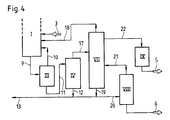
- 1 to 5 illustrate various aspects of the method according to the invention as follows: 1 shows as apparatus: a transesterification column (I), a distillation column (II) and thin film / falling film evaporator (111) and (IV). 1 further shows as starting materials: alkylene glycol carbonate (1), catalyst (solution) (2) and alcohol (3). 1 also shows as products: dialkyl carbonate (4), alkylene glycol (5) and catalyst-containing high boiler fraction (6) to be disposed of.
- FIG. 1 shows as internal streams: a gaseous stream of an alcohol / dialkyl carbonate mixture (7), alcohol-enriched alcohol / dialkyl carbonate mixture (8) which is recycled to (I), a glycol-containing bottom stream (9) Fractions (10) from the bottom stream containing low boilers, such as alcohol still present and dialkyl carbonate still present, which are returned to (I), crude alkylene glycol (11) containing catalyst and a fraction (12) containing high boilers containing catalyst, some of which as such ( 6) is discharged and is partly applied to the top of (I) in the sense of a catalyst return (13).
- (I) can be a column provided with internals known to the person skilled in the art (bubble trays, sieve plates, etc.) or packed with packing elements of the type known to the person skilled in the art.
- (II) is a distillation column which is preferably operated at elevated pressure, for example at 4 to 15 bar, preferably at 6 to 12 bar and which can be operated under simplified equipment and energy conditions (low reflux ratio).
- (III) and (IV) are of a generally known type.
- transesterification catalysts which can be used according to the invention are those known to the person skilled in the art, for example hydrides, oxides, hydroxides, alcoholates, amides or salts of alkali metals, such as lithium, sodium, potassium, rubidium and cesium of lithium, sodium and potassium, particularly preferably of sodium and potassium (US-3,642,858, US-3,803,201, EP 1082).
- alkali metals such as lithium, sodium, potassium, rubidium and cesium of lithium, sodium and potassium, particularly preferably of sodium and potassium (US-3,642,858, US-3,803,201, EP 1082).
- the alcoholates can also be formed according to the invention in situ by using the elemental alkali metals and the alcohol to be reacted according to the invention.
- Salts of the alkali metals can be those of organic or inorganic acids, such as of acetic acid, propionic acid, butyric acid, benzoic acid, stearic acid, carbonic acid (carbonates or hydrogen carbonates), of hydrochloric acid, hydrobromic or hydroiodic acid, nitric acid, sulfuric acid, hydrofluoric acid, phosphoric acid, hydrocyanic acid, rhodanic acid , Boric acid, tin acid, C1-C4 stannic acids or antimonic acids.
- organic or inorganic acids such as of acetic acid, propionic acid, butyric acid, benzoic acid, stearic acid, carbonic acid (carbonates or hydrogen carbonates), of hydrochloric acid, hydrobromic or hydroiodic acid, nitric acid, sulfuric acid, hydrofluoric acid, phosphoric acid, hydrocyanic acid, rhodanic acid , Boric acid, tin acid, C1-C4 stannic acids
- the oxides, hydroxides, alcoholates, acetates, propionates, benzoates, carbonates and bicarbonates are preferred as compounds of the alkali metals; hydroxides, alcoholates, acetates, benzoates or carbonates are used in a particularly preferred manner.
- Such alkali metal compounds (optionally formed in situ from the free alkali metals) are obtained in amounts of 0.001 to 2% by weight, preferably 0.005 to 1.5% by weight, particularly preferably 0.01 to 1.0% by weight on the reaction mixture to be used.
- alkali metal compounds EP 274 953
- examples include crown ethers such as dibenzo-18-crown-6, polyethylene glycols or bicyclic nitrogen-containing cryptands.
- Such complexing agents are used in amounts of 0.1 to 200 mol%, preferably in 1 to 100 mol%, based on the alkali metal compound.
- thallium I and thallium III compounds such as the oxides, hydroxides, carbonates, acetates, bromides, chlorides, fluorides, formates, nitrates, cyanates, stearates, naphthenates, benzoates, cyclohexylphosphonates, Hexahydrobenzoates, the cyclopentadienylthallium, thallium methylate, thallium ethylate, preferably Tl- (I) oxide, Tl- (I) hydroxide, Tl- (I) carbonate, Tl- (I) acetate, Tl- (III) acetate, Tl- (I) fluoride, Tl- (I) formate, Tl- (I) nitrate, Tl- (I) naphtenate and Tl- (I) methylate (EP 1083).
- the amounts of thallium catalyst are not particularly critical. They are
- Nitrogen-containing bases can also be used as catalysts in the process according to the invention (US Pat. No. 4,062,884).
- sec. or tert. Amines such as triethylamine, tributylamine, methyldibenzylamine, dimethylcyclohexylamine and others.
- the amounts of the nitrogen-containing bases used according to the invention are from 0.01 to 10% by weight, preferably from 0.1 to 5% by weight, particularly preferably from 0.1 to 1% by weight, based on the entire reaction mixture.
- compounds from the group of the phosphines, stibines, arsines or the divalent sulfur and selenium compounds and their onium salts can also be used as catalysts (EP 180 387, US Pat. No. 4,734,519).
- tributylphosphine triphenylphosphine, diphenylphosphine, 1,3-bis (diphenylphosphino) propane, triphenylarsine, trimethylarsine, tributylarsine, 1,2-bis (diphenylarsino) ethane, triphenylantimony, diphenyl sulfide, diphenyl disenphide, diphenyl disenphide, diphenyl disenphide, diphenyl disenphide, diphenyl disenphide, diphenyl disenphide, diphenyl disenphide, diphenyl disenphide, diphenyl disenphide, diphenyl disenphide, diphenyl disenphide, diphenyl disenphide, diphenyl selenide Cl, Br, J), tetraphenylarsonium halide (Cl, Br, J), triphenylsulfonium hal
- the amounts of use of this group of catalysts according to the invention are in the range from 0.1 to 10% by weight, preferably from 0.1 to 5% by weight, particularly preferably in the range from 0.1 to 2% by weight, based on the total Reaction mixture.
- the amounts which can be used according to the invention are 0.1 to 10% by weight, preferably 0.5 to 5% by weight, based on the mixture as a whole.
- A is preferably the cation of one of the metals Mg, Ca, Sr, Ba, Zn, Cu, Mn, Co, Ni, Fe, Cr, Mo, W, Ti, Zr, Sn, Hf, V and Ta, preferably around the cation of one of the metals Mg, Ca, Zn, Co, Ni, Mn, Cu and Sn.
- cationic oxo complexes of the metals mentioned are also possible, such as, for example, titanyl TiO++ and chromyl CrO2++.
- the anion X belonging to cation A is that of an inorganic or organic acid.
- Such an inorganic or organic acid can be monobasic or dibasic or tribasic.
- Such acids and their anions are known to the person skilled in the art.
- Examples of anions of monobasic inorganic or organic acids are: fluoride, bromide, chloride, iodide, nitrate, the anion of an alkane carboxylic acid with 1-16 C atoms and benzoate;
- Examples of anions of dibasic inorganic or organic acids are: sulfate, oxalate, succinate, fumarate, maleinate, phthalate and others;
- Examples of three-base inorganic or organic anions are: phosphate or citrate.
- Preferred anions X in the catalyst of the formula (III) are: fluoride, chloride, bromide, iodide, sulfate, nitrate, phosphate, formate, acetate, propionate, oxalate, butyrate, citrate, succinate, fumarate, maleate, benzoate, phthalate, decanoate, Stearate, palmitate, and laurinate.
- Particularly preferred anions X are: chloride, bromide, iodide, acetate, laurinate, stearate, palmitate, decanoate, nitrate and sulfate.
- the cation B in the catalysts of the formula (III) is one from the group of alkali or alkaline earth metal cations, the quaternary ammonium, phosphonium, arsonium or stibonium cations and the ternary sulfonium cations.
- the (earth) alkali metal cations here are: the lithium, sodium, potassium, rubidium, cesium, magnesium, calcium, strontium and barium cation, preferably the alkali metal cations mentioned, particularly preferably the sodium and the potassium cation.
- the formulas (IV) and (VI) take the place of the radicals R2, R3, R4 and R5 are the radicals R12, R13, R14 and R15, which independently of one another are straight-chain or branched C1-C12-alkyl or C7-C8-aralkyl and one of the radicals R12 to R15 can also be phenyl.
- the radicals R12, R13, R14 or R15 are replaced by the radicals R22, R23, R24 or R25, which independently of one another are C1-C8-alkyl or benzyl and one of the radicals R22 to R25 can also be phenyl.
- Straight-chain or branched C1-C18 alkyl is, for example, methyl, ethyl, propyl, isopropyl, butyl, isobutyl, hexyl, octyl, dodecyl, hexadecyl or octadecyl.
- Preferred alkyl has 1-12 C atoms, particularly preferred alkyl has 1-8 C atoms.
- C7-C12 aralkyl is, for example, benzyl, phenylethyl, phenylpropyl, naphthylmethyl or naphthyl-ethyl; preferred aralkyl is benzyl or phenylethyl, very particularly preferred aralkyl is benzyl.
- C6-C12 aryl is, for example, phenyl, naphthyl or biphenylyl, preferably phenyl.
- the anion Y in the catalyst of the formula (III) is a halide ion, such as fluoride, chloride, bromide or iodide, preferably bromide or iodide, particularly preferably iodide.
- halide ion such as fluoride, chloride, bromide or iodide, preferably bromide or iodide, particularly preferably iodide.
- it can also have the meaning of other anions mentioned under X, if in the specific case the anion X is bromide or iodide.
- the bifunctional catalyst of the formula (III) is used in an amount of 0.005-5% by weight, preferably 0.01-3% by weight, particularly preferably 0.01-1% by weight, based on the total transesterification mixture, used.
- Such catalysts can be added to the top of the column in homogeneous solution, alkylene glycol carbonate, alkylene glycol, alcohol or dialkyl carbonate, that is to say native solvents, being used as the solvent. It is of course possible to use insoluble transesterification catalysts which are arranged on the intermediate floors or in the middle of the packing of (I). In such a case, the metering of a dissolved catalyst via (2) can be omitted.
- Suitable heterogeneous catalysts are, for example: Ion exchange resins with functional groups from tert.
- Amines, quaternary ammonium groups, hydroxide, chloride or hydrogen sulfate being mentioned as counterions, sulfonic acid groups or carboxyl groups, hydrogen, alkali metals or alkaline earth metals being examples of both as counterions.
- These functional groups can be bound to the polymer either directly or via inert chains (US Pat. No. 4,062,884, US Pat. No. 4,691,041, JA 63/238 043, EP 298 167).
- Alkali or alkaline earth silicates impregnated on silicon dioxide supports and ammonium-exchanged zeolites may also be mentioned.
- Fig. 2 shows a supplement and improvement of the separation of the top stream (7) from (I).
- 1, pure dialkyl carbonate (4) is first separated off in (II) and an alcohol (8) containing dialkyl carbonate is removed in gaseous form.
- (8) is now only partially returned (for example 30 to 80%, preferably 40 to 70%, of the total stream) directly to (I), while the rest in a second distillation column (V) approximately in the middle is introduced and divided there into a bottom stream (15) representing almost pure alcohol and a top stream (14) containing almost all of the dialkyl carbonate in addition to further alcohol.
- (14) is returned to (II) for the further production of dialkyl carbonate
- (15) is preferably used as that according to the invention pure alcohol to be used in (1) and forms part of (3) there.
- FIG. 3 shows yet another aspect of the process according to the invention, namely the linkage with the production of arylalkyl carbonate or diaryl carbonate, which is obtained by reacting dialkyl carbonate with a phenol and in which a mixture of split off alcohol and incompletely converted dialkyl carbonate (16) is formed .
- (16) with its dialkyl carbonate content is in the range of (8) according to the invention, such a stream can be used according to the invention instead of (8).
- it is recycled to (II) for the recovery of the dialkyl carbonate and for the extensive separation of the underlying alcohol.
- a glycol stream (17) is first taken from (IV), which is worked up in a further distillation column (VII) to obtain purified glycol (22) which, if necessary, is purified in a further purification step (IX) (repeated distillation, extraction or the like) pure glycol (5) can be worked up.
- (22) is taken from the top of (VII) as a side stream.
- a low-boiling stream (18) obtained in (VII) is returned to (I).
- the high-boiling stream (19) obtained in (VII) can partly, just like (12), in the return line (13) are given, but is at least partially concentrated in (VIII) with regard to its content of high boilers, further glycol (21) being obtained.
- the concentrated bottom product of (VIII) is discharged as (6).
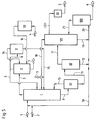
- FIG. 5 shows an integrated method variant in which the preferred elements from FIGS. 2, 3 and 4 have been integrated in FIG. 1. All apparatus and material flows are marked in FIG. 5 with the same reference numerals as in FIGS. 1 to 4.
- the transesterification in (1) is carried out at 0.5 to 5 bar, preferably 0.8 to 1.5 bar, particularly preferably at normal pressure and at a temperature of 40 to 150 ° C., preferably at 45 to 130 ° C.
- the pure alcohol (3) or additionally (15) to be fed in according to the invention is 0.2 to 5 times the proportion of dialkyl carbonate in the alcohol containing a dialkyl carbonate to be introduced via (8).
- the overhead stream (7) taken from (I) has, for example in the case of methanol / dimethyl carbonate, the composition of the azeotrope with 70% by weight of methanol and 30% by weight of dimethyl carbonate or has higher proportions of dimethyl carbonate.
- the alcohol to be used as (3) can also be obtained from an alcohol / dialkyl carbonate mixture from which the dialkyl carbonate has been removed by pervaporation, vapor permeation or two-pressure distillation.
- a countercurrent transesterification column (I) with stripping section and amplifier section was tempered by applying a temperature gradient such that the bottom temperature was about 120 ° C. and the top temperature was about 50 ° C.
- 367 g / h of ethylene glycol carbonate were metered in via (1).
- 872 g / h of a mixture of 80% by weight of methanol and 20% by weight of dimethyl carbonate were metered in via (8).
- 270 g / h of methanol were metered in via (3) and a further 130 g / h of methanol via (15).
- 375 g / h bottom product (11) passed into a further falling film evaporator (IV), from which 75 g / h concentrated catalyst solution (12) was removed via its bottom, about half of which was returned to (I) via (13) and the other half was metered into a thin-film evaporator with a separating attachment (VIII).
Landscapes
- Chemical & Material Sciences (AREA)
- Organic Chemistry (AREA)
- Organic Low-Molecular-Weight Compounds And Preparation Thereof (AREA)
- Low-Molecular Organic Synthesis Reactions Using Catalysts (AREA)
Abstract
Description
- Die vorliegende Erfindung betrifft ein kontinuierliches Verfahren zur Herstellung von niederen Dialkylcarbonaten durch katalysierte Umesterung von Ethylenglykol- oder Propylenglykolcarbonat mit niederen Alkololen, wobei die Umsetzung des Alkylencarbonats mit einem Dialkylcarbonat enthaltenden Alkohol im Gegenstrom vorgenommen wird. Das Verfahren erfordert die Einführung von reinem Alkohol unterhalb der Einführungsstelle für den Dialkylcarbonat enthaltenden Alkohol.
- Die Herstellung von Dialkylcarbonaten aus Ethylenglykolcarbonat und Alkoholen, bei der gleichzeitig das zugrundeliegende Ethylenglykol entsteht, ist bekannt und vielfach beschrieben worden. Fast alle Beschreibungen befassen sich jedoch mit der Katalyse dieser Umesterung, während die technische Realisierung dieses Verfahrens im Detail nicht beschrieben wird. In US 4.691.041 als einer der wenigen Quellen findet sich jedoch eine ausführliche Beschreibung eines solchen Verfahrens:
Ethylenglykolcarbonat und Methanol werden im Molverhältnis von 1:4 durch ein mit einem basischen Ionenaustauscher gefülltes Rohr bei etwa 100°C und etwa 7 bar gepumpt, wobei sich im günstigsten Fall das Umesterungsgleichgewicht einstellt, welches neben Methanol als Hauptkomponente und nicht umgesetztem Ethylenglykolcarbonat die Reaktionsprodukte Dimethylcarbonat und Ethylenglykol und zusätzlich Nebenprodukte, wie Polyglykole und Dimethylether, enthält. - Das beschriebene Reaktionsgemisch wird sodann in einer ersten Destillationsapparatur in die hochsiedenden Anteile Ethylenglykolcarbonat, Ethylenglykol und Polyglykole einerseits und die Leichtsieder Methanol, Dimethylcarbonat und Dimethylether andererseits aufgetrennt. In einer zweiten Destillation werden die Hochsieder in ein Ethylenglykol mit bis zu 10 % Ethylenglykolcarbonat und ein Polyglykole enthaltendes Ethylenglykolcarbonat aufgetrennt. Das Polyglykole enthaltende Ethylenglykolcarbonat fließt in die Umesterungsreaktion zurück, wobei die Gefahr der Aufkonzentrierung der hochsiedenden Nebenprodukte erwartet werden muß. Das Ethylenglykolcarbonat enthaltende Glykol wird in eine Hydrolyse eingespeist, in welcher das in das Ethylenglykol geratene Glykolcarbonat in Glykol und CO₂ aufgespalten wird und somit als Kohlensäurequelle verloren ist.
- Aus der genannten Leichtsiederfraktion wird sodann in einer 3. Destillation, die unter erhöhtem Druck ausgeführt wird, ein Sumpf von reinem Dimethylcarbonat und ein an Dimethylcarbonat abgereichertes Methanol, welches zusätzlich Dimethylether enthält, erhalten. Das Dimethylcarbonat enthaltende Methanol wird ebenfalls in die Umesterungsreaktion zurückgeführt. Durch die Zurückführung von Carbonat enthaltendem Material wird die Raum-Zeit-Ausbeute an Umesterungsprodukt merklich eingeschränkt. Diese Einschränkung beträgt schätzungsweise 30 bis 40 %, verglichen mit der Erstfüllung der Umesterungsapparatur. Diese Einschränkung ist umso schmerzlicher, als ohnehin bestenfalls die Einstellung des Umesterungsgleichgewichts erwartet werden kann. Diese Einschränkungen sind für eine technische Durchführung außerordentlich hinderlich. Somit schien zwar die Rückführung eines Dialkylcarbonat enthaltenden Alkohols sehr wünschenswert, denn in einem solchen Falle brauchte eine weitgehende und damit energieaufwendige Auftrennung des Dialkylcarbonats und des zugrundeliegenden Alkohols nicht durchgeführt zu werden, eine solche Rückführung erschien aber nicht realisierbar. Die Vermeidung einer solchen aufwendigen Trennung von Carbonat und Alkohol ist in gleichem Maße für alle niederen Alkohole (C₁-C₄) wünschenswert; in besonderem Maße ist sie jedoch wünschenswert im System Dimethylcarbonat/Methanol, welches ein schwierig zu trennendes Azeotrop bildet.
- In überraschend günstiger Weise ist die Benutzung eines Dialkylcarbonat enthaltenden Alkohols in einer technischen Realisierung dennoch möglich, wenn man in einer Kolonnenapparatur im Gegenstrom umestert, wobei dem im oberen Teil der Kolonne aufgegebenen Alkylencarbonat von unten her ein Dialkylcarbonat enthaltender Alkoholstrom entgegengeführt wird, wobei zusätzlich unterhalb der Einführung des Dialkylcarbonat enthaltenden Alkohols reiner Alkohol eingeführt wird.
- Es wurde ein Verfahren zur kontinuierlichen Herstellung von Dialkylcarbonaten der Formel
(R¹O)₂CO (I),
in der R¹ geradkettiges oder verzweigtes C₁-C₄-Alkyl, bevorzugt Methyl oder Ethyl, besonders bevorzugt Methyl darstellt,
durch katalysierte Umesterung von Ethylenglykol- oder Propylenglykolcarbonat, bevorzugt von Ethylenglykolcarbonat, mit einem Alkohol der Formel
R¹OH (II),
in der R¹ die obige Bedeutung hat,
gefunden, das dadurch gekennzeichnet ist, daß die Umesterung in einer Kolonne im Gegenstrom so geführt wird, daß Ethylenglykol- oder Propylenglykolcarbonat in den oberen Teil der Kolonne und ein Dialkylcarbonat enthaltender Alkohol, dessen Dialkylcarbonatgehalt bei 0,2 bis 30 Gew.-%, bevorzugt 1 bis 28 Gew.-%, besonders bevorzugt 3 bis 25 Gew.-% liegt, in den mittleren oder unteren Teil der Kolonne eingeführt werden und zusätzlich unterhalb der Einführung des Dialkylcarbonat enthaltenden Alkohols reiner Alkohol eingeführt wird. - Die Edukte für das erfindungsgemäße Verfahren sind demnach Ethylenglykolcarbonat oder Propylenglykolcarbonat, bevorzugt Ethylenglykolcarbonat einerseits und ein niederer Alkohol, wie Methanol, Ethanol, Propanol, Isopropanol, Butanol oder Isobutanol, andererseits, der mit dem zugehörigen Di-(C₁-C₄-alkyl)-carbonat vergesellschaftet ist. In einem solchen Gemisch beträgt der Anteil des Dialkylcarbonats 0,2 bis 30 Gew.-%, bevorzugt 1 bis 28 Gew.-%, besonders bevorzugt 3 bis 25 Gew.-%, bezogen auf die Gesamtmenge an Dialkylcarbonat und dem zugrundeliegenden Alkohol. Der einzusetzende Alkohol ist bevorzugt Methanol oder Ethanol, besonders bevorzugt Methanol; entsprechend ist das mit dem Alkohol vergesellschaftete Dialkylcarbonat das Dimethyl- bzw. Diethylcarbonat, bevorzugt das Dimethylcarbonat.
- Das Alkylenglykolcarbonat wird erfindungsgemäß in den oberen Teil der Umesterungskolonne eingespeist. Der das zugehörige Dialkylcarbonat enthaltende Alkohol wird in den mittleren oder unteren Teil der Kolonne eingeführt; zusätzlich wird im erfindungsgemäßen Verfahren unterhalb der Einspeisungsstelle des das zugehörige Dialkylcarbonat enthaltenden Alkohols reiner Alkohol der gleichen Art eingeführt.
- Der das zugehörige Dialkylcarbonat enthaltende Alkohol und der reine Alkohol werden in bevorzugter Weise gasförmig eingeführt und dem von oben herabrieselnden Alkylencarbonat entgegengeleitet.
- Die Reaktionsprodukte des erfindungsgemäßen Verfahrens sind Ethylenglykol bzw. Propylenglykol, in bevorzugter Weise Ethylenglykol, welches als Sumpfprodukt gewonnen wird und einer weiteren Reinigung zugeführt wird. Desweiteren erhält man als Reaktionsprodukt am Kopf der Kolonne das gewünschte Dialkylcarbonat, im allgemeinen im Gemisch mit dem im Überschuß vorhandenen und nicht vollständig umgesetzten zugrundeliegenden Alkohol. Aus diesem als Kopfprodukt entnommenen Gemisch wird das gewünschte Dialkylcarbonat destillativ gewonnen. Bei dieser Gewinnung fällt der abzutrennende zugrundeliegende Alkohol nur bei hohen Anstrengungen, im speziellen Fall des Systems Dimethylcarbonat/Methanol wegen der Azeotropbildung nur bei äußerst hohen Anstrengungen in reiner Form an. Bei geringeren destillativen Aufwendungen erhält man dagegen stets ein Gemisch des abzutrennenden Alkohols mit dem zugehörigen Dialkylcarbonat.
- Während der erfindungsgemäß das zugehörige Dialkylcarbonat enthaltende Alkohol aus einer beliebigen Quelle stammen kann (so beispielsweise aus der Herstellung von Alkyl-Arylcarbonat oder Diarylcarbonat, bei deren Reindarstellung ebenfalls ein Dialkyl/Alkohol-Gemisch anfällt), ist es erfindungsgemäß bevorzugt, einen solchen Dialkylcarbonat enthaltenden Alkohol einzusetzen, wie er bei der Reindarstellung der gewünschten Dialkylcarbonate im beschriebenen erfindungsgemäßen Verfahren unter Anlegung geringer destillativer Aufwendungen anfällt.
- In Fig. 1 bis Fig. 5 werden verschiedene Aspekte des erfindungsgemäßen Verfahrens wie folgt dargestellt:
Fig. 1 zeigt als Apparate: eine Umesterungskolonne (I), eine Destillationskolonne (II) und Dünnschicht/Fallfilmverdampfer (111) und (IV). Fig. 1 zeigt weiterhin als Edukte: Alkylenglykolcarbonat (1), Katalysator (-Lösung) (2) und Alkohol (3). Fig. 1 zeigt noch weiterhin als Produkte: Dialkylcarbonat (4), Alkylenglykol (5) und zu entsorgende, katalysatorhaltige Hochsiederfraktion (6). Noch weiter zeigt Fig. 1 als interne Ströme: einen gasförmigen Strom eines Alkohol/Dialkylcarbonat-Gemisches (7), an Alkohol angereichertes Alkohol/Dialkylcarbonat-Gemisch (8), das nach (I) zurückgeführt wird, einen Glykol enthaltenden Sumpfstrom (9), Leichtsieder enthaltende Anteile (10) aus dem Sumpfstrom, wie noch vorhandener Alkohol und noch vorhandenes Dialkylcarbonat, die nach (I) zurückgeführt werden, katalysatorhaltiges rohes Alkylenglykol (11) und eine katalysatorhaltige Hochsieder enthaltende Fraktion (12), die zum Teil als solche (6) ausgeschleust wird und zum Teil im Sinne einer Katalysatorrückführung (13) auf den Kopf von (I) gegeben wird. - Fig. 1 zeigt demnach die bereits angesprochene Variante, in der der erfindungsgemäß einzusetzende, Dialkylcarbonat enthaltende Alkohol ein solcher ist, der bei der Reindarstellung des gewünschten Dialkylcarbonats anfällt. (I) kann eine mit dem Fachmann bekannten Einbauten (Glockenböden, Siebböden usw.) versehene oder mit Füllkörpern der dem Fachmann bekannten Art gepackte Kolonne sein. (II) ist eine Destillationskolonne, die in bevorzugter Weise bei erhöhtem Druck, beispielsweise bei 4 bis 15 bar, bevorzugt bei 6 bis 12 bar betrieben wird und die unter vereinfachten apparativen und energetischen Bedingungen (geringes Rücklaufverhältnis) betrieben werden kann. (III) und (IV) sind von allgemein bekannter Bauart, Die erfindungsgemäß einsetzbaren Umesterungskatalysatoren sind die dem Fachmann bekannten, beispielsweise Hydride, Oxide, Hydroxide, Alkoholate, Amide oder Salze von Alkalimetallen, wie Lithium, Natrium, Kalium, Rubidium und Cäsium, bevorzugt von Lithium, Natrium und Kalium, besonders bevorzugt von Natrium und Kalium (US-3 642 858, US-3 803 201, EP 1082). Für den Fall des Einsatzes der Alkoholate können diese erfindungsgemäß auch in situ durch Einsatz der elementaren Alkalimetalle und dem erfindungsgemäßen umzusetzenden Alkohol gebildet werden. Salze der Alkalimetalle können solche von organischen oder anorganischen Säuren sein, wie von Essigsäure, Propionsäure, Buttersäure, Benzoesäure, Stearinsäure, Kohlensäure (Carbonate oder Hydrogencarbonate), von Salzsäure, Bromwasserstoff- oder Iodwasserstoffsäure, Salpetersäure, Schwefelsäure, Fluorwasserstoffsäure, Phosphorsäure, Blausäure, Rhodanwasserstoff, Borsäure, Zinnsäure, C₁-C₄-Stannonsäuren oder Antimonsäuren. In bevorzugter Weise kommen als Verbindungen der Alkalimetalle die Oxide, Hydroxide, Alkoholate, Acetate, Propionate, Benzoate, Carbonate und Hydrogencarbonate in Frage, in besonders bevorzugter Weise werden Hydroxide, Alkoholate, Acetate, Benzoate oder Carbonate eingesetzt. Solche Alkalimetallverbindungen (gegebenenfalls in situ gebildet aus den freien Alkalimetallen) werden in Mengen von 0,001 bis 2 Gew.-%, bevorzugt 0,005 bis 1,5 Gew.-%, besonders bevorzugt 0,01 bis 1,0 Gew.-%, bezogen auf das umzusetzende Reaktionsgemisch, eingesetzt.
- Es ist erfindungsgemäß möglich, solchen Alkalimetallverbindungen gegebenenfalls komplexierende Stoffe zuzusetzen (EP 274 953). Beispielsweise seien genannt Kronenether wie Dibenzo-18-krone-6, Polyethylenglykole oder bicyclische stickstoffhaltige Kryptanden.
- Solche Komplexiermittel werden in Mengen von 0,1 bis 200 mol-%, bevorzugt in 1 bis 100 mol-%, bezogen auf die Alkalimetallverbindung, eingesetzt.
- Als Katalysatoren für das erfindungsgemäße Verfahren sind ferner Thallium-I- und Thallium-III-Verbindungen geeignet, wie die Oxide, Hydroxide, Carbonate, Acetate, Bromide, Chloride, Fluoride, Formiate, Nitrate, Cyanate, Stearate, Naphthenate, Benzoate, Cyclohexylphosphonate, Hexahydrobenzoate, das Cyclopentadienylthallium, Thalliummethylat, Thalliumethylat, bevorzugt Tl-(I)-oxid, Tl-(I)-hydroxid, Tl-(I)-carbonat, Tl-(I)-acetat, Tl-(III)-acetat, Tl-(I)-fluorid, Tl-(I)-formiat, Tl-(I)-nitrat, Tl-(I)-naphtenat und Tl-(I)-methylat (EP 1083). Die Mengen an Thalliumkatalysator sind nicht besonders kritisch. Sie betragen im allgemeinen 0,0001-10 Gew.-%, bevorzugt 0,001-1 Gew.-%, bezogen auf das gesamte Reaktionsgemisch.
- Im erfindungsgemäßen Verfahren können weiterhin stickstoffhaltige Basen als Katalysatoren eingesetzt werden (US-4 062 884). Genannt seien beispielsweise sek. oder tert. Amine wie Triethylamin, Tributylamin, Methyldibenzylamin, Dimethylcyclohexylamin u.a..
- Die erfindungsgemäß eingesetzten Mengen der stickstoffhaltigen Basen liegen von 0,01 bis 10 Gew.-%, bevorzugt von 0,1 bis 5 Gew.-%, besonders bevorzugt von 0,1 bis 1 Gew.-%, bezogen auf das gesamte Reaktionsgemisch.
- Als Katalysatoren sind erfindungsgemäß ferner Verbindungen aus der Gruppe der Phosphine, Stibine, Arsine oder der zweiwertigen Schwefel- und Selen-Verbindungen sowie deren Oniumsalze einsetzbar (EP 180 387, US 4 734 519). Beispielhaft seien die folgenden genannt: Tributylphosphin, Triphenylphosphin, Diphenylphosphin, 1,3-Bis-(diphenylphosphino)propane, Triphenylarsin, Trimethylarsin, Tributylarsin, 1,2-Bis-(diphenylarsino)ethan, Triphenylantimon, Diphenylsulfid, Diphenyldisulfid, Diphenylselenid, Tetraphenylphosphoniumhalogenid (Cl, Br, J), Tetraphenylarsoniumhalogenid (Cl, Br, J), Triphenylsulfoniumhalogenid (Cl, Br) usw.
- Die erfindungsgemäßen Einsatzmengen dieser Katalysatorengruppe liegen im Bereich von 0,1 bis 10 Gew.-%, bevorzugt von 0,1 bis 5 Gew.-%, besonders bevorzugt im Bereich von 0,1 bis 2 Gew.-%, bezogen auf das gesamte Reaktionsgemisch.
- Weiterhin erfindungsgemäß einsetzbar sind Komplexe oder Salze des Zinns, Titans oder Zirkoniums (US 4 661 609). Beispiele solcher Systeme sind Butylstannonsäure, Zinnmethoxid, Dimethylzinn, Dibutylzinnoxid, Dibutylzinndilaurat, Tributylzinnhydrid, Tributylzinnchlorid, Zinn(II)ethylhexanoate, Zirkoniumalkoxide (Methyl, Ethyl, Butyl), Zirkonium(IV)halogenide (F, Cl, Br, J), Zirkoniumnitrate, Zirkoniumacetylacetonat, Titanalkoxide (Methyl, Ethyl, Isopropyl), Titanacetat, Titanacetylacetonat usw.
- Die erfindungsgemäß einsetzbaren Mengen betragen 0,1 bis 10 Gew.-%, bevorzugt 0,5 bis 5 Gew.-%, bezogen auf das Gesamtgemisch.
- Im erfindungsgemäßen Verfahren können weiterhin bifunktionelle Katalysatoren der Formel
[AaXb]m·[BcYd]n (III),
eingesetzt werden. In diesen bifunktionellen Katalysatoren wird das molare Verhältnis der beiden in eckigen Klammern stehenden Komponenten durch die Indices m und n ausgedrückt. Diese Indices können unabhängig voneinander Werte von 0,001-1, bevorzugt 0,01-1, besonders bevorzugt 0,05-1 und ganz besonders bevorzugt 0,1-1 annehmen. Innerhalb der eckigen Klammern stehen neutrale Salze aus je einem Kation und einem Anion. Die Indices a und b stellen unabhängig voneinander ganze Zahlen von 1-5 dar; die Indices c und d bedeuten unabhängig voneinander ganze Zahlen von 1-3, wobei den Forderungen der Valenzen der Kationen und Anionen zur Bildung solcher neutraler Salze zu entsprechen ist. Des weiteren bedeuten in (III) - A
- das Kation eines Metalles, das der
dritten Periode und Gruppe IIa, der
vierten Periode und Gruppe IIa, IVa-VIIIa, Ib oder IIb, der
fünften Periode und Gruppe IIa, IVa-VIIa oder IVb bzw. der
sechsten Periode und Gruppe IIa-VIa des Periodensystems der Elemente in der Kurzperiodenform angehört. - Die in Frage kommenden Metalle für das Kation A entnimmt der Fachmann den üblichen Darstellungen des Periodensystems der Elemente (Mendelejew) in der Kurzperiodenform. In bevorzugter Weise handelt es sich bei A um das Kation eines der Metalle Mg, Ca, Sr, Ba, Zn, Cu, Mn, Co, Ni, Fe, Cr, Mo, W, Ti, Zr, Sn, Hf, V und Ta, in bevorzugter Weise um das Kation eines der Metalle Mg, Ca, Zn, Co, Ni, Mn, Cu und Sn. Außer den nicht komplexierten Kationen der genannten Metalle kommen auch kationische Oxokomplexe der genannten Metalle in Frage, wie beispielsweise Titanyl TiO⁺⁺ und Chromyl CrO₂⁺⁺.
- Das zum Kation A gehörige Anion X ist das einer anorganischen oder organischen Säure. Eine solche anorganische oder organische Säure kann einbasisch oder zweibasisch oder dreibasisch sein. Solche Säuren und ihre Anionen sind dem Fachmann bekannt. Beispiele für Anionen einbasischer anorganischer oder organischer Säuren sind: Fluorid, Bromid, Chlorid, Iodid, Nitrat, das Anion einer Alkancarbonsäure mit 1-16 C-Atomen und Benzoat; Beispiele für Anionen zweibasischer anorganischer oder organischer Säuren sind: Sulfat, Oxalat, Succinat, Fumarat, Maleinat, Phthalat und weitere; Beispiele für dreibasische anorganische oder organische Anionen sind: Phosphat oder Citrat. Bevorzugte Anionen X im Katalysator der Formel (III) sind: Fluorid, Chlorid, Bromid, Iodid, Sulfat, Nitrat, Phosphat, Formiat, Acetat, Propionat, Oxalat, Butyrat, Citrat, Succinat, Fumarat, Maleinat, Benzoat, Phthalat, Decanoat, Stearat, Palmitat, und Laurinat. Besonders bevorzugte Anionen X sind: Chlorid, Bromid, Iodid, Acetat, Laurinat, Stearat, Palmitat, Decanoat, Nitrat und Sulfat.
- Als Kation B in den Katalysatoren der Formel (III) kommt eines aus der Gruppe der Alkali- oder Erdalkalikationen, der quaternären Ammonium-, Phosphonium-, Arsonium- oder Stibonium-Kationen und der ternären Sulfonium-Kationen in Frage.
- Als (Erd)Alkalimetallkationen seien hierbei genannt: das Lithium-, Natrium-, Kalium-, Rubidium-, Cäsium-, Magnesium-, Calcium-, Strontium- und Bariumkation, bevorzugt die genannten Alkalimetallkationen, besonders bevorzugt das Natrium- und das Kaliumkation.
- In bevorzugter Weise kommen als Kationen B solche der Formeln

in Frage, worin - Q¹
- für N, P, As oder Sb steht und
- R², R³, R⁴ und R⁵
- unabhängig voneinander geradkettiges oder verzweigtes C₁-C₁₈ oder C₇-C₁₂-Aralkyl sind und einer der Reste R²-R⁵ auch C₆-C₁₂ sein kann.
- In besonders bevorzugter Weise ist B ein Kation der Formel

worin, - Q²
- für N oder P, bevorzugt für N steht.
- In ganz besonders bevorzugter Weise treten im Rahmen der Formeln (IV) bzw. (VI) an die Stelle der Reste R², R³, R⁴ und R⁵ die Reste R¹², R¹³, R¹⁴ bzw. R¹⁵, die unabhängig voneinander geradkettiges oder verzweigtes C₁-C₁₂-Alkyl oder C₇-C₈-Aralkyl bedeuten und einer der Reste R¹² bis R¹⁵ auch Phenyl sein kann. In weiterhin ganz besonders bevorzugter Weise treten an die Stelle der Reste R¹², R¹³, R¹⁴ bzw. R¹⁵, die Reste R²², R²³, R²⁴ bzw. R²⁵, die unabhängig voneinander C₁-C₈-Alkyl oder Benzyl bedeuten und einer der Reste R²² bis R²⁵ auch Phenyl sein kann.
- Geradkettiges oder verzweigtes C₁-C₁₈-Alkyl ist beispielsweise Methyl, Ethyl, Propyl, Isopropyl, Butyl, Isobutyl, Hexyl, Octyl, Dodecyl, Hexadecyl oder Octadecyl. Bevorzugtes Alkyl hat 1-12 C-Atome, besonders bevorzugtes Alkyl hat 1-8 C-Atome.
- C₇-C₁₂-Aralkyl ist beispielsweise Benzyl, Phenylethyl, Phenylpropyl, Naphthylmethyl oder Naphthyl-ethyl; bevorzugtes Aralkyl ist Benzyl oder Phenylethyl, ganz besonders bevorzugtes Aralkyl ist Benzyl.
- C₆-C₁₂-Aryl ist beispielsweise Phenyl, Naphthyl oder Biphenylyl, bevorzugt Phenyl.
- Das Anion Y im Katalysator der Formel (III) ist ein Halogenidion, wie Fluorid, Chlorid, Bromid oder Iodid, bevorzugt Bromid oder Iodid, besonders bevorzugt Iodid. Es kann jedoch auch die Bedeutung von anderen unter X genannten Anionen besitzen, wenn im konkreten Fall das Anion X Bromid oder Iodid ist.
- Der bifunktionelle Katalysator der Formel (III) wird in einer Menge von 0,005-5 Gew.-%, bevorzugt 0,01-3 Gew.-%, besonders bevorzugt 0,01-1 Gew.-%, bezogen auf das gesamte Umesterungsgemisch, eingesetzt.
- Diese Katalysatormengen unterscheiden sich teilweise von den in der Literatur genannten Mengen. Besonders überraschend ist, daß im erfindungsgemäßen Verfahren relativ hohe Konzentrationen an den wirksamen Katalysatoren auf der Basis von Alkaliverbindungen eingesetzt werden können, ohne daß es dabei zu den ausbeutemindernden und die Reaktionsführung behindernden Entwicklungen von CO₂ und zur Bildung von Polyolen kommt, wie dies beispielsweise aus DE-OS 2 740 243 und der dort zitierten Literatur und aus DE-OS 2 740 251 bekannt ist. Auch dies ist eine überraschende Besonderheit des erfindungsgemäßen Verfahrens.
- Solche Katalysatoren können homogen gelöst auf den Kopf der Kolonne gegeben werden, wobei als Lösungsmittel Alkylenglykolcarbonat, Alkylenglykol, Alkohol oder Dialkylcarbonat, also systemeigene Lösungsmittel, zur Anwendung gelangen. Es ist selbstverständlich möglich, nicht lösliche Umesterungskatalysatoren einzusetzen, die auf den Zwischenböden oder inmitten der Füllkörper von (I) angeordnet sind. In einem solchen Fall kann die Dosierung eines gelösten Katalysators über (2) entfallen. Geeignete heterogene Katalysatoren sind beispielsweise:
Ionentauscherharze mit funktionellen Gruppen aus tert. Aminen, quartären Ammoniumgruppen, wobei als Gegenionen Hydroxid, Chlorid oder Hydrogensulfat beispielsweise genannt seien, Sulfonsäuregruppen oder Carboxylgruppen, wobei für beide als Gegenionen Wasserstoff, Alkalimetalle oder Erdalkalimetalle beispielhaft genannt seien. Diese funktionellen Gruppen können entweder direkt oder über inerte Ketten an das Polymer gebunden sein (US 4 062 884, US 4 691 041, JA 63/238 043, EP 298 167). Weiterhin genannt seien Alkali- oder Erdalkalisilikate, imprägniert auf Siliciumdioxidträgern, sowie Ammonium-ausgetauschte Zeolithe. - Fig. 2 zeigt eine Ergänzung und Verbesserung der Auftrennung des Kopfstromes (7) von (I). Hierbei wird, wie in Fig. 1 dargestellt, zunächst in (II) reines Dialkylcarbonat (4) abgetrennt und ein Dialkylcarbonat enthaltender Alkohol (8) gasförmig entnommen. (8) wird nunmehr in Abwandlung von Fig. 1 nur zum Teil (beispielsweise 30 bis 80 %, bevorzugt 40 bis 70 %, des gesamten Stromes) direkt nach (I) zurückgeleitet, während der Rest in eine zweite Destillationskolonne (V) etwa mittig eingeführt wird und dort in einen nahezu reinen Alkohol darstellenden Sumpfstrom (15) und einen nahezu das gesamte Dialkylcarbonat neben weiterem Alkohol enthaltenden Kopfstrom (14) aufgeteilt. Während (14) zur weiteren Gewinnung von Dialkylcarbonat nach (II) zurückgeleitet wird, wird (15) in bevorzugter Weise als der erfindungsgemäß einzusetzende reine Alkohol in (1) eingesetzt und stellt dort einen Teil von (3) dar.
- Fig. 3 zeigt einen noch weiteren Aspekt des erfindungsgemäßen Verfahrens, nämlich die Verknüpfung mit der Herstellung von Arylalkylcarbonat oder Diarylcarbonat, welches durch Umsetzung von Dialkylcarbonat mit einem Phenol gewonnen wird und bei welchem ein Gemisch aus abgespaltenem Alkohol und nicht vollständig umgesetztem Dialkylcarbonat (16) entsteht. Für den Fall, daß (16) mit seinem Gehalt an Dialkylcarbonat im erfindungsgemäßen Bereich von (8) liegt, kann ein solcher Strom anstelle von (8) erfindungsgemäß eingesetzt werden. Gemäß Fig. 3 wird er jedoch zur Rückgewinnung des Dialkylcarbonats und zur weitgehenden Abtrennung des zugrundeliegenden Alkohols nach (II) zurückgeführt.
- Fig. 4 schließlich zeigt eine weitere bevorzugte Variante in der Behandlung des Sumpfstromes (9) zur Gewinnung des erfindungsgemäß anfallenden Alkylenglykols und zur Entsorgung der Hochsiederfraktion (6). Hierbei wird aus (IV) zunächst ein Glykolstrom (17) entnommen, der in einer weiteren Destillationskolonne (VII) auf gereinigtes Glykol (22) aufgearbeitet wird, das bei Bedarf in einem weiteren Reinigungsschritt (IX) (nochmalige Destillation, Extraktion oder ähnliches) auf reines Glykol (5) aufgearbeitet werden kann. (22) wird im oberen Bereich von (VII) als Seitenstrom entnommen. Ein in (VII) anfallender Leichtsiederstrom (18) wird nach (I) zurückgeführt. Der in (VII) anfallende Hochsiederstrom (19) kann teilweise, genauso wie (12), in die Rückführungsleitung (13) gegeben werden, wird aber mindestens teilweise in (VIII) bezüglich seines Gehalts an Hochsiedern aufkonzentriert, wobei weiteres Glykol (21) anfällt. Das aufkonzentrierte Sumpfprodukt von (VIII) wird als (6) ausgeschleust.
- Fig. 5 zeigt eine integrierte Verfahrensvariante, in der die bevorzugten Elemente von Fig. 2, Fig. 3 und Fig. 4 in Fig. 1 integriert worden sind. Alle Apparate- und Stoffströme sind in Fig. 5 mit den gleichen Bezugszeichen markiert wie in Fig. 1 bis Fig. 4.
- Die Umesterung in (1) wird bei 0,5 bis 5 bar, bevorzugt 0,8 bis 1,5 bar, besonders bevorzugt bei Normaldruck und bei einer Temperatur von 40 bis 150°C, bevorzugt bei 45 bis 130°C, durchgeführt.
- Der erfindungsgemäß einzuspeisende reine Alkohol (3) bzw. zusätzlich (15) beträgt das 0,2 bis 5-fache des Dialkylcarbonatanteils in dem über (8) einzuführenden, ein Dialkylcarbonat enthaltenden Alkohol.
- Der aus (I) entnommene Kopfstrom (7) hat beispielsweise im Falle von Methanol/Dimethylcarbonat die Zusammensetzung des Azeotrops mit 70 Gew.-% Methanol und 30 Gew.-% Dimethylcarbonat oder hat höhere Anteile an Dimethylcarbonat.
- Der als (3) einzusetzende Alkohol kann auch aus einem Alkohol/Dialkylcarbonat-Gemisch gewonnen werden, aus welchem durch Pervaporation, Dampfpermeation oder Zweidruckdestillation das Dialkylcarbonat abgetrennt wurde.
- Das erfindungsgemäße Verfahren hat gegenüber dem aus US 4.691.041 bekannten Stand der Technik folgende Vorteile:
- a) Die Gleichgewichtseinstellung erfolgt rasch und führt durch ständig sich ändernde Stoffzusammensetzung zu sehr hohen Umsätzen und sehr hohen Selektivitäten.
- b) Durch die praktische vollständige Umesterung des Alkylencarbonats entsteht ein von Alkylencarbonat praktisch freies Alkylenglykol; die vom Stand der Technik (US' 041) her bekannten Verluste von Alkylencarbonat durch nachträgliche Hydrolyse werden hierbei vermieden.
- c) Infolge kurzer Verweilzeiten ist die Bildung von Nebenprodukten, wie die Bildung von Polyglykolen, auf Mengen unterhalb von 1 %, bezogen auf die Gesamtmenge an Alkylenglykol, begrenzt.
- d) Das erfindungsgemäße Verfahren kommt mit wenigen Apparaten aus, die sich aus standardisierten Typen rekrutieren.
- e) In der bevorzugten Ausführungsform gemäß Fig. 1 bis Fig. 5 werden viele interne Ströme nicht kondensiert, sondern als dampfförmige Ströme geführt. Damit werden die zu destillierenden Stoffmengen verkleinert und eine energetisch günstige Fahrweise geschaffen.
- f) Eine verfahrenstechnisch günstige Kopplung mit der Herstellung von Alkyl-Arylcarbonaten oder Diarylcarbonaten ist möglich.
- In einer Apparateanordnung gemäß Fig. 5 wurde eine Gegenstromumesterungskolonne (I) mit Abtriebsteil und Verstärkerteil unter Anlegung eines Temperaturgradienten so temperiert, daß die Sumpftemperatur bei etwa 120°C und die Kopftemperatur bei etwa 50°C lag. Über (1) dosierte man 367 g/h Ethylenglykolcarbonat. Über (8) dosierte man 872 g/h eines Gemisches aus 80 Gew.-% Methanol und 20 Gew.-% Dimethylcarbonat. In den unteren Teil der Kolonne, jedoch oberhalb des Abtriebsteils dosierte man über (3) 270 g/h Methanol und über (15) weitere 130 g/h Methanol. Weiterhin wurden auf den Kopf von (I) über (13) 37 bis 38 g/h eines rückgeführten, 4 Gew.-% Katalysator (KOH) enthaltenden Sumpfes und 1,2 g/h frisches Kaliumhydroxid über (2) dosiert. Soweit diese eindosierten Stoffströme interne Stoffströme darstellten, wurden sie den in Fig. 5 gezeigten Apparaten entnommen.
- Die Methanol enthaltenden eindosierten Stoffströme stiegen dampfförmig in der Kolonne nach oben, dem herabfließenden flüssigen und den Katalysator enthaltenden Ethylenglykolcarbonat entgegen, wobei die Umesterung zu Dimethylcarbonat und Ethylenglykol erfolgte. Am Kopf von (I) entnahm man 1380 g/h eines Gemisches (7) aus 60 Gew.-% Methanol und 40 Gew.-% Dimethylcarbonat, welches einer Bodenkolonne (II) in der Mitte aufgegeben und bei einem Druck von 10 bar in ein Gemisch aus etwa 80 Gew.-% Methanol und 20 Gew.-% Dimethylcarbonat und 378 g/h Dimethylcarbonat (4) aufgetrennt wurde. Vom dampfförmig entnommenen Gemisch (8) wurden die genannten 872 g/h nach (I) zurückgeführt, während der restliche Teil von (8) in der Kolonne (V) weiter aufgetrennt wurde; hierbei erhielt man ein Dimethylcarbonat enthaltendes Kopfprodukt, welches nach (II) zurückgeführt wurde und 130 g/h im wesentlichen aus Methanol bestehendes Sumpfprodukt (15), welches nach (I) zurückgeführt wurde.
- Das Sumpfprodukt (9) von (I), das im wesentlichen aus Ethylenglykol, geringen Mengen Leichtsiedern (Methanol und Dimethylcarbonat), Hochsiedern, wie Diethylenglykol und dem Katalysator bestand, gelangte in einen Fallfilmverdampfer (III), aus welchem 38 g/h Leichtsieder (10) nach (I) zurückgeführt wurden. 375 g/h Sumpfprodukt (11) gelangten in einen weiteren Fallfilmverdampfer (IV), dem über seinen Sumpf 75 g/h aufkonzentrierte Katalysatorlösung (12) entnommen wurde, die etwa zur Hälfte über (13) nach (I) zurückgeführt und zur anderen Hälfte in einen Dünnschichtverdampfer mit Trennaufsatz (VIII) eindosiert wurde. 302 g/h Dampfphase (17) aus (IV) wurden in die Kolonne (VII) eindosiert. In (VII) wurden nochmals 77 g/h Leichtsieder (18) abgetrennt, die nach (I) zurückgeführt wurden. Aus dem oberen Teil von (VII) wurden im Seitenabzug 255 bis 256 g/h Glykol (22) entnommen, die je nach Reinheitsanforderungen in (IX) weiter auf hochreines Glykol (5) mit einer Menge von 255 g/h weiter behandelt werden konnten. Der Sumpfablauf (19) von (VII) in einer Menge von 58 bis 59 g/h wurde gemeinsam mit der Hälfte des Sumpfablaufs (12) von (IV) einem Dünnschichtverdampfer (VIII) zugeführt, dessen Destillat (21) mit einer Menge von 91 g/h in den unteren Teil von (VII) eingespeist wurde. Der aufkonzentrierte Sumpf (6) von (VIII) mit allen Hochsiedern und einem Teil des Katalysators wurde der Entsorgung zugeführt.
Claims (9)
- Verfahren zur kontinuierlichen Herstellung von Dialkylcarbonat der Formel
(R¹O)₂CO,
in der R¹ geradkettiges oder verzweigtes C₁-C₄-Alkyl, bevorzugt Methyl oder Ethyl, besonders bevorzugt Methyl darstellt,
durch katalysierte Umesterung von Ethylenglykol- oder Propylenglykolcarbonat, bevorzugt von Ethylenglykolcarbonat, mit einem Alkohol der Formel
R¹OH,
in der R¹ die obige Bedeutung hat,
dadurch gekennzeichnet, daß die Umesterung in einer Kolonne im Gegenstrom so geführt wird, daß Ethylenglykol- oder Propylenglykolcarbonat in den oberen Teil der Kolonne und ein Dialkylcarbonat enthaltender Alkohol, dessen Dialkylcarbonatgehalt bei 0,2 bis 30 Gew.-%, bevorzugt 1 bis 28 Gew.-%, besonders bevorzugt 3 bis 25 Gew.-% liegt, in den mittleren oder unteren Teil der Kolonne eingeführt werden und zusätzlich unterhalb der Einführung des Dialkylcarbonat enthaltenden Alkohols reiner Alkohol eingeführt wird. - Verfahren nach Anspruch 1, dadurch gekennzeichnet, daß der Dialkylcarbonat enthaltende Alkohol aus der destillativen Trennung des aus der Umesterung als Kopfstrom entnommenen Dialkylcarbonat/Alkohol-Gemisches in Dialkylcarbonat und einen Dialkylcarbonat enthaltenden Alkohol stammt.
- Verfahren nach Anspruch 2, dadurch gekennzeichnet, daß die destillative Trennung bei 4 bis 15 bar, bevorzugt bei 6 bis 12 bar vorgenommen wird.
- Verfahren nach Anspruch 1, dadurch gekennzeichnet, daß der reine Alkohol das 0,2 bis 5-fache des Dialkylcarbonatanteils im Dialkylcarbonat enthaltenden Alkohol darstellt.
- Verfahren nach Anspruch 1, dadurch gekennzeichnet, daß die Umesterung bei einer Temperatur von 40 bis 150°C, bevorzugt bei 45 bis 130°C und einem Druck von 0,5 bis 2 bar, bevorzugt 0,9 bis 1,2 bar durchgeführt wird.
- Verfahren nach Anspruch 1, dadurch gekennzeichnet, daß Dimethylcarbonat durch Umesterung von Ethylenglykolcarbonat mit Methanol hergestellt wird.
- Verfahren nach Anspruch 2, dadurch gekennzeichnet, daß der bei der destillativen Trennung des aus der Umesterung als Kopfstrom entnommenen Dialkyl/Alkohol-Gemisches erhaltene weitere Kopfstrom zu 30 bis 80 Vol-%, bevorzugt zu 40 bis 70 Vol-% in die Umesterung zurückgeführt wird, während der Rest einer weiteren Destillation zugeführt wird, deren Sumpfprodukt im wesentlichen aus dem Alkohol besteht und in den unteren Teil der Umesterungskolonne zurückgeführt wird, während das Kopfprodukt dieser zweiten Kolonne in die erste Trennkolonne (11) zurückgeführt wird.
- Verfahren nach Anspruch 2, dadurch gekennzeichnet, daß ein aus der Herstellung von Alkyl-Arylcarbonat oder Diarylcarbonat stammender Dialkylcarbonat/Alkohol-Strom in die Trennkolonne (11) eingespeist wird.
- Verfahren nach Anspruch 1, dadurch gekennzeichnet, daß das nach Durchlaufen der Fallstrom-/Dünnschichtverdampfer (III) und (IV) erhaltene rohe Glykol (17) einer Glykol-Reindestillation in einer Kolonne (VII) zugeführt wird, an deren Kopf eine Leichtsiederfraktion (18) entnommen und in die Umesterungskolonne (I) zurückgeführt wird, unterhalb deren Kopf ein Seitenabzug (22) von Reinglykol entnommen wird, das in einer nachgeschalteten Reinigungsstufe (IX) weiter gereinigt werden kann, und deren Sumpf (19) gemeinsam mit einem Teil des Sumpfes (12) von (IV) einer Aufkonzentrierung in (VIII) zugeführt wird, deren Kopfstrom (21) der Glykol-Kolonne (VII) zugeführt und deren Sumpfprodukt (6) einer Entsorgung der Hochsieder und eines Teils des Katalysators zugeführt wird.
Applications Claiming Priority (2)
| Application Number | Priority Date | Filing Date | Title |
|---|---|---|---|
| DE4216121 | 1992-05-15 | ||
| DE4216121A DE4216121A1 (de) | 1992-05-15 | 1992-05-15 | Verfahren zur kontinuierlichen Herstellung von Dialkylcarbonaten |
Publications (2)
| Publication Number | Publication Date |
|---|---|
| EP0569812A1 true EP0569812A1 (de) | 1993-11-18 |
| EP0569812B1 EP0569812B1 (de) | 1996-03-13 |
Family
ID=6458988
Family Applications (1)
| Application Number | Title | Priority Date | Filing Date |
|---|---|---|---|
| EP93107141A Expired - Lifetime EP0569812B1 (de) | 1992-05-15 | 1993-05-03 | Verfahren zur kontinuierlichen Herstellung von Dialkylcarbonaten |
Country Status (5)
| Country | Link |
|---|---|
| US (1) | US5359118A (de) |
| EP (1) | EP0569812B1 (de) |
| JP (1) | JPH069507A (de) |
| DE (2) | DE4216121A1 (de) |
| ES (1) | ES2085073T3 (de) |
Cited By (19)
| Publication number | Priority date | Publication date | Assignee | Title |
|---|---|---|---|---|
| WO1997047583A1 (de) * | 1996-06-13 | 1997-12-18 | Henkel Kommanditgesellschaft Auf Aktien | Verfahren zur herstellung von dialkylcarbonaten |
| WO2008090108A1 (en) * | 2007-01-23 | 2008-07-31 | Shell Internationale Research Maatschappij B.V. | Process for the preparation of an alkanediol and a dialkyl carbonate |
| WO2008090109A1 (en) * | 2007-01-23 | 2008-07-31 | Shell Internationale Research Maatschappij B.V. | Process for the preparation of an alkanediol and a dialkyl carbonate |
| US7622601B2 (en) | 2004-10-14 | 2009-11-24 | Asahi Kasei Chemicals Corporation | Process for production of high-purity diaryl carbonate |
| US7777067B2 (en) | 2004-07-13 | 2010-08-17 | Asahi Kasei Chemicals Corporation | Industrial process for production of an aromatic carbonate |
| US7812189B2 (en) | 2004-08-25 | 2010-10-12 | Asahi Kasei Chemicals Corporation | Industrial process for production of high-purity diphenyl carbonate |
| DE102009030680A1 (de) | 2009-06-26 | 2010-12-30 | Bayer Materialscience Ag | Verfahren zur Herstellung von Dialkylcarbonaten aus Alkylencarbonaten und Alkoholen |
| WO2011039113A1 (en) * | 2009-09-29 | 2011-04-07 | Shell Internationale Research Maatschappij B.V. | Process for preparing alkanediol and dialkyl carbonate |
| EP2322261A2 (de) | 2009-11-14 | 2011-05-18 | Bayer MaterialScience AG | Verfahren zur Reinigung von Dialkylcarbonaten |
| DE102010006657A1 (de) | 2010-02-03 | 2011-08-04 | Bayer MaterialScience AG, 51373 | Verfahren zur Herstellung von Dialkylcarbonaten |
| US8049028B2 (en) | 2005-12-26 | 2011-11-01 | Asahi Kasei Chemicals Corporation | Industrial process for separating out dialkyl carbonate |
| US8058465B2 (en) | 2005-11-25 | 2011-11-15 | Asahi Kasei Chemicals Corporation | Process for industrially producing dialkyl carbonate and diol |
| US8071819B2 (en) | 2006-01-10 | 2011-12-06 | Asahi Kasei Chemicals Corporation | Industrial process for production of high-purity diol |
| US8093437B2 (en) | 2006-01-26 | 2012-01-10 | Asahi Kasei Chemicals Corporation | Industrial process for production of diol |
| DE102010042937A1 (de) | 2010-10-08 | 2012-04-12 | Bayer Materialscience Aktiengesellschaft | Verfahren zur Herstellung von Diarylcarbonaten aus Dialkylcarbonaten |
| DE102010042934A1 (de) | 2010-10-26 | 2012-04-26 | Bayer Materialscience Aktiengesellschaft | Verfahren zur kontinuierlichen Herstellung von Dialkylcarbonat |
| DE102010042936A1 (de) | 2010-10-26 | 2012-04-26 | Bayer Materialscience Aktiengesellschaft | Verfahren zur kontinuierlichen Herstellung von Dialkylcarbonat |
| EP2650278A1 (de) | 2012-04-11 | 2013-10-16 | Bayer MaterialScience AG | Verfahren zur Herstellung von Diarylcarbonaten aus Dialkylcarbonaten |
| US9475751B2 (en) | 2012-11-21 | 2016-10-25 | Covestro Deutschland Ag | Process for producing dialkyl carbonates |
Families Citing this family (43)
| Publication number | Priority date | Publication date | Assignee | Title |
|---|---|---|---|---|
| IT1269884B (it) * | 1994-06-03 | 1997-04-15 | Enichem Sintesi | Metodo per la rimozione dei contaminanti acidi e salini dalla fase condensata dell'effluente di reazione in un processo per la sintesi di dimetilcarbonato |
| US5847189A (en) * | 1995-12-22 | 1998-12-08 | Asahi Kasei Kogyo Kabushiki Kaisha | Method for continuously producing a dialkyl carbonate and a diol |
| WO1999064382A1 (en) | 1998-06-10 | 1999-12-16 | Asahi Kasei Kogyo Kabushiki Kaisha | Process for continuous production of dialkyl carbonate and diol |
| EP1174406B1 (de) | 1999-03-03 | 2007-10-31 | Asahi Kasei Chemicals Corporation | Verfahren zur kontinuierlichen herstellung von einem dialkylcarbonat und diol |
| DE10140846A1 (de) * | 2001-08-21 | 2003-03-06 | Cognis Deutschland Gmbh | Verfahren zur Herstellung von Dialkylcarbonaten |
| JP4818103B2 (ja) | 2004-06-17 | 2011-11-16 | 旭化成ケミカルズ株式会社 | ジアルキルカーボネートとジオールの製造方法 |
| EA011128B1 (ru) * | 2004-06-25 | 2008-12-30 | Асахи Касеи Кемикалз Корпорейшн | Способ промышленного получения ароматического карбоната |
| WO2007034669A1 (ja) | 2005-09-20 | 2007-03-29 | Asahi Kasei Chemicals Corporation | ジアルキルカーボネートとジオールの製造方法 |
| EA012516B1 (ru) * | 2005-11-25 | 2009-10-30 | Асахи Касеи Кемикалз Корпорейшн | Способ промышленного получения диалкилкарбоната и диола |
| JP4236276B2 (ja) * | 2005-12-12 | 2009-03-11 | 旭化成ケミカルズ株式会社 | ジアルキルカーボネートとジオール類の工業的製造方法 |
| TWI308911B (en) * | 2005-12-13 | 2009-04-21 | Asahi Kasei Chemcials Corp | Process for industrially producing dialkyl carbonate and diol |
| TW200732291A (en) * | 2005-12-14 | 2007-09-01 | Asahi Kasei Chemicals Corp | Process for production of dialkyl carbonate and diol in industrial scale and with high yield |
| IN2008KN00872A (de) * | 2005-12-19 | 2008-11-28 | Asahi Chemical Corp | |
| TW200738601A (en) * | 2005-12-27 | 2007-10-16 | Asahi Kasei Chemicals Corp | Industrial process for production of dialkyl carbonate and diol |
| TW200738602A (en) * | 2006-02-01 | 2007-10-16 | Asahi Kasei Chemicals Corp | Industrial process for producing high-purity diol |
| TWI382979B (zh) * | 2006-02-22 | 2013-01-21 | Shell Int Research | 碳酸伸烷酯之生產方法及由此生產的碳酸伸烷酯於烷二醇及碳酸二烷酯之製造中的用途 |
| TWI383976B (zh) * | 2006-02-22 | 2013-02-01 | Shell Int Research | 製備碳酸二烷酯及烷二醇的方法 |
| TW200740731A (en) * | 2006-02-22 | 2007-11-01 | Shell Int Research | Process for the preparation of alkanediol |
| TW200740749A (en) * | 2006-02-22 | 2007-11-01 | Shell Int Research | Process for the preparation of an alkanediol and a dialkyl carbonate |
| TWI378087B (en) * | 2006-02-22 | 2012-12-01 | Shell Int Research | Process for the preparation of an alkanediol and a dialkyl carbonate |
| TWI387584B (zh) * | 2006-03-13 | 2013-03-01 | Shell Int Research | 碳酸伸烷酯之生產方法及由此生產之碳酸伸烷酯於烷二醇及碳酸二烷酯之製造中之用途 |
| TWI436977B (zh) * | 2007-01-23 | 2014-05-11 | Shell Int Research | 製備碳酸二芳酯之方法 |
| KR101548024B1 (ko) * | 2007-04-23 | 2015-08-27 | 셀 인터나쵸나아레 레사아치 마아츠샤피 비이부이 | 1,2-알킬렌 카보네이트의 제조방법 |
| US20100121078A1 (en) * | 2008-05-06 | 2010-05-13 | Cyrille Paul Allais | Process for preparing alkanediol and dialkyl carbonate |
| TWI457317B (zh) | 2008-05-20 | 2014-10-21 | Shell Int Research | 碳酸伸烷酯之製造方法 |
| EP2337774B1 (de) | 2008-10-20 | 2013-12-04 | Shell Internationale Research Maatschappij B.V. | Verfahren zum entfernen einer alkanolverunreinigung aus einem organischen carbonatstrom |
| WO2010063694A1 (en) * | 2008-12-01 | 2010-06-10 | Shell Internationale Research Maatschappij B.V. | Process for removing an alkanol impurity from an organic carbonate stream |
| CN102471223B (zh) * | 2009-08-12 | 2015-03-25 | 国际壳牌研究有限公司 | 自碳酸二烷基酯流除去链烷醇杂质的方法 |
| TWI473786B (zh) | 2009-11-16 | 2015-02-21 | Shell Int Research | 製備烷二醇及碳酸二烷酯的方法 |
| US9249082B2 (en) * | 2010-02-09 | 2016-02-02 | King Abdulaziz City for Science and Technology (KACST) | Synthesis of dimethyl carbonate from carbon dioxide and methanol |
| US8809569B2 (en) | 2012-02-28 | 2014-08-19 | Saudi Basic Industries Corporation | Process for preparing dialkyl carbonate and diol products |
| US8735608B2 (en) | 2012-02-28 | 2014-05-27 | Saudi Basic Industries Corporation | Process for preparing carbonate and diol products |
| US9518003B1 (en) | 2013-07-30 | 2016-12-13 | E3Tec Service, Llc | Method of producing high-concentration alkyl carbonates using carbon dioxide as feedstock |
| US10189763B2 (en) | 2016-07-01 | 2019-01-29 | Res Usa, Llc | Reduction of greenhouse gas emission |
| WO2018004992A1 (en) | 2016-07-01 | 2018-01-04 | Res Usa, Llc | Conversion of methane to dimethyl ether |
| US9938217B2 (en) | 2016-07-01 | 2018-04-10 | Res Usa, Llc | Fluidized bed membrane reactor |
| ES2869149T3 (es) | 2017-07-18 | 2021-10-25 | Shell Int Research | Proceso de preparación de alcanodiol y carbonato de dialquilo |
| WO2020126989A1 (en) | 2018-12-18 | 2020-06-25 | Shell Internationale Research Maatschappij B.V. | Process for preparing dialkyl carbonate and alkanediol |
| US12098125B2 (en) | 2019-10-03 | 2024-09-24 | Shell Usa, Inc. | Process for preparing dialkyl carbonate and alkanediol |
| EP3831805A1 (de) | 2019-12-06 | 2021-06-09 | Shell Internationale Research Maatschappij B.V. | Verfahren zur herstellung von einem dialkylcarbonat und einem alkandiol |
| WO2021110627A1 (en) | 2019-12-06 | 2021-06-10 | Shell Internationale Research Maatschappij B.V. | Process for removing an ether alkanol impurity from an organic carbonate stream |
| TWI745931B (zh) * | 2020-04-16 | 2021-11-11 | 國立清華大學 | 碳酸二甲酯的製造裝置及製造方法 |
| WO2026002649A1 (en) | 2024-06-24 | 2026-01-02 | Shell Internationale Research Maatschappij B.V. | Process for the production of alkylene carbonate |
Citations (2)
| Publication number | Priority date | Publication date | Assignee | Title |
|---|---|---|---|---|
| US4691041A (en) * | 1986-01-03 | 1987-09-01 | Texaco Inc. | Process for production of ethylene glycol and dimethyl carbonate |
| EP0530615A2 (de) * | 1991-09-03 | 1993-03-10 | Bayer Ag | Verfahren zur kontinuierlichen Herstellung von Dialkylcarbonaten |
Family Cites Families (2)
| Publication number | Priority date | Publication date | Assignee | Title |
|---|---|---|---|---|
| DE2740251A1 (de) * | 1977-09-07 | 1979-03-22 | Bayer Ag | Verfahren zur herstellung von dialkylcarbonaten |
| DE2740243A1 (de) * | 1977-09-07 | 1979-03-15 | Bayer Ag | Verfahren zur herstellung von dialkylcarbonaten |
-
1992
- 1992-05-15 DE DE4216121A patent/DE4216121A1/de not_active Withdrawn
-
1993
- 1993-05-03 ES ES93107141T patent/ES2085073T3/es not_active Expired - Lifetime
- 1993-05-03 DE DE59301842T patent/DE59301842D1/de not_active Expired - Fee Related
- 1993-05-03 EP EP93107141A patent/EP0569812B1/de not_active Expired - Lifetime
- 1993-05-10 US US08/059,489 patent/US5359118A/en not_active Expired - Fee Related
- 1993-05-11 JP JP5132536A patent/JPH069507A/ja active Pending
Patent Citations (2)
| Publication number | Priority date | Publication date | Assignee | Title |
|---|---|---|---|---|
| US4691041A (en) * | 1986-01-03 | 1987-09-01 | Texaco Inc. | Process for production of ethylene glycol and dimethyl carbonate |
| EP0530615A2 (de) * | 1991-09-03 | 1993-03-10 | Bayer Ag | Verfahren zur kontinuierlichen Herstellung von Dialkylcarbonaten |
Cited By (39)
| Publication number | Priority date | Publication date | Assignee | Title |
|---|---|---|---|---|
| US5986125A (en) * | 1996-06-13 | 1999-11-16 | Henkel Kommanditgesellschaft Auf Aktien | Process for the production of dialkyl carbonates |
| WO1997047583A1 (de) * | 1996-06-13 | 1997-12-18 | Henkel Kommanditgesellschaft Auf Aktien | Verfahren zur herstellung von dialkylcarbonaten |
| US7777067B2 (en) | 2004-07-13 | 2010-08-17 | Asahi Kasei Chemicals Corporation | Industrial process for production of an aromatic carbonate |
| US7812189B2 (en) | 2004-08-25 | 2010-10-12 | Asahi Kasei Chemicals Corporation | Industrial process for production of high-purity diphenyl carbonate |
| US7622601B2 (en) | 2004-10-14 | 2009-11-24 | Asahi Kasei Chemicals Corporation | Process for production of high-purity diaryl carbonate |
| US8044167B2 (en) | 2004-10-14 | 2011-10-25 | Asahi Kasei Chemicals Corporation | Process for production of high-purity diaryl carbonate |
| US8044226B2 (en) | 2004-10-14 | 2011-10-25 | Asahi Kasei Chemicals Corporation | Process for production of high-purity diaryl carbonate |
| US8058465B2 (en) | 2005-11-25 | 2011-11-15 | Asahi Kasei Chemicals Corporation | Process for industrially producing dialkyl carbonate and diol |
| US8049028B2 (en) | 2005-12-26 | 2011-11-01 | Asahi Kasei Chemicals Corporation | Industrial process for separating out dialkyl carbonate |
| US8071819B2 (en) | 2006-01-10 | 2011-12-06 | Asahi Kasei Chemicals Corporation | Industrial process for production of high-purity diol |
| US8093437B2 (en) | 2006-01-26 | 2012-01-10 | Asahi Kasei Chemicals Corporation | Industrial process for production of diol |
| WO2008090109A1 (en) * | 2007-01-23 | 2008-07-31 | Shell Internationale Research Maatschappij B.V. | Process for the preparation of an alkanediol and a dialkyl carbonate |
| CN101605752B (zh) * | 2007-01-23 | 2013-01-02 | 国际壳牌研究有限公司 | 制备烷二醇和二烷基碳酸酯的方法 |
| CN101605751B (zh) * | 2007-01-23 | 2013-01-02 | 国际壳牌研究有限公司 | 制备烷二醇和二甲基碳酸酯的方法 |
| KR101531063B1 (ko) * | 2007-01-23 | 2015-06-23 | 셀 인터나쵸나아레 레사아치 마아츠샤피 비이부이 | 알칸디올 및 디알킬 카보네이트의 제조방법 |
| WO2008090108A1 (en) * | 2007-01-23 | 2008-07-31 | Shell Internationale Research Maatschappij B.V. | Process for the preparation of an alkanediol and a dialkyl carbonate |
| US7718820B2 (en) | 2007-01-23 | 2010-05-18 | Shell Oil Company | Process for the preparation of an alkanediol and a dialkyl carbonate |
| US7732630B2 (en) | 2007-01-23 | 2010-06-08 | Shell Oil Company | Process for the preparation of an alkanediol and a dialkyl carbonate |
| DE102009030680A1 (de) | 2009-06-26 | 2010-12-30 | Bayer Materialscience Ag | Verfahren zur Herstellung von Dialkylcarbonaten aus Alkylencarbonaten und Alkoholen |
| EP2272819A1 (de) | 2009-06-26 | 2011-01-12 | Bayer MaterialScience AG | Verfahren zur Herstellung von Dialkylcarbonaten aus Alkylencarbonaten und Alkoholen |
| US8338631B2 (en) | 2009-06-26 | 2012-12-25 | Bayer Materialscience Ag | Process for preparing dialkyl carbonates from alkylene carbonates and alcohols |
| CN102548950A (zh) * | 2009-09-29 | 2012-07-04 | 国际壳牌研究有限公司 | 制备烷二醇和二烷基碳酸酯的方法 |
| RU2531620C2 (ru) * | 2009-09-29 | 2014-10-27 | Шелл Интернэшнл Рисерч Маатсхаппий Б.В. | Способ получения алкандиола и диалкилкарбоната |
| CN102548950B (zh) * | 2009-09-29 | 2014-05-28 | 国际壳牌研究有限公司 | 制备烷二醇和二烷基碳酸酯的方法 |
| WO2011039113A1 (en) * | 2009-09-29 | 2011-04-07 | Shell Internationale Research Maatschappij B.V. | Process for preparing alkanediol and dialkyl carbonate |
| DE102009053370A1 (de) | 2009-11-14 | 2011-05-19 | Bayer Materialscience Ag | Verfahren zur Reinigung von Dialkylcarbonaten |
| EP2322261A2 (de) | 2009-11-14 | 2011-05-18 | Bayer MaterialScience AG | Verfahren zur Reinigung von Dialkylcarbonaten |
| EP2354115A2 (de) | 2010-02-03 | 2011-08-10 | Bayer MaterialScience AG | Verfahren zur Herstellung von Dialkylcarbonaten |
| US8552214B2 (en) | 2010-02-03 | 2013-10-08 | Bayer Materialscience Ag | Process for preparing dialkyl carbonates |
| DE102010006657A1 (de) | 2010-02-03 | 2011-08-04 | Bayer MaterialScience AG, 51373 | Verfahren zur Herstellung von Dialkylcarbonaten |
| DE102010042937A1 (de) | 2010-10-08 | 2012-04-12 | Bayer Materialscience Aktiengesellschaft | Verfahren zur Herstellung von Diarylcarbonaten aus Dialkylcarbonaten |
| EP2457891A1 (de) | 2010-10-08 | 2012-05-30 | Bayer MaterialScience AG | Verfahren zur Herstellung von Diarylcarbonaten aus Dialkylcarbonaten |
| US8304509B2 (en) | 2010-10-08 | 2012-11-06 | Bayer Intellectual Property Gmbh | Process for preparing diaryl carbonates from dialkyl carbonates |
| DE102010042936A1 (de) | 2010-10-26 | 2012-04-26 | Bayer Materialscience Aktiengesellschaft | Verfahren zur kontinuierlichen Herstellung von Dialkylcarbonat |
| EP2447244A1 (de) | 2010-10-26 | 2012-05-02 | Bayer MaterialScience AG | Verfahren zur kontinuierlichen Herstellung von Dialkylcarbonat |
| EP2447246A1 (de) | 2010-10-26 | 2012-05-02 | Bayer MaterialScience AG | Verfahren zur kontinuierlichen Herstellung von Dialkylcarbonat |
| DE102010042934A1 (de) | 2010-10-26 | 2012-04-26 | Bayer Materialscience Aktiengesellschaft | Verfahren zur kontinuierlichen Herstellung von Dialkylcarbonat |
| EP2650278A1 (de) | 2012-04-11 | 2013-10-16 | Bayer MaterialScience AG | Verfahren zur Herstellung von Diarylcarbonaten aus Dialkylcarbonaten |
| US9475751B2 (en) | 2012-11-21 | 2016-10-25 | Covestro Deutschland Ag | Process for producing dialkyl carbonates |
Also Published As
| Publication number | Publication date |
|---|---|
| JPH069507A (ja) | 1994-01-18 |
| US5359118A (en) | 1994-10-25 |
| EP0569812B1 (de) | 1996-03-13 |
| ES2085073T3 (es) | 1996-05-16 |
| DE4216121A1 (de) | 1993-11-18 |
| DE59301842D1 (de) | 1996-04-18 |
Similar Documents
| Publication | Publication Date | Title |
|---|---|---|
| EP0569812B1 (de) | Verfahren zur kontinuierlichen Herstellung von Dialkylcarbonaten | |
| EP0530615B1 (de) | Verfahren zur kontinuierlichen Herstellung von Dialkylcarbonaten | |
| DE60036936T2 (de) | Verfahren zur kontinuierlichen herstellung von einem dialkylcarbonat und diol | |
| DE69620470T2 (de) | Verfahren zur kontinuierlichen herstellung von dialkylcarbonaten und diolen | |
| DE69935979T2 (de) | Verfahren zur kontinuierlichen herstellung eines dialkylcarbonats und eines diols | |
| EP0499924B1 (de) | Verfahren zur Herstellung von Dialkylcarbonaten | |
| EP0582930B1 (de) | Verfahren zur Herstellung von Diarylcarbonaten | |
| EP0807619B1 (de) | Verfahren zur Herstellung von Diarylcarbonaten | |
| EP0801051B1 (de) | Verfahren zur kontinuierlichen Herstellung von Diarylcarbonaten | |
| EP0582931B1 (de) | Verfahren zur kontinuierlichen Herstellung von Diarylcarbonaten aus Dialkylcarbonaten | |
| EP2272819B1 (de) | Verfahren zur Herstellung von Dialkylcarbonaten aus Alkylencarbonaten und Alkoholen | |
| EP2322261B1 (de) | Verfahren zur Reinigung von Dialkylcarbonaten | |
| EP2354115B1 (de) | Verfahren zur Herstellung von Dialkylcarbonaten | |
| EP2675780A1 (de) | Verfahren zur herstellung von divinylethern | |
| DE60109783T2 (de) | Verfahren zur herstellung von oxiranen | |
| EP2457891B1 (de) | Verfahren zur Herstellung von Diarylcarbonaten aus Dialkylcarbonaten | |
| DE69707732T2 (de) | Verfahren zum Herstellen eines Diarylcarbonats | |
| EP0614877B1 (de) | Verfahren zur kontinuierlichen Herstellung von Arylcarbonaten | |
| DE4218061A1 (de) | Verfahren zur Herstellung von organischen Carbonaten mit mindestens einer aromatischen Estergruppe | |
| EP2922810B1 (de) | Verfahren zur herstellung von dialkylcarbonaten | |
| EP2650278A1 (de) | Verfahren zur Herstellung von Diarylcarbonaten aus Dialkylcarbonaten | |
| EP2447244B1 (de) | Verfahren zur kontinuierlichen Herstellung von Dialkylcarbonat | |
| EP0080118B1 (de) | Verfahren zur Herstellung von Malondialdehydtetraalkylacetalen | |
| DE69604749T2 (de) | Methode zum Herstellen von aromatischem Carbonat | |
| DE4316428A1 (de) | Verfahren zur kontinuierlichen Herstellung von Arylcarbonaten |
Legal Events
| Date | Code | Title | Description |
|---|---|---|---|
| PUAI | Public reference made under article 153(3) epc to a published international application that has entered the european phase |
Free format text: ORIGINAL CODE: 0009012 |
|
| AK | Designated contracting states |
Kind code of ref document: A1 Designated state(s): BE DE ES FR GB IT NL |
|
| 17P | Request for examination filed |
Effective date: 19940413 |
|
| 17Q | First examination report despatched |
Effective date: 19950831 |
|
| GRAA | (expected) grant |
Free format text: ORIGINAL CODE: 0009210 |
|
| AK | Designated contracting states |
Kind code of ref document: B1 Designated state(s): BE DE ES FR GB IT NL |
|
| PG25 | Lapsed in a contracting state [announced via postgrant information from national office to epo] |
Ref country code: NL Free format text: LAPSE BECAUSE OF FAILURE TO SUBMIT A TRANSLATION OF THE DESCRIPTION OR TO PAY THE FEE WITHIN THE PRESCRIBED TIME-LIMIT Effective date: 19960313 |
|
| REF | Corresponds to: |
Ref document number: 59301842 Country of ref document: DE Date of ref document: 19960418 |
|
| GBT | Gb: translation of ep patent filed (gb section 77(6)(a)/1977) |
Effective date: 19960417 |
|
| REG | Reference to a national code |
Ref country code: ES Ref legal event code: FG2A Ref document number: 2085073 Country of ref document: ES Kind code of ref document: T3 |
|
| ITF | It: translation for a ep patent filed | ||
| ET | Fr: translation filed | ||
| NLV1 | Nl: lapsed or annulled due to failure to fulfill the requirements of art. 29p and 29m of the patents act | ||
| PLBE | No opposition filed within time limit |
Free format text: ORIGINAL CODE: 0009261 |
|
| 26N | No opposition filed | ||
| PGFP | Annual fee paid to national office [announced via postgrant information from national office to epo] |
Ref country code: DE Payment date: 19980414 Year of fee payment: 6 |
|
| PGFP | Annual fee paid to national office [announced via postgrant information from national office to epo] |
Ref country code: GB Payment date: 19980424 Year of fee payment: 6 |
|
| PGFP | Annual fee paid to national office [announced via postgrant information from national office to epo] |
Ref country code: ES Payment date: 19980507 Year of fee payment: 6 |
|
| PGFP | Annual fee paid to national office [announced via postgrant information from national office to epo] |
Ref country code: FR Payment date: 19980520 Year of fee payment: 6 |
|
| PGFP | Annual fee paid to national office [announced via postgrant information from national office to epo] |
Ref country code: BE Payment date: 19980527 Year of fee payment: 6 |
|
| PG25 | Lapsed in a contracting state [announced via postgrant information from national office to epo] |
Ref country code: GB Free format text: LAPSE BECAUSE OF NON-PAYMENT OF DUE FEES Effective date: 19990503 |
|
| PG25 | Lapsed in a contracting state [announced via postgrant information from national office to epo] |
Ref country code: ES Free format text: LAPSE BECAUSE OF EXPIRATION OF PROTECTION Effective date: 19990504 |
|
| PG25 | Lapsed in a contracting state [announced via postgrant information from national office to epo] |
Ref country code: BE Free format text: LAPSE BECAUSE OF NON-PAYMENT OF DUE FEES Effective date: 19990531 |
|
| BERE | Be: lapsed |
Owner name: BAYER A.G. Effective date: 19990531 |
|
| GBPC | Gb: european patent ceased through non-payment of renewal fee |
Effective date: 19990503 |
|
| PG25 | Lapsed in a contracting state [announced via postgrant information from national office to epo] |
Ref country code: FR Free format text: LAPSE BECAUSE OF NON-PAYMENT OF DUE FEES Effective date: 20000131 |
|
| PG25 | Lapsed in a contracting state [announced via postgrant information from national office to epo] |
Ref country code: DE Free format text: LAPSE BECAUSE OF NON-PAYMENT OF DUE FEES Effective date: 20000301 |
|
| REG | Reference to a national code |
Ref country code: FR Ref legal event code: ST |
|
| REG | Reference to a national code |
Ref country code: ES Ref legal event code: FD2A Effective date: 20010601 |
|
| PG25 | Lapsed in a contracting state [announced via postgrant information from national office to epo] |
Ref country code: IT Free format text: LAPSE BECAUSE OF NON-PAYMENT OF DUE FEES;WARNING: LAPSES OF ITALIAN PATENTS WITH EFFECTIVE DATE BEFORE 2007 MAY HAVE OCCURRED AT ANY TIME BEFORE 2007. THE CORRECT EFFECTIVE DATE MAY BE DIFFERENT FROM THE ONE RECORDED. Effective date: 20050503 |