EP0570012B2 - Isolation thermique pour bâtiments - Google Patents
Isolation thermique pour bâtiments Download PDFInfo
- Publication number
- EP0570012B2 EP0570012B2 EP19930107911 EP93107911A EP0570012B2 EP 0570012 B2 EP0570012 B2 EP 0570012B2 EP 19930107911 EP19930107911 EP 19930107911 EP 93107911 A EP93107911 A EP 93107911A EP 0570012 B2 EP0570012 B2 EP 0570012B2
- Authority
- EP
- European Patent Office
- Prior art keywords
- thermal insulation
- mass
- water
- mineral
- agents
- Prior art date
- Legal status (The legal status is an assumption and is not a legal conclusion. Google has not performed a legal analysis and makes no representation as to the accuracy of the status listed.)
- Expired - Lifetime
Links
Images
Classifications
-
- C—CHEMISTRY; METALLURGY
- C04—CEMENTS; CONCRETE; ARTIFICIAL STONE; CERAMICS; REFRACTORIES
- C04B—LIME, MAGNESIA; SLAG; CEMENTS; COMPOSITIONS THEREOF, e.g. MORTARS, CONCRETE OR LIKE BUILDING MATERIALS; ARTIFICIAL STONE; CERAMICS; REFRACTORIES; TREATMENT OF NATURAL STONE
- C04B28/00—Compositions of mortars, concrete or artificial stone, containing inorganic binders or the reaction product of an inorganic and an organic binder, e.g. polycarboxylate cements
- C04B28/02—Compositions of mortars, concrete or artificial stone, containing inorganic binders or the reaction product of an inorganic and an organic binder, e.g. polycarboxylate cements containing hydraulic cements other than calcium sulfates
-
- C—CHEMISTRY; METALLURGY
- C04—CEMENTS; CONCRETE; ARTIFICIAL STONE; CERAMICS; REFRACTORIES
- C04B—LIME, MAGNESIA; SLAG; CEMENTS; COMPOSITIONS THEREOF, e.g. MORTARS, CONCRETE OR LIKE BUILDING MATERIALS; ARTIFICIAL STONE; CERAMICS; REFRACTORIES; TREATMENT OF NATURAL STONE
- C04B28/00—Compositions of mortars, concrete or artificial stone, containing inorganic binders or the reaction product of an inorganic and an organic binder, e.g. polycarboxylate cements
- C04B28/18—Compositions of mortars, concrete or artificial stone, containing inorganic binders or the reaction product of an inorganic and an organic binder, e.g. polycarboxylate cements containing mixtures of the silica-lime type
-
- E—FIXED CONSTRUCTIONS
- E04—BUILDING
- E04B—GENERAL BUILDING CONSTRUCTIONS; WALLS, e.g. PARTITIONS; ROOFS; FLOORS; CEILINGS; INSULATION OR OTHER PROTECTION OF BUILDINGS
- E04B1/00—Constructions in general; Structures which are not restricted either to walls, e.g. partitions, or floors or ceilings or roofs
- E04B1/62—Insulation or other protection; Elements or use of specified material therefor
- E04B1/74—Heat, sound or noise insulation, absorption, or reflection; Other building methods affording favourable thermal or acoustical conditions, e.g. accumulating of heat within walls
- E04B1/76—Heat, sound or noise insulation, absorption, or reflection; Other building methods affording favourable thermal or acoustical conditions, e.g. accumulating of heat within walls specifically with respect to heat only
- E04B1/762—Exterior insulation of exterior walls
-
- C—CHEMISTRY; METALLURGY
- C04—CEMENTS; CONCRETE; ARTIFICIAL STONE; CERAMICS; REFRACTORIES
- C04B—LIME, MAGNESIA; SLAG; CEMENTS; COMPOSITIONS THEREOF, e.g. MORTARS, CONCRETE OR LIKE BUILDING MATERIALS; ARTIFICIAL STONE; CERAMICS; REFRACTORIES; TREATMENT OF NATURAL STONE
- C04B2111/00—Mortars, concrete or artificial stone or mixtures to prepare them, characterised by specific function, property or use
- C04B2111/00474—Uses not provided for elsewhere in C04B2111/00
- C04B2111/00612—Uses not provided for elsewhere in C04B2111/00 as one or more layers of a layered structure
-
- C—CHEMISTRY; METALLURGY
- C04—CEMENTS; CONCRETE; ARTIFICIAL STONE; CERAMICS; REFRACTORIES
- C04B—LIME, MAGNESIA; SLAG; CEMENTS; COMPOSITIONS THEREOF, e.g. MORTARS, CONCRETE OR LIKE BUILDING MATERIALS; ARTIFICIAL STONE; CERAMICS; REFRACTORIES; TREATMENT OF NATURAL STONE
- C04B2111/00—Mortars, concrete or artificial stone or mixtures to prepare them, characterised by specific function, property or use
- C04B2111/20—Resistance against chemical, physical or biological attack
- C04B2111/25—Graffiti resistance; Graffiti removing
-
- C—CHEMISTRY; METALLURGY
- C04—CEMENTS; CONCRETE; ARTIFICIAL STONE; CERAMICS; REFRACTORIES
- C04B—LIME, MAGNESIA; SLAG; CEMENTS; COMPOSITIONS THEREOF, e.g. MORTARS, CONCRETE OR LIKE BUILDING MATERIALS; ARTIFICIAL STONE; CERAMICS; REFRACTORIES; TREATMENT OF NATURAL STONE
- C04B2111/00—Mortars, concrete or artificial stone or mixtures to prepare them, characterised by specific function, property or use
- C04B2111/20—Resistance against chemical, physical or biological attack
- C04B2111/28—Fire resistance, i.e. materials resistant to accidental fires or high temperatures
-
- C—CHEMISTRY; METALLURGY
- C04—CEMENTS; CONCRETE; ARTIFICIAL STONE; CERAMICS; REFRACTORIES
- C04B—LIME, MAGNESIA; SLAG; CEMENTS; COMPOSITIONS THEREOF, e.g. MORTARS, CONCRETE OR LIKE BUILDING MATERIALS; ARTIFICIAL STONE; CERAMICS; REFRACTORIES; TREATMENT OF NATURAL STONE
- C04B2111/00—Mortars, concrete or artificial stone or mixtures to prepare them, characterised by specific function, property or use
- C04B2111/30—Nailable or sawable materials
-
- C—CHEMISTRY; METALLURGY
- C04—CEMENTS; CONCRETE; ARTIFICIAL STONE; CERAMICS; REFRACTORIES
- C04B—LIME, MAGNESIA; SLAG; CEMENTS; COMPOSITIONS THEREOF, e.g. MORTARS, CONCRETE OR LIKE BUILDING MATERIALS; ARTIFICIAL STONE; CERAMICS; REFRACTORIES; TREATMENT OF NATURAL STONE
- C04B2201/00—Mortars, concrete or artificial stone characterised by specific physical values
- C04B2201/20—Mortars, concrete or artificial stone characterised by specific physical values for the density
-
- Y—GENERAL TAGGING OF NEW TECHNOLOGICAL DEVELOPMENTS; GENERAL TAGGING OF CROSS-SECTIONAL TECHNOLOGIES SPANNING OVER SEVERAL SECTIONS OF THE IPC; TECHNICAL SUBJECTS COVERED BY FORMER USPC CROSS-REFERENCE ART COLLECTIONS [XRACs] AND DIGESTS
- Y02—TECHNOLOGIES OR APPLICATIONS FOR MITIGATION OR ADAPTATION AGAINST CLIMATE CHANGE
- Y02A—TECHNOLOGIES FOR ADAPTATION TO CLIMATE CHANGE
- Y02A30/00—Adapting or protecting infrastructure or their operation
-
- Y—GENERAL TAGGING OF NEW TECHNOLOGICAL DEVELOPMENTS; GENERAL TAGGING OF CROSS-SECTIONAL TECHNOLOGIES SPANNING OVER SEVERAL SECTIONS OF THE IPC; TECHNICAL SUBJECTS COVERED BY FORMER USPC CROSS-REFERENCE ART COLLECTIONS [XRACs] AND DIGESTS
- Y02—TECHNOLOGIES OR APPLICATIONS FOR MITIGATION OR ADAPTATION AGAINST CLIMATE CHANGE
- Y02B—CLIMATE CHANGE MITIGATION TECHNOLOGIES RELATED TO BUILDINGS, e.g. HOUSING, HOUSE APPLIANCES OR RELATED END-USER APPLICATIONS
- Y02B30/00—Energy efficient heating, ventilation or air conditioning [HVAC]
- Y02B30/90—Passive houses; Double facade technology
-
- Y—GENERAL TAGGING OF NEW TECHNOLOGICAL DEVELOPMENTS; GENERAL TAGGING OF CROSS-SECTIONAL TECHNOLOGIES SPANNING OVER SEVERAL SECTIONS OF THE IPC; TECHNICAL SUBJECTS COVERED BY FORMER USPC CROSS-REFERENCE ART COLLECTIONS [XRACs] AND DIGESTS
- Y02—TECHNOLOGIES OR APPLICATIONS FOR MITIGATION OR ADAPTATION AGAINST CLIMATE CHANGE
- Y02W—CLIMATE CHANGE MITIGATION TECHNOLOGIES RELATED TO WASTEWATER TREATMENT OR WASTE MANAGEMENT
- Y02W30/00—Technologies for solid waste management
- Y02W30/50—Reuse, recycling or recovery technologies
- Y02W30/91—Use of waste materials as fillers for mortars or concrete
Definitions
- the invention relates to a containing pores Thermal insulation board by inserting an imaginative Mass of material, the lime binder, silicon dioxide, possibly porous Supplement, possibly additives and water, contains, is made in a mold.
- a plate is known from EP-A-0 170 801.
- EP-A-0 069 095 describes a porous thermal insulation board known, their manufacturing starting composition - based on the dry ingredients - 15 to 50% hydraulic binder, 10 to 70% silicate Material, 5 to 30% porous lightweight aggregate, and 0.1 to 0.5% pore-forming agent; the rest is water.
- the figurative mass is exposed to heat and pressure brought to harden.
- the light supplement is treated with a water repellent or the imaginative Bulk contains water repellant.
- FR-A-2 601 404 is a thermal insulation board known, the load-bearing layer made of concrete with a porous aggregate.
- the thermal insulation board is apart from the water repellent, essentially from calcium silicate hydrate, silicon dioxide, possibly a porous aggregate and possibly additives.
- the calcium silicate hydrate component is preferably based on the presence of slaked lime, Silicon dioxide and water in the manufacturing raw material. But you can also with a share quicklime work during production is hydrated by water absorption.
- the silicon dioxide component the thermal insulation board according to the invention preferably consists essentially of Quartz sand and / or amorphous silica.
- the preferably inherently stable thermal insulation board is not only for external thermal insulation can be used for other thermal insulation tasks in buildings, z. B. for the internal insulation of external walls, for thermal insulation of partitions and the thermal insulation infill of half-timbered buildings. Furthermore, the thermal insulation board according to the invention for the outside or the inside Use thermal insulation of roofs or sloping ceilings.
- the thermal insulation boards according to the invention consist of mineral material, which besides good thermal insulation, the advantages in particular good processability and incombustibility with itself brings.
- thermal insulation boards foamed plastic, especially foamed Polystyrene or foamed polyurethane are the Thermal insulation boards according to the invention from a fire protection point of view cheaper because in the event of fire do not produce toxic gases and do not melt run off the wall.
- thermal insulation boards according to the invention - measured by the same thermal insulation capacity - Are heavier than thermal insulation foamed plastic or fiber material also an advantage in terms of building physics because of this the total heat storage capacity of the building wall increases.
- the thermal insulation boards can be without problems, analogous to wood, sawing, milling, nailing, dowel, screw.
- the thermal insulation boards preferably have a specific weight of less than 250 kg / m 3 .
- a specific gravity of less than 220 kg / m 3 is more preferred, and more preferably less than 200 kg / m 3 . Compliance with the specified upper limits of the specific weight is mainly controlled by the volume fraction of the pores contained.
- the thermal insulation boards a thermal conductivity reading below 0.050 W / mK.
- a thermal conductivity measurement is particularly preferred below 0.045 W / mK, especially below 0.040 W / mK.
- the thermal conductivity of the thermal insulation boards depends primarily on the contained Pores, specifically from the volume fraction that the Take pores in the thermal insulation panels, and the Size as well as the distribution of the pores. above the term "thermal conductivity measurement" was used, to make it clear that these are a dry thermal insulation panel sample Thermal conductivity is concerned.
- a particularly preferred way to Creation of pores in the thermal insulation panels is that in the wet manufacturing raw material contained water during hardening evaporates. This leads to fine, evenly distributed pores.
- Another preferred Possibility of alternatively or in combination with the just described possibility be used can, is that already in the manufacturing raw material with the help of a pore-forming agent Pores are formed, which are then in the finished thermal insulation panels are included.
- Particularly suitable Pore-forming agents are surfactants, aluminum powder and Peroxotheticen.
- Porous aggregates are particularly suitable individually or in combination: pumice, expanded perlite, Expanded clay, expanded mica, expanded glass, foamed polystyrene. It should be noted that the described Possibilities for introducing pores into the thermal insulation panels individually or in any combination can be used.
- water repellant should the finished thermal insulation boards water-repellent Give properties, the thermal insulation boards but still remain permeable to water vapor should.
- Particularly suitable water repellants are the following remedies individually or in combination: Stearates, oleates, palmitates, laurates, behenates, silicones. In connection with the stearates are zinc stearate and aluminum stearate.
- the thermal insulation board according to the invention can be manufactured and used as a large format plate, especially in a size of more than 1 m x 0.4 m z. B. in the format 1.25 mx 0.5 m.
- the preferred The range of the thickness of the thermal insulation board is 20 to 100 mm, the thickness range from 30 to 50 mm particularly is preferred.
- Another object of the invention is a Thermal insulation for buildings, characterized in that she attached several side by side, thermal insulation boards according to the invention having.
- a preferred thermal insulation in addition characterized by at least one layer of plaster that either immediately or at least in the presence an intermediate layer on the outside on the thermal insulation boards is applied, the plaster layer a mineral plaster material, the one Pore-forming agent and / or a porous aggregate and contains a water repellent.
- the plaster layer consists of a special Plastering material, which the thermal insulation boards capillary waterproof. That way ensured that the thermal insulation panels that yes because of their porous structure for water absorption tend (which increases the thermal conductivity would significantly increase), reliably kept dry become. Overall, however, the thermal insulation, especially because of the porous structure of the thermal insulation panels and the plaster layer, water vapor diffusible. Since the insulation boards due to their Material structure inherently stable and mechanically resilient are, even local, external pressure stress on the plaster layer does not cause deformation of the thermal insulation and resulting plaster layer damage.
- the thermal insulation boards are preferred by means of adhesive mortar and / or by means of mechanical Holding elements, such as screwed into wall dowels Stainless steel screws or together with a dowel hammered stainless steel nails on the building wall attached. It is understood that the thermal insulation boards close to each other, practically avoiding of joints, attached to a building wall. The dimensional accuracy and the To facilitate the dimensional stability of the thermal insulation boards this target very much.
- the thermal insulation panels are practical form joint-free cladding of the building and do not work when the temperature changes and therefore one It can form the ideal basis for the plaster layer case by case (e.g. building area with the risk of Underground subsidence; old buildings made after the fact be provided with thermal insulation) cheap be between the thermal insulation boards and the plaster layer a reinforcing fabric embedded in filler provided. This represents the permanent The plaster layer is free of cracks.
- the reinforcement network can conveniently be made of glass silk, with plastic coated glass silk or plastic with glass fiber content consist.
- the adhesive mortar and / or the filler can be a pore-forming agent and / or a porous aggregate and / or a water repellent contain. These materials are used for enhancement the thermal insulation ability of the invention Total insulation and securing the Kapillarwasserdense. The further from related addressed with the thermal insulation panels, preferred pore-forming agent, porous Surcharges and water repellants are also for that Plaster layer material, the adhesive mortar and the filler prefers.
- the cleaning material and / or the adhesive mortar and / or the filler can be added with a fiber, preferably as cellulose fibers, glass fibers or polymer fibers.
- cellulose fibers especially improve the suppleness of the Cleaning material or adhesive mortar or filler in processing while the others fibers mentioned in particular the crack resistance the plaster layer or adhesive mortar or filler increase permanently.
- the Plaster layer contains such a fiber additive a reinforcing mesh embedded in filler be dispensable.
- the plaster layer according to the invention can be colored. Additionally or alternatively you can go to the insulation is coated on the outside Provide silicone paint. This coating improves the Capillary watertightness of thermal insulation without to significantly impair their vapor diffusion ability.
- the cleaning material preferably has the following Dry starting composition: 15-28 mass% hydraulic binder, preferably cement, 72-85 Mass% mineral surcharge and possibly mineral Filler, preferably quartz sand and / or Quartz flour and / or pumice and / or rock sand and / or rock flour, 0-2 mass% additives, preferably Pore-forming agents and / or water repellants and / or water retention agent and / or Haftverbes mecanicsstoff.
- 15-28 mass% hydraulic binder preferably cement, 72-85 Mass% mineral surcharge and possibly mineral Filler, preferably quartz sand and / or Quartz flour and / or pumice and / or rock sand and / or rock flour, 0-2 mass% additives, preferably Pore-forming agents and / or water repellants and / or water retention agent and / or Haftverbes mecanicsstoff.
- the adhesive mortar preferably has following dry starting composition: 15-28% by mass of hydraulic binder, preferably Cement, 72-85 mass% mineral aggregate and possibly mineral filler, preferably quartz sand and / or quartz powder and / or rock sand and / or rock flour, 0-5 mass% additives, preferably Pore-forming agents and / or water repellants and / or water retention agent and / or Adhesion promoters.
- hydraulic binder preferably Cement, 72-85 mass% mineral aggregate and possibly mineral filler, preferably quartz sand and / or quartz powder and / or rock sand and / or rock flour, 0-5 mass% additives, preferably Pore-forming agents and / or water repellants and / or water retention agent and / or Adhesion promoters.
- the filler preferably has following dry starting composition: 15-28 mass% binder, preferably Cement and / or building lime, 72-85 mass% mineral Surcharge and, if necessary, mineral filler, preferably Quartz sand and / or quartz powder and / or Pumice and / or stone sand and / or stone powder and / or expanded pearlite, 0-2 mass% additives, preferably Pore-forming agents and / or water repellants and / or water retention agent and / or Adhesion promoters.
- Water retention agent comes in particular cellulose ether into consideration; it prevents water from the layer of thermal insulation just applied excessive in the position of the thermal insulation below is sucked.
- adhesion improver come in particular Plastic dispersion powder into consideration.
- a preferred way of making the thermal insulation boards according to the invention consists in that the dry ingredients are mixed with water be that the resulting, sculptural mass of material in an open, frame-like, mostly rectangular Form is filled and peeled off at the top, and that then the form content - typically in one Autoclaves - under the influence of heat and pressure Hardening is brought. Technically particularly cheap this can be done in that in the autoclave Heating water vapor by evaporation of Water generated from the mass of material and / or Steam is fed to autoclaves. This poses increased pressure in the autoclave. typical Temperatures when the thermal insulation boards harden are up to 400 ° C.
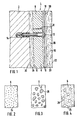
- FIG. 1 An outer wall 2 of a building is shown schematically on the left in FIG. 1 .
- the outer wall 2 is bricked for example from bricks or gas concrete blocks or consists of concrete. It is thicker to the left than the detail in FIG. 1 shows and continues up and down.
- Fig. 1 on the right of the outside of the wall 2 a multi-layer thermal insulation 4 is applied.
- thermal insulation panels 6 which are side by side and one above the other with the smallest possible joints 8 the wall 2 are attached.
- the attachment is by means of an adhesive mortar 10 takes place.
- thermal insulation boards 6 attached by means of screws 12, which in Dowels 14 are screwed into the corresponding Hole holes in the wall 2 are used. alternative you can work with nails that work with hammered into a wall hole become. It is understood that under the screw or Nail head sits a large-area disc.
- a leveling compound layer 16 with reinforcement mesh 18 embedded therein On the outside on the arrangement of the thermal insulation panels 6 is a leveling compound layer 16 with reinforcement mesh 18 embedded therein.
- the procedure is such that one first a first layer of filler on the thermal insulation boards 6, then the reinforcement net spanned, and finally a second layer Putty is applied, so that the reinforcement network 18 is embedded in the filler 16.
- a plaster layer 20 is applied, preferably by using fresh mortar sprayed on a cleaning machine. Outside on the plaster layer 20, a color layer 22 made of silicone paint is applied.
- the thermal insulation panels 6, the plaster layer 20, the adhesive mortar 10 and the filler 16 have a composition as detailed above has been described.
- FIG. 2 illustrates what a thermal insulation board 6 with pores 24, which is finely distributed everywhere, looks like, which results in particular from the formation of pores by water vapor formation and / or by using a pore-forming agent.
- Fig. 3 the appearance of a thermal insulation panel 6 is drawn, as it results if a porous aggregate remaining in the panel 6 during manufacture is used.
- Particles 26, for example made of expanded perlite, which are inherently porous are indicated in the drawing.
- the pearlite particles 26 make up a considerable volume fraction of the thermal insulation panel 6.
- FIG. 4 illustrates what a thermal insulation board 6 looks like when both pores 24 distributed throughout the material and particles 26 made of intrinsically porous aggregate are present.
- Fig. 1 it is indicated that the adhesive mortar 10 and the material of the plaster layer 20 each contain fibers 28. In addition, it is indicated by dotting 30 that the adhesive mortar 10, the filler 16 and the material of the plaster layer 20 each contain a pore formation additive. It is pointed out again that the fibers 28 and the reinforcement net 18 and the filler layer 16 are unnecessary in many cases.
- the pores in the thermal insulation boards 6 are of the greatest importance, the pores in the plaster layer 20 are of the second greatest importance and the pores in the adhesive mortar 10 and in the filler 16 are of relatively minor importance.
Landscapes
- Chemical & Material Sciences (AREA)
- Engineering & Computer Science (AREA)
- Ceramic Engineering (AREA)
- Structural Engineering (AREA)
- Physics & Mathematics (AREA)
- Architecture (AREA)
- Inorganic Chemistry (AREA)
- Organic Chemistry (AREA)
- Chemical Kinetics & Catalysis (AREA)
- Materials Engineering (AREA)
- Electromagnetism (AREA)
- Acoustics & Sound (AREA)
- Civil Engineering (AREA)
- Building Environments (AREA)
- Curing Cements, Concrete, And Artificial Stone (AREA)
- Compositions Of Macromolecular Compounds (AREA)
- Fireproofing Substances (AREA)
- Organic Low-Molecular-Weight Compounds And Preparation Thereof (AREA)
Claims (22)
- Plaque d'isolation thermique contenant des pores (6), qui est fabriquée par introduction dans un moule d'une masse de matériau plastique, qui contient un liant de chaux, du dioxyde de silicium, éventuellement un granulat poreux, éventuellement des additifs, et de l'eau, caractérisée(a) en ce que la masse de matériau plastique a la composition initiale de fabrication suivante :15 à 25 % en masse de liant de chaux, mis à disposition par chaux vive et/ou chaux éteinte,50 à 70 % en masse de dioxyde de silicium,0 à 10 % en masse de granulat poreux,0 à 2 % en masse d'additifs,le reste étant de l'eau ;(b) en ce que la masse de matériau plastique a été introduite dans le moule sans étape intermédiaire et a été amenée à durcir sous l'action de la chaleur et de la pression,(c) et en ce que la plaque d'isolation thermique (6) comporte un agent hydrofuge contenu dans la masse de matériau plastique et/ou un agent hydrofuge appliqué superficiellement.
- Plaque d'isolation thermique (6) selon la revendication 1, caractérisée en ce qu'elle a une masse spécifique inférieure à 250 kg/m3 , de préférence inférieure à 200 kg/m3, de manière particulièrement préférée inférieure à 200 kg/m3.
- Plaque d'isolation thermique (6) selon la revendication 1 ou 2, caractérisée en ce qu'elle a une valeur mesurée de la conductivité thermique inférieure à 0,050 W/mK, de préférence inférieure à 0,045 W/mK, de manière particulièrement préférée inférieure à 0,040 W/mK.
- Plaque d'isolation thermique (6) selon au moins l'une des revendications 1 à 3, caractérisée en ce que les pores sont formés par évaporation de l'eau contenue dans la composition initiale de fabrication et/ou au moyen d'un agent porogène.
- Plaque d'isolation thermique (6) selon la revendication 4, caractérisée en ce qu'au moins l'un des agents suivants : tensioactifs, poudre d'aluminium, composés peroxo est prévu comme agent porogène.
- Plaque d'isolation thermique (6) selon au moins l'une des revendications 1 à 5, caractérisée en ce qu'au moins l'une des substances suivantes : pierre ponce, perlite expansée, argile expansée, mica expansé, verre expansé, polystyrène expansé est prévue comme granulat poreux.
- Plaque d'isolation thermique (6) selon au moins l'une des revendications 1 à 6, caractérisée en ce qu'au moins l'un des agents suivants : stéarates, oléates, palmitates, laurates, béhénates, silicones est prévu comme agent hydrofuge.
- Plaque d'isolation thermique (6) selon au moins l'une des revendications 1 à 7, caractérisée en ce qu'elle a une taille supérieure à 1 m x 0,4 m.
- Plaque d'isolation thermique (6) selon au moins l'une des revendications 1 à 8, caractérisée en ce qu'elle a une épaisseur de 20 à 100 mm, de préférence de 30 à 50 mm.
- Isolation thermique (4) pour bâtiments, caractérisée en ce qu'elle comporte plusieurs plaques d'isolation thermique (6) selon au moins l'une des revendications 1 à 9 appliquées côte à côte.
- Isolation thermique (4) selon la revendication 10 sous forme d'isolation thermique extérieure, caractérisée par au moins une couche d'enduit (20) qui est appliquée du côté extérieur sur les plaques d'isolation thermique (6) directement ou en présence d'au moins une couche intermédiaire (16 ; 18), la couche d'enduit (20) consistant en un matériau d'enduit minéral qui contient un agent porogène et/ou un granulat poreux ainsi qu'un agent hydrofuge.
- Isolation thermique (4) selon la revendication 10 ou 11, caractérisée en ce que les plaques d'isolation thermique (6) sont fixées sur un mur de bâtiment (2) au moyen d'un mortier adhésif (10) et/ou d'éléments de maintien mécaniques (12).
- Isolation thermique (4) selon la revendication 11 ou 12, caractérisée par un treillis d'armature (18) inclus dans un mastic (16) entre les plaques d'isolation thermique (6) et la couche d'enduit (20).
- Isolation thermique (4) selon au moins l'une des revendications 11 à 13, caractérisée en ce que le mortier adhésif (10) et/ou le mastic (16) contiennent un agent porogène et/ou un granulat poreux et/ou un agent hydrofuge.
- Isolation thermique (4) selon au moins l'une des revendications 11 à 14, caractérisée en ce qu'au moins l'un des agents suivants : tensioactifs, poudre d'aluminium, composés peroxo est prévu comme agent porogène pour l'enduit et/ou le mortier adhésif (10) et/ou le mastic (16).
- Isolation thermique (4) selon au moins l'une des revendications 11 à 15, caractérisée en ce qu'au moins l'une des substances suivantes : pierre ponce, perlite expansée, argile expansée, mica expansé, verre expansé, polystyrène expansé est prévue comme granulat poreux pour l'enduit et/ou le mortier adhésif (10) et/ou le mastic (16).
- Isolation thermique (4) selon au moins l'une des revendications 11 à 16, caractérisée en ce qu'au moins l'un des agents suivants stéarates, oléates, palmitates, laurates, béhénates, silicones est prévu comme agent hydrofuge pour l'enduit et/ou le mortier adhésif (10) et/ou le mastic (16).
- Isolation thermique (4) selon au moins l'une des revendications 11 à 17, caractérisée en ce que l'enduit et/ou le mortier adhésif (10) et/ou le mastic (16) sont munis d'un additif fibreux (28) de préférence constitué par des fibres cellulosiques, des fibres de verre ou des fibres polymères.
- Isolation thermique (4) selon au moins l'une des revendications 11 à 18, caractérisée en ce qu'elle est munie extérieurement d'une couche de peinture de silicone (22).
- Isolation thermique (4) selon au moins l'une des revendications 11 à 19, caractérisée en ce que l'enduit a la composition initiale sèche suivante : 15 à 28 % en masse de liant hydraulique, de préférence du ciment, 72 à 85 % en masse de granulat minéral et éventuellement de charge minérale, préférence du sable de quartz, de la poudre de quartz, de la pierre ponce, du sable de roche, de la poudre de roche, 0 à 2 % en masse d'additifs, de préférence un agent porogène, un agent hydrofuge, un agent retenant l'eau, un agent améliorant l'adhésion.
- Isolation thermique (4) selon au moins l'une des revendications 11 à 20, caractérisée en ce que le mortier adhésif a la composition initiale sèche suivante 15 à 28 % en masse de liant hydraulique, de préférence du ciment, 72 à 85 % en masse de granulat minéral et éventuellement de charge minérale, de préférence du sable de quartz, de la poudre de quartz, du sable de roche, de la poudre de roche, 0 à 5 % en masse d'additifs, de préférence un agent porogène, un agent hydrofuge, un agent retenant l'eau, un agent améliorant l'adhésion.
- Isolation thermique (4) selon au moins l'une des revendications 11 à 21, caractérisée en ce que le mastic a la composition initiale sèche suivante : 15 à 28 % en masse de liant, de préférence du ciment et/ou de la chaux de construction, 72 à 85 % en masse de granulat minéral et éventuellement de charge minérale, de préférence du sable de quartz, de la poudre de quartz, de la pierre ponce, du sable de roche, de la poudre de roche, de la perlite expansée, 0 à 2 % en masse d'additifs, de préférence un agent porogène, un agent hydrofuge, un agent retenant l'eau, un agent améliorant l'adhésion.
Applications Claiming Priority (2)
| Application Number | Priority Date | Filing Date | Title |
|---|---|---|---|
| DE4216204A DE4216204A1 (de) | 1992-05-15 | 1992-05-15 | Wärmedämmung für Gebäude |
| DE4216204 | 1992-05-15 |
Publications (3)
| Publication Number | Publication Date |
|---|---|
| EP0570012A1 EP0570012A1 (fr) | 1993-11-18 |
| EP0570012B1 EP0570012B1 (fr) | 2000-08-09 |
| EP0570012B2 true EP0570012B2 (fr) | 2004-06-16 |
Family
ID=6459035
Family Applications (1)
| Application Number | Title | Priority Date | Filing Date |
|---|---|---|---|
| EP19930107911 Expired - Lifetime EP0570012B2 (fr) | 1992-05-15 | 1993-05-14 | Isolation thermique pour bâtiments |
Country Status (3)
| Country | Link |
|---|---|
| EP (1) | EP0570012B2 (fr) |
| AT (1) | ATE195307T1 (fr) |
| DE (2) | DE4216204A1 (fr) |
Cited By (1)
| Publication number | Priority date | Publication date | Assignee | Title |
|---|---|---|---|---|
| DE102015218288A1 (de) * | 2015-09-23 | 2017-03-23 | Hochschule Wismar | Dämmstoffplatte und Verfahren zur Herstellung einer Dämmstoffplatte |
Families Citing this family (23)
| Publication number | Priority date | Publication date | Assignee | Title |
|---|---|---|---|---|
| DE4408088A1 (de) * | 1994-03-10 | 1995-11-09 | Dennert Kg Veit | Verfahren zur Herstellung einer porösen, mineralischen Leicht-Dämmplatte |
| RU2151246C1 (ru) * | 1998-04-08 | 2000-06-20 | Открытое акционерное общество "Уральский научно-исследовательский центр по архитектуре и строительству" | Трехслойная наружная стена с подвесным облицовочным слоем |
| DE19839295C5 (de) * | 1998-08-28 | 2006-09-21 | Sto Ag | Wärmedämmverbundsystem und Verfahren zum Herstellen eines Wärmeverbundsystems |
| RU2139980C1 (ru) * | 1998-10-27 | 1999-10-20 | Писаренко Сергей Григорьевич | Способ защиты поверхности конструкции и строительная конструкция с защитным слоем |
| RU2140496C1 (ru) * | 1999-02-25 | 1999-10-27 | Писаренко Сергей Григорьевич | Анкер |
| RU2243335C1 (ru) * | 2003-05-13 | 2004-12-27 | Ромадов Виктор Серафимович | Способ изготовления трехслойных строительных изделий |
| DE10333299B4 (de) | 2003-07-22 | 2006-02-16 | Sto Ag | Wärmedämmsystem |
| DE102004050207A1 (de) * | 2004-10-15 | 2006-04-20 | Haase, Werner, Dipl.-Ing. | Innenwandaufbau zur Innendämmung |
| RU2304202C1 (ru) * | 2005-12-15 | 2007-08-10 | Государственное образовательное учреждение высшего профессионального образования Московский государственный строительный университет | Теплоизоляционная модульная конструкция |
| DE102007046986A1 (de) * | 2007-10-01 | 2009-04-09 | Pinta Acoustic Gmbh | Verfahren zur Herstellung einer Wärmedämmverkleidung sowie Wandelement auf Basis eines Wärmedämmelements |
| DE102008035007A1 (de) | 2008-07-25 | 2010-01-28 | Calsitherm Verwaltungs Gmbh | System zur Wärmedämmung und/oder Wandsanierung von Gebäuden |
| DE102008035006A1 (de) | 2008-07-25 | 2010-01-28 | Calsitherm Verwaltungs Gmbh | System zur Wärmedämmung und/oder Wandsanierung von Gebäuden |
| WO2010031206A1 (fr) * | 2008-09-22 | 2010-03-25 | Dow Global Technologies Inc. | Structure composite pour applications d’isolation extérieure |
| DE102008043988A1 (de) | 2008-11-21 | 2010-05-27 | Wacker Chemie Ag | Faserhaltige Mörtelzusammensetzung |
| DE102009018569A1 (de) * | 2009-04-24 | 2010-10-28 | Fischerwerke Gmbh & Co. Kg | Beschichtung von Befestigungselementen |
| DE102009003196A1 (de) | 2009-05-18 | 2010-11-25 | Wacker Chemie Ag | Faserhaltige pastöse Baustoffmassen |
| DE102009026892A1 (de) | 2009-06-10 | 2010-12-16 | Wacker Chemie Ag | Verfahren zur Herstellung von Faser-verstärkten Baustoffbeschichtungen |
| DE102011101261A1 (de) * | 2011-05-11 | 2012-11-15 | Sto Ag | Verfahren und System zur Innendämmung von Gebäudeaußenwänden |
| FR2991701B1 (fr) * | 2012-06-11 | 2015-03-06 | Rgo | Brique de construction avec conduction thermique limitee |
| WO2018033218A1 (fr) | 2016-08-19 | 2018-02-22 | Wacker Chemie Ag | Système composite d'isolation thermique |
| WO2020001791A1 (fr) | 2018-06-29 | 2020-01-02 | Wacker Chemie Ag | Compositions de mortier sec pour systèmes composites d'isolation thermique |
| JP2023513724A (ja) * | 2020-02-10 | 2023-04-03 | 上海聖奎塑業有限公司 | 耐火保温材及びその製造工程 |
| CN117287980B (zh) * | 2023-11-24 | 2024-02-09 | 江苏三恒高技术窑具有限公司 | 隔热保温复合砖及其制备方法 |
Family Cites Families (4)
| Publication number | Priority date | Publication date | Assignee | Title |
|---|---|---|---|---|
| US3608261A (en) * | 1969-03-28 | 1971-09-28 | Johns Manville | Sheet covering members for building surfaces |
| DE3428880A1 (de) * | 1984-08-04 | 1986-02-06 | Degussa Ag, 6000 Frankfurt | Verfahren zur herstellung von feuerbestaendigen, massgenauen calciumsilikat-formteilen |
| CH666713A5 (de) * | 1984-11-12 | 1988-08-15 | All Systembau Ag | Baukoerper, wie mauer, wand, wand-, fassaden-, verbundplatte. |
| FR2601404A1 (fr) * | 1986-07-10 | 1988-01-15 | Laville Cie H | Plaques de parement isolantes leur procede de fabrication et leur application a l'isolation des batiments neufs ou anciens. |
-
1992
- 1992-05-15 DE DE4216204A patent/DE4216204A1/de not_active Withdrawn
-
1993
- 1993-05-14 DE DE59310084T patent/DE59310084D1/de not_active Expired - Lifetime
- 1993-05-14 EP EP19930107911 patent/EP0570012B2/fr not_active Expired - Lifetime
- 1993-05-14 AT AT93107911T patent/ATE195307T1/de active
Cited By (1)
| Publication number | Priority date | Publication date | Assignee | Title |
|---|---|---|---|---|
| DE102015218288A1 (de) * | 2015-09-23 | 2017-03-23 | Hochschule Wismar | Dämmstoffplatte und Verfahren zur Herstellung einer Dämmstoffplatte |
Also Published As
| Publication number | Publication date |
|---|---|
| EP0570012B1 (fr) | 2000-08-09 |
| EP0570012A1 (fr) | 1993-11-18 |
| DE4216204A1 (de) | 1993-11-18 |
| ATE195307T1 (de) | 2000-08-15 |
| DE59310084D1 (de) | 2000-09-14 |
Similar Documents
| Publication | Publication Date | Title |
|---|---|---|
| EP0570012B2 (fr) | Isolation thermique pour bâtiments | |
| EP3083522B1 (fr) | Mélange sec de matériau de construction et enduit d'isolation thermique obtenu à partir de ce mélange | |
| EP2205535A1 (fr) | Mortier d'enduit pour un enduit intérieur | |
| EP3057917A1 (fr) | Corps moulés ou plaques stables constitués d'un matériau léger servant d'isolation thermique et destinés à être utilisés comme protection contre l'incendie, procédé de fabrication et utilisation desdits corps moulé ou des plaques, et ouvrage équipé desdits corps ou plaques | |
| DE4107430C2 (de) | Bauelement | |
| DE1154752B (de) | Verfahren zur Herstellung von glasartigen poroesen Formkoerpern | |
| DE19804325A1 (de) | Monolithische Bauplatte auf Zementbasis | |
| DE3040077C2 (de) | Verputztrockenmörtel und dessen Verwendung | |
| EP0985646B1 (fr) | Mortier de collage mince | |
| DE1646495C3 (de) | Putzmassen mit hohem Wärmedämmwert | |
| DE19839295C2 (de) | Wärmedämmverbundsystem und Verfahren zum Herstellen eines Wärmeverbundsystems | |
| CA2060519C (fr) | Calorifuge et structure utilisant celui-ci | |
| EP3109217A1 (fr) | Moulures stabiles ou de plaques d'isolation thermique et de protection contre les incendies, le processus pour leur fabrication et leur utilisation ainsi qu'une construction de telles | |
| EP2891752A1 (fr) | Corps de formage en matière légère et son procédé de fabrication et d'utilisation | |
| DE202017001061U1 (de) | Leichtbetonmaterial für Spezialanwendungen | |
| DE19743883A1 (de) | Verfahren zur Herstellung industriell vorgefertigter Wandelemente und danach hergestelltes Wandelement | |
| EP1686220B1 (fr) | Panneau léger de construction | |
| EP0568752A1 (fr) | Plâtre léger | |
| DE10006500C2 (de) | Wandputz und Verfahren zu seiner Herstellung | |
| DE4241534C1 (de) | Mineralwolle-Formkörper für die Dämmung von Bauteilen von Gebäuden sowie Verfahren zur Herstellung von Mineralwolle-Formkörpern | |
| DE2702984A1 (de) | Verfahren zur herstellung eines universalverputzes oder -anstriches | |
| DE888002C (de) | Verfahren zur Herstellung von Fachwerk-, insbesondere Holzgerippe- und Betonskelettwaenden | |
| CH675874A5 (fr) | ||
| US5308891A (en) | Cement based heat insulator, method of making same and structure having same | |
| DE102004038447A1 (de) | Dämmelement aus Mineralfasern und Wärmedämmverbundsystem für Gebäudeflächen |
Legal Events
| Date | Code | Title | Description |
|---|---|---|---|
| PUAI | Public reference made under article 153(3) epc to a published international application that has entered the european phase |
Free format text: ORIGINAL CODE: 0009012 |
|
| AK | Designated contracting states |
Kind code of ref document: A1 Designated state(s): AT CH DE LI |
|
| 17P | Request for examination filed |
Effective date: 19940518 |
|
| 17Q | First examination report despatched |
Effective date: 19960213 |
|
| GRAG | Despatch of communication of intention to grant |
Free format text: ORIGINAL CODE: EPIDOS AGRA |
|
| GRAG | Despatch of communication of intention to grant |
Free format text: ORIGINAL CODE: EPIDOS AGRA |
|
| GRAH | Despatch of communication of intention to grant a patent |
Free format text: ORIGINAL CODE: EPIDOS IGRA |
|
| GRAH | Despatch of communication of intention to grant a patent |
Free format text: ORIGINAL CODE: EPIDOS IGRA |
|
| GRAA | (expected) grant |
Free format text: ORIGINAL CODE: 0009210 |
|
| AK | Designated contracting states |
Kind code of ref document: B1 Designated state(s): AT CH DE LI |
|
| REF | Corresponds to: |
Ref document number: 195307 Country of ref document: AT Date of ref document: 20000815 Kind code of ref document: T |
|
| REG | Reference to a national code |
Ref country code: CH Ref legal event code: EP |
|
| REF | Corresponds to: |
Ref document number: 59310084 Country of ref document: DE Date of ref document: 20000914 |
|
| REG | Reference to a national code |
Ref country code: CH Ref legal event code: NV Representative=s name: MICHELI & CIE INGENIEURS-CONSEILS |
|
| EN | Fr: translation not filed | ||
| PLBQ | Unpublished change to opponent data |
Free format text: ORIGINAL CODE: EPIDOS OPPO |
|
| PLBI | Opposition filed |
Free format text: ORIGINAL CODE: 0009260 |
|
| PLBF | Reply of patent proprietor to notice(s) of opposition |
Free format text: ORIGINAL CODE: EPIDOS OBSO |
|
| 26 | Opposition filed |
Opponent name: FELS-WERKE GMBH Effective date: 20010505 |
|
| PLBF | Reply of patent proprietor to notice(s) of opposition |
Free format text: ORIGINAL CODE: EPIDOS OBSO |
|
| PLBF | Reply of patent proprietor to notice(s) of opposition |
Free format text: ORIGINAL CODE: EPIDOS OBSO |
|
| PLBF | Reply of patent proprietor to notice(s) of opposition |
Free format text: ORIGINAL CODE: EPIDOS OBSO |
|
| PLBF | Reply of patent proprietor to notice(s) of opposition |
Free format text: ORIGINAL CODE: EPIDOS OBSO |
|
| PUAH | Patent maintained in amended form |
Free format text: ORIGINAL CODE: 0009272 |
|
| 27A | Patent maintained in amended form |
Effective date: 20040616 |
|
| AK | Designated contracting states |
Kind code of ref document: B2 Designated state(s): AT CH DE LI |
|
| REG | Reference to a national code |
Ref country code: CH Ref legal event code: AEN Free format text: AUFRECHTERHALTUNG DES PATENTES IN GEAENDERTER FORM |
|
| EN | Fr: translation not filed | ||
| PGFP | Annual fee paid to national office [announced via postgrant information from national office to epo] |
Ref country code: CH Payment date: 20120522 Year of fee payment: 20 |
|
| PGFP | Annual fee paid to national office [announced via postgrant information from national office to epo] |
Ref country code: DE Payment date: 20120730 Year of fee payment: 20 |
|
| PGFP | Annual fee paid to national office [announced via postgrant information from national office to epo] |
Ref country code: AT Payment date: 20120521 Year of fee payment: 20 |
|
| REG | Reference to a national code |
Ref country code: DE Ref legal event code: R071 Ref document number: 59310084 Country of ref document: DE |
|
| REG | Reference to a national code |
Ref country code: CH Ref legal event code: PL |
|
| REG | Reference to a national code |
Ref country code: AT Ref legal event code: MK07 Ref document number: 195307 Country of ref document: AT Kind code of ref document: T Effective date: 20130514 |
|
| PG25 | Lapsed in a contracting state [announced via postgrant information from national office to epo] |
Ref country code: DE Free format text: LAPSE BECAUSE OF EXPIRATION OF PROTECTION Effective date: 20130515 |