EP0570116A1 - Datenspeicher und Zugriffseinrichtung - Google Patents
Datenspeicher und Zugriffseinrichtung Download PDFInfo
- Publication number
- EP0570116A1 EP0570116A1 EP93303068A EP93303068A EP0570116A1 EP 0570116 A1 EP0570116 A1 EP 0570116A1 EP 93303068 A EP93303068 A EP 93303068A EP 93303068 A EP93303068 A EP 93303068A EP 0570116 A1 EP0570116 A1 EP 0570116A1
- Authority
- EP
- European Patent Office
- Prior art keywords
- key
- data
- characters
- keys
- pressing
- Prior art date
- Legal status (The legal status is an assumption and is not a legal conclusion. Google has not performed a legal analysis and makes no representation as to the accuracy of the status listed.)
- Granted
Links
- 238000013500 data storage Methods 0.000 title claims description 15
- 238000013479 data entry Methods 0.000 claims abstract description 15
- 230000000007 visual effect Effects 0.000 abstract description 4
- 230000006870 function Effects 0.000 description 7
- 230000001413 cellular effect Effects 0.000 description 3
- 230000000881 depressing effect Effects 0.000 description 2
- 238000010586 diagram Methods 0.000 description 2
- HEFNNWSXXWATRW-UHFFFAOYSA-N Ibuprofen Chemical compound CC(C)CC1=CC=C(C(C)C(O)=O)C=C1 HEFNNWSXXWATRW-UHFFFAOYSA-N 0.000 description 1
- 238000006243 chemical reaction Methods 0.000 description 1
- 230000002596 correlated effect Effects 0.000 description 1
- 230000000875 corresponding effect Effects 0.000 description 1
- 230000000977 initiatory effect Effects 0.000 description 1
- 239000004973 liquid crystal related substance Substances 0.000 description 1
- 238000012986 modification Methods 0.000 description 1
- 230000004048 modification Effects 0.000 description 1
- 230000008520 organization Effects 0.000 description 1
Images

Classifications
-
- H—ELECTRICITY
- H04—ELECTRIC COMMUNICATION TECHNIQUE
- H04M—TELEPHONIC COMMUNICATION
- H04M1/00—Substation equipment, e.g. for use by subscribers
- H04M1/26—Devices for calling a subscriber
- H04M1/27—Devices whereby a plurality of signals may be stored simultaneously
- H04M1/274—Devices whereby a plurality of signals may be stored simultaneously with provision for storing more than one subscriber number at a time, e.g. using toothed disc
- H04M1/2745—Devices whereby a plurality of signals may be stored simultaneously with provision for storing more than one subscriber number at a time, e.g. using toothed disc using static electronic memories, e.g. chips
- H04M1/27467—Methods of retrieving data
- H04M1/2748—Methods of retrieving data by matching character strings
Definitions
- This invention relates to a data storage apparatus comprising a memory, and a user interface including a display and a keypad having a plurality of keys which can be pressed for entering data into and retrieving data from the memory.
- a mobile telephone is an example of a data storage apparatus which is generally designed with only a limited number of keys.
- mobile telephones are generally provided with a telephone number index comprising a memory in which the user may store frequently used telephone numbers together with a respective alpha-tag (i.e. a text data 'label') such as, for example, the name of the subscriber.
- the user interface must therefore be capable of inputting not only numeric, but also alphabet characters.
- numeric keys which are normally used for dialing also to have other characters, specifically alphabet characters, associated therewith.
- numeric keys eg keys 1-9
- nine of the numeric keys may each have three other characters associated therewith.
- nine keys are needed to represent the 26 characters of the English alphabet and one further character, suitably a space character, making 27 characters in total, in addition to the nine numeric characters.
- numeric data entry mode each of the numeric keys is pressed just once to enter the respective individual digits of a telephone number to be stored.
- an alphabetic data storage mode is initiated in which the three alphabet characters associated with a particular key may be selected respectively by pressing the key either once, twice or three times.
- the individual characters of a name or label to be searched are entered by pressing the relevant keys once, twice or three times, as appropriate.
- the full name is shown on the display either simultaneously or intermittently with the associated telephone number also stored in the memory.
- a drawback with this known arrangement is that many keystrokes are required for retrieving data from the memory and this can be time-consuming and irritating for the user. Specifically up to three keystrokes may be needed to enter a single character.
- a data storage apparatus comprising memory means for storing in encoded form a plurality of data items each comprising one or more characters, and a user interface including a display and a keyboard having a plurality of keys each having two or more characters associated therewith, characterised in that in one data entry mode a first character associated with a key is selected by pressing the respective key once, and a second character associated with a key is selected by pressing the respective key twice, and in a data retrieval mode the individual characters of a data item to be searched are entered by pressing only once for each character the respective keys having the desired character associated therewith, the data storage apparatus being adapted to show on the display a data item stored in encoded form in the memory means which corresponds with one of the possible combinations of characters associated with the sequence of keys pressed in the data retrieval mode.
- a data storage apparatus in accordance with the invention has the advantage of reducing the number of keystrokes in the data retrieval mode since the individual characters of a data item to be searched are entered by pressing the respective keys just once. Hence the user is able to search and find data items stored in the memory means more efficiently.
- a third character associated with a key may be selected by pressing the respective key three times in the first data entry mode. In the data retrieval mode a key is pressed only once to search for any of the three characters associated with that key.
- the first, second and third characters are different alphabet characters.
- each of the multi-character keys also has a numeric character associated therewith.
- the numeric character associated with a key is selected by pressing the respective key once.
- nine keys may be used to represent nine numeric characters (e.g. 1-9) and 27 other characters, e.g. 26 alphabet characters and one ASCII character such as a space.
- one of the 27 alphabet or ASCII characters may be selected by pressing the relevant key once, twice or three times as appropriate, and in the further data entry mode one of the nine numeric characters may be selected by pressing the relevant key once.
- This arrangement is particularly suitable in the context of a telephone since the numeric keys normally used for dialing can also be used to represent all the characters of the English alphabet without the need for additional keys.
- means may be provided for converting each data item into a numeric version wherein the component alphabetic characters of the data item are converted into respective numeric characters according to the correspondence of characters associated with the respective keys.
- the numeric version of each data item is stored in memory means to facilitate more rapid and efficient searching in the data retrieval mode as discussed in more detail below.
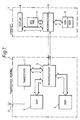
- the telephone apparatus shown in Figure 1 is a cellular mobile telephone comprising a transceiver 1 and all the other features conventionally found in a cellular telephone.
- the transceiver is present within a housing 2 and is coupled to an external antenna 3.
- a microprocessor 4 enclosed within the transceiver housing 2, is employed to control all the basic functions of the telephone.
- ROM read only memory
- RAM random access memory
- RAM 6 is used for the temporary storage of data while the telephone is in operation, as described in more detail below.
- a handset 7 is removably coupled to the transceiver housing in known manner via a conventional curly cord.
- the handset comprises a user interface including a visual display 8 and a keypad 9 coupled to a microprocessor 10 present locally in the handset.
- the user interface of the handset 7 is shown in more detail in Figure 2.
- the visual display comprises for example, a liquid crystal display 8 having two rows of eight characters. Additional indicators such as "ROAM”, “CALL”, “SIG”, illuminated by LEDs may also be provided.
- the keypad 9 essentially comprises two main sets of keys, namely alphanumeric keys 9a associated with alphanumeric data especially for dialing telephone numbers, but also for entering alphanumeric data into the telephone number store as discussed in more detail below; and a set of function keys 9b for enabling various predetermined functions or operations.
- the keys 9a are arranged in four rows of three keys each. As is conventional for the numeric key layout of a telephone, the top row comprises keys for numbers 1, 2 and 3 respectively, the second row down for numbers 4, 5 and 6 respectively, the next row down for numbers 7, 8 and 9 respectively, and the bottom row for *, 0 and # respectively.
- the keys 9a are also associated with alphabet information, as follows: The key for number 2 is associated with the alphabet characters A,B,C; The key for number 3 is associated with the alphabet characters D,E,F; The key for number 4 is associated with the alphabet characters G,H,I; The key for number 5 is associated with the alphabet characters J,K,L; The key for number 6 is associated with the alphabet characters M,N,O; The key for number 7 is associated with the alphabet characters P,R,S; The key for number 8 is associated with the alphabet characters T,U,V; The key for number 9 is associated with the alphabet characters W,X,Y; The key for number 1 is associated with the alphabet characters Q and Z, and the ASCII "space" character.
- the function keys 9b include a "SEND” and "END” key for respectively initiating and terminating a telephone call. Another of the keys 9b is an "ON/OFF" key for turning the telephone on and off. Another of the function keys may be a menu or function key labeled, for example, "MU". Depression of this key enables a variety of pre-set menus, the related instructions of which are stored in memory, to be viewed and selectively enabled. The various menus are selected by depressing the appropriate alphanumeric keys after depressing the "MU" key. The relevant menu is shown to the user in words or abbreviations on the display 8. For example, the user may be able to select an alpha search mode (discussed below) by appropriate menu selection.
- an alpha search mode discussed below
- an EEPROM 11 - also coupled to the handset microprocessor 10 - is used for storing both NAM data (e.g. telephone number, system ID, electronic serial number) and abbreviated dialing information (i.e. a telephone number store) as described in more detail below.
- NAM data e.g. telephone number, system ID, electronic serial number
- abbreviated dialing information i.e. a telephone number store
- the handset microprocessor 10 When the handset 7 is coupled to the transceiver housing 2 the handset microprocessor 10 is able to communicate with the main microprocessor 4 in the housing 2 via a serial data link. The microprocessor 4 continually monitors the presence of the handset connection. Once it is established that a handset is connected the microprocessor 4 requests the handset to download the NAM data from EEPROM 11 and the NAM data is then transferred into the RAM 6. Thus, while the handset 7 is connected, the transceiver will adopt the identity (telephone number, electronic serial number) of the handset in accordance with our European patent 0,406,985. This has the advantage that the same transceiver may be used at different times by any number of subscribers having their own handsets programmed with unique NAM data. Each subscriber will be able to receive his own calls and the charges for using the system can be levied to the appropriate subscriber's account.
- the EEPROM 11 also includes a telephone number store or abbreviated dialing memory (ADM).
- ADM telephone number store
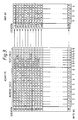
- the organization of the ADM will now be described with reference to Figure 3.
- the telephone number store typically comprises 100 records each consisting of a numeric field 8 bytes long for storing the telephone number, and a text field which suitably is also 8 bytes long.
- the records are stored respectively at locations 00, 01,000.99. It will be understood by a person skilled in the art that up to sixteen decimal digits and up to eight alphabet characters can be stored in an 8-byte field.
- the telephone numbers are stored right-justified in the "numeric" field (bytes 1 to 8) and filled to the left with "F" (in hexadecimal).
- the numeric field is filled with F's (hexadecimal).
- the text is stored left-justified in the text field (bytes 9 to 16) and filled to the right with spaces, ASCII code "20" (hexadecimal).
- ASCII code "20" hexadecimal
- the text field bytes 9 to 16 is filled with ASCII code spaces "20" (hexadecimal).
- the respective keys 9a on the handset are pressed once in turn and the selected digits are shown on the visual display 8. If the user wishes to initiate a call to the selected number he then simply presses the "SEND" key 9b in conventional manner. On the other hand if it is desired to store the selected number into the ADM the user presses the store (STO) key 9b. The display 8 will then show the first empty location in the telephone number store, eg: "MEM 10" indicating location 10. If the user presses the "STO" key 9b again the number is stored in location 10. On the other hand if the user wishes to store the number at a particular location he first presses the relevant numeric keys 9a.
- STO store
- pressing the "1" key, followed by the "5" key, followed by the "STO” key would store the number at location 15.
- a message is shown on the display 8 before the "STO" key is pressed for the second time indicating whether the chosen location is empty in order to avoid overwriting data previously stored at the selected location.
- the microprocessor 4 When the handset 7 is connected to the transceiver housing 2 the microprocessor 4 also requests the handset to download data from the telephone number store, ie ADM portion of the EEPROM 11. However only the text field (alphabetic) data is downloaded but this is converted and stored as a numeric version in RAM 6, as follows. Each text field is stored in a correlated location in RAM 6 illustrated in Figure 3 as an 'offset' of x. Hence data at location y in ADM 11 is stored at location x+y in RAM 6. Each alphabetic character is converted by microprocessor 4 into a numeric character according to the correspondence of characters associated with the respective keys. Thus the characters A,B,C convert to a 2; D,E,F convert to a 3 and so on.
- an alphabetic data retrieval mode can be initiated by menu selection using the "MU" key 9b. So, for example, the alphabetic data retrieval mode may be accessed by pressing the "MU” key 9b followed by the "0" and "5" keys 9a (assuming that this function is listed at menu location 05).
- the message “ALPHA SEARCH” is shown on the display 8. Pressing the "MU” key again will initiate the ALPHA search mode.
- the individual characters of a data item to be searched are entered by pressing only once for each character the respective keys having the desired character associated therewith.
- the user For example if the user is searching for the name "HARRY" he first presses the "4" key associated with the letter H (see Figure 2).
- the data stored in RAM 6 is searched until a first data item is found with a 4 in the first position.
- the first "corresponding" data item is at location x+6, namely 436743 which correlates to the data item GEORGE at location 06 in the ADM 11.
- This name and telephone number stored at ADM location 06 are then shown on the display 8.
- the name and number may be displayed simultaneously if the capacity of the display permits, or they may be displayed sequentially. Since the displayed data item is not the item being searched the user proceeds to press the "2" key associated with the letter A.
- the data stored in RAM 6 is searched until a first data item is found with the digits 42 in the first two positions.
- the first matching data item is at location x+7, namely 425 which correlates to the data item HAL at location 07 in the ADM 11.
- the name HAL and associated telephone number stored at ADM location 07 are shown on the handset display 8. Again this is not the item being searched and so the "7" key is pressed representing the letter R.
- the data stored in RAM 6 is again searched and a unique data item is found with the digits 427 in the first three positions.
- the unique matching data item is found at location x+8, namely 42779 which correlates with the data item HARRY at location 08 in the ADM 11.
- the name HARRY and the associated telephone number stored at ADM location are shown on the handset display 8.
- the search has thus been completed with only three key presses. The user can now proceed to call the displayed number simply by pressing the "SEND" key 9b.
- ANNE will be retrieved after a single keystroke, BRIAN after two keystrokes, CAROL after two keystrokes, DAVE after one keystroke, EVA after two keystrokes, FRED after two keystrokes, HAL after two keystrokes, HARRY after three keystrokes, and HOME after two keystrokes.
- the maximum number of keystrokes to search and find a particular data item is only three.
Landscapes
- Engineering & Computer Science (AREA)
- Signal Processing (AREA)
- Mobile Radio Communication Systems (AREA)
- Telephone Set Structure (AREA)
- Calculators And Similar Devices (AREA)
Applications Claiming Priority (2)
| Application Number | Priority Date | Filing Date | Title |
|---|---|---|---|
| GB9210064 | 1992-05-09 | ||
| GB9210064A GB2266797B (en) | 1992-05-09 | 1992-05-09 | Data storage apparatus |
Publications (2)
| Publication Number | Publication Date |
|---|---|
| EP0570116A1 true EP0570116A1 (de) | 1993-11-18 |
| EP0570116B1 EP0570116B1 (de) | 1998-09-30 |
Family
ID=10715284
Family Applications (1)
| Application Number | Title | Priority Date | Filing Date |
|---|---|---|---|
| EP93303068A Expired - Lifetime EP0570116B1 (de) | 1992-05-09 | 1993-04-20 | Datenspeicher und Zugriffseinrichtung |
Country Status (4)
| Country | Link |
|---|---|
| US (1) | US5977887A (de) |
| EP (1) | EP0570116B1 (de) |
| DE (1) | DE69321283T2 (de) |
| GB (1) | GB2266797B (de) |
Cited By (12)
| Publication number | Priority date | Publication date | Assignee | Title |
|---|---|---|---|---|
| WO1996036155A1 (en) * | 1995-05-11 | 1996-11-14 | Cidco, Incorporated | Multiple key press selection for repertory dialing |
| US5684873A (en) * | 1995-01-09 | 1997-11-04 | Nokia Mobile Phones Limited | Quick dialing in personal mobile phone |
| US5710810A (en) * | 1995-01-05 | 1998-01-20 | Nokia Mobile Phones Limited | Quick dialing in a mobile phone |
| WO1998038643A1 (en) * | 1997-02-28 | 1998-09-03 | Ascom Ag | A mobile or portable playback apparatus |
| WO1999033244A1 (en) * | 1997-12-19 | 1999-07-01 | Telefonaktiebolaget Lm Ericsson (Publ) | Man machine interface help search tool |
| WO2000024179A1 (en) * | 1998-10-17 | 2000-04-27 | Kim Hyun Chul | Method of searching stored telephone numbers in cellular phones |
| EP1031913A3 (de) * | 1999-02-22 | 2001-05-30 | Nokia Mobile Phones Ltd. | Kommunikationsendgerät mit prädiktiver Editor-Anwendung |
| EP0831628A3 (de) * | 1996-09-23 | 2003-09-17 | Siemens Aktiengesellschaft | Verfahren für Fernsprechendgeräte, insbesondere Mobilfunkendgeräte, zur Behandlung von Eingabeinformationen |
| WO2003107635A1 (en) * | 2000-05-12 | 2003-12-24 | Claudio Lucio David Muzel | Disposition of applied calendar in telephone receiver |
| WO2003007141A3 (en) * | 2001-07-12 | 2004-03-18 | Anders Trell Trust | Chord keybord |
| WO2007029581A1 (ja) | 2005-09-09 | 2007-03-15 | J-Data Co., Ltd. | 携帯電話 |
| US8271020B2 (en) | 2004-07-21 | 2012-09-18 | J-Data Co., Ltd. | Cellular telephone and personal digital assistant |
Families Citing this family (21)
| Publication number | Priority date | Publication date | Assignee | Title |
|---|---|---|---|---|
| US5847697A (en) * | 1995-01-31 | 1998-12-08 | Fujitsu Limited | Single-handed keyboard having keys with multiple characters and character ambiguity resolution logic |
| GB2325073B (en) * | 1995-01-31 | 1999-04-28 | Fujitsu Ltd | Data entry system |
| KR0149594B1 (ko) | 1995-04-27 | 1998-11-02 | 김광호 | 통신단말장치에서 다이얼정보 등록 및 검색방법 |
| GB2313738B (en) * | 1995-04-27 | 1998-10-14 | Samsung Electronics Co Ltd | Method and apparatus for retrieving registered dial information |
| GB2322511B (en) * | 1997-02-21 | 2001-08-15 | Nokia Mobile Phones Ltd | Handling of a local phone number database |
| CN1227914C (zh) * | 1997-03-19 | 2005-11-16 | 西门子公司 | 具有用于文字和/或数字和/或特殊字符输入工具的设备 |
| EP1004195A1 (de) * | 1997-08-20 | 2000-05-31 | Maxon Systems Inc. (London) Ltd. | Kommunikationsgerät und verfahren zur auffindung von einträgen in einem elektronischen telephonbuch |
| FI110216B (fi) | 1998-12-29 | 2002-12-13 | Nokia Corp | Menetelmä ja laite syötetyn tekstin muokkaamiseksi |
| EP1171813B1 (de) * | 1999-03-18 | 2003-06-04 | 602531 British Columbia Ltd. | Dateneingabe für personalrechnergeräte |
| US7293231B1 (en) * | 1999-03-18 | 2007-11-06 | British Columbia Ltd. | Data entry for personal computing devices |
| US7072461B2 (en) * | 2000-10-02 | 2006-07-04 | Microsoft Corporation | Merging various request methods into a single unified user interface |
| GB2369750A (en) * | 2000-11-22 | 2002-06-05 | Nokia Mobile Phones Ltd | Retrieving address book text using disambiguation of ambiguous key sequences |
| US6882869B1 (en) | 2000-12-19 | 2005-04-19 | Cisco Technology, Inc. | Device, methods, and user interface for providing optimized entry of alphanumeric text |
| KR100498323B1 (ko) * | 2001-01-16 | 2005-07-01 | 엘지전자 주식회사 | 이동통신 단말기의 특수문자 선택방법 |
| US7725133B2 (en) | 2001-03-30 | 2010-05-25 | Motorola, Inc. | Mobile wireless communication devices with quick-send features and methods therefor |
| US7656317B2 (en) * | 2004-04-27 | 2010-02-02 | Varia Llc | Reduced keypad for multi-tap input |
| US8552984B2 (en) | 2005-01-13 | 2013-10-08 | 602531 British Columbia Ltd. | Method, system, apparatus and computer-readable media for directing input associated with keyboard-type device |
| US10354097B2 (en) * | 2005-11-14 | 2019-07-16 | Nokia Technologies Oy | Context sensitive concealment of an input field |
| JP2010519655A (ja) * | 2007-02-26 | 2010-06-03 | ベイシス テクノロジー コーポレーション | 名前照合システムの名前インデックス付け |
| CA2581824A1 (en) * | 2007-03-14 | 2008-09-14 | 602531 British Columbia Ltd. | System, apparatus and method for data entry using multi-function keys |
| US10228819B2 (en) | 2013-02-04 | 2019-03-12 | 602531 British Cilumbia Ltd. | Method, system, and apparatus for executing an action related to user selection |
Citations (5)
| Publication number | Priority date | Publication date | Assignee | Title |
|---|---|---|---|---|
| GB2030423A (en) * | 1978-09-19 | 1980-04-02 | Standard Telephones Cables Ltd | Repertory dialler |
| EP0206391A2 (de) * | 1985-05-30 | 1986-12-30 | Automatic Dialer Partners Ltd. 1983 c/o Dasa Corporation General Partner | Rechnergesteuerte Wahleinrichtung mit Nummernspeicher |
| GB2195867A (en) * | 1986-08-08 | 1988-04-13 | Dictaphone Corp | Method and apparatus for creating and storing telephone directory listings |
| EP0457077A2 (de) * | 1990-05-16 | 1991-11-21 | Siemens Rolm Communications Inc. (a Delaware corp.) | Zugriff auf alphanumerische Information mit numerischer Tastatur |
| EP0469546A2 (de) * | 1990-07-30 | 1992-02-05 | Nec Corporation | Tragbarer Fernsprechapparat mit Eingabetasten und einer Schiebetaste auf verschiedenen Flächen |
-
1992
- 1992-05-09 GB GB9210064A patent/GB2266797B/en not_active Expired - Lifetime
-
1993
- 1993-04-20 DE DE69321283T patent/DE69321283T2/de not_active Expired - Lifetime
- 1993-04-20 EP EP93303068A patent/EP0570116B1/de not_active Expired - Lifetime
- 1993-05-03 US US08/056,718 patent/US5977887A/en not_active Expired - Lifetime
Patent Citations (5)
| Publication number | Priority date | Publication date | Assignee | Title |
|---|---|---|---|---|
| GB2030423A (en) * | 1978-09-19 | 1980-04-02 | Standard Telephones Cables Ltd | Repertory dialler |
| EP0206391A2 (de) * | 1985-05-30 | 1986-12-30 | Automatic Dialer Partners Ltd. 1983 c/o Dasa Corporation General Partner | Rechnergesteuerte Wahleinrichtung mit Nummernspeicher |
| GB2195867A (en) * | 1986-08-08 | 1988-04-13 | Dictaphone Corp | Method and apparatus for creating and storing telephone directory listings |
| EP0457077A2 (de) * | 1990-05-16 | 1991-11-21 | Siemens Rolm Communications Inc. (a Delaware corp.) | Zugriff auf alphanumerische Information mit numerischer Tastatur |
| EP0469546A2 (de) * | 1990-07-30 | 1992-02-05 | Nec Corporation | Tragbarer Fernsprechapparat mit Eingabetasten und einer Schiebetaste auf verschiedenen Flächen |
Non-Patent Citations (2)
| Title |
|---|
| PATENT ABSTRACTS OF JAPAN vol. 15, no. 433 (P-1271)5 November 1991 & JP-A-3 180 927 ( ALPINE ELECTRON ) * |
| PATENT ABSTRACTS OF JAPAN vol. 9, no. 255 (E-349)12 October 1985 & JP-A-60 103 760 ( SHARP K.K. ) * |
Cited By (19)
| Publication number | Priority date | Publication date | Assignee | Title |
|---|---|---|---|---|
| US5710810A (en) * | 1995-01-05 | 1998-01-20 | Nokia Mobile Phones Limited | Quick dialing in a mobile phone |
| US5684873A (en) * | 1995-01-09 | 1997-11-04 | Nokia Mobile Phones Limited | Quick dialing in personal mobile phone |
| US5754602A (en) * | 1995-05-11 | 1998-05-19 | Cidco, Incorporated | Multiple key press selection for repertory dialing |
| WO1996036155A1 (en) * | 1995-05-11 | 1996-11-14 | Cidco, Incorporated | Multiple key press selection for repertory dialing |
| EP0831628A3 (de) * | 1996-09-23 | 2003-09-17 | Siemens Aktiengesellschaft | Verfahren für Fernsprechendgeräte, insbesondere Mobilfunkendgeräte, zur Behandlung von Eingabeinformationen |
| WO1998038643A1 (en) * | 1997-02-28 | 1998-09-03 | Ascom Ag | A mobile or portable playback apparatus |
| WO1999033244A1 (en) * | 1997-12-19 | 1999-07-01 | Telefonaktiebolaget Lm Ericsson (Publ) | Man machine interface help search tool |
| US6198939B1 (en) | 1997-12-19 | 2001-03-06 | Telefonaktiebolaget Lm Ericsson (Publ) | Man machine interface help search tool |
| WO2000024179A1 (en) * | 1998-10-17 | 2000-04-27 | Kim Hyun Chul | Method of searching stored telephone numbers in cellular phones |
| EP1031913A3 (de) * | 1999-02-22 | 2001-05-30 | Nokia Mobile Phones Ltd. | Kommunikationsendgerät mit prädiktiver Editor-Anwendung |
| US7155683B1 (en) | 1999-02-22 | 2006-12-26 | Nokia Corporation | Communication terminal having a predictive editor application |
| US7725838B2 (en) | 1999-02-22 | 2010-05-25 | Nokia Corporation | Communication terminal having a predictive editor application |
| WO2003107635A1 (en) * | 2000-05-12 | 2003-12-24 | Claudio Lucio David Muzel | Disposition of applied calendar in telephone receiver |
| WO2003007141A3 (en) * | 2001-07-12 | 2004-03-18 | Anders Trell Trust | Chord keybord |
| US8271020B2 (en) | 2004-07-21 | 2012-09-18 | J-Data Co., Ltd. | Cellular telephone and personal digital assistant |
| WO2007029581A1 (ja) | 2005-09-09 | 2007-03-15 | J-Data Co., Ltd. | 携帯電話 |
| EP1924064A4 (de) * | 2005-09-09 | 2009-05-20 | Data Co Ltd J | Tragbares telefon |
| EP2192752A1 (de) * | 2005-09-09 | 2010-06-02 | J-Data Co., Ltd. | Mobiltelefon zum Abrufen von gespeicherten Daten |
| US8346296B2 (en) | 2005-09-09 | 2013-01-01 | J-Data Co., Ltd. | Portable telephone |
Also Published As
| Publication number | Publication date |
|---|---|
| GB2266797B (en) | 1995-06-14 |
| EP0570116B1 (de) | 1998-09-30 |
| US5977887A (en) | 1999-11-02 |
| DE69321283D1 (de) | 1998-11-05 |
| GB2266797A (en) | 1993-11-10 |
| DE69321283T2 (de) | 1999-05-12 |
| GB9210064D0 (en) | 1992-06-24 |
Similar Documents
| Publication | Publication Date | Title |
|---|---|---|
| US5977887A (en) | Data storage apparatus | |
| US5553125A (en) | Telephone apparatus with calling line identification | |
| EP0494526B1 (de) | Telefongerät mit Identifizierung der Rufleitung | |
| GB2278756A (en) | Telephone with speed dialing | |
| US6185295B1 (en) | Phone number database for a phone | |
| US5303288A (en) | Multiple mode cellular telephone control device | |
| US20020198027A1 (en) | Convenient dialing of names and numbers from a phone without alpha keypad | |
| EP0901263A2 (de) | Mobiltelefon und Verfahren zur Handhabung von Telefonnummern in einem Mobiltelefon | |
| EP0498997B1 (de) | Telefonapparat mit Anruferidentifikation | |
| JPH06133021A (ja) | 電話装置の高速ダイヤル方法 | |
| US7574237B2 (en) | Method and apparatus for changing at least one communication parameter for a communication device | |
| NO995244L (no) | Terminalanordning for kommunikasjon og fremgangsmåte til valg av muligheter ved bruk av en ringeskyttel | |
| EP0915604A2 (de) | Gerät und Suchverfahren in einem Datenbank | |
| US20080004080A1 (en) | Mobile communication device and quick dialing method used therein | |
| KR100571230B1 (ko) | 간단한 조작으로 메모리 내용을 검색하는 전화기 | |
| EP0494525B1 (de) | Telefongerät mit Identifizierung der Rufleitung | |
| KR20010023028A (ko) | 전자식 디렉토리의 저장된 엔트리 위치지정 방법 및 통신 장치 | |
| GB2331823A (en) | Radio apparatus with display | |
| KR100324634B1 (ko) | 전화기 키패드 및 이를 이용한 문자입력시스템 | |
| EP1924064B1 (de) | Tragbares telefon | |
| JP3338368B2 (ja) | 電話機 | |
| US6181915B1 (en) | Portable one-way radio pager including an electronic directory | |
| JP3338353B2 (ja) | 電話機 | |
| EP1672887B1 (de) | Verfahren und Vorrichtung zur Bereitstellung von Adressbuchinformationen basiert auf der Tastatureingabe einer Zahl oder eines Buchstaben | |
| WO2001031509A2 (en) | System and method for rapidly accessing and storing contact information in a communications device |
Legal Events
| Date | Code | Title | Description |
|---|---|---|---|
| PUAI | Public reference made under article 153(3) epc to a published international application that has entered the european phase |
Free format text: ORIGINAL CODE: 0009012 |
|
| AK | Designated contracting states |
Kind code of ref document: A1 Designated state(s): DE FR GB SE |
|
| 17P | Request for examination filed |
Effective date: 19940208 |
|
| 17Q | First examination report despatched |
Effective date: 19961205 |
|
| GRAG | Despatch of communication of intention to grant |
Free format text: ORIGINAL CODE: EPIDOS AGRA |
|
| GRAG | Despatch of communication of intention to grant |
Free format text: ORIGINAL CODE: EPIDOS AGRA |
|
| GRAH | Despatch of communication of intention to grant a patent |
Free format text: ORIGINAL CODE: EPIDOS IGRA |
|
| GRAH | Despatch of communication of intention to grant a patent |
Free format text: ORIGINAL CODE: EPIDOS IGRA |
|
| GRAA | (expected) grant |
Free format text: ORIGINAL CODE: 0009210 |
|
| AK | Designated contracting states |
Kind code of ref document: B1 Designated state(s): DE FR GB SE |
|
| REF | Corresponds to: |
Ref document number: 69321283 Country of ref document: DE Date of ref document: 19981105 |
|
| ET | Fr: translation filed | ||
| PLBE | No opposition filed within time limit |
Free format text: ORIGINAL CODE: 0009261 |
|
| STAA | Information on the status of an ep patent application or granted ep patent |
Free format text: STATUS: NO OPPOSITION FILED WITHIN TIME LIMIT |
|
| 26N | No opposition filed | ||
| REG | Reference to a national code |
Ref country code: GB Ref legal event code: IF02 |
|
| REG | Reference to a national code |
Ref country code: GB Ref legal event code: 732E |
|
| PGFP | Annual fee paid to national office [announced via postgrant information from national office to epo] |
Ref country code: DE Payment date: 20120425 Year of fee payment: 20 |
|
| PGFP | Annual fee paid to national office [announced via postgrant information from national office to epo] |
Ref country code: GB Payment date: 20120418 Year of fee payment: 20 Ref country code: SE Payment date: 20120411 Year of fee payment: 20 Ref country code: FR Payment date: 20120504 Year of fee payment: 20 |
|
| REG | Reference to a national code |
Ref country code: DE Ref legal event code: R071 Ref document number: 69321283 Country of ref document: DE |
|
| REG | Reference to a national code |
Ref country code: GB Ref legal event code: PE20 Expiry date: 20130419 |
|
| PG25 | Lapsed in a contracting state [announced via postgrant information from national office to epo] |
Ref country code: DE Free format text: LAPSE BECAUSE OF EXPIRATION OF PROTECTION Effective date: 20130423 Ref country code: GB Free format text: LAPSE BECAUSE OF EXPIRATION OF PROTECTION Effective date: 20130419 |