EP0570252A2 - Agar-agar à faible force de gel - Google Patents
Agar-agar à faible force de gel Download PDFInfo
- Publication number
- EP0570252A2 EP0570252A2 EP93401102A EP93401102A EP0570252A2 EP 0570252 A2 EP0570252 A2 EP 0570252A2 EP 93401102 A EP93401102 A EP 93401102A EP 93401102 A EP93401102 A EP 93401102A EP 0570252 A2 EP0570252 A2 EP 0570252A2
- Authority
- EP
- European Patent Office
- Prior art keywords
- agar
- gel strength
- food
- low
- parts
- Prior art date
- Legal status (The legal status is an assumption and is not a legal conclusion. Google has not performed a legal analysis and makes no representation as to the accuracy of the status listed.)
- Withdrawn
Links
Images



Classifications
-
- A—HUMAN NECESSITIES
- A61—MEDICAL OR VETERINARY SCIENCE; HYGIENE
- A61Q—SPECIFIC USE OF COSMETICS OR SIMILAR TOILETRY PREPARATIONS
- A61Q19/00—Preparations for care of the skin
-
- A—HUMAN NECESSITIES
- A21—BAKING; EDIBLE DOUGHS
- A21D—TREATMENT OF FLOUR OR DOUGH FOR BAKING, e.g. BY ADDITION OF MATERIALS; BAKING; BAKERY PRODUCTS
- A21D2/00—Treatment of flour or dough by adding materials thereto before or during baking
- A21D2/08—Treatment of flour or dough by adding materials thereto before or during baking by adding organic substances
- A21D2/14—Organic oxygen compounds
- A21D2/18—Carbohydrates
-
- A—HUMAN NECESSITIES
- A21—BAKING; EDIBLE DOUGHS
- A21D—TREATMENT OF FLOUR OR DOUGH FOR BAKING, e.g. BY ADDITION OF MATERIALS; BAKING; BAKERY PRODUCTS
- A21D2/00—Treatment of flour or dough by adding materials thereto before or during baking
- A21D2/08—Treatment of flour or dough by adding materials thereto before or during baking by adding organic substances
- A21D2/14—Organic oxygen compounds
- A21D2/18—Carbohydrates
- A21D2/183—Natural gums
-
- A—HUMAN NECESSITIES
- A23—FOODS OR FOODSTUFFS; TREATMENT THEREOF, NOT COVERED BY OTHER CLASSES
- A23C—DAIRY PRODUCTS, e.g. MILK, BUTTER OR CHEESE; MILK OR CHEESE SUBSTITUTES; PREPARATION THEREOF
- A23C19/00—Cheese; Cheese preparations; Making thereof
- A23C19/06—Treating cheese curd after whey separation; Products obtained thereby
- A23C19/068—Particular types of cheese
- A23C19/08—Process cheese preparations; Making thereof, e.g. melting, emulsifying, sterilizing
- A23C19/082—Adding substances to the curd before or during melting; Melting salts
-
- A—HUMAN NECESSITIES
- A23—FOODS OR FOODSTUFFS; TREATMENT THEREOF, NOT COVERED BY OTHER CLASSES
- A23C—DAIRY PRODUCTS, e.g. MILK, BUTTER OR CHEESE; MILK OR CHEESE SUBSTITUTES; PREPARATION THEREOF
- A23C9/00—Milk preparations; Milk powder or milk powder preparations
- A23C9/12—Fermented milk preparations; Treatment using microorganisms or enzymes
- A23C9/13—Fermented milk preparations; Treatment using microorganisms or enzymes using additives
- A23C9/137—Thickening substances
-
- A—HUMAN NECESSITIES
- A23—FOODS OR FOODSTUFFS; TREATMENT THEREOF, NOT COVERED BY OTHER CLASSES
- A23C—DAIRY PRODUCTS, e.g. MILK, BUTTER OR CHEESE; MILK OR CHEESE SUBSTITUTES; PREPARATION THEREOF
- A23C9/00—Milk preparations; Milk powder or milk powder preparations
- A23C9/152—Milk preparations; Milk powder or milk powder preparations containing additives
- A23C9/154—Milk preparations; Milk powder or milk powder preparations containing additives containing thickening substances, eggs or cereal preparations; Milk gels
- A23C9/1544—Non-acidified gels, e.g. custards, creams, desserts, puddings, shakes or foams, containing eggs or thickening or gelling agents other than sugar; Milk products containing natural or microbial polysaccharides, e.g. cellulose or cellulose derivatives; Milk products containing nutrient fibres
-
- A—HUMAN NECESSITIES
- A23—FOODS OR FOODSTUFFS; TREATMENT THEREOF, NOT COVERED BY OTHER CLASSES
- A23D—EDIBLE OILS OR FATS, e.g. MARGARINES, SHORTENINGS OR COOKING OILS
- A23D7/00—Edible oil or fat compositions containing an aqueous phase, e.g. margarines
- A23D7/005—Edible oil or fat compositions containing an aqueous phase, e.g. margarines characterised by ingredients other than fatty acid triglycerides
- A23D7/0056—Spread compositions
-
- A—HUMAN NECESSITIES
- A23—FOODS OR FOODSTUFFS; TREATMENT THEREOF, NOT COVERED BY OTHER CLASSES
- A23D—EDIBLE OILS OR FATS, e.g. MARGARINES, SHORTENINGS OR COOKING OILS
- A23D7/00—Edible oil or fat compositions containing an aqueous phase, e.g. margarines
- A23D7/015—Reducing calorie content; Reducing fat content, e.g. "halvarines"
-
- A—HUMAN NECESSITIES
- A23—FOODS OR FOODSTUFFS; TREATMENT THEREOF, NOT COVERED BY OTHER CLASSES
- A23G—COCOA; COCOA PRODUCTS, e.g. CHOCOLATE; SUBSTITUTES FOR COCOA OR COCOA PRODUCTS; CONFECTIONERY; CHEWING GUM; ICE-CREAM; PREPARATION THEREOF
- A23G3/00—Sweetmeats; Confectionery; Marzipan; Coated or filled products
- A23G3/34—Sweetmeats, confectionery or marzipan; Processes for the preparation thereof
- A23G3/343—Products for covering, coating, finishing, decorating
-
- A—HUMAN NECESSITIES
- A23—FOODS OR FOODSTUFFS; TREATMENT THEREOF, NOT COVERED BY OTHER CLASSES
- A23G—COCOA; COCOA PRODUCTS, e.g. CHOCOLATE; SUBSTITUTES FOR COCOA OR COCOA PRODUCTS; CONFECTIONERY; CHEWING GUM; ICE-CREAM; PREPARATION THEREOF
- A23G3/00—Sweetmeats; Confectionery; Marzipan; Coated or filled products
- A23G3/34—Sweetmeats, confectionery or marzipan; Processes for the preparation thereof
- A23G3/346—Finished or semi-finished products in the form of powders, paste or liquids
-
- A—HUMAN NECESSITIES
- A23—FOODS OR FOODSTUFFS; TREATMENT THEREOF, NOT COVERED BY OTHER CLASSES
- A23G—COCOA; COCOA PRODUCTS, e.g. CHOCOLATE; SUBSTITUTES FOR COCOA OR COCOA PRODUCTS; CONFECTIONERY; CHEWING GUM; ICE-CREAM; PREPARATION THEREOF
- A23G9/00—Frozen sweets, e.g. ice confectionery, ice-cream; Mixtures therefor
- A23G9/32—Frozen sweets, e.g. ice confectionery, ice-cream; Mixtures therefor characterised by the composition containing organic or inorganic compounds
- A23G9/34—Frozen sweets, e.g. ice confectionery, ice-cream; Mixtures therefor characterised by the composition containing organic or inorganic compounds characterised by carbohydrates used, e.g. polysaccharides
-
- A—HUMAN NECESSITIES
- A23—FOODS OR FOODSTUFFS; TREATMENT THEREOF, NOT COVERED BY OTHER CLASSES
- A23L—FOODS, FOODSTUFFS OR NON-ALCOHOLIC BEVERAGES, NOT OTHERWISE PROVIDED FOR; PREPARATION OR TREATMENT THEREOF
- A23L11/00—Pulses, i.e. fruits of leguminous plants, for production of food; Products from legumes; Preparation or treatment thereof
- A23L11/05—Mashed or comminuted pulses or legumes; Products made therefrom
-
- A—HUMAN NECESSITIES
- A23—FOODS OR FOODSTUFFS; TREATMENT THEREOF, NOT COVERED BY OTHER CLASSES
- A23L—FOODS, FOODSTUFFS OR NON-ALCOHOLIC BEVERAGES, NOT OTHERWISE PROVIDED FOR; PREPARATION OR TREATMENT THEREOF
- A23L13/00—Meat products; Meat meal; Preparation or treatment thereof
- A23L13/40—Meat products; Meat meal; Preparation or treatment thereof containing additives
- A23L13/42—Additives other than enzymes or microorganisms in meat products or meat meals
- A23L13/422—Addition of natural plant hydrocolloids, e.g. gums of cellulose derivatives or of microbial fermentation gums
-
- A—HUMAN NECESSITIES
- A23—FOODS OR FOODSTUFFS; TREATMENT THEREOF, NOT COVERED BY OTHER CLASSES
- A23L—FOODS, FOODSTUFFS OR NON-ALCOHOLIC BEVERAGES, NOT OTHERWISE PROVIDED FOR; PREPARATION OR TREATMENT THEREOF
- A23L13/00—Meat products; Meat meal; Preparation or treatment thereof
- A23L13/60—Comminuted or emulsified meat products, e.g. sausages; Reformed meat from comminuted meat product
- A23L13/67—Reformed meat products other than sausages
-
- A—HUMAN NECESSITIES
- A23—FOODS OR FOODSTUFFS; TREATMENT THEREOF, NOT COVERED BY OTHER CLASSES
- A23L—FOODS, FOODSTUFFS OR NON-ALCOHOLIC BEVERAGES, NOT OTHERWISE PROVIDED FOR; PREPARATION OR TREATMENT THEREOF
- A23L17/00—Food-from-the-sea products; Fish products; Fish meal; Fish-egg substitutes; Preparation or treatment thereof
- A23L17/70—Comminuted, e.g. emulsified, fish products; Processed products therefrom such as pastes, reformed or compressed products
-
- A—HUMAN NECESSITIES
- A23—FOODS OR FOODSTUFFS; TREATMENT THEREOF, NOT COVERED BY OTHER CLASSES
- A23L—FOODS, FOODSTUFFS OR NON-ALCOHOLIC BEVERAGES, NOT OTHERWISE PROVIDED FOR; PREPARATION OR TREATMENT THEREOF
- A23L2/00—Non-alcoholic beverages; Dry compositions or concentrates therefor; Preparation or treatment thereof
- A23L2/52—Adding ingredients
-
- A—HUMAN NECESSITIES
- A23—FOODS OR FOODSTUFFS; TREATMENT THEREOF, NOT COVERED BY OTHER CLASSES
- A23L—FOODS, FOODSTUFFS OR NON-ALCOHOLIC BEVERAGES, NOT OTHERWISE PROVIDED FOR; PREPARATION OR TREATMENT THEREOF
- A23L21/00—Marmalades, jams, jellies or the like; Products from apiculture; Preparation or treatment thereof
-
- A—HUMAN NECESSITIES
- A23—FOODS OR FOODSTUFFS; TREATMENT THEREOF, NOT COVERED BY OTHER CLASSES
- A23L—FOODS, FOODSTUFFS OR NON-ALCOHOLIC BEVERAGES, NOT OTHERWISE PROVIDED FOR; PREPARATION OR TREATMENT THEREOF
- A23L21/00—Marmalades, jams, jellies or the like; Products from apiculture; Preparation or treatment thereof
- A23L21/10—Marmalades; Jams; Jellies; Other similar fruit or vegetable compositions; Simulated fruit products
-
- A—HUMAN NECESSITIES
- A23—FOODS OR FOODSTUFFS; TREATMENT THEREOF, NOT COVERED BY OTHER CLASSES
- A23L—FOODS, FOODSTUFFS OR NON-ALCOHOLIC BEVERAGES, NOT OTHERWISE PROVIDED FOR; PREPARATION OR TREATMENT THEREOF
- A23L21/00—Marmalades, jams, jellies or the like; Products from apiculture; Preparation or treatment thereof
- A23L21/10—Marmalades; Jams; Jellies; Other similar fruit or vegetable compositions; Simulated fruit products
- A23L21/15—Marmalades; Jams; Jellies; Other similar fruit or vegetable compositions; Simulated fruit products derived from fruit or vegetable juices
-
- A—HUMAN NECESSITIES
- A23—FOODS OR FOODSTUFFS; TREATMENT THEREOF, NOT COVERED BY OTHER CLASSES
- A23L—FOODS, FOODSTUFFS OR NON-ALCOHOLIC BEVERAGES, NOT OTHERWISE PROVIDED FOR; PREPARATION OR TREATMENT THEREOF
- A23L21/00—Marmalades, jams, jellies or the like; Products from apiculture; Preparation or treatment thereof
- A23L21/20—Products from apiculture, e.g. royal jelly or pollen; Substitutes therefor
- A23L21/25—Honey; Honey substitutes
-
- A—HUMAN NECESSITIES
- A23—FOODS OR FOODSTUFFS; TREATMENT THEREOF, NOT COVERED BY OTHER CLASSES
- A23L—FOODS, FOODSTUFFS OR NON-ALCOHOLIC BEVERAGES, NOT OTHERWISE PROVIDED FOR; PREPARATION OR TREATMENT THEREOF
- A23L23/00—Soups; Sauces; Preparation or treatment thereof
-
- A—HUMAN NECESSITIES
- A23—FOODS OR FOODSTUFFS; TREATMENT THEREOF, NOT COVERED BY OTHER CLASSES
- A23L—FOODS, FOODSTUFFS OR NON-ALCOHOLIC BEVERAGES, NOT OTHERWISE PROVIDED FOR; PREPARATION OR TREATMENT THEREOF
- A23L25/00—Food consisting mainly of nutmeat or seeds; Preparation or treatment thereof
- A23L25/10—Peanut butter
-
- A—HUMAN NECESSITIES
- A23—FOODS OR FOODSTUFFS; TREATMENT THEREOF, NOT COVERED BY OTHER CLASSES
- A23L—FOODS, FOODSTUFFS OR NON-ALCOHOLIC BEVERAGES, NOT OTHERWISE PROVIDED FOR; PREPARATION OR TREATMENT THEREOF
- A23L27/00—Spices; Flavouring agents or condiments; Artificial sweetening agents; Table salts; Dietetic salt substitutes; Preparation or treatment thereof
- A23L27/60—Salad dressings; Mayonnaise; Ketchup
-
- A—HUMAN NECESSITIES
- A23—FOODS OR FOODSTUFFS; TREATMENT THEREOF, NOT COVERED BY OTHER CLASSES
- A23L—FOODS, FOODSTUFFS OR NON-ALCOHOLIC BEVERAGES, NOT OTHERWISE PROVIDED FOR; PREPARATION OR TREATMENT THEREOF
- A23L29/00—Foods or foodstuffs containing additives; Preparation or treatment thereof
- A23L29/20—Foods or foodstuffs containing additives; Preparation or treatment thereof containing gelling or thickening agents
- A23L29/206—Foods or foodstuffs containing additives; Preparation or treatment thereof containing gelling or thickening agents of vegetable origin
- A23L29/256—Foods or foodstuffs containing additives; Preparation or treatment thereof containing gelling or thickening agents of vegetable origin from seaweeds, e.g. alginates, agar or carrageenan
-
- A—HUMAN NECESSITIES
- A23—FOODS OR FOODSTUFFS; TREATMENT THEREOF, NOT COVERED BY OTHER CLASSES
- A23L—FOODS, FOODSTUFFS OR NON-ALCOHOLIC BEVERAGES, NOT OTHERWISE PROVIDED FOR; PREPARATION OR TREATMENT THEREOF
- A23L29/00—Foods or foodstuffs containing additives; Preparation or treatment thereof
- A23L29/30—Foods or foodstuffs containing additives; Preparation or treatment thereof containing carbohydrate syrups; containing sugars; containing sugar alcohols, e.g. xylitol; containing starch hydrolysates, e.g. dextrin
-
- A—HUMAN NECESSITIES
- A23—FOODS OR FOODSTUFFS; TREATMENT THEREOF, NOT COVERED BY OTHER CLASSES
- A23L—FOODS, FOODSTUFFS OR NON-ALCOHOLIC BEVERAGES, NOT OTHERWISE PROVIDED FOR; PREPARATION OR TREATMENT THEREOF
- A23L33/00—Modifying nutritive qualities of foods; Dietetic products; Preparation or treatment thereof
- A23L33/10—Modifying nutritive qualities of foods; Dietetic products; Preparation or treatment thereof using additives
- A23L33/125—Modifying nutritive qualities of foods; Dietetic products; Preparation or treatment thereof using additives containing carbohydrate syrups; containing sugars; containing sugar alcohols; containing starch hydrolysates
-
- A—HUMAN NECESSITIES
- A23—FOODS OR FOODSTUFFS; TREATMENT THEREOF, NOT COVERED BY OTHER CLASSES
- A23L—FOODS, FOODSTUFFS OR NON-ALCOHOLIC BEVERAGES, NOT OTHERWISE PROVIDED FOR; PREPARATION OR TREATMENT THEREOF
- A23L33/00—Modifying nutritive qualities of foods; Dietetic products; Preparation or treatment thereof
- A23L33/20—Reducing nutritive value; Dietetic products with reduced nutritive value
- A23L33/21—Addition of substantially indigestible substances, e.g. dietary fibres
-
- A—HUMAN NECESSITIES
- A23—FOODS OR FOODSTUFFS; TREATMENT THEREOF, NOT COVERED BY OTHER CLASSES
- A23L—FOODS, FOODSTUFFS OR NON-ALCOHOLIC BEVERAGES, NOT OTHERWISE PROVIDED FOR; PREPARATION OR TREATMENT THEREOF
- A23L35/00—Foods or foodstuffs not provided for in groups A23L5/00 - A23L33/00; Preparation or treatment thereof
- A23L35/20—No-fat spreads
-
- A—HUMAN NECESSITIES
- A23—FOODS OR FOODSTUFFS; TREATMENT THEREOF, NOT COVERED BY OTHER CLASSES
- A23L—FOODS, FOODSTUFFS OR NON-ALCOHOLIC BEVERAGES, NOT OTHERWISE PROVIDED FOR; PREPARATION OR TREATMENT THEREOF
- A23L5/00—Preparation or treatment of foods or foodstuffs, in general; Food or foodstuffs obtained thereby; Materials therefor
-
- A—HUMAN NECESSITIES
- A23—FOODS OR FOODSTUFFS; TREATMENT THEREOF, NOT COVERED BY OTHER CLASSES
- A23L—FOODS, FOODSTUFFS OR NON-ALCOHOLIC BEVERAGES, NOT OTHERWISE PROVIDED FOR; PREPARATION OR TREATMENT THEREOF
- A23L7/00—Cereal-derived products; Malt products; Preparation or treatment thereof
- A23L7/10—Cereal-derived products
- A23L7/109—Types of pasta, e.g. macaroni or noodles
- A23L7/111—Semi-moist pasta, i.e. containing about 20% of moist; Moist packaged or frozen pasta; Pasta fried or pre-fried in a non-aqueous frying medium, e.g. oil; Packaged pasta to be cooked directly in the package
-
- A—HUMAN NECESSITIES
- A23—FOODS OR FOODSTUFFS; TREATMENT THEREOF, NOT COVERED BY OTHER CLASSES
- A23L—FOODS, FOODSTUFFS OR NON-ALCOHOLIC BEVERAGES, NOT OTHERWISE PROVIDED FOR; PREPARATION OR TREATMENT THEREOF
- A23L7/00—Cereal-derived products; Malt products; Preparation or treatment thereof
- A23L7/10—Cereal-derived products
- A23L7/196—Products in which the original granular shape is maintained, e.g. parboiled rice
- A23L7/1963—Products in which the original granular shape is maintained, e.g. parboiled rice coated with a layer
-
- A—HUMAN NECESSITIES
- A61—MEDICAL OR VETERINARY SCIENCE; HYGIENE
- A61K—PREPARATIONS FOR MEDICAL, DENTAL OR TOILETRY PURPOSES
- A61K8/00—Cosmetics or similar toiletry preparations
- A61K8/18—Cosmetics or similar toiletry preparations characterised by the composition
- A61K8/72—Cosmetics or similar toiletry preparations characterised by the composition containing organic macromolecular compounds
- A61K8/73—Polysaccharides
-
- C—CHEMISTRY; METALLURGY
- C08—ORGANIC MACROMOLECULAR COMPOUNDS; THEIR PREPARATION OR CHEMICAL WORKING-UP; COMPOSITIONS BASED THEREON
- C08B—POLYSACCHARIDES; DERIVATIVES THEREOF
- C08B37/00—Preparation of polysaccharides not provided for in groups C08B1/00 - C08B35/00; Derivatives thereof
- C08B37/0006—Homoglycans, i.e. polysaccharides having a main chain consisting of one single sugar, e.g. colominic acid
- C08B37/0036—Galactans; Derivatives thereof
- C08B37/0039—Agar; Agarose, i.e. D-galactose, 3,6-anhydro-D-galactose, methylated, sulfated, e.g. from the red algae Gelidium and Gracilaria; Agaropectin; Derivatives thereof, e.g. Sepharose, i.e. crosslinked agarose
-
- C—CHEMISTRY; METALLURGY
- C08—ORGANIC MACROMOLECULAR COMPOUNDS; THEIR PREPARATION OR CHEMICAL WORKING-UP; COMPOSITIONS BASED THEREON
- C08L—COMPOSITIONS OF MACROMOLECULAR COMPOUNDS
- C08L5/00—Compositions of polysaccharides or of their derivatives not provided for in groups C08L1/00 or C08L3/00
- C08L5/12—Agar or agar-agar, i.e. mixture of agarose and agaropectin; Derivatives thereof
-
- C—CHEMISTRY; METALLURGY
- C12—BIOCHEMISTRY; BEER; SPIRITS; WINE; VINEGAR; MICROBIOLOGY; ENZYMOLOGY; MUTATION OR GENETIC ENGINEERING
- C12P—FERMENTATION OR ENZYME-USING PROCESSES TO SYNTHESISE A DESIRED CHEMICAL COMPOUND OR COMPOSITION OR TO SEPARATE OPTICAL ISOMERS FROM A RACEMIC MIXTURE
- C12P19/00—Preparation of compounds containing saccharide radicals
- C12P19/14—Preparation of compounds containing saccharide radicals produced by the action of a carbohydrase (EC 3.2.x), e.g. by alpha-amylase, e.g. by cellulase, hemicellulase
-
- A—HUMAN NECESSITIES
- A23—FOODS OR FOODSTUFFS; TREATMENT THEREOF, NOT COVERED BY OTHER CLASSES
- A23G—COCOA; COCOA PRODUCTS, e.g. CHOCOLATE; SUBSTITUTES FOR COCOA OR COCOA PRODUCTS; CONFECTIONERY; CHEWING GUM; ICE-CREAM; PREPARATION THEREOF
- A23G2200/00—COCOA; COCOA PRODUCTS, e.g. CHOCOLATE; SUBSTITUTES FOR COCOA OR COCOA PRODUCTS; CONFECTIONERY; CHEWING GUM; ICE-CREAM; PREPARATION THEREOF containing organic compounds, e.g. synthetic flavouring agents
- A23G2200/06—COCOA; COCOA PRODUCTS, e.g. CHOCOLATE; SUBSTITUTES FOR COCOA OR COCOA PRODUCTS; CONFECTIONERY; CHEWING GUM; ICE-CREAM; PREPARATION THEREOF containing organic compounds, e.g. synthetic flavouring agents containing beet sugar or cane sugar if specifically mentioned or containing other carbohydrates, e.g. starches, gums, alcohol sugar, polysaccharides, dextrin or containing high or low amount of carbohydrate
-
- A—HUMAN NECESSITIES
- A61—MEDICAL OR VETERINARY SCIENCE; HYGIENE
- A61Q—SPECIFIC USE OF COSMETICS OR SIMILAR TOILETRY PREPARATIONS
- A61Q5/00—Preparations for care of the hair
- A61Q5/02—Preparations for cleaning the hair
Definitions
- the present invention relates to low gel strength agar-agar or agar which has a low gel strength and does not coagulate at normal temperatures.
- Gelling agents include gelatin, starch, carrageenan, and agar.
- the agar which can produce stickiness-free gel with crispy texture, is made from red algae including Gelidium and Gracilaria.
- the agar has special properties, unlike other gelling agents, and is applicable to various uses.
- gel strength which indicates the solidity of gel.
- the gel strength is proportional to the agar concentration in a solution.
- the gel strength of normal agar is 400 g/cm2 or above in the case of powdered agar or flaked agar manufactured by industrial processes, and is 250 to 400 g/cm2 in the case of square agar or strip agar.
- the gel strength is measured in the following manner. A solution containing 1.5 % of agar, which is to be measured, is prepared. The solution is left for 15 hours at 20 °C and coagulated. A load is applied on the surface of the thus obtained gel, and a maximum weight of the load, which the gel can withstand for 20 seconds, is measured. The value of the maximum weight per 1 cm2 is called the gel strength of agar.
- low gel strength agar In contrast to the above-mentioned gel strength agar, there is a case where low gel strength of about 100 g/cm2 is required. For example, such low gel strength is needed in agar used as a gelling agent for spread foods, cosmetics and soft-texture confectionery, or used as a fat replacer. In this case, in order to use normal agar, it is necessary to decrease the agar concentration, thereby lowering the gel strength. If the agar concentration is lowered to a certain level, however, water removal occurs and elasticity of texture is lost. In order to prevent such problems from arising, low gel strength agar is required, which has a low gel strength even if the agar concentration exceeds a certain level, and can produce a soft gel with no syneresis.
- agar which can achieve a low gel strength of about 100 g/cm2 when the agar concentration is 1.5 %.
- molecules of agar components agarose and agaropectin
- a solution-state agar molecules are present in a random coil state, as shown in Fig. 6A.
- Fig. 6B a three-dimensional network of a double helix structure is formed, as shown in Fig. 6B.
- the sol state of the agar changes to the association state, as shown in Fig. 6C. Because of this gelation mechanism, the gel strength cannot be lowered if the molecules of agar are long.
- seaweeds such as Gelidium and Gracilaria are used as raw material, and an agar solution is extracted. The agar solution is filtered and then cooled. Thus, the solution is once gelatinized. The obtained gel is pressurized and dehydrated, or the gel is frozen and thawed to separate a water component and then it is dehydrated. Thus, dried agar is obtained.
- An object of the present invention is to provide low gel strength agar capable of producing a soft gel which has a low gel strength and is free from water removable, even when the agar concentration is increased to a certain level.
- Another object of the invention is to provide a process of manufacturing such low gel strength agar with high efficiency.
- Still another object of the invention is to provide foods with special properties not found in conventional foods, by using such low gel strength agar.
- Still another object of the invention is to provide cosmetics with special effects not found in conventional cosmetics in which a thickener (a agent for increasing viscosity) is used, by using such low gel strength agar.
- the molecules of the agar are cut to short fragments, and the gel strength is adjusted to be 250 g/cm2 or below at 1.5 % agar concentration. Therefore, even when the agar concentration is increased to a certain level, a soft gel which has a low gel strength and is free from syneresis can be obtained.
- the molecules of an agar constituent are cut by acid treatment, and the effect of an acid used in the acid treatment is eliminated by neutralization treatment.
- the acid treatment can be performed on dried agar pulverized in the process of manufacturing the agar.
- agar subjected to a dehydration step after a coagulating step in the agar manufacturing process, or agar subjected to a freezing step and a thawing step in the agar manufacturing process is re-dissolved without drying, the re-dissolved agar may be subjected to acid treatment.
- the acid treatment may be performed at the time of an extraction step in the agar manufacturing process, or agar subjected to either state after an extraction step or a filtering step in the agar manufacturing process may be subjected to the acid treatment.
- such low gel strength agar can be manufactured with high efficiency, and the gel strength of the manufactured agar does not decrease excessively.
- the foods of the invention contains the above-mentioned low gel strength agar.
- the low gel strength agar whose gel strength is adjusted to be 250 g/cm2 or below at 1.5 % agar concentration, is excellent in A) low calorie property, B) shape-retaining property, C) water retention property, D) improvement of texture, E) dietary fibers, F) thickening property, G) emulsification property, H) spinnability prevention, I) spreading property, and J) aging prevention property.
- the cosmetics of the present invention contain the above-mentioned low gel strength agar.
- the low gel strength agar whose gel strength is adjusted to be 250 g/cm2 or below at 1.5 % agar concentration, has excellent fluidity even when it is used at high concentration.
- the cosmetics containing a large quantity of the low gel strength agar include much natural minerals, give the skin with moisture, and smooth and clean the skin.
- the reason for this is that the low gel strength agar is excellent not only in thickening properties but also in permeability.
- the agar is applied to emulsified products such as milky lotion, the emulsification stability is enhanced.
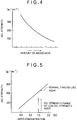
- the gel strength of low gel strength agar according to the present invention is limited, as shown in Fig. 5, to 250 g/cm2 or less, and preferably in a range between 10 to 250 g/cm2, at 1.5 % agar concentration.
- the reason for this is that if the gel strength is less than 10 g/cm2 at 1.5 % agar concentration, a problem of syneresis arises, and if the gel strength exceeds 250 g/cm2 at 1.5 % agar concentration, the same problems as in normal or conventional agar arise.
- the gel strength of 100 g/cm2 or below cannot be measured by the above-described measuring method.
- the gel strength of 10 g/cm2 at 1.5 % agar concentration is measured as 100 g/cm2 at 15 % agar concentration.
- the simplest confirmation method is to collect data showing the relationship between the gel strength of agar, whose molecules were cut by acid or special enzyme, and the amount of added acid or enzyme. Thereby, reproducibility is obtained.
- the special enzyme include ⁇ -agarase and ⁇ -agarase from Pseudomonas atlantica, Pseudomonas sp. and Luminous Bacterium, etc..
- a process for cutting the molecules of agar with the enzyme is as follows. ⁇ -agarase (30 units/1g agar) is added to agar solution dissolved in phosphate buffer, and incubate 6 hours at 40 °C. Then, the low gel strength agar is obtained by degradation of agar molecules.
- Fig. 4 shows a characteristic curve showing the relationship between the amount of added acid and the gel strength (at 1.5 % agar concentration). As seen from Fig. 4, the gel strength (at 1.5 % agar concentration) decreases in accordance with an increase in amount of added acid.
- the agar of the present invention has a low gel strength, a soft gel free from water removal can be obtained.
- the low gel strength agar can suitably be used as a gelling agent for spread foods, cosmetics and soft-texture confectionery, or used as a fat replacer.
- the gel obtained by using such low gel strength agar has a behavior acting on thixotropy as thickening agent, rather than gel, and it can have a special shape-retaining property not found in other gelling agents. From these properties, the agar of this invention is applicable to the following:
- the honey spread according to Applied Example 1 was experimentally produced, with the result that margarine-type honey spread with no spinnability was obtained.
- Fig. 1 shows the steps of a first example of the process according to the invention.
- seaweed such as Gelidium and Gracilaria, serving as raw material of agar
- alkali treatment to increase coagulation properties. If the alkali treatment is not necessary, this step 101 may be omitted, as indicated by a broken line.
- extraction treatment is performed, and a solution containing agar component extracted from the seaweed.
- the extracted solution is filtered, and in step 104 the filtered solution is coagulated (cooled). After step 104, the solution is gelatinized.
- step 105 pressing dehydration is carried out in step 105, or dehydration by freeze-thawing is performed in freezing step 106 and melting step 107.
- step 108 the dehydrated agar material is dried and pulverized in step 108, and agar (in the pulverized state in this case) having a normal gel strength is obtained.
- the constituents of the agar are polysaccharide having a basic skeleton of galactose and are classified into neutral agarose having good gelation properties, and ionic agaropectin having no gelation properties.
- the structure of agarobiose which is a repetition unit of agarose, consists of ⁇ -D-galactopyronose bonded at 1- and 3-positions, and 3, 6-anhydro- ⁇ -L-galactopyranose bonded at 1- and 4-positions.
- agaropectin includes all ionic polysaccharide, other than agarose, in the agar.
- the agaropectin has the same bonding structure as the agarose, but the former partly includes large amounts of sulfuric acid ester, methoxyl group, pyruvic acid group, and carboxyl group.
- the pulverized agar obtained in step 108 is subjected to acid treatment in step 109, and the agar molecules are cut to decrease the gel strength to a desired value.
- a solution of prescribed acid sulfuric acid, acetic acid, phosphoric acid, adipic acid, G.D.L., citric acid, malic acid, lactic acid, fumaric acid, gluconic acid, phytic acid, etc.
- the agar is uniformized in a blending machine. Thereafter, the agar is heated at 40 to 120 °C and subjected to hydrolysis for a predetermined time period.
- step 110 neutralization is effected in step 110, and the acid used in step 109 is neutralized.
- the acid is neutralized by spraying a solution of an alkali or alkaline salt (caustic soda, caustic potash, sodium carbonate, 4-sodium pyrophosphoric acid, 4-potassium pyrophosphate, sodium hydrogencarbonate, 3-potassium phosphate, 3-sodium phosphate, etc.) on the agar. Further, the agar is heated to recover water.
- an alkali or alkaline salt such as an alkali or alkaline salt
- agar subjected to the acid treatment and neutralization treatment in this manner is dried in step 111. Then, a low gel strength agar is obtained.
- sulfuric acid was used and agar was heated at 80 °C for six hours, and thus a low gel strength agar having a gel strength of 100 g/cm2 at 1.5 % agar concentration was obtained.
- step 109 normal dried agar product can be used in step 109, and a large quantity of low gel strength agar can be obtained at a time. In addition, energy cost is low. Furthermore, since the gel strength of agar can easily be controlled only by adjusting the amount of acid used in step 109, this process is suitable for industrialization.
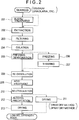
- Fig. 2 shows the steps of a second example of the process according to the invention.
- seaweed such as Gelidium and Gracilaria, serving as raw material of agar
- alkali treatment to increase gelation properties. If the alkali treatment is not necessary, this step 201 may be omitted, as indicated by a broken line.
- extraction treatment is performed, and a solution containing agar component is extracted from the seaweed.
- the extracted solution is filtered, and in step 204 the filtered solution is solidified (cooled). After step 204, the solution is gelatinized.
- pressing dehydration is carried out in step 205, or dehydration by freeze-thawing is performed in freezing step 206 and thawing step 207.
- the dehydrated agar gel is not dried, but it is re-dissolved in step 208, or dried agar is re-dissolved in step 208.
- Acid is applied to the re-dissolved liquid-phase agar in step 209, and the resultant agar is heated and decomposed.
- the liquid-phase agar is a diluted solution, it is difficult to perform drying in step 211 or recovery in alcohol precipitation step 212.
- the agar concentration is set at a high value. For this reason, the re-dissolving in step 208 is effected under pressure.
- step 210 neutralization treatment is performed after acid treatment in step 209, like step 110 in Fig. 1.
- drying treatment is performed in step 211 by a drum dry method or a spray dry method, thereby obtaining low gel strength agar.
- alcohol precipitation is effected in step 212 after step 210, and drying treatment is performed in step 213, thereby obtaining low gel strength agar.
- the amount of acid used in step 209 can be reduced.
- the drum dry method can be used in step 211, the low gel strength agar being powdered and easy to dissolve can be manufactured.
- Fig. 3 shows the steps of a third example of the process according to the invention.
- seaweed such as Gelidium and Gracilaria, serving as raw material of agar
- alkali treatment to increase gelation properties. If the alkali treatment is not necessary, this step 301 may be omitted, as indicated by a broken line.
- extraction treatment is performed, and a solution containing agar component is extracted from the seaweed.
- the extracted solution is filtered, and in step 304 the filtered solution is condensed. Then, the condensed solution is dried in step 305 by a drum dry method or a spray dry method, or alcohol precipitation is effected in step 306 and drying treatment is performed in step 307, thereby obtaining low gel strength agar.
- an acid treatment step 308 and a neutralization step 309 are performed at the time of extraction step 302 or after extraction step 302 or filtering step 303 (indicated by mark # ). If acid treatment step 308 and neutralization step 309 are performed at the time of extraction step 302 or just after extraction step 302, the subsequent steps become easier.
- the condensation step 304 is required.
- drying treatment is performed directly in step 305, without alcohol precipitation as in step 306, the finished low gel strength agar becomes crude agar.
- the above-described low gel strength agar of this invention there can be obtained a soft gel which is free from water removable and has a low gel strength even at a certain concentration level or above.
- the agar is high-stability and high-safety food, and is rich in dietary fibers.
- the agar has good flavor release and less stickiness.
- such low gel strength agar can be manufactured with high efficiency.
- the gel obtained by using such low gel strength agar has a behavior acting on thixotropy as thickening agent, rather than gel, and it can have a special shape-retaining property not found in other gelling agents.
- Table 1 shows the relationship between foods containing the low gel strength agar of this invention and the above-mentioned advantages A to J. Most expectable advantages are indicated by a mark #, and normally expectable advantages are by a mark +.
- the above foods containing the low gel strength agar may roughly be classified into (1) dietary fibers drinks, (2) low-calorie foods, (3) texture-improved foods, and (4) aging-prevention foods.
- Foods in group (1) are beverages enriched with dietary fibers by use of low gel strength agar.
- Foods in group (2) have low fats and oils and low calorie, since fat and oil constituents thereof are replaced by aqueous low gel strength agar spread components.
- Foods in group (3) have improved texture such as good flavor release.
- Foods in group (4) aim at preventing aging of starch, etc.
- Low gel strength agar whose molecules were cut to short fragments and whose gel strength was adjusted to 250 g/cm2 or below at 1.5 % agar concentration, is contained in low-calorie foods.
- the low-calorie foods include spreads (butter, margarine, chocolate cream, peanut butter etc.), ice products (ice cream, ice sherbet, shake, etc.), seasonings (mayonnaise, dressing, etc.), dairy products (cheese food, yogurt, pudding, milk shake, mousse, whipping cream, etc.), and meat products (hamburg steak, ham, etc.).
- the low-calorie foods include low-calorie pet foods.
- stabilizers such as starch, gelatin and gum is added, and/or constituents are controlled by adding protein or an emulsifying agent. That is, if a food is produced with a starch or gelatin system to maintain shape-retaining properties and water-retention properties, stickiness is caused in the food. And the food is not easily melted owing to reduction of fats and oils. In addition, since flavor is lost due to starch, flavor release is degraded.
- the salient feature of agar is a gelatinizing force.
- water-removing properties are high despite the fact that a "crispy" texture gel can be obtained with high shape-retention properties.
- good flavor release as well as smooth texture can be achieved.
- the texture of the food, of which calorie is to be lowered is undesirably changed by the gelatinizing force of the normal agar. It is not possible to increase the use concentration of the normal agar (e.g. 0.5 % or above). Thus, it is difficult to reflect the inherent properties of the prior-art agar on foods.
- the low-calorie foods according to the present invention which contain the low gel strength agar whose gel strength is adjusted to 250 g/cm2 or below at 1.5 % agar concentration.
- the reason for this is that the low gel strength agar has shape-retention properties and extension properties, and that the flavor of the original food can be reproduced by virtue of the flavor release of the low gel strength agar even if the fats and oils are reduced.
- the foods according to the present invention contain the low gel strength agar, the foods can have improved texture not found in prior-art foods.
- foods gelatinized by agar can be softened, which include jelly products (milk jelly, fruit jelly, etc.), hard-type yogurt consisting mainly of yogurt, and Japanese confectionery (soft adzuki-bean jelly, "kingyoku", etc.).
- Table 2 shows the relationship between the use concentration of agar, gel strength, and water-removal amount.
- Low-calorie margarine contains the low gel strength agar, whose gel strength is adjusted to 250 g/cm2 or below at 1.5 % agar concentration, as a fat replacer.
- agar whose gel strength is adjusted to 250 g/cm2 or below at 1.5 % agar concentration, as a fat replacer.
- it has the following composition:
- thickener such as gelatin or lactic components are added. If this method is used, however, stickiness is inevitably caused.
- agar if agar is used, crispy texture with good flavor release can be achieved, and therefore the special flavor of margarine can be maintained.
- Conventional agar has the same flavor release, but its gelatinizing force is stronger, and if the agar concentration is higher than a certain level (e.g. 0.4 % or above), the texture becomes rough. If the margarine is quickly pulverized to fine particles by a homomixer for obtaining a soft spread, the shape-retention properties of the soft spread are degraded, and the texture of conventional margarine cannot be achieved. In addition, if the agar concentration is increased, the texture becomes rough. By contrast, if the low gel strength agar is used in margarine, like the present invention, the texture does not become rough.
- Dressing according to this invention contains the low gel strength agar whose gel strength is adjusted to 250 g/cm2 or below at 1.5 % agar concentration.
- agar whose gel strength is adjusted to 250 g/cm2 or below at 1.5 % agar concentration.
- it has the following composition:
- Example 5 French dressing
- a stabilizer such as xanthane gum or guar gum is used for stabilizing emulsification between water, vinegar and vegetable fats. Since there has recently been a demand for lowering the calorie of dressing, an thickener such as carrageenan, pectin, locust been gum is added to create substitute texture for fats in addition to the stabilizer.
- the French dressing of the present invention has good flavor release of the low gel strength agar, which creates more flavor with low fats.
- Cheese spreads or cheese foods according to this invention contains the low gel strength agar, whose gel strength is adjusted to 250 g/cm2 or below at 1.5 % agar concentration, as a substitute for natural cheese.
- agar whose gel strength is adjusted to 250 g/cm2 or below at 1.5 % agar concentration, as a substitute for natural cheese.
- it has the following composition:
- Example 6 Cheese spreads/cheese foods
- Normal natural cheese contains about 30 % of fats. Thus, a conventional cheese spread using much normal natural cheese also contains about 25 % of fats.
- the cheese content can be reduced without adversely affecting the texture.
- a cheese spread or cheese food with less fats can be achieved.
- Some kind of matters such as pickles or dry fruits may be added to cheese spreads or cheese foods. In the conventional spreads, it cannot be said that the taste of added matters is fully enjoyed. By contrast, if the low gel strength agar is added, as in the product of the present invention, the taste of added matters can be fully enjoyed, and a range of selections of seasoning and flavoring can be widened.
- Terrine according to this invention contains the low gel strength agar whose gel strength is adjusted 250 g/cm2 or below.
- agar whose gel strength is adjusted 250 g/cm2 or below.
- it has the following composition:
- the terrine obtained by this invention has soft texture, shape-retention properties with high temperature.
- a hamburg steak according to this invention contains the low gel strength agar whose gel strength is adjusted to 250 g/cm2 or below at 1.5 % agar concentration.
- agar whose gel strength is adjusted to 250 g/cm2 or below at 1.5 % agar concentration.
- it has the following composition:
- the low gel strength agar is used, as in the present invention, a texture similar to that of a normal hamburg steak can be obtained. Since the melting point of low gel strength agar is higher than that of carrageenan, the amount of agar to be melted is small and meat juice can be contained inside the hamburg steak, when the hamburg steak is heated.
- Ice cream according to this invention contains the low gel strength agar whose gel strength is adjusted to 250 g/cm2 or below at 1.5 % agar concentration.
- agar whose gel strength is adjusted to 250 g/cm2 or below at 1.5 % agar concentration.
- it has the following composition:
- Example 8 Ice cream
- ice cream prepared according to a common recipe contains various stabilizers (carrageenan, gums, gelatin) in order to solve problems such as over-run characteristics, melt-down resistance, whey separation, and sandy condition. It is very difficult to determine an optimal adding rate of stabilizers so as to compensate their respective characteristics each other. Therefore, a great deal of time and work is required in only determining the recipe. In manufacturing factories, too, the manufacturing process is complex owing to the delicate recipe.
- the melt-down resistance among the characteristics required for ice cream, is remarkably improved, as compared to the case where other stabilizers are used. This is because the low gel strength agar has a higher melting point than other gelling agents and gums.
- the advantages obtained by adding the low gel strength agar to the ice cream are also obtainable with ice mix, lact-ice, and soft cream.
- the necessity of aging increases as the total solid constituent decreases. If the low gel strength agar is used, as in the present invention, the aging effect can be enhanced and therefore the over-run characteristics can be improved.
- low-calorie ice cream of Product 2 of Example 8 can be manufactured.
- the reason for this is that, in addition to the above-mentioned characteristics of the low gel strength agar, a fine and soft gel structure of the low gel strength agar can achieve a texture very similar to the texture of ice cream created by agglomeration of milk fats. Thus, tasty and low-calorie ice cream can be produced.
- Low-calorie mayonnaise contains the low gel strength agar whose gel strength is adjusted to 250 g/cm2 or below at 1.5 % agar concentration.
- agar whose gel strength is adjusted to 250 g/cm2 or below at 1.5 % agar concentration.
- it has the following composition:
- Example 9 Low-calorie mayonnaise
- Milk shake according to this invention contains the low gel strength agar whose gel strength is adjusted to 250 g/cm2 or below at 1.5 % agar concentration.
- agar whose gel strength is adjusted to 250 g/cm2 or below at 1.5 % agar concentration.
- it has the following composition:
- Example 10 Milk shake
- skim milk powder 10.00 parts 10.00 parts raw cream 35.00 parts 5.00 parts sugar 11.0 parts 11.00 parts powder bean 4.00 parts 4.00 parts glyceric fatty ester 0.04 part 0.04 part water 40.00 parts 60.00 parts carrageenan 0.03 part --- low gel strength agar --- 0.50 part powder whey --- 5.00 parts perfume 0.20 part 0.40 part
- the milk shake of the present invention using low gel strength agar has a low calorie and a suitably elastic texture.
- the obtained milk shake is not smoothly melted in the mouth and is hard to drink because of stickiness.
- the low gel strength agar is used, such a problem does not arise.
- the low gel strength agar is an excellent supply source of dietary fibers, and therefore various dietary fiber drinks can be realized by using the agar singly or in combination with other vegetable fibers.
- Frozen dessert (ice sherbet) according to this invention contains the low gel strength agar whose gel strength is adjusted to 250 g/cm2 or below at 1.5 % agar concentration.
- agar whose gel strength is adjusted to 250 g/cm2 or below at 1.5 % agar concentration.
- it has the following composition:
- Example 11 Frozen dessert (ice sherbet)
- stabilizers such as MC, CMC, carrageenan, pectin or vegetable gum are used in ice sherbet, in order to achieve suitable over-run characteristics and produce a smooth frazil ice structure.
- the prior-art sherbet using such stabilizers has a good structure, but remainder, stickiness and thirst is felt during or after eating, and it is not satisfactory.
- the product of this invention using the low gel strength agar eliminating the prior-art sensuous defect, can be smoothly melted in the mouth with good flavor release.
- the melt-down resistance of the product can be improved.
- the use of low gel strength agar can enhance over-run characteristics of the product, the product can be provided with shortness. Thus, crunch-type ice sherbet can be produced.
- Yogurt according to this invention contains the low gel strength agar, whose gel strength is adjusted to 250 g/cm2 or below at 1.5 % agar concentration, as a substitute for normal agar.
- agar whose gel strength is adjusted to 250 g/cm2 or below at 1.5 % agar concentration, as a substitute for normal agar.
- it has the following composition:
- Agar and gelatin have been used as shape-retention agents for determining the texture of hard-type yogurt, because the solidity of agar does not considerably vary in relation to a temperature change (between a freezing temperature and a normal temperature, e.g. 30 °C in the summer), the agar is not relatively hard at low concentration (0.4 % or less) and flavor release is good, and the gelatin has good water-retention properties and a soft texture can be achieved.
- a softer texture is not obtained with conventional agar or gelatin.
- a texture is to be created with only use of gelatin, while the use concentration of agar is lowered or agar is not used, the temperature control in the manufacturing process becomes difficult because of the time-basis change of strength of gelatin and the low melting point of gelatin. Furthermore, the texture of product yogurt is not stabilized.
- yogurt of a soft, creamy texture which is free from the above problem, can be produced.
- a soft similar texture can be produced as a substitute for curd of yogurt.
- the fatty constituent of yogurt can be reduced, and a dietary (low-calorie) yogurt can be obtained with the same texture as a conventional one.
- the gelatin of conventional yogurt can be replaced with low gel strength agar, and it is not necessary to add two kinds of gelling agents in the manufacturing process. Besides, since the low gel strength agar has a coagulation point lower than that of conventional agar by 5 to 10 °C, the culture temperature at which the starter is added can be lowered. Thereby, lacto bacilli can function more effectively.
- Soft adzuki-bean jelly contains the low gel strength agar, whose gel strength is adjusted to 250 g/cm2 or below at 1.5 % agar concentration.
- agar whose gel strength is adjusted to 250 g/cm2 or below at 1.5 % agar concentration.
- it has the following composition:
- Example 13 Soft adzuki-bean jelly
- the low gel strength agar is used singly, as in the Product 2 of Example 13, or in combination with conventional agar, as in the Product 1 of Example 13, the bean jam does not precipitate and a soft adzuki-bean jelly having good flavor release, which cannot be found in conventional products, can be obtained.
- a Japanese confectionery so called "Kingyoku" contains the low gel strength agar whose gel strength is adjusted to 250 g/cm2 or below at 1.5 % agar concentration.
- soft grape jelly has the following composition:
- Example 14 Soft grape jelly
- Gummy jelly according to this invention contains the low gel strength agar, whose gel strength is adjusted to 250 g/cm2 or below at 1.5 % agar concentration, as a substitute for gelatin.
- agar whose gel strength is adjusted to 250 g/cm2 or below at 1.5 % agar concentration, as a substitute for gelatin.
- it has the following composition:
- Example 15 Gummy jelly
- prior-art gummy jelly differs from prior-art gummy jelly and the gummy jelly of the present invention.
- Gelatin is used in the prior-art gummy jelly.
- the jelly melts when the temperature rises in the summer, and the texture varies depending on temperatures.
- the product of the present invention using the agar has no such problems.
- Gelatin is a protein and has calorie
- the low gel strength agar is dietary fibers of a polysaccharide and is a non-calorie food. If the low gel strength agar is used, a food of a softer texture can be achieved, with no smell of animal protein like gelatin.
- Caramel according to this invention contains the low gel strength agar whose gel strength is adjusted to 250 g/cm2 or below at 1.5 % agar concentration.
- agar whose gel strength is adjusted to 250 g/cm2 or below at 1.5 % agar concentration.
- it has the following composition:
- the caramel of this invention containing a small amount of low gel strength agar does not easily adhere to the teeth and is not sticky. In addition, even in the summer, it does not soften. Further, if the concentration of the low gel strength agar is increased (e.g. about 5 %) and the sugar content is decreased, a healthy caramel with vegetable fibers can be obtained. The same technique is applicable to chewing gum.
- Jam according to this invention contains the low gel strength agar whose gel strength is adjusted to 250 g/cm2 or below at 1.5 % agar concentration.
- agar whose gel strength is adjusted to 250 g/cm2 or below at 1.5 % agar concentration.
- it has the following composition:
- a commercially available conventional jam e.g. pectin jam
- the jam of this invention using the low gel strength agar has good flavor release and is not sticky.
- the freshness of contained fruits can be enjoyed.
- Peanut butter spread according to this invention contains the low gel strength agar whose gel strength is adjusted to 250 g/cm2 or below at 1.5 % agar concentration.
- agar whose gel strength is adjusted to 250 g/cm2 or below at 1.5 % agar concentration.
- it has the following composition:
- Example 17B Peanut butter spread
- the peanut butter spread of this invention using the low gel strength agar has good flavor release and makes smooth texture.
- Honey spread according to this invention contains the low gel strength agar whose gel strength is adjusted to 250 g/cm2 or below at 1.5 % agar concentration.
- agar whose gel strength is adjusted to 250 g/cm2 or below at 1.5 % agar concentration.
- it has the following composition:
- Example 18 Honey spread
- the honey spread according to this invention contains low gel strength agar, and it is a margarine-like spread with no webbing properties.
- Sauce according to this invention contains the low gel strength agar, whose gel strength is adjusted to 250 g/cm2 or below at 1.5 % agar concentration, as a substitute for corn starch.
- agar whose gel strength is adjusted to 250 g/cm2 or below at 1.5 % agar concentration, as a substitute for corn starch.
- it has the following composition:
- brown Worcestershire sauces which are generally called “sauce” in Japan include not only conventional Worcestershire sauce, middle-thick sauce, and thick sauce, but also various sauces for, e.g. "okonomiyaki” (a kind of Japanese pancake).
- the tastes and texture are widely varied in accordance with purposes of use.
- starches such as corn starch is used to make sauces dense, and an additive of tamarind gum, etc. is used as thickening agent.
- the starch causes the texture to change due to time-based separation or aging, and it is susceptible to microorganismal enzyme decomposition. Further, the use of thickening agent causes webbing. In particular, in the case of thick sauce, thixotropic properties are not exhibited.
- Japanese sauces according to this invention include sauces for fish and shellfish, sauces for meat products and sauces for confectionery.
- a sauce for meat balls contains the low gel strength agar, whose gel strength is adjusted to 250 g/cm2 or below at 1.5 % agar concentration, as a substitute for dogtooth violet starch.
- it has the following composition:
- Example 20 Sauce for meat balls
- the sauce does not age and has good adhesion to meat balls.
- the low gel strength agar contributes to flavor release of soy sauce.
- Brown sauce according to this invention has following composition:
- Example 20B Brown sauce
- Brown sauce according to this invention improve texture and has good flavor release.
- Sauce for "yakitori” or Japanese grilled chicken according to this invention contains the low gel strength agar, whose gel strength is adjusted to 250 g/cm2 or below at 1.5 % agar concentration, as a substitute for dogtooth violet starch.
- agar whose gel strength is adjusted to 250 g/cm2 or below at 1.5 % agar concentration, as a substitute for dogtooth violet starch.
- it has the following composition:
- Example 21 Sauce for Japanese grilled chicken
- Sauce for Japanese grilled chicken needs to have good adhesion and stickiness on meat, when it is grilled after dipped in sauce, and also needs to be free from time-basis change.
- the prior-art product contains starch.
- sauce is easily removed when the chicken is grilled after it is dipped in the sauce, and also the sauce is easily scorched. Further, when the sauce is marketed in a packed state, the starch in the sauce ages with the passing of time, resulting in water removal.
- the product of the present invention using the low gel strength agar has good flavor release and good adhesion on the meat.
- Pizza sauce according to this invention has the following composition:
- Example 21B Pizza sauce
- Pizza sauce according to this invention can spread easily and not drip down.
- Noodles according to this invention contain the low gel strength agar, whose gel strength is adjusted to 250 g/cm2 or below at 1.5 % agar concentration.
- cooled noodles have the following composition:
- Example 22 Cooled noodles
- the noodles according to this invention contain the low gel strength agar, and therefore the noodles have more "resiliency” and “smoothness” than the prior-art product.
- the noodles match the gelatinizing force of agar, texture improvement effect is great.
- the amount of brine can be reduced, healthy cooled noodle is obtained.
- a similar example is "cupped" (packed in a cup) uncooked Chinese noodles, by which boiled noodles can be preserved for a long time.
- the "cupped" uncooked Chinese noodles according to this invention contain the low gel strength agar whose gel strength is adjusted to 250 g/cm2 or below at 1.5 % agar concentration.
- the noodles have the following composition:
- Example 23 "Cupped” uncooked Chinese noodles
- the "soba" noodles and Chinese noodles are processed with acidifier, such as citric acid and phytin acid, to the acid side (about pH4) for long-time preservation.
- acidifier such as citric acid and phytin acid
- Example 23 a small amount of brine was added to wheat flour for the purpose of flavoring. Then, the pH of the resultant was adjusted by citric acid solution. After the noodles were boiled, the adhesion between noodles was prevented by using oil, and subjected to secondary sterilization.
- Bread according to this invention contains the low gel strength agar whose gel strength is adjusted to 250 g/cm2 or below at 1.5 % agar concentration.
- agar whose gel strength is adjusted to 250 g/cm2 or below at 1.5 % agar concentration.
- it has the following composition:
- the bread Since the low gel strength agar is used in the bread of the invention, the bread is softer than the prior-art product and is less aged. A variation between products in the manufacturing process can be reduced, and bread can be stably manufactured.
- Icing according to this invention contains the low gel strength agar whose gel strength is adjusted to 250 g/cm2 or below at 1.5 % agar concentration.
- agar whose gel strength is adjusted to 250 g/cm2 or below at 1.5 % agar concentration.
- it has the following composition:
- Icing of this invention using the low gel strength agar has good solubility and easily boil down. It has good water-retaining and shape-retention properties.
- Rice according to this invention contains, as vegetable fibers, the low gel strength agar whose gel strength is adjusted to 250 g/cm2 or below at 1.5 % agar concentration.
- the following amount of additive is mixed in ordinary rice:
- the rice has good gloss and stickiness. This advantage is greater with older rice. Thus, a recent demand for high-quality rice can be satisfied.
- a dietary fiber-containing beverage according to this invention contains, as dietary fibers, the low gel strength agar whose gel strength is adjusted to 250 g/cm2 or below at 1.5 % agar concentration.
- the beverage has the following composition:
- Example 26 Dietary fiber-containing beverage
- Agar contains a largest amount of dietary fibers of all foods. If agar is contained in a beverage, dietary fibers can be taken in only by drinking the beverage. However, since conventional agar has a strong gelatinizing force, it must be used at a concentration of 0.1 % or less in order to prevent gelatinization. This concentration is very low. Thus, a beverage with such a low agar concentration cannot be said to have sufficient dietary fibers.
- Japanese rice cakes according to the invention include "kashiwa-mochi” (rice cake wrapped in an oak leaf), “daifuku-mochi” (rice cake stuffed with bean jam), “sakura-mochi”, “suama”, “yubeshi”, “dango”, “gyuhi”, cut rice cakes.
- the rice cake according to this invention contains the low gel strength agar whose gel strength is adjusted to 250 g/cm2 or below at 1.5 % agar concentration.
- "kashiwa-mochi” has the following composition:
- the "kashiwa-mochi" of this invention containing the low gel strength agar does not easily age, and also its texture does not easily change.
- the low gel strength agar may also be contained in other rice cakes such as "shoyo-manju”, “sake-manju”, “keiyo-manju”, “kuzu-manju”, “mushi-manju”, “Chinese-manju”, “oyaki”, “uiro”, and the same aging-prevention effect can be obtained.
- Foods using the low gel strength agar of the present invention are not limited to the above examples.
- the gel strength of the low gel strength agar used in the present invention is lowered in advance by acid and heat, and then it is contained in foods.
- a normal strength agar may be contained in foods in advance, and in the foods manufacturing process the normal agar may be processed by acid and heated, so that the gel strength of the agar may lower as well as that of the low gel strength agar as mentioned above.
- the low gel strength agar of the invention includes such agar.
- cosmetics such as milky lotion, cream, shampoo, pack and tooth powder contain, as thickening agent, tragacanth gum, karaya gum, pectin, sodium alginate, carrageenan, CMC, MC, PVP, etc.
- conventional agar has a strong gelatinizing force, as stated above. Thus, if it is used at high concentration, fluidity is insufficient. When it is actually contained in cosmetics, it is difficult to maintain the liquid- or cream-phase. If the conventional agar is used at low concentration in order to avoid this, the agar content decreases and the functions (thickening properties, permeability, etc.) peculiar to agar cannot be exhibited.
- the low gel strength agar of the present invention has no such problems, and it can be contained in cosmetics with good advantages expected. Examples of the cosmetics according to this invention will now be described.
- Example 28 0.5 part of low gel strength agar is contained in 100 parts of lotion.
- the lotion obtained by this composition is superior to lotion containing conventional thickening agent, in advantages of providing the skin with moisture, smoothing the skin, and cleaning the skin.
- Example 29 3 parts of low gel strength agar is contained in 100 parts of a packing agent.
- the packing agent obtained by this composition is superior to a packing agent containing conventional thickening agent, in advantages of providing the skin with moisture, smoothing the skin, and cleaning the skin.
- Example 30 1 part of low gel strength agar is contained in 100 parts of shampoo.
- Example 30 Shampoo
- the shampoo obtained by this composition is superior to shampoo containing conventional thickening agent, in advantages of providing the skin with moisture, smoothing the skin, and cleaning the skin.
- the cosmetics of the present invention are not limited to the above examples, and are applicable to creams, tooth powders, etc.
- concentration of the used low gel strength agar is not limited to the values shown in the examples.
Landscapes
- Life Sciences & Earth Sciences (AREA)
- Chemical & Material Sciences (AREA)
- Engineering & Computer Science (AREA)
- Health & Medical Sciences (AREA)
- Polymers & Plastics (AREA)
- Food Science & Technology (AREA)
- Nutrition Science (AREA)
- Molecular Biology (AREA)
- Organic Chemistry (AREA)
- General Health & Medical Sciences (AREA)
- Zoology (AREA)
- Chemical Kinetics & Catalysis (AREA)
- Dispersion Chemistry (AREA)
- Biotechnology (AREA)
- Public Health (AREA)
- Animal Behavior & Ethology (AREA)
- Veterinary Medicine (AREA)
- Biochemistry (AREA)
- Botany (AREA)
- Mycology (AREA)
- Medicinal Chemistry (AREA)
- Wood Science & Technology (AREA)
- Oil, Petroleum & Natural Gas (AREA)
- Microbiology (AREA)
- Materials Engineering (AREA)
- General Chemical & Material Sciences (AREA)
- Bioinformatics & Cheminformatics (AREA)
- General Engineering & Computer Science (AREA)
- Genetics & Genomics (AREA)
- Dermatology (AREA)
- Inorganic Chemistry (AREA)
- Agronomy & Crop Science (AREA)
- Marine Sciences & Fisheries (AREA)
- Birds (AREA)
- Epidemiology (AREA)
- Jellies, Jams, And Syrups (AREA)
Priority Applications (1)
| Application Number | Priority Date | Filing Date | Title |
|---|---|---|---|
| EP98107465A EP0873691A3 (fr) | 1992-05-15 | 1993-04-28 | Aliment comprenant un agar à faible force de gel |
Applications Claiming Priority (6)
| Application Number | Priority Date | Filing Date | Title |
|---|---|---|---|
| JP4148855A JP3023244B2 (ja) | 1992-05-15 | 1992-05-15 | 低強度寒天およびその製造方法 |
| JP148855/92 | 1992-05-15 | ||
| JP4217250A JP2795424B2 (ja) | 1992-07-23 | 1992-07-23 | 低強度寒天を用いた食品 |
| JP217250/92 | 1992-07-23 | ||
| JP226398/92 | 1992-08-03 | ||
| JP4226398A JPH0656625A (ja) | 1992-08-03 | 1992-08-03 | 低強度寒天を用いた化粧品 |
Related Child Applications (1)
| Application Number | Title | Priority Date | Filing Date |
|---|---|---|---|
| EP98107465A Division EP0873691A3 (fr) | 1992-05-15 | 1993-04-28 | Aliment comprenant un agar à faible force de gel |
Publications (2)
| Publication Number | Publication Date |
|---|---|
| EP0570252A2 true EP0570252A2 (fr) | 1993-11-18 |
| EP0570252A3 EP0570252A3 (en) | 1994-02-23 |
Family
ID=27319634
Family Applications (2)
| Application Number | Title | Priority Date | Filing Date |
|---|---|---|---|
| EP19930401102 Withdrawn EP0570252A3 (en) | 1992-05-15 | 1993-04-28 | Low gel strength agar-agar |
| EP98107465A Withdrawn EP0873691A3 (fr) | 1992-05-15 | 1993-04-28 | Aliment comprenant un agar à faible force de gel |
Family Applications After (1)
| Application Number | Title | Priority Date | Filing Date |
|---|---|---|---|
| EP98107465A Withdrawn EP0873691A3 (fr) | 1992-05-15 | 1993-04-28 | Aliment comprenant un agar à faible force de gel |
Country Status (3)
| Country | Link |
|---|---|
| US (1) | US5502181A (fr) |
| EP (2) | EP0570252A3 (fr) |
| MA (1) | MA22924A1 (fr) |
Cited By (4)
| Publication number | Priority date | Publication date | Assignee | Title |
|---|---|---|---|---|
| WO1995023815A1 (fr) * | 1994-03-04 | 1995-09-08 | Sports Eze Limited | Production et emploi d'agars et d'agaroides de faible poids moleculaire |
| EP0715812A3 (fr) * | 1994-12-07 | 1996-10-23 | Yakult Honsha Kk | Lait enrichi en calcium et procédé de préparation |
| CN105506033A (zh) * | 2016-02-25 | 2016-04-20 | 福建省绿麒食品胶体有限公司 | 一种低凝胶强度琼胶的制备方法 |
| EP3302088A4 (fr) * | 2015-06-04 | 2019-01-09 | General Mills, Inc. | Compositions à base de caramel cuit et produits alimentaires connexes |
Families Citing this family (15)
| Publication number | Priority date | Publication date | Assignee | Title |
|---|---|---|---|---|
| AUPN907496A0 (en) * | 1996-04-02 | 1996-04-26 | Byron Australia Pty Ltd | Spreadable gelled food product |
| TW460293B (en) * | 1997-10-28 | 2001-10-21 | Kao Corp | External skin-care composition |
| TWI244484B (en) * | 1998-06-09 | 2005-12-01 | Takara Bio Inc | Pharmaceutical composition containing oxy-containing hexacyclic compound |
| TWI247585B (en) * | 1999-05-14 | 2006-01-21 | Takara Bio Inc | Agarobiose-containing composition |
| US6548097B1 (en) * | 2000-11-27 | 2003-04-15 | Nestec S.A. | Frozen confections comprising a gel composition |
| AU2002952713A0 (en) * | 2002-11-18 | 2002-11-28 | Mars, Incorporated | Packaged pet food of novel appearance |
| DE202005012934U1 (de) * | 2005-08-12 | 2005-12-01 | Tomljanovic, Steffi | Gelee aus Bierwürze |
| KR100789399B1 (ko) * | 2006-02-28 | 2007-12-28 | 한일인삼산업 주식회사 | 다시마, 우뭇가사리 및 지누아리 추출물이 함유된건강음료 조성물 |
| JP4102416B2 (ja) | 2006-11-15 | 2008-06-18 | 丸石製薬株式会社 | ゲル状殺菌消毒用組成物 |
| ES2422531B1 (es) * | 2010-06-07 | 2014-10-06 | Fuji Oil Company Limited | Agar altamente viscoelástico y altamente resistente, y método para la producción del mismo |
| KR101960503B1 (ko) | 2016-11-15 | 2019-03-21 | 고려대학교 산학협력단 | 항충치 활성을 갖는 아가로바이오스 또는 아가로올리고당의 용도 |
| WO2018093129A1 (fr) * | 2016-11-15 | 2018-05-24 | 고려대학교 산학협력단 | Utilisation d'un agarobiose ou d'un agaro-oligosaccharide présentant une activité anticariogène |
| CN109929061B (zh) * | 2017-12-18 | 2021-06-04 | 内蒙古蒙牛乳业(集团)股份有限公司 | 琼脂及其制备方法及应用 |
| CN109965011A (zh) * | 2019-04-08 | 2019-07-05 | 河北兄弟伊兰食品科技股份有限公司 | 一种低凝胶强度卡拉胶的制备方法 |
| JP7749397B2 (ja) | 2021-09-30 | 2025-10-06 | キヤノン株式会社 | 超音波ファントム及び超音波ファントムの製造方法 |
Family Cites Families (5)
| Publication number | Priority date | Publication date | Assignee | Title |
|---|---|---|---|---|
| FR330595A (fr) * | 1903-03-25 | 1903-08-21 | Max Maetschke | Procédé permettant d'obtenir des dissolutions limpides d'agar-agar, à haute teneur |
| JPS5774072A (en) * | 1980-10-29 | 1982-05-10 | Yamanouchi Pharmaceut Co Ltd | Granule of dietary fiber and its preparation |
| JPS62210965A (ja) * | 1986-03-13 | 1987-09-17 | Shokuhin Sangyo Baioriakutaa Syst Gijutsu Kenkyu Kumiai | 低カロリ−飲食品およびその製造方法 |
| JPH0673442B2 (ja) * | 1986-03-13 | 1994-09-21 | 明治製菓株式会社 | 食品の老化防止方法 |
| DK0474299T3 (da) * | 1990-09-07 | 1995-01-09 | Unilever Plc | Vand-i-olie-dispersion |
-
1993
- 1993-04-28 EP EP19930401102 patent/EP0570252A3/en not_active Withdrawn
- 1993-04-28 EP EP98107465A patent/EP0873691A3/fr not_active Withdrawn
- 1993-05-14 MA MA23187A patent/MA22924A1/fr unknown
-
1994
- 1994-10-18 US US08/324,545 patent/US5502181A/en not_active Expired - Lifetime
Cited By (7)
| Publication number | Priority date | Publication date | Assignee | Title |
|---|---|---|---|---|
| WO1995023815A1 (fr) * | 1994-03-04 | 1995-09-08 | Sports Eze Limited | Production et emploi d'agars et d'agaroides de faible poids moleculaire |
| US6322814B1 (en) * | 1994-03-04 | 2001-11-27 | Ian James Miller | Manufacture of and uses for low molecular weight agars and agaroids |
| EP0715812A3 (fr) * | 1994-12-07 | 1996-10-23 | Yakult Honsha Kk | Lait enrichi en calcium et procédé de préparation |
| US5609898A (en) * | 1994-12-07 | 1997-03-11 | Kabushiki Kaisha Yakult Honsha | Calcium-enriched drink and method for producing the same |
| EP3302088A4 (fr) * | 2015-06-04 | 2019-01-09 | General Mills, Inc. | Compositions à base de caramel cuit et produits alimentaires connexes |
| US11470854B2 (en) | 2015-06-04 | 2022-10-18 | General Mills, Inc. | Process of providing a cooked caramel slurry for coating |
| CN105506033A (zh) * | 2016-02-25 | 2016-04-20 | 福建省绿麒食品胶体有限公司 | 一种低凝胶强度琼胶的制备方法 |
Also Published As
| Publication number | Publication date |
|---|---|
| EP0873691A2 (fr) | 1998-10-28 |
| MA22924A1 (fr) | 1994-04-01 |
| EP0873691A3 (fr) | 1999-07-14 |
| US5502181A (en) | 1996-03-26 |
| EP0570252A3 (en) | 1994-02-23 |
Similar Documents
| Publication | Publication Date | Title |
|---|---|---|
| US5502181A (en) | Low gel strength agar-agar | |
| Igoe | Dictionary of food ingredients | |
| CN106108024B (zh) | 包括可缓慢消化或抗消化的糖类组合物的食品 | |
| CN105935081B (zh) | 含纤维的碳水化合物组合物 | |
| CN101494997B (zh) | 包括可缓慢消化或抗消化的糖类组合物的食品 | |
| US3766165A (en) | Polysaccharides and their preparation | |
| US4143172A (en) | Food binding agent | |
| EP2177111A1 (fr) | Composition alimentaire traitée contenant de la dextrine | |
| US20060068073A1 (en) | Low calorie, palatable sugar substitute with water insoluble bulking agent | |
| WO2017030206A1 (fr) | Composition contenant de la gomme welan | |
| EP0532775A1 (fr) | Produit alimentaire contenant de polymer de fructose | |
| JP2795424B2 (ja) | 低強度寒天を用いた食品 | |
| JP5321028B2 (ja) | 食品用物性改良剤 | |
| CN114945282A (zh) | 高纤维低糖可溶性膳食纤维、包括它们的产品以及用于制作和使用它们的方法 | |
| CN105163604A (zh) | 含纤维的碳水化合物组合物 | |
| KR19990077246A (ko) | 귀리로 만든 냉동 과자 | |
| US7544379B2 (en) | Composite containing fine cellulose | |
| CA2187807C (fr) | Produit de type mayonnaise | |
| JP3138329B2 (ja) | 食品における油脂代替物としての澱粉の使用方法 | |
| DE2305494B2 (de) | Verfahren zur enzymatischen Herstellung von Stärkehydrolysenprodukten | |
| JPS5939260A (ja) | 飲食品の製造法 | |
| JP7486288B2 (ja) | 澱粉分解物、並びに該澱粉分解物を用いた飲食品用組成物、飲食品、コク付与剤、飲食品の製造方法、及びコク付与方法 | |
| JP2000116343A (ja) | グミキャンデイ組成物 | |
| JPS5836945B2 (ja) | ダイエツト食品組成物の製法 | |
| EP3135124B1 (fr) | Utilisation d'un polysaccharide de pois soluble dans l'eau |
Legal Events
| Date | Code | Title | Description |
|---|---|---|---|
| PUAI | Public reference made under article 153(3) epc to a published international application that has entered the european phase |
Free format text: ORIGINAL CODE: 0009012 |
|
| AK | Designated contracting states |
Kind code of ref document: A2 Designated state(s): DE DK ES FR GB |
|
| PUAL | Search report despatched |
Free format text: ORIGINAL CODE: 0009013 |
|
| AK | Designated contracting states |
Kind code of ref document: A3 Designated state(s): DE DK ES FR GB |
|
| 17P | Request for examination filed |
Effective date: 19940801 |
|
| 17Q | First examination report despatched |
Effective date: 19970303 |
|
| STAA | Information on the status of an ep patent application or granted ep patent |
Free format text: STATUS: THE APPLICATION IS DEEMED TO BE WITHDRAWN |
|
| 18D | Application deemed to be withdrawn |
Effective date: 19980717 |