EP0570976A2 - Elektrisches Energieversorgungssystem - Google Patents
Elektrisches Energieversorgungssystem Download PDFInfo
- Publication number
- EP0570976A2 EP0570976A2 EP93108281A EP93108281A EP0570976A2 EP 0570976 A2 EP0570976 A2 EP 0570976A2 EP 93108281 A EP93108281 A EP 93108281A EP 93108281 A EP93108281 A EP 93108281A EP 0570976 A2 EP0570976 A2 EP 0570976A2
- Authority
- EP
- European Patent Office
- Prior art keywords
- power
- power converter
- current
- output frequency
- output
- Prior art date
- Legal status (The legal status is an assumption and is not a legal conclusion. Google has not performed a legal analysis and makes no representation as to the accuracy of the status listed.)
- Granted
Links
Images




Classifications
-
- H—ELECTRICITY
- H02—GENERATION; CONVERSION OR DISTRIBUTION OF ELECTRIC POWER
- H02J—ELECTRIC POWER NETWORKS; CIRCUIT ARRANGEMENTS OR SYSTEMS FOR SUPPLYING OR DISTRIBUTING ELECTRIC POWER; SYSTEMS FOR STORING ELECTRIC ENERGY
- H02J3/00—Circuit arrangements for AC mains or AC distribution networks
- H02J3/38—Arrangements for feeding a single network from two or more generators or sources in parallel; Arrangements for feeding already energised networks from additional generators or sources in parallel
- H02J3/46—Controlling the sharing of generated power between the generators, sources or networks
-
- H—ELECTRICITY
- H02—GENERATION; CONVERSION OR DISTRIBUTION OF ELECTRIC POWER
- H02J—ELECTRIC POWER NETWORKS; CIRCUIT ARRANGEMENTS OR SYSTEMS FOR SUPPLYING OR DISTRIBUTING ELECTRIC POWER; SYSTEMS FOR STORING ELECTRIC ENERGY
- H02J3/00—Circuit arrangements for AC mains or AC distribution networks
- H02J3/38—Arrangements for feeding a single network from two or more generators or sources in parallel; Arrangements for feeding already energised networks from additional generators or sources in parallel
-
- H—ELECTRICITY
- H02—GENERATION; CONVERSION OR DISTRIBUTION OF ELECTRIC POWER
- H02J—ELECTRIC POWER NETWORKS; CIRCUIT ARRANGEMENTS OR SYSTEMS FOR SUPPLYING OR DISTRIBUTING ELECTRIC POWER; SYSTEMS FOR STORING ELECTRIC ENERGY
- H02J3/00—Circuit arrangements for AC mains or AC distribution networks
- H02J3/38—Arrangements for feeding a single network from two or more generators or sources in parallel; Arrangements for feeding already energised networks from additional generators or sources in parallel
- H02J3/40—Synchronisation of generators for connection to a network or to another generator
Definitions
- the present invention relates generally to an electric power supply system in which a power converter such as an inverter or the like and other AC power source such as an electric generator can be operated in parallel by maintaining a current-balanced state. More particularly, the invention is concerned with an electric power supply system in which a power converter such as an inverter and an AC power source such as a generator can be changed over with each other without involving interruption of power supply to a load by suppressing a voltage build-up due to a cross current.
- a method of operating in parallel a power converter such as an inverter and other AC power source such as a generator by imparting a drooping characteristic to an output frequency of the inverter is well known in the art.
- the power supply system of this type is employed, for example, as a static-type power source system for an aircraft. More specifically, during an ordinary flight operation, an onboard electric generator is used as a power source for supplying an electric power to a load, while after the landing, operation of the onboard generator is stopped and the power supply to the load is changed over to an inverter installed on the ground. At that time, two power sources are temporarily connected in parallel to the load, whereon these power sources are changed over without interrupting the power supply to the load.
- FIG. 8 is a block diagram showing schematically a structure of a hitherto known power supply system which includes a power converter connected such that it can be operated in parallel with a generator.
- this type power supply system is disclosed, for example, in Japanese Patent Publication No. 24690/1976.
- a power converter typified by an inverter 1 serves to convert a DC power P d (a product of a DC voltage V d and a DC current I d ) supplied from a DC power source (not shown) to an AC power P1 (a product of an AC voltage V1 and an AC current I1).
- Other AC power source such as an electric generator 2 is provided in parallel to the inverter 1.
- the output frequency (frequency of the AC power P1) of the inverter 1 is controlled or regulated in dependence on the voltage by an inverter control circuit described hereinafter so as to be substantially equal to that of the output frequency of the AC power source 2 (i.e., the frequency of the AC power P2).
- the inverter 1 and the AC power source 2 which constitute a parallel-type power source are connected to an AC bus 5 via switches 3 and 4, respectively. Further, a load 6 is connected to the bus 5 so that the AC power P1 or P2 generated by the inverter 1 or the AC power source 2 can be supplied to the load 6.
- both the switches 3 and 4 are closed, and thus the inverter 1 and the AC power source 2 share the power supply to the load 6 with each other.
- either one of the switch 3 or switch 4 is closed, whereby either one of the inverter 1 or the AC power source 2 bears the power supply to the load 6.
- An inverter control circuit for adjusting or regulating the output frequency of the inverter in accordance with an effective or active component of the AC power P1 is comprised of a voltage control circuit 10 for controlling the AC voltage V1 supplied from the inverter 1 so that it coincides with a reference voltage V ref , a subtractor 11 for determining arithmetically a deviation or difference ⁇ V between the AC voltage V1 and the reference voltage V ref , and a voltage sensor 12 for detecting the AC voltage V1, wherein the elements mentioned above constitute a feedback control circuit for equalizing the AC voltage V1 outputted from the inverter 1 to the reference voltage V ref .
- the reference voltage V ref is generated by a reference voltage generating circuit 13 which serves for determining the output frequency of the inverter 1 on the basis of an oscillation frequency f outputted from a voltage-controlled oscillator 14.
- the effective power P of the AC power P1 outputted from the inverter 1 is detected by a power sensor 15, wherein the effective power P as detected is inputted to the voltage-controlled oscillator 14.
- the voltage-controlled oscillator 14 exhibits such a voltage-versus-frequency (P-f) characteristic as represented by a solid line curve shown in Fig. 9.
- a broken line curve represents a power-versus-frequency (P-f) characteristic of the AC power source 2 or generator.
- the effective power P outputted from the inverter 1 increases to P1 (>0)
- the effective power P is negative, i.e., when the AC power P2 is not consumed by the load 6 but fed back as a regenerative power, the oscillation frequency f rises up.
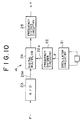
- Fig. 10 is a block diagram showing an exemplary configuration of the voltage-controlled oscillator 14 exhibiting the operation characteristics illustrated in Fig. 9.
- the voltage-controlled oscillator 14 is comprised of an oscillation circuitry 21 including a quartz oscillator which oscillates at a constant frequency F, a frequency divider circuitry 22 for dividing the oscillation frequency of the oscillator circuitry 21 to thereby output, for example, an eight-bit signal 22a, an analogue-to-digital (A/D) converter 23 for converting an analogue signal outputted from the power sensor 15, i.e., the effective power P, into a digital signal such as, for example, a four-bit signal 23a.
- an oscillation circuitry 21 including a quartz oscillator which oscillates at a constant frequency F
- a frequency divider circuitry 22 for dividing the oscillation frequency of the oscillator circuitry 21 to thereby output, for example, an eight-bit signal 22a
- an analogue-to-digital (A/D) converter 23 for converting an analogue signal outputted from the power sensor 15, i.e., the effective power P, into a digital signal such as,
- the four-bit signal 23a and the eight-bit signal 22a are inputted to a digital multiplier 24 which serves to modulate the four less significant bits of the eight-bit signal 22a with the four-bit signal 23a to thereby regulate the constant oscillation frequency F in dependence on the effective power P.
- the output of the multiplier 24 is supplied to a frequency divider 25 which serves for dividing the frequency output of the multiplier 24 to thereby output a proper oscillation frequency f which corresponds to the output frequency of the inverter 1.
- the switch 4 is first closed to establish a parallel operation state in which the invertor 1 and the power source 2 are operated in parallel. Thereafter, the switch 3 is opened. In the parallel operation state, a cross current will flow between the inverter 1 and the AC power source 2, which current has a magnitude corresponding to differences between the output voltages and phases of the inverter 1 and the AC power source 2.
- the cross current may be considered to be provided only by the active current component which is ascribable to the difference in phase between the output of the inverter and that of the power source. Consequently, in the parallel operation of the power supply system, the burden for power supply to the load is shared between the inverter and the power source or generator in dependence on the power-versus-frequency characteristics thereof.
- the power supply system operates at such an operation point where the inverter 1 bears the supply of the power P1 with the power source bearing the power P2 at a frequency f1 shown in Fig. 9.
- the inverter 1 and the AC power source 2 can share the power supply to the load 6 in accordance with the respective power-frequency characteristics.
- the power supply to the load 6 can certainly be shared by the inverter or power converter 1 and the power source 2 in the steady operation state.
- a large cross current will flow until synchronism is established between the two power sources 1 and 2. Accordingly, in the system where the inverter 1 and the AC power source 2 are to be changed over without interrupting the power supply to the load 6, the inverter 1 and the AC power 2 are operated in parallel only for a short time.
- the AC voltage V1 or V2 of the inverter 1 or the AC power source 2 droops, as a result of which the voltage of the AC bus 5 is lowered during the change-over period or immediately after the lapse of that period, giving rise to a problem that reliability of the power supply system is degraded.
- the output frequency of the inverter 1 droops in dependence on the effective power P, which in turn means that the output frequency decreases in dependence on the load 6, to another disadvantage.
- Another object of the present invention is to provide a power supply system which can enjoy an enhanced reliability by shifting gradually the output frequency of the inverter to the center frequency without controlling synchronism with other AC power source after termination of the parallel operation, to thereby prevent abrupt or steep lowering of the output frequency.
- Yet another object of the present invention is to provide a power supply system of an enhanced or improved reliability by establishing rapidly synchronism between the inverter and the AC power source upon occurrence of power regeneration from the AC power source to the inverter in the parallel operation, to thereby protect the elements constituting the inverter against injury or damage.
- a further object of the present invention is to provide a power supply system of an enhanced reliability by simplifying the circuit configuration of a feedback control system for the synchronism control of the inverter output.
- the present invention is directed to an electric power supply system which comprises a power converter for outputting a first AC power of a first AC voltage and a first AC current, an AC power source for outputting a second AC power of a second AC voltage and a second AC current, a switch means for supplying at least one of the first and second AC powers to a load, and a power converter control circuit for regulating an output frequency of the power converter in accordance with an active component of the first AC power.
- a power supply system in which a current sensor means for detecting the first AC current supplied from the power converter, a comparator for determining that the first AC current exceeds a predetermined value, and a regulation input means for fetching an active component of the first AC power supplied from the power converter in response to an output signal of the comparator are provided in the power converter control circuit, wherein when the first AC current exceeds the predetermined value, an output frequency of the power converter is so regulated as to coincide with an output frequency of the AC power source by taking into account the active component of the first AC power.
- synchronism can rapidly be established between the output power of the AC power source and that of the power convertor, and the output frequency of the voltage-controlled oscillator can be so regulated that a cross current flow between the AC power source and the power converter is decreased in the transient parallel operation, while the output frequency is regulated to be constant when the synchronism control is not required.
- a power supply system wherein the regulation input means for fetching the effective power is imparted with a function for allowing the active component of the first AC power to pass therethrough in a transient parallel operation in which the first AC power and the second AC power are supplied to the load from the power converter and the AC power source, respectively, through the power source change-over switch means, while inhibiting the active component of the first AC power from passing therethrough in an isolated operation in which only the first AC power is supplied to the load through the switch means, and wherein the power converter control circuit controls the output frequency of the power converter in the transient parallel operation while regulating the output frequency of the power converter to a center frequency corresponding to a no-load operation in the isolated operation in succession to termination of the transient parallel operation.
- control of synchronism between the output of the AC power source and that of the power converter can speedily be validated in the transient parallel operation, while in the isolated operation, the control of synchronism between the AC power source and the power converter can gradually be released to thereby prevent the output frequency of the power converter from lowering abruptly.
- a power supply system in which a power sensor means for detecting the first AC power, a comparator for determining that the first AC power is in a regenerative state, a regulation input means for fetching an active component of the first AC power in response to an output signal of the comparator are provided in the power converter control circuit, wherein an output frequency of the power converter is so controlled as to coincide with an output frequency of the AC power source in accordance with the active component of the first AC power when the first AC power is in the regenerative state.
- a fourth aspect of the present invention is seen in that the power converter control circuit regulates the output frequency of the power converter such that the first AC power is always maintained higher than the second AC power.
- the AC power outputted form the power converter can constantly be set higher than the AC generated by the AC power source, whereby the stability of the change-over control can be ensured.
- a power supply system in which a current sensor means for detecting the first AC current, a comparator for determining that the first AC current exceeds a predetermined value, and a frequency change-over means for changing the output frequency of the power converter in response to an output signal of the comparator and in dependence on polarity of the active component of the first AC power are provided in the power converter control circuit, wherein the output frequency of the power converter is so regulated as to be a highest frequency when the first AC current exceeds the predetermined value and when the active component is of negative polarity, while the output frequency of the power converter is so regulated as to be a lowest frequency when the first AC current exceeds the predetermined value and when the active component is of positive polarity, and the output frequency of the power converter is so regulated as to assume a center frequency when the first AC current is below the predetermined value.
- the output frequency of the power converter is set to a highest value or a lowest value in dependence on the polarity of the active component of the first AC power when the first AC current exceeds a predetermined value in the parallel operation.
- a sixth aspect of the invention is seen in that the power converter is constituted by an inverter, wherein the power converter control circuit includes a DC current sensor for detecting a DC current value of the inverter, and wherein the output frequency of the power converter is so regulated as to coincide with the output frequency of the AC power source in response to the DC current value.
- the inverter output frequency can be controlled on the basis of the DC current of the power converter or inverter with an extremely simple circuit configuration.
- Fig. 1 shows a power supply system according to a first embodiment of the present invention.
- the elements or components designated by reference numerals 1 to 6 and 10 to 15 are same as or equivalent to those denoted by like numerals in Fig. 8 and mentioned hereinbefore. Therefore, repeated description of these elements will be unnecessary.
- the inverter control circuit further includes a current transformer 16 for detecting an AC current I1 outputted from the inverter 1 and a current sensor or transducer 17 for converting the AC current I1 detected by the current transformer 16 into a voltage signal.
- the current transformer 16 and the current transducer 17 cooperate to constitute a current sensor means.
- a comparator 18 is connected to the output of the current sensor means 16; 17 for making decision as to whether the AC current I1 exceeds a predetermined value, to thereby generates an output signal C of "H" level when the AC current I1 exceeds the predetermined value.
- An analogue switch 19 is interposed between the output terminal of the power sensor 15 and the voltage-controlled oscillator 14 and is adapted to be closed when the output signal C of the comparator 18 is at the level of "H".
- the analogue switch 19 constitutes a regulation input means for fetching an active component P of the AC power P1 in response to the output signal C of the comparator 18.
- the predetermined value used as the reference for the decision to be made by the comparator 18 is set in consideration of the AC current I1 flowing in the parallel operation state of the inverter 1 and the AC power source 2.
- the analogue switch 19 is closed, whereby the active component or effective power P of the AC power P1 is fetched to be supplied to the voltage-controlled oscillator 14.
- the output frequency of the inverter 1 is so regulated as to coincide with the output frequency of the AC power source 2 in dependence on the effective power P through the inverter control circuit constituted by the elements 10 to 19.
- the output signal C of the comparator 18 assumes a level "L" because the AC current I1 becomes smaller than the predetermined value. Then, the analogue switch 19 is opened, whereby the fetching of the effective power P is interrupted.
- the oscillation frequency f of the voltage-controlled oscillator 14 is shifted to the center frequency f0, resulting in that the output frequency of the inverter 1 is regulated to the center frequency f0.
- the output frequency of the inverter 1 droops in dependence on the effective power P, as can be seen from the characteristic curve shown in Fig. 9, which in turn means that the output frequency f of the inverter 1 will droops in dependence on the load 6 even in the isolated apparition of the inverter.
- the synchronism control is performed on the basis of regulation of the output frequency of the inverter 1 only in the parallel operation, while in the isolated operation, the inverter is controlled to output the center frequency f0, whereby the output frequency f is prevented from lowering.
- the frequency control i.e., the synchronism control of the inverter 1 based on the effective power P is performed only when the AC current I1 outputted from the inverter 1 increases due to the cross current from the AC power source 2 in the parallel operation.
- the output frequency f assumes the center frequency f0 in correspondence to the effective power of zero.
- the analogue switch 19 is opened instantaneously when the AC current I1 decreases below the predetermined value set for the comparator 18 after termination of the parallel operation, which is accompanied with a rapid shift of the output frequency f of the inverter 1 to the center frequency f0. In practical application, however, it is desirable to shift smoothly the output frequency f to the center frequency f0.
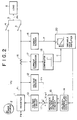
- Fig. 2 shows a structure of the power supply system according to the second embodiment of the invention.
- a variable gain amplifier 20 is interposed between the power sensor 15 and the voltage-controlled oscillator 14 as the regulation input means.
- This variable gain amplifier 20 is so designed that gain thereof becomes “1" (unity) when the output signal C of the comparator 18 assumes the level “H” and that the gain is gradually lowered to "0" (zero) over a time span T1 when the output signal C of the comparator 18 assumes the level "L”.
- the above-mentioned time span or period T1 for the variable gain amplifier 20 is set sufficiently longer than the duration of the parallel operation for the change-over of the power sources in which both the switches 3 and 4 are closed. More specifically, in the transient parallel operation in which both the switches 3 and 4 are closed to supply the AC powers P1 and P2 to the load 6, the effective or active component P of the AC power P1 is allowed to pass through the variable gain amplifier 20 with the gain of "1". On the other hand, when the switch 4 is opened with the switch 3 being held in the closed state to supply only the AC power P1 to the load 6 after lapse of the transient parallel operation (i.e., after lapse of T1 seconds), the effective power P passing through the variable gain amplifier 20 is gradually decreased.
- the gain of the variable gain amplifier 20 is set to "1" in response to the output signal C of the comparator 18, whereby the synchronism control is started, as described previously, whereby the difference in phase between the output of the inverter 1 and that of the AC power source 2 is decreased.
- the gain of the variable gain amplifier 20 decreases only gradually to zero over the time span of T1 seconds.
- the input to the voltage-controlled oscillator 14 decreases gradually to zero, causing the output frequency f of the inverter 1 to be smoothly shifted back to the center frequency f0.
- the inverter 1 can operate at the center frequency f0 which corresponds to the frequency in the no-load operation state.
- Fig. 3 shows a structure of the power supply system according to the third embodiment of the invention.
- the inverter control circuit includes a comparator 22 connected to the output terminal of the power sensor 15. This comparator 22 is designed to make decision on the basis of the effective power P detected by the power sensor whether or not the AC power P1 is in the regenerated state and generates an output signal D of "H" level when the effective power P is of negative polarity.
- a one-shot multivibrator 23 is connected to an output terminal of the comparator 22 and designed to output a pulse E of a duration T2 (in seconds) when the output signal D of the comparator 22 assumes a level of "H".
- the duration T2 is selected to be sufficiently longer than that of the parallel operation in which both the switches 3 and 4 are simultaneously closed.
- An analogue switch 19 connected to the output terminal of the one-shot multivibrator 23 and closed when the latter produces a pulse E constitutes the regulation input means for fetching the effective power P in response to the output signal D of the comparator 22.
- the comparator 22 decides on the basis of the detected effective power P of negative polarity that the AC power P1 is in the regenerative state, the output signal D of the comparator 22 assumes the level "H", as a result of which the one-shot multivibrator 23 outputs the pulse E of "H" level for the period of T2 seconds.
- the analogue switch 19 is closed to allow the effective power P to flow therethrough to be applied to the voltage-controlled oscillator 14.
- the inverter control circuit controls the output frequency of the inverter 1 so as to coincide with the output frequency of the AC power source 2 on the basis of the effective power P.
- the inverter control circuit performs the synchronism control only for the period of T2 seconds, whereby synchronism can speedily be established between the inverter 1 and the AC power source 2.
- the synchronism control is effective during the parallel operation of the inverter 1 and the AC power source 2, while the output frequency of the inverter 1 and hence that of the power supply system is regulated to be the center frequency f0 in the isolated operation of the inverter 1.
- the regeneration decision circuit 22 or 23 can be employed in combination with the current sensor means 16; 17 described hereinbefore in the first and second embodiments.
- the voltage-controlled oscillator 14 having the characteristic illustrated in Fig. 9 is employed for effecting the synchronism control which satisfies the condition that P1 ⁇ P2 when the effective power P is of positive polarity.
- the synchronism control may alternatively be performed such that the condition P1 > P2 can be satisfied. In this case, an advantage of an improved control stability can be obtained.
- the fourth embodiment of the present invention it is contemplated to provide the power supply system in which the effective power P1 outputted from the inverter 1 is primarily in charge of bearing the power supply P6 to the load 6.
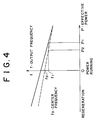
- Fig. 4 shows power-versus-frequency characteristics of the voltage-controlled oscillator 14. More specifically, a solid line curve represents the output frequency characteristic of the inverter 1, and a broken line curve represents the output frequency characteristic of the AC power source 2.
- the output frequency (represented by the solid line curve) of the inverter 1 is higher than the center frequency f0 than the output frequency (broken curve) of the AC power source 2 in the no-load state, i.e., when the effective power P is zero.
- the frequency droops, while it rises up when the effective power P is of negative polarity.
- the inverter 1 and the AC power source or generator 2 operate at an operation point where they share the load power P6 by P1 and P2, respectively, at the frequency f1 (> 0) in the parallel operation.
- the load power P6 is given as a sum of P1 and P2, where P1 > P2.
- the inverter control circuit performs such control that the AC power P1 to be borne by the inverter 1 is constantly higher than the AC power P2, whereby the power supplied to the load 6 transits stepwise smoothly or uniformly throughout the power supply change-over operation process, i.e., before, during and after the power supply change-over.
- the analogue switch 19 Upon termination of the parallel operation, the analogue switch 19 is opened, resulting in that the synchronism control is disabled.
- the voltage-controlled oscillator 14 exhibiting the power-versus-frequency characteristics illustrated in Fig. 9 is employed for realizing the synchronism control between the AC powers P1 and P2 by controlling the inverter output frequency f . It is however desirable to effectuate a forcive synchronism control as soon as possible when the parallel operation is started.
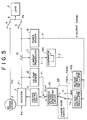
- Fig. 5 shows a power supply system according to the fifth embodiment of the invention.
- a voltage-controlled oscillator 14A for generating the center frequency f0
- a voltage-controlled oscillator 14B for generating a lowest (minimum) frequency f min or a highest (maximum) frequency f max in dependence on the polarity of the effective power P
- a change-over switch 25 inserted between the voltage-controlled oscillators 14A and 14B and a reference voltage generating circuit 13.
- a comparator 18A serves for making decision as to whether the AC current I1 exceeds a predetermined value and generates an output signal F of "H" level when the answer of the decision is affirmative, wherein the output signal F is inputted to the change-over switch 25 which has an output terminal connected to an input terminal of the reference voltage signal generator 13.
- the change-over switch 25 allows the center frequency f0 outputted from the voltage-controlled oscillator 14A to pass therethrough while allowing the lowest frequency f min or the highest frequency f max from the voltage-controlled oscillator 14B to pass therethrough when the output signal F is at the level of "H".
- the voltage-controlled oscillators 14A and 14B cooperate to constitute a frequency change-over means for changing over selectively the output frequencies of the inverter 1 in response to the output signal F of the comparator 18A and in dependence on the polarity of the effective power P.
- Fig. 6 is a view for illustrating graphically the power-versus-frequency imparted to the frequency change-over means 14A, 14B and 25.
- the effective power D is of positive polarity (indicative of the power running)
- a minimum or lowest frequency f min is generated
- the effective power P is of negative polarity (indicating the state of regeneration)
- a predetermined highest or maximum frequency f max is generated.
- the center frequency f0 is generated.
- the change-over switch 25 selects the voltage-controlled oscillator 14B in response to the output signal F of the level "H" when the AC current I1 exceeds the predetermined value and when the effective power P is of negative polarity.
- the voltage-controlled oscillator 14B when the effective power P is of negative polarity, the voltage-controlled oscillator 14B generates the maximum frequency f max in response to the effective power P of negative polarity. In this manner, the inverter control circuit regulates the output frequency f of the inverter 1 to the maximum frequency f max .
- the change-over switch 25 responds to the output signal F of "H" level to select the voltage-controlled oscillator 14B, whereby the minimum or lowest frequency F min is generated by the voltage-controlled oscillator 14B in response to the effective power P of positive polarity.
- the inverter control circuit regulates the output frequency f of the inverter 1 to the lowest or minimum frequency f min .
- the change-over switch 25 selects the voltage-controlled oscillator 14A in response to the output signal F of "L" level. Consequently, the inverter control circuit regulates the output frequency f of the inverter 1 to the center frequency f0.
- the speed at which the phase of the AC power P1 outputted from the inverter 1 is equalized to that of the AC power P2 supplied from the AC power source 2 increases as the difference in frequency between both the output powers increases. Accordingly, when the cross current of a magnitude greater than the predetermined value flows at the start of the parallel operation, synchronism can speedily be established by setting the output frequency f to the predetermined lowest frequency f min or highest frequency f max in dependence on the polarity of the effective power P.
- the power converter is constituted by the inverter 1 for converting a DC power to an AC power
- a cyclo-converter for AC-to-AC power transformation may be employed to substantially same effect.
- the effective power P detected by the power sensor 15 is fed back to the voltage-controlled oscillator 14, as in the case of the power supply system known heretofore.
- the power converter is constituted by the inverter 1 in the intrinsic sense of the term, a current value at the DC side of the inverter 1 may be employed as the feedback quantity.
- Fig. 7 shows schematically a structure of the power supply system according to the sixth embodiment of the invention.
- a current transformer 27 is provided for detecting a DC current I d at the input side of the inverter 1 in combination with a current transducer 28 for converting the DC current I d as detected to a voltage signal.
- the current transformer 27 and the DC current transducer 28 cooperate to constitute a DC current sensor means for detecting a DC current value of the inverter 1, wherein the DC current signal I d outputted from the current transducer 28 is inputted to the voltage-controlled oscillator 14C to be utilized for controlling the output frequency of the inverter 1.
- the inverter control circuit comprised of the DC current sensor means 27 and 28 is adapted to regulate the output frequency of the inverter 1 so as to coincide with the output frequency of the AC power source 2 in response to the DC current I d .
- the effective power P when the effective power P is to be detected from the AC power P1 as in the case of the first to fifth embodiments, it is required to detect the phase relation between the AC voltage V1 and the AC current I1, which means that the sensor means to this end will have to be implemented in a complicated configuration.
- the DC current I d can easily be detected by the current sensor means 27 and 28 with a much simplified structure.
- an analogue switch may be interposed between the current transducer 28 and the voltage-controlled oscillator 14 with the DC current I d outputted from the current transducer 28 is caused to pass through the comparator to thereby close the analogue switch in dependence on the comparator output when the DC current I d indicates the regeneration state (negative polarity) or the cross current state (positive polarity).
Landscapes
- Engineering & Computer Science (AREA)
- Power Engineering (AREA)
- Inverter Devices (AREA)
- Stand-By Power Supply Arrangements (AREA)
- Supply And Distribution Of Alternating Current (AREA)
Applications Claiming Priority (2)
| Application Number | Priority Date | Filing Date | Title |
|---|---|---|---|
| JP130912/92 | 1992-05-22 | ||
| JP4130912A JP2758782B2 (ja) | 1992-05-22 | 1992-05-22 | 電源装置 |
Publications (3)
| Publication Number | Publication Date |
|---|---|
| EP0570976A2 true EP0570976A2 (de) | 1993-11-24 |
| EP0570976A3 EP0570976A3 (en) | 1994-07-20 |
| EP0570976B1 EP0570976B1 (de) | 1997-04-16 |
Family
ID=15045647
Family Applications (1)
| Application Number | Title | Priority Date | Filing Date |
|---|---|---|---|
| EP93108281A Expired - Lifetime EP0570976B1 (de) | 1992-05-22 | 1993-05-21 | Elektrisches Energieversorgungssystem |
Country Status (4)
| Country | Link |
|---|---|
| US (1) | US5422518A (de) |
| EP (1) | EP0570976B1 (de) |
| JP (1) | JP2758782B2 (de) |
| DE (1) | DE69309772T2 (de) |
Cited By (10)
| Publication number | Priority date | Publication date | Assignee | Title |
|---|---|---|---|---|
| DE4440357A1 (de) * | 1993-11-12 | 1995-05-18 | Fuji Electric Co Ltd | Gasverknappungs-Schutzschaltung für eine Brennstoffzellen-Energieerzeugungsanlage |
| EP0677911A1 (de) * | 1994-04-12 | 1995-10-18 | Canon Kabushiki Kaisha | Vorrichtung zum Verhindern des "Islanding"-Betriebs und diese benutzende verteilter Stromgenerator und Stromerzeugungssystem |
| EP0817350A3 (de) * | 1996-06-24 | 1999-01-20 | SANYO ELECTRIC Co., Ltd. | Stromversorgungssystem mit Systemverbindung |
| WO2000013285A3 (en) * | 1998-08-26 | 2000-09-08 | Northrop Grumman Corp | Integrated mode control for micropower systems |
| US7045913B2 (en) | 2002-06-18 | 2006-05-16 | Ingersoll Rand Energy Systems | Microturbine engine system |
| US7161257B2 (en) | 2004-03-08 | 2007-01-09 | Ingersoll-Rand Energy Systems, Inc. | Active anti-islanding system and method |
| WO2005048433A3 (en) * | 2003-11-07 | 2008-01-03 | Newage Int Ltd | An ac power generating system |
| WO2008145807A3 (en) * | 2007-05-30 | 2009-01-29 | Waertsilae Finland Oy | Regulation system |
| WO2011085961A3 (de) * | 2010-01-12 | 2012-04-05 | Skywind Gmbh | Verfahren und vorrichtung zum aufsynchronisieren eines generators in einem netz |
| WO2023281179A1 (fr) * | 2021-07-08 | 2023-01-12 | Safran Electrical & Power | Architecture électrique pour aéronef |
Families Citing this family (23)
| Publication number | Priority date | Publication date | Assignee | Title |
|---|---|---|---|---|
| AT399966B (de) * | 1993-03-19 | 1995-08-25 | Elin Energieversorgung | Synchronisiervorrichtung |
| US5627737A (en) * | 1993-09-13 | 1997-05-06 | Sanyo Electric Co., Ltd. | Power inverter for use in system interconnection |
| JP3383100B2 (ja) * | 1995-02-07 | 2003-03-04 | 三菱電機株式会社 | 電力変換器の異常検出装置 |
| JP3310819B2 (ja) * | 1995-05-29 | 2002-08-05 | 三菱電機株式会社 | 電力系統補償装置及び電力変換装置 |
| EP0746078B1 (de) * | 1995-05-31 | 2002-09-18 | Kabushiki Kaisha Meidensha | Verfahren und Vorrichtung zum Detektieren des Islanding-Betriebes eines verteilten Generators |
| JP3327774B2 (ja) * | 1996-06-03 | 2002-09-24 | キヤノン株式会社 | 太陽光発電システム |
| US6140803A (en) * | 1999-04-13 | 2000-10-31 | Siemens Westinghouse Power Corporation | Apparatus and method for synchronizing a synchronous condenser with a power generation system |
| JP3440889B2 (ja) | 1999-06-28 | 2003-08-25 | 国産電機株式会社 | 電力変換回路付き電源装置及びその制御方法 |
| JP2001112262A (ja) | 1999-10-05 | 2001-04-20 | Kokusan Denki Co Ltd | 電力変換回路付き電源装置及びその制御方法 |
| JP3854908B2 (ja) * | 2002-08-02 | 2006-12-06 | 株式会社豊田自動織機 | デジタルvco及びそのデジタルvcoを用いたpll回路 |
| WO2005089257A2 (en) * | 2004-03-16 | 2005-09-29 | Tecogen, Inc. | Engine driven power inverter system with cogeneration |
| US7388298B2 (en) * | 2006-06-21 | 2008-06-17 | Tracy Blackman | Retrofittable power distribution system for a household |
| US7388299B2 (en) * | 2006-06-21 | 2008-06-17 | Tracy Blackman | Retrofittable power distribution system for a household |
| US8400794B2 (en) * | 2007-10-02 | 2013-03-19 | Ching Hsiung Liu | Power system |
| JP5508796B2 (ja) * | 2009-09-18 | 2014-06-04 | 東京瓦斯株式会社 | 電源システム制御方法及び電源システム制御装置 |
| US9391458B2 (en) | 2011-06-22 | 2016-07-12 | Kawasaki Jukogyo Kabushiki Kaisha | Control method and control system for parallel operation of different types of power generation apparatuses |
| US9601919B2 (en) | 2011-10-31 | 2017-03-21 | Trane International Inc. | Time delay with control voltage sensing |
| US9520819B2 (en) * | 2014-02-28 | 2016-12-13 | General Electric Company | System and method for controlling a power generation system based on a detected islanding event |
| CN106253289B (zh) * | 2016-08-12 | 2018-09-28 | 成都运达科技股份有限公司 | 一种车网耦合的地铁供电系统电力潮流计算方法 |
| JP6279777B1 (ja) * | 2017-02-06 | 2018-02-14 | ヤマハモーターパワープロダクツ株式会社 | インバータ発電機及びその制御方法 |
| US10840825B2 (en) * | 2017-10-26 | 2020-11-17 | Industrial Technology Research Institute | Voltage balance control method and device for three-phase DC-AC inverter |
| US11635797B2 (en) * | 2019-10-11 | 2023-04-25 | Schneider Electric It Corporation | Method for reducing UPS component stresses during transition from inverter to green/bypass operation |
| WO2022272279A1 (en) | 2021-06-23 | 2022-12-29 | Tecogen Inc. | Hybrid power system with electric generator and auxiliary power source |
Family Cites Families (10)
| Publication number | Priority date | Publication date | Assignee | Title |
|---|---|---|---|---|
| US3932764A (en) * | 1974-05-15 | 1976-01-13 | Esb Incorporated | Transfer switch and transient eliminator system and method |
| JPS5124690A (en) * | 1974-08-23 | 1976-02-28 | Teijin Ltd | Horiesuteruno seizoho |
| JPS5850089A (ja) * | 1982-08-30 | 1983-03-24 | サンデン株式会社 | 自動販売機の商品収納器 |
| JPS61254026A (ja) * | 1985-04-30 | 1986-11-11 | 三菱電機株式会社 | 交流出力変換装置の並列運転制御装置 |
| JPS62147962A (ja) * | 1985-12-20 | 1987-07-01 | Toshiba Corp | インバ−タの制御装置 |
| US4766327A (en) * | 1987-07-31 | 1988-08-23 | Westinghouse Electric Corp. | Circuit and method for synchronizing power sources in a parallel AC electrical power system |
| JP2526992B2 (ja) * | 1988-05-30 | 1996-08-21 | 三菱電機株式会社 | 交流出力変換器の並列運転システム |
| US4937462A (en) * | 1989-01-23 | 1990-06-26 | Sundstrand Corporation | No break power transfer control for a VSCF power generating system |
| FR2667734B1 (fr) * | 1990-10-08 | 1995-06-09 | Merlin Gerin | Installation d'alimentation en energie electrique alternative comportant une alimentation de concours equipee d'un onduleur fonctionnant en mode reversible. |
| US5172009A (en) * | 1991-02-25 | 1992-12-15 | Regents Of The University Of Minnesota | Standby power supply with load-current harmonics neutralizer |
-
1992
- 1992-05-22 JP JP4130912A patent/JP2758782B2/ja not_active Expired - Lifetime
-
1993
- 1993-05-21 EP EP93108281A patent/EP0570976B1/de not_active Expired - Lifetime
- 1993-05-21 DE DE69309772T patent/DE69309772T2/de not_active Expired - Fee Related
- 1993-05-21 US US08/064,581 patent/US5422518A/en not_active Expired - Fee Related
Cited By (18)
| Publication number | Priority date | Publication date | Assignee | Title |
|---|---|---|---|---|
| DE4440357A1 (de) * | 1993-11-12 | 1995-05-18 | Fuji Electric Co Ltd | Gasverknappungs-Schutzschaltung für eine Brennstoffzellen-Energieerzeugungsanlage |
| US5624768A (en) * | 1993-11-12 | 1997-04-29 | Fuji Electric Co., Ltd. | Gas shortage preventive circuit for a fuel cell power generation system |
| DE4440357B4 (de) * | 1993-11-12 | 2004-09-16 | Fuji Electric Co., Ltd., Kawasaki | Brennstoffzellen-Energieerzeugungsanlage mit Gasverknappungs-Schutzschaltung |
| EP0677911A1 (de) * | 1994-04-12 | 1995-10-18 | Canon Kabushiki Kaisha | Vorrichtung zum Verhindern des "Islanding"-Betriebs und diese benutzende verteilter Stromgenerator und Stromerzeugungssystem |
| US5686766A (en) * | 1994-04-12 | 1997-11-11 | Canon Kabushiki Kaisha | Islanding-operation prevention apparatus, and dispersed power generation apparatus and power generation system using the same |
| EP0817350A3 (de) * | 1996-06-24 | 1999-01-20 | SANYO ELECTRIC Co., Ltd. | Stromversorgungssystem mit Systemverbindung |
| WO2000013285A3 (en) * | 1998-08-26 | 2000-09-08 | Northrop Grumman Corp | Integrated mode control for micropower systems |
| US7078825B2 (en) | 2002-06-18 | 2006-07-18 | Ingersoll-Rand Energy Systems Corp. | Microturbine engine system having stand-alone and grid-parallel operating modes |
| US7045913B2 (en) | 2002-06-18 | 2006-05-16 | Ingersoll Rand Energy Systems | Microturbine engine system |
| WO2005048433A3 (en) * | 2003-11-07 | 2008-01-03 | Newage Int Ltd | An ac power generating system |
| US7619905B2 (en) | 2003-11-07 | 2009-11-17 | Cummins Generator Technologies Limited | Method of controlling connection of a supply of AC power to a load and to a power supply grid |
| US7161257B2 (en) | 2004-03-08 | 2007-01-09 | Ingersoll-Rand Energy Systems, Inc. | Active anti-islanding system and method |
| US7365444B2 (en) | 2004-03-08 | 2008-04-29 | Southern California Gas Company | Active anti-islanding system and method |
| WO2008145807A3 (en) * | 2007-05-30 | 2009-01-29 | Waertsilae Finland Oy | Regulation system |
| WO2011085961A3 (de) * | 2010-01-12 | 2012-04-05 | Skywind Gmbh | Verfahren und vorrichtung zum aufsynchronisieren eines generators in einem netz |
| WO2023281179A1 (fr) * | 2021-07-08 | 2023-01-12 | Safran Electrical & Power | Architecture électrique pour aéronef |
| FR3125176A1 (fr) * | 2021-07-08 | 2023-01-13 | Safran Electrical & Power | Architecture électrique pour aéronef |
| US12322973B2 (en) | 2021-07-08 | 2025-06-03 | Safran Electrical & Power | Electrical architecture for an aircraft |
Also Published As
| Publication number | Publication date |
|---|---|
| EP0570976B1 (de) | 1997-04-16 |
| US5422518A (en) | 1995-06-06 |
| DE69309772T2 (de) | 1997-09-04 |
| JPH05328638A (ja) | 1993-12-10 |
| JP2758782B2 (ja) | 1998-05-28 |
| DE69309772D1 (de) | 1997-05-22 |
| EP0570976A3 (en) | 1994-07-20 |
Similar Documents
| Publication | Publication Date | Title |
|---|---|---|
| US5422518A (en) | Electric power supply system using multiple power sources | |
| US5742493A (en) | Power conversion apparatus | |
| EP0417805B1 (de) | Verfahren und Vorrichtung zum Steuern eines Wechselstrommotors | |
| US6313600B1 (en) | Control method and apparatus for insufficient input voltage in an AC drive | |
| JPH0965588A (ja) | 電力貯蔵システム | |
| EP0293915A2 (de) | Wechselrichtersteuerungseinrichtung | |
| US4608499A (en) | Power system and power generation method | |
| US5115386A (en) | Circuit for controlling an electric power supply apparatus, a method therefor and an uninterruptible power supply | |
| US5055765A (en) | Voltage regulator for direct current aircraft power bus | |
| US4878208A (en) | Voltage-phase responsive, inverter disable circuit for system interconnection | |
| EP0431967B1 (de) | Vorrichtung zum Unterdrücken von Spannungsschwankungen und Oberschwingungen | |
| US5438253A (en) | Static var generator using self-commutated inverter | |
| US5576606A (en) | Asynchronous motor power supply control system | |
| US5327336A (en) | Constant voltage constant frequency inverter and method for controlling the same | |
| JPS6122766A (ja) | 安定化給電装置 | |
| US4488100A (en) | Motor controller | |
| JPS6334699B2 (de) | ||
| JPH11206021A (ja) | 分散形発電システム | |
| JPS6132915B2 (de) | ||
| JP3367737B2 (ja) | 系統連系インバータの制御装置 | |
| JP3272495B2 (ja) | 電力変換装置 | |
| JP2781292B2 (ja) | インバータ装置の制御回路 | |
| JP3341047B2 (ja) | 多レベル電力変換装置 | |
| JP3154336B2 (ja) | 太陽光発電用インバータの制御回路 | |
| JP3142029B2 (ja) | 分散配置型電源設備における逆充電検出回路 |
Legal Events
| Date | Code | Title | Description |
|---|---|---|---|
| PUAI | Public reference made under article 153(3) epc to a published international application that has entered the european phase |
Free format text: ORIGINAL CODE: 0009012 |
|
| AK | Designated contracting states |
Kind code of ref document: A2 Designated state(s): DE FR GB |
|
| PUAL | Search report despatched |
Free format text: ORIGINAL CODE: 0009013 |
|
| AK | Designated contracting states |
Kind code of ref document: A3 Designated state(s): DE FR GB |
|
| 17P | Request for examination filed |
Effective date: 19940901 |
|
| 17Q | First examination report despatched |
Effective date: 19960105 |
|
| GRAG | Despatch of communication of intention to grant |
Free format text: ORIGINAL CODE: EPIDOS AGRA |
|
| GRAH | Despatch of communication of intention to grant a patent |
Free format text: ORIGINAL CODE: EPIDOS IGRA |
|
| GRAH | Despatch of communication of intention to grant a patent |
Free format text: ORIGINAL CODE: EPIDOS IGRA |
|
| GRAA | (expected) grant |
Free format text: ORIGINAL CODE: 0009210 |
|
| AK | Designated contracting states |
Kind code of ref document: B1 Designated state(s): DE FR GB |
|
| REF | Corresponds to: |
Ref document number: 69309772 Country of ref document: DE Date of ref document: 19970522 |
|
| ET | Fr: translation filed | ||
| REG | Reference to a national code |
Ref country code: GB Ref legal event code: 727 |
|
| REG | Reference to a national code |
Ref country code: GB Ref legal event code: 727A |
|
| REG | Reference to a national code |
Ref country code: GB Ref legal event code: 727B |
|
| PLBE | No opposition filed within time limit |
Free format text: ORIGINAL CODE: 0009261 |
|
| REG | Reference to a national code |
Ref country code: GB Ref legal event code: SP |
|
| 26N | No opposition filed | ||
| REG | Reference to a national code |
Ref country code: GB Ref legal event code: IF02 |
|
| PGFP | Annual fee paid to national office [announced via postgrant information from national office to epo] |
Ref country code: FR Payment date: 20040510 Year of fee payment: 12 |
|
| PGFP | Annual fee paid to national office [announced via postgrant information from national office to epo] |
Ref country code: GB Payment date: 20040519 Year of fee payment: 12 |
|
| PGFP | Annual fee paid to national office [announced via postgrant information from national office to epo] |
Ref country code: DE Payment date: 20040603 Year of fee payment: 12 |
|
| PG25 | Lapsed in a contracting state [announced via postgrant information from national office to epo] |
Ref country code: GB Free format text: LAPSE BECAUSE OF NON-PAYMENT OF DUE FEES Effective date: 20050521 |
|
| PG25 | Lapsed in a contracting state [announced via postgrant information from national office to epo] |
Ref country code: DE Free format text: LAPSE BECAUSE OF NON-PAYMENT OF DUE FEES Effective date: 20051201 |
|
| GBPC | Gb: european patent ceased through non-payment of renewal fee |
Effective date: 20050521 |
|
| PG25 | Lapsed in a contracting state [announced via postgrant information from national office to epo] |
Ref country code: FR Free format text: LAPSE BECAUSE OF NON-PAYMENT OF DUE FEES Effective date: 20060131 |
|
| REG | Reference to a national code |
Ref country code: FR Ref legal event code: ST Effective date: 20060131 |