EP0570997B1 - Procédé de fabrication de bande thermorétractable en matière synthétique - Google Patents
Procédé de fabrication de bande thermorétractable en matière synthétique Download PDFInfo
- Publication number
- EP0570997B1 EP0570997B1 EP93112705A EP93112705A EP0570997B1 EP 0570997 B1 EP0570997 B1 EP 0570997B1 EP 93112705 A EP93112705 A EP 93112705A EP 93112705 A EP93112705 A EP 93112705A EP 0570997 B1 EP0570997 B1 EP 0570997B1
- Authority
- EP
- European Patent Office
- Prior art keywords
- threads
- process according
- strands
- mat
- strip
- Prior art date
- Legal status (The legal status is an assumption and is not a legal conclusion. Google has not performed a legal analysis and makes no representation as to the accuracy of the status listed.)
- Expired - Lifetime
Links
Images

Classifications
-
- B—PERFORMING OPERATIONS; TRANSPORTING
- B29—WORKING OF PLASTICS; WORKING OF SUBSTANCES IN A PLASTIC STATE IN GENERAL
- B29C—SHAPING OR JOINING OF PLASTICS; SHAPING OF MATERIAL IN A PLASTIC STATE, NOT OTHERWISE PROVIDED FOR; AFTER-TREATMENT OF THE SHAPED PRODUCTS, e.g. REPAIRING
- B29C61/00—Shaping by liberation of internal stresses; Making preforms having internal stresses; Apparatus therefor
- B29C61/06—Making preforms having internal stresses, e.g. plastic memory
- B29C61/0608—Making preforms having internal stresses, e.g. plastic memory characterised by the configuration or structure of the preforms
- B29C61/0658—Making preforms having internal stresses, e.g. plastic memory characterised by the configuration or structure of the preforms consisting of fibrous plastics material, e.g. woven
-
- B—PERFORMING OPERATIONS; TRANSPORTING
- B29—WORKING OF PLASTICS; WORKING OF SUBSTANCES IN A PLASTIC STATE IN GENERAL
- B29C—SHAPING OR JOINING OF PLASTICS; SHAPING OF MATERIAL IN A PLASTIC STATE, NOT OTHERWISE PROVIDED FOR; AFTER-TREATMENT OF THE SHAPED PRODUCTS, e.g. REPAIRING
- B29C61/00—Shaping by liberation of internal stresses; Making preforms having internal stresses; Apparatus therefor
- B29C61/06—Making preforms having internal stresses, e.g. plastic memory
- B29C61/0608—Making preforms having internal stresses, e.g. plastic memory characterised by the configuration or structure of the preforms
- B29C61/0633—Preforms comprising reinforcing elements
-
- B—PERFORMING OPERATIONS; TRANSPORTING
- B29—WORKING OF PLASTICS; WORKING OF SUBSTANCES IN A PLASTIC STATE IN GENERAL
- B29C—SHAPING OR JOINING OF PLASTICS; SHAPING OF MATERIAL IN A PLASTIC STATE, NOT OTHERWISE PROVIDED FOR; AFTER-TREATMENT OF THE SHAPED PRODUCTS, e.g. REPAIRING
- B29C70/00—Shaping composites, i.e. plastics material comprising reinforcements, fillers or preformed parts, e.g. inserts
- B29C70/04—Shaping composites, i.e. plastics material comprising reinforcements, fillers or preformed parts, e.g. inserts comprising reinforcements only, e.g. self-reinforcing plastics
- B29C70/06—Fibrous reinforcements only
- B29C70/10—Fibrous reinforcements only characterised by the structure of fibrous reinforcements, e.g. hollow fibres
- B29C70/16—Fibrous reinforcements only characterised by the structure of fibrous reinforcements, e.g. hollow fibres using fibres of substantial or continuous length
-
- B—PERFORMING OPERATIONS; TRANSPORTING
- B29—WORKING OF PLASTICS; WORKING OF SUBSTANCES IN A PLASTIC STATE IN GENERAL
- B29C—SHAPING OR JOINING OF PLASTICS; SHAPING OF MATERIAL IN A PLASTIC STATE, NOT OTHERWISE PROVIDED FOR; AFTER-TREATMENT OF THE SHAPED PRODUCTS, e.g. REPAIRING
- B29C70/00—Shaping composites, i.e. plastics material comprising reinforcements, fillers or preformed parts, e.g. inserts
- B29C70/04—Shaping composites, i.e. plastics material comprising reinforcements, fillers or preformed parts, e.g. inserts comprising reinforcements only, e.g. self-reinforcing plastics
- B29C70/06—Fibrous reinforcements only
- B29C70/10—Fibrous reinforcements only characterised by the structure of fibrous reinforcements, e.g. hollow fibres
- B29C70/16—Fibrous reinforcements only characterised by the structure of fibrous reinforcements, e.g. hollow fibres using fibres of substantial or continuous length
- B29C70/22—Fibrous reinforcements only characterised by the structure of fibrous reinforcements, e.g. hollow fibres using fibres of substantial or continuous length oriented in at least two directions forming a two-dimensional [2D] structure
Definitions
- the invention relates to a method for producing a heat-recoverable band made of plastic, in which a mat of strands running in the longitudinal and transverse directions of the band is embedded in a layer of plastic.
- winding sleeves which consist of a cross-linked plastic band which is stretched to make it heat-recoverable.
- Such tapes are placed around the splice, closed at their longitudinal edges and z. B. heated by means of a propane gas flame and shrunk down to the splice.
- An adhesive layer on the inner surface of the tape softens when shrinking and seals the splice point against moisture.
- This technique has proven itself and is the subject of DE-PS 15 25 815.
- the sleeves described there are not resistant to pressure and are sensitive to overheating, which, for. B. can occur when improperly working with the propane gas flame. The sleeves can also tear if the surface is damaged. Communication cables in particular are often operated with internal pressure in order to prevent the ingress of moisture.
- a wrapping sleeve which consists of a heat-recoverable fabric, which is embedded in a plastic matrix.
- the fabric consists of longitudinally stretched and thus heat-recoverable threads, which are not heat-recoverable threads, e.g. B. are woven from glass fiber.
- a fabric is produced from pre-stretched cross-linked plastic threads running in one direction and glass threads running transverse to the plastic threads using a method according to EP-A-0 116 390. This tissue is then embedded in a plastic matrix.
- special attention must be paid to the temperature control of the embedding compound, since the stretched threads shrink when a certain temperature is exceeded.
- Another major disadvantage is that it is difficult to connect the crosslinked plastic threads to the embedding compound, since crosslinked plastics are difficult to glue or weld.
- Another disadvantage is the fact that the reinforcing threads made of non-heat-recoverable material run only in one direction. A similar process is disclosed by EP-A-0 270 132.
- a tape is extruded from a plastic, crosslinked and stretched and a plastic tape is applied to one of the surfaces by lamination, in which a fabric is embedded.
- the crosslinked tape has on its surface to be coated a thermoplastic, non-crosslinked layer which is coextruded with the crosslinked layer. Due to the coextrusion and subsequent crosslinking of only one layer, the thermoplastic layer containing the fabric can be easily connect to the uncrosslinked layer of the tape. It is also disadvantageous here that precise temperature control during lamination must be ensured. In addition, the production requires a high level of mechanical complexity.
- the present invention is therefore based on the object to improve the method known from EP-A-0 116 390 or EP-A-0 270 132 in such a way that a complex temperature control can be dispensed with and in which a heat-recoverable band with an embedded fabric made of threads running both in the stretching or shrinking direction and perpendicularly thereto, made of a thread which cannot be stretched at the stretching or shrinking temperature, i.e. H. tensile material is obtained.
- a mat or a fabric is formed from intersecting strands of non-stretchable or only slightly stretchable material, at least the strands running in one direction being shaped like a spiral are that the mat or fabric is embedded in a plastic material, that the plastic material crosslinks after the embedding process, heated thereon, and that the tape thus produced is stretched in the direction of the helical strands in the heated state and cooled in the stretched state .
- the main advantage of the invention can be seen in the fact that, as with the tapes according to DE-PS 15 25 815, the plastic matrix can be heat-reset, and the fabric as a reinforcing layer in the plastic matrix is embedded.
- the fabric itself has an expansion reserve due to the helical shape of the strands, although the material of the strands themselves is not stretchable, so that the tape with the embedded fabric can be stretched to the commonly used degrees of stretching of 400% and more.
- stretching the lay length increases and the diameter of the helix decreases. In extreme cases, the helix is deformed into an elongated strand.
- the plastic strand on which the strand is wound softens and then takes part in the stretching process, thereby giving the necessary freedom of movement for the helix. In the subsequent shrinking process, the strand then lies in an irregular course in the plastic matrix.
- each of the strands shaped in the manner of a helix is wound helically on a plastic strand of any cross section. This enables a dimensionally stable mat or a dimensionally stable fabric to be produced which can be drawn off from a supply spool without deforming the mesh size and fed to the embedding system.
- the mat or fabric is embedded in the plastic material by extrusion, lamination or lamination. It is essential that the plastic material penetrates into the interstices between the meshes, so that a single-layer band-shaped body with an embedded reinforcement layer is produced.
- the plastic strand, on which the strand is wound like a coil preferably consists of one thermoplastic uncrosslinked plastic. This ensures that it connects well with the plastic material, which is also in the thermoplastic, uncrosslinked state.
- a particularly advantageous development of the invention is that the mat or the fabric is extrusion-coated in a continuous operation with a silane-grafted polyethylene, that the silane-grafted polyethylene is crosslinked in the presence of water or water vapor, that the crosslinked tape is at a temperature above the crystallite melting point of the polyethylene is heated, stretched at this temperature by at least 40% and cooled in the stretched state.
- other types of networking are suitable, such as. B. the peroxidic crosslinking or the radiation crosslinking.
- the particularly preferred type of networking is characterized by a low level of mechanical complexity.
- warp threads being rectilinear threads made of essentially non-stretchable material and the weft threads consisting of a thermoplastic plastic strand with a helical wrap of one or more threads made of a substantially non-stretchable material that the mat or fabric is continuously embedded in a plastic material, that the plastic material is cross-linked, that molded articles are separated from the belt and that the molded articles are heated, stretched in the heated state and cooled in the stretched state.
- material for the non-stretchable strands or threads come, for. B.
- cotton threads, metal threads, glass threads which can also be made up of twisted or stranded or folded single threads, in question.
- Several threads can also be wound onto the plastic strand, whereby a combination of the above materials is also conceivable.
- a silane-grafted polyethylene is used as the plastic matrix, it is also expedient to preferably use a strand of polyethylene as the support for the strand made of non-stretchable material.
- the cross section of the strip is cross-linked with different degrees of strength, in such a way that a higher degree of cross-linking of e.g. 25 - 50% and in the wall areas facing away from the object a lower degree of crosslinking of e.g. 5 - 25% is present. Since, as has been determined by tests, the susceptibility to cracking increases with the degree of crosslinking, the tape produced in this way is less susceptible to tearing.
- the tape is advantageously produced by coextrusion of at least two layers, the layers consisting of polyethylene grafted to different degrees.
- This crosslinking of polyethylene by grafting on silanes and subsequent storage in a moist environment is particularly suitable for this process, since by adding different amounts of crosslinking agents and / or catalysts, several layers with different degrees of crosslinking can be produced, so that the tape shows a sandwich-like structure .
- the sandwich construction significantly increases the tensile strength of the tape compared to a homogeneous tape with the same wall thickness due to a mechanical synergistic effect.
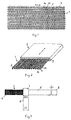
- FIG. 1 shows a fabric 1, which is made up of crossing threads 2 and 3.
- the thread 3 consists of a polyethylene strand 3a, on which a thread 3b made of another material is wound in a helical manner.
- the threads 2 and 3b consist of a non-stretchable material such as. B. glass, cotton, metal, etc.
- the threads 2 and 3b consist of a plurality of folded glass threads.
- the helical winding results in an excess length or expansion reserve, so that the threads 3 can be stretched.
- a fabric shown in FIG. 1 can be embedded in a plastic matrix in a continuous work process. Such a band is shown in FIG. 2, in which the plastic matrix is designated 4.
- the plastic thread 3 is first produced by extrusion, which is cooled by a folded glass thread 3b with a relatively short lay length after cooling.
- Such a thread 3 can be stretched at most by a factor of about 4.
- the thread 3 is processed as a weft thread in a loom, not shown, with a multiplicity of folded glass threads 2 of approx. 0.05 mm in diameter entering as warp threads to form a fabric.
- the fabric 1 is continuously drawn off from a roll 6 and moved into the crosshead 7 of an extruder 8 and embedded there in the plastic matrix 4.
- the tape 5 thus produced is then cut into partial lengths 9 which, as indicated by the arrows, can be stretched transversely to the direction of extrusion.
- a mixture of is used as the material for the plastic matrix 50 parts of polyethylene 40 parts of ethylene-vinyl acetate copolymer and 10 parts of carbon black manufactured and processed into granules.
- the granules are together with about 1 wt.% Vinylmetoxisilan in the Funnel of the extruder 8 filled and formed around the fabric 1 into a band with a wall thickness of about 4 mm.
- the separated partial lengths are then crosslinked at about 95 ° C. in the presence of water vapor. It goes without saying that the partial lengths 9 can only be separated from the belt 5 after the crosslinking.
- the cross-linked partial lengths 9, which are also referred to as blanks, are then stretched to approximately 4 times the length in a stretching frame (not shown).
- This stretching process is carried out at a temperature of approximately 120-150 ° C., the plastic strand 3a also softening and its cross-section being reduced by the stretching process, and thus the change in the shape of the helically wound thread 3b is not a hindrance.
- the stretched tape then has a wall thickness of approx. 1 mm.
- the tape In the stretched state, the tape is cooled to room temperature and is ready for use, i.e. H. when reheated, the tape tends to shrink back into the shape created during extrusion.
- Figures 4 to 6 show different embodiments of fabric-reinforced wrapping sleeves or cuffs.
- the wrapping sleeve has the shape that has prevailed for the wrapping of cable splices.
- the band 5 has two webs 11 and 12 on its longitudinal edges and a tab 13 extending beyond the area of the web 12. After the band has been folded around the splice connection, the tab 13 passes under the area of the web 11. By sliding a rail, not shown, as is known from DE-PS 15 25 815 , the band 5 is held in its tubular shape.
- the band 5 has, on its surface facing the splice, an unspecified adhesive coating.
- Figure 5 shows another example of a wrapping sleeve.
- the band 5 is loop-like folded at its longitudinal edges, with a flexible rod 14 and 15 z. B. is arranged from stranded or folded glass threads. After the formation of the band 5 around the cable splice, these rods 14 and 15 are gripped by the rail described above.
- the loops are formed by gluing and / or by sewing or stapling the overlapping areas.
- the band edges can be put around the bars 14 and 15 immediately after the extrusion process, because then a welding of the overlapping areas which have not yet been crosslinked is possible.
- the fabric 1 extends to the longitudinal edges of the band 5, ie the edge regions of the fabric 1 loop around the rods 14 and 15.
- FIG. 6 shows a further advantageous embodiment.
- the rods 14 and 15 are wrapped in the fabric 1.
- This embodiment can be produced in a particularly advantageous manner by laying the longitudinal edges of the fabric 1 around the rods 14 and 15 to form a loop, which fixes the overlapping areas by sewing and then extrusion-coated this structure in the extruder with the plastic matrix.
- the thickenings formed by the rods 14 and 15 serve as means which are encompassed by the closure rail.
Landscapes
- Engineering & Computer Science (AREA)
- Textile Engineering (AREA)
- Chemical & Material Sciences (AREA)
- Composite Materials (AREA)
- Mechanical Engineering (AREA)
- Shaping By String And By Release Of Stress In Plastics And The Like (AREA)
- Laminated Bodies (AREA)
- Extrusion Moulding Of Plastics Or The Like (AREA)
- Woven Fabrics (AREA)
- Insulating Bodies (AREA)
- Cable Accessories (AREA)
- Yarns And Mechanical Finishing Of Yarns Or Ropes (AREA)
Claims (10)
- Procédé de fabrication d'une bande (5) de plastique, rétractable à chaud, dans le cas duquel on enrobe dans une couche (4) de plastique un tapis (1) constitué d'éléments continus (2,3) orientés selon la direction longitudinale et la direction transversale de la bande (5), caractérisé par le fait que l'on forme tout d'abord un tapis ou un tissu (1) constitué de fils (2,3), qui se croisent, d'un matériau non étirable ou seulement faiblement étirable, au moins les fils (3b) orientés selon une direction étant formés à la façon d'une spirale, que l'on enrobe le tapis ou le tissu (1) dans un matériau plastique (4), qu'après le processus d'enrobage on fait réticuler le matériau plastique (4), puis qu'on le chauffe et que l'on étire à l'état réchauffé, la bande (5), ainsi fabriquée, selon la direction des fils (3b) orientés en forme de spirale et qu'on la fait refroidir à l'état étiré.
- Procédé selon la revendication 1, caractérisé par le fait que l'on enroule sur un boudin de plastique (3a), à la façon d'une spirale, chacun des fils (3b), formés à la façon d'une spirale.
- Procédé selon la revendication 1 ou 2, caractérisé par le fait que l'enrobage du tapis ou du tissu (1) dans le matériau plastique (4) se fait par extrusion, doublage ou stratification.
- Procédé selon la revendication 2 ou 3, caractérisé par le fait que l'on enroule le fil (3b), en forme de spirale, sur un boudin de plastique (3a) thermoplastique, non réticulé.
- Procédé selon l'une ou plusieurs des revendications 1 à 4, caractérisé par le fait que, dans une phase continue de travail, on enrobe le tapis ou le tissu (1), par extrusion, dans un polyéthylène greffé de silane, que l'on fait réticuler le polyéthylène greffé de silane en présence d'eau ou de vapeur d'eau, que l'on amène, en chauffant, la bande réticulée (1) à une température supérieure au point de fusion des cristallites du polyéthylène, qu'on l'étire d'au moins 40% à cette température et qu'on la fait refroidir à l'état étiré.
- Procédé selon l'une ou plusieurs des revendications 1 à 5, caractérisé par le fait que l'on fabrique un tapis presque sans fin (1) constitué de fils de chaîne et de fils de trame (2,3), les fils de chaîne (2) étant des fils orientés rectilignement et constitués d'un matériau sensiblement non étirable et les fils de trame (3) étant constitués d'un boudin de plastique thermoplastique (3a) avec un enrubannage, en forme de spirale, constitué d'un ou plusieurs fils (3b) de matériau sensiblement non étirable, que l'on enrobe en continu le tapis ou le tissu (1) dans un matériau plastique, que l'on fait réticuler le matériau plastique, que l'on sépare de la bande (5) des tronçons (9) et que l'on réchauffe les tronçons (9), les étire selon la direction des boudins de plastique (3a) et les refroidit à l'état étiré.
- Procédé selon l'une ou plusieurs des revendications 1 à 6, caractérisé par le fait que comme matériau non étirable (2,3) on emploie des fils de coton, des fibres de verre ou des fils métalliques.
- Procédé selon l'une ou plusieurs des revendications 1 à 7, caractérisé par le fait que, vu en coupe, on fait réticuler la bande (5) de façon fortement différente de façon à avoir, dans les zones de paroi orientées vers l'objet à envelopper, un taux de réticulation assez élevé de par exemple 25 - 50% et, dans les zones de paroi orientées en sens opposé à l'objet, un taux de réticulation moindre de par exemple 5 à 25%.
- Procédé selon la revendication 8, caractérisé par le fait que l'on fabrique la bande (5) par coextrusion d'au moins deux couches, les couches étant constituées de polyéthylène greffé de façon fortement différente.
- Procédé selon l'une ou plusieurs des revendications 1 à 9, caractérisé par le fait que l'on place à une distance différente l'un de l'autre le ou les boudins de plastique (3) enrubannés.
Applications Claiming Priority (3)
| Application Number | Priority Date | Filing Date | Title |
|---|---|---|---|
| DE3833415A DE3833415C2 (de) | 1988-10-01 | 1988-10-01 | Verfahren zur Herstellung eines wärmerückstellbaren Bandes |
| DE3833415 | 1988-10-01 | ||
| EP19890111942 EP0350732B1 (fr) | 1988-07-13 | 1989-06-30 | Câble formé, élité |
Related Parent Applications (2)
| Application Number | Title | Priority Date | Filing Date |
|---|---|---|---|
| EP19890111942 Division EP0350732B1 (fr) | 1988-07-13 | 1989-06-30 | Câble formé, élité |
| EP89111942.2 Division | 1989-06-30 |
Publications (2)
| Publication Number | Publication Date |
|---|---|
| EP0570997A1 EP0570997A1 (fr) | 1993-11-24 |
| EP0570997B1 true EP0570997B1 (fr) | 1995-09-27 |
Family
ID=6364169
Family Applications (1)
| Application Number | Title | Priority Date | Filing Date |
|---|---|---|---|
| EP93112705A Expired - Lifetime EP0570997B1 (fr) | 1988-10-01 | 1989-06-30 | Procédé de fabrication de bande thermorétractable en matière synthétique |
Country Status (5)
| Country | Link |
|---|---|
| EP (1) | EP0570997B1 (fr) |
| AT (1) | ATE128410T1 (fr) |
| DE (2) | DE3833415C2 (fr) |
| ES (1) | ES2081672T3 (fr) |
| HK (1) | HK149596A (fr) |
Families Citing this family (7)
| Publication number | Priority date | Publication date | Assignee | Title |
|---|---|---|---|---|
| DE4020931C2 (de) * | 1990-06-30 | 1994-01-27 | Stewing Nachrichtentechnik | Verfahren zum Herstellen einer wärmerückstellbaren Werkstoffbahn |
| DE4119633A1 (de) | 1991-06-14 | 1992-12-17 | Kabelmetal Electro Gmbh | Verfahren zur herstellung eines gewebeverstaerkten waermerueckstellbaren gegenstandes |
| DE4200251A1 (de) * | 1992-01-08 | 1993-07-15 | Kabelmetal Electro Gmbh | Waermerueckstellbarer gegenstand |
| EP0723852A1 (fr) * | 1995-01-26 | 1996-07-31 | RXS Kabelgarnituren Gesellschaft mit beschränkter Haftung | Manchon comprenant une couche thermorétractable avec un renforcement |
| DE19506406A1 (de) * | 1995-02-23 | 1996-08-29 | Rxs Schrumpftech Garnituren | Schrumpfbare Umhüllung |
| ES2187601T3 (es) * | 1995-10-06 | 2003-06-16 | Ccs Technology Inc | Procedimiento para fabricar un manguito contractil de material sintetico termoplastico para terminales de cables. |
| DE19638244C2 (de) * | 1995-10-06 | 2003-10-16 | Ccs Technology Inc | Verfahren zum Herstellen einer Schrumpfmanschette aus thermoplastischem Kunststoff für Kabelmuffen |
Family Cites Families (7)
| Publication number | Priority date | Publication date | Assignee | Title |
|---|---|---|---|---|
| US4164837A (en) * | 1974-06-12 | 1979-08-21 | Hoechst Aktiengesellschaft | Method of forming a wrapped yarn |
| DE2945222A1 (de) * | 1979-11-09 | 1981-06-04 | Akzo Gmbh, 5600 Wuppertal | Gurtband, vorzugsweise fuer auto-sicherheitsgurte |
| IN159633B (fr) * | 1983-01-06 | 1987-05-30 | Raychem Corp | |
| CA1231816A (fr) * | 1983-01-06 | 1988-01-26 | Kenneth B. Pithouse | Article retrecissable |
| US4626458A (en) * | 1983-01-06 | 1986-12-02 | Raychem Limited | Recoverable article for encapsulation |
| GB8528966D0 (en) * | 1985-11-25 | 1986-01-02 | Raychem Ltd | Wrap-around fabric articles |
| DE3806660C2 (de) * | 1988-03-02 | 1995-04-13 | Kabelmetal Electro Gmbh | Wärmerückstellbare Manschette zum Umhüllen eines Substrates |
-
1988
- 1988-10-01 DE DE3833415A patent/DE3833415C2/de not_active Expired - Fee Related
-
1989
- 1989-06-30 DE DE58909456T patent/DE58909456D1/de not_active Expired - Fee Related
- 1989-06-30 ES ES93112705T patent/ES2081672T3/es not_active Expired - Lifetime
- 1989-06-30 AT AT93112705T patent/ATE128410T1/de not_active IP Right Cessation
- 1989-06-30 EP EP93112705A patent/EP0570997B1/fr not_active Expired - Lifetime
-
1996
- 1996-08-08 HK HK149596A patent/HK149596A/xx not_active IP Right Cessation
Also Published As
| Publication number | Publication date |
|---|---|
| EP0570997A1 (fr) | 1993-11-24 |
| HK149596A (en) | 1996-08-16 |
| ATE128410T1 (de) | 1995-10-15 |
| DE3833415C2 (de) | 1996-08-14 |
| ES2081672T3 (es) | 1996-03-16 |
| DE58909456D1 (de) | 1995-11-02 |
| DE3833415A1 (de) | 1990-04-05 |
Similar Documents
| Publication | Publication Date | Title |
|---|---|---|
| DE3687038T2 (de) | Umhuellender textilgegenstand. | |
| DE69702706T2 (de) | Ausziehbarer gegenstand | |
| DE60007662T2 (de) | Verbundgewebe | |
| EP0350732A2 (fr) | Câble formé, élité | |
| DE69703435T2 (de) | Thermisch schützender schlauch. | |
| DE1629830C3 (de) | Verfahren und Vorrichtung zur Herstellung von in der Längs- und Querrichtung durch Textilfaden verstärkten schmalen Bändern aus thermoplastischen Kunststoffen | |
| EP0299439B1 (fr) | Enveloppe thermorétractable | |
| DE69016791T2 (de) | Rückstellbare gewebemuffe. | |
| EP0570997B1 (fr) | Procédé de fabrication de bande thermorétractable en matière synthétique | |
| DE3929859C2 (de) | Verfahren zur Herstellung von Schrumpfartikeln | |
| DE3806660C2 (de) | Wärmerückstellbare Manschette zum Umhüllen eines Substrates | |
| EP0257223A1 (fr) | Procédé d'enrobage d'objets allongés | |
| DE69109675T2 (de) | Geflechte und dessen herstellungsverfahren. | |
| EP0518176B1 (fr) | Procédé de fabrication d'un objet thermorétractable renforcé par un tissu | |
| US5217553A (en) | Method for making heat recoverable product | |
| DE3831996A1 (de) | Verfahren zum herstellen von waermerueckstellbaren baendern aus kunststoff | |
| DE4142045C2 (de) | Verfahren zur Herstellung eines Kunststoffkörpers | |
| DE2212802A1 (de) | Verfahren und Anlage zur Herstellung von textilarmierten Materialien | |
| DE3737005A1 (de) | Waermeschrumpfender gegenstand und verfahren zu seiner herstellung | |
| DE4200251A1 (de) | Waermerueckstellbarer gegenstand | |
| EP0445381B1 (fr) | Couverture thermo-rétractable | |
| EP0464429B1 (fr) | Procédé pour la fabrication d'une feuille thermorétractable | |
| DE69222865T2 (de) | Rückstellbare Gewebemuffe. | |
| DE3751194T2 (de) | Umhüllender wärmeschrumpfbarer Artikel. | |
| DE2913054A1 (de) | Lichtleiteranordnung |
Legal Events
| Date | Code | Title | Description |
|---|---|---|---|
| PUAI | Public reference made under article 153(3) epc to a published international application that has entered the european phase |
Free format text: ORIGINAL CODE: 0009012 |
|
| 17P | Request for examination filed |
Effective date: 19930812 |
|
| AC | Divisional application: reference to earlier application |
Ref document number: 350732 Country of ref document: EP |
|
| AK | Designated contracting states |
Kind code of ref document: A1 Designated state(s): AT BE CH DE ES FR GB GR IT LI NL SE |
|
| 17Q | First examination report despatched |
Effective date: 19941213 |
|
| GRAA | (expected) grant |
Free format text: ORIGINAL CODE: 0009210 |
|
| AC | Divisional application: reference to earlier application |
Ref document number: 350732 Country of ref document: EP |
|
| AK | Designated contracting states |
Kind code of ref document: B1 Designated state(s): AT BE CH DE ES FR GB GR IT LI NL SE |
|
| REF | Corresponds to: |
Ref document number: 128410 Country of ref document: AT Date of ref document: 19951015 Kind code of ref document: T |
|
| ITF | It: translation for a ep patent filed | ||
| REF | Corresponds to: |
Ref document number: 58909456 Country of ref document: DE Date of ref document: 19951102 |
|
| GBT | Gb: translation of ep patent filed (gb section 77(6)(a)/1977) |
Effective date: 19951110 |
|
| REG | Reference to a national code |
Ref country code: GR Ref legal event code: FG4A Free format text: 3017713 |
|
| ET | Fr: translation filed | ||
| REG | Reference to a national code |
Ref country code: ES Ref legal event code: FG2A Ref document number: 2081672 Country of ref document: ES Kind code of ref document: T3 |
|
| PLBE | No opposition filed within time limit |
Free format text: ORIGINAL CODE: 0009261 |
|
| 26N | No opposition filed | ||
| REG | Reference to a national code |
Ref country code: CH Ref legal event code: PUE Owner name: KABELMETAL ELECTRO GESELLSCHAFT MIT BESCHRAENKTER |
|
| PGFP | Annual fee paid to national office [announced via postgrant information from national office to epo] |
Ref country code: AT Payment date: 20000523 Year of fee payment: 12 |
|
| PGFP | Annual fee paid to national office [announced via postgrant information from national office to epo] |
Ref country code: NL Payment date: 20000524 Year of fee payment: 12 |
|
| PGFP | Annual fee paid to national office [announced via postgrant information from national office to epo] |
Ref country code: SE Payment date: 20000526 Year of fee payment: 12 |
|
| NLS | Nl: assignments of ep-patents |
Owner name: N.V. RAYCHEM S.A. |
|
| PGFP | Annual fee paid to national office [announced via postgrant information from national office to epo] |
Ref country code: GR Payment date: 20000628 Year of fee payment: 12 |
|
| REG | Reference to a national code |
Ref country code: GB Ref legal event code: 732E |
|
| REG | Reference to a national code |
Ref country code: FR Ref legal event code: TP |
|
| BECA | Be: change of holder's address |
Free format text: 20000517 *RAYCHEM N.V.:DIESTSESTEENWEG 692, 3010 KESSEL-LO |
|
| PG25 | Lapsed in a contracting state [announced via postgrant information from national office to epo] |
Ref country code: GR Free format text: LAPSE BECAUSE OF NON-PAYMENT OF DUE FEES Effective date: 20010630 Ref country code: AT Free format text: LAPSE BECAUSE OF NON-PAYMENT OF DUE FEES Effective date: 20010630 |
|
| PG25 | Lapsed in a contracting state [announced via postgrant information from national office to epo] |
Ref country code: SE Free format text: LAPSE BECAUSE OF NON-PAYMENT OF DUE FEES Effective date: 20010701 |
|
| PG25 | Lapsed in a contracting state [announced via postgrant information from national office to epo] |
Ref country code: NL Free format text: LAPSE BECAUSE OF NON-PAYMENT OF DUE FEES Effective date: 20020101 |
|
| REG | Reference to a national code |
Ref country code: GB Ref legal event code: IF02 |
|
| NLV4 | Nl: lapsed or anulled due to non-payment of the annual fee |
Effective date: 20020101 |
|
| EUG | Se: european patent has lapsed |
Ref document number: 93112705.4 |
|
| PG25 | Lapsed in a contracting state [announced via postgrant information from national office to epo] |
Ref country code: IT Free format text: LAPSE BECAUSE OF NON-PAYMENT OF DUE FEES;WARNING: LAPSES OF ITALIAN PATENTS WITH EFFECTIVE DATE BEFORE 2007 MAY HAVE OCCURRED AT ANY TIME BEFORE 2007. THE CORRECT EFFECTIVE DATE MAY BE DIFFERENT FROM THE ONE RECORDED. Effective date: 20050630 |
|
| PGFP | Annual fee paid to national office [announced via postgrant information from national office to epo] |
Ref country code: FR Payment date: 20060620 Year of fee payment: 18 |
|
| PGFP | Annual fee paid to national office [announced via postgrant information from national office to epo] |
Ref country code: GB Payment date: 20060626 Year of fee payment: 18 Ref country code: ES Payment date: 20060626 Year of fee payment: 18 |
|
| PGFP | Annual fee paid to national office [announced via postgrant information from national office to epo] |
Ref country code: CH Payment date: 20060628 Year of fee payment: 18 |
|
| PGFP | Annual fee paid to national office [announced via postgrant information from national office to epo] |
Ref country code: BE Payment date: 20060714 Year of fee payment: 18 |
|
| PGFP | Annual fee paid to national office [announced via postgrant information from national office to epo] |
Ref country code: DE Payment date: 20060731 Year of fee payment: 18 |
|
| BERE | Be: lapsed |
Owner name: *RAYCHEM N.V. Effective date: 20070630 |
|
| REG | Reference to a national code |
Ref country code: CH Ref legal event code: PL |
|
| GBPC | Gb: european patent ceased through non-payment of renewal fee |
Effective date: 20070630 |
|
| PG25 | Lapsed in a contracting state [announced via postgrant information from national office to epo] |
Ref country code: BE Free format text: LAPSE BECAUSE OF NON-PAYMENT OF DUE FEES Effective date: 20070630 |
|
| REG | Reference to a national code |
Ref country code: FR Ref legal event code: ST Effective date: 20080229 |
|
| PG25 | Lapsed in a contracting state [announced via postgrant information from national office to epo] |
Ref country code: LI Free format text: LAPSE BECAUSE OF NON-PAYMENT OF DUE FEES Effective date: 20070630 Ref country code: DE Free format text: LAPSE BECAUSE OF NON-PAYMENT OF DUE FEES Effective date: 20080101 Ref country code: CH Free format text: LAPSE BECAUSE OF NON-PAYMENT OF DUE FEES Effective date: 20070630 |
|
| PG25 | Lapsed in a contracting state [announced via postgrant information from national office to epo] |
Ref country code: GB Free format text: LAPSE BECAUSE OF NON-PAYMENT OF DUE FEES Effective date: 20070630 |
|
| REG | Reference to a national code |
Ref country code: ES Ref legal event code: FD2A Effective date: 20070702 |
|
| PG25 | Lapsed in a contracting state [announced via postgrant information from national office to epo] |
Ref country code: FR Free format text: LAPSE BECAUSE OF NON-PAYMENT OF DUE FEES Effective date: 20070702 |
|
| PG25 | Lapsed in a contracting state [announced via postgrant information from national office to epo] |
Ref country code: ES Free format text: LAPSE BECAUSE OF NON-PAYMENT OF DUE FEES Effective date: 20070702 |