EP0571105A1 - Contact pour sockle - Google Patents
Contact pour sockle Download PDFInfo
- Publication number
- EP0571105A1 EP0571105A1 EP93303502A EP93303502A EP0571105A1 EP 0571105 A1 EP0571105 A1 EP 0571105A1 EP 93303502 A EP93303502 A EP 93303502A EP 93303502 A EP93303502 A EP 93303502A EP 0571105 A1 EP0571105 A1 EP 0571105A1
- Authority
- EP
- European Patent Office
- Prior art keywords
- lead pin
- narrowly
- inclining
- spaced
- clamping portion
- Prior art date
- Legal status (The legal status is an assumption and is not a legal conclusion. Google has not performed a legal analysis and makes no representation as to the accuracy of the status listed.)
- Granted
Links
- 238000003780 insertion Methods 0.000 claims abstract description 44
- 230000037431 insertion Effects 0.000 claims abstract description 42
- 230000002708 enhancing effect Effects 0.000 description 2
- 230000002265 prevention Effects 0.000 description 2
- 238000010276 construction Methods 0.000 description 1
- 230000001627 detrimental effect Effects 0.000 description 1
- 238000012986 modification Methods 0.000 description 1
- 230000004048 modification Effects 0.000 description 1
Images


Classifications
-
- H—ELECTRICITY
- H01—ELECTRIC ELEMENTS
- H01R—ELECTRICALLY-CONDUCTIVE CONNECTIONS; STRUCTURAL ASSOCIATIONS OF A PLURALITY OF MUTUALLY-INSULATED ELECTRICAL CONNECTING ELEMENTS; COUPLING DEVICES; CURRENT COLLECTORS
- H01R13/00—Details of coupling devices of the kinds covered by groups H01R12/70 or H01R24/00 - H01R33/00
- H01R13/02—Contact members
- H01R13/193—Means for increasing contact pressure at the end of engagement of coupling part, e.g. zero insertion force or no friction
Definitions
- This invention relates generally to a socket contact in which lead pins of an electric part are loosely inserted with a small resistance into a space defined by opposite surfaces of a first and a second elastic contact elements along the opposite surfaces, and then the lead pins are horizontally moved from this loose insertion portion so as to be clamped, and more particularly to a socket contact which is suitably used to contact, for example, a pin grid array type integrated circuit (PGA type IC) having a number of lead pins projecting downwardly from a lower surface of a socket body.
- PGA type IC pin grid array type integrated circuit
- Japanese Utility Model Publication No. Sho 63-4370 discloses a socket contact used for the above PGA type IC.
- This socket contact has a first elastic contact element and a second elastic contact element both extending in a direction opposite to the insertion direction (vertical direction) of the lead pin of the IC.
- a lead pin loose insertion portion is formed between opposite surfaces of the first and second elastic contact elements, and a narrowly-spaced lead pin clamping portion is formed between the opposite surfaces of the first and second elastic contact elements.
- the lead pin inserted into the lead pin loose insertion portion with a small pressure is moved in a horizontal direction so as to be guided into the lead pin clamping portion where the lead pin is clamped by and between the first and second elastic contact elements to achieve an electrical contact.
- a pair of normally-inclining slant sides disposed in symmetric relation to each other are formed in order to guide the lead pin into the narrowly-spaced lead pin clamping portion.
- a pair of reversely inclining clamping sides forming the narrowly-spaced lead pin clamping portion are provided.
- the first and second elastic contact elements are simultaneously pressed so as to be spread outwardly against elasticity thereof at portions between the pair of slant sides and the pair of clamping sides.
- resistances caused by the first and second elastic contact elements are applied simultaneously to the first and second elastic contact elements, and an operating force for the movement of the lead pin is overly increased.
- the space of the clamping portion must be narrower at that end where the lead pin begins to be guided in. As a result, an operating force required for moving the lead pin into the lead pin clamping portion is more increased.
- a contact socket having a first and a second elastic contact elements extending in an insertion direction (vertical direction) of a lead pin of an electric part, a lead pin loose insertion portion formed between and along opposite surfaces of the first and second elastic contact elements, and a narrowly-spaced lead pin clamping portion formed between the opposite surfaces, the lead pin inserted into the lead pin loose insertion portion being brought into the narrowly-spaced lead pin clamping portion by moving the lead pin in a horizontal direction, thereby assuring a reliable electrical contact, wherein a pair of normally-inclining slant sides for guiding the lead pin into the narrowly-spaced lead pin clamping portion from the lead pin loose insertion portion are formed between the lead pin loose insertion portion and the narrowly-spaced lead pin clamping portion, a pair of clamping sides forming the narrowly-spaced lead pin clamping portion are formed as reversely-inclining slant sides connected respectively at one ends thereof to one ends of the normally-inclin
- Distal end portions of the first and second elastic contact elements are inclined forwardly in an opposing direction relatively to each other, and the normally-inclining slant sides and the reversely-inclining slant sides are formed by edges of opposing surfaces side of the forwardly inclining end portions.
- the distal end portion of one of the first and second elastic contact elements is located in a position higher than a distal end portion of the other.
- a support element is provided along one side of each of the first and second elastic contact elements, and the lead pin loosely-insertion portion is formed between the support elements.
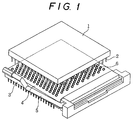
- Fig. 1 shows, as a typical example of an electric part, a PGA type IC as well as a socket used for the IC.
- the numeral 1 denotes the PGA type IC having lead pins 2 consisting of a number of round pins densely projecting from a lower surface of an IC body.
- the socket comprises a socket body 3, and a placing plate 4 horizontally movably superimposed on an upper surface of the socket body 3. The horizontal movement of the placing plate 4 is achieved by operation of a crank lever 5.
- the socket body 3 is provided with a number of socket contacts 7 capable of contacting the IC lead pins 2.
- the IC lead pins 2 are brought into contacting position and releasing position in accordance with the horizontal movement of the placing plate 4.
- each socket contact 7 includes a first elastic contact element 8 and a second elastic contact element 9 both extending in an opposite direction relative to an insertion direction (vertical direction) of each lead pin 2.
- the socket contact 7 further includes a support element 10 disposed at one sides of and extending along the first and second elastic contact elements 8 and 9.
- the first and second elastic contact elements 8 and 9 and the support element 10 are connected to each other at basal portions thereof.
- the socket contact 7 further includes a male terminal 11 extending downwardly from the connecting area between the first and second elastic contact elements 8 and 9 and the support element 10.
- the support element 10 is formed with a pair of press-fit lugs 12 projecting sidewardly from opposite sides thereof upper than the contacting area, while the male contact is formed of a pair of press-fit lugs 13 projecting sidewardly from opposite sides thereof lower than the connecting area.
- the socket contact 7 is pressure fitted into a contact retaining hole 14 formed in the socket body 3 by the press-fit lugs 12 and 13, and opposite side edges of the support element 10 are restricted by opposite inner surfaces of the contact retaining hole 14, thereby preventing a detrimental inclination of the socket contact 7.
- a lead pin loosely insertion portion 15 is formed between and along opposite surfaces of the first and second elastic contact elements 8 and 9 (that is, along an inner surface of the support element 10), and a narrowly-spaced lead pin clamping portion 16 is formed between the opposite surface of the first and second elastic contact elements 8 and 9.
- the IC lead pin 2 is inserted into the lead pin loosely insertion portion 15 through the hole 6 with a small resistance, and then horizontally moved from the lead pin loosely insertion portion 15 so as to be brought into the narrowly-spaced lead pin clamping portion 16 against elasticity of the first and second elastic contact elements 8 and 9, thereby achieving an electrical contact.
- the IC 1 can be removed with a small resistance.
- the socket has the crank lever 5, and the placing plate 4 as means for horizontally moving the placing plate 4.
- the placing plate 4 and the IC 1 are horizontally moved, thereby reciprocating the lead pin 2 between the lead pin loosely insertion portion 15 and the narrowly-spaced lead pin clamping portion 16.
- the socket contact 7 includes a pair of normally-inclining slant sides 17a and 17b formed between the lead pin loosely insertion portion 15 and the narrowly-spaced lead pin clamping portion 16 and converging toward the narrowly-spaced lead pin clamping portion 16 from the lead pin loosely insertion portion 15.
- a lead pin guide portion 18 is formed between the normally-inclining slant sides 17a and 17b. The lead pin 2 is brought to the narrowly-spaced lead pin clamping portion 16 guided from the lead pin loosely insertion portion 15 by the normally-inclining slant sides 17a and 17b.
- a pair of clamping sides forming the narrowly-spaced lead pin clamping portion 16 there are provided a pair of reversely-inclining slant sides 19a and 19b connected respectively at one ends thereof to one ends of the normally-inclining slant sides 17a and 17b and gradually enlarging toward the other ends thereof.
- One of the reversely-inclining slant sides i.e., the slant side 19a is connected to one of the normally-inclining slant sides 17a and 17b, i.e., the slant side 17a, and the other reversely-inclining slant side 19b is connected to the other normally-inclining slant side 17b.
- Connecting areas between the reversely-inclining slant side 19a and the normally-inclining slant side 17a and between the reversely-inclining slant side 19b and the normally-inclining slant side 17b are formed respectively with projections 20a and 20b projecting toward their opposite surfaces.
- the connecting area between the reversely-inclining slant side 19a and the normally-inclining slant side 17a is horizontally displaced relative to the connecting area between the reversely-inclining slant side 19b and the normally-inclining slant side 17b. This means that the projections 20a and 20b are horizontally displaced relative to each other.
- the pair of normally-inclining slant sides 17a and 17b forming the lead pin guide portion 18 are in horizontally-displaced relation to each other, and the reversely-inclining slant sides 19a and 19b forming the narrowly-spaced lead pin clamping portion 16 are likewise in horizontally-displaced relation to each other.
- the normally-inclining slant sides 17a and 17b forming the lead pin guide portion 18 are in displaced relation to each other at at least their end portions on the narrowly-spaced lead pin clamping portion 16 side, and the reversely-inclining slant sides 19a and 19b are likewise in displaced relation to each other at their end portions on the lead pin guide portion 18 side. Accordingly, one end of the reversely-inclining slant side 19a of the first elastic contact element 8 forming the narrowly-spaced lead pin clamping portion 16 extend so far as a position opposite to the normally-inclining slant side 17b and is connected to the normally-inclining slant side 17a.
- the entirety or one end of the normally-inclining slant side 17b of the second elastic contact element 9 extend so far as the position opposite to the reversely-inclining slant side 19a.
- Reference numeral 19a' denotes an inclining end portion of the reversely-inclining slant side 19a corresponding to the normally-inclining slant side 17b. This inclining end portion 19' is served to reduce resistance at the time the lead pin 2 is caused to climb over the projection 20b. As mentioned, the projections 20a and 20b are in horizontally-displaced relation to each other.
- the lead pin guide portion 18 and the narrowly-spaced lead pin clamping portion 16 are formed at distal end portions of the first and second elastic contact elements 8 and 9.
- the distal end portions of the first and second elastic contact elements 8 and 9 are inclined forwardly toward the opposite surfaces at a predetermined angle
- the normally-inclining slant sides 17a and 17b and the reversely-inclining slant sides 19a and 19b are constructed by opposite surfaces side edges (inner surfaces side edges) of the forwardly-inclining portions.
- the lead pin guide portion 18 is formed between the normally-inclining slant sides 17a and 17b
- the narrowly-spaced lead pin clamping portion 16 is formed between the reversely-inclining slant sides 19a and 19b.
- the lead pin loosely insertion portion 15 is situated outside the area between the opposite surfaces of the first and second elastic contact elements 8 and 9.
- the lead pin loosely insertion portion 15 may be situated inside the area between the opposite surfaces of the first and second elastic contact elements 8 and 9.
- the lead pin loosely insertion portion 15 may be situated inside or outside the area between the opposite surfaces of the first and second elastic contact elements 8 and 9.
- FIGs. 6A and 7A the lead pin 2 is inserted into the lead pin loosely insertion portion 15. Then, the lead pin 2 is horizontally moved from the lead pin loosely insertion portion 15. As shown in Figs. 6B and 7B, first, the lead pin 2 is brought into contact with the normally-inclining slant side 17a of the first elastic contact element 8. Then, as shown in Figs.
- the lead pin 2 is further moved horizontally from the position of Figs. 6D and 7D guided by the pair of reversely-inclining slant sides 19a and 19b, and clamped by and between the reversely-inclining slant sides 19a and 19b.
- the lead pin 2 is elastically clamped by and between the first and second elastic contact elements 8 and 9, thereby achieving an electrical contact.
- the reversely-inclining slant sides 19a and 19b are served as means for enhancing the introduction of the lead pin 2 at the time the lead pin 2 is introduced from the lead pin guide portion 18, and also as means working against the movement of the lead pin 2 from the narrowly-spaced lead pin clamping portion 16 toward the lead pin guide portion 18.
- the lead pin 2 when the lead pin 2 is moved from the lead pin loosely insertion portion 15 to the narrowly-spaced lead pin clamping portion 16, the lead pin 2 is caused to climb over the projection 20a formed on the connecting area between the normally-inclining slant side 17a and the reversely-inclining slant side 19a to displace the first elastic contact element 8 outwardly, and thereafter caused to climb over the other projection 20b formed on the connecting area between the other normally-inclining slant side 17b and the other reversely-inclining slant side 19b. Accordingly, the resistances of the first and second elastic contact elements 8 and 9 (i.e.
- the lead pin 2 is in contact with the reversely-inclining slant side 19a when the lead pin 2 is caused to climb over the projection 20b formed on the connecting area between the normally-inclining slant side 17b and the reversely-inclining slant side 19b after the lead pin 2 is caused to climb over the projection 20a formed on the connecting area between the normally-inclining slant side 17a and the reversely-inclining slant side 19a.
- the reversely-inclining slant side 19a is served to enhance the introduction of the lead pin 2 to the narrowly-spaced lead pin clamping portion 16, thus enabling for the lead pin 2 to climb over the projection 20b with a reduced operating force.
- the lead pin 2 can be effectively prevented from being moved accidentally to the lead pin loosely insertion portion 15 from the narrowly-spaced lead pin clamping portion 16.
- the lead pin can be moved from the lead pin loosely insertion portion to the narrowly-spaced lead pin clamping portion with a small resistance, and the lead pin is positively held by the narrowly-spaced lead pin clamping portion, thereby assuring a more reliable contact.
Landscapes
- Connecting Device With Holders (AREA)
- Coupling Device And Connection With Printed Circuit (AREA)
Applications Claiming Priority (2)
| Application Number | Priority Date | Filing Date | Title |
|---|---|---|---|
| JP155801/92 | 1992-05-21 | ||
| JP4155801A JPH0675417B2 (ja) | 1992-05-21 | 1992-05-21 | ソケットコンタクト |
Publications (2)
| Publication Number | Publication Date |
|---|---|
| EP0571105A1 true EP0571105A1 (fr) | 1993-11-24 |
| EP0571105B1 EP0571105B1 (fr) | 1996-07-31 |
Family
ID=15613748
Family Applications (1)
| Application Number | Title | Priority Date | Filing Date |
|---|---|---|---|
| EP93303502A Expired - Lifetime EP0571105B1 (fr) | 1992-05-21 | 1993-05-06 | Contact pour sockle |
Country Status (4)
| Country | Link |
|---|---|
| US (1) | US5299950A (fr) |
| EP (1) | EP0571105B1 (fr) |
| JP (1) | JPH0675417B2 (fr) |
| DE (1) | DE69303862D1 (fr) |
Cited By (6)
| Publication number | Priority date | Publication date | Assignee | Title |
|---|---|---|---|---|
| EP0689265A1 (fr) * | 1994-06-24 | 1995-12-27 | Thomas & Betts Corporation | Connexion électrique à faible force d'insertion |
| GB2295734A (en) * | 1994-10-11 | 1996-06-05 | Methode Electronics Inc | Zero insertion force socket |
| US6000975A (en) * | 1997-12-12 | 1999-12-14 | 3M Innovative Properties Company | Canted beam electrical contact and receptacle housing therefor |
| EP0969711A3 (fr) * | 1998-07-01 | 2000-04-05 | Enplas Corporation | Socle pour un dispositif électrique et sa méthode d'assemblage |
| EP1059692A1 (fr) * | 1999-06-08 | 2000-12-13 | Berg Electronics Manufacturing B.V. | Borne à faible force d'insertion |
| US6217395B1 (en) * | 1997-12-02 | 2001-04-17 | Tyco Electronics Logistics Ag | Contact spring and receptacle contact having an insertion funnel and contact surface |
Families Citing this family (18)
| Publication number | Priority date | Publication date | Assignee | Title |
|---|---|---|---|---|
| JP2672450B2 (ja) * | 1993-06-30 | 1997-11-05 | 山一電機株式会社 | 電気接触子 |
| US5454727A (en) * | 1994-02-10 | 1995-10-03 | Hsu; Fu-Yu | Electrical connector with ZIF socket |
| JP2710562B2 (ja) * | 1994-06-30 | 1998-02-10 | 山一電機株式会社 | 電気接触子 |
| US5582519A (en) * | 1994-12-15 | 1996-12-10 | The Whitaker Corporation | Make-first-break-last ground connections |
| JP2746862B2 (ja) * | 1995-12-28 | 1998-05-06 | 山一電機株式会社 | コンタクト |
| JP2820916B2 (ja) * | 1996-01-26 | 1998-11-05 | 山一電機株式会社 | 三接片形コンタクトにおける絡み防止機構 |
| TW438109U (en) * | 1999-03-19 | 2001-05-28 | Hon Hai Prec Ind Co Ltd | Terminal of electrical connector |
| JP3120377B2 (ja) | 1999-04-28 | 2000-12-25 | モレックス インコーポレーテッド | ピングリッドアレイパッケージ用ソケット及び端子 |
| TW472962U (en) * | 2000-12-21 | 2002-01-11 | Hon Hai Prec Ind Co Ltd | Connector terminal with no insertion force |
| TW534506U (en) * | 2000-12-29 | 2003-05-21 | Hon Hai Prec Ind Co Ltd | Terminal for CPU socket connector |
| US6450826B1 (en) * | 2001-11-26 | 2002-09-17 | Hon Hai Precision Ind. Co., Ltd. | Contact of electrical connector |
| US6478598B1 (en) * | 2001-12-07 | 2002-11-12 | Hon Hai Precision Ind. Co., Ltd. | Electrical connector having improved contacts |
| TW532609U (en) * | 2001-12-19 | 2003-05-11 | Hon Hai Prec Ind Co Ltd | Electrical connector |
| TW525837U (en) * | 2002-03-08 | 2003-03-21 | Hon Hai Prec Ind Co Ltd | Electrical connector |
| TW551726U (en) * | 2002-07-09 | 2003-09-01 | Guang-Jr Lai | Conductive device of ZIF IC socket |
| JP4551189B2 (ja) * | 2003-12-26 | 2010-09-22 | タイコエレクトロニクスジャパン合同会社 | Pga型icソケット |
| JP2007250476A (ja) * | 2006-03-17 | 2007-09-27 | Espec Corp | Icソケット |
| US7988500B2 (en) * | 2009-12-16 | 2011-08-02 | Sensata Technologies Massachusetts, Inc. | Socket and contact having anchors |
Citations (3)
| Publication number | Priority date | Publication date | Assignee | Title |
|---|---|---|---|---|
| US3728769A (en) * | 1970-12-28 | 1973-04-24 | Ibm | Apparatus for assembling a module element to a substrate element |
| EP0379219A2 (fr) * | 1989-01-20 | 1990-07-25 | Japan Aviation Electronics Industry, Limited | Connecteur électrique |
| US5057031A (en) * | 1990-08-15 | 1991-10-15 | Aries Electronics, Inc. | Zero insertion force pin grid array test socket |
Family Cites Families (7)
| Publication number | Priority date | Publication date | Assignee | Title |
|---|---|---|---|---|
| US4422703A (en) * | 1981-09-15 | 1983-12-27 | Thomas & Betts Corporation | Electrical connector for use with multi-pin arrays |
| US4648669A (en) * | 1985-11-06 | 1987-03-10 | Amp Incorporated | Removable retaining and guide means for electrical sockets |
| JPS634370A (ja) * | 1986-06-24 | 1988-01-09 | Fuji Photo Film Co Ltd | 画像処理方法 |
| JPH0634370Y2 (ja) * | 1987-12-21 | 1994-09-07 | 株式会社リコー | スタンパ作製装置 |
| US4988310A (en) * | 1989-10-10 | 1991-01-29 | Amp Incorporated | ZIF PGA socket and a tool for use therewith |
| JPH0748385B2 (ja) * | 1990-07-13 | 1995-05-24 | 山一電機工業株式会社 | 三方向挟接形コンタクト |
| US5092789A (en) * | 1990-08-15 | 1992-03-03 | Aries Electronics, Inc. | Electrical connector for ZIF PGA test socket |
-
1992
- 1992-05-21 JP JP4155801A patent/JPH0675417B2/ja not_active Expired - Lifetime
-
1993
- 1993-05-05 US US08/056,534 patent/US5299950A/en not_active Expired - Lifetime
- 1993-05-06 EP EP93303502A patent/EP0571105B1/fr not_active Expired - Lifetime
- 1993-05-06 DE DE69303862T patent/DE69303862D1/de not_active Expired - Lifetime
Patent Citations (3)
| Publication number | Priority date | Publication date | Assignee | Title |
|---|---|---|---|---|
| US3728769A (en) * | 1970-12-28 | 1973-04-24 | Ibm | Apparatus for assembling a module element to a substrate element |
| EP0379219A2 (fr) * | 1989-01-20 | 1990-07-25 | Japan Aviation Electronics Industry, Limited | Connecteur électrique |
| US5057031A (en) * | 1990-08-15 | 1991-10-15 | Aries Electronics, Inc. | Zero insertion force pin grid array test socket |
Cited By (9)
| Publication number | Priority date | Publication date | Assignee | Title |
|---|---|---|---|---|
| EP0689265A1 (fr) * | 1994-06-24 | 1995-12-27 | Thomas & Betts Corporation | Connexion électrique à faible force d'insertion |
| GB2295734A (en) * | 1994-10-11 | 1996-06-05 | Methode Electronics Inc | Zero insertion force socket |
| US6217395B1 (en) * | 1997-12-02 | 2001-04-17 | Tyco Electronics Logistics Ag | Contact spring and receptacle contact having an insertion funnel and contact surface |
| US6000975A (en) * | 1997-12-12 | 1999-12-14 | 3M Innovative Properties Company | Canted beam electrical contact and receptacle housing therefor |
| EP0969711A3 (fr) * | 1998-07-01 | 2000-04-05 | Enplas Corporation | Socle pour un dispositif électrique et sa méthode d'assemblage |
| US6371783B1 (en) | 1998-07-01 | 2002-04-16 | Enplas Corporation | Socket for electrical parts and method of assembling the same |
| EP1389898A1 (fr) * | 1998-07-01 | 2004-02-18 | Enplas Corporation | Socle pour un dispositif électrique et sa méthode d'assemblage |
| EP1059692A1 (fr) * | 1999-06-08 | 2000-12-13 | Berg Electronics Manufacturing B.V. | Borne à faible force d'insertion |
| US6537095B1 (en) | 1999-06-08 | 2003-03-25 | Berg Technology, Inc. | Low insertion force terminal |
Also Published As
| Publication number | Publication date |
|---|---|
| DE69303862D1 (de) | 1996-09-05 |
| US5299950A (en) | 1994-04-05 |
| JPH05326090A (ja) | 1993-12-10 |
| JPH0675417B2 (ja) | 1994-09-21 |
| EP0571105B1 (fr) | 1996-07-31 |
Similar Documents
| Publication | Publication Date | Title |
|---|---|---|
| EP0571105B1 (fr) | Contact pour sockle | |
| US5244412A (en) | Electrical device for surface mounting on a circuit board and mounting component thereof | |
| US5676555A (en) | Card edge connector having means for applying inward transverse force on printed wiring boards | |
| EP0664581A2 (fr) | Connecteur à profil bas pour l'interconnexion de deux cartes de circuits imprimés | |
| WO1986002131A1 (fr) | Prise de courant electrique | |
| US7455556B2 (en) | Electrical contact | |
| EP0379219B1 (fr) | Connecteur électrique | |
| US6875025B2 (en) | Matrix socket | |
| KR100344051B1 (ko) | Pga 패키지용 전기 커넥터 | |
| US6139348A (en) | Electric connector with an elastically deformable contact pin | |
| US6843688B2 (en) | Connector in which movement of contact portion of contact is guided by insulator | |
| US5860838A (en) | Tangle-preventive mechanism in three contact pieces type contact | |
| EP0454977A1 (fr) | Connecteur à fiche électrique ayant des bandes de contacts encastrées dans une plaque isolante pour application aux plaquettes de circuits | |
| EP1102358B1 (fr) | Socle pour composants électroniques | |
| IE59217B1 (en) | Surface mount electrical conector with floating electrical terminals | |
| US5865649A (en) | Card edge connector having means for preventing overstress of contact elements | |
| KR100527319B1 (ko) | 낮은 프로파일 커넥터 | |
| US6062874A (en) | IC socket for IC package | |
| EP1107371A1 (fr) | Connecteur | |
| US4647134A (en) | IC socket contact | |
| EP1091628A2 (fr) | Fassung für elektrische Zwischenverbindung | |
| US5749750A (en) | Connector | |
| JPH0523429U (ja) | 表面実装型コネクタ | |
| JP3939801B2 (ja) | 電気部品用ソケット | |
| JP2555601Y2 (ja) | 可動コネクタ |
Legal Events
| Date | Code | Title | Description |
|---|---|---|---|
| PUAI | Public reference made under article 153(3) epc to a published international application that has entered the european phase |
Free format text: ORIGINAL CODE: 0009012 |
|
| AK | Designated contracting states |
Kind code of ref document: A1 Designated state(s): DE FR GB IT |
|
| 17P | Request for examination filed |
Effective date: 19940114 |
|
| 17Q | First examination report despatched |
Effective date: 19950330 |
|
| GRAH | Despatch of communication of intention to grant a patent |
Free format text: ORIGINAL CODE: EPIDOS IGRA |
|
| GRAH | Despatch of communication of intention to grant a patent |
Free format text: ORIGINAL CODE: EPIDOS IGRA |
|
| GRAA | (expected) grant |
Free format text: ORIGINAL CODE: 0009210 |
|
| AK | Designated contracting states |
Kind code of ref document: B1 Designated state(s): DE FR GB IT |
|
| PG25 | Lapsed in a contracting state [announced via postgrant information from national office to epo] |
Ref country code: IT Free format text: LAPSE BECAUSE OF FAILURE TO SUBMIT A TRANSLATION OF THE DESCRIPTION OR TO PAY THE FEE WITHIN THE PRESCRIBED TIME-LIMIT;WARNING: LAPSES OF ITALIAN PATENTS WITH EFFECTIVE DATE BEFORE 2007 MAY HAVE OCCURRED AT ANY TIME BEFORE 2007. THE CORRECT EFFECTIVE DATE MAY BE DIFFERENT FROM THE ONE RECORDED. Effective date: 19960731 Ref country code: FR Effective date: 19960731 |
|
| REF | Corresponds to: |
Ref document number: 69303862 Country of ref document: DE Date of ref document: 19960905 |
|
| PG25 | Lapsed in a contracting state [announced via postgrant information from national office to epo] |
Ref country code: DE Effective date: 19961101 |
|
| EN | Fr: translation not filed | ||
| PGFP | Annual fee paid to national office [announced via postgrant information from national office to epo] |
Ref country code: GB Payment date: 19970418 Year of fee payment: 5 |
|
| PLBE | No opposition filed within time limit |
Free format text: ORIGINAL CODE: 0009261 |
|
| STAA | Information on the status of an ep patent application or granted ep patent |
Free format text: STATUS: NO OPPOSITION FILED WITHIN TIME LIMIT |
|
| 26N | No opposition filed | ||
| PG25 | Lapsed in a contracting state [announced via postgrant information from national office to epo] |
Ref country code: GB Free format text: LAPSE BECAUSE OF NON-PAYMENT OF DUE FEES Effective date: 19980506 |
|
| GBPC | Gb: european patent ceased through non-payment of renewal fee |
Effective date: 19980506 |