EP0571899A1 - Durch Einwirkung von Strahlung vernetzendes Gemisch und dessen Verwendung zur Herstellung hochtemperaturbeständiger Reliefstrukturen - Google Patents
Durch Einwirkung von Strahlung vernetzendes Gemisch und dessen Verwendung zur Herstellung hochtemperaturbeständiger Reliefstrukturen Download PDFInfo
- Publication number
- EP0571899A1 EP0571899A1 EP93108257A EP93108257A EP0571899A1 EP 0571899 A1 EP0571899 A1 EP 0571899A1 EP 93108257 A EP93108257 A EP 93108257A EP 93108257 A EP93108257 A EP 93108257A EP 0571899 A1 EP0571899 A1 EP 0571899A1
- Authority
- EP
- European Patent Office
- Prior art keywords
- acid
- component
- mixture according
- groups
- bis
- Prior art date
- Legal status (The legal status is an assumption and is not a legal conclusion. Google has not performed a legal analysis and makes no representation as to the accuracy of the status listed.)
- Granted
Links
- 0 CCCCCCc(cc1)ccc1Oc1ccc(*CC(c(c(C(C)=O)c2)cc(C(CNc(cc3)ccc3Oc3ccc(CCCCCC)cc3)=O)c2C(C)=O)=O)cc1 Chemical compound CCCCCCc(cc1)ccc1Oc1ccc(*CC(c(c(C(C)=O)c2)cc(C(CNc(cc3)ccc3Oc3ccc(CCCCCC)cc3)=O)c2C(C)=O)=O)cc1 0.000 description 3
- QYWIRWXTZFPDGC-UHFFFAOYSA-N CC(C1C=C(C(C)=O)C(C(C)=O)=CC1C(C)=O)=O Chemical compound CC(C1C=C(C(C)=O)C(C(C)=O)=CC1C(C)=O)=O QYWIRWXTZFPDGC-UHFFFAOYSA-N 0.000 description 2
- AMRPCNQAPYHARQ-UHFFFAOYSA-N CCCCCCc(cc1)ccc1Oc(cc1)ccc1N Chemical compound CCCCCCc(cc1)ccc1Oc(cc1)ccc1N AMRPCNQAPYHARQ-UHFFFAOYSA-N 0.000 description 2
- IDSZPGXKZKSTFS-UHFFFAOYSA-N CCCCCCc(cc1)ccc1Oc(cc1)ccc1NCC(c(cc(C(Nc(cc1)ccc1Oc1ccc(CCCCCC)cc1)=O)c(C(C)=O)c1)c1C(C)=O)=O Chemical compound CCCCCCc(cc1)ccc1Oc(cc1)ccc1NCC(c(cc(C(Nc(cc1)ccc1Oc1ccc(CCCCCC)cc1)=O)c(C(C)=O)c1)c1C(C)=O)=O IDSZPGXKZKSTFS-UHFFFAOYSA-N 0.000 description 1
Classifications
-
- G—PHYSICS
- G03—PHOTOGRAPHY; CINEMATOGRAPHY; ANALOGOUS TECHNIQUES USING WAVES OTHER THAN OPTICAL WAVES; ELECTROGRAPHY; HOLOGRAPHY
- G03F—PHOTOMECHANICAL PRODUCTION OF TEXTURED OR PATTERNED SURFACES, e.g. FOR PRINTING, FOR PROCESSING OF SEMICONDUCTOR DEVICES; MATERIALS THEREFOR; ORIGINALS THEREFOR; APPARATUS SPECIALLY ADAPTED THEREFOR
- G03F7/00—Photomechanical, e.g. photolithographic, production of textured or patterned surfaces, e.g. printing surfaces; Materials therefor, e.g. comprising photoresists; Apparatus specially adapted therefor
- G03F7/004—Photosensitive materials
- G03F7/027—Non-macromolecular photopolymerisable compounds having carbon-to-carbon double bonds, e.g. ethylenic compounds
- G03F7/032—Non-macromolecular photopolymerisable compounds having carbon-to-carbon double bonds, e.g. ethylenic compounds with binders
- G03F7/037—Non-macromolecular photopolymerisable compounds having carbon-to-carbon double bonds, e.g. ethylenic compounds with binders the binders being polyamides or polyimides
-
- G—PHYSICS
- G03—PHOTOGRAPHY; CINEMATOGRAPHY; ANALOGOUS TECHNIQUES USING WAVES OTHER THAN OPTICAL WAVES; ELECTROGRAPHY; HOLOGRAPHY
- G03F—PHOTOMECHANICAL PRODUCTION OF TEXTURED OR PATTERNED SURFACES, e.g. FOR PRINTING, FOR PROCESSING OF SEMICONDUCTOR DEVICES; MATERIALS THEREFOR; ORIGINALS THEREFOR; APPARATUS SPECIALLY ADAPTED THEREFOR
- G03F7/00—Photomechanical, e.g. photolithographic, production of textured or patterned surfaces, e.g. printing surfaces; Materials therefor, e.g. comprising photoresists; Apparatus specially adapted therefor
- G03F7/004—Photosensitive materials
- G03F7/027—Non-macromolecular photopolymerisable compounds having carbon-to-carbon double bonds, e.g. ethylenic compounds
-
- Y—GENERAL TAGGING OF NEW TECHNOLOGICAL DEVELOPMENTS; GENERAL TAGGING OF CROSS-SECTIONAL TECHNOLOGIES SPANNING OVER SEVERAL SECTIONS OF THE IPC; TECHNICAL SUBJECTS COVERED BY FORMER USPC CROSS-REFERENCE ART COLLECTIONS [XRACs] AND DIGESTS
- Y10—TECHNICAL SUBJECTS COVERED BY FORMER USPC
- Y10S—TECHNICAL SUBJECTS COVERED BY FORMER USPC CROSS-REFERENCE ART COLLECTIONS [XRACs] AND DIGESTS
- Y10S430/00—Radiation imagery chemistry: process, composition, or product thereof
- Y10S430/1053—Imaging affecting physical property or radiation sensitive material, or producing nonplanar or printing surface - process, composition, or product: radiation sensitive composition or product or process of making binder containing
- Y10S430/1055—Radiation sensitive composition or product or process of making
- Y10S430/106—Binder containing
- Y10S430/107—Polyamide or polyurethane
-
- Y—GENERAL TAGGING OF NEW TECHNOLOGICAL DEVELOPMENTS; GENERAL TAGGING OF CROSS-SECTIONAL TECHNOLOGIES SPANNING OVER SEVERAL SECTIONS OF THE IPC; TECHNICAL SUBJECTS COVERED BY FORMER USPC CROSS-REFERENCE ART COLLECTIONS [XRACs] AND DIGESTS
- Y10—TECHNICAL SUBJECTS COVERED BY FORMER USPC
- Y10S—TECHNICAL SUBJECTS COVERED BY FORMER USPC CROSS-REFERENCE ART COLLECTIONS [XRACs] AND DIGESTS
- Y10S430/00—Radiation imagery chemistry: process, composition, or product thereof
- Y10S430/1053—Imaging affecting physical property or radiation sensitive material, or producing nonplanar or printing surface - process, composition, or product: radiation sensitive composition or product or process of making binder containing
- Y10S430/1055—Radiation sensitive composition or product or process of making
- Y10S430/114—Initiator containing
- Y10S430/115—Cationic or anionic
-
- Y—GENERAL TAGGING OF NEW TECHNOLOGICAL DEVELOPMENTS; GENERAL TAGGING OF CROSS-SECTIONAL TECHNOLOGIES SPANNING OVER SEVERAL SECTIONS OF THE IPC; TECHNICAL SUBJECTS COVERED BY FORMER USPC CROSS-REFERENCE ART COLLECTIONS [XRACs] AND DIGESTS
- Y10—TECHNICAL SUBJECTS COVERED BY FORMER USPC
- Y10S—TECHNICAL SUBJECTS COVERED BY FORMER USPC CROSS-REFERENCE ART COLLECTIONS [XRACs] AND DIGESTS
- Y10S430/00—Radiation imagery chemistry: process, composition, or product thereof
- Y10S430/1053—Imaging affecting physical property or radiation sensitive material, or producing nonplanar or printing surface - process, composition, or product: radiation sensitive composition or product or process of making binder containing
- Y10S430/1055—Radiation sensitive composition or product or process of making
- Y10S430/114—Initiator containing
- Y10S430/122—Sulfur compound containing
-
- Y—GENERAL TAGGING OF NEW TECHNOLOGICAL DEVELOPMENTS; GENERAL TAGGING OF CROSS-SECTIONAL TECHNOLOGIES SPANNING OVER SEVERAL SECTIONS OF THE IPC; TECHNICAL SUBJECTS COVERED BY FORMER USPC CROSS-REFERENCE ART COLLECTIONS [XRACs] AND DIGESTS
- Y10—TECHNICAL SUBJECTS COVERED BY FORMER USPC
- Y10S—TECHNICAL SUBJECTS COVERED BY FORMER USPC CROSS-REFERENCE ART COLLECTIONS [XRACs] AND DIGESTS
- Y10S430/00—Radiation imagery chemistry: process, composition, or product thereof
- Y10S430/1053—Imaging affecting physical property or radiation sensitive material, or producing nonplanar or printing surface - process, composition, or product: radiation sensitive composition or product or process of making binder containing
- Y10S430/1055—Radiation sensitive composition or product or process of making
- Y10S430/114—Initiator containing
- Y10S430/122—Sulfur compound containing
- Y10S430/123—Sulfur in heterocyclic ring
-
- Y—GENERAL TAGGING OF NEW TECHNOLOGICAL DEVELOPMENTS; GENERAL TAGGING OF CROSS-SECTIONAL TECHNOLOGIES SPANNING OVER SEVERAL SECTIONS OF THE IPC; TECHNICAL SUBJECTS COVERED BY FORMER USPC CROSS-REFERENCE ART COLLECTIONS [XRACs] AND DIGESTS
- Y10—TECHNICAL SUBJECTS COVERED BY FORMER USPC
- Y10S—TECHNICAL SUBJECTS COVERED BY FORMER USPC CROSS-REFERENCE ART COLLECTIONS [XRACs] AND DIGESTS
- Y10S522/00—Synthetic resins or natural rubbers -- part of the class 520 series
- Y10S522/904—Monomer or polymer contains initiating group
Definitions
- the invention relates to the action of radiation-crosslinking mixtures which contain soluble polymeric precursors of high-temperature-resistant heterocyclic polymers, copolymerizable ethylenically unsaturated compounds, photoinitiators, solvents and, if appropriate, further auxiliaries or additives, and their use for the production of high-temperature-resistant relief structures, with polyimides in particular under high-temperature-resistant heterocyclic polymers , Polyisoindoloquinazolinediones and polyaroylenbenzimidazoles are to be understood, the precursors of which still carry free carboxyl groups.
- the heterocyclic or aromatic / heterocyclic polymers mentioned above are preferably used because of the high thermal and mechanical loads during manufacture as substances of functional level C.
- the soluble precursors A for such polymers C are in general compounds of a polyamide basic structure, in such a way that another group is in the ortho or peri position to the amide group, generally a carboxyl or ester group, which is transferred to the step C using higher temperatures, with the amide group undergoes a condensation reaction.
- One way of making polymeric, polyamide basic structures of stage A radiation-crosslinkable is to introduce unsaturated side groups, as is shown on a polyamic acid ester:
- the introduction of unsaturated groups into polymeric precursors A is described, for example, in DE-A-2 437 397, DE-A-2 437 348, DE-A-2 437 413, DE-A-2 437 369, DE-A-2 919 840, DE-A-2 919 841, DE-A-2 933 826 and DE-A-2 308 830.
- the object of the present invention is to provide photoresists based on soluble precursors of e.g.
- soluble precursors e.g.
- polyimide, polyisoindoloquinazolinedione, polyaroylenbenzimidazole or other polyheterocycles which avoid the disadvantages mentioned above, i.e. are simple and reproducible to produce and provide relief structures with the desired flexural and buckling strength.
- Preferred component (I) are polyamic acids of the general structure wherein the carboxyl groups are bonded to Ar1 in such a way that they are ortho or peri-permanent to the amido groups,
- Ar1 is a substituted or unsubstituted tetravalent aromatic, araliphatic, alicyclic, aliphatic or heterocyclic radical
- Ar2 is a substituted or unsubstituted divalent, aromatic, araliphatic, alicyclic, aliphatic or heterocyclic radical.
- the polyamic acid can be a random copolymer or a block copolymer, wherein at least 2 different groups Ar 1 and / or Ar 2 can be contained in the polyamic acid.
- reaction products of thiodiglycol with glycidyl (meth) acrylate and an organic mono-, di- or polycarboxylic acid are preferred.
- Preferred embodiments of the mixtures according to the invention also consist in that a ternary sulfonium salt is used as component (II) which contains at least one ethylenically unsaturated group in both the cation and the anion, or that the component (II) contained ethylenically unsaturated groups are acrylate or methacrylate groups.
- the mixtures according to the invention can additionally contain so-called "reactive diluents", ie, ethylenically unsaturated copolymerizable organic compounds different from component (II) and, if appropriate, further auxiliaries or additives, such as leveling agents, sensitizers and / or adhesion promoters.
- reactive diluents ie, ethylenically unsaturated copolymerizable organic compounds different from component (II) and, if appropriate, further auxiliaries or additives, such as leveling agents, sensitizers and / or adhesion promoters.
- the present invention also relates to a method for producing high-temperature-resistant relief structures by imagewise irradiation of layers of radiation-sensitive mixtures applied to a support and removal of the unirradiated areas of these layers, which is characterized in that the layers of radiation-sensitive mixtures consist of mixtures according to the invention.
- the mixture according to the invention contains polymeric carboryl group-containing precursors of high-temperature-resistant heterocyclic polymers which are soluble in polar aprotic organic solvents.
- Precursors of such polyheterocycles are generally obtained by reacting aromatic, heterocyclic or cycloaliphatic dianhydrides of the general formula O (CO) 2R (CO) 2O with optionally substituted polyamines.
- Suitable dianhydrides are the Dianhydrides of pyromellitic acid or the Benzene-1,2,3,4-tetracarboxylic acid, Dianhydride the 4,4-esterification, 4,4-etherification and 4,4-amidization dimers of trimellitic acid, Dianhydride the 3,3 ', 4,4'-biphenyltetracarboxylic acid, 2,2 ', 4,4'-biphenyltetracarboxylic acid, 2,3,3 ', 4'-biphenyltetracarboxylic acid, 3,3 ', 4,4'-benzophenonetetracarboxylic acid, 2,2 ', 3,3'-benzophenonetetracarboxylic acid, 2,3,3 ', 4'-benzophenonetetracarboxylic acid, 2,3,6,7-naphthalenetetracarboxylic acid, 1,2,5,6-naphthalenetetracarboxylic
- Suitable polyamines can be mentioned: p-phenylenediamine, m-phenylenediamine, 4,4'-diaminodiphenyl oxide, 3,3'-diaminodiphenyl oxide, 3,4'-diaminodiphenyl oxide, 4,4'-diaminodiphenyl sulfide, 3,3'-diaminodiphenyl sulfide, 3,4'-diaminodiphenyl sulfide, 4,4'-diaminodiphenyl sulfone, 3,3'-diaminodiphenyl sulfone, 3,4'-diaminodiphenyl sulfone, 4,4'-diaminodiphenylmethane, 3,3'-diaminodiphenylmethane, 3,4'-diaminodiphenylmethane, (4,4'-diaminodiphenylme
- polyamines are also to be understood as meaning compounds which contain the structural element N-N, i.e. are derivatives of hydrazine.
- the preparation of the precursors of the polyheterocycles can advantageously be carried out with the addition of regulators. This makes it possible to set the solids content and viscosity of the precursors in a targeted manner, while at the same time improving the reproducibility.
- regulators provided they are ethylenically unsaturated compounds, improves the photosensitivity of the resists prepared from these precursors, since the regulators are built into the polyheterocycle precursors as end groups.
- R1 aliphatic, cycloaliphatic, araliphatic, aromatic or heterocyclic radical, which preferably contains a polymerizable multiple bond.
- Regulation is carried out in such a way that part of the dianhydride and / or the polyamine are reacted with the regulator component before or during the preparation of the polyheterocycle precursor, so that monofunctional polymer building blocks which act as end groups in the polymer chain are obtained in the sense of the polymer structure.
- Monohydroxy or monoamino compounds can be used as regulators for the dianhydrides, preferably those which carry unsaturated groups, for example 2-hydroxyethyl acrylate, 2-hydroxyethyl methacrylate, Glycerine diacrylate, Glycerine dimethacrylate, 3-hydroxypropyl acrylate, 3-hydroxypropyl methacrylate, 2-hydroxypropyl acrylate, 2-hydroxypropyl methacrylate, 4-hydroxybutyl acrylate, 4-hydroxybutyl methacrylate, Polyethylene glycol modified acrylate, Polypropylene glycol modified acrylate, Polyethylene glycol modified methacrylate, Polypropylene glycol modified methacrylate, Pentaerythritol triacrylate, Pentaerythritol trimethacrylate, Dipentaerythritol pentaacrylate, Dipentaerythritol pentamethacrylate, trimethylol propane diacrylate, Trimethylolpropane dimethacrylate, Cin
- Monoanhydrides or monoisocyanates can be used as regulators for the polyamines, preferably those which bear unsaturated groups, for example: Maleic anhydride, Itaconic anhydride, Methacrylic anhydride, Acrylic anhydride, Isocyanatoethyl methacrylate, 1- (1-isocyanato-1-methylethyl) -4- (1-methylethenyl) benzene, Monoaddition products of unsaturated alcohols with 2,4-tolylene diisocyanate and Monoaddition products of unsaturated alcohols with 2,4'-isocyanatodiphenylmethane.
- Component (I) is generally present in the mixture according to the invention in an amount of 5 to 60, preferably 20 to 45% by weight, based on the mixture as a whole.
- the mixture according to the invention contains copolymerizable ethylenically unsaturated ternary sulfonium salts as component (II).
- reaction products of saturated or unsaturated thioethers with unsaturated epoxides such as e.g. Glycidyl methacrylate or glycidyl acrylate in the presence of an acid or the reaction products of unsaturated thioethers with saturated epoxides in the presence of an acid.
- Preferred reactions are those in which the thioethers are hydroxy-substituted, for example the sulfonium salt of the general formula wherein R contains an ethylenically unsaturated group and X ⁇ represents an organic or inorganic acid anion.
- the acid used carries a polymerizable multiple bond in addition to the epoxide or thioether, such as crotonic acid, Methacrylic acid, acrylic acid, fumaric acid, cinnamic acid, maleic acid, propiolic acid, 2-acrylamidoglycolic acid, 2,2-bis (acrylamido) acetic acid, generally the addition products of unsaturated alcohols or amines (as already listed above as regulators) to mono- or polyanhydrides, for example 4- (2-methacryloyloxyethyl) maleic acid, 4- (2-acryloyloxyethyl) maleic acid, phthalic acid monomethacryloyloxyethyl ester, phthalic acid monoacryloyloxyethyl ester, pyromellitic acid di- (2-methacryloyloxyethyl ester), N, N-diallylmaleic acid monoamide as well as N, N -aconacid
- Reaction products of thiodiglycol with unsaturated epoxides and the above-mentioned unsaturated acids are very particularly preferred.
- Component (II) according to the invention is generally present in an amount of 1 to 50, preferably 10 to 35% by weight, based on the mixture as a whole.
- the mixture according to the invention contains a photoinitiator or a photoinitiator system.
- Benzophenone Acetophenone, Benzanthrone, Anthrone, 4,4'-N, N, N ', N'-tetramethyldiaminobenzophenone (Michler's ketone), Phenanthrene, 2-nitrofluorene, Nitroacenaphthene, benzoquinone, N-acetyl-p-nitroaniline, p-nitroaniline, 2-ethylanthraquinone, 2-tert-butylanthraquinone, N-acetyl-4-nitro-1-naphthylamine, Picramid, 1,2-benzanthraquinone, 3-methyl-1,3-diaza-1,9-benzanthrone, 4,4'-tetraethyldiaminobenzophenone, 2-chlor
- Component (III) is present in the mixture according to the invention in amounts of 0.01 to 10, preferably 0.5 to 5% by weight.
- polar aprotic organic solvents are used as component (IV).
- the preparation of the above-mentioned precursors of polyheterocycles (I) is also generally carried out in highly polar, preferably aprotic, solvents.
- solvents are: Formamide, acetamide, N-methylformamide, N, N-dimethylformamide, N, N-diethylformamide, N-methylpyrrolidone, N, N-dimethylacetamide, N, N-diethylacetamide, ⁇ -butyrolactone, caprolactam, pyrrolidone, dimethyl sulfoxide, sulfolane, dimethyl sulfone, Hexamethylene phosphoric acid amide, dimethyl propylene urea, dimethyl ethylene urea inter alia, with N-methylpyrrolidone, dimethylacetamide, ⁇ -butyrolactone and dimethyl sulfoxide being preferred.
- Some of these polar substances can be replaced by other solvents such as alcohols, esters, ketones, ethers and hydrocarbons.
- Component (IV) can generally be present in the mixture according to the invention in amounts of 10 to 80, preferably 40 to 60% by weight.
- the mixture according to the invention can additionally contain component (II) ethylenically unsaturated copolymerizable organic compounds, so-called reactive diluents.
- Reactive thinners are generally low-viscosity, mono- or poly-ethylenically unsaturated compounds, which are added to increase sensitivity to light and to improve processability. Compounds from the class of acrylates and methacrylates and their polyfunctional representatives are preferred.
- Hydroxyalkyl (meth) acrylates such as hydroxyethyl acrylate, hydroxyethyl methacrylate, hydroxypropyl acrylate, hydroxypropyl methacrylate, butanediol monoacrylate, butanediol monomethacrylate, N-hydroxymethyl acrylamide, N-hydroxymethyl methacrylamide, diethylene glycol monoacrylate, diethylene glycol monomethacrylate, Glyzerindimethacrylat, Glyzerindiacrylat, Glyzerintrimethacrylat, glyceryl dimethacrylate, trimethylolpropane dimethacrylate, trimethylolpropane diacrylate, trimethylolpropane trimethacrylate, trimethylolpropane triacrylate, pentaerythritol trimethacrylate , Pentaerythritol triacrylate, diacetone (meth) acrylamide, cinnamon alcohol, hydroxyalkyl cinn
- Amide compounds with carbon-carbon double bonds such as N-acrylolylpiperidine, N-acrylolylmorpholine, acrylamide, methacrylamide, N-methylacrylamide, N-methylmethacrylamide, N-ethylacrylamide, N-ethylmethacrylamide, acrylamidoglycolic acid, are also very particularly suitable and further N-alkyl acrylamides, N, N-dimethylacrylamide, N, N-dimethyl methacrylamide, N, N-diethylacrylamide, N, N-diethyl methacrylamide, further N, N-dialkyl- (meth) -acrylamides, N, N-dimethylaminoethyl - (meth) -acrylamide, N, N-dimetyhlaminopropyl (meth) acrylamide and other N-amino-alkyl- (meth) acrylamides and N, N-diaminoalkyl (meth) acrylamides,
- methylolation products of acrylic and methacrylamide and their ether-like condensation products with mono- or polyfunctional alcohols are also particularly suitable.
- reactive diluents can be added to the mixture according to the invention in amounts of up to 25% by weight, based on the total amount.
- auxiliaries or additives can be added to the mixtures according to the invention in small amounts of up to 10% by weight in order to achieve certain desired effects.
- the mixtures according to the invention are used as photoresists for the production of high-temperature-resistant relief structures, such as those used in the production of microelectronic components as insulation or passivation layers or as ⁇ -particle barriers.
- the method according to the invention for the production of photoresists and the production of high-temperature-resistant relief structures can be carried out in a generally customary manner.
- the photoresist solutions were spun onto silicon wafers in a layer thickness of 6 ⁇ m (dry), 10 min. dried at 80 ° C on a hotplate and then exposed to a 360 W high-pressure mercury lamp through a gray wedge mask with 15 gradations (multidensity resolution target from Optoline) for a period of 60 sec.
- the wafer was then developed in a spray developer with dimethylpropyleneurea for 60 seconds and then rinsed with isopropanol.
- films of the photoresists were knife-coated on sheet metal strips, dried at 90 ° C. for 30 min under N2 and exposed over the entire surface. The films were then heated in a plate drying cabinet under vacuum at a heating rate of 3 ° / min to 400 ° C and kept at this temperature for 30 min. After slow cooling, the bending and kink resistance was tested.
Landscapes
- Physics & Mathematics (AREA)
- Spectroscopy & Molecular Physics (AREA)
- General Physics & Mathematics (AREA)
- Macromolecular Compounds Obtained By Forming Nitrogen-Containing Linkages In General (AREA)
- Polymerisation Methods In General (AREA)
- Compositions Of Macromolecular Compounds (AREA)
- Macromonomer-Based Addition Polymer (AREA)
- Exposure And Positioning Against Photoresist Photosensitive Materials (AREA)
- Addition Polymer Or Copolymer, Post-Treatments, Or Chemical Modifications (AREA)
Abstract
Description
- Die Erfindung betrifft durch Einwirkung von Strahlung vernetzende Gemische, die lösliche polymere Vorstufen hochtemperaturbeständiger heterocyclischer Polymerer, copolymerisierbare ethylenisch ungesättigte Verbindungen, Photoinitiatoren, Lösungsmittel sowie gegebenenfalls weitere Hilfs- oder Zusatzstoffe enthalten, sowie deren Verwendung zur Herstellung hochtemperaturbeständiger Reliefstrukturen, wobei unter hochtemperaturbeständigen heterocyclischen Polymeren insbesondere Polyimide, Polyisoindolochinazolindione und Polyaroylenbenzimidazole zu verstehen sind, deren Vorstufen noch freie Carboxylgruppen tragen.
- Es ist bekannt, hochwärmebeständige Reliefstrukturen insbesondere für den Aufbau elektronischer Schaltungen zu erzeugen, indem zunächst lösliche, strahlungsempfindliche, bevorzugt UV-empfindliche Vorstufen A aus Lösung auf ein Substrat aufgetragen und unter milden Bedingungen getrocknet werden, dann unter einer Maske mit Strahlung einer geeigneten Wellenlänge eine vernetzte Zwischenstufe B gebildet wird, mit geeigneten Lösemittelgemischen sodann die nicht bestrahlten, d.h. unbelichteten Stellen, die noch die Vorstufe A enthalten, ausgewaschen werden und die so erzeugten Reliefstrukturen anschließend unter Anwendung hoher Temperatur (Ausheizschritt) in die Endfunktionsstruktur der Stufe C überführt werden.
- Für die Erzeugung solcher Reliefstrukturen, die z.B. als Interlayerdielektrika oder als Passivierungsschichten für Mikrochips Verwendung finden, werden wegen der hohen thermischen und mechanischen Belastungen bei der Herstellung als Stoffe der Funktionsstufe C bevorzugt die oben erwähnten heterocyclischen bzw. aromatisch/heterocyclischen Polymeren verwendet.
- Die löslichen Vorstufen A für solche Polymeren C sind im allgemeinen Verbindungen von polyamidischer Grundstruktur, und zwar so, daß in Ortho- bzw. Peristellung zur Amidgruppe eine andere Gruppe steht, in der Regel eine Carboxyl- oder Estergruppe, die bei der Überführung in die Stufe C unter Anwendung höherer Temperaturen, mit der Amidgruppe eine Kondensationsreaktion eingeht.
- Ein Weg, polymere, polyamidische Grundstrukturen der Stufe A strahlenvernetzbar zu machen, ist die Einführung ungesättigter Seitengruppen, wie an einem Polyamidsäureester verdeutlicht wird:

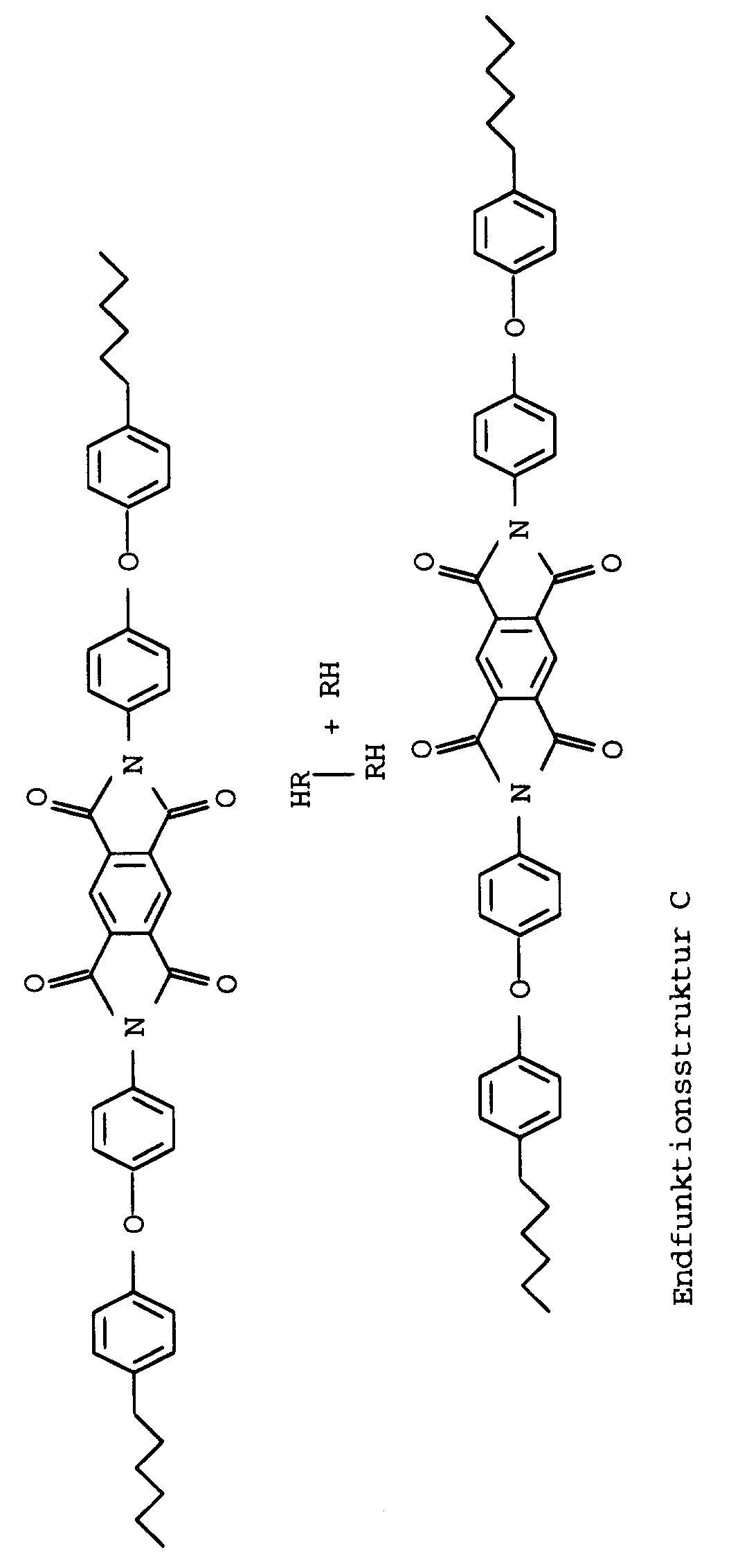
Die Einführung ungesättigter Gruppen in polymere Vorstufen A ist beispielsweise beschrieben in DE-A-2 437 397, DE-A-2 437 348, DE-A-2 437 413, DE-A-2 437 369, DE-A-2 919 840, DE-A-2 919 841, DE-A-2 933 826 und DE-A-2 308 830. - Im allgemeinen werden folgende drei Wege zum Aufbau lichtempfindlicher Vorstufen A nach dem Stand der Technik benutzt:
- a) Die Einführung der lichtempfindlichen Gruppen, in der Regel ethylenisch ungesättigte Gruppen, in die Monomerbausteine und danach Aufbbau der höhermolekularen Vorstufen.
Ein typisches Beispiel für diesen Weg wird in DE-A-2 437 397 angegeben, nämlich die Addition von Allylalkohol an Pyromellithsäureanhydrid, Umsetzung des entstandenen Halbesters mit Thionylchlorid zum Säurechlorid und aus diesem Aufbau der Polymeren durch Umsetzung mit aromatischen Diaminen.
Weitere Schriften zum Stand der Technik, die Aufbauwege von ungesättigten monomeren Bausteinen ausgehend beschreiben, sind z.B. DE-A-2 437 369, DE-A-2 437 413, DE-A-2 919 840, DE-A-2 919 841, DE-A-3 411 660, DE-A-3 411 697, DE-A-3 411 706, DE-A-3 411 714, US-A 4 551 522 und US-A 4 558 117. - b) Ein anderer Weg zur Einführung lichtempfindlicher ungesättigter Gruppen besteht darin, zunächst polymere bzw. oligomere Produkte ohne lichtempfindliche Gruppen aufzubauen und in diese dann lichtempfindliche Gruppen einzuführen.
Ein typisches Beispiel für diesen Weg wird z.B. in DE-A-2 933 826 beschrieben. Hier werden Pyromellithsäureanhydrid und Diaminodiphenyloxid in Dimethylacetamid als Lösemittel zu einem Polyamid addiert, das Carboxylgruppen enthält. An diesen Carboxylgruppen werden dann mit Glycidylmethacrylat Doppelbindungen eingeführt, wodurch die Vorprodukte A gebildet werden, die in Gegenwart von Photoinitiatoren unter UV-Licht vernetzbar sind.
Prinzipielle Nachteile des Standes der Technik nach Weg a) sind die aufwendige Reaktionssequenz und die Schwierigkeiten beim Aufbau der polymeren Stufen A, die sich aus dem ungesättigten Charakter der Ausgangs- und der Endstoffe ergeben.
Ebenso ist es schwierig nach Weg b) in polymere Produkte nachträglich Doppelbindungen einzuführen. Hier dürfen z.B. nur relativ niedrige Temperaturen angewandt werden, was lange Reaktionszeiten und schlechte Umsätze ergibt. Weiter müssen trotzdem z.T. Polymerisationsinhibitoren bei der Herstellung zugegeben und später in aufwendigen Reinigungsschritten wieder entfernt werden, um bei der Verwendung eine hohe Lichtempfindlichkeit zu erreichen.
Eine Reihe der oben genannten Patentschriften betrifft deshalb auch nicht das Prinzip, sondern Optimierungen der Methoden zur Herstellung der polymeren, lichtempfindlichen Vorstufen. Trotzdem bleibt ihre Herstellung kritisch. - c) Um diesen Problemen auszuweichen, wird in anderen Patentschriften vorgeschlagen, zunächst wie beim Weg b) ebenfalls nicht lichtempfindliche Polyamidsäuren aufzubauen und diese nachträglich durch einfache Zugabe ungesättigter Amine, die mit den Polyamidsäuren Salze bilden (vgl. z.B. DE-A-2 914 619), sehr schonend lichtempfindlich zu machen.
Hauptprobleme bei diesem Weg sind die schlechte Löslichkeit der Polymersalze und ihre hohe Viskosität, so daß nur Lösungen mit geringen Feststoffgehalten hergestellt werden können. Schließlich weisen die nach c) hergestellten Vorstufen bei Raumtemperatur eine für die Verarbeitung nur unzureichende Lagerstabilität auf.
Ein weiteres grundsätzliches Problem betrifft den Ausheizschritt der nach a) oder b) hergestellten Vorstufen A. Da die ungesättigten Gruppen kovalent an die Vorstufen der Heterocyclenpolymeren gebunden sind, müssen für längere Zeiten hohe Temperaturen angewendet werden, um eine quantitative Cyclisierung zu erreichen. Dabei färben sich die erzeugten Reliefstrukturen nicht nur schwarz, sondern die gewünschten mechanischen Eigenschaften, wie Biege- und Knickfestigkeit werden nicht erreicht. Gerade diesen Eigenschaften kommen durch den Trend in der Mikroelektronik zu immer größeren und immer höher integrierteren chips eine immer größere Bedeutung zu, um die gewünschte Zuverlässigkeit der erzeugten Bauteile sicherzustellen und um die Fehlerquote bei der Herstellung zu minimieren. - Aufgabe der vorliegenden Erfindung ist es, Photoresiste auf der Basis von löslichen Vorstufen von z.B. Polyimid, Polyisoindolochinazolindion, Polyaroylenbenzimidazol oder anderen Polyheterocyclen bereitzustellen, die die oben genannten Nachteile vermeiden, d.h., einfach und reproduzierbar herzustellen sind und Reliefstrukturen mit der gewünschten Biege- und Knickfestigkeit liefern.
- Diese Aufgabe läßt sich überraschenderweise sehr vorteilhaft durch die erfindungsgemäßen Gemische lösen.
- Gegenstand der vorliegenden Erfindung sind durch Einwirkung von Strahlung vernetzende Gemische, die dadurch gekennzeichnet sind, daß sie im wesentlichen bestehen aus
- (I) mindestens einer in polaren organischen Lösungsmitteln löslichen carboxylgruppenhaltigen polymeren Vorstufe hochtemperaturbeständiger heterocyclischer Polymerer,
- (II) mindestens einem copolymerisierbaren ethylenisch ungesättigten ternären Sulfoniumsalz,
- (III) mindestens einem Photoinitiator oder Photoinitiatorsystem und
- (IV) mindestens einem polaren aprotischen organischen Lösungsmittel.
- Bevorzugt als Komponente (I) sind Polyamidsäuren der allgemeinen Struktur

wobei die Carboxylgruppen an Ar¹ so gebunden sind, daß sie ortho- oder peri-ständig zu den Amidogruppen stehen,
Ar¹ ein substituierter oder nicht substituierter 4-wertiger aromatischer, araliphatischer, alicyclischer, aliphatischer oder heterocyclischer Rest ist,
Ar² ein substituierter oder nicht substituierter 2-wertiger, aromatischer, araliphatischer, alicyclischer, aliphatischer oder heterocyclischer Rest ist. Die Polyamidsäure kann ein statistisches Copolymer oder ein Blockcopolymer sein, wobei mindestens 2 unterschiedliche Gruppen Ar¹ und/oder Ar² in der Polyamidsäure enthalten sein können. - Als Komponente (II) sind Umsetzungsprodukte aus Thiodiglykol mit Glycidyl(meth)acrylat und einer organischen Mono-, Di- oder Polycarbonsäure bevorzugt.
- Bevorzugte Ausführungsformen der erfindungsgemäßen Gemische bestehen auch darin, daß als Komponente (II) ein ternäres Sulfoniumsalz eingesetzt wird, das sowohl im Kation als auch im Anion jeweils mindestens eine ethylenisch ungesättigte Gruppe enthält, bzw. daß es sich bei den in der Komponente (II) enthaltenen ethylenisch ungesättigten Gruppen um Acrylat- oder Methacrylatgruppen handelt.
- Als Komponente (III) bevorzugt sind Azide.
- Die erfindungsgemäßen Gemische können zusätzlich sogenannte "Reaktivverdünner", d.h., von Komponente (II) verschiedene ethylenisch ungesättigte copolymerisierbare organische Verbindungen sowie gegebenenfalls weitere Hilfs- oder Zusatzstoffe, wie Verlaufshilfsmittel, Sensibilisatoren und/oder Haftvermittler enthalten.
- Gegenstand der vorliegenden Erfindung ist auch ein Verfahren zur Herstellung von hochtemperaturbeständigen Reliefstrukturen durch bildmäßige Bestrahlung von auf einem Träger angebrachten Schichten strahlungsempfindlicher Gemische und Entfernung der unbestrahlten Bereiche dieser Schichten, das dadurch gekennzeichnet ist, daß die Schichten strahlungsempfindlicher Gemische aus erfindungsgemäßen Gemischen bestehen.
- Zu den Aufbaukomponenten der erfindungsgemäßen Gemische sowie zum erfindungsgemäßen Verfahren zur Herstellung hochtemperaturbeständiger Reliefstrukturen ist im einzelnen folgendes auszuführen.
- Das erfindungsgemäße Gemisch enthält als Komponente (I) in polaren aprotischen organischen Lösungsmitteln lösliche carborylgruppenhaltige polymere Vorstufen hochtemperaturbeständiger heterocyclischer Polymerer.
- Vorstufen derartiger Polyheterocyclen werden im allgemeinen erhalten durch Umsetzung von aromatischen, heterocyclischen oder cycloaliphatischen Dianhydriden der allgemeinen Formel O(CO)₂R(CO)₂O mit, gegebenenfalls substituierten, Polyaminen.
- Als Beispiele für geeignete Dianhydride, ohne Einschränkung auf diese, können genannt werden die
Dianhydride der Pyromellithsäure
oder der
Benzol-1,2,3,4-tetracarbonsäure,
Dianhydride der
4,4-Veresterungs-, 4,4-Veretherungs- und 4,4-Amidisierungsdimere der Trimellithsäure,
Dianhydride der
3,3',4,4'-Biphenyltetracarbonsäure,
2,2',4,4'-Biphenyltetracarbonsäure,
2,3,3',4'-Biphenyltetracarbonsäure,
3,3',4,4'-Benzophenontetracarbonsäure,
2,2',3,3'-Benzophenontetracarbonsäure,
2,3,3',4'-Benzophenontetracarbonsäure,
2,3,6,7-Naphthalintetracarbonsäure,
1,2,5,6-Naphthalintetracarbonsäure,
1,2,4,5-Naphthalintetracarbonsäure,
1,4,5,8-Naphthalintetracarbonsäure,
1,2,6,7-Naphthalintetracarbonsäure,
2,6-Dichlornaphthalin-1,4,5,8-tetracarbonsäure,
2,7-Dichlornaphthalin-1,4,5,8-tetracarbonsäure,
2,3,6,7-Tetrachlornaphthalin-1,4,5,8-tetracarbonsäure,
1,4,5,8-Tetrachlornaphthalin-2,3,6,7-tetracarbonsäure,
4,8-Dimethyl-1,2,3,5,6,7-hexahydronaphthalin-1,2,5,6-tetracarbonsäure,
4,8-Dimethyl-1,2,3,5,6,7-hexahydronaphthalin-2,3,6,7-tetracarbonsäure,
4,4'-Oxydiphthalsäure,
3,3'-Oxydiphthalsäure,
4,4'-Sulfonyldiphthalsäure,
4,4'-Sulfonyldiphthalsäure,
4,4'-Thiodiphthalsäure,
3,3'-Thiodiphthalsäure,
4,4'-Acetylidendiphthalsäure,
Bis(2,3-dicarboxyphenyl)methan,
Bis(3,4-dicarboxyphenyl)methan,
1,1-Bis(2,3-dicarboxyphenyl)ethan,
1,1-Bis(3,4-dicarboxyphenyl)ethan,
2,2-Bis(2,3-dicarboxyphenyl)propan,
2,2-Bis(3,4-dicarboxyphenyl)propan,
Phenanthren-1,2,7,9-tetracarbonsäure,
Phenanthren-1,2,6,7-tetracarbonsäure,
Phenanthren-3,4,5,6-tetracarbonsäure,
Phenanthren-1,2,9,10-tetracarbonsäure,
2,3,9,10-Perylentetracarbonsäure,
3,4,9,10-Perylentetracarbonsäure,
2,3,8,9-Perylentetracarbonsäure,
4,5,10,11-Perylentetracarbonsäure,
4,5,11,12-Perylentetracarbonsäure,
3,3'',4,4''-Terphenyltetracarbonsäure,
2,2'',3,3''-p-Terphenyltetracarbonsäure,
2,3,3'',4''-p-Terphenyltetracarbonsäure,
Butan-1,2,3,4-tetracarbonsäure,
Cyclopentan-1,2,3,4-tetracarbonsäure,
Pyrrolidin-2,3,4,5-tetracarbonsäure,
Thiophen-2,3,4,5-tetracarbonsäure,
Pyrazin-2,3,5,6-tetracarbonsäure, Tetrahydrofurantetracarbonsäure,
9-Brom-10-merkaptoanthracentetracarbonsäure,
9,10-Dimerkaptoanthracendicarbonsäure und
2,6-Endovinylencyklohexan-1,2,4,5-tetracarbonsäure,
die einzeln oder als Gemisch für die Synthese der Vorstufe der Polyheterocyclen eingesetzt werden können. - Unter Polyamine werden aromatische, araliphatische, heterocyclische, cycloaliphatische, aliphatische Verbindungen vom folgenden Typ verstanden:
SnR(NH₂)m
0≦n≦m, 1<m, wobei n und m ganze Zahlen sind
R = aromatischer, araliphatischer, heterocyclischer, cycloaliphatische, aliphatischer Rest
S = OH, COOH, NH₂, CONH₂, CSNH₂. - Als Beispiele für geeignete Polyamine, ohne Einschränkung auf diese, können genannt werden:
p-Phenylendiamin,
m-Phenylendiamin,
4,4'-Diaminodiphenyloxid,
3,3'-Diaminodiphenyloxid,
3,4'-Diaminodiphenyloxid,
4,4'-Diaminodiphenylsulfid,
3,3'-Diaminodiphenylsulfid,
3,4'-Diaminodiphenylsulfid,
4,4'-Diaminodiphenylsulfon,
3,3'-Diaminodiphenylsulfon,
3,4'-Diaminodiphenylsulfon,
4,4'-Diaminodiphenylmethan,
3,3'-Diaminodiphenylmethan,
3,4'-Diaminodiphenylmethan,
(4,4'-Diaminodiphenyl)-propan,
(3,3'-Diaminodiphenyl)-propan,
(4,4'-Diaminodiphenyl)-ethan,
(3,3'-Diaminodiphenyl)-ethan,
4,4'-Bis (4,4'-aminophenoxy)-biphenyl,
4,4'-Bis (4,3'-aminophenoxy)-biphenyl,
2,2-Bis[4-(4,4-aminophenoxy)phenyl]-propan,
2,2-Bis[4-(4,4-aminophenoxy)phenyl]-perfluorpropan,
2,2-Bis[4-(3,4-aminophenoxy)phenyl]-propan,
2,2-Bis[4-(3,3'-aminophenoxy)phenyl]-propan,
2,2-Bis[4-(4,4'-aminophenoxy)phenyl]-sulfon,
2,2-Bis[4-(3,4-aminophenoxy)phenyl]-sulfon,
2,2-Bis[4-(3,3'-aminophenoxy)phenyl]-sulfon,
4,4'-Dimethyl-3,3'-diaminodiphenylsulfon,
2,2-Bis[4-(4,4'-aminophenoxy)phenyl]-sulfid,
2,2-Bis[4-(3,4-aminophenoxy)phenyl]-sulfid,
2,2-Bis[4-(3,3'-aminophenoxy)phenyl]-sulfid,
2,2-Bis[4-(4,4'-aminophenoxy)phenyl]-methan,
2,2-Bis[4-(3,4-aminophenoxy)phenyl]-methan,
2,2-Bis[4-(3,3'-aminophenoxy)phenyl]-methan,
1,4-Bis-(4,4'-aminophenoxy)-phenylen,
1,4-Bis-(3,4'-aminophenoxy)-phenylen,
1,4-Bis-(3,3'-aminophenoxy)-phenylen,
4,4'-Diaminobenzanilid,
3,4'-Diaminobenzanilid,
3,3'-Diaminobenzanilid,
4,4'-Diaminodiphenyl (Benzidin),
3,4'-Diaminodiphenyl,
3,3'-Diaminodiphenyl,
3,3'-Dimethoxy-4,4'-diaminodiphenyl,
3,3'-Dimethoxy-3,4'-diaminodiphenyl,
3,3'-Dimethyl-4,4'-diaminodiphenyl,
3,3'-Dimethyl-3,4'-diaminodiphenyl,
1,8-Diaminonaphthalin,
1,5-Diaminonaphthalin,
p-Terphenyl-4,4''-diamin,
p-Terphenyl-3,3''-diamin,
5-tert.-Butyl-2,4-toluylendiamin,
3-tert.-Butyl-2,6-toluylendiamin,
3,5-Diethyl-2,4-toluylendiamin,
3,5-Diethyl-2,6-toluylendiamin,
α,ω-Diamino-(polyphenylensulfid)e,
m-Xylylendiamin,
p-Xylylendiamin,
Bis-4,4'-[(2,6-diisopropyl)aminophenyl]methan,
Bis-4,4'-[(2-methyl-6-isopropyl)aminophenyl]methan,
Bis-4,4'-[(2,6-dimethyl)aminophenyl]methan,
Bis-4,4'-[(2,6-diisopropyl)aminophenyl]ether,
Bis-4,4'-[(2-methyl-6-isopropyl)aminophenyl]ether,
Bis-4,4'-[(2,6-dimethyl)aminophenyl]ether,
Diamino-(dimethyl-)-dicyclohexyl-methan,
Diamino-(dimethyl-diisopropyl-)-dicyclohexyl-methan,
Diamino-(tetraisopropyl-)-dicyclohexyl-methan,
Diamino-(diisopropyl-)-dicyclohexyl-methan,
Diisopropyltoluylendiamin,
Alkyliso-propyl-toluylendiamin,
3,3',4,4'-Tetraaminobiphenyl,
3,3',4,4'-Tetraaminodiphenylmethan,
3,3',4,4'-Tetraaminodiphenylether,
3,3',4,4'-Tetraaminodiphenylsulfon,
3,3',4,4'-Tetraaminodiphenylsulfid,
3,3'-Dihydrorybenzidin,
Hexafluoro-2,2-bis-(4-hydroxy-3-aminophenyl)-propan,
Methylenbisanthranilsäure,
2,4-Diaminobenzoesäure,
Methylenbisanthranilsäurebisamid sowie
2,4-Diaminobenzoesäureamid. - Unter Polyaminen im Sinne der Erfindung sollen auch Verbindungen verstanden werden, die das Strukturelement N-N enthalten, d.h., Derivate des Hydrazins darstellen.
- Bei der Herstellung der Vorstufen der Polyheterocyclen kann vorteilhaft mit Zusatz von Reglern gearbeitet werden. Dadurch ist es möglich, gezielt Festgehalt und Viskosität der Vorstufen einzustellen, wobei gleichzeitig die Reproduzierbarkeit verbessert wird.
- Ohne Regler werden hochmolekulare und damit hochviskose Lösungen erhalten, die nur noch schwer zu verarbeiten sind.
- Ferner verbessert der Zusatz von Reglern, sofern es sich um ethylenisch ungesättigte Verbindungen handelt, die Lichtempfindlichkeit der aus diesen Vorstufen hergestellten Resiste, da die Regler als Endgruppen in die Polyheterocyclenvorstufen eingebaut werden. Als Beispiel sind die Strukturformeln geregelter Polyamidsäuren aufgeführt.

P¹ = -O-R¹, -NH-R¹
P² = -CO-R¹, -CO-NH-R¹, -CO-OR¹. - R¹ = aliphatischer, cycloaliphatischer, araliphatischer, aromatischer oder heterocyclischer Rest, der vorzugsweise eine polymerisierbare Mehrfachbindung enthält.
- Geregelt wird in der Weise, daß vor oder während der Herstellung der Polyheterocyclenvorstufe ein Teil der Dianhydrids und/oder des Polyamins mit der Reglerkomponente umgesetzt werden, so daß im Sinne des Polymeraufbaus monofunktionelle Polymerbausteine erhalten werden, die als Endgruppen in der Polymerkette wirken.
- Als Regler für die Dianhydride können Monohydroxy- bzw. Monoaminoverbindungen eingesetzt werden, vorzugsweise solche, die ungesättigte Gruppen tragen, z.B.
2-Hydroxyethylacrylat,
2-Hydroxyethylmethacrylat,
Glyzerindiacrylat,
Glyzerindimethacrylat,
3-Hydroxypropylacrylat,
3-Hydroxypropylmethacrylat,
2-Hydroxypropylacrylat,
2-Hydroxypropylmethacrylat,
4-Hydroxybutylacrylat,
4-Hydroxybutylmethacrylat,
Polyethylenglycolmodifiziertes Acrylat,
Polypropylenglycolmodifiziertes Acrylat,
Polyethylenglycolmodifiziertes Methacrylat,
Polypropylenglycolmodifiziertes Methacrylat,
Pentaerythrittriacrylat,
Pentaerythrittrimethacrylat,
Dipentaerythritpentaacrylat,
Dipentaerythritpentamethacrylat, Trimethylolpropandiacrylat,
Trimethylolpropandimethacrylat,
Zimtalkohol,
Allylalkohol,
Pentaerythrittriallylether,
Trimethylolpropandiallylether,
4-Hydroxybutylallylether,
Glyzerindiallylether,
Allylamin,
Diallylamin sowie
4-Aminostyrol. - Als Regler für die Polyamine können Monoanhydride bzw. Monoisocyanate eingesetzt werden, vorzugsweise solche, die ungesättigte Gruppen tragen, z.B.:
Maleinsäureanhydrid,
Itaconsäureanhydrid,
Methacrylsäureanhydrid,
Acrylsäureanhydrid,
Isocyanatoethylmethacrylat,
1-(1-Isocyanato-1-methylethyl)-4-(1-methylethenyl)-benzol,
Monoadditionsprodukte von ungesättigten Alkoholen an 2,4-Toluylendiisocyanat sowie
Monoadditionsprodukte von ungesättigten Alkoholen an 2,4'-Isocyanatodiphenylmethan. - Bezüglich der miteinander zur Reaktion zu Dringenden Ausgangskomponenten sowie der Reaktionsbedingungen ist zu erwähnen, daß zweckmäßigerweise bei Temperaturen zwischen -10 und +100°C in hochpolaren organischen Lösungsmitteln gearbeitet wird.
- Komponente (I) ist im erfindungsgemäßen Gemisch im allgemeinen in einer Menge von 5 bis 60, vorzugsweise 20 bis 45 Gew.-%, bezogen auf das gesamte Gemisch enthalten.
- Als Komponente (II) enthält das erfindungsgemäße Gemisch copolymerisierbare ethylenisch ungesättigte ternäre Sulfoniumsalze.
- Ternäre Sulfoniumsalze sind Umsetzungsprodukte von Thioethern mit Epoxiden in Gegenwart einer Säure oder von Thioethern mit anderen Alkylierungsmitteln, wie Alkylhalogeniden, Alkylsulfaten usw. Maßgeblich ist, daß mindestens eine der verwendeten Komponenten eine ungesättigte, polymerisierbare Mehrfachbindung enthält, so daß das erhaltene Sulfoniumsalz mindestens eine ungesättigte, polymerisierbare Mehrfachbindung enthält, entweder im Sulfoniumteil oder aber im Gegenion.

- R', R'', R'''
- = aliphatische, aromatische, araliphatische oder cycloaliphatische Reste, möglicherweise unterbrochen durch O, N, S, Carbonylgruppe, Ester oder Amidbindung und gegebenenfalls sübstituiert durch OH,
- X⁻
- = organisches oder anorganisches Anion, dessen Nukleophilie so gering ist, daß es bei Raumtemperatur nicht mit der Sulfoniumgruppe reagiert.
- Besonders bevorzugt sind die Umsetzungsprodukte von gesättigten oder ungesättigten Thioethern mit ungesättigten Epoxiden wie z.B. Glycidylmethacrylat oder Glycidylacrylat in Gegenwart einer Säure oder die Umsetzungsprodukte von ungesättigten Thioethern mit gesättigten Epoxiden in Gegenwart einer Säure.
- Bevorzugt sind solche Umsetzungen, bei denen die Thioether hydroxysubstituiert sind, z.B. das Sulfoniumsalz der allgemeinen Formel

worin R eine ethylenisch ungesättigte Gruppe enthält und X⁻ für ein organisches oder anorganisches Säureanion steht. - Weiterhin bevorzugt sind die Umsetzungen, bei denen die eingesetzte Säure zusätzlich zum Epoxid oder Thioether eine polymerisierbare Mehrfachbindung trägt, wie z.B. Crotonsäure, Methacrylsäure, Acrylsäure, Fumarsäure, Zimtsäure, Maleinsäure, Propiolsäure, 2-Acrylamidoglycolsäure, 2,2-Bis(acrylamido)essigsäure, allgemein die Additionsprodukte von ungesättigten Alkoholen oder Aminen (wie sie oben bereits als Regler aufgelistet wurden) an Mono- oder Polyanhydride z.B. 4-(2-Methacryloyloxyethyl)maleinsäure, 4-(2-Acryloyloxyethyl)maleinsäure, Phthalsäuremonomethacryloyloxyethylester, Phthalsäuremonoacryloyloxyethylester, Pyromellithsäuredi-(2-methacryloyloxyethylester), N,N-Diallylmaleinsäuremonoamid sowie N,N-Diallylitaconsäuremonoamid.
- Ganz besonders bevorzugt sind Umsetzungsprodukte von Thiodiglycol mit ungesättigten Epoxiden und den oben genannten ungesättigten Säuren.
- Komponente (II) ist erfindungsgemäßes Gemisch im allgemeinen in einer Menge von 1 bis 50, vorzugsweise 10 bis 35 Gew.-%, bezogen auf das gesamte Gemisch enthalten.
- Als Komponente (III) enthält das erfindungsgemäße Gemisch einen Photoinitiator oder ein Photoinitiatorsystem.
- Als Photoinitiatoren kommen praktisch alle bekannten Systeme z.B. H-abstrahierende Systeme, α-Spalter und besonders bevorzugt Azide in Frage. Als Beispiele sind zu nennen:
Benzophenon,
Acetophenon,
Benzanthron,
Anthrone,
4,4'-N,N,N',N'-Tetramethyldiaminobenzophenon (Michlers Keton),
Phenanthrene,
2-Nitrofluoren,
Nitroacenaphthen, Benzochinon,
N-Acetyl-p-nitroanilin,
p-Nitroanilin,
2-Ethylanthrachinon,
2-tert.Butylanthrachinon,
N-Acetyl-4-nitro-1-naphthylamin,
Picramide,
1,2-Benzanthrachinon,
3-Methyl-1,3-diaza-1,9-benzanthron,
4,4'-Tetraethyldiaminobenzophenon,
2-Chloro-4-nitroanilin,
Dibenzalaceton,
1,2-Naphthochinon,
2,5-Bis-(4'-diethylaminobenzal)-cyclopentan,
2,6-Bis-(4'-diethylaminobenzal)-cyclohexanon,
2,6-Bis-(4'-diethylaminobenzal)-methylcyclohexanon,
2,6-Bis-(4'-dimethylaminobenzal)-methylcyclohexanon,
4,4'-Bis-(dimethylamino)chalcone,
4,4'-Bis-(diethylamino)chalcone,
p-Dimethylaminobenzylidenindanon,
1,3-Bis-(4'-dimethylaminobenzal)-aceton,
1,3-Bis-(4'-diethylaminobenzal)-aceton,
N-Phenyldiethanolamin,
N-p-tolyldiethylamin,
Styrolderivate,
Cumarinderivate,
2,2-Dimethoxy-2-phenylacetophenon,
1-Hydroxycyclohexylphenylketon,
2-Methyl[(4-methylthio)-phenyl]-2-morpholino-1-propan,
3,3',4,4'-Tetra(tert.-butylperoxycarbonyl)benzophenon,
Benzoin-isopropylether,
Benzoin-isobutylether,
4,4'-Dimethoxybenzil,
1,4-Dibenzoylbenzol,
4-Benzoylbiphenyl,
2-Benzoylnaphthalin,
Methyl-o-benzoyl-benzoat,
2,2'-Bis(o-chlorophenyl)-4,4',5,5'-tetraphenyl-1,2-bisimidazol,
10-Butyl-2-chloroacridon,
Etyhl-4-dimethylaminobenzoat,
Dibenzoylmethan,
2,4-Diethylthioxanthon,
3,3-Dimethyl-4-methoxybenzophenon,
2-Hydroxy-2-methyl-1-phenylpropan-1-on,
1-(4-Isopropylphenyl)-2-hydroxy-2-methylpropan-1-on,
1-(4-Dodecylphenyl)-2-hydroxy-2-methylpropan-1-on,
1-Phenyl-1,2-butandion-2-(o-methoxycarbonyl)oxim,
1-Phenylpropandion-2-(benzoyl)oxim,
1,2-Diphenylethandion-1-(o-benzoyl)oxim,
1-Phenyl-3-ethoxypropantrion-2-(o-benzoyl)oxim,
Glyzin-Derivate,
Oxazolon-Derivate,
substituierte Hexaarylbisimidazole,
1,3,5-Triazin-2-(4-methoxyphenyl)4,6-di-(trichloromethyl),
1,3,5-Triazin-2-(piperonyl)-4,6-di-(trichloromethyl),
1,3,5-Triazin-2-(4-methoxynaphthalin)-4,6-di-(trichloromethyl) sowie vorzugsweise
Azide, deren N₃-Gruppen direkt oder über eine So₂- oder CO-Gruppe an einen aromatischen Ring gebunden sind, z.B.
2-(N,N-Dimethylamino)-ethyl-4-azidocinnamat,
2-(N,N-Dimethylamino)-ethyl-4-azidonaphthylketon,
2-(N,N-Dimethylamino)-ethyl-4-azidobenzoat,
5-Azido-1-naphthyl-2'-(N,N-dimethylamino)ethylsulfon,
N-(4-Sulfonylazidophenyl)maleinimid,
N-Acetyl-4-sulfonylazidoanilin,
4-Sulfonylazidoanilin,
4-Azidoanilin,
4-Azidophenacylbromid,
p-Azidobenzoesäure,
2,6-Bis(p-azidobenzyliden)cyclohexanon und
2,6-Bis(p-azidobenzyliden)-4-methylcyclohexanon. - Auch Gemische von Aziden mit nicht Azidogruppen enthaltenden Photoinitiatoren kommen hier in Frage.
- Komponente (III) ist im erfindungsgemäßen Gemisch in Mengen von 0,01 bis 10, vorzugsweise 0,5 bis 5 Gew.-%, enthalten.
- Als Komponente (IV) werden erfindungsgemäß polare aprotische organische Lösungsmittel eingesetzt.
- Auch die Herstellung der oben genannten Vorstufen von Polyheterocyclen (I) erfolgt in der Regel in hochpolaren, vorzugsweise aprotischen Lösemitteln. Als Beispiele für derartige Lösungsmittel können genannt werden:
Formamid, Acetamid, N-Methylformamid, N,N-Dimethylformamid, N,N-Diethylformamid, N-Methylpyrrolidon, N,N-Dimethylacetamid, N,N-Diethylacetamid, γ-Butyrolacton, Caprolactam, Pyrrolidon, Dimethylsulfoxid, Sulfolan, Dimethylsulfon, Hexamethylenphosphorsäureamid, Dimethylpropylenharnstoff, Dimethylethylenharnstoff u.a., wobei N-Methylpyrrolidon, Dimethylacetamid, γ-Butyrolacton und Dimethylsulfoxid bevorzugt sind. - Diese polaren Stoffe können teilweise durch weitere Lösemittel wie Alkohole, Ester, Ketone, Ether und Kohlenwasserstoffe ersetzt werden.
- Komponente (IV) kann im erfindungsgemäßen Gemisch im allgemeinen in Mengen von 10 bis 80, vorzugsweise 40 bis 60 Gew.-% enthalten sein.
- Das erfindungsgemäße Gemisch kann zusätzlich von Komponente (II) verschiedene ethylenisch ungesättigte copolymerisierbare organische Verbindungen, sogenannte Reaktivverdünner, enthalten.
- Reaktivverdünner sind in der Regel niedrigviskose, einfach oder mehrfach ethylenisch ungesättigte Verbindungen, die zur Erhöhung der Lichtempfindlichkeit und zur besseren Verarbeitbarkeit zugesetzt werden. Bevorzugt werden dafür Verbindungen aus der Klasse der Acrylate und Methacrylate sowie deren polyfunktionelle Vertreter.
- Besonders geeignet sind:
Hydroxyalkyl-(meth)-acrylate, wie Hydroxyethylacrylat, Hydroxyethylmethacrylat, Hydroxypropylacrylat, Hydroxypropylmethacrylat, Butandiolmonoacrylat, Butandiolmonomethacrylat, N-Hydroxymethylacrylamid, N-Hydroxymethylmethacrylamid, Diethylenglykolmonoacrylat, Diethylenglykolmonomethacrylat, Glyzerindimethacrylat, Glyzerindiacrylat, Glyzerintrimethacrylat, Glyzerintriacrylat, Trimethylolpropandimethacrylat, Trimethylolpropandiacrylat, Trimethylolpropantrimethacrylat, Trimethylolpropantriacrylat, Pentaerythrittrimethacrylat, Pentaerythrittriacrylat, Diaceton(meth)acrylamid, Zimtalkohol, Hydroxyalkylzimtsäureester und Hydroxyzimtalkohol oder Mischungen der genannten Verbindungen. - Weiterhin sind ganz besonders geeignet Amidverbindungen mit Kohlenstoff-Kohlenstoff-Doppelbindungen wie N-Acrylolyl-piperidin, N-Acrylolylmorpholin, Acrylamid, Methacrylamid, N-Methylacrylamid, N-Methylmethacrylamid, N-Ethylacrylamid, N-Ethylmethacrylamid, Acrylamidoglykolsäure und weitere N-Alkylacrylamide, N,N-Dimethylacrylamid, N,N-Dimethyl-methacrylamid, N,N-Diethylacrylamid, N,N-Diethylmethacrylamid, weitere N,N-Dialkyl-(meth)-acrylamide, N,N-Dimethylaminoethyl-(meth)-acrylamid, N,N-Dimetyhl-aminopropyl(meth)acrylamid und weitere N-Amino-alkyl-(meth)acrylamide und N,N-Diaminoalkyl(meth)acrylamide, N-Aminoalkoxyalkyl(meth)acrylamide und N,N-Diaminoalkoxyalkyl(meth)acrylamide sowie N-Vinyl-pyrrolidon.
- Besonders geeignet sind weiter die Methylolierungsprodukte von Acryl- und Methacrylamid und deren etherartigen Kondensationsprodukte mit mono- oder polyfunktionellen Alkoholen.
- Diese Reaktivverdünner können dem erfindungsgemäßen Gemisch in Mengen von bis zu 25 Gew.-%, bezogen auf die Gesamtmenge, zugesetzt werden.
- Den erfindungsgemäßen Gemischen können noch weitere Hilfs- bzw. Zusatzstoffe in geringen Mengen von bis zu 10 Gew.-% zugefügt werden, um bestimmte gewünschte Effekte zu erzielen.
- Als weitere derartige Hilfs- bzw. Zusatzstoffe können Verwendung finden:
- a) Verlaufshilfsmittel, die dazu dienen, glatte, kraterfreie Oberflächen zu erhalten
- b) Sensibilisatoren,
die die Lichtemfpindlichkeit durch Erweiterung des Absorptionsbereichs des eingesetzten Photoinitiators durch wirksame Übertragung von Strahlungsenergie auf den Photoinitiator verbessern, z.B.
Anthrachinon, 2-Methylanthrachinon, 2-Ethylanthrachinon. Benzochinon, 1,2-Naphthochinon, 1,4-Naphthochinon, 1,2-Benzanthrachinon, Benzophenon, 4,4'-Dimethylbenzophenon, Michler's Keton, 2-Nitrofluoren, 5-Nitroacetonaphthen, 4-Nitro-1-naphthylamin, Anthron, 1,9-Benzanthron, Dibenzalaceton, 4,4'-Bis(diethylamino)benzophenon, Acridin, Cyanoacridin, Nitropyren, 1,8-Dinitropyren, Pyren-1,6-chinon, 2-Brom-benzanthrachinon, 9-Fluorenon, 2-Chlor-1,8-phthaloylnaphthalin, usw. - c) Leukofarbstoffe, z.B. Leukokristallviolett;
- d) Haftvermittler, z.B. 3-Azidopropyltriethoxysilan.
- Verwendung finden die erfindungsgemäßen Mischungen als Photoresiste für die Herstellung hochtemperaturbeständiger Reliefstrukturen, wie sie bei der Herstellung mikroelektronischer Bauteile als Isolations- oder Passivierungsschichten oder auch als α-Partikelbarrieren eingesetzt werden.
- Das erfindungsgemäße Verfahren zur Herstellung von Photoresisten sowie die Herstellung von hochtemperaturbeständigen Reliefstrukturen daraus kann in allgemein üblicher Weise durchgeführt werden.
- Die besonderen Vorteile der erfindungsgemäßen Gemische und deren Weiterverarbeitung liegen in ihrer einfachen und gut reproduzierbaren Herstellung sowie in der Biege- und Knickfestigkeit der daraus hergestellten Reliefstrukturen.
- Die in den Beispielen angegebenen Teile und Prozente sind, soweit nicht anders angegeben, Gewichtsteile bzw. Gewichtsprozente.
-
- PMDA
- Pyromellithsäuredianhydrid
- BPDA
- 3,3',4,4'-Benzophenontetracarbonsäuredianhydrid
- ODPA
- 4,4'-Oxydiphthalsäureanhydrid
- BAPP
- 2,2-(Bis(4-(4-aminophenoxy)phenyl)propan
- DADO
- 4,4'-Diaminodiphenyloxid
- NMP
- N-Methylpyrrolidon
- DMAA
- Dimethylacetamid
- DMAP
- 4-Dimethylaminopyridin
- HEA
- Hydroxyethylacrylat
- HEMA
- Hydroxyethylmethacrylat
- GDMA
- Glyzerindimethacrylat
- TDG
- Thiodiglycol
- GMA
- Glycidylmethacrylat
- GA
- Glycidylacrylat
- HQME
- Hydrochinonmonomethylether
- LKV
- Leukokristallviolett
- MAZ
- N-(4-Azidosulfonylphenyl)maleinimid.
- (I)1:
In einer trockenen Apparatur wurde unter Reinststickstoff 54,5 g PMDA in 130,5 g DMAA bei 70°C gelöst, 0,4 g DMAP zugegeben und innerhalb von 2 Stunden eine Lösung von 102,6 g BAPP in 185,0 g NMP und 54,5 g DMAA bei 70°C zugegeben. Nach Ende der Zugabe wurde noch 2 Stunden bei 70°C gerührt und die erhaltene viskose Lösung auf Raumtemperatur abgekühlt.
Viskosität/Festgehalt: 11000 mPas/30 %
Säurezahl: 53,3 (Theorie 53,5) - (I)2:
In einer trockenen Apparatur wurde unter Reinststickstoff 8,18 g PMDA in 195,2 g DMAA bei 30°C vorgelegt. Es wurden 2,0 g HEA zugegeben und die Mischung 2 Stunden bei 30°C gerührt, dann wurde bei 30°C innerhalb von 2 Stunden eine Lösung von 153,9 g BAPP und 0,6 g DMAP in 277,2 g NMP und 81,9 g DMAA zugegeben und 1 Stunde bei 30°C gerührt. Anschließend wurde die viskose Lösung für 2 Stunden auf 70°C erwärmt.
Viskosität/Festgehalt: 4000 mPas/30 %
Säurezahl: 53,4 (Theorie: 53,5) - (I)3:
Es wurde wie bei (I)2 verfahren, nur wurden 4,1 g HEA verwendet.
Viskosität/Festgehalt: 1600 mPas/30 %
Säurezahl: 53,5 (Theorie: 53,5) - (I)4:
Es wurde wie bei (I)3 verfahren, nur wurden 10,6 g HEA verwendet.
Viskosität/Festgehalt: 630 mPas/30 %
Säurezahl: 53,6 (Theorie: 53,5) - (I)5:
Es wurde wie bei (I)1 verfahren, nur wurden anstelle PMDA 80,6 g BPDA eingesetzt.
Viskosität/Festgehalt: 14000 mPas/30 %
Säurezahl: 45,6 (Theorie: 45,8) - (I)6:
Es wurde wie bei (I)1 verfahren, nur wurden anstelle PMDA 77,6 g ODPA eingesetzt.
Viskosität/Festgehalt: 15000 mPas/30 %
Säurezahl: 46,3 (Theorie: 46,6) - Aus den gemäß (I)1 bis (I)6 hergestellten Vorstufen von Polyheterocyclen wurden durch einfaches Zumischen unterschiedlicher Mengen der gemäß (II)1 bis (II)8 erhaltenen Sulfoniumverbindungen und durch die Zugabe von jeweils 5 % MAZ (bezogen auf den Gesamtfeststoffgehalt des Photoresists) und 1 % LKV Photoresistlösungen hergestellt.
- Die Photoresistlösungen wurden auf Silicium-Wafer in einer Schichtdicke von 6 µm (trocken) aufgeschleuert, 10 min. bei 80°C auf einer hotplate getrocknet und anschließend mit einer 360 W Quecksilberhochdrucklampe durch eine Graukeilmaske mit 15 Abstufungen (Multidensity Resolution Target der Firma Optoline) für die Dauer von 60 sec belichtet. Danach wurde der Wafer in einem Sprühentwickler 60 sec lang mit Dimethylpropylenharnstoff entwickelt und anschließend mit Isopropanol gespült.
- Zur Prüfung der mechanischen Eigenschaften wurden Filme der Photoresiste auf Blechstreifen gerakelt, bei 90°C für 30 min unter N₂ getrocknet und vollflächig belichtet. Anschließend wurden die Filme in einem Plattentrockenschrank unter Vakuum mit einer Heizrate von 3°/min auf 400°C erhitzt und 30 min bei dieser Temperatur belassen. Nach dem langsamen Abkühlen wurde die Biege- und Knickfestigkeit geprüft.
- Dazu wurden die Blechstreifen über einen unsymmetrischen Dorn (Länge 200 mm, Durchmesser zwischen 37 mm und 3 mm) um 180° gebogen. Bewertet wurde nach folgender Skala:
- 1: Der Film reißt an keiner Stelle.
- 2: Der Film reißt max. bis zur halben Breite des Dorns.
- 3: Der Film reißt mehr als bis zur halben Breite des Dorns.
- 4: Der Film reißt auf der gesamten Dornbreite.
- Sie wurde an abgelösten Filmstreifen geprüft und nach folgender Skala bewertet:
- 1: Der Film bricht bei mehrfachem Knicken nicht.
- 2: Der Film bricht erst bei mehrfachem Knicken.
- 3: Der Film bricht beim Knicken.
- 4: Der Film ist spröde und bricht schon im Ansatz zum Knicken.
- Die Prüfergebnisse sind in der Tabelle angeführt.
- 109,0 g PMDA und 130,1 g HEMA wurden zusammen mit 400 g γ-Butyrolacton und 100 g Pyridin 40 Stunden bei Raumtemperatur gerührt. Zu der erhaltenen Lösung wurde bei 20°C eine Lösung von 100,1 g DADO und 206 g Dicyclohexylcarbodiimid in 400 g NMP zugetropft. Die Reaktionsmischung wurde über Nacht gerührt. Danach wurde der ausgefallene Dicyclohexylharnstoff abfiltriert. Die erhaltene Lösung wurde in Ethanol ausgefällt, der ausgefallene Polyamidsäureester abgesaugt und im Vakuum getrocknet. Es wurde eine 30%ige Lösung in NMP hergestellt und daraus durch Zugabe von 5 % MAZ und 1 % LKV ein Resist formuliert, der in der gleichen Weise geprüft wurde, wie die oben beschriebenen erfindungsgemäßen Resiste.
Tabelle Beispiel Nr. Vorstufe Sulfoniumsalz/Menge *) Graukeilstufe**) Biegefestigkeit Knickfestigkeit 1 (I)1 (II)2/100 18 2 3 2 (I)1 (II)3/100 14 2 2 3 (I)1 (II)3/ 75 12 1 1 4 (I)1 (II)3/ 65 14 1 1 5 (I)1 (II)3/ 50 24 1 1 6 (I)1 (II)4 /70 22 2 2 7 (I)1 (II)5/ 70 16 1 1 8 (I)1 (II)6/ 75 25 1 2 9 (I)1 (II)7/ 70 22 1 1 10 (I)1 (II)8/ 75 25 1 2 11 (I)1 (II)2/ 70 20 2 2 12 (I)2 (II)3 9/70 18 1 1 13 (I)3 (II)3 9/70 22 1 1 14 (I)4 (II)3 9/70 25 1 2 16 (I)5 (II)3 9/70 14 1 1 16 (I)6 (II)3 9/70 14 1 1 Vgl.Bsp. - 10 4 4 *) die Menge in Gew.-% bezogen auf den Feststoffgehalt der eingesetzten Vorstufe (I) **) angegeben ist die Transmission der Graukeilstufe in %; d.h. je kleiner die Zahl, desto höher die Empfindlichkeit.
A Herstellung der Vorstufen (I)
B Herstellung der Sulfoniumsalze (II)
(II)1:
279,4 g TDG, 184,6 g GMA, 0,18 g HQME und 60 g Essigsäure wurden bei Raumtemperatur gemischt und anschließend für 8 Stunden auf 40°C erwärmt. Danach war der Umsatz bezüglich der Essigsäure quantitativ (potentiometrische Titration mit Tetrabutylammoniumhydroxid) . Die Ausbeute an Sulfoniumacetat betrug 75 % (potentiometrische Titration mit Perchlorsäure).
(II)2 bis (II)8:
Wie bei (II)1 beschrieben, wurden von verschiedenen Säuren ausgehend die folgenden Sulfoniumsalze hergestellt:
| Bezeichnung | Säure | Temperatur/Reaktionszeit | Umsatz Säure | Ausbeute an Sulfoniumsalz |
| (II)2 | Maleinsäure | 40°C/5 h | 100 % | 98 % |
| (II)3 | Oxalsäure | 20°C/4 h | 96 % | 95 % |
| (II)4 | Propargylsäure | 20°C/6 h | 97 % | 81 % |
| (II)5 | Methansulfonsäure | 20°C/1 h | 97 % | nicht bestimmt |
| (II)6 | Crotonsäure | 40°C/9 h | 97 % | 71 % |
| (II)7 | Zimtsäure | 40⁰C/6 h | 90 % | 67 % |
| (II)8 | 4-(2-Methacryloyloxyethyl)-maleinsäure | 40°C/7 h | 100 % | 93 % |
Claims (14)
- Durch Einwirkung von Strahlung vernetzendes Gemisch, dadurch gekennzeichnet, daß es im wesentlichen besteht aus(I) mindestens einer in polaren organischen Lösungsmitteln löslichen carboxylgruppenhaltigen polymeren Vorstufe hochtemperaturbeständiger heterocyclischer Polymerer,(II) mindestens einem copolymerisierbaren ethylenisch ungesättigten ternären Sulfoniumsalz,(III) mindestens einem Photoinitiator oder Photoinitiatorsystem und(IV) mindetens einem polaren aprotischen organischen Lösungsmittel.
- Gemisch nach Anspruch 1, dadurch gekennzeichnet, daß es als Komponente (I) eine Polyamidsäure der allgemeinen Struktur

Ar¹ ein substituierter oder nicht substituierter 4-wertiger aromatischer, araliphatischer, alicyclischer, aliphatischer oder heterocyclischer Rest ist,
Ar² ein substituierter oder nicht substituierter 2-wertiger aromatischer, araliphatischer, alicyclischer, aliphatischer oder heterocyclischer Rest ist. - Gemisch nach Anspruch 2, dadurch gekennzeichnet, daß die Polyamidsäure ein statistisches Copolymer oder Blockcopolymeres darstellt, wobei mindestens 2 unterschiedliche Gruppen Ar¹ und/oder Ar² in der Polyamidsäure enthalten sind.
- Gemisch nach einem der vorhergehenden Ansprüche, dadurch gekennzeichnet, daß als Komponente (I) Polyamidsäuren eingesetzt werden, die ethylenisch ungesättigte Endgruppen tragen.
- Gemisch nach einem der vorhergehenden Ansprüche, dadurch gekennzeichnet, daß es als Komponente (II) ein Umsetzungsprodukt aus Thiodiglykol mit Glycidyl(meth)acrylat und einer organischen Mono-, Di- oder Polycarbonsäure enthält.
- Gemisch nach einem der vorhergehenden Ansprüche, dadurch gekennzeichnet, daß als Komponente (II) ein ternäres Sulfoniumsalz eingesetzt wird, das sowohl im Anion als auch im Kation jeweils mindestens eine ethylenisch ungesättigte Gruppe enthält.
- Gemisch nach einem der vorhergehenden Ansprüche, dadurch gekennzeichnet, daß es sich bei den in der Komponente (II) enthaltenen ethylenisch ungesättigten Gruppen um Acrylat- oder Methacrylatgruppen handelt.
- Gemisch nach einem der vorhergehenden Ansprüche, dadurch gekennzeichnet, daß als Komponente (III) ein Azid eingesetzt wird.
- Gemisch nach Anspruch 8, dadurch gekennzeichnet, daß als Komponente (III) Azide eingesetzt werden, die über eine SO₂- oder CO-Gruppe an einen Aromaten gebunden sind.
- Gemisch nach Anspruch 9, dadurch gekennzeichnet, daß als Komponente (III) N(4-Azidosulfonylphenyl)maleinimid eingesetzt wird.
- Gemisch nach einem der vorhergehenden Ansprüche, dadurch gekennzeichnet, daß es zusätzlich eine von Komponente (II) verschiedene ethylenisch ungesättigte copolymerisierbare organische Verbindung sowie gegebenenfalls weitere Hilfs- oder Zusatzstoffe enthält.
- Gemisch nach einem der vorhergehenden Ansprüche, dadurch gekennzeichnet, daß als Komponente (I) Polyamidsäuren der allgemeinen Struktur gemäß Anspruch 2 eingesetzt werden, worin
Ar¹ ausgewählt ist aus den vierwertigen Gruppierungen

- Gemisch nach Anspruch 5, dadurch gekennzeichnet, daß das Säureanion ausgewählt ist aus der Gruppe Monomaleat, Monooxalat, Propiolat, Methansulfonat und Benzolsulfonat.
- Verfahren zur Herstellung von hochtemperaturbeständigen Reliefstrukturen durch bildmäßige Bestrahlung von auf einem Träger angebrachten Schichten strahlungsempfindlicher Gemische und Entfernung der unbestrahlten Bereiche dieser Schichten, dadurch gekennzeichnet, daß die Schichten strahlungsempfindlicher Gemische aus Gemischen gemäß einem der vorhergehenden Ansprüche bestehen.
Applications Claiming Priority (2)
| Application Number | Priority Date | Filing Date | Title |
|---|---|---|---|
| DE4217688 | 1992-05-29 | ||
| DE4217688A DE4217688A1 (de) | 1992-05-29 | 1992-05-29 | Durch Einwirkung von Strahlung vernetzendes Gemisch und dessen Verwendung zur Herstellung hochtemperaturbeständiger Reliefstrukturen |
Publications (2)
| Publication Number | Publication Date |
|---|---|
| EP0571899A1 true EP0571899A1 (de) | 1993-12-01 |
| EP0571899B1 EP0571899B1 (de) | 1994-11-02 |
Family
ID=6459927
Family Applications (1)
| Application Number | Title | Priority Date | Filing Date |
|---|---|---|---|
| EP93108257A Expired - Lifetime EP0571899B1 (de) | 1992-05-29 | 1993-05-21 | Durch Einwirkung von Strahlung vernetzendes Gemisch und dessen Verwendung zur Herstellung hochtemperaturbeständiger Reliefstrukturen |
Country Status (6)
| Country | Link |
|---|---|
| US (1) | US5474876A (de) |
| EP (1) | EP0571899B1 (de) |
| JP (1) | JPH0651510A (de) |
| AT (1) | ATE113732T1 (de) |
| DE (2) | DE4217688A1 (de) |
| ES (1) | ES2063592T3 (de) |
Cited By (3)
| Publication number | Priority date | Publication date | Assignee | Title |
|---|---|---|---|---|
| EP0702270A3 (de) * | 1994-09-13 | 1997-10-29 | Nippon Zeon Co | Fotoempfindliche Polyimidharzzusammensetzung |
| RU2190869C2 (ru) * | 2000-03-31 | 2002-10-10 | Российский химико-технологический университет им. Д.И.Менделеева | Сухой пленочный фоторезист |
| EP1642923A1 (de) * | 2004-10-01 | 2006-04-05 | Degussa AG | Pulver mit verbesserten Recyclingeigenschaften, Verfahren zu dessen Herstellung und Verwendung des Pulvers in einem Verfahren zur Herstellung dreidimensionaler Objekte |
Families Citing this family (7)
| Publication number | Priority date | Publication date | Assignee | Title |
|---|---|---|---|---|
| JP3687988B2 (ja) * | 1993-09-03 | 2005-08-24 | 日立化成工業株式会社 | i線ステッパ用感光性樹脂組成物 |
| KR100320773B1 (ko) * | 1999-05-31 | 2002-01-17 | 윤종용 | 포토레지스트 조성물 |
| KR100548625B1 (ko) * | 2003-03-24 | 2006-01-31 | 주식회사 엘지화학 | 고내열성 투명 폴리이미드 전구체 및 이를 이용한 감광성수지 조성물 |
| JP3963456B2 (ja) | 2003-06-16 | 2007-08-22 | キヤノン株式会社 | 感光性樹脂組成物およびこれを用いたインクジェット記録ヘッドおよびその製造方法 |
| JP6087655B2 (ja) * | 2013-02-18 | 2017-03-01 | 東京応化工業株式会社 | 現像液、及び感光性樹脂組成物の現像処理方法 |
| JP6984322B2 (ja) * | 2017-11-01 | 2021-12-17 | 東レ株式会社 | 光重合性モノマー、それを用いた感光性樹脂組成物および感光性樹脂組成物の硬化膜 |
| JP2019182927A (ja) * | 2018-04-03 | 2019-10-24 | Jnc株式会社 | ポリアミック酸およびその製造方法、ならびにイミド結合を有する重合体 |
Citations (3)
| Publication number | Priority date | Publication date | Assignee | Title |
|---|---|---|---|---|
| EP0119719A1 (de) * | 1983-03-03 | 1984-09-26 | Toray Industries, Inc. | Strahlungsempfindliche Polymermasse |
| EP0380010A2 (de) * | 1989-01-25 | 1990-08-01 | BASF Aktiengesellschaft | Strahlungsempfindliche, ethylenisch ungesättigte, copolymerisierbare Sulfoniumsalze und Verfahren zu deren Herstellung |
| EP0430221A2 (de) * | 1989-11-30 | 1991-06-05 | Sumitomo Bakelite Company Limited | Fotoempfindliche Harzzusammensetzung |
Family Cites Families (19)
| Publication number | Priority date | Publication date | Assignee | Title |
|---|---|---|---|---|
| NL177718C (nl) * | 1973-02-22 | 1985-11-01 | Siemens Ag | Werkwijze ter vervaardiging van reliefstructuren uit warmte-bestendige polymeren. |
| DE2326314C2 (de) * | 1973-05-23 | 1983-10-27 | Siemens AG, 1000 Berlin und 8000 München | Verfahren zur Herstellung von Reliefstrukturen |
| US4058400A (en) * | 1974-05-02 | 1977-11-15 | General Electric Company | Cationically polymerizable compositions containing group VIa onium salts |
| US4058401A (en) * | 1974-05-02 | 1977-11-15 | General Electric Company | Photocurable compositions containing group via aromatic onium salts |
| AT341792B (de) * | 1974-08-02 | 1978-02-27 | Siemens Ag | Verfahren zur herstellung von schichtstrukturen |
| DE2437348B2 (de) * | 1974-08-02 | 1976-10-07 | Ausscheidung in: 24 62 105 | Verfahren zur herstellung von reliefstrukturen |
| AT352406B (de) * | 1974-08-02 | 1979-09-25 | Siemens Ag | Verfahren zur herstellung von reliefstrukturen |
| JPS5952822B2 (ja) * | 1978-04-14 | 1984-12-21 | 東レ株式会社 | 耐熱性感光材料 |
| US4212398A (en) * | 1978-08-16 | 1980-07-15 | Pet Incorporated | Particle separating device |
| DE2919841A1 (de) * | 1979-05-16 | 1980-11-20 | Siemens Ag | Verfahren zur phototechnischen herstellung von reliefstrukturen |
| US4299938A (en) * | 1979-06-19 | 1981-11-10 | Ciba-Geigy Corporation | Photopolymerizable and thermally polymerizable compositions |
| DE2933826A1 (de) * | 1979-08-21 | 1981-03-19 | Siemens AG, 1000 Berlin und 8000 München | Polyimid-, polyisoindolochinazolindion-, polyoxazindion- und polychinazolindion-vorstufen sowie deren herstellung |
| JPS59220729A (ja) * | 1983-05-30 | 1984-12-12 | Ube Ind Ltd | 有機溶媒可溶性の感光性ポリイミド |
| DE3411706A1 (de) * | 1984-03-29 | 1985-10-10 | Siemens AG, 1000 Berlin und 8000 München | Verfahren zur herstellung von polyimidazol- und polyimidazopyrrolon-vorstufen |
| DE3411660A1 (de) * | 1984-03-29 | 1985-10-03 | Siemens AG, 1000 Berlin und 8000 München | Verfahren zur herstellung von polyimid- und polyisoindolochinazolindion-vorstufen |
| DE3411697A1 (de) * | 1984-03-29 | 1985-10-10 | Siemens AG, 1000 Berlin und 8000 München | Verfahren zur herstellung von polyimid- und polyisoindolochinazolindion-reliefstrukturen |
| DE3411714A1 (de) * | 1984-03-29 | 1985-10-10 | Siemens AG, 1000 Berlin und 8000 München | Verfahren zur herstellung von polyimidazol- und polyimidazopyrrolon-reliefstrukturen |
| US4551522A (en) * | 1985-04-26 | 1985-11-05 | E. I. Du Pont De Nemours And Company | Process for making photopolymerizable aromatic polyamic acid derivatives |
| GB2213487B (en) * | 1987-12-08 | 1992-01-08 | Kansai Paint Co Ltd | Method of forming a cured coating film |
-
1992
- 1992-05-29 DE DE4217688A patent/DE4217688A1/de not_active Withdrawn
-
1993
- 1993-05-21 EP EP93108257A patent/EP0571899B1/de not_active Expired - Lifetime
- 1993-05-21 DE DE59300019T patent/DE59300019D1/de not_active Expired - Fee Related
- 1993-05-21 AT AT93108257T patent/ATE113732T1/de not_active IP Right Cessation
- 1993-05-21 ES ES93108257T patent/ES2063592T3/es not_active Expired - Lifetime
- 1993-05-27 JP JP5126260A patent/JPH0651510A/ja active Pending
-
1994
- 1994-10-05 US US08/318,190 patent/US5474876A/en not_active Expired - Fee Related
Patent Citations (3)
| Publication number | Priority date | Publication date | Assignee | Title |
|---|---|---|---|---|
| EP0119719A1 (de) * | 1983-03-03 | 1984-09-26 | Toray Industries, Inc. | Strahlungsempfindliche Polymermasse |
| EP0380010A2 (de) * | 1989-01-25 | 1990-08-01 | BASF Aktiengesellschaft | Strahlungsempfindliche, ethylenisch ungesättigte, copolymerisierbare Sulfoniumsalze und Verfahren zu deren Herstellung |
| EP0430221A2 (de) * | 1989-11-30 | 1991-06-05 | Sumitomo Bakelite Company Limited | Fotoempfindliche Harzzusammensetzung |
Cited By (5)
| Publication number | Priority date | Publication date | Assignee | Title |
|---|---|---|---|---|
| EP0702270A3 (de) * | 1994-09-13 | 1997-10-29 | Nippon Zeon Co | Fotoempfindliche Polyimidharzzusammensetzung |
| RU2190869C2 (ru) * | 2000-03-31 | 2002-10-10 | Российский химико-технологический университет им. Д.И.Менделеева | Сухой пленочный фоторезист |
| EP1642923A1 (de) * | 2004-10-01 | 2006-04-05 | Degussa AG | Pulver mit verbesserten Recyclingeigenschaften, Verfahren zu dessen Herstellung und Verwendung des Pulvers in einem Verfahren zur Herstellung dreidimensionaler Objekte |
| CN1817942B (zh) * | 2004-10-01 | 2010-05-12 | 德古萨公司 | 具有改进的回收特性的粉末及其制备方法和应用 |
| US8173258B2 (en) | 2004-10-01 | 2012-05-08 | Evonik Degussa Gmbh | Powder with improved recycling properties, process for its production, and use of the powder in a process for producing three-dimensional objects |
Also Published As
| Publication number | Publication date |
|---|---|
| US5474876A (en) | 1995-12-12 |
| ES2063592T3 (es) | 1995-01-01 |
| DE59300019D1 (de) | 1994-12-08 |
| EP0571899B1 (de) | 1994-11-02 |
| ATE113732T1 (de) | 1994-11-15 |
| DE4217688A1 (de) | 1993-12-02 |
| JPH0651510A (ja) | 1994-02-25 |
Similar Documents
| Publication | Publication Date | Title |
|---|---|---|
| EP0362649B1 (de) | Strahlungsempfindliche Gemische und deren Verwendung | |
| EP0362644B1 (de) | Strahlungsempfindliche Gemische und deren Verwendung | |
| EP0624826B1 (de) | Verfahren zur Herstellung von Reliefstrukturen durch i-Linien-Bestrahlung | |
| US5668248A (en) | Photosensitive resin composition | |
| EP0103225B1 (de) | Fotolacke zur Ausbildung von Reliefstrukturen aus hochwärmebeständigen Polymeren | |
| DE4394317C2 (de) | Polyimid-Vorstufe und diese enthaltende lichtempfindliche Zusammensetzung | |
| EP0571899B1 (de) | Durch Einwirkung von Strahlung vernetzendes Gemisch und dessen Verwendung zur Herstellung hochtemperaturbeständiger Reliefstrukturen | |
| DE3620254C2 (de) | Durch Strahlen mit wirksamer Energie härtbare Harzmischung | |
| DE69030484T2 (de) | Fotoempfindliche Harzzusammensetzung | |
| EP0414099A2 (de) | Umsetzungsprodukt, Verfahren zu dessen Herstellung und damit erhaltenes strahlungsempfindliches material | |
| DE3850459T2 (de) | Lichtempfindliche Zusammensetzungen. | |
| EP0303069B1 (de) | Verfahren zur Herstellung oligomerer oder polymerer strahlungsreaktiver Vorstufen für lösungsmittel-strukturierte Schichten | |
| EP0333655A2 (de) | Negativ-Fotoresists vom Polyimid-Typ mit 1,2-Disulfonen | |
| EP0573866B1 (de) | Verfahren zur Herstellung strukturierter Schichten wärmebeständiger Polykondensate | |
| EP0041678A2 (de) | Verfahren zur Herstellung hochwärmebeständiger Reliefstrukturen und deren Verwendung | |
| DE69827429T2 (de) | Strahlungsempfindliche Polymerzusammensetzung | |
| EP0143380B1 (de) | Fotoresist-Zusammensetzungen | |
| EP0372361B1 (de) | Durch Strahlung polymerisierbares Gemisch und daraus hergestelltes Aufzeichnungsmaterial | |
| DE3878349T2 (de) | Substituierte acridin-derivate und deren verwendung. | |
| EP0026299B1 (de) | Verfahren zur Herstellung hochwärmebeständiger Reliefstrukturen, danach hergestellte Reliefstrukturen und deren Verwendung | |
| EP0410276A2 (de) | Pfropfpolymerisat mit ungesättigten Seitenketten, dieses enthaltendes lichtempfindliches Gemisch sowie daraus hergestelltes Aufzeichnungsmaterial | |
| EP0414100A2 (de) | Strahlungsempfindliches, positiv arbeitendes Gemisch | |
| DE3927631A1 (de) | Umsetzungsprodukt, verfahren zu dessen herstellung und damit herstellbares strahlungsempfindliches gemisch | |
| DE4328839C2 (de) | N-(4-Azidosulfonylphenyl)-tetrahydrophthalimid sowie die Verwendung von N-(4-Azidosulfonylphenyl)-phthalimid und/oder N-(Azidosulfonylphenyl)-tetrahydrophthalimid | |
| DE69610242T2 (de) | Auf photographischem Weg aufzeichnende und durch Wasser entwickelbare, dauerhafte Mehrschichtbeschichtungen für Leiterplatten |
Legal Events
| Date | Code | Title | Description |
|---|---|---|---|
| PUAI | Public reference made under article 153(3) epc to a published international application that has entered the european phase |
Free format text: ORIGINAL CODE: 0009012 |
|
| 17P | Request for examination filed |
Effective date: 19930929 |
|
| AK | Designated contracting states |
Kind code of ref document: A1 Designated state(s): AT BE CH DE ES FR GB IT LI NL |
|
| 17Q | First examination report despatched |
Effective date: 19940304 |
|
| GRAA | (expected) grant |
Free format text: ORIGINAL CODE: 0009210 |
|
| AK | Designated contracting states |
Kind code of ref document: B1 Designated state(s): AT BE CH DE ES FR GB IT LI NL |
|
| REF | Corresponds to: |
Ref document number: 113732 Country of ref document: AT Date of ref document: 19941115 Kind code of ref document: T |
|
| REF | Corresponds to: |
Ref document number: 59300019 Country of ref document: DE Date of ref document: 19941208 |
|
| GBT | Gb: translation of ep patent filed (gb section 77(6)(a)/1977) |
Effective date: 19941116 |
|
| ITF | It: translation for a ep patent filed | ||
| REG | Reference to a national code |
Ref country code: ES Ref legal event code: FG2A Ref document number: 2063592 Country of ref document: ES Kind code of ref document: T3 |
|
| ET | Fr: translation filed | ||
| PLBE | No opposition filed within time limit |
Free format text: ORIGINAL CODE: 0009261 |
|
| 26N | No opposition filed | ||
| PGFP | Annual fee paid to national office [announced via postgrant information from national office to epo] |
Ref country code: FR Payment date: 20000413 Year of fee payment: 8 |
|
| PGFP | Annual fee paid to national office [announced via postgrant information from national office to epo] |
Ref country code: AT Payment date: 20000425 Year of fee payment: 8 |
|
| PGFP | Annual fee paid to national office [announced via postgrant information from national office to epo] |
Ref country code: CH Payment date: 20000426 Year of fee payment: 8 |
|
| PGFP | Annual fee paid to national office [announced via postgrant information from national office to epo] |
Ref country code: NL Payment date: 20000428 Year of fee payment: 8 |
|
| PGFP | Annual fee paid to national office [announced via postgrant information from national office to epo] |
Ref country code: ES Payment date: 20000505 Year of fee payment: 8 |
|
| PGFP | Annual fee paid to national office [announced via postgrant information from national office to epo] |
Ref country code: BE Payment date: 20000620 Year of fee payment: 8 |
|
| PG25 | Lapsed in a contracting state [announced via postgrant information from national office to epo] |
Ref country code: AT Free format text: LAPSE BECAUSE OF NON-PAYMENT OF DUE FEES Effective date: 20010521 |
|
| PG25 | Lapsed in a contracting state [announced via postgrant information from national office to epo] |
Ref country code: ES Free format text: LAPSE BECAUSE OF NON-PAYMENT OF DUE FEES Effective date: 20010522 |
|
| PG25 | Lapsed in a contracting state [announced via postgrant information from national office to epo] |
Ref country code: BE Free format text: LAPSE BECAUSE OF NON-PAYMENT OF DUE FEES Effective date: 20010531 |
|
| PG25 | Lapsed in a contracting state [announced via postgrant information from national office to epo] |
Ref country code: LI Free format text: LAPSE BECAUSE OF NON-PAYMENT OF DUE FEES Effective date: 20010620 Ref country code: CH Free format text: LAPSE BECAUSE OF NON-PAYMENT OF DUE FEES Effective date: 20010620 |
|
| BERE | Be: lapsed |
Owner name: BASF LACKE + FARBEN A.G. Effective date: 20010531 |
|
| PG25 | Lapsed in a contracting state [announced via postgrant information from national office to epo] |
Ref country code: NL Free format text: LAPSE BECAUSE OF NON-PAYMENT OF DUE FEES Effective date: 20011201 |
|
| REG | Reference to a national code |
Ref country code: GB Ref legal event code: IF02 |
|
| REG | Reference to a national code |
Ref country code: CH Ref legal event code: PL |
|
| PG25 | Lapsed in a contracting state [announced via postgrant information from national office to epo] |
Ref country code: FR Free format text: LAPSE BECAUSE OF NON-PAYMENT OF DUE FEES Effective date: 20020131 |
|
| NLV4 | Nl: lapsed or anulled due to non-payment of the annual fee |
Effective date: 20011201 |
|
| PGFP | Annual fee paid to national office [announced via postgrant information from national office to epo] |
Ref country code: GB Payment date: 20020425 Year of fee payment: 10 |
|
| PGFP | Annual fee paid to national office [announced via postgrant information from national office to epo] |
Ref country code: DE Payment date: 20020604 Year of fee payment: 10 |
|
| REG | Reference to a national code |
Ref country code: ES Ref legal event code: FD2A Effective date: 20030203 |
|
| PG25 | Lapsed in a contracting state [announced via postgrant information from national office to epo] |
Ref country code: GB Free format text: LAPSE BECAUSE OF NON-PAYMENT OF DUE FEES Effective date: 20030521 |
|
| PG25 | Lapsed in a contracting state [announced via postgrant information from national office to epo] |
Ref country code: DE Free format text: LAPSE BECAUSE OF NON-PAYMENT OF DUE FEES Effective date: 20031202 |
|
| GBPC | Gb: european patent ceased through non-payment of renewal fee |
Effective date: 20030521 |
|
| PG25 | Lapsed in a contracting state [announced via postgrant information from national office to epo] |
Ref country code: IT Free format text: LAPSE BECAUSE OF NON-PAYMENT OF DUE FEES;WARNING: LAPSES OF ITALIAN PATENTS WITH EFFECTIVE DATE BEFORE 2007 MAY HAVE OCCURRED AT ANY TIME BEFORE 2007. THE CORRECT EFFECTIVE DATE MAY BE DIFFERENT FROM THE ONE RECORDED. Effective date: 20050521 |