EP0573263A2 - Fenstervorhänge - Google Patents
Fenstervorhänge Download PDFInfo
- Publication number
- EP0573263A2 EP0573263A2 EP93304250A EP93304250A EP0573263A2 EP 0573263 A2 EP0573263 A2 EP 0573263A2 EP 93304250 A EP93304250 A EP 93304250A EP 93304250 A EP93304250 A EP 93304250A EP 0573263 A2 EP0573263 A2 EP 0573263A2
- Authority
- EP
- European Patent Office
- Prior art keywords
- members
- apertures
- blind according
- blind
- pairs
- Prior art date
- Legal status (The legal status is an assumption and is not a legal conclusion. Google has not performed a legal analysis and makes no representation as to the accuracy of the status listed.)
- Withdrawn
Links
Images


Classifications
-
- E—FIXED CONSTRUCTIONS
- E06—DOORS, WINDOWS, SHUTTERS, OR ROLLER BLINDS IN GENERAL; LADDERS
- E06B—FIXED OR MOVABLE CLOSURES FOR OPENINGS IN BUILDINGS, VEHICLES, FENCES OR LIKE ENCLOSURES IN GENERAL, e.g. DOORS, WINDOWS, BLINDS, GATES
- E06B9/00—Screening or protective devices for wall or similar openings, with or without operating or securing mechanisms; Closures of similar construction
- E06B9/24—Screens or other constructions affording protection against light, especially against sunshine; Similar screens for privacy or appearance; Slat blinds
- E06B9/26—Lamellar or like blinds, e.g. venetian blinds
- E06B9/262—Lamellar or like blinds, e.g. venetian blinds with flexibly-interconnected horizontal or vertical strips; Concertina blinds, i.e. upwardly folding flexible screens
-
- E—FIXED CONSTRUCTIONS
- E06—DOORS, WINDOWS, SHUTTERS, OR ROLLER BLINDS IN GENERAL; LADDERS
- E06B—FIXED OR MOVABLE CLOSURES FOR OPENINGS IN BUILDINGS, VEHICLES, FENCES OR LIKE ENCLOSURES IN GENERAL, e.g. DOORS, WINDOWS, BLINDS, GATES
- E06B9/00—Screening or protective devices for wall or similar openings, with or without operating or securing mechanisms; Closures of similar construction
- E06B9/24—Screens or other constructions affording protection against light, especially against sunshine; Similar screens for privacy or appearance; Slat blinds
- E06B9/26—Lamellar or like blinds, e.g. venetian blinds
- E06B9/262—Lamellar or like blinds, e.g. venetian blinds with flexibly-interconnected horizontal or vertical strips; Concertina blinds, i.e. upwardly folding flexible screens
- E06B2009/2625—Pleated screens, e.g. concertina- or accordion-like
Definitions
- the present invention relates to window blinds.
- window blinds having a sheet of fabric which is rolled up on a roller mounted at the upper part of the window; pleated blinds in which pleated fabric, usually with a bottom rail and having horizontal pleats, can be raised and lowered; venetian blinds in which the slats can be tilted and a bottom rail can be raised and lowered to open the blind completely; louvre blinds in which vertically extending louvers can be tilted and moved to the left and right to open the blind and cellular blinds.
- Venetian blinds in particular can be used to give a different lighting effect.
- a blind comprising a first set of pairs of elongate planar first and second members, the members of the first set of pairs being hinged together at a first series of hinge lines; a second set of pairs of elongate planar third and fourth members, the members of the second set of pairs being hinged together at a second series of hinge lines; a plurality of first and second connection means, the first connection means hingedly connecting the second members to next adjacent third members and the second connection means hingedly connecting first members to next adjacent fourth members, whereby the first series of hinge lines lie to one side of a given plane, the second series of hinge lines lie to the other side of said plane, and said first connection means lie in or to one side of said plane and the second set of hinge lines lie in or to the other side of said plane and whereby the planar members may be arranged in zig-zag array; and operating means to cause either the first and second members to be folded towards one another and the third and fourth members to be folded away from one another or the
- At least some of the pairs of elongate planar first and second members of the first set are dimensionally and/or visually different from the other pairs of the set. Additionally or alternatively at least some of the third and fourth members of a pair are dimensionally and/or visually different from one another and again at least some of the pairs of elongate planar third and fourth members of the second set may be dimensionally and/or visually different from the other pairs of the set.
- the at least some pairs of first and second members of the first set are dimensionally and/or visually different from at least some pairs of third and fourth members of the second set. Using these various combinations, very different visual effects can be achieved.
- At least some of the members are opaque and at least some partly translucent.
- the visual effect is very much that of an open venetian blind.
- the translucent members will overlie one another and opaque members will be folded away from one another so that they are aligned and the effect then will be similar to that of a closed venetian blind or indeed of a generally opaque blind.
- the translucent effect may be achieved by the third and fourth members being perforated or being formed of a translucent plastics material. If they are perforated members then they may be in the form of perforated metal slats hinged to one another.
- the first and second connection members may be of the same form or of a different form. In either event according to one embodiment they comprise at least one line of adhesive connecting the second members of the first set to the third members of the second set and the fourth members to the second set to the first members of the next adjacent pair of the first set.
- connection means comprise a flexible strip of plastics material comprising a central flexible web portion and two edges portions each formed with a groove therein, the grooves accommodating the edges of the planar members.
- connection means comprise upper and lower layers of strip material laminated together at their centre and having edge portions of the relevant planar members sandwiched therebetween.
- first and second sets of hinge lines could all lie in a first plane and the second set of hinge lines could lie in different planes from one another or that the second set of hinge lines could all lie in the second plane in which case the first set of hinge lines could again lie in different planes from one another.
- the first set of hinge lines all lie in a first plane
- the second set of hinge lines all lie in a second plane and the first plane to one side of the given plane and the second planes lies to the other side of the given plane.
- the operating means may take many different forms.
- the first, second, third and fourth members are rigid, they may be hinged together by hinge pins and these hinge pins may extend axially beyond the members and be engaged by cords or chains located in side rails positioned adjacent the side edges of the blind.
- the first, second, third and fourth members are formed of relatively soft materials, such as fabrics, then pins may be adhered to the hinge lines and be operated in a similar way to that described above.
- the blind further comprises a first set of aligned apertures formed in at least one of the sets of pairs of members and a second set of aligned apertures formed in at least one of the sets of pairs of members; and wherein said operating means comprise a first cord passing freely through said first set of apertures of one member of a pair and also through the first set of apertures in the other member of a pair, but physically engaging said other members and a second cord passing freely through said second set of apertures in one member of a pair and also through the second set of apertures in the other member of a pair, but physically engaging said other members.
- the disposition of the apertures can be varied.
- the first and second sets of apertures are formed in the first and second members respectively.
- the first set of apertures are formed in the first members and the second members and the second set of apertures are formed in the third members and the fourth members.
- the apertures can be disposed in any of the members provided that the cords engage alternate members and pass freely through the other alternate members.
- first and second cords may be provided with knots or beads at spaced locations along the length, the knots or beads themselves physically engaging said other members.
- the edges of the members are provided with inwardly directed recesses and said first set of apertures and said second set of apertures are provided in inserts slid into said recesses.
- the inserts could each include a first notch through which the associated cord passes freely and a second narrow notch which can be locked against the cord.
- At least one third set of aligned apertures should pass through all of the members and at least one third cord should pass through the apertures for expanding and contracting the blind. This can be achieved by providing a bottom rail connected to an end one of the members and to one end of said at least one third cord.
- a bottom rail may have associated therewith a bar or pulley and the first and second cords are unitary or are connected to one another and pass around said bar or pulley.
- the third apertures are advantageously formed in the first and second members.
- the blind illustrated therein comprises a first set 20 of pairs of elongate first and second members 21,22 hinged together along hinge lines 23. These are associated with a second set 24 of pairs of elongate planar third and fourth members 25,26 hinged together to one another at a second set of hinge lines 27.
- first and second connecting means 28,29 are provided, the first connection means 28 hingedly connecting the second members 22 to next adjacent third members 25 and the second connection means 29 hingedly connect the first members 21 to next adjacent fourth members 26.
- first series of hinge lines 23 lie to one side of a generally central plane 30 and the second series of hinge lines 27 lie to the other side of said plane 30, and the first and second connection means 28,29 all lie on the generally central plane 30, whereby the planar members 21,22,25,26 are arranged in a zig-zag array.
- the first set of hinge lines 23 are located on a first plane 31 to one side of the generally central plane 30 and the second set of hinge lines 27 are located on a second plane 32 on the other side of the plane 30.
- the first and second planes 31,32 will, of course, move as the blind is operated.
- a first set of aligned apertures 40 are formed, as shown, in the first and second members 21,22 and the second set of aligned apertures 41 are provided, as shown, in the third and fourth members 25,26.
- a first cord 42 passes through the first set of apertures 40 and a second cord 43 passes through the second set of apertures 41.
- cord 42 passes freely through the apertures 40 in the second members 22 but is physically engaged by means to be described later with the first members 21.
- the cord 43 passes freely through the apertures 41 in the fourth members 26, but is physically engaged with the third members 25.
- first and second members 21,22 are made physically or visually different from the third and fourth members 25,26 then these two positions of the blind will give a totally different visual effect.
- the members 21,22 are opaque and the members 25,26 are translucent, then in the position of Figure 2B, the blind will become effectively a translucent blind and will give an appearance similar to that of a venetian blind with the slats in the open, parallel, horizontal position.
- the effect will be similar to an opaque roller blind.
- FIG. 3 shows a slight modification in which like parts being indicated by like reference numerals.
- the third and fourth members 25,26 are formed as separate slats, rather than as folded elements and are connected by a flexible hinge member 50.
- Figures 5, 6 and 7 show other configurations in which the relative sizes of the first, second, third and fourth members are shown as varied, again, like parts being indicated by like reference numerals. Variations are shown with a suffix letter.
- first and second members 21,22 are as in Figure 1, but the third and fourth members 25a,26a, are the same as each other but much wider than the first and second members 21,22.
- first and second elements there are two different sizes of first and second elements. As shown there are alternate members 21,22 as the same size as shown in Figure 1. The other alternate first and second members 21b,22b being of the same size as the enlarged third and fourth members 25a,26a.
- Figure 7 shows a further variation in which alternate first members 21 are the same size as in Figure 1, but the other alternate ones 21c are much larger.
- the third and fourth members 25a,26a are shown as in Figures 5 and 6 except that every alternate fourth member 26c is again back to the same size as in Figure 1. This gives a very different visual effect again.
- Figure 4 shows the arrangement of Figure 1 in perspective for the sake of greater clarity.
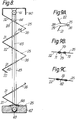
- Figure 8 shows a further modification in which a headrail 60 and a bottom rail 62 are each provided with pulleys 61,63 respectively.
- the connectors means 28,29 are here provided with a third set of apertures 64 through which passes downwardly a lift cord 65 which is secured to the bottom rail at 66 and is connected to means (not shown) for winding up the lift cord.
- the first and second cords 42,43 are passed over pulley 61 and under pulley 63.
- the upper pulley 61 may be used to cause relative movement between the first and second cords 42,43 as described in Figure 1.
- the lowermost of the third members 25 is secured to the bottom rail 62 in this arrangement.
- Figures 9A, 9B and 9C illustrate three different forms of connector.
- the connections 28,29 are simply formed by flexibly adhering the members 22 to the members 25 and the members 21 to the members 26.
- a molded connector 70 is provided with recesses 71,72 on each side and a flexible centre 73.
- upper and lower flexible members 81,82 are laminated together and sandwich the members which they connect therebetween, here illustrated as the members 22,25.
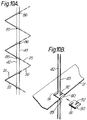
- FIGs 10A and 10B two different arrangements are provided for physically engaging the cords with alternate ones of the members.
- the cord 42 is provided with projections, such as beads or knots 85 which engage the slats 22, while the cords pass freely through the apertures in the members 21.
- projections such as beads or knots 86 on the cord 43 engage the fourth members 26 but pass freely through the second members 25.
- FIG. 10B A somewhat different arrangement is shown in Figure 10B in which the slat 21 is provided with laterally extending recesses 89 into which is pressed and retained a molded insert 90.
- This insert has a V-shaped notch 91 on one side and a relatively open notch 92 on the opposite side.
- the cord 42 can be engaged in the V-notch 91 to secure the cord to the insert 90 and the cord 43 can pass freely through the notch 92.
- the insert 90 can be inverted so that the cord 42 will pass freely and the cord 43 will be retained.
Landscapes
- Engineering & Computer Science (AREA)
- Structural Engineering (AREA)
- Architecture (AREA)
- Civil Engineering (AREA)
- Blinds (AREA)
Applications Claiming Priority (2)
| Application Number | Priority Date | Filing Date | Title |
|---|---|---|---|
| GB9211645 | 1992-06-02 | ||
| GB929211645A GB9211645D0 (en) | 1992-06-02 | 1992-06-02 | Window blinds |
Publications (2)
| Publication Number | Publication Date |
|---|---|
| EP0573263A2 true EP0573263A2 (de) | 1993-12-08 |
| EP0573263A3 EP0573263A3 (en) | 1994-07-06 |
Family
ID=10716387
Family Applications (1)
| Application Number | Title | Priority Date | Filing Date |
|---|---|---|---|
| EP19930304250 Withdrawn EP0573263A3 (en) | 1992-06-02 | 1993-06-01 | Window blinds |
Country Status (5)
| Country | Link |
|---|---|
| US (1) | US5445204A (de) |
| EP (1) | EP0573263A3 (de) |
| AU (1) | AU661397B2 (de) |
| CA (1) | CA2097467A1 (de) |
| GB (1) | GB9211645D0 (de) |
Families Citing this family (9)
| Publication number | Priority date | Publication date | Assignee | Title |
|---|---|---|---|---|
| US5680891A (en) * | 1996-01-11 | 1997-10-28 | Royal Wood Inc. | Window covering |
| US5813447A (en) * | 1996-07-29 | 1998-09-29 | Lysyj; Phillip A. | Cordless cellular and pleated shade |
| US5706876A (en) * | 1996-07-29 | 1998-01-13 | Lysyj; Phillip A. | Cordless, roller bar cellular shade |
| US6006812A (en) * | 1998-03-17 | 1999-12-28 | Comfortex Corporation | Sheer support window covering |
| US5918655A (en) * | 1998-03-17 | 1999-07-06 | Comfortex Corporation | View-through cellular window covering |
| AU700011B3 (en) * | 1998-08-14 | 1998-12-17 | Peter John Scarcella | A blind assembly for a window |
| USD568082S1 (en) | 2006-08-31 | 2008-05-06 | Hunter Douglas Industries Bv | Roman shade of washi fabric |
| US8079397B2 (en) * | 2009-10-30 | 2011-12-20 | Robertson Richard W | Roman shade with protected operating cords |
| US9957750B2 (en) * | 2016-06-09 | 2018-05-01 | Whole Space Industries Ltd | Window covering positional adjustment apparatus |
Family Cites Families (14)
| Publication number | Priority date | Publication date | Assignee | Title |
|---|---|---|---|---|
| GB1051822A (de) * | ||||
| DE674059C (de) * | 1937-09-15 | 1939-04-04 | Ernst Flohr & Co G M B H | Verdunklungsvorrichtung fuer Fenster |
| GB543937A (en) * | 1938-10-24 | 1942-03-19 | Eric Sigfrid Persson | Improvements in and relating to pleated blinds |
| US2874612A (en) * | 1956-03-09 | 1959-02-24 | Luboshez Sergius N Ferris | Thermal insulator |
| DE1950354U (de) * | 1966-10-11 | 1966-11-24 | Wilkhahn Wilkening & Hahne | Sonnenschutzvorrichtung fuer fenster, glaswaende u. dgl. |
| US3552185A (en) * | 1968-10-09 | 1971-01-05 | Dow Chemical Co | Thermal conductivity apparatus |
| US3982581A (en) * | 1974-12-18 | 1976-09-28 | Madsen Harold L | Drapery hanger and manipulator |
| US4544011A (en) * | 1983-07-01 | 1985-10-01 | Dowa Seishi Co., Ltd. | Pleat screen |
| EP0134150A3 (de) * | 1983-08-19 | 1986-09-17 | Lipschitz, Suzanne Lucien | Jalousie, Textilgewebe und ihre Herstellung |
| IT8421810V0 (it) * | 1984-05-15 | 1984-05-15 | Arquati Spa | Dispositivo di azionamento, particolarmente studiato per tende a pacchetto o a pannello. |
| AU580452B2 (en) * | 1985-10-21 | 1989-01-12 | Tass Zorbas | Blind |
| US4928369A (en) * | 1988-06-20 | 1990-05-29 | Comfortex Corporation | Method of making a pleated blind with articulative slat extensions |
| JP2749473B2 (ja) * | 1991-12-26 | 1998-05-13 | 株式会社メタコ | ワイヤー・テンション・システムによるプリーツ状スクリーン装置 |
| EP0589846A1 (de) * | 1992-09-24 | 1994-03-30 | Baumann Weberei Und Färberei Ag | Verstellbarer Vorhang |
-
1992
- 1992-06-02 GB GB929211645A patent/GB9211645D0/en active Pending
-
1993
- 1993-06-01 CA CA002097467A patent/CA2097467A1/en not_active Abandoned
- 1993-06-01 EP EP19930304250 patent/EP0573263A3/en not_active Withdrawn
- 1993-06-01 AU AU40012/93A patent/AU661397B2/en not_active Expired - Fee Related
-
1995
- 1995-01-11 US US08/371,454 patent/US5445204A/en not_active Expired - Fee Related
Also Published As
| Publication number | Publication date |
|---|---|
| EP0573263A3 (en) | 1994-07-06 |
| US5445204A (en) | 1995-08-29 |
| AU4001293A (en) | 1993-12-09 |
| GB9211645D0 (en) | 1992-07-15 |
| AU661397B2 (en) | 1995-07-20 |
| CA2097467A1 (en) | 1993-12-03 |
Similar Documents
| Publication | Publication Date | Title |
|---|---|---|
| US6068039A (en) | Material for venetian type blinds | |
| US7806159B2 (en) | Flexible window covering | |
| US5733632A (en) | Window covering | |
| US7686060B2 (en) | Retractable covering for architectural openings having a pair of flexible parallel sheets at least partially integrally connected with vanes | |
| US4901419A (en) | A-frame window covering mounting arrangement | |
| KR20010074451A (ko) | 수직 지지 창문 가리개 | |
| US5445204A (en) | Window blinds | |
| EP0552784A1 (de) | Jalousie | |
| US5582226A (en) | Venetian blind | |
| CA2406553A1 (en) | Roll-up shade with cord capture | |
| ES2098313T3 (es) | Persiana romana plegadiza, perfil para dicha persiana y un metodo para plegar una hoja de material por medio de dicho perfil para formar dicha persiana. | |
| WO1997046784A1 (en) | Light control window covering | |
| US5121783A (en) | Window covering apparatus | |
| US6401789B1 (en) | Pleated blind | |
| US4687039A (en) | Insulative pleated window shade | |
| GB2236551A (en) | Single web, cellular concertina blind | |
| US2583031A (en) | Venetian blind | |
| US20070175595A1 (en) | Blind with semitransparent sheets of drapery material | |
| KR200386802Y1 (ko) | 커튼 겸용 버티컬 블라인드 | |
| JPH0329957B2 (de) | ||
| CA2388899A1 (en) | Venetian blind with curtain fabric | |
| JP2604407Y2 (ja) | ベネシャンブラインド用スラット | |
| US20050121149A1 (en) | Window blinds slat structure | |
| CN100443025C (zh) | 罗马帘 | |
| JPH10148073A (ja) | 引上げ式折畳カーテンに用いるピッチ保持コード及びそれを用いる引上げ式折畳カーテン装置 |
Legal Events
| Date | Code | Title | Description |
|---|---|---|---|
| PUAI | Public reference made under article 153(3) epc to a published international application that has entered the european phase |
Free format text: ORIGINAL CODE: 0009012 |
|
| AK | Designated contracting states |
Kind code of ref document: A2 Designated state(s): DE ES FR GB IT NL SE |
|
| PUAL | Search report despatched |
Free format text: ORIGINAL CODE: 0009013 |
|
| AK | Designated contracting states |
Kind code of ref document: A3 Designated state(s): DE ES FR GB IT NL SE |
|
| 17P | Request for examination filed |
Effective date: 19950105 |
|
| STAA | Information on the status of an ep patent application or granted ep patent |
Free format text: STATUS: THE APPLICATION HAS BEEN WITHDRAWN |
|
| 18W | Application withdrawn |
Withdrawal date: 19950606 |