EP0573376B1 - Multilobale Fäden und Verfahren zu ihrer Herstellung - Google Patents
Multilobale Fäden und Verfahren zu ihrer Herstellung Download PDFInfo
- Publication number
- EP0573376B1 EP0573376B1 EP93420228A EP93420228A EP0573376B1 EP 0573376 B1 EP0573376 B1 EP 0573376B1 EP 93420228 A EP93420228 A EP 93420228A EP 93420228 A EP93420228 A EP 93420228A EP 0573376 B1 EP0573376 B1 EP 0573376B1
- Authority
- EP
- European Patent Office
- Prior art keywords
- dtex
- filament
- filaments
- die
- yarns
- Prior art date
- Legal status (The legal status is an assumption and is not a legal conclusion. Google has not performed a legal analysis and makes no representation as to the accuracy of the status listed.)
- Revoked
Links
- 238000000034 method Methods 0.000 title claims abstract description 18
- 229920002647 polyamide Polymers 0.000 claims abstract description 18
- 238000009987 spinning Methods 0.000 claims abstract description 17
- 239000004952 Polyamide Substances 0.000 claims abstract description 16
- 238000001816 cooling Methods 0.000 claims abstract description 8
- 239000004753 textile Substances 0.000 claims abstract description 8
- 238000004804 winding Methods 0.000 claims abstract description 7
- 238000012986 modification Methods 0.000 claims description 13
- 230000004048 modification Effects 0.000 claims description 13
- 229920000642 polymer Polymers 0.000 claims description 11
- 229920002302 Nylon 6,6 Polymers 0.000 claims description 5
- 239000000155 melt Substances 0.000 claims description 4
- 238000002074 melt spinning Methods 0.000 claims description 2
- 230000001747 exhibiting effect Effects 0.000 abstract 2
- 239000002826 coolant Substances 0.000 abstract 1
- 238000005259 measurement Methods 0.000 description 8
- 238000001125 extrusion Methods 0.000 description 7
- 230000008602 contraction Effects 0.000 description 6
- 238000012360 testing method Methods 0.000 description 4
- 229920000297 Rayon Polymers 0.000 description 3
- 238000009940 knitting Methods 0.000 description 3
- 239000002964 rayon Substances 0.000 description 3
- 238000011282 treatment Methods 0.000 description 3
- 229920002292 Nylon 6 Polymers 0.000 description 2
- KKEYFWRCBNTPAC-UHFFFAOYSA-N Terephthalic acid Chemical compound OC(=O)C1=CC=C(C(O)=O)C=C1 KKEYFWRCBNTPAC-UHFFFAOYSA-N 0.000 description 2
- 239000000654 additive Substances 0.000 description 2
- WNLRTRBMVRJNCN-UHFFFAOYSA-N adipic acid Chemical compound OC(=O)CCCCC(O)=O WNLRTRBMVRJNCN-UHFFFAOYSA-N 0.000 description 2
- 238000013459 approach Methods 0.000 description 2
- 238000009833 condensation Methods 0.000 description 2
- 229920001577 copolymer Polymers 0.000 description 2
- 238000004043 dyeing Methods 0.000 description 2
- JBKVHLHDHHXQEQ-UHFFFAOYSA-N epsilon-caprolactam Chemical compound O=C1CCCCCN1 JBKVHLHDHHXQEQ-UHFFFAOYSA-N 0.000 description 2
- 235000013305 food Nutrition 0.000 description 2
- 238000004519 manufacturing process Methods 0.000 description 2
- 238000006068 polycondensation reaction Methods 0.000 description 2
- 238000009941 weaving Methods 0.000 description 2
- 238000003466 welding Methods 0.000 description 2
- UDHXJZHVNHGCEC-UHFFFAOYSA-N Chlorophacinone Chemical compound C1=CC(Cl)=CC=C1C(C=1C=CC=CC=1)C(=O)C1C(=O)C2=CC=CC=C2C1=O UDHXJZHVNHGCEC-UHFFFAOYSA-N 0.000 description 1
- 235000010582 Pisum sativum Nutrition 0.000 description 1
- 240000004713 Pisum sativum Species 0.000 description 1
- 229920002334 Spandex Polymers 0.000 description 1
- GWEVSGVZZGPLCZ-UHFFFAOYSA-N Titan oxide Chemical compound O=[Ti]=O GWEVSGVZZGPLCZ-UHFFFAOYSA-N 0.000 description 1
- 238000009825 accumulation Methods 0.000 description 1
- 235000011037 adipic acid Nutrition 0.000 description 1
- 239000001361 adipic acid Substances 0.000 description 1
- 230000015572 biosynthetic process Effects 0.000 description 1
- 238000002788 crimping Methods 0.000 description 1
- 230000001627 detrimental effect Effects 0.000 description 1
- 238000010586 diagram Methods 0.000 description 1
- 230000004927 fusion Effects 0.000 description 1
- 238000010438 heat treatment Methods 0.000 description 1
- 239000006224 matting agent Substances 0.000 description 1
- 210000003632 microfilament Anatomy 0.000 description 1
- 239000000178 monomer Substances 0.000 description 1
- 230000003287 optical effect Effects 0.000 description 1
- 230000003647 oxidation Effects 0.000 description 1
- 238000007254 oxidation reaction Methods 0.000 description 1
- 229920000728 polyester Polymers 0.000 description 1
- 229920000573 polyethylene Polymers 0.000 description 1
- 238000002360 preparation method Methods 0.000 description 1
- 238000004513 sizing Methods 0.000 description 1
- 239000007787 solid Substances 0.000 description 1
- 239000003381 stabilizer Substances 0.000 description 1
- 230000003068 static effect Effects 0.000 description 1
- DJZKNOVUNYPPEE-UHFFFAOYSA-N tetradecane-1,4,11,14-tetracarboxamide Chemical group NC(=O)CCCC(C(N)=O)CCCCCCC(C(N)=O)CCCC(N)=O DJZKNOVUNYPPEE-UHFFFAOYSA-N 0.000 description 1
- OGIDPMRJRNCKJF-UHFFFAOYSA-N titanium oxide Inorganic materials [Ti]=O OGIDPMRJRNCKJF-UHFFFAOYSA-N 0.000 description 1
Images


Classifications
-
- D—TEXTILES; PAPER
- D01—NATURAL OR MAN-MADE THREADS OR FIBRES; SPINNING
- D01D—MECHANICAL METHODS OR APPARATUS IN THE MANUFACTURE OF ARTIFICIAL FILAMENTS, THREADS, FIBRES, BRISTLES OR RIBBONS
- D01D5/00—Formation of filaments, threads, or the like
- D01D5/08—Melt spinning methods
- D01D5/098—Melt spinning methods with simultaneous stretching
-
- D—TEXTILES; PAPER
- D01—NATURAL OR MAN-MADE THREADS OR FIBRES; SPINNING
- D01D—MECHANICAL METHODS OR APPARATUS IN THE MANUFACTURE OF ARTIFICIAL FILAMENTS, THREADS, FIBRES, BRISTLES OR RIBBONS
- D01D5/00—Formation of filaments, threads, or the like
- D01D5/08—Melt spinning methods
- D01D5/088—Cooling filaments, threads or the like, leaving the spinnerettes
-
- D—TEXTILES; PAPER
- D01—NATURAL OR MAN-MADE THREADS OR FIBRES; SPINNING
- D01D—MECHANICAL METHODS OR APPARATUS IN THE MANUFACTURE OF ARTIFICIAL FILAMENTS, THREADS, FIBRES, BRISTLES OR RIBBONS
- D01D5/00—Formation of filaments, threads, or the like
- D01D5/253—Formation of filaments, threads, or the like with a non-circular cross section; Spinnerette packs therefor
-
- D—TEXTILES; PAPER
- D01—NATURAL OR MAN-MADE THREADS OR FIBRES; SPINNING
- D01F—CHEMICAL FEATURES IN THE MANUFACTURE OF ARTIFICIAL FILAMENTS, THREADS, FIBRES, BRISTLES OR RIBBONS; APPARATUS SPECIALLY ADAPTED FOR THE MANUFACTURE OF CARBON FILAMENTS
- D01F6/00—Monocomponent artificial filaments or the like of synthetic polymers; Manufacture thereof
- D01F6/58—Monocomponent artificial filaments or the like of synthetic polymers; Manufacture thereof from homopolycondensation products
- D01F6/60—Monocomponent artificial filaments or the like of synthetic polymers; Manufacture thereof from homopolycondensation products from polyamides
Definitions
- the present invention relates to filaments and a multifilament yarn capable of texturing. It also relates to a process for obtaining such yarns and the textured yarns thus obtained as well as woven and knitted articles prepared from the textured yarns.
- the spinning of high viscosity polymer in the molten state has two major drawbacks, on the one hand the need to use very high pressure drops in the spinning packs, compared to the polymers usually used in applications textiles, and on the other hand the yarns thus obtained by spinning at the usual speeds, have a weak orientation leading to poor mechanical characteristics.
- the present invention consists in preparing yarns of total titer identical or of the same order to those composed of microbrows, by reducing the number of strands to obtain the desired transparency, but by replacing the microbrows by yarns of higher stranded title allowing, by their shape to maintain an identical level of sweetness. They are, moreover, obtained with much less technical difficulty, and have improved workability.
- They generally have a strand titer preferably between 1.3 and 2.5 dtex.
- They preferably have a three-lobed shape with marked lobes.
- the lobes are also defined by the angle determined as follows: the tangent at the point of inflection is drawn on the opposite sides of 2 consecutive or adjacent lobes; the angle ⁇ is the angle determined by the 2 tangents at the point of inflection of the 2 consecutive lobes. The values given are averages over 10 measurements. The angle ⁇ thus determined is shown in FIG. 2.
- the angle ⁇ is less than 140 °, preferably less than 130 °.
- the multifilament yarns constituted by the filaments defined above have an overall titer of between 10 and 130 dtex, preferably 10 to 100 dtex.
- the present invention also relates to a process for spinning multilobed filaments as described above, by extrusion of molten polyamide, of viscosity in the molten state of between 800 and 2000 poises, preferably 1000 and 1500 poises, through orifices of a multi-lobed die whose temperature is maintained between 270 and 290 ° C, preferably 270 to 280 ° C, each strand coming from a single orifice, cooling to room temperature, the start of the cooling means being placed at a distance maximum of the die between 70 mm and 40 mm, preferably 60 to 30 mm, then sizing and winding of the filaments.
- the winding speed is equal to or greater than 3500 m / min, preferably ⁇ 4000 m / min, up to 5000 or 6000 m / min or even more.
- a three-lobed die is used and the filaments can be interlaced before winding.
- the present invention also relates to a polyamide-based yarn, textured, consisting of multifilaments of multilobed form with a strand strength ⁇ 3 dtex.
- the overall strand titer is generally between 8 and 100 dtex, preferably 8 and 80, and the strand titer of the filaments is preferably ⁇ 2.5 dtex.
- the modification report R 2 R 1 is ⁇ 1.8 preferably ⁇ 2 and preferably the wires have a three-lobed shape.
- the present invention also relates to woven or knitted articles using the textured yarns defined above, having a very great softness.
- the present invention relates to knitted articles intended for women's footwear, that is to say the stockings and tights having the qualities of softness and transparency desired.
- polyamide means the polyamides usually spinnable in the molten state such as polyhexamethylene adipamide (PA 66), polycaprolactam (PA 6) or their copolymers such as copolymers of polyhexamethylene adipamide containing at least 85 % of units of hexamethylene adipamide and up to 15% of other units, obtained by replacing, for example, the starting adipic acid with another diacid such as terephthalic acid, sebacic etc ... or by replacing the 2 monomers with caprolactam.
- PA 66 polyhexamethylene adipamide
- PA 6 polycaprolactam
- the starting polyamides may also contain additives such as matting agents, stabilizing agents with regard to light, heat, oxidation, additives intended to reduce the accumulation of static charges or modify the 'suitability for dyeing.
- additives such as matting agents, stabilizing agents with regard to light, heat, oxidation, additives intended to reduce the accumulation of static charges or modify the 'suitability for dyeing.
- VF viscosity in the molten state
- the multilamide polyamide-based filaments according to the present invention have the particularity of having on polymer a melt viscosity measured at 290 ° C. of between 800 and 2000 poises, preferably between 800 and 1500 poises. This viscosity value does not require any particular operation such as post-condensation and such a polyamide is obtained according to the usual methods of polycondensation.
- the filaments according to the present invention possibly preoriented have a strand count less than 4 dtex, preferably between 1.3 and 2.5 dtex and preferably a three-lobed shape which gives them the desired softness and transparency particularly required for the production of stockings and tights.
- the overall titer of the threads is generally between 10 and 130 dtex and preferably 10 and 50 dtex when the titer of the desired strand is located in the lower zone between 1.3 and 2.5 dtex.
- the marking of the lobes is represented by the report R 2 R 1 , representing, in cross section, the radius of the circle circumscribed to each filament, this circle being of constant diameter along each filament, and R1 being the circle inscribed in each filament, itself having a constant diameter along each strand (seen in cross section), the 2 circles being generally concentric.
- Fig. 1 represents a filament diagram of trilobed section on which are indicated the circumscribed and inscribed circles, of respective radii R 2 and R 1 .
- the filaments according to the present invention have a modification ratio R 2 R 1 ⁇ 1.8, preferably greater than 2 or 2.5.
- the touch is linked to the angle determined by the 2 tangents at the point of inflection corresponding to the opposite sides of 2 consecutive or adjacent lobes; the smaller the angle, the better the touch, and conversely if the three-lobed wire approaches an equilateral triangle its characteristics of touch and opacity become uninteresting.
- the angle ⁇ depends on the number of lobes.
- the angle ⁇ thus determined is generally ⁇ 140 °, preferably ⁇ 130 ° measured on a cross-sectional section photograph, as shown in FIG. 2.
- the multilobe filaments according to the present invention also have good mechanical characteristics allowing them to undergo the usual subsequent textile treatments, in particular texturing.
- the present invention also relates to a process for spinning multi-lobed filaments, based on polyamide, by extrusion of the molten polymer, of melt viscosity 800 to 2000 poises measured at 290 ° C., preferably 800 to 1500 poises, through a multilobed, preferably three-lobed, die whose temperature is maintained between 270 and 290 ° C, preferably 270 to 280 ° C, each filament coming from a single orifice, and cooling of the threads by any cooling means placed at a distance maximum of the die between 70 mm and 40 mm at room temperature, the filaments then being sized, possibly interlaced and rewound.
- the winding speed is generally greater than 3500 m / mm, preferably greater than 4000 m / min, being able to go up to 5000 or 6000 m / min or even more.
- the distance between the die and the start of cooling is an important factor for good marking of the lobes, and this should be all the smaller the lower the strand titer of the filaments.
- the distance should be less than 40 mm while for titles from 3 to 4 dtex a distance of about 60 mm is sufficient. This distance also depends on the viscosity of the polymer; the distance will also be all the smaller as the viscosity approaches the lower zone of the viscosity values in the molten state. Likewise, the spinning temperature will be lowered in the minimum zone when the melt viscosity is in a low zone.
- Interleaving is an optional step: it becomes necessary when the number of strands is large, for better reeling of the coils. In general when the number of strands reaches 10, an interleaving must be carried out. This also depends on the intended application and on the conditions of reeling.
- the filaments thus obtained can be used as flat threads according to all known downstream textile techniques.
- they are preoriented they are intended more particularly for texturing according to any known method, for example according to the skewer or friction methods, according to a sequential or simultaneous stretch-texturing method.
- the present invention also relates to textured yarns obtained from the multilobed filaments described above, having after texturing a strand count ⁇ 3 dtex, preferably ⁇ 2.5 dtex; the overall titer of the threads can be between 8 and 100 dtex, preferably 8 to 80 dtex.
- Textured multilobed yarns are preferably three-lobed and their modification ratio R 2 R 1 the definition of which is given above is generally ⁇ 1.8, preferably ⁇ 2. It is surprising to note that the textured multilobed yarns are slightly deformed during texturing and have no breakage or particular brittleness, even in the case of strands of low titer, as is the case of multilobed threads obtained by spinning through radial slots and welding under the die.
- the textured yarns thus obtained are widely used in the fields of knitting and weaving. They are particularly suitable for stockings and pantyhose applications which benefit from both the softness and the level of transparency required for this type of article, in particular the strand title and the number of strands.
- the multi-lobed textured yarns according to the invention give the knitted surfaces a softer feel than round yarns. They also provide access to knitted items as soft as round threads of lower titer.
- the textured multilobed yarns according to the invention are generally knitted on a 4-drop circular loom, for example in combination with a commercial elastane yarn for the preferred uses of female footwear.
- a polyhexamethylene adipamide loaded with 0.3% titanium oxide, with a viscosity in the molten state of 1200 poises (measured as indicated in the description) is spun through a die maintained at approximately 278 ° C. comprising 34 orifices of three-lobed shape. with a flow rate of 22.7 g / min.
- the wires are cooled by means of a transverse blower, the start of which is placed 43 mm from the die, propelling air maintained at room temperature.
- the filaments are converged, sized and intertwined in the usual way and then wound up at a speed of 4200 m / mm.
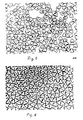
- the filaments in cross section are shown in FIG. 3. They have a regular shape over their entire length.
- the characteristics of the preoriented wires are as follows: Global title, dtex 54 Stranded title, dtex 1.59 Breaking toughness, cN / tex 29 Elongation at break% 70 Secant module at 25% elongation, cN / tex 52 U% 1.5
- the feel of the pre-oriented yarns thus obtained is particularly soft. They are subjected to a simultaneous drawing / texturing process in a conventional manner using a conventional commercial machine under the following conditions: Speed (mm / min) 750 Oven length (m) 2.0 Temperature (° C) 210 Draw rate 1.225 D / Y 1.67 Type discs COULD Stacking 1-4-1 Interlacing by nozzle before rewinding Yes
- the textured threads obtained have a modification ratio of 2.3 on average over 25 measures, that is to say that on textured threads, the lobes remain very marked as shown in FIG. 4 and the yarns after texturing are slightly deformed compared to the preoriented food yarns.
- crimp contraction E% and of contraction of crimped intermediate K% are carried out using a commercial device known under the brand Texturmat according to the method described in standard AFNOR G 07.305 (A).
- the measurement is made mechanically on an NPT automatic device type R2040 from Rothschild. This detects the distance between interlacing points using a needle which penetrates between the filaments of the moving wire, and which retracts as soon as it encounters a point of resistance, i.e. say a voltage higher than the threshold voltage imposed.
- threshold voltage 0.2 g / dtex + Title (dtex) number of strands
- Example 2 The same polyamide is spun under the conditions indicated in Example 1, with a die flow 18.06 g / min per thread.
- the preoriented wires thus obtained have a very marked three-lobed shape whose modification ratio is 2.5 on average and the angle formed by the tangents at the point of inflection of 2 consecutive lobes and 110 ° on average.
- the preoriented filaments obtained have a regular section over their entire length, seen in cross section.
- the textured threads obtained have a modification ratio of 2.3 on an average of 25 measurements, the lobes remaining very marked on the textured threads.
- the characteristics of the textured yarns are brought together in the following table: Global title, dtex 36 Stranded title, dtex 1.05 Elongation at break% 26 Breaking toughness, cN / tex 28 Breaking stress, cN / tex 36 Module 8%, cN / tex 159
- the yarns thus obtained have good mechanical properties and characteristics of feel and appearance which are particularly suitable for the manufacture of stockings and tights.
- a polyamide identical to that of Example 1 is spun through a die maintained at 280 ° C., comprising 6 three-lobed orifices, with a flow rate of 6.2 g / min.
- the filaments are cooled at a distance from the die 55 mm by air at room temperature.
- the filaments are converged, sized, interlaced and reeled in the usual way at a speed of 4200 m / min.
- the POY wires obtained have a marked three-lobed shape with an average modification ratio.
- R 2 R 1 2 and an angle formed by the tangents at the point of inflection of 2 consecutive lobes and 130 ° on average.
- the mechanical characteristics of the preoriented wires are as follows: Global title, dtex 15.5 Stranded title, dtex 2.58 Breaking toughness, cN / tex 32.5 Elongation at break% 72 Secant module at 25% elongation, cN / tex 51.5
- the yarns obtained are textured under the following conditions: Speed (mm / min) 850 Oven length (m) 2.0 Temperature (° C) 210 Draw rate 1.237 D / Y 2.24 Type discs COULD Stacking 1-4-1 Nozzle interlacing no
- Textured yarns have the following characteristics: Title, dtex 13 Elongation at break (%) 31 Tenacity, cN / tex 38 Constraint, cN / tex 50 Module 8%, cN / tex 135 Photo Yes
Landscapes
- Engineering & Computer Science (AREA)
- Textile Engineering (AREA)
- Mechanical Engineering (AREA)
- Chemical & Material Sciences (AREA)
- Chemical Kinetics & Catalysis (AREA)
- General Chemical & Material Sciences (AREA)
- Yarns And Mechanical Finishing Of Yarns Or Ropes (AREA)
- Artificial Filaments (AREA)
- Knitting Of Fabric (AREA)
- Materials For Medical Uses (AREA)
- Laminated Bodies (AREA)
- Treatments For Attaching Organic Compounds To Fibrous Goods (AREA)
- Polyesters Or Polycarbonates (AREA)
Claims (18)
- Preorientiertes, multilobales Filament, erhalten durch Schmelzspinnen aus einer einzigen Öffnung der Spinndüse mit einer Spinngeschwindigkeit von größer als 3500 m/min eines Polyamids mit einer Viskosität in geschmolzenem Zustand zwischen 800 und 2000 Poises, gemessen bei 290°C, welches einen Spinnfadentiter geringer als oder gleich 4 dtex, ein Modifikationsverhältnis

- Filament gemäß Anspruch 1, dadurch gekennzeichnet, daß es eine trilobale Form besitzt.
- Filament gemäß Anspruch 2, dadurch gekennzeichnet, daß das Modifikationsverhältnis gleich oder größer als 2,5 ist.
- Filament gemäß Anspruch 2, dadurch gekennzeichnet, daß der im Querschnitt betrachtete Winkel θ, welcher erhalten wird, indem man die Tangenten am Inflexionspunkt an den gegenüberliegenden Seiten von 2 benachbarten Lappen einzeichnet, kleiner oder gleich 140° ist.
- Filament gemäß Anspruch 1, dadurch gekennzeichnet, daß es einen Spinnfadentiter zwischen 1,3 und 2,5 dtex besitzt.
- Filament gemäß Anspruch 1, dadurch gekennzeichnet, daß das Polyamid Polyhexamethylenadipamid ist.
- Verfahren zum Spinnen von Filamenten auf Polyamidbasis gemäß Anspruch 1, dadurch gekennzeichnet, daß man das Polymere durch eine Spinndüse, deren Öffnungen eine multilobale Form aufweisen und deren Temperatur zwischen 270 und 290°C gehalten wird, extrudiert, wobei jedes Filament aus einer einzigen Öffnung stammt, daß man die Filamente auf Raumtemperatur abkühlt, wobei der maximale Abstand zwischen der Spinndüse und dem Anfang des Kühlmittels zwischen 70 und 40 mm beträgt, daß man die Filamente schmälzt und mit einer Geschwindigkeit von höher als 3500 m/min aufwickelt, wobei die Viskosität des Polyamids in geschmolzenem Zustand zwischen 800 und 2000 Poises, gemessen bei 290°C, beträgt.
- Verfahren gemäß Anspruch 7, dadurch gekennzeichnet, daß der Anfang des Kühlmittels sich in einem maximalen Abstand zur Spinndüse zwischen 60 und 30 mm befindet.
- Verfahren gemäß Anspruch 7, dadurch gekennzeichnet, daß die Temperatur der Spinndüse zwischen 270 und 280°C gehalten wird.
- Verfahren gemäß Anspruch 7, dadurch gekennzeichnet, daß die verwendete Spinndüse eine Spinndüse ist, deren Öffnungen eine trilobale Form aufweisen.
- Verfahren gemäß Anspruch 7, dadurch gekennzeichnet, daß die Filamente vor dem Aufwickeln verschlungen werden.
- Multifilgarn auf Polyamidbasis gemäß den Ansprüchen 1 bis 7, dadurch gekennzeichnet, daß die Filamente multilobal sind und daß sie einen Gesamtspinnfadentiter zwischen 10 und 130 dtex aufweisen.
- Garn gemäß Anspruch 12, dadurch gekennzeichnet, daß es texturiert ist und daß der Spinnfadentiter weniger als oder gleich 3 dtex beträgt.
- Garn gemäß Anspruch 13, dadurch gekennzeichnet, daß die Filamente einen Spinnfadentiter von weniger als oder gleich 2,5 dtex besitzen.
- Garn gemäß Anspruch 13, dadurch gekennzeichnet, daß es einen Gesamttiter zwischen 8 und 100 dtex, vorzugsweise zwischen 8 und 80 dtex, besitzt.
- Multifilgarn gemäß Anspruch 13, dadurch gekennzeichnet, daß die Filamente ein Modifikationsverhältnis

- Unter Verwendung der texturierten Garne nach den Ansprüchen 13 bis 16 gewobene gewirkte Textilartikel.
- Strickwaren für Damen für gutsitzende Anwendungen, erhalten aus den Garnen nach den Ansprüchen 13 bis 16.
Applications Claiming Priority (2)
| Application Number | Priority Date | Filing Date | Title |
|---|---|---|---|
| FR9207154A FR2691985B1 (fr) | 1992-06-05 | 1992-06-05 | Fils multilobes et leur procede d'obtention. |
| FR9207154 | 1992-06-05 |
Publications (2)
| Publication Number | Publication Date |
|---|---|
| EP0573376A1 EP0573376A1 (de) | 1993-12-08 |
| EP0573376B1 true EP0573376B1 (de) | 1997-11-19 |
Family
ID=9430699
Family Applications (1)
| Application Number | Title | Priority Date | Filing Date |
|---|---|---|---|
| EP93420228A Revoked EP0573376B1 (de) | 1992-06-05 | 1993-06-04 | Multilobale Fäden und Verfahren zu ihrer Herstellung |
Country Status (9)
| Country | Link |
|---|---|
| EP (1) | EP0573376B1 (de) |
| AT (1) | ATE160390T1 (de) |
| DE (1) | DE69315259T2 (de) |
| DK (1) | DK0573376T3 (de) |
| EC (1) | ECSP930941A (de) |
| ES (1) | ES2110074T3 (de) |
| FR (1) | FR2691985B1 (de) |
| GR (1) | GR3025949T3 (de) |
| UY (1) | UY23593A1 (de) |
Families Citing this family (2)
| Publication number | Priority date | Publication date | Assignee | Title |
|---|---|---|---|---|
| ATE159303T1 (de) † | 1992-07-03 | 1997-11-15 | Nylstar Sa | Profiliertes, feinfibrilliges filamentgarn und verfahren zur herstellung desselben |
| MXPA06008587A (es) * | 2004-01-30 | 2006-08-28 | Procter & Gamble | Telas de fibras con forma. |
Family Cites Families (7)
| Publication number | Priority date | Publication date | Assignee | Title |
|---|---|---|---|---|
| NL164602B (nl) * | 1950-10-21 | Henkel Kgaa | Gevormd wasmiddel. | |
| NL241210A (de) * | 1958-07-14 | |||
| NL263172A (de) * | 1961-04-04 | |||
| GB1218066A (en) * | 1967-06-30 | 1971-01-06 | Toray Industries | Crimped synthetic filament having a branched cross-section and a method for manufacturing the same |
| US3508390A (en) * | 1968-09-30 | 1970-04-28 | Allied Chem | Modified filament and fabrics produced therefrom |
| DE3036683C2 (de) * | 1980-09-29 | 1985-01-24 | Davy McKee AG, 6000 Frankfurt | Verfahren zum Schmelzspinnen von synthetischen Polymeren |
| JPH0299634A (ja) * | 1988-10-05 | 1990-04-11 | Toray Ind Inc | Y型断面非捲縮性トルク加工糸およびその製造方法 |
-
1992
- 1992-06-05 FR FR9207154A patent/FR2691985B1/fr not_active Expired - Lifetime
-
1993
- 1993-06-04 DE DE69315259T patent/DE69315259T2/de not_active Revoked
- 1993-06-04 DK DK93420228.4T patent/DK0573376T3/da active
- 1993-06-04 EC EC1993000941A patent/ECSP930941A/es unknown
- 1993-06-04 ES ES93420228T patent/ES2110074T3/es not_active Expired - Lifetime
- 1993-06-04 AT AT93420228T patent/ATE160390T1/de active
- 1993-06-04 EP EP93420228A patent/EP0573376B1/de not_active Revoked
- 1993-06-07 UY UY23593A patent/UY23593A1/es unknown
-
1998
- 1998-01-20 GR GR980400119T patent/GR3025949T3/el unknown
Also Published As
| Publication number | Publication date |
|---|---|
| DE69315259T2 (de) | 1998-04-16 |
| GR3025949T3 (en) | 1998-04-30 |
| ATE160390T1 (de) | 1997-12-15 |
| FR2691985A1 (fr) | 1993-12-10 |
| ES2110074T3 (es) | 1998-02-01 |
| DE69315259D1 (de) | 1998-01-02 |
| DK0573376T3 (da) | 1997-12-22 |
| UY23593A1 (es) | 1993-11-25 |
| ECSP930941A (es) | 1994-03-14 |
| EP0573376A1 (de) | 1993-12-08 |
| FR2691985B1 (fr) | 1996-03-29 |
Similar Documents
| Publication | Publication Date | Title |
|---|---|---|
| US3772872A (en) | Polyester yarn for draw-texturing process | |
| CN100523326C (zh) | 复合纤维 | |
| EP2647746B1 (de) | Polyamidgarn enthaltend ultrafeine filamente sowie schmelzspinnverfahren und -vorrichtung dafür | |
| EP1995358B1 (de) | Garn aus konjugatfaser | |
| US3998042A (en) | Mixed shrinkage yarn | |
| CA1107472A (en) | Textured yarn and process | |
| MXPA01011166A (es) | Hilo de denier fino de poli(tereftalato de trimetileno). | |
| CA3236004A1 (en) | Polytrimethylene terephthalate fiber and method for producing same | |
| US6214264B1 (en) | Drawing of polyester filaments | |
| EP0573376B1 (de) | Multilobale Fäden und Verfahren zu ihrer Herstellung | |
| EP0118375B1 (de) | Vereinfachtes Verfahren zum Schnellspinnen von Polyamid | |
| EP0117215B1 (de) | Vereinfachtes Verfahren zum Schnellspinnen von Polyesterfasern | |
| EP1044293B1 (de) | Textilfäden aus multifilamenten mit hohlquerschnitt, herstellungsverfahren und daraus hergestellte textil-flächengebilde | |
| JP3533872B2 (ja) | 合成繊維の直接紡糸延伸方法 | |
| JP3920087B2 (ja) | 分繊用ポリエステルフィラメント及びその製造方法 | |
| EP0452405A1 (de) | Verfahren für dimensionell stabiles polyestergarn. | |
| EP0692040B1 (de) | Texturierte synthetische garne und flächengebilde mit einem von diesen garnen | |
| CA1230716A (fr) | Procede pour ameliorer la regularite de structure des filaments a base de polymeres thermoplastiques | |
| JP2853859B2 (ja) | 未延伸ポリアミド捲縮糸 | |
| JP2866190B2 (ja) | 伸度差を有する混繊糸の製造方法 | |
| JP3998667B2 (ja) | ポリトリメチレンテレフタレート異型糸 | |
| JPS5947047B2 (ja) | ポリアミド捲縮加工糸の製造法 | |
| JPH0197212A (ja) | 高強度複合繊維 | |
| CA1272568A (en) | Partially oriented nylon yarn and process | |
| US20050233144A1 (en) | High tenacity polyester yarns |
Legal Events
| Date | Code | Title | Description |
|---|---|---|---|
| PUAI | Public reference made under article 153(3) epc to a published international application that has entered the european phase |
Free format text: ORIGINAL CODE: 0009012 |
|
| AK | Designated contracting states |
Kind code of ref document: A1 Designated state(s): AT BE CH DE DK ES FR GB GR IE IT LI LU NL PT SE |
|
| 17P | Request for examination filed |
Effective date: 19940520 |
|
| 17Q | First examination report despatched |
Effective date: 19960304 |
|
| GRAG | Despatch of communication of intention to grant |
Free format text: ORIGINAL CODE: EPIDOS AGRA |
|
| GRAH | Despatch of communication of intention to grant a patent |
Free format text: ORIGINAL CODE: EPIDOS IGRA |
|
| GRAH | Despatch of communication of intention to grant a patent |
Free format text: ORIGINAL CODE: EPIDOS IGRA |
|
| GRAA | (expected) grant |
Free format text: ORIGINAL CODE: 0009210 |
|
| AK | Designated contracting states |
Kind code of ref document: B1 Designated state(s): AT BE CH DE DK ES FR GB GR IE IT LI LU NL PT SE |
|
| REF | Corresponds to: |
Ref document number: 160390 Country of ref document: AT Date of ref document: 19971215 Kind code of ref document: T |
|
| REG | Reference to a national code |
Ref country code: CH Ref legal event code: EP |
|
| ITF | It: translation for a ep patent filed | ||
| REG | Reference to a national code |
Ref country code: DK Ref legal event code: T3 |
|
| REF | Corresponds to: |
Ref document number: 69315259 Country of ref document: DE Date of ref document: 19980102 |
|
| REG | Reference to a national code |
Ref country code: ES Ref legal event code: FG2A Ref document number: 2110074 Country of ref document: ES Kind code of ref document: T3 |
|
| GBT | Gb: translation of ep patent filed (gb section 77(6)(a)/1977) |
Effective date: 19980116 |
|
| REG | Reference to a national code |
Ref country code: PT Ref legal event code: SC4A Free format text: AVAILABILITY OF NATIONAL TRANSLATION Effective date: 19971229 |
|
| PLAV | Examination of admissibility of opposition |
Free format text: ORIGINAL CODE: EPIDOS OPEX |
|
| PLBQ | Unpublished change to opponent data |
Free format text: ORIGINAL CODE: EPIDOS OPPO |
|
| PLBI | Opposition filed |
Free format text: ORIGINAL CODE: 0009260 |
|
| PLBF | Reply of patent proprietor to notice(s) of opposition |
Free format text: ORIGINAL CODE: EPIDOS OBSO |
|
| 26 | Opposition filed |
Opponent name: E.I. DU PONT DE NEMOURS AND COMPANY Effective date: 19980818 |
|
| NLR1 | Nl: opposition has been filed with the epo |
Opponent name: E.I. DU PONT DE NEMOURS AND COMPANY |
|
| PLBF | Reply of patent proprietor to notice(s) of opposition |
Free format text: ORIGINAL CODE: EPIDOS OBSO |
|
| PLBF | Reply of patent proprietor to notice(s) of opposition |
Free format text: ORIGINAL CODE: EPIDOS OBSO |
|
| PGFP | Annual fee paid to national office [announced via postgrant information from national office to epo] |
Ref country code: FR Payment date: 19990603 Year of fee payment: 7 |
|
| PGFP | Annual fee paid to national office [announced via postgrant information from national office to epo] |
Ref country code: DE Payment date: 19990607 Year of fee payment: 7 |
|
| PLBF | Reply of patent proprietor to notice(s) of opposition |
Free format text: ORIGINAL CODE: EPIDOS OBSO |
|
| PGFP | Annual fee paid to national office [announced via postgrant information from national office to epo] |
Ref country code: AT Payment date: 19990614 Year of fee payment: 7 |
|
| PGFP | Annual fee paid to national office [announced via postgrant information from national office to epo] |
Ref country code: BE Payment date: 19990819 Year of fee payment: 7 |
|
| RDAH | Patent revoked |
Free format text: ORIGINAL CODE: EPIDOS REVO |
|
| RDAG | Patent revoked |
Free format text: ORIGINAL CODE: 0009271 |
|
| STAA | Information on the status of an ep patent application or granted ep patent |
Free format text: STATUS: PATENT REVOKED |
|
| PGFP | Annual fee paid to national office [announced via postgrant information from national office to epo] |
Ref country code: DK Payment date: 20000613 Year of fee payment: 8 Ref country code: CH Payment date: 20000613 Year of fee payment: 8 |
|
| PGFP | Annual fee paid to national office [announced via postgrant information from national office to epo] |
Ref country code: GB Payment date: 20000614 Year of fee payment: 8 |
|
| PGFP | Annual fee paid to national office [announced via postgrant information from national office to epo] |
Ref country code: ES Payment date: 20000623 Year of fee payment: 8 |
|
| PGFP | Annual fee paid to national office [announced via postgrant information from national office to epo] |
Ref country code: LU Payment date: 20000626 Year of fee payment: 8 Ref country code: SE Payment date: 20000626 Year of fee payment: 8 |
|
| PGFP | Annual fee paid to national office [announced via postgrant information from national office to epo] |
Ref country code: IE Payment date: 20000628 Year of fee payment: 8 |
|
| PGFP | Annual fee paid to national office [announced via postgrant information from national office to epo] |
Ref country code: NL Payment date: 20000629 Year of fee payment: 8 |
|
| PGFP | Annual fee paid to national office [announced via postgrant information from national office to epo] |
Ref country code: GR Payment date: 20000630 Year of fee payment: 8 |
|
| PGFP | Annual fee paid to national office [announced via postgrant information from national office to epo] |
Ref country code: PT Payment date: 20000705 Year of fee payment: 8 |
|
| 27W | Patent revoked |
Effective date: 20000128 |
|
| GBPR | Gb: patent revoked under art. 102 of the ep convention designating the uk as contracting state |
Free format text: 20000128 |
|
| REG | Reference to a national code |
Ref country code: CH Ref legal event code: PL |
|
| NLR2 | Nl: decision of opposition | ||
| REG | Reference to a national code |
Ref country code: PT Ref legal event code: MF4A Effective date: 20000801 |