EP0573760B1 - Méthode pour l'identification des signaux de parole et de progression d'appel - Google Patents
Méthode pour l'identification des signaux de parole et de progression d'appel Download PDFInfo
- Publication number
- EP0573760B1 EP0573760B1 EP93106482A EP93106482A EP0573760B1 EP 0573760 B1 EP0573760 B1 EP 0573760B1 EP 93106482 A EP93106482 A EP 93106482A EP 93106482 A EP93106482 A EP 93106482A EP 0573760 B1 EP0573760 B1 EP 0573760B1
- Authority
- EP
- European Patent Office
- Prior art keywords
- largest
- speech
- maxima
- digitized signal
- correlation
- Prior art date
- Legal status (The legal status is an assumption and is not a legal conclusion. Google has not performed a legal analysis and makes no representation as to the accuracy of the status listed.)
- Expired - Lifetime
Links
Images


Classifications
-
- H—ELECTRICITY
- H04—ELECTRIC COMMUNICATION TECHNIQUE
- H04Q—SELECTING
- H04Q1/00—Details of selecting apparatus or arrangements
- H04Q1/18—Electrical details
- H04Q1/30—Signalling arrangements; Manipulation of signalling currents
- H04Q1/44—Signalling arrangements; Manipulation of signalling currents using alternate current
- H04Q1/444—Signalling arrangements; Manipulation of signalling currents using alternate current with voice-band signalling frequencies
- H04Q1/46—Signalling arrangements; Manipulation of signalling currents using alternate current with voice-band signalling frequencies comprising means for distinguishing between a signalling current of predetermined frequency and a complex current containing that frequency, e.g. speech current
Definitions
- the present invention relates to digital signal processing and to methods for identifying speech and tone energy on a signal line. More particularly, the present invention relates to methods for identifying and discriminating between tones, such as DTMF tones, dial tones, busy signals and other tones used in telephone systems, and speech energy on a signal line.
- tones such as DTMF tones, dial tones, busy signals and other tones used in telephone systems, and speech energy on a signal line.
- DE 31 01 851 A1 discloses a method for sampling speech wherein a zero order autocorrelation coefficient and a partial first order autocorrelation coefficient are derived from a speech signal. If either a first state, wherein the zero order autocorrelation coefficient exceeds a first threshold value, or a second state, wherein the zero order autocorrelation coefficient exceeds a second threshold value and the partial first order autocorrelation coefficient is smaller than a third threshold value are present for a predetermined number of extraction intervals, the beginning of a speech signal has been detected. If a state is detected, which is neither the first state nor the second state, the end of a speech signal is detected. This method is used to discriminate between speech signals and noise signals.
- US 4,439,639 B1 discloses a digital circuit and a method for the detection of call progress tones in telephone systems.
- the PCM signal is linearized and normalized and the level of the linear signal is measured. Then the number of zero level passes are counted. Moreover, the envelope frequency of the signal is detected. The results of the level measurement, the zero level pass counts and the envelope frequency are then evaluated to provide an output signal representing the identity of the input PCM signal.
- US 3,944,753 B1 discloses an apparatus for distinguishing voice and other noise signals from legitimate multi-frequency tone signals present on telephone or similar communication lines.
- a frequency drop detector is used to detect data and control signals, voice and other noise signals, as they appear on the line. Upon the occurence of any signal on the line, the frequency drop detector provides a output, which terminates only if the frequency of that signal rapidly drops at a predetermined amount. Depending on the duration of the output signal, the signal on the line is defined as noise or as a legitimate signal.
- a method as claimed in claim 1 for real-time identification of electrical energy on a signal line as human speech or as call-progression tone energy achieves a higher degree of accuracy than is possible using prior art techniques.
- a method for real-time recognition of speech and call-progression tone energy includes the steps of digitizing an analog signal present on a signal line, correlating N neighboring portions of the digitized signal, performing frequency analysis using fast fourier transform (FFT) analysis on the digitized signal, identifying the three largest frequency-domain maxima, determining whether the two largest maxima are above a threshold frequency, and determining whether the ratio of the largest to the third largest maxima exceeds a predetermined value.
- the steps of the method may be performed in real time using fixed-point hardware by approximating the correlation and FFT functions.
- Fig. 1 is a functional block diagram of apparatus for performing the method of the present invention.
- FIG. 2 is a flow diagram showing the steps of a method according to a presently preferred embodiment of the invention.
- FIG. 3 is a block diagram illustrating a presently preferred method for sharpening the FFT maxima.
- Speech may be divided into two components.
- a first voiced component comprises the English language vowel sounds, and consonants such as "m” "n” etc.
- a second unvoiced component comprises sounds such as "sh” "th” "p” and "t”. While the unvoiced sounds are characterized by little or no correlation, the voiced sounds in speech are highly correlated in the intervals of their pitch. Such a feature recommends the use of correlation techniques as a component of a speech identification method.
- Certain applications notably telecommunications, require reliable detection and identification of both speech sounds and tones, such as call progression tones. Because call progression tones, usually unmodulated sinusoidal tones, are ideally perfectly correlated and practically highly correlated, correlation techniques alone cannot be used to discriminate between speech sounds and tones such as call-progression signals on communications lines.
- a combination of digital real-time signal processing techniques implemented in fixed-point hardware may be employed to readily differentiate between speech sounds and call progression tones.
- the method of the present invention provides a reliable and economically viable solution to the speech recognition problem. From the description presented herein, those of ordinary skill in the art will recognize that the method of the present invention could be performed by an appropriately programmed personal computer, such as an IBM compatible computer equipped with a 386 processor. Particular software coded instruction routines for carrying out an actual embodiment of the present invention may be easily provided by those of ordinary skill in the art as a routine exercise.
- a signal line 10 to be monitored carries a digitized signal which is to be identified.
- this digitized signal may be in PCM format, sampled at a rate of 8,000 samples/sec.
- Codec apparatus for creating such signals from analog signals is well known and widely used in the art and consequently need not be disclosed herein.
- low-pass digital filter 12 may have a linear rolloff characteristic curve in which attenuation begins at 700 Hz and is complete at 800 Hz. Digital filter technology for provision of such a filter is conventional and well understood.
- the filtered digital signal is then decimated in circuit block 14 using conventional decimation techniques, preferably by taking every fifth sample, resulting in a data sample rate out of block 14 of 1,600 samples/sec.
- data samples may be placed in a register 16 for holding while they are processed according to the present method.
- the digital signal is then subjected to both correlation (block 18) and FFT analysis (block 20).
- correlation block 18
- FFT analysis block 20
- Both of these forms of digital signal processing are well known to those of ordinary skill in the art and are described in texts such as L. R. Rabiner and R. W. Schafer, Digital Processing of Speech Signals, Prentice Hall, 1978, and R. E. Blahut, Fast Algorithms for Digital Signal Processing, Addison Wesley, 1987. Both of these works are expressly incorporated by reference herein.
- the results of both the correlation and FFT signal processing steps are evaluated to determine if the energy represented by the digital signal on line 12 comprises speech, tone energy, or noise.
- FIG. 2 A flow diagram representing a method according to a presently preferred embodiment of the invention is depicted in FIG. 2.
- correlation is performed on a first block of the data samples.
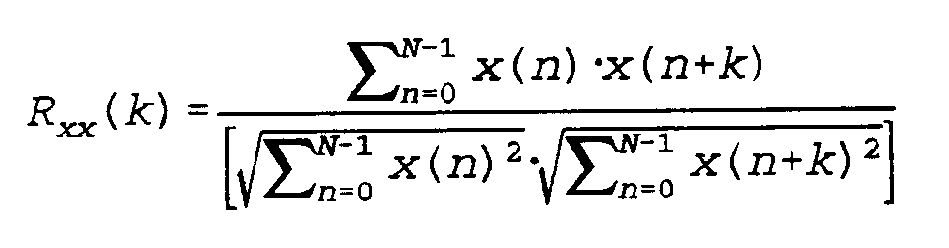
- Correlation R xx (k) of two signal samples may be expressed as:
- the correlation lag k is chosen to be within the range of human pitch, i.e., between about 2.5 to 20 msec.
- the correlation length is chosen to be at least as long as the maximum human pitch, i.e., about 20 msec. At a sample rate of 1,600 samples/sec., the correlation length should be preferably at least 32 samples.
- the maximum R is first determined by employing only the numerator of eq. [1].
- the function R(k) may be estimated by taking the arithmetic mean rather than the geometric mean specified by the denominator of eq. [1], thus significantly simplifying the amount of processing necessary.
- the correlation result is compared with a predetermined threshold ⁇ to determine if there is a possibility that the energy on the line comprises speech.
- the threshold may be between about 0.6 and 0.8.
- Steps 36 and 38 illustrate the repetition of the correlation step for N blocks. As previously stated, the presently preferred value for N is 3.
- the results of the correlation operation indicate the possibility of speech energy, but can also indicate the presence of call-progression tone energy. Therefore, according to the present energy, the digital signal is also subjected to FFT analysis at step 40 to make the final determination regarding whether speech or tone energy is present on the line.
- FFT analysis of digital signals is well known.
- the FFT analysis results may be "sharpened” according to a presently preferred embodiment of the invention under some conditions. Because of the overlapping band coverage of the FFT process, the frequency response at frequencies between the center bandwidth points defined by the FFT are attenuated and may introduce some ambiguity into the determination. According to this aspect of the invention, the maxima are "sharpened” before the maxima are evaluated.
- the three highest frequency maxima M1, M2, and M3 are identified at step 44. If the largest or second largest maxima are found to fall below 300 Hz at step 46, speech is identified at step 48 because call progression tones having a frequency of less than 300 Hz are not likely to be employed. If none of the two highest maxima M1 and M2, fall below 300 Hz, the largest maxima M1 is compared with the third highest maxima M3 at step 50. If the ratio exceeds the threshold, the third maxima is significantly lower energy than the first maxima and the energy is identified as a dual tone at step 52. If the ratio of the first and third maxima is below a preselected threshold (i.e., about 8-10 db) the energy may be identified as speech.
- a preselected threshold i.e., about 8-10 db
- FIG. 3 a block diagram illustrates a presently preferred method for sharpening the FFT maxima.
- the amplitude of the FFT results in adjacent frequency bands are evaluated in groups of three selected in step 60.
- the magnitude of each band is compared with its right and left hand neighbors in step 62. If, at step 64, it is determined that the center bandwidth has the largest magnitude and the ratio of the center bandwidth to one of its right or left hand immediate neighbors is greater than 9 db and the ratio to the other immediate neighbor is less than 6 db, then the amplitude of the second highest value is added to the amplitude of the highest value and then that second highest band is zeroed out in step 66.
Landscapes
- Engineering & Computer Science (AREA)
- Computer Networks & Wireless Communication (AREA)
- Telephonic Communication Services (AREA)
- Selective Calling Equipment (AREA)
- Mobile Radio Communication Systems (AREA)
Claims (10)
- Procédé pour effectuer la reconnaissance en temps réel de signaux de parole et de progression d'appel à partir de l'énergie électrique circulant sur une ligne de signaux (10) comprenant les étapes consistant à :- fournir un signal numérisé représentant ladite énergie;- corréler (18) N parties voisines dudit signal numérisé et signaler "pas de présence de parole" si la corrélation (R) ne dépasse pas un seuil prédéterminé (α);- exécuter une analyse FFT (transformation rapide de Fourier) (20) sur le signal numérisé et identifier les premier (M1), second (M2) et troisième (M3) plus grands maxima dans le domaine fréquenciel;- déterminer si lesdits premier (M1) et second (M2) plus grands maxima sont au-dessus d'une fréquence de seuil et signaler "présence de parole" si l'un ou l'autre desdits premier (M1) et second (M2) plus grands maxima sont en dessous de ladite fréquence de seuil; et- déterminer si le rapport dudit premier (M1) plus grand maximum audit troisième (M3) plus grand maximum dépasse une valeur prédéterminée, signaler "présence de tonalité" si ledit rapport est plus grand que ladite valeur prédéterminée (Th), et signaler "présence de bruit" si ledit rapport est plus petit que ladite valeur prédéterminée (Th).
- Procédé selon la revendication 1, dans lequel le signal numérisé est en format PCM (modulation par impulsions codées) ayant une fréquence d'échantillonnage de 8000 échantillons/seconde.
- Procédé selon la revendication 2, dans lequel le signal numérisé est traité par un filtre passe-bas (12) ayant une courbe caractéristique de coupure linéaire dans laquelle l'atténuation commence à 700 Hz et est totale à 800 Hz.
- Procédé selon la revendication 2 ou 3, dans lequel le signal numérisé est décimé (14) en prenant chaque cinquième échantillon pour atteindre une fréquence d'échantillonnage de 1600 échantillons/seconde.
- Procédé selon la revendication 1 à 4, dans lequel l'étape consistant à corréler N parties voisines dudit signal numérisé comprend l'exécution du calcul suivant :
- Procédé selon l'une quelconque des revendications 1 à 5, dans lequel il est signalé "pas de présence de parole" si la corrélation ne dépasse pas un seuil prédéterminé (α) de 0,6 à 0,8.
- Procédé selon l'une quelconque des revendications 1 à 6, dans lequel l'analyse FFT est exécutée à une fréquence d'échantillonnage de 1600 échantillons/secondes à une longueur FFT de 128.
- Procédé selon l'une quelconque des revendications 1 à 7, dans lequel les résultats de l'analyse FFT sont affinés par les étapes suivantes :- l'amplitude des résultats FFT dans des bandes de fréquences adjacentes sont évalués en groupes de trois;- pour tous les groupes de trois maxima adjacents, les étapes de comparaison suivantes sont effectuées :- l'amplitude de chaque bande de fréquences (C) est comparée avec ses voisins droit (R) et gauche (L);- s'il est déterminé que la bande de fréquence médiane (C) a la plus grande amplitude et que le rapport de la bande de fréquence médiane (C) à l'un de ses voisins adjacents gauche ou droit (L, R) est plus grand que 9 dB et que le rapport de la bande de fréquence médiane (C) à son autre voisin adjacent gauche ou droit (L, R) est plus petit que 6 dB, alors l'amplitude de la deuxième valeur la plus haute est additionnée à l'amplitude de la valeur la plus haute et la deuxième bande de fréquence la plus haute est mise à zéro.
- Procédé selon l'une quelconque des revendications 1 à 8, dans lequel ladite fréquence de seuil est de 300 Hz.
- Procédé selon l'une quelconque des revendications 1 à 9, dans lequel ladite valeur de rapport prédéterminée est d'environ 8 - 10 dB.
Applications Claiming Priority (2)
| Application Number | Priority Date | Filing Date | Title |
|---|---|---|---|
| US889513 | 1986-07-25 | ||
| US07/889,513 US5319703A (en) | 1992-05-26 | 1992-05-26 | Apparatus and method for identifying speech and call-progression signals |
Publications (2)
| Publication Number | Publication Date |
|---|---|
| EP0573760A1 EP0573760A1 (fr) | 1993-12-15 |
| EP0573760B1 true EP0573760B1 (fr) | 1995-08-30 |
Family
ID=25395260
Family Applications (1)
| Application Number | Title | Priority Date | Filing Date |
|---|---|---|---|
| EP93106482A Expired - Lifetime EP0573760B1 (fr) | 1992-05-26 | 1993-04-21 | Méthode pour l'identification des signaux de parole et de progression d'appel |
Country Status (4)
| Country | Link |
|---|---|
| US (1) | US5319703A (fr) |
| EP (1) | EP0573760B1 (fr) |
| AT (1) | ATE127303T1 (fr) |
| DE (1) | DE69300413T2 (fr) |
Families Citing this family (31)
| Publication number | Priority date | Publication date | Assignee | Title |
|---|---|---|---|---|
| US5459784A (en) * | 1992-09-28 | 1995-10-17 | Comsat Corporation | Dual-tone multifrequency (DTMF) signalling transparency for low-data-rate vocoders |
| US5483579A (en) * | 1993-02-25 | 1996-01-09 | Digital Acoustics, Inc. | Voice recognition dialing system |
| US5450484A (en) * | 1993-03-01 | 1995-09-12 | Dialogic Corporation | Voice detection |
| CA2153170C (fr) * | 1993-11-30 | 2000-12-19 | At&T Corp. | Reduction du bruit transmis dans les systemes de telecommunications |
| US5416836A (en) * | 1993-12-17 | 1995-05-16 | At&T Corp. | Disconnect signalling detection arrangement |
| CA2116043C (fr) * | 1994-02-21 | 1997-09-23 | Alexander F. Tulai | Detecteur de tonalites de progression d'appel numerique programmable |
| US5692040A (en) * | 1994-06-30 | 1997-11-25 | Greenblatt; Richard David | Method of and apparatus for exchanging compatible universal identification telephone protocols over a public switched telephone network |
| US5588053A (en) * | 1995-11-29 | 1996-12-24 | Advanced Micro Devices | DTMF detector system and method which performs static and dynamic thresholding |
| US5644634A (en) * | 1995-11-29 | 1997-07-01 | Advanced Micro Devices | System and method for dual tone multifrequency detection using variable frame widths |
| SE506034C2 (sv) * | 1996-02-01 | 1997-11-03 | Ericsson Telefon Ab L M | Förfarande och anordning för förbättring av parametrar representerande brusigt tal |
| US5875234A (en) | 1996-02-14 | 1999-02-23 | Netphone, Inc. | Computer integrated PBX system |
| US5719921A (en) * | 1996-02-29 | 1998-02-17 | Nynex Science & Technology | Methods and apparatus for activating telephone services in response to speech |
| US5946649A (en) * | 1997-04-16 | 1999-08-31 | Technology Research Association Of Medical Welfare Apparatus | Esophageal speech injection noise detection and rejection |
| GB2330727B (en) * | 1997-10-24 | 2002-10-09 | Mitel Corp | Tone and periodical signal detection |
| US6370244B1 (en) | 1998-04-03 | 2002-04-09 | Board Of Regents Of The University Of Texas System | Efficient digital ITU-compliant zero-buffering DTMF detection using the non-uniform discrete fourier transform |
| US6229880B1 (en) | 1998-05-21 | 2001-05-08 | Bell Atlantic Network Services, Inc. | Methods and apparatus for efficiently providing a communication system with speech recognition capabilities |
| US6233315B1 (en) | 1998-05-21 | 2001-05-15 | Bell Atlantic Network Services, Inc. | Methods and apparatus for increasing the utility and interoperability of peripheral devices in communications systems |
| US6744860B1 (en) | 1998-12-31 | 2004-06-01 | Bell Atlantic Network Services | Methods and apparatus for initiating a voice-dialing operation |
| US6321194B1 (en) | 1999-04-27 | 2001-11-20 | Brooktrout Technology, Inc. | Voice detection in audio signals |
| DE19934990A1 (de) * | 1999-07-26 | 2001-02-01 | Deutsche Telekom Ag | Verfahren und Kommunikationsendeinrichtung zum Detektieren einer Teilnehmersignalisierung in einer analogen Kommunikationsendeinrichtung |
| US7110525B1 (en) | 2001-06-25 | 2006-09-19 | Toby Heller | Agent training sensitive call routing system |
| US7035394B2 (en) * | 2001-12-17 | 2006-04-25 | Ricoh Company, Ltd. | Tone detector judging a detection of a predetermined tone signal by comparing a characteristic quantity of the tone signal with characteristic quantities of other signals |
| US7372952B1 (en) | 2002-03-07 | 2008-05-13 | Wai Wu | Telephony control system with intelligent call routing |
| US7023979B1 (en) | 2002-03-07 | 2006-04-04 | Wai Wu | Telephony control system with intelligent call routing |
| US9818136B1 (en) | 2003-02-05 | 2017-11-14 | Steven M. Hoffberg | System and method for determining contingent relevance |
| US7676034B1 (en) | 2003-03-07 | 2010-03-09 | Wai Wu | Method and system for matching entities in an auction |
| CN1816164B (zh) * | 2005-02-04 | 2010-07-07 | 华为技术有限公司 | 用于多频信号音检测中的抗噪声方法 |
| US8874477B2 (en) | 2005-10-04 | 2014-10-28 | Steven Mark Hoffberg | Multifactorial optimization system and method |
| US8300798B1 (en) | 2006-04-03 | 2012-10-30 | Wai Wu | Intelligent communication routing system and method |
| CN101635865B (zh) * | 2008-07-22 | 2012-07-04 | 中兴通讯股份有限公司 | 一种双音多频信号抗误检测的系统及方法 |
| WO2016073380A1 (fr) | 2014-11-03 | 2016-05-12 | Genentech, Inc. | Procédé et biomarqueurs permettant de prédire l'efficacité et d'évaluer un traitement par l'agoniste ox40 |
Family Cites Families (12)
| Publication number | Priority date | Publication date | Assignee | Title |
|---|---|---|---|---|
| US3944753A (en) * | 1974-10-31 | 1976-03-16 | Proctor & Associates Company | Apparatus for distinguishing voice and other noise signals from legitimate multi-frequency tone signals present on telephone or similar communication lines |
| FR2409652A1 (fr) * | 1977-11-18 | 1979-06-15 | Materiel Telephonique | Recepteur de signaux numeriques multifrequences codes |
| US4354248A (en) * | 1979-11-28 | 1982-10-12 | Motorola, Inc. | Programmable multifrequency tone receiver |
| JPS56104399A (en) * | 1980-01-23 | 1981-08-20 | Hitachi Ltd | Voice interval detection system |
| US4534041A (en) * | 1982-02-12 | 1985-08-06 | Northern Telecom Limited | Digital circuit for determining the envelope frequency of PCM encoded call progress tones in a telephone system |
| CA1177588A (fr) * | 1982-02-12 | 1984-11-06 | Ernst A. Munter | Circuit numerique et methode de detection de tonalites d'appel en marche pour systemes telephoniques |
| US4477698A (en) * | 1982-09-07 | 1984-10-16 | Melita Electronics Labs, Inc. | Apparatus for detecting pick-up at a remote telephone set |
| US4521647A (en) * | 1984-02-17 | 1985-06-04 | Octel Communications, Inc. | Tone detection system and method |
| US4689760A (en) * | 1984-11-09 | 1987-08-25 | Digital Sound Corporation | Digital tone decoder and method of decoding tones using linear prediction coding |
| US4599495A (en) * | 1985-02-28 | 1986-07-08 | Northern Telecom Limited | Apparatus for multifrequency signalling tone detection |
| US4677665A (en) * | 1985-03-08 | 1987-06-30 | Tii Computer Systems, Inc. | Method and apparatus for electronically detecting speech and tone |
| US4979214A (en) * | 1989-05-15 | 1990-12-18 | Dialogic Corporation | Method and apparatus for identifying speech in telephone signals |
-
1992
- 1992-05-26 US US07/889,513 patent/US5319703A/en not_active Expired - Fee Related
-
1993
- 1993-04-21 EP EP93106482A patent/EP0573760B1/fr not_active Expired - Lifetime
- 1993-04-21 AT AT93106482T patent/ATE127303T1/de not_active IP Right Cessation
- 1993-04-21 DE DE69300413T patent/DE69300413T2/de not_active Expired - Fee Related
Also Published As
| Publication number | Publication date |
|---|---|
| US5319703A (en) | 1994-06-07 |
| DE69300413T2 (de) | 1996-02-01 |
| EP0573760A1 (fr) | 1993-12-15 |
| ATE127303T1 (de) | 1995-09-15 |
| DE69300413D1 (de) | 1995-10-05 |
Similar Documents
| Publication | Publication Date | Title |
|---|---|---|
| EP0573760B1 (fr) | Méthode pour l'identification des signaux de parole et de progression d'appel | |
| EP0575725B1 (fr) | Procédé de détection adaptatif pour l'évolution de signaux codés en multifréquence | |
| US5323337A (en) | Signal detector employing mean energy and variance of energy content comparison for noise detection | |
| CA2094412C (fr) | Detecteur et classification de signaux multifrequence | |
| US4821325A (en) | Endpoint detector | |
| US4764966A (en) | Method and apparatus for voice detection having adaptive sensitivity | |
| KR950013551B1 (ko) | 잡음신호예측장치 | |
| Miller | Pitch detection by data reduction | |
| US6950511B2 (en) | Detection of both voice and tones using Goertzel filters | |
| AU2002252143A1 (en) | Segmenting audio signals into auditory events | |
| WO2002097792A1 (fr) | Segmentation de signaux audio en evenements auditifs | |
| EP0423787B1 (fr) | Récepteur de signaux multi-fréquences et méthode de détection de signaux multi-fréquences | |
| US4864307A (en) | Method and device for the automatic recognition of targets from "Doppler" ec | |
| US4920568A (en) | Method of distinguishing voice from noise | |
| CA2117053C (fr) | Detecteur de verre brise | |
| EP0092611B1 (fr) | Dispositif d'analyse de la parole | |
| EP0474496B1 (fr) | Appareil de reconnaissance de la parole | |
| EP0535570B1 (fr) | Processement de détection transiente, pref. récognition de signaux acoustiques sous-marins | |
| EP0530645A2 (fr) | Classification d'un signal téléphonique et procédé et dispositif de livraison de messages téléphoniques | |
| JP2648779B2 (ja) | 通話信号識別装置 | |
| US5058168A (en) | Overflow speech detecting apparatus for speech recognition | |
| JPH04100099A (ja) | 音声検出装置 | |
| KR960007843B1 (ko) | 음성신호처리장치 | |
| JPH04230798A (ja) | 雑音予測装置 | |
| JPH0114599B2 (fr) |
Legal Events
| Date | Code | Title | Description |
|---|---|---|---|
| PUAI | Public reference made under article 153(3) epc to a published international application that has entered the european phase |
Free format text: ORIGINAL CODE: 0009012 |
|
| 17P | Request for examination filed |
Effective date: 19930621 |
|
| AK | Designated contracting states |
Kind code of ref document: A1 Designated state(s): AT BE CH DE FR GB IT LI LU NL SE |
|
| 17Q | First examination report despatched |
Effective date: 19941215 |
|
| GRAA | (expected) grant |
Free format text: ORIGINAL CODE: 0009210 |
|
| ITF | It: translation for a ep patent filed | ||
| AK | Designated contracting states |
Kind code of ref document: B1 Designated state(s): AT BE CH DE FR GB IT LI LU NL SE |
|
| REF | Corresponds to: |
Ref document number: 127303 Country of ref document: AT Date of ref document: 19950915 Kind code of ref document: T |
|
| REF | Corresponds to: |
Ref document number: 69300413 Country of ref document: DE Date of ref document: 19951005 |
|
| ET | Fr: translation filed | ||
| PGFP | Annual fee paid to national office [announced via postgrant information from national office to epo] |
Ref country code: LU Payment date: 19960401 Year of fee payment: 4 |
|
| PGFP | Annual fee paid to national office [announced via postgrant information from national office to epo] |
Ref country code: BE Payment date: 19960422 Year of fee payment: 4 |
|
| PGFP | Annual fee paid to national office [announced via postgrant information from national office to epo] |
Ref country code: CH Payment date: 19960423 Year of fee payment: 4 Ref country code: SE Payment date: 19960423 Year of fee payment: 4 Ref country code: AT Payment date: 19960423 Year of fee payment: 4 |
|
| PLBE | No opposition filed within time limit |
Free format text: ORIGINAL CODE: 0009261 |
|
| 26N | No opposition filed | ||
| PG25 | Lapsed in a contracting state [announced via postgrant information from national office to epo] |
Ref country code: LU Free format text: LAPSE BECAUSE OF NON-PAYMENT OF DUE FEES Effective date: 19970421 Ref country code: AT Effective date: 19970421 |
|
| PG25 | Lapsed in a contracting state [announced via postgrant information from national office to epo] |
Ref country code: SE Effective date: 19970422 |
|
| PG25 | Lapsed in a contracting state [announced via postgrant information from national office to epo] |
Ref country code: LI Free format text: LAPSE BECAUSE OF NON-PAYMENT OF DUE FEES Effective date: 19970430 Ref country code: CH Free format text: LAPSE BECAUSE OF NON-PAYMENT OF DUE FEES Effective date: 19970430 Ref country code: BE Effective date: 19970430 |
|
| BERE | Be: lapsed |
Owner name: VMX INC. Effective date: 19970430 |
|
| PG25 | Lapsed in a contracting state [announced via postgrant information from national office to epo] |
Ref country code: NL Effective date: 19971101 |
|
| REG | Reference to a national code |
Ref country code: CH Ref legal event code: PL |
|
| NLV4 | Nl: lapsed or anulled due to non-payment of the annual fee |
Effective date: 19971101 |
|
| EUG | Se: european patent has lapsed |
Ref document number: 93106482.8 |
|
| PGFP | Annual fee paid to national office [announced via postgrant information from national office to epo] |
Ref country code: FR Payment date: 19990318 Year of fee payment: 7 |
|
| PGFP | Annual fee paid to national office [announced via postgrant information from national office to epo] |
Ref country code: GB Payment date: 19990325 Year of fee payment: 7 |
|
| PGFP | Annual fee paid to national office [announced via postgrant information from national office to epo] |
Ref country code: DE Payment date: 19990630 Year of fee payment: 7 |
|
| PG25 | Lapsed in a contracting state [announced via postgrant information from national office to epo] |
Ref country code: GB Free format text: LAPSE BECAUSE OF NON-PAYMENT OF DUE FEES Effective date: 20000421 |
|
| GBPC | Gb: european patent ceased through non-payment of renewal fee |
Effective date: 20000421 |
|
| PG25 | Lapsed in a contracting state [announced via postgrant information from national office to epo] |
Ref country code: FR Free format text: LAPSE BECAUSE OF NON-PAYMENT OF DUE FEES Effective date: 20001229 |
|
| PG25 | Lapsed in a contracting state [announced via postgrant information from national office to epo] |
Ref country code: DE Free format text: LAPSE BECAUSE OF NON-PAYMENT OF DUE FEES Effective date: 20010201 |
|
| REG | Reference to a national code |
Ref country code: FR Ref legal event code: ST |
|
| PG25 | Lapsed in a contracting state [announced via postgrant information from national office to epo] |
Ref country code: IT Free format text: LAPSE BECAUSE OF NON-PAYMENT OF DUE FEES;WARNING: LAPSES OF ITALIAN PATENTS WITH EFFECTIVE DATE BEFORE 2007 MAY HAVE OCCURRED AT ANY TIME BEFORE 2007. THE CORRECT EFFECTIVE DATE MAY BE DIFFERENT FROM THE ONE RECORDED. Effective date: 20050421 |