EP0573849A2 - 7-Amino-3-methoxymethyl-3-cephem-4-carbonsäureester-Hydrolase, Verfahren zu deren Herstellung sowie deren Verwendung - Google Patents
7-Amino-3-methoxymethyl-3-cephem-4-carbonsäureester-Hydrolase, Verfahren zu deren Herstellung sowie deren Verwendung Download PDFInfo
- Publication number
- EP0573849A2 EP0573849A2 EP93108560A EP93108560A EP0573849A2 EP 0573849 A2 EP0573849 A2 EP 0573849A2 EP 93108560 A EP93108560 A EP 93108560A EP 93108560 A EP93108560 A EP 93108560A EP 0573849 A2 EP0573849 A2 EP 0573849A2
- Authority
- EP
- European Patent Office
- Prior art keywords
- esterase
- compound
- formula
- amino
- methoxymethyl
- Prior art date
- Legal status (The legal status is an assumption and is not a legal conclusion. Google has not performed a legal analysis and makes no representation as to the accuracy of the status listed.)
- Granted
Links
Classifications
-
- C—CHEMISTRY; METALLURGY
- C12—BIOCHEMISTRY; BEER; SPIRITS; WINE; VINEGAR; MICROBIOLOGY; ENZYMOLOGY; MUTATION OR GENETIC ENGINEERING
- C12N—MICROORGANISMS OR ENZYMES; COMPOSITIONS THEREOF; PROPAGATING, PRESERVING, OR MAINTAINING MICROORGANISMS; MUTATION OR GENETIC ENGINEERING; CULTURE MEDIA
- C12N9/00—Enzymes; Proenzymes; Compositions thereof; Processes for preparing, activating, inhibiting, separating or purifying enzymes
- C12N9/14—Hydrolases (3)
- C12N9/16—Hydrolases (3) acting on ester bonds (3.1)
-
- C—CHEMISTRY; METALLURGY
- C12—BIOCHEMISTRY; BEER; SPIRITS; WINE; VINEGAR; MICROBIOLOGY; ENZYMOLOGY; MUTATION OR GENETIC ENGINEERING
- C12P—FERMENTATION OR ENZYME-USING PROCESSES TO SYNTHESISE A DESIRED CHEMICAL COMPOUND OR COMPOSITION OR TO SEPARATE OPTICAL ISOMERS FROM A RACEMIC MIXTURE
- C12P35/00—Preparation of compounds having a 5-thia-1-azabicyclo [4.2.0] octane ring system, e.g. cephalosporin
-
- C—CHEMISTRY; METALLURGY
- C07—ORGANIC CHEMISTRY
- C07D—HETEROCYCLIC COMPOUNDS
- C07D501/00—Heterocyclic compounds containing 5-thia-1-azabicyclo [4.2.0] octane ring systems, i.e. compounds containing a ring system of the formula:, e.g. cephalosporins; Such ring systems being further condensed, e.g. 2,3-condensed with an oxygen-, nitrogen- or sulfur-containing hetero ring
- C07D501/14—Compounds having a nitrogen atom directly attached in position 7
-
- C—CHEMISTRY; METALLURGY
- C12—BIOCHEMISTRY; BEER; SPIRITS; WINE; VINEGAR; MICROBIOLOGY; ENZYMOLOGY; MUTATION OR GENETIC ENGINEERING
- C12N—MICROORGANISMS OR ENZYMES; COMPOSITIONS THEREOF; PROPAGATING, PRESERVING, OR MAINTAINING MICROORGANISMS; MUTATION OR GENETIC ENGINEERING; CULTURE MEDIA
- C12N9/00—Enzymes; Proenzymes; Compositions thereof; Processes for preparing, activating, inhibiting, separating or purifying enzymes
- C12N9/14—Hydrolases (3)
- C12N9/16—Hydrolases (3) acting on ester bonds (3.1)
- C12N9/18—Carboxylic ester hydrolases (3.1.1)
-
- Y—GENERAL TAGGING OF NEW TECHNOLOGICAL DEVELOPMENTS; GENERAL TAGGING OF CROSS-SECTIONAL TECHNOLOGIES SPANNING OVER SEVERAL SECTIONS OF THE IPC; TECHNICAL SUBJECTS COVERED BY FORMER USPC CROSS-REFERENCE ART COLLECTIONS [XRACs] AND DIGESTS
- Y10—TECHNICAL SUBJECTS COVERED BY FORMER USPC
- Y10S—TECHNICAL SUBJECTS COVERED BY FORMER USPC CROSS-REFERENCE ART COLLECTIONS [XRACs] AND DIGESTS
- Y10S435/00—Chemistry: molecular biology and microbiology
- Y10S435/8215—Microorganisms
- Y10S435/822—Microorganisms using bacteria or actinomycetales
- Y10S435/872—Nocardia
-
- Y—GENERAL TAGGING OF NEW TECHNOLOGICAL DEVELOPMENTS; GENERAL TAGGING OF CROSS-SECTIONAL TECHNOLOGIES SPANNING OVER SEVERAL SECTIONS OF THE IPC; TECHNICAL SUBJECTS COVERED BY FORMER USPC CROSS-REFERENCE ART COLLECTIONS [XRACs] AND DIGESTS
- Y10—TECHNICAL SUBJECTS COVERED BY FORMER USPC
- Y10S—TECHNICAL SUBJECTS COVERED BY FORMER USPC CROSS-REFERENCE ART COLLECTIONS [XRACs] AND DIGESTS
- Y10S435/00—Chemistry: molecular biology and microbiology
- Y10S435/8215—Microorganisms
- Y10S435/822—Microorganisms using bacteria or actinomycetales
- Y10S435/886—Streptomyces
Definitions
- ester cleavage known from the literature require reaction conditions which do not permit application to 7-amino-3-methoxymethyl-3-cephem-4-carboxylic acid esters in a satisfactory manner because of the labile ⁇ -lactam ring.
- esters with bases such as KOH, NaOH or sodium alcoholates in water or in organic solvents such as e.g. Dioxane or alcohol only for decomposition products.
- bases such as KOH, NaOH or sodium alcoholates
- organic solvents such as e.g. Dioxane or alcohol only for decomposition products.
- S. Torii et al. the cleavage of cephalosporin esters by means of phenol and acid catalysis is described (J. Org. Chem. 56 (1991) 3633).
- application of this process to 7-amino-3-methoxymethyl-3-cephem-4-carboxylic acid esters only gave the desired carboxylic acid in low yield and inadequate purity.
- MACA ester hydrolase for short, is used, among other things. formed by Pseudomonads and Actinomycetes, in particular of the genera Streptomyces and Amycolatopsis, and released into the culture broth.
- strains are Streptomyces bambergiensis ATCC 13879, Amycolatopsis orientalis ATCC 14930 and Amycolatopsis orientalis ATCC 53492.
- the cultivation is preferably carried out at room temperature or slightly above, in particular at about 28 ° C.
- the cultivation period is z. B. 48-60 hrs.
- the isolation of the esterase if necessary, is carried out in the usual way, e.g. by filtration or centrifugation, the esterase being in the supernatant, which is subsequently e.g. can be lyophilized or subjected to ultrafiltration. Further cleaning steps may be indicated and e.g. include a precipitation step (e.g. with ammonium sulfate) and / or a further centrifugation.
- a precipitation step e.g. with ammonium sulfate
- / or a further centrifugation for the use of the esterase, it can also make sense to immobilize it on a suitable carrier.
- esterase For the immobilization of purified, partially purified or crude cell extracts containing the esterase, e.g. B. carrier-related immobilization in question.
- the esterase can be bound by a covalent bond via a lysine residue that is not essential for catalysis polymeric carrier are coupled.
- Another option is to adsorb the esterase onto a support and then crosslink with z.
- B. polymeric, porous supports such as celluloses, e.g. B. DEAE or CM celluloses, Sepharose, such as. B. BrCN- or divinyl sulfone-activated Sepharosen, modified polyacrylamide gels with amino or hydroxyl groups or various organic copolymers of acrylamide, methacrylates or methacrylamide and maleic anhydride in question.
- copolymers of glycidyl methacrylate, allyl glycidyl ether, methylenebismethylacrylamide and methacrylamide, such as, for. B. @Eupergit can be used.
- Suitable enzyme carriers are crosslinked polymers based on polyvinyl esters and polyvinyl alcohols according to DE-OS 33 44 912.
- the anchoring reaction of the esterase on the enzyme carrier takes place in a known manner, as described for example in DE-OS 2 215 687.
- a particularly suitable enzyme carrier is VA epoxy biosynth from Riedel de Haen.
- An enzyme from A. orientalis has a molecular weight of 55 200 ⁇ 300 Da (sodium dodecyl sulfate-polyacrylamide gel electrophoresis) and a specific activity of approx. 15 mU / mg in the culture filtrate.
- the pH optimum is 6.5. until 7.5.
- the enzyme can easily be bound to the enzyme carrier VA-Epory-Biosynth R , for example.
- the activity is usually determined by converting MACA ester to MACA.
- HPLC or DC is used for the quantitative evaluation of the amount of MACA formed.
- the esterase according to the invention is suitable for cleaving various carboxylic acid esters. It is particularly suitable for cleaving esters of mono- or dicarboxylic acids with up to 6 carbon atoms, which may optionally be substituted with F, CI or Br, from naturally occurring amino acids or from 7-amino-3-methoxymethyl-3 -cephem-4-carboxylic acid with a mono-, di- or trihydric alcohol with up to 6 carbon atoms, in which the carbon chain can also be interrupted by a -C (O) O group, or with phenol which can also be substituted by nitro.
- the esterase is particularly suitable for cleaving p-nitrophenylacetate, 7-amino-3-methoxymethyl-3-cephem-4-carboxylic acid [1 (R, S) -1- (2,2-dimethylpropionyloxy) ethyl ester], 7-amino -3-methoxymethyl-3-cephen-4-carboxylic acid - [(2,2-dimethylpropionyloxy) methyl ester], 1,1-bis (pivaloyloxy) ethane, ethyl propionate, ethyl pivalate, triacetin, tributyrin, ethyl alanate and ethyl 2-chloropropionate.
- the process is very particularly suitable for the cleavage of amino-3-methoxymethyl-3-cephem-4-carboxylic acid [1 (R, S) -1- (2,2-dimethylpropionyloxy) ethyl ester], ethyl propionate, ethyl pivalate, ethyl alanate and 2-chloropropionate , in particular for the cleavage of 7-amino-3-methoxymethyl-3-cephem-4-carboxylic acid [1 (R, S) -1- (2,2-dimethylpropionyloxy) ethyl ester].
- the cleavage of the esters is preferably carried out under the following conditions.
- the compound of the formula II is treated with the esterase in an aqueous solution, preferably buffered in the pH 6.8 range (for example potassium phosphate buffer), preferably with the esterase in a suitably fixed form.
- the reaction is preferably allowed to proceed at 25-35 ° C, especially at about 30 ° C.
- the reaction is usually 95% complete after approx. 6-8 hours.
- the reaction solution is made according to known methods, e.g. Filtration, separated from the enzyme.
- the compound of formula 1 is isolated, e.g. by lyophilization, and then further purified if necessary, e.g. by recrystallization.
- Suitable hydrolase producers were checked after preliminary and main cultivation of the strains in Müller Hinton Medium (Difco) at 28 ° C. and 240 rpm.
- the pre-culture of A. orientalis ATCC 53492 in the medium is as follows
- composition carried out:
- 3.5 l culture solution from example 2 are separated by centrifugation into culture supernatant and biomass.
- the enzyme is in the supernatant.
- the culture filtrate can also be concentrated to 500 ml by means of ultrafiltration (cut-off: 10,000 Da). Then ammonium sulfate is added to 35% of the saturation and centrifuged again. The supernatant is increased to 70% of the saturation with ammonium sulfate. After a further centrifugation at at least 13000g, the precipitate is taken up in 250ml buffer (see above). The activity of this solution is 370mU / ml.
Landscapes
- Chemical & Material Sciences (AREA)
- Organic Chemistry (AREA)
- Life Sciences & Earth Sciences (AREA)
- Zoology (AREA)
- Engineering & Computer Science (AREA)
- Wood Science & Technology (AREA)
- Health & Medical Sciences (AREA)
- Genetics & Genomics (AREA)
- Bioinformatics & Cheminformatics (AREA)
- Microbiology (AREA)
- Biotechnology (AREA)
- Biochemistry (AREA)
- General Engineering & Computer Science (AREA)
- General Health & Medical Sciences (AREA)
- Biomedical Technology (AREA)
- Molecular Biology (AREA)
- Medicinal Chemistry (AREA)
- Chemical Kinetics & Catalysis (AREA)
- General Chemical & Material Sciences (AREA)
- Preparation Of Compounds By Using Micro-Organisms (AREA)
- Cephalosporin Compounds (AREA)
- Enzymes And Modification Thereof (AREA)
Abstract
Description
- Bei der Synthese von oralen Cephalosporinen ausgehend von 7-Amino-3-methoxymethyl-3-cephem-4-carbonsäure (MACA) (I) fällt ein Isomeren-Gemisch von 7-Amino-3-methoxymethyl-3-cephem-4-carbonsäure-[1(R,S)-1-(2.2-dimethylpropionyloxy)-ethylester] (Pro-J- bzw. Pro-K-MACA-Ester) (11) an.

Nach Trennung in R- und S-Diastereomer muß das unerwünschte R-Diastereomer, das noch S-Anteil enthält durch eine nicht stereo- aber chemoselektive Reaktion in (I) zurückgeführt werden. - Die literaturbekannten Methoden der Esterspaltung erfordern Reaktionsbedingungen, die eine Anwendung auf 7-Amino-3-methoxymethyl-3-cephem-4-carbonsäureester wegen des labilen ß-Lactamringes nicht in befriedigender Weise zulassen. So führt z.B. die alkalische Hydrolyse von Estern mit Basen wie KOH, NaOH oder Natriumalkoholaten in Wasser oder in organischen Lösungsmitteln wie z.B. Dioxan oder Alkohol lediglich zu Zersetzungsprodukten. Von S. Torii et al. ist die Spaltung von Cephalosporinestern mittels Phenol und Säurekatalyse beschrieben (J. Org. Chem. 56 (1991) 3633). Eine Anwendung dieses Verfahrens auf 7-Amino-3-methoxymethyl-3-cephem-4-carbonsäureester lieferte jedoch die gewünschte Carbonsäure lediglich in geringer Ausbeute und ungenügender Reinheit.
- Auch die gut zugängliche Schweineleberesterase ist für die genannte Reaktion nicht geeignet, da sie ausschließlich zur Spaltung des S-Diastereomers führt.
- Es wurde nun überraschenderweise gefunden, daß eine mikrobiologisch gewonnene Esterase geeignet ist, die oben beschriebene Esterspaltung chemoselektiv in guter Ausbeute zu bewirken. Das Enzym, kurz MACA-Ester-Hydrolase genannt, wird u.a. von Pseudomonaden und Actinomyceten insbesondere der Gattungen Streptomyces und Amycolatopsis gebildet und in die Kulturbrühe abgegeben.
- Ganz besonders geeignete Stämme sind Streptomyces bambergiensis ATCC 13879, Amycolatopsis orientalis ATCC 14930 und Amycolatopsis orientalis ATCC 53492.
- Das Verfahren zur Herstellung der genannten Esterase, das ebenfalls Gegenstand der vorliegenden Erfindung ist, ist wie folgt charakterisiert:
- Die Kultivierung der betreffenden Mikroorganismen erfolgt unter üblichen Bedingungen. Vorzugsweise erfolgen Anzucht und Kultivierung auf Komplexmedien mit z.B. Cornsteep, Fleischextrakt, Pepton, Casein, Hefeextrakt, Gelatine, Trypton, Nitrat oder Ammonium als Stickstoffquellen und löslicher Stärke, Dextrin, Saccharose, Glucose oder Glycerin als Kohlenstoffquellen. Als Mineralien können u.a. Magnesium, Eisen, Calcium, Natrium, und Kobalt zugesetzt werden.
- Die Kultivierung erfolgt vorzugsweise bei Raumtemperatur oder leicht darüber, insbesondere bei ca. 28 °C. Die Kultivierungsdauer beträgt z. B. 48-60 Std. Die gegebenenfalls nötige Isolierung der Esterase erfolgt auf übliche Weise, z.B. durch Abfiltrieren oder Abzentrifugieren, wobei die Esterase sich im Überstand befindet, der nachfolgend z.B. lyophilisiert werden kann oder einer Ultrafiltration unterzogen werden kann. Weitere Reinigungsschritte können angezeigt sein und z.B. eine Fällstufe (z.B. mit Ammoniumsulfat) und/oder eine weitere Zentrifugation beinhalten. Für den Einsatz der Esterase kann es auch sinnvoll sein, dieselbe auf einem geeigneten Träger zu immobilisieren.
- Für die Immobilisierung von gereinigten, teilweise gereinigten oder rohen Zellextrakten, die die Esterase enthalten, kommen z. B. trägergebundene Immobilisierungsverfahren in Frage. Beispielsweise kann die Esterase durch eine covalente Bindung über einen zur Katalyse nicht essentiellen Lysinrest an den polymeren Träger gekuppelt werden. Eine weitere Möglichkeit ist, die Adsorption der Esterase an einen Träger sowie die anschließende Quervernetzung mit z. B. Glutardialdehyd.
- Als Enzymträger kommen z. B. polymere, poröse Träger wie Cellulosen, z. B. DEAE- oder CM-Cellulosen, Sepharosen, wie z. B. BrCN- oder Divinylsulfonaktivierte Sepharosen, modifizierte Polyacrylamidgele mit Amino- oder Hydroxylgruppen oder verschiedene organische Copolymerisate aus Acrylamid, Methacrylaten oder Methacrylamid und Maleinsäureanhydrid in Frage. Ferner können als Enzymträger auch Copolymere aus Glycidylmethacrylat, Allylglycidylether, Methylenbismethylacrylamid und Methacrylamid, wie z. B. @Eupergit, eingesetzt werden.
- Weitere geeignete Enzymträger sind vernetzte Polymere auf Basis von Polyvinylestern und Polyvinylalkoholen nach der DE-OS 33 44 912. Die Verankerungsreaktion der Esterase auf dem Enzymträger erfolgt in bekannter Weise, wie etwa in der DE-OS 2 215 687 beschrieben. Ein besonders geeigneter Enzymträger ist VA-Epoxy-Biosynth der Firma Riedel de Haen.
- Ein Enzym aus A. orientalis hat ein Molekulargewicht von 55 200 ± 300 Da (Natriumdodecylsulfat-Polyacrylamid Gelelektrophorese) und eine spezifische Aktivität von ca. 15 mU/mg im Kulturfiltrat. Das pH-Optimum liegt bei 6.5. bis 7.5.
- Es weist bei Raumtemperatur und pH 7.0 eine für technische Zwecke ausreichende Stabilität von mehreren Tagen auf. Das Enzym läßt sich nach Teilreinigung problemlos z.B. an den Enzymträger VA-Epory-BiosynthR binden.
- Die Aktivität wird normalerweise durch Umsetzung von MACA-Ester zu MACA bestimmt. Dabei wird die HPLC oder DC zur quantitativen Auswertung der gebildeten MACA-Menge herangezogen.
- Methoden zur Bestimmung der enzymatischen Aktivität:
- DC-System: HPTLC Kieselgel 60 F254 10*20 1-Butanol: Eisessig:Ethanol:H20 50:20:15:15 ®Desaga Densitometer CD 50
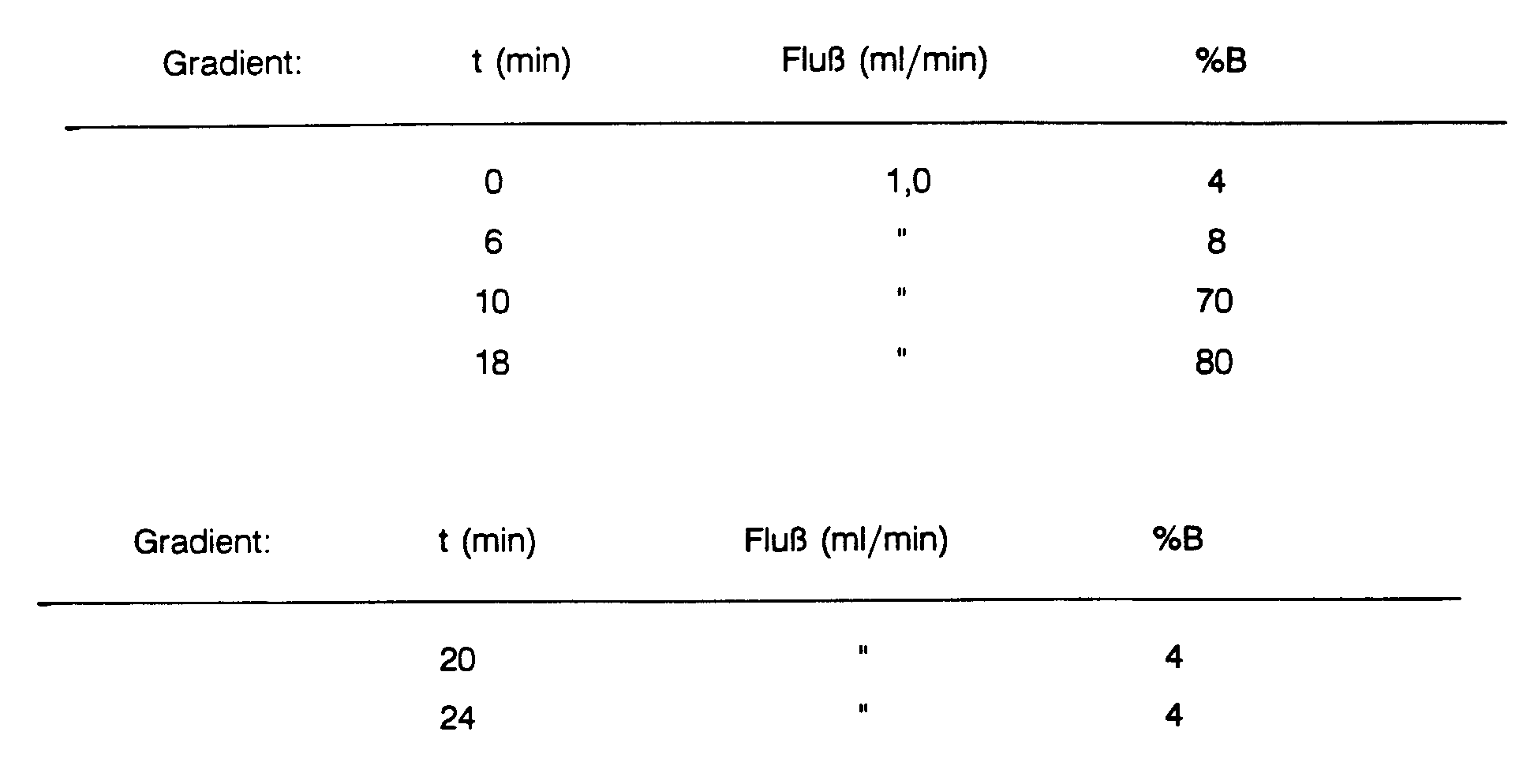
- HPLC-System: HPLC - Analytik: Säule: @LiChrospher 100 RP 18, 5 um Mob. Phase: A = 0,1% Ammoniumacetat + Tetrabutylammoniumhydrogensulfat-(10mg/l) B = A + 80% AcetonitrilProben-Vol.: 10 bzw. 20µl Wellenlänge: 260 nm
- Die erfindungsgemäße Esterase eignet sich zur Spaltung verschiedener Carbonsäureester. Besonders geeignet ist sie zur Spaltung von Estern von Mono- oder Dicarbonsäuren mit bis zu 6 C-Atomen, die ggf. mit F, CI oder Br substituiert sein können, von natürlich vorkommenden Aminosäuren oder von der 7-Amino-3-methoxymethyl-3-cephem-4-carbonsäure mit einem ein-, zwei- oder 3-wertigen Alkohol mit bis zu 6 C-Atomen, in dem die Kohlenstoffkette auch durch eine -C(O)O-Gruppe unterbrochen sein kann, oder mit Phenol, das auch durch Nitro substituiert sein kann.
- Besonders geeignet ist die Esterase zur Spaltung von p-Nitrophenylacetat, 7-Amino-3-methoxymethyl-3-cephem-4-carbonsäure-[1(R,S)-1-(2.2-dimethylpropionyloxy)-ethylester], 7-Amino-3-methoxymethyl-3- cephen-4-carbonsäure-[(2.2-dimethylpropionyloxy)-methylester], 1,1-Bis(pivaloyloxy)-ethan, Propionsäureethylester, Pivalinsäureethylester, Triacetin, Tributyrin, Alaninethylester und 2-Chlorpropionsäureethylester. Ganz besonders geeignet ist das Verfahren zur Spaltung von Amino-3-methoxymethyl-3-cephem-4-carbonsäure[1(R,S)-1-(2.2-dimethylpropionyloxy)-ethylester], Propionsäureethylester, Pivalinsäureethylester, Alaninethylester und 2-Chlorpropionsäureethylester, insbesondere zur Spaltung von 7-Amino-3-methoxymethyl-3-cephem-4-carbonsäur-[1(R,S)-1-(2.2-dimethylpropionyloxy)-ethylester].
- Die Spaltung der Ester, stellvertretend für die Umsetzung der Verbindung der Formel 11 zur Verbindung der Formel I erläutert, findet vorzugsweise unter folgenden Bedingungen statt. Die Verbindung der Formel II wird in wäßriger, vorzugsweise auf im Bereich pH 6.8 gepufferter Lösung (z.B. Kaliumphosphatpuffer) mit der Esterase behandelt, bevorzugt mit der Esterase in geeignet fixierter Form. Vorzugsweise läßt man die Reaktion bei 25-35 °C, insbesondere bei ca 30 °C ablaufen. Nach ca. 6-8 Std. ist in der Regel die Reaktion zu 95% abgeschlossen. Die Reaktionslösung wird nach bekannten Methoden, z.B. Filtration, vom Enzym getrennt. Die Verbindung der Formel 1 wird isoliert, z.B. durch Lyophilisation, und anschließend ggf. weiter gereinigt, z.B. durch Umkristallisation.
- Im folgenden soll die Erfindung durch Beispiele und den Inhalt der Patentansprüche näher erläutert werden.
- Die Überprüfung geeigneter Hydrolaseproduzenten erfolgte nach Vor- und Hauptanzucht der Stämme in Müller Hinton Medium (Difco) bei 28°C und 240 Upm.
- Nach 3 Tagen wurden folgende Hydrolase-Aktivitäten ermittelt:

- Die Vorkultur von A. orientalis ATCC 53492 wird im Medium folgender
- Zusammensetzung durchgeführt:
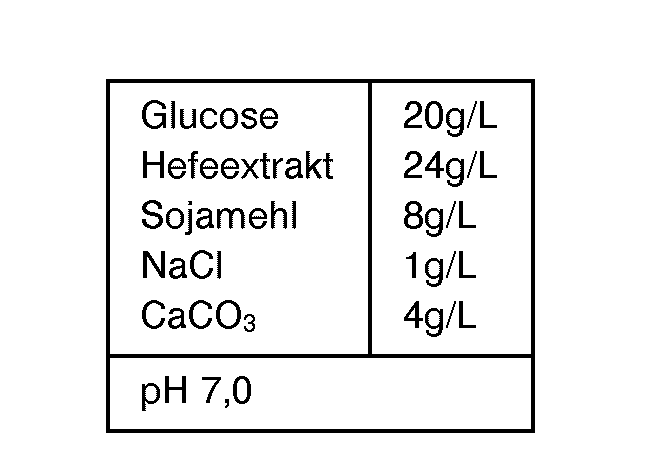
- 500ml/2000ml Erienmeyerkolben; 28 °C; 240 Upm; 3 Tage
- Hauptkulturmedium:

- 9L Medium/12L Fermenter; Inokulum = 6%; 28 °C; 350Upm; Belüftungsrate: 0,5vvm Nach 48-60 Stunden wird die maximale Hydrolase-Aktivität von >90% MACA-Bildung in 4 Std. erreicht.
- 3.5 I Kulturlösung aus Beispiel 2 werden durch Zentrifugation in Kulturüberstand und Biomasse getrennt. Das Enzym befindet sich im Überstand. Diese Lösung wird lyophilisiert. 85g Feststoff werden in 500ml 50mM Kaliumphosphatlösung, pH =7.8, eingerührt und anschließend zentrifugiert. Die fast klare, dunkelbraune Lösung wird einer Ammoniumsulfatfällung unterworfen. Statt der Lyophilisation kann das Kulturfiltrat auch mittels Ultrafiltration (cut-off: 10 000 Da) auf 500ml konzentriert werden. Dann wird Ammoniumsulfat ad 35% der Sättigung zugegeben und abermals zentrifugiert. Der Überstand wird auf 70% der Sättigung mit Ammoniumsulfat aufgestockt. Nach einer weiteren Zentrifugation bei mind. 13000g wird der Niederschlag in 250ml Puffer (s.o.) aufgenommen. Die Aktivität dieser Lösung beträgt 370mU/ml.
- Zu 250ml Enzymlösung nach Beispiel 3 wird soviel prim. und sek. Phosphat gegeben, daß die Lösung 1 M an Phosphat ist. Der pH beträgt 8.0. Eine leichte Trübung wird in Kauf genommen. Dann werden 50g Enzymträger VA-Epoxy BiosynthR (Riedel de Haen, Seelze, Deutschland) hinzugegeben und 3 Tage bei Raumtemperatur stehengelassen. Dann wird mit 1 M NaCI und mit bidest. Wasser gewaschen. 72% der Enzymaktivität befinden sich auf dem Träger, der eine spez. Aktivität von 1.35 U/g TGW aufweist.
- 2.5g R-Ester-Hydrochlorid werden in 800ml 50mM Kaliumphosphatlösung, pH=6.8, gelöst. Dann werden unter Rühren 100g feuchtes fixiertes Enzym zugegeben. Der pH wird bei 6.8 und die Temperatur auf 30 °C gehalten. Nach 2.5 h werden weitere 1.25 und nach 4 1/4 h nochmals 1.25g Substrat zugegeben. Insgesamt enthält der Ansatz 5g MACA-Ester (R). Die Spaltung verläuft innerhalb von 6-8 Stunden bis auf 95% Umsatz laut HPLC. Die vom Enzym getrennte Spaltlösung wird lyophilisiert. Man erhält ca. 10g eines weißen Feststoffes.
- Der aus Beispiel 5 gewonnene Feststoff wird in 35ml Wasser aufgenommen, pH = 6.8 eingestellt (verd. Ammoniak) und ein unlöslicher Rückstand abgetrennt. Dann wird die klare, gelbliche Lösung auf 10 abgekühlt und unter Rühren 5 N HCI zugegeben. Ab pH = 5.5 beginnt die MACA auszukristallisieren. Der pH wird weiter auf 2.5 abgesenkt und 20 Minuten nachgerührt. Die Kristalle werden über Seitz-Filter abgetrennt. Es wird dann mit Wasser, Aceton und schließlich Diisopropyläther nachgewaschen. Der Feststoff wird im Vakuum bei R.T. getrocknet.
- Auswaage: 2.2g (96%-ig) entsprechend 71% Ausbeute, bezogen auf eingesetzten MACA-Ester. 0.34g MACA, entsprechend 11.4%, verbleiben in der Mutterlauge.
- Die folgende Tabelle enthält weitere Informationen über die Substratspezifität der erfindungsgemäßen Esterase:

Claims (10)

Applications Claiming Priority (2)
| Application Number | Priority Date | Filing Date | Title |
|---|---|---|---|
| DE4218785 | 1992-06-06 | ||
| DE4218785A DE4218785A1 (de) | 1992-06-06 | 1992-06-06 | 7-Amino-3-methoxy-3-cephem-4-carbonsäureester - Hydrolase, Verfahren zu deren Herstellung sowie deren Verwendung |
Publications (3)
| Publication Number | Publication Date |
|---|---|
| EP0573849A2 true EP0573849A2 (de) | 1993-12-15 |
| EP0573849A3 EP0573849A3 (en) | 1994-08-17 |
| EP0573849B1 EP0573849B1 (de) | 2000-02-09 |
Family
ID=6460584
Family Applications (1)
| Application Number | Title | Priority Date | Filing Date |
|---|---|---|---|
| EP93108560A Expired - Lifetime EP0573849B1 (de) | 1992-06-06 | 1993-05-27 | 7-Amino-3-methoxymethyl-3-cephem-4-carbonsäureester-Hydrolase, Verfahren zu deren Herstellung sowie deren Verwendung |
Country Status (12)
| Country | Link |
|---|---|
| US (1) | US5527697A (de) |
| EP (1) | EP0573849B1 (de) |
| JP (1) | JPH06133770A (de) |
| KR (1) | KR940005794A (de) |
| AT (1) | ATE189698T1 (de) |
| CA (1) | CA2097770A1 (de) |
| DE (2) | DE4218785A1 (de) |
| DK (1) | DK0573849T3 (de) |
| ES (1) | ES2144430T3 (de) |
| GR (1) | GR3033220T3 (de) |
| IL (1) | IL105903A (de) |
| PT (1) | PT573849E (de) |
Family Cites Families (4)
| Publication number | Priority date | Publication date | Assignee | Title |
|---|---|---|---|---|
| DE2215687C3 (de) * | 1972-03-30 | 1980-12-11 | Bayer Ag, 5090 Leverkusen | Neue wasserunlösliche Proteinpräparate |
| US4316955A (en) * | 1980-11-10 | 1982-02-23 | Eli Lilly And Company | Enzymatic deesterification of cephalosporin methyl esters |
| DE3344912A1 (de) * | 1983-12-13 | 1985-06-20 | Hoechst Ag, 6230 Frankfurt | Vernetzte polymerisate, verfahren zu ihrer herstellung und ihre anwendung |
| EP0265185A3 (de) * | 1986-10-21 | 1990-03-28 | Beecham Group Plc | Cephalosporine, Verfahren zu ihrer Herstellung und sie enthaltende pharmazeutische Präparate |
-
1992
- 1992-06-06 DE DE4218785A patent/DE4218785A1/de not_active Ceased
-
1993
- 1993-05-27 DE DE59309949T patent/DE59309949D1/de not_active Expired - Fee Related
- 1993-05-27 ES ES93108560T patent/ES2144430T3/es not_active Expired - Lifetime
- 1993-05-27 DK DK93108560T patent/DK0573849T3/da active
- 1993-05-27 PT PT93108560T patent/PT573849E/pt unknown
- 1993-05-27 AT AT93108560T patent/ATE189698T1/de not_active IP Right Cessation
- 1993-05-27 EP EP93108560A patent/EP0573849B1/de not_active Expired - Lifetime
- 1993-06-03 IL IL10590393A patent/IL105903A/en not_active IP Right Cessation
- 1993-06-04 JP JP5134218A patent/JPH06133770A/ja active Pending
- 1993-06-04 KR KR1019930010031A patent/KR940005794A/ko active Pending
- 1993-06-04 CA CA002097770A patent/CA2097770A1/en not_active Abandoned
-
1994
- 1994-07-12 US US08/273,622 patent/US5527697A/en not_active Expired - Fee Related
-
2000
- 2000-04-14 GR GR20000400911T patent/GR3033220T3/el not_active IP Right Cessation
Non-Patent Citations (2)
| Title |
|---|
| ENZYME AND MICROBIAL TECHNOLOGY, Bd.4, Nr.2, 1982, HAYWARDS HEATH GB Seiten 80 - 84 BERRY D.R ET AL. 'Enzymatic removal of a ...' * |
| JOURNAL OR ORGANIC CHEMISTRY, Bd.56, 1991, WASHINGTON DC US Seiten 3633 - 3637 SIGERU TORII ET AL. 'Deprotection of carboxylic esters ...' * |
Also Published As
| Publication number | Publication date |
|---|---|
| ATE189698T1 (de) | 2000-02-15 |
| JPH06133770A (ja) | 1994-05-17 |
| DE59309949D1 (de) | 2000-03-16 |
| EP0573849B1 (de) | 2000-02-09 |
| GR3033220T3 (en) | 2000-08-31 |
| ES2144430T3 (es) | 2000-06-16 |
| IL105903A (en) | 1999-06-20 |
| US5527697A (en) | 1996-06-18 |
| DK0573849T3 (da) | 2000-07-10 |
| PT573849E (pt) | 2000-07-31 |
| CA2097770A1 (en) | 1993-12-07 |
| IL105903A0 (en) | 1993-10-20 |
| EP0573849A3 (en) | 1994-08-17 |
| DE4218785A1 (de) | 1993-12-09 |
| KR940005794A (ko) | 1994-03-22 |
Similar Documents
| Publication | Publication Date | Title |
|---|---|---|
| DE3424440C2 (de) | ||
| DE69422662T2 (de) | Enzymatische Hydrolyse oder Esterifikation von C-10 und C-13 Hydroxy oder Acyloxy enthaltende Taxanen | |
| DE2754326C2 (de) | Antibiotikum AM 2282, seine Herstellung und Arzneimittel | |
| DE69914458T2 (de) | Verfahren zur enzymatischen auflösung von laktamen | |
| DE2423058C2 (de) | Verfahren zur Herstellung von 3-Hydroxymethyl-cephalosporinen | |
| DE3523018A1 (de) | Verfahren zur herstellung von peptiden | |
| DE69121080T2 (de) | D-pantolactonhydrolase und ihre herstellung | |
| DE2757980C2 (de) | ||
| DE2527068A1 (de) | Verfahren zur herstellung von cholesterinesterase | |
| EP0502525B1 (de) | Biotechnologisches Verfahren zur Herstellung von S-(+)-2,2-Dimethylcyclopropancarboxamid und R-(-)-2,2-Dimethylcyclopropancarbonsäure | |
| GB1303038A (en) | Pleuromutilin derivatives | |
| EP0573849B1 (de) | 7-Amino-3-methoxymethyl-3-cephem-4-carbonsäureester-Hydrolase, Verfahren zu deren Herstellung sowie deren Verwendung | |
| DE69721812T2 (de) | Verfahren zur herstellung optisch aktiver 3-quinuclidinol derivate | |
| DE2723463C3 (de) | Verfahren zur Herstellung von 7-Aminocephem-Verbindungen | |
| DE1967074C3 (de) | Verfahren zur Herstellung von a-Aminobenzylpenicillin | |
| DE3888307T2 (de) | Verfahren zur Herstellung von Ascorbinsäure-2-phosphat. | |
| US4073687A (en) | Enzymatic acylation to afford β-lactam antibiotics | |
| DE69229616T2 (de) | Enzymatische Resolution von Alpha-tertiären-Karbonsäureestern | |
| DE2740348A1 (de) | Verfahren zur optischen trennung von dl-lysin-verbindungen | |
| DE2441637C2 (de) | Verfahren zur Herstellung von 6- Aminopenicillansäure-1-oxid | |
| DE2332065C2 (de) | Verfahren zur Herstellung von Cephalosporinen sowie deren N-Alkoxycarbonyl- oder N-Arylcarbamoylderivaten | |
| DE60010013T2 (de) | Verfahren zur Herstellung von optisch aktivem 1,2,4-Butantriol und optisch aktivem 3-Hydroxy-gamma-butyrolacton mittels Mikroorganismen | |
| US3485722A (en) | Fermentative process for producing ergocryptine | |
| DE2213674C3 (de) | Gemisch aus Pepstatin B und Pepstatin C, Verfahren zu dessen Herstellung und dieses Gemisch enthaltende Arzneimittel | |
| DE2408708A1 (de) | Verfahren zur herstellung von glucoseisomerase |
Legal Events
| Date | Code | Title | Description |
|---|---|---|---|
| PUAI | Public reference made under article 153(3) epc to a published international application that has entered the european phase |
Free format text: ORIGINAL CODE: 0009012 |
|
| AK | Designated contracting states |
Kind code of ref document: A2 Designated state(s): AT BE CH DE DK ES FR GB GR IE IT LI LU NL PT SE |
|
| PUAL | Search report despatched |
Free format text: ORIGINAL CODE: 0009013 |
|
| AK | Designated contracting states |
Kind code of ref document: A3 Designated state(s): AT BE CH DE DK ES FR GB GR IE IT LI LU NL PT SE |
|
| 17P | Request for examination filed |
Effective date: 19950217 |
|
| 17Q | First examination report despatched |
Effective date: 19971121 |
|
| GRAG | Despatch of communication of intention to grant |
Free format text: ORIGINAL CODE: EPIDOS AGRA |
|
| GRAG | Despatch of communication of intention to grant |
Free format text: ORIGINAL CODE: EPIDOS AGRA |
|
| GRAH | Despatch of communication of intention to grant a patent |
Free format text: ORIGINAL CODE: EPIDOS IGRA |
|
| GRAH | Despatch of communication of intention to grant a patent |
Free format text: ORIGINAL CODE: EPIDOS IGRA |
|
| GRAH | Despatch of communication of intention to grant a patent |
Free format text: ORIGINAL CODE: EPIDOS IGRA |
|
| GRAA | (expected) grant |
Free format text: ORIGINAL CODE: 0009210 |
|
| AK | Designated contracting states |
Kind code of ref document: B1 Designated state(s): AT BE CH DE DK ES FR GB GR IE IT LI LU NL PT SE |
|
| REF | Corresponds to: |
Ref document number: 189698 Country of ref document: AT Date of ref document: 20000215 Kind code of ref document: T |
|
| REG | Reference to a national code |
Ref country code: CH Ref legal event code: EP |
|
| REF | Corresponds to: |
Ref document number: 59309949 Country of ref document: DE Date of ref document: 20000316 |
|
| ET | Fr: translation filed | ||
| ITF | It: translation for a ep patent filed | ||
| REG | Reference to a national code |
Ref country code: IE Ref legal event code: FG4D Free format text: GERMAN |
|
| GBT | Gb: translation of ep patent filed (gb section 77(6)(a)/1977) |
Effective date: 20000425 |
|
| REG | Reference to a national code |
Ref country code: ES Ref legal event code: FG2A Ref document number: 2144430 Country of ref document: ES Kind code of ref document: T3 |
|
| REG | Reference to a national code |
Ref country code: DK Ref legal event code: T3 |
|
| REG | Reference to a national code |
Ref country code: PT Ref legal event code: SC4A Free format text: AVAILABILITY OF NATIONAL TRANSLATION Effective date: 20000419 |
|
| PLBE | No opposition filed within time limit |
Free format text: ORIGINAL CODE: 0009261 |
|
| 26N | No opposition filed | ||
| REG | Reference to a national code |
Ref country code: GB Ref legal event code: IF02 |
|
| PGFP | Annual fee paid to national office [announced via postgrant information from national office to epo] |
Ref country code: DE Payment date: 20020416 Year of fee payment: 10 |
|
| PGFP | Annual fee paid to national office [announced via postgrant information from national office to epo] |
Ref country code: NL Payment date: 20020422 Year of fee payment: 10 Ref country code: DK Payment date: 20020422 Year of fee payment: 10 Ref country code: AT Payment date: 20020422 Year of fee payment: 10 |
|
| PGFP | Annual fee paid to national office [announced via postgrant information from national office to epo] |
Ref country code: SE Payment date: 20020423 Year of fee payment: 10 Ref country code: PT Payment date: 20020423 Year of fee payment: 10 Ref country code: GB Payment date: 20020423 Year of fee payment: 10 Ref country code: FR Payment date: 20020423 Year of fee payment: 10 |
|
| PGFP | Annual fee paid to national office [announced via postgrant information from national office to epo] |
Ref country code: CH Payment date: 20020424 Year of fee payment: 10 |
|
| PGFP | Annual fee paid to national office [announced via postgrant information from national office to epo] |
Ref country code: GR Payment date: 20020425 Year of fee payment: 10 |
|
| PGFP | Annual fee paid to national office [announced via postgrant information from national office to epo] |
Ref country code: ES Payment date: 20020520 Year of fee payment: 10 |
|
| PGFP | Annual fee paid to national office [announced via postgrant information from national office to epo] |
Ref country code: BE Payment date: 20020521 Year of fee payment: 10 |
|
| PGFP | Annual fee paid to national office [announced via postgrant information from national office to epo] |
Ref country code: IE Payment date: 20020531 Year of fee payment: 10 |
|
| PGFP | Annual fee paid to national office [announced via postgrant information from national office to epo] |
Ref country code: LU Payment date: 20020604 Year of fee payment: 10 |
|
| PG25 | Lapsed in a contracting state [announced via postgrant information from national office to epo] |
Ref country code: LU Free format text: LAPSE BECAUSE OF NON-PAYMENT OF DUE FEES Effective date: 20030527 Ref country code: IE Free format text: LAPSE BECAUSE OF NON-PAYMENT OF DUE FEES Effective date: 20030527 Ref country code: GB Free format text: LAPSE BECAUSE OF NON-PAYMENT OF DUE FEES Effective date: 20030527 Ref country code: AT Free format text: LAPSE BECAUSE OF NON-PAYMENT OF DUE FEES Effective date: 20030527 |
|
| PG25 | Lapsed in a contracting state [announced via postgrant information from national office to epo] |
Ref country code: SE Free format text: LAPSE BECAUSE OF NON-PAYMENT OF DUE FEES Effective date: 20030528 Ref country code: ES Free format text: LAPSE BECAUSE OF NON-PAYMENT OF DUE FEES Effective date: 20030528 |
|
| PG25 | Lapsed in a contracting state [announced via postgrant information from national office to epo] |
Ref country code: LI Free format text: LAPSE BECAUSE OF NON-PAYMENT OF DUE FEES Effective date: 20030531 Ref country code: CH Free format text: LAPSE BECAUSE OF NON-PAYMENT OF DUE FEES Effective date: 20030531 Ref country code: BE Free format text: LAPSE BECAUSE OF NON-PAYMENT OF DUE FEES Effective date: 20030531 |
|
| BERE | Be: lapsed |
Owner name: *HOECHST A.G. Effective date: 20030531 |
|
| PG25 | Lapsed in a contracting state [announced via postgrant information from national office to epo] |
Ref country code: PT Free format text: LAPSE BECAUSE OF NON-PAYMENT OF DUE FEES Effective date: 20031130 |
|
| PG25 | Lapsed in a contracting state [announced via postgrant information from national office to epo] |
Ref country code: NL Free format text: LAPSE BECAUSE OF NON-PAYMENT OF DUE FEES Effective date: 20031201 Ref country code: DK Free format text: LAPSE BECAUSE OF NON-PAYMENT OF DUE FEES Effective date: 20031201 |
|
| PG25 | Lapsed in a contracting state [announced via postgrant information from national office to epo] |
Ref country code: DE Free format text: LAPSE BECAUSE OF NON-PAYMENT OF DUE FEES Effective date: 20031202 |
|
| PG25 | Lapsed in a contracting state [announced via postgrant information from national office to epo] |
Ref country code: GR Free format text: LAPSE BECAUSE OF NON-PAYMENT OF DUE FEES Effective date: 20031203 |
|
| EUG | Se: european patent has lapsed | ||
| REG | Reference to a national code |
Ref country code: CH Ref legal event code: PL |
|
| GBPC | Gb: european patent ceased through non-payment of renewal fee |
Effective date: 20030527 |
|
| PG25 | Lapsed in a contracting state [announced via postgrant information from national office to epo] |
Ref country code: FR Free format text: LAPSE BECAUSE OF NON-PAYMENT OF DUE FEES Effective date: 20040130 |
|
| NLV4 | Nl: lapsed or anulled due to non-payment of the annual fee |
Effective date: 20031201 |
|
| REG | Reference to a national code |
Ref country code: DK Ref legal event code: EBP |
|
| REG | Reference to a national code |
Ref country code: FR Ref legal event code: ST Ref country code: PT Ref legal event code: MM4A Free format text: LAPSE DUE TO NON-PAYMENT OF FEES Effective date: 20031130 |
|
| REG | Reference to a national code |
Ref country code: IE Ref legal event code: MM4A |
|
| REG | Reference to a national code |
Ref country code: ES Ref legal event code: FD2A Effective date: 20030528 |
|
| PG25 | Lapsed in a contracting state [announced via postgrant information from national office to epo] |
Ref country code: IT Free format text: LAPSE BECAUSE OF NON-PAYMENT OF DUE FEES;WARNING: LAPSES OF ITALIAN PATENTS WITH EFFECTIVE DATE BEFORE 2007 MAY HAVE OCCURRED AT ANY TIME BEFORE 2007. THE CORRECT EFFECTIVE DATE MAY BE DIFFERENT FROM THE ONE RECORDED. Effective date: 20050527 |