EP0574027A2 - Verfahren und Vorrichtung zur Analyse von ausgeatmetem Gas - Google Patents
Verfahren und Vorrichtung zur Analyse von ausgeatmetem Gas Download PDFInfo
- Publication number
- EP0574027A2 EP0574027A2 EP93109614A EP93109614A EP0574027A2 EP 0574027 A2 EP0574027 A2 EP 0574027A2 EP 93109614 A EP93109614 A EP 93109614A EP 93109614 A EP93109614 A EP 93109614A EP 0574027 A2 EP0574027 A2 EP 0574027A2
- Authority
- EP
- European Patent Office
- Prior art keywords
- gas
- expired
- expired gas
- columns
- sample
- Prior art date
- Legal status (The legal status is an assumption and is not a legal conclusion. Google has not performed a legal analysis and makes no representation as to the accuracy of the status listed.)
- Withdrawn
Links
Images


Classifications
-
- G—PHYSICS
- G01—MEASURING; TESTING
- G01N—INVESTIGATING OR ANALYSING MATERIALS BY DETERMINING THEIR CHEMICAL OR PHYSICAL PROPERTIES
- G01N30/00—Investigating or analysing materials by separation into components using adsorption, absorption or similar phenomena or using ion-exchange, e.g. chromatography or field flow fractionation
- G01N30/02—Column chromatography
- G01N30/26—Conditioning of the fluid carrier; Flow patterns
- G01N30/38—Flow patterns
- G01N30/46—Flow patterns using more than one column
- G01N30/466—Flow patterns using more than one column with separation columns in parallel
-
- G—PHYSICS
- G01—MEASURING; TESTING
- G01N—INVESTIGATING OR ANALYSING MATERIALS BY DETERMINING THEIR CHEMICAL OR PHYSICAL PROPERTIES
- G01N33/00—Investigating or analysing materials by specific methods not covered by groups G01N1/00 - G01N31/00
- G01N33/0004—Gaseous mixtures, e.g. polluted air
- G01N33/0009—General constructional details of gas analysers, e.g. portable test equipment
- G01N33/0011—Sample conditioning
-
- G—PHYSICS
- G01—MEASURING; TESTING
- G01N—INVESTIGATING OR ANALYSING MATERIALS BY DETERMINING THEIR CHEMICAL OR PHYSICAL PROPERTIES
- G01N33/00—Investigating or analysing materials by specific methods not covered by groups G01N1/00 - G01N31/00
- G01N33/48—Biological material, e.g. blood, urine; Haemocytometers
- G01N33/483—Physical analysis of biological material
- G01N33/497—Physical analysis of biological material of gaseous biological material, e.g. breath
-
- G—PHYSICS
- G01—MEASURING; TESTING
- G01N—INVESTIGATING OR ANALYSING MATERIALS BY DETERMINING THEIR CHEMICAL OR PHYSICAL PROPERTIES
- G01N30/00—Investigating or analysing materials by separation into components using adsorption, absorption or similar phenomena or using ion-exchange, e.g. chromatography or field flow fractionation
- G01N30/02—Column chromatography
- G01N30/26—Conditioning of the fluid carrier; Flow patterns
- G01N30/28—Control of physical parameters of the fluid carrier
- G01N30/30—Control of physical parameters of the fluid carrier of temperature
- G01N2030/3007—Control of physical parameters of the fluid carrier of temperature same temperature for whole column
-
- G—PHYSICS
- G01—MEASURING; TESTING
- G01N—INVESTIGATING OR ANALYSING MATERIALS BY DETERMINING THEIR CHEMICAL OR PHYSICAL PROPERTIES
- G01N30/00—Investigating or analysing materials by separation into components using adsorption, absorption or similar phenomena or using ion-exchange, e.g. chromatography or field flow fractionation
- G01N30/02—Column chromatography
- G01N30/26—Conditioning of the fluid carrier; Flow patterns
- G01N30/28—Control of physical parameters of the fluid carrier
- G01N30/30—Control of physical parameters of the fluid carrier of temperature
- G01N2030/3046—Control of physical parameters of the fluid carrier of temperature temperature control of column inlet
-
- G—PHYSICS
- G01—MEASURING; TESTING
- G01N—INVESTIGATING OR ANALYSING MATERIALS BY DETERMINING THEIR CHEMICAL OR PHYSICAL PROPERTIES
- G01N30/00—Investigating or analysing materials by separation into components using adsorption, absorption or similar phenomena or using ion-exchange, e.g. chromatography or field flow fractionation
- G01N30/02—Column chromatography
- G01N30/62—Detectors specially adapted therefor
- G01N2030/628—Multiplexing, i.e. several columns sharing a single detector
-
- G—PHYSICS
- G01—MEASURING; TESTING
- G01N—INVESTIGATING OR ANALYSING MATERIALS BY DETERMINING THEIR CHEMICAL OR PHYSICAL PROPERTIES
- G01N33/00—Investigating or analysing materials by specific methods not covered by groups G01N1/00 - G01N31/00
- G01N33/0004—Gaseous mixtures, e.g. polluted air
- G01N33/0006—Calibrating gas analysers
Definitions
- expired gas has almost not been used as samples in clinical biochemical examination. This is firstly because there is a prejudice in the art that expired gas could not be usable as samples for the clinical biochemical examination, and secondly because specific gas components contained in the expired gas to be detected are quite low in concentration (ppb or ppm at the most) so that they could be measurable only by a special equipment and an instrument (a large-scaled gas detecting device of high sensitivity and a concentrating device of the trace amounts of gas components) and a skilled operator for the measurement. There are heard only few clinical reports of this kind of measurement.
- Expired gas is intermittently breathed out by human (or animals) during their lives are maintained, and it is readily collectable, without causing subjects a physical or mental pain, particularly from infants, patients with serious illness or damages in consciousness by use of a specially designed instrument. Also, since trace amounts of volatile components of mixed venous blood flowing through alveolar blood capillary is moved into expired gas by gas exchange, it is inferred that expired gas and blood have correlation with respect to the volatile components.
- samples used now in most of the clinical examinations are blood. But, collecting blood causes subjects or patients a physical pain with loss of their important blood, and repeated collection of blood and a continuous measurement thereof impose a heavy burden on the subjects or patients.
- analyzing the blood samples is delt exclusively or centrally by a blood analysis center (firms specialized in analyzing blood) to occupy much time from collecting blood to the analysis, leading to larger errors in measurement of certain components of blood which easily gasified or denatured.
- a blood analysis center firms specialized in analyzing blood
- urine is discharge relatively readily and amply collectable and broadly used in screening, but has a problem that it provides less information than blood does.
- the examinations with urine cause the subjects or patients a mental pain as from a feeling of shame and do not enable a continuous measurement, and urine is hard to be collected at all times.
- the inventors have zealously studied development of clinical examination methods and devices using expired gas as samples.
- Expired gas when collected in vessels occupies much spaces for preservation and transportation, so that they are not well subjected to the same analyzing course as that of blood, i.e., as first transported to the analysis center and analyzed by the large-scaled apparatuses.
- the examination device is required to be small-sized, portable, of high sensitivity, simply operable and superior in safety and rapidity in measurement. Reliability of provided data and economization in use of such examination device are also required.
- the inventors have previously developed a practical clinical examination method and device using expired gas as samples under the foregoing circumstances.
- the previously developed examination method and device causes gas components contained in expired gas to be separated through a column and detects the components by a detector.
- the detector employs PID (Photo Ionization Detector), IMS (Ion Mobility Spectrometer) or ECD (Electron Capture Detector), wherein the aimed gas components to be detected is applied with light or radiation to be ionized so that measurement signals are output corresponding to amounts of ionization of the gas components.
- An object of the invention is to provide a novel expired gas analytical method and device for clinical purpose by which analytical method and device a plurality of gas components contained in expired gas of subjects can be measured rapidly and accurately with a single operation by use of gas chromatograph.
- Another object of the present invention is to provide an expired gas analytical device which is of high sensitivity, readily operable, applicable to infants, aged men and women and unconscious patients and also having safety, reliability of provided data and economization in use of the device.
- Fig. 1 is a block diagram showing an example of an expired gas analytical device according to the present invention.
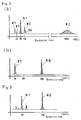
- Fig. 2(a) is a gas chromatogram obtained by separating an expired gas sample with a column for separating acetone
- Fig. 2(b) a gas chromatogram obtained by separating an expired gas with a column for separating 4-heptanone.
- Fig. 3 is a gas chromatogram of an expired gas measured by the expired gas analytical device according to the present invention.
- Fig. 4 is a block diagram showing a modified example of the expired gas analytical device of the invention.
- the inventors have provided in the expired gas analytical device a plurality of columns different in gas separating conditions (shapes of columns, adsorbents and column temperatures) so that a plurality of gas components, which may have large difference from each other in retention time under the same separating condition, can be measured in a short time with less difference in the retention time without deterioration of separation accuracy.
- acetoacetic acid increases due to sthenia of fat metabolism in diabetes (type I) or bulimia (acetonemic vomiting, etc) and is made use of for diagnosing the diseases.
- 3-hydroxybutyric acid (3-OHBA) is also measured rarely and acetone (Ac) formed by decarboxylation of acetoacetic acid is hardly measured since acetone is discharged into expired gas to be in quite trace amount.
- the inventors carried out measurement of expired gas on the basis of the knowledge and obtained the same measurement results as the above.
- acetone among the conventional three components in ketone body shows higher concentration in measurement of expired gas
- Measurement of ketone body in blood or urine takes much cost and labor while the analysis of ketone body by using expired gas is quite simple.
- measuring acetone and 4-heptanone in expired gas has a large significance for diagnosis of diabetes and as a monitor for therapy.
- Fig. 2(a) shows the gas chromatogram obtained by measuring acetone and 4-heptanone in expired gas with using an expired gas analytical device (a single column: column temperature of 60°C) previously developed by the inventors.
- retention time of acetone (peak #1) is 50 sec and that of 4-heptanone (peak #2) 1860 sec (31 min).
- the difference of retention time is inferred to be from difference of boiling points, i.e., 56.5°C for acetone and 150°C for 4-heptanone and causes the analytical device to have no practicality as a clinical biochemical examination device.
- Fig. 2(a) shows the gas chromatogram obtained by measuring acetone and 4-heptanone in expired gas with using an expired gas analytical device (a single column: column temperature of 60°C) previously developed by the inventors.
- retention time of acetone (peak #1) is 50 sec and that of 4-heptanone (peak #2) 1860 sec (31 min).
- the difference of retention time is inferred to be from
- Fig. 2(b) is a gas chromatogram similarly obtained by the expired gas analytical device with temperature of the single column being set to 150°C, wherein retention time of 4-heptanone (peak #8) is substantially reduced to 135 sec (2.25 min) while acetone is measured but not clearly separated from other low boiling point compounds, such as acetaldehyde and others, (peak #7), thereby making impossible an accurate measurement.
- the present invention has been designed to solve this problem and has a characteristic in that the expired gas analytical device is constructed with a multi-channel style using a plurality of columns differing in gas-separating conditions.
- two columns each set to 60 and 150°C respectively without changing adsorbents and column shapes.
- a low temperature column may be selectively set to 40 to 60°C and a high temperature column 100 to 200°C depending upon specific gas components to be measured.
- Optimum column shapes and adsorbents in addition to column temperatures may be selected for aimed gases to further reduce the retention times.
- three or more columns may be usable in combination with selected column temperatures and structures and fillers.
- a plurality of columns may be preferably used for examination of various diseases in addition to diabetes, for example, liver cirrhosis and also for examination of newborn infants.
- Expired gas of a patient with serious liver cirrhosis contains low-boiling ammonia (-33.4°C) and methyl mercaptan (6°C) and high-boiling lower fatty acid such as acetic acid (118.1°C), propionic acid (141.1°), isobutyric acid (154.5°C), butyric acid (163.5°C) and isovaleric acid (176°C).
- a low temperature column e.g. 40°C
- a high temperature column e.g., 150°C
- a low temperature column for ammonia
- a high temperature column for the remainder
- the expired gas analytical device generally comprises an expired gas breathe-into part, a carrier gas feeding part, a sample measuring part, a detecting part and an arithmetic processing part.
- the detecting part i.e., a column and a detector
- the column may use a packed column or a capillary column.
- the capillary column is more preferably used since it requires less amount of samples and provides a sharp chromatogram.
- a plurality of columns are mounted, each column being set of constructions, kinds of adsorbents (fillers and liquid layers) and heating temperatures corresponding to aimed gas components so as to allow retention time of the aimed gas components to be several minutes or 2 to 3 min.
- the adsorbents are selected, corresponding to specific gases to be detected, from various kinds of fillers and liquid layers hitherto known in consideration of such conditions required for the examination as measurement accuracy, reproducibility and rapidity.
- the detector employs the foregoing PID, IMS or ECD.
- the photo ionization detector (PID) which does not use radiation is most preferable.
- the PID utilizes the phenomenon that an aimed gas component is applied with light (ultraviolet) having energy larger than ionization potential of the gas, thereby causing ionization.
- An amount of ionization of the gas is converted to ionizing current with electrodes to be output, so that concentration of detected gas components is determined from magnitude of ionizing current.
- the detector may be used in the same number as the columns, but a single detector is sufficient when aimed gas components have large difference in retention time.
- the expired gas breathe-into part is adapted to feed expired air (expired gas) to the sample measuring part and comprises an expired gas collector such as a mouthpiece or a mask for collecting expired gas and a collecting tube (a sampling probe) mounting the expired gas collector at one end.
- the expired gas breathe-into part, particularly, the collecting tube is preferably to be heated at its inner surface to human body temperature or higher temperatures, for example, 36 to 100°C, more preferably 40 to 50°C. This prevents that moisture of the expired gas condenses on and sticks to an inner wall of the collecting tube to dissolve and adsorb an aimed gas component.
- a heating element may be disposed circumferentially of or inside the collecting tube, or the tube may be made of a material having itself heat build-up and sheathed with insulating material. Also, the collecting tube may include a temperature adjuster mechanism.
- the expired gas collector may be disposable type to be sanitary.
- expired gas is collected first in a separate expired-gas collecting means such as a large injector or a gas bag (but not directly breathed into the analytical device) and then fed into the device through the collecting tube.
- expired gas collected at a predetermined amount by a syringe may be injected from an expired gas sample injecting part formed at the upper stream side of the column.
- the expired gas collecting means i.e., the injector, gas bag and syringe requires to be kept at specific temperatures or heated so that inside of the expired gas collecting means can be kept at temperatures higher than human body temperature.
- the sample measuring part collects and holds as an expired gas sample a predetermined amount of portion of expired gas fed from the expired gas breathe-into part.
- the collection of the predetermined amount of air portion may be carried out by patient's positive blowing to push the expired gas or preferably by use of a sampling pump to take in or press the expired gas.
- Use of the sampling pump has advantages that expired gas can be collected readily from infants or unconscious patients and contamination (carry-over) on the inner wall of the collecting tube due to a previous subject's expired gas can be purged and removed by taking in atmosphere or a subsequent patient's expired gas.
- the sample measuring parts may be provided in the same number as the columns for highly accurate measurement.
- a single set of sample measuring part may be provided to allow expired gas sample to be fed equally to the columns, or a change-over valve may be provided between the sample measuring part and the column group to feed the expired gas sample to the columns in order.
- a predetermined amount of expired gas sample to be fed into each column depends upon capacity of the detecting part and may be about 0.05 to 5.0 ml, more preferably 0.1 to 0.8 ml.
- the sample measuring part, particularly, the measuring chamber needs to be kept at a constant temperature higher than human body temperature (for example, the same temperatures as the collecting tube) to prevent sticking of moisture and keep constant the mass of the expired gas samples.
- the carrier gas feeding part feeds a carrier gas which sends the expired air samples to the separation column.
- a source of the carrier gas is preferably a small-sized gas cylinder in consideration of the portability of the analytical device according to the invention. In case that the analytical device is installed at a fixed position for use, a larger gas cylinder is usable for the carrier gas source.
- the invention can employ as the carrier gas a purified air or nitrogen gas which are cheap, and also all kinds of gases, such as helium or the like, generally used in the art.
- ambient air not the air packed in a cylinder may be used to be fed by a compression pump.
- an air filter including adsorbent or the like is provided for purifying taken ambient air to eliminate effects of trace amounts of gas content of the taken ambient air.
- a principal portion of the arithmetic processing part is a microcomputer which controls an operating program for the whole of the expired air analytical device as receives measurement signals output from the detector to process the signals, computes concentration of an aimed gas component by use of previously memorized calibration curves, stores the computed concentration as a clinical examination data or outputs the data on an indicating device (display) or a recording device (printer), or receives input signals from a keyboard.
- the analytical device of the invention particularly, those provided with a sampling pump is adapted to automatically make operation by itself after subjects merely blow their breath in the device.
- the examination can be readily applied to any subjects such as aged men and women, newborn infants, and unconscious patients.
- the analytical device is small-sized and readily operable and enables measurement in a short time without causing patients any pain, the device is quite suitable for not only a sudden examination of diabetes but also a continuous examination such as tolerance test or monitoring of a course of diseases.
- FIG. 1 is a block diagram showing an expired gas analytical device 1 according to the present invention.
- the analytical device 1 comprises an expired gas breathe-into part 2, a carrier gas feeding part 3, a sample measuring part 4, a detecting part 5, an arithmetic processing part 6, a keyboard 7 serving as an input device, a printer 8 serving as an output device and a display 9.
- the detecting part 5 is provided with two columns each separating acetone and 4-heptanone, respectively and two sample measuring chambers.
- the expired gas breathe-into part 2 comprises an expired gas collecting mask 21 serving as an expired gas collector and a collecting tube 22 mounting the mask 21 at the utmost end.
- the collecting tube 22 comprises a Teflon pipe 23 (1 - 5 mm in inner diameter and about 1.5 m in length) mounting thereon a heater 24 and sheathed with a heat insulating material 25, so that the pipe 23 is heated of the inside to prevent moisture of expired air from sticking on the inner surface of the pipe 23.
- the heating is carried out at a temperature of 36 to 100°C, for example, 40°C adjusted by a controller.
- a mouthpiece may be usable instead of the expired gas collecting mask 21.
- the collecting tube 22 is connected at its rear end to a four-way solenoid valve 33.
- the carrier gas feeding part 3 comprises a small-sized air cylinder 31 containing purified air, a carrier gas passage 32 and the four-way solenoid valve 33.
- the carrier gas passage 32 made of Teflon pipe or the like connects the air cylinder 31 with the four-way solenoid valve 33 and diverges at the solenoid valve 33 into two lines leading to the respective columns.
- the carrier gas passage branch 32A and 32B may be provided with a flow adjuster 34, 35.
- the sample measuring part 4 is defined by a part of the carrier gas passage 32.
- each of the carrier gas passage branches 32A, 32B from the four-way solenoid valve 33 are locally provided with a three-way solenoid valve 41, 42, respectively to form a measuring chamber 43 for acetone by the part defined by the solenoid valves 33 and 41 and a measuring chamber 44 for 4-heptanone by that defined by the solenoid valves 33 and 42.
- the solenoid valves 41 and 42 are connected with a suction pump 47 through a discharge tube 45, 46.
- the carrier gas passage branches 32A, 32B are constructed similarly with the collecting tube 22 by use of the same materials, so that the carrier gas passage branches 32A, 32B are similarly heated at about 40°C.
- a capacity of the measuring chambers 43, 44 is about 0.5 ml but may be set separately corresponding to specific gas-separation conditions.
- a patient may blow through the collecting tube to force his or her expired gas inside.
- an expired gas sample injecting part 54 is formed at the upper stream side of the columns, through which part 54 a measured expired gas sample is fed into the columns.
- the detector 5 comprises a column 51 for separating acetone, a column 52 for separating 4-heptanone and a single detector 53.
- the acetone-separation column 51 may employ a capillary column (PEG-20M, 0.25 mm ⁇ x 25m, film thickness of liquid in solid phase: 0.25 ⁇ m) and carries out gas-separation at column temperature 60°C with carrier gas flow of 2 ml/min.
- Another column 52 for 4-heptanone employs the same column as that for acetone and carries out gas-separation at a set temperature 150°C.
- the separated gas components fed from the columns join together and are fed into the single detector 53 which is a photo ionization detector (PID). Two detectors may be used (not shown). 4-heptanone or other gases which have longer retention time, separated in the acetone-separation column may be removed by backflush.
- PID photo ionization detector
- Fig. 2(a) is a gas chromatogram of an expired gas sample provided only with the acetone-separation column 51. As seen from the drawing, the peak of acetone (peak #1) clearly appears at retention time about 50 sec as accurately separated from the other gas components of the expired gas such as acetaldehyde, isoprene, ethanol and isopropanol having approximate properties to acetone.
- peak #1 clearly appears at retention time about 50 sec as accurately separated from the other gas components of the expired gas such as acetaldehyde, isoprene, ethanol and isopropanol having approximate properties to acetone.
- 2(b) is a gas chromatogram of an expired gas sample analyzed by using only the column 52 for 4-heptanone, wherein 4-heptanone (peak #8) clearly appears at retention time about 2 min while acetone and the other low-boiling point compounds do not show sufficient separation (peak #7).
- the analytical device in the example uses the two columns in combination and the single detector 53 but is set to allow acetone and 4-heptanone to have difference in retention time, so that acetone and 4-heptanone are detected in order by the detector 53 without overlapping with each other and the gas chromatogram as shown in Fig. 3 is obtained.
- the gas chromatogram in Fig. 3 corresponds to a synthesis of the gas chromatograms (charts) of Figs. 2(a) and 2(b).
- the clinical examination data obtained by the analytical device may be stored in the microcomputer 61 or output on the printer or display as aforesaid.
- a main switch on the keyboard 7 is first turned on to have a constant temperature at the specific parts.
- the expired gas collecting mask 21 is fit on the patient's face and the measurement start button on the keyboard 7 is depressed.
- Expired gas B is exhausted outside by the suction pump 47 while a part of the expired gas B is filled in the measuring chambers 43, 44 to be collected as a predetermined amount of expired gas sample S1 (for analyzing acetone) and that S2 (for 4-heptanone) by closing the solenoid valves 33, 41 and 42.
- a subject's blowing expired gas is about 5 sec.
- Each expired gas sample S1 and S2 is fed into the respective column 51 and 52 by the carrier gas A (sent from the air cylinder 41 or the like) to be developed, separated and fractionated depending on specific retention time of the gases, and ionized orderly in the detector 53. Amounts of ionization of acetone and 4-heptanone are converted to electric signals to be output. The electric signals are processed by the arithmetic processing part 6 so that concentration of acetone and 4-heptanone are determined by use of previously memorized calibration curves and memorized and displayed. Measurement ends about 3 min after the expired gas of the subject is sucked into the device.
- the expired gas analytical device 10 shown in Fig. 4 comprises a single measuring chamber 49, columns 51 and 52 in parallel to each other and a distributor or a change-over means 50 interposed between the measuring chamber 49 and the columns.
- the measuring chamber 49 comprises an extension of the collecting tube 22 partitioned or sandwiched by two sets of three-way solenoid valves 36 and 48. Structures other than the above are the same as those of the analytical device in the foregoing example shown in Fig. 1.
- the present invention relates to an expired gas analytical device which analyzes an expired gas sample of subjects to measure aimed trace amounts of gases contained in the expired gas sample.
- An expired gas sample fed from the expired gas breathe-into part is sent through the columns to the detector which ionizes trace amounts of aimed gas components contained in the expired gas by applying ultraviolet or radiation to the aimed gas components so as to detect such gas components, thereby measuring concentration of the gas components.
- the invention has the following characteristics.
Landscapes
- Life Sciences & Earth Sciences (AREA)
- Health & Medical Sciences (AREA)
- Chemical & Material Sciences (AREA)
- Engineering & Computer Science (AREA)
- Physics & Mathematics (AREA)
- Analytical Chemistry (AREA)
- Pathology (AREA)
- Immunology (AREA)
- General Physics & Mathematics (AREA)
- General Health & Medical Sciences (AREA)
- Biochemistry (AREA)
- Biomedical Technology (AREA)
- Medicinal Chemistry (AREA)
- Food Science & Technology (AREA)
- Molecular Biology (AREA)
- Urology & Nephrology (AREA)
- Hematology (AREA)
- Biophysics (AREA)
- Combustion & Propulsion (AREA)
- Investigating Or Analysing Biological Materials (AREA)
Applications Claiming Priority (2)
| Application Number | Priority Date | Filing Date | Title |
|---|---|---|---|
| JP178994/92 | 1992-06-12 | ||
| JP17899492 | 1992-06-12 |
Publications (2)
| Publication Number | Publication Date |
|---|---|
| EP0574027A2 true EP0574027A2 (de) | 1993-12-15 |
| EP0574027A3 EP0574027A3 (en) | 1995-09-06 |
Family
ID=16058259
Family Applications (1)
| Application Number | Title | Priority Date | Filing Date |
|---|---|---|---|
| EP93109614A Withdrawn EP0574027A3 (en) | 1992-06-12 | 1993-06-14 | Expired gas analytical method and device |
Country Status (2)
| Country | Link |
|---|---|
| EP (1) | EP0574027A3 (de) |
| CA (1) | CA2098215A1 (de) |
Cited By (15)
| Publication number | Priority date | Publication date | Assignee | Title |
|---|---|---|---|---|
| DE19601571A1 (de) * | 1996-01-17 | 1997-07-24 | Siemens Ag | Gas-Chromatograph |
| WO2006119167A1 (en) * | 2005-04-29 | 2006-11-09 | Sionex Corporation | Compact gas chromatography and ion mobility based sample analysis systems, methods, and devices |
| EP1726258A3 (de) * | 2005-05-25 | 2007-03-28 | Hitachi, Ltd. | Filter für Ausatemluft, Vorrichtung zur Entnahme, System und Verfahren zur Analyse von Ausatemluft |
| WO2007148084A1 (en) * | 2006-06-21 | 2007-12-27 | Smiths Detection-Watford Limited | Detection apparatus and methods |
| US7456394B2 (en) | 2004-02-02 | 2008-11-25 | Sionex Corporation | Compact sample analysis systems and related methods of using combined chromatography and mobility spectrometry techniques |
| EP2452186A4 (de) * | 2009-07-07 | 2013-10-23 | Tricorntech Corp | Kaskadierte gaschromatographen (cgcs) mit individueller temperaturregelung und gasanalysesysteme damit |
| US8695401B2 (en) | 2008-06-17 | 2014-04-15 | Tricorntech Corporation | Handheld gas analysis systems for point-of-care medical applications |
| US8978444B2 (en) | 2010-04-23 | 2015-03-17 | Tricorn Tech Corporation | Gas analyte spectrum sharpening and separation with multi-dimensional micro-GC for gas chromatography analysis |
| US9658196B2 (en) | 2009-07-31 | 2017-05-23 | Tricorntech Corporation | Gas collection and analysis system with front-end and back-end pre-concentrators and moisture removal |
| US10034621B2 (en) | 2011-12-21 | 2018-07-31 | Capnia, Inc. | Collection and analysis of a volume of exhaled gas with compensation for the frequency of a breathing parameter |
| US10499819B2 (en) | 2013-01-08 | 2019-12-10 | Capnia, Inc. | Breath selection for analysis |
| CN110715832A (zh) * | 2019-10-22 | 2020-01-21 | 好维股份有限公司 | 用于口气检测的主动式采样器及与气相色谱联用分析方法 |
| CN112057115A (zh) * | 2020-09-01 | 2020-12-11 | 广东昊朗医疗科技有限责任公司 | 尿液定量取样装置 |
| US11191449B2 (en) | 2013-08-30 | 2021-12-07 | Capnia, Inc. | Neonatal carbon dioxide measurement system |
| US11331004B2 (en) | 2013-02-12 | 2022-05-17 | Capnia, Inc. | Sampling and storage registry device for breath gas analysis |
Family Cites Families (5)
| Publication number | Priority date | Publication date | Assignee | Title |
|---|---|---|---|---|
| GB1053205A (de) * | 1900-01-01 | |||
| US4114422A (en) * | 1975-01-02 | 1978-09-19 | Hutson Donald G | Method of monitoring diet |
| EP0088439B1 (de) * | 1982-03-10 | 1986-08-13 | Hitachi, Ltd. | Gaschromatograph |
| US4735777A (en) * | 1985-03-11 | 1988-04-05 | Hitachi, Ltd. | Instrument for parallel analysis of metabolites in human urine and expired air |
| CA2097363A1 (en) * | 1992-06-03 | 1993-12-04 | Hideo Ueda | Expired air examination device and method for clinical purpose |
-
1993
- 1993-06-11 CA CA 2098215 patent/CA2098215A1/en not_active Abandoned
- 1993-06-14 EP EP93109614A patent/EP0574027A3/en not_active Withdrawn
Cited By (22)
| Publication number | Priority date | Publication date | Assignee | Title |
|---|---|---|---|---|
| DE19601571A1 (de) * | 1996-01-17 | 1997-07-24 | Siemens Ag | Gas-Chromatograph |
| US7456394B2 (en) | 2004-02-02 | 2008-11-25 | Sionex Corporation | Compact sample analysis systems and related methods of using combined chromatography and mobility spectrometry techniques |
| WO2006119167A1 (en) * | 2005-04-29 | 2006-11-09 | Sionex Corporation | Compact gas chromatography and ion mobility based sample analysis systems, methods, and devices |
| US7608818B2 (en) | 2005-04-29 | 2009-10-27 | Sionex Corporation | Compact gas chromatography and ion mobility based sample analysis systems, methods, and devices |
| EP1726258A3 (de) * | 2005-05-25 | 2007-03-28 | Hitachi, Ltd. | Filter für Ausatemluft, Vorrichtung zur Entnahme, System und Verfahren zur Analyse von Ausatemluft |
| WO2007148084A1 (en) * | 2006-06-21 | 2007-12-27 | Smiths Detection-Watford Limited | Detection apparatus and methods |
| US8695401B2 (en) | 2008-06-17 | 2014-04-15 | Tricorntech Corporation | Handheld gas analysis systems for point-of-care medical applications |
| EP2452186A4 (de) * | 2009-07-07 | 2013-10-23 | Tricorntech Corp | Kaskadierte gaschromatographen (cgcs) mit individueller temperaturregelung und gasanalysesysteme damit |
| US9683974B2 (en) | 2009-07-07 | 2017-06-20 | Tricorntech Corporation | Cascaded gas chromatographs (CGCs) with individual temperature control and gas analysis systems using same |
| US8999245B2 (en) | 2009-07-07 | 2015-04-07 | Tricorn Tech Corporation | Cascaded gas chromatographs (CGCs) with individual temperature control and gas analysis systems using same |
| US9658196B2 (en) | 2009-07-31 | 2017-05-23 | Tricorntech Corporation | Gas collection and analysis system with front-end and back-end pre-concentrators and moisture removal |
| US8978444B2 (en) | 2010-04-23 | 2015-03-17 | Tricorn Tech Corporation | Gas analyte spectrum sharpening and separation with multi-dimensional micro-GC for gas chromatography analysis |
| US9921192B2 (en) | 2010-04-23 | 2018-03-20 | Tricorntech Corporation | Gas analyte spectrum sharpening and separation with multi-dimensional micro-GC for gas chromatography analysis |
| US11035834B2 (en) | 2010-04-23 | 2021-06-15 | TricornTech Taiwan | Gas analyte spectrum sharpening and separation with multi-dimensional micro-GC for gas chromatography analysis |
| US11796515B2 (en) | 2010-04-23 | 2023-10-24 | Tricorntech Corporation | Gas analyte spectrum sharpening and separation with multi-dimensional micro-GC for gas chromatography analysis |
| US12265067B2 (en) | 2010-04-23 | 2025-04-01 | Tricorntech Corporation | Gas analyte spectrum sharpening and separation with multi-dimensional micro-GC for gas chromatography analysis |
| US10034621B2 (en) | 2011-12-21 | 2018-07-31 | Capnia, Inc. | Collection and analysis of a volume of exhaled gas with compensation for the frequency of a breathing parameter |
| US10499819B2 (en) | 2013-01-08 | 2019-12-10 | Capnia, Inc. | Breath selection for analysis |
| US11331004B2 (en) | 2013-02-12 | 2022-05-17 | Capnia, Inc. | Sampling and storage registry device for breath gas analysis |
| US11191449B2 (en) | 2013-08-30 | 2021-12-07 | Capnia, Inc. | Neonatal carbon dioxide measurement system |
| CN110715832A (zh) * | 2019-10-22 | 2020-01-21 | 好维股份有限公司 | 用于口气检测的主动式采样器及与气相色谱联用分析方法 |
| CN112057115A (zh) * | 2020-09-01 | 2020-12-11 | 广东昊朗医疗科技有限责任公司 | 尿液定量取样装置 |
Also Published As
| Publication number | Publication date |
|---|---|
| CA2098215A1 (en) | 1993-12-13 |
| EP0574027A3 (en) | 1995-09-06 |
Similar Documents
| Publication | Publication Date | Title |
|---|---|---|
| EP0573060B1 (de) | Vorrichtung und Verfahren zur Untersuchung ausgeatmeter Luft für klinische Zwecke | |
| Phillips et al. | Ion-trap detection of volatile organic compounds in alveolar breath | |
| JP3838671B2 (ja) | 呼気採取装置 | |
| US4735777A (en) | Instrument for parallel analysis of metabolites in human urine and expired air | |
| EP0574027A2 (de) | Verfahren und Vorrichtung zur Analyse von ausgeatmetem Gas | |
| US6248078B1 (en) | Volatile biomarkers for analysis of hepatic disorders | |
| Gordon et al. | Volatile organic compounds in exhaled air from patients with lung cancer. | |
| US5042501A (en) | Apparatus and method for analysis of expired breath | |
| Jansson et al. | Analysis of organic compounds in human breath by gas chromatography-mass spectrometry | |
| Dubowski | Breath analysis as a technique in clinical chemistry | |
| JPH0658919A (ja) | 呼気分析方法及び装置 | |
| Phillips et al. | Method for the collection and analysis of volatile compounds in the breath | |
| Cailleux et al. | Is pentane a normal constituent of human breath? | |
| JP3525157B2 (ja) | 腸内ガス成分測定方法及び放屁検知方法 | |
| JPH0647047A (ja) | 臨床用呼気検査方法及び装置 | |
| JP2004077467A (ja) | 終末呼気の採取方法及び装置 | |
| JPH10186A (ja) | 呼気中の特定ガス成分を分析する方法及び装置 | |
| JP4452783B2 (ja) | 呼気分析装置を用いた肝硬変検査方法及び装置 | |
| Alonso et al. | Capillary thermal desorption unit for near real-time analysis of VOCs at sub-trace levels. Application to the analysis of environmental air contamination and breath samples | |
| JP4028006B2 (ja) | 呼気中の特定ガス成分の分析装置 | |
| EP0577053A1 (de) | Verfahren und Sammelrohr zur Abnahme von ausgeatmeten Gasen | |
| Periago et al. | Application of thermal desorption to the biological monitoring of organic compounds in exhaled breath | |
| CN216669856U (zh) | 一种基于微型气相色谱的癌症检测系统 | |
| Ljungkvist et al. | A field method for sampling benzene in end-exhaled air | |
| Yu et al. | On-line monitoring of breath by membrane extraction with sorbent interface coupled with CO2 sensor |
Legal Events
| Date | Code | Title | Description |
|---|---|---|---|
| PUAI | Public reference made under article 153(3) epc to a published international application that has entered the european phase |
Free format text: ORIGINAL CODE: 0009012 |
|
| AK | Designated contracting states |
Kind code of ref document: A2 Designated state(s): CH DE FR GB IT LI |
|
| PUAL | Search report despatched |
Free format text: ORIGINAL CODE: 0009013 |
|
| AK | Designated contracting states |
Kind code of ref document: A3 Designated state(s): CH DE FR GB IT LI |
|
| STAA | Information on the status of an ep patent application or granted ep patent |
Free format text: STATUS: THE APPLICATION IS DEEMED TO BE WITHDRAWN |
|
| 18D | Application deemed to be withdrawn |
Effective date: 19951231 |