EP0576664B1 - Verfahren und vorrichtung zur vorbereitung von strümpfen für das zusammennähen der spitzen - Google Patents
Verfahren und vorrichtung zur vorbereitung von strümpfen für das zusammennähen der spitzen Download PDFInfo
- Publication number
- EP0576664B1 EP0576664B1 EP93903889A EP93903889A EP0576664B1 EP 0576664 B1 EP0576664 B1 EP 0576664B1 EP 93903889 A EP93903889 A EP 93903889A EP 93903889 A EP93903889 A EP 93903889A EP 0576664 B1 EP0576664 B1 EP 0576664B1
- Authority
- EP
- European Patent Office
- Prior art keywords
- conveyor
- stitches
- row
- rows
- rods
- Prior art date
- Legal status (The legal status is an assumption and is not a legal conclusion. Google has not performed a legal analysis and makes no representation as to the accuracy of the status listed.)
- Expired - Lifetime
Links
- 238000000034 method Methods 0.000 title claims abstract description 14
- 238000009940 knitting Methods 0.000 claims abstract description 7
- 238000009958 sewing Methods 0.000 claims description 6
- 239000004744 fabric Substances 0.000 claims description 4
- 229910000639 Spring steel Inorganic materials 0.000 claims description 2
- 238000010276 construction Methods 0.000 description 2
- 230000003247 decreasing effect Effects 0.000 description 2
- 238000004519 manufacturing process Methods 0.000 description 2
- 229920000742 Cotton Polymers 0.000 description 1
- NIXOWILDQLNWCW-UHFFFAOYSA-N acrylic acid group Chemical group C(C=C)(=O)O NIXOWILDQLNWCW-UHFFFAOYSA-N 0.000 description 1
- 238000007796 conventional method Methods 0.000 description 1
- 230000002787 reinforcement Effects 0.000 description 1
- 210000002268 wool Anatomy 0.000 description 1
Images


Classifications
-
- D—TEXTILES; PAPER
- D05—SEWING; EMBROIDERING; TUFTING
- D05B—SEWING
- D05B27/00—Work-feeding means
- D05B27/10—Work-feeding means with rotary circular feed members
- D05B27/18—Feed cups
- D05B27/185—Guides or supports for the work presented to the feed cups, e.g. uncurling guides
-
- D—TEXTILES; PAPER
- D05—SEWING; EMBROIDERING; TUFTING
- D05B—SEWING
- D05B23/00—Sewing apparatus or machines not otherwise provided for
- D05B23/007—Sewing units for assembling parts of knitted panties or closing the stocking toe part
- D05B23/009—Toe closers
Definitions
- the invention relates to a method for preparing stockings made on circular knitting machines for sewing together or linking the tips in a linking machine which has a chain conveyor.
- the invention further relates to a conveyor for linking machines in which the tips of the stockings prepared according to the method are closed.
- the quality of the seam varies greatly depending on the fabric on which it is carried out; it is best for wool and acrylic stockings, less good for cotton stockings. Furthermore, the seam is larger because it was not only carried out on the rows of elastic thread, but also on the wide row reinforced with two threads.
- the known system explained above uses a special construction of the conveyor with which the linking machines are equipped, in which the tips of the stockings prepared as previously explained are closed.
- the construction is made possible by the fact that through the development of the hosiery conveyors with chains, the thickness of the bars increased from an initial 4 mm to 8 mm and even 9 mm.
- the invention has for its object to provide a method for preparing stockings made on circular knitting machines for closing the tips in chain machines with chain conveyors, in which the disadvantages of the prior art are avoided.
- a better alignment of the stocking is to be achieved, especially in the corners, so that a practically perfect, straight seam can be produced.
- the seam should also be thinner and extremely secure. After all, this seam should have a visible and tangible alignment with the excellent conventional stitching point by point.
- the row of wide stitches follows a row of narrow stitches, which was made with the same yarn as the stocking.
- This measure has the advantage that a reinforcement is obtained in the area of the row of narrow stitches compared to the following row with wide stitches.
- the conveyor provided for solving the above object with the features in the preamble of claim 5 solves the above object in that the thickness of the guide ribs is less than the height of the wide stitches which are formed at the end of the stocking tip.
- the rib thickness is preferably between 0.5 and 0.8 mm.
- the mutually opposite debris of the two toothed chains of the conveyor are pressed by springs in the direction of the longitudinal center plane of the conveyor.
- the two layers of the stocking can be positioned more precisely when it is inserted into the gap that separates the first portions of the guide ribs that protrude from the rods towards the median plane, because the fabric has the possibility of coming off to better adapt to both sides.
- the measure of claim 8 has the advantage that the fine-meshed rows of elastic yarn are always slightly stretched, whereby the small difference in height between the fine-meshed rows on the side of the decreasing tip and the fine-meshed rows in the heel area is compensated.
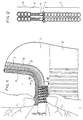
- a row of stitches 3 with very narrow stitches is produced on a circular knitting machine known per se in the region of the round tip 1 of the actual stocking 2 (cf. wide stitches follows, which in turn are followed by a few small rows 5, for example four or five rows of narrow stitches made of elastic yarn. Following these fine courses, a further 10 to 12 courses are made with a yarn that is stronger than the yarn of the stocking due to a known, normal manufacturing process, so that a reinforced or widened edge 6 is formed, which has the task of the stocking to position on the conveyor of the warping machine. If one looks at the thickness of the stocking in FIG.
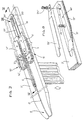
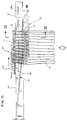
- the conveyor for feeding the stocking prepared according to the invention to the linking machine has, in a manner known per se, two rods 7 and 7 'which are mirror-symmetrical to the longitudinal center plane of the conveyor and are separated from one another by a slot 8.
- the width of this slot 8 is dimensioned such that when the layers lying one above the other in the region of the top of the stocking are pushed manually into the inlet 9 (FIG. 3) of the conveyor, the reinforced edges 6 on the adjacent edge sections of the upper sides of the bars 7 and 7 '(see also FIG. 6).
- the reinforced edges 6 are gripped by two toothed chains 10 and 10 'of the conveyor, whereby the toe is automatically moved towards the exit of the conveyor.
- the opposite sides of the rods 7 and 7 ' are designed such that, as shown in Figure 5, they have rib sections 11 and 11', respectively, which run obliquely downwards and are separated from one another by a slot whose width is smaller than the thickness of the two layers of row 3 lying on top of each other with the very narrow stitches, followed by the wide row of stitches 4.
- the inclined sections 11 and 11 'of the ribs merge into horizontal sections 12 and 12', the undersides of which run parallel to the upper sides of the rods 7 and 7 'and are at a distance from these upper sides which is somewhat smaller than the sum of the height of the wide ones Row of stitches 4 and the fine rows of stitches 5 is in the tensioned state.
- this sum is 7 to 8 mm.
- the thickness of the ribs of the two sections 11, 11 'and 12, 12' is itself smaller than the height of the stitches of row 4 with wide stitches and amounts to only 0.5 to 0.8 mm.
- the mutually opposite debris 14, 14 'of the toothed chains 10, 10' are spring-loaded according to FIG. 7, specifically via strips 15, 15 ', on which small springs 16, 16' act, which are attached to the rods 7, 7 ' Covers 17, 17 'are housed.
- This solution of double spring loading allows a more precise positioning of the two layers of the top of the stocking when the wide row of stitches 4 enters the slot separating the oblique rib sections 11, 11 'from each other, which are on the opposite walls of the two rods 7 and 7 'are trained, because the fabric has the opportunity to adapt better on both sides.
- the increase in the thickness of the stocking, which rests on the ribs in order to tension the fine courses 5, can be achieved in that there is a row with reinforced loops in front of row 4 with wide loops or in that the stocking made of double yarn and the row 4 with wide stitches consist of just a single yarn.
- the flexibility of the slats 16 and 16 'could be adjustable by means of suitable stops with screws in order to adapt to the stocking to be sewn.
Landscapes
- Engineering & Computer Science (AREA)
- Textile Engineering (AREA)
- Socks And Pantyhose (AREA)
- Sewing Machines And Sewing (AREA)
Applications Claiming Priority (3)
| Application Number | Priority Date | Filing Date | Title |
|---|---|---|---|
| ITTO920064 | 1992-01-29 | ||
| ITTO920064A IT1256791B (it) | 1992-01-29 | 1992-01-29 | Procedimento di preparazione di calze prodotte su macchine circolari alla cucitura delle rispettive punte per mezzo di macchine rimagliatrici provviste di convogliatore a catene e convogliatore per rimagliatrici destinate a cucire le punte delle calze preparate attuando detto procedimento. |
| PCT/EP1993/000207 WO1993015253A1 (de) | 1992-01-29 | 1993-01-29 | Verfahren und vorrichtung zur vorbereitung von strümpfen für das zusammennähen der spitzen |
Publications (2)
| Publication Number | Publication Date |
|---|---|
| EP0576664A1 EP0576664A1 (de) | 1994-01-05 |
| EP0576664B1 true EP0576664B1 (de) | 1997-01-02 |
Family
ID=11409962
Family Applications (1)
| Application Number | Title | Priority Date | Filing Date |
|---|---|---|---|
| EP93903889A Expired - Lifetime EP0576664B1 (de) | 1992-01-29 | 1993-01-29 | Verfahren und vorrichtung zur vorbereitung von strümpfen für das zusammennähen der spitzen |
Country Status (6)
| Country | Link |
|---|---|
| US (1) | US5398626A (it) |
| EP (1) | EP0576664B1 (it) |
| JP (1) | JPH07505068A (it) |
| DE (1) | DE59304947D1 (it) |
| IT (1) | IT1256791B (it) |
| WO (1) | WO1993015253A1 (it) |
Families Citing this family (16)
| Publication number | Priority date | Publication date | Assignee | Title |
|---|---|---|---|---|
| DE19623065A1 (de) * | 1996-06-10 | 1997-12-11 | Bayer Ag | Verfahren zur Herstellung von Polyurethan Hartschaumstoffen mit geringer Wärmeleitfähigkeit |
| US6209363B1 (en) | 1997-01-03 | 2001-04-03 | B.B. & T. Knitting, Ltd. | Process for facilitating closure of a tubular knit article |
| IT1292459B1 (it) * | 1997-07-02 | 1999-02-08 | Conti Complett Spa | Convogliatore per macchine cucitrici per la chiusura della punta di calze o simili,ad elevata versatilita' di impiego |
| US6158367A (en) * | 1999-03-17 | 2000-12-12 | B. B. & S. Knitting Consultants | Apparatus and method for automatically orienting hosiery articles for closing toe ends thereof |
| IT1313646B1 (it) * | 1999-09-29 | 2002-09-09 | Conti Complett Spa | Apparecchiatura e procedimento per l'alimentazione automatica dimanufatti tubolari, in particolare calze, ad una macchina cucitrice |
| ITFI20010063A1 (it) * | 2001-04-11 | 2002-10-11 | Metalworking And Finance Group | Metodo e dispositivo per la chiusura della punta di manufatti,tubolari a maglia |
| ITMI20021736A1 (it) * | 2002-08-01 | 2004-02-02 | Lonati Spa | Procedimento di cucitura particolarmente per la chiusura |
| US7044071B2 (en) * | 2003-01-24 | 2006-05-16 | B.B. & S Knitting Consultants | Apparatus and method for automatically orienting hosiery articles for closing toe ends thereof |
| US7025011B2 (en) * | 2003-01-24 | 2006-04-11 | B.B. & S Knitting Consultants | Apparatus for automatically orienting hosiery articles for closing toe ends thereof |
| US6779472B1 (en) * | 2003-03-25 | 2004-08-24 | Sara Lee Corporation | Hosiery toe closing apparatus and method |
| ITMI20030896A1 (it) * | 2003-04-30 | 2004-11-01 | Lonati Spa | Dispositivo per perfezionare il posizionamento della punta |
| ITFI20070183A1 (it) * | 2007-08-02 | 2009-02-03 | Andrea Conti | "attrezzatura per elaborare manufatti doppi fra loro connessi e da separare per le successive rifinizioni |
| US8156768B2 (en) | 2009-07-20 | 2012-04-17 | Hbi Branded Apparel Enterprises, Llc | System and method of forming a toe seam |
| KR101397870B1 (ko) | 2013-04-11 | 2014-05-20 | 이찬우 | 양말 봉조기 |
| HRP20201336T1 (hr) * | 2015-01-28 | 2020-11-27 | Lonati S.P.A. | Postupak za dobivanje poludovršenih izrađenih cjevastih proizvoda koji se zatvaraju šivanjem na njihovom osnom kraju za proizvodnju čarapa i poludovršeni izrađeni cjevasti proizvod proizveden ovim postupkom |
| US9957649B2 (en) * | 2015-09-23 | 2018-05-01 | Tsung-Yuan Liu | Sock structure |
Family Cites Families (11)
| Publication number | Priority date | Publication date | Assignee | Title |
|---|---|---|---|---|
| US2968937A (en) * | 1958-06-19 | 1961-01-24 | Margulies Samuel | Knitted fabrics and methods of closing same |
| NL137683C (it) * | 1963-04-09 | |||
| US3450075A (en) * | 1967-07-07 | 1969-06-17 | Martinsburg Mills Inc | Apparatus for closing the toe portion of circular knit hosiery |
| US3527181A (en) * | 1968-06-25 | 1970-09-08 | Hanes Corp | Fabric guiding means for sewing machines |
| US4009672A (en) * | 1975-10-06 | 1977-03-01 | Jetsew, Inc. | Sewing machine material preassembly system |
| IT1178407B (it) * | 1984-11-02 | 1987-09-09 | Profeel Srl | Dispositivo allineatore dei bordi di lembi di capi di tessuto per macchine da cucire industriali |
| IT1197008B (it) * | 1986-07-28 | 1988-11-25 | Complett Spa | Tipo di punto a sopraggitto nonche' procedimento e dispositivo per la sua produzione |
| FR2616161B1 (fr) * | 1987-06-02 | 1990-11-23 | Sotexi | Machine permettant de realiser la couture de deux panneaux tricotes comportant un bord cote et un long en jersey |
| JPH01259892A (ja) * | 1988-04-11 | 1989-10-17 | Takatori Haitetsuku:Kk | パンテイストッキング素材の自動装着装置 |
| IT1239964B (it) * | 1990-05-10 | 1993-11-27 | Araldi Srl | Procedimento perfezionato di preparazione per la cucitura della punta di calze ottenute con macchine circolari |
| US5189970A (en) * | 1991-09-23 | 1993-03-02 | The Charles Stark Draper Laboratory, Inc. | Cross-seam alignment apparatus |
-
1992
- 1992-01-29 US US08/122,579 patent/US5398626A/en not_active Expired - Fee Related
- 1992-01-29 IT ITTO920064A patent/IT1256791B/it active IP Right Grant
-
1993
- 1993-01-29 WO PCT/EP1993/000207 patent/WO1993015253A1/de not_active Ceased
- 1993-01-29 DE DE59304947T patent/DE59304947D1/de not_active Expired - Fee Related
- 1993-01-29 JP JP5512942A patent/JPH07505068A/ja active Pending
- 1993-01-29 EP EP93903889A patent/EP0576664B1/de not_active Expired - Lifetime
Also Published As
| Publication number | Publication date |
|---|---|
| EP0576664A1 (de) | 1994-01-05 |
| JPH07505068A (ja) | 1995-06-08 |
| ITTO920064A1 (it) | 1993-07-29 |
| ITTO920064A0 (it) | 1992-01-29 |
| DE59304947D1 (de) | 1997-02-13 |
| IT1256791B (it) | 1995-12-15 |
| US5398626A (en) | 1995-03-21 |
| WO1993015253A1 (de) | 1993-08-05 |
Similar Documents
| Publication | Publication Date | Title |
|---|---|---|
| DE2051416C3 (de) | Verfahren zur Herstellung eines Bandes und Nadelwebstuhl zu seiner Durchführung | |
| EP0576664A1 (de) | Verfahren und vorrichtung zur vorbereitung von strümpfen für das zusammennähen der spitzen. | |
| DE2946180C3 (de) | Bandgewebe, Verfahren zu seiner Herstellung und Bandwebmaschine zur Durchführung des Verfahrens | |
| DE2707946C3 (de) | Verfahren und Vorrichtung zum Herstellen eines gekuppelten Reißverschlusses | |
| DE3035582C2 (de) | Rundstrickmaschine zur Herstellung einer einflächigen Plüschware | |
| DE3827265C2 (it) | ||
| DE2204122A1 (de) | Florstoff und Verfahren zu seiner Herstellung | |
| DE1812973A1 (de) | Verfahren zur Herstellung von Quastenfransen und nach dem Verfahren hergestellte Franse | |
| DE1919268C3 (de) | Nadelplatte für Tuftingmaschinen od.dgl | |
| DE10018897A1 (de) | Strickmaschinennadel | |
| DE951032C (de) | Verfahren zum Herstellen des Randes einer glattgestrickten Ware | |
| DE2724326C2 (de) | Nähgewirke und Nähwirkmaschine zu dessen Herstellung | |
| DE102011108702B4 (de) | Verfahren zur Herstellung eines Gestricks mit Zierstichen sowie Gestrick | |
| DE1952558A1 (de) | Textilverbundstoff,insbesondere Vliesstoff sowie Vorrichtung und Verfahren zu seiner Herstellung | |
| DE2647185A1 (de) | Verfahren und vorrichtung zur maschenbildung | |
| DE3413258C2 (it) | ||
| DE4122358C2 (it) | ||
| DE3707139C2 (it) | ||
| DE3621987A1 (de) | Verfahren und vorrichtung zum herstellen eines reissverschlussbandes durch weben | |
| DE3219385A1 (de) | Kettenwirkmaschine, insbesondere naehwirkmaschine | |
| EP0305682A2 (de) | Gestrick | |
| DE1074955B (de) | Ziernahtfuß für Nähmaschinen | |
| DE3734416C2 (de) | Verfahren zur Herstellung eines textilen Flächengebildes, wie Häkelborte | |
| DE3512775C2 (it) | ||
| DE19824432C1 (de) | Verfahren und Vorrichtung zur Herstellung von vollständigen Reißverschlußhälften mit beidseitiger Webkante in einem Arbeitsgang |
Legal Events
| Date | Code | Title | Description |
|---|---|---|---|
| PUAI | Public reference made under article 153(3) epc to a published international application that has entered the european phase |
Free format text: ORIGINAL CODE: 0009012 |
|
| AK | Designated contracting states |
Kind code of ref document: A1 Designated state(s): DE ES FR GB |
|
| 17P | Request for examination filed |
Effective date: 19940207 |
|
| 17Q | First examination report despatched |
Effective date: 19951020 |
|
| GRAG | Despatch of communication of intention to grant |
Free format text: ORIGINAL CODE: EPIDOS AGRA |
|
| GRAH | Despatch of communication of intention to grant a patent |
Free format text: ORIGINAL CODE: EPIDOS IGRA |
|
| GRAH | Despatch of communication of intention to grant a patent |
Free format text: ORIGINAL CODE: EPIDOS IGRA |
|
| GRAA | (expected) grant |
Free format text: ORIGINAL CODE: 0009210 |
|
| AK | Designated contracting states |
Kind code of ref document: B1 Designated state(s): DE ES FR GB |
|
| PG25 | Lapsed in a contracting state [announced via postgrant information from national office to epo] |
Ref country code: GB Effective date: 19970102 Ref country code: FR Effective date: 19970102 Ref country code: ES Free format text: THE PATENT HAS BEEN ANNULLED BY A DECISION OF A NATIONAL AUTHORITY Effective date: 19970102 |
|
| REF | Corresponds to: |
Ref document number: 59304947 Country of ref document: DE Date of ref document: 19970213 |
|
| EN | Fr: translation not filed | ||
| GBV | Gb: ep patent (uk) treated as always having been void in accordance with gb section 77(7)/1977 [no translation filed] |
Effective date: 19970102 |
|
| PLBE | No opposition filed within time limit |
Free format text: ORIGINAL CODE: 0009261 |
|
| STAA | Information on the status of an ep patent application or granted ep patent |
Free format text: STATUS: NO OPPOSITION FILED WITHIN TIME LIMIT |
|
| 26N | No opposition filed | ||
| PGFP | Annual fee paid to national office [announced via postgrant information from national office to epo] |
Ref country code: DE Payment date: 20050727 Year of fee payment: 13 |
|
| PG25 | Lapsed in a contracting state [announced via postgrant information from national office to epo] |
Ref country code: DE Free format text: LAPSE BECAUSE OF NON-PAYMENT OF DUE FEES Effective date: 20060801 |